



当前实现固态制冷的关键问题在于如何设计出具有突出制冷能力和服役能力的高性能相变材料。传统Heusler合金Ni-Mn-X (X = Ga、In、Sn、Sb等)具有丰富的物理性能(如形状记忆效应[3,4]、弹热效应[5,6]、磁热效应[7,8]、磁致伸缩[3,5,6,9]等),在传感器、磁制动器、固态制冷等领域具有广阔的应用前景;但其p-d轨道杂化又导致本征脆性大、晶界结合强度弱、力学性能和可加工性能差,严重阻碍了Heusler合金的实际应用。新型Ni-Mn-Ti基全d族Heusler合金因其以类似金属键的d-d轨道杂化代替传统的p-d轨道杂化而表现出优异的力学性能。同时,大量研究表明,Ni-Mn-Ti合金通过合金化可获得显著的弹热效应[10~15]和磁热效应[16~19],尤其是在掺杂Co和(或) B的情况下。
弹热效应是利用外力诱导马氏体相变及其逆相变过程中的吸放热来实现的。实现显著弹热效应的关键在于合金存在较大的绝热温变(ΔTad),而ΔTad受到相变熵的影响[20~22]。虽然影响相变熵的因素较多,但晶格振动是影响Ni-Mn-Ti合金相变熵的关键因素[22]。相较于传统Ni-Mn-X基Heusler合金,Ni-Mn-Ti合金表现出显著的晶格振动熵[22],说明该合金具有产生显著弹热效应的潜力。Cong等[10]、Yan等[13]、Wei等[14]和Guan等[15]通过B和(或) Fe元素微合金化、改变制备工艺手段,获得了显著的弹热效应并表现出优异的力学性能。这为进一步设计和开发下一代具有优异服役能力的智能材料起到重要启示。
由于Ni-Mn-Ti合金中Mn/Ti无序导致奥氏体和马氏体呈现弱磁性,不能如传统Ni-Mn基Heusler合金在马氏体相变及逆相变过程中获得较大的磁化强度差(ΔM),即合金不能发生磁-结构耦合,但其卓越的力学性能促使研究者们积极寻求方法来改善它的磁控功能特性。为了激活Ni-Mn-Ti合金的磁热效应,科研人员尝试通过掺杂第四组元Co元素,使合金奥氏体母相由弱磁性转变为强铁磁性,合金发生了从铁磁性奥氏体向弱磁性马氏体的磁-结构耦合转变,在不同的磁场下获得的磁熵变分别为:25 J/(kg·K) (5 T磁场)[6]、38 J/(kg·K) (2 T磁场)[16]、27 J/(kg·K) (2 T磁场)[18]、18 J/(kg·K) (5 T磁场)[23]和19.3 J/(kg·K) (5 T磁场)[24],为发展Ni-Mn-Ti合金的磁制冷技术提供了可能[6,13,16,18,23~26]。
通常来说,合金马氏体相变产生的等温熵变(ΔSiso)和磁熵变(ΔSM)越大,对应的热效应(包括磁热效应、弹热效应、电热效应和压热效应)就越明显。此外,热滞后(ΔThys)会在马氏体相变和逆相变过程中造成能量损失,较大的ΔThys会限制合金在固态制冷领域的实际应用,因此,实现高的ΔSiso和ΔSM同时降低ΔThys对提高合金的热效率至关重要。
在传统Ni-Mn-X (X = Ga、In、Sn、Sb等) Heusler合金中掺入Si元素不仅能改善力学性能,还能显著降低合金相变的ΔThys[27~31]。Li等[28]通过Si元素掺杂在Ni50Mn35In13Si2合金中实现了显著的弹性热效应和制冷能力,在300 MPa压缩应力下,获得-17.7 K的绝热温变,制冷容量达到1330 J/kg。Zhang等[29]制备的Ni49.0Mn38.4Sb11.7Si0.9合金的平均磁滞损耗仅为2.1 J/kg,远小于三元Ni49.0Mn38.5Sb12.5合金的11.4 J/kg。Wójcik等[30]指出,Ni44Co6Mn39Sn11 - x Si x (x = 1%、2%,原子分数)合金的ΔSM始终高于不含Si原子的原始材料。在Ni-Mn-Ti合金中掺入Co元素能够使合金获得显著的热效应[10~19],而关于在Ni-Mn-Ti合金中掺杂Si元素的报道还很少见。
微合金化是调整合金相变特征(包括ΔThys、ΔSiso、ΔSM等)、磁性能和力学性能的有效途径[32~36]。但单一元素合金化在改善某一性能的同时,通常会伴随其他性能的衰退。Bai等[32]报道,随着Ti含量的逐渐增加,Ni8Mn4 - x Ga4Ti x 合金中析出的Ni3Ti弥散析出相可以提高合金的力学性能,但同时降低了合金的Curie温度。Liang等[36]分析了Co掺杂对Ni2Mn1.5In0.5合金的影响,发现Co能够显著提高合金的磁化强度,且理论研究表明,Co原子优先直接占据Ni原子的亚晶格格点,但随着Ni原子逐步被Co取代,马氏体相变温度(TM)降低且相变热滞后增加。研究[37]表明,掺杂Co可以使Ni50Mn35Ti15合金奥氏体发生铁磁激活效应,进而实现磁-结构耦合。因此研究人员试图通过多组元共掺杂的手段来改善Heusler合金的综合性能。但通过实验的方法对合金进行多组元掺杂的成分优化,不仅工作量大且成本高。基于此,本工作通过第一性原理计算,系统研究Co和Si共掺杂对Ni-Mn-Ti合金的马氏体相变、力学性能和磁性能的影响规律,从理论计算的角度分析Si掺杂降低Ni-Mn-Ti基合金ΔThys的原因,为设计具有较小ΔThys和明显热效应的固态相变材料提供理论依据。
1 计算方法
本工作基于密度泛函理论框架,利用VASP软件[38]进行第一性原理计算。采用投影增强波(projector augmented wave,PAW)[39]方法描述离子与电子之间的相互作用,并选择广义梯度近似(generalized gradient approximation,GGA)的PBE (Perdew-Burke-Ernzerhof)[39]方法处理交换相关势。所涉及元素的价电子构型为Ni-3d84s2、Co-3d84s1、Mn-3d64s1、Ti-3d34s1和Si-2s2p2。在结构优化过程中,将总能量和单个原子间的作用力分别设置为小于0.1 meV和0.2 eV/nm。采用Monkhorst-Pack网格对Brillouin区进行采样[40],为确保计算精度,选取K点为10 × 10 × 10。
为了研究掺杂元素的聚集程度和化合物的相稳定性,使用下式计算归一化后的形成能(Ef):
式中,Etotal为化合物的总能量;k = Ni、Co、Mn、Ti、Si;Nk 为超胞中每种元素对应的原子个数;Ek 为Ni、Co、Mn、Ti和Si在其参考态块体单质中每个原子的总能量,其中Ni和Si具有fcc结构,Mn具有复杂bcc结构,Ti和Co具有hcp结构;M为超胞中的原子总数。
2 计算结果与分析
2.1 优先占位和结构优化
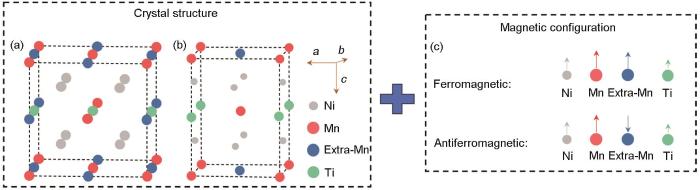
本工作在具有部分无序B2结构的奥氏体和具有L10结构的非调质马氏体(NM马氏体)[41]的Ni-Mn-Ti合金中进行Co和Si共掺杂,其晶体结构分别如图1a和b所示。在第一性原理计算中,为确保各相中Co和Si原子的掺杂含量一致,奥氏体结构沿c轴方向扩胞,生成32个原子的超胞,NM马氏体则沿b轴和c轴方向展开,生成32个原子的超胞。为保证计算精度,奥氏体和马氏体的Brillouin区的K点网格分别设置为10 × 10 × 5和7 × 7 × 11。此外,Ni-Mn-Ti合金在马氏体相变过程中,各相的磁性状态考虑了铁磁性和反铁磁性两种状态,如图1c所示;为了便于描述,本工作将铁磁性和反铁磁性的奥氏体和马氏体分别称为FA、AFA、FM和AFM。
图1
为了便于研究Co和Si共掺杂对Ni-Mn-Ti合金物理性质的影响,首先确定Si掺杂原子的优先占位。如图2所示,考虑了两种占位方式:直接占位和间接占位。直接占位考虑了四种情况:(1) Si取代Ni位,(2) Si取代正常的Mn位(Mn+),(3) Si取代过量的Mn位(Mn-),(4) Si取代Ti位。通过计算不同占位的Ef,发现Si占据晶格格点Mn (Mn+和Mn-)的形成能相对较低,它们之间的差异仅为-2.78 meV/atom。这说明掺杂的Si原子占据2个Mn原子位点的概率相近,并且更倾向于Mn-位点。然而,在传统的Ni-Mn-X (X = In和Sn) Heusler合金[28,30,31,42~44]中,Si原子倾向于占据主族元素X的位置。因此,本工作也考虑了掺杂Si原子的间接占位:Si→Mn-→Ti,并发现这种占位方式会增加Ef,从而降低合金的稳定性。
图2
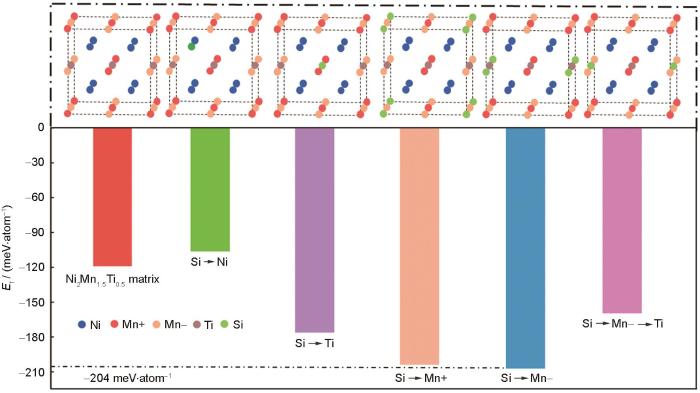
图2
Si原子在Ni2Mn1.5Ti0.5合金中不同占位方式下的形成能
Fig.2
Formation energy (Ef) of doped Si atom with different atomic occupations in Ni2Mn1.5Ti0.5 alloy
图3
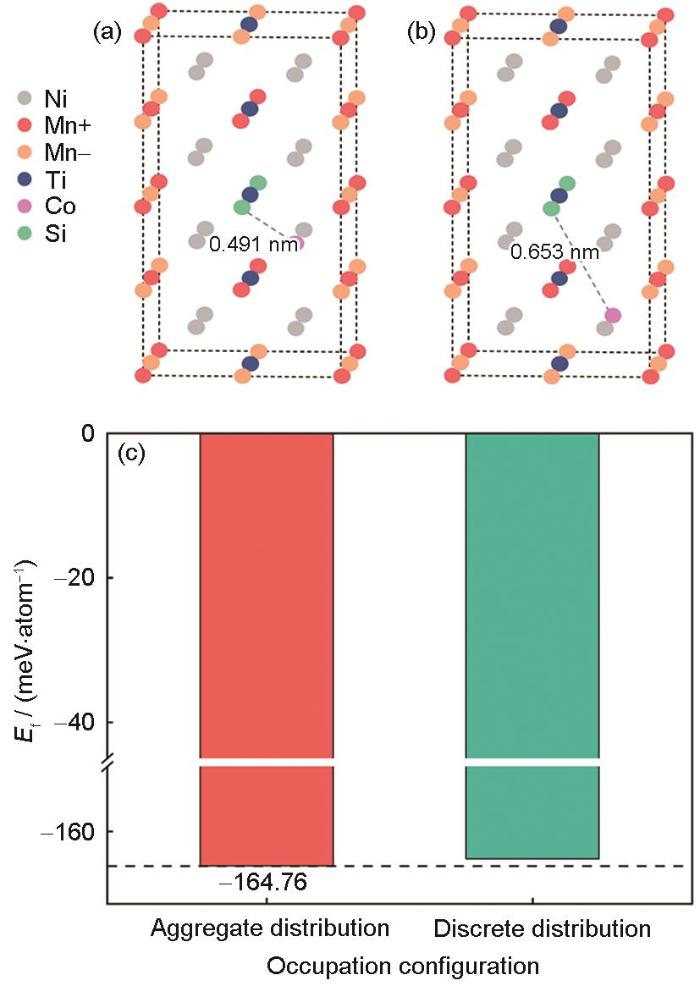
图3
Co和Si原子在Ni2Mn1.5Ti0.5合金中的聚集程度示意图及形成能
Fig.3
Degree of aggregation of Co and Si atoms in Ni2Mn1.5Ti0.5 alloy and Ef
(a) aggregated distribution
(b) discrete distribution
(c) Ef for different distribution states of Co and Si
表1列出了Ni2 - x Co x Mn1.5 - y Si y Ti0.5合金(Co含量:0≤ x ≤ 0.625,Si含量:y = 0.125和0.25,原子比,下同)奥氏体和NM马氏体在稳定磁性态下的平衡晶格常数[48]。在成分范围内,除去y = 0.25、x = 0.625这一成分点奥氏体呈现铁磁态,其余合金的奥氏体和NM马氏体均呈现反铁磁态。奥氏体的晶格常数随Si含量的增加而降低。这一现象可归因于Si的原子半径小于Mn。尽管Co的原子半径(0.125 nm)略大于Ni的原子半径(0.124 nm),但随着Co含量的增加,奥氏体的晶格常数也呈下降趋势。差异在于Co的原子磁矩比Ni大得多。因此,在Ni-Co-Mn-Si-Ti合金中,原子磁矩对晶格常数的影响占主导地位。而NM马氏体的晶格常数变化更为复杂,从整体来看,随着x的增大,反铁磁性马氏体的晶格常数aAFM和bAFM减小,而cAFM增大。
表1 Ni2 - x Co x Mn1.5 - y Si y Ti0.5 (0≤ x ≤ 0.625,y = 0.125和0.25)合金的平衡晶格常数
Table 1
| Ni2 -x Co x Mn1.5 -y Si y Ti0.5 | Austenite | NM martensite | |||||||
|---|---|---|---|---|---|---|---|---|---|
| y | x | a = b = c / nm | V / nm3 | a / nm | b / nm | c / nm | V / nm3 | ||
| 0 | 0 | 0.5848[48] | 0.2000 | 0.4498 | 0.4176 | 0.5124 | 0.1925 | ||
| 0.125 | 0 | 0.5839 | 0.1991 | 0.4475 | 0.4172 | 0.5138 | 0.1919 | ||
| 0.125 | 0.5834 | 0.1985 | 0.4461 | 0.4164 | 0.5143 | 0.1911 | |||
| 0.25 | 0.5826 | 0.1977 | 0.4446 | 0.4159 | 0.5171 | 0.1912 | |||
| 0.375 | 0.5821 | 0.1973 | 0.3770 | 0.3777 | 0.6784 | 0.1932 | |||
| 0.5 | 0.5811 | 0.1962 | 0.3782 | 0.3794 | 0.6733 | 0.1932 | |||
| 0.625 | 0.5812 | 0.1963 | 0.3805 | 0.3807 | 0.6661 | 0.1929 | |||
| 0.25 | 0 | 0.5828 | 0.1979 | 0.4447 | 0.4182 | 0.5152 | 0.1916 | ||
| 0.125 | 0.5828 | 0.1979 | 0.4439 | 0.4169 | 0.5154 | 0.1908 | |||
| 0.25 | 0.5807 | 0.1958 | 0.4428 | 0.4163 | 0.5179 | 0.1909 | |||
| 0.375 | 0.5812 | 0.1963 | 0.4406 | 0.4153 | 0.5185 | 0.1898 | |||
| 0.5 | 0.5806 | 0.1957 | 0.4381 | 0.4151 | 0.5221 | 0.1899 | |||
| 0.625 | 0.5819 (FA) | 0.1970 (FA) | 0.4375 | 0.4150 | 0.5227 | 0.1898 | |||
图4
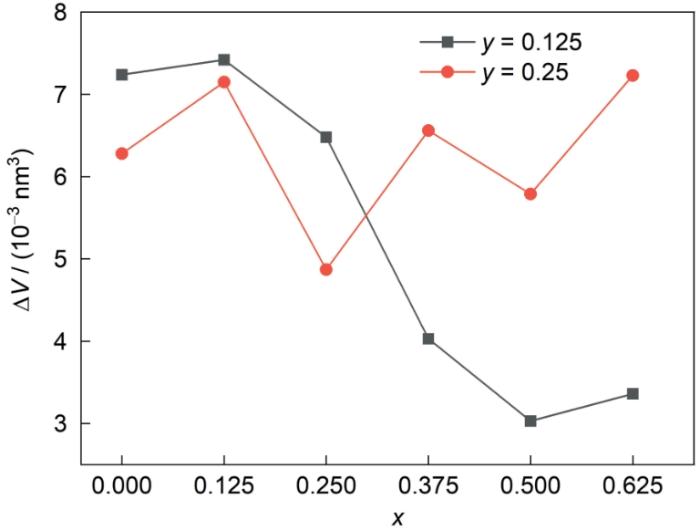
图4
Ni2 - x Co x Mn1.5 - y Si y Ti0.5 (0 ≤ x ≤ 0.625,y = 0.125和0.25)合金奥氏体与马氏体体积差(ΔV)
Fig.4
Volume change (ΔV) between austenite and martensite for Ni2 - x Co x Mn1.5 - y Si y Ti0.5 (0 ≤ x ≤ 0.625, y = 0.125 and 0.25) alloys
2.2 相稳定性和马氏体相变
在确定Si和Co原子在Ni2Mn1.5Ti0.5合金中的优先占位后,详细研究了Ni2 - x Co x Mn1.5 - y Si y Ti0.5 (0≤ x ≤ 0.625,y = 0.125和0.25)合金的奥氏体和马氏体的Ef以及马氏体相变驱动力(ΔE),结果如图5和6所示。形成能越低,合金的热力学稳定性越高。从图5a可以看出,当y = 0.125时,随着x的增加,FA相的Ef逐渐降低,意味着奥氏体的铁磁性增强;而AFA相的Ef逐渐增加,反铁磁性减弱;并且,AFA和AFM相的Ef始终低于铁磁态相的Ef,这意味着在所研究的成分范围内,奥氏体和马氏体更倾向于呈现反铁磁状态。值得注意的是,当y = 0.125、x = 0.625时,AFA与FA的Ef非常接近,二者之间的差值仅为1.27 meV/atom,表明在此成分下的AFA相与FA相稳定性接近,有可能共存。
图5
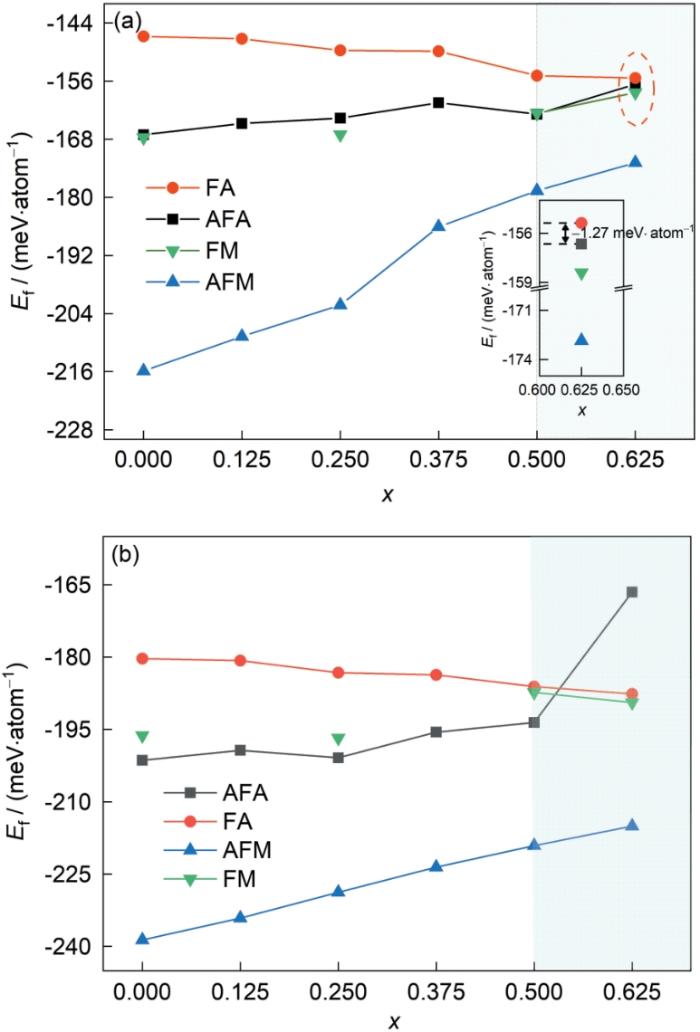
图5
Ni2 - x Co x Mn1.5 - y Si y Ti0.5(0≤ x ≤ 0.625)合金奥氏体和马氏体的形成能
Fig.5
Formation energies of austenite and martensite in Ni2 - x Co x Mn1.5 - y Si y Ti0.5 (0≤ x ≤ 0.625) alloys (AFA—antiferromagnetic austenite, FM—ferro-magnetic martensite, AFM—antiferromagnetic martensite. Within the shaded region, ferromag-netic austenite has higher thermodynamic stability than antiferromagnetic austenite)
(a) y = 0.125 (Inset shows the locally enlarged view of the elliptical region)
(b) y = 0.25
图6
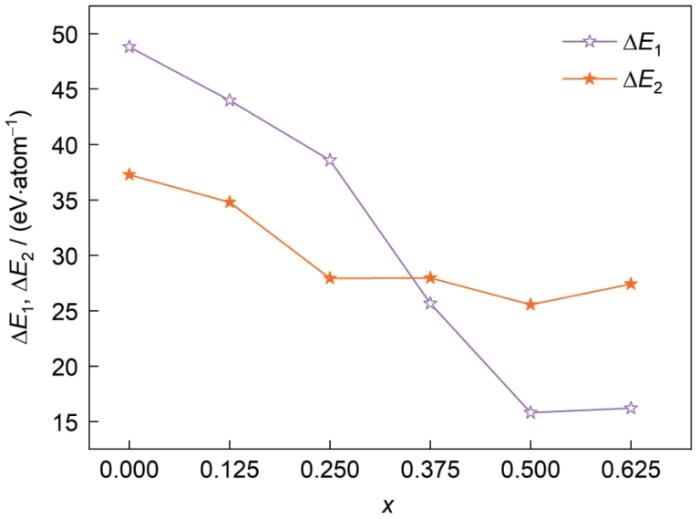
图6
Ni2 - x Co x Mn1.5 - y Si y Ti0.5 (0≤ x ≤ 0.625)奥氏体和马氏体之间的能量差
Fig.6
Formation energy differences between austenite and martensite of Ni2 - x Co x Mn1.5 - y Si y Ti0.5 (0≤ x ≤ 0.625) alloys (ΔE1 and ΔE2 represent the formation energy differences between austenite and martensite at y = 0.125 and 0.25, respectively)
当y = 0.25时,如图5b所示,随着x的增加,FA相的Ef减小而AFA相的Ef增加,说明铁磁性奥氏体的稳定性提高,反铁磁性奥氏体的稳定性降低。当0≤ x ≤ 0.532时,AFA的Ef始终低于FA相,奥氏体呈现反铁磁状态。当x 0.532时,情况相反,随着x增加,奥氏体更倾向于呈现铁磁状态。
对于马氏体,在所研究的成分范围内,AFM相的Ef始终低于FM相,这意味着马氏体始终呈现反铁磁状态。值得注意的是,y = 0.25时奥氏体和马氏体的Ef均低于y = 0.125时对应的Ef,这说明Si元素的掺杂可以提高Ni-Co-Mn-Ti合金中奥氏体和马氏体相的稳定性。
ΔE反映了合金马氏体相变的难易程度,∆E越大,意味着相变驱动力越大,相应的相变温度也会升高。如图6所示(图中,ΔE1和ΔE2分别表示y = 0.125和0.25时奥氏体与马氏体的形成能差),不同Co、Si含量组合下合金的ΔE总是正的,这表明合金在所研究的成分范围内均能发生马氏体相变。此外,随着x的增加,ΔE呈下降趋势,这意味着马氏体相变的驱动力减小,对应的马氏体相变温度降低,这与实验观察结果[51]一致。当0≤ x ≤ 0.353时,ΔE1 ΔE2,说明合金在y = 0.125时的相变驱动力较大,更容易发生马氏体相变;当x 0.353时,ΔE1 ΔE2,说明合金在y = 0.25时的相变驱动力更大,马氏体相变更容易发生。当Co含量较低时,掺杂的Si会降低相变的驱动力。然而,当Co含量增加时,掺杂的Si会抵消Co对相变的强烈阻碍作用,从而稳定相变温度。
2.3 磁性能
对Ni2 - x Co x Mn1.5 - y Si y Ti0.5 (0≤ x ≤ 0.625; y = 0.125和0.25)合金中处于稳定磁性状态的奥氏体和马氏体的磁性能进行分析,其总磁矩如图7所示。可以看出,当y = 0.125时,随着Co含量增加,奥氏体和马氏体在所研究的成分范围内均呈现反铁磁状态,总磁矩在0.5 μB左右。当y = 0.25、x = 0.625时,合金中的奥氏体相从反铁磁态转变为铁磁态,而马氏体仍呈现反铁磁态。这表明,Ni1.375Co0.625Mn1.25Si0.25Ti0.5合金中将发生磁-结构耦合转变,这对于实现显著的磁热效应至关重要。此外,在马氏体相变过程中,Co含量的增加会增大磁化差(ΔM),ΔM的增加可降低驱动磁-结构耦合转变所需的临界磁场,从而有利于合金在低磁场中的应用。
图7
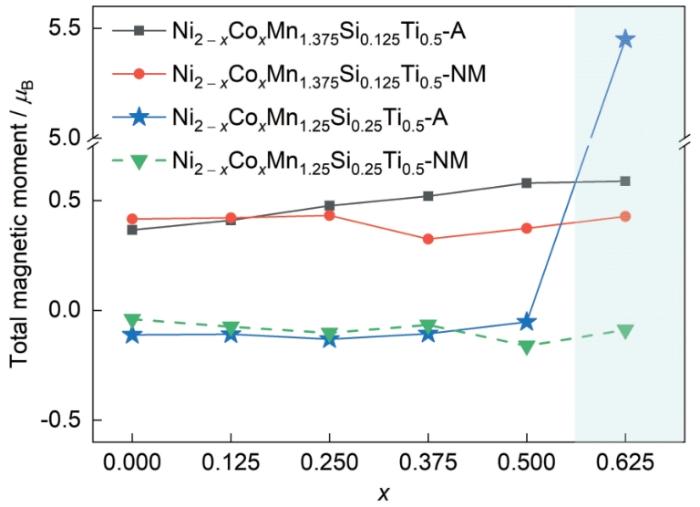
图7
Ni-Co-Mn-Si-Ti合金奥氏体和马氏体的总磁矩
Fig.7
Total magnetic moments of austenite (A) and martensite for Ni-Co-Mn-Si-Ti alloys (μB—Bohr magneton. The shaded region indicates the composition range where austenite transforms from an antiferromagnetic state to a ferromagnetic state)
为了分析合金产生磁-结构耦合现象的本质原因,详细研究了Ni2 - x Co x Mn1.25Si0.25Ti0.5 (0≤ x ≤ 0.625)合金奥氏体和NM马氏体的原子磁矩,结果如图8所示。可以看出,Mn和Co原子是合金磁性的主要贡献者,而Ni、Ti和Si原子对Ni-Mn-Ti合金总磁矩的影响相对较小。值得注意的是,Co的原子磁矩受其周围Mn原子的总体磁性环境的强烈影响。在0≤ x ≤ 0.5范围内,Mn的原子磁矩在
图8
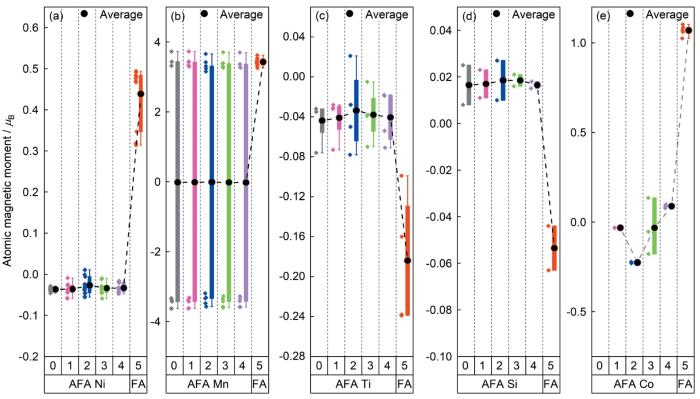
图8
Ni2 - x Co x Mn1.25Si0.25Ti0.5 (0≤ x ≤ 0.625)合金奥氏体的原子磁矩
Fig.8
Atomic magnetic moments of austenite for Ni2 - x Co x Mn1.25Si0.25Ti0.5 (0≤ x ≤ 0.625) alloys (The numbers 0-5 represent the contens of Co for 0, 0.125, 0.25, 0.375, 0.5, and 0.625, respectively; the same in Fig.9)
(a) Ni (b) Mn (c) Ti (d) Si (e) Co
如图9所示,Ni2 - x Co x Mn1.25Si0.25Ti0.5合金马氏体中Ni、Mn、Ti、Co和Si原子的平均磁矩约为0,因此马氏体的总磁矩为0,表明其处于反铁磁状态。在这些原子中,Mn和Co原子的磁矩变化范围很广,其中Mn原子的变化范围最大。Mn原子的原子磁矩呈均匀对称分布,约为
图9
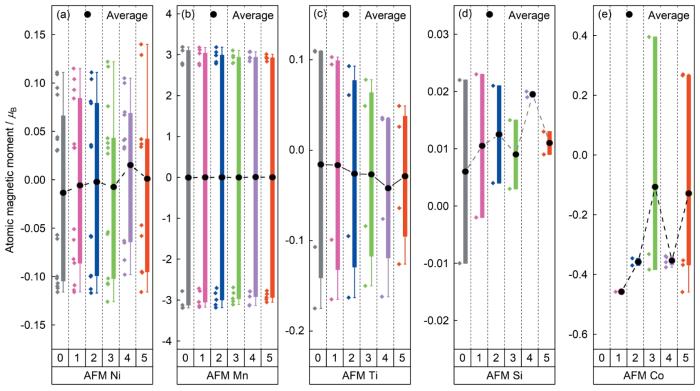
图9
Ni2 - x Co x Mn1.25Si0.25Ti0.5 (0≤ x ≤ 0.625)合金马氏体的原子磁矩
Fig.9
Atomic magnetic moments of martensite for Ni2 - x Co x Mn1.25Si0.25Ti0.5 (0≤ x ≤ 0.625) alloys
(a) Ni (b) Mn (c) Ti (d) Si (e) Co
进一步计算Ni2 - x Co x Mn1.25Si0.25Ti0.5 (0≤ x ≤ 0.625)合金奥氏体和马氏体中Mn-Mn和Co-Mn原子之间的距离,结论列于表2。可以看出,奥氏体中Co-Mn原子间的距离基本保持不变,约为0.252 nm。当0≤ x ≤ 0.5时,奥氏体中Mn-Mn原子间的距离相对较小,在0.269~0.281 nm范围内变化,由于退磁效应使相邻的Mn原子磁矩自旋方向相反排列,使得Mn原子对周围环境的铁磁贡献消失,从而使合金处于反铁磁状态。然而,当x = 0.625时,Mn-Mn原子间的距离增加到0.291 nm,相邻Mn原子之间的距离达到临界值,致使Mn磁矩自旋方向翻转,Mn原子对其周围环境的铁磁性贡献增强,导致Co-Mn原子之间发生强铁磁性耦合。上述结果为大量实验研究提供了理论解释,预测Co、Si共掺杂可以有效增强Ni-Mn-Ti基合金的磁热效应。
表2 Ni2 - x Co x Mn1.25Si0.25Ti0.5合金奥氏体和马氏体最近邻Mn-Mn和Co-Mn原子之间的距离 (nm)
Table 2
| Atom pair | Phase | x | ||||
|---|---|---|---|---|---|---|
| 0.125 | 0.25 | 0.375 | 0.5 | 0.625 | ||
| Mn-Mn | Austenite | 0.273 | 0.269 | 0.280 | 0.281 | 0.291 |
| Martensite | 0.255 | 0.256 | 0.255 | 0.256 | 0.256 | |
| Co-Mn | Austenite | 0.253 | 0.252 | 0.252 | 0.252 | 0.252 |
| Martensite | 0.250 | 0.249 | 0.248 | 0.247 | 0.247 | |
2.4 电子态密度
图10
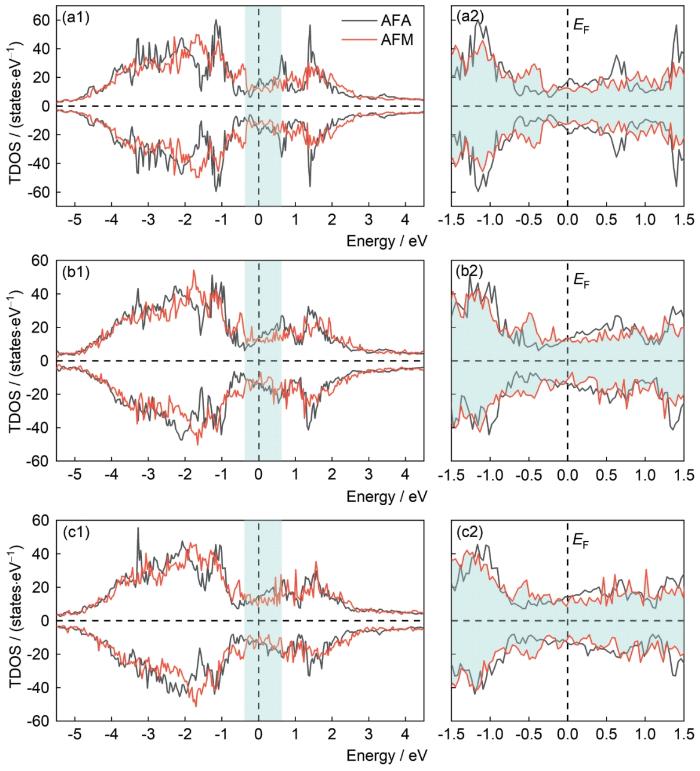
图10
Ni2Mn1.5 - y Si y Ti0.5(0≤ y ≤ 0.25)合金奥氏体和马氏体的总态密度(TDOS)
Fig.10
Total density of states (TDOS) of austenite and martensite for Ni2Mn1.5 - y Si y Ti0.5 (0≤ y ≤ 0.25) alloys (The light blue shaded regions indicate the distribution of electronic density of states near Fermi level (EF). Figs.10a2-c2 present zoom-in views of the shaded regions in Figs.10a1-c1, respectively)
(a1, a2) y = 0 (b1, b2) y = 0.125 (c1, c2) y = 0.25
图11
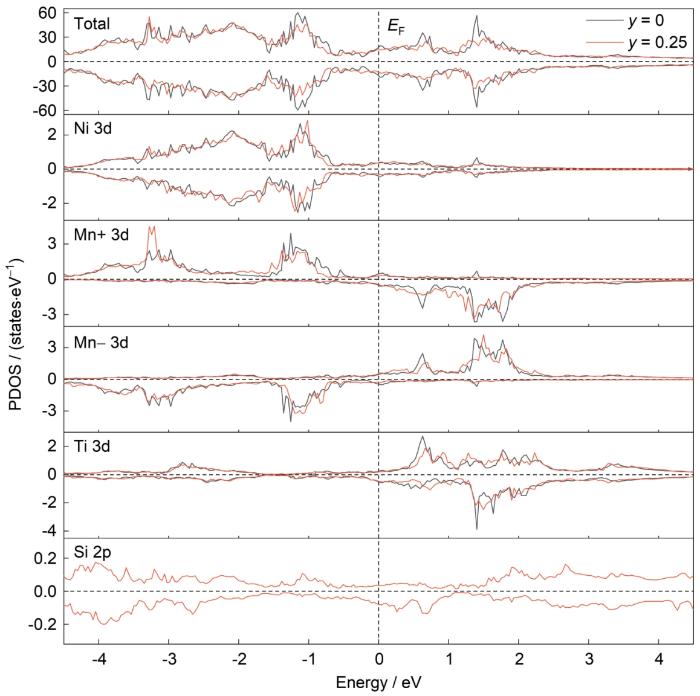
图11
Ni2Mn1.5Ti0.5和Ni2Mn1.25Si0.25Ti0.5合金奥氏体的分波电子态密度(PDOS)
Fig.11
Partial density of states (PDOS) of the austenite for Ni2Mn1.5Ti0.5 and Ni2Mn1.25Si0.25Ti0.5 alloys
图10描述了Ni2Mn1.5 - y Si y Ti0.5 (0≤ y ≤ 0.25)合金的TDOS,图10a2~c2显示了图10a1~c1 Fermi能级附近TDOS的局部放大图。可以看出,在所研究的成分范围内,奥氏体和马氏体自旋向上和自旋向下的TDOS表现出极高的对称性,因此Ni-(Si)-Mn-Ti合金中的奥氏体和马氏体表现出弱磁性[52,53]。AFA相自旋向下的TDOS在Fermi面处有一个态密度峰,代表奥氏体相的电子结构不稳定,倾向于通过发生相变转变为具有更稳定电子结构的相变产物。通过观察Fermi能级附近的TDOS,可见在从AFA相向AFM相转变的过程中存在显著的Jahn-Teller劈裂效应,这一现象与在其他Ni-Mn基Heusler合金[54,55]中观察到的现象相似。
掺入Si后,奥氏体的自旋向上和自旋下降的TDOS对称性略有降低,但仍然很高,导致奥氏体仍处于反铁磁态。值得注意的是,Si的2p轨道与其他原子(Ni、Mn和Ti)的3d轨道之间存在一定程度的p-d杂化。具体来说,Mn+原子在-3.25 eV附近存在一个明显的杂化峰,表明Mn原子的3d轨道与Si原子的2p轨道之间存在较强的相互作用,但与d轨道杂化相比,这种作用仍然较弱。
综上所述,随着Si含量的增加,Ni-Mn-Ti三元合金的d-d轨道杂化特性被p-d杂化部分取代。在传统的Ni-Mn基Heusler合金中,p-d轨道杂化键与内在脆性有关[56]。弹性常数是评价材料力学稳定性和弹性性能的重要指标[48]。金属材料的塑性和韧性可以用Cauchy压力(Pc)、Pugh比(B / G,其中B为体积模量,G为剪切模量)、Poisson比(v)来表示,其数值越大,材料的塑性和韧性也就越强。当材料的B / G小于1.75时,被认为是脆性材料,相反则为韧性材料。如表3所示,弹性性能结果表明,Ni2Mn1.25Si0.25Ti0.5合金B、Young's模量(Y)、G相比于Ni2Mn1.5Ti0.5合金均有所增加,而Pc、v、B / G相应减少,表明掺入Si时会增加强度,同时降低韧性;进一步掺杂Co元素,合金的强度与韧性同步降低,但相较于Ni-Mn-Ti三元合金,Co、Si共掺杂合金整体上表现出更高的强度。上述结果表明,电子态密度的特征与弹性特性的计算结果相互印证。
表3 Ni-(Co)-Mn-(Si)-Ti合金的弹性性能
Table 3
| Alloy | B / GPa | Y / GPa | G / GPa | Pc / GPa | v | B / G |
|---|---|---|---|---|---|---|
| Ni2Mn1.5Ti0.5 | 148.72 | 92.79 | 33.23 | 68.87 | 0.396 | 4.48 |
| Ni2Mn1.25Si0.25Ti0.5 | 155.08 | 113.34 | 41.12 | 59.63 | 0.378 | 3.77 |
| Ni1.75Co0.25Mn1.25Si0.25Ti0.5 | 152.52 | 109.54 | 39.68 | 54.91 | 0.380 | 3.84 |
Note:B—bulk modulus, Y—Young's modulus, G—shear modulus, Pc—Cauchy pressure, v—Poisson's ratio, B / G—Pugh's ratio
图12描述了Ni2 - x Co x Mn1.25Si0.25Ti0.5 (0≤ x ≤ 0.625)合金中奥氏体和马氏体的TDOS。随着Co含量的增加,奥氏体TDOS的对称性逐渐降低。当x = 0.625时,奥氏体表现出铁磁性。而马氏体的TDOS始终保持高的对称性,马氏体表现出反铁磁性。这意味着在该成分下会发生磁-结构耦合转变。此外,奥氏体在Fermi能级周围自旋向下的TDOS比马氏体的高,表明马氏体的电子结构更稳定,合金可以发生马氏体相变。
图12
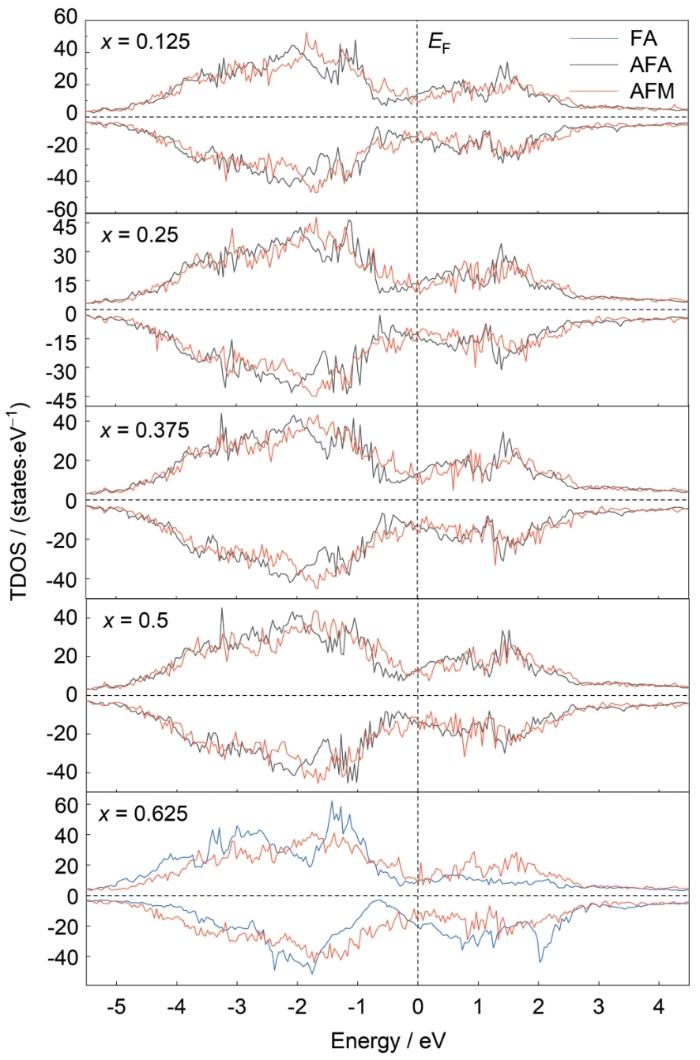
图12
Ni2 - x Co x Mn1.25Si0.25Ti0.5 (0≤ x ≤ 0.625)合金奥氏体和马氏体的TDOS
Fig.12
TDOS of austenite and martensite for Ni2 - x Co x -Mn1.25Si0.25Ti0.5 (0≤ x ≤ 0.625) alloys
图13
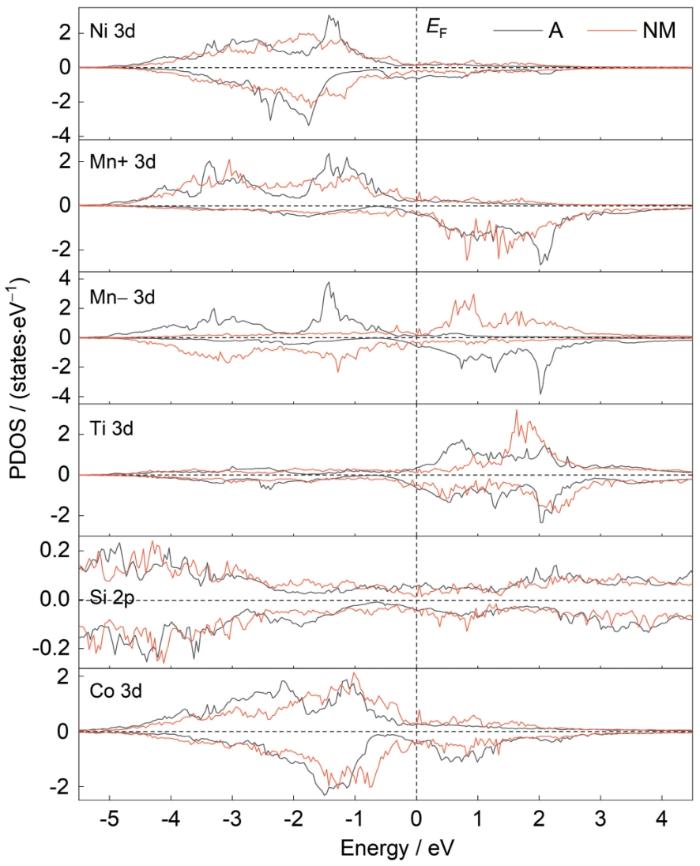
图13
Ni1.375Co0.625Mn1.25Si0.25Ti0.5合金奥氏体和马氏体的PDOS
Fig.13
PDOS of the austenite and martensite for Ni1.375Co0.625Mn1.25Si0.25Ti0.5 alloy
3 结论
(1) 在Ni-(Co)-Mn-(Si)-Ti合金中,掺杂的Si原子倾向于直接占据Mn的亚晶格格点,掺杂的Co原子倾向于直接占据Ni的亚晶格格点,共掺杂的Co和Si原子在合金中表现出聚集分布趋势。
(2) 在Ni2 - x Co x Mn1.5 - y Si y Ti0.5 (0 ≤ x ≤ 0.625,y = 0.125和0.25)合金中,随着x的增加,反铁磁性奥氏体的稳定性逐渐降低,而铁磁性奥氏体的稳定性逐渐增强。当x = 0.625且y = 0.125时,合金奥氏体呈现铁磁状态,而当y = 0.25时,奥氏体铁磁态与反铁磁态的形成能接近,可能出现共存。当合金中Co含量较低时,Si掺杂会降低马氏体相变的驱动力;但随着Co含量的增加,掺杂的Si会延缓Co对相变的强烈阻碍作用,从而稳定马氏体相变温度。
(3) Co、Si共掺杂激活了合金奥氏体的铁磁耦合效应,合金奥氏体呈现铁磁状态,而马氏体始终呈现反铁磁状态,这意味着Co、Si共掺杂可以有效诱发合金的磁热效应。另外,随着Co含量的增加,在马氏体相变及逆相变过程中的磁化强度差增加,有利于该合金在低磁场下的应用。
(4) Ni2Mn1.5Ti0.5合金中Si原子掺杂后形成的p-d轨道杂化在一定程度上会降低合金的韧性。同时,弹性特征的计算结果也表明,掺入Si会使强度增加,韧性降低;Fermi面附近的TDOS表明,奥氏体在向马氏体转变过程中发生了明显的Jahn-Teller劈裂效应,表明合金会转变为具有更稳定电子结构的马氏体相。
参考文献
Caloric materials near ferroic phase transitions
[J].
A magnetically, electrically or mechanically responsive material can undergo significant thermal changes near a ferroic phase transition when its order parameter is modified by the conjugate applied field. The resulting magnetocaloric, electrocaloric and mechanocaloric (elastocaloric or barocaloric) effects are compared here in terms of history, experimental method, performance and prospective cooling applications.
Giant barocaloric effects at low pressure in ferrielectric ammonium sulphate
[J].Lloveras, P.; Barrio, M.; Tamarit, J-Ll Univ Politecn Cataluna, ETSEIB, Dept Fis & Engn Nucl, E-08028 Barcelona, Catalonia, Spain. Stern-Taulats, E.; Planes, A.; Manosa, Ll; Moya, X. Univ Barcelona, Fac Fis, Dept Estruct & Constituents Mat, E-08028 Barcelona, Catalonia, Spain. Crossley, S.; Li, W.; Mathur, N. D.; Moya, X. Univ Cambridge, Dept Mat Sci, Cambridge CB3 0FS, England. Li, W. Huazhong Univ Sci & Technol, Sch Phys, Wuhan 430074, Peoples R China. Li, W. Huazhong Univ Sci & Technol, Wuhan Natl High Magnet Field Ctr, Wuhan 430074, Peoples R China. Pomjakushin, V. Paul Scherrer Inst, Lab Neutron Scattering & Imaging, CH-5232 Villigen, Switzerland.
Magnetic-field-induced shape recovery by reverse phase transformation
[J].
Realization of magnetic field-induced reversible martensitic transformation in NiCoMnGa alloys
[J].Effect of a magnetic field on martensitic transformation in the NiCoMnGa alloys was investigated. A field-induced reversible martensitic transformation from the martensitic phase of low magnetization to the parent phase of high magnetization has been realized. The substitution of Co for Ni atoms has turned the magnetic ordering of the parent phase from partially antiferromagnetic to ferromagnetic, resulting in a large magnetization change across the transformation, which dramatically enhances the magnetic field driving force. The transformation temperature can be downshifted by magnetic field at a rate up to 14K∕T in Ni37Co13Mn32Ga18. Other mechanism details were also discussed.
Magnetostructural martensitic transformations with large volume changes and magneto-strains in all-d-metal Heusler alloys
[J].
Realization of multifunctional shape-memory ferromagnets in all-d-metal Heusler phases
[J].
Giant elastocaloric effect in directionally solidified Ni-Mn-In magnetic shape memory alloy
[J].
Elastocaloric effect associated with different types of martensitic transformations: Typical first-order and weak first-order ones
[J].
Magnetic and martensitic transformations of NiMnX (X = In, Sn, Sb) ferromagnetic shape memory alloys
[J].Martensitic and magnetic transformations of the Heusler Ni50Mn50−yXy (X=In, Sn and Sb) alloys were investigated by differential scanning calorimetry measurement and the vibrating sample magnetometry technique. In all these alloy systems, the austenite phase with the ferromagnetic state was transformed into the martensite phase, which means that these Heusler alloys have potential as Ga-free ferromagnetic shape memory alloys (FSMAs). Furthermore, multiple martensitic transformations, such as two- or three-step martensitic transformations, occur in all these alloy systems. It was confirmed by transmission electron microscopy observation that the crystal structure of the martensite phase is an orthorhombic four-layered structure which has not been reported in other FSMAs. Therefore, the present Ga-free FSMAs have the great possibility of the appearance of a large magnetic-field-induced strain.
Colossal elastocaloric effect in ferroelastic Ni-Mn-Ti alloys
[J].
Elastocaloric effect of all-d-metal Heusler NiMnTi(Co) magnetic shape memory alloys by digital image correlation and infrared thermography
[J].We have studied the stress-induced martensitic transformation behaviors and the associated elastocaloric effect (eCE) for non-textured polycrystalline all-d-metal Heusler alloys of Ni50Mn32Ti18 and Ni35Co15Mn35Ti15 by a combination of Digital Image Correlation (DIC) and Infrared (IR) thermography techniques. A large but irreversible adiabatic temperature change (ΔTad) of 10.7 K at a strain level of 3.9% is observed for Ni50Mn32Ti18, whereas Ni35Co15Mn35Ti15 exhibits a reversible eCE with ΔTad = 9.0 K at a strain level of 4.6%. At lower strain levels (<2.4%), both specimens exhibit full superelasticity without residual strain. While in a higher strain range (>3.2%), Ni50Mn32Ti18 is plastically deformed with small strain variation in space from the DIC map. In contrast, Ni35Co15Mn35Ti15 can be deformed superelastically accompanied by large strain variation in space, which can be ascribed predominately to the crystalline orientation dependence of both the transformation strain and the Young's modulus from different orientated grains under mechanical loading. The improved reversibility of eCE for Ni35Co15Mn35Ti15 is supposed to be associated with the enhancement of d-d hybridization by the introduction of the element Co.
Magnetocaloric and elastocaloric effects in all-d-Metal Ni37Co9Fe4Mn35Ti15 magnetic shape memory alloy
[J].
Giant elastocaloric effect and exceptional mechanical properties in an all-d-metal Ni-Mn-Ti alloy: experimental and ab-initio studies
[J].
Low-pressure-induced giant barocaloric effect in an all-d-metal Heusler Ni35.5Co14.5Mn35Ti15 magnetic shape memory alloy
[J].
Ultrahigh cyclic stability and giant elastocaloric effect in directionally solidified (Ni50Mn28Fe2.5-Ti19.5)99.4B0.6 alloy
[J].
Tailoring magnetocaloric effect in all-d-metal Ni-Co-Mn-Ti Heusler alloys: A combined experimental and theoretical study
[J].
Magnetic-field-induced metamagnetic reverse martensitic transformation and magnetocaloric effect in all-d-metal Ni36.0Co14.0Mn35.7Ti14.3 alloy ribbons
[J].
Giant enhancement of the magnetocaloric response in Ni-Co-Mn-Ti by rapid solidification
[J].
The study of martensitic transformation and magnetocaloric effect in rare earth Y-doped all-d-metal Ni-Co-Mn-Ti Heusler alloys
[J].
Large room-temperature elastocaloric effect of Ni57Mn18Ga21In4 alloy undergoing a magnetostructural coupling transition
[J].
Entropy change linked to the martensitic transformation in metamagnetic shape memory alloys
[J].
Vibrational and magnetic contributions to the entropy change associated with the martensitic transformation of Ni-Fe-Ga ferromagnetic shape memory alloys
[J].
Martensitic transformation and giant magneto-functional properties in all-d-metal Ni-Co-Mn-Ti alloy ribbons
[J].
Large magnetocaloric effect and excellent mechanical properties near room temperature in Ni-Co-Mn-Ti non-textured polycrystalline alloys
[J].
Martensitic transformation and magnetic properties of Heusler alloys Co-V-(Al, Ga, In)
[J].
Giant barocaloric effect in all-d-metal Heusler shape memory alloys
[J].
Correlation of magnetocaloric effect through magnetic and electrical resistivity on Si doped Ni-Mn-In Heusler melt spun ribbon
[J].
Enhanced elastocaloric effect and refrigeration properties in a Si-doped Ni-Mn-In shape memory alloy
[J].We demonstrate giant elastocaloric effect and outstanding refrigeration capacity in a <0 0 1>A textured Ni50Mn35In13Si2 alloy with large transformation entropy change ΔStr and low-hysteresis ΔThys. On unloading from a relatively low compressive stress of 300 MPa, giant adiabatic temperature variation ΔTad up to -17.7 K was realized. Moreover, large stress-induced entropy change ΔSσ of 25.9 J kg-1 K-1 and giant refrigeration capacity RCσ of 1330 J kg-1 were achieved under the compressive stress of 300 MPa. Simultaneously achieving giant ΔTad and outstanding refrigeration capacity indicates that this alloy is promising to be the candidate material for elastocaloric refrigeration.
Magnetocaloric effect with low magnetic hysteresis loss in ferromagnetic Ni-Mn-Sb-Si alloys
[J].
Structure and inverse magnetocaloric effect in Ni-Co-Mn-Sn(Si) Heusler alloys
[J].
Structure stability driven large magnetocaloric response in Ni-Co-Mn-In-Si Heusler alloy
[J].
First-principles calculations of phase stability and magnetic properties of Ni-Mn-Ga-Ti ferromagnetic shape memory alloys
[J].
Ni-Mn-Ga-Ti铁磁形状记忆合金的相稳定性和磁性能的第一性原理计算
[J].
Revealing essence of magnetostructural coupling of Ni-Co-Mn-Ti alloys by first-principles calculations and experimental verification
[J].\n In this work, the effects of Co doping on the magnetostructural coupling transformation of Ni\n \n 50‐\n x\n \n Co\n \n x\n \n Mn\n \n 50‐\n y\n \n Ti\n \n y\n \n (\n x\n = 0–15,\n y\n = 12.5–15) Heusler alloys were systematically investigated through the first‐principles calculations and experimental verification. The calculation result indicates that the doped Co atoms prefer to occupy the Ni sublattice. The Co atoms tend to flock together in terms of the lowest energy principle. Since the formation energy of the austenite is higher than that of the martensite, the alloys will undergo martensitic transformation for the Ni\n \n 50‐\n x\n \n Co\n \n x\n \n Mn\n 37.5\n Ti\n 12.5\n alloys (\n x\n = 0–12.5). The magnetostructural coupling point of Ni\n \n 50‐\n x\n \n Co\n \n x\n \n Mn\n 37.5\n Ti\n 12.5\n alloys is predicted in the vicinity of\n x\n = 11–12. Based on the computational composition Ni\n 37.5\n Co\n 12.5\n Mn\n 37.5\n Ti\n 12.5\n, the Ni\n 36\n Co\n 14\n Mn\n 36\n Ti\n 14\n alloy with magnetostructural coupling near room temperature was experimentally developed by simultaneously increasing the Ti and Co contents. The largest magnetization change (Δ\n M\n ) and magnetic entropy changes (Δ\n S\n m\n ) obtained under magnetic field of 5 T for the martensitic transformation in the Ni\n 36\n Co\n 14\n Mn\n 36\n Ti\n 14\n alloy are about 87.6 A·m\n 2\n ·kg\n −1\n and 21 J·kg\n −1\n ·K\n −1\n, respectively. The fracture strength and strain for non‐textured polycrystalline Ni\n 36\n Co\n 14\n Mn\n 36\n Ti\n 14\n alloy reach 953 MPa and 12.3%, respectively. The results show that the alloy not only possesses a large magnetocaloric effect but also has excellent mechanical properties. In addition, the 6 M modulated martensite is evidenced in the Ni‐Co‐Mn‐Ti alloys via transmission electron microscopy technique.\n
Ni-Co-Mn-Ti-B high performance multiferroic phase transformation material: Simultaneous modulation of mechanical properties and successive caloric effects by B doping
[J].
An alloying strategy for tuning magnetism, thermal hysteresis, and mechanical properties in Ni-Mn-Sn-based Heusler alloys
[J].
Effect of Co doping on martensitic transformation and magnetic properties of Ni50Mn35. 4In14. 6 alloy by first-principles calculations
[J].
Design of magnetostructural coupling and magnetic martensitic transformations in hexagonal MM'X and all-d-metal Heusler shape memory alloys
[D].
MM'X合金和全d-metal Heusler合金中的磁相变设计
[D].
From ultrasoft pseudopotentials to the projector augmented-wave method
[J].
Generalized gradient approximation made simple
[J].
Special points for Brillouin-zone integrations
[J].
First-principles investigation of B2 partial disordered structure, martensitic transformation, elastic and magnetic properties of all-d-metal Ni-Mn-Ti Heusler alloys
[J].In this work, the B2 partial disordered structure of the austenitic parent phase, martensitic transformation, elastic and magnetic properties of the Ni8Mn4+xTi4-x (x = 0, 1 and 2) Heusler alloys have been systematically investigated by the first-principles calculations. The preferential atomic occupation of B2 structure is one Ti atom exchange with the nearest neighboring Mn atom from the view of lowest energy principle. This disordered exchange sites (Mn-Ti) and the excess Mn atoms occupying the Ti sites (MnTi) could reduce the nearest Mn-Mn distance, resulting in the antiferromagnetic state in the austenitic and martensitic phases of the alloys. The total magnetic moment of the alloy decreases with the increasing Mn content; it is ascribed to the antiferromagnetic magnetic moments of the excess Mn atoms. When x = 0, the alloy does not undergo martensitic transformation since the austenite has absolute phase stability. The martensitic transformation will occur during cooling process for x = 1 or 2, owing to the energy difference between the austenite and the martensite could provide the driving force for the phase transformation. The elastic properties of the cubic austenitic phase for the Ni2MnTi alloy is calculated, and the results reveal the reason why Ni-Mn-Ti alloy has excellent mechanical properties. The origin of martensitic transformation and magnetic properties was discussed based on the electronic density of states.
The effect of partial substitution of In by Si on the phase transitions and respective magnetic entropy changes of Ni50Mn35In15 Heusler alloy
[J].
Giant low-field magnetocaloric effect in Si alloyed Ni-Co-Mn-In alloys
[J].
Hydrostatic pressure effects on martensitic transition, magnetic and magnetocaloric effect in Si doped Ni-Mn-Sn Heusler alloys
[J].
T. Elastic properties of Ni2MnGa from first-principles calculations
[J].
Magnetocaloric and electrical properties in annealed Si-doped Ni-Mn-In Heusler alloy ribbons
[J].
Transformation temperatures and magnetoplasticity of Ni-Mn-Ga alloyed with Si, In, Co or Fe
[J].
First-principles investigation on phase stability, elastic and magnetic properties of boron doping in Ni-Mn-Ti alloy
[J].
Enhanced reversibility and unusual microstructure of a phase-transforming material
[J].
Combinatorial search of thermoelastic shape-memory alloys with extremely small hysteresis width
[J].Reversibility of structural phase transformations has profound technological implications in a wide range of applications from fatigue life in shape-memory alloys (SMAs) to magnetism in multiferroic oxides. The geometric nonlinear theory of martensite universally applicable to all structural transitions has been developed. It predicts the reversibility of the transitions as manifested in the hysteresis behaviour based solely on crystal symmetry and geometric compatibilities between phases. In this article, we report on the verification of the theory using the high-throughput approach. The thin-film composition-spread technique was devised to rapidly map the lattice parameters and the thermal hysteresis of ternary alloy systems. A clear relationship between the hysteresis and the middle eigenvalue of the transformation stretch tensor as predicted by the theory was observed for the first time. We have also identified a new composition region of titanium-rich SMAs with potential for improved control of SMA properties.
Large reversible multicaloric effects over a broad refrigeration temperature range in Co and B co-doped Ni-Mn-Ti alloys
[J].
Atomic scale understanding the periodic modulation in ferroelastic alloy Ni-Mn-Ti
[J].
d-d hybridization controlled large-volume-change martensitic phase transition in Ni-Mn-Ti-based all-d-metal Heusler compounds
[J].
Understanding the magneto-structural coupling of Ni50Mn35.4In14.6 alloy from first-principles calculations
[J].
Role of composition, site ordering, and magnetic structure for the structural stability of off-stoichiometric Ni2MnSb alloys with excess Ni and Mn
[J].


