



累积叠轧焊(accumulative roll bonding,ARB)是Saito等[4]在1999年提出的一种大塑性变形加工工艺。传统ARB通过重复堆叠和轧制起始的双层或三层板材,是制备不混溶多层复合材料的一种高效且低成本方法。Gao等[5]通过改进ARB工艺,制备出了具有类似于“条形码”形态的Cu (fcc结构)/Nb (fcc结构)纳米层状复合材料,其在保持超导性的同时,屈服强度和抗氧化性能也显著提升。多层复合材料的异相界面既是位错源,也是位错湮灭点,位错与界面之间的相互作用极大地影响了局部塑性变形,例如,界面失稳导致剪切带形成,从而使材料失去上述优异性能[6,7]。晶界和相界通常会造成位错堆积,但在一定条件下也可吸收并重新发射位错,部分位错甚至能够直接穿过界面。有利于位错传播的界面呈现出极强的滑移诱导应变,而阻碍位错滑移的界面则会在界面一侧呈现出高的局域应变集中[8]。
近年来,界面与滑移的交互作用已有较多研究。Zhang等[9]利用晶体塑性有限元方法(crystal plasticity finite element method,CPFEM)模拟了五层Cu/Nb复合材料的压缩过程,发现大取向差角倾向于阻碍应变在界面处的传递,从而削弱界面稳定性。Zhou等[10]利用CPFEM模拟了纯Ni双晶的压缩过程,发现晶粒取向差角相等时,外部应力状态会影响晶粒的应力配分,导致双晶中的应变分布不均匀。Patriarca等[11]将数字图像相关(digital image correlation,DIC)技术与电子背散射衍射(EBSD)技术结合,识别了fcc结构FeCr多晶材料中的滑移系,并根据入射滑移系与出射滑移系计算了残余Burgers矢量(Δb),发现Δb较小的晶界的应变场较连续;而Δb较大的晶界,滑移倾向于在其一侧累积,这表明Δb可作为评价多晶材料中滑移传递行为的重要参数。Luster和Morris[12]基于滑移面法线方向夹角和Burgers矢量方向夹角定义了一个与晶界倾角无关的参数来评价晶界的滑移传递,即Luster-Morris参数(m′)。徐永生等[13]利用CPFEM对双晶铁素体的变形行为进行模拟,发现晶界附近的变形均匀程度与m′呈正相关。Alizadeh等[14]采用滑移迹线分析方法研究了纯Al晶界处的滑移传递现象,发现当Δb < 0.350且m′ > 0.90时,滑移传递才可能发生。Palomares-García等[15]对γ-TiAl中异相界面的滑移传递进行研究,发现相界处出射滑移系激活的控制机制是由m′决定的。然而,位错与界面间的交互是一个相当复杂的过程,分子动力学模拟研究[16]表明,局部分剪切应力、界面结构以及边界类型等因素同样对滑移传递过程具有决定性影响。
基于上述背景,本工作研究了Cu/Nb多层材料晶界和相界处的滑移传递现象,采用ARB工艺制备了Cu/Nb多晶多层材料,并对其进行原位拉伸实验,采用扫描电子显微镜(SEM)和EBSD判断激活的滑移系种类,通过计算统计滑移传递和滑移阻塞界面的m′和Δb,从而得出Cu/Nb多层复合材料中界面的滑移传递规律,以期为后续Cu/Nb多层材料的优化设计提供理论指导。
1 实验方法
1.1 实验材料
本工作中使用的材料为商业纯Nb板(> 99.9%,质量分数,下同)和纯Cu板(> 99.9%),厚度均为1 mm。在冷轧初始板材上沿平行于原轧制方向切割出尺寸为25 mm × 90 mm × 1 mm的Cu板和Nb板。在进行ARB之前,将Cu板和Nb板分别置于600和900 ℃的Ar气保护气氛中退火2 h。
1.2 ARB和原位拉伸实验
图1a为ARB工艺示意图。ARB兼具轧制过程与冶金结合过程的特点。轧制前需对板材进行酒精清洗和电刷打磨接触面,电刷打磨不仅可以去掉氧化层,而且能有效增加接触面的粗糙度,进而增大结合面积[17]。然后,将Cu板与Nb板以Cu-Nb-Cu-Nb的顺序堆叠,两端用铁丝固定。在第一次轧制循环中,轧辊速率为10 rad/s,板材终轧厚度为2.3 mm。将轧制后的板材切割成两部分,之后进行清洁、打磨、堆叠、捆绑和轧制。随后的每道次压下量均约为50%,且在每道次轧制后,板材均需在600 ℃的Ar气保护气氛中退火2 h,以平衡两相间的强度差异,并最大限度地减少塑性不稳定性和边缘裂纹的产生。将上述步骤重复进行3 cyc循环,整个过程中保持轧制方向不变。轧制完成后在980 ℃的Ar气保护气氛下进行10 h的扩散焊处理,此步骤可促使变形组织重新再结晶并长大为等轴晶;同时,在残余应力作用下促进两相扩散,从而增加结合强度。
图1
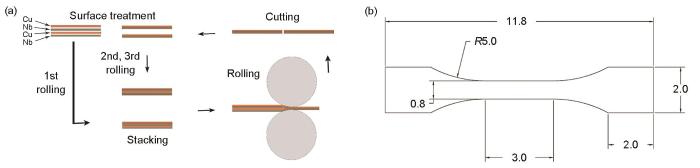
图1
累积叠轧焊(ARB)工艺与原位拉伸试样尺寸示意图
Fig.1
Schematics of accumulative roll bonding (ARB) procedure (a) and dimension of the in situ tensile sample (unit: mm) (b)
沿RD-ND (其中,RD为轧制方向,ND为轧制面法向)面切出狗骨状原位拉伸试样。试样具体尺寸如图1b所示。随后对拉伸前后的试样进行研磨、抛光、离子抛光处理,得到EBSD样品。采用搭载C-Swift EBSD探头和Kammrath & Weiss原位力学实验台的Gemini 300 SEM进行原位拉伸实验。EBSD扫描步长为0.5 μm,EBSD数据采用AztecCrystal软件和MATLAB开源工具箱MTEX进行分析。整个拉伸过程中,拉伸速率恒定为0.05 mm/min,总应变为12%。如图2所示,每间隔4%的应变,采用SEM对感兴趣区域(region of interest,ROI)进行拍照。
图2

图2
不同应变下感兴趣区域(ROI)的SEM像
(a) 0% (b) 4% (c) 8% (d) 12%
Fig.2
SEM images of the region of interest (ROI) under different strains (ε) (C type represents curved slip trace near grain boundary)
2 实验结果
2.1 滑移参数计算
图3
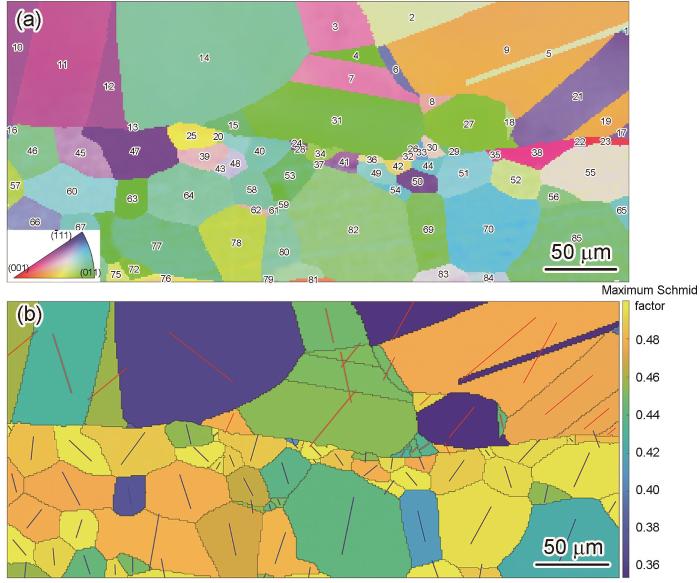
图3
未变形样品ROI的反极图(IPF)和最大Schmid因子对应的滑移迹
Fig.3
Inverse pole figure (IPF) of the ROI (Numbers represent grain identification, the same below) (a) and the slip trace corresponding to the maximum Schmid factor of the underformed sample (Red lines represent Cu layers, blue lines represent Nb layers) (b)
将任意向量从晶体坐标系转换到全局样品坐标系需做如下变换:
式中, ds表示处于样品坐标系的向量, dc表示处于晶体坐标系的向量。
单轴拉伸的单位应力张量为
式中, nc为滑移面法向方向的单位矢量, bc为单位Burgers矢量。滑移系在样品表面的滑移迹( ts)可表示为[18]:
m' = cosψcosκ,其中,ψ为两个滑移面法线的夹角,κ为入射与出射滑移方向之间的夹角。m′的取值范围为0 ≤ m′ ≤ 1,其中1表示位错可以无阻力地穿过界面,0表示位错不能穿过界面。m′可以表示为[18]:
式中, bs1、 bs2和 ns1、 ns2分别为全局样品坐标系下两个滑移系的单位Burgers矢量和单位滑移面法线; bc1、 bc2和 nc1、 nc2分别为晶体坐标系下两个滑移系的单位Burgers矢量和单位滑移面法线;下标1代表出射滑移系,下标2代表入射滑移系。Δb可表示为[12]:
式中,ω为两个Burgers矢量的夹角,m′和Δb的取值范围分别为[0, 1]和[0,
2.2 滑移迹的识别
fcc结构Cu中存在12种可能的滑移系,这些滑移系由4个{111}滑移面上的3个<110>滑移方向构成。接下来以Cu层中的晶粒9为例,说明滑移迹的识别方法。如图4a所示,样品表面存在两组滑移迹,位错发生了交滑移。图4b为晶粒9的所有理论滑移系以及对应的Schmid因子。将晶粒9的实际滑移迹线与所有理论滑移迹进行叠加可知,第一组滑移迹与绿色滑移系(
图4
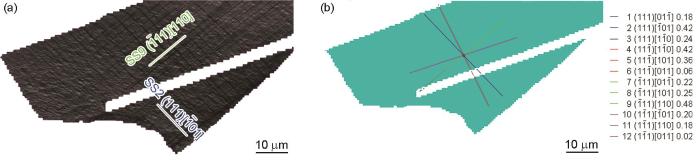
图4
应变为12%时Cu层中晶粒9的实际滑移迹和所有理论滑移迹
Fig.4
Actual slip traces (a) and all theoretical slip traces (b) in grain 9 of Cu layer under 12% strain (SS represents slip system. The lines in Fig.4b with different colors represent different sets of slip planes, the rightmost value in the legend of Fig.4b represents the Schmid factor of each slip system, the same in Fig.5)
在bcc结构Nb中,考虑{110}<111>和{112}<111>两个滑移系族的激活,共存在24个滑移系。滑移迹识别方法与Cu类似。首先找到与滑移迹对应的滑移系,然后利用Schmid因子判断最有可能激活的滑移系。如图5所示,Nb层中晶粒47的滑移迹与滑移系21的理论滑移迹夹角最小,因此可以认为晶粒47中的滑移系21 (21
图5

图5
应变为12%时Nb层中晶粒47的实际滑移迹和所有理论滑移迹
Fig.5
Actual slip trace (a) and all theoretical slip traces (b) in grain 47 of Nb layer under 12% strain
2.3 滑移系激活与界面的相互作用
图6
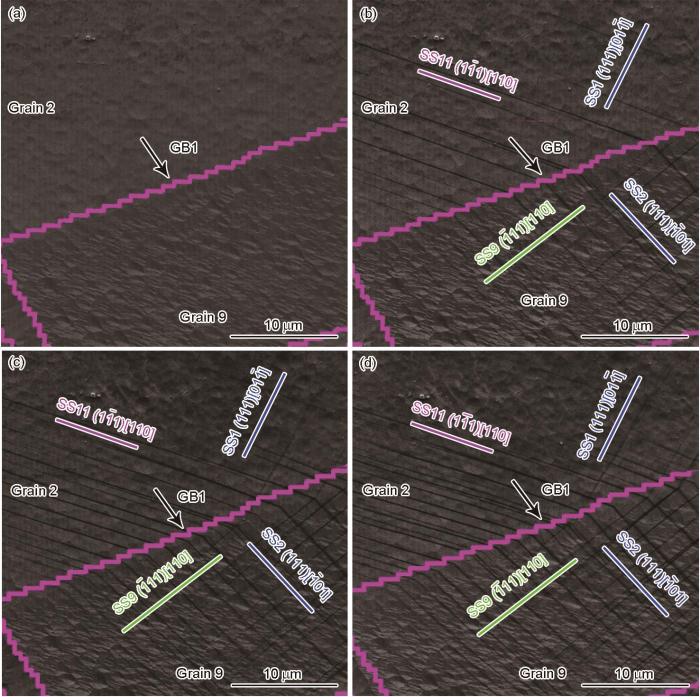
图6
不同应变下Cu层中晶粒2与9间晶界(GB1)处的激活滑移系
(a) 0% (b) 4% (c) 8% (d) 12%
Fig.6
Activated slip systems at GB1 between grains 2 and 9 in Cu layer under different ε (GB—grain boundary)
随着应变增加,滑移与界面的相互作用可依据如下两类情形进行分析。(1) 滑移传递确实发生。如图6所示,晶界(GB)处的滑移迹对齐度良好,且没有不连续的形貌。在变形初期,晶粒9中Schmid因子最大及次大的两个滑移系(即滑移系9和2)开始启动,样品表面可观察到两组滑移迹。随着应变增加,滑移迹密度逐渐增大。图6中两组滑移系(即晶粒9的滑移系9与晶粒2的滑移系1,晶粒9的滑移系2与晶粒2的滑移系11)的滑移迹均对齐度良好。随着应变增加,晶界处未出现形貌上的不连续。表1为GB1两侧晶粒中激活滑移系的Schmid因子和滑移传递参数(m′和Δb)。这两对滑移系均具有非常大的m′,分别为0.77和0.78,以及极其小的Δb,分别是0.005和0.010。因此,GB1处发生滑移传递是可信的。当晶界处应变增大时,由于GB1处有两对滑移系可以发生滑移传递,剪切应变可以跨越晶界,从而使晶界附近发生协调变形,不会产生应变累积。(2) 没有观察到滑移传递。界面两侧区域具有显著的形貌差别,滑移迹也不连续,这表明相邻区域的变形是不兼容的,如图7中Cu层晶粒7与31间的晶界GB2。表2为GB2两侧晶粒中激活滑移系的Schmid因子和两滑移系间的滑移传递参数。考虑到两个激活滑移系之间的不良几何对齐(m′ = 0.46),跨越GB2的滑移传递基本不可能发生。变形初期(ε = 4%),晶粒7和晶粒31中Schmid因子最大的滑移系基本同时开始启动,并在表面产生清晰的滑移迹。随着应变增加,滑移迹密度也同时增加,但是由于两个滑移系对齐极差,无法在晶界处协调变形,应变在晶界处累积,产生边缘凸起(图7)。
表1 Cu层中GB1处两晶粒激活滑移系的Schmid因子和滑移传递参数
Table 1
| Slip system | m'/Δb | |
|---|---|---|
SS2 in grain 9 (m = 0.42) | SS9 in grain 9 (m = 0.48) | |
SS1 in grain 2 (m = 0.36) | 0.27/1.000 | 0.77/0.005 |
SS11 in grain 2 (m = 0.28) | 0.78/0.010 | 0.28/0.996 |
图7
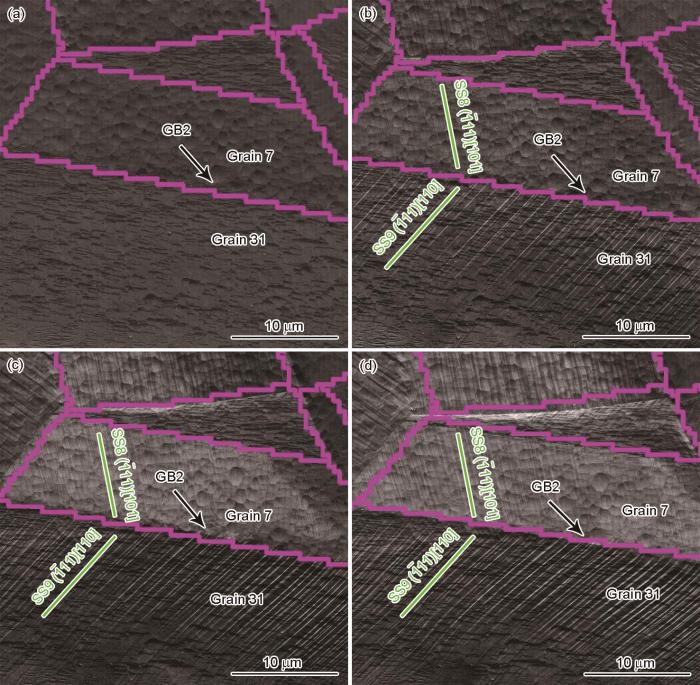
图7
不同应变下Cu层中晶粒7与31间晶界(GB2)处的激活滑移系
(a) 0% (b) 4% (c) 8% (d) 12%
Fig.7
Activated slip systems at GB2 between grains 7 and 31 in Cu layer under different ε
表2 Cu层中GB2处两晶粒激活滑移系的Schmid因子及两滑移系间的滑移传递参数
Table 2
| Slip system | m | m' | Δb |
|---|---|---|---|
| SS8 in grain 7 | 0.45 | 0.27 | 1.000 |
| SS9 in grain 31 | 0.45 |
同样地,对相界(phase boundary,PB)处的滑移传递行为进行分析。相界处的滑移阻塞与Cu层类似,相界处观察到的滑移传递存在如下两种形式。
一种滑移传递方式如图8所示。Cu层中的晶粒14与Nb层中的晶粒47构成了异相界面PB1。在Cu层,晶粒14中滑移系7 (m = 0.36)和滑移系4 (m = 0.33)两个滑移系基本同时启动,这两个滑移系的Schmid因子最大,但其各自启动位置不同,滑移系4在PB1处开动,且未向晶粒内部扩展。在Nb层,晶粒47中Schmid因子最大的滑移系21 (m = 0.45)是唯一启动的滑移系。表3为PB1两侧晶粒中激活滑移系的Schmid因子和两滑移系间的滑移传递参数。可见,晶粒14中的滑移系4与晶粒47中的滑移系21几何对齐非常好,两个滑移系间的m′为0.93,Δb为0.173。两个晶粒的滑移系在晶粒内独立启动,并向相界发展,由于其在相界处对齐度极好,可以协同变形,从而发生滑移传递。此外,PB1处的Nb晶粒47、Cu晶粒12和Cu晶粒14组成了一个三叉界面。当ε ≥ 8%时,Cu层中的晶粒12与晶粒14中均可观察到两组在界面处和晶粒内部分别发展的滑移迹,如图8c和d所示。Cu晶粒12中激活的两个滑移系分别是滑移系10 (1
图8
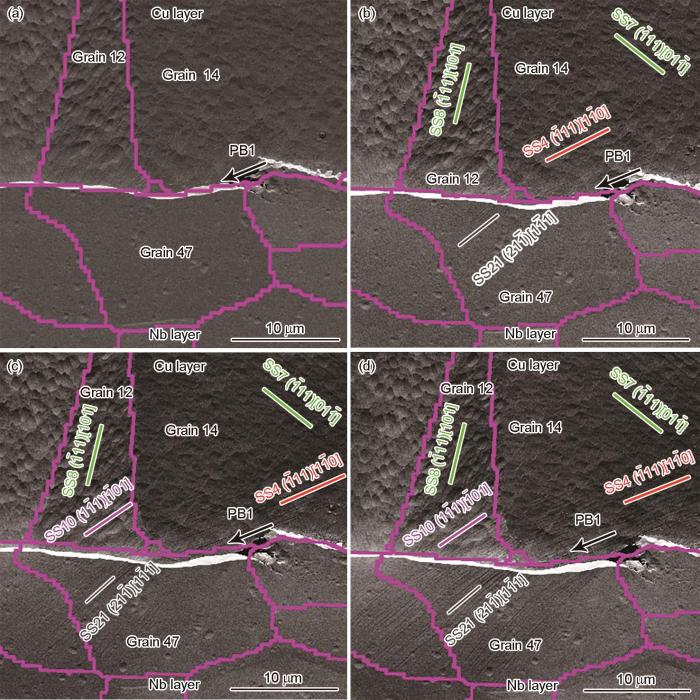
图8
不同应变下Cu层与Nb层间相界(PB1)处的激活滑移系
(a) 0% (b) 4% (c) 8% (d) 12%
Fig.8
Activated slip systems at PB1 between Cu layer and Nb layer under different ε (PB—phase boundary)
表3 PB1处两晶粒激活滑移系的Schmid因子及两滑移系间的滑移传递参数
Table 3
| Layer | Slip system | m | m' | Δb |
|---|---|---|---|---|
| Cu | SS4 in grain 14 | 0.33 | 0.93 | 0.173 |
| Nb | SS21 in grain 47 | 0.45 |
另外一种滑移传递方式如图9所示。Cu晶粒31与Nb晶粒40构成了异相界面PB2。当ε= 4%时,Cu晶粒31中的滑移系9率先启动。随着应变增加,滑移迹密度越来越大。而在Nb晶粒40中,应变较小时未观察到明显的滑移启动。随着应变增加,Cu晶粒31中的滑移系9在相界PB2处的累积应变增加,Nb晶粒40中的滑移系24逐渐开始启动。表4为PB2两侧晶粒中激活滑移系的Schmid因子和两滑移系间的滑移传递参数。Cu晶粒31中Schmid因子最大的滑移系为滑移系9,但Nb晶粒40中Schmid因子最大的滑移系却不是滑移系24,两个滑移系间的m′为0.72。因此,可以认为滑移系24是由滑移系9激活的,当应变累积到一定程度时,滑移跨越PB2相界从Cu晶粒31传递到Nb晶粒40。
图9

图9
不同应变下PB2处的激活滑移系
(a) 0% (b) 4% (c) 8% (d) 12%
Fig.9
Activated slip systems at PB2 between Cu layer and Nb layer under different ε
表4 PB2处两晶粒激活滑移系的Schmid因子及两滑移系间的滑移传递参数
Table 4
| Layer | Slip system | m | m' | Δb |
|---|---|---|---|---|
| Cu | SS9 in grain 31 | 0.45 | 0.72 | 0.727 |
| Nb | SS24 in grain 40 | 0.30 |
3 分析与讨论
依据前文所述方法,本工作统计了实验结果中29个Cu晶界、67个Nb晶界和15个Cu/Nb相界的滑移传递与界面处几何因素之间的关系。图10为Cu晶界、Nb晶界和Cu/Nb相界中m′、Δb和取向差的关系图。
图10
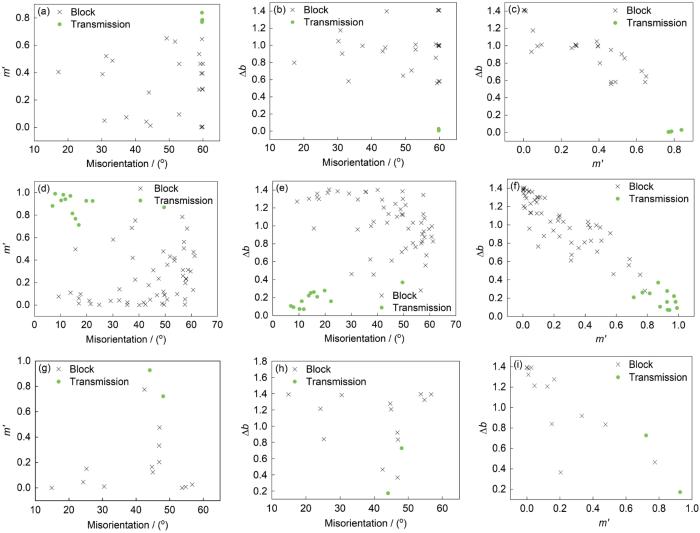
图10
Cu晶界、Nb晶界和Cu/Nb相界处的m′、Δb和取向差的关系图
(a, d, g) m′ vs misorientation (b, e, h) Δb vs misorientation (c, f, i) Δb vsm′
Fig.10
Relationships of m′, Δb, and misorientations at Cu GBs (a-c), Nb GBs (d-f), and Cu/Nb PBs (g-i) (Dots represent slip transfer, crosses represent slip blocks)
如图10g~i所示,针对Cu/Nb相界,当m′大于0.93且Δb小于0.170时能够发生滑移传递。研究[25]表明,采用ARB工艺制备的Cu/Nb复合材料的异相界面具有{112}fcc/{112}bcc取向关系,Cu中大部分晶界属于Σ3晶界;由于Cu与Nb在弹性模量和原子半径上存在失配,Cu/Nb相界面具有更加复杂的结构和更大的界面能。与晶界相比,异相界面需要更高的分剪切应力来驱动滑移传递[26],并且与晶界相比,不连续的Cu/Nb界面具有较低的剪切强度,是滑移传递的有效屏障[27,28]。因此,Cu/Nb界面处发生滑移传递的
4 结论
(1) 滑移传递具有两种形式:一种是在晶界两侧滑移系同时启动,当滑移到达晶界处时,如果两个滑移系对齐度良好会产生协同变形,否则会在晶界处发生滑移阻塞;另一种形式是一侧晶粒开始变形,当应变在界面处积累到一定程度时,由于晶格旋转和应力集中,会激活另一侧晶粒的滑移系,发生滑移传递。
(2) 在Cu层中,当m′大于0.77且Δb小于0.029时,滑移能够发生传递。在Nb层中,当m′大于0.81且Δb小于0.250时,滑移能够发生传递。由于Nb的弹性模量大于Cu,发生滑移传递所需的分剪切应力大于Cu,且Nb晶界能大于Cu,晶界对滑移的阻碍更大,因此Nb中晶界滑移传递的
(3) 对于Cu/Nb相界,当m′大于0.93且Δb小于0.173时,滑移可发生传递。Cu/Nb相界发生滑移传递的
参考文献
Dynamic self-organization in Cu alloys under ion irradiation
[J].
Interface enabled defects reduction in helium ion irradiated Cu/V nanolayers
[J].
Nanostructured Cu/Nb multilayers subjected to helium ion-irradiation
[J].
Novel ultra-high straining process for bulk materials—Development of the accumulative roll-bonding (ARB) process
[J].
Superconducting Cu/Nb nanolaminate by coded accumulative roll bonding and its helium damage characteristics
[J].
Thickness-dependent shear localization in Cu/Nb metallic nanolayered composites
[J].
Simulation of shear banding in heterophase co-deformation: Example of plane strain compressed Cu-Ag and Cu-Nb metal matrix composites
[J].
Review on slip transmission criteria in experiments and crystal plasticity models
[J].
Thermo-kinetic orientation study on interface behavior of polycrystalline Cu-Nb composite by crystal plasticity finite element method
[J].
Investigation on the effects of grain boundary on deformation behavior of bicrystalline pillar by crystal plasticity finite element method
[J].
Slip transmission in bcc FeCr polycrystal
[J].
Compatibility of deformation in two-phase Ti-Al alloys: Dependence on microstructure and orientation relationships
[J].
Simulation of deformation coordination and hardening behavior in ferrite-ferrite grain boundary
[J].
铁素体晶间变形协调与硬化行为模拟研究
[J].
A criterion for slip transfer at grain boundaries in Al
[J].
Slip transfer across γ-TiAl lamellae in tension
[J].
The role of slip transmission on plastic strain accumulation across grain boundaries
[J].
Microstructural evolution and mechanical behavior of Cu/Nb multilayer composites processed by accumulative roll bonding
[J].
Statistical analysis of slip transfer in Al alloy based on in-situ tensile test and high-throughput computing method
[J].
In-situ analysis of the slip activity during tensile deformation of cast and extruded Mg-10Gd-3Y-0.5 Zr (wt.%) at 250 oC
[J].
On the origin of deformation mechanisms in a heterostructured aluminum alloy via slip trace and lattice rotation analyses
[J].
Thermo-kinetic characteristics on stabilizing hetero-phase interface of metal matrix composites by crystal plasticity finite element method
[J].
In-situ study of the effect of grain boundary misorientation on plastic deformation of Inconel 718 at high temperature
[J].
Interface modifications on strength and plasticity of nanolayered metallic composites
[J].
纳米金属层状材料强塑性的界面调控
[J].
Dynamic precipitation and deformation behaviors of a bimodal-grained WE43 alloy with enhanced mechanical properties
[J].
Review: Effect of bimetal interface structure on the mechanical behavior of Cu-Nb fcc-bcc nanolayered composites
[J].
A review of slip transfer: Applications of mesoscale techniques
[J].
Slip transmission across fcc/bcc interfaces with varying interface shear strengths
[J].
The influence of interface shear strength on the glide dislocation-interface interactions
[J].
Energy of slip transmission and nucleation at grain boundaries
[J].
Analysis of the correlation between the energy and crystallographic orientation of grain boundaries in Fe based on atomistic simulations
[J].
基于原子模拟的金属Fe晶界能与晶界取向相关性分析
[J].


