



针对钼基合金高温氧化失效的难题,现有研究主要聚焦于两大技术路径:其一为通过合金化设计开发兼具力学性能与抗氧化性能的新型钼基材料;其二为在合金表面构筑高性能防护涂层以隔绝氧化侵蚀。尽管通过添加Al、Si、B等元素可适度改善抗氧化能力[5,6],但过量合金元素的加入将导致晶粒异常粗大,恶化力学性能[7],同时有限的保护效果难以满足实际需求。相比之下,表面涂层技术能够在不显著恶化基体性能的前提下,通过物理屏障效应实现高效抗氧化防护,成为更具工程化前景的解决方案。其中,硅化物涂层因具有优异的热稳定性(熔点> 2000 ℃)及自修复特性备受关注[8]。目前,研究者已利用包埋渗法[9]、热浸镀[10]、放电等离子烧结[11]及浆料烧结[12]等多种工艺在难熔金属表面成功制备硅化物涂层。其中,包埋渗法因工艺简单、涂层结合力强等优势,被广泛用于钼基合金表面涂层的制备[13]。
利用包埋渗法在钼基合金表面制备的硅化物涂层通常呈现双层结构,包括MoSi2外层和Mo5Si3过渡层[14]。然而,硅化物涂层存在以下两个主要问题:(1) MoSi2 (热膨胀系数α = 9.7 × 10⁻⁶ K-1)与Mo基体(α = 5.2 × 10⁻⁶ K-1)间的显著热膨胀系数失配,导致循环氧化过程中界面热应力累积,引发涂层开裂甚至剥落[15,16];(2) 在高温服役时,MoSi2中的Si元素持续向基体扩散,导致MoSi2相逐渐转变为Mo5Si3和Mo3Si等中间相,而此类硅化物难以形成保护性SiO2膜,最终引发灾难性氧化[17]。为突破上述限制,研究者提出通过引入第二相构建复合涂层以优化性能。例如,Yoon和Kim[18]在MoSi2中掺入低热膨胀系数(α = 4.0 × 10⁻⁶ K-1)的SiC颗粒,显著降低了涂层/基体间的热应力,循环氧化寿命提升幅度超200%。此外,通过添加B、C等元素构建扩散障,抑制Si元素扩散已成为重要研究方向[19,20]。B改性涂层内原位生成的MoB相和Mo5SiB2相可有效阻隔Si元素内扩散,延长涂层的服役寿命[21]。同时,陈郑等[22]发现,B掺杂MoSi2可诱导氧化膜中形成硼硅酸盐玻璃相,其O扩散系数较纯SiO2降低幅度超20%。此外,MoB相的热膨胀系数(α = 7.4 × 10⁻⁶ K-1)介于Mo基体与MoSi2涂层之间,能够缓解热应力[23],表明硅化物-硼化物复合涂层有望成为缓解涂层/基体热失配并具备优异抗氧化性能的理想体系。
尽管已有研究证实了硅化物-硼化物复合涂层具备性能优势,但对其微观组织演化机制及高温氧化行为仍缺乏系统阐释。基于此,本工作采用包埋渗法在纯Mo表面制备硅化物-硼化物复合涂层,通过多尺度表征手段探究涂层的形成机理和高温氧化行为。
1 实验方法
1.1 涂层制备
采用线切割方式从纯Mo板中获取尺寸为10 mm × 10 mm × 3 mm的试样,逐级使用400~2000号SiC砂纸打磨试样表面并去除试样棱角,在酒精中超声清洗后干燥备用。采用包埋渗法在纯Mo表面制备涂层。首先,按30Si-5NaCl-65Al2O3或30Si-1B-5NaCl-64Al2O3 (质量分数,%)比例称取各渗剂粉末,球磨4 h使其均匀混合。其次,将基体试样置于圆柱形Al2O3坩埚中,四周包裹渗剂粉末并压实。然后,使用高温黏结剂密封坩埚,并用钼丝紧紧缠绕。最后,将密封好的坩埚置于管式炉中央,以10 ℃/min的升温速率将炉温升至1200 ℃,保温指定时间(渗Si:5 h;Si、B共渗:0、1.5、3、5和10 h)后结束加热,随炉进行冷却,整个包埋过程在Ar气氛中进行。
1.2 高温氧化实验
选用保温5 h制备的涂层样品进行氧化性能测试。氧化实验在管式炉中进行,当炉温达到1200 ℃后,将样品同坩埚一起推入炉中,氧化一定时间后取出。待样品和坩埚自然冷却至室温后,采用METTLER TOLEDO ME204E电子天平(精度0.1 mg)称量涂层样品和坩埚的质量,称重后将样品推入炉中。多次重复上述步骤,累积到达所需氧化时间(1、5、10、20和30 h)。为减少误差,氧化实验前将坩埚干烧至恒重。
1.3 热力学分析与微观组织表征
使用HSC Chemistry 6.0软件的Equilibrium Compositions和Reactions Equations模块,对包埋渗过程中的气相组成和各类反应进行分析。根据不同渗剂比例设置初始反应物的输入量,由于Al2O3基本不参与反应,将其排除在外。
采用D8 Advance型X射线衍射仪(XRD)获取涂层表面氧化前后的晶体结构信息,CuKα 靶,波长λ = 0.154 nm,扫描速率为10°/min。采用SU 5000扫描电子显微镜(SEM)及其附带的能谱仪(EDS)对涂层氧化前后的微观组织和化学成分进行表征。采用JSM-IT800 SEM附带的电子背散射衍射仪(EBSD)对涂层截面晶粒取向分布进行分析。
2 实验结果与讨论
2.1 涂层微观组织
图1为保温5 h制备的硅化物涂层及硅化物-硼化物复合涂层表面的XRD谱。可以看出,除MoSi2衍射峰外还识别出Al2O3的衍射峰。值得注意的是,硅化物涂层样品表面MoSi2相的(002)晶面衍射强度明显高于标准粉末样品的衍射强度,这表明其晶粒可能具有一定的取向。而硅化物-硼化物复合涂层表面MoSi2相的衍射峰与标准粉末样品相近。硅化物涂层和硅化物-硼化物复合涂层样品表面形貌的SEM像和EDS分析如图2所示。从图2a插图中的晶粒尺寸分布可见,硅化物涂层的晶粒尺寸分布较为分散,呈现双峰分布特征,平均晶粒尺寸分别为(1.86 ± 0.14)和(4.64 ± 0.22) μm。相比之下,硅化物-硼化物复合涂层的晶粒尺寸分布更加均匀,晶粒更加细化,平均尺寸为(1.75 ± 0.05) μm (图2b中插图)。此外,两种涂层表面均存在浅灰色主相和深灰色相。图2c的EDS分析结果显示,浅灰色主相主要由Mo和Si元素组成,结合XRD分析可以推断,该相为MoSi2。从图2d可见,深灰色相主要由Al和O元素组成,对应物相为包埋渗过程中附着的Al2O3。
图1
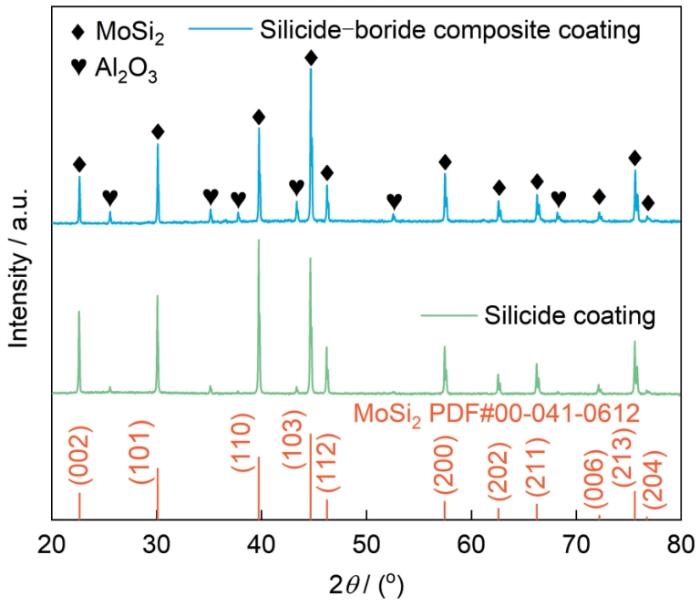
图1
硅化物涂层及硅化物-硼化物复合涂层表面的XRD谱
Fig.1
XRD patterns of the surfaces of silicide coating and silicide-boride composite coating
图2

图2
硅化物涂层和硅化物-硼化物复合涂层表面形貌的SEM像和EDS分析
Fig.2
Surface SEM images of the silicide coating (a) and silicide-boride composite coating (b) (Insets in Figs.2a and b show the corresponding grain size distributions); EDS analyses of spot 1 (c) and spot 2 (d) in Fig.2b
硅化物涂层和硅化物-硼化物复合涂层截面形貌的SEM背散射电子(BSE)像和EDS成分分析结果分别如图3和表1所示。硅化物涂层呈现双层结构,由厚度约为61 μm的MoSi2外层(图3a)和厚度约为1 μm的Mo5Si3过渡层(图3b)组成。值得注意的是,虽然硅化物涂层整体致密,但仍存在较多贯穿性裂纹。这一现象可归因于MoSi2与Mo基体热膨胀系数失配。在冷却至室温的过程中,热膨胀系数的显著差异会导致较高的热应力,从而引发裂纹的形成。从图3c可见,硅化物-硼化物复合涂层的表层为致密的深灰色MoSi2相,厚度约为18 μm;次表层MoSi2 + MoB混合层的厚度约为45 μm。对图3d中的点4、点5进行EDS成分分析,结果表明,该层由深灰色相MoSi2和弥散分布的浅灰色MoB相组成,且层内存在较多孔洞。从图3d可见,在MoSi2 + MoB混合层与基体之间存在三层结构,且Mo、Si、B元素的线扫描结果表明元素呈梯度分布,结合不同区域的EDS成分分析结果(表1),推断该区域内主要物相依次为Mo5Si3 (厚度约1 μm)、MoB (厚度约6 μm)和Mo2B (厚度约1 μm)。综上所述,硅化物-硼化物复合涂层整体呈现五层梯度结构,即:表层MoSi2、次表层MoSi2 + MoB混合层、第三层Mo5Si3、次内层MoB及最内层Mo2B。值得注意的是,混合层中的孔洞多分布于MoB相附近,而内层MoB结构致密无孔洞,说明两者形成机制存在差异。与硅化物涂层对比,硅化物-硼化物复合涂层中未形成贯穿性裂纹。这可归因于内层MoB的热膨胀系数介于Mo与MoSi2之间,能有效降低涂层的热应力积累。同时,当裂纹扩展至MoSi2 + MoB混合区的孔洞时,其尖端的应力通过孔洞得以释放,从而减缓裂纹的扩展[24,25]。
图3
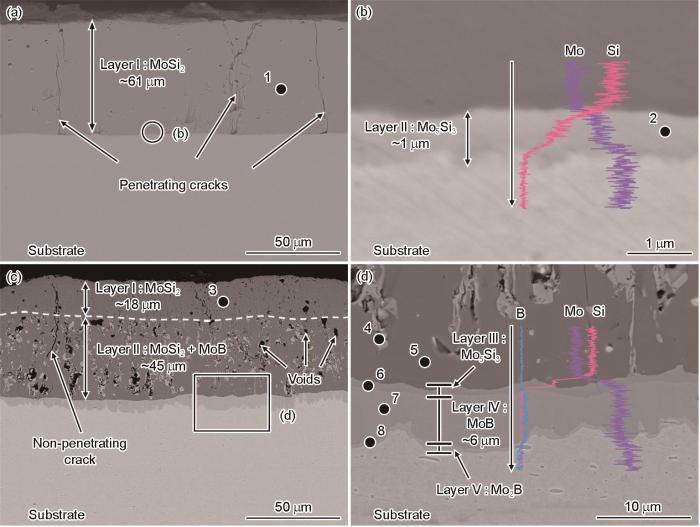
图3
硅化物涂层和硅化物-硼化物复合涂层截面形貌的SEM像
Fig.3
Low (a, c) and locally high (b, d) magnified cross-sectional SEM images of the silicide coating (a, b) and silicide-boride composite coating (c, d)
表1 图3中点1~8的EDS成分分析结果
Table 1
| Coating | Layer | Spot | Atomic fraction / % | Possible phase | ||
|---|---|---|---|---|---|---|
| B | Si | Mo | ||||
| Silicide coating | Layer I | 1 | - | 65.80 | 34.20 | MoSi2 |
| Layer II | 2 | - | 37.64 | 62.36 | Mo5Si3 | |
| Silicide-boride composite coating | Layer I | 3 | - | 64.21 | 35.79 | MoSi2 |
| Layer II | 4 | 51.44 | 0.55 | 48.01 | MoB | |
| 5 | - | 67.05 | 32.95 | MoSi2 | ||
| Layer III | 6 | 0.76 | 36.38 | 62.86 | Mo5Si3 | |
| Layer IV | 7 | 59.25 | - | 40.75 | MoB | |
| Layer V | 8 | 30.95 | - | 69.05 | Mo2B | |
图4为硅化物涂层及硅化物-硼化物复合涂层截面的EBSD分析结果。在硅化物涂层中,MoSi2晶粒主要呈现为柱状晶结构,且在涂层表面区域散布着尺寸较小的初生晶粒(图4a和b)。相较之下,硅化物-硼化物复合涂层中除了含有柱状MoSi2外,还存在大量细小的MoSi2等轴晶,这些晶粒主要分布在表层(图4c和d)。这一微观结构特征与图2所示的涂层表面晶粒分布情况一致。从图4e可以看出,在硅化物-硼化物复合涂层中,内层MoB层中的MoB晶粒尺寸较大,而MoSi2 + MoB混合区中的MoB晶粒则显著细化。为了探究两种涂层晶粒的取向特征,绘制了涂层截面不同物相的极图,如图5所示。在硅化物涂层中,MoSi2的(001)晶面沿涂层的生长方向(Y方向)展现出明显的择优取向,其织构强度最大值高达20.77 mud (图5a),这表明MoSi2晶粒生长受Si定向扩散主导。然而,在硅化物-硼化物复合涂层中,MoSi2相则呈现随机取向特征,织构强度最大值降至7.81 mud (图5b),这与涂层表面XRD分析结果吻合。由此可见,硅化物涂层及硅化物-硼化物复合涂层中MoSi2晶粒择优取向的转变与表面MoSi2相的生成机制存在密切关联。此外,由图5c和d可知,在硅化物-硼化物复合涂层中,内层MoB层中MoB相的最大织构强度为37.47 mud,而MoSi2 + MoB混合区内MoB相的最大织构强度仅为5.64 mud,结合图4e呈现的晶粒尺寸差异可知,内层MoB层和MoSi2 + MoB混合区内的MoB相存在不同的形成机制。
图4

图4
硅化物涂层和硅化物-硼化物复合涂层截面的EBSD分析
Fig.4
Cross-sectional EBSD analysis results of the silicide coating (a, b) and silicide-boride composite coating (c-e) (a, b) phase distribution map (a) and inverse pole figure (IPF) of MoSi2 along GD (b) of silicide coating (GD—growth direction, RD—rolling direction, ND—normal direction) (c-e) phase distribution map (c) and IPFs of MoSi2 (d) and MoB (e) along GD of silicide-boride composite coating
图5

图5
硅化物涂层和硅化物-硼化物复合涂层截面中不同物相的极图
Fig.5
Cross-sectional pole figures (PFs) of different phases in the silicide coating (a) and silicide-boride composite coating (b-d)
(a) PF of MoSi2 in silicide coating
(b) PF of MoSi2 in silicide-boride composite coating
(c, d) PFs of MoB in the MoB layer (c) and MoSi2 + MoB layer (d) of silicide-boride composite coating
2.2 涂层微观组织形成机制
为进一步理解涂层形成机理,对硅化物-硼化物复合涂层不同保温时间的微观组织和物相进行分析。图6为不同保温时间下硅化物-硼化物复合涂层表面的XRD谱。保温时间为0 h时,涂层表面识别出MoSi2、Mo5Si3、MoB、Mo2B、Al2O3以及基体Mo的衍射峰,其中基体Mo的衍射信号归因于涂层未完全覆盖试样表面。当保温时间延长至1.5 h,涂层表面MoSi2衍射峰强度升至最高,同时识别出MoB和Al2O3的衍射峰。随着保温时间继续延长,涂层表面仅识别出MoSi2和Al2O3的衍射峰。
图6

图6
不同保温时间下硅化物-硼化物复合涂层表面的XRD谱
Fig.6
XRD patterns on the surfaces of silicide-boride composite coating at different holding time
图7为不同保温时间下硅化物-硼化物复合涂层截面形貌的SEM像。在保温0 h时,涂层存在两种典型结构:(1) 内层为MoB,外层为初生的MoSi2,如图7a所示;(2) 内层为MoB,次内层为Mo5Si3,次表层为MoSi2,表层为MoB,如图7b和c所示。保温1.5 h的样品中,表层MoSi2较薄且持续存在MoB相(图7d),初步形成与保温5 h样品相同的涂层结构。随保温时间延长,涂层厚度逐渐增加,涂层结构无明显变化(图7e和f)。对不同区域涂层的厚度进行测定,每个样品选取10个测量数据并取平均值,结果如图8所示。可以看出,硅化物-硼化物复合涂层的生长动力学曲线满足抛物线形式,表明涂层的生长受Si、B元素的向内扩散控制。保温0 h时,涂层形成源于升温和降温过程中的元素扩散。
图7

图7
不同保温时间下硅化物-硼化物复合涂层截面形貌的SEM像
Fig.7
Cross-sectional SEM images of silicide-boride composite coating at holding time of 0 h (a-c), 1.5 h (d), 3 h (e), and 10 h (f) (Inset in Fig.7a shows the locally enlarged image of the rectangle zone)
图8

图8
1200 ℃下硅化物-硼化物复合涂层的生长动力学曲线
Fig.8
Growth kinetics curves of silicide-boride composite coating prepared at 1200 oC (t—holding time, R2—coefficient of determination)
式中,ΔG为反应的Gibbs自由能变化。
图9

图9
不同温度下30Si-5NaCl-65Al2O3和30Si-1B-5NaCl-64Al2O3渗剂粉末内主要气相的平衡分压
Fig.9
Equilibrium partial pressures (P) of the main gas phases for 30Si-5NaCl-65Al2O3 (a) and 30Si-1B-5NaCl-64Al2O3 (b) infiltrant powders under different temperatures
图10

图10
纯Mo表面硅化物涂层和硅化物-硼化物复合涂层的形成机理示意图
Fig.10
Schematics of the formation mechanisms of silicide coating (a) and silicide-boride composite coating (b) on the surface of pure Mo (JSi, JMo, and JB represent the diffusion fluxes of Si, Mo, and B atoms, respectively)
随着保温时间延长,Si原子的扩散通量显著超越B原子,诱发MoB层与Si发生如
值得注意的是,尽管B原子可与MoSi2通过
综合分析表明,B元素的引入促使保温初始阶段基体表面率先形成MoB层,该层不仅阻碍了Si原子的定向扩散,同时改变了MoSi2的形成机制:反应路径由Si-Mo二元反应转变为Si与MoB的置换反应。热力学与动力学的协同作用减弱了MoSi2晶粒的择优生长趋势。此外,在MoSi2 + MoB混合区中,MoB由基体中Mo原子向外扩散与B原子反应生成,在此过程中伴随的体积收缩效应导致混合层内形成伴生孔洞结构。混合区粗糙界面为MoSi2相的形核提供高密度活性位点,这促进了涂层表面的晶粒细化和均匀分布。这些因素共同导致MoSi2 + MoB复合涂层的特殊梯度结构形成。
2.3 高温氧化行为
硅化物涂层及硅化物-硼化物复合涂层在1200 ℃的氧化增重曲线如图11所示。氧化增重曲线呈抛物线上升趋势,表明氧化进程受O的向内扩散控制。经30 h氧化后,硅化物涂层和硅化物-硼化物复合涂层的氧化增重分别为1.78和1.28 mg/cm2。采用抛物线方程拟合得到两者的氧化速率常数分别为0.62和0.29 mg/(cm2·h) (降幅53%),这表明硅化物-硼化物复合涂层具有更优的抗氧化性能。
图11

图11
硅化物涂层及硅化物-硼化物复合涂层在1200 ℃的氧化动力学曲线
Fig.11
Oxidation kinetics curves of silicide coating and silicide-boride composite coating at 1200 oC
图12为硅化物涂层和硅化物-硼化物复合涂层在1200 ℃氧化1和30 h后的XRD谱。两种涂层表面的主要物相均为MoSi2、Mo5Si3、SiO2和Al2O3。随着氧化时间延长,涂层表面Mo5Si3衍射峰的强度均增加,尤其在硅化物涂层中,氧化30 h后Mo5Si3衍射峰的强度甚至高于MoSi2,这表明高温氧化过程伴随显著的MoSi2→Mo5Si3相变。硅化物涂层和硅化物-硼化物复合涂层在1200 ℃氧化1和30 h后表面形貌的SEM像如图13所示。可以看出,氧化1 h后,硅化物涂层呈现颗粒结构,晶界处形成网状SiO2 (图13a);硅化物-硼化物复合涂层表面则更为平整,氧化过程中生成的SiO2能够在涂层表面良好铺展,并覆盖涂层大部分区域(图13b)。这归因于硅化物-硼化物复合涂层具有更加细小的晶粒,晶粒细化有助于提升氧化膜的形成速率[34,35]。经30 h氧化后,两种涂层表面均形成连续玻璃态氧化层,但硅化物涂层中局部区域仍存在少量孔洞(图13c),这为O的扩散提供了快速通道。此外,玻璃态SiO2的表面还有一些白色物相。如表2的EDS结果表明,深色区主要为SiO2相,白色区为MoO3、Al2O3和SiO2相的混合物。XRD谱中没有识别出MoO3衍射峰,推测是由于其体积分数相对较小所致。
图12

图12
硅化物涂层和硅化物-硼化物复合涂层在1200 ℃氧化1和30 h后的XRD谱
Fig.12
XRD patterns of silicide coating (a) and silicide-boride composite coating (b) after oxidation at 1200 oC for 1 and 30 h
图13

图13
硅化物涂层和硅化物-硼化物复合涂层在1200 ℃氧化1和30 h后表面形貌的SEM像
Fig.13
Surface SEM images of silicide coating (a, c) and silicide-boride composite coating (b, d) after oxidation at 1200 oC for 1 h (a, b) and 30 h (c, d) (Circles in Fig.13c indicate pores)
表2 图13中点1~9的EDS成分分析结果
Table 2
| Spot | Atomic fraction / % | Possible phase | |||
|---|---|---|---|---|---|
| O | Al | Si | Mo | ||
| 1 | 3.12 | - | 62.73 | 34.15 | MoSi2 |
| 2 | 67.72 | 0.60 | 30.77 | 0.91 | SiO2 |
| 3 | 54.68 | 5.73 | 39.59 | - | SiO2, Al2O3 |
| 4 | 3.42 | - | 63.13 | 33.45 | MoSi2 |
| 5 | 47.43 | 9.60 | 33.24 | 9.73 | SiO2, Al2O3, MO3 |
| 6 | 55.48 | 6.17 | 36.85 | 1.50 | SiO2, Al2O3 |
| 7 | 50.60 | 13.62 | 20.52 | 15.26 | SiO2, Al2O3, MO3 |
| 8 | 43.39 | 10.77 | 35.66 | 10.18 | SiO2, Al2O3, MO3 |
| 9 | 54.96 | 10.14 | 34.90 | - | SiO2, Al2O3 |
图14为硅化物涂层和硅化物-硼化物复合涂层在1200 ℃氧化1 h后截面形貌的SEM像,对应的EDS成分分析结果如表3所示。两种涂层表面均形成少量Mo5Si3相,同时在高温作用下Si元素向基体的扩散导致Mo5Si3扩散区的形成。其中,硅化物-硼化物复合涂层的扩散区厚度仅为3 μm,显著小于硅化物涂层的6 μm (图14c和d)。与此同时,硅化物-硼化物复合涂层的MoB层厚度减小,其对应的Mo2B层厚度增加。当氧化时间延长至30 h时(图15,对应的EDS成分分析结果如表4所示),硅化物涂层表面的Mo5Si3相呈现连续层状分布,而复合涂层的Mo5Si3相离散程度更高,该形貌特征与XRD分析结果相吻合。此时硅化物涂层的扩散区厚度增加至36 μm,而硅化物-硼化物复合涂层的扩散区厚度仅增加至14 μm (图15a和b),这证实MoB中间层显著抑制了Si元素向基体的扩散。得益于扩散抑制作用,硅化物-硼化物复合涂层的MoSi2层仍保持56 μm的厚度,该结构特征可为SiO2氧化膜的形成提供充足的Si元素储备,对延长涂层服役寿命具有积极意义[21,36]。
图14

图14
硅化物涂层和硅化物-硼化物复合涂层在1200 ℃氧化1 h后截面形貌的SEM像
Fig.14
Low (a, b) and locally high (c, d) magnified cross-sectional SEM images of silicide coating (a, c) and silicide-boride composite coating (b, d) after oxidation at 1200 oC for 1 h (Insets in Figs.14a and b show locally enlarged images of rectangle zones. Arrows in Figs.14c and d indicate the diffusion paths of Si element)
表3 图14中点1~6点的EDS成分分析结果
Table 3
| Spot | Atomic fraction / % | Possible | |||
|---|---|---|---|---|---|
| B | O | Si | Mo | phase | |
| 1 | - | 4.50 | 34.59 | 60.91 | Mo5Si3 |
| 2 | - | 4.90 | 34.32 | 60.78 | Mo5Si3 |
| 3 | - | - | 35.73 | 64.27 | Mo5Si3 |
| 4 | - | - | 34.43 | 65.57 | Mo5Si3 |
| 5 | 50.11 | - | 0.29 | 49.60 | MoB |
| 6 | 38.27 | - | 0.31 | 61.42 | Mo2B |
图15

图15
硅化物涂层和硅化物-硼化物复合涂层在1200 ℃氧化30 h后截面形貌的SEM像
Fig.15
Low (a, b) and locally high (c, d) magnified cross-sectional SEM images of silicide coating (a, c) and silicide-boride composite coating (b, d) after oxidation at 1200 oC for 30 h (Arrow in Fig.15b indicate the diffusion path of Si element)
表4 图15中点1~6的EDS成分分析结果
Table 4
| Spot | Atomic fraction / % | Possible phase | |||
|---|---|---|---|---|---|
| O | Al | Si | Mo | ||
| 1 | 26.08 | 7.56 | 66.36 | - | SiO2, Al2O3 |
| 2 | 3.98 | - | 34.09 | 61.93 | Mo5Si3 |
| 3 | 2.20 | - | 64.80 | 33.00 | MoSi2 |
| 4 | 57.58 | 5.81 | 34.76 | 1.85 | SiO2, Al2O3 |
| 5 | 5.92 | - | 34.52 | 59.56 | Mo5Si3 |
| 6 | 2.25 | - | 64.74 | 33.01 | MoSi2 |
在氧化过程中,涂层表面发生如下反应:
在氧化初期,MoSi2表面同时发生反应(8)和(9),生成SiO2、Mo5Si3相及易挥发的MoO3相。随着SiO2氧化膜形成,O的扩散受到阻碍,导致MoSi2/SiO2界面氧分压急剧下降。通过
式中,ΔG
综合上述分析可知,硅化物-硼化物复合涂层表面的细化晶粒可促进致密连续SiO2膜的快速形成,有效阻隔O的扩散,从而有效降低涂层的氧化速率。同时由于MoB层的存在,有效减缓了Si元素向基体内的扩散,显著提升了涂层在长期高温氧化环境下的稳定性。
3 结论
(1) 通过包埋渗法制备了具有五层梯度结构的硅化物-硼化物复合涂层,包含MoSi2外层、MoSi2 + MoB混合层、Mo5Si3过渡层、MoB次内层及Mo2B内层。在复合涂层形成初期,B原子优先扩散,与Mo反应生成MoB中间层,随后Si原子主导扩散并与MoB相发生置换反应,形成MoSi2和Mo5Si3相。B元素的引入改变了Si原子扩散路径和反应序列,致使复合涂层中MoSi2晶粒呈现随机取向。
(2) MoSi2 + MoB混合区中的MoB相为基体中Mo原子向外扩散与B原子反应生成,由于其摩尔体积仅为MoSi2相的51%,伴随显著体积收缩效应,导致混合层内形成伴生孔洞结构。同时,混合区的粗糙界面为MoSi2相形核提供高密度活性位点,促进晶粒细化和均匀分布。
(3) 硅化物-硼化物复合涂层在1200 ℃氧化30 h后氧化增重为1.28 mg/cm2,氧化速率常数为0.29 mg/(cm2·h),较单一硅化物涂层降低53%。这主要归因于表面晶粒细化促进了致密连续SiO2膜的快速形成,有效阻隔O的扩散。此外,MoB层的存在减缓了Si元素向基体内的扩散,提升了涂层在长期高温氧化环境下的稳定性。
参考文献
Research progress on additively manufactured refractory metals
[J].
难熔金属增材制造研究进展
[J].
Ultrahigh-temperature tensile creep of TiC-reinforced Mo-Si-B-based alloy
[J].
In this study, the ultrahigh-temperature tensile creep behaviour of a TiC-reinforced Mo-Si-B-based alloy was investigated in the temperature range of 1400-1600 degrees C at constant true stress. The tests were performed in a stress range of 100-300 MPa for 400 h under vacuum, and creep rupture data were rationalized with Larson-Miller and Monkman-Grant plots. Interestingly, the MoSiBTiC alloy displayed excellent creep strength with relatively reasonable creep parameters in the ultrahigh-temperature range: a rupture time of similar to 400 h at 1400 degrees C under 137 MPa with a stress exponent (n) of 3 and an apparent activation energy of creep (Q(app)) of 550 kJ/mol. The increasing rupture strains with decreasing stresses (up to 70%) and moderate strain-rate oscillations in the creep curves suggest that two mechanisms contribute to the creep: phase boundary sliding between the hard T-2 and (Ti, Mo)C phases and the Moss phase, and dynamic recovery and recrystallization in Mo-ss, observed with orientation imaging scanning electron microscopy. The results presented here represent the first full analysis of creep for the MoSiBTiC alloy in an ultrahigh-temperature range. They indicate that the high-temperature mechanical properties of this material under vacuum are promising.
Microstructures of Co-Re-Cr, Mo-Si and Mo-Si-B high-temperature alloys
[J].
Microstructure and oxidation resistance of a YSZ modified silicide coating for Ta-W alloy at 1800 oC
[J].
Microstructure and oxidation behavior of metal-modified Mo-Si-B alloys: A review
[J].With the rapid development of the nuclear industry and the aerospace field, it is urgent to develop structural materials that can work in ultra-high temperature environments to replace nickel-based alloys. Mo-Si-B alloys are considered to have the most potential for new ultra-high temperature structural material and are favored by researchers. However, the medium-low temperature oxidizability of Mo-Si-B alloys limits their further application. Therefore, this study carried out extensive research and pointed out that alloying is an effective way to solve this problem. This work provided a comprehensive review for the microstructure and oxidation resistance of low silicon and high silicon Mo-Si-B alloys. Moreover, the influence of metallic elements on the microstructure, phase compositions, oxidation kinetics and behavior of Mo-Si-B alloys were also studied systematically. Finally, the modification mechanism of metallic elements was summarized in order to obtain Mo-Si-B alloys with superior oxidation performance.
Selective oxidation of aluminium in Mo(Al, Si)2
[J].
Mo-Si-B alloys for ultrahigh-temperature structural applications
[J].
Review on metal silicide anti-oxidation coatings
[J].
金属硅化物抗氧化涂层的研究进展
[J].
Characterization of microstructure and oxidation resistance of Y modified silicide composite coating on Mo-Cr-W-Al-Ti substrate
[J].
Synthesis WSi2 coating on W substrate by HDS method with various deposition times
[J].
Refractory WMoNbVTa high-entropy alloy as a diffusion barrier between a molybdenum substrate and MoSi2 ceramic coating
[J].
Formation and oxidation behavior of Ce-modified MoSi2-NbSi2 coating on niobium alloy
[J].
Oxidation protection of high-temperature coatings on the surface of Mo-based alloys—A review
[J].Molybdenum and its alloys, with high melting points, excellent corrosion resistance and high temperature creep resistance, are a vital high-temperature structural material. However, the poor oxidation resistance at high temperatures is a major barrier to their application. This work provides a summary of surface modification techniques for Mo and its alloys under high-temperature aerobic conditions of nearly half a century, including slurry sintering technology, plasma spraying technology, chemical vapor deposition technology, and liquid phase deposition technology. The microstructure and oxidation behavior of various coatings were analyzed. The advantages and disadvantages of various processes were compared, and the key measures to improve oxidation resistance of coatings were also outlined. The future research direction in this field is set out.
Microstructure and high-temperature oxidation behaviour of MoSi2 protective coatings on Mo-based combustion chamber in rocket engines
[J].
The role of defects on thermophysical properties: Thermal expansion of V, Nb, Ta, Mo and W
[J].
Thermal expansion studies of the group IV-VII transition-metal disilicides
[J].
Thermal shock behavior and crack propagation of MoSi2 coating on molybdenum alloy
[J].
钼合金MoSi2涂层高温热震行为与裂纹扩展
[J].
Isothermal and cyclic oxidation behavior of in-situ grown MoSi2-SiC coating on Mo substrate at 1300 oC
[J].
A novel niobium based oxidation protective coating with three lines of defense at ultra-high temperature
[J].
Ultra-high temperature oxidation behavior of ZrB2/YSZ modified Si-Mo-W coating with a diffusion barrier on niobium alloy
[J].
Preparation and characterization of MoSi2/MoB composite coating on Mo substrate
[J].
First principles study on effect of B addition on oxidation resistance of MoSi2-based compound
[J].
B添加对MoSi2基化合物抗氧化性能影响的第一性原理研究
[J].
Thermal expansion behavior of intermetallic compounds in the Mo-Si-B system
[J].
Influence of pore characteristics of air plasma sprayed thermal barrier coatings on calcia-magnesia-alumino-silicate (CMAS) attack behavior
[J].
Enhanced thick thermal barrier coatings that exhibit varying porosity
[J].
Development and growth of boron-modified and germanium-doped titanium-silicide diffusion coatings by the halide-activated, pack-cementation method
[J].
Oxidation behavior and microstructural evolution of a slurry sintered Si-Mo coating on Mo alloy at 1650 oC
[J].
The B-Mo (boron-molybdenum) system
[J].
Thermodynamic modeling of the Mo-Si-B system
[J].
Characterization and oxidation behavior of silicide coating on multiphase Mo-Si-B alloy
[J].
Reaction diffusion of MoSi2 and Mo5SiB2
[J].
Formation of MoSi2-SiC composite coatings by chemical vapor deposition of Si on the surface of Mo2C layer formed by carburizing of Mo substrate
[J].
Impact of surface roughness on crystal nucleation
[J].We examine the effect of rough surfaces on crystal nucleation by means of kinetic Monte Carlo simulations. Our work makes use of three-dimensional kMC models, explicit representation of transport in solution and rough surfaces modeled as randomly varying height fluctuations (roughness) with exponentially decaying correlation length (topology). We use Forward-Flux Sampling to determine the nucleation rate for crystallization for surfaces of different roughness and topology and show that the effect on crystallization is a complex interplay between the two. For surfaces with low roughness, small clusters form on the surface but as clusters become larger they are increasingly likely to be found in the bulk solution while rougher surfaces eventually favor heterogeneous nucleation on the surface. In both cases, the rough surface raises the local supersaturation in the solution thus leading to another mechanism of enhanced nucleation rate.
Microstructure and oxidation resistance behavior of lanthanum oxide-doped Mo-12Si-8.5B alloys
[J].
Transient oxidation of Mo-Si-B alloys: Effect of the microstructure size scale
[J].
Fabrication and oxidation resistance of a novel MoSi2-ZrB2-based coating on Mo-based alloy
[J].To enhance the oxidation resistance of Mo-based TZM alloy (Mo-0.5Ti-0.1Zr-0.02C, wt%), a novel MoSi2-ZrB2 composite coating was applied on the TZM substrate by a two-step process comprising the in situ reaction of Mo, Zr, and B4C to form a ZrB2-MoB pre-layer followed by pack siliconizing. The as-packed coating was composed of a multi-layer structure, consisting of a MoB diffusion layer, an MoSi2-ZrB2 inner layer, and an outer layer of mixture of MoSi2 and Al2O3. The composite coating could provide excellent oxidation-resistant protection for the TZM alloy at 1600 °C. The oxidation kinetic curve of the composite coating followed the parabolic rule, and the weight gain of the coated sample after 20 h of oxidation at 1600 °C was only 5.24 mg/cm2. During oxidation, a dense and continuous SiO2-baed oxide scale embedded with ZrO2 and ZrSiO4 particles showing high thermal stability and low oxygen permeability could be formed on the surface of the coating by oxidation of MoSi2 and ZrB2, which could hinder the inward diffusion of oxygen at high temperatures. Concurrently, the MoB inner diffusion layer played an important role in hindering the diffusion of Si inward with regard to the TZM alloy and could retard the degradation of MoSi2, which could also improve the long life of the coating.
18O diffusion through amorphous SiO2 and cristobalite
[J].Secondary ion mass spectrometry was used to profile the diffusion of oxygen in polycrystalline β-cristobalite and vitreous SiO2. The tracer concentration profiles of cristobalite are consistent with a model based on two mechanisms: bulk and short-circuit diffusion. The profiles of partially crystallized samples containing vitreous SiO2 and β-cristobalite were fitted using the sum of two complementary error functions and taking account of some interstitial-network exchange. The bulk oxygen diffusivity, in the temperature range 1240–1500 °C, is about five times greater for vitreous silica than for β-cristobalite.
Diffusion annealing of Mo/MoSi2 couple and silicon diffusivity in Mo5Si3 layer
[J].


