



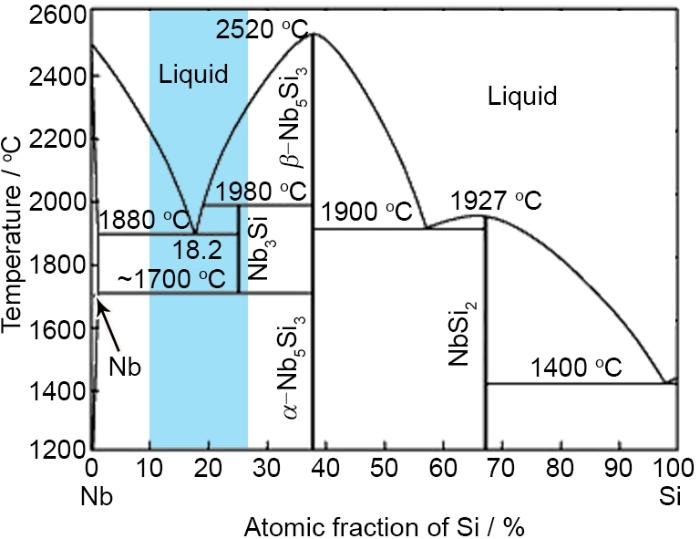
Nb-Si基超高温合金通常由铌基固溶体(Nbss)以及Nb与Si形成的金属间化合物共同构成,后者主要包括Nb3Si和Nb5Si3等[8]。从图1[9]所示的Nb-Si二元相图可以看出,Nb5Si3 可表现为α、β两种晶体结构,在特定成分条件下还可能形成γ-Nb5Si3。相较之下,Nb3Si 属于亚稳相。为了更清晰地说明后续合金化调控所涉及的相稳定背景,图1[9]中蓝色区域标示了本文重点讨论的主要相区及典型成分范围。Nb-Si基合金的成分设计主要围绕Nbss、Nb3Si和Nb5Si3三类相展开,其中本文涉及的典型成分大多分布在Si含量10%~25% (原子分数,下同)范围内。该区域通常对应Nbss与硅化物共存的组织状态,是兼顾室温韧性与高温强度的关键设计窗口。一般而言,Nbss有助于提高材料的室温韧性,Nb5Si3则是保证材料高温强度和热稳定性的主要强化相;相比之下,Nb3Si通常被认为是不利相,其含量增多会降低室温韧性并影响组织稳定性。因此,后续关于不同元素调控作用的讨论,实质上都是围绕抑制Nb3Si生成、稳定有利硅化物以及维持Nbss连续性这一主线展开的。
图1
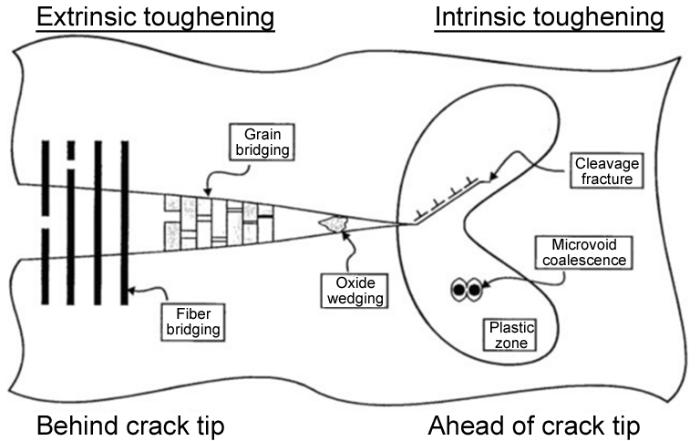
室温断裂韧性不足与高温抗氧化性能差,是Nb-Si基超高温合金长期面临的两大核心瓶颈。对于高温结构材料而言,室温断裂韧性直接关系到加工、装配和损伤容限。尽管连续分布的Nbss可通过裂纹桥接、偏转和钝化等机制提升材料韧性,但Nb5Si3等硅化物的本征脆性较强,裂纹易在脆性相和相界处萌生并快速扩展[5]。与此同时,为保证材料在1200 ℃以上仍具备较高高温承载能力,通常又需要保持较高比例的硅化物强化相,这进一步加剧了强度与韧性的矛盾。另一方面,Nb在高温氧化环境中极易形成Nb2O5,而该氧化物熔点较低、热膨胀系数与基体失配明显,难以构成稳定保护膜;虽然Si可促进SiO2形成,但单一SiO2往往难以长期保持连续与致密,也不足以完全阻止O向基体内部扩散。Nb-Si基超高温合金的相组成、组织作用及核心瓶颈示意图如图2所示。Nb-Si基超高温合金所面临的并不是单一性能缺陷,而是硅化物强化-Nbss韧化-氧化膜稳定化三者之间尚未实现有效协同的系统性问题。
图2
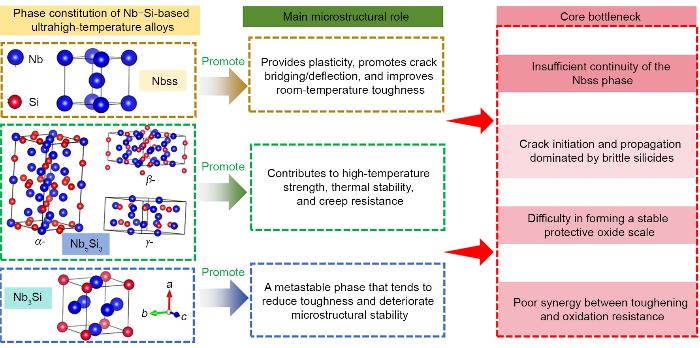
图2
Nb-Si基超高温合金的相组成、组织作用及核心瓶颈示意图
Fig.2
Schematics of phase constitution, microstructural roles, and core bottlenecks of Nb-Si-based ultrahigh-temperature alloys (Nbss—niobium solid solution)
围绕上述瓶颈,近年来国内外学者已从制备工艺优化、成分设计、热处理调控及其对微观组织的影响等多个层面开展了大量研究工作。在工艺方面,Nb-Si基超高温合金的制备工艺已由传统的熔炼、粉末冶金、定向凝固等逐步扩展到激光增材制造;在合金化方面,Ti、Zr、Mo、Cr、Al、B、Ta、Hf等非稀土元素以及Y、Er、Sc、La等稀土元素被广泛用于调控相稳定性、细化组织、改善力学性能和氧化层结构;在组织调控方面,通过凝固路径设计和后续热处理进一步优化了相分布与组织特征。基于这些研究,本文围绕Nb-Si基超高温合金的制备工艺-微观组织-性能关系,系统梳理制备工艺对组织演化的影响,归纳主要合金化元素在相稳定性、力学性能与抗氧化性能调控中的作用规律,并在此基础上总结多元合金化中的协同增益、负协同效应及设计边界,以期为面向极端服役环境的Nb-Si基超高温合金的成分设计与工程应用提供参考。
1 制备工艺对组织演化与性能的影响
图3
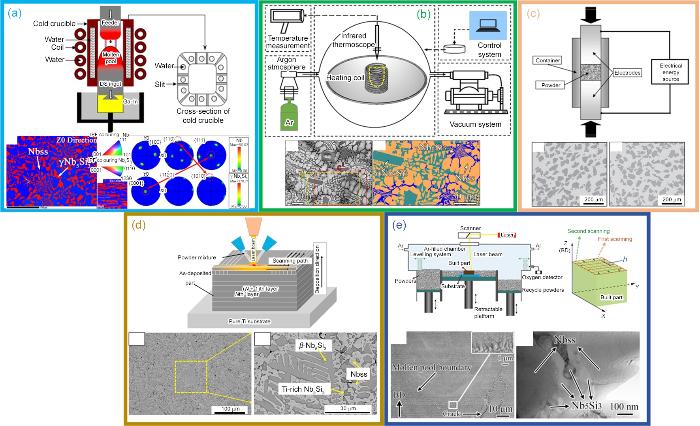
图3
Nb-Si基超高温合金制备工艺及其典型微观组织形貌[10~18]
Fig.3
Preparation processes of different Nb-Si-based ultrahigh-temperature alloys and their typical microstructures
(a) directional solidification (DS) [10] and the aligned microstructures[11](b) vacuum induction melting (VIM) [12] and as-cast coarse microstructures[13](c) spark plasma sintering (SPS) [14] and refined grains[15](d) laser directed energy deposition (LDED) and the continuous Nbss morphologies[16] (e) laser powder bed fusion (LPBF) [17] and the ultrafine microstructures[18] (BD—building direction, h—hatching distance)
定向凝固(DS)代表了Nb-Si基超高温合金向主动构造高温服役组织发展的方向。该方法通过建立稳定温度梯度并控制凝固界面移动,使晶体沿特定方向优先生长,从而形成柱状晶甚至单晶组织,减少横向晶界数量并显著提升高温强度、蠕变抗力和疲劳寿命。Guo等[19]研究表明,采用定向凝固可使硅化物沿凝固方向均匀排布;Wang等[20]在Nb-Ti-Si-Cr-Al-Hf系合金中发现,随着凝固速率增加,组织进一步细化。然而,定向凝固并不必然带来室温韧性的同步提升,其在部分体系中甚至出现轻微下降。这说明定向凝固更擅长优化承载高温载荷所需的定向组织(如定向硅化物骨架),而对室温裂纹扩展阻力的改善仍需与成分设计和相界优化相结合。
在传统熔炼工艺中,真空感应熔炼(VIM)是Nb-Si基超高温合金常用的制备方法之一。该方法利用电磁感应产生涡流加热炉料,能够提供足够高的熔炼温度,并借助电磁搅拌在一定程度上改善熔体均匀性。VIM具有若干优势,例如合金熔体过热度高、流动性好以及化学成分均匀,这些特性有利于精密铸造和金属材料的重熔,且效率较高。然而,在熔炼过程中,与合金熔体直接接触的耐火坩埚可能导致合金污染,合金熔体与坩埚材料之间的界面反应是污染的主要来源之一[12]。总体来看,传统熔炼工艺更适合作为基础研究阶段的成分制备手段,但在组织精细化和缺陷控制方面仍有不足。
粉末冶金为Nb-Si基超高温合金的组织细化与快速致密化提供了另一条有效路径。放电等离子烧结(SPS)依靠脉冲电流与压力的协同作用实现粉末快速致密化,其核心优势在于缩短烧结时间并抑制晶粒粗化;热压烧结促进粉末扩散与致密化,有利于获得更细小、更均匀的微观组织。Liu等[21]研究表明,Nb-16Si-24Ti-2Al-2Cr (原子分数,%,下同)合金经热压烧结后,在适宜烧结温度下可实现明显的组织细化并兼顾较好的抗氧化性能。由此可见,粉末冶金工艺的意义不仅在于提高致密度,更重要的是通过细化组织、抑制粗大初生相形成,为后续材料力学性能和环境稳定性的提升提供组织基础。
近年来,以激光定向能量沉积(LDED)和激光粉末床熔融(LPBF)为代表的激光增材制造技术,为Nb-Si基超高温合金的近净成形和组织精细化提供了新的可能[5,22]。LDED采用激光为热源、同步送粉为供料方式,可实现大型复杂构件的快速成形,并可利用预混合粉末在熔池中完成原位合金化,适合开展多成分高通量筛选和快速材料开发。相比之下,LPBF工艺的熔池更小、凝固速率更快,因而能够显著细化枝晶并重塑相连续性。Liu等[23]研究显示,随着激光功率提高,LDED制备Nb-17Si-23Ti合金的显微组织更加定向和均匀,二次枝晶间距细化至1~2 μm,Nbss呈连续网状分布,同时Nbss中Si和Ti的固溶度提高,从而使材料力学性能显著优化,同时Nbss断裂特征由解理向韧窝转变。
增材制造的优势不仅体现在提高材料力学性能上,也体现在改善抗氧化性能上。例如,相比于真空感应熔炼制备的样品,LPBF制备的Nb-18Si-24Ti-2Cr-2Al-2Hf合金样品具有更细化的组织和更低的氧化动力学速率[18]。经1250 ℃氧化50 h后,LPBF成形合金的氧化增重远低于传统熔炼合金;其表面可生成结构更致密、无明显剥落的氧化层,该氧化膜呈双层结构:外层为连续富Ti-Cr氧化层,内层为致密SiO2玻璃相层。上述结果表明,增材制造因快速凝固而获得超细显微组织,其作用不仅是改变合金晶粒尺寸,还可通过调控元素分布、改变氧化膜生长进程调控合金的高温氧化行为。
一方面,LPBF超高冷却速率带来的快速凝固能够大幅减小枝晶间距、弱化元素偏析,使Ti、Cr、Al、Si等有利于生成保护性氧化膜的合金元素均匀分布,因此在氧化反应初期即可快速生成外层富Ti-Cr氧化层、内层SiO2玻璃层的完整防护氧化膜。另一方面,细化的组织缩短了Si、Al、Cr等元素向氧化界面扩散的特征距离,有利于快速补充保护性氧化物形成所需的元素,减少局部Si贫化,从而抑制疏松、非保护性Nb2O5的过量生成。连续外层氧化物可降低O向内扩散通量,内层的SiO2则因具有较低的O扩散系数而阻挡O进入基体。与此同时,分层且较连续的氧化膜能够缓解单一脆性氧化层中的热应力集中,减少孔洞、裂纹和剥落,从而提高氧化膜与基体之间的附着力。因此,快速凝固改善抗氧化性能的关键在于组织细化-元素均匀化-保护性氧化物连续化-O扩散路径延长之间的协同作用。
表1 Nb-Si基超高温合金主要制备工艺对比[5,15,18~21,23~26]
Table 1
| Process | Microstructure characteristic | Main advantage | Main limitation | Representative application |
|---|---|---|---|---|
| Coarse as-cast structure;microsegregation;shrinkage cavities;limited Nbss continuity control | Mature process;flexible alloy design;convenient for composition exploration | Inhomogeneous solidification;casting defects;limited ingot size | Alloy preparation; composition optimization; phase analysis | |
| Refined grains;high densification;uniform phase distribution | Grain refinement; defect reduction; improved microstructure homogeneity | High powder cost; bulk size limit; complex processing | Dense bulk alloy fabrication; fine-grained design | |
| Refined silicides; ordered phase alignment; directional Nbss/silicides distribution | Excellent high-temperature strength, creep resistance; directional load-bearing | Narrow processing window; strict equipment control; poor room-temperature toughness | High-temperature alloy development; creep-resistant design | |
| Ultrafine structure;reduced dendrite spacing; enhanced Nbss continuity | Near-net shaping of complex parts; strong grain refinement; rapid composition iteration | High residual stress; pronounced anisotropy; unstable process parameters | Complex component fabrication; rapid alloy development |
2 合金化对相稳定性与组织调控的作用规律
在常见的合金化元素中,Ti、Zr和Mo对抑制Nb3Si生成及稳定Nb5Si3的影响最为典型。Ti是Nb-Si基超高温合金中最常用的元素之一,可显著改变硅化物结构类型和固溶行为。Sala和Mitra[27]研究表明,在含Ti元素的Nb-Si四元合金中,除原有Nbss和Nb5Si3外,还可能出现主要分布于枝晶间区域的β-Tiss (钛基固溶体)相。更重要的是,Ti的较优添加范围通常集中在10%~24%,此时Ti合金化对Nb5Si3多晶型稳定性和Nbss固溶行为的影响主要来自原子尺寸、元素分配与相稳定性的共同作用。Ti与Nb均可形成bcc结构固溶体,二者具有较高互溶能力,因此Ti容易进入Nbss中形成置换固溶体,提高Nbss的成分容纳能力并降低局部成分偏析。同时,Ti可部分取代Nb5Si3中的Nb原子位置,改变硅化物晶格畸变、键合状态和不同 Nb5Si3多晶型之间的相对稳定性,从而提高γ-Nb5Si3的形成倾向,并抑制α-Nb5Si3的生长。
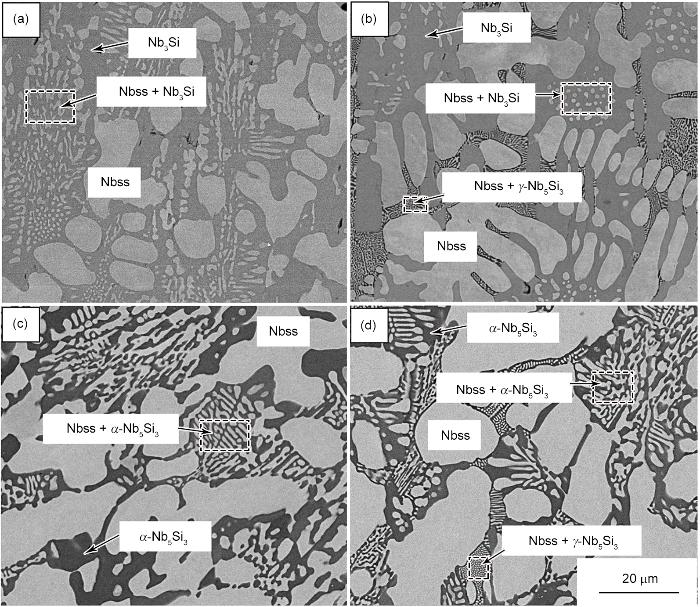
Zr合金化则表现出更典型的改变相转变路径的特征。Li等[28,29]研究发现,Zr合金化有助于γ-Nb5Si3的形成。Sankar等[30]研究表明,在Nb-Si-Zr合金中,当Zr含量较低时,合金主相仍以Nbss与Nb3Si为主;当Zr含量提高到约4%及以上时,Nb3Si可通过共析分解方式转变为平衡态Nb5Si3,并进一步促进α-Nb5Si3向γ-Nb5Si3转变,如图4[30]所示。Zhang等[31]研究发现,Zr通常富集于Nb5Si3中,形成(Nb, Zr)5Si3固溶体,并伴随共晶组织细化及晶粒取向差增大。由此可见,Zr的作用在于改变相稳定顺序和析出路径,从而使Nb-Si基超高温合金更容易形成有利于综合性能的相组合。
图4
Ta合金化的特点则更接近改形不改类。Yu等[39]研究表明,在Nb-Ti-Si-Zr-Hf-Al基合金中,Ta合金化通常不会改变基础相的种类,组织仍主要由Nbss和γ-(Nb, X)5Si3构成。这与Ta的原子半径与Nb接近,易在Nbss中形成置换固溶体有关。但Ta合金化可以改变相的分布特征。低含量Ta,尤其含量约为1%时,可细化组织、减小γ-(Nb, X)5Si3相尺寸并降低Nbss中的Si含量;当Ta含量进一步提高时,初生γ-(Nb, X)5Si3相的数量增加,Nbss的面积分数下降,脆性相比例随之上升。因此,Ta更适合作为通过调整Nbss和 γ-Nb5Si3的形貌和比例从而改善相匹配的元素,而不是主导相种类变化的核心元素。
图5
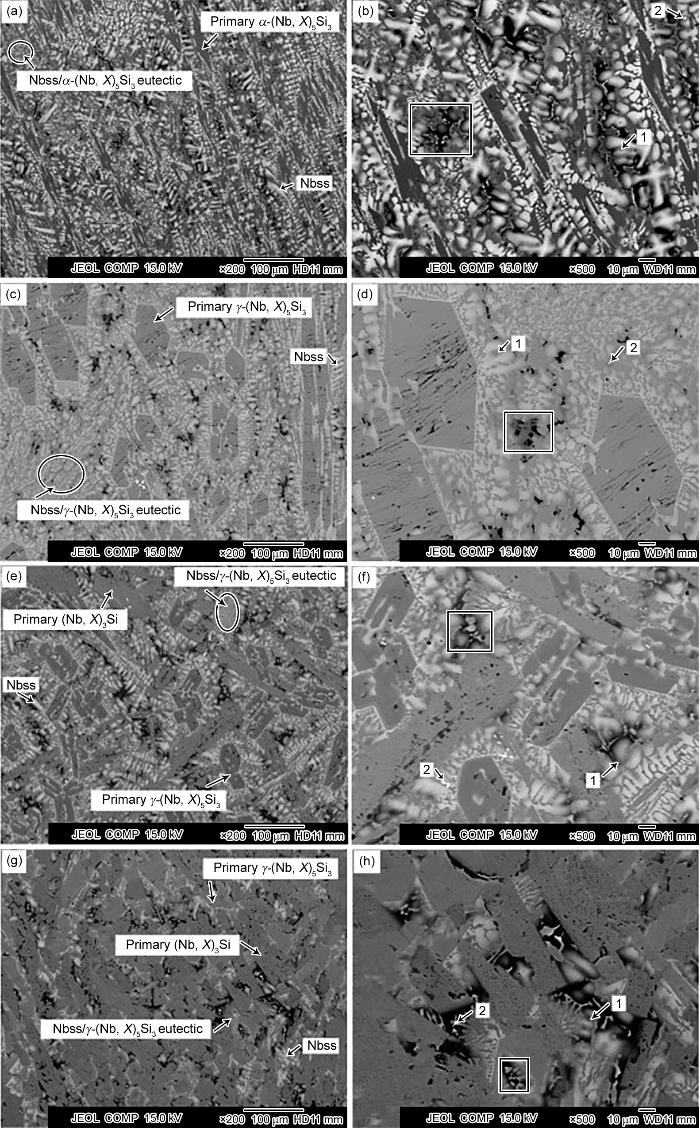
图5
电弧熔炼Nb-22Ti-16Si-5Cr-4Hf-3Al-xB合金的BSE像[44]
Fig.5
Low (a, c, e, g) and high (b, d, f, h) magnified BSE images of arc-melted Nb-22Ti-16Si-5Cr-4Hf-3Al-xB alloys[44](The rectangle areas in Figs.5b, d, f, and h indicate the regions containing Nbss/(Nb, X)5Si3/Cr2(Nb, X) three-phase eutectics)
(a, b) x = 0 (c, d) x = 2 (e, f) x = 5 (g, h) x = 10
综上所述,合金元素对Nb-Si基超高温合金组织调控的作用可归纳为三类:第一类为相稳定与共晶路径调控元素,如Ti、Zr和Mo,其主要作用是抑制Nb3Si相生成、促进Nb5Si3尤其是γ-(Nb, X)5Si3相的稳定形成,并通过细化共晶组织和改善 Nbss/硅化物分布提高组织协调性;第二类为组织拓扑结构调节元素,如Cr、Al、Ta、Hf和B,其作用不仅取决于元素本身,还高度依赖基体成分和元素添加量窗口,元素适量添加可优化硅化物尺寸、相界状态和裂纹扩展路径,元素过量则可能增加Cr2Nb、Nb3Al或粗大硅化物等脆性相的数量;第三类为界面净化和氧化膜辅助调控元素,如Y、La、Sc、Er、Gd等稀土元素,其主要通过熔体净化、晶粒细化、相界优化和氧化物颗粒稳定化增强合金化效果。因此,Nb-Si 基超高温合金的组织优化是由相稳定性、相比例、相分布与界面状态共同决定的。
3 合金化对力学性能的影响机制
图6
Zr合金化对Nb-Si基超高温合金力学性能的改善则更偏向固溶强化+组织细化+相稳定性优化的综合作用。Sankar等[30]发现,Zr作为Nb3Si和Nb5Si3相的有效固溶强化元素,可显著提高二者的弹性模量和硬度;同时,可有效细化共晶组织、提高Nbss塑性并改善相稳定性,还有助于提升室温断裂韧性和高温抗压强度。Li等[29]研究表明,在LDED制备的Nb-22Ti-16Si-xZr (x = 0~15) 合金中,添加5%Zr能够显著提升韧性,过量Zr因硬脆硅化物增多导致韧性下降。Qiao等[58]研究发现,随着Zr含量增加,电弧熔炼Nb-22Ti-15Si-5Cr-3Hf-3Al-xZr (x = 0、1、2、4、8)合金的室温韧性和高温强度均显著提高,其中4%~8%常被认为是较优的Zr含量区间。但当Zr含量超过适宜窗口后,脆性γ-Nb5Si3相增多、α-Nb5Si3相比例下降,由组织中的脆性相构成的连续网络重新形成并增强,最终导致合金力学性能恶化。如图7 [59]所示,Nb-16Si-22Ti-2Al-2Cr合金的室温断裂韧性在含2%Zr时达到峰值,为14.15 MPa·m1/2、含10%Zr时回升至14.03 MPa·m1/2;随着Zr含量增加,1200 ℃高温抗压强度先降低后升高。上述研究表明,Zr的有效作用建立在组织细化与相稳定性改善大于脆性相增多这一前提之上。
图7

图7
不同Zr含量电弧熔炼Nb-16Si-22Ti-2Al-2Cr合金的力学性能[59]
Fig.7
Mechanical properties of Nb-16Si-22Ti-2Al-2Cr alloy with different Zr contents obtained by arc melting[59]
(a) loading-displacement curves(b) room-temperature fracture toughness (KQ)(c) volume fractions of constituent phases(d) true stress-strain curves(e) high-temperature compression strengths and variable quantities
Cr、B、Al、Ta和Hf元素的作用则体现出更明显的窗口依赖性。Cr合金化虽能提升Nb-Si基超高温合金的显微硬度和部分高温性能,但通常会降低室温断裂韧性,且脆化效应随Cr含量增加而加剧,其主要原因在于Cr倾向于增加脆性相比例并使Nbss脆化[37,61]。B元素在适当条件下可显著提高高温强度,但其强化通常伴随着塑性相比例下降和脆性相增多,因此对室温韧性不利[43]。Al合金化则更具体系依赖性。在部分高Al含量体系中,Al通过替代Nb5Si3中的Si、降低共价键比例并生成较具塑性的Nb3Al,可显著改善断裂韧性[38];但在更多体系中,Al会减小Nbss的稳定范围并提高脆性相比例,导致韧性下降。Ta元素的添加量通常较低,添加约1%Ta时可通过细化组织、降低Nbss中的Si含量和增加裂纹偏转路径提升断裂韧性,过量添加Ta则导致初生脆性相增多[39,62]。Hf元素则通常表现出更稳定的韧化作用,可通过细化组织、优化相分布并改变Nbss的断裂行为,使裂纹桥接与偏转更加明显,因此在若干体系中兼具韧化与强化潜力[61,63,64]。
从组织调控与力学性能的对应关系来看,Nb-Si基超高温合金的强韧化取决于Nbss、硅化物与相界三者之间的协同。连续或半连续Nbss能够通过裂纹桥接、裂纹偏转和裂尖塑性耗能提高室温断裂韧性;细小、弥散且形貌规则的Nb5Si3有利于提升高温强度和蠕变抗力;稳定且协调的Nbss/硅化物界面则可降低裂纹沿脆性相快速贯通的倾向。因此,Ti、Zr、Hf、Ta等元素的韧化作用主要来自Nbss连续性维持、硅化物细化和裂纹路径复杂化,而Mo、B等元素的强化作用更多来自硅化物稳定化、固溶强化和共晶组织重构。相反,当Cr、Al、B或过量Zr、Mo、Ta导致脆性相比例升高、Nbss连续性下降或界面协调性恶化时,室温韧性往往下降。由此可见,Nb-Si基超高温合金力学性能优化的核心应从提高某一相含量转向构建可耗能、可承载、可阻裂的多相组织。
4 合金化对抗氧化性能的影响机制
Nb-Si基超高温合金的高温环境失效首先表现为氧化行为失控,而利用合金化改善抗氧化性能的本质,不是单纯降低一次氧化实验中的增重,而是在高温暴露过程中形成连续、致密、附着性良好且生长稳定的保护层。Nb-Si基超高温合金抗氧化性能的核心矛盾来自Nb的本征氧化特征,即高温下易生成Nb2O5,而该氧化物熔点较低,易软化、挥发,并因热膨胀失配而在热暴露过程中易开裂、剥落。虽然Si可促进SiO2生成,但单一SiO2往往难以长期保持完整,也不足以完全阻挡O向基体内部扩散。Nb-Si基超高温合金的抗氧化机制图如图8所示。可见,Nb-Si基超高温合金的抗氧化设计应围绕抑制Nb2O5、促进复合保护层形成以及提高膜层完整性与附着力展开。
图8
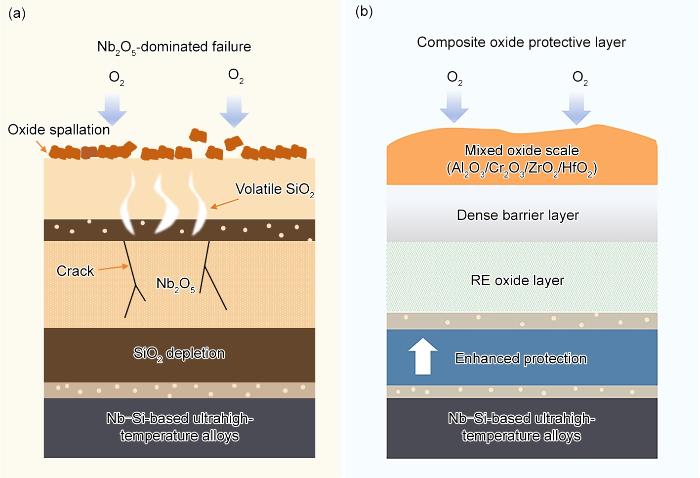
图8
Nb-Si基超高温合金的抗氧化机制图
Fig.8
Schematics of antioxidation mechanism of Nb-Si-based ultrahigh-temperature alloys
(a) Nb2O5-dominated failure mechanism (b) composite oxide protective layer (RE—rare earth)
有利于Nb-Si基超高温合金抗氧化性能的氧化层通常具有两个特征:一是存在高稳定性氧化物,如Al2O3、Cr2O3、HfO2或稀土复杂氧化物;二是膜层具有分层或复合特征,使外层、过渡层和内层共同形成多级扩散屏障。内层连续分布的SiO2、过渡层内弥散析出的细小稀土氧化物颗粒,以及外层的Al2O3或富集Cr的氧化物,都能够在不同层级上阻碍O向内扩散,降低膜层生长应力并提高其附着性。相反,一旦氧化层中的孔隙率升高、低熔点氧化物挥发或脆性相导致热循环应力集中,氧化动力学便容易由抛物线规律转向线性规律,表明膜层已失去有效保护作用。
在常见的非稀土元素中,Ti元素的抗氧化作用最能体现温区依赖性。Sala等[65]研究表明,Ti对Nb-Si基超高温合金的作用并非始终正向:在较低温度区间,Ti可能因快速氧化形成TiO2并诱发氧化皮开裂,从而削弱保护性;而在1100~1200 ℃下,Ti又能够显著降低氧化增重和氧化速率,使合金更接近稳态氧化。这说明Ti是典型的温区敏感型调控元素,其有效性取决于温度条件及其对氧化层结构的具体影响。
图9
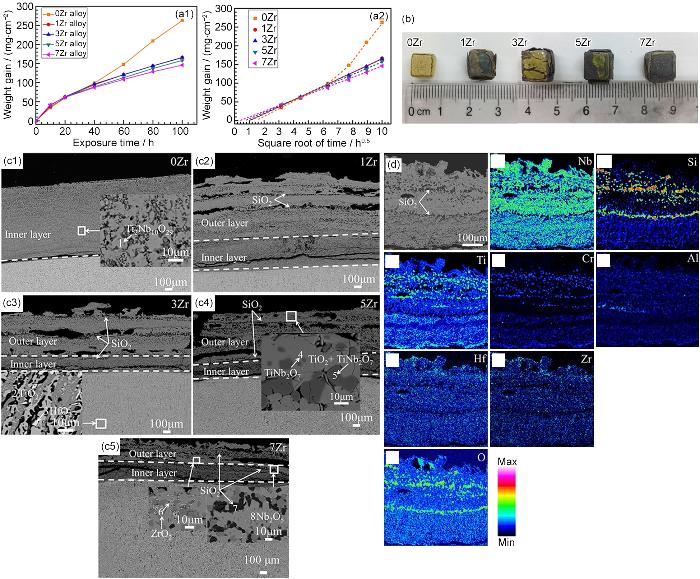
图9
添加Zr对Nb-Si基超高温合金高温抗氧化性能的影响[31]
Fig.9
Effects of Zr addition on high-temperature oxidation resistance of Nb-Si-based ultrahigh-temperature alloys[31]
(a1, a2) weight gain versus time (a1) and the square root of time (a2)(b) macroscopic morphologies before and after oxidation at 1300 oC for 100 h(c1-c5) cross-sectional SEM images of the oxide layer in 0Zr (c1), 1Zr (c2), 3Zr (c3), 5Zr (c4), and 7Zr (c5) alloys(d) BSE image and corresponding EDS elemental mappings of the oxide layer
Cr和Al是Nb-Si基超高温合金中最典型的抗氧化主导元素。Cr可促进Cr2O3或CrNbO4等保护性氧化物形成,改善高温氧化膜结构,并在多元体系中与Ti、Si等共同构筑致密复合保护层[35,66,67]。然而,Cr的作用也具有温度上限,当温度过高时,挥发性CrO3的生成会削弱保护效果[68]。Al元素则是较稳定的抗氧化改善元素,其核心作用在于形成致密Al2O3保护膜并促进Si-Al复合氧化物生成,从而将不稳定的Nb2O5氧化层转化为以Al2O3和复合氧化物为骨架的稳定防护层[38,68]。因此,Cr更偏向于促进特定防护性氧化相的生成,而Al更倾向于重构主导氧化产物类型,两者常通过协同作用获得更优的抗氧化效果。
稀土元素在改善抗氧化性能方面常表现出少量掺杂即可显著提升氧化防护能力的效果。其共性机制主要包括:优先与O结合实现熔体和界面净化;在氧化层或相界附近形成稳定的氧化物颗粒,阻碍O向基体扩散;通过构建复杂氧化物层提高膜层附着力与结构完整性。La、Sc、Er、Y以及Ce等元素都在不同Nb-Si基超高温合金体系中显示出这一规律。La合金化能通过原位形成La2O3同时提升韧性与抗氧化性能;Sc合金化可在相界形成Sc2O3,并与TiO2、SiO2协同构建连续氧化屏障;Er合金化不仅能够通过形成Er2O3而净化熔体,还可促进ErNbO4等复杂氧化物形成,使氧化动力学更接近稳定的抛物线规律;Y以及Ce等低含量稀土元素则主要通过细化组织、提高膜层致密性和附着性来发挥作用[45~54]。因此,稀土元素改善Nb-Si基超高温合金抗氧化性能的关键,在于以微量方式稳定氧化层的生长过程。
然而,抗氧化性能提升与室温韧性之间并不总是相容的。Cr和Al合金化尤其体现了这种权衡关系:它们虽有助于构建稳定氧化膜,却常常伴随脆性相增多和Nbss相减少,导致室温韧性下降。Ti、Mo、B和Ta等元素也都表现出温区和含量窗口敏感性。表2[31,33,35,36,39,42,44~54,58,65~70] 为主要合金元素对Nb-Si基超高温合金氧化行为的影响。可以看出,对Nb-Si基超高温合金而言,抗氧化设计应在氧化膜层稳定性、室温韧性与高温强度之间寻求综合平衡。从组织调控与抗氧化性能的关系看,Nb-Si基超高温合金抗氧化能力的提升主要依赖两条路径:一是通过Al、Cr、Hf、Zr和稀土元素促进Al2O3、Cr2O3、HfO2、ZrO2、稀土氧化物及SiO2等稳定氧化物形成,构建连续、致密、附着性良好的复合氧化层;二是通过细化组织、改善相分布和减少O扩散通道,延缓O向基体内部扩散。值得注意的是,抗氧化性能提升往往与力学性能改善存在竞争关系。Cr和Al虽有利于形成保护性氧化物,但过量添加可能降低Nbss连续性或增加脆性相比例,从而削弱室温韧性;Zr、Hf和稀土元素则更倾向于通过弥散氧化物填充孔隙、改善氧化膜附着性和界面稳定性,在一定条件下可兼顾韧性与抗氧化性能。因此,抗氧化设计应同时考虑氧化膜稳定性、Nbss连续性与脆性相比例之间的平衡。
表2 合金元素对Nb-Si基超高温合金氧化行为的影响对比[31,33,35,36,39,42,44~54,58,65~70]
Table 2
Alloying element | Main oxide-scale feature | Protective effect | Main trade-off |
|---|---|---|---|
Ti[65] | TiO2-containing composite scale, Ti-rich outer layer; can form denser layer at high temperature | Improves compactness at > 1100 oC | Poor efficacy at lower temperatures; clear temperature window |
| ZrO2 particles/regions; improved continuity of inner SiO2 layer | ZrO2 fills defects, reduces porosity, stabilizes protective sublayer | Excess Zr increases brittle silicide fraction and degrades mechanical balance | |
Mo[33] | Less porous at suitable content; excessive Mo introduces pores and fast-diffusion paths | Optimizes phase constitution and indirectly retards oxidation at appropriate levels | Narrow beneficial window; overaddition aggravates oxidation via pore formation |
| Forms Cr2O3, CrNbO4, or Cr-enriched outer scale; promotes dense external protective layer | Enhances compactness and slows inward oxygen diffusion | Often sacrifices room temperature toughness | |
| Forms relatively dense Al2O3-containing scale; suppresses loose Nb2O5 growth | Improves scale continuity, compactness, and oxygen-barrier capability | Reduces Nbss continuity and lowers room-temperature toughness | |
Ta[39] | Slightly denser scale; in some systems, helps reduce severe scale disruption | Indirectly optimizes phase constitution and oxidation response | Very narrow optimum (~1%, atomic fraction); over-addition reverses the benefit |
| HfO2-containing scale or dispersed Hf-rich oxides; denser and more adherent multilayer architecture containing scale or dispersed Hf | Markedly improves scale adhesion, suppresses spallation, stabilizes protective layers | Increases density and cost; excessive Hf complicates phase constitution | |
| Alters oxidation response mainly through microstructure/eutectic modification, not by forming a dominant oxide | Refines microstructure and helps construct a more uniform oxidation pathway | Very narrow window; excess B increases silicide fraction, impairing toughness and oxidation balance | |
| Forms stable rare-earth oxides or complex oxides (e.g., ErNbO4); denser and more adherent scale | Reactive element effect: improves adhesion, suppresses cracking/spallation, reduces oxygen diffusion, purifies interfaces | Effective only at trace/low levels; over-addition forms coarse oxides/inclusions that degrade integrity |
5 多元合金化的效应与设计边界
单一元素合金化虽然能够对Nb-Si基超高温合金某一性能的改善产生明显效果,但通常难以同时解决其室温韧性不足、高温强度要求高与抗氧化性能薄弱这三类核心矛盾。其根本原因在于,单一元素往往只能主导某一类机制,例如,稳定特定硅化物、强化Nbss或改善氧化膜组成,却难以在不同性能目标之间建立持久而稳定的协同关系。正因如此,Nb-Si基超高温合金的成分设计已逐步由二元、三元体系向多组元体系发展,多元合金化成为实现综合性能优化的重要路径。多元合金化的价值并不只是把若干有益元素简单叠加,而是通过不同元素之间的功能分工和机制互补,重新构筑合金内部的相稳定关系、裂纹扩展路径和氧化膜生长行为。这类效应大体可分为两类:一类是协同增效,即不同元素在组织调控、强韧化或抗氧化方面形成互补,最终带来超过单一元素线性叠加的综合性能提升;另一类是负协同效应,即某些元素虽分别具备提升性能的局部正效应,但复合后在相组成、氧化产物或界面应力方面产生冲突,反而使部分关键性能恶化。
图10[40,61,71~74]从室温韧性和抗氧化性能两个维度,总结了Nb-Si基超高温合金中代表性多元合金化体系的定性设计窗口。Zr-Mo和Ti-Zr-Hf体系位于协同设计窗口内,表明它们在多性能优化方面具有相对均衡的潜力。Cr-Hf体系位于抗氧化主导区域,其抗氧化性能的提升通常伴随着韧性的权衡。相比之下,Zr-Ti体系更接近韧性主导区域,但其进一步应用仍受到抗氧化性能不足的限制。Mo-B和Mo-V体系则对性能的提升有限且处于负协同区域,反映出它们的成分窗口更窄、性能约束更强。可见,Nb-Si基超高温合金中多元合金化所带来的优势并非普适存在,而是高度依赖于协同强化、氧化防护及伴随的性能之间的平衡。
图10
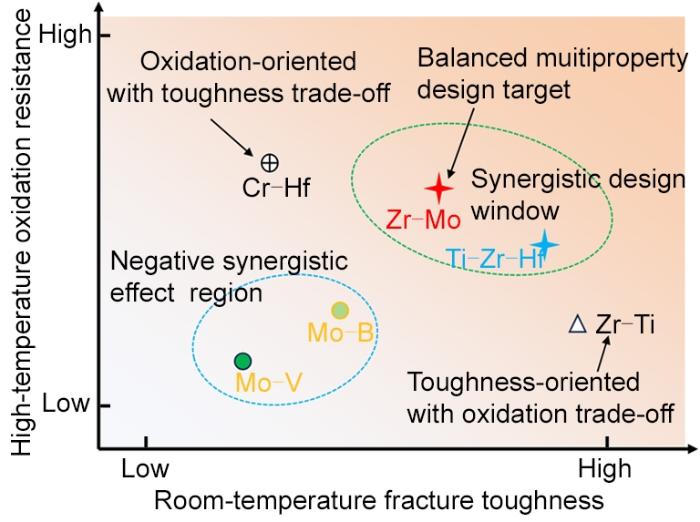
从组织调控-力学性能-抗氧化性能的关联角度分析,多元合金化体系可进一步归纳为三种类型。第一种为综合协同型,如Zr-Mo和Ti-Zr-Hf体系,其共同特征是能够同时促进有利硅化物稳定、细化共晶组织、维持一定的Nbss连续性,并改善裂纹扩展路径,因此在室温韧性与高温强度之间表现出较好的平衡。其中,Zr主要通过促进γ-(Nb, X)5Si3相形成和细化组织发挥作用,Mo主要通过抑制Nb3Si生成、强化Nbss/硅化物并调节氧化过程发挥作用,二者结合体现出稳定相-强韧化-氧化膜优化的互补关系。第二种为抗氧化主导型,如Cr-Hf和Cr-Al体系,其优势在于形成Cr2O3、Al2O3、HfO2或复合氧化层,提高氧化膜致密性和附着性,但往往需要面对Cr2Nb和脆性硅化物增多或Nbss连续性下降带来的韧性损失。第三种为窗口敏感型或负协同型,如Mo-B、Mo-V和部分Zr-Ti体系,这类合金可能在高温强度或室温韧性方面具有优势,但由于脆性相比例、低熔点氧化物含量、O扩散行为及不同服役温度下的组织和性能稳定性等方面存在差异的影响,难以同时实现强韧化与抗氧化性能协同提升。由此可见,多元合金化设计的关键是明确各元素在稳相、韧化、强化和氧化膜构筑中的功能分工,避免不同机制之间的相互抵消。
Zr、Mo元素协同是最具代表性的协同增效体系之一。Li等[75]研究了Mo与Zr协同作用对Nb-Ti-Si基合金的影响,结果表明,两者协同能够抑制脆性相Nb3Si的形成,同时稳定γ-Nb5Si3相,进而提升断裂韧性。Ma和Guo[71]研究表明,Zr能够推动Nb-Si基超高温合金组织由共晶向过共晶特征转变,抑制α-(Nb, X)5Si3相的形成并促进γ-(Nb, X)5Si3相稳定析出,而Mo更侧重于提高Nbss与硅化物的高温承载能力,同时通过调节氧化过程中的应力释放程度改善膜层稳定性。两者复合后,Nb-Si基超高温合金在高温力学性能和抗氧化行为方面均表现出优于单一元素添加的综合效果,如图11[71]所示,说明该组合的本质在于组织重构+高温强化+氧化膜优化三个层面的互补。
图11
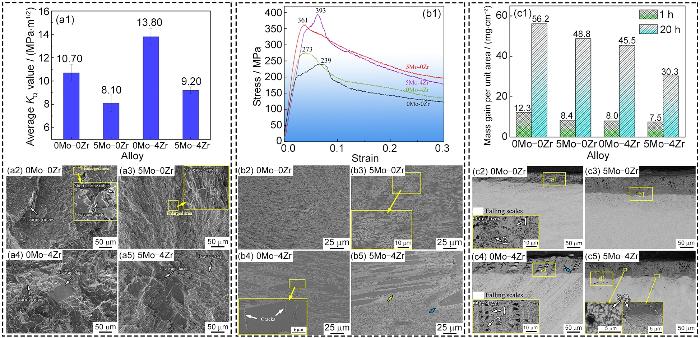
图11
Mo与Zr对Nb-Si基超高温合金力学性能及高温抗氧化性能的协同影响[71]
Fig.11
Synergistic effects of Mo and Zr on mechanical properties and high-temperature oxidation resistance of Nb-Si-based ultrahigh-temperature alloys[71]
(a1-a5) KQ (a1) and fracture surface morphologies of 0Mo-0Zr (a2), 5Mo-0Zr (a3), 0Mo-4Zr (a4), and 5Mo-4Zr (a5) alloys
(b1-b5) high-temperature compression stress-strain curves (b1) and deformation microstructures of 0Mo-0Zr (b2), 5Mo-0Zr (b3), 0Mo-4Zr (b4), and 5Mo-4Zr (b5) alloys
(c1-c5) oxidation mass gain (c1) and microstructures of oxide layers of 0Mo-0Zr (c2), 5Mo-0Zr (c3), 0Mo-4Zr (c4), and 5Mo-4Zr (c5) alloys
Ti-Zr-Hf三元体系则体现出典型的组织诱导型协同。Wang等[40]研究表明,Zr合金化是促进γ-(Nb, X)5Si3相形成的关键元素,而Ti和Hf元素的进一步加入可放大这种组织优势,使Nbss/γ-(Nb, X)5Si3共晶更加规则,并显著增加裂纹桥接、偏转和二次裂纹等韧化机制的发生概率。其结果是通过诱导有利硅化物、构建更规则的拓扑组织以及改善裂纹扩展行为,使室温断裂韧性显著提升。
Cr、Hf协同则更能体现性能补偿型协同的思路。Zhang和Guo[61]研究发现,Cr合金化虽是提升高温抗氧化性能的关键元素,但常导致Nbss脆化和脆性相增多,从而降低室温韧性;Hf合金化则具有细化组织、优化相分布和缓解裂纹快速扩展的作用。两者复合后,Hf合金化能在一定程度上抵消Cr带来的韧性劣化,而 Cr合金化又可弥补单独Hf体系抗氧化性能提升有限的问题。此类体系的价值,在于通过明确的角色分工,使抗氧化主导元素与韧化补偿元素共同作用,维持更合理的综合性能平衡。Mo、B协同则更多体现为凝固组织调控机制:二者复合后可通过改变共晶形态,提高高温抗压强度并使室温韧性出现一定回升,说明性能提升有时首先来自拓扑组织的优化,而非单一相本征性能的提高[73]。
但是,并非所有元素组合都会产生正向协同效果。Mo、V复合就是典型的负协同体系[74]。虽然单独 Mo合金化可通过抑制Nb3Si生成、强化Nbss/硅化物并改善共晶组织规则性提高高温承载能力,但Mo与V复合添加后容易对性能产生不利的影响。其原因主要包括两个方面:一方面,Mo和V均可进入Nbss或硅化物中形成固溶强化,适量的固溶强化有利于提高高温强度,但过强的固溶强化会降低Nbss塑性变形能力,使裂纹尖端难以通过Nbss塑性耗能实现钝化和桥接;另一方面,V的加入可能改变硅化物的形貌和相比例,使组织中脆性相或脆性界面的比例增加,从而为裂纹萌生和快速扩展提供更多路径。因此,在Mo已经强化基体和硅化物的基础上,继续引入V可能使组织由强化转向脆化,表现为室温断裂韧性下降。
Zr、Ti协同则代表了另一类局部有效、整体受限的负协同体系[72]。该组合虽可改善室温韧性和抗压强度,但在中温区间的抗氧化性能却可能明显恶化。Zr、Ti协同对Nb-Si基超高温合金氧化行为的影响具有明显的温区依赖性。在较高温度下,Ti元素可通过形成TiO2或富集Ti的复合氧化物参与构建外层保护膜,而Zr倾向于优先氧化生成弥散分布的ZrO2。适量ZrO2可填充孔隙并改善氧化膜致密性,但当Zr改变了Ti在基体和氧化层中的分配行为时,可能削弱富集Ti的氧化物层的连续性。同时,Zr诱导的Nbss比例增加会提高Nb2O5形成倾向,而Nb2O5疏松且易开裂,保护性较差。因此,在中温区,Zr、Ti复合添加可能导致氧化膜由连续富集Ti/Si的保护层转向Nb2O5与离散ZrO2/TiO2共存的非连续结构,从而降低抗氧化性能。这说明,多元合金化对不同性能目标和不同温区之间的响应方向不一致,对于宽温域、热循环服役场景而言,这种局部负协同尤需引起重视。
从总体规律看,要真正通过多元合金化实现Nb-Si基超高温合金综合性能的提升,通常需要同时满足三个条件:一是抑制对韧性和组织稳定性不利的Nb3Si相的形成;二是稳定更有利的硅化物类型和分布,特别是促进γ-(Nb, X)5Si3相形成、细化共晶并维持合理的Nbss连续性;三是在高温氧化过程中形成更致密、更稳定的复合氧化层。当不同元素在相稳定、强韧化和抗氧化三个层面形成清晰分工且彼此兼容时,Nb-Si基超高温合金才可能获得跨尺度、跨性能目标的协同增益。
然而,多元合金化的设计空间并非无限扩展,而是受到明显的成分窗口和体系边界约束。Zr含量通常在4%~8%更有利于组织和力学性能优化;Mo含量较低时有益于组织和力学性能优化,过量Mo则导致Nbss脆化和孔洞数量增加;B和Ta合金化也都表现出典型的最佳添加范围。更重要的是,同一元素的作用可能随Nb、Ti 和 Si的比例,Cr和Hf的含量以及凝固条件的不同而发生改变。表3[35,40,61,71~77]为Nb-Si基超高温合金中多组元合金化体系的协同效益、主要风险和应用目标。可以看出,Nb-Si基超高温合金的多元设计并不存在脱离基体成分和工艺条件的普适最优方案,真正有效的设计边界应建立在具体基体-具体工艺-具体服役目标共同约束下的综合可行区间之上。
表3 Nb-Si基超高温合金中多组元合金化体系的协同效益、风险及应用目标[35,40,61,71~77]
Table 3
Alloy combination | Main benefit | Main risk | Best application target |
|---|---|---|---|
| Improves phase stability, suppresses Nb3Si, refines microstructure, enhances both toughness and oxidation resistance | Narrow content windows; excess Mo embrittles Nbss and worsens oxidation, excess Zr increases brittle silicide | Balanced design for toughness + high- temperature strength + oxidation resistance | |
Ti-Zr-Hf[40] | Stabilizes favorable silicide constitution, improves phase distribution, retains better strength-toughness balance than single additions | Excess total addition reduces Nbss continuity, raises silicide fraction, increases density/cost | Integrated microstructure optimization focusing on phase stability and toughness retention |
Cr-Hf[61] | Oxidation-oriented synergy: Cr builds protective external oxides, Hf improves scale adhesion and long-term stability | Still increases brittle intermetallic fractions; room temperature toughness remains a concern if Cr is too high | High-temperature oxidation resistance with improved scale stability |
| Cr-Al[35] | Strong oxidation synergy via dense Cr/Al-containing protective scales | weakened Nbss continuity and increased brittle phases | Oxidation-prioritized alloy design |
Mo-B[73] | Strong high-temperature strengthening synergy via phase regulation + eutectic-path control; overall performance improves with careful B control | B has very narrow safe range; excess B sharply increases brittle silicide, excess Mo narrows toughness margin | High-temperature strength and microstructure-regulated eutectic design |
Zr-Ti[72] | In selected systems, improves room temperature toughness and compressive strength through combined refinement and phase-distribution optimization | Benefits not universal; oxidation benefit is limited and strongly system dependent | Toughness-oriented or mechanically balanced composition design |
Mo-V[74] | May provide selective strengthening in some compositions | Often limited or antagonistic overall benefit; can increase phase complexity and reduce toughness if poorly controlled | Exploratory strengthening-oriented design, not mainstream balanced route |
Ti-Zr-Mo[76] | Combines Ti-assisted phase adjustment, Zr refinement, and Mo-driven Nb3Si suppression; potentially beneficial for overall structural optimization | Strong system dependence; optimum balance shifts with base Si/Ti/Nb ratio and processing route | Comprehensive phase-constitution and morphology control |
RE-containing multicomponent[77] | Trace RE addition amplifies benefits of other elements via melt purification, interface improvement, oxide-scale stabilization, and microstructural refinement | Over-addition introduces oxide inclusions, segregation, or coarse particles, offsetting synergy | Controlling inclusions, segregation, or coarse particles to preserve synergy |
6 总结与展望
Nb-Si基超高温合金凭借超高熔点、低密度及优异的高温强度和蠕变抗力,被认为是替代镍基高温合金、应用于1200~1400 ℃热端构件的关键候选材料。然而,Nbss相与Nb5Si3相之间固有的强韧性矛盾,以及Nbss相高温抗氧化能力不足,导致室温韧性与高温抗氧化性能难以兼顾,成为其工程应用的核心瓶颈。近年来,随着制备工艺优化、合金化设计和组织调控的发展,Nb-Si基超高温合金的研究已由单一性能提升逐步转向综合性能协同优化。制备工艺是决定组织结构和性能水平的重要基础。传统熔炼适用于成分探索,粉末冶金有利于组织细化与快速致密化,定向凝固可构建取向组织以提升高温承载能力,而增材制造则在细化组织、改善Nbss连续性及提高氧化膜致密性方面展现出明显优势,体现了工艺-组织-性能协同设计的重要性。合金化设计是实现综合性能优化的核心途径。Ti、Zr、Mo等元素主要通过稳定有利硅化物Nb5Si3相、抑制脆性Nb3Si相形成及优化共晶组织提升强韧匹配;Cr、Al、Ta、Hf等元素则通过调控相组成及促进保护性氧化膜形成改善高温抗氧化性能,但均存在明显的含量窗口和体系依赖性。稀土及微量活性元素可进一步通过熔体净化、界面调控和复杂氧化物形成增强组织稳定性和氧化膜防护能力。
当前,多元协同合金化已成为Nb-Si基超高温合金设计的主要发展方向。当不同元素在相稳定、高温强化和氧化膜构筑等方面形成互补作用时,可获得显著的协同增益;反之,若元素间在相稳定性、氧化行为或组织演化方面存在冲突,则易产生负协同效应,削弱综合性能。
总体而言,Nb-Si基超高温合金的合金化设计可归纳为“一主线三平衡”的框架。其主线是通过合金化与工艺调控,实现有利相稳定、组织拓扑优化、裂纹扩展阻滞和氧化膜稳定化的递进式设计。三个平衡具体体现为:第一,Nbss与硅化物之间的平衡,以兼顾室温韧性与高温承载能力;第二,抗氧化元素添加与脆性相控制之间的平衡,在形成Al2O3、Cr2O3等保护性氧化膜的同时,防止脆性相过量生成;第三,单元素局部优化与多元协同设计之间的平衡,通过Ti、Zr、Mo、Hf、Cr、Al、B、Ta及稀土元素的功能分工,构筑兼具强韧化与抗氧化性能的综合性能窗口。
尽管Nb-Si基超高温合金在组织调控和综合性能优化方面已取得明显进展,但其后续发展仍需从经验式优化转向更具预测性和系统性的设计范式。
(1) 建立更统一的性能评价体系。目前不同研究在室温断裂韧性、高温强度和抗氧化行为的测试条件上差异较大,试样状态、热处理制度、氧化温度、暴露时间及评价指标并不统一,这限制了横向比较和规律提炼。未来有必要围绕断裂韧性、高温屈服强度、短时/长期氧化失重及增重等关键指标建立更一致的测试标准和数据库。
(2) 进一步推进面向 Nbss 连续性与硅化物稳定性的定量成分设计。现阶段多数研究仍以经验试错为主,虽然已经识别出Ti、Zr、Mo、Al、Hf、Ta、B及部分稀土元素的有效窗口,但对不同元素如何影响Nb3Si、γ-Nb5Si3的形成、共晶组织演化以及Nbss体积分数调节,仍缺乏统一的定量描述。后续可结合热力学计算、第一性原理、相场模拟和数据驱动方法,建立成分-相稳定性-拓扑组织-性能的映射关系。
(4) Nb-Si基超高温合金走向工程应用仍需更多接近真实服役环境的验证。现有研究多集中于等温氧化、室温弯曲和高温压缩等基础评价,而对热循环、热冲击、长期蠕变、复杂应力场以及涂层/基体耦合服役下的损伤演化认识仍相对有限。未来研究应逐步从实验室尺度的单因素性能评价,转向面向实际构件的多场耦合稳定性验证,并进一步关注成分可重复性、尺寸效应和制造成本等工程化问题。只有在材料设计、工艺制备与服役评价三者之间建立完整闭环,Nb-Si基超高温合金才有可能真正从高潜力候选材料发展为可用的超高温结构材料。
参考文献
Refractory metal-intermetallic in-situ composites for aircraft engines
[J].
Space fission reactor structural materials: Choices past, present, and future
[J].
A review of very-high-temperature Nb-silicide-based composites
[J].
Ultrahigh-temperature Nb-silicide-based composites
[J].
Progress in Nb-Si ultra-high temperature structural materials: A review
[J].Nb-Si based alloys have the greatest potential to replace nickel-based superalloys and become a new generation ultra-high temperature structural material with service temperature of 1200-1400 °C due to their high melting point, high stiffness, low density, and attractive specific mechanical properties at elevated temperatures. This article reviewed the recent progress in the development of Nb-Si based refractory alloys. Special attention was paid to the property characteristics, preparation techniques, alloying effects, oxidation resistance and fabrication of Nb-Si based alloy components. Thereafter, the trend of development in the future was forecasted, including: Optimization of the composition and microstructure of Nb-Si based alloys to achieve a balance of mechanical properties; Comprehensive properties evaluation for Nb-Si based alloys to accumulate sufficient data for engineering applications; Development of practical preparation technology for Nb-Si based alloy components with complex shapes; New multilayer composite coatings for Nb-Si based alloy; Joining technology of Nb-Si alloy to itself and to superalloy.
Overview of powder forming research on Nb-Si-based ultra-high temperature alloys
[J].
Advanced intermetallic alloys—Beyond gamma titanium aluminides
[J].
Research progress of high temperature oxidation behavior of Nb-Si based alloys and their coatings
[J].
Nb-Si基合金及其涂层的高温氧化行为研究进展
[J].
Microstructural and mechanical characterization of Nb-based in situ composites from Nb-Si-Ti ternary system
[J].
Directional solidification of TiAl-W-Si alloy by electromagnetic confinement of melt in cold crucible
[J].
Crystallographic characteristics of an integrally directionally solidified Nb-Ti-Si based in-situ composite
[J].
Erosion behaviors of BaZrO3 and BaZrO3/Y2O3 dual-phase refractories within Nb-Si melts during vacuum induction melting
[J].
Tuning microstructures and improving oxidation resistance of Nb-Si based alloys via electron beam surface melting
[J].
Consolidation/synthesis of materials by electric current activated/assisted sintering
[J].
Failure mode transition of Nb phase from cleavage to dimple/tear in Nb-16Si-based alloys prepared via spark plasma sintering
[J].
Microstructure and isothermal oxidation behavior of Nb-Ti-Si-based alloy additively manufactured by powder-feeding laser directed energy deposition
[J].
Rapid fabrication of Nb-Si based alloy by selective laser melting: Microstructure, hardness and initial oxidation behavior
[J].
Improvement in the oxidation resistance of Nb-Si based alloy by selective laser melting
[J].
Microstructure and microhardness of directionally solidified and heat-treated Nb-Ti-Si based ultrahigh temperature alloy
[J].
Microstructure optimization of directionally solidified hypereutectic Nb-Si alloy
[J].
Improvement in the oxidation resistance of Nb-16Si-24Ti-2Al-2Cr alloy by hot pressing
[J].
Recent developments and future perspectives in metal additive manufacturing: Techniques, challenges, and functional performance
[J].
Rapid directionally solidified microstructure characteristic and fracture behaviour of laser melting deposited Nb-Si-Ti alloy
[J].
Research progress in manufacturing technology of Nb-Si based ultra-high temperature structural materials
[J].Nb-Si based ultra-high temperature structural material is the potential material to break the service temperature limitation of conventional superalloys.However,due to the much higher melting point and the lower plasticity and ductility of Nb-Si based alloys, it is much more difficult to prepare and manufacture than the existing high temperature metal structural materials. The manufacture processes for the complex part with Nb-Si based alloy were reviewed including the developments of the melting technology,the investment casting and the powder metallurgy, and the problems existing in the forming technology were analyzed.Based on the problem analysis,the developing trend was prospected,it is considered that the manufacture technology for Nb-Si based ultra-high temperature structural materials is still in the stage of laboratory research,and in-depth research needs to be carried out continuously on the melting technology for master alloy with large size,the related auxiliary technologies to ultra-high temperature investment casting and the preparation technology for Nb-Si based alloy powder.
High-temperature strength and room-temperature toughness of Nb-W-Si-B alloys prepared by arc-melting
[J].
Investigation on the as-cast microstructure of Nb-Nb silicide based multicomponent alloys
[J].
Effect of Ti addition and microstructural evolution on toughening and strengthening behavior of as cast or annealed Nb-Si-Mo based hypoeutectic and hypereutectic alloys
[J].
Precipitation behavior of Nb-Si-based in-situ composite manufactured by laser directed energy deposition
[J].
Zirconium modified Nb-22Ti-16Si alloys fabricated by laser additive manufacturing: Microstructure and fracture toughness
[J].
Effect of Zr addition on the mechanical properties of Nb-Si based alloys
[J].
Improvement in the oxidation resistance of Nb-Si-Ti based alloys containing zirconium
[J].
Formation of (Nb, X)ss/β-(Nb, X)5Si3 eutectic and its effect on mechanical properties of Nb-Si-Ti alloys by addition of Mo
[J].
Influence of molybdenum contents on the microstructure, mechanical properties and oxidation behavior of multi-elemental Nb-Si based ultrahigh temperature alloys
[J].
Microstructure evolution and fracture toughness of Nb-Si-Ti based alloy with Cr, Mo and W elements addition
[J].
The oxidation behavior of high Cr and Al containing Nb-Si-Ti-Hf-Al-Cr alloys at 1200 and 1250 oC
[J].
Oxidation behavior of Nb-20Mo-15Si-25Cr and Nb-20Mo-15Si-25Cr-5B alloys
[J].
Toughening and strengthening behavior of an Nb-8Si-20Ti-6Hf alloy with addition of Cr
[J].
Effect of Ti and Al interaction on microstructures and mechanical properties of the Nb-Ti-Si-Al alloys
[J].
Simultaneous improving high temperature oxidation resistance and room temperature toughness of Nb-Si based alloy via appropriate Ta content addition strategy
[J].
Collaborative optimization of microstructure, phase composition and room-temperature fracture toughness of Nb-Si based alloys using Ti, Zr and Hf elements
[J].
On the microstructures and hardness of the Nb-24Ti-18Si-5Al-5Cr-5Ge and Nb-24Ti-18Si-5Al-5Cr-5Ge-5Hf (at.%) silicide based alloys
[J].The microstructures and hardness of the as cast and heat treated (1400 °C/100 h) alloys Nb-24Ti-18Si-5Ge-5Cr-5Al (ZF6) and Nb-24Ti-18Si-5Ge-5Cr-5Al-5Hf (ZF9) were studied. Both alloys were compared with refractory metal bcc solid solution + intermetallic High Entropy Alloys (HEAs). There was macrosegregation of Si, Ti, Cr and Al in both alloys. The roles of Ge and Hf on macrosegregation are discussed. In both alloys the primary phase was the βNb5Si3. In the as cast alloy ZF6 the Nbss, βNb5Si3 and C14-NbCr2 Laves phase and Nbss + βNb5Si3 eutectic were formed. The microstructure of the as cast alloy ZF9 consisted of Nbss, βNb5Si3, γNb5Si3 and C14-NbCr2 Laves phase. The heat-treated microstructures of the alloys ZF6 and ZF9 consisted of Nbss, βNb5Si3 and αNb5Si3 and Nbss, βNb5Si3, αNb5Si3 and γNb5Si3, respectively. The surfaces of both alloys were contaminated by oxygen where TiO2 and HfO2 formed respectively in the alloys ZF6 and ZF9. Alloying with Hf increased the lattice parameter of Nbss and decreased the hardness of ZF9 and Nb5Si3. The roles of alloying additions on the hardness of the Nbss and Nb5Si3 and relationships between alloy hardness and alloy parameters VEC (valence electron concentration), δ (related to atomic size) and Δχ (related to electronegativity) were discussed.
High-temperature oxidation behavior of Nb-Si-Cr alloys with Hf additions
[J].
Improved microstructure and mechanical properties of Nb-Si in situ composites: Focus on interstitial element B doping, atomic diffusion and dislocation behaviors
[J].
Effects of B addition on the microstructure and properties of Nb silicide based ultrahigh temperature alloys
[J].
Effect of Hf, Sn, Ta, Zr, Dy and Ho on microstructure and mechanical properties of Nb-Nb5Si3 alloy
[J].
合金元素Hf, Sn, Ta, Zr, Dy和Ho对Nb-Nb5Si3合金组织和力学性能的影响
[J].
Effect of Dy addition on microstructure and mechanical properties of Nb-Nb5Si3 eutectic alloy
[J].
Dy对Nb-Nb5Si3共晶合金显微组织和力学性能的影响
[J].

Nb--23Ti--10Ta--2Cr--18Si--xDy (原子分数(%) x=0.0,0.1) 共晶合金主要由(Nb, Ti)ss, α--(Nb,Ti)5Si3和β-(Nb, Ti)5Si3相组成.稀土元素Dy的加入使组织明显细化,尤其表现为硅化物尺寸 的减少.Dy主要偏聚在晶界和相界,偏聚比约为2.5.Dy的加入有利于合金室温和高温强度以及室温塑性的提高.
An as-cast Nb-Si-based alloy with fine-grains and remarkable fracture toughness by minor Sc addition
[J].
Er-induced microstructural refinement and internal oxidation enhancing fracture toughness in Nb-Si alloys
[J].
Investigating scandium-alloyed Nb-Si systems: Microstructure, oxidation behavior, and fracture toughness
[J].
Enhancing the oxidation resistance of Nb-Si based alloys by yttrium addition
[J].
Gadolinium doping induced the microstructure evolution and mechanical properties improvement of Nb-Si based in-situ superalloy
[J].
Synchronous improvement in room-temperature fracture toughness and high-temperature oxidation resistance of Nb-Si based alloys with erbium addition
[J].
Improved toughness and oxidation resistance of Nb-Si based ultra-high temperature alloys by in-situ generated La2O3 phase
[J].
Fine microstructure, better compactness, and significant fracture toughness of multi-component Nb-Si based alloy by an appropriate amount of yttrium addition during the laser melting deposition
[J].
On the fracture toughness of advanced materials
[J].
Effects of Ti addition on cleavage fracture in Nb-Cr-Ti solid-solution alloys
[J].
Microstructure and fracture toughness of a Nb-Ti-Si-based in-situ composite fabricated by laser-based directed energy deposition
[J].
Study of the effects of Zr addition on the microstructure and properties of Nb-Ti-Si based ultrahigh temperature alloys
[J].
The microstructural characteristics and mechanical properties of Nb-16Si-22Ti-2Al-2Cr alloys with Zr addition
[J].
The effect of Mo on microstructure and mechanical properties of Nb-22Ti-16Si alloy additively manufactured via laser directed energy deposition
[J].
Effects of Cr and Hf additions on the microstructure and properties of Nb silicide based ultrahigh temperature alloys
[J].
Microstructure and fracture toughness of Nb-Si based alloys with Ta and W additions
[J].
Microstructure and room temperature fracture toughness of cast Nbss/silicides composites alloyed with Hf
[J].
Mechanical properties and fracture behavior of an Nbss/Nb5Si3 in-situ composite modified by Mo and Hf alloying
[J].
Effect of Ti addition on the kinetics and mechanism of non-isothermal and isothermal oxidation of Nb-Si-Mo alloys at 900 oC-1200 oC
[J].
Experimental studies and modeling of the oxidation of multiphase niobium-base alloys
[J].
Investigation on the composite effect of Zr and Cr on oxidation behavior and fracture toughness of Nb-Ti-Si-based alloys manufactured by directed energy deposition
[J].
Effect of the Al, Cr and B elements on the mechanical properties and oxidation resistance of Nb-Si based alloys: A review
[J].
Discussion of effects of Hf on the high temperature oxidation of Nb-based alloy
[J].
铪提高铌硅基合金高温抗氧化性能的机理探讨
[J].
Alloying on the high-temperature oxidation behavior of Nb-Ti-Si-based alloy additively manufactured by laser directed energy deposition
[J].
Effects of Mo and Zr composite additions on the microstructure, mechanical properties and oxidation resistance of multi-elemental Nb-Si based ultrahigh temperature alloys
[J].
Effect of Zr and Ti on isothermal oxidation behavior of Nb-Si based alloys
[J].
Cooperative effects of Mo and B additions on the microstructure and mechanical properties of multi-elemental Nb-Si-Ti based alloys
[J].
Cooperative effects of Mo, V and Zr additions on the microstructure and properties of multi-elemental Nb-Si based alloys
[J].Eight multi-elemental Nb-Si-based alloys with various Mo, V and Zr contents were prepared by vacuum non-consumable arc melting. The cooperative alloying effects of Mo, V and Zr on the arc-melted and heat-treated microstructure, mechanical properties as well as oxidation resistance at 1250 °C of the alloys were evaluated systematically. The results show that except for adding Mo solely, additions of Mo, V and Zr change the microstructure from eutectic to hypereutectic. The additions of Mo, V and Zr suppress the formation of α(Nb, X)5Si3 (“X” represents the alloying elements that substitute for Nb in the lattices), whilst promoting the formation of γ(Nb, X)5Si3. The heat treatment at 1450 °C for 50 h promotes the formation of (Nb, X)3Si phase in the Zr-containing alloys. Alloying with either Mo or Zr improves, and their composite additions more obviously improve the compressive yield strength at 1250 °C as well as the microhardness of γ(Nb, X)5Si3. The room temperature fracture toughness of the alloys is enhanced by sole and composite additions of V and Zr, while it is deteriorated by the addition of Mo. The sole addition of Mo, V or Zr improves the oxidation resistance at 1250 °C, the composite additions of V with Mo/Zr (especially V-Mo-Zr) degrade the oxidation resistance at 1250 °C.
Seynergistic effect of Mo and Zr additions on microstructure and mechanical properties of Nb-Ti-Si-based alloys additively manufactured by laser directed energy deposition
[J].
Growth mechanism of the Nb(X)Si2 and [Nb(X)]5Si3 phases by reactive diffusion in Nb (X = Ti, Mo, or Zr)-Si systems
[J].
Balancing the fracture toughness and tensile strength by multiple additions of Zr and Y in Nb-Si based alloys
[J].
Artificial neural network application to study quantitative relationship between silicide and fracture toughness of Nb-Si alloys
[J].
Machine learning approach for predicting the fracture toughness of Nb-Si based alloys
[J].
Accelerating the design of multivariate Nb-Si based alloys with excellent strength and toughness matching through machine learning
[J].
Artificial neural network application to microstructure design of Nb-Si alloy to improve ultimate tensile strength
[J].


