Development of aluminium and aluminium alloy
1
2019
... 铝合金具有比强度高和加工性能好等特点,是一类十分重要的工程材料,在机械制造、交通运输和航空航天等民用和国防工业中发挥着重要作用[1,2].然而,铝合金如船用5xxx系列和航空航天用7xxx系列合金在实际使用过程中会发生晶间腐蚀(intergranular corrosion,IGC),其应用范围受到一定限制.通常,人们通过改进热处理来调控晶界析出相或外层涂料以隔绝外部环境的方法减轻铝合金的晶间腐蚀倾向[3],却忽略了晶间腐蚀行为的主体,即晶界本身[4,5].从晶界的结构与特性入手,通过“晶界工程” (grain boundary engineering,GBE)调控晶界特征分布(grain boundary character distribution,GBCD),是解决铝合金晶间腐蚀问题的根本途径[6].GBE是通过一定的形变和退火等热机械加工(thermal mechanical processing,TMP)在材料中引入大量能量低、结构稳定且十分耐蚀的共格孪晶界,也称奇异晶界(singular boundary,SB)[7],来提高材料的IGC抗力.但是,高层错能的Al及其合金因交滑移活跃,在TMP过程中不易生成SB,其比例一般不超过1.0%[8],对提升IGC抗力的作用十分有限.想要通过GBE方法提升铝合金IGC抗力,需要采用新的GBCD表征方法,探索其他类型、易于生成且耐蚀的晶界并设法调控此类晶界. ...
铝及铝合金材料进展
1
2019
... 铝合金具有比强度高和加工性能好等特点,是一类十分重要的工程材料,在机械制造、交通运输和航空航天等民用和国防工业中发挥着重要作用[1,2].然而,铝合金如船用5xxx系列和航空航天用7xxx系列合金在实际使用过程中会发生晶间腐蚀(intergranular corrosion,IGC),其应用范围受到一定限制.通常,人们通过改进热处理来调控晶界析出相或外层涂料以隔绝外部环境的方法减轻铝合金的晶间腐蚀倾向[3],却忽略了晶间腐蚀行为的主体,即晶界本身[4,5].从晶界的结构与特性入手,通过“晶界工程” (grain boundary engineering,GBE)调控晶界特征分布(grain boundary character distribution,GBCD),是解决铝合金晶间腐蚀问题的根本途径[6].GBE是通过一定的形变和退火等热机械加工(thermal mechanical processing,TMP)在材料中引入大量能量低、结构稳定且十分耐蚀的共格孪晶界,也称奇异晶界(singular boundary,SB)[7],来提高材料的IGC抗力.但是,高层错能的Al及其合金因交滑移活跃,在TMP过程中不易生成SB,其比例一般不超过1.0%[8],对提升IGC抗力的作用十分有限.想要通过GBE方法提升铝合金IGC抗力,需要采用新的GBCD表征方法,探索其他类型、易于生成且耐蚀的晶界并设法调控此类晶界. ...
Application of aluminum alloy in automotive lightweight
1
2020
... 铝合金具有比强度高和加工性能好等特点,是一类十分重要的工程材料,在机械制造、交通运输和航空航天等民用和国防工业中发挥着重要作用[1,2].然而,铝合金如船用5xxx系列和航空航天用7xxx系列合金在实际使用过程中会发生晶间腐蚀(intergranular corrosion,IGC),其应用范围受到一定限制.通常,人们通过改进热处理来调控晶界析出相或外层涂料以隔绝外部环境的方法减轻铝合金的晶间腐蚀倾向[3],却忽略了晶间腐蚀行为的主体,即晶界本身[4,5].从晶界的结构与特性入手,通过“晶界工程” (grain boundary engineering,GBE)调控晶界特征分布(grain boundary character distribution,GBCD),是解决铝合金晶间腐蚀问题的根本途径[6].GBE是通过一定的形变和退火等热机械加工(thermal mechanical processing,TMP)在材料中引入大量能量低、结构稳定且十分耐蚀的共格孪晶界,也称奇异晶界(singular boundary,SB)[7],来提高材料的IGC抗力.但是,高层错能的Al及其合金因交滑移活跃,在TMP过程中不易生成SB,其比例一般不超过1.0%[8],对提升IGC抗力的作用十分有限.想要通过GBE方法提升铝合金IGC抗力,需要采用新的GBCD表征方法,探索其他类型、易于生成且耐蚀的晶界并设法调控此类晶界. ...
铝合金在汽车轻量化领域的应用研究
1
2020
... 铝合金具有比强度高和加工性能好等特点,是一类十分重要的工程材料,在机械制造、交通运输和航空航天等民用和国防工业中发挥着重要作用[1,2].然而,铝合金如船用5xxx系列和航空航天用7xxx系列合金在实际使用过程中会发生晶间腐蚀(intergranular corrosion,IGC),其应用范围受到一定限制.通常,人们通过改进热处理来调控晶界析出相或外层涂料以隔绝外部环境的方法减轻铝合金的晶间腐蚀倾向[3],却忽略了晶间腐蚀行为的主体,即晶界本身[4,5].从晶界的结构与特性入手,通过“晶界工程” (grain boundary engineering,GBE)调控晶界特征分布(grain boundary character distribution,GBCD),是解决铝合金晶间腐蚀问题的根本途径[6].GBE是通过一定的形变和退火等热机械加工(thermal mechanical processing,TMP)在材料中引入大量能量低、结构稳定且十分耐蚀的共格孪晶界,也称奇异晶界(singular boundary,SB)[7],来提高材料的IGC抗力.但是,高层错能的Al及其合金因交滑移活跃,在TMP过程中不易生成SB,其比例一般不超过1.0%[8],对提升IGC抗力的作用十分有限.想要通过GBE方法提升铝合金IGC抗力,需要采用新的GBCD表征方法,探索其他类型、易于生成且耐蚀的晶界并设法调控此类晶界. ...
Research status and development trend of aluminum alloy anticorrosion technology
1
2020
... 铝合金具有比强度高和加工性能好等特点,是一类十分重要的工程材料,在机械制造、交通运输和航空航天等民用和国防工业中发挥着重要作用[1,2].然而,铝合金如船用5xxx系列和航空航天用7xxx系列合金在实际使用过程中会发生晶间腐蚀(intergranular corrosion,IGC),其应用范围受到一定限制.通常,人们通过改进热处理来调控晶界析出相或外层涂料以隔绝外部环境的方法减轻铝合金的晶间腐蚀倾向[3],却忽略了晶间腐蚀行为的主体,即晶界本身[4,5].从晶界的结构与特性入手,通过“晶界工程” (grain boundary engineering,GBE)调控晶界特征分布(grain boundary character distribution,GBCD),是解决铝合金晶间腐蚀问题的根本途径[6].GBE是通过一定的形变和退火等热机械加工(thermal mechanical processing,TMP)在材料中引入大量能量低、结构稳定且十分耐蚀的共格孪晶界,也称奇异晶界(singular boundary,SB)[7],来提高材料的IGC抗力.但是,高层错能的Al及其合金因交滑移活跃,在TMP过程中不易生成SB,其比例一般不超过1.0%[8],对提升IGC抗力的作用十分有限.想要通过GBE方法提升铝合金IGC抗力,需要采用新的GBCD表征方法,探索其他类型、易于生成且耐蚀的晶界并设法调控此类晶界. ...
铝合金腐蚀防护技术研究现状及发展趋势
1
2020
... 铝合金具有比强度高和加工性能好等特点,是一类十分重要的工程材料,在机械制造、交通运输和航空航天等民用和国防工业中发挥着重要作用[1,2].然而,铝合金如船用5xxx系列和航空航天用7xxx系列合金在实际使用过程中会发生晶间腐蚀(intergranular corrosion,IGC),其应用范围受到一定限制.通常,人们通过改进热处理来调控晶界析出相或外层涂料以隔绝外部环境的方法减轻铝合金的晶间腐蚀倾向[3],却忽略了晶间腐蚀行为的主体,即晶界本身[4,5].从晶界的结构与特性入手,通过“晶界工程” (grain boundary engineering,GBE)调控晶界特征分布(grain boundary character distribution,GBCD),是解决铝合金晶间腐蚀问题的根本途径[6].GBE是通过一定的形变和退火等热机械加工(thermal mechanical processing,TMP)在材料中引入大量能量低、结构稳定且十分耐蚀的共格孪晶界,也称奇异晶界(singular boundary,SB)[7],来提高材料的IGC抗力.但是,高层错能的Al及其合金因交滑移活跃,在TMP过程中不易生成SB,其比例一般不超过1.0%[8],对提升IGC抗力的作用十分有限.想要通过GBE方法提升铝合金IGC抗力,需要采用新的GBCD表征方法,探索其他类型、易于生成且耐蚀的晶界并设法调控此类晶界. ...
Influence of aging on corrosion behaviour of the 6061 cast aluminium alloy
1
2021
... 铝合金具有比强度高和加工性能好等特点,是一类十分重要的工程材料,在机械制造、交通运输和航空航天等民用和国防工业中发挥着重要作用[1,2].然而,铝合金如船用5xxx系列和航空航天用7xxx系列合金在实际使用过程中会发生晶间腐蚀(intergranular corrosion,IGC),其应用范围受到一定限制.通常,人们通过改进热处理来调控晶界析出相或外层涂料以隔绝外部环境的方法减轻铝合金的晶间腐蚀倾向[3],却忽略了晶间腐蚀行为的主体,即晶界本身[4,5].从晶界的结构与特性入手,通过“晶界工程” (grain boundary engineering,GBE)调控晶界特征分布(grain boundary character distribution,GBCD),是解决铝合金晶间腐蚀问题的根本途径[6].GBE是通过一定的形变和退火等热机械加工(thermal mechanical processing,TMP)在材料中引入大量能量低、结构稳定且十分耐蚀的共格孪晶界,也称奇异晶界(singular boundary,SB)[7],来提高材料的IGC抗力.但是,高层错能的Al及其合金因交滑移活跃,在TMP过程中不易生成SB,其比例一般不超过1.0%[8],对提升IGC抗力的作用十分有限.想要通过GBE方法提升铝合金IGC抗力,需要采用新的GBCD表征方法,探索其他类型、易于生成且耐蚀的晶界并设法调控此类晶界. ...
Revealing the evolution of microstructure, mechanical property and corrosion behavior of 7A46 aluminum alloy with different ageing treatment
1
2019
... 铝合金具有比强度高和加工性能好等特点,是一类十分重要的工程材料,在机械制造、交通运输和航空航天等民用和国防工业中发挥着重要作用[1,2].然而,铝合金如船用5xxx系列和航空航天用7xxx系列合金在实际使用过程中会发生晶间腐蚀(intergranular corrosion,IGC),其应用范围受到一定限制.通常,人们通过改进热处理来调控晶界析出相或外层涂料以隔绝外部环境的方法减轻铝合金的晶间腐蚀倾向[3],却忽略了晶间腐蚀行为的主体,即晶界本身[4,5].从晶界的结构与特性入手,通过“晶界工程” (grain boundary engineering,GBE)调控晶界特征分布(grain boundary character distribution,GBCD),是解决铝合金晶间腐蚀问题的根本途径[6].GBE是通过一定的形变和退火等热机械加工(thermal mechanical processing,TMP)在材料中引入大量能量低、结构稳定且十分耐蚀的共格孪晶界,也称奇异晶界(singular boundary,SB)[7],来提高材料的IGC抗力.但是,高层错能的Al及其合金因交滑移活跃,在TMP过程中不易生成SB,其比例一般不超过1.0%[8],对提升IGC抗力的作用十分有限.想要通过GBE方法提升铝合金IGC抗力,需要采用新的GBCD表征方法,探索其他类型、易于生成且耐蚀的晶界并设法调控此类晶界. ...
Grain boundary engineering
1
1994
... 铝合金具有比强度高和加工性能好等特点,是一类十分重要的工程材料,在机械制造、交通运输和航空航天等民用和国防工业中发挥着重要作用[1,2].然而,铝合金如船用5xxx系列和航空航天用7xxx系列合金在实际使用过程中会发生晶间腐蚀(intergranular corrosion,IGC),其应用范围受到一定限制.通常,人们通过改进热处理来调控晶界析出相或外层涂料以隔绝外部环境的方法减轻铝合金的晶间腐蚀倾向[3],却忽略了晶间腐蚀行为的主体,即晶界本身[4,5].从晶界的结构与特性入手,通过“晶界工程” (grain boundary engineering,GBE)调控晶界特征分布(grain boundary character distribution,GBCD),是解决铝合金晶间腐蚀问题的根本途径[6].GBE是通过一定的形变和退火等热机械加工(thermal mechanical processing,TMP)在材料中引入大量能量低、结构稳定且十分耐蚀的共格孪晶界,也称奇异晶界(singular boundary,SB)[7],来提高材料的IGC抗力.但是,高层错能的Al及其合金因交滑移活跃,在TMP过程中不易生成SB,其比例一般不超过1.0%[8],对提升IGC抗力的作用十分有限.想要通过GBE方法提升铝合金IGC抗力,需要采用新的GBCD表征方法,探索其他类型、易于生成且耐蚀的晶界并设法调控此类晶界. ...
Textures and grain boundary character distributions in a cold rolled and annealed Pb-Ca based alloy
2
2010
... 铝合金具有比强度高和加工性能好等特点,是一类十分重要的工程材料,在机械制造、交通运输和航空航天等民用和国防工业中发挥着重要作用[1,2].然而,铝合金如船用5xxx系列和航空航天用7xxx系列合金在实际使用过程中会发生晶间腐蚀(intergranular corrosion,IGC),其应用范围受到一定限制.通常,人们通过改进热处理来调控晶界析出相或外层涂料以隔绝外部环境的方法减轻铝合金的晶间腐蚀倾向[3],却忽略了晶间腐蚀行为的主体,即晶界本身[4,5].从晶界的结构与特性入手,通过“晶界工程” (grain boundary engineering,GBE)调控晶界特征分布(grain boundary character distribution,GBCD),是解决铝合金晶间腐蚀问题的根本途径[6].GBE是通过一定的形变和退火等热机械加工(thermal mechanical processing,TMP)在材料中引入大量能量低、结构稳定且十分耐蚀的共格孪晶界,也称奇异晶界(singular boundary,SB)[7],来提高材料的IGC抗力.但是,高层错能的Al及其合金因交滑移活跃,在TMP过程中不易生成SB,其比例一般不超过1.0%[8],对提升IGC抗力的作用十分有限.想要通过GBE方法提升铝合金IGC抗力,需要采用新的GBCD表征方法,探索其他类型、易于生成且耐蚀的晶界并设法调控此类晶界. ...
... 完成EBSD测试后,导出取向成像显微(OIM)图、晶界网络图、取向差分布图以及合并多个测试区域得到的宏观织构取向分布函数(ODF)等Euler角(φ2 = 45°)截面图.在进行{111}/{111}-NSB表征前,需要将EBSD原始数据进行格式转换后导入TSL-OIM8.0软件完成数据处理.同时,基于OIM重构晶界迹线以及获取所有晶界迹线的晶体学数据,如迹线长度、迹线起点和终点在试样坐标系中的坐标、迹线两侧晶粒的取向(Euler角)等.采用自编程序计算每条晶界迹线关联的晶界的取向差信息,并以轴角对<uvw>/θ'标识(其中<uvw>为取向差转轴,θ'为取向差转角).根据取向差特征,利用自编程序将重构出的晶界进行过滤后分成若干组.晶界过滤分两步进行,首先进行轴过滤,即根据<uvw>的不同过滤晶界.{111}/{111}-NSB的旋转轴以<111>、<112>和<122>为主[9],本工作的轴过滤只考虑这3个旋转轴.在轴过滤时,设置转轴的偏移量为±5°.然后进行角过滤,也就是对轴过滤后的每一组晶界按照θ'的不同再次过滤晶界.角过滤以5°间隔从5°开始到60°结束,且每个转角的偏差设为±2.5°.以此过滤出来的每组晶界具有各自固定的轴角对取向差.因为在计算晶界取向差时,已将其约化到Rodriguez空间的基区内,所以取向差最大转角为62.8°.需要注意的是,在计算{111}/{111}-NSB比例时,忽略取向差角度小于10°的小角度晶界(LAGB).另外,取向差为<111>/60°的晶界被定义为孪晶界(Σ3晶界),其中具有{111}/{111} GBIC特征的晶界为共格孪晶界,即SB,将进行单独统计,不纳入本工作测定的{111}/{111}-NSB之内.利用FPA法[12],对每组具有固定取向差的晶界进行晶界面分布(grain boundary plane distribution,GBPD)统计.GBPD可以描述晶界面的法线方向在晶体学空间的三维分布.为方便分析,GBPD一般被投影在晶体学空间的低指数晶面内.本工作所用的具有fcc结构的高纯Al,其GBPD投影在(001)内.由于不同Miller指数的晶面其表面能不同[26],GBPD通常不是随机分布,因此,一般采用随机分布的倍数(multiple of random distribution,MRD)来计算GBPD分布强度.在获得每一组具有固定取向差晶界的GBPD后,采用Wang等[7,9]提出的方法确定该组晶界中是否存在{111}/{111}-NSB,若存在,其占总晶界的比例(Fi )可用如下公式确定[10,11]: ...
Study on Σ3 boundaries in an cold rolled and recrystallized Al-Cu alloy
1
2018
... 铝合金具有比强度高和加工性能好等特点,是一类十分重要的工程材料,在机械制造、交通运输和航空航天等民用和国防工业中发挥着重要作用[1,2].然而,铝合金如船用5xxx系列和航空航天用7xxx系列合金在实际使用过程中会发生晶间腐蚀(intergranular corrosion,IGC),其应用范围受到一定限制.通常,人们通过改进热处理来调控晶界析出相或外层涂料以隔绝外部环境的方法减轻铝合金的晶间腐蚀倾向[3],却忽略了晶间腐蚀行为的主体,即晶界本身[4,5].从晶界的结构与特性入手,通过“晶界工程” (grain boundary engineering,GBE)调控晶界特征分布(grain boundary character distribution,GBCD),是解决铝合金晶间腐蚀问题的根本途径[6].GBE是通过一定的形变和退火等热机械加工(thermal mechanical processing,TMP)在材料中引入大量能量低、结构稳定且十分耐蚀的共格孪晶界,也称奇异晶界(singular boundary,SB)[7],来提高材料的IGC抗力.但是,高层错能的Al及其合金因交滑移活跃,在TMP过程中不易生成SB,其比例一般不超过1.0%[8],对提升IGC抗力的作用十分有限.想要通过GBE方法提升铝合金IGC抗力,需要采用新的GBCD表征方法,探索其他类型、易于生成且耐蚀的晶界并设法调控此类晶界. ...
冷轧变形Al-Cu合金再结晶Σ3晶界研究
1
2018
... 铝合金具有比强度高和加工性能好等特点,是一类十分重要的工程材料,在机械制造、交通运输和航空航天等民用和国防工业中发挥着重要作用[1,2].然而,铝合金如船用5xxx系列和航空航天用7xxx系列合金在实际使用过程中会发生晶间腐蚀(intergranular corrosion,IGC),其应用范围受到一定限制.通常,人们通过改进热处理来调控晶界析出相或外层涂料以隔绝外部环境的方法减轻铝合金的晶间腐蚀倾向[3],却忽略了晶间腐蚀行为的主体,即晶界本身[4,5].从晶界的结构与特性入手,通过“晶界工程” (grain boundary engineering,GBE)调控晶界特征分布(grain boundary character distribution,GBCD),是解决铝合金晶间腐蚀问题的根本途径[6].GBE是通过一定的形变和退火等热机械加工(thermal mechanical processing,TMP)在材料中引入大量能量低、结构稳定且十分耐蚀的共格孪晶界,也称奇异晶界(singular boundary,SB)[7],来提高材料的IGC抗力.但是,高层错能的Al及其合金因交滑移活跃,在TMP过程中不易生成SB,其比例一般不超过1.0%[8],对提升IGC抗力的作用十分有限.想要通过GBE方法提升铝合金IGC抗力,需要采用新的GBCD表征方法,探索其他类型、易于生成且耐蚀的晶界并设法调控此类晶界. ...
Grain boundary inter-connections in polycrystalline aluminum with random orientation
5
2018
... 近几年,Wang等[9~11]在Randle等[12]测定晶界面分布的五参数分析(five parameter analysis,FPA)法基础上,建立了基于晶界界面匹配(grain boundary inter-connection,GBIC)的GBCD表征方法,把传统的只局限于中低层错能fcc金属的GBE研究拓展到了高层错能fcc金属和bcc金属,并在研究高纯Al的GBCD时发现[9],那些虽不具有孪晶取向差(<111>/60°)特征,却具有密排面与密排面匹配(即具有{111}/{111} GBIC特征)的晶界是一类比SB更容易在TMP过程中生成的晶界,此类晶界比一般晶界(random boundary,RB)具有更高的面重合阵点密度[13].Du等[14]在研究Al-Cu合金不同类型晶界的析出行为时观察到,具有{111}/{111} GBIC特征的晶界,其析出相呈点状不连续分布,该类晶界的腐蚀抗力介于RB和SB之间,但更接近于SB.可见,具有{111}/{111} GBIC特征的晶界是Al及其合金中的一类近奇异晶界(near singular boundary,NSB),简称{111}/{111}-NSB.因此,有必要研究TMP过程中{111}/{111}-NSB的变化规律、影响因素和形成机理,这对合理调控此类晶界,从根本上提升铝合金IGC抗力具有重要的科学意义和价值. ...
... [9],那些虽不具有孪晶取向差(<111>/60°)特征,却具有密排面与密排面匹配(即具有{111}/{111} GBIC特征)的晶界是一类比SB更容易在TMP过程中生成的晶界,此类晶界比一般晶界(random boundary,RB)具有更高的面重合阵点密度[13].Du等[14]在研究Al-Cu合金不同类型晶界的析出行为时观察到,具有{111}/{111} GBIC特征的晶界,其析出相呈点状不连续分布,该类晶界的腐蚀抗力介于RB和SB之间,但更接近于SB.可见,具有{111}/{111} GBIC特征的晶界是Al及其合金中的一类近奇异晶界(near singular boundary,NSB),简称{111}/{111}-NSB.因此,有必要研究TMP过程中{111}/{111}-NSB的变化规律、影响因素和形成机理,这对合理调控此类晶界,从根本上提升铝合金IGC抗力具有重要的科学意义和价值. ...
... 完成EBSD测试后,导出取向成像显微(OIM)图、晶界网络图、取向差分布图以及合并多个测试区域得到的宏观织构取向分布函数(ODF)等Euler角(φ2 = 45°)截面图.在进行{111}/{111}-NSB表征前,需要将EBSD原始数据进行格式转换后导入TSL-OIM8.0软件完成数据处理.同时,基于OIM重构晶界迹线以及获取所有晶界迹线的晶体学数据,如迹线长度、迹线起点和终点在试样坐标系中的坐标、迹线两侧晶粒的取向(Euler角)等.采用自编程序计算每条晶界迹线关联的晶界的取向差信息,并以轴角对<uvw>/θ'标识(其中<uvw>为取向差转轴,θ'为取向差转角).根据取向差特征,利用自编程序将重构出的晶界进行过滤后分成若干组.晶界过滤分两步进行,首先进行轴过滤,即根据<uvw>的不同过滤晶界.{111}/{111}-NSB的旋转轴以<111>、<112>和<122>为主[9],本工作的轴过滤只考虑这3个旋转轴.在轴过滤时,设置转轴的偏移量为±5°.然后进行角过滤,也就是对轴过滤后的每一组晶界按照θ'的不同再次过滤晶界.角过滤以5°间隔从5°开始到60°结束,且每个转角的偏差设为±2.5°.以此过滤出来的每组晶界具有各自固定的轴角对取向差.因为在计算晶界取向差时,已将其约化到Rodriguez空间的基区内,所以取向差最大转角为62.8°.需要注意的是,在计算{111}/{111}-NSB比例时,忽略取向差角度小于10°的小角度晶界(LAGB).另外,取向差为<111>/60°的晶界被定义为孪晶界(Σ3晶界),其中具有{111}/{111} GBIC特征的晶界为共格孪晶界,即SB,将进行单独统计,不纳入本工作测定的{111}/{111}-NSB之内.利用FPA法[12],对每组具有固定取向差的晶界进行晶界面分布(grain boundary plane distribution,GBPD)统计.GBPD可以描述晶界面的法线方向在晶体学空间的三维分布.为方便分析,GBPD一般被投影在晶体学空间的低指数晶面内.本工作所用的具有fcc结构的高纯Al,其GBPD投影在(001)内.由于不同Miller指数的晶面其表面能不同[26],GBPD通常不是随机分布,因此,一般采用随机分布的倍数(multiple of random distribution,MRD)来计算GBPD分布强度.在获得每一组具有固定取向差晶界的GBPD后,采用Wang等[7,9]提出的方法确定该组晶界中是否存在{111}/{111}-NSB,若存在,其占总晶界的比例(Fi )可用如下公式确定[10,11]: ...
... ,9]提出的方法确定该组晶界中是否存在{111}/{111}-NSB,若存在,其占总晶界的比例(Fi )可用如下公式确定[10,11]: ...
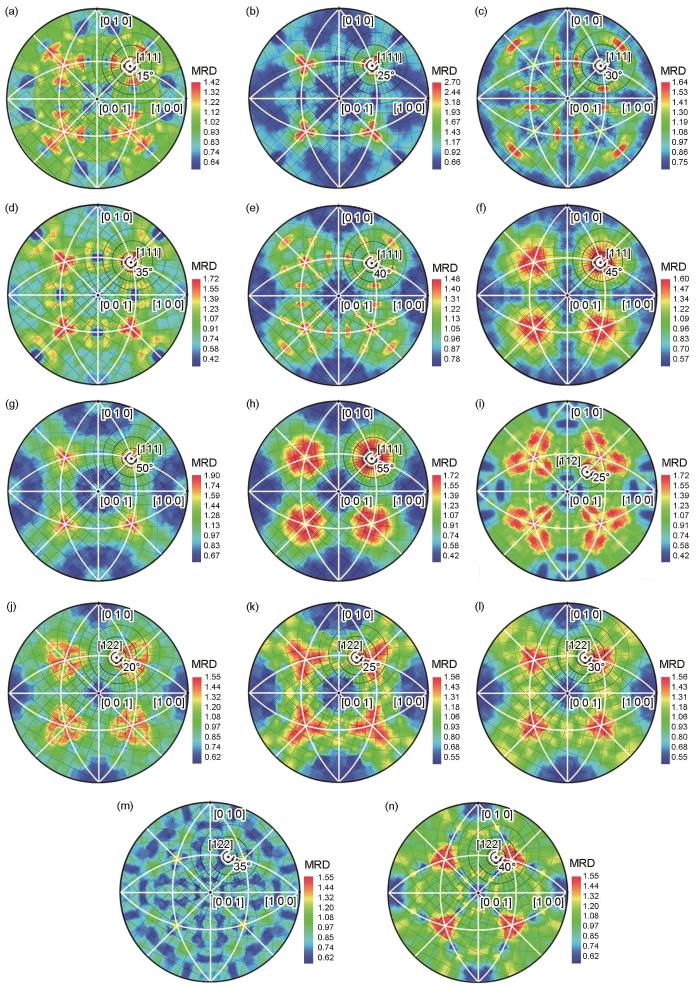
... 对过滤出来的各组晶界进行FPA统计,可确定其GBPD分布强点和次强点位置,使用文献[9]给出的方法进行分析,可确定任意一组晶界中是否存在{111}/{111}-NSB.图3和4分别给出了F和F1样品中存在{111}/{111}-NSB的各组晶界的GBPD图,并从中得到Mi 值(即MRD值).各组晶界的Pi 、Wi 以及利用式(1)和(2)计算得到的Fi 和F列于表3.可见,相较于室温轧制,深冷轧制更有益于后续再结晶退火形成{111}/{111}-NSB;F1样品中的{111}/{111}-NSB比例达到6.0%,比F样品提高了122%. ...
The near singular boundaries in BCC iron
1
2022
... 完成EBSD测试后,导出取向成像显微(OIM)图、晶界网络图、取向差分布图以及合并多个测试区域得到的宏观织构取向分布函数(ODF)等Euler角(φ2 = 45°)截面图.在进行{111}/{111}-NSB表征前,需要将EBSD原始数据进行格式转换后导入TSL-OIM8.0软件完成数据处理.同时,基于OIM重构晶界迹线以及获取所有晶界迹线的晶体学数据,如迹线长度、迹线起点和终点在试样坐标系中的坐标、迹线两侧晶粒的取向(Euler角)等.采用自编程序计算每条晶界迹线关联的晶界的取向差信息,并以轴角对<uvw>/θ'标识(其中<uvw>为取向差转轴,θ'为取向差转角).根据取向差特征,利用自编程序将重构出的晶界进行过滤后分成若干组.晶界过滤分两步进行,首先进行轴过滤,即根据<uvw>的不同过滤晶界.{111}/{111}-NSB的旋转轴以<111>、<112>和<122>为主[9],本工作的轴过滤只考虑这3个旋转轴.在轴过滤时,设置转轴的偏移量为±5°.然后进行角过滤,也就是对轴过滤后的每一组晶界按照θ'的不同再次过滤晶界.角过滤以5°间隔从5°开始到60°结束,且每个转角的偏差设为±2.5°.以此过滤出来的每组晶界具有各自固定的轴角对取向差.因为在计算晶界取向差时,已将其约化到Rodriguez空间的基区内,所以取向差最大转角为62.8°.需要注意的是,在计算{111}/{111}-NSB比例时,忽略取向差角度小于10°的小角度晶界(LAGB).另外,取向差为<111>/60°的晶界被定义为孪晶界(Σ3晶界),其中具有{111}/{111} GBIC特征的晶界为共格孪晶界,即SB,将进行单独统计,不纳入本工作测定的{111}/{111}-NSB之内.利用FPA法[12],对每组具有固定取向差的晶界进行晶界面分布(grain boundary plane distribution,GBPD)统计.GBPD可以描述晶界面的法线方向在晶体学空间的三维分布.为方便分析,GBPD一般被投影在晶体学空间的低指数晶面内.本工作所用的具有fcc结构的高纯Al,其GBPD投影在(001)内.由于不同Miller指数的晶面其表面能不同[26],GBPD通常不是随机分布,因此,一般采用随机分布的倍数(multiple of random distribution,MRD)来计算GBPD分布强度.在获得每一组具有固定取向差晶界的GBPD后,采用Wang等[7,9]提出的方法确定该组晶界中是否存在{111}/{111}-NSB,若存在,其占总晶界的比例(Fi )可用如下公式确定[10,11]: ...
Quantitative determination of grain boundary inter-connections
2
... 近几年,Wang等[9~11]在Randle等[12]测定晶界面分布的五参数分析(five parameter analysis,FPA)法基础上,建立了基于晶界界面匹配(grain boundary inter-connection,GBIC)的GBCD表征方法,把传统的只局限于中低层错能fcc金属的GBE研究拓展到了高层错能fcc金属和bcc金属,并在研究高纯Al的GBCD时发现[9],那些虽不具有孪晶取向差(<111>/60°)特征,却具有密排面与密排面匹配(即具有{111}/{111} GBIC特征)的晶界是一类比SB更容易在TMP过程中生成的晶界,此类晶界比一般晶界(random boundary,RB)具有更高的面重合阵点密度[13].Du等[14]在研究Al-Cu合金不同类型晶界的析出行为时观察到,具有{111}/{111} GBIC特征的晶界,其析出相呈点状不连续分布,该类晶界的腐蚀抗力介于RB和SB之间,但更接近于SB.可见,具有{111}/{111} GBIC特征的晶界是Al及其合金中的一类近奇异晶界(near singular boundary,NSB),简称{111}/{111}-NSB.因此,有必要研究TMP过程中{111}/{111}-NSB的变化规律、影响因素和形成机理,这对合理调控此类晶界,从根本上提升铝合金IGC抗力具有重要的科学意义和价值. ...
... 完成EBSD测试后,导出取向成像显微(OIM)图、晶界网络图、取向差分布图以及合并多个测试区域得到的宏观织构取向分布函数(ODF)等Euler角(φ2 = 45°)截面图.在进行{111}/{111}-NSB表征前,需要将EBSD原始数据进行格式转换后导入TSL-OIM8.0软件完成数据处理.同时,基于OIM重构晶界迹线以及获取所有晶界迹线的晶体学数据,如迹线长度、迹线起点和终点在试样坐标系中的坐标、迹线两侧晶粒的取向(Euler角)等.采用自编程序计算每条晶界迹线关联的晶界的取向差信息,并以轴角对<uvw>/θ'标识(其中<uvw>为取向差转轴,θ'为取向差转角).根据取向差特征,利用自编程序将重构出的晶界进行过滤后分成若干组.晶界过滤分两步进行,首先进行轴过滤,即根据<uvw>的不同过滤晶界.{111}/{111}-NSB的旋转轴以<111>、<112>和<122>为主[9],本工作的轴过滤只考虑这3个旋转轴.在轴过滤时,设置转轴的偏移量为±5°.然后进行角过滤,也就是对轴过滤后的每一组晶界按照θ'的不同再次过滤晶界.角过滤以5°间隔从5°开始到60°结束,且每个转角的偏差设为±2.5°.以此过滤出来的每组晶界具有各自固定的轴角对取向差.因为在计算晶界取向差时,已将其约化到Rodriguez空间的基区内,所以取向差最大转角为62.8°.需要注意的是,在计算{111}/{111}-NSB比例时,忽略取向差角度小于10°的小角度晶界(LAGB).另外,取向差为<111>/60°的晶界被定义为孪晶界(Σ3晶界),其中具有{111}/{111} GBIC特征的晶界为共格孪晶界,即SB,将进行单独统计,不纳入本工作测定的{111}/{111}-NSB之内.利用FPA法[12],对每组具有固定取向差的晶界进行晶界面分布(grain boundary plane distribution,GBPD)统计.GBPD可以描述晶界面的法线方向在晶体学空间的三维分布.为方便分析,GBPD一般被投影在晶体学空间的低指数晶面内.本工作所用的具有fcc结构的高纯Al,其GBPD投影在(001)内.由于不同Miller指数的晶面其表面能不同[26],GBPD通常不是随机分布,因此,一般采用随机分布的倍数(multiple of random distribution,MRD)来计算GBPD分布强度.在获得每一组具有固定取向差晶界的GBPD后,采用Wang等[7,9]提出的方法确定该组晶界中是否存在{111}/{111}-NSB,若存在,其占总晶界的比例(Fi )可用如下公式确定[10,11]: ...
晶界界面匹配定量表征方法
2
... 近几年,Wang等[9~11]在Randle等[12]测定晶界面分布的五参数分析(five parameter analysis,FPA)法基础上,建立了基于晶界界面匹配(grain boundary inter-connection,GBIC)的GBCD表征方法,把传统的只局限于中低层错能fcc金属的GBE研究拓展到了高层错能fcc金属和bcc金属,并在研究高纯Al的GBCD时发现[9],那些虽不具有孪晶取向差(<111>/60°)特征,却具有密排面与密排面匹配(即具有{111}/{111} GBIC特征)的晶界是一类比SB更容易在TMP过程中生成的晶界,此类晶界比一般晶界(random boundary,RB)具有更高的面重合阵点密度[13].Du等[14]在研究Al-Cu合金不同类型晶界的析出行为时观察到,具有{111}/{111} GBIC特征的晶界,其析出相呈点状不连续分布,该类晶界的腐蚀抗力介于RB和SB之间,但更接近于SB.可见,具有{111}/{111} GBIC特征的晶界是Al及其合金中的一类近奇异晶界(near singular boundary,NSB),简称{111}/{111}-NSB.因此,有必要研究TMP过程中{111}/{111}-NSB的变化规律、影响因素和形成机理,这对合理调控此类晶界,从根本上提升铝合金IGC抗力具有重要的科学意义和价值. ...
... 完成EBSD测试后,导出取向成像显微(OIM)图、晶界网络图、取向差分布图以及合并多个测试区域得到的宏观织构取向分布函数(ODF)等Euler角(φ2 = 45°)截面图.在进行{111}/{111}-NSB表征前,需要将EBSD原始数据进行格式转换后导入TSL-OIM8.0软件完成数据处理.同时,基于OIM重构晶界迹线以及获取所有晶界迹线的晶体学数据,如迹线长度、迹线起点和终点在试样坐标系中的坐标、迹线两侧晶粒的取向(Euler角)等.采用自编程序计算每条晶界迹线关联的晶界的取向差信息,并以轴角对<uvw>/θ'标识(其中<uvw>为取向差转轴,θ'为取向差转角).根据取向差特征,利用自编程序将重构出的晶界进行过滤后分成若干组.晶界过滤分两步进行,首先进行轴过滤,即根据<uvw>的不同过滤晶界.{111}/{111}-NSB的旋转轴以<111>、<112>和<122>为主[9],本工作的轴过滤只考虑这3个旋转轴.在轴过滤时,设置转轴的偏移量为±5°.然后进行角过滤,也就是对轴过滤后的每一组晶界按照θ'的不同再次过滤晶界.角过滤以5°间隔从5°开始到60°结束,且每个转角的偏差设为±2.5°.以此过滤出来的每组晶界具有各自固定的轴角对取向差.因为在计算晶界取向差时,已将其约化到Rodriguez空间的基区内,所以取向差最大转角为62.8°.需要注意的是,在计算{111}/{111}-NSB比例时,忽略取向差角度小于10°的小角度晶界(LAGB).另外,取向差为<111>/60°的晶界被定义为孪晶界(Σ3晶界),其中具有{111}/{111} GBIC特征的晶界为共格孪晶界,即SB,将进行单独统计,不纳入本工作测定的{111}/{111}-NSB之内.利用FPA法[12],对每组具有固定取向差的晶界进行晶界面分布(grain boundary plane distribution,GBPD)统计.GBPD可以描述晶界面的法线方向在晶体学空间的三维分布.为方便分析,GBPD一般被投影在晶体学空间的低指数晶面内.本工作所用的具有fcc结构的高纯Al,其GBPD投影在(001)内.由于不同Miller指数的晶面其表面能不同[26],GBPD通常不是随机分布,因此,一般采用随机分布的倍数(multiple of random distribution,MRD)来计算GBPD分布强度.在获得每一组具有固定取向差晶界的GBPD后,采用Wang等[7,9]提出的方法确定该组晶界中是否存在{111}/{111}-NSB,若存在,其占总晶界的比例(Fi )可用如下公式确定[10,11]: ...
Five-parameter grain boundary analysis of a titanium alloy before and after low-temperature annealing
2
2008
... 近几年,Wang等[9~11]在Randle等[12]测定晶界面分布的五参数分析(five parameter analysis,FPA)法基础上,建立了基于晶界界面匹配(grain boundary inter-connection,GBIC)的GBCD表征方法,把传统的只局限于中低层错能fcc金属的GBE研究拓展到了高层错能fcc金属和bcc金属,并在研究高纯Al的GBCD时发现[9],那些虽不具有孪晶取向差(<111>/60°)特征,却具有密排面与密排面匹配(即具有{111}/{111} GBIC特征)的晶界是一类比SB更容易在TMP过程中生成的晶界,此类晶界比一般晶界(random boundary,RB)具有更高的面重合阵点密度[13].Du等[14]在研究Al-Cu合金不同类型晶界的析出行为时观察到,具有{111}/{111} GBIC特征的晶界,其析出相呈点状不连续分布,该类晶界的腐蚀抗力介于RB和SB之间,但更接近于SB.可见,具有{111}/{111} GBIC特征的晶界是Al及其合金中的一类近奇异晶界(near singular boundary,NSB),简称{111}/{111}-NSB.因此,有必要研究TMP过程中{111}/{111}-NSB的变化规律、影响因素和形成机理,这对合理调控此类晶界,从根本上提升铝合金IGC抗力具有重要的科学意义和价值. ...
... 完成EBSD测试后,导出取向成像显微(OIM)图、晶界网络图、取向差分布图以及合并多个测试区域得到的宏观织构取向分布函数(ODF)等Euler角(φ2 = 45°)截面图.在进行{111}/{111}-NSB表征前,需要将EBSD原始数据进行格式转换后导入TSL-OIM8.0软件完成数据处理.同时,基于OIM重构晶界迹线以及获取所有晶界迹线的晶体学数据,如迹线长度、迹线起点和终点在试样坐标系中的坐标、迹线两侧晶粒的取向(Euler角)等.采用自编程序计算每条晶界迹线关联的晶界的取向差信息,并以轴角对<uvw>/θ'标识(其中<uvw>为取向差转轴,θ'为取向差转角).根据取向差特征,利用自编程序将重构出的晶界进行过滤后分成若干组.晶界过滤分两步进行,首先进行轴过滤,即根据<uvw>的不同过滤晶界.{111}/{111}-NSB的旋转轴以<111>、<112>和<122>为主[9],本工作的轴过滤只考虑这3个旋转轴.在轴过滤时,设置转轴的偏移量为±5°.然后进行角过滤,也就是对轴过滤后的每一组晶界按照θ'的不同再次过滤晶界.角过滤以5°间隔从5°开始到60°结束,且每个转角的偏差设为±2.5°.以此过滤出来的每组晶界具有各自固定的轴角对取向差.因为在计算晶界取向差时,已将其约化到Rodriguez空间的基区内,所以取向差最大转角为62.8°.需要注意的是,在计算{111}/{111}-NSB比例时,忽略取向差角度小于10°的小角度晶界(LAGB).另外,取向差为<111>/60°的晶界被定义为孪晶界(Σ3晶界),其中具有{111}/{111} GBIC特征的晶界为共格孪晶界,即SB,将进行单独统计,不纳入本工作测定的{111}/{111}-NSB之内.利用FPA法[12],对每组具有固定取向差的晶界进行晶界面分布(grain boundary plane distribution,GBPD)统计.GBPD可以描述晶界面的法线方向在晶体学空间的三维分布.为方便分析,GBPD一般被投影在晶体学空间的低指数晶面内.本工作所用的具有fcc结构的高纯Al,其GBPD投影在(001)内.由于不同Miller指数的晶面其表面能不同[26],GBPD通常不是随机分布,因此,一般采用随机分布的倍数(multiple of random distribution,MRD)来计算GBPD分布强度.在获得每一组具有固定取向差晶界的GBPD后,采用Wang等[7,9]提出的方法确定该组晶界中是否存在{111}/{111}-NSB,若存在,其占总晶界的比例(Fi )可用如下公式确定[10,11]: ...
Application of the O-lattice model to the calculation of the interfacial dislocations
1
2002
... 近几年,Wang等[9~11]在Randle等[12]测定晶界面分布的五参数分析(five parameter analysis,FPA)法基础上,建立了基于晶界界面匹配(grain boundary inter-connection,GBIC)的GBCD表征方法,把传统的只局限于中低层错能fcc金属的GBE研究拓展到了高层错能fcc金属和bcc金属,并在研究高纯Al的GBCD时发现[9],那些虽不具有孪晶取向差(<111>/60°)特征,却具有密排面与密排面匹配(即具有{111}/{111} GBIC特征)的晶界是一类比SB更容易在TMP过程中生成的晶界,此类晶界比一般晶界(random boundary,RB)具有更高的面重合阵点密度[13].Du等[14]在研究Al-Cu合金不同类型晶界的析出行为时观察到,具有{111}/{111} GBIC特征的晶界,其析出相呈点状不连续分布,该类晶界的腐蚀抗力介于RB和SB之间,但更接近于SB.可见,具有{111}/{111} GBIC特征的晶界是Al及其合金中的一类近奇异晶界(near singular boundary,NSB),简称{111}/{111}-NSB.因此,有必要研究TMP过程中{111}/{111}-NSB的变化规律、影响因素和形成机理,这对合理调控此类晶界,从根本上提升铝合金IGC抗力具有重要的科学意义和价值. ...
O点阵模型及其在界面位错计算中的应用
1
2002
... 近几年,Wang等[9~11]在Randle等[12]测定晶界面分布的五参数分析(five parameter analysis,FPA)法基础上,建立了基于晶界界面匹配(grain boundary inter-connection,GBIC)的GBCD表征方法,把传统的只局限于中低层错能fcc金属的GBE研究拓展到了高层错能fcc金属和bcc金属,并在研究高纯Al的GBCD时发现[9],那些虽不具有孪晶取向差(<111>/60°)特征,却具有密排面与密排面匹配(即具有{111}/{111} GBIC特征)的晶界是一类比SB更容易在TMP过程中生成的晶界,此类晶界比一般晶界(random boundary,RB)具有更高的面重合阵点密度[13].Du等[14]在研究Al-Cu合金不同类型晶界的析出行为时观察到,具有{111}/{111} GBIC特征的晶界,其析出相呈点状不连续分布,该类晶界的腐蚀抗力介于RB和SB之间,但更接近于SB.可见,具有{111}/{111} GBIC特征的晶界是Al及其合金中的一类近奇异晶界(near singular boundary,NSB),简称{111}/{111}-NSB.因此,有必要研究TMP过程中{111}/{111}-NSB的变化规律、影响因素和形成机理,这对合理调控此类晶界,从根本上提升铝合金IGC抗力具有重要的科学意义和价值. ...
The dependence of precipitate morphology on the grain boundary types in an aged Al-Cu binary alloy
1
2021
... 近几年,Wang等[9~11]在Randle等[12]测定晶界面分布的五参数分析(five parameter analysis,FPA)法基础上,建立了基于晶界界面匹配(grain boundary inter-connection,GBIC)的GBCD表征方法,把传统的只局限于中低层错能fcc金属的GBE研究拓展到了高层错能fcc金属和bcc金属,并在研究高纯Al的GBCD时发现[9],那些虽不具有孪晶取向差(<111>/60°)特征,却具有密排面与密排面匹配(即具有{111}/{111} GBIC特征)的晶界是一类比SB更容易在TMP过程中生成的晶界,此类晶界比一般晶界(random boundary,RB)具有更高的面重合阵点密度[13].Du等[14]在研究Al-Cu合金不同类型晶界的析出行为时观察到,具有{111}/{111} GBIC特征的晶界,其析出相呈点状不连续分布,该类晶界的腐蚀抗力介于RB和SB之间,但更接近于SB.可见,具有{111}/{111} GBIC特征的晶界是Al及其合金中的一类近奇异晶界(near singular boundary,NSB),简称{111}/{111}-NSB.因此,有必要研究TMP过程中{111}/{111}-NSB的变化规律、影响因素和形成机理,这对合理调控此类晶界,从根本上提升铝合金IGC抗力具有重要的科学意义和价值. ...
{111}/{111} Near singular boundaries in a Al-Zn-Mg-Cu Alloy recrystallized after rolling at different temperatures
1
2023
... 王宗谱等[15]研究了经固溶并在250~450 ℃温区内不同温度轧制后再经520 ℃再结晶退火的7A85铝合金中的{111}/{111}-NSB.结果显示,相比于其他温度轧制,经300 ℃轧制的样品,其再结晶后{111}/{111}-NSB比例达到极大值(5.0%),这是由于经300 ℃轧制形成的亚结构在后续退火过程中可促发连续静态再结晶(continuous static recrystallization,CSRX)[16~18]机制.尽管目前尚不清楚CSRX对{111}/{111}-NSB的作用机制,但是,可以确定变形亚结构对后续退火过程中的再结晶方式及{111}/{111}-NSB的生成有显著影响,因此有必要进一步探索变形亚结构特征及其在再结晶退火过程中的演变行为以及与{111}/{111}-NSB的相关性. ...
不同温度轧制Al-Zn-Mg-Cu合金再结晶后的{111}/{111}近奇异晶界
1
2023
... 王宗谱等[15]研究了经固溶并在250~450 ℃温区内不同温度轧制后再经520 ℃再结晶退火的7A85铝合金中的{111}/{111}-NSB.结果显示,相比于其他温度轧制,经300 ℃轧制的样品,其再结晶后{111}/{111}-NSB比例达到极大值(5.0%),这是由于经300 ℃轧制形成的亚结构在后续退火过程中可促发连续静态再结晶(continuous static recrystallization,CSRX)[16~18]机制.尽管目前尚不清楚CSRX对{111}/{111}-NSB的作用机制,但是,可以确定变形亚结构对后续退火过程中的再结晶方式及{111}/{111}-NSB的生成有显著影响,因此有必要进一步探索变形亚结构特征及其在再结晶退火过程中的演变行为以及与{111}/{111}-NSB的相关性. ...
Continuous static recrystallization in ultrafine-grained copper processed by multi-directional forging
1
2008
... 王宗谱等[15]研究了经固溶并在250~450 ℃温区内不同温度轧制后再经520 ℃再结晶退火的7A85铝合金中的{111}/{111}-NSB.结果显示,相比于其他温度轧制,经300 ℃轧制的样品,其再结晶后{111}/{111}-NSB比例达到极大值(5.0%),这是由于经300 ℃轧制形成的亚结构在后续退火过程中可促发连续静态再结晶(continuous static recrystallization,CSRX)[16~18]机制.尽管目前尚不清楚CSRX对{111}/{111}-NSB的作用机制,但是,可以确定变形亚结构对后续退火过程中的再结晶方式及{111}/{111}-NSB的生成有显著影响,因此有必要进一步探索变形亚结构特征及其在再结晶退火过程中的演变行为以及与{111}/{111}-NSB的相关性. ...
Effects of grain growth on the {111}/{111} near singular boundaries in high purity aluminum
1
2024
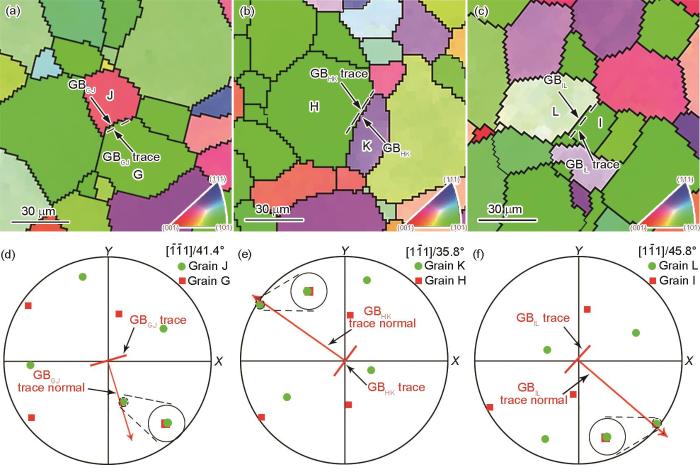
... 对F和F1样品OIM组织的进一步观察和重叠极图晶界迹线分析发现,{011}<>再结晶织构主要通过2种方式促进{111}/{111}-NSB的生成.一种方式如图11所示,具有{011}<>取向的G、H和I晶粒分别与其毗连的、但具有其他取向的J、K和L晶粒之间形成<111>/θ'取向差关系,它们之间的晶界GBGJ、GBHK和GBIL均为{111}/{111}-NSB.因为{011}<>织构在370 ℃退火过程中持续增强,可以认为GBGJ、GBHK和GBIL是G、H和I晶粒在长大过程中与J、K和L晶粒相遇而形成的,这与作者先前报道的“相遇-再取向”机制[17]是一致的.另一种方式如图12所示,具有{011}<>取向的A、B和C晶粒分别与其毗连的、但具有{011}<>漫散取向的D、E和F晶粒之间形成<111>/θ'取向差关系,它们之间的晶界GBAD、GBBE和GBCF也均为{111}/{111}-NSB.通过该方式形成的{111}/{111}-NSB,其具体机制尚不明确,可能与退火过程中亚晶界持续吸收位错及亚晶界的局部微调与转变有关,相关问题仍在进一步研究中.表5和6给出了G、H、I、J、K、L各晶粒取向信息和GBGJ、GBHK和GBIL各晶界取向差信息,以及A、B、C、D、E、F各晶粒取向信息和GBAD、GBBE和GBCF各晶界取向差信息.图13给出了{011}<>取向的P1晶粒与其漫散取向的M晶粒之间以及{011}<>取向的P2晶粒与其他取向的N晶粒之间形成{111}/{111}-NSB的晶胞示意图.表7给出了P1、P2、M和N各晶粒取向信息以及P1晶粒与M晶粒之间和P2晶粒与N晶粒之间的晶界取向差信息. ...
晶粒长大对高纯Al{111}/{111}近奇异晶界的影响
1
2024
... 对F和F1样品OIM组织的进一步观察和重叠极图晶界迹线分析发现,{011}<>再结晶织构主要通过2种方式促进{111}/{111}-NSB的生成.一种方式如图11所示,具有{011}<>取向的G、H和I晶粒分别与其毗连的、但具有其他取向的J、K和L晶粒之间形成<111>/θ'取向差关系,它们之间的晶界GBGJ、GBHK和GBIL均为{111}/{111}-NSB.因为{011}<>织构在370 ℃退火过程中持续增强,可以认为GBGJ、GBHK和GBIL是G、H和I晶粒在长大过程中与J、K和L晶粒相遇而形成的,这与作者先前报道的“相遇-再取向”机制[17]是一致的.另一种方式如图12所示,具有{011}<>取向的A、B和C晶粒分别与其毗连的、但具有{011}<>漫散取向的D、E和F晶粒之间形成<111>/θ'取向差关系,它们之间的晶界GBAD、GBBE和GBCF也均为{111}/{111}-NSB.通过该方式形成的{111}/{111}-NSB,其具体机制尚不明确,可能与退火过程中亚晶界持续吸收位错及亚晶界的局部微调与转变有关,相关问题仍在进一步研究中.表5和6给出了G、H、I、J、K、L各晶粒取向信息和GBGJ、GBHK和GBIL各晶界取向差信息,以及A、B、C、D、E、F各晶粒取向信息和GBAD、GBBE和GBCF各晶界取向差信息.图13给出了{011}<>取向的P1晶粒与其漫散取向的M晶粒之间以及{011}<>取向的P2晶粒与其他取向的N晶粒之间形成{111}/{111}-NSB的晶胞示意图.表7给出了P1、P2、M和N各晶粒取向信息以及P1晶粒与M晶粒之间和P2晶粒与N晶粒之间的晶界取向差信息. ...
Effect of pre-deformation temperature on formation of {111}/{111} near singular boundaries in Al-Mg alloy during subsequent recrystallization
1
2023
... 王宗谱等[15]研究了经固溶并在250~450 ℃温区内不同温度轧制后再经520 ℃再结晶退火的7A85铝合金中的{111}/{111}-NSB.结果显示,相比于其他温度轧制,经300 ℃轧制的样品,其再结晶后{111}/{111}-NSB比例达到极大值(5.0%),这是由于经300 ℃轧制形成的亚结构在后续退火过程中可促发连续静态再结晶(continuous static recrystallization,CSRX)[16~18]机制.尽管目前尚不清楚CSRX对{111}/{111}-NSB的作用机制,但是,可以确定变形亚结构对后续退火过程中的再结晶方式及{111}/{111}-NSB的生成有显著影响,因此有必要进一步探索变形亚结构特征及其在再结晶退火过程中的演变行为以及与{111}/{111}-NSB的相关性. ...
预变形温度对Al-Mg合金再结晶{111}/{111}近奇异晶界的影响
1
2023
... 王宗谱等[15]研究了经固溶并在250~450 ℃温区内不同温度轧制后再经520 ℃再结晶退火的7A85铝合金中的{111}/{111}-NSB.结果显示,相比于其他温度轧制,经300 ℃轧制的样品,其再结晶后{111}/{111}-NSB比例达到极大值(5.0%),这是由于经300 ℃轧制形成的亚结构在后续退火过程中可促发连续静态再结晶(continuous static recrystallization,CSRX)[16~18]机制.尽管目前尚不清楚CSRX对{111}/{111}-NSB的作用机制,但是,可以确定变形亚结构对后续退火过程中的再结晶方式及{111}/{111}-NSB的生成有显著影响,因此有必要进一步探索变形亚结构特征及其在再结晶退火过程中的演变行为以及与{111}/{111}-NSB的相关性. ...
Effect of annealing temperature on microstructures and mechanical properties of a 5083 Al alloy deformed at cryogenic temperature
1
2004
... Lee等[19]研究了经-196 ℃ (液氮温度)深冷轧制5083铝合金的变形组织特征,发现深冷轧制可以抑制动态回复,并且可保留变形时产生的高密度缺陷和亚结构;与室温或高温轧制变形相比,深冷轧制仅需要较小的塑性变形就能获得更高位错密度和更复杂的变形亚结构.陈鼎和黎文献[20]研究发现,深冷轧制可引起铝合金的晶格收缩,使材料体积减小,空位浓度减少,位错密度增加;相比于室温轧制变形,深冷轧制变形可增大晶粒转动幅度,形成更强的织构等[21~25]. ...
Cryogenic treatment of Al and Al alloys
1
2000
... Lee等[19]研究了经-196 ℃ (液氮温度)深冷轧制5083铝合金的变形组织特征,发现深冷轧制可以抑制动态回复,并且可保留变形时产生的高密度缺陷和亚结构;与室温或高温轧制变形相比,深冷轧制仅需要较小的塑性变形就能获得更高位错密度和更复杂的变形亚结构.陈鼎和黎文献[20]研究发现,深冷轧制可引起铝合金的晶格收缩,使材料体积减小,空位浓度减少,位错密度增加;相比于室温轧制变形,深冷轧制变形可增大晶粒转动幅度,形成更强的织构等[21~25]. ...
铝和铝合金的深冷处理
1
2000
... Lee等[19]研究了经-196 ℃ (液氮温度)深冷轧制5083铝合金的变形组织特征,发现深冷轧制可以抑制动态回复,并且可保留变形时产生的高密度缺陷和亚结构;与室温或高温轧制变形相比,深冷轧制仅需要较小的塑性变形就能获得更高位错密度和更复杂的变形亚结构.陈鼎和黎文献[20]研究发现,深冷轧制可引起铝合金的晶格收缩,使材料体积减小,空位浓度减少,位错密度增加;相比于室温轧制变形,深冷轧制变形可增大晶粒转动幅度,形成更强的织构等[21~25]. ...
Cryogenic treatment of metals to improve wear resistance
1
1982
... Lee等[19]研究了经-196 ℃ (液氮温度)深冷轧制5083铝合金的变形组织特征,发现深冷轧制可以抑制动态回复,并且可保留变形时产生的高密度缺陷和亚结构;与室温或高温轧制变形相比,深冷轧制仅需要较小的塑性变形就能获得更高位错密度和更复杂的变形亚结构.陈鼎和黎文献[20]研究发现,深冷轧制可引起铝合金的晶格收缩,使材料体积减小,空位浓度减少,位错密度增加;相比于室温轧制变形,深冷轧制变形可增大晶粒转动幅度,形成更强的织构等[21~25]. ...
Effect of cryogenic treatment on microstructure, mechanical and wear behaviors of AISI H13 hot work tool steel
0
2011
Effect of deep cryogenic treatment on the mechanical properties of tool steels
0
2001
Deep cryogenic treatment of tool steels
0
2016
Microstructure and mechanical properties of 5052 Al alloy by cryogenic rolling
1
2020
... Lee等[19]研究了经-196 ℃ (液氮温度)深冷轧制5083铝合金的变形组织特征,发现深冷轧制可以抑制动态回复,并且可保留变形时产生的高密度缺陷和亚结构;与室温或高温轧制变形相比,深冷轧制仅需要较小的塑性变形就能获得更高位错密度和更复杂的变形亚结构.陈鼎和黎文献[20]研究发现,深冷轧制可引起铝合金的晶格收缩,使材料体积减小,空位浓度减少,位错密度增加;相比于室温轧制变形,深冷轧制变形可增大晶粒转动幅度,形成更强的织构等[21~25]. ...
Structure-energy correlation for grain boundaries in F.C.C. metals—I. Boundaries on the (111) and (100) planes
3
1989
... 完成EBSD测试后,导出取向成像显微(OIM)图、晶界网络图、取向差分布图以及合并多个测试区域得到的宏观织构取向分布函数(ODF)等Euler角(φ2 = 45°)截面图.在进行{111}/{111}-NSB表征前,需要将EBSD原始数据进行格式转换后导入TSL-OIM8.0软件完成数据处理.同时,基于OIM重构晶界迹线以及获取所有晶界迹线的晶体学数据,如迹线长度、迹线起点和终点在试样坐标系中的坐标、迹线两侧晶粒的取向(Euler角)等.采用自编程序计算每条晶界迹线关联的晶界的取向差信息,并以轴角对<uvw>/θ'标识(其中<uvw>为取向差转轴,θ'为取向差转角).根据取向差特征,利用自编程序将重构出的晶界进行过滤后分成若干组.晶界过滤分两步进行,首先进行轴过滤,即根据<uvw>的不同过滤晶界.{111}/{111}-NSB的旋转轴以<111>、<112>和<122>为主[9],本工作的轴过滤只考虑这3个旋转轴.在轴过滤时,设置转轴的偏移量为±5°.然后进行角过滤,也就是对轴过滤后的每一组晶界按照θ'的不同再次过滤晶界.角过滤以5°间隔从5°开始到60°结束,且每个转角的偏差设为±2.5°.以此过滤出来的每组晶界具有各自固定的轴角对取向差.因为在计算晶界取向差时,已将其约化到Rodriguez空间的基区内,所以取向差最大转角为62.8°.需要注意的是,在计算{111}/{111}-NSB比例时,忽略取向差角度小于10°的小角度晶界(LAGB).另外,取向差为<111>/60°的晶界被定义为孪晶界(Σ3晶界),其中具有{111}/{111} GBIC特征的晶界为共格孪晶界,即SB,将进行单独统计,不纳入本工作测定的{111}/{111}-NSB之内.利用FPA法[12],对每组具有固定取向差的晶界进行晶界面分布(grain boundary plane distribution,GBPD)统计.GBPD可以描述晶界面的法线方向在晶体学空间的三维分布.为方便分析,GBPD一般被投影在晶体学空间的低指数晶面内.本工作所用的具有fcc结构的高纯Al,其GBPD投影在(001)内.由于不同Miller指数的晶面其表面能不同[26],GBPD通常不是随机分布,因此,一般采用随机分布的倍数(multiple of random distribution,MRD)来计算GBPD分布强度.在获得每一组具有固定取向差晶界的GBPD后,采用Wang等[7,9]提出的方法确定该组晶界中是否存在{111}/{111}-NSB,若存在,其占总晶界的比例(Fi )可用如下公式确定[10,11]: ...
... 式中,下标i指第i组具有固定取向差的晶界,Pi 为该组晶界总长度占总晶界长度的分数,Mi 为从该组GBPD图中所确定的{111}的分布强度MRD值,Wi 为在该组晶界加权平均取向差Gaussian分布曲线中的半高宽[26].显然,实际上{111}/{111}-NSB不止在一组晶界中存在,本工作给出的{111}/{111}-NSB比例是指从多组(n组)晶界中测定的该类晶界比例之和(F),且: ...
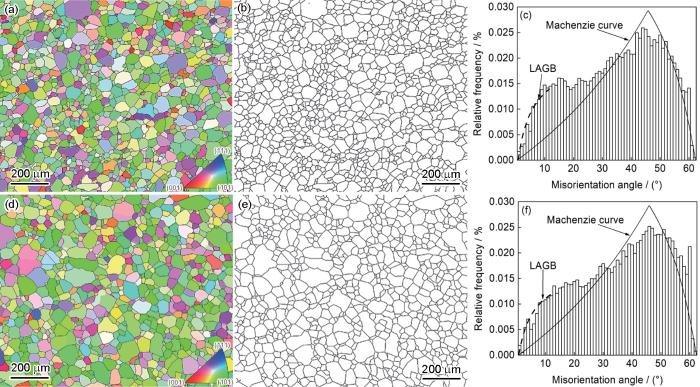
... 图1给出了经室温和-196 ℃深冷轧制后再经370 ℃再结晶退火30 min后的F和F1 2个样品显微组织的OIM图、晶界网络及取向差分布.可以看出,F和F1 2个样品均完成再结晶,平均晶粒尺寸分别为29.6和33.3 μm;2个样品的晶粒等轴化程度均较好,但晶粒尺寸不均匀,表现为局部区域的晶粒明显小于该样品的平均晶粒尺寸(图1a、b、d和e).2个样品中均形成了很强的<011>//ND的织构(图1a和d,具体织构类型将在下文ODF图中加以分析),导致其取向差分布严重偏离Machenzie分布[26]且LAGB含量较高(图1c和f). ...
Extracting twins from orientation imaging microscopy scan data
2
2002
... 由1.2节的方法获得的{111}/{111}-NSB比例是一个统计结果,不能确定某一具体晶界的GBIC特征.为此,采用Wright和Larsen[27]的重叠极图晶界迹线分析法确认晶界是否为{111}/{111}-NSB.具体过程为:首先,基于OIM图选定待分析的晶界,绘出该晶界两侧2个晶粒各自的{111}极图,并将它们重叠起来;其次,观察{111}重叠极图中是否存在重合的{111}极点,如果存在,说明选定的晶界具有绕<111>转动一定角度的取向差;第三,将选定的晶界迹线从OIM图中平移至{111}重叠极图的中心,考察晶界迹线的法线方向是否穿过重合的{111}极点,若穿过,则确定该晶界为{111}/{111}-NSB. ...
... 那么,上述经OG机制生成的强的{011}<>再结晶织构是否与{111}/{111}-NSB的生成存在关联及如何关联呢?为此,采用重叠极图晶界迹线分析法[27]对随机选择的不同微区多个{011}<>取向晶粒及多个非{011}<>取向晶粒所关联的大量晶界的特征进行了统计分析,结果见表4.可以看出,不管是室温轧制后再进行再结晶退火的F样品,还是深冷轧制后再进行再结晶退火的F1样品,相比于其他取向的晶粒,具有{011}<>取向的晶粒,其所关联的晶界中,{111}/{111}-NSB比例显著偏高,表明{011}<>再结晶织构与{111}/{111}-NSB的形成存在正相关;较比于F样品,F1样品形成了更强的{011}<>再结晶织构,其{111}/{111}-NSB比例也更高. ...
Preferred orientation of grain boundary plane in recrystallized high purity aluminum
1
2014
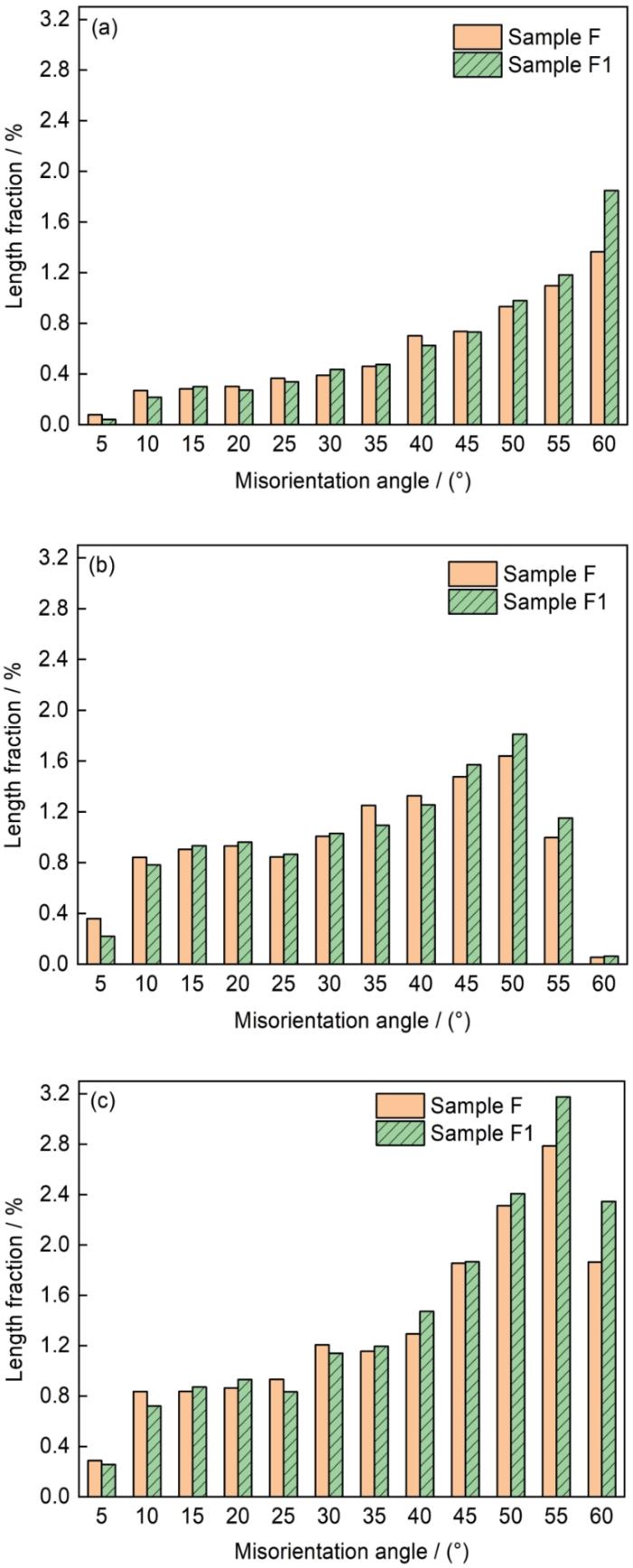
... 经EBSD测试和相关数据处理,从F和F1样品中分别提取出50736和52556条晶界,其晶界总长度分别为763576和823552 μm;经轴过滤,得到取向差转轴为<111>、<112>和<122>的晶界数量及其占总晶界的比例见表2.可以看出,旋转轴为<122>的晶界数量较多、比例较高;旋转轴为<111>和<112>的晶界数量较少、比例较低.进一步经角过滤和归一化处理,得到2个样品中旋转轴分别为<111>、<112>、<122>的晶界取向差分布,见图2.可以看出,轧制温度对2个样品各旋转轴晶界的取向差分布没有明显影响.但这并不意味着其GBPD和GBIC,特别是{111}/{111}-NSB比例也不发生变化.从图2a可以看出,2个样品中Σ3晶界的比例均低于1.9%,其中共格Σ3晶界,即SB比例更低,说明Al及其合金难以形成SB[28]. ...
Mechanical anisotropy and microstructural changes during cryorolling of Al-Mg-Si alloy
1
2015
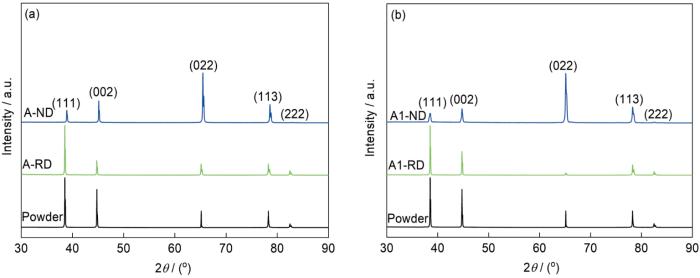
... 图6为A和A1样品以及轧制后再经370 ℃退火不同时间所得各样品轧面精细扫描{022} XRD谱.可以看到,A和A1样品的{022}衍射角(2θA和2θA1)均明显大于粉末样品的相同晶面衍射角(2θPowder),即{022}衍射峰位发生明显右移,其中A1样品的{022}衍射峰位右移程度明显大于A样品(图6a).这一结果表明A和A1样品的{022}晶面间距比标准值有所减小,2个样品沿轧板厚度方向均存在宏观内应力[29,30],属于压应力,A1样品中的压应力大于A样品.同时,由图6a还可以看出,A和A1样品的{022}衍射峰半高宽(WA和WA1)均明显大于粉末样品的相同晶面衍射峰半高宽(WPowder),其中,WA1又明显大于WA.这一结果表明,A和A1样品中的晶粒均得到一定程度的碎化(即变形亚结构或变形亚晶),均存在成对出现的等值异号且在数个晶粒尺度范围内达到平衡的一类微观内应力[31];A1样品中的晶粒碎化程度及微观内应力均高于或大于A样品[32,33].室温和深冷轧制后再经370 ℃退火6 min的B和B1样品,其{022}衍射角(2θB和2θB1)比2θA和2θA1明显减小(图6a),表明宏观内应力得到明显释放,不过2θB1明显小于2θB (图6a),说明相比于室温轧制,深冷轧制变形组织在370 ℃退火早期其宏观内应力的释放速率更快.此外,由图6a还可以看到,B1样品的{022}衍射峰的半高宽(WB1)比WA1大幅收窄,表明变形亚晶已发生较大程度的合并,微观内应力也得到大幅释放;相同的现象在A和B 2个样品的对比中同样存在.进一步延长退火时间至12、18、24和30 min,C、D、E、F和C1、D1、E1、F1各样品的{022}衍射峰示于图6b.可以看出,当退火时间达到12 min以上时,不管退火前经室温轧制还是深冷轧制,各样品的{022}衍射峰峰位和峰宽均接近粉末样品的{022}衍射峰,表明各样品已基本完成再结晶;值得注意的是,相比于C、D、E、F样品,C1、D1、E1、F1样品的{022}衍射峰峰位均有一定的右移,表明在370 ℃退火6~30 min区间内,深冷轧制样品的储能释放慢于室温轧制样品(尽管在退火初期(6 min以前)其储能释放较快).为了方便对比,图6b仍然插入了A和A1以及B和B1样品的{022}衍射峰. ...
Study on cryorolled Al-Cu alloy using X-ray diffraction line profile analysis and evaluation of strengthening mechanisms
1
2013
... 图6为A和A1样品以及轧制后再经370 ℃退火不同时间所得各样品轧面精细扫描{022} XRD谱.可以看到,A和A1样品的{022}衍射角(2θA和2θA1)均明显大于粉末样品的相同晶面衍射角(2θPowder),即{022}衍射峰位发生明显右移,其中A1样品的{022}衍射峰位右移程度明显大于A样品(图6a).这一结果表明A和A1样品的{022}晶面间距比标准值有所减小,2个样品沿轧板厚度方向均存在宏观内应力[29,30],属于压应力,A1样品中的压应力大于A样品.同时,由图6a还可以看出,A和A1样品的{022}衍射峰半高宽(WA和WA1)均明显大于粉末样品的相同晶面衍射峰半高宽(WPowder),其中,WA1又明显大于WA.这一结果表明,A和A1样品中的晶粒均得到一定程度的碎化(即变形亚结构或变形亚晶),均存在成对出现的等值异号且在数个晶粒尺度范围内达到平衡的一类微观内应力[31];A1样品中的晶粒碎化程度及微观内应力均高于或大于A样品[32,33].室温和深冷轧制后再经370 ℃退火6 min的B和B1样品,其{022}衍射角(2θB和2θB1)比2θA和2θA1明显减小(图6a),表明宏观内应力得到明显释放,不过2θB1明显小于2θB (图6a),说明相比于室温轧制,深冷轧制变形组织在370 ℃退火早期其宏观内应力的释放速率更快.此外,由图6a还可以看到,B1样品的{022}衍射峰的半高宽(WB1)比WA1大幅收窄,表明变形亚晶已发生较大程度的合并,微观内应力也得到大幅释放;相同的现象在A和B 2个样品的对比中同样存在.进一步延长退火时间至12、18、24和30 min,C、D、E、F和C1、D1、E1、F1各样品的{022}衍射峰示于图6b.可以看出,当退火时间达到12 min以上时,不管退火前经室温轧制还是深冷轧制,各样品的{022}衍射峰峰位和峰宽均接近粉末样品的{022}衍射峰,表明各样品已基本完成再结晶;值得注意的是,相比于C、D、E、F样品,C1、D1、E1、F1样品的{022}衍射峰峰位均有一定的右移,表明在370 ℃退火6~30 min区间内,深冷轧制样品的储能释放慢于室温轧制样品(尽管在退火初期(6 min以前)其储能释放较快).为了方便对比,图6b仍然插入了A和A1以及B和B1样品的{022}衍射峰. ...
Cryogenic processing high-strength 7050 aluminum alloy and controlling of the microstructures and mechanical properties
1
2017
... 图6为A和A1样品以及轧制后再经370 ℃退火不同时间所得各样品轧面精细扫描{022} XRD谱.可以看到,A和A1样品的{022}衍射角(2θA和2θA1)均明显大于粉末样品的相同晶面衍射角(2θPowder),即{022}衍射峰位发生明显右移,其中A1样品的{022}衍射峰位右移程度明显大于A样品(图6a).这一结果表明A和A1样品的{022}晶面间距比标准值有所减小,2个样品沿轧板厚度方向均存在宏观内应力[29,30],属于压应力,A1样品中的压应力大于A样品.同时,由图6a还可以看出,A和A1样品的{022}衍射峰半高宽(WA和WA1)均明显大于粉末样品的相同晶面衍射峰半高宽(WPowder),其中,WA1又明显大于WA.这一结果表明,A和A1样品中的晶粒均得到一定程度的碎化(即变形亚结构或变形亚晶),均存在成对出现的等值异号且在数个晶粒尺度范围内达到平衡的一类微观内应力[31];A1样品中的晶粒碎化程度及微观内应力均高于或大于A样品[32,33].室温和深冷轧制后再经370 ℃退火6 min的B和B1样品,其{022}衍射角(2θB和2θB1)比2θA和2θA1明显减小(图6a),表明宏观内应力得到明显释放,不过2θB1明显小于2θB (图6a),说明相比于室温轧制,深冷轧制变形组织在370 ℃退火早期其宏观内应力的释放速率更快.此外,由图6a还可以看到,B1样品的{022}衍射峰的半高宽(WB1)比WA1大幅收窄,表明变形亚晶已发生较大程度的合并,微观内应力也得到大幅释放;相同的现象在A和B 2个样品的对比中同样存在.进一步延长退火时间至12、18、24和30 min,C、D、E、F和C1、D1、E1、F1各样品的{022}衍射峰示于图6b.可以看出,当退火时间达到12 min以上时,不管退火前经室温轧制还是深冷轧制,各样品的{022}衍射峰峰位和峰宽均接近粉末样品的{022}衍射峰,表明各样品已基本完成再结晶;值得注意的是,相比于C、D、E、F样品,C1、D1、E1、F1样品的{022}衍射峰峰位均有一定的右移,表明在370 ℃退火6~30 min区间内,深冷轧制样品的储能释放慢于室温轧制样品(尽管在退火初期(6 min以前)其储能释放较快).为了方便对比,图6b仍然插入了A和A1以及B和B1样品的{022}衍射峰. ...
高强7050铝合金超低温大变形加工与组织、性能调控
1
2017
... 图6为A和A1样品以及轧制后再经370 ℃退火不同时间所得各样品轧面精细扫描{022} XRD谱.可以看到,A和A1样品的{022}衍射角(2θA和2θA1)均明显大于粉末样品的相同晶面衍射角(2θPowder),即{022}衍射峰位发生明显右移,其中A1样品的{022}衍射峰位右移程度明显大于A样品(图6a).这一结果表明A和A1样品的{022}晶面间距比标准值有所减小,2个样品沿轧板厚度方向均存在宏观内应力[29,30],属于压应力,A1样品中的压应力大于A样品.同时,由图6a还可以看出,A和A1样品的{022}衍射峰半高宽(WA和WA1)均明显大于粉末样品的相同晶面衍射峰半高宽(WPowder),其中,WA1又明显大于WA.这一结果表明,A和A1样品中的晶粒均得到一定程度的碎化(即变形亚结构或变形亚晶),均存在成对出现的等值异号且在数个晶粒尺度范围内达到平衡的一类微观内应力[31];A1样品中的晶粒碎化程度及微观内应力均高于或大于A样品[32,33].室温和深冷轧制后再经370 ℃退火6 min的B和B1样品,其{022}衍射角(2θB和2θB1)比2θA和2θA1明显减小(图6a),表明宏观内应力得到明显释放,不过2θB1明显小于2θB (图6a),说明相比于室温轧制,深冷轧制变形组织在370 ℃退火早期其宏观内应力的释放速率更快.此外,由图6a还可以看到,B1样品的{022}衍射峰的半高宽(WB1)比WA1大幅收窄,表明变形亚晶已发生较大程度的合并,微观内应力也得到大幅释放;相同的现象在A和B 2个样品的对比中同样存在.进一步延长退火时间至12、18、24和30 min,C、D、E、F和C1、D1、E1、F1各样品的{022}衍射峰示于图6b.可以看出,当退火时间达到12 min以上时,不管退火前经室温轧制还是深冷轧制,各样品的{022}衍射峰峰位和峰宽均接近粉末样品的{022}衍射峰,表明各样品已基本完成再结晶;值得注意的是,相比于C、D、E、F样品,C1、D1、E1、F1样品的{022}衍射峰峰位均有一定的右移,表明在370 ℃退火6~30 min区间内,深冷轧制样品的储能释放慢于室温轧制样品(尽管在退火初期(6 min以前)其储能释放较快).为了方便对比,图6b仍然插入了A和A1以及B和B1样品的{022}衍射峰. ...
Effect of cryo-rolling and annealing on microstructure and properties of commercially pure aluminium
1
2005
... 图6为A和A1样品以及轧制后再经370 ℃退火不同时间所得各样品轧面精细扫描{022} XRD谱.可以看到,A和A1样品的{022}衍射角(2θA和2θA1)均明显大于粉末样品的相同晶面衍射角(2θPowder),即{022}衍射峰位发生明显右移,其中A1样品的{022}衍射峰位右移程度明显大于A样品(图6a).这一结果表明A和A1样品的{022}晶面间距比标准值有所减小,2个样品沿轧板厚度方向均存在宏观内应力[29,30],属于压应力,A1样品中的压应力大于A样品.同时,由图6a还可以看出,A和A1样品的{022}衍射峰半高宽(WA和WA1)均明显大于粉末样品的相同晶面衍射峰半高宽(WPowder),其中,WA1又明显大于WA.这一结果表明,A和A1样品中的晶粒均得到一定程度的碎化(即变形亚结构或变形亚晶),均存在成对出现的等值异号且在数个晶粒尺度范围内达到平衡的一类微观内应力[31];A1样品中的晶粒碎化程度及微观内应力均高于或大于A样品[32,33].室温和深冷轧制后再经370 ℃退火6 min的B和B1样品,其{022}衍射角(2θB和2θB1)比2θA和2θA1明显减小(图6a),表明宏观内应力得到明显释放,不过2θB1明显小于2θB (图6a),说明相比于室温轧制,深冷轧制变形组织在370 ℃退火早期其宏观内应力的释放速率更快.此外,由图6a还可以看到,B1样品的{022}衍射峰的半高宽(WB1)比WA1大幅收窄,表明变形亚晶已发生较大程度的合并,微观内应力也得到大幅释放;相同的现象在A和B 2个样品的对比中同样存在.进一步延长退火时间至12、18、24和30 min,C、D、E、F和C1、D1、E1、F1各样品的{022}衍射峰示于图6b.可以看出,当退火时间达到12 min以上时,不管退火前经室温轧制还是深冷轧制,各样品的{022}衍射峰峰位和峰宽均接近粉末样品的{022}衍射峰,表明各样品已基本完成再结晶;值得注意的是,相比于C、D、E、F样品,C1、D1、E1、F1样品的{022}衍射峰峰位均有一定的右移,表明在370 ℃退火6~30 min区间内,深冷轧制样品的储能释放慢于室温轧制样品(尽管在退火初期(6 min以前)其储能释放较快).为了方便对比,图6b仍然插入了A和A1以及B和B1样品的{022}衍射峰. ...
Effect of severe deformation under different temperatures and annealing on microstructure of commercial pure aluminum
1
2011
... 图6为A和A1样品以及轧制后再经370 ℃退火不同时间所得各样品轧面精细扫描{022} XRD谱.可以看到,A和A1样品的{022}衍射角(2θA和2θA1)均明显大于粉末样品的相同晶面衍射角(2θPowder),即{022}衍射峰位发生明显右移,其中A1样品的{022}衍射峰位右移程度明显大于A样品(图6a).这一结果表明A和A1样品的{022}晶面间距比标准值有所减小,2个样品沿轧板厚度方向均存在宏观内应力[29,30],属于压应力,A1样品中的压应力大于A样品.同时,由图6a还可以看出,A和A1样品的{022}衍射峰半高宽(WA和WA1)均明显大于粉末样品的相同晶面衍射峰半高宽(WPowder),其中,WA1又明显大于WA.这一结果表明,A和A1样品中的晶粒均得到一定程度的碎化(即变形亚结构或变形亚晶),均存在成对出现的等值异号且在数个晶粒尺度范围内达到平衡的一类微观内应力[31];A1样品中的晶粒碎化程度及微观内应力均高于或大于A样品[32,33].室温和深冷轧制后再经370 ℃退火6 min的B和B1样品,其{022}衍射角(2θB和2θB1)比2θA和2θA1明显减小(图6a),表明宏观内应力得到明显释放,不过2θB1明显小于2θB (图6a),说明相比于室温轧制,深冷轧制变形组织在370 ℃退火早期其宏观内应力的释放速率更快.此外,由图6a还可以看到,B1样品的{022}衍射峰的半高宽(WB1)比WA1大幅收窄,表明变形亚晶已发生较大程度的合并,微观内应力也得到大幅释放;相同的现象在A和B 2个样品的对比中同样存在.进一步延长退火时间至12、18、24和30 min,C、D、E、F和C1、D1、E1、F1各样品的{022}衍射峰示于图6b.可以看出,当退火时间达到12 min以上时,不管退火前经室温轧制还是深冷轧制,各样品的{022}衍射峰峰位和峰宽均接近粉末样品的{022}衍射峰,表明各样品已基本完成再结晶;值得注意的是,相比于C、D、E、F样品,C1、D1、E1、F1样品的{022}衍射峰峰位均有一定的右移,表明在370 ℃退火6~30 min区间内,深冷轧制样品的储能释放慢于室温轧制样品(尽管在退火初期(6 min以前)其储能释放较快).为了方便对比,图6b仍然插入了A和A1以及B和B1样品的{022}衍射峰. ...
不同温度重度变形及退火对工业纯铝组织的影响
1
2011
... 图6为A和A1样品以及轧制后再经370 ℃退火不同时间所得各样品轧面精细扫描{022} XRD谱.可以看到,A和A1样品的{022}衍射角(2θA和2θA1)均明显大于粉末样品的相同晶面衍射角(2θPowder),即{022}衍射峰位发生明显右移,其中A1样品的{022}衍射峰位右移程度明显大于A样品(图6a).这一结果表明A和A1样品的{022}晶面间距比标准值有所减小,2个样品沿轧板厚度方向均存在宏观内应力[29,30],属于压应力,A1样品中的压应力大于A样品.同时,由图6a还可以看出,A和A1样品的{022}衍射峰半高宽(WA和WA1)均明显大于粉末样品的相同晶面衍射峰半高宽(WPowder),其中,WA1又明显大于WA.这一结果表明,A和A1样品中的晶粒均得到一定程度的碎化(即变形亚结构或变形亚晶),均存在成对出现的等值异号且在数个晶粒尺度范围内达到平衡的一类微观内应力[31];A1样品中的晶粒碎化程度及微观内应力均高于或大于A样品[32,33].室温和深冷轧制后再经370 ℃退火6 min的B和B1样品,其{022}衍射角(2θB和2θB1)比2θA和2θA1明显减小(图6a),表明宏观内应力得到明显释放,不过2θB1明显小于2θB (图6a),说明相比于室温轧制,深冷轧制变形组织在370 ℃退火早期其宏观内应力的释放速率更快.此外,由图6a还可以看到,B1样品的{022}衍射峰的半高宽(WB1)比WA1大幅收窄,表明变形亚晶已发生较大程度的合并,微观内应力也得到大幅释放;相同的现象在A和B 2个样品的对比中同样存在.进一步延长退火时间至12、18、24和30 min,C、D、E、F和C1、D1、E1、F1各样品的{022}衍射峰示于图6b.可以看出,当退火时间达到12 min以上时,不管退火前经室温轧制还是深冷轧制,各样品的{022}衍射峰峰位和峰宽均接近粉末样品的{022}衍射峰,表明各样品已基本完成再结晶;值得注意的是,相比于C、D、E、F样品,C1、D1、E1、F1样品的{022}衍射峰峰位均有一定的右移,表明在370 ℃退火6~30 min区间内,深冷轧制样品的储能释放慢于室温轧制样品(尽管在退火初期(6 min以前)其储能释放较快).为了方便对比,图6b仍然插入了A和A1以及B和B1样品的{022}衍射峰. ...
Recrystallization texture in aluminum after compression
1
1940
... 为此,再次考察图9和图10b~e可见,经室温和-196 ℃深冷轧制后再经370 ℃退火至18 min得到的D和D1样品,其晶粒尺寸十分接近,但D样品中的{011}<>再结晶织构明显强于D1样品.考虑到A样品中的{011}<>织构也明显强于A1样品,可以认为,轧制后再经370 ℃退火过程中形成的{011}<>再结晶织构是通过定向生长(oriented growth,OG)[34]机制进行的.大变形高纯Al中存在着数目众多的各类取向的晶核(如形变亚晶),但只有那些取向“合适”的晶核才能长大,从而抑制或吞并其他取向的晶核而形成再结晶织构.据此,可以很好地解释退火时间延长至30 min得到的F1样品,其晶粒尺寸明显大于F样品,并且其{011}<>再结晶织构也明显强于F样品的测定结果.相反,如果{011}<>再结晶织构是通过定向形核(oriented nucleation,ON)[35]机制进行的,经室温和深冷轧制的2个样品在370 ℃退火过程中,由于后者的再结晶形核密度明显偏高(图9),当退火至18 min时2个样品的晶粒长大至十分接近时,后者的{011}<>再结晶织构应当明显强于前者,但是实测结果恰恰相反(图10b和e). ...
The roles of oriented nucleation and oriented growth on recrystallization textures in commercial purity aluminium
1
1996
... 为此,再次考察图9和图10b~e可见,经室温和-196 ℃深冷轧制后再经370 ℃退火至18 min得到的D和D1样品,其晶粒尺寸十分接近,但D样品中的{011}<>再结晶织构明显强于D1样品.考虑到A样品中的{011}<>织构也明显强于A1样品,可以认为,轧制后再经370 ℃退火过程中形成的{011}<>再结晶织构是通过定向生长(oriented growth,OG)[34]机制进行的.大变形高纯Al中存在着数目众多的各类取向的晶核(如形变亚晶),但只有那些取向“合适”的晶核才能长大,从而抑制或吞并其他取向的晶核而形成再结晶织构.据此,可以很好地解释退火时间延长至30 min得到的F1样品,其晶粒尺寸明显大于F样品,并且其{011}<>再结晶织构也明显强于F样品的测定结果.相反,如果{011}<>再结晶织构是通过定向形核(oriented nucleation,ON)[35]机制进行的,经室温和深冷轧制的2个样品在370 ℃退火过程中,由于后者的再结晶形核密度明显偏高(图9),当退火至18 min时2个样品的晶粒长大至十分接近时,后者的{011}<>再结晶织构应当明显强于前者,但是实测结果恰恰相反(图10b和e). ...