



Cu-Ni合金因其优异的耐海水腐蚀和抗冲刷腐蚀性能,在海水管路中得到了广泛应用。其中,B10 Cu-Ni合金含有约10%Ni (质量分数)以及少量Fe和Mn元素。由于Cu与Ni的原子半径极为接近、电负性相似,且二者能够形成无限固溶体,因此B10合金的相结构为单一的固溶体相[1~3]。此外,B10合金具备良好的加工延展性和高性价比,被广泛应用于海洋环境中的管路、散热器和冷凝系统[4,5]。然而,在复杂水工条件下,尤其是高流速、高压力的动态海水环境中,B10合金仍然面临严重的腐蚀问题。这不仅与合金的微观结构演变有关,还受到海水流动引起的复杂流体力学因素的影响[6]。因此,深入研究深海流动环境下铜合金的失效动力学机制,对于提升Cu-Ni合金管路的腐蚀防护能力和延长其使用寿命具有重要意义。
在深海动态环境中,B10合金不仅受到海水压力的作用,还受到海水流动产生的切应力的影响,多重应力的作用会改变合金表面的微观结构,降低其化学稳定性和电子束缚能力,导致Cu原子在高压、高流速环境下的化学溶解性增强,从而加速腐蚀[7]。Leon等[8]通过模拟深海环境下的慢速率应力-应变曲线,发现应力会引发Ti6Al4V合金的微结构演变,并导致位错增殖和微裂纹扩展,进而加速腐蚀过程。任鹏伟[9]研究了静水压力对Cu-Ni-Zn合金在海水中腐蚀行为的影响,结果表明,当压力增至20 MPa时,合金的开路电位显著负移至-0.43 V,其腐蚀速率显著增加,呈现出明显的压力加速腐蚀现象。Liu等[10]研究了Ti6Al4V合金在模拟深海高压环境下的应力腐蚀开裂行为,发现静水压力通过压缩表面双电层降低合金的功函数(hcp Ti从4.59 eV降至3.70 eV),导致合金结构稳定性降低。此外,在实际服役环境中,海水流速是导致合金失效不可忽视的关键因素。研究[11]表明,WE43合金在海水流速为5.33 cm/s时的腐蚀速率约为3.49 mm/a,是静态条件下的1.7倍。对B10合金在高流速海水中的腐蚀行为研究[12,13]表明,当合金表面海水流速超过临界流速(3.6 m/s)时,合金表面的阻抗显著下降,腐蚀速率加快。此外,在海水流动作用下,管线钢表面会发生较大破坏,证明压力与冲刷腐蚀之间存在显著的协同作用[14]。研究[15]表明,随海水流速增加到4.5 m/s,X70钢的腐蚀速率从静态浸泡下的0.057 mm/a逐渐升高至0.233 mm/a。当海水流速低于临界流速(2.25 m/s)时,压力作用占主导地位;当流速高于临界流速时,流动作用占据主导地位。由此可见,在实际深海工况环境下,合金受到压力与流动的共同作用,二者之间的协同作用会进一步加剧腐蚀[16]。然而,由于实验条件的限制,目前对B10合金在深海动态环境下流速与压力耦合作用下的腐蚀过程研究仍较为有限,特别是其失效协同动力学机制、控制因素和关键步骤尚不清楚。因此,研究管路用铜合金微观结构演变与复杂海水工况之间的关系,探索海水流速、压力以及合金内应力等多重力学因素耦合作用下的失效动力学机制,是海洋工程领域亟待解决的重要问题。
本工作以B10 Cu-Ni合金为研究对象,利用实验与模拟计算相结合的方法,研究不同应力条件下合金的内应力状态、微观结构及表面流体力学特性,揭示腐蚀过程中的关键控制步骤及其机制。通过建立具有Cu原子表面偏析的热力学稳定性fcc结构模型,并引入合金表面的海水溶剂化模型,精确模拟了海水压力、流动状态及其对合金表面微观结构演变和腐蚀倾向性的影响,重点分析了海水流速与压力等多重力学因素耦合作用下的腐蚀动力学过程。在此基础上,结合Cu原子腐蚀过程中多步耦合的迁移-溶解能垒图谱,得到腐蚀速率常数,实现对动态深海环境下B10合金腐蚀速率的准确预测,为合金在复杂深海工况中的应用与防护提供理论依据。
1 实验方法
1.1 实验材料
1.2 微观结构表征
采用Sigma 360扫描电子显微镜(SEM)观察合金的表面形貌,并结合能量色散光谱(EDS)解析合金的化学状态及元素分布。利用Agilent 5110电感耦合等离子发射光谱仪(ICP)测试合金的元素含量。利用Tecnai G2 F20高分辨透射电子显微镜(HRTEM)分析合金的微观结构,并对其进行快速Fourier变换(FFT)、逆Fourier变换(IFFT)和几何相位分析(GPA),从而获得晶面的应变分布状态。进一步解析合金各晶面存在的位错信息和应力状态,并对合金的微应变进行定量分析。使用X'Pert PRO MPD X射线衍射仪(XRD)表征合金的微应变及位错密度[19],采用Cu靶Kα 射线辐射(电压40 kV,电流200 mA,波长λ = 0.15406 nm),扫描速率6.0°/min,扫描范围10°~90°。铜合金的位错密度(δ)及微应变(ε)计算方法如下[20,21]:
式中,D为晶粒尺寸,θ为衍射角,β为衍射峰的半峰宽(FWHM)。
1.3 密度泛函理论(DFT)模型的建立及计算
采用Materials Studio (MS)软件中Perdew-Burke-Ernzerhof (PBE)函数的广义梯度近似(GGA)方法对合金模型进行几何结构优化[22]。基于合金测试所得的成分与结构信息,建立具有fcc结构的Cu基体原子模型,构建具有4层结构的(111)晶面铜合金结构模型,每层包含3 × 3共9个原子,沿z轴方向建立厚度为1.5 nm的真空层。计算参数如下:采用Monkhorst-Pack方法在(2 × 2 × 1) K点网格上对合金表面的Brillouin区进行采样。利用DFT半核赝势(DSPP)方法引入相对论效应对核心电子进行处理。基集的选择为双数值加极化(DNP)。在结构优化过程中,将合金的收敛容差设定为2.72 × 10⁻³ eV/atom,自洽场(SCF)的收敛标准设定为2.72 × 10-3 eV/atom。合金的形成能(ΔEf)计算公式为[23]:
式中,Etotal为合金模型的总能量,Ealloy为单个原子完全取代合金结构时的单原子能量,N为模型中某一类型原子的数量。合金的内聚能(ΔEc)计算公式为[24]:
式中,Ealloy - v为单个合金原子在真空中的能量。合金的空位形成能(ΔEvac)定义为合金表面形成原子空穴所需的能量,采用如下公式计算[25]:
式中,Evac为模型表面脱除原子后的总能量,Esingle为合金表面脱除单个原子的能量。表面能(Esurf)采用如下公式计算[26]:
式中,ΔG0,#为反应的标准Gibbs自由活化能;σ为反应路径的简并度,取值为1;p0为气相标准态压力,取值为0.1 MPa;n为分子反应数,Δn = n - 1,单分子反应中Δn为0;h为反映能量和频率关系的Planck常数,取值为6.626 × 10⁻³⁴ J·s;kb为Boltzmann常数,取值为1.381 × 10⁻²³ J/K;R为普适气体常数,取值为8.314 J/(mol·K);T为反应温度。
1.4 腐蚀失重实验
海水压力、流速及其耦合作用下的腐蚀失重实验在模拟实验装置上进行。该装置由深海高压流动腐蚀实验釜、气体增压装置、循环控温系统、仪表电器柜等组成。实验所用人工海水按照GB/T 10834—2008标准配制,1 L人工海水的具体组成为:24.53 g NaCl + 5.20 g MgCl2 + 4.09 g Na2SO4 + 1.16 g CaCl2 + 0.70 g KCl + 0.20 g NaHCO3 + 0.10 g KBr。实验压力分别为0.1、4.0、6.0、8.0和12.0 MPa,流速分别为1、2、3、4和5 m/s。氧浓度约为5 mg/L[29~31],腐蚀实验时间为10 h。腐蚀失重实验采用尺寸为50 mm × 25 mm × 5 mm的片状试样,试样表面用SiC砂纸逐级打磨至2000号,之后用去离子水、无水乙醇清洗吹干称重。依据GB/T 16545—2015标准,将试样置于超声中处理3 min,用HCl与去离子水按质量比1∶1配制酸洗溶液,去除表面腐蚀产物后称重,依据JB/T 7901—1999标准计算合金腐蚀失重速率(ΔW):
式中,W0和W分别为实验前后样品的质量(g)。
2 结果与讨论
2.1 B10合金微观结构表征及其迁移-溶解腐蚀动力学过程
为了研究B10合金相组成及内应力的微观状态,采用XRD技术并结合Rietveld精修拟合方法对其进行了表征[32]。如图1a所示的XRD谱表明,B10合金在43.56°、50.72°和74.38°处分别呈现出对应于(111)、(200)和(220)晶面的衍射峰。与标准fcc结构金属Cu (PDF# 04-0836)的衍射峰位置相比,B10合金的衍射峰发生了轻微偏移,这一现象表明Cu与Ni元素之间实现了有效的合金化。此外,衍射峰的位置和形状均与典型的fcc结构一致,进一步证实B10样品保持了Cu基体fcc晶格的基本晶体结构特征[33]。基于Rietveld精修拟合结果,进一步计算了B10合金不同晶面的微应变和位错密度,分别如图1b和c所示。结果表明,B10合金不同晶面的弹性微应变水平存在差异, (111)、(200)和(220)晶面的微应变分别为0.38%、0.31%和0.23%。值得注意的是,(111)晶面的微应变水平较高,其对应的位错密度也较大,达到4.49 × 10⁻³ nm-2。在fcc晶体中,{111}晶面族作为原子最密排面,是优先启动的滑移系,因此在凝固或加工过程中产生的应力更容易通过该晶面上的位错运动来调节,从而导致其累积了更高的应变能和位错密度[34,35]。B10 Cu-Ni合金的HRTEM像如图1d所示。可见,合金原子无明显聚集,呈规则排列,具有清晰的原子有序结构。EDS分析表明,B10合金中Cu、Ni、Fe和Mn元素含量(质量分数)分别为87.75%、11.28%、0.65%和0.32% (图1e)。此外,SEM像(图1f)显示B10合金表面平整光滑,无明显缺陷。图1g~j的元素面分布图直观地证实了Cu、Ni、Fe和Mn元素在基体中均分布均匀,无明显偏析。上述结果进一步说明,B10合金具有单一的fcc物相、均匀的元素分布以及良好的固溶合金化状态。
图1

图1
B10 Cu-Ni合金的结构表征及EDS分析
Fig.1
Structural characterizations and EDS analyses of B10 Cu-Ni alloy
(a) refined XRD patterns
(b) microstrains of different crystal facets
(c) dislocation densities of different crystal facets
(d) HRTEM image (e) EDS (f) SEM image
(g-j) EDS mappings of Cu (g), Ni (h), Fe (i), and Mn (j) elements
为在原子尺度上对晶格结构与应变进行表征,对B10合金进行了HRTEM分析。从图2a1~a3可以看出,FFT图像呈现出清晰的衍射斑点,根据IFFT结果计算得到(111)、(200)和(220)晶面的晶面间距分别为0.207、0.177和0.124 nm,这与fcc晶体结构的理论值一致,从而在原子尺度上进一步验证了合金的物相[36,37]。为了进一步实现微观应变在空间上的可视化,采用GPA分析不同晶面的应变云图。图2b1~b3、c1~c3和d1~d3分别为(111)、(200)和(220)和晶面的应变张量分量εxx (x方向应变)、εxy (xy方向应变)和εyy (y方向应变)分布图。图中的颜色梯度直观地反映了应变的属性与强度,红色至黄色区域对应拉伸应变,而绿色至蓝色区域对应压缩应变[38]。应变偶极子是相邻的拉伸-压缩区域构成的关键特征结构(如图2b1~d3中白色方框所示)。这种偶极子是晶格位错存在的直接证据,位错核心作为应力集中点,使其周围原子晶格发生严重畸变[39]。通过对比不同晶面的应变云图可以发现,(111)晶面的应变分布呈现出显著的异质性,尤其是εyy 存在明显的、由位错引起的拉伸-压缩应力集中区(图2b1~b3);而(200)和(220)晶面的应变分布相对均匀,整体应变水平较低,未观察到显著的应力集中(图2c1~c3、d1~d3)。这一结果提供了直接证据,表明合金内部的晶格应变主要集中在(111)晶面上。这种应变的高度局域化使得(111)晶面成为晶格能量的汇集点,根据Yi等[40]的研究,这些高能量区域最有可能成为腐蚀反应的优先起始点。该结论与XRD分析得到的(111)晶面具有最高微应变和位错密度的结论一致。
图2
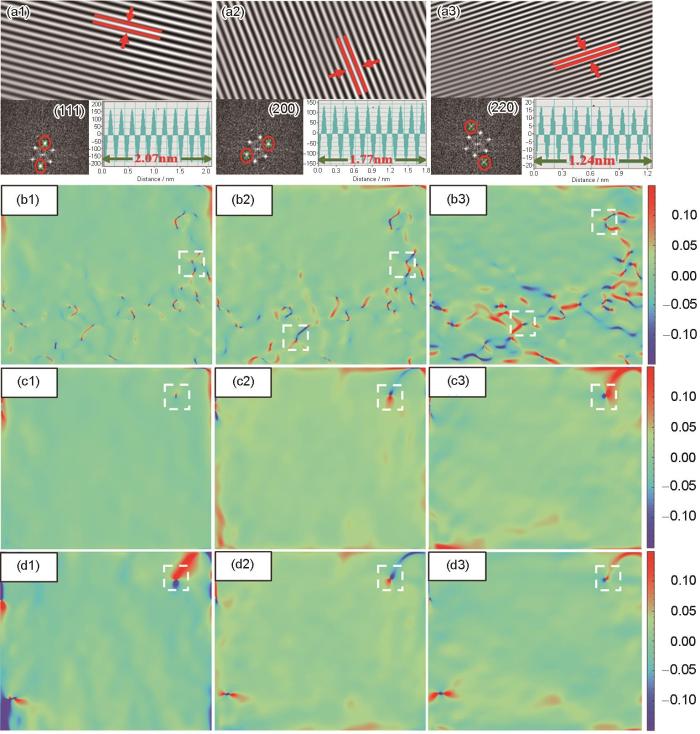
图2
B10 Cu-Ni合金不同晶面的快速Fourier变换(FFT)、逆快速Fourier变换(IFFT)及应变水平分析
Fig.2
Fast Fourier transforms (FFT), inverse fast Fourier transforms (IFFT), interplanar spacings, and strain level analyses of different crystal planes of B10 Cu-Ni alloy (The color scale bars indicate strains: red-to-yellow for tensile strain, green-to-blue for compressive strain; white boxes mark tensile-compressive stress concentration zones) (a1-a3) FFT and IFFT on the (111) (a1), (200) (a2), and (220) (a3) crystal planes, along with their corresponding interplanar spacing line profiles (b1-b3) x-direction strain (εxx ) (b1), xy-direction strain (εxy ) (b2), and y-direction strain (εyy ) (b3) on the (111) crystal plane (c1-c3) εxx (c1), εxy (c2), and εyy (c3) on the (200) crystal plane (d1-d3) εxx (d1), εxy (d2), and εyy (d3) on the (220) crystal plane
在铜合金的腐蚀研究中,(111)晶面作为最密排且最常暴露的表面,通常被选为腐蚀过程的研究对象[41]。为解析B10合金的微观结构演变过程及腐蚀失效机制,首先建立了基于(111)晶面的fcc结构模型(图3a),并通过将Ni原子固溶于Cu基体,构建了元素分布均匀的B10合金模型(图3b)。为探究热力学稳定构型,研究了合金表面的偏析过程,Cu原子在最外层表面富集时可形成能量最低的稳定结构,即B10seg合金模型(图3c),基于此稳定构型进行了腐蚀动力学分析。计算结果表明,发生表面偏析后的B10seg合金模型,其形成能(-0.74 eV)显著低于均匀固溶的B10模型(-0.44 eV),且表面能(1.29 J/m2)低于B10模型(1.48 J/m2)。这说明B10seg合金模型具有更高的热力学稳定性(图3d)。此外,B10seg合金模型的功函数(4.63 eV)相较于B10合金模型(3.84 eV)大幅提升,意味着表面对电子的束缚能力增强,进一步证实了B10seg偏析结构具有更高的稳定性[42]。为了揭示B10合金的腐蚀动力学过程,采用线性同步转变(linear synchronous transit,LST)/二次同步转变(quadratic synchronous transit,QST)方法,研究了合金表面原子迁移-溶解路径的过渡态能垒,并对铜合金的腐蚀过程进行了定量分析。图3e1~e3显示了纯Cu模型中Cu原子和B10seg合金模型中Cu、Ni原子迁移-溶解过程的示意图。Cu和Ni原子的迁移-溶解过程为多步骤耦合的动力学过程,具体步骤包括:(1) 初始状态(IS);(2) 表层Cu原子溶解,在合金表面形成Cu原子空位(Vac 1);(3) 亚表层原子(Cu/Ni)通过跨越与表层之间的迁移-溶解能垒,迁移至表层原子空位的过渡态(TS);(4) 迁移至表层的原子(Cu/Ni)发生溶解,再次形成表面原子空位(Vac 2),达到包含双原子空位的终态结构(FS)[43]。图3f为纯Cu及B10seg合金中Cu、Ni原子迁移-溶解过程的能量演化路径。可以看出,B10seg合金中Cu和Ni原子由亚表层迁移至表层空位(步骤3)所需要克服的迁移-溶解能垒分别为1.81和2.00 eV。由于Ni原子的迁移-溶解能垒显著高于Cu原子,表明Cu原子的优先迁移与溶解是决定B10seg合金腐蚀行为的关键,因此该步骤被认为是整个腐蚀反应的速控步骤。为了进一步预测腐蚀倾向,基于过渡态理论(TST)和配分函数计算了原子腐蚀速率常数。计算结果表明,在B10seg合金中,Cu和Ni原子的腐蚀速率常数分别为10.09和9.33 s-1,进一步证实了B10seg合金中Cu原子迁移-溶解过程是导致合金腐蚀失效的主要原因。此外,B10seg合金中Cu原子的腐蚀速率常数(10.09 s-1)低于纯Cu (10.21 s-1),表明B10seg合金的耐腐蚀性能优于纯Cu。
图3

图3
B10合金稳定结构模型的建立及迁移-溶解动力学过程分析
Fig.3
Establishment of the stable structure model of B10 alloy and analyses of the migration-dissolution kinetics process
(a) pure Cu model
(b) B10 alloy model
(c) B10seg (featuring a Cu-segregated surface in the lowest-energy state) alloy model
(d) comparisons of formation energy, surface energy, and work function
(e1-e3) migration-dissolution process analyses of Cu atom in pure Cu model (e1), Cu atom in B10seg alloy model (e2), and Ni atom in B10seg alloy model (e3) (IS—initial state, TS—transition state, FS—final state, Vac 1—surface Cu atom vacancy, Vac 2—re-formation of surface vacancy)
(f) atomic dissolution energy diagram
2.2 海水压力对合金微观结构演变及腐蚀行为的影响
为了研究海水压力对B10合金腐蚀行为的影响,在模拟深海静态高压环境中开展了腐蚀实验,并对其微观组织演变进行了表征[44]。不同海水压力下(海水流速为0) B10合金腐蚀10 h前后的SEM像如图4a~f所示。可以看出,压力对腐蚀形貌具有显著影响:随着压力由常压增至高压,合金表面由初始的光滑平整状态,逐渐演变为腐蚀点密布、腐蚀产物层增厚的形态,并最终呈现出褶皱状形貌。从图4g的XRD谱可以看出,随着海水压力的增大,合金基体的衍射峰出现明显右移,表明合金原子晶格收缩,微观结构发生改变,导致合金原子发生选择性溶解。基于此,进一步量化了微观结构的变化,发现随着海水压力的增大,(111)晶面的微应变从0.25%增加至0.57%,同时位错密度由0.72 × 10⁻³ nm-2显著上升至3.79 × 10⁻³ nm-2 (图4h和i)。上述结果表明,静水压力通过促进合金原子的迁移与溶解过程,显著加剧了微观结构中的缺陷累积与应变,从而破坏了B10 Cu-Ni合金的稳定性,导致其在深海高压环境中的耐腐蚀性能降低、腐蚀加速。
图4

图4
不同海水压力下(海水流速为0) B10合金腐蚀10 h前后的SEM像、XRD谱、(111)晶面的微应变及位错密度
Fig.4
SEM images of B10 alloy before (a) and after corrosion for 10 h under seawater pressures 0.1 MPa (b), 4.0 MPa (c), 6.0 MPa (d), 8.0 MPa (e), and 12.0 MPa (f); XRD patterns (g); microstrains of (111) crystal plane (h); and dislocation density of (111) crystal plane (i) at a seawater flow rate of 0
为了进一步研究深海高压环境对合金微观结构演变及腐蚀加剧过程的影响,建立了B10seg合金/海水界面溶剂化模型,并通过模拟海水与合金表面之间的距离来表征海水压力的影响[45,46]。如图5a所示,采用分子动力学方法构建模型,定量描述不同海水压力下H2O分子与合金表面之间的压缩距离。结果表明,海水压力分别为0.1、4.0、6.0、8.0和12.0 MPa时,H2O分子与合金表面的距离依次为0.34、0.27、0.25、0.24、0.22 nm (图5b)。通过调控模型表面H2O分子与合金表面的距离,能够模拟深海环境对合金微观结构演变过程的影响,如图5c所示。随着海水压力的增加,合金表面能从1.31 J/m2增加至1.40 J/m2 (图5d),表明合金的热力学稳定性下降;同时,功函数从4.65 eV降低至3.95 eV (图5e),说明合金表面电荷状态发生变化,电子束缚能力明显减弱。此外,海水压力的增大导致H2O分子与合金表面之间的距离减小,导致金属表层与海水介质接触的外Helmholtz面被压缩(图5f),影响了电极反应的动力学过程,从而加速合金迁移-溶解过程[47]。进一步分析海水压力对B10seg合金迁移-溶解过程的影响,结果表明,随着海水压力的增大,Cu原子和Ni原子的迁移-溶解能垒(步骤(3))分别由1.76和1.94 eV降至1.54和1.76 eV (图5g和h),表明海水压力显著加速了合金腐蚀过程。此外,从图5i可以看出,基于迁移-溶解能垒计算的腐蚀速率常数与实验值的变化趋势一致,进一步验证了合金-海水溶剂化模型的准确性,该模型能够有效预测合金在不同海水压力条件下的腐蚀行为。此外,深海环境中B10合金腐蚀加剧主要由Cu原子的迁移-溶解过程控制,海水压力通过降低Cu原子的迁移-溶解能垒使腐蚀速率增大。
图5

图5
不同海水压力下B10seg合金/海水界面溶剂化模型的建立,合金表面H2O分子的密度分布,模拟不同压力下H2O分子对合金中表面原子溶解影响的示意图模型,合金的表面能和功函数,海水压力对Helmboltz层影响的示意图,压力作用下原子的迁移-溶解过程及腐蚀速率常数与质量损失的对比
Fig.5
Establishment of the solvation model at the B10seg alloy/seawater interface under different seawater pressures (a), density distributions of H2O molecule on the alloy surface (b), schematic model for simulating the effect of H2O molecules on the dissolution of surface atoms in alloys under different pressures (c), surface energy (d), work function (e), schematic of the influence of seawater pressure on the Helmholtz layer (OHP—outer Helmholtz plane) (f), Cu (g) and Ni (h) atomic migration-dissolution processes under different pressures, and comparisons of corrosion rate constant and mass loss under different pressures (i)
2.3 海水流速对合金微观结构演变及腐蚀行为的影响
为了研究海水流速对B10 Cu-Ni合金腐蚀行为的影响,在常压条件下,海水流速为1~5 m/s范围内开展了腐蚀实验。从图6a1~a5的SEM像可以看出,在流动海水作用下,合金表面沿流动方向形成较为稳定且致密的腐蚀产物膜。随着海水流速增加,腐蚀产物膜由光滑变得粗糙,部分区域出现腐蚀产物脱落现象,尤其是在5 m/s海水流速下,合金基体明显裸露出来,表明腐蚀程度显著加剧[48]。从图6b的XRD谱可以看出,尽管不同海水流速下腐蚀试样的晶体结构未发生改变,但各晶面衍射峰强度随海水流速增加呈下降趋势,表明海水流动对B10合金的结构完整性产生了一定影响,这与Yi等[49]研究结果一致。进一步对(111)晶面进行解析,结果表明,随着海水流速增大,(111)晶面微应变和位错密度显著增加,在5 m/s海水流速下分别达到1.08%和12.13 × 10-3 nm-2,表明合金内部应变水平上升,结构缺陷增多,微观结构发生显著变化(图6c和d)。基于海水流速与(111)晶面微应变的对应关系,通过原子级轴向拉伸微应变模拟,揭示了表面切应力对合金中金属原子迁移-溶解过程的影响。图6e和f为不同海水流速下B10seg合金中Cu与Ni原子的迁移-溶解能垒谱图。可以看出,随着海水流速的增加,Cu与Ni原子的迁移-溶解能垒均呈现下降趋势,其中Cu原子在步骤(3) TS阶段的能垒由1.78 eV降至1.57 eV,Ni原子由1.93 eV降至1.75 eV,表明金属原子更容易跨越迁移能垒,加速腐蚀动力学过程。值得注意的是,当流速达到4 m/s时,Cu原子的迁移-溶解能垒显著下降,表明4 m/s是B10合金加速腐蚀的临界流速。基于Sobereva方法的过渡态理论,计算了不同海水流速下合金的腐蚀速率常数(图6g),其与实测结果变化趋势一致,验证了B10seg合金结构模型的准确性。从图6g可以看出,在海水流速为4 m/s时腐蚀速率常数显著增加,腐蚀速率增大,进一步说明了B10 Cu-Ni合金的临界流速为4 m/s。此外,图6h和i显示了海水流速对合金表面能及金属原子空位形成能的影响。可以看出,随着海水流速增加,表面能由1.43 J/m2上升至1.53 J/m2,Vac 1空位形成能由1.12 eV降至1.08 eV,表明合金表面稳定性下降,更易发生原子溶解。同时,表面功函数由4.62 eV降至4.43 eV (图6j),进一步证明海水流速的增加削弱了合金表面对电子的束缚能力,促进了电荷交换,加剧了腐蚀过程。本工作通过多尺度实验与理论模拟,系统揭示了海水流速对B10合金腐蚀行为的影响机制,为评估和预测不同海水流速条件下的流动腐蚀提供了理论依据。
图6

图6
常压条件下海水流速为1~5 m/s时B10合金表面腐蚀形貌的SEM像,XRD谱,(111)晶面的微应变和位错密度;B10seg合金的迁移-溶解过程,腐蚀速率常数与质量损失对比及腐蚀动力学参数分析
Fig.6
Corrosion behaviors of alloys under atmospheric pressure (0.1 MPa) at various seawater flow rates (1-5 m/s) (a1-a5) SEM images of B10 alloy under atmospheric pressure with seawater flow rates of 1 m/s (a1), 2 m/s (a2), 3 m/s (a3), 4 m/s (a4), and 5 m/s (a5) (b) XRD patterns of B10 alloy (c) microstrains of (111) crystal plane in B10 alloy (d) dislocation densities of B10 alloy (e) B10seg-Cu migration-dissolution process (f) B10seg-Ni migration-dissolution process (g) comparisons of corrosion rate constant and mass loss at different flow rates (h) relationship between surface energy and flow rate of B10seg alloy model (i) vacancy energies of B10seg alloy model (j) work functions of B10seg alloy model
2.4 海水流速与压力耦合作用对合金失效动力学的影响
在深海流动工况下,海水管路可能同时受到海水压力与流速的耦合作用,导致腐蚀加剧。4.0 MPa的海水压力能够更好地模拟实际应用环境中的工况,尤其是在海洋防腐领域中,该压力范围具有代表性。因此,为研究海水流速与压力耦合效应对B10合金微观结构的影响,并解析其与腐蚀行为的关系,在4.0 MPa海水压力下,系统研究了海水流速对合金原子迁移-溶解能垒及腐蚀速率常数的影响规律。图7a和b分别为海水压力与流速耦合作用下B10seg合金中Cu原子和Ni原子的迁移-溶解过程能量台阶图。可以看出,在耦合因素作用下,随着海水流速增加,Cu和Ni原子的迁移-溶解能垒呈下降趋势,但该过程仍为速控步骤。在1~5 m/s海水流速范围内,Cu原子的迁移-溶解能垒由1.68 eV降至1.36 eV,Ni原子由1.83 eV降至1.55 eV,表明在海水压力与流速的协同作用下,B10合金中Cu和Ni组分的腐蚀速率均显著加快,且Cu原子的腐蚀倾向高于Ni原子。基于Cu原子的迁移-溶解能垒,计算得到腐蚀速率常数(图7c),在4.0 MPa海水压力下,腐蚀速率常数随海水流速增加而上升,呈现出与常压条件下相似的规律,但腐蚀速率明显高于单一流速作用下的结果,表明海水压力与流速之间存在显著的协同效应。此外,腐蚀速率常数计算值与实测值变化趋势基本一致,验证了通过模拟海水静压力的铜合金/海水溶剂化界面模型与海水流动作用下的合金表面应变模型相结合的多因素耦合模型的准确性,表明金属原子迁移-溶解能垒及腐蚀速率常数能够有效评估和预测复杂海水环境下的腐蚀行为。
图7

图7
4.0 MPa压力条件下,海水流速为1~5 m/s时B10seg合金的迁移-溶解过程,腐蚀速率常数与质量损失的对比;单一压力(4.0 MPa、0 m/s)/流速(0.1 MPa、4 m/s)及耦合因素(4.0 MPa、4 m/s)作用时B10合金表面腐蚀形貌的SEM像、XRD谱及(111)晶面的微应变和位错密度分析
Fig.7
Migration-dissolution process of B10seg alloy at 4.0 MPa with seawater flow velocities of 1-5 m/s, and the corrosion behavior of B10 alloy under the individual effects of pressure (4.0 MPa, 0 m/s) and flow velocity (0.1 MPa, 4 m/s) versus coupled effect (4.0 MPa, 4 m/s)
(a, b) migration-dissolution processes of B10seg-Cu (a) and B10seg-Ni (b) under 4.0 MPa pressure and different flow rates
(c) comparisons of corrosion rate constant and mass loss at different flow rates under 4.0 MPa
(d-f) SEM images of the surface corrosion morphology of the B10 alloy under 4.0 MPa (d), at 4 m/s (e), and under 4.0 MPa and at 4 m/s (f)
(g) XRD patterns of B10 alloy
(h) microstrains of (111) crystal plane in B10 alloy
(i) dislocation densities of B10 alloy
为了研究海水压力与流速耦合作用对B10合金的协同腐蚀作用,比较了单一压力、单一流速及其耦合作用下的腐蚀过程。图7d~f分别为4.0 MPa压力(海水流速为0)、4 m/s流速(压力为0)及4.0 MPa压力与4 m/s流速耦合作用下B10合金腐蚀10 h后的表面微观形貌。可以看出,单一压力作用下合金表面较为光滑,无大面积腐蚀产物堆叠(图7d);单一流速作用下腐蚀产物明显增厚,并沿海水流速方向呈现波浪状形貌(图7e);而在海水压力与流速耦合作用下,合金表面腐蚀产物厚度进一步增加,形貌更为粗糙,并出现部分缺陷和微裂纹,表明腐蚀程度显著加剧(图7f)。从图7g的XRD谱可以看出,衍射峰仍表现为合金基体的晶体结构。进一步对(111)晶面的微应变和缺陷密度进行分析发现,相较于单一压力或流速作用,压力与流速耦合作用下B10合金的微应变水平(0.74%)和位错密度(6.36 × 10⁻³ nm-2)明显增加(图7h和i),表明海水压力与流速耦合作用导致合金内部产生更多结构缺陷及应变,从而加速了腐蚀过程。
为了揭示海水压力与流速对B10合金腐蚀的协同作用机制,对单一因素及耦合因素下的腐蚀行为进行了对比分析。图8a和b为单一压力(4.0 MPa、0 m/s)/流速(0.1 MPa、4 m/s)及耦合因素作用(4.0 MPa、4 m/s)条件下B10seg合金中Cu原子和Ni原子的迁移-溶解能垒图。可以看出,压力与流速的耦合作用显著降低了Cu原子(1.50 eV)和Ni原子(1.67 eV)的迁移-溶解能垒,其效应远超单一因素作用(图8a和b)。相应地,理论计算的腐蚀速率常数在耦合条件下达到最高值12.96 s-1 (图8c),这为二者间的协同促进效应提供了直接的动力学证据[50,51]。这种动力学上的加速与合金表面热力学稳定性的降低有关。在耦合作用下,合金表面能增至1.54 J/m²,而表面原子空位形成能则降至0.94 eV (图8d和e),表明表面原子的溶解变得更为容易。进一步从电子结构层面探究可以发现,耦合作用导致功函数降至更低水平(图8f),削弱了表面对电子的束缚能力。同时,表面电荷密度分布图(图8g~i)显示,在海水压力与流速耦合作用下合金表面电荷呈现出明显的局部聚集,形成了容易与海水中高电负性物种(如O2-、Cl-)发生键合的活性位点[52]。综上所述,海水压力与流速的协同作用通过降低原子溶解的动力学能垒、削弱表面热力学稳定性以及优化表面电子结构以利于电荷交换等多重路径,共同加剧了B10合金的腐蚀进程。
图8

图8
压力(4.0 MPa、0 m/s)/流速(0.1 MPa、4 m/s)单一因素与耦合因素作用(4.0 MPa、4 m/s)条件下B10seg合金的迁移-溶解过程、腐蚀动力学参数及电荷密度分布
Fig.8
Migration-dissolution processes, corrosion kinetics parameters, and charge density distributions of B10seg alloy under the effect of pressure (4.0 MPa, 0 m/s)/flow velocity (0.1 MPa, 4 m/s) as single factors and coupled factors (4.0 MPa, 4 m/s)
(a, b) migration dissolution of Cu (a) and Ni (b) atoms under single/coupled mechanical conditions in B10seg alloy model
(c) comparisons of corrosion rate constant of B10seg alloy model
(d) surface energies of B10seg alloy model
(e) vacancy energies of B10seg alloy model
(f) work functions of B10seg alloy model
(g-i) charge density distributions of B10seg alloy model under 4.0 MPa (g), at 4 m/s (h), and under 4.0 MPa and at 4 m/s (i)
当B10合金受到海水压力与流动的共同作用时,二者之间的协同效应显著加剧了腐蚀过程。如图9所示,合金的腐蚀过程遵循表面原子优先溶解机制:该过程始于表层原子的初始溶解状态(IS),继而在表面形成Cu原子空位缺陷(Vac 1);随后,亚表层原子克服能量势垒迁移至表层原子空位处(TS),完成动态的结构重构;迁移至表层的原子发生溶解,再次形成表层原子空位(Vac 2),最终,形成双空位缺陷的终态结构(FS),使腐蚀向合金内部持续扩展。基于TST对迁移-溶解过程能量演化路径的计算结果表明,亚表层原子向表面空位的迁移过程是整个腐蚀反应的关键速率控制步骤。在静态无外力作用时,该迁移过程存在较高的能垒,赋予了合金固有的耐腐蚀性能。然而,当合金受到海水压力或流速的单一作用时,外力诱导的晶格畸变会显著降低原子迁移的能垒,从而在动力学上促进腐蚀。更为关键的是,在海水压力与流速的耦合作用下,二者产生的协同效应能够最大程度地降低该能垒,从而极大地促进原子迁移速率,最终导致合金的局部腐蚀倾向显著加剧。
图9

图9
深海动态环境下B10 Cu-Ni合金的迁移-溶解动力学机制示意图
Fig.9
Schematic showing the migration dissolution kinetics of B10 Cu-Ni alloy under deep-sea dynamic environment
3 结论
(1) 构建了表面富Cu的B10合金微观模型,并从原子尺度阐明了其腐蚀过程。计算结果表明,亚表层金属原子克服能量势垒迁移至表面空位的过程,是决定整体腐蚀速率的关键速控步骤。
(2) 海水压力或流速的增加会导致合金内部微应变与结构缺陷的累积,从而降低原子迁移-溶解的动力学能垒,加速腐蚀。4 m/s是诱发腐蚀显著加剧的临界流速,此时原子迁移-溶解能垒大幅下降。
(3) 在海水压力与流速的耦合作用下,B10合金的原子迁移-溶解能垒被进一步削弱,其腐蚀速率常数显著高于单一因素作用。这揭示了两种环境因素之间存在着明确的协同效应,共同加剧了合金的腐蚀进程。
(4) 基于理论计算所得的迁移-溶解活化能和腐蚀速率常数与实验测量结果具有一致性,验证了B10seg合金结构模型的准确性与可靠性,证明其能够为B10合金在复杂海洋工况下的腐蚀行为提供有效评估与预测。
参考文献
Surface and interface characteristics of Cu-Ni alloy corroded in seawater
[J].
铜镍合金海水腐蚀的表面与界面特征研究
[J].
采用金相(OM)、俄歇(AES)、扫描电镜(SEM)及透射电镜(TEM)等技术手段对实海暴露试样进行探测分析,揭示了表面膜缺陷(如碳膜)、晶界缺陷(晶界析出物)等加速该合金腐蚀进程的试验现象和内在根据,特别指出影响该合金海水腐蚀产物膜稳定性的主要因素,分析了其中的沿晶扩散及应变诱生调峰分解与沿晶腐蚀、沿晶脆断的相互关系。
Analysis and thinking of B10 material standard of ship sea pipeline
[J].
舰船海水管路B10材料标准分析与思考
[J].
Progress on corrosion and repair technology of marine seawater pipe
[J].
船舶海水管路腐蚀及修复技术研究进展
[J].
Applications of copper alloy in shipbuilding
[J].
铜合金在舰船上的应用
[J].
Research progress on microbiological induced corrosion of metallic materials under ocean environment
[J].
海洋环境下金属材料微生物腐蚀研究进展
[J].
Some thoughts on modelling the effects of oxygen and particle concentration on the erosion-corrosion of steels in aqueous slurries
[J].
Numerical simulation study on erosion-corrosion induced by liquid-solid two-phase flow
[D].
液固两相流冲刷腐蚀数值模拟研究
[D].
The effect of strain rate on stress corrosion performance of Ti6Al4V alloy produced by additive manufacturing process
[J].Ti6Al4V alloy is considered as a favourable material for additive manufacturing (AM) and in particular for selective laser melting (SLM), due to the inherent difficulties relating to casting and plastic forming of this alloy. However, the significantly increased solidification rate associated with the SLM process results in a modified micro-structure and inherent casting imperfections that can have a detrimental effect on the alloy stress corrosion performance. The main objective of this study was to evaluate the effect of strain rate on stress corrosion behavior of Ti6Al4V alloy produced by SLM, as compared to its wrought alloy (Grade 5) coun-terpart of the same chemical composition. Micro-structure and phase identification were examined by scanning electron microscopy and X-ray diffraction analysis. General corrosion resistance was evaluated in terms of open circuit potential, potentiodynamic polarization analysis and by impedance spectroscopy, while stress corrosion behavior was examined at various strain rates in a 3.5% NaCl solution at ambient temperature. The results obtained revealed that general corrosion resistance and stress corrosion endurance at slow strain rate, in terms of time to failure and ductility of the SLM alloy, were relatively reduced, as compared to the wrought alloy counterpart. This was mainly due to the formation of a strained martensitic matrix in the form of alpha' phase and the significant reduction of the 13 phase in the alloy produced by SLM process. (C) 2020 The Authors. Published by Elsevier B.V. This is an open access article under the CC BY-NC-ND license (http://creativecommons.org/licenses/by-nc-nd/4.0/).
Study of tribocorrosion of three different corrosion reisistance materials under deep-sea high pressure
[D].
三类不同耐蚀性材料在深海高压下的磨蚀研究
[D].
Stress corrosion cracking of the titanium alloys under hydrostatic pressure resulting from the degradation of passive films
[J].
In vitro corrosion behavior of biodegradable WE43 alloy under various physiological flow velocities
[J].
Electrochemical corrosion behavior of 90/10 Cu-Ni alloy in flowing seawater
[J].
B10铜镍合金流动海水冲刷腐蚀电化学行为
[J].
Erosion corrosion behavior of copper-nickel alloy pipe in flowing seawater
[J].
流动海水中铜镍合金管材的冲刷腐蚀行为
[J].
Erosion enhanced corrosion and corrosion enhanced erosion of API X-70 pipeline steel
[J].
Study on erosion-corrosion behavior of X70 steel in simulated deep sea environment
[D].
X70钢在模拟深海环境下的冲刷腐蚀行为研究
[D].
Surface characterization and corrosion behavior of 70/30 Cu-Ni alloy in pristine and sulfide-containing simulated seawater
[J].
Effect of iron and manganese on corrosion resistance of B10 copper-nickel alloy and its mechanism
[D].
铁、锰对B10白铜合金耐蚀性能的影响及机理研究
[D].
Study on passivating treatment of Cu-Ni alloy in compound passivant containing benzotriazole
[J].
Cu-Ni合金BTA复配体系钝化处理工艺研究
[J].采用苯并三氮唑(BTA)复配钝化体系对B10 Cu--Ni合金进行钝化处理,以提高其在含硫化物环境介质中的耐腐蚀性能, 并研究工艺参数对钝化膜耐蚀性的影响规律. 利用动电位极化曲线和电化学阻抗谱研究钝化膜的耐腐蚀性能, 采用X射线光电子能谱分析钝化膜的化学成分.实验结果表明, 在BTA与磺基水杨酸组成的复配体系中形成的钝化膜比BTA单一体系中形成的钝化膜具有更高的耐蚀性, 这是磺基水杨酸与基体合金反应形成的络合物膜与Cu(I)BTA膜协同作用的结果; 钝化处理的时间和温度是影响钝化膜耐蚀性的重要工艺参数, 延长钝化时间和提高钝化温度均可以提高钝化膜的耐蚀性, 60 ℃高温条件下5 min的钝化处理即能够达到常温条件下3 h的钝化处理效果.
Explicit microstructure, corrosion, and stress analysis of value-added Al-3.7%Cu-1.4%Mg/1.5% rice husk ash nanoparticles for pump impeller application
[J].
A comparative study of methods for calculating the dislocation density in GaN-on-Si epitaxial wafers
[J].A series of characterization methods involving high-resolution X-ray diffraction (HR-XRD), electron channel contrast imaging (ECCI), cathodoluminescence microscopy (CL), and atomic force microscopy (AFM) were applied to calculate the dislocation density of GaN-on-Si epitaxial wafers, and their performance was analyzed and evaluated. The ECCI technique, owing to its high lateral resolution, reveals dislocation distributions on material surfaces, which can visually characterize the dislocation density. While the CL technique is effective for low-density dislocations, it is difficult to accurately identify the number of dislocation clusters in CL images as the density increases. The AFM technique analyzes surface dislocation characteristics by detecting surface pits caused by dislocations, which are easily affected by sample and probe conditions. A prevalent method for assessing the crystal quality of GaN is the rocking curve of HR-XRD (ω-scan), which calculates the dislocation density based on the FWHM value of the curves. By comparing the above four dislocation characterization methods, the advantages and limitations of each method are clarified, which also verifies the applicability of DB=β29b2 for GaN-on-Si epitaxial wafers. This provides an important reference value for dislocation characterization in GaN-on-Si materials. The accuracy evaluation of dislocation density can truly and reliably reflect crystal quality, which is conducive to further optimization. Furthermore, this study can also be applied to other heterogeneous or homogeneous epitaxial materials.
X-ray analysis of ZnO nanoparticles by Williamson-Hall and size-strain plot methods
[J].
An all-electron numerical method for solving the local density functional for polyatomic molecules
[J].
Atomistic understanding of Pt-based medium entropy alloys for oxygen reduction electrocatalysis based on first principles
[J].
Linear relationship between weighted-average madelung constants and density functional theory energies for MgO nanotubes
[J].
Determinants of vacancy formation and migration in high-entropy alloys
[J].\n Vacancies are crucial for the radiation resistance, strength, and ductility of high-entropy alloys (HEAs). However, complex electronic interactions resulting from chemical disorder prohibit the quantification of vacancy formation energy (\n E\n f\n ) and migration barriers (\n E\n b\n ). Herein, we propose an electronic descriptor χ\n S\n v\n (electronegativity χ and valence-electron number\n S\n v\n ) to quantify the bonding strength of constituents on the basis of the tight-binding model, which allows us to build analytical models to achieve the site-to-site quantification of\n E\n f\n and\n E\n b\n. The descriptor χ\n S\n v\n reflects the d-band occupation, indicating the dominant role of the electronic interactions in the vacancy formation and migration of HEAs. As a size effect, local lattice distortion plays a more important role in vacancy migration than in vacancy formation. Our model establishes a universal physical picture of vacancy formation and migration, which helps to understand the radiation resistance and mechanical properties of HEAs, thereby accelerating the design of high-performance HEAs.\n
First-principles calculations of metal surfaces. I. Slab-consistent bulk reference for convergent surface properties
[J].
KiSThelP: A program to predict thermodynamic properties and rate constants from quantum chemistry results
[J].Kinetic and Statistical Thermodynamical Package (KiSThelP) is a cross-platform free open-source program developed to estimate molecular and reaction properties from electronic structure data. To date, three computational chemistry software formats are supported (Gaussian, GAMESS, and NWChem). Some key features are: gas-phase molecular thermodynamic properties (offering hindered rotor treatment), thermal equilibrium constants, transition state theory rate coefficients (transition state theory (TST), variational transition state theory (VTST)) including one-dimensional (1D) tunnelling effects (Wigner, and Eckart) and Rice-Ramsperger-Kassel-Marcus (RRKM) rate constants, for elementary reactions with well-defined barriers. KiSThelP is intended as a working tool both for the general public and also for more expert users. It provides graphical front-end capabilities designed to facilitate calculations and interpreting results. KiSThelP enables to change input data and simulation parameters directly through the graphical user interface and to visually probe how it affects results. Users can access results in the form of graphs and tables. The graphical tool offers customizing of 2D plots, exporting images and data files. These features make this program also well-suited to support and enhance students learning and can serve as a very attractive courseware, taking the teaching content directly from results in molecular and kinetic modelling.© 2013 Wiley Periodicals, Inc.
The synchronous-transit method for determining reaction pathways and locating molecular transition states
[J].
Variations in dissolved oxygen and aquatic biological responses in China’s coastal seas
[J].
Contiguous low oxygen waters between the continental shelf hypoxia zone and nearshore coastal waters of Louisiana, USA: Interpreting 30 years of profiling data and three-dimensional ecosystem modeling
[J].
Vertical profile of dissolved oxygen and associated water variables in the Pasur-Rupsha estuary of Bangladesh
[J].
Effects of heat treatment processes and W wire properties on residual stress in W wire reinforced Zr-based metallic glass composites
[J].Bulk metallic glasses (BMGs) are exhibit a unique atomic structure and have a long-range disorder but short-to-medium-range order, contrasting sharply with the periodic arrangements found in crystalline materials. This distinct arrangement grants BMGs exceptional properties such as high strength, significant elastic limits, and high resistance to corrosion and wear. However, BMGs are brittle owing to localized shear band propagation during deformation under load, particularly at temperatures below their glass transition temperature. This brittleness restricts their practical applications, prompting researchers to explore methods to enhance their ductility. One prominent approach involves the development of bulk metallic glass composites (BMGCs) via incorporating a secondary phase that effectively mitigates the single shear band instability and promotes multiple shear bands to partake in plastic deformation, significantly enhancing the room-temperature ductility. BMGCs reinforced with W wire are noteworthy owing to the high density and strength of W, making these materials highly applicable in the defense sector. By embedding W wires homogeneously into a BMG matrix such as Vitreloy 1 (Zr41.2Ti13.8Cu12.5Ni10.0Be22.5, atomic fraction, %), the resulting composite has high compressive strength and ductility. Despite these benefits, the production of W wire-reinforced BMGCs inevitably introduces thermal residual stresses owing to the differences in the coefficients of thermal expansion of the composite components. These stresses can significantly affect the mechanical properties of the BMGCs. Advanced nondestructive techniques such as neutron diffraction have become indispensable tools for evaluating the internal stress distribution within such materials. Neutron diffraction enables the measurement of stresses deep within the materials, providing a comprehensive view of the entire sample volume, which is crucial for optimizing the manufacturing processes and enhancing the performance of the BMGCs. This work aims to comprehensively investigate the effects of various processing parameters, such as the diameter of the W wires and temperature, on the residual stresses within W wire-reinforced BMGCs. By using neutron diffraction to analyze the effects of annealing treatment of W wires in hydrogen, heat treatment duration of BMGCs, and W wire diameter on residual stresses, this work aims to finely tune the internal stresses during the manufacturing process, thereby laying a foundation for optimizing and improving the material properties of W wire-reinforced BMGCs. The results reveal a strong <110> texture along the axial direction of the W wire and a low refined residual value (Rwp), confirming the accuracy of the refined data. The tempering process demonstrates a complex influence on the control of residual stresses within W wire-reinforced BMGCs. Measurements and analyses of residual stresses after different tempering treatments reveal that a 30 min temper at 200oC effectively reduces residual stresses. However, extending the tempering duration to 60 min leads to the reaccumulation of stresses owing to complex reactions within the BMGCs. In addition, a comparative analysis of W wire-reinforced BMGCs annealed in the present and absence of hydrogen indicates that the former significantly improves the surface quality of W wires, thereby reducing the residual stresses in the BMGCs. After annealing in hydrogen, the diameter of W wires increases from 0.2 mm to 0.3 mm, which has little effect on the overall stress distribution.
热处理工艺和W丝特性对W丝增强锆基非晶复合材料残余应力的影响
[J].
[Cu13{S2CN n Bu2}6-(acetylide)4]+: A two-electron superatom
[J].
Calculation of the surface energy of FCC metals with modified embedded-atom method
[J].
Surface energies, adhesion energies, and exfoliation energies relevant to copper-graphene and copper-graphite systems
[J].
The deformations of carbon nanotubes under cutting
[J].The determination of structural evolution at the atomic level is essential to understanding the intrinsic physics and chemistries of nanomaterials. Mechanochemistry represents a promising method to trace structural evolution, but conventional mechanical tension generates random breaking points, which makes it unavailable for effective analysis. It remains difficult to find an appropriate model to study shear deformations. Here, we synthesize high-modulus carbon nanotubes that can be cut precisely, and the structural evolution is efficiently investigated through a combination of geometry phase analysis and first-principles calculations. The lattice fluctuation depends on the anisotropy, chirality, curvature, and slicing rate. The strain distribution further reveals a plastic breaking mechanism for the conjugated carbon atoms under cutting. The resulting sliced carbon nanotubes with controllable sizes and open ends are promising for various applications, for example, as an anode material for lithium-ion batteries.
Calculation of the band structure for copper as a function of lattice spacing
[J].
Characterization of strain field distribution in carbon fiber reinforced resin matrix composites using electron beam moiré and geometric phase analysis
[J].
Molecular dynamics simulation of creep mechanism in nanocrystalline α-zirconium under various conditions
[J].
不同条件下纳米晶α-Zr蠕变行为的分子动力学模拟
[J].为理解锆合金在核反应堆中的辐照损伤及蠕变的微观电子机制,本工作利用分子动力学方法对α-Zr纳米晶在高温、辐照等不同条件下的拉伸蠕变过程进行了模拟。结果表明:温度、应力、辐照和晶粒尺寸会影响纳米晶α-Zr的蠕变行为,升高温度、增大应力和细化晶粒均会促进蠕变过程的进行。蠕变后体系的微观组织发生显著变化,部分晶粒随蠕变的变形过程而长大,另一些晶粒则逐渐缩小甚至消失。变形过程中晶格畸变逐渐向晶粒内部传递,使体系内原有的有序hcp结构受到影响而有序度降低。模拟结果分析发现,晶界迁移是纳米晶α-Zr在稳态蠕变过程中的主要变形机制,升高温度和增大应力水平会使晶界宽化,并促进组织演变。模拟不同能量粒子辐照后,体系中产生大量点缺陷,其扩散对蠕变有一定贡献,且这些缺陷最终汇集于晶界处,可提高晶界可动性。增大辐照能量可加大产生辐照缺陷的数量和尺寸,对蠕变过程起到更大的促进作用。
Crystallographic anisotropy of corrosion rate and surface faceting of polycrystalline 90Cu-10Ni in acidic NaCl solution
[J].
Study on anisotropic oxide formation rate in the initial corrosion stage of 90Cu-10Ni alloy in alkaline NaCl solution by experiments and first-principles calculation
[J].
Corrosion mechanism of T1 phase in Al-Cu-Li alloy: First-principles calculations
[J].
第一性原理研究Al-Cu-Li合金中T1相的腐蚀机理
[J].
DFT approach for predicting the pH-potential-dependent durabilities of Pt-skinned Pt-M (M = Ni, Co, and Ir) alloys for fuel cell cathodes
[J].
Influence of hydrostatic pressure on the corrosion behavior of 90/10 copper-nickel alloy tube under alternating dry and wet condition
[J].
Experimental and computational study of CO2 storage and sequestration with aqueous 2-amino-2-hydroxymethyl-1,3-propanediol (TRIS) solutions
[J].
Adsorption and corrosion-inhibiting effect of 2-(2-{[2-(4-Pyridylcarbonyl)hydrazono]methyl}phenoxy)acetic acid on mild steel surface in seawater
[J].
Study on the mechanism of hydrostatic pressure promoting electrochemical corrosion of pure iron in 3.5% NaCl solution
[J].
Erosion-corrosion behavior of copper and 90/10 Cu-Ni alloy in flowing seawater
[D].
TUP紫铜及B10铜镍合金流动海水冲刷腐蚀行为研究
[D].
Elucidating different selective corrosion behavior of two typical marine aluminum bronze alloys from the perspective of constituent phases
[J].
Development mechanism of internal local corrosion of X80 pipeline steel
[J].The occurrence and development mechanism of internal local corrosion has always been a controversial topic, and especially under flow conditions. In this paper, an improved high shear force loop was experimentally used, and local flow field is induced by simulating corrosion defects on the surface of X80 pipeline steel specimens. The characteristics of corrosion products deposited on the surface of specimens in CO2-saturated NACE solution were investigated by means of electrochemical impedance spectroscopy (EIS), scanning electron microscopy (SEM), X-ray diffraction (XRD), and energy dispersive spectrometry (EDS). The 3D micromorphology of the corrosion test surface after remove the corrosion scale used to measure the size of localized corrosion pit. Under the influence of local defects, the wall shear stress (WSS) and turbulent kinetic energy of local flow fields enhanced significantly, and pressure fluctuations in local flow field were induced. The results showed that the characteristics of surface corrosion products varied with flow velocity. The corrosion scales formed in various regions of specimens with defects exhibited different surface micro-morphologies and chemical compositions. Overall, these data offer new perspectives for better understanding the mechanisms behind local corrosion.
In-situ electrochemical testing and fluid dynamics simulation of pipeline defects under flow accelerated corrosion
[J].


