



1988年,Yoshizawa等[9]首次开发出Fe-Si-B-Cu-Nb (Finemet)系纳米晶软磁合金,其出色的综合软磁性能引起广泛关注,加之其生产工艺性能好,迅速实现了商业化[10]。随后,研究人员又相继开发出了Fe-(Zr/Nb/Hf)-B (Nanoperm)[11]、(Fe, Co)-(Zr/Hf)-B-Cu (Hitperm)[12]和Fe-Si-B-P-Cu (Nanomet)[13]等典型纳米晶软磁合金体系。近年来,一系列新型具有高Bs的纳米晶合金也相继被研发出来,如Fe75.5Co0.5-Mo0.5Cu1Nb1.5Si13B8[14]和Fe85.5B10Si2P2C0.5[15]等。然而,Nanoperm和Hitperm合金中的Zr、Hf易氧化,难以在大气条件下制备;Nanomet合金需要在高升温速率下进行热处理,才能保证良好的软磁性,对热处理设备要求高,因此,这些纳米晶合金目前尚无法实现大规模工业化生产。为满足器件对软磁材料高频性能的更高要求,科研人员尝试通过优化合金成分和调控热处理工艺等手段进一步提高商用Finemet系纳米晶合金的高频软磁性能。Zhou等[14]通过在Fe76.5Si13B8Cu1Nb1.5纳米晶合金中添加Co和Mo元素,使其在100 kHz下的μe提高了44%。Mao等[16,17]采用1% (原子分数,下同)的Gd或Y元素替换Fe73.5Si13.5B9-Cu1Nb3纳米晶合金中的Fe,在提升其μe的同时,还改善了软磁性能的高温稳定性。Lu等[18]采用2%的V元素替换Fe73.5Si13.5B9Cu1Nb3纳米晶合金中的Nb,使其在0.5 T、20 kHz下的Pcv降低了33%。Fu等[19]通过磁场热处理将Fe73.5Si15.5B7Cu1Nb3纳米晶合金在100 kHz的μe提高3倍以上。Fan等[20]在热处理时施加410 MPa张应力,使Fe73.5Si13.5B9Cu1Nb3纳米晶合金的高频μe得到显著提升。He等[21]通过对Fe76Cu1Si14B6Nb3纳米晶铁心进行横向磁场退火,显著降低了其Pcm。当然,成分调控需要综合考虑非晶形成能力、软磁性能和生产工艺性之间的相互制约。采用磁场/应力热处理工艺虽然能够改善软磁性能,但也会导致生产工艺复杂化和制备成本增加。
随着合金带材制备技术的发展,降低带材厚度以提高纳米晶合金高频磁性能正受到越来越多的关注。Lee等[22]研究表明,当频率低于100 kHz时,厚度为20 μm的Fe83B9Nb7Cu1纳米晶带材的μe高于厚度为7 μm的纳米晶;但当频率高于100 kHz时,厚度为7 μm的薄带材的μe更高。Xu等[23]研究同样表明,当频率低于100 kHz时,Fe82B10Nb7Cu1纳米晶合金厚带材的μe高于薄带材,在频率高于100 kHz时发生反转。Jiang等[24]则发现,Fe73.5Si15.5B7Cu1Nb3纳米晶薄带材在1 kHz~1 MHz频率范围内始终具有比厚带材更高的μe。Lee等[22]发现,在0.2 T、100 kHz条件下,Fe83B9Nb7Cu1纳米晶薄带材较厚带材具有更低的Pcm。李准等[25]和时红昊等[26]也都通过降低纳米晶带材厚度降低了Pcm。目前,尽管通过降低带材厚度来降低纳米晶合金的高频损耗已得到普遍认可,但是带材厚度对磁导率的影响规律尚无统一结论,带材厚度对纳米晶合金高频磁化行为的影响机制也有待进一步澄清。
本工作以Fe75.2Si13B8Cu1Nb2.8合金为研究对象,制备了厚度为15~23 µm的合金带材,系统研究了带材厚度对该合金的快淬态与热处理态组织结构、静态和高频磁性能以及磁畴结构的影响规律,通过构建带材厚度-磁畴结构-高频软磁性能间的关联,讨论了带材厚度影响纳米晶合金高频磁化行为的机制。
1 实验方法
按照合金名义成分(原子分数) Fe75.2Si13B8Cu1Nb2.8称重配料,所用Fe、Si、B、Cu和Nb原料纯度(质量分数)均不低于99.5%。采用非自耗真空电弧炉在Ar气气氛中熔炼母合金锭,反复熔炼4遍以保证成分均匀,质量损失不超过0.2%。采用单辊甩带法制备宽度为1.5 mm的快淬合金带材,通过调整铜辊转速改变带材厚度(t = 15、19、23 µm,误差±1 µm),分别标记为T15、T19和T23。通过螺旋测微器进行多点测量以确认带材厚度(见补充材料图S1)。将快淬带材缠绕成内径为9 mm、外径为11 mm的环形铁心。将带材及铁心样品真空封装在石英管中,使用箱式马弗炉在783~883 K范围内间隔20 K等温退火60 min,随后水淬获得纳米晶合金。采用TA SDT650差式扫描量热仪(DSC)分析快淬合金带材的热性能。采用D8 Focus X射线衍射仪(XRD,CuKα)对带材进行物相分析,并根据Scherrer公式估算α-Fe的平均晶粒尺寸(Dα-Fe)。采用JEM-2100F透射电子显微镜(TEM)表征带材微观组织并统计α-Fe晶粒尺寸分布,利用正态分布函数拟合获得Dα-Fe和尺寸分布标准差。分别使用MATS-2010SD直流B-H回线仪和7404S振动样品磁强计(VSM)测试样品的Hc和Bs。采用Keysight E4990A阻抗分析仪测试样品在1~104 kHz频率下的μe。使用SY-8218交流B-H分析仪测试样品在最大磁感应强度(Bm)为0.2 T、频率为10~500 kHz下的Pcm。使用JK2516A直流低电阻测试仪测试样品的室温电阻率(R)。采用em-Kerr-highres磁光Kerr显微镜(MOKE)表征样品的准静态磁畴结构。利用Archimedes法测定合金的密度(ρ),所用溶液为邻苯二甲酸二乙酯,并以此进行磁性能单位换算。
2 实验结果
图1

图1
不同厚度Fe75.2Si13B8Cu1Nb2.8快淬合金带材的XRD谱和差式扫描量热(DSC)曲线
Fig.1
XRD patterns (a) and DSC curves (b) of melt-spun Fe75.2Si13B8Cu1Nb2.8 alloy ribbons with different thicknesses (t—ribbon thickness, Tx1—onset temperature of the first crystallization peak, Tx2—onset temperature of the second crystallization peak)
图2

图2
厚度为23 µm的Fe75.2Si13B8Cu1Nb2.8快淬合金带材的TEM明场像、HRTEM像和选区电子衍射(SAED)花样
Fig.2
Bright-field TEM (a) and HRTEM (b) images of melt-spun Fe75.2Si13B8Cu1Nb2.8 alloy ribbon with a thickness of 23 μm (Inset in Fig.2a is the corresponding SAED pattern)
随后研究了Fe75.2Si13B8Cu1Nb2.8合金带材经热处理后的磁性能。由不同厚度合金带材的Bs和Hc与退火温度(Ta)的关系(图3)可见,经783~863 K退火60 min后,各带材的Bs相较于快淬态均显著增加,维持在1.35~1.36 T (以ρ = 7.362 g/cm3换算),而经883 K退火后又呈现略微降低的趋势。随着Ta升高,各带材的Hc均呈现先降低后升高的变化趋势;经843 K退火60 min后,各合金带材均可获得最低的Hc,对应数值为0.5~0.6 A/m,无明显差异。不同厚度合金带材在经843 K退火后均获得了最优的综合静态磁性能,即兼具较高的Bs与较低的Hc,并且在该温度附近的一定波动范围内,带材的磁性能保持相对稳定。因此,确定843 K、60 min为最佳热处理工艺,后续的高频磁性能测试也以该工艺下处理的带材为主。各合金带材在该工艺下的Bs和Hc具体数值见表1。
图3
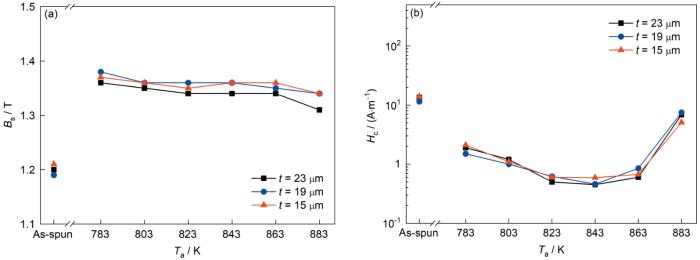
图3
不同厚度Fe75.2Si13B8Cu1Nb2.8合金带材的磁通密度(Bs)和矫顽力(Hc)与退火温度(Ta)的关系
Fig.3
Variations in saturation magnetic flux density (Bs) (a) and coercivity (Hc) (b) of Fe75.2Si13B8Cu1Nb2.8 alloy ribbons with different thicknesses as a function of annealing temperature (Ta)
表1 不同厚度Fe75.2Si13B8Cu1Nb2.8纳米晶带材的α-Fe平均晶粒尺寸和磁性能参数
Table 1
| Alloy | t µm | Dα-Fe nm | Bs T | Hc A·m-1 | μe | Pcm / (W·kg-1) | ||
|---|---|---|---|---|---|---|---|---|
| 100 kHz | 1 MHz | 0.2 T, 100 kHz | 0.2 T, 500 kHz | |||||
| T15 | 15 | 11.0 | 1.36 | 0.6 | 17000 | 5200 | 67 | 811 |
| T19 | 19 | 11.6 | 1.36 | 0.5 | 16500 | 4100 | 81 | 1017 |
| T23 | 23 | 11.4 | 1.35 | 0.5 | 14000 | 2900 | 108 | 1396 |
经843 K退火的各合金带材的μe与频率(f)的关系如图4a所示。各带材的μe在1~60 kHz频率下保持稳定,且数值无明显差异,均维持在22000左右,但随频率继续升高,其μe开始逐渐下降。T15、T19和T23带材的μe开始显著下降时的频率分别为60、150和300 kHz,表明薄带材的μe具有更好的频率稳定性,在60 kHz以上时,薄带材具有高的μe。T15带材在100 kHz和1 MHz下的μe分别为17000和5200,远高于T23带材的14000和2900。图4b为各合金带材的Pcm随频率的变化曲线。尽管各带材的Pcm均随频率的升高而呈现上升趋势,但是在相同频率下,薄带材的Pcm更低,且该现象随频率升高更加显著。当Bm为0.2 T、频率为100 kHz时,T15带材的Pcm为67 W/kg,分别比T19和T23带材降低了17.3%和38.0%;在频率为500 kHz时,T15带材的Pcm为811 W/kg,相比T19和T23带材降低幅度可达20.3%和41.9%。各带材的μe和Pcm的具体数值见表1。
图4
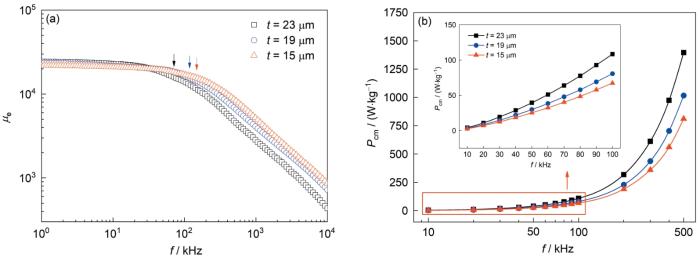
图4
843 K退火60 min后不同厚度Fe75.2Si13B8Cu1Nb2.8合金带材的有效磁导率(μe)和单位质量铁心损耗(Pcm)与频率的关系
Fig.4
Frequency (f) dependences of μe (The arrows denote the frequencies for μe starting to decline) (a) and Pcm (Inset shows the partial enlarged view of 10-100 kHz) (b) of Fe75.2Si13B8Cu1Nb2.8 alloy ribbons with different thicknesses after annealing at 843 K for 60 min
图5为不同厚度合金带材经843 K退火60 min后的XRD谱和TEM分析结果。如图5a所示,各退火带材的XRD谱均在45°和65°附近出现衍射峰,分别对应α-Fe相的(110)和(200)晶面。利用Scherrer公式估算得到T15、T19和T23带材的Dα-Fe分别为11.0、11.6和11.4 nm (见表1)。图5b~d为不同厚度合金带材退火的TEM明场像、相应的SAED花样和晶粒尺寸分布。3种合金带材的非晶基体中都均匀析出了α-Fe纳米晶粒,形成了典型的非晶+纳米晶双相结构。根据TEM结果统计晶粒尺寸可以得到,T15、T19和T23带材的Dα-Fe分别为11.3、11.5和11.0 nm (与XRD估算结果相近),晶粒尺寸分布标准差分别为2.9、2.5和2.7。结合XRD和TEM结果可知,T15、T19和T23带材经热处理后获得了基本一致的纳米晶组织结构。
图5
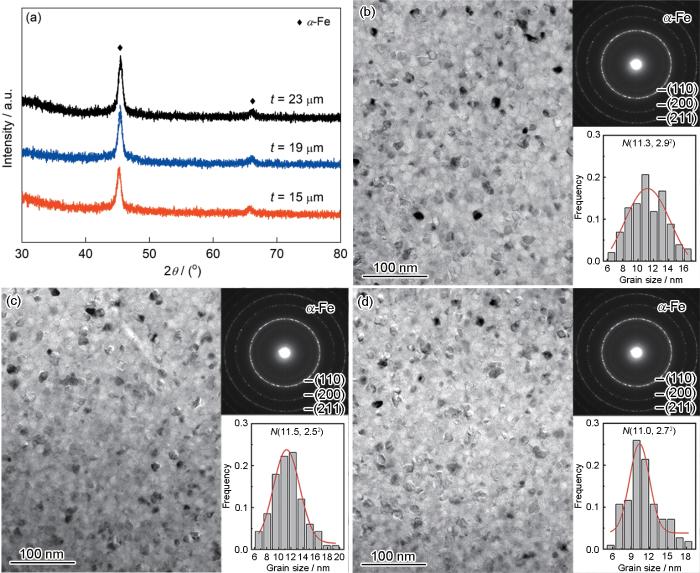
图5
843 K退火60 min后不同厚度Fe75.2Si13B8Cu1Nb2.8合金带材的XRD谱和TEM分析
Fig.5
XRD patterns (a) and bright-field TEM images (Insets are SAED patterns and grain size distributions with normal fitting. N—normal distribution) (b-d) of Fe75.2Si13B8Cu1Nb2.8 alloy ribbons with different thicknesses after annealing at 843 K for 60 min
(b) t = 15 µm (c) t = 19 µm (d) t = 23 µm
3 分析与讨论
纳米晶合金优异的软磁性能源于其非晶+纳米晶双相组织结构。根据Herzer[29]提出的随机各向异性模型,对于铁基纳米晶合金,当Dα-Fe小于40 nm时,晶粒间的铁磁交换耦合作用会显著降低磁晶各向异性,从而实现低的Hc,并且通常Hc与
为了进一步分析薄带材具有低Pcm的原因,根据Bertotti损耗分离理论[30]将损耗分为3部分:
式中,Pt为总损耗,即Pcm;Ph为磁滞损耗;Pec为涡流损耗;Pex为剩余损耗。根据Steinmetz公式,
式中,α为Steinmetz系数;Ch、Cec和Cex分别为磁滞损耗、涡流损耗和剩余损耗的系数。基于
图6
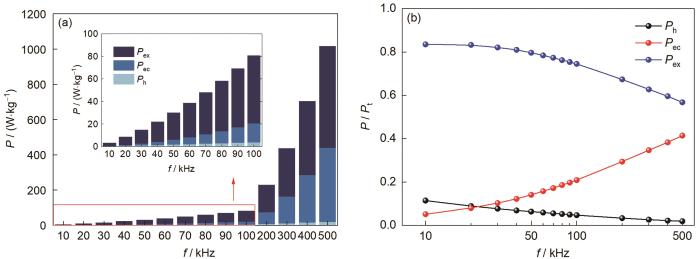
图6
厚度为19 μm的Fe75.2Si13B8Cu1Nb2.8纳米晶带材的磁滞损耗(Ph)、涡流损耗(Pec)和剩余损耗(Pex)及各损耗占比(P / Pt)与频率的关系
Fig.6
Frequency dependences of hysteresis loss (Ph), Eddy current loss (Pec), and excess loss (Pex) (Inset shows the partial enlarged view of 10-100 kHz) (a) and loss / total loss (P / Pt) (b) of Fe75.2Si13B8Cu1Nb2.8 nanocrystalline ribbons with a thickness of 19 μm
图7

图7
不同厚度Fe75.2Si13B8Cu1Nb2.8纳米晶带材的Pec和Pex与频率的关系
Fig.7
Frequency dependences of Pec (a) and Pex (b) of Fe75.2Si13B8Cu1Nb2.8 nanocrystalline ribbons with different thicknesses (Insets show the partial enlarged views of 10-100 kHz)
Pec是材料内部感应电流引起的损耗,可通过以下公式计算[32]:
测得不同厚度纳米晶合金带材的R均为(118 ± 4) × 10-8 Ω·m,ρ为7.362 × 10³ kg/m3,这与与其相似的纳米晶组织结构相符。根据
为了明确带材厚度引起的纳米晶带材高频Pex的差异,观察了不同厚度带材的磁畴结构。如图8所示,深浅不同的区域代表不同磁矩方向的磁畴,随着外磁场的增加,磁矩方向与外磁场方向接近的磁畴增大,当外磁场约为零时,得到合金在退磁状态的磁畴组态。由图8可知,随着带材厚度的降低,磁畴逐渐变成规则的长条状,且薄带材的磁畴宽度更小,磁畴和畴壁数量更多。T23、T19和T15带材在退磁状态下的磁畴宽度分别为(35 ± 5)、(21 ± 3)和(14 ± 2) µm。另外,T19和T15带材在磁化过程中伴随着畴壁上锯齿状突起的出现和消失(图8b2~b4和c2~c4),对应于磁畴内部亚磁畴的旋转,这表明薄带材在磁化过程中可以更容易地诱发磁畴旋转。一方面,Pex来源于畴壁移动产生的局部涡流,与畴壁移动距离和移动速率有关[24,33]。T23带材的磁畴宽度大,磁化时畴壁移动距离长、速率快,故产生的局部涡流更大;T15带材磁畴均匀且宽度窄,磁化时畴壁移动距离短且速率慢,可避免较大局部涡流的产生。另一方面,Pex与磁后效有关,源于磁化过程中畴壁位移和/或磁畴旋转的时间效应。高频下畴壁来不及进行长距离的移动,而磁畴旋转具有更短的弛豫时间[14],故磁化主要以磁畴旋转的方式进行[23],并且高频下磁畴会进一步分裂成斑块状磁畴[34,35]。薄带材在准静态磁化过程中已经表现出了一定的磁畴旋转趋势,并且其窄的磁畴也容易发生分裂和畴形核,有利于高频下的磁畴旋转。这两方面均有利于薄带材高频Pex的降低。同样,薄带材在高频(> 60 kHz)下展现出更高的µe,这也归因于其更窄的磁畴结构和亚磁畴的存在。这种磁畴在高频下更容易分化为斑块畴,有利于磁畴旋转[34,35],同时多磁畴的均匀协同磁化提高了磁化响应速率,这些因素共同促进了高频下磁化的进行,因此薄带材的高频磁导率远高于厚带材。
图8

图8
不同厚度Fe75.2Si13B8Cu1Nb2.8纳米晶带材磁畴随变化磁场的演变
Fig.8
Evolutions of magnetic domain structures of Fe75.2Si13B8Cu1Nb2.8 nanocrystalline ribbons with different thicknesses under varying magnetic fields (a1-a5) t = 23 µm (b1-b5) t = 19 µm (c1-c5) t = 15 µm
4 结论
(1) 厚度为15~23 µm的Fe75.2Si13B8Cu1Nb2.8急冷合金带材均为完全非晶态结构。经843 K等温退火60 min后,所有带材均形成了一致的微细、均匀非晶+ α-Fe纳米晶双相组织,Dα-Fe在11.0~11.6 nm范围内。
(2) 不同厚度纳米晶合金带材的静态磁性能无明显差异,其Bs和Hc分别为1.35~1.36 T和0.5~0.6 A/m。当频率低于60 kHz时,所有纳米晶带材的μe均稳定在22000;在60 kHz以上时,薄带材展现出更好的频率稳定性,且在相同频率下其μe更高。T15带材在100 kHz和1 MHz的μe分别为17000和5200,远高于T23带材的14000和2900。薄带材还具有较低的高频损耗,在0.2 T、100 kHz和0.2 T、500 kHz条件下,T15带材的Pcm分别为67和811 W/kg,较T23带材分别降低38.0%和41.9%。
(3) 薄带材较低的高频Pcm主要归因于Pec和Pex的降低。减小带材厚度使得纳米晶合金的磁畴结构更加细化,有助于高频下磁畴旋转、缩短磁化弛豫时间、提升磁化响应速率,从而提高了高频磁导率并降低了Pex。
文中补充材料可通过以下网址查看:
参考文献
Advances in Fe-based amorphous/nanocrystalline alloys
[J].
Effect of miscible and immiscible element microalloying on crystallization behavior and soft magnetic properties of Fe-P-C-B amorphous alloy
[J].
Composition design for Fe-based soft magnetic amorphous and nanocrystalline alloys with high Fe content
[J].
Excellent magnetic softness-magnetization synergy and suppressed defect activation in soft magnetic amorphous alloys by magnetic field annealing
[J].
Fe-based amorphous alloys with high saturation magnetic flux density (Bs) are increasingly attractive from both scientific and technological points of view, however, they usually suffer from the trade-off between magnetization and softness. In this work, we explore the soft magnetic properties (SMPs), magnetic and atomic structures, and defect activation during creep deformation of as-quenched and annealed Fe82.65-xCoxSi2B14Cu1.35 (x = 0-20) amorphous alloys (AAs). Improved magnetic softness-magnetization synergy has been realized in all these alloys by field annealing. Particularly, superb SMPs with super-high Bs of 1.86 T, low coercivity of 1.2 A/m and high effective permeability of 16300 are obtained in the Fe66.65Co16Si2B14Cu1.35 AA. The locally regularized arrangement of domains, homogenized structure with less structural/magnetic defects and suppressed crystal-like ordering by field annealing contribute synergistically to the superb SMPs. Besides, the relaxation time spectra obtained from creep deformation indicate less liquid-like and solid-like defects activated in the field-annealed AA, which is correlated with the structural homogenization and superb SMPs. This work provides new and comprehensive insight into the interplay among external field, heterogeneous structure, SMPs and defect activation of Fe-based AAs, and offers a promising pathway for softening amorphous alloys with high Bs.
Nanocrystallization, good soft magnetic properties and ultrahigh mechanical strength for Fe82-85B13-16Si1Cu1 amorphous alloys
[J].
Modern soft magnets: Amorphous and nanocrystalline materials
[J].
Regulation of structure and magnetic properties of Fe98.5-xBxCu1.5 nanocrystalline alloys based on B content
[J].
B含量调控Fe98.5-xBxCu1.5纳米晶合金组织结构和磁性能
[J].为研发具有良好软磁性和工艺性的高饱和磁感应强度(Bs) 铁基纳米晶合金,本工作以高Fe含量的Fe-B-Cu合金体系为对象,研究了B含量对Fe98.5 - x B x Cu1.5 (x = 12~18,原子分数,%)系快淬合金带材的微结构、结晶化组织和磁性能的影响,分析了B含量-快淬微结构-结晶化组织-磁性能间的关联。结果表明,快淬合金均为非晶基体中分布着纳米尺度α-Fe晶粒(预存α-Fe晶)的结构;随x由12增加至18,非晶基体中预存α-Fe晶的数密度和晶粒尺寸逐渐降低,结构转变为近非晶态。经低升温速率热处理后,x = 12~17时合金均为非晶/α-Fe纳米晶双相结构,而x = 18时合金形成了非晶/α-Fe/Fe3B纳米复相组织结构;x = 13~16时合金具有微细的纳米晶组织和较好的软磁性能,α-Fe相的平均晶粒尺寸(D¯α-Fe)、Bs和矫顽力(Hc)分别在15.8~16.3 nm、1.80~1.91 T和18.9~22.7 A/m的范围内,其中x = 15时合金的D¯α-Fe、Bs和Hc分别为16.0 nm、1.86 T和18.9 A/m。基于合金热处理前后的组织结构演化,提出了不同B含量快淬合金的结晶化模型,阐明了快淬合金非晶基体中高数密度的细小预存α-Fe晶粒间以及与热处理结晶化新生α-Fe晶粒间的强竞争生长效应,导致均匀、微细纳米晶组织形成的机制。
Reduction of high-frequency core loss of a Fe77.2Si11B8.5Cu0.8Nb2.5 soft magnetic nanocrystalline alloy by minor alloying
[J].
New Fe-based soft magnetic alloys composed of ultrafine grain structure
[J].The magnetic properties of Fe-Si-B-M (M: additives) alloys prepared by annealing amorphous alloys made by the single roller method over their crystallization temperature have been investigated for development of new Fe-based soft magnetic alloys. Excellent soft magnetic properties were obtained by adding the two elements Cu and Nb to Fe-Si-B alloys. It was found that these new alloys, called ‘‘FINEMET,’’ have an ultrafine grain structure composed of bcc Fe solid solution. They are suitable for many kinds of magnetic components such as saturable reactors, choke coils, and transformers, because they have superior soft magnetic properties and a high saturation flux density, and because different types of B-H hysteresis loops are obtained by magnetic field annealing.
Effect of primary α-Fe on soft magnetic properties of FeCuNbSiB amorphous/nanocrystalline alloy
[J].
Soft magnetic properties of nanocrystalline Fe-M-B (M = Zr, Hf, Nb) alloys with high magnetization
[J].
Structure and magnetic properties of (Fe0.5Co0.5)88Zr7B4Cu1 nanocrystalline alloys
[J].The development of Fe73.5Si13.5B9Nb3Cu1 (FINEMET) by Yoshizawa et al. and Fe88Zr7B4Cu1 (NANOPERM) by Inoue et al. have shown that nanocrystalline microstructures can play an important role in the production of materials with outstanding soft magnetic properties. The FINEMET and NANOPERM materials rely on nanocrystalline α-Fe3Si and α-Fe, respectively, for their soft magnetic properties. The magnetic properties of a new class of nanocrystalline magnets are described herein. These alloys with a composition of (Fe,Co)–M–B–Cu (where M=Zr and Hf) are based on the α- and α′-FeCo phases, have been named HITPERM magnets, and offer large magnetic inductions to elevated temperatures. This report focuses on thermomagnetic properties, alternating current (ac) magnetic response, and unambiguous evidence of α′-FeCo as the nanocrystalline ferromagnetic phase, as supported by synchrotron x-ray diffraction. Synchrotron data have distinguished between the HITPERM alloy, with nanocrystallites having a B2 structure from the FINEMET alloys, with the D03 structure, and NANOPERM alloys, with the A2 structure. Thermomagnetic data shows high magnetization to persist to the α→γ phase transformation at 980 °C. The room temperature ac permeability has been found to maintain a high value of 1800 up to a frequency of ∼2 kHz. The room temperature core loss has also been shown to be competitive with that of commercial high temperature alloys with a value of 1 W/g at BS=10 kG and f=1 kHz.
Nanocrystalline soft magnetic Fe-Si-B-P-Cu alloys with high B of 1.8-1.9 T contributable to energy saving
[J].
Ultrahigh permeability at high frequencies via a magnetic-heterogeneous nanocrystallization mechanism in an iron-based amorphous alloy
[J].
Design of Fe-based nanocrystalline alloys with superior magnetization and manufacturability
[J].
Microstructures and soft magnetic properties of Fe73.5-xCu1Nb3Si13.5B9Gdx (x = 0-1.5) alloys
[J].In this experiment, the rare earth Gd element was added to Finemet alloy to observe the microstructure and soft magnetic properties. The experimental results showed that the samples with the addition of 0.5% Gd and 1.0% Gd can be quenched and cast normally, and the MS of Fe73Cu1Nb3Si13.5B9Gd0.5 alloy was 10.41% higher than that of Finemet. After annealing, crystal grains of about 10 nm were formed. The μi and μm values of Fe73Cu1Nb3Si13.5B9Gd0.5 alloy were 25.51% and 22.23% higher, respectively, and the coercivity HC was reduced by 12.19% compared to Finemet. At 1 kHz, the μe value of Fe73Cu1Nb3Si13.5B9Gd0.5 alloy at room temperature was 14.57% higher than that of Finemet, while the μe reached 162.34 k and 142.42 k at 90 °C and 150 °C (24% and 29.51% higher, respectively). The Fe72.5Cu1Nb3Si13.5B9Gd1.0 alloy had the best performance at 100 kHz, with higher μe values than Finemet across the ambient temperature range of 30 °C to 150 °C. After tension annealing, the μe values of Fe72.5Cu1Nb3Si13.5B9Gd1.0 alloy were 20–30% higher than those of Finemet.
Microstructures and soft magnetic properties of Fe73.5-xCu1Nb3Si13.5B9Yx (x = 0-1.5) alloys
[J].
Structure and soft magnetic properties of V-doped finemet-type alloys
[J].
Effect of low magnetic field heat treatment process on grain sizes and soft magnetic properties of finemet cores
[J].
Orientation dependence of the nanocrystallization and magnetic behavior during annealing of the finemet alloy
[J].
Microstructure, magnetic domain and dynamic loss of surface-textured Fe-based nanocrystalline alloy
[J].Heterogeneous coarse surface crystallites induced in the industrial Fe-rich nanocrystalline alloy is an obstacle for high-frequency and high-power commercial applications. Herein, the phase, crystal orientation, nanostructure and magnetic domain evolution of the surface-crystallized Fe-rich alloy were systematically investigated. Microstructure and inverse pole figures analysis confirms that the DO3 ordered dendritic-crystallites bear <001>-oriented fiber texture before and after annealing at the free surface, while ultrafine nanocrystals are randomly oriented in the interior and wheel surface after annealing. As compared to zero magnetic-field-annealing, the transverse magnetic-field-annealing induces weakly oriented fiber texture and relatively uniform dendritic-crystallites at the surface, and uniform anisotropy in the interior and surface, which promotes smooth wall motion at the surface and magnetization rotation in the interior. This synergetic effect reduces the excess loss and leads reduction in dynamic loss at 1.0 T and 10 kHz by 36%.
The magnetic properties of ultrathin FeBNbCu nanocrystalline alloy
[J].
The mechanism of magnetic relaxation in Fe-based nanocrystalline alloy ribbons investigated by permeability spectroscopy
[J].
Superior high-frequency performances of Fe-based soft-magnetic nanocrystalline alloys
[J].
Effect of thickness of FeCuNbSiB ribbon on magnetic properties of tape wounded cores
[J].
带厚对FeCuNbSiB纳米晶铁芯性能的影响
[J].
Effect of ribbon thickness on soft magnetic properties of amorphous and nanocrystalline tape wounded cores
[J].
带厚对非晶纳米晶铁芯软磁性能的影响
[J].
Microstructure evolution, magnetic properties and frequency characteristics of Si-rich FeSiBCuNb soft magnetic alloy induced by annealing treatment
[J].
High-frequency magnetic characteristics and operating thermal stability of industrialized Fe76Si13B8Nb2-Cu1 nanocrystalline alloy
[J].
Grain size dependence of coercivity and permeability in nanocrystalline ferromagnets
[J].
General properties of power losses in soft ferromagnetic materials
[J].
Effect of grain size on magnetic loss of nanocrystalline alloy under high-frequency non-sinusoidal excitation
[J].
Core loss of ultra-rapidly annealed Fe-rich nanocrystalline soft magnetic alloys
[J].Ultra-rapidly annealed (heating rate > 10(4) K/s, annealing time < 1 s) Fe-rich nanocrystalline soft magnetic materials with a nominal composition of Fe100-xBx and Fe87-yB13My where x = 12, 13, 14, y = 1, 2 and M = Cu, Ni (HiB-Nanoperm) have recently been demonstrated with a saturation magnetic polarization (J(s)) up to 1.92 T and a low coercivity (H-c) of less than 8 A/m. In this study the AC core loss (P-cm) is estimated for HiB-Nanoperm at 50, 400 and 1000 Hz and is compared with existing amorphous, nanocrystalline and conventionally crystalline (Fe-Si) materials. The P-cm of HiB-Nanoperm at 1.5 T, 50 Hz is demonstrated to be 5-15% that of Fe-3 wt% Si. In specific, Fe86B13Cu1 displays losses that are 30% that of Fe-6.5 wt% Si steel while also possessing a 5% larger J(s). For maximum magnetic polarization (J(m)) values greater than 1.5 T this same composition also exhibits some of the lowest core losses seen from all Fe-based nanocrystalline alloys across the frequencies tested in this study. Core loss separation and an estimation of the anomaly factor (eta) for selected HiB-Nanoperm alloys is also undertaken and compared with a Fe-based amorphous alloy. The eta of HiB-Nanoperm is seen to be lower than that of Fe-based amorphous alloy and is also observed to be positively correlated with saturation magnetostriction. The low core loss of HiB-Nanoperm is attributed to a reduced anomalous loss which may be brought about by the moderate magnetostriction of this alloy.
Correlation between dynamic magnetization process and dynamic domains of high saturation induction FeSiBNbCuMo nanocrystalline alloy with dual anisotropies
[J].
Dynamic magnetization process of nanocrystalline tape wound cores with transverse field-induced anisotropy
[J].


