1
2015
... 近年来,汽车工业快速发展,汽车销量逐年上升,但伴随的能源消耗和环境污染问题日益严重.为满足国家节能减排要求和确保汽车安全性,汽车轻量化是实现以上目标的有效途径.研究[1]表明,乘用车自重每减少10%,能耗和排放可以降低6%~8%,而热冲压成形技术则有效满足了汽车行业对安全性和轻量化的双重需求.该技术利用材料在高温状态下的优异成形性,不仅显著减少回弹,延长模具寿命,还能通过成形淬火工艺获得超高强度的零部件.相较于传统冷成形工艺,热冲压成形技术结合了优异的性能优势与成本效益,展现出较强的竞争力. ...
1
2015
... 近年来,汽车工业快速发展,汽车销量逐年上升,但伴随的能源消耗和环境污染问题日益严重.为满足国家节能减排要求和确保汽车安全性,汽车轻量化是实现以上目标的有效途径.研究[1]表明,乘用车自重每减少10%,能耗和排放可以降低6%~8%,而热冲压成形技术则有效满足了汽车行业对安全性和轻量化的双重需求.该技术利用材料在高温状态下的优异成形性,不仅显著减少回弹,延长模具寿命,还能通过成形淬火工艺获得超高强度的零部件.相较于传统冷成形工艺,热冲压成形技术结合了优异的性能优势与成本效益,展现出较强的竞争力. ...
Critical review of automotive hot-stamped sheet steel from an industrial perspective
2
2018
... 热冲压作为一种先进的汽车零部件成形技术,其工艺过程为:首先将钢板加热至奥氏体化温度以上,在完成加热和保温后,将钢板快速转移至配备水冷系统的模具中进行冲压成形和淬火处理.此工艺的关键环节包括板材的加热调控、保温时间设定以及快速冷却过程,这些参数的选择会直接影响产品的最终性能.典型的加热温度在880~950 ℃之间,保温时间在3~10 min[2,3].为确保充分奥氏体化,热成形前的初始温度通常在600 ℃以上.此外,为了保证奥氏体向马氏体的完全转变,冷却速率必须超过临界值,以获得理想的力学性能[4].值得注意的是,材料在热处理过程中的温度和时间调控至关重要:加热不足会影响相变效果,温度过高则可能导致表面氧化和晶粒粗化;保温时间过短会降低组织均匀性,保温时间过长会降低效率并影响晶粒结构.因此,优化这些参数对提升产品质量和降低能耗至关重要.热成形工艺不仅实现了高强度钢零件的精密成形,同时通过精确的控温和冷却工艺,可确保零件具备优异的综合力学性能.根据零部件的加工难易,工业上分为直接和间接热冲压成形.直接热冲压效率高,适用于简单结构件,如汽车的A柱或B柱.间接热冲压适用于复杂零件,通过预成形提升成形质量和设计空间,但需更高设备投入.间接工艺适合复杂曲面和高强度部件,尽管能耗较高,但提供了更大的设计灵活性,其中,锌基涂层板多采用间接热冲压成形工艺,主要是为了减少热成形过程中锌层的影响,避免因锌镀层在高温下的液化和扩散导致开裂、模具磨损和零件质量下降. ...
... 近年来,在全球汽车轻量化技术发展推动下,超高强度热成形钢正迎来创新突破.目前行业内广泛采用的是ArcelorMittal开发的22MnB5系列(抗拉强度1500 MPa等级)[2],但工业界对材料力学性能的更高需求持续驱动着技术创新.研究[10]表明,通过调控马氏体中的C含量,可以有效实现“两化一体”的强化效应:既可通过细化晶粒实现微观结构优化,又能提升位错密度.这种独创性的位错-晶界耦合强化机制已经被领先钢企转化为商业化产品,包括德国ThyssenKrupp公司基于34MnB5成分开发的MBW1900、瑞典SSAB推出的基于37MnB4成分的 Docol2000Bor系列、韩国POSCO的HPF2000以及ArcelorMittal 公司的Usibor2000等多款2000 MPa级别的产品,这些钢不仅突破了传统热成形钢的强化理论极限,更为汽车轻量化技术的未来发展开辟了新方向,展现了材料改性技术在工程实践中的持续可能性[11~14].当前热成形钢的合金化设计正向多元化协同强化的方向发展,各元素的特定作用机理不断被揭示.Ti、Nb、V、Mo等强碳化物形成元素的加入,可在相界处形成纳米级沉淀相,在产生显著沉淀强化效果的同时增加晶界迁移阻力.其中,Nb的优势尤为显著,能同步细化奥氏体晶粒、马氏体晶胞及马氏体板条,有效实现强度与韧性的协同提升[15].易红亮等[16]基于34MnB5V体系的研究已使材料抗拉强度达到了1971 MPa,其机理在于V的微合金化不仅可以细化组织,还可以通过VC纳米析出相改善C分布,在提升强度的同时避免了马氏体基体脆性的提升.最新研究[17,18]表明,在一种新型无镀层热成形钢中引入Si和Cr元素,通过优化C配分可形成稳定的残余奥氏体,不仅提高了材料的延展性还增强了抗氧化性[19].基于该成分提出的一种统一化理念(unified steel concept)[20]有望彻底革新全球汽车工业车身板材制造工艺,并助力实现碳中和目标.该理念的核心突破在于,通过对一种基础钢种进行不同温度的退火,即可获得适用于不同部位、具有梯度性能特征的一系列车身结构产品(抗拉强度600~1680 MPa).基于该工艺制备的热成形钢展现出优异的综合性能:相比于传统商用钢种,其抗侧撞性能和焊接合格率均有所提升[20].这项技术方案特别适用于汽车白车身构件,仅需储备单一标准成分,即可通过调整回火参数实现从A柱到防撞梁的差异化性能需求. ...
Phase transformation and carbon profile at the interface between Al-Si coating and steel substrate in a press-hardened steel
3
2021
... 热冲压作为一种先进的汽车零部件成形技术,其工艺过程为:首先将钢板加热至奥氏体化温度以上,在完成加热和保温后,将钢板快速转移至配备水冷系统的模具中进行冲压成形和淬火处理.此工艺的关键环节包括板材的加热调控、保温时间设定以及快速冷却过程,这些参数的选择会直接影响产品的最终性能.典型的加热温度在880~950 ℃之间,保温时间在3~10 min[2,3].为确保充分奥氏体化,热成形前的初始温度通常在600 ℃以上.此外,为了保证奥氏体向马氏体的完全转变,冷却速率必须超过临界值,以获得理想的力学性能[4].值得注意的是,材料在热处理过程中的温度和时间调控至关重要:加热不足会影响相变效果,温度过高则可能导致表面氧化和晶粒粗化;保温时间过短会降低组织均匀性,保温时间过长会降低效率并影响晶粒结构.因此,优化这些参数对提升产品质量和降低能耗至关重要.热成形工艺不仅实现了高强度钢零件的精密成形,同时通过精确的控温和冷却工艺,可确保零件具备优异的综合力学性能.根据零部件的加工难易,工业上分为直接和间接热冲压成形.直接热冲压效率高,适用于简单结构件,如汽车的A柱或B柱.间接热冲压适用于复杂零件,通过预成形提升成形质量和设计空间,但需更高设备投入.间接工艺适合复杂曲面和高强度部件,尽管能耗较高,但提供了更大的设计灵活性,其中,锌基涂层板多采用间接热冲压成形工艺,主要是为了减少热成形过程中锌层的影响,避免因锌镀层在高温下的液化和扩散导致开裂、模具磨损和零件质量下降. ...
... 如图1a[5]所示,Al-Si镀层的横截面微观结构可分为三层:最外层为纯Al层;中间层由Fe-Al-Si三元合金相组成;最内层为Fe-Al合金层,主要由FeAl3和Fe2Al5相构成.另外,在基体与镀层之间还可以观察到一层约5 μm厚的Fe2Al7Si (τ5相),如图1b[5]所示.图1c[5]为经过奥氏体化(920 ℃热处理5 min)及热冲压后镀层的微观结构,镀层结构主要分为5层(定义最外层为第1层),第1层和第3层为FeAl2相,第2层和第4层为Fe2SiAl2相,第5层为富Al、Si 的α-Fe相[6,7].由于金属间化合物的硬度高达700~1000 HV,因此,这层结构在冲压后极易产生裂纹[3],如图1c[5]所示. ...
... Al-Si镀层显著影响热成形钢的弯曲断裂韧性[3,24,25].热冲压后,镀层结构会演变为复杂多层体系,包括表面Al2O3保护层、金属间化合物层以及金属间化合物层与马氏体基体之间的铁素体扩散层(含富Al和无Al铁素体).界面处的铁素体扩散层生长会将C原子排入基体,促进高脆性高碳马氏体的形成,从而削弱材料的弯曲韧性.电子探针(EPMA)分析证实了界面C富集的现象,为理解镀层脆化机制提供了关键证据. ...
Effect of ultra-fine martensite and retained austenite induced by slow quenching on the mechanical properties of 9Cr1.5Mo1Co(FB2) steel
1
2021
... 热冲压作为一种先进的汽车零部件成形技术,其工艺过程为:首先将钢板加热至奥氏体化温度以上,在完成加热和保温后,将钢板快速转移至配备水冷系统的模具中进行冲压成形和淬火处理.此工艺的关键环节包括板材的加热调控、保温时间设定以及快速冷却过程,这些参数的选择会直接影响产品的最终性能.典型的加热温度在880~950 ℃之间,保温时间在3~10 min[2,3].为确保充分奥氏体化,热成形前的初始温度通常在600 ℃以上.此外,为了保证奥氏体向马氏体的完全转变,冷却速率必须超过临界值,以获得理想的力学性能[4].值得注意的是,材料在热处理过程中的温度和时间调控至关重要:加热不足会影响相变效果,温度过高则可能导致表面氧化和晶粒粗化;保温时间过短会降低组织均匀性,保温时间过长会降低效率并影响晶粒结构.因此,优化这些参数对提升产品质量和降低能耗至关重要.热成形工艺不仅实现了高强度钢零件的精密成形,同时通过精确的控温和冷却工艺,可确保零件具备优异的综合力学性能.根据零部件的加工难易,工业上分为直接和间接热冲压成形.直接热冲压效率高,适用于简单结构件,如汽车的A柱或B柱.间接热冲压适用于复杂零件,通过预成形提升成形质量和设计空间,但需更高设备投入.间接工艺适合复杂曲面和高强度部件,尽管能耗较高,但提供了更大的设计灵活性,其中,锌基涂层板多采用间接热冲压成形工艺,主要是为了减少热成形过程中锌层的影响,避免因锌镀层在高温下的液化和扩散导致开裂、模具磨损和零件质量下降. ...
Cracking and interfacial debonding of the Al-Si coating in hot stamping of pre-coated boron steel
7
2014
... 如图1a[5]所示,Al-Si镀层的横截面微观结构可分为三层:最外层为纯Al层;中间层由Fe-Al-Si三元合金相组成;最内层为Fe-Al合金层,主要由FeAl3和Fe2Al5相构成.另外,在基体与镀层之间还可以观察到一层约5 μm厚的Fe2Al7Si (τ5相),如图1b[5]所示.图1c[5]为经过奥氏体化(920 ℃热处理5 min)及热冲压后镀层的微观结构,镀层结构主要分为5层(定义最外层为第1层),第1层和第3层为FeAl2相,第2层和第4层为Fe2SiAl2相,第5层为富Al、Si 的α-Fe相[6,7].由于金属间化合物的硬度高达700~1000 HV,因此,这层结构在冲压后极易产生裂纹[3],如图1c[5]所示. ...
... [5]所示.图1c[5]为经过奥氏体化(920 ℃热处理5 min)及热冲压后镀层的微观结构,镀层结构主要分为5层(定义最外层为第1层),第1层和第3层为FeAl2相,第2层和第4层为Fe2SiAl2相,第5层为富Al、Si 的α-Fe相[6,7].由于金属间化合物的硬度高达700~1000 HV,因此,这层结构在冲压后极易产生裂纹[3],如图1c[5]所示. ...
... [5]为经过奥氏体化(920 ℃热处理5 min)及热冲压后镀层的微观结构,镀层结构主要分为5层(定义最外层为第1层),第1层和第3层为FeAl2相,第2层和第4层为Fe2SiAl2相,第5层为富Al、Si 的α-Fe相[6,7].由于金属间化合物的硬度高达700~1000 HV,因此,这层结构在冲压后极易产生裂纹[3],如图1c[5]所示. ...
... [5]所示. ...
... [
5]
Cross-sectional SEM images of the Al-Si coated boron steel before (a, b) and after (c) press hardening<sup>[<xref ref-type="bibr" rid="R5">5</xref>]</sup>(a) as-coated (b) detail of intermetallic layer (c) austenitized at 920 oC for 5 min ...
... [
5]
(a) as-coated (b) detail of intermetallic layer (c) austenitized at 920 oC for 5 min ...
... 实验结果[5]表明,22MnB5镀层钢在短时间(≤ 8 min)奥氏体化处理后,Al-Si镀层的氧化增重可以忽略不计.镀层中O的扩散深度不足4 μm,远低于镀层厚度,充分证明Al-Si镀层在高温条件下能有效保护钢基体.在奥氏体化过程中,Al原子在Fe2Al7Si相及镀层与基体界面上的扩散速率明显快于Fe原子,这促使Al向内扩散形成Fe-Al合金相,同时向外迁移,生成Al2O3保护层,从而增强钢材的高温抗氧化性能. ...
Effect of temperature on microstructure and formability of Al-10 mass% Si coatings
1
2016
... 如图1a[5]所示,Al-Si镀层的横截面微观结构可分为三层:最外层为纯Al层;中间层由Fe-Al-Si三元合金相组成;最内层为Fe-Al合金层,主要由FeAl3和Fe2Al5相构成.另外,在基体与镀层之间还可以观察到一层约5 μm厚的Fe2Al7Si (τ5相),如图1b[5]所示.图1c[5]为经过奥氏体化(920 ℃热处理5 min)及热冲压后镀层的微观结构,镀层结构主要分为5层(定义最外层为第1层),第1层和第3层为FeAl2相,第2层和第4层为Fe2SiAl2相,第5层为富Al、Si 的α-Fe相[6,7].由于金属间化合物的硬度高达700~1000 HV,因此,这层结构在冲压后极易产生裂纹[3],如图1c[5]所示. ...
Microstructure evolution of hot-dip Al-10%Si coating during the austenitization of 22MnB5 hot stamping steel
1
2017
... 如图1a[5]所示,Al-Si镀层的横截面微观结构可分为三层:最外层为纯Al层;中间层由Fe-Al-Si三元合金相组成;最内层为Fe-Al合金层,主要由FeAl3和Fe2Al5相构成.另外,在基体与镀层之间还可以观察到一层约5 μm厚的Fe2Al7Si (τ5相),如图1b[5]所示.图1c[5]为经过奥氏体化(920 ℃热处理5 min)及热冲压后镀层的微观结构,镀层结构主要分为5层(定义最外层为第1层),第1层和第3层为FeAl2相,第2层和第4层为Fe2SiAl2相,第5层为富Al、Si 的α-Fe相[6,7].由于金属间化合物的硬度高达700~1000 HV,因此,这层结构在冲压后极易产生裂纹[3],如图1c[5]所示. ...
22MnB5热成形钢奥氏体化时热镀Al-10%Si镀层组织的演化
1
2017
... 如图1a[5]所示,Al-Si镀层的横截面微观结构可分为三层:最外层为纯Al层;中间层由Fe-Al-Si三元合金相组成;最内层为Fe-Al合金层,主要由FeAl3和Fe2Al5相构成.另外,在基体与镀层之间还可以观察到一层约5 μm厚的Fe2Al7Si (τ5相),如图1b[5]所示.图1c[5]为经过奥氏体化(920 ℃热处理5 min)及热冲压后镀层的微观结构,镀层结构主要分为5层(定义最外层为第1层),第1层和第3层为FeAl2相,第2层和第4层为Fe2SiAl2相,第5层为富Al、Si 的α-Fe相[6,7].由于金属间化合物的硬度高达700~1000 HV,因此,这层结构在冲压后极易产生裂纹[3],如图1c[5]所示. ...
Effects of Al-Si coating and Zn coating on the hydrogen uptake and embrittlement of ultra-high strength press-hardened steel
11
2019
... 锌基镀层通过双重防护机制正在发展成为热成形钢的理想镀层选择.一方面,它能在热冲压过程中有效阻止基体氧化;另一方面,成形后的材料具有优异的耐腐蚀性能,因此锌基镀层被作为Al-Si镀层的重要替代方案.目前,工业上主要采用热浸镀纯Zn (GI)和Zn-Fe合金(GA)两种方案[8,9].其中,GI镀层为含(0.2~2.5)%Al (质量分数,下同)的纯Zn结构,而GA镀层加入了(10~15)%Fe.在热冲压过程中,GI镀层经历了显著的结构演变:最初为由纯Zn层和富Al薄层组成的双层体系,在Fe扩散作用下逐步转变为具有梯度特征的三层结构,包括表层的锌铝氧化物防护层、中间含有超过70%Zn的核心防护层,以及与基体紧密结合的α-Fe相(Zn含量≥ 10%)界面层[9].在锌液热浸镀过程中,先得到GI镀层,然后对GI镀层进行高温退火便可获得GA镀层.此外,GI和GA镀层中都会添加极少量的Al元素,用于抑制脆性Fe-Zn金属间化合物的形成,同时减少Zn的蒸发损失,从而改善镀层的性能. ...
... 尽管热成形钢在抗氢脆方面已取得一些研究进展,但仍有关键科学问题尚待深入探索.例如,关于NbC和VC等纳米析出相的抗氢脆机理已有一定的研究[36~38],但Al2O3等夹杂物的氢捕获行为、脆化机制及其临界尺寸尚缺乏系统而深入的研究[39,40].此外,氢致延迟断裂通常起源于零件表面,但热成形钢表面因脱碳[39,41]、氧化[39,42]或镀层[8,43]等因素,其微观结构较为复杂.随着抗拉强度提升至1500 MPa以上,表面缺陷(如镀层裂纹或冷剪切损伤)对氢脆的敏感性显著增强.应力集中效应会促使H原子在缺陷处优先富集,从而加剧超高强度热成形钢的氢脆风险.然而,也有研究[26]表明,脱碳层或Al-Si镀层形成的铁素体组织可以在一定程度上改善材料的抗氢脆性能,但镀层结构对氢脆的影响具有复杂多样性.因此,本文除了探讨基体组织的影响外,还将重点分析镀层以及表面微观结构和状态对热成形钢氢脆的作用机制. ...
... 经过热冲压处理后,热成形钢通常为全马氏体显微组织.这种具有超高强度和高缺陷密度的组织对氢脆非常敏感[8,32].研究[32,33]表明,马氏体钢的氢致裂纹扩展行为紧密依赖于H的浓度:低H浓度时主要发生晶内解理断裂,高H浓度时则更易引发延晶断裂.除了H含量外,局部应力等因素也会影响材料的氢脆特性,本课题组[44]提出的一种相场模型充分证明了这一点.如图4[44]所示,实验和相场模拟均证实,在热成形钢中,H原子主要富集于原奥氏体晶界(PAGB)和板条界(LB),这与其高密度的几何必需位错密切相关[44].同时,局部应力对H的空间分布也具有调控作用.以22MnB5钢为例,当局部H浓度约为2.50 × 10⁻⁶ (临界值)时,马氏体晶界面临氢脆断裂风险.值得注意的是,在较高的局部应力条件下(图4b[44]),PAGB断裂对应的临界H浓度为1.0 × 10⁻⁶,LB断裂的临界H浓度则为1.49 × 10⁻⁶,这两种晶界发生氢致裂纹起裂需要的H含量均低于低应力状态下的H含量,这与实验结果高度一致[44].此发现为氢脆机理的分析和评估提供了重要的理论依据.最近研究[45]表明,除了形变过程中H的再分布以外,形变早期阶段氢致微裂纹的大量形核及扩展对热成形钢抗氢脆性能也有影响. ...
... 与裸板相比,Al-Si镀层板在奥氏体化过程中会向热成形钢中引入更多的扩散氢[8].在高于900 ℃的温度下,Al与H2O发生反应在表面生成H原子,这些H原子会迅速扩散进入钢基体.因此,控制露点是影响钢板抗氢脆性能的重要因素,通常通过降低露点以减少热冲压后材料中的H含量[8].此外,研究[8]发现,170 ℃烘烤20 min会影响H的逸出:裸板经过烘烤处理后可以消除大部分可扩散氢,而镀层板经过烘烤处理后,H含量仅从0.50 × 10⁻⁶降至0.37 × 10⁻⁶,该现象证实了镀层对氢逸出具有阻碍作用.在弯曲韧性方面,Fe-Al金属间化合物和富Al铁素体表现出脆性.镀层中的裂纹易在微变形条件下沿裂纹扩展至基体,导致应力集中并促进局部剪切变形,从而降低弯曲性能.应力集中还会引导H向裂纹尖端偏聚,加剧断裂韧性恶化[83].研究[83]表明,Al-Si镀层热成形钢中的氢致裂纹源于内部夹杂物或镀层区域,裂纹在H的协助下可沿微裂纹深入基体超过10 μm,诱发局部剪切变形,明显降低热成形钢的抗氢脆性能.Fe-Al金属间化合物甚至可能与环境中的H2O反应生成扩散氢,此类原位产氢虽难以直接检测,但界面可能存在局部H富集,需高度关注其引发的氢脆风险.本课题组[84]提出了一种利用两步法诱导氢去局部化的新工艺,通过采用低Al、Si含量的高韧性铁素体表面结构,使材料实现了更高的表面塑性和塑性变形能量吸收,该两步法生产的镀层钢在抗氢脆性能方面相较传统热成形钢提高了两倍以上,同时保持了优异的拉伸性能[84]. ...
... [8].此外,研究[8]发现,170 ℃烘烤20 min会影响H的逸出:裸板经过烘烤处理后可以消除大部分可扩散氢,而镀层板经过烘烤处理后,H含量仅从0.50 × 10⁻⁶降至0.37 × 10⁻⁶,该现象证实了镀层对氢逸出具有阻碍作用.在弯曲韧性方面,Fe-Al金属间化合物和富Al铁素体表现出脆性.镀层中的裂纹易在微变形条件下沿裂纹扩展至基体,导致应力集中并促进局部剪切变形,从而降低弯曲性能.应力集中还会引导H向裂纹尖端偏聚,加剧断裂韧性恶化[83].研究[83]表明,Al-Si镀层热成形钢中的氢致裂纹源于内部夹杂物或镀层区域,裂纹在H的协助下可沿微裂纹深入基体超过10 μm,诱发局部剪切变形,明显降低热成形钢的抗氢脆性能.Fe-Al金属间化合物甚至可能与环境中的H2O反应生成扩散氢,此类原位产氢虽难以直接检测,但界面可能存在局部H富集,需高度关注其引发的氢脆风险.本课题组[84]提出了一种利用两步法诱导氢去局部化的新工艺,通过采用低Al、Si含量的高韧性铁素体表面结构,使材料实现了更高的表面塑性和塑性变形能量吸收,该两步法生产的镀层钢在抗氢脆性能方面相较传统热成形钢提高了两倍以上,同时保持了优异的拉伸性能[84]. ...
... [8]发现,170 ℃烘烤20 min会影响H的逸出:裸板经过烘烤处理后可以消除大部分可扩散氢,而镀层板经过烘烤处理后,H含量仅从0.50 × 10⁻⁶降至0.37 × 10⁻⁶,该现象证实了镀层对氢逸出具有阻碍作用.在弯曲韧性方面,Fe-Al金属间化合物和富Al铁素体表现出脆性.镀层中的裂纹易在微变形条件下沿裂纹扩展至基体,导致应力集中并促进局部剪切变形,从而降低弯曲性能.应力集中还会引导H向裂纹尖端偏聚,加剧断裂韧性恶化[83].研究[83]表明,Al-Si镀层热成形钢中的氢致裂纹源于内部夹杂物或镀层区域,裂纹在H的协助下可沿微裂纹深入基体超过10 μm,诱发局部剪切变形,明显降低热成形钢的抗氢脆性能.Fe-Al金属间化合物甚至可能与环境中的H2O反应生成扩散氢,此类原位产氢虽难以直接检测,但界面可能存在局部H富集,需高度关注其引发的氢脆风险.本课题组[84]提出了一种利用两步法诱导氢去局部化的新工艺,通过采用低Al、Si含量的高韧性铁素体表面结构,使材料实现了更高的表面塑性和塑性变形能量吸收,该两步法生产的镀层钢在抗氢脆性能方面相较传统热成形钢提高了两倍以上,同时保持了优异的拉伸性能[84]. ...
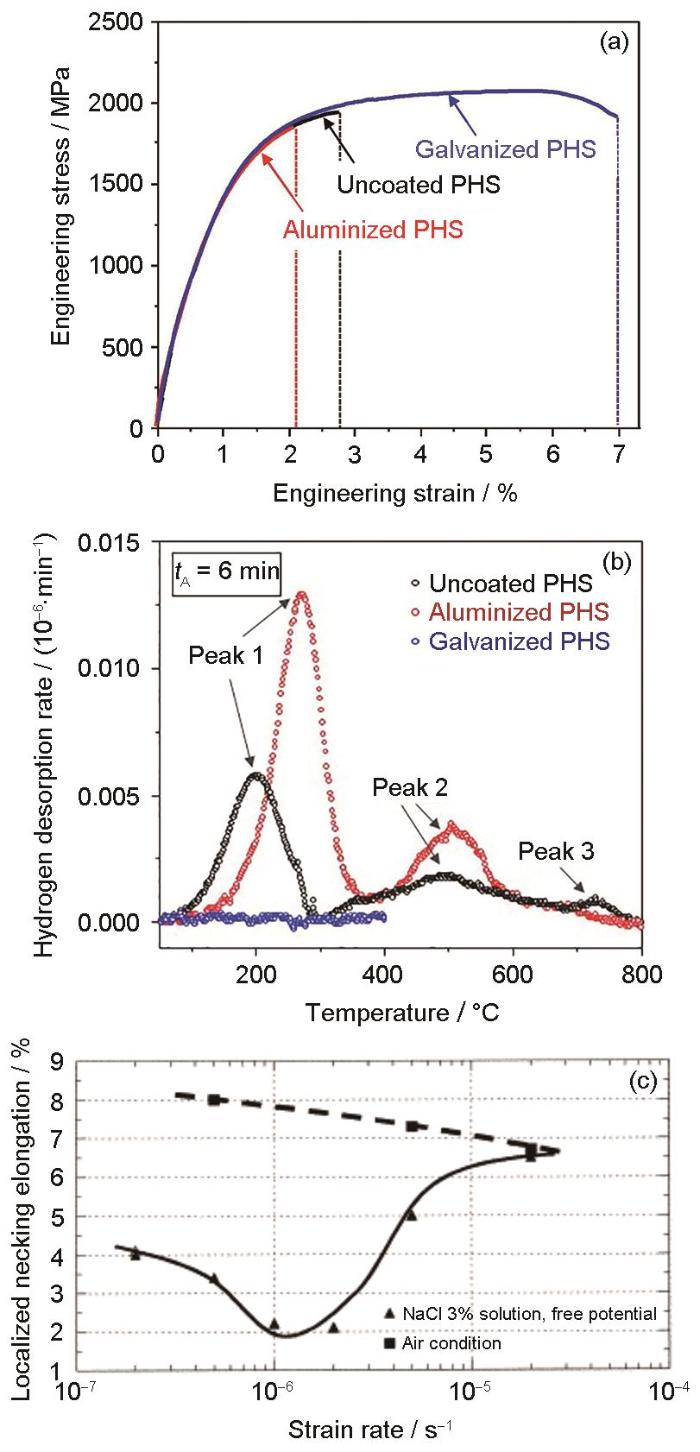
... 目前关于锌镀层对氢脆影响的认知仍存在争议.与Al-Si镀层和无镀层钢相比,镀锌热成形钢在热冲压后只存在极其微量的H,并且表现出优异的延展性[8].这可能由两个主要机制引起:(1) ZnO保护层抑制了可扩散氢的形成;(2) 在奥氏体化阶段,液态Zn相中的H扩散速率较低.然而在腐蚀环境中,镀锌钢可能发生电化学充氢反应,导致服役期间可扩散氢含量增加,从而影响其抗氢脆性能[85] (图9[8,85]).在3%NaCl溶液中的应力腐蚀测试结果表明:当应变速率大于10-5 s-1时,局部颈缩伸长率变化不大;而当应变速率降低到10-6 s-1时,颈缩伸长率会急剧下降约67%,而在空气环境中的相应延伸率则略有提升.这是因为氢致裂纹主要源于钢材表面锌镀层的开裂,在低应变速率条件下,通过电化学腐蚀产生的可扩散氢进而诱发氢脆.因此,在评估镀锌热成形钢的抗氢脆性能时,必须特别关注其在腐蚀环境(尤其是恶劣腐蚀工况)中的表现.鉴于锌镀层在服役过程中可能成为H的主要来源,建立针对腐蚀-氢脆耦合效应的评价体系在镀锌热成形钢中具有重要意义. ...
... [8,85]).在3%NaCl溶液中的应力腐蚀测试结果表明:当应变速率大于10-5 s-1时,局部颈缩伸长率变化不大;而当应变速率降低到10-6 s-1时,颈缩伸长率会急剧下降约67%,而在空气环境中的相应延伸率则略有提升.这是因为氢致裂纹主要源于钢材表面锌镀层的开裂,在低应变速率条件下,通过电化学腐蚀产生的可扩散氢进而诱发氢脆.因此,在评估镀锌热成形钢的抗氢脆性能时,必须特别关注其在腐蚀环境(尤其是恶劣腐蚀工况)中的表现.鉴于锌镀层在服役过程中可能成为H的主要来源,建立针对腐蚀-氢脆耦合效应的评价体系在镀锌热成形钢中具有重要意义. ...
... [
8,
85]
Influences of Zn coating on the hydrogen embrittlement risk of PHS<sup>[<xref ref-type="bibr" rid="R8">8</xref>,<xref ref-type="bibr" rid="R85">85</xref>]</sup> (a, b) tensile curves (a) and thermal desorption analysis (TDA) curves (b) of aluminized, uncoated, and galvanized PHS austenitized at 900 <sup>o</sup>C for an aus-tenitizing time (<i>t</i><sub>A</sub>) of 6 min<sup>[<xref ref-type="bibr" rid="R8">8</xref>]</sup> (c) evolution of localized necking elongation (elon-gation from ultimate tensile strength up to fracture) with strain rate for a Zn-coated steel in 3%NaCl solution and air conditions<sup>[<xref ref-type="bibr" rid="R85">85</xref>]</sup>Fig.9![]() <strong>5</strong> 结论与展望<strong>5.1</strong> 热成形钢镀层弯曲韧性总结
<strong>5</strong> 结论与展望<strong>5.1</strong> 热成形钢镀层弯曲韧性总结相较于无镀层钢板,Al-Si镀层板材展现出显著的优势:出众的抗高温氧化性能、优异的耐腐蚀特性,以及在简化生产流程、提高制件品质等方面具有突出表现.这使得Al-Si镀层技术成为热冲压钢材应用的主要发展方向.然而,镀层热成形钢的弯曲断裂性能和抗裂纹扩展能力相较裸板明显降低,其关键机理为:在镀层合金化处理过程中,界面迁移引发的相互扩散导致了α-Fe相与马氏体界面区域形成C元素富集,该区域高碳马氏体的存在直接导致了韧性的降低和延迟开裂敏感性的提高.值得注意的是,通过控制镀层厚度可有效减轻C元素富集程度,从而提升镀层材料的韧性.本课题组[25]最新研发的两步法工艺Al-Si镀层22MnB5钢板的弯曲断裂形变率较现有镀层技术提升了超过20%,这一突破性进展成功克服了Al-Si镀层相对裸板的唯一性能短板,为Al-Si镀层板全面取代裸板创造了技术可行性.另一方面,锌基镀层虽然可以作为Al-Si镀层的重要替代方案,但其液态金属脆化现象限制了锌镀层的应用.液态金属脆化效应的发生需满足两个条件:液态Zn的存在和外应力的施加.降低外应力、减少金属含量、降低材料敏感性以及优化工艺流程可以一定程度缓解材料脆化问题. ...
... [
8,
85] (a, b) tensile curves (a) and thermal desorption analysis (TDA) curves (b) of aluminized, uncoated, and galvanized PHS austenitized at 900
oC for an aus-tenitizing time (
tA) of 6 min
[8] (c) evolution of localized necking elongation (elon-gation from ultimate tensile strength up to fracture) with strain rate for a Zn-coated steel in 3%NaCl solution and air conditions
[85]Fig.9![]() <strong>5</strong> 结论与展望<strong>5.1</strong> 热成形钢镀层弯曲韧性总结
<strong>5</strong> 结论与展望<strong>5.1</strong> 热成形钢镀层弯曲韧性总结相较于无镀层钢板,Al-Si镀层板材展现出显著的优势:出众的抗高温氧化性能、优异的耐腐蚀特性,以及在简化生产流程、提高制件品质等方面具有突出表现.这使得Al-Si镀层技术成为热冲压钢材应用的主要发展方向.然而,镀层热成形钢的弯曲断裂性能和抗裂纹扩展能力相较裸板明显降低,其关键机理为:在镀层合金化处理过程中,界面迁移引发的相互扩散导致了α-Fe相与马氏体界面区域形成C元素富集,该区域高碳马氏体的存在直接导致了韧性的降低和延迟开裂敏感性的提高.值得注意的是,通过控制镀层厚度可有效减轻C元素富集程度,从而提升镀层材料的韧性.本课题组[25]最新研发的两步法工艺Al-Si镀层22MnB5钢板的弯曲断裂形变率较现有镀层技术提升了超过20%,这一突破性进展成功克服了Al-Si镀层相对裸板的唯一性能短板,为Al-Si镀层板全面取代裸板创造了技术可行性.另一方面,锌基镀层虽然可以作为Al-Si镀层的重要替代方案,但其液态金属脆化现象限制了锌镀层的应用.液态金属脆化效应的发生需满足两个条件:液态Zn的存在和外应力的施加.降低外应力、减少金属含量、降低材料敏感性以及优化工艺流程可以一定程度缓解材料脆化问题. ...
... [
8] (c) evolution of localized necking elongation (elon-gation from ultimate tensile strength up to fracture) with strain rate for a Zn-coated steel in 3%NaCl solution and air conditions
[85]Fig.9![]() <strong>5</strong> 结论与展望<strong>5.1</strong> 热成形钢镀层弯曲韧性总结
<strong>5</strong> 结论与展望<strong>5.1</strong> 热成形钢镀层弯曲韧性总结相较于无镀层钢板,Al-Si镀层板材展现出显著的优势:出众的抗高温氧化性能、优异的耐腐蚀特性,以及在简化生产流程、提高制件品质等方面具有突出表现.这使得Al-Si镀层技术成为热冲压钢材应用的主要发展方向.然而,镀层热成形钢的弯曲断裂性能和抗裂纹扩展能力相较裸板明显降低,其关键机理为:在镀层合金化处理过程中,界面迁移引发的相互扩散导致了α-Fe相与马氏体界面区域形成C元素富集,该区域高碳马氏体的存在直接导致了韧性的降低和延迟开裂敏感性的提高.值得注意的是,通过控制镀层厚度可有效减轻C元素富集程度,从而提升镀层材料的韧性.本课题组[25]最新研发的两步法工艺Al-Si镀层22MnB5钢板的弯曲断裂形变率较现有镀层技术提升了超过20%,这一突破性进展成功克服了Al-Si镀层相对裸板的唯一性能短板,为Al-Si镀层板全面取代裸板创造了技术可行性.另一方面,锌基镀层虽然可以作为Al-Si镀层的重要替代方案,但其液态金属脆化现象限制了锌镀层的应用.液态金属脆化效应的发生需满足两个条件:液态Zn的存在和外应力的施加.降低外应力、减少金属含量、降低材料敏感性以及优化工艺流程可以一定程度缓解材料脆化问题. ...
Liquid-metal-induced embrittlement of Zn-coated hot stamping steel
2
2012
... 锌基镀层通过双重防护机制正在发展成为热成形钢的理想镀层选择.一方面,它能在热冲压过程中有效阻止基体氧化;另一方面,成形后的材料具有优异的耐腐蚀性能,因此锌基镀层被作为Al-Si镀层的重要替代方案.目前,工业上主要采用热浸镀纯Zn (GI)和Zn-Fe合金(GA)两种方案[8,9].其中,GI镀层为含(0.2~2.5)%Al (质量分数,下同)的纯Zn结构,而GA镀层加入了(10~15)%Fe.在热冲压过程中,GI镀层经历了显著的结构演变:最初为由纯Zn层和富Al薄层组成的双层体系,在Fe扩散作用下逐步转变为具有梯度特征的三层结构,包括表层的锌铝氧化物防护层、中间含有超过70%Zn的核心防护层,以及与基体紧密结合的α-Fe相(Zn含量≥ 10%)界面层[9].在锌液热浸镀过程中,先得到GI镀层,然后对GI镀层进行高温退火便可获得GA镀层.此外,GI和GA镀层中都会添加极少量的Al元素,用于抑制脆性Fe-Zn金属间化合物的形成,同时减少Zn的蒸发损失,从而改善镀层的性能. ...
... [9].在锌液热浸镀过程中,先得到GI镀层,然后对GI镀层进行高温退火便可获得GA镀层.此外,GI和GA镀层中都会添加极少量的Al元素,用于抑制脆性Fe-Zn金属间化合物的形成,同时减少Zn的蒸发损失,从而改善镀层的性能. ...
The morphology of microstructure composed of lath martensites in steels
1
1980
... 近年来,在全球汽车轻量化技术发展推动下,超高强度热成形钢正迎来创新突破.目前行业内广泛采用的是ArcelorMittal开发的22MnB5系列(抗拉强度1500 MPa等级)[2],但工业界对材料力学性能的更高需求持续驱动着技术创新.研究[10]表明,通过调控马氏体中的C含量,可以有效实现“两化一体”的强化效应:既可通过细化晶粒实现微观结构优化,又能提升位错密度.这种独创性的位错-晶界耦合强化机制已经被领先钢企转化为商业化产品,包括德国ThyssenKrupp公司基于34MnB5成分开发的MBW1900、瑞典SSAB推出的基于37MnB4成分的 Docol2000Bor系列、韩国POSCO的HPF2000以及ArcelorMittal 公司的Usibor2000等多款2000 MPa级别的产品,这些钢不仅突破了传统热成形钢的强化理论极限,更为汽车轻量化技术的未来发展开辟了新方向,展现了材料改性技术在工程实践中的持续可能性[11~14].当前热成形钢的合金化设计正向多元化协同强化的方向发展,各元素的特定作用机理不断被揭示.Ti、Nb、V、Mo等强碳化物形成元素的加入,可在相界处形成纳米级沉淀相,在产生显著沉淀强化效果的同时增加晶界迁移阻力.其中,Nb的优势尤为显著,能同步细化奥氏体晶粒、马氏体晶胞及马氏体板条,有效实现强度与韧性的协同提升[15].易红亮等[16]基于34MnB5V体系的研究已使材料抗拉强度达到了1971 MPa,其机理在于V的微合金化不仅可以细化组织,还可以通过VC纳米析出相改善C分布,在提升强度的同时避免了马氏体基体脆性的提升.最新研究[17,18]表明,在一种新型无镀层热成形钢中引入Si和Cr元素,通过优化C配分可形成稳定的残余奥氏体,不仅提高了材料的延展性还增强了抗氧化性[19].基于该成分提出的一种统一化理念(unified steel concept)[20]有望彻底革新全球汽车工业车身板材制造工艺,并助力实现碳中和目标.该理念的核心突破在于,通过对一种基础钢种进行不同温度的退火,即可获得适用于不同部位、具有梯度性能特征的一系列车身结构产品(抗拉强度600~1680 MPa).基于该工艺制备的热成形钢展现出优异的综合性能:相比于传统商用钢种,其抗侧撞性能和焊接合格率均有所提升[20].这项技术方案特别适用于汽车白车身构件,仅需储备单一标准成分,即可通过调整回火参数实现从A柱到防撞梁的差异化性能需求. ...
10
2016
... 近年来,在全球汽车轻量化技术发展推动下,超高强度热成形钢正迎来创新突破.目前行业内广泛采用的是ArcelorMittal开发的22MnB5系列(抗拉强度1500 MPa等级)[2],但工业界对材料力学性能的更高需求持续驱动着技术创新.研究[10]表明,通过调控马氏体中的C含量,可以有效实现“两化一体”的强化效应:既可通过细化晶粒实现微观结构优化,又能提升位错密度.这种独创性的位错-晶界耦合强化机制已经被领先钢企转化为商业化产品,包括德国ThyssenKrupp公司基于34MnB5成分开发的MBW1900、瑞典SSAB推出的基于37MnB4成分的 Docol2000Bor系列、韩国POSCO的HPF2000以及ArcelorMittal 公司的Usibor2000等多款2000 MPa级别的产品,这些钢不仅突破了传统热成形钢的强化理论极限,更为汽车轻量化技术的未来发展开辟了新方向,展现了材料改性技术在工程实践中的持续可能性[11~14].当前热成形钢的合金化设计正向多元化协同强化的方向发展,各元素的特定作用机理不断被揭示.Ti、Nb、V、Mo等强碳化物形成元素的加入,可在相界处形成纳米级沉淀相,在产生显著沉淀强化效果的同时增加晶界迁移阻力.其中,Nb的优势尤为显著,能同步细化奥氏体晶粒、马氏体晶胞及马氏体板条,有效实现强度与韧性的协同提升[15].易红亮等[16]基于34MnB5V体系的研究已使材料抗拉强度达到了1971 MPa,其机理在于V的微合金化不仅可以细化组织,还可以通过VC纳米析出相改善C分布,在提升强度的同时避免了马氏体基体脆性的提升.最新研究[17,18]表明,在一种新型无镀层热成形钢中引入Si和Cr元素,通过优化C配分可形成稳定的残余奥氏体,不仅提高了材料的延展性还增强了抗氧化性[19].基于该成分提出的一种统一化理念(unified steel concept)[20]有望彻底革新全球汽车工业车身板材制造工艺,并助力实现碳中和目标.该理念的核心突破在于,通过对一种基础钢种进行不同温度的退火,即可获得适用于不同部位、具有梯度性能特征的一系列车身结构产品(抗拉强度600~1680 MPa).基于该工艺制备的热成形钢展现出优异的综合性能:相比于传统商用钢种,其抗侧撞性能和焊接合格率均有所提升[20].这项技术方案特别适用于汽车白车身构件,仅需储备单一标准成分,即可通过调整回火参数实现从A柱到防撞梁的差异化性能需求. ...
... 当前热成形钢的强韧化调控主要依托改善热处理工艺实现显微组织优化.(1) Q&P工艺,通过精准调控残余奥氏体含量,实现延伸率提升[21];(2) 闪速配分技术,利用马氏体板条中的快速C扩散,使1660 MPa级钢材仍能保持10.4%的较好延伸率[22];(3) 临界温度淬火工艺,通过双相区控冷技术,将强度和韧性协同提升至1843 MPa和9.8%,较传统22MnB5钢(1522 MPa和7.4%)实现强度-塑性双突破[23].值得注意的是,Q&P工艺因为需要精确匹配加热模具温度,会显著影响生产线效率,而闪速配分技术因工艺窗口更宽松更具工程推广价值.这些新工艺的共同特征在于:通过C的亚稳态再分配稳定残余奥氏体,强化相变诱发塑性(TRIP)效应,利用奥氏体TRIP机理破解钢材强塑性倒置难题.表1[11~14]总结了近年来超强热成形钢的发展现状.可见,抗拉强度由22MnB5钢的1478 MPa显著提升至38MnB5钢的2181 MPa,有效推动了高性能钢材在汽车工业中应用水平的不断提升. ...
... 典型热成形钢的化学成分和抗拉强度[11~14] ...
... Chemical compositions and tensile strengths of typical press-hardening steels[11-14] ...
... [
11]
0.23 | 1.18 | 0.002 | 0.22 | 0.16 | 0.040 | - | - | - | 1478 | | 25MnB5[11] | 0.25 | 1.24 | 0.002 | 0.21 | 0.34 | 0.042 | - | - | - | 1611 |
| 28MnB5[11] | 0.28 | 1.30 | 0.005 | 0.40 | - | - | - | - | - | 1740 |
| 30MnB5[14] | 0.30 | 1.58 | 0.005 | 0.33 | 0.36 | 0.055 | - | 0.04 | - | 1880 |
| 32MnB5[12] | 0.32 | 1.20 | 0.003 | 0.25 | 0.12 | 0.030 | 0.05 | - | - | 1904 |
| 34MnB5[11] | 0.34 | 1.30 | 0.005 | 0.40 | - | - | - | - | - | 1919 |
| 35MnB5[13] | 0.36 | 1.40 | 0.003 | 0.20 | - | - | - | - | - | 2000 |
| 37MnB4[11] | 0.37 | 0.81 | 0.001 | 0.31 | 0.19 | 0.046 | - | - | - | 2040 |
| 38MnB5[11] | 0.38 | 1.20 | 0.003 | 0.19 | 0.28 | 0.024 | - | - | 0.005 | 2181 |
<strong>3</strong> 超高强度热成形钢的弯曲断裂韧性<strong>3.1</strong> 弯曲断裂韧性评价标准热成形钢部件的碰撞性能与其在平面应变条件下的弯曲韧性密切相关[16].在汽车行业中,普遍采用VDA 238-100标准评估热成形钢的弯曲韧性.值得关注的是,当外层拉应力达到材料屈服强度后热成形钢会萌生微裂纹,该临界状态下测量的最大弯曲角(αmax)是评价材料弯曲韧性的重要指标.此时的表层等效塑性应变直接对应于平面应变工况下的断裂极限应变,这使得该参数能够:(1) 精确表征材料的韧性极限;(2) 直接用于整车碰撞计算机辅助(CAE)仿真的失效准则设定;(3) 指导零部件安全设计中的断裂危险区域判定.基于这种材料-构件-整车多尺度关联特性,不断提升热冲压钢的αmax已成为当前研发的重要技术突破方向,这对于改善车辆的碰撞安全性能具有直接而积极的推动作用. ...
... [
11]
0.25 | 1.24 | 0.002 | 0.21 | 0.34 | 0.042 | - | - | - | 1611 | | 28MnB5[11] | 0.28 | 1.30 | 0.005 | 0.40 | - | - | - | - | - | 1740 |
| 30MnB5[14] | 0.30 | 1.58 | 0.005 | 0.33 | 0.36 | 0.055 | - | 0.04 | - | 1880 |
| 32MnB5[12] | 0.32 | 1.20 | 0.003 | 0.25 | 0.12 | 0.030 | 0.05 | - | - | 1904 |
| 34MnB5[11] | 0.34 | 1.30 | 0.005 | 0.40 | - | - | - | - | - | 1919 |
| 35MnB5[13] | 0.36 | 1.40 | 0.003 | 0.20 | - | - | - | - | - | 2000 |
| 37MnB4[11] | 0.37 | 0.81 | 0.001 | 0.31 | 0.19 | 0.046 | - | - | - | 2040 |
| 38MnB5[11] | 0.38 | 1.20 | 0.003 | 0.19 | 0.28 | 0.024 | - | - | 0.005 | 2181 |
<strong>3</strong> 超高强度热成形钢的弯曲断裂韧性<strong>3.1</strong> 弯曲断裂韧性评价标准热成形钢部件的碰撞性能与其在平面应变条件下的弯曲韧性密切相关[16].在汽车行业中,普遍采用VDA 238-100标准评估热成形钢的弯曲韧性.值得关注的是,当外层拉应力达到材料屈服强度后热成形钢会萌生微裂纹,该临界状态下测量的最大弯曲角(αmax)是评价材料弯曲韧性的重要指标.此时的表层等效塑性应变直接对应于平面应变工况下的断裂极限应变,这使得该参数能够:(1) 精确表征材料的韧性极限;(2) 直接用于整车碰撞计算机辅助(CAE)仿真的失效准则设定;(3) 指导零部件安全设计中的断裂危险区域判定.基于这种材料-构件-整车多尺度关联特性,不断提升热冲压钢的αmax已成为当前研发的重要技术突破方向,这对于改善车辆的碰撞安全性能具有直接而积极的推动作用. ...
... [
11]
0.28 | 1.30 | 0.005 | 0.40 | - | - | - | - | - | 1740 | | 30MnB5[14] | 0.30 | 1.58 | 0.005 | 0.33 | 0.36 | 0.055 | - | 0.04 | - | 1880 |
| 32MnB5[12] | 0.32 | 1.20 | 0.003 | 0.25 | 0.12 | 0.030 | 0.05 | - | - | 1904 |
| 34MnB5[11] | 0.34 | 1.30 | 0.005 | 0.40 | - | - | - | - | - | 1919 |
| 35MnB5[13] | 0.36 | 1.40 | 0.003 | 0.20 | - | - | - | - | - | 2000 |
| 37MnB4[11] | 0.37 | 0.81 | 0.001 | 0.31 | 0.19 | 0.046 | - | - | - | 2040 |
| 38MnB5[11] | 0.38 | 1.20 | 0.003 | 0.19 | 0.28 | 0.024 | - | - | 0.005 | 2181 |
<strong>3</strong> 超高强度热成形钢的弯曲断裂韧性<strong>3.1</strong> 弯曲断裂韧性评价标准热成形钢部件的碰撞性能与其在平面应变条件下的弯曲韧性密切相关[16].在汽车行业中,普遍采用VDA 238-100标准评估热成形钢的弯曲韧性.值得关注的是,当外层拉应力达到材料屈服强度后热成形钢会萌生微裂纹,该临界状态下测量的最大弯曲角(αmax)是评价材料弯曲韧性的重要指标.此时的表层等效塑性应变直接对应于平面应变工况下的断裂极限应变,这使得该参数能够:(1) 精确表征材料的韧性极限;(2) 直接用于整车碰撞计算机辅助(CAE)仿真的失效准则设定;(3) 指导零部件安全设计中的断裂危险区域判定.基于这种材料-构件-整车多尺度关联特性,不断提升热冲压钢的αmax已成为当前研发的重要技术突破方向,这对于改善车辆的碰撞安全性能具有直接而积极的推动作用. ...
... [
11]
0.34 | 1.30 | 0.005 | 0.40 | - | - | - | - | - | 1919 | | 35MnB5[13] | 0.36 | 1.40 | 0.003 | 0.20 | - | - | - | - | - | 2000 |
| 37MnB4[11] | 0.37 | 0.81 | 0.001 | 0.31 | 0.19 | 0.046 | - | - | - | 2040 |
| 38MnB5[11] | 0.38 | 1.20 | 0.003 | 0.19 | 0.28 | 0.024 | - | - | 0.005 | 2181 |
<strong>3</strong> 超高强度热成形钢的弯曲断裂韧性<strong>3.1</strong> 弯曲断裂韧性评价标准热成形钢部件的碰撞性能与其在平面应变条件下的弯曲韧性密切相关[16].在汽车行业中,普遍采用VDA 238-100标准评估热成形钢的弯曲韧性.值得关注的是,当外层拉应力达到材料屈服强度后热成形钢会萌生微裂纹,该临界状态下测量的最大弯曲角(αmax)是评价材料弯曲韧性的重要指标.此时的表层等效塑性应变直接对应于平面应变工况下的断裂极限应变,这使得该参数能够:(1) 精确表征材料的韧性极限;(2) 直接用于整车碰撞计算机辅助(CAE)仿真的失效准则设定;(3) 指导零部件安全设计中的断裂危险区域判定.基于这种材料-构件-整车多尺度关联特性,不断提升热冲压钢的αmax已成为当前研发的重要技术突破方向,这对于改善车辆的碰撞安全性能具有直接而积极的推动作用. ...
... [
11]
0.37 | 0.81 | 0.001 | 0.31 | 0.19 | 0.046 | - | - | - | 2040 | | 38MnB5[11] | 0.38 | 1.20 | 0.003 | 0.19 | 0.28 | 0.024 | - | - | 0.005 | 2181 |
<strong>3</strong> 超高强度热成形钢的弯曲断裂韧性<strong>3.1</strong> 弯曲断裂韧性评价标准热成形钢部件的碰撞性能与其在平面应变条件下的弯曲韧性密切相关[16].在汽车行业中,普遍采用VDA 238-100标准评估热成形钢的弯曲韧性.值得关注的是,当外层拉应力达到材料屈服强度后热成形钢会萌生微裂纹,该临界状态下测量的最大弯曲角(αmax)是评价材料弯曲韧性的重要指标.此时的表层等效塑性应变直接对应于平面应变工况下的断裂极限应变,这使得该参数能够:(1) 精确表征材料的韧性极限;(2) 直接用于整车碰撞计算机辅助(CAE)仿真的失效准则设定;(3) 指导零部件安全设计中的断裂危险区域判定.基于这种材料-构件-整车多尺度关联特性,不断提升热冲压钢的αmax已成为当前研发的重要技术突破方向,这对于改善车辆的碰撞安全性能具有直接而积极的推动作用. ...
... [
11]
0.38 | 1.20 | 0.003 | 0.19 | 0.28 | 0.024 | - | - | 0.005 | 2181 | <strong>3</strong> 超高强度热成形钢的弯曲断裂韧性<strong>3.1</strong> 弯曲断裂韧性评价标准热成形钢部件的碰撞性能与其在平面应变条件下的弯曲韧性密切相关[16].在汽车行业中,普遍采用VDA 238-100标准评估热成形钢的弯曲韧性.值得关注的是,当外层拉应力达到材料屈服强度后热成形钢会萌生微裂纹,该临界状态下测量的最大弯曲角(αmax)是评价材料弯曲韧性的重要指标.此时的表层等效塑性应变直接对应于平面应变工况下的断裂极限应变,这使得该参数能够:(1) 精确表征材料的韧性极限;(2) 直接用于整车碰撞计算机辅助(CAE)仿真的失效准则设定;(3) 指导零部件安全设计中的断裂危险区域判定.基于这种材料-构件-整车多尺度关联特性,不断提升热冲压钢的αmax已成为当前研发的重要技术突破方向,这对于改善车辆的碰撞安全性能具有直接而积极的推动作用. ...
Effects of Nb or (Nb + Mo) alloying on charpy impact, bending, and delayed fracture properties in 1.9-GPa-grade press hardening steels
1
2021
... Chemical compositions and tensile strengths of typical press-hardening steels
[11-14]Table 1| Steel | Chemical composition (mass fraction / %) | Tensile strength MPa |
|---|
| C | Mn | B | Si | Cr | Ti | Nb | V | Mo |
|---|
| 22MnB5[11] | 0.23 | 1.18 | 0.002 | 0.22 | 0.16 | 0.040 | - | - | - | 1478 |
| 25MnB5[11] | 0.25 | 1.24 | 0.002 | 0.21 | 0.34 | 0.042 | - | - | - | 1611 |
| 28MnB5[11] | 0.28 | 1.30 | 0.005 | 0.40 | - | - | - | - | - | 1740 |
| 30MnB5[14] | 0.30 | 1.58 | 0.005 | 0.33 | 0.36 | 0.055 | - | 0.04 | - | 1880 |
| 32MnB5[12] | 0.32 | 1.20 | 0.003 | 0.25 | 0.12 | 0.030 | 0.05 | - | - | 1904 |
| 34MnB5[11] | 0.34 | 1.30 | 0.005 | 0.40 | - | - | - | - | - | 1919 |
| 35MnB5[13] | 0.36 | 1.40 | 0.003 | 0.20 | - | - | - | - | - | 2000 |
| 37MnB4[11] | 0.37 | 0.81 | 0.001 | 0.31 | 0.19 | 0.046 | - | - | - | 2040 |
| 38MnB5[11] | 0.38 | 1.20 | 0.003 | 0.19 | 0.28 | 0.024 | - | - | 0.005 | 2181 |
<strong>3</strong> 超高强度热成形钢的弯曲断裂韧性<strong>3.1</strong> 弯曲断裂韧性评价标准热成形钢部件的碰撞性能与其在平面应变条件下的弯曲韧性密切相关[16].在汽车行业中,普遍采用VDA 238-100标准评估热成形钢的弯曲韧性.值得关注的是,当外层拉应力达到材料屈服强度后热成形钢会萌生微裂纹,该临界状态下测量的最大弯曲角(αmax)是评价材料弯曲韧性的重要指标.此时的表层等效塑性应变直接对应于平面应变工况下的断裂极限应变,这使得该参数能够:(1) 精确表征材料的韧性极限;(2) 直接用于整车碰撞计算机辅助(CAE)仿真的失效准则设定;(3) 指导零部件安全设计中的断裂危险区域判定.基于这种材料-构件-整车多尺度关联特性,不断提升热冲压钢的αmax已成为当前研发的重要技术突破方向,这对于改善车辆的碰撞安全性能具有直接而积极的推动作用. ...
Enhanced ductility and toughness in 2000 MPa grade press hardening steels by auto-tempering
1
2020
... Chemical compositions and tensile strengths of typical press-hardening steels
[11-14]Table 1| Steel | Chemical composition (mass fraction / %) | Tensile strength MPa |
|---|
| C | Mn | B | Si | Cr | Ti | Nb | V | Mo |
|---|
| 22MnB5[11] | 0.23 | 1.18 | 0.002 | 0.22 | 0.16 | 0.040 | - | - | - | 1478 |
| 25MnB5[11] | 0.25 | 1.24 | 0.002 | 0.21 | 0.34 | 0.042 | - | - | - | 1611 |
| 28MnB5[11] | 0.28 | 1.30 | 0.005 | 0.40 | - | - | - | - | - | 1740 |
| 30MnB5[14] | 0.30 | 1.58 | 0.005 | 0.33 | 0.36 | 0.055 | - | 0.04 | - | 1880 |
| 32MnB5[12] | 0.32 | 1.20 | 0.003 | 0.25 | 0.12 | 0.030 | 0.05 | - | - | 1904 |
| 34MnB5[11] | 0.34 | 1.30 | 0.005 | 0.40 | - | - | - | - | - | 1919 |
| 35MnB5[13] | 0.36 | 1.40 | 0.003 | 0.20 | - | - | - | - | - | 2000 |
| 37MnB4[11] | 0.37 | 0.81 | 0.001 | 0.31 | 0.19 | 0.046 | - | - | - | 2040 |
| 38MnB5[11] | 0.38 | 1.20 | 0.003 | 0.19 | 0.28 | 0.024 | - | - | 0.005 | 2181 |
<strong>3</strong> 超高强度热成形钢的弯曲断裂韧性<strong>3.1</strong> 弯曲断裂韧性评价标准热成形钢部件的碰撞性能与其在平面应变条件下的弯曲韧性密切相关[16].在汽车行业中,普遍采用VDA 238-100标准评估热成形钢的弯曲韧性.值得关注的是,当外层拉应力达到材料屈服强度后热成形钢会萌生微裂纹,该临界状态下测量的最大弯曲角(αmax)是评价材料弯曲韧性的重要指标.此时的表层等效塑性应变直接对应于平面应变工况下的断裂极限应变,这使得该参数能够:(1) 精确表征材料的韧性极限;(2) 直接用于整车碰撞计算机辅助(CAE)仿真的失效准则设定;(3) 指导零部件安全设计中的断裂危险区域判定.基于这种材料-构件-整车多尺度关联特性,不断提升热冲压钢的αmax已成为当前研发的重要技术突破方向,这对于改善车辆的碰撞安全性能具有直接而积极的推动作用. ...
Precipitation behaviour and strengthening mechanisms of V-bearing 1800?MPa grade hot-stamping steel
5
2023
... 近年来,在全球汽车轻量化技术发展推动下,超高强度热成形钢正迎来创新突破.目前行业内广泛采用的是ArcelorMittal开发的22MnB5系列(抗拉强度1500 MPa等级)[2],但工业界对材料力学性能的更高需求持续驱动着技术创新.研究[10]表明,通过调控马氏体中的C含量,可以有效实现“两化一体”的强化效应:既可通过细化晶粒实现微观结构优化,又能提升位错密度.这种独创性的位错-晶界耦合强化机制已经被领先钢企转化为商业化产品,包括德国ThyssenKrupp公司基于34MnB5成分开发的MBW1900、瑞典SSAB推出的基于37MnB4成分的 Docol2000Bor系列、韩国POSCO的HPF2000以及ArcelorMittal 公司的Usibor2000等多款2000 MPa级别的产品,这些钢不仅突破了传统热成形钢的强化理论极限,更为汽车轻量化技术的未来发展开辟了新方向,展现了材料改性技术在工程实践中的持续可能性[11~14].当前热成形钢的合金化设计正向多元化协同强化的方向发展,各元素的特定作用机理不断被揭示.Ti、Nb、V、Mo等强碳化物形成元素的加入,可在相界处形成纳米级沉淀相,在产生显著沉淀强化效果的同时增加晶界迁移阻力.其中,Nb的优势尤为显著,能同步细化奥氏体晶粒、马氏体晶胞及马氏体板条,有效实现强度与韧性的协同提升[15].易红亮等[16]基于34MnB5V体系的研究已使材料抗拉强度达到了1971 MPa,其机理在于V的微合金化不仅可以细化组织,还可以通过VC纳米析出相改善C分布,在提升强度的同时避免了马氏体基体脆性的提升.最新研究[17,18]表明,在一种新型无镀层热成形钢中引入Si和Cr元素,通过优化C配分可形成稳定的残余奥氏体,不仅提高了材料的延展性还增强了抗氧化性[19].基于该成分提出的一种统一化理念(unified steel concept)[20]有望彻底革新全球汽车工业车身板材制造工艺,并助力实现碳中和目标.该理念的核心突破在于,通过对一种基础钢种进行不同温度的退火,即可获得适用于不同部位、具有梯度性能特征的一系列车身结构产品(抗拉强度600~1680 MPa).基于该工艺制备的热成形钢展现出优异的综合性能:相比于传统商用钢种,其抗侧撞性能和焊接合格率均有所提升[20].这项技术方案特别适用于汽车白车身构件,仅需储备单一标准成分,即可通过调整回火参数实现从A柱到防撞梁的差异化性能需求. ...
... 当前热成形钢的强韧化调控主要依托改善热处理工艺实现显微组织优化.(1) Q&P工艺,通过精准调控残余奥氏体含量,实现延伸率提升[21];(2) 闪速配分技术,利用马氏体板条中的快速C扩散,使1660 MPa级钢材仍能保持10.4%的较好延伸率[22];(3) 临界温度淬火工艺,通过双相区控冷技术,将强度和韧性协同提升至1843 MPa和9.8%,较传统22MnB5钢(1522 MPa和7.4%)实现强度-塑性双突破[23].值得注意的是,Q&P工艺因为需要精确匹配加热模具温度,会显著影响生产线效率,而闪速配分技术因工艺窗口更宽松更具工程推广价值.这些新工艺的共同特征在于:通过C的亚稳态再分配稳定残余奥氏体,强化相变诱发塑性(TRIP)效应,利用奥氏体TRIP机理破解钢材强塑性倒置难题.表1[11~14]总结了近年来超强热成形钢的发展现状.可见,抗拉强度由22MnB5钢的1478 MPa显著提升至38MnB5钢的2181 MPa,有效推动了高性能钢材在汽车工业中应用水平的不断提升. ...
... 典型热成形钢的化学成分和抗拉强度[11~14] ...
... Chemical compositions and tensile strengths of typical press-hardening steels[11-14] ...
... [
14]
0.30 | 1.58 | 0.005 | 0.33 | 0.36 | 0.055 | - | 0.04 | - | 1880 | | 32MnB5[12] | 0.32 | 1.20 | 0.003 | 0.25 | 0.12 | 0.030 | 0.05 | - | - | 1904 |
| 34MnB5[11] | 0.34 | 1.30 | 0.005 | 0.40 | - | - | - | - | - | 1919 |
| 35MnB5[13] | 0.36 | 1.40 | 0.003 | 0.20 | - | - | - | - | - | 2000 |
| 37MnB4[11] | 0.37 | 0.81 | 0.001 | 0.31 | 0.19 | 0.046 | - | - | - | 2040 |
| 38MnB5[11] | 0.38 | 1.20 | 0.003 | 0.19 | 0.28 | 0.024 | - | - | 0.005 | 2181 |
<strong>3</strong> 超高强度热成形钢的弯曲断裂韧性<strong>3.1</strong> 弯曲断裂韧性评价标准热成形钢部件的碰撞性能与其在平面应变条件下的弯曲韧性密切相关[16].在汽车行业中,普遍采用VDA 238-100标准评估热成形钢的弯曲韧性.值得关注的是,当外层拉应力达到材料屈服强度后热成形钢会萌生微裂纹,该临界状态下测量的最大弯曲角(αmax)是评价材料弯曲韧性的重要指标.此时的表层等效塑性应变直接对应于平面应变工况下的断裂极限应变,这使得该参数能够:(1) 精确表征材料的韧性极限;(2) 直接用于整车碰撞计算机辅助(CAE)仿真的失效准则设定;(3) 指导零部件安全设计中的断裂危险区域判定.基于这种材料-构件-整车多尺度关联特性,不断提升热冲压钢的αmax已成为当前研发的重要技术突破方向,这对于改善车辆的碰撞安全性能具有直接而积极的推动作用. ...
Effect of niobium precipitation behavior on microstructure and hydrogen induced cracking of press hardening steel 22MnB5
1
2018
... 近年来,在全球汽车轻量化技术发展推动下,超高强度热成形钢正迎来创新突破.目前行业内广泛采用的是ArcelorMittal开发的22MnB5系列(抗拉强度1500 MPa等级)[2],但工业界对材料力学性能的更高需求持续驱动着技术创新.研究[10]表明,通过调控马氏体中的C含量,可以有效实现“两化一体”的强化效应:既可通过细化晶粒实现微观结构优化,又能提升位错密度.这种独创性的位错-晶界耦合强化机制已经被领先钢企转化为商业化产品,包括德国ThyssenKrupp公司基于34MnB5成分开发的MBW1900、瑞典SSAB推出的基于37MnB4成分的 Docol2000Bor系列、韩国POSCO的HPF2000以及ArcelorMittal 公司的Usibor2000等多款2000 MPa级别的产品,这些钢不仅突破了传统热成形钢的强化理论极限,更为汽车轻量化技术的未来发展开辟了新方向,展现了材料改性技术在工程实践中的持续可能性[11~14].当前热成形钢的合金化设计正向多元化协同强化的方向发展,各元素的特定作用机理不断被揭示.Ti、Nb、V、Mo等强碳化物形成元素的加入,可在相界处形成纳米级沉淀相,在产生显著沉淀强化效果的同时增加晶界迁移阻力.其中,Nb的优势尤为显著,能同步细化奥氏体晶粒、马氏体晶胞及马氏体板条,有效实现强度与韧性的协同提升[15].易红亮等[16]基于34MnB5V体系的研究已使材料抗拉强度达到了1971 MPa,其机理在于V的微合金化不仅可以细化组织,还可以通过VC纳米析出相改善C分布,在提升强度的同时避免了马氏体基体脆性的提升.最新研究[17,18]表明,在一种新型无镀层热成形钢中引入Si和Cr元素,通过优化C配分可形成稳定的残余奥氏体,不仅提高了材料的延展性还增强了抗氧化性[19].基于该成分提出的一种统一化理念(unified steel concept)[20]有望彻底革新全球汽车工业车身板材制造工艺,并助力实现碳中和目标.该理念的核心突破在于,通过对一种基础钢种进行不同温度的退火,即可获得适用于不同部位、具有梯度性能特征的一系列车身结构产品(抗拉强度600~1680 MPa).基于该工艺制备的热成形钢展现出优异的综合性能:相比于传统商用钢种,其抗侧撞性能和焊接合格率均有所提升[20].这项技术方案特别适用于汽车白车身构件,仅需储备单一标准成分,即可通过调整回火参数实现从A柱到防撞梁的差异化性能需求. ...
Strength, ductility and fracture strain of press-hardening steels
2
2020
... 近年来,在全球汽车轻量化技术发展推动下,超高强度热成形钢正迎来创新突破.目前行业内广泛采用的是ArcelorMittal开发的22MnB5系列(抗拉强度1500 MPa等级)[2],但工业界对材料力学性能的更高需求持续驱动着技术创新.研究[10]表明,通过调控马氏体中的C含量,可以有效实现“两化一体”的强化效应:既可通过细化晶粒实现微观结构优化,又能提升位错密度.这种独创性的位错-晶界耦合强化机制已经被领先钢企转化为商业化产品,包括德国ThyssenKrupp公司基于34MnB5成分开发的MBW1900、瑞典SSAB推出的基于37MnB4成分的 Docol2000Bor系列、韩国POSCO的HPF2000以及ArcelorMittal 公司的Usibor2000等多款2000 MPa级别的产品,这些钢不仅突破了传统热成形钢的强化理论极限,更为汽车轻量化技术的未来发展开辟了新方向,展现了材料改性技术在工程实践中的持续可能性[11~14].当前热成形钢的合金化设计正向多元化协同强化的方向发展,各元素的特定作用机理不断被揭示.Ti、Nb、V、Mo等强碳化物形成元素的加入,可在相界处形成纳米级沉淀相,在产生显著沉淀强化效果的同时增加晶界迁移阻力.其中,Nb的优势尤为显著,能同步细化奥氏体晶粒、马氏体晶胞及马氏体板条,有效实现强度与韧性的协同提升[15].易红亮等[16]基于34MnB5V体系的研究已使材料抗拉强度达到了1971 MPa,其机理在于V的微合金化不仅可以细化组织,还可以通过VC纳米析出相改善C分布,在提升强度的同时避免了马氏体基体脆性的提升.最新研究[17,18]表明,在一种新型无镀层热成形钢中引入Si和Cr元素,通过优化C配分可形成稳定的残余奥氏体,不仅提高了材料的延展性还增强了抗氧化性[19].基于该成分提出的一种统一化理念(unified steel concept)[20]有望彻底革新全球汽车工业车身板材制造工艺,并助力实现碳中和目标.该理念的核心突破在于,通过对一种基础钢种进行不同温度的退火,即可获得适用于不同部位、具有梯度性能特征的一系列车身结构产品(抗拉强度600~1680 MPa).基于该工艺制备的热成形钢展现出优异的综合性能:相比于传统商用钢种,其抗侧撞性能和焊接合格率均有所提升[20].这项技术方案特别适用于汽车白车身构件,仅需储备单一标准成分,即可通过调整回火参数实现从A柱到防撞梁的差异化性能需求. ...
... 热成形钢部件的碰撞性能与其在平面应变条件下的弯曲韧性密切相关[16].在汽车行业中,普遍采用VDA 238-100标准评估热成形钢的弯曲韧性.值得关注的是,当外层拉应力达到材料屈服强度后热成形钢会萌生微裂纹,该临界状态下测量的最大弯曲角(αmax)是评价材料弯曲韧性的重要指标.此时的表层等效塑性应变直接对应于平面应变工况下的断裂极限应变,这使得该参数能够:(1) 精确表征材料的韧性极限;(2) 直接用于整车碰撞计算机辅助(CAE)仿真的失效准则设定;(3) 指导零部件安全设计中的断裂危险区域判定.基于这种材料-构件-整车多尺度关联特性,不断提升热冲压钢的αmax已成为当前研发的重要技术突破方向,这对于改善车辆的碰撞安全性能具有直接而积极的推动作用. ...
热冲压成形钢的强度与塑性及断裂应变
2
2020
... 近年来,在全球汽车轻量化技术发展推动下,超高强度热成形钢正迎来创新突破.目前行业内广泛采用的是ArcelorMittal开发的22MnB5系列(抗拉强度1500 MPa等级)[2],但工业界对材料力学性能的更高需求持续驱动着技术创新.研究[10]表明,通过调控马氏体中的C含量,可以有效实现“两化一体”的强化效应:既可通过细化晶粒实现微观结构优化,又能提升位错密度.这种独创性的位错-晶界耦合强化机制已经被领先钢企转化为商业化产品,包括德国ThyssenKrupp公司基于34MnB5成分开发的MBW1900、瑞典SSAB推出的基于37MnB4成分的 Docol2000Bor系列、韩国POSCO的HPF2000以及ArcelorMittal 公司的Usibor2000等多款2000 MPa级别的产品,这些钢不仅突破了传统热成形钢的强化理论极限,更为汽车轻量化技术的未来发展开辟了新方向,展现了材料改性技术在工程实践中的持续可能性[11~14].当前热成形钢的合金化设计正向多元化协同强化的方向发展,各元素的特定作用机理不断被揭示.Ti、Nb、V、Mo等强碳化物形成元素的加入,可在相界处形成纳米级沉淀相,在产生显著沉淀强化效果的同时增加晶界迁移阻力.其中,Nb的优势尤为显著,能同步细化奥氏体晶粒、马氏体晶胞及马氏体板条,有效实现强度与韧性的协同提升[15].易红亮等[16]基于34MnB5V体系的研究已使材料抗拉强度达到了1971 MPa,其机理在于V的微合金化不仅可以细化组织,还可以通过VC纳米析出相改善C分布,在提升强度的同时避免了马氏体基体脆性的提升.最新研究[17,18]表明,在一种新型无镀层热成形钢中引入Si和Cr元素,通过优化C配分可形成稳定的残余奥氏体,不仅提高了材料的延展性还增强了抗氧化性[19].基于该成分提出的一种统一化理念(unified steel concept)[20]有望彻底革新全球汽车工业车身板材制造工艺,并助力实现碳中和目标.该理念的核心突破在于,通过对一种基础钢种进行不同温度的退火,即可获得适用于不同部位、具有梯度性能特征的一系列车身结构产品(抗拉强度600~1680 MPa).基于该工艺制备的热成形钢展现出优异的综合性能:相比于传统商用钢种,其抗侧撞性能和焊接合格率均有所提升[20].这项技术方案特别适用于汽车白车身构件,仅需储备单一标准成分,即可通过调整回火参数实现从A柱到防撞梁的差异化性能需求. ...
... 热成形钢部件的碰撞性能与其在平面应变条件下的弯曲韧性密切相关[16].在汽车行业中,普遍采用VDA 238-100标准评估热成形钢的弯曲韧性.值得关注的是,当外层拉应力达到材料屈服强度后热成形钢会萌生微裂纹,该临界状态下测量的最大弯曲角(αmax)是评价材料弯曲韧性的重要指标.此时的表层等效塑性应变直接对应于平面应变工况下的断裂极限应变,这使得该参数能够:(1) 精确表征材料的韧性极限;(2) 直接用于整车碰撞计算机辅助(CAE)仿真的失效准则设定;(3) 指导零部件安全设计中的断裂危险区域判定.基于这种材料-构件-整车多尺度关联特性,不断提升热冲压钢的αmax已成为当前研发的重要技术突破方向,这对于改善车辆的碰撞安全性能具有直接而积极的推动作用. ...
Cr-alloyed novel press-hardening steel with superior combination of strength and ductility
3
2021
... 近年来,在全球汽车轻量化技术发展推动下,超高强度热成形钢正迎来创新突破.目前行业内广泛采用的是ArcelorMittal开发的22MnB5系列(抗拉强度1500 MPa等级)[2],但工业界对材料力学性能的更高需求持续驱动着技术创新.研究[10]表明,通过调控马氏体中的C含量,可以有效实现“两化一体”的强化效应:既可通过细化晶粒实现微观结构优化,又能提升位错密度.这种独创性的位错-晶界耦合强化机制已经被领先钢企转化为商业化产品,包括德国ThyssenKrupp公司基于34MnB5成分开发的MBW1900、瑞典SSAB推出的基于37MnB4成分的 Docol2000Bor系列、韩国POSCO的HPF2000以及ArcelorMittal 公司的Usibor2000等多款2000 MPa级别的产品,这些钢不仅突破了传统热成形钢的强化理论极限,更为汽车轻量化技术的未来发展开辟了新方向,展现了材料改性技术在工程实践中的持续可能性[11~14].当前热成形钢的合金化设计正向多元化协同强化的方向发展,各元素的特定作用机理不断被揭示.Ti、Nb、V、Mo等强碳化物形成元素的加入,可在相界处形成纳米级沉淀相,在产生显著沉淀强化效果的同时增加晶界迁移阻力.其中,Nb的优势尤为显著,能同步细化奥氏体晶粒、马氏体晶胞及马氏体板条,有效实现强度与韧性的协同提升[15].易红亮等[16]基于34MnB5V体系的研究已使材料抗拉强度达到了1971 MPa,其机理在于V的微合金化不仅可以细化组织,还可以通过VC纳米析出相改善C分布,在提升强度的同时避免了马氏体基体脆性的提升.最新研究[17,18]表明,在一种新型无镀层热成形钢中引入Si和Cr元素,通过优化C配分可形成稳定的残余奥氏体,不仅提高了材料的延展性还增强了抗氧化性[19].基于该成分提出的一种统一化理念(unified steel concept)[20]有望彻底革新全球汽车工业车身板材制造工艺,并助力实现碳中和目标.该理念的核心突破在于,通过对一种基础钢种进行不同温度的退火,即可获得适用于不同部位、具有梯度性能特征的一系列车身结构产品(抗拉强度600~1680 MPa).基于该工艺制备的热成形钢展现出优异的综合性能:相比于传统商用钢种,其抗侧撞性能和焊接合格率均有所提升[20].这项技术方案特别适用于汽车白车身构件,仅需储备单一标准成分,即可通过调整回火参数实现从A柱到防撞梁的差异化性能需求. ...
... 在新开发的无镀层热成形钢中,Cr的碳化物主要在热冲压前通过退火工艺析出,在后续奥氏体化(如930 ℃保温5 min)和热冲压过程中,这些碳化物仍能保持稳定,并在微观组织中实现均匀分布[17].Cr的碳化物具有双重作用:一方面可以细化奥氏体晶粒尺寸,从而改善材料的弯曲韧性[17];另一方面,作为氢陷阱,其有效性尚需进一步验证.纳米级Cr的碳化物被证实可以作为不可逆氢陷阱调控材料性能[70].一些初步研究[71]也表明,无镀层热成形钢在0.1 mol/L HCl溶液中浸泡120 h后,在100%屈服应力条件下未出现延迟断裂,显示出良好的抗氢脆性能.值得注意的是,与尺寸约10 nm的NbC相比,无镀层钢中的碳化物尺寸明显更大,其氢捕获机制可能截然不同[72].未来需重点研究Cr的碳化物是否具有高效的氢捕获能力及其作用机理,以指导材料设计和性能优化. ...
... [17];另一方面,作为氢陷阱,其有效性尚需进一步验证.纳米级Cr的碳化物被证实可以作为不可逆氢陷阱调控材料性能[70].一些初步研究[71]也表明,无镀层热成形钢在0.1 mol/L HCl溶液中浸泡120 h后,在100%屈服应力条件下未出现延迟断裂,显示出良好的抗氢脆性能.值得注意的是,与尺寸约10 nm的NbC相比,无镀层钢中的碳化物尺寸明显更大,其氢捕获机制可能截然不同[72].未来需重点研究Cr的碳化物是否具有高效的氢捕获能力及其作用机理,以指导材料设计和性能优化. ...
Effect of rapid heating on microstructure and tensile properties of a novel coating-free oxidation-resistant press-hardening steel
1
2021
... 近年来,在全球汽车轻量化技术发展推动下,超高强度热成形钢正迎来创新突破.目前行业内广泛采用的是ArcelorMittal开发的22MnB5系列(抗拉强度1500 MPa等级)[2],但工业界对材料力学性能的更高需求持续驱动着技术创新.研究[10]表明,通过调控马氏体中的C含量,可以有效实现“两化一体”的强化效应:既可通过细化晶粒实现微观结构优化,又能提升位错密度.这种独创性的位错-晶界耦合强化机制已经被领先钢企转化为商业化产品,包括德国ThyssenKrupp公司基于34MnB5成分开发的MBW1900、瑞典SSAB推出的基于37MnB4成分的 Docol2000Bor系列、韩国POSCO的HPF2000以及ArcelorMittal 公司的Usibor2000等多款2000 MPa级别的产品,这些钢不仅突破了传统热成形钢的强化理论极限,更为汽车轻量化技术的未来发展开辟了新方向,展现了材料改性技术在工程实践中的持续可能性[11~14].当前热成形钢的合金化设计正向多元化协同强化的方向发展,各元素的特定作用机理不断被揭示.Ti、Nb、V、Mo等强碳化物形成元素的加入,可在相界处形成纳米级沉淀相,在产生显著沉淀强化效果的同时增加晶界迁移阻力.其中,Nb的优势尤为显著,能同步细化奥氏体晶粒、马氏体晶胞及马氏体板条,有效实现强度与韧性的协同提升[15].易红亮等[16]基于34MnB5V体系的研究已使材料抗拉强度达到了1971 MPa,其机理在于V的微合金化不仅可以细化组织,还可以通过VC纳米析出相改善C分布,在提升强度的同时避免了马氏体基体脆性的提升.最新研究[17,18]表明,在一种新型无镀层热成形钢中引入Si和Cr元素,通过优化C配分可形成稳定的残余奥氏体,不仅提高了材料的延展性还增强了抗氧化性[19].基于该成分提出的一种统一化理念(unified steel concept)[20]有望彻底革新全球汽车工业车身板材制造工艺,并助力实现碳中和目标.该理念的核心突破在于,通过对一种基础钢种进行不同温度的退火,即可获得适用于不同部位、具有梯度性能特征的一系列车身结构产品(抗拉强度600~1680 MPa).基于该工艺制备的热成形钢展现出优异的综合性能:相比于传统商用钢种,其抗侧撞性能和焊接合格率均有所提升[20].这项技术方案特别适用于汽车白车身构件,仅需储备单一标准成分,即可通过调整回火参数实现从A柱到防撞梁的差异化性能需求. ...
Effect of flash heating on microstructure and mechanical properties of 2000 MPa hot stamping steel
1
2024
... 近年来,在全球汽车轻量化技术发展推动下,超高强度热成形钢正迎来创新突破.目前行业内广泛采用的是ArcelorMittal开发的22MnB5系列(抗拉强度1500 MPa等级)[2],但工业界对材料力学性能的更高需求持续驱动着技术创新.研究[10]表明,通过调控马氏体中的C含量,可以有效实现“两化一体”的强化效应:既可通过细化晶粒实现微观结构优化,又能提升位错密度.这种独创性的位错-晶界耦合强化机制已经被领先钢企转化为商业化产品,包括德国ThyssenKrupp公司基于34MnB5成分开发的MBW1900、瑞典SSAB推出的基于37MnB4成分的 Docol2000Bor系列、韩国POSCO的HPF2000以及ArcelorMittal 公司的Usibor2000等多款2000 MPa级别的产品,这些钢不仅突破了传统热成形钢的强化理论极限,更为汽车轻量化技术的未来发展开辟了新方向,展现了材料改性技术在工程实践中的持续可能性[11~14].当前热成形钢的合金化设计正向多元化协同强化的方向发展,各元素的特定作用机理不断被揭示.Ti、Nb、V、Mo等强碳化物形成元素的加入,可在相界处形成纳米级沉淀相,在产生显著沉淀强化效果的同时增加晶界迁移阻力.其中,Nb的优势尤为显著,能同步细化奥氏体晶粒、马氏体晶胞及马氏体板条,有效实现强度与韧性的协同提升[15].易红亮等[16]基于34MnB5V体系的研究已使材料抗拉强度达到了1971 MPa,其机理在于V的微合金化不仅可以细化组织,还可以通过VC纳米析出相改善C分布,在提升强度的同时避免了马氏体基体脆性的提升.最新研究[17,18]表明,在一种新型无镀层热成形钢中引入Si和Cr元素,通过优化C配分可形成稳定的残余奥氏体,不仅提高了材料的延展性还增强了抗氧化性[19].基于该成分提出的一种统一化理念(unified steel concept)[20]有望彻底革新全球汽车工业车身板材制造工艺,并助力实现碳中和目标.该理念的核心突破在于,通过对一种基础钢种进行不同温度的退火,即可获得适用于不同部位、具有梯度性能特征的一系列车身结构产品(抗拉强度600~1680 MPa).基于该工艺制备的热成形钢展现出优异的综合性能:相比于传统商用钢种,其抗侧撞性能和焊接合格率均有所提升[20].这项技术方案特别适用于汽车白车身构件,仅需储备单一标准成分,即可通过调整回火参数实现从A柱到防撞梁的差异化性能需求. ...
闪速加热对2000 MPa级热成形钢显微组织和力学性能的影响
1
2024
... 近年来,在全球汽车轻量化技术发展推动下,超高强度热成形钢正迎来创新突破.目前行业内广泛采用的是ArcelorMittal开发的22MnB5系列(抗拉强度1500 MPa等级)[2],但工业界对材料力学性能的更高需求持续驱动着技术创新.研究[10]表明,通过调控马氏体中的C含量,可以有效实现“两化一体”的强化效应:既可通过细化晶粒实现微观结构优化,又能提升位错密度.这种独创性的位错-晶界耦合强化机制已经被领先钢企转化为商业化产品,包括德国ThyssenKrupp公司基于34MnB5成分开发的MBW1900、瑞典SSAB推出的基于37MnB4成分的 Docol2000Bor系列、韩国POSCO的HPF2000以及ArcelorMittal 公司的Usibor2000等多款2000 MPa级别的产品,这些钢不仅突破了传统热成形钢的强化理论极限,更为汽车轻量化技术的未来发展开辟了新方向,展现了材料改性技术在工程实践中的持续可能性[11~14].当前热成形钢的合金化设计正向多元化协同强化的方向发展,各元素的特定作用机理不断被揭示.Ti、Nb、V、Mo等强碳化物形成元素的加入,可在相界处形成纳米级沉淀相,在产生显著沉淀强化效果的同时增加晶界迁移阻力.其中,Nb的优势尤为显著,能同步细化奥氏体晶粒、马氏体晶胞及马氏体板条,有效实现强度与韧性的协同提升[15].易红亮等[16]基于34MnB5V体系的研究已使材料抗拉强度达到了1971 MPa,其机理在于V的微合金化不仅可以细化组织,还可以通过VC纳米析出相改善C分布,在提升强度的同时避免了马氏体基体脆性的提升.最新研究[17,18]表明,在一种新型无镀层热成形钢中引入Si和Cr元素,通过优化C配分可形成稳定的残余奥氏体,不仅提高了材料的延展性还增强了抗氧化性[19].基于该成分提出的一种统一化理念(unified steel concept)[20]有望彻底革新全球汽车工业车身板材制造工艺,并助力实现碳中和目标.该理念的核心突破在于,通过对一种基础钢种进行不同温度的退火,即可获得适用于不同部位、具有梯度性能特征的一系列车身结构产品(抗拉强度600~1680 MPa).基于该工艺制备的热成形钢展现出优异的综合性能:相比于传统商用钢种,其抗侧撞性能和焊接合格率均有所提升[20].这项技术方案特别适用于汽车白车身构件,仅需储备单一标准成分,即可通过调整回火参数实现从A柱到防撞梁的差异化性能需求. ...
Revolutionizing car body manufacturing using a unified steel metallurgy concept
2
2021
... 近年来,在全球汽车轻量化技术发展推动下,超高强度热成形钢正迎来创新突破.目前行业内广泛采用的是ArcelorMittal开发的22MnB5系列(抗拉强度1500 MPa等级)[2],但工业界对材料力学性能的更高需求持续驱动着技术创新.研究[10]表明,通过调控马氏体中的C含量,可以有效实现“两化一体”的强化效应:既可通过细化晶粒实现微观结构优化,又能提升位错密度.这种独创性的位错-晶界耦合强化机制已经被领先钢企转化为商业化产品,包括德国ThyssenKrupp公司基于34MnB5成分开发的MBW1900、瑞典SSAB推出的基于37MnB4成分的 Docol2000Bor系列、韩国POSCO的HPF2000以及ArcelorMittal 公司的Usibor2000等多款2000 MPa级别的产品,这些钢不仅突破了传统热成形钢的强化理论极限,更为汽车轻量化技术的未来发展开辟了新方向,展现了材料改性技术在工程实践中的持续可能性[11~14].当前热成形钢的合金化设计正向多元化协同强化的方向发展,各元素的特定作用机理不断被揭示.Ti、Nb、V、Mo等强碳化物形成元素的加入,可在相界处形成纳米级沉淀相,在产生显著沉淀强化效果的同时增加晶界迁移阻力.其中,Nb的优势尤为显著,能同步细化奥氏体晶粒、马氏体晶胞及马氏体板条,有效实现强度与韧性的协同提升[15].易红亮等[16]基于34MnB5V体系的研究已使材料抗拉强度达到了1971 MPa,其机理在于V的微合金化不仅可以细化组织,还可以通过VC纳米析出相改善C分布,在提升强度的同时避免了马氏体基体脆性的提升.最新研究[17,18]表明,在一种新型无镀层热成形钢中引入Si和Cr元素,通过优化C配分可形成稳定的残余奥氏体,不仅提高了材料的延展性还增强了抗氧化性[19].基于该成分提出的一种统一化理念(unified steel concept)[20]有望彻底革新全球汽车工业车身板材制造工艺,并助力实现碳中和目标.该理念的核心突破在于,通过对一种基础钢种进行不同温度的退火,即可获得适用于不同部位、具有梯度性能特征的一系列车身结构产品(抗拉强度600~1680 MPa).基于该工艺制备的热成形钢展现出优异的综合性能:相比于传统商用钢种,其抗侧撞性能和焊接合格率均有所提升[20].这项技术方案特别适用于汽车白车身构件,仅需储备单一标准成分,即可通过调整回火参数实现从A柱到防撞梁的差异化性能需求. ...
... [20].这项技术方案特别适用于汽车白车身构件,仅需储备单一标准成分,即可通过调整回火参数实现从A柱到防撞梁的差异化性能需求. ...
Enhanced mechanical properties of a hot stamped advanced high-strength steel treated by quenching and partitioning process
1
2011
... 当前热成形钢的强韧化调控主要依托改善热处理工艺实现显微组织优化.(1) Q&P工艺,通过精准调控残余奥氏体含量,实现延伸率提升[21];(2) 闪速配分技术,利用马氏体板条中的快速C扩散,使1660 MPa级钢材仍能保持10.4%的较好延伸率[22];(3) 临界温度淬火工艺,通过双相区控冷技术,将强度和韧性协同提升至1843 MPa和9.8%,较传统22MnB5钢(1522 MPa和7.4%)实现强度-塑性双突破[23].值得注意的是,Q&P工艺因为需要精确匹配加热模具温度,会显著影响生产线效率,而闪速配分技术因工艺窗口更宽松更具工程推广价值.这些新工艺的共同特征在于:通过C的亚稳态再分配稳定残余奥氏体,强化相变诱发塑性(TRIP)效应,利用奥氏体TRIP机理破解钢材强塑性倒置难题.表1[11~14]总结了近年来超强热成形钢的发展现状.可见,抗拉强度由22MnB5钢的1478 MPa显著提升至38MnB5钢的2181 MPa,有效推动了高性能钢材在汽车工业中应用水平的不断提升. ...
Quenching and flash-partitioning enables austenite stabilization during press-hardening processing
2
2020
... 当前热成形钢的强韧化调控主要依托改善热处理工艺实现显微组织优化.(1) Q&P工艺,通过精准调控残余奥氏体含量,实现延伸率提升[21];(2) 闪速配分技术,利用马氏体板条中的快速C扩散,使1660 MPa级钢材仍能保持10.4%的较好延伸率[22];(3) 临界温度淬火工艺,通过双相区控冷技术,将强度和韧性协同提升至1843 MPa和9.8%,较传统22MnB5钢(1522 MPa和7.4%)实现强度-塑性双突破[23].值得注意的是,Q&P工艺因为需要精确匹配加热模具温度,会显著影响生产线效率,而闪速配分技术因工艺窗口更宽松更具工程推广价值.这些新工艺的共同特征在于:通过C的亚稳态再分配稳定残余奥氏体,强化相变诱发塑性(TRIP)效应,利用奥氏体TRIP机理破解钢材强塑性倒置难题.表1[11~14]总结了近年来超强热成形钢的发展现状.可见,抗拉强度由22MnB5钢的1478 MPa显著提升至38MnB5钢的2181 MPa,有效推动了高性能钢材在汽车工业中应用水平的不断提升. ...
... 热冲压成形后的钢材通常需要进行喷涂烘烤处理,典型工艺参数为170 ℃保温20 min[47].该工艺类似于马氏体的低温回火:一方面可以降低固溶C浓度,促进过渡碳化物析出;另一方面有助于释放材料内应力.研究[48,49]表明,减少固溶C含量不仅能够降低马氏体的四方性,还通过析出碳化物形成氢陷阱,有效抑制氢脆.同时,通过缓解内应力还能减少H在晶界的富集.相关实验[50]发现,经烘烤的热成形钢在拉伸和弯曲实验中表现出明显的抗氢脆性能提升.此外,研究[22]表明,采用自回火+淬火等新型热处理工艺,不仅可以通过析出碳化物降低马氏体中的固溶C含量,还能将C元素迁移到残余奥氏体中,从而改善抗氢脆性能. ...
A dual-phase press-hardening steel with improved mechanical properties and superior oxidation resistance
1
2022
... 当前热成形钢的强韧化调控主要依托改善热处理工艺实现显微组织优化.(1) Q&P工艺,通过精准调控残余奥氏体含量,实现延伸率提升[21];(2) 闪速配分技术,利用马氏体板条中的快速C扩散,使1660 MPa级钢材仍能保持10.4%的较好延伸率[22];(3) 临界温度淬火工艺,通过双相区控冷技术,将强度和韧性协同提升至1843 MPa和9.8%,较传统22MnB5钢(1522 MPa和7.4%)实现强度-塑性双突破[23].值得注意的是,Q&P工艺因为需要精确匹配加热模具温度,会显著影响生产线效率,而闪速配分技术因工艺窗口更宽松更具工程推广价值.这些新工艺的共同特征在于:通过C的亚稳态再分配稳定残余奥氏体,强化相变诱发塑性(TRIP)效应,利用奥氏体TRIP机理破解钢材强塑性倒置难题.表1[11~14]总结了近年来超强热成形钢的发展现状.可见,抗拉强度由22MnB5钢的1478 MPa显著提升至38MnB5钢的2181 MPa,有效推动了高性能钢材在汽车工业中应用水平的不断提升. ...
Improving the bending toughness of Al-Si coated press-hardened steel by tailoring coating thickness
1
2021
... Al-Si镀层显著影响热成形钢的弯曲断裂韧性[3,24,25].热冲压后,镀层结构会演变为复杂多层体系,包括表面Al2O3保护层、金属间化合物层以及金属间化合物层与马氏体基体之间的铁素体扩散层(含富Al和无Al铁素体).界面处的铁素体扩散层生长会将C原子排入基体,促进高脆性高碳马氏体的形成,从而削弱材料的弯曲韧性.电子探针(EPMA)分析证实了界面C富集的现象,为理解镀层脆化机制提供了关键证据. ...
Optimizing bendability of alsi-coated 2GPa-grade press-hardened steel by double austenitization
13
2023
... Al-Si镀层显著影响热成形钢的弯曲断裂韧性[3,24,25].热冲压后,镀层结构会演变为复杂多层体系,包括表面Al2O3保护层、金属间化合物层以及金属间化合物层与马氏体基体之间的铁素体扩散层(含富Al和无Al铁素体).界面处的铁素体扩散层生长会将C原子排入基体,促进高脆性高碳马氏体的形成,从而削弱材料的弯曲韧性.电子探针(EPMA)分析证实了界面C富集的现象,为理解镀层脆化机制提供了关键证据. ...
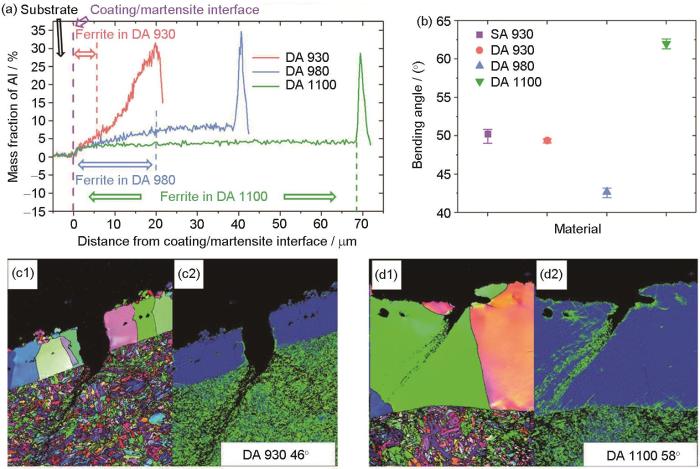
... 关于Al-Si镀层对热成形钢弯曲韧性的影响,学术界还存在争议[26,27].通常,热冲压后形成的金属间化合物层较脆,容易在弯曲中引发裂纹.然而,互扩散铁素体层的弯曲性能受到Al含量的影响,表现出双重效应:Al含量高于4%的铁素体表现为脆性,损害弯曲性能[25];Al含量低于4%的铁素体则具有较好韧性,可提升弯曲性能[25].采用两步奥氏体化(DA)工艺可以调控镀层的Al含量,从而优化弯曲性能.如图2a[25]所示,DA 930和DA 980试样的互扩散层主要由富Al铁素体(> 4%)组成,而DA 1100试样铁素体中的Al含量低于4%.富Al铁素体层即使在微小拉伸变形下也难以阻止裂纹扩展.因此,为提升热成形钢镀层的弯曲韧性,本课题组[25]开发了一种薄镀层工艺.较薄的Al-Si镀层在形成较薄的脆性金属间化合物和铁素体层的同时,能够缩短裂纹长度,降低裂纹尖端的应力强度,从而改善弯曲性能.与DA 930试样相比,DA 980试样中较厚的富Al铁素体层会降低弯曲性能(图2b[25]).裂纹扩展行为进一步验证了贫Al铁素体层的作用:在弯曲角达到46°时,DA930 试样表面的裂纹贯穿镀层直达马氏体基体,裂纹路径附近的低位错密度表明镀层仅能承受极小的弯曲应力(图2c1和c2[25]);而在弯曲角为58°时,DA 1100试样的铁素体层仍能有效阻滞裂纹扩展,裂纹尖端的高位错密度表明该层通过剧烈塑性变形承受大量弯曲应力(图2d1和d2[25]).因此,通过两步奥氏体化法制备的DA 1100试样具有更加优异的弯曲韧性,其关键在于贫Al铁素体层的延展性能够有效阻碍裂纹的扩展[25]. ...
... [25].采用两步奥氏体化(DA)工艺可以调控镀层的Al含量,从而优化弯曲性能.如图2a[25]所示,DA 930和DA 980试样的互扩散层主要由富Al铁素体(> 4%)组成,而DA 1100试样铁素体中的Al含量低于4%.富Al铁素体层即使在微小拉伸变形下也难以阻止裂纹扩展.因此,为提升热成形钢镀层的弯曲韧性,本课题组[25]开发了一种薄镀层工艺.较薄的Al-Si镀层在形成较薄的脆性金属间化合物和铁素体层的同时,能够缩短裂纹长度,降低裂纹尖端的应力强度,从而改善弯曲性能.与DA 930试样相比,DA 980试样中较厚的富Al铁素体层会降低弯曲性能(图2b[25]).裂纹扩展行为进一步验证了贫Al铁素体层的作用:在弯曲角达到46°时,DA930 试样表面的裂纹贯穿镀层直达马氏体基体,裂纹路径附近的低位错密度表明镀层仅能承受极小的弯曲应力(图2c1和c2[25]);而在弯曲角为58°时,DA 1100试样的铁素体层仍能有效阻滞裂纹扩展,裂纹尖端的高位错密度表明该层通过剧烈塑性变形承受大量弯曲应力(图2d1和d2[25]).因此,通过两步奥氏体化法制备的DA 1100试样具有更加优异的弯曲韧性,其关键在于贫Al铁素体层的延展性能够有效阻碍裂纹的扩展[25]. ...
... [25]所示,DA 930和DA 980试样的互扩散层主要由富Al铁素体(> 4%)组成,而DA 1100试样铁素体中的Al含量低于4%.富Al铁素体层即使在微小拉伸变形下也难以阻止裂纹扩展.因此,为提升热成形钢镀层的弯曲韧性,本课题组[25]开发了一种薄镀层工艺.较薄的Al-Si镀层在形成较薄的脆性金属间化合物和铁素体层的同时,能够缩短裂纹长度,降低裂纹尖端的应力强度,从而改善弯曲性能.与DA 930试样相比,DA 980试样中较厚的富Al铁素体层会降低弯曲性能(图2b[25]).裂纹扩展行为进一步验证了贫Al铁素体层的作用:在弯曲角达到46°时,DA930 试样表面的裂纹贯穿镀层直达马氏体基体,裂纹路径附近的低位错密度表明镀层仅能承受极小的弯曲应力(图2c1和c2[25]);而在弯曲角为58°时,DA 1100试样的铁素体层仍能有效阻滞裂纹扩展,裂纹尖端的高位错密度表明该层通过剧烈塑性变形承受大量弯曲应力(图2d1和d2[25]).因此,通过两步奥氏体化法制备的DA 1100试样具有更加优异的弯曲韧性,其关键在于贫Al铁素体层的延展性能够有效阻碍裂纹的扩展[25]. ...
... [25]开发了一种薄镀层工艺.较薄的Al-Si镀层在形成较薄的脆性金属间化合物和铁素体层的同时,能够缩短裂纹长度,降低裂纹尖端的应力强度,从而改善弯曲性能.与DA 930试样相比,DA 980试样中较厚的富Al铁素体层会降低弯曲性能(图2b[25]).裂纹扩展行为进一步验证了贫Al铁素体层的作用:在弯曲角达到46°时,DA930 试样表面的裂纹贯穿镀层直达马氏体基体,裂纹路径附近的低位错密度表明镀层仅能承受极小的弯曲应力(图2c1和c2[25]);而在弯曲角为58°时,DA 1100试样的铁素体层仍能有效阻滞裂纹扩展,裂纹尖端的高位错密度表明该层通过剧烈塑性变形承受大量弯曲应力(图2d1和d2[25]).因此,通过两步奥氏体化法制备的DA 1100试样具有更加优异的弯曲韧性,其关键在于贫Al铁素体层的延展性能够有效阻碍裂纹的扩展[25]. ...
... [25]).裂纹扩展行为进一步验证了贫Al铁素体层的作用:在弯曲角达到46°时,DA930 试样表面的裂纹贯穿镀层直达马氏体基体,裂纹路径附近的低位错密度表明镀层仅能承受极小的弯曲应力(图2c1和c2[25]);而在弯曲角为58°时,DA 1100试样的铁素体层仍能有效阻滞裂纹扩展,裂纹尖端的高位错密度表明该层通过剧烈塑性变形承受大量弯曲应力(图2d1和d2[25]).因此,通过两步奥氏体化法制备的DA 1100试样具有更加优异的弯曲韧性,其关键在于贫Al铁素体层的延展性能够有效阻碍裂纹的扩展[25]. ...
... [25]);而在弯曲角为58°时,DA 1100试样的铁素体层仍能有效阻滞裂纹扩展,裂纹尖端的高位错密度表明该层通过剧烈塑性变形承受大量弯曲应力(图2d1和d2[25]).因此,通过两步奥氏体化法制备的DA 1100试样具有更加优异的弯曲韧性,其关键在于贫Al铁素体层的延展性能够有效阻碍裂纹的扩展[25]. ...
... [25]).因此,通过两步奥氏体化法制备的DA 1100试样具有更加优异的弯曲韧性,其关键在于贫Al铁素体层的延展性能够有效阻碍裂纹的扩展[25]. ...
... [25]. ...
... [
25]
Coating structures and bending fracture toughnesses under different double austenitization (DA) conditions (The SA number indicates the austenitization temperature, and the DA numbers indicate the first austenitization temperatures)<sup>[<xref ref-type="bibr" rid="R25">25</xref>]</sup>(a) Al profile within the interdiffusion ferrite layer under different DA conditions ...
... [
25]
(a) Al profile within the interdiffusion ferrite layer under different DA conditions ...
... 然而,当残余奥氏体含量较高(> 5%,体积分数)且不稳定时,其抗氢脆性能可能反而变差[79,81].原因在于,此类奥氏体可能转变为变形诱导的高碳马氏体,后者未经过回火,具有较高的脆性.相变引起的体积膨胀也会引发应力集中,变形产物还会进一步捕获H.当亚稳态奥氏体已经存储过量的H时,变形诱导的新马氏体极易因H饱和而促进氢致裂纹萌生,从而降低热成形钢的抗氢脆能力.此外,脆性马氏体主要分布在奥氏体晶界或马氏体晶界,即使没有H存在,在三向应力作用下也可引发沿晶脆性断裂[25,82].H还可能进一步降低奥氏体的稳定性,加剧形变诱导马氏体形成.未来,针对此类含奥氏体钢的设计应着重调控奥氏体的组成、体积分数及形貌,以获得少量稳定性高且呈薄片状的奥氏体组织,避免形成不稳定、大块状奥氏体,从而有效提升热成形钢的抗氢脆性能. ...
... 相较于无镀层钢板,Al-Si镀层板材展现出显著的优势:出众的抗高温氧化性能、优异的耐腐蚀特性,以及在简化生产流程、提高制件品质等方面具有突出表现.这使得Al-Si镀层技术成为热冲压钢材应用的主要发展方向.然而,镀层热成形钢的弯曲断裂性能和抗裂纹扩展能力相较裸板明显降低,其关键机理为:在镀层合金化处理过程中,界面迁移引发的相互扩散导致了α-Fe相与马氏体界面区域形成C元素富集,该区域高碳马氏体的存在直接导致了韧性的降低和延迟开裂敏感性的提高.值得注意的是,通过控制镀层厚度可有效减轻C元素富集程度,从而提升镀层材料的韧性.本课题组[25]最新研发的两步法工艺Al-Si镀层22MnB5钢板的弯曲断裂形变率较现有镀层技术提升了超过20%,这一突破性进展成功克服了Al-Si镀层相对裸板的唯一性能短板,为Al-Si镀层板全面取代裸板创造了技术可行性.另一方面,锌基镀层虽然可以作为Al-Si镀层的重要替代方案,但其液态金属脆化现象限制了锌镀层的应用.液态金属脆化效应的发生需满足两个条件:液态Zn的存在和外应力的施加.降低外应力、减少金属含量、降低材料敏感性以及优化工艺流程可以一定程度缓解材料脆化问题. ...
Effects of Al-Si coating structures on bendability and resistance to hydrogen embrittlement in 1.5-GPa-grade hot-press-forming steel
2
2022
... 关于Al-Si镀层对热成形钢弯曲韧性的影响,学术界还存在争议[26,27].通常,热冲压后形成的金属间化合物层较脆,容易在弯曲中引发裂纹.然而,互扩散铁素体层的弯曲性能受到Al含量的影响,表现出双重效应:Al含量高于4%的铁素体表现为脆性,损害弯曲性能[25];Al含量低于4%的铁素体则具有较好韧性,可提升弯曲性能[25].采用两步奥氏体化(DA)工艺可以调控镀层的Al含量,从而优化弯曲性能.如图2a[25]所示,DA 930和DA 980试样的互扩散层主要由富Al铁素体(> 4%)组成,而DA 1100试样铁素体中的Al含量低于4%.富Al铁素体层即使在微小拉伸变形下也难以阻止裂纹扩展.因此,为提升热成形钢镀层的弯曲韧性,本课题组[25]开发了一种薄镀层工艺.较薄的Al-Si镀层在形成较薄的脆性金属间化合物和铁素体层的同时,能够缩短裂纹长度,降低裂纹尖端的应力强度,从而改善弯曲性能.与DA 930试样相比,DA 980试样中较厚的富Al铁素体层会降低弯曲性能(图2b[25]).裂纹扩展行为进一步验证了贫Al铁素体层的作用:在弯曲角达到46°时,DA930 试样表面的裂纹贯穿镀层直达马氏体基体,裂纹路径附近的低位错密度表明镀层仅能承受极小的弯曲应力(图2c1和c2[25]);而在弯曲角为58°时,DA 1100试样的铁素体层仍能有效阻滞裂纹扩展,裂纹尖端的高位错密度表明该层通过剧烈塑性变形承受大量弯曲应力(图2d1和d2[25]).因此,通过两步奥氏体化法制备的DA 1100试样具有更加优异的弯曲韧性,其关键在于贫Al铁素体层的延展性能够有效阻碍裂纹的扩展[25]. ...
... 尽管热成形钢在抗氢脆方面已取得一些研究进展,但仍有关键科学问题尚待深入探索.例如,关于NbC和VC等纳米析出相的抗氢脆机理已有一定的研究[36~38],但Al2O3等夹杂物的氢捕获行为、脆化机制及其临界尺寸尚缺乏系统而深入的研究[39,40].此外,氢致延迟断裂通常起源于零件表面,但热成形钢表面因脱碳[39,41]、氧化[39,42]或镀层[8,43]等因素,其微观结构较为复杂.随着抗拉强度提升至1500 MPa以上,表面缺陷(如镀层裂纹或冷剪切损伤)对氢脆的敏感性显著增强.应力集中效应会促使H原子在缺陷处优先富集,从而加剧超高强度热成形钢的氢脆风险.然而,也有研究[26]表明,脱碳层或Al-Si镀层形成的铁素体组织可以在一定程度上改善材料的抗氢脆性能,但镀层结构对氢脆的影响具有复杂多样性.因此,本文除了探讨基体组织的影响外,还将重点分析镀层以及表面微观结构和状态对热成形钢氢脆的作用机制. ...
Influence of austenitizing parameters on microstructure and mechanical properties of Al-Si coated press hardened steel
1
2019
... 关于Al-Si镀层对热成形钢弯曲韧性的影响,学术界还存在争议[26,27].通常,热冲压后形成的金属间化合物层较脆,容易在弯曲中引发裂纹.然而,互扩散铁素体层的弯曲性能受到Al含量的影响,表现出双重效应:Al含量高于4%的铁素体表现为脆性,损害弯曲性能[25];Al含量低于4%的铁素体则具有较好韧性,可提升弯曲性能[25].采用两步奥氏体化(DA)工艺可以调控镀层的Al含量,从而优化弯曲性能.如图2a[25]所示,DA 930和DA 980试样的互扩散层主要由富Al铁素体(> 4%)组成,而DA 1100试样铁素体中的Al含量低于4%.富Al铁素体层即使在微小拉伸变形下也难以阻止裂纹扩展.因此,为提升热成形钢镀层的弯曲韧性,本课题组[25]开发了一种薄镀层工艺.较薄的Al-Si镀层在形成较薄的脆性金属间化合物和铁素体层的同时,能够缩短裂纹长度,降低裂纹尖端的应力强度,从而改善弯曲性能.与DA 930试样相比,DA 980试样中较厚的富Al铁素体层会降低弯曲性能(图2b[25]).裂纹扩展行为进一步验证了贫Al铁素体层的作用:在弯曲角达到46°时,DA930 试样表面的裂纹贯穿镀层直达马氏体基体,裂纹路径附近的低位错密度表明镀层仅能承受极小的弯曲应力(图2c1和c2[25]);而在弯曲角为58°时,DA 1100试样的铁素体层仍能有效阻滞裂纹扩展,裂纹尖端的高位错密度表明该层通过剧烈塑性变形承受大量弯曲应力(图2d1和d2[25]).因此,通过两步奥氏体化法制备的DA 1100试样具有更加优异的弯曲韧性,其关键在于贫Al铁素体层的延展性能够有效阻碍裂纹的扩展[25]. ...
Transgranular cracking in a liquid Zn embrittled high strength steel
1
2020
... 锌基镀层在热成形应用中面临液态金属脆化(LME)这一关键挑战[28].图3a[29]展示了GI镀层板在冲压前的结构构成:外部的锌镀层与基材界面处的一层薄铝层.由于Zn的熔点(420 ℃)明显低于热冲压温度,在热冲压时,液化的锌镀层会浸润到热成形钢基体中,降低晶界结合力,使得板材在外应力下更易沿着晶界开裂,如图3b[29]所示.图3c[29]所示的机理图揭示了在液态Zn通过镀层缺陷渗入基体的过程中,会引发表面微裂纹,这些裂纹沿奥氏体晶界扩展,最终导致材料失效.研究[29]表明,当裂纹深度超过10 μm时,材料的力学性能会急剧下降.Bhattacharya等[30]采用部分奥氏体化的临界退火工艺在双相钢中形成了双相组织结构,有效抑制了LME现象.该双相组织由超细铁素体晶粒和离散马氏体岛组成,显著减少了原奥氏体晶界的比例并降低了材料的LME敏感性. ...
7
2019
... 锌基镀层在热成形应用中面临液态金属脆化(LME)这一关键挑战[28].图3a[29]展示了GI镀层板在冲压前的结构构成:外部的锌镀层与基材界面处的一层薄铝层.由于Zn的熔点(420 ℃)明显低于热冲压温度,在热冲压时,液化的锌镀层会浸润到热成形钢基体中,降低晶界结合力,使得板材在外应力下更易沿着晶界开裂,如图3b[29]所示.图3c[29]所示的机理图揭示了在液态Zn通过镀层缺陷渗入基体的过程中,会引发表面微裂纹,这些裂纹沿奥氏体晶界扩展,最终导致材料失效.研究[29]表明,当裂纹深度超过10 μm时,材料的力学性能会急剧下降.Bhattacharya等[30]采用部分奥氏体化的临界退火工艺在双相钢中形成了双相组织结构,有效抑制了LME现象.该双相组织由超细铁素体晶粒和离散马氏体岛组成,显著减少了原奥氏体晶界的比例并降低了材料的LME敏感性. ...
... [29]所示.图3c[29]所示的机理图揭示了在液态Zn通过镀层缺陷渗入基体的过程中,会引发表面微裂纹,这些裂纹沿奥氏体晶界扩展,最终导致材料失效.研究[29]表明,当裂纹深度超过10 μm时,材料的力学性能会急剧下降.Bhattacharya等[30]采用部分奥氏体化的临界退火工艺在双相钢中形成了双相组织结构,有效抑制了LME现象.该双相组织由超细铁素体晶粒和离散马氏体岛组成,显著减少了原奥氏体晶界的比例并降低了材料的LME敏感性. ...
... [29]所示的机理图揭示了在液态Zn通过镀层缺陷渗入基体的过程中,会引发表面微裂纹,这些裂纹沿奥氏体晶界扩展,最终导致材料失效.研究[29]表明,当裂纹深度超过10 μm时,材料的力学性能会急剧下降.Bhattacharya等[30]采用部分奥氏体化的临界退火工艺在双相钢中形成了双相组织结构,有效抑制了LME现象.该双相组织由超细铁素体晶粒和离散马氏体岛组成,显著减少了原奥氏体晶界的比例并降低了材料的LME敏感性. ...
... [29]表明,当裂纹深度超过10 μm时,材料的力学性能会急剧下降.Bhattacharya等[30]采用部分奥氏体化的临界退火工艺在双相钢中形成了双相组织结构,有效抑制了LME现象.该双相组织由超细铁素体晶粒和离散马氏体岛组成,显著减少了原奥氏体晶界的比例并降低了材料的LME敏感性. ...
... [
29]
Schematic of hot-dip galvanized Zn (GI) coating before and after press hardening (a), cross-sectional morphologies of liquid metal embrittlement (LME) cracks and EDS analysis illustrating the distribution of Zn elements on the coated surface of 22MnB5 steel (Yellow arrows indicate the presence of LME cracks) (b), the process of LME occurrence during press hardening of Zn-coated steels (c), and processing window of the press hardening process for Zn and Al-Si coatings (d)<sup>[<xref ref-type="bibr" rid="R29">29</xref>]</sup>Fig.3![]()
在热成形工艺方面,锌基镀层材料存在明显局限:与裸板和Al-Si镀层板相比,其热成形工艺窗口较窄(图3d[29]).这是因为纯Zn的沸点(907 ℃)接近22MnB5钢的奥氏体化温度(约880 ℃),导致短时间内难以充分实现镀层元素的扩散,最终形成不完整的扩散层以及Zn富集区域.而延长加热时间又容易在深层形成微裂纹,从而限制了锌基镀层板的工业应用. ...
... [
29]
Fig.3![]()
在热成形工艺方面,锌基镀层材料存在明显局限:与裸板和Al-Si镀层板相比,其热成形工艺窗口较窄(图3d[29]).这是因为纯Zn的沸点(907 ℃)接近22MnB5钢的奥氏体化温度(约880 ℃),导致短时间内难以充分实现镀层元素的扩散,最终形成不完整的扩散层以及Zn富集区域.而延长加热时间又容易在深层形成微裂纹,从而限制了锌基镀层板的工业应用. ...
... 在热成形工艺方面,锌基镀层材料存在明显局限:与裸板和Al-Si镀层板相比,其热成形工艺窗口较窄(图3d[29]).这是因为纯Zn的沸点(907 ℃)接近22MnB5钢的奥氏体化温度(约880 ℃),导致短时间内难以充分实现镀层元素的扩散,最终形成不完整的扩散层以及Zn富集区域.而延长加热时间又容易在深层形成微裂纹,从而限制了锌基镀层板的工业应用. ...
Influence of the starting microstructure of an advanced high strength steel on the characteristics of Zn-assisted liquid metal embrittlement
1
2021
... 锌基镀层在热成形应用中面临液态金属脆化(LME)这一关键挑战[28].图3a[29]展示了GI镀层板在冲压前的结构构成:外部的锌镀层与基材界面处的一层薄铝层.由于Zn的熔点(420 ℃)明显低于热冲压温度,在热冲压时,液化的锌镀层会浸润到热成形钢基体中,降低晶界结合力,使得板材在外应力下更易沿着晶界开裂,如图3b[29]所示.图3c[29]所示的机理图揭示了在液态Zn通过镀层缺陷渗入基体的过程中,会引发表面微裂纹,这些裂纹沿奥氏体晶界扩展,最终导致材料失效.研究[29]表明,当裂纹深度超过10 μm时,材料的力学性能会急剧下降.Bhattacharya等[30]采用部分奥氏体化的临界退火工艺在双相钢中形成了双相组织结构,有效抑制了LME现象.该双相组织由超细铁素体晶粒和离散马氏体岛组成,显著减少了原奥氏体晶界的比例并降低了材料的LME敏感性. ...
Effect of a Zn interlayer on the adhesion strength and corrosion resistance of Zn-Mg coated TRIP steel
1
2019
... 近年来,Zn-Mg基镀层因其优异的耐腐蚀性能受到关注[31].Mg原子优先电离,提供电子,增强牺牲阳极作用,从而延缓了腐蚀过程.生成的MgCO3和Mg(OH)2腐蚀产物层可以有效阻碍腐蚀扩展.此外,Zn-Mg金属间化合物本身也表现出优异的抗腐蚀性能,未来有望在热成形钢领域得到更广泛的应用. ...
Hydrogen absorption and embrittlement of ultra-high strength aluminized press hardening steel
3
2018
... 氢脆是热成形钢中一种关键材料失效机制,主要表现为自由扩散的H原子与残余应力或外部应力协同作用,导致材料韧性显著下降.H的主要来源包括奥氏体化处理、喷涂工艺和腐蚀环境[32].当H原子在材料表面吸附后,会向局部应力集中区域扩散并富集,从而降低其临界断裂应力.一旦该临界应力低于残余应力或外加应力,材料内部就会萌生裂纹并不断扩展,最终引发延迟断裂[33~35].这一过程可能持续数小时至数年.虽然热冲压工艺能显著降低超高强度热成形钢的残余应力,但由于其形成的高硬度马氏体组织具有较高的缺陷密度,会加剧H原子捕获,增加材料的氢脆敏感性. ...
... 经过热冲压处理后,热成形钢通常为全马氏体显微组织.这种具有超高强度和高缺陷密度的组织对氢脆非常敏感[8,32].研究[32,33]表明,马氏体钢的氢致裂纹扩展行为紧密依赖于H的浓度:低H浓度时主要发生晶内解理断裂,高H浓度时则更易引发延晶断裂.除了H含量外,局部应力等因素也会影响材料的氢脆特性,本课题组[44]提出的一种相场模型充分证明了这一点.如图4[44]所示,实验和相场模拟均证实,在热成形钢中,H原子主要富集于原奥氏体晶界(PAGB)和板条界(LB),这与其高密度的几何必需位错密切相关[44].同时,局部应力对H的空间分布也具有调控作用.以22MnB5钢为例,当局部H浓度约为2.50 × 10⁻⁶ (临界值)时,马氏体晶界面临氢脆断裂风险.值得注意的是,在较高的局部应力条件下(图4b[44]),PAGB断裂对应的临界H浓度为1.0 × 10⁻⁶,LB断裂的临界H浓度则为1.49 × 10⁻⁶,这两种晶界发生氢致裂纹起裂需要的H含量均低于低应力状态下的H含量,这与实验结果高度一致[44].此发现为氢脆机理的分析和评估提供了重要的理论依据.最近研究[45]表明,除了形变过程中H的再分布以外,形变早期阶段氢致微裂纹的大量形核及扩展对热成形钢抗氢脆性能也有影响. ...
... [32,33]表明,马氏体钢的氢致裂纹扩展行为紧密依赖于H的浓度:低H浓度时主要发生晶内解理断裂,高H浓度时则更易引发延晶断裂.除了H含量外,局部应力等因素也会影响材料的氢脆特性,本课题组[44]提出的一种相场模型充分证明了这一点.如图4[44]所示,实验和相场模拟均证实,在热成形钢中,H原子主要富集于原奥氏体晶界(PAGB)和板条界(LB),这与其高密度的几何必需位错密切相关[44].同时,局部应力对H的空间分布也具有调控作用.以22MnB5钢为例,当局部H浓度约为2.50 × 10⁻⁶ (临界值)时,马氏体晶界面临氢脆断裂风险.值得注意的是,在较高的局部应力条件下(图4b[44]),PAGB断裂对应的临界H浓度为1.0 × 10⁻⁶,LB断裂的临界H浓度则为1.49 × 10⁻⁶,这两种晶界发生氢致裂纹起裂需要的H含量均低于低应力状态下的H含量,这与实验结果高度一致[44].此发现为氢脆机理的分析和评估提供了重要的理论依据.最近研究[45]表明,除了形变过程中H的再分布以外,形变早期阶段氢致微裂纹的大量形核及扩展对热成形钢抗氢脆性能也有影响. ...
Effects of local stress, strain, and hydrogen content on hydrogen-related fracture behavior in low-carbon martensitic steel
3
2021
... 氢脆是热成形钢中一种关键材料失效机制,主要表现为自由扩散的H原子与残余应力或外部应力协同作用,导致材料韧性显著下降.H的主要来源包括奥氏体化处理、喷涂工艺和腐蚀环境[32].当H原子在材料表面吸附后,会向局部应力集中区域扩散并富集,从而降低其临界断裂应力.一旦该临界应力低于残余应力或外加应力,材料内部就会萌生裂纹并不断扩展,最终引发延迟断裂[33~35].这一过程可能持续数小时至数年.虽然热冲压工艺能显著降低超高强度热成形钢的残余应力,但由于其形成的高硬度马氏体组织具有较高的缺陷密度,会加剧H原子捕获,增加材料的氢脆敏感性. ...
... 经过热冲压处理后,热成形钢通常为全马氏体显微组织.这种具有超高强度和高缺陷密度的组织对氢脆非常敏感[8,32].研究[32,33]表明,马氏体钢的氢致裂纹扩展行为紧密依赖于H的浓度:低H浓度时主要发生晶内解理断裂,高H浓度时则更易引发延晶断裂.除了H含量外,局部应力等因素也会影响材料的氢脆特性,本课题组[44]提出的一种相场模型充分证明了这一点.如图4[44]所示,实验和相场模拟均证实,在热成形钢中,H原子主要富集于原奥氏体晶界(PAGB)和板条界(LB),这与其高密度的几何必需位错密切相关[44].同时,局部应力对H的空间分布也具有调控作用.以22MnB5钢为例,当局部H浓度约为2.50 × 10⁻⁶ (临界值)时,马氏体晶界面临氢脆断裂风险.值得注意的是,在较高的局部应力条件下(图4b[44]),PAGB断裂对应的临界H浓度为1.0 × 10⁻⁶,LB断裂的临界H浓度则为1.49 × 10⁻⁶,这两种晶界发生氢致裂纹起裂需要的H含量均低于低应力状态下的H含量,这与实验结果高度一致[44].此发现为氢脆机理的分析和评估提供了重要的理论依据.最近研究[45]表明,除了形变过程中H的再分布以外,形变早期阶段氢致微裂纹的大量形核及扩展对热成形钢抗氢脆性能也有影响. ...
... 热成形钢呈现两种典型的氢脆断裂模式:准解理断裂(QC)和沿晶断裂(IG).准解理断裂指H富集在解理面((110)或(100)晶面)形成特征断裂面的氢脆现象[51,52],例如产生撕裂棱和锯齿状痕迹.沿晶断裂则典型发生于PAGB,其特征为平坦的断裂表面[33,53,54].根据氢致晶界脱黏机制(HEDE),H在高角度马氏体晶界富集会降低晶界结合力,促进裂纹沿晶界扩展[53,55].除了H的影响外,热成形钢中的合金元素偏析也会改变晶界的结合能,从而影响抗氢脆性能[56,57].例如,Mn和P的偏析可能引发回火脆化,同时加剧氢脆风险[58];而B和Mo的偏析则有助于增强界面结合力,从而改善抗氢脆性能[59,60].B不仅能改善钢的淬透性,还能在奥氏体化过程中偏析至晶界,降低界面能,抑制淬火时铁素体的形核[60].添加微量的B即可显著改善钢的淬透性和晶界结合力.最近,相关研究[59,60]表明,B在PAGB上的偏聚可以缓解氢脆,这是由于B与H的互斥作用缓解了H在PAGB上的富集,进而降低沿晶开裂倾向.同时,Mo也能显著提升热成形钢的抗氢脆性能,其作用机制主要包括两个方面:一是强化晶界原子结合力,抑制晶间断裂;二是作为高效的氢陷阱,固溶态Mo和Mo的碳化物能够减少局部H的富集,从而降低氢脆敏感性. ...
Hydrogen trapping in carbon supersaturated α iron and its decohesion effect in martensitic steel
1
2018
... 热成形钢的超高强度主要源于淬火后的马氏体板条中存在过饱和固溶C.为了获得超过1500 MPa的拉伸强度,工业上通常通过增加C含量来增强固溶强化和沉淀强化.例如,22MnB5钢的C含量为0.22%,其拉伸强度为1500 MPa;而34MnB5钢的C含量达0.34%,其拉伸强度为1900 MPa.虽然淬火形成的马氏体具备高强度,但通常韧性较低.此外,C含量的增加会提升马氏体的四方度和缺陷密度,从而进一步增加氢脆敏感性[34,46].本课题组研究[47]发现,随着C含量的增加,热成形钢的断裂韧性明显下降,这是PHS2000钢抗氢脆性能较差的主要原因(图5[47]).具体表现为:PHS1500钢达到峰值应力后,裂纹扩展速率变缓,表现为分段式裂纹扩展;PHS2000钢的起裂韧性和裂纹稳态扩展韧性较低,氢致裂纹可以迅速扩展,基本不受阻碍(图5d[47]),这一差异直观揭示了C含量对氢脆行为的影响机制. ...
Influence of hydrogen on the mechanical and fracture properties of some martensitic advanced high strength steels in simulated service conditions
1
2016
... 氢脆是热成形钢中一种关键材料失效机制,主要表现为自由扩散的H原子与残余应力或外部应力协同作用,导致材料韧性显著下降.H的主要来源包括奥氏体化处理、喷涂工艺和腐蚀环境[32].当H原子在材料表面吸附后,会向局部应力集中区域扩散并富集,从而降低其临界断裂应力.一旦该临界应力低于残余应力或外加应力,材料内部就会萌生裂纹并不断扩展,最终引发延迟断裂[33~35].这一过程可能持续数小时至数年.虽然热冲压工艺能显著降低超高强度热成形钢的残余应力,但由于其形成的高硬度马氏体组织具有较高的缺陷密度,会加剧H原子捕获,增加材料的氢脆敏感性. ...
The effect of TiC on the hydrogen induced ductility loss and trapping behavior of Fe-C-Ti alloys
1
2016
... 尽管热成形钢在抗氢脆方面已取得一些研究进展,但仍有关键科学问题尚待深入探索.例如,关于NbC和VC等纳米析出相的抗氢脆机理已有一定的研究[36~38],但Al2O3等夹杂物的氢捕获行为、脆化机制及其临界尺寸尚缺乏系统而深入的研究[39,40].此外,氢致延迟断裂通常起源于零件表面,但热成形钢表面因脱碳[39,41]、氧化[39,42]或镀层[8,43]等因素,其微观结构较为复杂.随着抗拉强度提升至1500 MPa以上,表面缺陷(如镀层裂纹或冷剪切损伤)对氢脆的敏感性显著增强.应力集中效应会促使H原子在缺陷处优先富集,从而加剧超高强度热成形钢的氢脆风险.然而,也有研究[26]表明,脱碳层或Al-Si镀层形成的铁素体组织可以在一定程度上改善材料的抗氢脆性能,但镀层结构对氢脆的影响具有复杂多样性.因此,本文除了探讨基体组织的影响外,还将重点分析镀层以及表面微观结构和状态对热成形钢氢脆的作用机制. ...
Observation of hydrogen trapping at dislocations, grain boundaries, and precipitates
2
2020
... 尽管H与Nb、Ti、V的碳化物的相互作用已被广泛研究[37,38],但关于碳化物析出相中具体的H捕获位点的争议仍未解决.主要涉及相干界面上的C空位[38,62]、半相干界面中的位错核心[63,64]、非相干界面以及析出相周围的应变场[37,65]等因素.相关研究达成的普遍共识是,氢陷阱主要集中在碳化物与基体的界面区域.图7[63]展示了回火过程中NbC作为氢陷阱的演变机制.图7a[63]表明,在淬火状态(无碳化物析出)时,H偏聚于PAGB,导致材料氢脆敏感性较高.经过480 ℃回火后(图7b[63]),形成均匀分布的纳米级NbC析出相,NbC作为不可逆氢陷阱,显著降低可扩散氢含量,有效增强抗氢脆性能.当回火温度升高至560 ℃时(图7c[63]),碳化物发生粗化,界面面积减少,H的捕获能力下降,因此,Q&T-560样品的抗氢脆性能低于Q&T-480.图7d[63]的热脱附光谱(TDS)分析显示,Q&T-480试样具有最多的不可逆氢陷阱(高温峰)和最少的可逆氢陷阱(低温峰),进一步验证了其优异的抗氢脆性能.图7e[63]揭示了NbC改善抗氢脆性能的机理,纳米级析出相在内部捕获H原子,使H在晶界上的富集减弱. ...
... [37,65]等因素.相关研究达成的普遍共识是,氢陷阱主要集中在碳化物与基体的界面区域.图7[63]展示了回火过程中NbC作为氢陷阱的演变机制.图7a[63]表明,在淬火状态(无碳化物析出)时,H偏聚于PAGB,导致材料氢脆敏感性较高.经过480 ℃回火后(图7b[63]),形成均匀分布的纳米级NbC析出相,NbC作为不可逆氢陷阱,显著降低可扩散氢含量,有效增强抗氢脆性能.当回火温度升高至560 ℃时(图7c[63]),碳化物发生粗化,界面面积减少,H的捕获能力下降,因此,Q&T-560样品的抗氢脆性能低于Q&T-480.图7d[63]的热脱附光谱(TDS)分析显示,Q&T-480试样具有最多的不可逆氢陷阱(高温峰)和最少的可逆氢陷阱(低温峰),进一步验证了其优异的抗氢脆性能.图7e[63]揭示了NbC改善抗氢脆性能的机理,纳米级析出相在内部捕获H原子,使H在晶界上的富集减弱. ...
Origin of hydrogen trapping site in vanadium carbide precipitation strengthening steel
3
2018
... 尽管热成形钢在抗氢脆方面已取得一些研究进展,但仍有关键科学问题尚待深入探索.例如,关于NbC和VC等纳米析出相的抗氢脆机理已有一定的研究[36~38],但Al2O3等夹杂物的氢捕获行为、脆化机制及其临界尺寸尚缺乏系统而深入的研究[39,40].此外,氢致延迟断裂通常起源于零件表面,但热成形钢表面因脱碳[39,41]、氧化[39,42]或镀层[8,43]等因素,其微观结构较为复杂.随着抗拉强度提升至1500 MPa以上,表面缺陷(如镀层裂纹或冷剪切损伤)对氢脆的敏感性显著增强.应力集中效应会促使H原子在缺陷处优先富集,从而加剧超高强度热成形钢的氢脆风险.然而,也有研究[26]表明,脱碳层或Al-Si镀层形成的铁素体组织可以在一定程度上改善材料的抗氢脆性能,但镀层结构对氢脆的影响具有复杂多样性.因此,本文除了探讨基体组织的影响外,还将重点分析镀层以及表面微观结构和状态对热成形钢氢脆的作用机制. ...
... 尽管H与Nb、Ti、V的碳化物的相互作用已被广泛研究[37,38],但关于碳化物析出相中具体的H捕获位点的争议仍未解决.主要涉及相干界面上的C空位[38,62]、半相干界面中的位错核心[63,64]、非相干界面以及析出相周围的应变场[37,65]等因素.相关研究达成的普遍共识是,氢陷阱主要集中在碳化物与基体的界面区域.图7[63]展示了回火过程中NbC作为氢陷阱的演变机制.图7a[63]表明,在淬火状态(无碳化物析出)时,H偏聚于PAGB,导致材料氢脆敏感性较高.经过480 ℃回火后(图7b[63]),形成均匀分布的纳米级NbC析出相,NbC作为不可逆氢陷阱,显著降低可扩散氢含量,有效增强抗氢脆性能.当回火温度升高至560 ℃时(图7c[63]),碳化物发生粗化,界面面积减少,H的捕获能力下降,因此,Q&T-560样品的抗氢脆性能低于Q&T-480.图7d[63]的热脱附光谱(TDS)分析显示,Q&T-480试样具有最多的不可逆氢陷阱(高温峰)和最少的可逆氢陷阱(低温峰),进一步验证了其优异的抗氢脆性能.图7e[63]揭示了NbC改善抗氢脆性能的机理,纳米级析出相在内部捕获H原子,使H在晶界上的富集减弱. ...
... [38,62]、半相干界面中的位错核心[63,64]、非相干界面以及析出相周围的应变场[37,65]等因素.相关研究达成的普遍共识是,氢陷阱主要集中在碳化物与基体的界面区域.图7[63]展示了回火过程中NbC作为氢陷阱的演变机制.图7a[63]表明,在淬火状态(无碳化物析出)时,H偏聚于PAGB,导致材料氢脆敏感性较高.经过480 ℃回火后(图7b[63]),形成均匀分布的纳米级NbC析出相,NbC作为不可逆氢陷阱,显著降低可扩散氢含量,有效增强抗氢脆性能.当回火温度升高至560 ℃时(图7c[63]),碳化物发生粗化,界面面积减少,H的捕获能力下降,因此,Q&T-560样品的抗氢脆性能低于Q&T-480.图7d[63]的热脱附光谱(TDS)分析显示,Q&T-480试样具有最多的不可逆氢陷阱(高温峰)和最少的可逆氢陷阱(低温峰),进一步验证了其优异的抗氢脆性能.图7e[63]揭示了NbC改善抗氢脆性能的机理,纳米级析出相在内部捕获H原子,使H在晶界上的富集减弱. ...
Effect of hydrogen and inclusions on the tensile properties and fracture behaviour of A350LF2 steels after exposure to wet H2S environments
3
2012
... 尽管热成形钢在抗氢脆方面已取得一些研究进展,但仍有关键科学问题尚待深入探索.例如,关于NbC和VC等纳米析出相的抗氢脆机理已有一定的研究[36~38],但Al2O3等夹杂物的氢捕获行为、脆化机制及其临界尺寸尚缺乏系统而深入的研究[39,40].此外,氢致延迟断裂通常起源于零件表面,但热成形钢表面因脱碳[39,41]、氧化[39,42]或镀层[8,43]等因素,其微观结构较为复杂.随着抗拉强度提升至1500 MPa以上,表面缺陷(如镀层裂纹或冷剪切损伤)对氢脆的敏感性显著增强.应力集中效应会促使H原子在缺陷处优先富集,从而加剧超高强度热成形钢的氢脆风险.然而,也有研究[26]表明,脱碳层或Al-Si镀层形成的铁素体组织可以在一定程度上改善材料的抗氢脆性能,但镀层结构对氢脆的影响具有复杂多样性.因此,本文除了探讨基体组织的影响外,还将重点分析镀层以及表面微观结构和状态对热成形钢氢脆的作用机制. ...
... [39,41]、氧化[39,42]或镀层[8,43]等因素,其微观结构较为复杂.随着抗拉强度提升至1500 MPa以上,表面缺陷(如镀层裂纹或冷剪切损伤)对氢脆的敏感性显著增强.应力集中效应会促使H原子在缺陷处优先富集,从而加剧超高强度热成形钢的氢脆风险.然而,也有研究[26]表明,脱碳层或Al-Si镀层形成的铁素体组织可以在一定程度上改善材料的抗氢脆性能,但镀层结构对氢脆的影响具有复杂多样性.因此,本文除了探讨基体组织的影响外,还将重点分析镀层以及表面微观结构和状态对热成形钢氢脆的作用机制. ...
... [39,42]或镀层[8,43]等因素,其微观结构较为复杂.随着抗拉强度提升至1500 MPa以上,表面缺陷(如镀层裂纹或冷剪切损伤)对氢脆的敏感性显著增强.应力集中效应会促使H原子在缺陷处优先富集,从而加剧超高强度热成形钢的氢脆风险.然而,也有研究[26]表明,脱碳层或Al-Si镀层形成的铁素体组织可以在一定程度上改善材料的抗氢脆性能,但镀层结构对氢脆的影响具有复杂多样性.因此,本文除了探讨基体组织的影响外,还将重点分析镀层以及表面微观结构和状态对热成形钢氢脆的作用机制. ...
A new nonmetallic inclusion rating method by positive use of hydrogen embrittlement phenomenon
1
2013
... 尽管热成形钢在抗氢脆方面已取得一些研究进展,但仍有关键科学问题尚待深入探索.例如,关于NbC和VC等纳米析出相的抗氢脆机理已有一定的研究[36~38],但Al2O3等夹杂物的氢捕获行为、脆化机制及其临界尺寸尚缺乏系统而深入的研究[39,40].此外,氢致延迟断裂通常起源于零件表面,但热成形钢表面因脱碳[39,41]、氧化[39,42]或镀层[8,43]等因素,其微观结构较为复杂.随着抗拉强度提升至1500 MPa以上,表面缺陷(如镀层裂纹或冷剪切损伤)对氢脆的敏感性显著增强.应力集中效应会促使H原子在缺陷处优先富集,从而加剧超高强度热成形钢的氢脆风险.然而,也有研究[26]表明,脱碳层或Al-Si镀层形成的铁素体组织可以在一定程度上改善材料的抗氢脆性能,但镀层结构对氢脆的影响具有复杂多样性.因此,本文除了探讨基体组织的影响外,还将重点分析镀层以及表面微观结构和状态对热成形钢氢脆的作用机制. ...
Characterization of the bendability of press-hardened 22MnB5 steel
1
2014
... 尽管热成形钢在抗氢脆方面已取得一些研究进展,但仍有关键科学问题尚待深入探索.例如,关于NbC和VC等纳米析出相的抗氢脆机理已有一定的研究[36~38],但Al2O3等夹杂物的氢捕获行为、脆化机制及其临界尺寸尚缺乏系统而深入的研究[39,40].此外,氢致延迟断裂通常起源于零件表面,但热成形钢表面因脱碳[39,41]、氧化[39,42]或镀层[8,43]等因素,其微观结构较为复杂.随着抗拉强度提升至1500 MPa以上,表面缺陷(如镀层裂纹或冷剪切损伤)对氢脆的敏感性显著增强.应力集中效应会促使H原子在缺陷处优先富集,从而加剧超高强度热成形钢的氢脆风险.然而,也有研究[26]表明,脱碳层或Al-Si镀层形成的铁素体组织可以在一定程度上改善材料的抗氢脆性能,但镀层结构对氢脆的影响具有复杂多样性.因此,本文除了探讨基体组织的影响外,还将重点分析镀层以及表面微观结构和状态对热成形钢氢脆的作用机制. ...
A novel medium-Mn steel with superior mechanical properties and marginal oxidization after press hardening
1
2021
... 尽管热成形钢在抗氢脆方面已取得一些研究进展,但仍有关键科学问题尚待深入探索.例如,关于NbC和VC等纳米析出相的抗氢脆机理已有一定的研究[36~38],但Al2O3等夹杂物的氢捕获行为、脆化机制及其临界尺寸尚缺乏系统而深入的研究[39,40].此外,氢致延迟断裂通常起源于零件表面,但热成形钢表面因脱碳[39,41]、氧化[39,42]或镀层[8,43]等因素,其微观结构较为复杂.随着抗拉强度提升至1500 MPa以上,表面缺陷(如镀层裂纹或冷剪切损伤)对氢脆的敏感性显著增强.应力集中效应会促使H原子在缺陷处优先富集,从而加剧超高强度热成形钢的氢脆风险.然而,也有研究[26]表明,脱碳层或Al-Si镀层形成的铁素体组织可以在一定程度上改善材料的抗氢脆性能,但镀层结构对氢脆的影响具有复杂多样性.因此,本文除了探讨基体组织的影响外,还将重点分析镀层以及表面微观结构和状态对热成形钢氢脆的作用机制. ...
YAP prevents premature senescence of astrocytes and cognitive decline of Alzheimer's disease through regulating CDK6 signaling
1
2021
... 尽管热成形钢在抗氢脆方面已取得一些研究进展,但仍有关键科学问题尚待深入探索.例如,关于NbC和VC等纳米析出相的抗氢脆机理已有一定的研究[36~38],但Al2O3等夹杂物的氢捕获行为、脆化机制及其临界尺寸尚缺乏系统而深入的研究[39,40].此外,氢致延迟断裂通常起源于零件表面,但热成形钢表面因脱碳[39,41]、氧化[39,42]或镀层[8,43]等因素,其微观结构较为复杂.随着抗拉强度提升至1500 MPa以上,表面缺陷(如镀层裂纹或冷剪切损伤)对氢脆的敏感性显著增强.应力集中效应会促使H原子在缺陷处优先富集,从而加剧超高强度热成形钢的氢脆风险.然而,也有研究[26]表明,脱碳层或Al-Si镀层形成的铁素体组织可以在一定程度上改善材料的抗氢脆性能,但镀层结构对氢脆的影响具有复杂多样性.因此,本文除了探讨基体组织的影响外,还将重点分析镀层以及表面微观结构和状态对热成形钢氢脆的作用机制. ...
Understanding hydrogen embrittlement in press-hardened steel by coupling phase field and hydrogen diffusion modeling
7
2022
... 经过热冲压处理后,热成形钢通常为全马氏体显微组织.这种具有超高强度和高缺陷密度的组织对氢脆非常敏感[8,32].研究[32,33]表明,马氏体钢的氢致裂纹扩展行为紧密依赖于H的浓度:低H浓度时主要发生晶内解理断裂,高H浓度时则更易引发延晶断裂.除了H含量外,局部应力等因素也会影响材料的氢脆特性,本课题组[44]提出的一种相场模型充分证明了这一点.如图4[44]所示,实验和相场模拟均证实,在热成形钢中,H原子主要富集于原奥氏体晶界(PAGB)和板条界(LB),这与其高密度的几何必需位错密切相关[44].同时,局部应力对H的空间分布也具有调控作用.以22MnB5钢为例,当局部H浓度约为2.50 × 10⁻⁶ (临界值)时,马氏体晶界面临氢脆断裂风险.值得注意的是,在较高的局部应力条件下(图4b[44]),PAGB断裂对应的临界H浓度为1.0 × 10⁻⁶,LB断裂的临界H浓度则为1.49 × 10⁻⁶,这两种晶界发生氢致裂纹起裂需要的H含量均低于低应力状态下的H含量,这与实验结果高度一致[44].此发现为氢脆机理的分析和评估提供了重要的理论依据.最近研究[45]表明,除了形变过程中H的再分布以外,形变早期阶段氢致微裂纹的大量形核及扩展对热成形钢抗氢脆性能也有影响. ...
... [44]所示,实验和相场模拟均证实,在热成形钢中,H原子主要富集于原奥氏体晶界(PAGB)和板条界(LB),这与其高密度的几何必需位错密切相关[44].同时,局部应力对H的空间分布也具有调控作用.以22MnB5钢为例,当局部H浓度约为2.50 × 10⁻⁶ (临界值)时,马氏体晶界面临氢脆断裂风险.值得注意的是,在较高的局部应力条件下(图4b[44]),PAGB断裂对应的临界H浓度为1.0 × 10⁻⁶,LB断裂的临界H浓度则为1.49 × 10⁻⁶,这两种晶界发生氢致裂纹起裂需要的H含量均低于低应力状态下的H含量,这与实验结果高度一致[44].此发现为氢脆机理的分析和评估提供了重要的理论依据.最近研究[45]表明,除了形变过程中H的再分布以外,形变早期阶段氢致微裂纹的大量形核及扩展对热成形钢抗氢脆性能也有影响. ...
... [44].同时,局部应力对H的空间分布也具有调控作用.以22MnB5钢为例,当局部H浓度约为2.50 × 10⁻⁶ (临界值)时,马氏体晶界面临氢脆断裂风险.值得注意的是,在较高的局部应力条件下(图4b[44]),PAGB断裂对应的临界H浓度为1.0 × 10⁻⁶,LB断裂的临界H浓度则为1.49 × 10⁻⁶,这两种晶界发生氢致裂纹起裂需要的H含量均低于低应力状态下的H含量,这与实验结果高度一致[44].此发现为氢脆机理的分析和评估提供了重要的理论依据.最近研究[45]表明,除了形变过程中H的再分布以外,形变早期阶段氢致微裂纹的大量形核及扩展对热成形钢抗氢脆性能也有影响. ...
... [44]),PAGB断裂对应的临界H浓度为1.0 × 10⁻⁶,LB断裂的临界H浓度则为1.49 × 10⁻⁶,这两种晶界发生氢致裂纹起裂需要的H含量均低于低应力状态下的H含量,这与实验结果高度一致[44].此发现为氢脆机理的分析和评估提供了重要的理论依据.最近研究[45]表明,除了形变过程中H的再分布以外,形变早期阶段氢致微裂纹的大量形核及扩展对热成形钢抗氢脆性能也有影响. ...
... [44].此发现为氢脆机理的分析和评估提供了重要的理论依据.最近研究[45]表明,除了形变过程中H的再分布以外,形变早期阶段氢致微裂纹的大量形核及扩展对热成形钢抗氢脆性能也有影响. ...
... [
44]
Relationships between overall average hydrogen concentration and the local hydrogen concentration in prior-austenite grain boundary (PAGB), lath boundary (LB), and matrix within low (a) and high (b) hydrostatic stress regions<sup>[<xref ref-type="bibr" rid="R44">44</xref>]</sup>Fig.4![]() 4.2.2 固溶C与马氏体内应力
4.2.2 固溶C与马氏体内应力热成形钢的超高强度主要源于淬火后的马氏体板条中存在过饱和固溶C.为了获得超过1500 MPa的拉伸强度,工业上通常通过增加C含量来增强固溶强化和沉淀强化.例如,22MnB5钢的C含量为0.22%,其拉伸强度为1500 MPa;而34MnB5钢的C含量达0.34%,其拉伸强度为1900 MPa.虽然淬火形成的马氏体具备高强度,但通常韧性较低.此外,C含量的增加会提升马氏体的四方度和缺陷密度,从而进一步增加氢脆敏感性[34,46].本课题组研究[47]发现,随着C含量的增加,热成形钢的断裂韧性明显下降,这是PHS2000钢抗氢脆性能较差的主要原因(图5[47]).具体表现为:PHS1500钢达到峰值应力后,裂纹扩展速率变缓,表现为分段式裂纹扩展;PHS2000钢的起裂韧性和裂纹稳态扩展韧性较低,氢致裂纹可以迅速扩展,基本不受阻碍(图5d[47]),这一差异直观揭示了C含量对氢脆行为的影响机制. ...
... [
44]
Fig.4![]() 4.2.2 固溶C与马氏体内应力
4.2.2 固溶C与马氏体内应力热成形钢的超高强度主要源于淬火后的马氏体板条中存在过饱和固溶C.为了获得超过1500 MPa的拉伸强度,工业上通常通过增加C含量来增强固溶强化和沉淀强化.例如,22MnB5钢的C含量为0.22%,其拉伸强度为1500 MPa;而34MnB5钢的C含量达0.34%,其拉伸强度为1900 MPa.虽然淬火形成的马氏体具备高强度,但通常韧性较低.此外,C含量的增加会提升马氏体的四方度和缺陷密度,从而进一步增加氢脆敏感性[34,46].本课题组研究[47]发现,随着C含量的增加,热成形钢的断裂韧性明显下降,这是PHS2000钢抗氢脆性能较差的主要原因(图5[47]).具体表现为:PHS1500钢达到峰值应力后,裂纹扩展速率变缓,表现为分段式裂纹扩展;PHS2000钢的起裂韧性和裂纹稳态扩展韧性较低,氢致裂纹可以迅速扩展,基本不受阻碍(图5d[47]),这一差异直观揭示了C含量对氢脆行为的影响机制. ...
On the hydrogen embrittlement mechanism of 2 GPa-grade press-hardened steel at various strain rates: Experiments and modeling
1
2025
... 经过热冲压处理后,热成形钢通常为全马氏体显微组织.这种具有超高强度和高缺陷密度的组织对氢脆非常敏感[8,32].研究[32,33]表明,马氏体钢的氢致裂纹扩展行为紧密依赖于H的浓度:低H浓度时主要发生晶内解理断裂,高H浓度时则更易引发延晶断裂.除了H含量外,局部应力等因素也会影响材料的氢脆特性,本课题组[44]提出的一种相场模型充分证明了这一点.如图4[44]所示,实验和相场模拟均证实,在热成形钢中,H原子主要富集于原奥氏体晶界(PAGB)和板条界(LB),这与其高密度的几何必需位错密切相关[44].同时,局部应力对H的空间分布也具有调控作用.以22MnB5钢为例,当局部H浓度约为2.50 × 10⁻⁶ (临界值)时,马氏体晶界面临氢脆断裂风险.值得注意的是,在较高的局部应力条件下(图4b[44]),PAGB断裂对应的临界H浓度为1.0 × 10⁻⁶,LB断裂的临界H浓度则为1.49 × 10⁻⁶,这两种晶界发生氢致裂纹起裂需要的H含量均低于低应力状态下的H含量,这与实验结果高度一致[44].此发现为氢脆机理的分析和评估提供了重要的理论依据.最近研究[45]表明,除了形变过程中H的再分布以外,形变早期阶段氢致微裂纹的大量形核及扩展对热成形钢抗氢脆性能也有影响. ...
Hydrogen trapping and desorption of dual precipitates in tempered low-carbon martensitic steel
1
2020
... 热成形钢的超高强度主要源于淬火后的马氏体板条中存在过饱和固溶C.为了获得超过1500 MPa的拉伸强度,工业上通常通过增加C含量来增强固溶强化和沉淀强化.例如,22MnB5钢的C含量为0.22%,其拉伸强度为1500 MPa;而34MnB5钢的C含量达0.34%,其拉伸强度为1900 MPa.虽然淬火形成的马氏体具备高强度,但通常韧性较低.此外,C含量的增加会提升马氏体的四方度和缺陷密度,从而进一步增加氢脆敏感性[34,46].本课题组研究[47]发现,随着C含量的增加,热成形钢的断裂韧性明显下降,这是PHS2000钢抗氢脆性能较差的主要原因(图5[47]).具体表现为:PHS1500钢达到峰值应力后,裂纹扩展速率变缓,表现为分段式裂纹扩展;PHS2000钢的起裂韧性和裂纹稳态扩展韧性较低,氢致裂纹可以迅速扩展,基本不受阻碍(图5d[47]),这一差异直观揭示了C含量对氢脆行为的影响机制. ...
Comparing hydrogen embrittlement behaviors of two press hardening steels: 2 GPa vs. 1.5 GPa grade
6
2022
... 热成形钢的超高强度主要源于淬火后的马氏体板条中存在过饱和固溶C.为了获得超过1500 MPa的拉伸强度,工业上通常通过增加C含量来增强固溶强化和沉淀强化.例如,22MnB5钢的C含量为0.22%,其拉伸强度为1500 MPa;而34MnB5钢的C含量达0.34%,其拉伸强度为1900 MPa.虽然淬火形成的马氏体具备高强度,但通常韧性较低.此外,C含量的增加会提升马氏体的四方度和缺陷密度,从而进一步增加氢脆敏感性[34,46].本课题组研究[47]发现,随着C含量的增加,热成形钢的断裂韧性明显下降,这是PHS2000钢抗氢脆性能较差的主要原因(图5[47]).具体表现为:PHS1500钢达到峰值应力后,裂纹扩展速率变缓,表现为分段式裂纹扩展;PHS2000钢的起裂韧性和裂纹稳态扩展韧性较低,氢致裂纹可以迅速扩展,基本不受阻碍(图5d[47]),这一差异直观揭示了C含量对氢脆行为的影响机制. ...
... [47]).具体表现为:PHS1500钢达到峰值应力后,裂纹扩展速率变缓,表现为分段式裂纹扩展;PHS2000钢的起裂韧性和裂纹稳态扩展韧性较低,氢致裂纹可以迅速扩展,基本不受阻碍(图5d[47]),这一差异直观揭示了C含量对氢脆行为的影响机制. ...
... [47]),这一差异直观揭示了C含量对氢脆行为的影响机制. ...
... [
47]
Fracture toughnesses and crack propagation behaviors of press hardening steel (PHS) with tensile strengths of 1500 and 2000 MPa<sup>[<xref ref-type="bibr" rid="R47">47</xref>]</sup>(a) J-integral-based resistance curves (J-R curves) measured from the side-grooved compact tension specimens at room temperature ...
... [
47]
(a) J-integral-based resistance curves (J-R curves) measured from the side-grooved compact tension specimens at room temperature ...
... 热冲压成形后的钢材通常需要进行喷涂烘烤处理,典型工艺参数为170 ℃保温20 min[47].该工艺类似于马氏体的低温回火:一方面可以降低固溶C浓度,促进过渡碳化物析出;另一方面有助于释放材料内应力.研究[48,49]表明,减少固溶C含量不仅能够降低马氏体的四方性,还通过析出碳化物形成氢陷阱,有效抑制氢脆.同时,通过缓解内应力还能减少H在晶界的富集.相关实验[50]发现,经烘烤的热成形钢在拉伸和弯曲实验中表现出明显的抗氢脆性能提升.此外,研究[22]表明,采用自回火+淬火等新型热处理工艺,不仅可以通过析出碳化物降低马氏体中的固溶C含量,还能将C元素迁移到残余奥氏体中,从而改善抗氢脆性能. ...
Improved resistance to hydrogen embrittlement in a high-strength steel by quenching-partitioning-tempering treatment
1
2015
... 热冲压成形后的钢材通常需要进行喷涂烘烤处理,典型工艺参数为170 ℃保温20 min[47].该工艺类似于马氏体的低温回火:一方面可以降低固溶C浓度,促进过渡碳化物析出;另一方面有助于释放材料内应力.研究[48,49]表明,减少固溶C含量不仅能够降低马氏体的四方性,还通过析出碳化物形成氢陷阱,有效抑制氢脆.同时,通过缓解内应力还能减少H在晶界的富集.相关实验[50]发现,经烘烤的热成形钢在拉伸和弯曲实验中表现出明显的抗氢脆性能提升.此外,研究[22]表明,采用自回火+淬火等新型热处理工艺,不仅可以通过析出碳化物降低马氏体中的固溶C含量,还能将C元素迁移到残余奥氏体中,从而改善抗氢脆性能. ...
Prevention of hydrogen embrittlement in steels
1
2016
... 热冲压成形后的钢材通常需要进行喷涂烘烤处理,典型工艺参数为170 ℃保温20 min[47].该工艺类似于马氏体的低温回火:一方面可以降低固溶C浓度,促进过渡碳化物析出;另一方面有助于释放材料内应力.研究[48,49]表明,减少固溶C含量不仅能够降低马氏体的四方性,还通过析出碳化物形成氢陷阱,有效抑制氢脆.同时,通过缓解内应力还能减少H在晶界的富集.相关实验[50]发现,经烘烤的热成形钢在拉伸和弯曲实验中表现出明显的抗氢脆性能提升.此外,研究[22]表明,采用自回火+淬火等新型热处理工艺,不仅可以通过析出碳化物降低马氏体中的固溶C含量,还能将C元素迁移到残余奥氏体中,从而改善抗氢脆性能. ...
A phase 1, open-label study of LCAR-B38M, a chimeric antigen receptor T cell therapy directed against B cell maturation antigen, in patients with relapsed or refractory multiple myeloma
1
2018
... 热冲压成形后的钢材通常需要进行喷涂烘烤处理,典型工艺参数为170 ℃保温20 min[47].该工艺类似于马氏体的低温回火:一方面可以降低固溶C浓度,促进过渡碳化物析出;另一方面有助于释放材料内应力.研究[48,49]表明,减少固溶C含量不仅能够降低马氏体的四方性,还通过析出碳化物形成氢陷阱,有效抑制氢脆.同时,通过缓解内应力还能减少H在晶界的富集.相关实验[50]发现,经烘烤的热成形钢在拉伸和弯曲实验中表现出明显的抗氢脆性能提升.此外,研究[22]表明,采用自回火+淬火等新型热处理工艺,不仅可以通过析出碳化物降低马氏体中的固溶C含量,还能将C元素迁移到残余奥氏体中,从而改善抗氢脆性能. ...
Characteristics and mechanisms of hydrogen-induced quasi-cleavage fracture of lath martensitic steel
1
2021
... 热成形钢呈现两种典型的氢脆断裂模式:准解理断裂(QC)和沿晶断裂(IG).准解理断裂指H富集在解理面((110)或(100)晶面)形成特征断裂面的氢脆现象[51,52],例如产生撕裂棱和锯齿状痕迹.沿晶断裂则典型发生于PAGB,其特征为平坦的断裂表面[33,53,54].根据氢致晶界脱黏机制(HEDE),H在高角度马氏体晶界富集会降低晶界结合力,促进裂纹沿晶界扩展[53,55].除了H的影响外,热成形钢中的合金元素偏析也会改变晶界的结合能,从而影响抗氢脆性能[56,57].例如,Mn和P的偏析可能引发回火脆化,同时加剧氢脆风险[58];而B和Mo的偏析则有助于增强界面结合力,从而改善抗氢脆性能[59,60].B不仅能改善钢的淬透性,还能在奥氏体化过程中偏析至晶界,降低界面能,抑制淬火时铁素体的形核[60].添加微量的B即可显著改善钢的淬透性和晶界结合力.最近,相关研究[59,60]表明,B在PAGB上的偏聚可以缓解氢脆,这是由于B与H的互斥作用缓解了H在PAGB上的富集,进而降低沿晶开裂倾向.同时,Mo也能显著提升热成形钢的抗氢脆性能,其作用机制主要包括两个方面:一是强化晶界原子结合力,抑制晶间断裂;二是作为高效的氢陷阱,固溶态Mo和Mo的碳化物能够减少局部H的富集,从而降低氢脆敏感性. ...
Effects of reversed austenite on the cryogenic impact toughness of 0Cr16Ni5Mo1 super martensitic stainless steel
1
2025
... 热成形钢呈现两种典型的氢脆断裂模式:准解理断裂(QC)和沿晶断裂(IG).准解理断裂指H富集在解理面((110)或(100)晶面)形成特征断裂面的氢脆现象[51,52],例如产生撕裂棱和锯齿状痕迹.沿晶断裂则典型发生于PAGB,其特征为平坦的断裂表面[33,53,54].根据氢致晶界脱黏机制(HEDE),H在高角度马氏体晶界富集会降低晶界结合力,促进裂纹沿晶界扩展[53,55].除了H的影响外,热成形钢中的合金元素偏析也会改变晶界的结合能,从而影响抗氢脆性能[56,57].例如,Mn和P的偏析可能引发回火脆化,同时加剧氢脆风险[58];而B和Mo的偏析则有助于增强界面结合力,从而改善抗氢脆性能[59,60].B不仅能改善钢的淬透性,还能在奥氏体化过程中偏析至晶界,降低界面能,抑制淬火时铁素体的形核[60].添加微量的B即可显著改善钢的淬透性和晶界结合力.最近,相关研究[59,60]表明,B在PAGB上的偏聚可以缓解氢脆,这是由于B与H的互斥作用缓解了H在PAGB上的富集,进而降低沿晶开裂倾向.同时,Mo也能显著提升热成形钢的抗氢脆性能,其作用机制主要包括两个方面:一是强化晶界原子结合力,抑制晶间断裂;二是作为高效的氢陷阱,固溶态Mo和Mo的碳化物能够减少局部H的富集,从而降低氢脆敏感性. ...
逆转变奥氏体对0Cr16Ni5Mo1超级马氏体不锈钢低温冲击韧性的影响
1
2025
... 热成形钢呈现两种典型的氢脆断裂模式:准解理断裂(QC)和沿晶断裂(IG).准解理断裂指H富集在解理面((110)或(100)晶面)形成特征断裂面的氢脆现象[51,52],例如产生撕裂棱和锯齿状痕迹.沿晶断裂则典型发生于PAGB,其特征为平坦的断裂表面[33,53,54].根据氢致晶界脱黏机制(HEDE),H在高角度马氏体晶界富集会降低晶界结合力,促进裂纹沿晶界扩展[53,55].除了H的影响外,热成形钢中的合金元素偏析也会改变晶界的结合能,从而影响抗氢脆性能[56,57].例如,Mn和P的偏析可能引发回火脆化,同时加剧氢脆风险[58];而B和Mo的偏析则有助于增强界面结合力,从而改善抗氢脆性能[59,60].B不仅能改善钢的淬透性,还能在奥氏体化过程中偏析至晶界,降低界面能,抑制淬火时铁素体的形核[60].添加微量的B即可显著改善钢的淬透性和晶界结合力.最近,相关研究[59,60]表明,B在PAGB上的偏聚可以缓解氢脆,这是由于B与H的互斥作用缓解了H在PAGB上的富集,进而降低沿晶开裂倾向.同时,Mo也能显著提升热成形钢的抗氢脆性能,其作用机制主要包括两个方面:一是强化晶界原子结合力,抑制晶间断裂;二是作为高效的氢陷阱,固溶态Mo和Mo的碳化物能够减少局部H的富集,从而降低氢脆敏感性. ...
Microscopic defects formed during crack incubation, initiation and propagation processes causing hydrogen-related fracture of dual-phase steels
2
2020
... 热成形钢呈现两种典型的氢脆断裂模式:准解理断裂(QC)和沿晶断裂(IG).准解理断裂指H富集在解理面((110)或(100)晶面)形成特征断裂面的氢脆现象[51,52],例如产生撕裂棱和锯齿状痕迹.沿晶断裂则典型发生于PAGB,其特征为平坦的断裂表面[33,53,54].根据氢致晶界脱黏机制(HEDE),H在高角度马氏体晶界富集会降低晶界结合力,促进裂纹沿晶界扩展[53,55].除了H的影响外,热成形钢中的合金元素偏析也会改变晶界的结合能,从而影响抗氢脆性能[56,57].例如,Mn和P的偏析可能引发回火脆化,同时加剧氢脆风险[58];而B和Mo的偏析则有助于增强界面结合力,从而改善抗氢脆性能[59,60].B不仅能改善钢的淬透性,还能在奥氏体化过程中偏析至晶界,降低界面能,抑制淬火时铁素体的形核[60].添加微量的B即可显著改善钢的淬透性和晶界结合力.最近,相关研究[59,60]表明,B在PAGB上的偏聚可以缓解氢脆,这是由于B与H的互斥作用缓解了H在PAGB上的富集,进而降低沿晶开裂倾向.同时,Mo也能显著提升热成形钢的抗氢脆性能,其作用机制主要包括两个方面:一是强化晶界原子结合力,抑制晶间断裂;二是作为高效的氢陷阱,固溶态Mo和Mo的碳化物能够减少局部H的富集,从而降低氢脆敏感性. ...
... [53,55].除了H的影响外,热成形钢中的合金元素偏析也会改变晶界的结合能,从而影响抗氢脆性能[56,57].例如,Mn和P的偏析可能引发回火脆化,同时加剧氢脆风险[58];而B和Mo的偏析则有助于增强界面结合力,从而改善抗氢脆性能[59,60].B不仅能改善钢的淬透性,还能在奥氏体化过程中偏析至晶界,降低界面能,抑制淬火时铁素体的形核[60].添加微量的B即可显著改善钢的淬透性和晶界结合力.最近,相关研究[59,60]表明,B在PAGB上的偏聚可以缓解氢脆,这是由于B与H的互斥作用缓解了H在PAGB上的富集,进而降低沿晶开裂倾向.同时,Mo也能显著提升热成形钢的抗氢脆性能,其作用机制主要包括两个方面:一是强化晶界原子结合力,抑制晶间断裂;二是作为高效的氢陷阱,固溶态Mo和Mo的碳化物能够减少局部H的富集,从而降低氢脆敏感性. ...
Optimising the strength-ductility-toughness combination in ultra-high strength quenching and partitioning steels by tailoring martensite matrix and retained austenite
1
2020
... 热成形钢呈现两种典型的氢脆断裂模式:准解理断裂(QC)和沿晶断裂(IG).准解理断裂指H富集在解理面((110)或(100)晶面)形成特征断裂面的氢脆现象[51,52],例如产生撕裂棱和锯齿状痕迹.沿晶断裂则典型发生于PAGB,其特征为平坦的断裂表面[33,53,54].根据氢致晶界脱黏机制(HEDE),H在高角度马氏体晶界富集会降低晶界结合力,促进裂纹沿晶界扩展[53,55].除了H的影响外,热成形钢中的合金元素偏析也会改变晶界的结合能,从而影响抗氢脆性能[56,57].例如,Mn和P的偏析可能引发回火脆化,同时加剧氢脆风险[58];而B和Mo的偏析则有助于增强界面结合力,从而改善抗氢脆性能[59,60].B不仅能改善钢的淬透性,还能在奥氏体化过程中偏析至晶界,降低界面能,抑制淬火时铁素体的形核[60].添加微量的B即可显著改善钢的淬透性和晶界结合力.最近,相关研究[59,60]表明,B在PAGB上的偏聚可以缓解氢脆,这是由于B与H的互斥作用缓解了H在PAGB上的富集,进而降低沿晶开裂倾向.同时,Mo也能显著提升热成形钢的抗氢脆性能,其作用机制主要包括两个方面:一是强化晶界原子结合力,抑制晶间断裂;二是作为高效的氢陷阱,固溶态Mo和Mo的碳化物能够减少局部H的富集,从而降低氢脆敏感性. ...
Current challenges and opportunities toward understanding hydrogen embrittlement mechanisms in advanced high-strength steels: A review
1
2021
... 热成形钢呈现两种典型的氢脆断裂模式:准解理断裂(QC)和沿晶断裂(IG).准解理断裂指H富集在解理面((110)或(100)晶面)形成特征断裂面的氢脆现象[51,52],例如产生撕裂棱和锯齿状痕迹.沿晶断裂则典型发生于PAGB,其特征为平坦的断裂表面[33,53,54].根据氢致晶界脱黏机制(HEDE),H在高角度马氏体晶界富集会降低晶界结合力,促进裂纹沿晶界扩展[53,55].除了H的影响外,热成形钢中的合金元素偏析也会改变晶界的结合能,从而影响抗氢脆性能[56,57].例如,Mn和P的偏析可能引发回火脆化,同时加剧氢脆风险[58];而B和Mo的偏析则有助于增强界面结合力,从而改善抗氢脆性能[59,60].B不仅能改善钢的淬透性,还能在奥氏体化过程中偏析至晶界,降低界面能,抑制淬火时铁素体的形核[60].添加微量的B即可显著改善钢的淬透性和晶界结合力.最近,相关研究[59,60]表明,B在PAGB上的偏聚可以缓解氢脆,这是由于B与H的互斥作用缓解了H在PAGB上的富集,进而降低沿晶开裂倾向.同时,Mo也能显著提升热成形钢的抗氢脆性能,其作用机制主要包括两个方面:一是强化晶界原子结合力,抑制晶间断裂;二是作为高效的氢陷阱,固溶态Mo和Mo的碳化物能够减少局部H的富集,从而降低氢脆敏感性. ...
Segregation of boron at prior austenite grain boundaries in a quenched martensitic steel studied by atom probe tomography
1
2015
... 热成形钢呈现两种典型的氢脆断裂模式:准解理断裂(QC)和沿晶断裂(IG).准解理断裂指H富集在解理面((110)或(100)晶面)形成特征断裂面的氢脆现象[51,52],例如产生撕裂棱和锯齿状痕迹.沿晶断裂则典型发生于PAGB,其特征为平坦的断裂表面[33,53,54].根据氢致晶界脱黏机制(HEDE),H在高角度马氏体晶界富集会降低晶界结合力,促进裂纹沿晶界扩展[53,55].除了H的影响外,热成形钢中的合金元素偏析也会改变晶界的结合能,从而影响抗氢脆性能[56,57].例如,Mn和P的偏析可能引发回火脆化,同时加剧氢脆风险[58];而B和Mo的偏析则有助于增强界面结合力,从而改善抗氢脆性能[59,60].B不仅能改善钢的淬透性,还能在奥氏体化过程中偏析至晶界,降低界面能,抑制淬火时铁素体的形核[60].添加微量的B即可显著改善钢的淬透性和晶界结合力.最近,相关研究[59,60]表明,B在PAGB上的偏聚可以缓解氢脆,这是由于B与H的互斥作用缓解了H在PAGB上的富集,进而降低沿晶开裂倾向.同时,Mo也能显著提升热成形钢的抗氢脆性能,其作用机制主要包括两个方面:一是强化晶界原子结合力,抑制晶间断裂;二是作为高效的氢陷阱,固溶态Mo和Mo的碳化物能够减少局部H的富集,从而降低氢脆敏感性. ...
Three-dimensional atom probe analysis of boron segregation at austenite grain boundary in a low carbon steel—Effects of boundary misorientation and quen-ching temperature
1
2018
... 热成形钢呈现两种典型的氢脆断裂模式:准解理断裂(QC)和沿晶断裂(IG).准解理断裂指H富集在解理面((110)或(100)晶面)形成特征断裂面的氢脆现象[51,52],例如产生撕裂棱和锯齿状痕迹.沿晶断裂则典型发生于PAGB,其特征为平坦的断裂表面[33,53,54].根据氢致晶界脱黏机制(HEDE),H在高角度马氏体晶界富集会降低晶界结合力,促进裂纹沿晶界扩展[53,55].除了H的影响外,热成形钢中的合金元素偏析也会改变晶界的结合能,从而影响抗氢脆性能[56,57].例如,Mn和P的偏析可能引发回火脆化,同时加剧氢脆风险[58];而B和Mo的偏析则有助于增强界面结合力,从而改善抗氢脆性能[59,60].B不仅能改善钢的淬透性,还能在奥氏体化过程中偏析至晶界,降低界面能,抑制淬火时铁素体的形核[60].添加微量的B即可显著改善钢的淬透性和晶界结合力.最近,相关研究[59,60]表明,B在PAGB上的偏聚可以缓解氢脆,这是由于B与H的互斥作用缓解了H在PAGB上的富集,进而降低沿晶开裂倾向.同时,Mo也能显著提升热成形钢的抗氢脆性能,其作用机制主要包括两个方面:一是强化晶界原子结合力,抑制晶间断裂;二是作为高效的氢陷阱,固溶态Mo和Mo的碳化物能够减少局部H的富集,从而降低氢脆敏感性. ...
Revealing fracture mechanisms of medium manganese steels with and without delta-ferrite
1
2019
... 热成形钢呈现两种典型的氢脆断裂模式:准解理断裂(QC)和沿晶断裂(IG).准解理断裂指H富集在解理面((110)或(100)晶面)形成特征断裂面的氢脆现象[51,52],例如产生撕裂棱和锯齿状痕迹.沿晶断裂则典型发生于PAGB,其特征为平坦的断裂表面[33,53,54].根据氢致晶界脱黏机制(HEDE),H在高角度马氏体晶界富集会降低晶界结合力,促进裂纹沿晶界扩展[53,55].除了H的影响外,热成形钢中的合金元素偏析也会改变晶界的结合能,从而影响抗氢脆性能[56,57].例如,Mn和P的偏析可能引发回火脆化,同时加剧氢脆风险[58];而B和Mo的偏析则有助于增强界面结合力,从而改善抗氢脆性能[59,60].B不仅能改善钢的淬透性,还能在奥氏体化过程中偏析至晶界,降低界面能,抑制淬火时铁素体的形核[60].添加微量的B即可显著改善钢的淬透性和晶界结合力.最近,相关研究[59,60]表明,B在PAGB上的偏聚可以缓解氢脆,这是由于B与H的互斥作用缓解了H在PAGB上的富集,进而降低沿晶开裂倾向.同时,Mo也能显著提升热成形钢的抗氢脆性能,其作用机制主要包括两个方面:一是强化晶界原子结合力,抑制晶间断裂;二是作为高效的氢陷阱,固溶态Mo和Mo的碳化物能够减少局部H的富集,从而降低氢脆敏感性. ...
Improving hydrogen embrittlement resistance of martensitic steel via interface B segregation
2
2025
... 热成形钢呈现两种典型的氢脆断裂模式:准解理断裂(QC)和沿晶断裂(IG).准解理断裂指H富集在解理面((110)或(100)晶面)形成特征断裂面的氢脆现象[51,52],例如产生撕裂棱和锯齿状痕迹.沿晶断裂则典型发生于PAGB,其特征为平坦的断裂表面[33,53,54].根据氢致晶界脱黏机制(HEDE),H在高角度马氏体晶界富集会降低晶界结合力,促进裂纹沿晶界扩展[53,55].除了H的影响外,热成形钢中的合金元素偏析也会改变晶界的结合能,从而影响抗氢脆性能[56,57].例如,Mn和P的偏析可能引发回火脆化,同时加剧氢脆风险[58];而B和Mo的偏析则有助于增强界面结合力,从而改善抗氢脆性能[59,60].B不仅能改善钢的淬透性,还能在奥氏体化过程中偏析至晶界,降低界面能,抑制淬火时铁素体的形核[60].添加微量的B即可显著改善钢的淬透性和晶界结合力.最近,相关研究[59,60]表明,B在PAGB上的偏聚可以缓解氢脆,这是由于B与H的互斥作用缓解了H在PAGB上的富集,进而降低沿晶开裂倾向.同时,Mo也能显著提升热成形钢的抗氢脆性能,其作用机制主要包括两个方面:一是强化晶界原子结合力,抑制晶间断裂;二是作为高效的氢陷阱,固溶态Mo和Mo的碳化物能够减少局部H的富集,从而降低氢脆敏感性. ...
... [59,60]表明,B在PAGB上的偏聚可以缓解氢脆,这是由于B与H的互斥作用缓解了H在PAGB上的富集,进而降低沿晶开裂倾向.同时,Mo也能显著提升热成形钢的抗氢脆性能,其作用机制主要包括两个方面:一是强化晶界原子结合力,抑制晶间断裂;二是作为高效的氢陷阱,固溶态Mo和Mo的碳化物能够减少局部H的富集,从而降低氢脆敏感性. ...
Protection of metal interfaces against hydrogen-assisted cracking
3
2025
... 热成形钢呈现两种典型的氢脆断裂模式:准解理断裂(QC)和沿晶断裂(IG).准解理断裂指H富集在解理面((110)或(100)晶面)形成特征断裂面的氢脆现象[51,52],例如产生撕裂棱和锯齿状痕迹.沿晶断裂则典型发生于PAGB,其特征为平坦的断裂表面[33,53,54].根据氢致晶界脱黏机制(HEDE),H在高角度马氏体晶界富集会降低晶界结合力,促进裂纹沿晶界扩展[53,55].除了H的影响外,热成形钢中的合金元素偏析也会改变晶界的结合能,从而影响抗氢脆性能[56,57].例如,Mn和P的偏析可能引发回火脆化,同时加剧氢脆风险[58];而B和Mo的偏析则有助于增强界面结合力,从而改善抗氢脆性能[59,60].B不仅能改善钢的淬透性,还能在奥氏体化过程中偏析至晶界,降低界面能,抑制淬火时铁素体的形核[60].添加微量的B即可显著改善钢的淬透性和晶界结合力.最近,相关研究[59,60]表明,B在PAGB上的偏聚可以缓解氢脆,这是由于B与H的互斥作用缓解了H在PAGB上的富集,进而降低沿晶开裂倾向.同时,Mo也能显著提升热成形钢的抗氢脆性能,其作用机制主要包括两个方面:一是强化晶界原子结合力,抑制晶间断裂;二是作为高效的氢陷阱,固溶态Mo和Mo的碳化物能够减少局部H的富集,从而降低氢脆敏感性. ...
... [60].添加微量的B即可显著改善钢的淬透性和晶界结合力.最近,相关研究[59,60]表明,B在PAGB上的偏聚可以缓解氢脆,这是由于B与H的互斥作用缓解了H在PAGB上的富集,进而降低沿晶开裂倾向.同时,Mo也能显著提升热成形钢的抗氢脆性能,其作用机制主要包括两个方面:一是强化晶界原子结合力,抑制晶间断裂;二是作为高效的氢陷阱,固溶态Mo和Mo的碳化物能够减少局部H的富集,从而降低氢脆敏感性. ...
... ,60]表明,B在PAGB上的偏聚可以缓解氢脆,这是由于B与H的互斥作用缓解了H在PAGB上的富集,进而降低沿晶开裂倾向.同时,Mo也能显著提升热成形钢的抗氢脆性能,其作用机制主要包括两个方面:一是强化晶界原子结合力,抑制晶间断裂;二是作为高效的氢陷阱,固溶态Mo和Mo的碳化物能够减少局部H的富集,从而降低氢脆敏感性. ...
Improving the hydrogen embrittlement property of 1.8 GPa press-hardened steel by controlling the prior austenite grain size
7
2024
... 此外,微合金化带来的晶粒细化对热成形钢的氢脆也具有重要影响[61].即使在Nb微合金化的1800 MPa热成形钢中形成的是大量不能捕获H的亚微米级析出相,晶粒细化仍能显著改善材料的抗氢脆性能.这些亚微米级析出相能有效细化原奥氏体晶粒,提升晶界的密度(图6c和d[61]),进而降低可扩散氢在基体中的扩散速率,缓解H在晶界上的富集,使H在材料中的分布更为均匀.如图6e[61]所示,在相同充氢条件下,晶粒细化的1800 MPa热成形钢表现出比大尺寸晶粒1800 MPa热成形钢更优异的抗氢脆性能.这表明马氏体晶界在热成形钢的氢脆机制中起到关键作用[61]. ...
... [61]),进而降低可扩散氢在基体中的扩散速率,缓解H在晶界上的富集,使H在材料中的分布更为均匀.如图6e[61]所示,在相同充氢条件下,晶粒细化的1800 MPa热成形钢表现出比大尺寸晶粒1800 MPa热成形钢更优异的抗氢脆性能.这表明马氏体晶界在热成形钢的氢脆机制中起到关键作用[61]. ...
... [61]所示,在相同充氢条件下,晶粒细化的1800 MPa热成形钢表现出比大尺寸晶粒1800 MPa热成形钢更优异的抗氢脆性能.这表明马氏体晶界在热成形钢的氢脆机制中起到关键作用[61]. ...
... [61]. ...
... [
61]
Influences of grain refinement on the microstructure and hydrogen embrittlement resistance of 1800 MPa PHS<sup>[<xref ref-type="bibr" rid="R61">61</xref>]</sup> (a, b) SEM image (a) and EBSD IPF (b) of Nb free steel (c, d) SEM image (c) and EBSD IPF (d) of Nb steel (e) plots of fracture stress <i>vs</i> H concentrations of the Nb and Nb free steels acquired using the notch tensile samples (Error bars of the fracture stress represent the standard deviation of three pre-charge tensile tests for the same charging time)Fig.6![]() 4.2.4 碳化物
4.2.4 碳化物(1) Nb、Ti和V微合金化 ...
... [
61] (a, b) SEM image (a) and EBSD IPF (b) of Nb free steel (c, d) SEM image (c) and EBSD IPF (d) of Nb steel (e) plots of fracture stress
vs H concentrations of the Nb and Nb free steels acquired using the notch tensile samples (Error bars of the fracture stress represent the standard deviation of three pre-charge tensile tests for the same charging time)
Fig.6![]() 4.2.4 碳化物
4.2.4 碳化物(1) Nb、Ti和V微合金化 ...
... 在多种合金元素的作用下,碳化物对氢脆的影响变得更加复杂[66,67].例如,在热成形钢中同时加入Ti和Nb可能形成粗大的(Nb, Ti)(C, N)夹杂物,这不仅减小了纳米沉淀物的分布密度,还可能成为裂纹萌生源[61].尽管研究[68]表明,(Ti, Mo)C是有效的氢陷阱,但第一性原理计算结果[69]显示,Mo的加入会削弱Nb、Ti和V的碳化物的氢捕获能力.因此,亟需深入研究微合金元素的类型和含量,以优化析出相的性质并发挥其协同沉淀的作用.此外,纳米级碳化物在热成形钢中的形成机制和时机也是关键问题.由于淬火速率较高(> 25 ℃/s),析出更可能发生在热轧间歇或卷曲工艺之前的热处理过程中.目前对于这些工艺环节中纳米碳化物的形成、表征和调控仍缺乏系统研究,未来有必要深入探索其形成机制和调控路径. ...
Changing the interfacial composition of carbide precipitates in metals and its effect on hydrogen trapping
1
2019
... 尽管H与Nb、Ti、V的碳化物的相互作用已被广泛研究[37,38],但关于碳化物析出相中具体的H捕获位点的争议仍未解决.主要涉及相干界面上的C空位[38,62]、半相干界面中的位错核心[63,64]、非相干界面以及析出相周围的应变场[37,65]等因素.相关研究达成的普遍共识是,氢陷阱主要集中在碳化物与基体的界面区域.图7[63]展示了回火过程中NbC作为氢陷阱的演变机制.图7a[63]表明,在淬火状态(无碳化物析出)时,H偏聚于PAGB,导致材料氢脆敏感性较高.经过480 ℃回火后(图7b[63]),形成均匀分布的纳米级NbC析出相,NbC作为不可逆氢陷阱,显著降低可扩散氢含量,有效增强抗氢脆性能.当回火温度升高至560 ℃时(图7c[63]),碳化物发生粗化,界面面积减少,H的捕获能力下降,因此,Q&T-560样品的抗氢脆性能低于Q&T-480.图7d[63]的热脱附光谱(TDS)分析显示,Q&T-480试样具有最多的不可逆氢陷阱(高温峰)和最少的可逆氢陷阱(低温峰),进一步验证了其优异的抗氢脆性能.图7e[63]揭示了NbC改善抗氢脆性能的机理,纳米级析出相在内部捕获H原子,使H在晶界上的富集减弱. ...
Atomic-scale investigation of deep hydrogen trapping in NbC/α-Fe semi-coherent interfaces
9
2020
... 尽管H与Nb、Ti、V的碳化物的相互作用已被广泛研究[37,38],但关于碳化物析出相中具体的H捕获位点的争议仍未解决.主要涉及相干界面上的C空位[38,62]、半相干界面中的位错核心[63,64]、非相干界面以及析出相周围的应变场[37,65]等因素.相关研究达成的普遍共识是,氢陷阱主要集中在碳化物与基体的界面区域.图7[63]展示了回火过程中NbC作为氢陷阱的演变机制.图7a[63]表明,在淬火状态(无碳化物析出)时,H偏聚于PAGB,导致材料氢脆敏感性较高.经过480 ℃回火后(图7b[63]),形成均匀分布的纳米级NbC析出相,NbC作为不可逆氢陷阱,显著降低可扩散氢含量,有效增强抗氢脆性能.当回火温度升高至560 ℃时(图7c[63]),碳化物发生粗化,界面面积减少,H的捕获能力下降,因此,Q&T-560样品的抗氢脆性能低于Q&T-480.图7d[63]的热脱附光谱(TDS)分析显示,Q&T-480试样具有最多的不可逆氢陷阱(高温峰)和最少的可逆氢陷阱(低温峰),进一步验证了其优异的抗氢脆性能.图7e[63]揭示了NbC改善抗氢脆性能的机理,纳米级析出相在内部捕获H原子,使H在晶界上的富集减弱. ...
... [63]展示了回火过程中NbC作为氢陷阱的演变机制.图7a[63]表明,在淬火状态(无碳化物析出)时,H偏聚于PAGB,导致材料氢脆敏感性较高.经过480 ℃回火后(图7b[63]),形成均匀分布的纳米级NbC析出相,NbC作为不可逆氢陷阱,显著降低可扩散氢含量,有效增强抗氢脆性能.当回火温度升高至560 ℃时(图7c[63]),碳化物发生粗化,界面面积减少,H的捕获能力下降,因此,Q&T-560样品的抗氢脆性能低于Q&T-480.图7d[63]的热脱附光谱(TDS)分析显示,Q&T-480试样具有最多的不可逆氢陷阱(高温峰)和最少的可逆氢陷阱(低温峰),进一步验证了其优异的抗氢脆性能.图7e[63]揭示了NbC改善抗氢脆性能的机理,纳米级析出相在内部捕获H原子,使H在晶界上的富集减弱. ...
... [63]表明,在淬火状态(无碳化物析出)时,H偏聚于PAGB,导致材料氢脆敏感性较高.经过480 ℃回火后(图7b[63]),形成均匀分布的纳米级NbC析出相,NbC作为不可逆氢陷阱,显著降低可扩散氢含量,有效增强抗氢脆性能.当回火温度升高至560 ℃时(图7c[63]),碳化物发生粗化,界面面积减少,H的捕获能力下降,因此,Q&T-560样品的抗氢脆性能低于Q&T-480.图7d[63]的热脱附光谱(TDS)分析显示,Q&T-480试样具有最多的不可逆氢陷阱(高温峰)和最少的可逆氢陷阱(低温峰),进一步验证了其优异的抗氢脆性能.图7e[63]揭示了NbC改善抗氢脆性能的机理,纳米级析出相在内部捕获H原子,使H在晶界上的富集减弱. ...
... [63]),形成均匀分布的纳米级NbC析出相,NbC作为不可逆氢陷阱,显著降低可扩散氢含量,有效增强抗氢脆性能.当回火温度升高至560 ℃时(图7c[63]),碳化物发生粗化,界面面积减少,H的捕获能力下降,因此,Q&T-560样品的抗氢脆性能低于Q&T-480.图7d[63]的热脱附光谱(TDS)分析显示,Q&T-480试样具有最多的不可逆氢陷阱(高温峰)和最少的可逆氢陷阱(低温峰),进一步验证了其优异的抗氢脆性能.图7e[63]揭示了NbC改善抗氢脆性能的机理,纳米级析出相在内部捕获H原子,使H在晶界上的富集减弱. ...
... [63]),碳化物发生粗化,界面面积减少,H的捕获能力下降,因此,Q&T-560样品的抗氢脆性能低于Q&T-480.图7d[63]的热脱附光谱(TDS)分析显示,Q&T-480试样具有最多的不可逆氢陷阱(高温峰)和最少的可逆氢陷阱(低温峰),进一步验证了其优异的抗氢脆性能.图7e[63]揭示了NbC改善抗氢脆性能的机理,纳米级析出相在内部捕获H原子,使H在晶界上的富集减弱. ...
... [63]的热脱附光谱(TDS)分析显示,Q&T-480试样具有最多的不可逆氢陷阱(高温峰)和最少的可逆氢陷阱(低温峰),进一步验证了其优异的抗氢脆性能.图7e[63]揭示了NbC改善抗氢脆性能的机理,纳米级析出相在内部捕获H原子,使H在晶界上的富集减弱. ...
... [63]揭示了NbC改善抗氢脆性能的机理,纳米级析出相在内部捕获H原子,使H在晶界上的富集减弱. ...
... [
63]
Influences of NbC on hydrogen embrittlement resistance of high-strength martensitic steels<sup>[<xref ref-type="bibr" rid="R63">63</xref>]</sup> (a-c) tensile stress-strain curves with and without hydrogen charging for martensitic steels as-quenched (900-Q') (a), tempered at 480 <sup>o</sup>C (Q&T-480) (b), and tempered at 560 <sup>o</sup>C (Q&T-560) (c) (HC—hydrogen pre-charged) (d) thermal desorption spectroscopy (TDS) curves (The TDS profiles corresponding to the temperature range from 300 <sup>o</sup>C to 500 <sup>o</sup>C are shown in the enlarged inset) (e) schematics showing how NbC nano-precipitates enhance hydrogen embrittlement resistanceFig.7![]()
在多种合金元素的作用下,碳化物对氢脆的影响变得更加复杂[66,67].例如,在热成形钢中同时加入Ti和Nb可能形成粗大的(Nb, Ti)(C, N)夹杂物,这不仅减小了纳米沉淀物的分布密度,还可能成为裂纹萌生源[61].尽管研究[68]表明,(Ti, Mo)C是有效的氢陷阱,但第一性原理计算结果[69]显示,Mo的加入会削弱Nb、Ti和V的碳化物的氢捕获能力.因此,亟需深入研究微合金元素的类型和含量,以优化析出相的性质并发挥其协同沉淀的作用.此外,纳米级碳化物在热成形钢中的形成机制和时机也是关键问题.由于淬火速率较高(> 25 ℃/s),析出更可能发生在热轧间歇或卷曲工艺之前的热处理过程中.目前对于这些工艺环节中纳米碳化物的形成、表征和调控仍缺乏系统研究,未来有必要深入探索其形成机制和调控路径. ...
... [
63] (a-c) tensile stress-strain curves with and without hydrogen charging for martensitic steels as-quenched (900-Q') (a), tempered at 480
oC (Q&T-480) (b), and tempered at 560
oC (Q&T-560) (c) (HC—hydrogen pre-charged) (d) thermal desorption spectroscopy (TDS) curves (The TDS profiles corresponding to the temperature range from 300
oC to 500
oC are shown in the enlarged inset) (e) schematics showing how NbC nano-precipitates enhance hydrogen embrittlement resistance
Fig.7![]()
在多种合金元素的作用下,碳化物对氢脆的影响变得更加复杂[66,67].例如,在热成形钢中同时加入Ti和Nb可能形成粗大的(Nb, Ti)(C, N)夹杂物,这不仅减小了纳米沉淀物的分布密度,还可能成为裂纹萌生源[61].尽管研究[68]表明,(Ti, Mo)C是有效的氢陷阱,但第一性原理计算结果[69]显示,Mo的加入会削弱Nb、Ti和V的碳化物的氢捕获能力.因此,亟需深入研究微合金元素的类型和含量,以优化析出相的性质并发挥其协同沉淀的作用.此外,纳米级碳化物在热成形钢中的形成机制和时机也是关键问题.由于淬火速率较高(> 25 ℃/s),析出更可能发生在热轧间歇或卷曲工艺之前的热处理过程中.目前对于这些工艺环节中纳米碳化物的形成、表征和调控仍缺乏系统研究,未来有必要深入探索其形成机制和调控路径. ...
Effects of Cu addition on resistance to hydrogen embrittlement in 1 GPa-grade duplex lightweight steels
1
2020
... 尽管H与Nb、Ti、V的碳化物的相互作用已被广泛研究[37,38],但关于碳化物析出相中具体的H捕获位点的争议仍未解决.主要涉及相干界面上的C空位[38,62]、半相干界面中的位错核心[63,64]、非相干界面以及析出相周围的应变场[37,65]等因素.相关研究达成的普遍共识是,氢陷阱主要集中在碳化物与基体的界面区域.图7[63]展示了回火过程中NbC作为氢陷阱的演变机制.图7a[63]表明,在淬火状态(无碳化物析出)时,H偏聚于PAGB,导致材料氢脆敏感性较高.经过480 ℃回火后(图7b[63]),形成均匀分布的纳米级NbC析出相,NbC作为不可逆氢陷阱,显著降低可扩散氢含量,有效增强抗氢脆性能.当回火温度升高至560 ℃时(图7c[63]),碳化物发生粗化,界面面积减少,H的捕获能力下降,因此,Q&T-560样品的抗氢脆性能低于Q&T-480.图7d[63]的热脱附光谱(TDS)分析显示,Q&T-480试样具有最多的不可逆氢陷阱(高温峰)和最少的可逆氢陷阱(低温峰),进一步验证了其优异的抗氢脆性能.图7e[63]揭示了NbC改善抗氢脆性能的机理,纳米级析出相在内部捕获H原子,使H在晶界上的富集减弱. ...
Hydrogen absorption of incoherent TiC particles in iron from environment at high temperatures
1
2004
... 尽管H与Nb、Ti、V的碳化物的相互作用已被广泛研究[37,38],但关于碳化物析出相中具体的H捕获位点的争议仍未解决.主要涉及相干界面上的C空位[38,62]、半相干界面中的位错核心[63,64]、非相干界面以及析出相周围的应变场[37,65]等因素.相关研究达成的普遍共识是,氢陷阱主要集中在碳化物与基体的界面区域.图7[63]展示了回火过程中NbC作为氢陷阱的演变机制.图7a[63]表明,在淬火状态(无碳化物析出)时,H偏聚于PAGB,导致材料氢脆敏感性较高.经过480 ℃回火后(图7b[63]),形成均匀分布的纳米级NbC析出相,NbC作为不可逆氢陷阱,显著降低可扩散氢含量,有效增强抗氢脆性能.当回火温度升高至560 ℃时(图7c[63]),碳化物发生粗化,界面面积减少,H的捕获能力下降,因此,Q&T-560样品的抗氢脆性能低于Q&T-480.图7d[63]的热脱附光谱(TDS)分析显示,Q&T-480试样具有最多的不可逆氢陷阱(高温峰)和最少的可逆氢陷阱(低温峰),进一步验证了其优异的抗氢脆性能.图7e[63]揭示了NbC改善抗氢脆性能的机理,纳米级析出相在内部捕获H原子,使H在晶界上的富集减弱. ...
Strain-induced precipitation of NbC in Nb and Nb-Ti microalloyed HSLA steels
1
2002
... 在多种合金元素的作用下,碳化物对氢脆的影响变得更加复杂[66,67].例如,在热成形钢中同时加入Ti和Nb可能形成粗大的(Nb, Ti)(C, N)夹杂物,这不仅减小了纳米沉淀物的分布密度,还可能成为裂纹萌生源[61].尽管研究[68]表明,(Ti, Mo)C是有效的氢陷阱,但第一性原理计算结果[69]显示,Mo的加入会削弱Nb、Ti和V的碳化物的氢捕获能力.因此,亟需深入研究微合金元素的类型和含量,以优化析出相的性质并发挥其协同沉淀的作用.此外,纳米级碳化物在热成形钢中的形成机制和时机也是关键问题.由于淬火速率较高(> 25 ℃/s),析出更可能发生在热轧间歇或卷曲工艺之前的热处理过程中.目前对于这些工艺环节中纳米碳化物的形成、表征和调控仍缺乏系统研究,未来有必要深入探索其形成机制和调控路径. ...
The effect of nanosized (Ti, Mo)C precipitates on hydrogen embrittlement of tempered lath martensitic steel
1
2014
... 在多种合金元素的作用下,碳化物对氢脆的影响变得更加复杂[66,67].例如,在热成形钢中同时加入Ti和Nb可能形成粗大的(Nb, Ti)(C, N)夹杂物,这不仅减小了纳米沉淀物的分布密度,还可能成为裂纹萌生源[61].尽管研究[68]表明,(Ti, Mo)C是有效的氢陷阱,但第一性原理计算结果[69]显示,Mo的加入会削弱Nb、Ti和V的碳化物的氢捕获能力.因此,亟需深入研究微合金元素的类型和含量,以优化析出相的性质并发挥其协同沉淀的作用.此外,纳米级碳化物在热成形钢中的形成机制和时机也是关键问题.由于淬火速率较高(> 25 ℃/s),析出更可能发生在热轧间歇或卷曲工艺之前的热处理过程中.目前对于这些工艺环节中纳米碳化物的形成、表征和调控仍缺乏系统研究,未来有必要深入探索其形成机制和调控路径. ...
Effects of Ti alloying on resistance to hydrogen embrittlement in (Nb + Mo)-alloyed ultra-high-strength hot-stamping steels
1
2020
... 在多种合金元素的作用下,碳化物对氢脆的影响变得更加复杂[66,67].例如,在热成形钢中同时加入Ti和Nb可能形成粗大的(Nb, Ti)(C, N)夹杂物,这不仅减小了纳米沉淀物的分布密度,还可能成为裂纹萌生源[61].尽管研究[68]表明,(Ti, Mo)C是有效的氢陷阱,但第一性原理计算结果[69]显示,Mo的加入会削弱Nb、Ti和V的碳化物的氢捕获能力.因此,亟需深入研究微合金元素的类型和含量,以优化析出相的性质并发挥其协同沉淀的作用.此外,纳米级碳化物在热成形钢中的形成机制和时机也是关键问题.由于淬火速率较高(> 25 ℃/s),析出更可能发生在热轧间歇或卷曲工艺之前的热处理过程中.目前对于这些工艺环节中纳米碳化物的形成、表征和调控仍缺乏系统研究,未来有必要深入探索其形成机制和调控路径. ...
Atomistic insight into hydrogen trapping at MC/BCC-Fe phase boundaries: The role of local atomic environment
1
2021
... 在多种合金元素的作用下,碳化物对氢脆的影响变得更加复杂[66,67].例如,在热成形钢中同时加入Ti和Nb可能形成粗大的(Nb, Ti)(C, N)夹杂物,这不仅减小了纳米沉淀物的分布密度,还可能成为裂纹萌生源[61].尽管研究[68]表明,(Ti, Mo)C是有效的氢陷阱,但第一性原理计算结果[69]显示,Mo的加入会削弱Nb、Ti和V的碳化物的氢捕获能力.因此,亟需深入研究微合金元素的类型和含量,以优化析出相的性质并发挥其协同沉淀的作用.此外,纳米级碳化物在热成形钢中的形成机制和时机也是关键问题.由于淬火速率较高(> 25 ℃/s),析出更可能发生在热轧间歇或卷曲工艺之前的热处理过程中.目前对于这些工艺环节中纳米碳化物的形成、表征和调控仍缺乏系统研究,未来有必要深入探索其形成机制和调控路径. ...
Characterization of hydrogen traps in a co-precipitation steel investigated by atom probe experiments without cryogenic transfer
1
2024
... 在新开发的无镀层热成形钢中,Cr的碳化物主要在热冲压前通过退火工艺析出,在后续奥氏体化(如930 ℃保温5 min)和热冲压过程中,这些碳化物仍能保持稳定,并在微观组织中实现均匀分布[17].Cr的碳化物具有双重作用:一方面可以细化奥氏体晶粒尺寸,从而改善材料的弯曲韧性[17];另一方面,作为氢陷阱,其有效性尚需进一步验证.纳米级Cr的碳化物被证实可以作为不可逆氢陷阱调控材料性能[70].一些初步研究[71]也表明,无镀层热成形钢在0.1 mol/L HCl溶液中浸泡120 h后,在100%屈服应力条件下未出现延迟断裂,显示出良好的抗氢脆性能.值得注意的是,与尺寸约10 nm的NbC相比,无镀层钢中的碳化物尺寸明显更大,其氢捕获机制可能截然不同[72].未来需重点研究Cr的碳化物是否具有高效的氢捕获能力及其作用机理,以指导材料设计和性能优化. ...
Review on hydrogen embrittlement of press-hardened steels for automotive applications
9
2023
... 在新开发的无镀层热成形钢中,Cr的碳化物主要在热冲压前通过退火工艺析出,在后续奥氏体化(如930 ℃保温5 min)和热冲压过程中,这些碳化物仍能保持稳定,并在微观组织中实现均匀分布[17].Cr的碳化物具有双重作用:一方面可以细化奥氏体晶粒尺寸,从而改善材料的弯曲韧性[17];另一方面,作为氢陷阱,其有效性尚需进一步验证.纳米级Cr的碳化物被证实可以作为不可逆氢陷阱调控材料性能[70].一些初步研究[71]也表明,无镀层热成形钢在0.1 mol/L HCl溶液中浸泡120 h后,在100%屈服应力条件下未出现延迟断裂,显示出良好的抗氢脆性能.值得注意的是,与尺寸约10 nm的NbC相比,无镀层钢中的碳化物尺寸明显更大,其氢捕获机制可能截然不同[72].未来需重点研究Cr的碳化物是否具有高效的氢捕获能力及其作用机理,以指导材料设计和性能优化. ...
... 发生氢断的马氏体钢中经常会出现鱼眼形断裂形貌[73].图8a~c[71,74]分别为FeS、TiN和MnS夹杂物处的高分辨率图像,白色颗粒(Ag)显示这些夹杂物区域的H浓度明显高于基体中的平均水平.研究[74]表明,夹杂物中的H浓度远高于钢基体,从而在夹杂物内部或界面处引发裂纹,促使裂纹沿着夹杂物扩展,最终导致氢脆断裂.如图8d和e [71]所示,拉伸强度为1900 MPa的热成形钢的断裂面呈现鱼眼状.此类型断裂从夹杂物的中心开始,并沿着马氏体组织向外扩展.因此,通常认为夹杂物在氢致断裂中起到了主导作用. ...
... [71]所示,拉伸强度为1900 MPa的热成形钢的断裂面呈现鱼眼状.此类型断裂从夹杂物的中心开始,并沿着马氏体组织向外扩展.因此,通常认为夹杂物在氢致断裂中起到了主导作用. ...
... [
71,
74]
Influences of inclusions on hydrogen embrittlement (a-c) high-resolution tritium autoradiographies of FeS (a), TiN (b), and MnS (c), respectively, as hydrogen traps<sup>[<xref ref-type="bibr" rid="R71">71</xref>.<xref ref-type="bibr" rid="R74">74</xref>]</sup> (d) fisheye morphology on the fracture surface of PHS1900 after hydrogen charging<sup>[<xref ref-type="bibr" rid="R71">71</xref>]</sup> (e) enlarged image of Fig.8d<sup>[<xref ref-type="bibr" rid="R71">71</xref>]</sup> (e1-e5) EDS analyses of the inclusion in Fig.8e<sup>[<xref ref-type="bibr" rid="R71">71</xref>]</sup>Fig.8![]()
在充氢之前,夹杂物与钢基体之间可能出现脱黏现象.脆性夹杂物(如Al2O3)的脱黏通常源于轧制过程中形成的界面分层;韧性夹杂物(如MnS)的脱黏则主要由结合力不足和冷却过程中显著的收缩引起[71].H原子可能在夹杂物与基体的界面处富集并结合,形成高内压区,从而引发裂纹的萌生和扩展[75].此外,夹杂物的形貌亦会影响应力分布和H的富集行为.目前的研究虽尚未完全阐明夹杂物对热成形钢氢脆行为的具体影响机制,但已有研究[76]表明,通过调控夹杂物特性可以显著提升材料的抗氢脆性能.例如,采用紧凑式带钢工艺形成的铝钙氧化物和CaS夹杂物对氢脆的负面影响远低于传统热冲压工艺中所出现的尖锐、棱角多的TiN-Al2O3-MnS复合夹杂物体系.未来的研究应进一步比较不同材料中的夹杂物性能差异,系统量化夹杂物的类型、尺寸和形貌对氢脆的影响,明确不同热成形钢中夹杂物的临界尺寸和H含量,为学术研究和产品质量控制提供理论依据. ...
... [
71.
74] (d) fisheye morphology on the fracture surface of PHS1900 after hydrogen charging
[71] (e) enlarged image of Fig.8d
[71] (e1-e5) EDS analyses of the inclusion in Fig.8e
[71]Fig.8![]()
在充氢之前,夹杂物与钢基体之间可能出现脱黏现象.脆性夹杂物(如Al2O3)的脱黏通常源于轧制过程中形成的界面分层;韧性夹杂物(如MnS)的脱黏则主要由结合力不足和冷却过程中显著的收缩引起[71].H原子可能在夹杂物与基体的界面处富集并结合,形成高内压区,从而引发裂纹的萌生和扩展[75].此外,夹杂物的形貌亦会影响应力分布和H的富集行为.目前的研究虽尚未完全阐明夹杂物对热成形钢氢脆行为的具体影响机制,但已有研究[76]表明,通过调控夹杂物特性可以显著提升材料的抗氢脆性能.例如,采用紧凑式带钢工艺形成的铝钙氧化物和CaS夹杂物对氢脆的负面影响远低于传统热冲压工艺中所出现的尖锐、棱角多的TiN-Al2O3-MnS复合夹杂物体系.未来的研究应进一步比较不同材料中的夹杂物性能差异,系统量化夹杂物的类型、尺寸和形貌对氢脆的影响,明确不同热成形钢中夹杂物的临界尺寸和H含量,为学术研究和产品质量控制提供理论依据. ...
... [
71] (e) enlarged image of Fig.8d
[71] (e1-e5) EDS analyses of the inclusion in Fig.8e
[71]Fig.8![]()
在充氢之前,夹杂物与钢基体之间可能出现脱黏现象.脆性夹杂物(如Al2O3)的脱黏通常源于轧制过程中形成的界面分层;韧性夹杂物(如MnS)的脱黏则主要由结合力不足和冷却过程中显著的收缩引起[71].H原子可能在夹杂物与基体的界面处富集并结合,形成高内压区,从而引发裂纹的萌生和扩展[75].此外,夹杂物的形貌亦会影响应力分布和H的富集行为.目前的研究虽尚未完全阐明夹杂物对热成形钢氢脆行为的具体影响机制,但已有研究[76]表明,通过调控夹杂物特性可以显著提升材料的抗氢脆性能.例如,采用紧凑式带钢工艺形成的铝钙氧化物和CaS夹杂物对氢脆的负面影响远低于传统热冲压工艺中所出现的尖锐、棱角多的TiN-Al2O3-MnS复合夹杂物体系.未来的研究应进一步比较不同材料中的夹杂物性能差异,系统量化夹杂物的类型、尺寸和形貌对氢脆的影响,明确不同热成形钢中夹杂物的临界尺寸和H含量,为学术研究和产品质量控制提供理论依据. ...
... [
71] (e1-e5) EDS analyses of the inclusion in Fig.8e
[71]Fig.8![]()
在充氢之前,夹杂物与钢基体之间可能出现脱黏现象.脆性夹杂物(如Al2O3)的脱黏通常源于轧制过程中形成的界面分层;韧性夹杂物(如MnS)的脱黏则主要由结合力不足和冷却过程中显著的收缩引起[71].H原子可能在夹杂物与基体的界面处富集并结合,形成高内压区,从而引发裂纹的萌生和扩展[75].此外,夹杂物的形貌亦会影响应力分布和H的富集行为.目前的研究虽尚未完全阐明夹杂物对热成形钢氢脆行为的具体影响机制,但已有研究[76]表明,通过调控夹杂物特性可以显著提升材料的抗氢脆性能.例如,采用紧凑式带钢工艺形成的铝钙氧化物和CaS夹杂物对氢脆的负面影响远低于传统热冲压工艺中所出现的尖锐、棱角多的TiN-Al2O3-MnS复合夹杂物体系.未来的研究应进一步比较不同材料中的夹杂物性能差异,系统量化夹杂物的类型、尺寸和形貌对氢脆的影响,明确不同热成形钢中夹杂物的临界尺寸和H含量,为学术研究和产品质量控制提供理论依据. ...
... [
71]
Fig.8![]()
在充氢之前,夹杂物与钢基体之间可能出现脱黏现象.脆性夹杂物(如Al2O3)的脱黏通常源于轧制过程中形成的界面分层;韧性夹杂物(如MnS)的脱黏则主要由结合力不足和冷却过程中显著的收缩引起[71].H原子可能在夹杂物与基体的界面处富集并结合,形成高内压区,从而引发裂纹的萌生和扩展[75].此外,夹杂物的形貌亦会影响应力分布和H的富集行为.目前的研究虽尚未完全阐明夹杂物对热成形钢氢脆行为的具体影响机制,但已有研究[76]表明,通过调控夹杂物特性可以显著提升材料的抗氢脆性能.例如,采用紧凑式带钢工艺形成的铝钙氧化物和CaS夹杂物对氢脆的负面影响远低于传统热冲压工艺中所出现的尖锐、棱角多的TiN-Al2O3-MnS复合夹杂物体系.未来的研究应进一步比较不同材料中的夹杂物性能差异,系统量化夹杂物的类型、尺寸和形貌对氢脆的影响,明确不同热成形钢中夹杂物的临界尺寸和H含量,为学术研究和产品质量控制提供理论依据. ...
... 在充氢之前,夹杂物与钢基体之间可能出现脱黏现象.脆性夹杂物(如Al2O3)的脱黏通常源于轧制过程中形成的界面分层;韧性夹杂物(如MnS)的脱黏则主要由结合力不足和冷却过程中显著的收缩引起[71].H原子可能在夹杂物与基体的界面处富集并结合,形成高内压区,从而引发裂纹的萌生和扩展[75].此外,夹杂物的形貌亦会影响应力分布和H的富集行为.目前的研究虽尚未完全阐明夹杂物对热成形钢氢脆行为的具体影响机制,但已有研究[76]表明,通过调控夹杂物特性可以显著提升材料的抗氢脆性能.例如,采用紧凑式带钢工艺形成的铝钙氧化物和CaS夹杂物对氢脆的负面影响远低于传统热冲压工艺中所出现的尖锐、棱角多的TiN-Al2O3-MnS复合夹杂物体系.未来的研究应进一步比较不同材料中的夹杂物性能差异,系统量化夹杂物的类型、尺寸和形貌对氢脆的影响,明确不同热成形钢中夹杂物的临界尺寸和H含量,为学术研究和产品质量控制提供理论依据. ...
Effect of Ti, Mo and Cr based precipitates on the hydrogen trapping and embrittlement of Fe-C-X Q&T alloys
1
2015
... 在新开发的无镀层热成形钢中,Cr的碳化物主要在热冲压前通过退火工艺析出,在后续奥氏体化(如930 ℃保温5 min)和热冲压过程中,这些碳化物仍能保持稳定,并在微观组织中实现均匀分布[17].Cr的碳化物具有双重作用:一方面可以细化奥氏体晶粒尺寸,从而改善材料的弯曲韧性[17];另一方面,作为氢陷阱,其有效性尚需进一步验证.纳米级Cr的碳化物被证实可以作为不可逆氢陷阱调控材料性能[70].一些初步研究[71]也表明,无镀层热成形钢在0.1 mol/L HCl溶液中浸泡120 h后,在100%屈服应力条件下未出现延迟断裂,显示出良好的抗氢脆性能.值得注意的是,与尺寸约10 nm的NbC相比,无镀层钢中的碳化物尺寸明显更大,其氢捕获机制可能截然不同[72].未来需重点研究Cr的碳化物是否具有高效的氢捕获能力及其作用机理,以指导材料设计和性能优化. ...
Effects of hydrogen pressure and prior austenite grain size on the hydrogen embrittlement characteristics of a press-hardened martensitic steel
1
2021
... 发生氢断的马氏体钢中经常会出现鱼眼形断裂形貌[73].图8a~c[71,74]分别为FeS、TiN和MnS夹杂物处的高分辨率图像,白色颗粒(Ag)显示这些夹杂物区域的H浓度明显高于基体中的平均水平.研究[74]表明,夹杂物中的H浓度远高于钢基体,从而在夹杂物内部或界面处引发裂纹,促使裂纹沿着夹杂物扩展,最终导致氢脆断裂.如图8d和e [71]所示,拉伸强度为1900 MPa的热成形钢的断裂面呈现鱼眼状.此类型断裂从夹杂物的中心开始,并沿着马氏体组织向外扩展.因此,通常认为夹杂物在氢致断裂中起到了主导作用. ...
Hydrogen trapping on non metallic inclusions in Cr-Mo low alloy steels
4
1998
... 发生氢断的马氏体钢中经常会出现鱼眼形断裂形貌[73].图8a~c[71,74]分别为FeS、TiN和MnS夹杂物处的高分辨率图像,白色颗粒(Ag)显示这些夹杂物区域的H浓度明显高于基体中的平均水平.研究[74]表明,夹杂物中的H浓度远高于钢基体,从而在夹杂物内部或界面处引发裂纹,促使裂纹沿着夹杂物扩展,最终导致氢脆断裂.如图8d和e [71]所示,拉伸强度为1900 MPa的热成形钢的断裂面呈现鱼眼状.此类型断裂从夹杂物的中心开始,并沿着马氏体组织向外扩展.因此,通常认为夹杂物在氢致断裂中起到了主导作用. ...
... [74]表明,夹杂物中的H浓度远高于钢基体,从而在夹杂物内部或界面处引发裂纹,促使裂纹沿着夹杂物扩展,最终导致氢脆断裂.如图8d和e [71]所示,拉伸强度为1900 MPa的热成形钢的断裂面呈现鱼眼状.此类型断裂从夹杂物的中心开始,并沿着马氏体组织向外扩展.因此,通常认为夹杂物在氢致断裂中起到了主导作用. ...
... ,
74]
Influences of inclusions on hydrogen embrittlement (a-c) high-resolution tritium autoradiographies of FeS (a), TiN (b), and MnS (c), respectively, as hydrogen traps<sup>[<xref ref-type="bibr" rid="R71">71</xref>.<xref ref-type="bibr" rid="R74">74</xref>]</sup> (d) fisheye morphology on the fracture surface of PHS1900 after hydrogen charging<sup>[<xref ref-type="bibr" rid="R71">71</xref>]</sup> (e) enlarged image of Fig.8d<sup>[<xref ref-type="bibr" rid="R71">71</xref>]</sup> (e1-e5) EDS analyses of the inclusion in Fig.8e<sup>[<xref ref-type="bibr" rid="R71">71</xref>]</sup>Fig.8![]()
在充氢之前,夹杂物与钢基体之间可能出现脱黏现象.脆性夹杂物(如Al2O3)的脱黏通常源于轧制过程中形成的界面分层;韧性夹杂物(如MnS)的脱黏则主要由结合力不足和冷却过程中显著的收缩引起[71].H原子可能在夹杂物与基体的界面处富集并结合,形成高内压区,从而引发裂纹的萌生和扩展[75].此外,夹杂物的形貌亦会影响应力分布和H的富集行为.目前的研究虽尚未完全阐明夹杂物对热成形钢氢脆行为的具体影响机制,但已有研究[76]表明,通过调控夹杂物特性可以显著提升材料的抗氢脆性能.例如,采用紧凑式带钢工艺形成的铝钙氧化物和CaS夹杂物对氢脆的负面影响远低于传统热冲压工艺中所出现的尖锐、棱角多的TiN-Al2O3-MnS复合夹杂物体系.未来的研究应进一步比较不同材料中的夹杂物性能差异,系统量化夹杂物的类型、尺寸和形貌对氢脆的影响,明确不同热成形钢中夹杂物的临界尺寸和H含量,为学术研究和产品质量控制提供理论依据. ...
... .
74] (d) fisheye morphology on the fracture surface of PHS1900 after hydrogen charging
[71] (e) enlarged image of Fig.8d
[71] (e1-e5) EDS analyses of the inclusion in Fig.8e
[71]Fig.8![]()
在充氢之前,夹杂物与钢基体之间可能出现脱黏现象.脆性夹杂物(如Al2O3)的脱黏通常源于轧制过程中形成的界面分层;韧性夹杂物(如MnS)的脱黏则主要由结合力不足和冷却过程中显著的收缩引起[71].H原子可能在夹杂物与基体的界面处富集并结合,形成高内压区,从而引发裂纹的萌生和扩展[75].此外,夹杂物的形貌亦会影响应力分布和H的富集行为.目前的研究虽尚未完全阐明夹杂物对热成形钢氢脆行为的具体影响机制,但已有研究[76]表明,通过调控夹杂物特性可以显著提升材料的抗氢脆性能.例如,采用紧凑式带钢工艺形成的铝钙氧化物和CaS夹杂物对氢脆的负面影响远低于传统热冲压工艺中所出现的尖锐、棱角多的TiN-Al2O3-MnS复合夹杂物体系.未来的研究应进一步比较不同材料中的夹杂物性能差异,系统量化夹杂物的类型、尺寸和形貌对氢脆的影响,明确不同热成形钢中夹杂物的临界尺寸和H含量,为学术研究和产品质量控制提供理论依据. ...
Effect of deformation and charging conditions on crack and blister formation during electrochemical hydrogen charging
1
2017
... 在充氢之前,夹杂物与钢基体之间可能出现脱黏现象.脆性夹杂物(如Al2O3)的脱黏通常源于轧制过程中形成的界面分层;韧性夹杂物(如MnS)的脱黏则主要由结合力不足和冷却过程中显著的收缩引起[71].H原子可能在夹杂物与基体的界面处富集并结合,形成高内压区,从而引发裂纹的萌生和扩展[75].此外,夹杂物的形貌亦会影响应力分布和H的富集行为.目前的研究虽尚未完全阐明夹杂物对热成形钢氢脆行为的具体影响机制,但已有研究[76]表明,通过调控夹杂物特性可以显著提升材料的抗氢脆性能.例如,采用紧凑式带钢工艺形成的铝钙氧化物和CaS夹杂物对氢脆的负面影响远低于传统热冲压工艺中所出现的尖锐、棱角多的TiN-Al2O3-MnS复合夹杂物体系.未来的研究应进一步比较不同材料中的夹杂物性能差异,系统量化夹杂物的类型、尺寸和形貌对氢脆的影响,明确不同热成形钢中夹杂物的临界尺寸和H含量,为学术研究和产品质量控制提供理论依据. ...
Effect of submicron‐scale MnS inclusions on hydrogen trapping and hic susceptibility of X70 pipeline steels
1
2018
... 在充氢之前,夹杂物与钢基体之间可能出现脱黏现象.脆性夹杂物(如Al2O3)的脱黏通常源于轧制过程中形成的界面分层;韧性夹杂物(如MnS)的脱黏则主要由结合力不足和冷却过程中显著的收缩引起[71].H原子可能在夹杂物与基体的界面处富集并结合,形成高内压区,从而引发裂纹的萌生和扩展[75].此外,夹杂物的形貌亦会影响应力分布和H的富集行为.目前的研究虽尚未完全阐明夹杂物对热成形钢氢脆行为的具体影响机制,但已有研究[76]表明,通过调控夹杂物特性可以显著提升材料的抗氢脆性能.例如,采用紧凑式带钢工艺形成的铝钙氧化物和CaS夹杂物对氢脆的负面影响远低于传统热冲压工艺中所出现的尖锐、棱角多的TiN-Al2O3-MnS复合夹杂物体系.未来的研究应进一步比较不同材料中的夹杂物性能差异,系统量化夹杂物的类型、尺寸和形貌对氢脆的影响,明确不同热成形钢中夹杂物的临界尺寸和H含量,为学术研究和产品质量控制提供理论依据. ...
Mitigating hydrogen embrittlement via film-like retained austenite in 2 GPa direct-quenched and partitioned martensitic steels
1
2024
... 传统的热冲压工艺通常会使钢材形成全马氏体组织,基本不含残余奥氏体.然而,近年来的研究[77]表明,残余奥氏体在热成形钢的性能调控中变得日益重要.在某些材料以及高铬、高硅无镀层热成形钢中,通常会含有3%~10% (体积分数)的残余奥氏体.这些奥氏体多为亚稳态,在变形过程中会发生马氏体相变,产生TRIP效应,显著增强材料的加工硬化能力,改善延展性.然而,残余奥氏体对氢脆敏感性的影响机制较为复杂,仍需深入研究. ...
Quantification of hydrogen trapping in multiphase steels: Part II-effect of austenite morphology
1
2020
... 残余奥氏体可以减缓微观组织中的H扩散速率,同时增加H的溶解度.理论上,奥氏体的H扩散系数比马氏体低几个数量级,但其H溶解度更高[78].此外,H可能在马氏体/奥氏体相界面和残余奥氏体内部被捕获[79].除了减缓H的扩散外,C元素从马氏体向奥氏体的偏析,也有助于降低马氏体中的溶质C含量,从而提升韧性并降低氢脆敏感性[80].因此,一些马氏体钢中稳定存在的薄膜状残余奥氏体被认为有助于抑制氢脆. ...
Alleviating strength-hydrogen embrittlement trade-off in TRIP1180 steel via vanadium carbide reinforced ferrite matrix
2
2026
... 残余奥氏体可以减缓微观组织中的H扩散速率,同时增加H的溶解度.理论上,奥氏体的H扩散系数比马氏体低几个数量级,但其H溶解度更高[78].此外,H可能在马氏体/奥氏体相界面和残余奥氏体内部被捕获[79].除了减缓H的扩散外,C元素从马氏体向奥氏体的偏析,也有助于降低马氏体中的溶质C含量,从而提升韧性并降低氢脆敏感性[80].因此,一些马氏体钢中稳定存在的薄膜状残余奥氏体被认为有助于抑制氢脆. ...
... 然而,当残余奥氏体含量较高(> 5%,体积分数)且不稳定时,其抗氢脆性能可能反而变差[79,81].原因在于,此类奥氏体可能转变为变形诱导的高碳马氏体,后者未经过回火,具有较高的脆性.相变引起的体积膨胀也会引发应力集中,变形产物还会进一步捕获H.当亚稳态奥氏体已经存储过量的H时,变形诱导的新马氏体极易因H饱和而促进氢致裂纹萌生,从而降低热成形钢的抗氢脆能力.此外,脆性马氏体主要分布在奥氏体晶界或马氏体晶界,即使没有H存在,在三向应力作用下也可引发沿晶脆性断裂[25,82].H还可能进一步降低奥氏体的稳定性,加剧形变诱导马氏体形成.未来,针对此类含奥氏体钢的设计应着重调控奥氏体的组成、体积分数及形貌,以获得少量稳定性高且呈薄片状的奥氏体组织,避免形成不稳定、大块状奥氏体,从而有效提升热成形钢的抗氢脆性能. ...
Quenching and partitioning steel heat treatment
1
2013
... 残余奥氏体可以减缓微观组织中的H扩散速率,同时增加H的溶解度.理论上,奥氏体的H扩散系数比马氏体低几个数量级,但其H溶解度更高[78].此外,H可能在马氏体/奥氏体相界面和残余奥氏体内部被捕获[79].除了减缓H的扩散外,C元素从马氏体向奥氏体的偏析,也有助于降低马氏体中的溶质C含量,从而提升韧性并降低氢脆敏感性[80].因此,一些马氏体钢中稳定存在的薄膜状残余奥氏体被认为有助于抑制氢脆. ...
Chemical heterogeneity enhances hydrogen resistance in high-strength steels
1
2021
... 然而,当残余奥氏体含量较高(> 5%,体积分数)且不稳定时,其抗氢脆性能可能反而变差[79,81].原因在于,此类奥氏体可能转变为变形诱导的高碳马氏体,后者未经过回火,具有较高的脆性.相变引起的体积膨胀也会引发应力集中,变形产物还会进一步捕获H.当亚稳态奥氏体已经存储过量的H时,变形诱导的新马氏体极易因H饱和而促进氢致裂纹萌生,从而降低热成形钢的抗氢脆能力.此外,脆性马氏体主要分布在奥氏体晶界或马氏体晶界,即使没有H存在,在三向应力作用下也可引发沿晶脆性断裂[25,82].H还可能进一步降低奥氏体的稳定性,加剧形变诱导马氏体形成.未来,针对此类含奥氏体钢的设计应着重调控奥氏体的组成、体积分数及形貌,以获得少量稳定性高且呈薄片状的奥氏体组织,避免形成不稳定、大块状奥氏体,从而有效提升热成形钢的抗氢脆性能. ...
Ductile and intergranular brittle fracture in a two-step quenching and partitioning steel
1
2018
... 然而,当残余奥氏体含量较高(> 5%,体积分数)且不稳定时,其抗氢脆性能可能反而变差[79,81].原因在于,此类奥氏体可能转变为变形诱导的高碳马氏体,后者未经过回火,具有较高的脆性.相变引起的体积膨胀也会引发应力集中,变形产物还会进一步捕获H.当亚稳态奥氏体已经存储过量的H时,变形诱导的新马氏体极易因H饱和而促进氢致裂纹萌生,从而降低热成形钢的抗氢脆能力.此外,脆性马氏体主要分布在奥氏体晶界或马氏体晶界,即使没有H存在,在三向应力作用下也可引发沿晶脆性断裂[25,82].H还可能进一步降低奥氏体的稳定性,加剧形变诱导马氏体形成.未来,针对此类含奥氏体钢的设计应着重调控奥氏体的组成、体积分数及形貌,以获得少量稳定性高且呈薄片状的奥氏体组织,避免形成不稳定、大块状奥氏体,从而有效提升热成形钢的抗氢脆性能. ...
Hydrogen embrittlement revealed via novel in situ fracture experiments using notched micro-cantilever specimens
2
2018
... 与裸板相比,Al-Si镀层板在奥氏体化过程中会向热成形钢中引入更多的扩散氢[8].在高于900 ℃的温度下,Al与H2O发生反应在表面生成H原子,这些H原子会迅速扩散进入钢基体.因此,控制露点是影响钢板抗氢脆性能的重要因素,通常通过降低露点以减少热冲压后材料中的H含量[8].此外,研究[8]发现,170 ℃烘烤20 min会影响H的逸出:裸板经过烘烤处理后可以消除大部分可扩散氢,而镀层板经过烘烤处理后,H含量仅从0.50 × 10⁻⁶降至0.37 × 10⁻⁶,该现象证实了镀层对氢逸出具有阻碍作用.在弯曲韧性方面,Fe-Al金属间化合物和富Al铁素体表现出脆性.镀层中的裂纹易在微变形条件下沿裂纹扩展至基体,导致应力集中并促进局部剪切变形,从而降低弯曲性能.应力集中还会引导H向裂纹尖端偏聚,加剧断裂韧性恶化[83].研究[83]表明,Al-Si镀层热成形钢中的氢致裂纹源于内部夹杂物或镀层区域,裂纹在H的协助下可沿微裂纹深入基体超过10 μm,诱发局部剪切变形,明显降低热成形钢的抗氢脆性能.Fe-Al金属间化合物甚至可能与环境中的H2O反应生成扩散氢,此类原位产氢虽难以直接检测,但界面可能存在局部H富集,需高度关注其引发的氢脆风险.本课题组[84]提出了一种利用两步法诱导氢去局部化的新工艺,通过采用低Al、Si含量的高韧性铁素体表面结构,使材料实现了更高的表面塑性和塑性变形能量吸收,该两步法生产的镀层钢在抗氢脆性能方面相较传统热成形钢提高了两倍以上,同时保持了优异的拉伸性能[84]. ...
... [83]表明,Al-Si镀层热成形钢中的氢致裂纹源于内部夹杂物或镀层区域,裂纹在H的协助下可沿微裂纹深入基体超过10 μm,诱发局部剪切变形,明显降低热成形钢的抗氢脆性能.Fe-Al金属间化合物甚至可能与环境中的H2O反应生成扩散氢,此类原位产氢虽难以直接检测,但界面可能存在局部H富集,需高度关注其引发的氢脆风险.本课题组[84]提出了一种利用两步法诱导氢去局部化的新工艺,通过采用低Al、Si含量的高韧性铁素体表面结构,使材料实现了更高的表面塑性和塑性变形能量吸收,该两步法生产的镀层钢在抗氢脆性能方面相较传统热成形钢提高了两倍以上,同时保持了优异的拉伸性能[84]. ...
Mitigating delayed fracture in AlSi-coated 2 GPa press-hardened steel via surface plasticity-induced hydrogen delocalization
2
2025
... 与裸板相比,Al-Si镀层板在奥氏体化过程中会向热成形钢中引入更多的扩散氢[8].在高于900 ℃的温度下,Al与H2O发生反应在表面生成H原子,这些H原子会迅速扩散进入钢基体.因此,控制露点是影响钢板抗氢脆性能的重要因素,通常通过降低露点以减少热冲压后材料中的H含量[8].此外,研究[8]发现,170 ℃烘烤20 min会影响H的逸出:裸板经过烘烤处理后可以消除大部分可扩散氢,而镀层板经过烘烤处理后,H含量仅从0.50 × 10⁻⁶降至0.37 × 10⁻⁶,该现象证实了镀层对氢逸出具有阻碍作用.在弯曲韧性方面,Fe-Al金属间化合物和富Al铁素体表现出脆性.镀层中的裂纹易在微变形条件下沿裂纹扩展至基体,导致应力集中并促进局部剪切变形,从而降低弯曲性能.应力集中还会引导H向裂纹尖端偏聚,加剧断裂韧性恶化[83].研究[83]表明,Al-Si镀层热成形钢中的氢致裂纹源于内部夹杂物或镀层区域,裂纹在H的协助下可沿微裂纹深入基体超过10 μm,诱发局部剪切变形,明显降低热成形钢的抗氢脆性能.Fe-Al金属间化合物甚至可能与环境中的H2O反应生成扩散氢,此类原位产氢虽难以直接检测,但界面可能存在局部H富集,需高度关注其引发的氢脆风险.本课题组[84]提出了一种利用两步法诱导氢去局部化的新工艺,通过采用低Al、Si含量的高韧性铁素体表面结构,使材料实现了更高的表面塑性和塑性变形能量吸收,该两步法生产的镀层钢在抗氢脆性能方面相较传统热成形钢提高了两倍以上,同时保持了优异的拉伸性能[84]. ...
... [84]. ...
The effects of an Fe-Zn intermetallic-containing coating on the stress corrosion cracking behavior of a hot-dip galvanized steel
5
2001
... 目前关于锌镀层对氢脆影响的认知仍存在争议.与Al-Si镀层和无镀层钢相比,镀锌热成形钢在热冲压后只存在极其微量的H,并且表现出优异的延展性[8].这可能由两个主要机制引起:(1) ZnO保护层抑制了可扩散氢的形成;(2) 在奥氏体化阶段,液态Zn相中的H扩散速率较低.然而在腐蚀环境中,镀锌钢可能发生电化学充氢反应,导致服役期间可扩散氢含量增加,从而影响其抗氢脆性能[85] (图9[8,85]).在3%NaCl溶液中的应力腐蚀测试结果表明:当应变速率大于10-5 s-1时,局部颈缩伸长率变化不大;而当应变速率降低到10-6 s-1时,颈缩伸长率会急剧下降约67%,而在空气环境中的相应延伸率则略有提升.这是因为氢致裂纹主要源于钢材表面锌镀层的开裂,在低应变速率条件下,通过电化学腐蚀产生的可扩散氢进而诱发氢脆.因此,在评估镀锌热成形钢的抗氢脆性能时,必须特别关注其在腐蚀环境(尤其是恶劣腐蚀工况)中的表现.鉴于锌镀层在服役过程中可能成为H的主要来源,建立针对腐蚀-氢脆耦合效应的评价体系在镀锌热成形钢中具有重要意义. ...
... ,85]).在3%NaCl溶液中的应力腐蚀测试结果表明:当应变速率大于10-5 s-1时,局部颈缩伸长率变化不大;而当应变速率降低到10-6 s-1时,颈缩伸长率会急剧下降约67%,而在空气环境中的相应延伸率则略有提升.这是因为氢致裂纹主要源于钢材表面锌镀层的开裂,在低应变速率条件下,通过电化学腐蚀产生的可扩散氢进而诱发氢脆.因此,在评估镀锌热成形钢的抗氢脆性能时,必须特别关注其在腐蚀环境(尤其是恶劣腐蚀工况)中的表现.鉴于锌镀层在服役过程中可能成为H的主要来源,建立针对腐蚀-氢脆耦合效应的评价体系在镀锌热成形钢中具有重要意义. ...
... ,
85]
Influences of Zn coating on the hydrogen embrittlement risk of PHS<sup>[<xref ref-type="bibr" rid="R8">8</xref>,<xref ref-type="bibr" rid="R85">85</xref>]</sup> (a, b) tensile curves (a) and thermal desorption analysis (TDA) curves (b) of aluminized, uncoated, and galvanized PHS austenitized at 900 <sup>o</sup>C for an aus-tenitizing time (<i>t</i><sub>A</sub>) of 6 min<sup>[<xref ref-type="bibr" rid="R8">8</xref>]</sup> (c) evolution of localized necking elongation (elon-gation from ultimate tensile strength up to fracture) with strain rate for a Zn-coated steel in 3%NaCl solution and air conditions<sup>[<xref ref-type="bibr" rid="R85">85</xref>]</sup>Fig.9![]() <strong>5</strong> 结论与展望<strong>5.1</strong> 热成形钢镀层弯曲韧性总结
<strong>5</strong> 结论与展望<strong>5.1</strong> 热成形钢镀层弯曲韧性总结相较于无镀层钢板,Al-Si镀层板材展现出显著的优势:出众的抗高温氧化性能、优异的耐腐蚀特性,以及在简化生产流程、提高制件品质等方面具有突出表现.这使得Al-Si镀层技术成为热冲压钢材应用的主要发展方向.然而,镀层热成形钢的弯曲断裂性能和抗裂纹扩展能力相较裸板明显降低,其关键机理为:在镀层合金化处理过程中,界面迁移引发的相互扩散导致了α-Fe相与马氏体界面区域形成C元素富集,该区域高碳马氏体的存在直接导致了韧性的降低和延迟开裂敏感性的提高.值得注意的是,通过控制镀层厚度可有效减轻C元素富集程度,从而提升镀层材料的韧性.本课题组[25]最新研发的两步法工艺Al-Si镀层22MnB5钢板的弯曲断裂形变率较现有镀层技术提升了超过20%,这一突破性进展成功克服了Al-Si镀层相对裸板的唯一性能短板,为Al-Si镀层板全面取代裸板创造了技术可行性.另一方面,锌基镀层虽然可以作为Al-Si镀层的重要替代方案,但其液态金属脆化现象限制了锌镀层的应用.液态金属脆化效应的发生需满足两个条件:液态Zn的存在和外应力的施加.降低外应力、减少金属含量、降低材料敏感性以及优化工艺流程可以一定程度缓解材料脆化问题. ...
... ,
85] (a, b) tensile curves (a) and thermal desorption analysis (TDA) curves (b) of aluminized, uncoated, and galvanized PHS austenitized at 900
oC for an aus-tenitizing time (
tA) of 6 min
[8] (c) evolution of localized necking elongation (elon-gation from ultimate tensile strength up to fracture) with strain rate for a Zn-coated steel in 3%NaCl solution and air conditions
[85]Fig.9![]() <strong>5</strong> 结论与展望<strong>5.1</strong> 热成形钢镀层弯曲韧性总结
<strong>5</strong> 结论与展望<strong>5.1</strong> 热成形钢镀层弯曲韧性总结相较于无镀层钢板,Al-Si镀层板材展现出显著的优势:出众的抗高温氧化性能、优异的耐腐蚀特性,以及在简化生产流程、提高制件品质等方面具有突出表现.这使得Al-Si镀层技术成为热冲压钢材应用的主要发展方向.然而,镀层热成形钢的弯曲断裂性能和抗裂纹扩展能力相较裸板明显降低,其关键机理为:在镀层合金化处理过程中,界面迁移引发的相互扩散导致了α-Fe相与马氏体界面区域形成C元素富集,该区域高碳马氏体的存在直接导致了韧性的降低和延迟开裂敏感性的提高.值得注意的是,通过控制镀层厚度可有效减轻C元素富集程度,从而提升镀层材料的韧性.本课题组[25]最新研发的两步法工艺Al-Si镀层22MnB5钢板的弯曲断裂形变率较现有镀层技术提升了超过20%,这一突破性进展成功克服了Al-Si镀层相对裸板的唯一性能短板,为Al-Si镀层板全面取代裸板创造了技术可行性.另一方面,锌基镀层虽然可以作为Al-Si镀层的重要替代方案,但其液态金属脆化现象限制了锌镀层的应用.液态金属脆化效应的发生需满足两个条件:液态Zn的存在和外应力的施加.降低外应力、减少金属含量、降低材料敏感性以及优化工艺流程可以一定程度缓解材料脆化问题. ...
... [
85]
Fig.9![]() <strong>5</strong> 结论与展望<strong>5.1</strong> 热成形钢镀层弯曲韧性总结
<strong>5</strong> 结论与展望<strong>5.1</strong> 热成形钢镀层弯曲韧性总结相较于无镀层钢板,Al-Si镀层板材展现出显著的优势:出众的抗高温氧化性能、优异的耐腐蚀特性,以及在简化生产流程、提高制件品质等方面具有突出表现.这使得Al-Si镀层技术成为热冲压钢材应用的主要发展方向.然而,镀层热成形钢的弯曲断裂性能和抗裂纹扩展能力相较裸板明显降低,其关键机理为:在镀层合金化处理过程中,界面迁移引发的相互扩散导致了α-Fe相与马氏体界面区域形成C元素富集,该区域高碳马氏体的存在直接导致了韧性的降低和延迟开裂敏感性的提高.值得注意的是,通过控制镀层厚度可有效减轻C元素富集程度,从而提升镀层材料的韧性.本课题组[25]最新研发的两步法工艺Al-Si镀层22MnB5钢板的弯曲断裂形变率较现有镀层技术提升了超过20%,这一突破性进展成功克服了Al-Si镀层相对裸板的唯一性能短板,为Al-Si镀层板全面取代裸板创造了技术可行性.另一方面,锌基镀层虽然可以作为Al-Si镀层的重要替代方案,但其液态金属脆化现象限制了锌镀层的应用.液态金属脆化效应的发生需满足两个条件:液态Zn的存在和外应力的施加.降低外应力、减少金属含量、降低材料敏感性以及优化工艺流程可以一定程度缓解材料脆化问题. ...