



研究[7~12]表明,预时效热处理后合金中存在的第二相对材料的动态软化有着较大影响。Khan等[13]在峰时效7系铝合金压缩实验中发现,基体中的析出相会阻碍位错和晶界运动,致使位错堆积,提高了7系铝合金的加工硬化能力。Wang等[14]在时效态7系铝合金室温动态回复(dynamic recovery,DRV)的研究中发现,当合金基体中存在细小可剪切析出相时,DRV现象得到抑制,但随着析出相间距的增加会促进DRV。Wang等[15]研究了2219-O铝合金中析出相对其动态再结晶(dynamic recrystallization,DRX)的影响,结果表明,利用预时效处理中优先析出的Al2Cu作为优先形核点,可促进2219-O铝合金的DRX。可见,铝合金的预时效处理在一定条件下可能会促进热机械加工和高温高应力服役环境中的动态软化。
热变形流变应力是材料在高温下的塑性指标之一,其与动态软化有着紧密的联系。本构模型是一种建立流变应力与动态软化联系的方法,通过分析应力/应变建立本构模型,可以较为准确地预测不同变形工艺参数下的流变应力曲线。Bo等[7]在建立本构模型的基础上,发现预时效处理明显降低了变形热激活能(本构模型参数),促进了动态软化。热加工图间接反映了流变应力与动态软化的联系,Chen等[16]通过建立Al-Cu-Mg-Zr合金热加工图,发现预时效处理降低了流变应力,获得了良好的热加工性能。然而在7系Al-Zn-Mg-Cu合金实际服役过程中,往往更关注其在不同服役条件下的流变应力曲线,但目前关于预时效对流变应力曲线中力学行为影响的研究比较匮乏。
本工作选取预时效7系Al-Zn-Mg-Cu合金为研究对象,对预时效处理的Al-Zn-Mg-Cu合金进行热变形实验,同时将固溶态合金作为对比材料,采用Gleeble热压缩实验系统研究不同变形工艺参数下两种材料的力学行为,利用扫描电子显微镜(SEM)、电子背散射(EBSD)系统和透射电子显微镜(TEM)等手段分析不同压缩变形工艺参数下的铝合金微观组织演化,揭示预时效处理对Al-Zn-Mg-Cu合金热变形过程中动态软化和力学行为的影响规律,以期阐明微观组织变化、动态软化与热变形力学行为三者之间的内在作用机制,为Al-Zn-Mg-Cu合金热变形工艺制定和优化及其在高温服役环境中的应用提供参考依据。
1 实验方法
实验材料为7系Al-Zn-Mg-Cu铝合金锻件,其名义化学成分为Al-6.31Zn-2.09Mg-2.18Cu-0.099Zr-0.06Si-0.049Fe-0.023Ti (质量分数,%)。铝合金在750 K保温5.5 h后水冷至室温,此时的铝合金样品标记为固溶态。为促进时效析出[17],固溶态Al-Zn-Mg-Cu合金样品首先进行3%的冷变形,随后分别在398和450 K保温6 h后空冷,此时的样品标记为时效态。采用线切割将热处理后的样品加工成直径8 mm、厚12 mm的标准热压缩试样,随后在Gleeble-3800热模拟试验机上进行热压缩实验,变形温度分别为473、573、673和743 K,应变速率分别为0.01和0.50 s-1,应变为60%,压缩后试样立即水冷,用于后续微观组织表征。热模拟工艺如图1所示。在进行热压缩实验前,在样品与压头的接触面上分别涂抹石墨,以减少端部摩擦造成的变形不均匀现象。
图1

图1
Al-Zn-Mg-Cu合金热模拟实验的工艺示意图
Fig.1
Schematic of the thermal simulation experiments of Al-Zn-Mg-Cu alloys (Inset shows the dimensions of the sample before and after thermal compression. unit: mm)
采用Apreo热场发射SEM观察不同热处理状态以及热压缩实验后试样基体中析出相的形貌和分布特征;利用SEM配备的EBSD系统进行晶粒形貌及取向分析,并用Channel 5软件对EBSD数据进行处理。采用JEM-2100F TEM及其配备的能谱仪(EDS)进一步观察和分析应变速率及热压缩温度对固溶和时效后样品中第二相分布的影响规律。为保证实验结果的准确性,统一将观测区域选择在实验样品的中心部位。
2 实验结果与讨论
2.1 Al-Zn-Mg-Cu合金的初始微观组织
固溶态和时效态Al-Zn-Mg-Cu合金的微观组织表征如图2所示。可以看出,固溶态合金的晶粒尺寸较大,小角度晶界(LAGB,2°~10°)的数密度和位错密度较低,如图2a1~a3所示。EBSD统计结果显示,固溶态合金的平均晶粒尺寸为32.9 μm,大角度晶界(HAGB,> 15°)占比19.7%,平均局部取向差(KAM)为0.77°。在固溶态合金的晶粒内部和晶界处存在少量尺寸较大的第二相,析出相富Zn、Mg和Cu,沿[110]Al拍摄的高分辨TEM (HRTEM)像和相应的快速Fourier变换(FFT)显示(图2c1~c3),其为η相,这与文献[18]结论相一致。时效态合金的平均晶粒尺寸为26.5 μm,不同尺寸晶粒相间分布,晶界数密度较高,HAGB占比达到22.5%,平均KAM值为1.32°,如图2b1~b3所示。相比固溶态合金,时效态合金的晶粒得到细化,位错密度提高。在时效过程中,Al-Zn-Mg-Cu合金晶内析出了大量第二相,析出相富Zn、Mg和Cu,如图2d1和d2所示。沿[110]Al拍摄的HRTEM像和相应的FFT显示,η'相与基体存在[10
图2

图2
固溶态和时效态Al-Zn-Mg-Cu合金的初始微观组织表征
Fig.2
Original microstructure characterizations of solid-solution state (a1-a3, c1-c3) and aging state (b1-b3, d1-d3) Al-Zn-Mg-Cu alloys (HAGB—high-angle grain boundary, > 15o; LAGB—low-angle grain boundary, 2o-10o; MAGB—medium-angle grain boundary, 10o-15o. The significance of the color representation of inverse pole figure (IPF) and kernel average misorientation (KAM) plots in this paper is consistent with Figs.2a1 and a3, respectively)
(a1, b1) IPF maps (a2, b2) grain boundary orientation difference maps (a3, b3) KAM maps (The average KAM values are provided in the upper-right corner) (c1, d1) TEM images (c2, d2) EDS mappings (c3, d3) HRTEM images and corresponding fast Fourier transform (FFT) images of the box areas
2.2 Al-Zn-Mg-Cu合金的热变形力学行为
图3a~c为固溶态与时效态Al-Zn-Mg-Cu合金在不同热压缩工艺参数下的应力-应变曲线。可以看出,在相同应变速率条件下,固溶态和时效态样品的流变应力随温度上升均呈现下降的趋势,而当变形温度相同时,固溶态和时效态样品的流变应力随应变速率的提高而增加。
图3
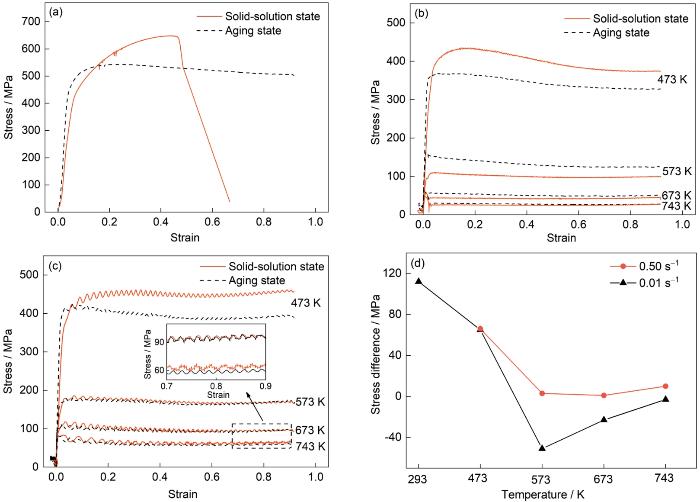
图3
固溶态和时效态Al-Zn-Mg-Cu合金的应力-应变曲线及固溶态与时效态合金的流变应力差曲线
Fig.3
Stress-strain curves of Al-Zn-Mg-Cu alloys under solid-solution and aging states (a-c) and differences in rheological stress of alloys between solid-solution state and aging state (d)
(a)
(b)
(c)
如图3a所示,在0.01 s-1低应变速率下,室温下Al-Zn-Mg-Cu合金时效态的流变应力低于固溶态的流变应力;当固溶态样品的应变达到0.5时,样品发生了剪切断裂,这是由于固溶态样品的晶界处存在较大尺寸未溶解的η相(图2c1),硬而脆的η相在变形过程中极易成为微裂纹萌生点从而导致过早开裂[19]。在0.01 s-1低应变速率下,473 K时,固溶态样品的流变应力仍保持高于时效态流变应力的趋势,但相比于室温压缩条件,二者之间差值有所下降;573 K时,时效态样品的流变应力大于固溶态样品;673 K时,时效态与固溶态样品的应力差减小;743 K时,时效态与固溶态样品的应力曲线基本重合,如图3b和d所示。在0.50 s-1高应变速率下,所有状态样品的压缩曲线均呈现锯齿状,且固溶态样品的振幅大于时效态样品,这主要是由于在高应变速率条件下,固溶的Mg原子对固定位错的钉扎作用不足,导致位错在障碍物前的等待时间显著缩短,从而增大了固定位错克服障碍物的概率[20,21],而时效态中Mg原子形成析出相,增强了对位错的钉扎作用,从而使流变曲线相对稳定,如图3c所示。473 K时,固溶态样品的流变应力高于时效态样品;573和673 K时,二者的流变应力相近,流变应力差逐渐降低;而在743 K时,二者之间的流变应力差增大,如图3d所示。
观察固溶态和时效态合金的应力-应变曲线发现两个现象:(1) 在低应变速率下,固溶态合金在室温和473 K热变形过程中的流变应力高于时效态合金,而在573~743 K时,时效态合金的流变应力超过固溶态合金,且随着温度升高,二者之间的流变应力差降低;(2) 743 K是Al-Zn-Mg-Cu合金的固溶温度,通常在此温度下变形,固溶态与时效态的流变应力曲线重合,而在高应变速率下,固溶态与时效态的流变应力差增大。为进一步分析Al-Zn-Mg-Cu合金上述流变应力异常变化趋势下的力学行为,下文将深入分析和讨论不同变形工艺参数下,Al-Zn-Mg-Cu合金微观组织演变对其力学行为的影响规律。
2.3 Al-Zn-Mg-Cu合金的微观组织演变
2.3.1 合金在0.01 s-1应变速率下不同温度的微观组织
图4
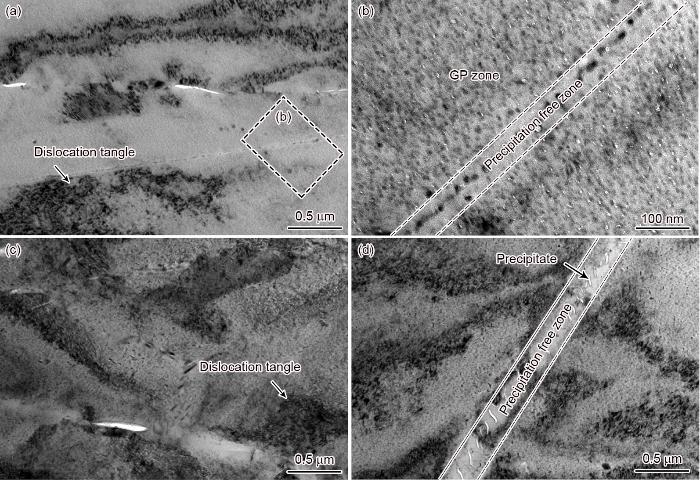
图4
473 K、0.01 s-1应变速率下,固溶态和时效态Al-Zn-Mg-Cu合金微观组织的TEM像
Fig.4
TEM images of solid-solution state (a, b) and aging state (c, d) Al-Zn-Mg-Cu alloys at 473 K and
(a, c) morphologies of precipitates and dislocation entanglement (GP—Guinier-Preston) (b, d) morphologies of precipitation free zone
图5
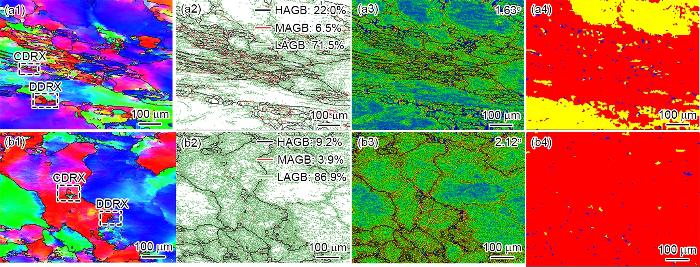
图5
573 K、0.01 s-1应变速率下,固溶态和时效态Al-Zn-Mg-Cu合金的微观组织EBSD分析
Fig.5
EBSD analyses of solid-solution state (a1-a4) and aging state (b1-b4) Al-Zn-Mg-Cu alloys at 573 K and
图6
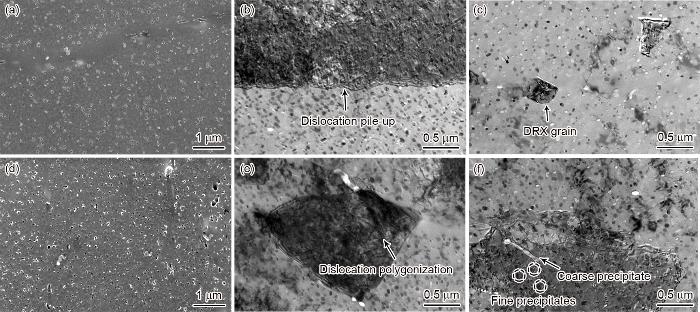
图6
573 K、0.01 s-1应变速率下,固溶态和时效态Al-Zn-Mg-Cu合金的微观组织形貌
Fig.6
Morphologies of solid-solution state (a-c) and aging state (d-f) Al-Zn-Mg-Cu alloys at 573 K and
(a, d) SEM images of the precipitates (b, e) TEM images of the precipitates and dislocations (c, f) TEM images of the DRX grains (c) and the coarse precipitates (f)
图7
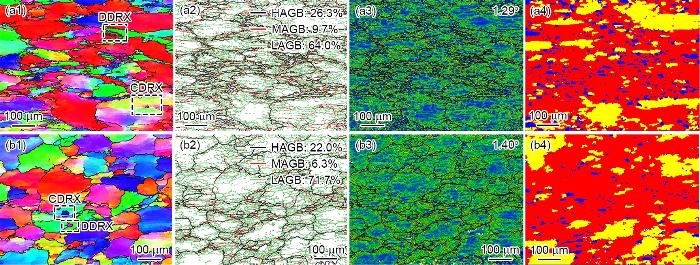
图7
673 K、0.01 s-1应变速率下,固溶态和时效态Al-Zn-Mg-Cu合金微观组织EBSD分析
Fig.7
EBSD analyses of solid-solution state (a1-a4) and aging state (b1-b4) Al-Zn-Mg-Cu alloys at 673 K and
(a1, b1) IPF maps (DRX grains are shown in the boxes) (a2, b2) grain boundary maps (a3, b3) KAM maps (a4, b4) recrystallization maps (Blue for recrystallized grains, yellow for substructures, and red for deformed grains)
图8

图8
673 K、0.01 s-1应变速率下,固溶态和时效态Al-Zn-Mg-Cu合金微观组织的TEM像
Fig.8
TEM images of solid-solution state (a-c) and aging state (d-f) Al-Zn-Mg-Cu alloys at 673 K and
(a, d) morphologies of DRX grains (b, c) morphologies between precipitates (b) and double-wall microbands (c) (e) interaction between fine precipitates and dislocations (f) discontinuous coarsening of precipitates
表1 固溶态和时效态Al-Zn-Mg-Cu合金在0.01 s-1应变速率下573和673 K时变形晶粒、亚结构和再结晶晶粒占比统计
Table 1
| Temperature / K | State | Volume fraction of deformed grains / % | Volume fraction of substructures / % | Volume fraction of recrystallized grains / % |
|---|---|---|---|---|
| 573 | Solid-solution | 75.7 | 21.2 | 3.1 |
| Aging | 98.0 | 0.9 | 1.1 | |
| 673 | Solid-solution | 52.3 | 23.6 | 24.1 |
| Aging | 62.0 | 25.8 | 12.2 |
在573 K、0.01 s-1应变速率条件下,固溶态和时效态Al-Zn-Mg-Cu合金微观组织的EBSD分析如图5所示。可以看出,经573 K热压缩后,固溶态样品的平均晶粒尺寸降低,达到18.5 μm,HAGBs占比由原始态的19.6%上升到22.0%,说明在此温度下固溶态样品发生了DRX。除了在晶界处观察到不连续动态再结晶(DDRX)现象,在晶粒内部也发现大量连续动态再结晶(CDRX),如图5a1和b1方框所示。与固溶态样品相比,时效态样品在573 K热压缩后平均晶粒尺寸也有所降低,达到25.3 μm,但仍高于固溶态样品的晶粒尺寸,此时,样品中的LAGB占比大幅提升,达到86.9%,而HAGBs仅为9.2%,不到固溶态的1/2,这些结果说明时效态样品中发生了较少的DRX。同时,通过对比再结晶组织(图5a4和b4)可以看出,固溶态Al-Zn-Mg-Cu合金的回复和再结晶组织占比(24.3%)明显高于时效态(2.0%),如表1所示。时效态样品较低的动态软化使基体中残留大量位错,从而导致其流变应力异常大于固溶态,如图3d所示。
573 K、0.01 s-1应变速率下,固溶态和时效态Al-Zn-Mg-Cu合金的微观组织如图6所示。固溶态样品中析出了大量球状、少量棒状第二相,如图6a所示。相比于固溶态样品,时效态样品中析出相的密度更高,如图6d所示,并且存在较大尺寸的棒状和球状析出相,如图6f所示。图6b为固溶态变形晶粒与回复晶粒的界面。在界面处形成了位错塞积[25],界面两侧位错密度的差异驱动晶界发生迁移,这是DDRX的典型特征[26,27]。此外,在固溶态样品晶粒内部发现了位错缠结形成的亚晶粒,以及亚晶粒吸收位错旋转而成的CDRX晶粒[28],如图6c所示。而在时效态样品中发现更多的因析出相钉扎位错形成的大面积位错缠结,在图6e中也发现了位错缠结的亚晶粒[29],但析出相对晶界的钉扎并未使LAGB转变为HAGB[30]。综上分析,时效态样品中存在部分较大尺寸和较高数密度的析出相,对位错以及晶界产生较强的钉扎作用,减弱了基体的动态软化程度,使时效态样品的流变应力大于固溶态样品。
673 K、0.01 s-1应变速率下,固溶态和时效态Al-Zn-Mg-Cu合金的微观组织EBSD分析如图7所示。与573 K相比,固溶态样品在673 K热变形后的HAGB和中角度晶界(medium angle grain boundary,MAGB,10°~15°)占比继续上升,分别达到26.3%和9.7%,位错密度下降,说明其发生了较大程度的DRV和DRX,如图7a2和a3所示。在固溶态样品中观察到CDRX晶粒和沿晶界形成的DDRX晶粒,如图7a1中方框所示。对比图5a4与图7a4可以看出,673 K时的固溶态样品的回复与再结晶组织的占比增大,占比达到24.3%。与573 K相比,时效态样品在673 K热变形后的HAGB占比也发生了明显的上升,达到22.0%,如图7b2和b3所示;同时,位错密度大幅下降,并在晶界及晶内发现了DRX现象,如图7b1中方框所示,DRX体积分数为12.2%,明显低于固溶态样品(24.1%),如表1所示,这表明时效态样品在该温度变形条件下的主要的软化机制为DRV。虽然在673 K热变形时,时效态样品的再结晶体积分数低于固溶态样品,但是由于DRV体积分数的大幅提升,动态软化程度提高,位错密度大幅降低,致使固溶态和时效态Al-Zn-Mg-Cu合金热变形过程中的流变应力差减小。
为进一步探究673 K、低应变速率下,时效态样品动态软化程度大幅提高的原因以及析出相的内在作用机制,对比分析了该条件下固溶态和时效态Al-Zn-Mg-Cu合金的微观组织,结果如图8所示。可以看出,在673 K热变形过程中,固溶态样品中析出了尺寸约为100 nm的第二相,而时效态样品中的部分析出相发生了粗化,但两种状态样品中析出相的数密度均大幅下降。与固溶态不同的是,在时效态合金中发现了大量小尺寸的析出相,如图8e和f所示。固溶态样品的TEM结果揭示了CDRX晶粒的形成的过程:首先左侧LAGB包围的亚晶粒不断吸收位错,进而取向差不断增大,LAGB晶粒不断吸收位错,最终形成右侧DRX晶粒[31],如图8a所示。这从另一角度解释了微观组织中MAGB和HAGB占比提升的原因,进一步证实了固溶态样品发生了CDRX。同时,固溶态样品的TEM像也揭示了DDRX晶粒形成的过程:首先位错在晶界处塞积形成位错墙结构,进而推动晶界发生迁移弓出,晶界处大尺寸析出相促进晶核形核过程,最终形成新的DRX晶粒[32],如图8c所示。时效态样品中析出相的粗化使位错缠结现象减少,小尺寸析出相可以有效限制位错的运动造成相对较多的位错线,在673 K较高的温度下,交结在一起的位错发生相互作用,从而致使DRV发生,如图8e所示。另一方面时效态样品中小尺寸析出相钉扎位错提高了形变储能[33],促进了DDRX的发生,如图8d所示,晶界迁移形成DDRX晶粒。时效态样品中未观察到明显CDRX现象,这是由于细小析出相阻碍了LAGB→HAGB的转变。时效态样品中析出相的粗化、小尺寸析出相的残留和形变储能的提高是其在673 K动态软化程度提高的重要原因。
2.3.2 合金在743 K下不同应变速率时的微观组织
当变形温度提高到743 K时,固溶态和时效态Al-Zn-Mg-Cu合金在低应变速率下的流变应力差进一步减小,二者的应力-应变曲线近乎重合。在高应变速率下,时效态样品的流变应力明显低于固溶态样品,如图3c所示。因此,采用EBSD和TEM表征手段分析Al-Zn-Mg-Cu合金在此温度、不同应变速率条件下的微观组织演变规律,进而分析二者流变应力产生差异的原因。
743 K、不同应变速率下,固溶态和时效态Al-Zn-Mg-Cu合金的微观组织EBSD分析如图9所示。在0.01 s-1低应变速率下,固溶态样品中的HAGB占比继续上升,达到29.6%,如图9a2所示,但是位错密度进一步降低,平均KAM值降至1.12°,如图9a3所示,此时,回复与再结晶组织体积分数达到64.3%,如表2所示,这说明DRV、DRX全面启动。图9a1中固溶态样品中的DRX晶粒大多沿晶界形成,晶内也存在少量DRX晶粒,证明在此温度和应变速率下,DDRX占主导地位。在相同应变速率下,时效态样品中HAGB和MAGB占比大幅提升至30.1%和10.0%,高于相同工艺条件下的固溶态样品,同时位错密度进一步下降,低于原始组织的位错密度,如图9c2和c3所示。在时效态样品的晶界处也观察到大量DDRX现象,DRX晶粒尺寸略大于固溶态,回复与再结晶组织体积分数达到66.7%;时效态样品中的DRX体积分数高于固溶态,DRV体积分数低于固溶态,如表2所示。时效态与固溶态样品相近的动态软化程度使得流变应力接近。
图9
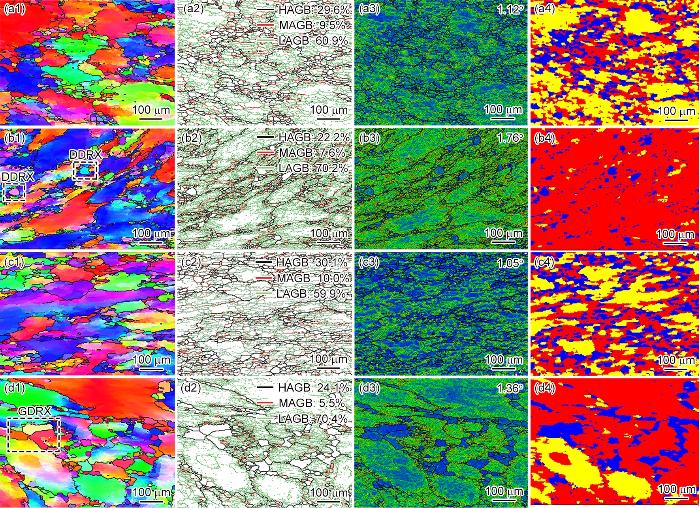
图9
743 K、不同应变速率下,固溶态和时效态Al-Zn-Mg-Cu合金的微观组织EBSD分析
Fig.9
EBSD analyses of solid-solution state (a1-a4, b1-b4) and aging state (c1-c4, d1-d4) Al-Zn-Mg-Cu alloys at 743 K with strain rates of 0.01 s-1 (a1-a4, c1-c4) and 0.50 s-1 (b1-b4, d1-d4) (GDRX—geometric dynamic recrystallization)
(a1-d1) IPF maps (DRX grains are shown in the boxes) (a2-d2) grain boundary maps (a3-d3) KAM maps (a4-d4) recrystallization maps (Blue for recrystallized grains, yellow for substructures, and red for deformed grains)
表2 固溶态和时效态Al-Zn-Mg-Cu合金在743 K、不同应变速率下变形晶粒、亚结构和再结晶晶粒的占比统计
Table 2
| State | Strain rates / s-1 | Volume fraction of deformed grains / % | Volume fraction of substructures / % | Volume fraction of recrystallized grains / % |
|---|---|---|---|---|
| Solid-solution | 0.01 | 35.7 | 34.1 | 30.2 |
| 0.5 | 83.7 | 2.1 | 14.2 | |
| Aging | 0.01 | 33.3 | 30.5 | 36.2 |
| 0.5 | 72.8 | 7.6 | 19.6 |
当应变速率由0.01 s-1提升至0.50 s-1时,固溶态和时效态Al-Zn-Mg-Cu合金中的HAGB占比分别降低至22.2%和24.1%,位错密度提高,表明二者动态软化程度均发生了下降。由于固溶态样品中位错密度提升较大,其表现出对应变速率更高的敏感性[31],如图9b2、b3和d2、d3所示。此外,固溶态与时效态样品的动态软化机制和体积分数差异较大,固溶态时主要软化机制为DDRX,DRX晶粒细小,如图9b1所示;时效态时为DRV与DDRX共存的软化机制,如图9d1方框中存在许多大尺寸DRX晶粒,该DRX晶粒更倾向于是由几何动态再结晶(GDRX)形成的[34,35]。时效态下回复与再结晶的体积分数(27.2%)高于固溶态(16.3%),如表2所示,其相对较高的动态软化程度是造成其流变应力低于固溶态样品的主要原因。
图10为743 K、不同应变速率下固溶态和时效态Al-Zn-Mg-Cu合金的微观组织TEM像。可以看出,当应变速率为0.01 s-1时,固溶态样品中没有第二相析出,基体中存在少量大尺寸棒状析出相,如图10a和b所示;而时效态样品中发生了析出相的部分回溶,基体中存在大尺寸棒状析出相以及大量小尺寸球状颗粒,这种小尺寸球状颗粒在变形过程中钉扎位错,提高了形变储能,进而降低了DDRX临界形核半径,DRX晶粒快速形核长大,提高了DRX体积分数,如图10e和f所示。图10a中,固溶态晶粒内部存在大量位错墙和亚晶粒等有序结构,而时效态基本未观察到位错墙和亚晶粒等,证实固溶态合金发生了更为广泛的DRV[36],最终使得固溶态和时效态在低应变速率下的动态软化程度相当。
图10
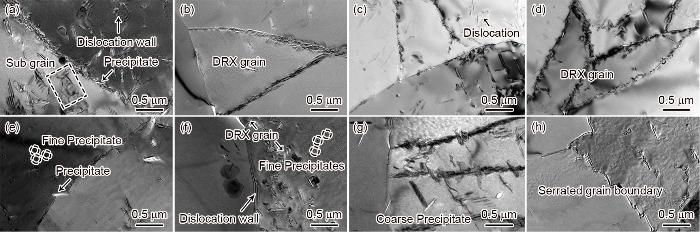
图10
743 K、不同应变速率下,Al-Zn-Mg-Cu合金微观组织的TEM像
Fig.10
TEM images of solid-solution state (a-d) and aging state (e-h) Al-Zn-Mg-Cu alloys at 743 K with different strain rates
(a, b, e, f) 0.01 s-1 (c, d, g, h) 0.50 s-1
当应变速率提高至0.5 s-1时,固溶态和时效态Al-Zn-Mg-Cu合金中的位错密度均发生提高,固溶态样品中未观察到低应变速率下存在的位错墙,这是由于高温高应变速率下,变形时间缩短,变形储存能更大程度上推进了DRX,导致DRV的体积分数大幅度降低,如图10c和d所示。时效态样品中存在尺寸不一的析出相,促进了DRX形核,如图10g所示。值得注意的是,在时效态基体中观察到大量的锯齿状晶界(图10h),这进一步证实了图9d1方框中为GDRX晶粒[33,37]。在较高的应变速率下,时效态样品中存在的许多小尺寸晶粒为GDRX发生提供了必要条件[33,38],而GDRX的发生提高了时效态DRX体积分数,进而提高了时效态合金的动态软化程度。
图11为Al-Zn-Mg-Cu合金固溶态与时效态热变形过程中的微观组织演变示意图。固溶态样品由于初始微观组织中没有时效析出相,在低温(473 K)、低应变速率(0.01 s-1)下,基体脱溶转变形成GP区,由于GP区钉扎位错能力较弱,导致基体DRV程度较大,位错密度较低;在573 K、低应变速率(0.01 s-1)下,基体析出大量球状析出相,晶粒内部出现少量DRX现象,DRX的出现进一步提高了合金的软化程度;在673 K、低应变速率(0.01 s-1)下,基体析出亚微米级球状和棒状等多种不同形状的析出相,此时DDRX为主要软化机制;在高温(743 K)、低应变速率(0.01 s-1)下,基体中无明显析出现象,DRX体积分数进一步提高,DDRX晶粒发生长大,743 K时提高应变速率,基体仍未有明显析出现象,但DRX体积分数下降。相比之下,时效态样品由于预析出处理,在较低温度(473 K)、低应变速率(0.01 s-1)下,基体中较宽的PFZ降低了形变储能,较粗大的析出相钉扎位错提高了变形热激活能,基体的DRV程度低于固溶态样品;在573 K、低应变速率(0.01 s-1)下,基体中较高数密度析出相对位错与晶界的钉扎作用较强,延缓了LAGB的形成和LAGB→HAGB的转变,基体中未出现DRX现象;在673 K、低应变速率(0.01 s-1)下,析出相发生不连续粗化,除了亚微米级球状和棒状等多种析出相,还存在大量小尺寸球状析出相,这种小尺寸析出相钉扎位错提高了形变储能,提高了DRV软化程度,但与固溶态样品相比,DRX体积分数较低;在高温(743 K)、低应变速率(0.01 s-1)下,小尺寸析出相的存在进一步促进了DRX,基体中软化程度与固溶态样品相近;743 K时提高应变速率,基体中DRX体积分数降低,GDRX的出现使得时效态样品DRX的体积分数高于固溶态样品。
图11
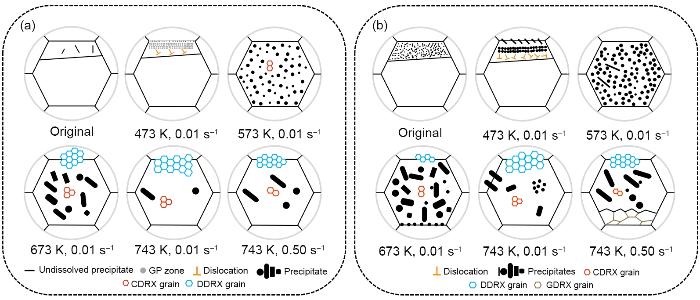
图11
Al-Zn-Mg-Cu合金热变形微观组织演变示意图
Fig.11
Schematics of microstructure evolution of Al-Zn-Mg-Cu alloy during heat deformation process
(a) solid-solution state (b) aging state
综上,预析出处理并没有改变Al-Zn-Mg-Cu合金的DRX机制,固溶态和时效态样品在643~743 K范围内均以DDRX为主。但相比于固溶态样品,时效态样品预析出高密度析出相在473~573 K钉扎位错与晶界,延缓了DRV与DRX进程;在673 K下,析出相的不连续粗化促进了DRV进程;随着温度升高至743 K,未完全回溶的析出相促进了DRX的发生。
3 结论
(1) 室温、低应变速率(0.01 s-1)下,固溶态晶界处未溶粗大的η相诱导裂纹萌生,致使其提前发生剪切断裂。
(2) 473 K、低应变速率(0.01 s-1)下,时效态高密度析出相提高了变形抗力,粗化的PFZ降低了动态软化效应,导致固溶态和时效态样品的流变应力差降低。
(3) 573 K、低应变速率(0.01 s-1)下,时效态高密度析出相钉扎效应延缓了DRV进程,致使其流变应力超过固溶态。
(4) 673~743 K、低应变速率(0.01 s-1)下,时效态样品析出相发生不连续粗化和溶解,小尺寸球状析出相钉扎位错提高了形变储能,促进了DRX,致使时效态和固溶态流变应力趋于一致。
(5) 743 K、高应变速率(0.50 s-1)下,时效态样品中小尺寸晶粒的存在为GDRX发生提供了必要条件,这是时效态流变应力低于固溶态的重要原因。
参考文献
Recent developments in advanced aircraft aluminium alloys
[J].
A critical review of experimental results and constitutive descriptions for metals and alloys in hot working
[J].
Effects of thermomechanical processing on production of Al-Zn-Mg-Cu alloy plate
[J].
Issues and requirements for aluminum alloys used in aircraft components: State of the art
[J].
Global understanding of deformation behavior in CoCrFeMnNi high entropy alloy under high-strain torsion deformation at a wide range of elevated temperatures
[J].
Material properties of normal and high strength aluminium alloys at elevated temperatures
[J].
Revealing the influence of pre-precipitation microstructure on hot workability in an Al-Cu-Mg-Zr alloy
[J].
Hot deformation behavior and microstructure evolution of a novel high-Zn containing Al-Zn-Mg-Cu-Zr alloy
[J].
Effect of coarse β(Al3Mg2) phase on microstructure evolution in 573 K annealed Al-10Mg alloy by uniaxial compression
[J].
573K高温时效处理的Al-10Mg合金中粗大β(Al3Mg2)相对热压缩组织演化的影响及机理
[J].
对高镁Al-10Mg合金分别做了固溶与时效处理,固溶工艺为673 K、24 h,固溶后的高温时效工艺为573 K、24 h,并对固溶及时效态试样分别进行了两道次压缩实验。通过OM、XRD、EPMA、EBSD等分析表征手段,研究了时效析出的β相对高镁Al-10Mg合金热变形过程中的力学性能及微观组织演变的影响。结果表明,时效处理后晶粒内部析出了均匀分布的β相,两道次压缩实验后时效态试样的应力-应变曲线始终处于固溶态试样曲线的下方。第一道次压缩实验中时效态试样的硬化率低于固溶态试样的硬化率,在回复过程中固溶Mg原子对形变强化起主要作用;第二道次压缩实验中时效态试样的硬化率高于固溶态试样的硬化率,时效态试样内部的位错累积更显著并且更早地出现了再结晶软化。时效态试样压缩组织内残余了更多的形变储能,使β相激发出更多的小角度晶界,进而将变形晶粒基体切割成若干区块,促进了再结晶形核,从而细化了再结晶晶粒。时效态压缩组织各区块的Schmid因子分布更均匀,在后续变形过程中能承受更多的塑性变形。再结晶形核不再局限于晶界凸出(bulging)形核,再结晶晶粒不再具备典型的再结晶织构特性,各向异性被弱化。β相阻碍了位错的滑移,将部分变形储能累积在沉淀相周围的小角度晶界处,减少了滑移到变形晶粒晶界处的位错数量,从而减缓了变形晶粒晶格的旋转,使变形晶粒含有{001}和{101} 2种面织构组分。
Effects of V and B on the microstructure evolution and deformation mechanisms of Ti-44Al-5Nb-1Mo alloys
[J].
V和B元素对Ti-44Al-5Nb-1Mo合金显微组织及热变形机制的影响
[J].为了探究V和B元素复合添加对β型γ-TiAl合金的显微组织和变形机制产生的影响,本工作针对Ti-44Al-5Nb-1Mo合金和Ti-44Al-5Nb-1Mo-2V-0.2B合金,进行了不同温度和应变速率条件下的高温热压缩实验,利用SEM-BSE和TEM对组织进行表征,对比分析了其变形后的显微组织,研究了添加V和B对Ti-44Al-5Nb-1Mo合金的显微组织及热变形机制的影响。结果表明,2种TiAl合金的显微组织差异较大,添加V和B可以显著改变TiAl合金对热变形的敏感性。Ti-44Al-5Nb-1Mo-2V-0.2B合金高温变形能力明显优于Ti-44Al-5Nb-1Mo合金。Ti-44Al-5Nb-1Mo合金的高温热变形以难变形片层团的偏转、变形带的产生为主,温度为1250℃时,其变形组织表现出较高的温度和应变速率敏感性,极易形成尺寸不均匀的近片层组织;对于Ti-44Al-5Nb-1Mo-2V-0.2B合金而言,升高变形温度或降低应变速率,既可以促进片层团内部的变形诱导L(α/γ)→α + γ + β/B2和γ→α相变,又可以促进α和β/B2相的球化/动态再结晶,从而大幅提高该合金的组织均匀性。基于变形参数对组织的影响规律,确定了控制Ti-44Al-5Nb-1Mo和Ti-44Al-5Nb-1Mo-2V-0.2B合金中近全片层、近双态显微组织的方法。
Effect of δ-ferrite on hot deformation and recrystallization of 316KD austenitic stainless steel for sodium-cooled fast reactor application
[J].
δ-铁素体对钠冷快堆用316KD奥氏体不锈钢热变形行为和动态再结晶的影响
[J].奥氏体不锈钢中δ-铁素体的存在显著影响热加工过程中奥氏体晶粒度的控制,造成晶粒不均匀现象,关于δ-铁素体对奥氏体动态再结晶行为的影响机制尚不清楚。本工作利用Gleeble-3800热力模拟试验机在1423 K、0.1 s-1条件下进行了铸态样品和均质化处理态样品的热压缩实验,结合SEM、EBSD和TEM等研究了δ-铁素体对热变形行为和动态再结晶的影响。结果表明:1473 K均质化处理14 h可基本消除δ-铁素体,同时伴随着奥氏体晶粒的显著长大,计算表明δ-铁素体向奥氏体的转变速率主要受控于Cr在奥氏体中的扩散。铸态样品变形过程中,δ-铁素体内部、δ-铁素体/奥氏体界面处的塑性变形先于奥氏体相,高温下较软δ-铁素体的存在,造成铸态样品的流变应力明显低于均质化处理态无δ-铁素体样品。随着变形的进行,δ-铁素体易发生动态回复,动态回复引起的软化导致流变应力显著下降。均质化处理态样品的动态再结晶机制是原始奥氏体晶界弓出形核的不连续动态再结晶。而δ-铁素体的存在促进了δ-铁素体/奥氏体界面附近奥氏体的动态再结晶,其机制为连续动态再结晶。铸态样品中的原始奥氏体晶界为不连续动态再结晶的形核位置,2种动态再结晶机制的耦合作用使得铸态样品的动态再结晶程度显著高于均质化处理态样品。
Effects of initial grain size and strengthening phase on thermal deformation and recrystallization behavior of GH4096 superalloy
[J].GH4096 alloy were used for disks and shafts of advanced gas turbine engines owing to its excellent properties such as resistance to creep, fatigue, and corrosion as well as microstructure stability up to about 700oC. In this study, GH4096, a hard-to-deform disk superalloy, was processed through an advanced cast and wrought route to avoid the expensive power metallurgy (P/M) route. Many types of full-scale disk forgings possessing homogeneous fine-grained microstructures were successfully carried out, and the ultrasonic inspectability was comparative to that of the alloy produced by the P/M route. The effects of the initial grain size and strengthening phase on hot deformation behavior and dynamic recrystallization (DRX) were studied by OM, SEM, EBSD, and TEM under different deformation parameters. The results showed that as the initial grain size decreased within the temperature range of 1050-1120oC, the flow peak stresses decreased and the fractions of DRX increased. With an increase in the initial grain size, the thermal deformation temperature required for complete dynamic recrystallization decreased, and also the critical strain of dynamic recrystallization decreased. The initial grain size and the strain did not affect the recrystallized grain size when deformed at a sub-solvus temperature. The thermal deformation constitutive equations related to the initial grain sizes were established and the activation energies of thermal deformation related to the original grain sizes were calculated. The effect of γ' phase size on the thermal deformation behavior in as-cast microstructure was studied. In the sub-solvus temperature range, the thermal deformation resistance could be effectively reduced with the increase in the size of γ' phase, the critical strain of DRX was decreased, and the DRX fraction was also increased. The dynamic recrystallization mechanisms related to the γ' phase and initial grain size were also discussed. DRX nucleation takes place at the sub-grains near original grain boundaries for samples with larger initial grain size deformed at sub-solvus temperature. For samples with fine initial grain size, the interface slip of incoherent γ' phase is the significant dynamic softening mechanism during the sub-solvus temperature deformation. For as-cast samples, the main dynamic softening mechanism is original grain boundary bowing out DRX nucleation and coarse second-phase-induced DRX nucleation.
初始晶粒尺寸和强化相对GH4096高温合金热变形行为和再结晶的影响
[J].以镍基变形高温合金GH4096为研究对象,进行了不同组织状态下的热压缩实验,分析了该合金热变形流变行为特点,并采用OM、SEM、EBSD和TEM等手段研究了热压缩过程中初始晶粒尺寸(晶界面积和数量)和强化相对动态再结晶行为及组织演变的影响。结果表明:在1050~1120℃温度范围内,随着初始晶粒尺寸的减小,峰值流变应力降低,动态再结晶分数增加,实现完全动态再结晶所需热变形温度降低,发生动态再结晶的临界应变降低;在亚固溶温度下热变形时,动态再结晶晶粒尺寸与初始晶粒尺寸和变形量没有相关性;计算了与初始晶粒尺寸相关的热变形激活能,并建立了与热变形前的初始晶粒尺寸相关的热变形本构方程;研究了铸态组织中强化相γ'相形态对热变形行为的影响,在亚固溶温度下热变形时,随着强化相γ'相尺寸的增加,可一定程度降低热变形峰值流变应力,降低动态再结晶的临界应变,提高动态再结晶分数。分析讨论了GH4096合金不同组织状态下的主导动态软化机制。
Precipitation behaviour in an Al-Zn-Mg-Cu alloy subjected to high strain rate compression tests
[J].
The effect of shearable clusters and precipitates on dynamic recovery of Al alloys
[J].
Effect of deformation parameters and Al2Cu evolution on dynamic recrystallization of 2219-O Al alloy during hot compression
[J].
The effects of η phases and Al3(Er, Zr) particles pre-precipitation on the hot workability and recrystallization of Al-Zn-Mg-Er-Zr alloy
[J].
Effect of pre-deformation on microstructure and mechanical properties of ultra-high strength Al-Zn-Mg-Cu alloy after ageing treatment
[J].Ultra-high strength Al-Zn-Mg-Cu alloy is a promising lightweight structural material, and there is still room to improve its mechanical property. As a typical precipitation strengthening material, controlling the size and distribution of precipitate is an effective way to enhance the mechanical properties of the ultra-high strength Al-Zn-Mg-Cu alloy. The influence of pre-deformation on the microstructures and properties of the ultra-high strength Al-Zn-Mg-Cu alloy after ageing treatment was studied by TEM, XRD, SEM, DSC and tensile tests. The microstructures and the tensile mechanical properties of Al-Zn-Mg-Cu alloy without pre-deformation and with 3% and 4% pre-deformation were compared. It is found that the pre-deformation can promote the ageing precipitation rate and enhance the precipitate density in the Al-Zn-Mg-Cu alloy, and the pre-deformation ratio of 3% can promote the dispersion of the precipitate phase in the grain interiors, but the pre-deformation ratio of 4% may result in coarsening of precipitate. The size of precipitate along the grain boundaries and the width of precipitation free zones decreased in the pre-deformation treated ultra-high strength Al-Zn-Mg-Cu alloys. The tensile strength and yield strength of the pre-deformation treated ultra-high strength Al-Zn-Mg-Cu alloys increased, and the elongation also increased slightly, in which the tensile strength and elongation of 3% pre-deformation alloy combined with 80 ℃ for 12 h and 120 ℃ for 8 h ageing were (813±4) MPa and 10.10%±0.77%, respectively. The results show that the dislocations produced by pre-deformation may provide more heterogeneous nucleation sites for the precipitate formation, and improve the precipitate's distribution.
预变形对超高强Al-Zn-Mg-Cu合金时效组织与力学性能的影响
[J].利用TEM、XRD、SEM、DSC以及室温拉伸等方法,研究了预变形对超高强Al-Zn-Mg-Cu合金组织与性能的影响。通过对比未经预变形和预变形量为3%及4%的Al-Zn-Mg-Cu合金时效态微观组织与拉伸力学性能,发现:预变形可以提高铝合金时效析出速率和密度,变形量为3%时可促进析出相在晶内弥散分布,但增加到4%会导致析出相粗化;经预变形处理后晶间析出相尺寸减小,晶界无析出带宽度降低;抗拉强度和屈服强度提高,伸长率略微提高,经3%预变形以及80 ℃、12 h和120 ℃、8 h时效后的抗拉强度可达到(813±4) MPa,伸长率为10.10%±0.77%。分析认为,预变形产生的位错为析出相形核提供了异质形核的质点,改善了其在晶内与晶间的分布状态。
Effect of cooling rate on the composition and chemical heterogeneity of quench-induced grain boundary η-phase precipitates in 7xxx aluminium alloys
[J].
Suppressed hydrogen embrittlement of high-strength Al alloys by Mn-rich intermetallic compound particles
[J].
Concurrent dynamic strain aging and dynamic precipitation evades strength-ductility trade-off in a high Mg-content aluminum crossover alloy
[J].
Effects of aging heat-treatment on dynamic strain aging behavior in high-Mn lightweight steel
[J].
Unusual secondary precipitation within the primary precipitation free zone substantially enhances the ductility of Al-Zn-Mg-Cu alloy
[J].
Effects of Cr addition on the constitutive equation and precipitated phases of copper alloy during hot deformation
[J].
Effect of Zn content on the dynamic softening of Al-Zn-Mg-Cu alloys during hot compression deformation
[J].
Microstructure evolution and recrystallization behavior during hot deformation of spray formed AlSiCuMg alloy
[J].Wrought Al-Si alloy has partially replaced the traditional wear-resistant alloy for structural weight reduction owing to the excellent comprehensive properties, such as wear resistance, low coefficient of thermal expansion, and high specific strength. The deformation aluminum alloy based on Al-Si binary alloy is widely used in aerospace and automotive industries. The hot compression test, SEM, TEM, and EBSD technologies were used to investigate the microstructure evolution and dynamic recrystallization nucleation mechanism of spray formed Al25Si4Cu1Mg (mass fraction, %) alloy. The results show that the as-sprayed microstructure consists of equiaxed α-Al, coarse Si phase, AlSiCuMg phase, and Al2Cu phase with different scales. Under 623-723 K and 0.001-5 s-1, the fine Al2Cu phases gradually dissolve with the increase in deformation temperature. During high strain rate (5 s-1) compression, dislocation accumulation causes a high degree of stress concentration in front of the coarse and insoluble primary phases, resulting in the cracking of some brittle primary phases. Local cracks also appear at the interfaces between α-Al and primary phases. The α-Al phase undergoes complete dynamic recrystallization. The recrystallized grain size decreases with the increase and decrease in strain rate and deformation temperature, respectively. The residual dislocation and deformation substructure in the grain decrease with the increase in deformation temperature. The random texture demonstrates that the dynamic recrystallization mechanism of spray formed Al25Si4Cu1Mg alloy is “particle stimulated nucleation (PSN)”.
喷射成形AlSiCuMg合金的热变形组织演变及再结晶行为
[J].采用热压缩实验、SEM、TEM以及EBSD技术研究了喷射成形Al25Si4Cu1Mg (质量分数,%)合金的热变形组织演变规律及动态再结晶形核机制。结果表明:喷射态组织主要由等轴α-Al相、粗大块状Si相、AlSiCuMg相和不同尺度的Al<sub>2</sub>Cu相构成。在623~723 K和0.001~5 s–1条件下,细小的Al<sub>2</sub>Cu相随形变温度的升高而逐渐回溶。高应变速率(5 s–1)热压缩时,位错塞积在粗大不溶初生相前沿产生应力集中,导致部分脆性初生相开裂,同时在初生相与α-Al相界面处出现局部裂纹。α-Al相则发生了完全动态再结晶。再结晶晶粒尺寸随着变形温度的下降和应变速率的提高而降低,晶粒内部的残留位错和形变亚结构随形变温度的升高而逐渐减少。随机织构表明,喷射成形Al25Si4Cu1Mg合金的动态再结晶机制为“粒子激发形核 (PSN)”机制。
Hot deformation behavior and microstructure evolution model of 7055 aluminum alloy
[J].
Grain refining with DDRX by isothermal MDF of Al-Zn-Mg-Cu alloy
[J].
A CDRX-based material model for hot deformation of aluminium alloys
[J].
Dynamic softening mechanisms of GH4720Li alloy during hot deformation
[J].
GH4720Li合金热变形过程动态软化机制
[J].以锻态GH4720Li镍基沉淀强化型高温合金为研究对象,对合金进行了不同工艺参数下的热压缩实验。采用OM、SEM、EBSD和TEM研究了热压缩过程中再结晶晶粒的形成和晶粒内亚结构的演变规律,分析了合金在不同热变形工艺参数下的动态软化机制。研究表明,合金在所有热变形工艺参数下均发生了非连续动态再结晶行为。变形组织分析表明,高温低应变速率能够抑制非连续动态再结晶行为的发生,而提高应变速率能促进非连续动态再结晶行为,且能够获得等轴状尺寸均匀的晶粒组织。未完全溶解细小γ'强化相的钉扎作用能够使变形晶粒内形成高密度位错亚结构和亚晶界,亚晶界角度通过连续的吸收位错而不断地升高,进而以“强化相诱发连续动态再结晶”方式形成细小的再结晶晶粒组织。不同热变形工艺下孪晶界的演变规律分析表明,热变形温度与应变速率通过影响合金的动态再结晶行为来改变孪晶界的数量。
Dynamic evolution of the T1 phase and its effect on continuous dynamic recrystallization in Al-Cu-Li alloys
[J].
Variation of strain rate sensitivity of an aluminum alloy in a wide strain rate range: Mechanism analysis and modeling
[J].
A review of dynamic recrystallization phenomena in metallic materials
[J].
Microstructure and tensile properties of rolled Mg-4Al-2Sn-1Zn alloy with pre-rolling deformation
[J].
Interface microstructure and bonding mechanisms of 7050 aluminum alloy thick plates produced by vacuum roll cladding
[J].
Microstructure evolution mechanisms and a physically-based constitutive model for an Al-Zn-Mg-Cu-Zr aluminum alloy during hot deformation
[J].
A unified constitutive model and microstructure evolution of a solution treated 7075 aluminum alloys under warm forming condition
[J].
Mechanisms of macrozone elimination and grain refinement of near α Ti alloy via the spheroidization of the Widmannstätten structure
[J].


