|
|
|
| Site Occupation of Alloying Elements in α2 Phase in High-Temperature Titanium Alloys: A First-Principles Study |
LIANG Bining1,2, CAO Shuo1, WANG Ci3, LIU Jianrong1( ), YANG Rui1, HU Qingmiao1() |
1 Shi -changxu Innovation Center for Advanced Materials, Institute of Metal Research, Chinese Academy of Sciences, Shenyang 110016, China
2 School of Materials Science and Engineering, University of Science and Technology of China, Shenyang 110016, China
3 College of Physics and Optoelectronic Engineering, Harbin Engineering University, Harbin 150001, China |
|
Cite this article:
LIANG Bining, CAO Shuo, WANG Ci, LIU Jianrong, YANG Rui, HU Qingmiao. Site Occupation of Alloying Elements in α2 Phase in High-Temperature Titanium Alloys: A First-Principles Study. Acta Metall Sin, 2026, 62(10): 1762-1772.
|
|
|
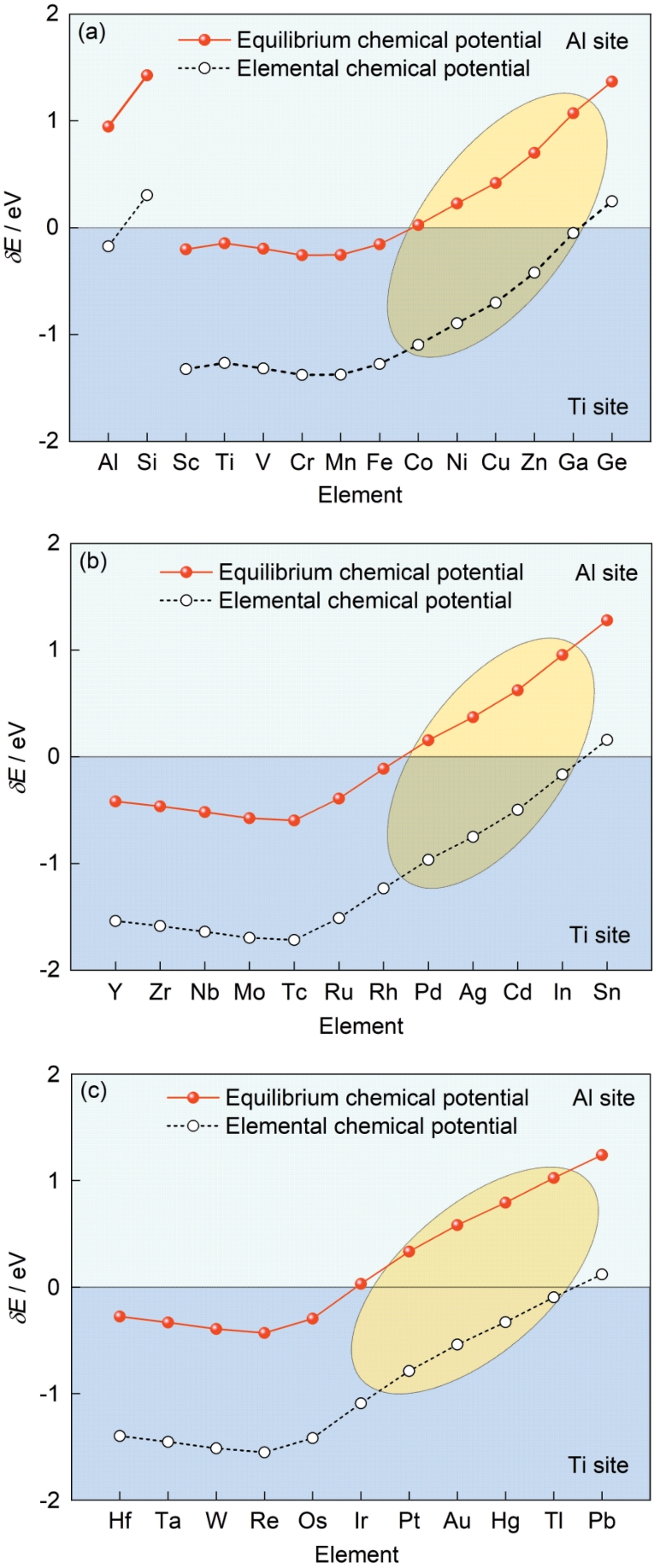
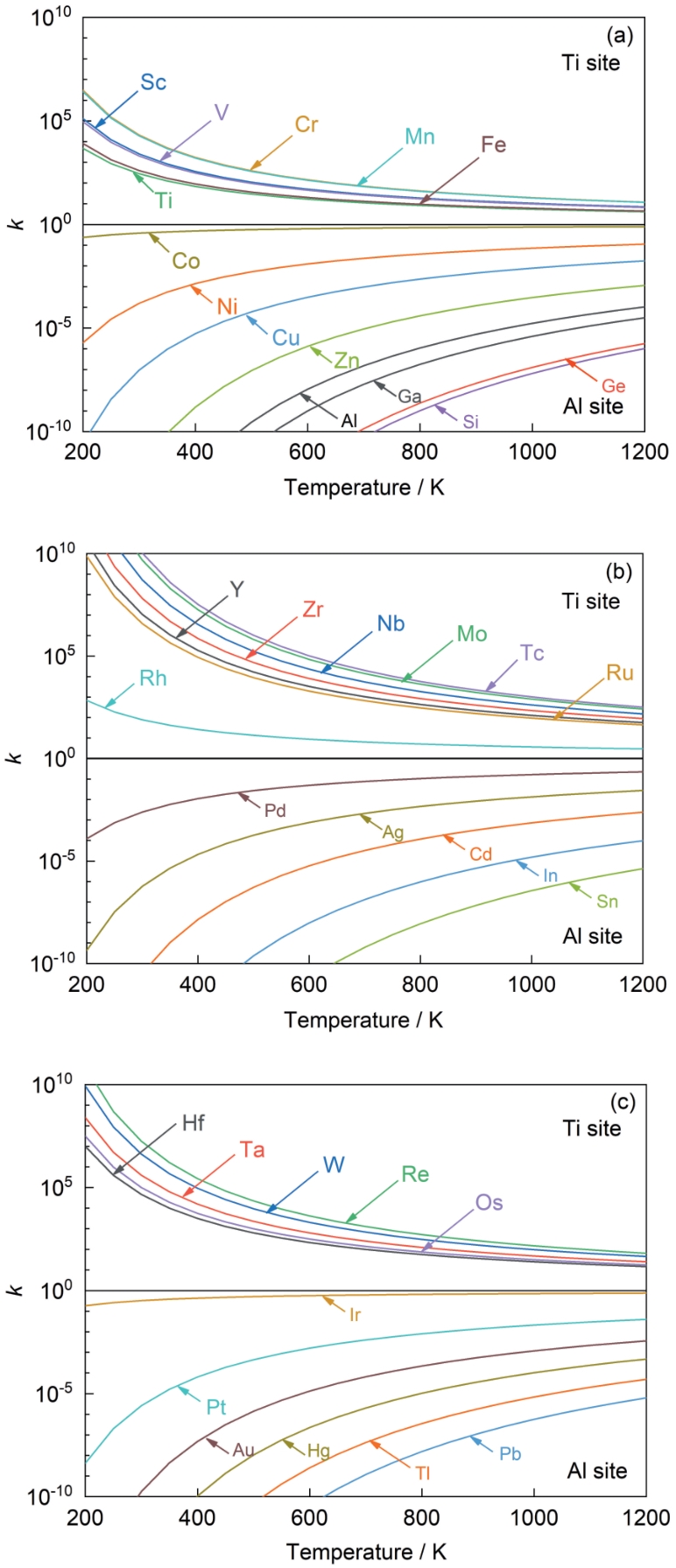
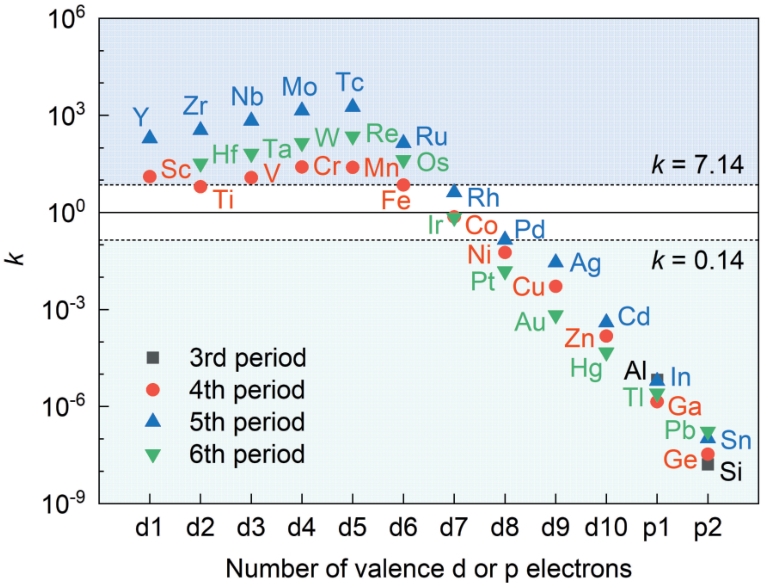
Abstract The site occupation of alloying elements on various sublattices of intermetallic compounds directly affects their properties. The precipitation of the α2 phase (Ti3Al intermetallic compound) serves as a key strengthening mechanism in high-temperature titanium alloys. However, due to the complex composition of these alloys and the nanoscale size of the α2-Ti3Al phase, the occupation behavior of alloying elements in α2-Ti3Al remains unclear. Theoretically, this behavior can be predicted by calculating the formation energies of alloying atoms on different sublattices, which requires knowledge of the chemical potentials of the matrix atoms (Ti and Al in Ti3Al) as reference energies. Conventionally, these chemical potentials are approximated by the energies of the elements in their standard states. However, this approach is inadequate for determining site occupations in α2-Ti3Al precipitated in high-temperature alloys, as it neglects the phase equilibrium between the precipitate and matrix, which governs the chemical potentials. In addition, the influence of temperature on site occupation in α2-Ti3Al has not yet been theoretically addressed. In this study, the chemical potentials of Ti and Al are evaluated based on the phase equilibrium between the α-Ti matrix and the α2-Ti3Al precipitate. The formation energies of alloying elements on Ti and Al sublattices are then computed using first-principles methods, and their site preference is assessed by comparing these formation energies. Furthermore, the temperature-dependent partitioning of alloying elements between the two sublattices is determined based on site preference energy. The results show that, at service temperatures of high-temperature titanium alloys, elements such as Sc, V, Cr, Mn, Fe, Y, Zr, Nb, Mo, Tc, Ru, Hf, Ta, W, Re, and Os preferentially occupy the Ti sublattice; Si, Ni, Cu, Zn, Ga, Ge, Ag, Cd, In, Sn, Pt, Au, Hg, Tl, and Pb preferentially occupy the Al sublattice; while Co, Rh, Pd, and Ir distribute over both sublattices.
|
|
Received: 30 December 2024
|
|
|
| Fund: National Natural Science Foundation of China(52071315);National Natural Science Foundation of China(52001307);National Natural Science Foundation of China(52201008);National Science and Technology Major Project(J2019-VI-0012-0126) |
Corresponding Authors:
LIU Jianrong, professor, Tel: (024)23971942, E-mail: jrliu@imr.ac.cn;
HU Qingmiao, professor, Tel: (024)23971813, E-mail: qmhu@imr.ac.cn
|
| [1] |
Williams J C, Starke Jr E A. Progress in structural materials for aerospace systems[J]. Acta Mater., 2003, 51: 5775
doi: 10.1016/j.actamat.2003.08.023
|
| [2] |
Eylon D, Fujishiro S, Postans P J, et al. High-temperature titanium alloys—A review[J]. JOM, 1984, 36(11): 55
|
| [3] |
Wang Q J, Liu J R, Yang R. High temperature titanium alloys: Status and perspective[J]. J. Aeronaut. Mater., 2014, 34(4): 1
|
|
王清江, 刘建荣, 杨 锐. 高温钛合金的现状与前景[J]. 航空材料学报, 2014, 34(4): 1
doi: 10.11868/j.issn.1005-5053.2014.4.001
|
| [4] |
Rosenberger A H, Madsen A, Ghonem H. Aging effects on the creep behavior of the near-alpha titanium alloy Ti-1100[J]. J. Mater. Eng. Perform., 1995, 4: 182
doi: 10.1007/BF02664112
|
| [5] |
Neeraj T, Mills M J. Short-range order (SRO) and its effect on the primary creep behavior of a Ti-6wt.%Al alloy[J]. Mater. Sci. Eng., 2001, A319-321: 415
|
| [6] |
Li D, Liu Y Y. On the thermal stability of Ti alloys Ⅱ. The behaviour of transition elements in Ti3 X-phase formation[J]. Acta Metall. Sin., 1984, 20: 384
|
|
李 东, 刘羽寅. 钛合金热稳定性研究Ⅱ.过渡族元素在Ti3X相形成中的行为 [J]. 金属学报, 1984, 20: 384
|
| [7] |
Yue K, Liu J R, Zhang H J, et al. Precipitates and alloying elements distribution in near α titanium alloy Ti65[J]. J. Mater. Sci. Technol., 2020, 36: 91
doi: 10.1016/j.jmst.2019.03.018
|
| [8] |
Wu Z W, Qiu C L, Venkatesh V, et al. The influence of precipitation of alpha2 on properties and microstructure in TIMETAL 6-4[J]. Metall. Mater. Trans., 2013, 44A: 1706
|
| [9] |
Radecka A, Coakley J, Vorontsov V A, et al. Precipitation of the ordered α2 phase in a near-α titanium alloy[J]. Scr. Mater., 2016, 117: 81
doi: 10.1016/j.scriptamat.2016.02.015
|
| [10] |
Radecka A, Bagot P A J, Martin T L, et al. The formation of ordered clusters in Ti-7Al and Ti-6Al-4V[J]. Acta Mater., 2016, 112: 141
doi: 10.1016/j.actamat.2016.03.080
|
| [11] |
Dear F F, Kontis P, Gault B, et al. Mechanisms of Ti3Al precipitation in hcp α-Ti[J]. Acta Mater., 2021, 212: 116811
doi: 10.1016/j.actamat.2021.116811
|
| [12] |
Zhang S Z, Xu H Z, Li G P, et al. Effect of carbon and aging treatment on precipitation of ordered α2 in Ti-5.6Al-4.8Sn-2Zr-1Mo-0.35Si-0.7Nd alloy[J]. Mater. Sci. Eng., 2005, A408: 290
|
| [13] |
Xin S W, Zhao Y Q, Zeng W D. Inductions and discussions of solid state phase transformation of titanium alloy(Ⅱ)—Eutectoid and ordering transformation[J]. Titanium Ind. Prog., 2008, 25(1): 40
|
|
辛社伟, 赵永庆, 曾卫东. 钛合金固态相变的归纳与讨论(Ⅱ)—共析和有序化转变[J]. 钛工业进展, 2008, 25(1): 40
|
| [14] |
Hao Y L, Xu D S, Cui Y Y, et al. The site occupancies of alloying elements in TiAl and Ti3Al alloys[J]. Acta Mater., 1999, 47: 1129
doi: 10.1016/S1359-6454(99)00006-3
|
| [15] |
Xu D S, Song Y, Li D, et al. Site occupancy of alloying elements in Ti3Al compounds[J]. Mater. Sci. Eng., 1997, A234-236: 230
|
| [16] |
Holec D, Reddy R K, Klein T, et al. Preferential site occupancy of alloying elements in TiAl-based phases[J]. J. Appl. Phys., 2016, 119: 205104
doi: 10.1063/1.4951009
|
| [17] |
Wei Y, Zhang Y, Lu G H, et al. Effects of transition metals in a binary-phase TiAl-Ti3Al alloy: From site occupancy, interfacial energetics to mechanical properties[J]. Intermetallics, 2012, 31: 105
doi: 10.1016/j.intermet.2012.06.012
|
| [18] |
Benedek R, van de Walle A, Gerstl S S A, et al. Partitioning of solutes in multiphase Ti-Al alloys[J]. Phys. Rev., 2005, 71B: 094201
|
| [19] |
Chen L Q. Chemical potential and Gibbs free energy[J]. MRS Bull., 2019, 44: 520
doi: 10.1557/mrs.2019.162
|
| [20] |
Guan H Q, Huang S S, Ding J H, et al. Chemical environment and magnetic moment effects on point defect formations in CoCrNi-based concentrated solid-solution alloys[J]. Acta Mater., 2020, 187: 122
doi: 10.1016/j.actamat.2020.01.044
|
| [21] |
Tang C, Zhang L, Wijethunge D, et al. Controllable polarization and doping in ferroelectric In2Se3 monolayers and heterobilayers via intrinsic defect engineering[J]. J. Phys. Chem., 2021, 125C: 24648
|
| [22] |
Kresse G, Furthmüller J. Efficiency of ab-initio total energy calculations for metals and semiconductors using a plane-wave basis set[J]. Comput. Mater. Sci., 1996, 6: 15
doi: 10.1016/0927-0256(96)00008-0
|
| [23] |
Kresse G, Joubert D. From ultrasoft pseudopotentials to the projector augmented-wave method[J]. Phys. Rev., 1999, 59B: 1758
|
| [24] |
Perdew J P, Burke K, Ernzerhof M. Generalized gradient approximation made simple[J]. Phys. Rev. Lett., 1996, 77: 3865
doi: 10.1103/PhysRevLett.77.3865
pmid: 10062328
|
| [25] |
Monkhorst H J, Pack J D. Special points for Brillouin-zone integrations[J]. Phys. Rev., 1976, 13B: 5188
|
| [26] |
Maintz S, Deringer V L, Tchougréeff A L, et al. LOBSTER: A tool to extract chemical bonding from plane-wave based DFT[J]. J. Comput. Chem., 2016, 37: 1030
doi: 10.1002/jcc.24300
pmid: 26914535
|
| [27] |
Kobayashi Y, Oda E, Nishiuchi T, et al. Cation distribution analysis of Sr-La-Co M-type ferrites by neutron diffraction, extended X-ray absorption fine structure and X-ray magnetic circular dichroism[J]. J. Ceram. Soc. Japan, 2011, 119: 285
doi: 10.2109/jcersj2.119.285
|
| [28] |
Liu R S, Yu X, Sun Y, et al. Occupation distribution analysis of Co in La-Co substituted M-type hexaferrite and its significant effect on magnetic properties[J]. J. Alloys Compd., 2024, 1003: 175659
doi: 10.1016/j.jallcom.2024.175659
|
| [29] |
Muto S, Ohtsuka M. High-precision quantitative atomic-site-analysis of functional dopants in crystalline materials by electron-channelling-enhanced microanalysis[J]. Prog. Cryst. Growth Charact. Mater., 2017, 63: 40
doi: 10.1016/j.pcrysgrow.2017.02.001
|
| [30] |
Ohtsuka M, Muto S, Tatsumi K, et al. Quantitative determination of occupation sites of trace Co substituted for multiple Fe sites in M-type hexagonal ferrite using statistical beam-rocking TEM-EDXS analysis[J]. Microscopy, 2016, 65: 127
doi: 10.1093/jmicro/dfv356
|
| [31] |
Singh A, Chaturvedi P. Error propagation[J]. Resonance, 2021, 26: 853
doi: 10.1007/s12045-021-1185-1
|
| [32] |
Dronskowski R, Bloechl P E. Crystal orbital Hamilton populations (COHP): Energy-resolved visualization of chemical bonding in solids based on density-functional calculations[J]. J. Phys. Chem., 1993, 97: 8617
|
| [33] |
Deringer V L, Tchougréeff A L, Dronskowski R. Crystal orbital Hamilton population (COHP) analysis as projected from plane-wave basis sets[J]. J. Phys. Chem., 2011, 115A: 5461
|
| [34] |
Bolvardi H, Emmerlich J, Baben M T, et al. Systematic study on the electronic structure and mechanical properties of X2BC (X = Mo, Ti, V, Zr, Nb, Hf, Ta and W)[J]. J. Phys. Condens. Matter., 2013, 25: 045501
|
| [35] |
Park N, Lee S C, Cha P R. Effects of alloying elements on the stability and mechanical properties of Fe3Al from first-principles calculations[J]. Comput. Mater. Sci., 2018, 146: 303
doi: 10.1016/j.commatsci.2018.01.042
|
| [36] |
Zhang D, Ji S J, Cao Y, et al. Exploring the synergistic effect of alloying toward hydrogen evolution reaction: A case study of Ni3 M (M = Ti, Ge and Sn) series[J]. Dalton Trans., 2022, 51: 9728
doi: 10.1039/d2dt00956k
pmid: 35700533
|
| [37] |
Liu H L, Tong K, Feng X, et al. Temperature-dependent elastic and plastic properties of α2-Ti3Al[J]. Intermetallics, 2021, 139: 107368
doi: 10.1016/j.intermet.2021.107368
|
| [38] |
Hu Q M, Yang R. Unconventional non-uniform local lattice distortion in dilute Ti-Mo solid solution[J]. Acta Mater., 2020, 197: 91
doi: 10.1016/j.actamat.2020.07.033
|
| [39] |
Chen S M, Gao Y, Yu Z H, et al. Spontaneous symmetry breaking of substitutional solute atoms in dilute α-Ti solid solutions[J]. Phys. Rev. Mater., 2023, 7: 083605
|
| No Suggested Reading articles found! |
|
|
Viewed |
|
|
|
Full text
|
|
|
|
|
Abstract
|
|
|
|
|
Cited |
|
|
|
|
| |
Shared |
|
|
|
|
| |
Discussed |
|
|
|
|