|
|
|
| Effect of Transient Heat Treatment on the Interfacial Microstructure and Bonding Properties of Titanium/Steel Transit Joint |
SU Yiyun1, HAO Xiaohu1,2, LI Shuhua2, CUI Zeqin1( ), YAN Dejun3(), LI Weiguo1 ), YAN Dejun3(), LI Weiguo1 |
1 College of Materials Science and Engineering, Taiyuan University of Technology, Taiyuan 030024, China
2 Guangdong Provincial Key Laboratory of Advanced Welding Technology for Ships, CSSC Huangpu Wenchong Shipbuilding Co. Ltd., Guangzhou 510715, China
3 Guangdong Provincial Key Laboratory of Advanced Welding Technology for Ships, Foshan University, Foshan 528051, China |
|
Cite this article:
SU Yiyun, HAO Xiaohu, LI Shuhua, CUI Zeqin, YAN Dejun, LI Weiguo. Effect of Transient Heat Treatment on the Interfacial Microstructure and Bonding Properties of Titanium/Steel Transit Joint. Acta Metall Sin, 2026, 62(9): 1528-1540.
|
|
|
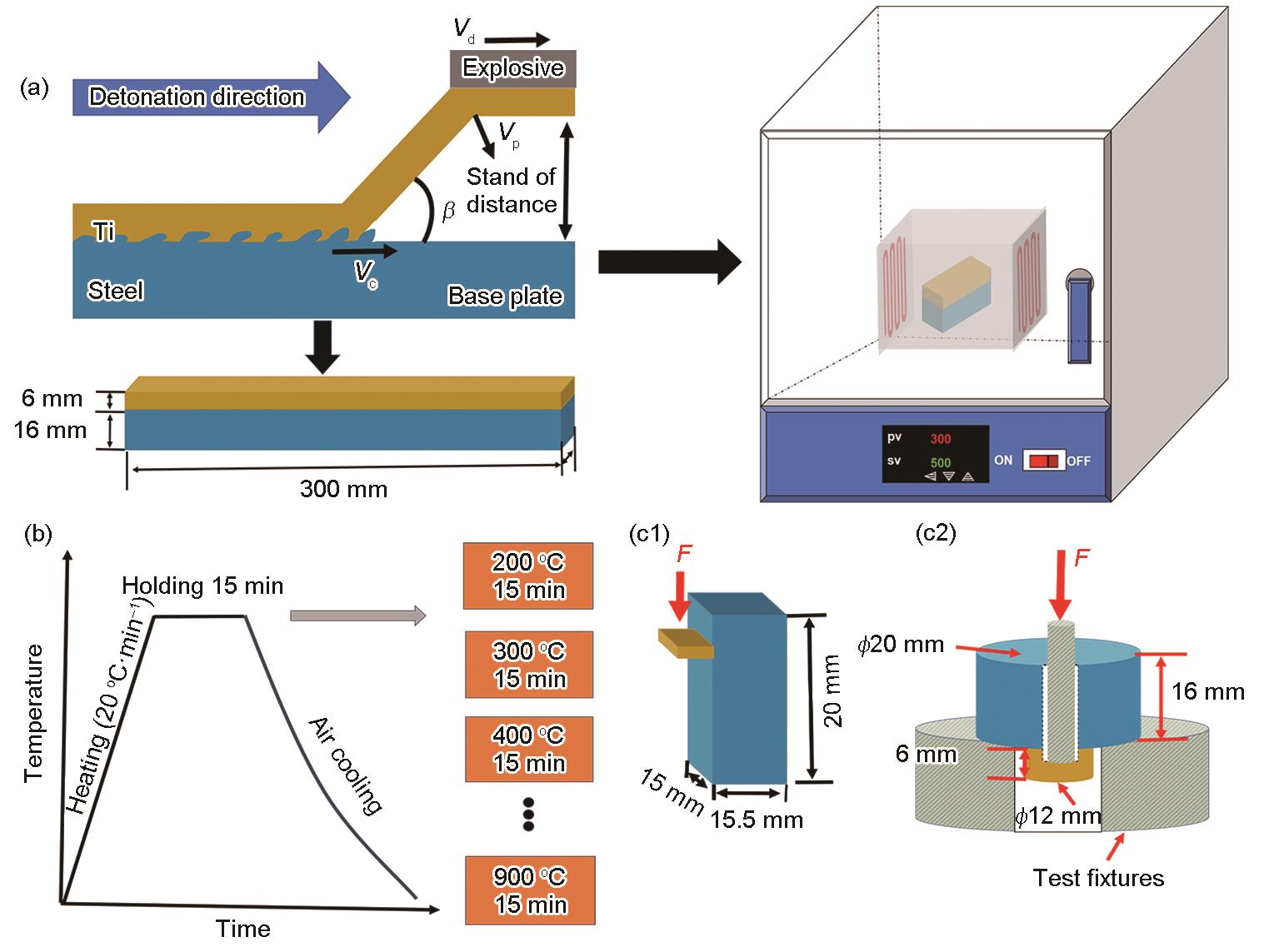
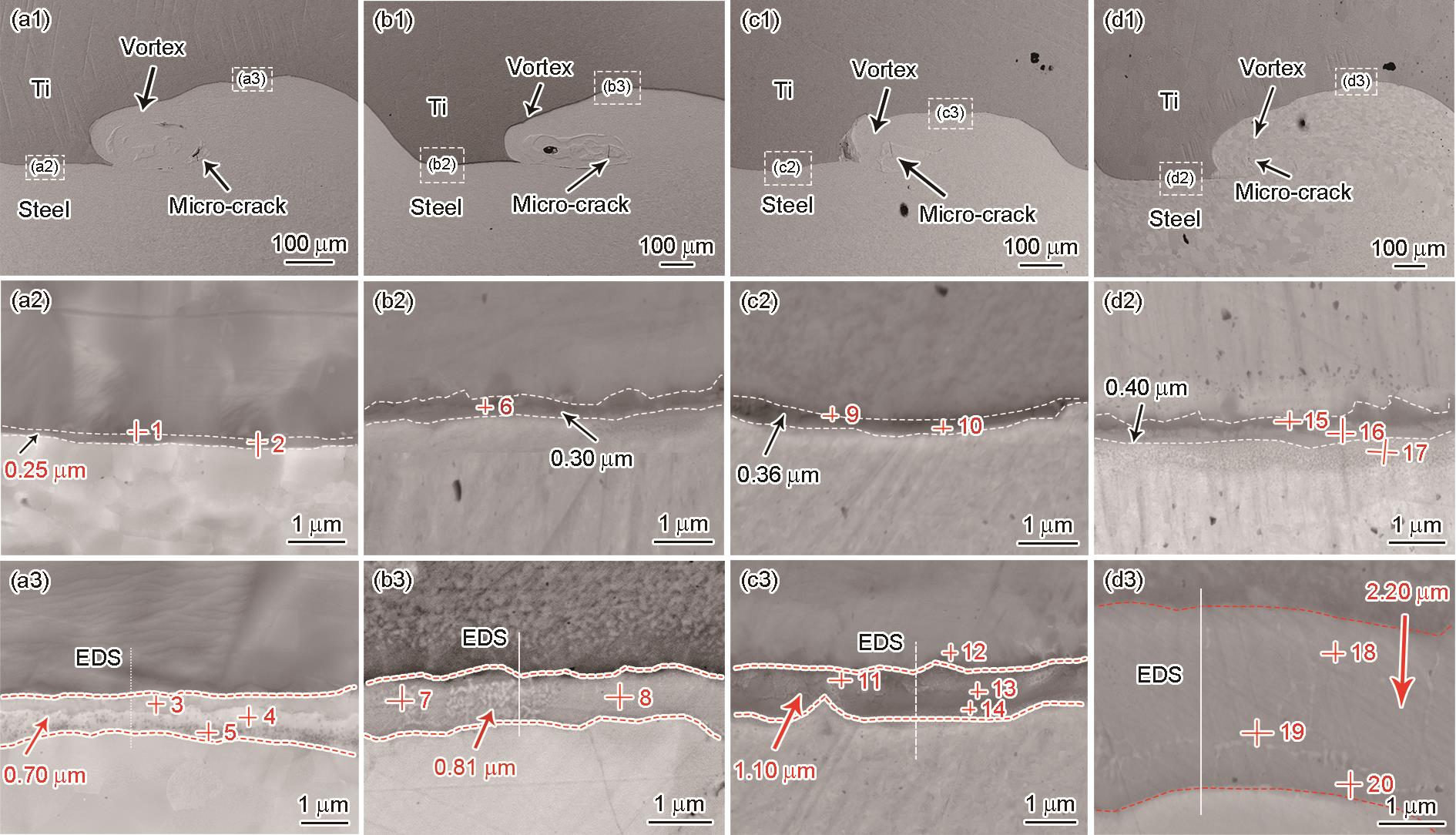
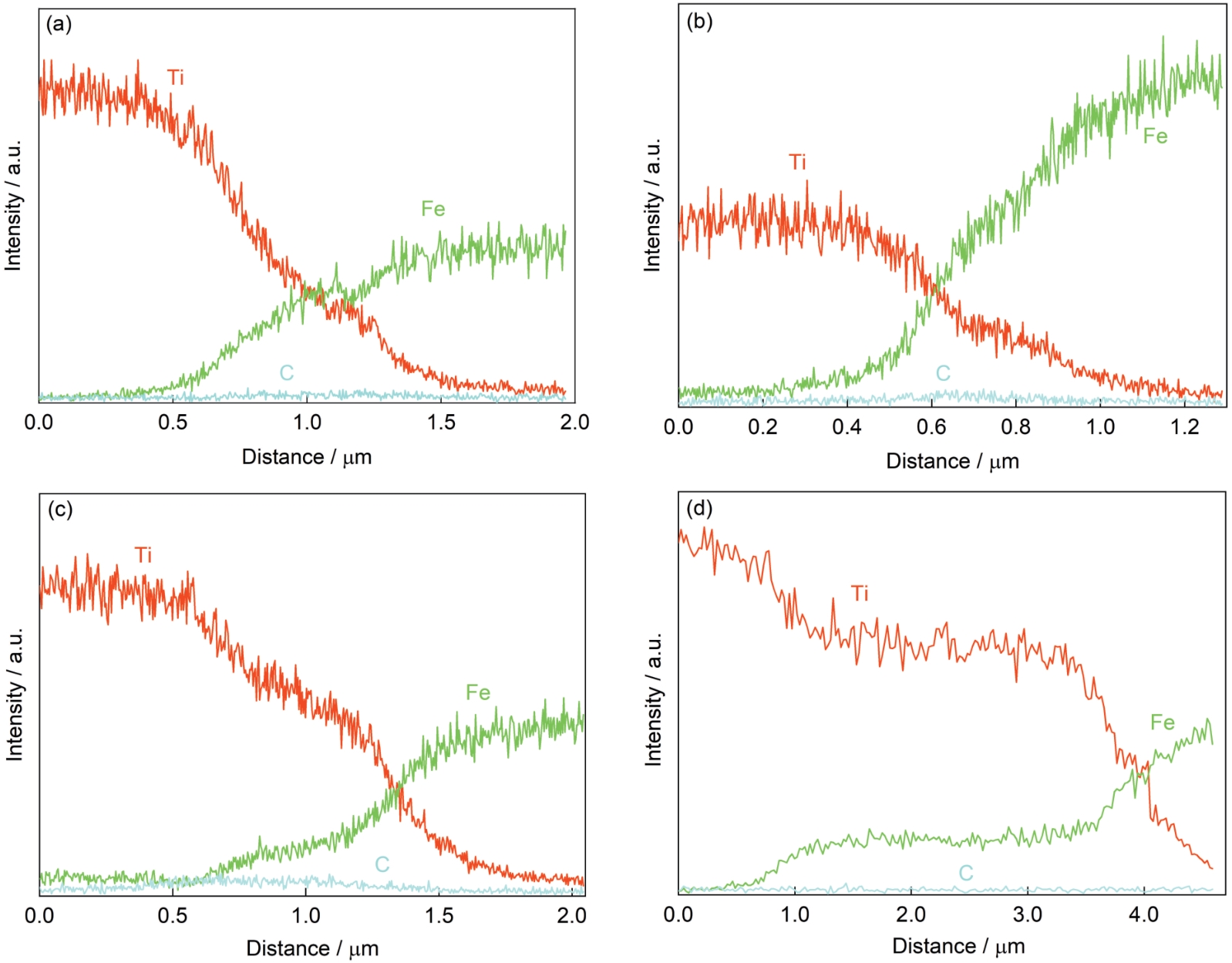
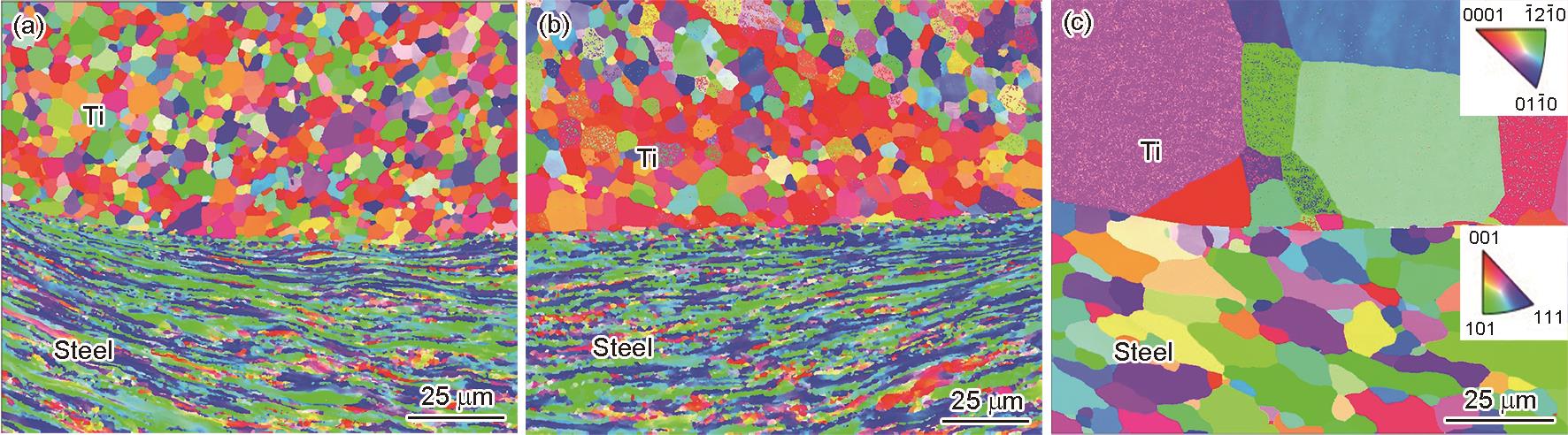
Abstract During the secondary welding process of titanium-steel hybrid structures for ships, repeated thermal cycles inevitably change the interfacial microstructure and mechanical properties of explosive-welded transit joints. These changes directly affect the bonding strength of hybrid structures and navigational safety of ships. Herein, simulated transient heat treatment (STHT) was adopted to study the relationship among temperature, interfacial microstructure, and bonding properties of a titanium-steel hybrid structures during the secondary welding process. Results showed that when the STHT temperature was <600 oC, the interfacial microstructure remained stable. Meanwhile, at ≥ 700 oC, recrystallization occurred, causing grains near the interface to become coarse. Furthermore, the thickness of the intermetallic compound layer comprising FeTi and TiC increased rapidly. Unlike aluminum-steel hybrid structures, in which the interfacial bonding strength monotonically decreases with increasing temperature, the bonding and shear strengths of the titanium-steel hybrid structures initially increased and then decreased, with peaks appearing at 500 and 600 oC. The thermal effect at medium and low temperatures promoted atomic diffusion and stress release, thereby improving the interfacial bonding strength. At high temperatures, grain coarsening and intermetallic compound growth decreased the bonding strength of the transit joint. Overall, the critical threshold temperature at the interface of the titanium-steel hybrid structures is 600 oC.
|
|
Received: 26 December 2024
|
|
|
| Fund: National Natural Science Foundation of China(52105389);China Postdoctoral Science Foundation(2023M743270);Shanxi Province Patent Transformation Project(202402002);Guangdong Provincial Key Laboratory of Advanced Welding Technology for Ships(2023B1212070026) |
| [1] |
Yang M, Wang J X, Cao C, et al. A new strategy for preparing advanced aluminum/steel joint using low-temperature explosive welding technology [J]. Phys. Status Solidi-Rapid Res. Lett., 2023, 17: 2300179
doi: 10.1002/pssr.v17.10
|
| [2] |
Tricarico L, Spina R, Sorgente D, et al. Effects of heat treatments on mechanical properties of Fe/Al explosion-welded structural transition joints [J]. Mater. Des., 2009, 30: 2693
doi: 10.1016/j.matdes.2008.10.010
|
| [3] |
Xia Y Q, Dong H G, Zhang R Z, et al. Interfacial microstructure and shear strength of Ti6Al4V alloy/316L stainless steel joint brazed with Ti33.3Zr16.7Cu50 - x Ni x amorphous filler metals [J]. Mater. Des., 2020, 187: 108380
doi: 10.1016/j.matdes.2019.108380
|
| [4] |
Kundu S, Roy D, Chatterjee S, et al. Influence of interface microstructure on the mechanical properties of titanium/17-4 PH stainless steel solid state diffusion bonded joints [J]. Mater. Des., 2012, 37: 560
doi: 10.1016/j.matdes.2011.10.041
|
| [5] |
Norouzi E, Shamanian M, Atapour M, et al. Diffusion brazing of Ti-6Al-4V and AISI 304: An EBSD study and mechanical properties [J]. J. Mater. Sci., 2017, 52: 12467
doi: 10.1007/s10853-017-1376-z
|
| [6] |
Dong H G, Li Y G, Li P, et al. Inhomogeneous microstructure and mechanical properties of rotary friction welded joints between 5052 aluminum alloy and 304 stainless steel [J]. J. Mater. Process. Technol., 2019, 272: 17
doi: 10.1016/j.jmatprotec.2019.04.039
|
| [7] |
Li S H, Chen Y H, Zhou X W, et al. High-strength titanium alloy/steel butt joint produced via friction stir welding [J]. Mater. Lett., 2019, 234: 155
doi: 10.1016/j.matlet.2018.09.094
|
| [8] |
Li Y L, Di H S, Chen L Q, et al. Microstructure and mechanical properties of TA2/304 weld seam with Cu transition layer under bias oscillation laser welding process [J]. J. Mater. Eng. Perform., 2024, 33: 4962
doi: 10.1007/s11665-023-08295-5
|
| [9] |
Wang Y C, Li P, Zhao C H, et al. A novel high entropy composite interlayer for diffusion bonding of TC4 titanium alloy to 316L stainless steel [J]. Mater. Today Commun., 2024, 41: 110291
|
| [10] |
Wang X M. Property and welding procedure of the steel-aluminum structural transition joint [J]. Ship Ocean Eng., 2008, 37(3): 20
|
|
王绪明. 钢-铝结构过渡接头的性能特点及焊接工艺 [J]. 船海工程, 2008, 37(3): 20
|
| [11] |
Li B F, Li J Y. Application of aluminum-steel transition joint in real ship construction [J]. Dev. Appl. Mater., 1994, 9(6): 1
|
|
李标峰, 李敬勇. 铝-钢过渡接头在实船建造中的应用 [J]. 材料开发与应用, 1994, 9(6): 1
|
| [12] |
Wang S H, Luo X B, Su H, et al. Effect of heat treatment temperature on interfacial microstructures and bonding properties of Al-steel clad plate [J]. J. Iron Steel Res., 2019, 31: 937
|
|
王世宏, 罗小兵, 苏 航 等. 热处理温度对铝钢复合板界面组织和性能的影响 [J]. 钢铁研究学报, 2019, 31: 937
doi: 10.13228/j.boyuan.issn1001-0963.20180027
|
| [13] |
Phengsakul S, Rodchanarowan A. Effect of thermal treatment on intermetallic phases of Fe/Al structural transition joints [J]. Energy Procedia, 2013, 34: 782
doi: 10.1016/j.egypro.2013.06.814
|
| [14] |
Zhao H, Wang Y Z, Bai Y F, et al. Investigation on heat treatment process optimization of 304L/Q235B stainless steel clad plates [J]. Hot Work. Technol., 2023, 52(16): 69
|
|
赵 惠, 王艺卓, 白一凡 等. 304L/Q235B不锈钢层状复合板热处理工艺优化研究 [J]. 热加工工艺, 2023, 52(16): 69
|
| [15] |
Liu Z W, Guan S Z, Liu R S, et al. Relation of microstructure and mechanical property on aluminium/steel clad plate joining intererface under different heat treatment temperature [J]. Met. World, 2010, (1): 18
|
|
刘壮武, 关尚哲, 刘润生 等. 铝/钢复合板不同热处理温度结合界面显微结构与力学性能的关系 [J]. 金属世界, 2010, (1): 18
|
| [16] |
Wang T, Wang H, Li N, et al. Microstructural and mechanical heterogeneity of electron beam welded thick pure titanium/Q235B steel bimetallic plate joint [J]. J. Mater. Eng. Perform., 2023, 32: 5273
doi: 10.1007/s11665-022-07489-7
|
| [17] |
Ren G Z, Zhang Y, Zhou J P, et al. Titanium/steel composites were prepared by composite interlayer and two pass laser welding [J]. J. Mater. Res. Technol., 2023, 27: 6367
doi: 10.1016/j.jmrt.2023.11.118
|
| [18] |
Gao Y D, Zhou J P, Zhang Y, et al. Two pass laser welding of TC4 titanium alloy and 304 stainless steel using TA2/Q235 composite interlayer [J]. Mater. Lett., 2019, 255: 126521
doi: 10.1016/j.matlet.2019.126521
|
| [19] |
Bi Z Y, Yang J, Liu H Z, et al. Investigation on the welding process and microstructure and mechanical property of butt joints of TA1/X65 clad plates [J]. Acta Metall. Sin., 2016, 52: 1017
doi: 10.11900/0412.1961.2015.00615
|
|
毕宗岳, 杨 军, 刘海璋 等. TA1/X65复合板焊接工艺及焊缝组织和性能研究 [J]. 金属学报, 2016, 52: 1017
doi: 10.11900/0412.1961.2015.00615
|
| [20] |
Wang T, Zhang F, Li X P, et al. Interfacial evolution of explosively welded titanium/steel joint under subsequent EBW process [J]. J. Mater. Process. Technol., 2018, 261: 24
doi: 10.1016/j.jmatprotec.2018.05.031
|
| [21] |
Kundu S, Sam S, Chatterjee S. Interface microstructure and strength properties of Ti-6Al-4V and microduplex stainless steel diffusion bonded joints [J]. Mater. Des., 2011, 32: 2997
doi: 10.1016/j.matdes.2010.12.052
|
| [22] |
Zhao D S, Yan J C, Liu Y J. Effect of intermetallic compounds on heat resistance of hot roll bonded titanium alloy-stainless steel transition joint [J]. Trans. Nonferrous Met. Soc. China, 2013, 23: 1966
doi: 10.1016/S1003-6326(13)62684-9
|
| [23] |
Wu T, Yang C L. Interfacial evolution of titanium/steel clad plates during pulsed tungsten inert gas welding [J]. Mater. Sci. Technol., 2023, 39: 834
doi: 10.1080/02670836.2022.2143622
|
| [24] |
Wu T, Yang C L. Influence of pulse TIG welding thermal cycling on the microstructure and mechanical properties of explosively weld titanium/steel joint [J]. Vacuum, 2022, 197: 110817
doi: 10.1016/j.vacuum.2021.110817
|
| [25] |
Akbari Mousavi S A A, Sartangi P F. Effect of post-weld heat treatment on the interface microstructure of explosively welded titanium-stainless steel composite [J]. Mater. Sci. Eng., 2008, A494: 329
|
| [26] |
Zhang B Y, Ma H H, Xu J F, et al. Investigations on the microstructure evolution and mechanical properties of explosive welded ODS-Cu/316L stainless steel composite [J]. Fusion Eng. Des., 2022, 179: 113142
doi: 10.1016/j.fusengdes.2022.113142
|
| [27] |
Yang X Y, Guo K, Gao Y Z, et al. Effect of carbon content on interfacial microstructure and mechanical properties of a vacuum hot-compressed bonding titanium-steel composite [J]. Mater. Sci. Eng., 2021, A824: 141802
|
| [28] |
Chai X Y, Chen G, Chai F, et al. Hot roll bonding between commercially pure titanium and high-strength low-alloy steel using Fe interlayer [J]. J. Iron Steel Res. Int., 2019, 26: 1126
doi: 10.1007/s42243-019-00322-x
|
| [29] |
Yu C, Xiao H, Yu H, et al. Mechanical properties and interfacial structure of hot-roll bonding TA2/Q235B plate using DT4 interlayer [J]. Mater. Sci. Eng., 2017, A695: 120
|
| [30] |
Momono T, Enjo T, Ikeuchi K. Effects of carbon content on the diffusion bonding of iron and steel to titanium [J]. ISIJ Int., 1990, 30: 978
doi: 10.2355/isijinternational.30.978
|
| [31] |
Zhang H, Jiao K X, Zhang J L, et al. Microstructure and mechanical properties investigations of copper-steel composite fabricated by explosive welding [J]. Mater. Sci. Eng., 2018, A731: 278
|
| [32] |
Yang M, Cao C, Wang J X. Fabrication of high-quality platinum coating using explosive welding technology and its microstructure evolution mechanisms [J]. Mater. Des., 2023, 235: 112372
doi: 10.1016/j.matdes.2023.112372
|
| [33] |
Tan J C, Tan M J. Dynamic continuous recrystallization characteristics in two stage deformation of Mg-3Al-1Zn alloy sheet [J]. Mater. Sci. Eng., 2003, A339: 124
|
| [34] |
Omiya M, Sakakibara Y. Strain evaluation method around triple junctions using electron backscatter diffraction [J]. Mater. Trans., 2024, 65: 754
doi: 10.2320/matertrans.MT-Z2023013
|
| [35] |
Prasanthi T N, Sudha R C, Saroja S. Explosive cladding and post-weld heat treatment of mild steel and titanium [J]. Mater. Des., 2016, 93: 180
doi: 10.1016/j.matdes.2015.12.120
|
| No Suggested Reading articles found! |
|
|
Viewed |
|
|
|
Full text
|
|
|
|
|
Abstract
|
|
|
|
|
Cited |
|
|
|
|
| |
Shared |
|
|
|
|
| |
Discussed |
|
|
|
|