|
|
|
| In Situ Quantification of Fracture Surface Self-Healing in Monocrystalline Nb4AlC3MAX Phase Nanowires |
CUI Junfeng1, HU Xiaofei2, CHEN Guoxin2, LI Youbing3, KE Peiling2( ), ZHAO Hongwei1() ), ZHAO Hongwei1() |
1 School of Materials Science and Physics, China University of Mining and Technology, Xuzhou 221116, China
2 Public Technology Center, Ningbo Institute of Materials Technology and Engineering, Chinese Academy of Sciences, Ningbo 315201, China
3 School of Radiation Medicine and Protection, Soochow University, Suzhou 215123, China |
|
Cite this article:
CUI Junfeng, HU Xiaofei, CHEN Guoxin, LI Youbing, KE Peiling, ZHAO Hongwei. In Situ Quantification of Fracture Surface Self-Healing in Monocrystalline Nb4AlC3MAX Phase Nanowires. Acta Metall Sin, 2026, 62(9): 1478-1486.
|
|
|
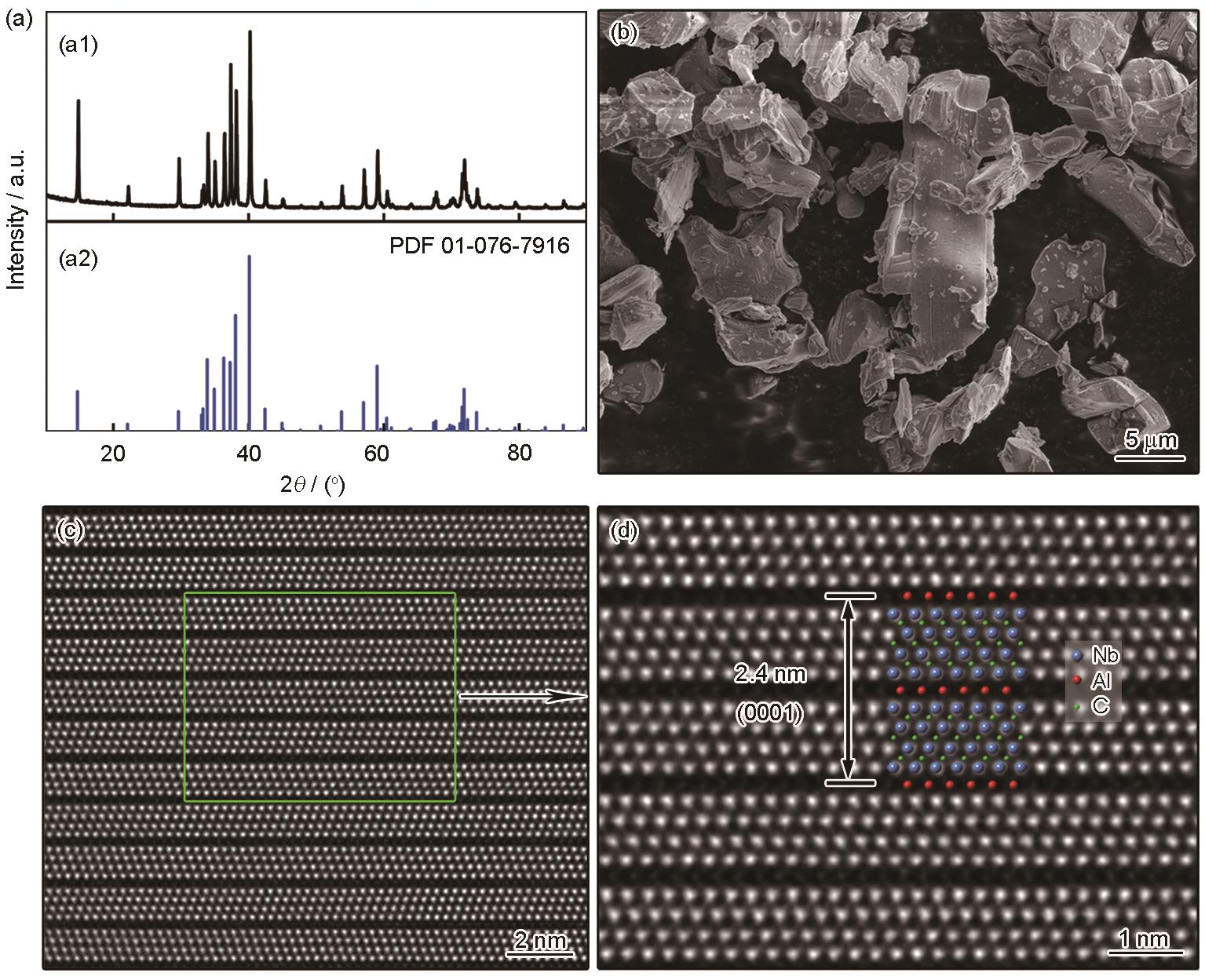
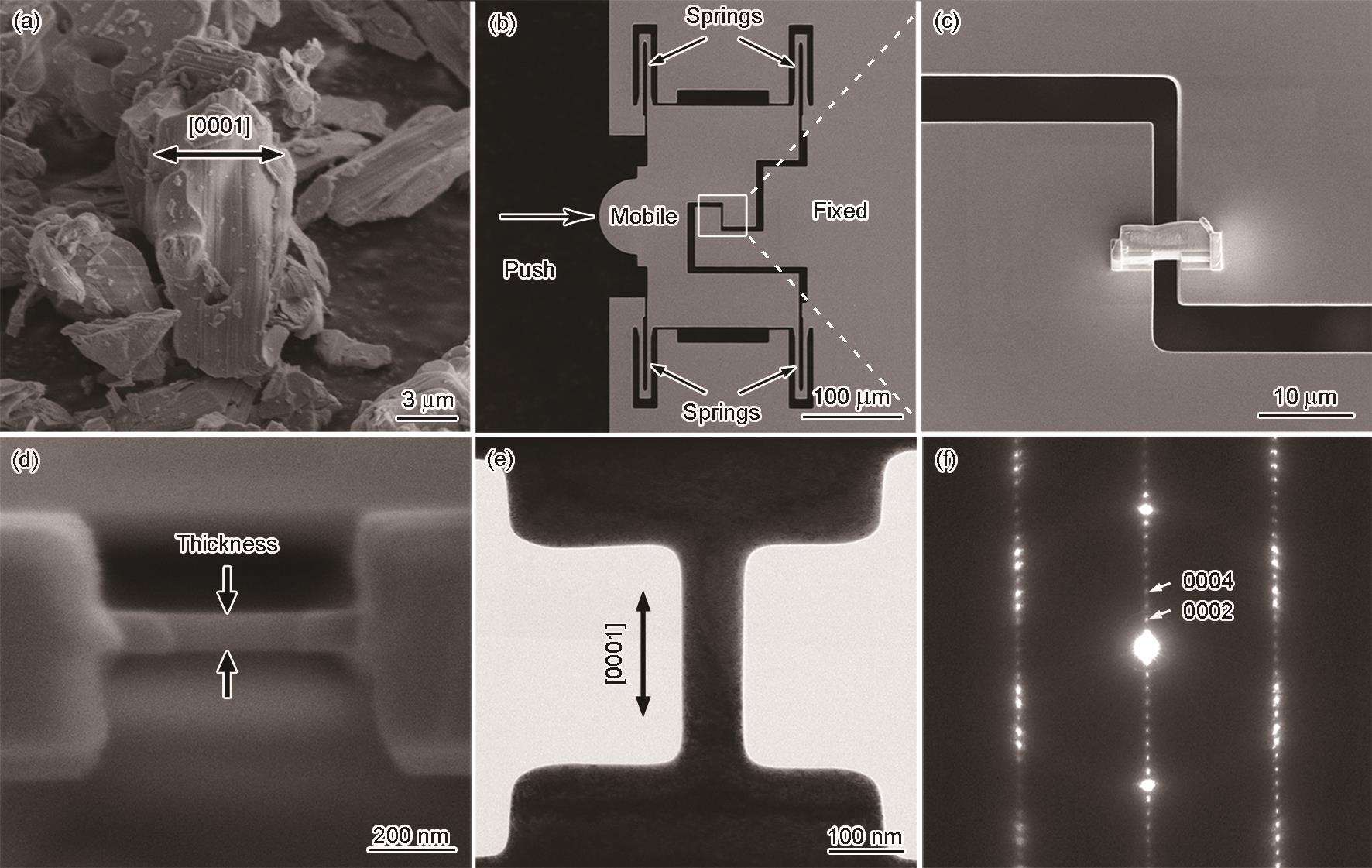
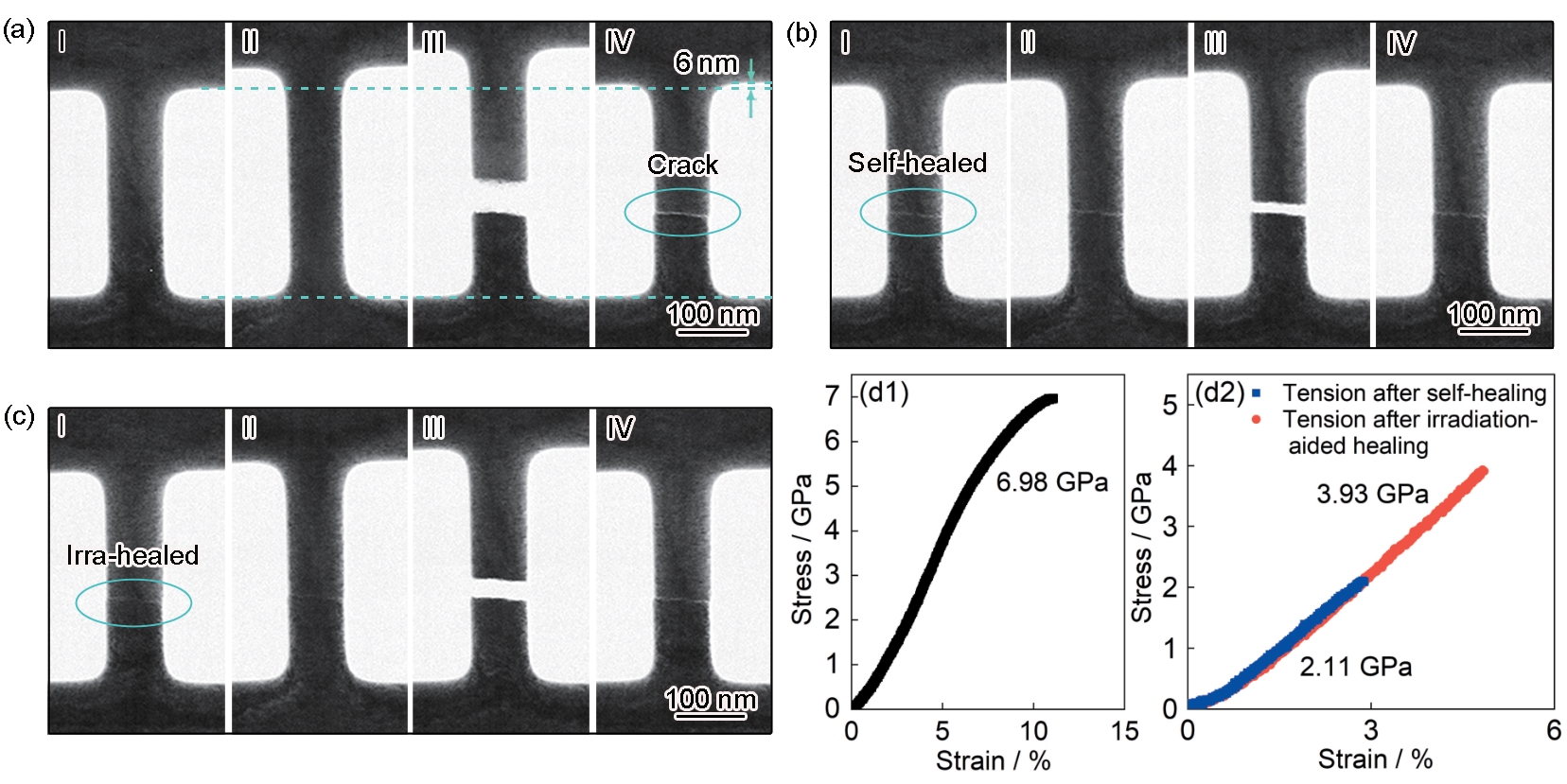
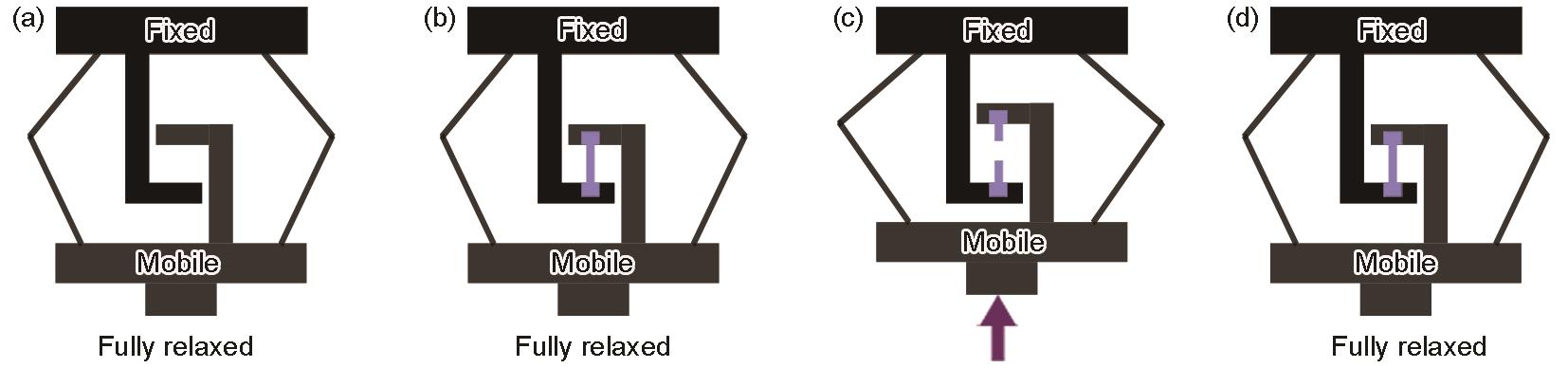
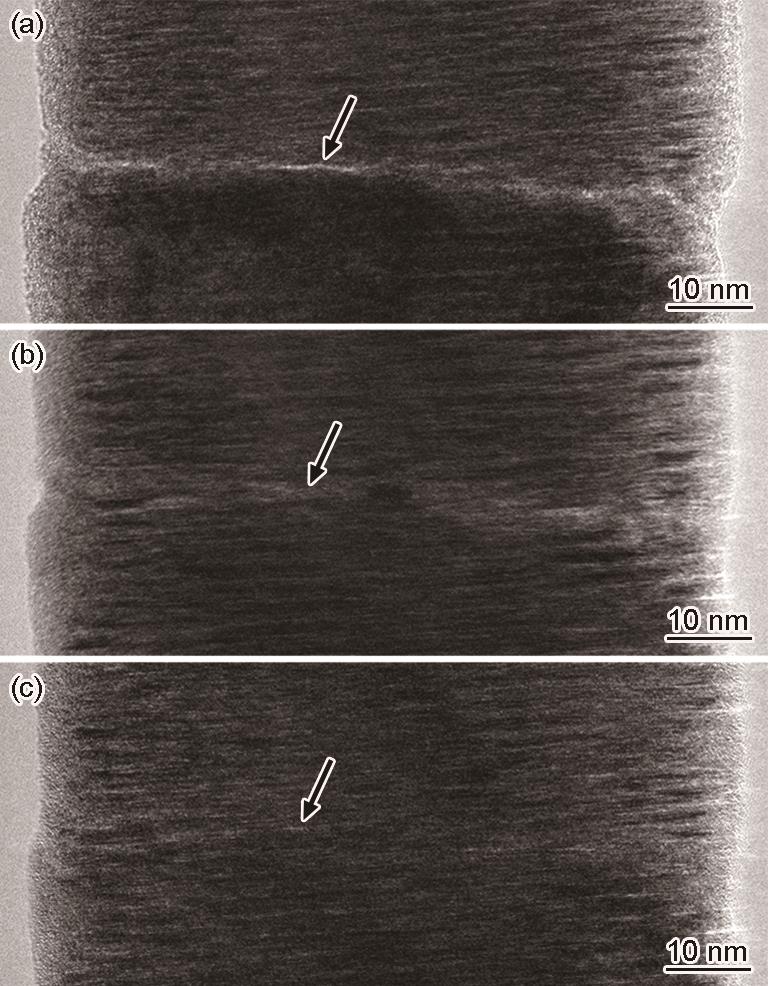
Abstract The development of high-strength self-healing materials with heat and radiation resistance is crucial for improving the safety and reliability of advanced nuclear energy systems. However, conventional self-healing materials—including polymers and their composites—suffer from low strength, poor thermal stability, and insufficient irradiation resistance, severely limiting their practical applications in harsh nuclear environments. Self-healing of metallic or ceramic materials at high temperatures can be achieved through oxidation, atomic diffusion, or phase changes; however, this is impractical for in-service components. MAX phases are a family of nanolayered ternary carbides and nitrides with the general formula Mn+ 1AXn. Their unique combination of metallic and ceramic properties—including high-temperature stability and radiation and damage tolerance—makes them promising candidates for nuclear applications. Nevertheless, the nanoscale self-healing behavior of MAX phases, particularly the underlying mechanisms and quantitative healing efficiency, remains largely unexplored. Moreover, the mechanical properties of single-crystalline Nb4AlC3MAX phase nanowires, particularly their fracture behaviors and postfracture self-healing capability, have not yet been systematically investigated. In this work, monocrystalline [0001]-oriented Nb4AlC3MAX phase nanowires were fabricated using focused ion beam-based nanofabrication. The mechanical behavior and fracture surface self-healing were quantitatively investigated by in situ tensile testing within TEM, elucidating the mechanical properties and fracture mechanisms under uniaxial tension along the c-axis and revealing the atomistic mechanisms governing room-temperature spontaneous self-healing of fractured surfaces. An electron beam irradiation strategy is also proposed to enhance healing efficiency and elucidate its underlying physical mechanisms. The results show that the nanowires exhibit brittle fracture under tensile stress (fracture strength: 6.98 GPa, super-elongation: 11.5%), attributed to the size effect and absence of defects at the nanoscale. The fractured surfaces spontaneously self-healed at room temperature, recovering 30.2% of the original fracture strength. Atomic-scale HRTEM characterization reveals that atomic rebonding across the fracture surfaces and atomic migration dominate self-healing. Furthermore, electron beam irradiation can cause lattice expansion along the c-axis and promote atomic migration, enabling more atoms to participate in rebonding and thereby further enhancing the healing efficiency (up to 56.3% recovery).
|
|
Received: 03 December 2025
|
|
|
| Fund: National Natural Science Foundation of China(52302203);Key Program of Jiangsu Provincial Research Foundation for Basic Research(BK20253032) |
| [1] |
Shi J Y, Lei Y M, Wang C X, et al. Ion irradiation damage behavior in titanium carbide with different stoichiometry [J]. J. Inorg. Mater., 2026, 41: 322
doi: 10.15541/jim20250228
|
|
石金瑜, 雷一明, 王晨旭 等. 不同化学计量碳化钛的离子辐照损伤行为研究 [J]. 无机材料学报, 2026, 41: 322
|
| [2] |
Wang D, Xu L Y, Zhao L, et al. Phase field and crystal plasticity simulation of irradiation-induced He bubbles evolution and mechanical behavior in 316H steel and weld metal [J]. Acta Metall. Sin., 2026, 62: 173
doi: 10.11900/0412.1961.2025.00239
|
|
王 栋, 徐连勇, 赵 雷 等. 316H钢及其焊缝金属辐照He泡演化与力学行为的相场-晶体塑性耦合模拟 [J]. 金属学报, 2026, 62: 173
|
| [3] |
Wool R P. Self-healing materials: A review [J]. Soft Matter, 2008, 4: 400
doi: 10.1039/b711716g
pmid: 32907199
|
| [4] |
Cash J J, Kubo T, Bapat A P, et al. Room-temperature self-healing polymers based on dynamic-covalent boronic esters [J]. Macromolecules, 2015, 48: 2098
doi: 10.1021/acs.macromol.5b00210
|
| [5] |
Taylor D L, Panhuis M I H. Self-healing hydrogels [J]. Adv. Mater., 2016, 28: 9060
doi: 10.1002/adma.v28.41
|
| [6] |
Wen N, Song T T, Ji Z H, et al. Recent advancements in self-healing materials: Mechanicals, performances and features [J]. React. Funct. Polym., 2021, 168: 105041
doi: 10.1016/j.reactfunctpolym.2021.105041
|
| [7] |
Chu M C, Cho S J, Lee Y C, et al. Crack healing in silicon carbide [J]. J. Am. Ceram. Soc., 2004, 87: 490
doi: 10.1111/jace.2004.87.issue-3
|
| [8] |
Tavangarian F, Hui D, Li G Q. Crack-healing in ceramics [J]. Composites, 2018, 144B: 56
|
| [9] |
Wang J, Stevens R. Modification of indentation cracks in TZP ceramics by thermal treatment [J]. J. Mater. Sci. Lett., 1988, 7: 560
doi: 10.1007/BF01730293
|
| [10] |
Zhang H T, Tersoff J, Xu S, et al. Approaching the ideal elastic strain limit in silicon nanowires [J]. Sci. Adv., 2016, 2: e1501382
doi: 10.1126/sciadv.1501382
|
| [11] |
Xu C T, Zou R J, Peng Y X, et al. In situ transmission electron microscope studies on one-dimensional nanomaterials: Manipulation, properties and applications [J]. Prog. Mater. Sci., 2020, 113: 100674
doi: 10.1016/j.pmatsci.2020.100674
|
| [12] |
Xu T T, Chen Q, Zhang C Y, et al. Self-healing of bended WS2 nanotubes and its effect on the nanotube's properties [J]. Nanoscale, 2012, 4: 7825
doi: 10.1039/c2nr32591h
|
| [13] |
Wang Y B, Joyce H J, Gao Q, et al. Self-healing of fractured GaAs nanowires [J]. Nano Lett., 2011, 11: 1546
doi: 10.1021/nl104330h
pmid: 21417399
|
| [14] |
Lu Y, Huang J Y, Wang C, et al. Cold welding of ultrathin gold nanowires [J]. Nat. Nanotechnol., 2010, 5: 218
doi: 10.1038/nnano.2010.4
pmid: 20154688
|
| [15] |
Zhang Z Y, Cui J F, Wang B, et al. In situ TEM observation of rebonding on fractured silicon carbide [J]. Nanoscale, 2018, 10: 6261
doi: 10.1039/C8NR00341F
|
| [16] |
Cui J F, Sun Y, Chen H X, et al. Atomic insights of self-healing in silicon nanowires [J]. Adv. Funct. Mater., 2023, 33: 2210053
doi: 10.1002/adfm.v33.6
|
| [17] |
Qiu K L, Hou J P, Chen S, et al. Self-healing of fractured diamond [J]. Nat. Mater., 2023, 22: 1317
doi: 10.1038/s41563-023-01656-4
|
| [18] |
Ding H M, Li Y B, Li M, et al. Chemical scissor-mediated structural editing of layered transition metal carbides [J]. Science, 2023, 379: 1130
doi: 10.1126/science.add5901
pmid: 36927013
|
| [19] |
Ding H M, Li M, Li Y B, et al. Progress in structural tailoring and properties of ternary layered ceramics [J]. J. Inorg. Mater., 2023, 38: 845
doi: 10.15541/jim20230123
|
|
丁浩明, 李 勉, 李友兵 等. 三元层状材料结构调控及性能研究进展 [J]. 无机材料学报, 2023, 38: 845
|
| [20] |
Suh M, Lee D H, Sloo W G, et al. Effect of temperature on the healing capacity and mechanical properties of Ti2AlC MAX phase ceramics [J]. Int. J. Appl. Ceram. Technol., 2024, 21: 2757
doi: 10.1111/ijac.v21.4
|
| [21] |
Rathod H J, Ouisse T, Radovic M, et al. Room temperature crack-healing in an atomically layered ternary carbide [J]. Sci. Adv., 2021, 7: eabg2549
doi: 10.1126/sciadv.abg2549
|
| [22] |
Hu C F, Li F Z, He L F, et al. In situ reaction synthesis, electrical and thermal, and mechanical properties of Nb4AlC3 [J]. J. Am. Ceram. Soc., 2008, 91: 2258
doi: 10.1111/jace.2008.91.issue-7
|
| [23] |
Li C, He X D, Li Q F. Compressive properties of Ti3AlC2 ceramics prepared by SHS/PHIP [J]. Rare Met. Mater. Eng., 2008, 37(suppl.1) : 244
|
|
李 翀, 贺晓东, 李庆芬. 自蔓延准热等静压技术制备Ti3AlC2可加工陶瓷的压缩性能 [J]. 稀有金属材料与工程, 2008, 37(): 244
|
| [24] |
Cai P, He Q M, Yang L H, et al. Mechanical and thermal properties and microstructural evolution of Ta-doped Nb4AlC3 [J]. Ceram. Int., 2019, 45: 9799
doi: 10.1016/j.ceramint.2019.02.017
|
| [25] |
Gu J, Pan L M, Yang J, et al. Mechanical properties and oxidation behavior of Ti-doped Nb4AlC3 [J]. J. Eur. Ceram. Soc., 2016, 36: 1001
doi: 10.1016/j.jeurceramsoc.2015.10.023
|
| [26] |
Fu Y D, Wang B C, Teng Y, et al. The role of group III, IV elements in Nb4AC3 MAX phases (A = Al, Si, Ga, Ge) and the unusual anisotropic behavior of the electronic and optical properties [J]. Phys. Chem. Chem. Phys., 2017, 19: 15471
doi: 10.1039/C7CP01375B
|
| [27] |
Liu G T, Li Z F, Gao W H, et al. Oxidation mechanism and mechanical properties of substitutional transition metal modified Nb4AlC3: A first-principles density functional theory study [J]. Ceram. Int., 2023, 49: 29141
doi: 10.1016/j.ceramint.2023.06.194
|
| [28] |
Hu C F, Li F Z, Zhang J, et al. Nb4AlC3: A new compound belonging to the MAX phases [J]. Scr. Mater., 2007, 57: 893
doi: 10.1016/j.scriptamat.2007.07.038
|
| [29] |
Cui J F, Hu X F, Zhang L, et al. Highly efficient self-healing of fractured Ti3AlC2 MAX phase nanowires [J]. Adv. Funct. Mater., 2025, 35: 2422697
doi: 10.1002/adfm.v35.17
|
| [30] |
Wang C X, Yang T F, Tracy C L, et al. Disorder in Mn + 1 AXn phases at the atomic scale [J]. Nat. Commun., 2019, 10: 622
doi: 10.1038/s41467-019-08588-1
|
| [31] |
Zheng L Y, Zhou Y C, Feng Z H. Preparation, structural featrures, properties and prospective of MAX phases [J]. Aerosp. Mater. Technol., 2013, 43(6): 1
|
|
郑丽雅, 周延春, 冯志海. MAX相陶瓷的制备、结构、性能及发展趋势 [J]. 宇航材料工艺, 2013, 43(6): 1
|
| [32] |
Radovic M, Barsoum M W, El-Raghy T, et al. Tensile properties of Ti3SiC2 in the 25-1300 oC temperature range [J]. Acta Mater., 2000, 48: 453
doi: 10.1016/S1359-6454(99)00351-1
|
| [33] |
Zhan Z Q, Chen Y X, Radovic M, et al. Non-classical crystallographic slip in a ternary carbide-Ti2AlC [J]. Mater. Res. Lett., 2020, 8: 275
doi: 10.1080/21663831.2020.1748733
|
| [34] |
Tromas C, Parent S, Sylvain W, et al. Nanoindentation-induced deformation twinning in MAX phase Ti2AlN [J]. Acta Mater., 2022, 227: 117665
doi: 10.1016/j.actamat.2022.117665
|
| [35] |
Brüsewitz C, Knorr I, Hofsäss H, et al. Single crystal pillar microcompression tests of the MAX phases Ti2InC and Ti4AlN3 [J]. Scr. Mater., 2013, 69: 303
doi: 10.1016/j.scriptamat.2013.05.002
|
| [36] |
Benitez R, Kan W H, Gao H, et al. Mechanical properties and microstructure evolution of Ti2AlC under compression in 25-1100 oC temperature range [J]. Acta Mater. 2020, 189: 154
doi: 10.1016/j.actamat.2020.02.057
|
| [37] |
Wang J, Lu C S, Wang Q, et al. Self-healing in fractured GaAs nanowires [J]. Acta Mater., 2012, 60: 5593
doi: 10.1016/j.actamat.2012.07.013
|
| [38] |
Wang J M, Wang J Y, Zhou Y C, et al. Phase stability, electronic structure and mechanical properties of ternary-layered carbide Nb4AlC3: An ab initio study [J]. Acta Mater., 2008, 56: 1511
doi: 10.1016/j.actamat.2007.12.003
|
| [39] |
Zhang Z, Duan X M, Jia D C, et al. On the formation mechanisms and properties of MAX phases: A review [J]. J. Eur. Ceram. Soc., 2021, 41: 3851
doi: 10.1016/j.jeurceramsoc.2021.02.002
|
| [40] |
Bowden D, Ward J, Middleburgh S, et al. The stability of irradiation-induced defects in Zr3AlC2, Nb4AlC3 and (Zr0.5, Ti0.5)3AlC2 MAX phase-based ceramics [J]. Acta Mater., 2020, 183: 24
doi: 10.1016/j.actamat.2019.10.049
|
| [41] |
Chen Y, Zhou G S, Zhan T, et al. Fatigue characteristics of copper-steel electron beam welding materials [J]. J. Mater. Eng., 2023, 51(3): 89
doi: 10.11868/j.issn.1001-4381.2021.001236
|
|
陈 雨, 周根树, 詹 腾 等. 铜-钢电子束焊接材料的疲劳特性 [J]. 材料工程, 2023, 51(3): 89
|
| [42] |
Li G X, Zou C, Wang F, et al. Atomic-precision manipulation of defects in RuO2 nanocrystals via electron-beam [J]. Adv. Funct. Mater., 2024, 34: 2410524
doi: 10.1002/adfm.v34.51
|
| No Suggested Reading articles found! |
|
|
Viewed |
|
|
|
Full text
|
|
|
|
|
Abstract
|
|
|
|
|
Cited |
|
|
|
|
| |
Shared |
|
|
|
|
| |
Discussed |
|
|
|
|