



随着我国海洋工程、工程机械、水力发电等领域的发展,对高强钢的需求持续增加[1~5]。焊接作为高强钢结构装备建造过程中重要的热加工工艺[6~8],对高强钢的应用有着重要影响。然而,焊接接头往往是焊接结构中的薄弱环节,在服役过程中容易失效。焊接接头的质量主要取决于焊接材料、焊接方法及焊接工艺等因素[9~11]。当焊接方法和焊接工艺确定后,合理选择焊接材料是实现焊接接头强韧性良好匹配,确保焊接结构服役可靠的关键。目前,国内外钢铁企业已开发出1000 MPa级高强钢[12~14],但其配套焊接材料的强韧性不足[15~18]。因此,亟须通过优化焊接材料的合金成分来改善焊缝金属微观组织,以期获得高强韧的焊缝金属。
800 MPa以上级别高强钢配套焊接材料的合金体系主要为Fe-Cr-Ni-Mo系[19],其焊缝金属的微观组织通常为贝氏体+马氏体+少量残余奥氏体(RA)[20]。Keehan等[21]通过调控焊缝金属中的C含量,获得了马氏体+贝氏体组织,随着C含量增加,焊缝金属的抗拉强度由831 MPa上升至971 MPa,但其韧性显著下降。原因在于随着C含量的增加,焊缝金属中的聚合贝氏体(coalesced bainite,CB)含量逐渐增加,其尺寸较大、取向单一,对韧性不利。CB常出现在高强钢焊缝金属微观组织中[21,22],通常由多个平行排列的板条贝氏体(lath bainite,LB)组成,形成束状或块状集合体,内部常存在析出相。研究[23]表明,向焊缝金属中添加Ni元素,可阻止高温时的晶粒长大,对焊缝金属冲击韧性有益。焊缝金属中Ni含量为5.5% (质量分数,下同)时[24],微观组织为取向复杂的LB,CB含量大幅降低,具有优异的冲击韧性,但仍需进一步提高强度。Mo为固溶强化元素,同时可以提高焊缝金属的淬透性,其含量在一定范围内可提高高强钢焊缝金属的强度[25],但其对1000 MPa级高强钢焊缝金属组织与性能的影响规律尚不明确,有必要进行系统分析。
本工作采用不同Mo含量的气体保护焊焊丝,采用熔化极气体保护电弧焊(GMAW)方法制备三种不同Mo含量的焊缝金属,研究Mo含量对1000 MPa级高强钢焊缝金属微观组织特征及其力学性能的影响,分析焊缝金属组织演变及其强度、韧性变化原因,为1000 MPa级高强钢配套焊接材料合金成分优化和焊缝金属组织调控提供理论和实验依据。
1 实验方法
母材及垫板材料均采用调质态1000 MPa级高强钢,母材尺寸为360 mm × 100 mm × 14 mm,垫板尺寸为360 mm × 20 mm × 10 mm,母材化学成分如表1所示。焊接材料为自制的Mo含量(质量分数,下同)分别为0.003%、0.310%和0.710%的实芯焊丝,焊丝直径为1.2 mm。母材在焊接前需进行反变形处理,反变形角度约为6°。采用砂浴对母材进行预热处理,预热温度为90~105 ℃。母材坡口尺寸如图1a所示,坡口根部间隙为10 mm,坡口角度为22.5°。采用TA1400型焊接机器人对母材进行GMAW焊接,保护气体为95%Ar + 5%CO2 (体积分数),气体流速为20 L/min,层间温度为95~105 ℃,焊接电流为210~250 A,焊接电压为25~28 V,焊接速率为300 mm/min。焊缝金属共三层九道,宏观形貌如图1b所示。对射线探伤合格的焊缝金属进行化学成分分析,结果如表1所示。三种焊缝金属中Mo含量分别为0.04%、0.32%和0.71%,对应的样品分别命名为Mo00、Mo03和Mo07,其他合金元素含量相当。
表1 母材及焊缝金属的化学成分 (mass fraction / %)
Table 1
| Sample | C | Si | Mn | Ni | Mo | V | Cu | Fe |
|---|---|---|---|---|---|---|---|---|
| Base metal | 0.15 | 0.21 | 1.05 | 2.14 | 0.48 | 0.03 | 0.14 | Bal. |
| Mo00 | 0.10 | 0.37 | 1.08 | 5.32 | 0.04 | 0.19 | 0.49 | Bal. |
| Mo03 | 0.12 | 0.36 | 1.05 | 5.39 | 0.32 | 0.19 | 0.50 | Bal. |
| Mo07 | 0.12 | 0.33 | 1.04 | 5.36 | 0.71 | 0.19 | 0.50 | Bal. |
图1
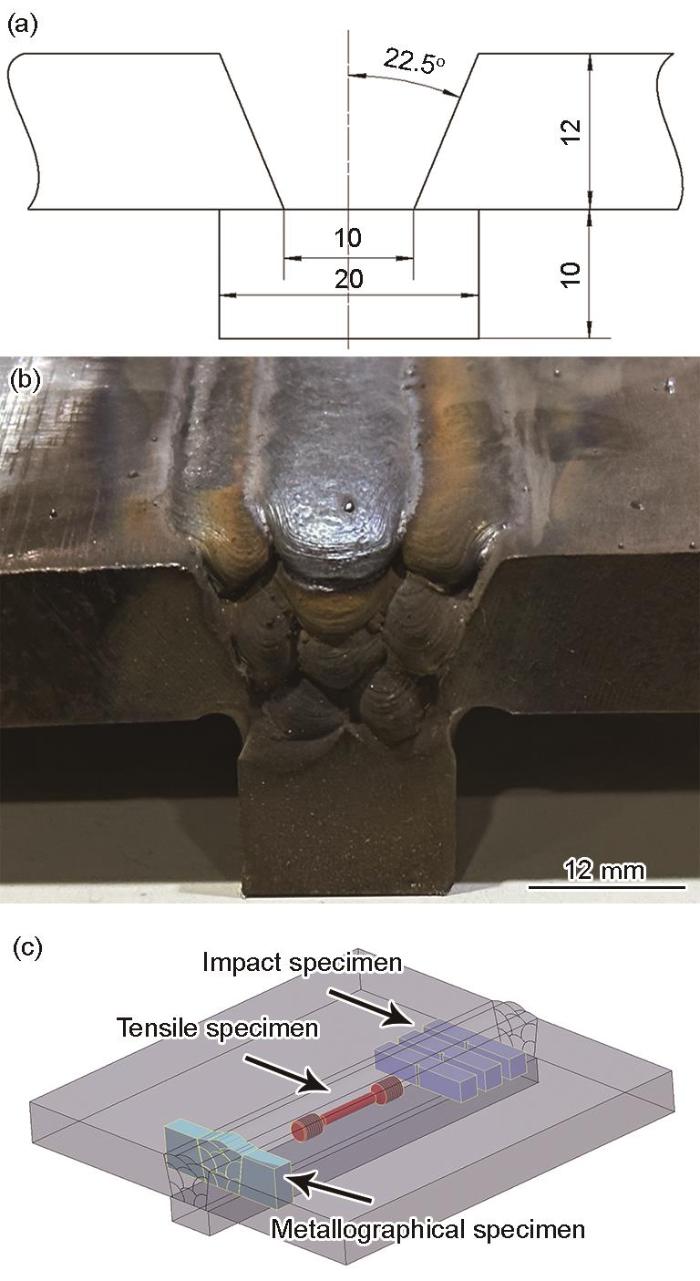
图1
母材V型坡口尺寸示意图、焊缝金属宏观形貌和焊缝金属微观组织观察试样及力学测试取样位置示意图
Fig.1
Schematic of V-type groove design of base metal (unit: mm) (a), macrostructure of weld metal (b), and schematic of machining locations of microstructure observation and mechanical properties testing specimens in weld metal (c)
焊缝金属微观组织观察试样取样位置如图1c所示,经砂纸研磨、机械抛光后,采用体积分数为4%的硝酸酒精溶液侵蚀,分别采用Axio Lab.A1型光学显微镜(OM)、SUPRA 35型扫描电子显微镜(SEM)观察焊缝金属微观组织。采用Verios 5 UC型SEM对焊缝金属进行电子背散射衍射(EBSD)分析,EBSD试样经砂纸研磨、机械抛光后,采用VibroMet 2振动抛光仪在70 Hz下对其振动抛光10 h,以去除表面应力。利用EBSD测量RA含量时,扫描步长设置为0.04 μm,利用EBSD分析组织取向时,扫描步长设置为0.15 μm,实验数据通过OIM软件分析处理。利用Tenupol-5双喷电解仪制备焊缝金属透射电镜(TEM)样品,电解溶液采用体积分数为10%高氯酸酒精溶液,工作电压为25 V,工作温度保持在-26 ℃左右。利用Talos F200X型TEM及其附带的能谱仪(EDS)表征焊缝金属组织中板条、CB及其内部析出相。利用Smartlab X射线衍射仪(XRD)对焊缝金属中的物相进行分析,计算焊缝金属组织中的RA含量,XRD测试采用Cu靶,扫描范围10°~105°,步长0.04°,扫描速率0.5°/min。XRD试样经砂纸研磨、机械抛光后,采用VibroMet 2振动抛光仪在70 Hz下对其振动抛光10 h,以去除表面应力。
焊缝金属拉伸和冲击试样取样位置如图1c所示,按照国家标准GB/T228.1—2021和GB/T229—2020分别进行室温拉伸和室温冲击实验。拉伸实验在TSE105D电子万能试验机上进行,圆棒状拉伸试样总长度为60 mm,平行长度的原始直径为5 mm。采用示波冲击实验记录焊缝金属的冲击断裂过程,室温示波冲击实验在TSP452H摆锤式冲击试验机上进行,冲击试样尺寸为55 mm × 10 mm × 10 mm,V型缺口开在焊缝中心,垂直于焊接方向。拉伸实验的平行试样两支,示波冲击实验的平行试样三支。利用SUPRA 35型SEM对拉伸试样断口和冲击试样断口进行形貌观察。焊缝金属横截面经砂纸研磨、机械抛光后,采用体积分数为4%的硝酸酒精溶液侵蚀处理,利用KB 30 SR FA型Vickers硬度计测量焊缝金属中线Vickers硬度,测试区域分别距左、右熔合线3 mm,硬度点间距为0.5 mm,载荷为500 g,加载时间为10 s,保载时间为15 s。利用L78 RITA型快速加热热膨胀仪进行热膨胀实验,试样尺寸为直径3 mm、长10 mm,将试样加热至900 ℃并保温15 min,以30 ℃/s的速率冷却至室温,测试焊缝金属的相变温度。
2 实验结果
2.1 焊缝金属的微观组织
图2为不同Mo含量焊缝金属组织的OM像和SEM像。可以看出,不同Mo含量焊缝金属组织主要由LB和CB构成,且随Mo含量增加,焊缝金属中CB含量增加。为了进一步定量分析Mo含量对焊缝金属中CB含量的影响,随机采集10张不同视场的SEM照片,使用Image-Pro Plus软件统计不同Mo含量焊缝金属组织中的CB含量(面积分数),统计结果表明,随着Mo含量从0.04%增加到0.32%再到0.71%,焊缝金属中CB含量分别为8.53% ± 1.18%、13.43% ± 2.05%和15.11% ± 2.27%。
图2
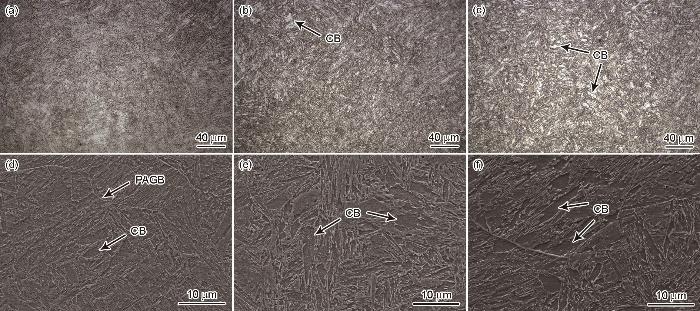
图2
不同Mo含量焊缝金属微观组织的OM像和SEM像
Fig.2
OM (a-c) and SEM (d-f) images of weld metals with different Mo contents (CB—coalesced bainite, LB—lath bainite, PAGB—prior austenite grain boundary) (a, d) Mo00 (b, e) Mo03 (c, f) Mo07
不同Mo含量焊缝金属组织的EBSD像如图3a~c所示。可以看出,随着Mo含量增加,焊缝金属微观组织形貌由交织状向平行状转变,取向变单一。利用TEM对焊缝金属组织内的板条形貌进行观察,发现随着Mo含量增加,贝氏体板条数量明显减少,形成了粗大的CB,如图3d~f所示,这与OM和SEM观察到的CB变化趋势一致。采用GMAW方法制备焊缝金属时,由于使用活性气体作为保护气体,焊缝金属中会形成球状夹杂物[26],如图3d所示。对Mo03和Mo07焊缝金属中的CB进一步表征,结果如图4所示。由于CB是相同方向生长的贝氏体板条发生聚合,且聚合后板条边界消失而形成,因此CB尺寸明显大于其他组织,且在CB内部形成了大量针状析出相,如图3f和图4所示。
图3

图3
不同Mo含量焊缝金属微观组织的EBSD像和TEM像
Fig.3
EBSD (a-c) and TEM (d-f) images of weld metals with different Mo contents (a, d) Mo00 (b, e) Mo03 (c, f) Mo07
图4
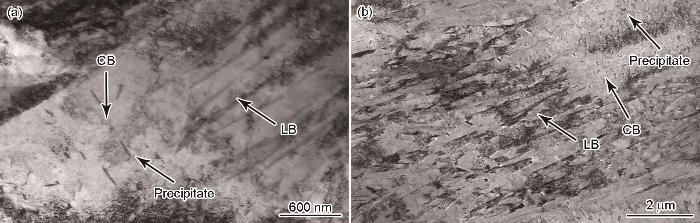
图4
Mo03和Mo07焊缝金属组织中聚合贝氏体(CB)的TEM像
Fig.4
TEM images of CB in the weld metals with different Mo contents
(a) Mo03 (b) Mo07
图5
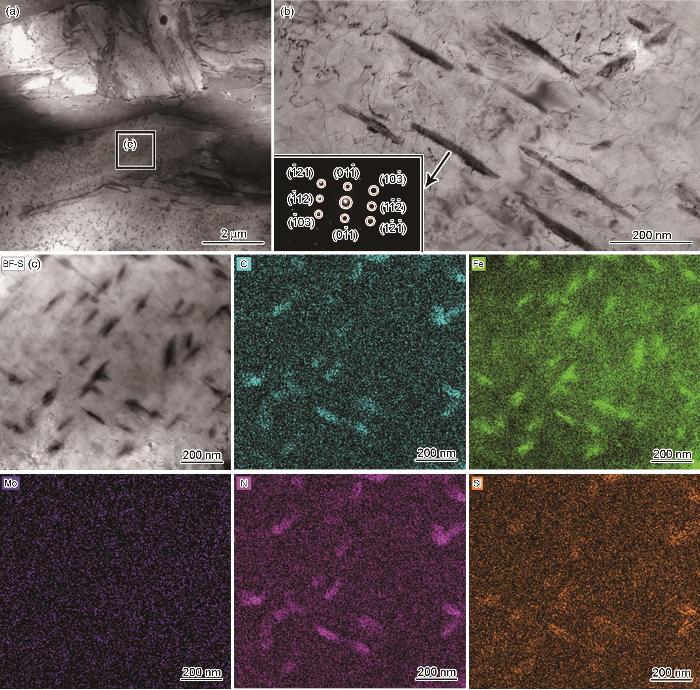
图5
Mo07焊缝金属中CB内部析出相的TEM表征
Fig.5
TEM characterizations of the precipitated phases inside the CB for Mo07 sample
(a, b) low (a) and high (b) magnified bright field TEM images and SAED pattern (inset)
(c) locally enlarged image of square region in Fig.5a and corresponding EDS elemental mappings
相变温度取决于焊缝金属的化学成分和冷却速率。由于母材尺寸和焊接参数相同,不同Mo含量焊缝金属的冷却速率基本不变,此时相变温度主要取决于焊缝金属化学成分。不同Mo含量焊缝金属的热膨胀曲线如图6所示。可以看出,随着Mo含量增加,焊缝金属的贝氏体相变起始温度(Bs)降低,当Mo含量分别为0.04%、0.32%和0.71%时,Bs分别为455、437和416 ℃。不同Mo含量焊缝金属中贝氏体板条形貌、CB含量和RA含量的变化与相变温度的改变有关。
图6

图6
不同Mo含量焊缝金属的热膨胀曲线
Fig.6
Thermal expansion curves of the weld metals with different Mo contents
不同Mo含量焊缝金属的XRD谱如图7所示。随着Mo含量增加,(111) γ 衍射峰明显增强,说明焊缝金属中RA含量增加。由于Mo00焊缝金属中RA含量较少,其XRD谱分峰困难,仅使用Jade软件通过K值法对Mo03和Mo07焊缝金属内的RA含量进行计算,测得Mo03和Mo07焊缝金属中RA的体积分数分别为3.1%和4.3%。图8为不同Mo含量焊缝金属的反极图和相图。如图8d~f所示,随着Mo含量从0.04%增加到0.32%再到0.71%,焊缝金属中fcc结构RA的面积分数从1.6%增加至2.9%和6.4%,变化趋势与XRD谱结果一致。研究[30]表明,对于低碳贝氏体钢,Mo元素能够增强奥氏体稳定性,使得组织中RA含量增加。
图7

图7
不同Mo含量焊缝金属的XRD谱
Fig.7
XRD patterns of weld metals with different Mo contents
图8
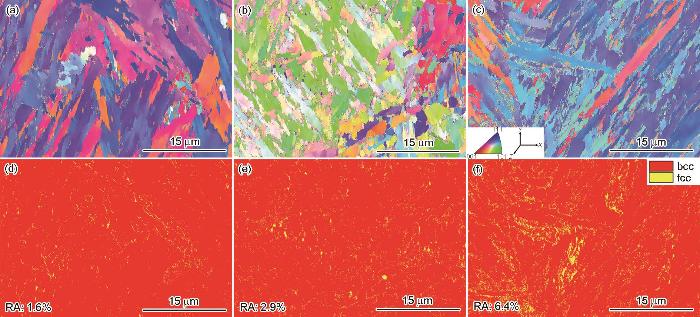
图8
不同Mo含量焊缝金属的反极图和相图
Fig.8
Inverse pole figures (a-c) and phase maps (d-f) of weld metals with different Mo contents (RA—retained austenite)
(a, d) Mo00 (b, e) Mo03 (c, f) Mo07
图9

图9
Mo00焊缝金属中残余奥氏体的TEM明场像、暗场像及SAED花样
Fig.9
TEM bright field (a) and dark field (b) images and corresponding SAED pattern (inset) of RA in Mo00 weld metal
2.2 焊缝金属的力学性能
不同Mo含量焊缝金属的室温拉伸性能如图10a所示。可以看出,随着Mo含量从0.04%增加到0.32%再到0.71%,焊缝金属屈服强度(Rp0.2)从(905 ± 13) MPa增大到(926 ± 18) MPa再到(939 ± 10) MPa,抗拉强度(Rm)也从(1038 ± 2) MPa增加到(1131 ± 3) MPa再到(1181 ± 2) MPa。Mo含量的增加对焊缝金属的伸长率(A)和断面收缩率(Z)没有明显影响。
图10

图10
不同Mo含量焊缝金属的力学性能
Fig.10
Mechanical properties of weld metals with different Mo contents
(a) tensile properties at room temperature (Rp0.2—yield strength, Rm—tensile strength, A—elongation, Z—reduction of area)
(b) Vickers hardnesses (c) impact energies at room temperature
不同Mo含量焊缝金属的Vickers硬度如图10b所示。受到焊缝金属微观结构不均匀的影响,硬度曲线呈波浪状,但随着焊缝金属中Mo含量的上升,焊缝金属的淬硬性提高,焊缝金属组织中较为硬脆的贝氏体含量增加,使得焊缝金属整体硬度提高,其平均值从336 HV0.5增大至350 HV0.5再到380 HV0.5。
不同Mo含量焊缝金属的室温冲击性能如图10c所示。可以看出,Mo00、Mo03和Mo07焊缝金属的室温冲击功分别为(83 ± 3)、(53 ± 2)和(60 ± 3) J。
Pavlina和Van Tyne[34]研究表明,显微硬度与拉伸性能之间有强关联,可通过显微硬度预测材料的强度。对于屈服强度在300~1700 MPa之间的钢材,Vickers硬度(H)与Rp0.2和Rm的关系如下:
利用
表2 不同Mo含量焊缝金属屈服强度和抗拉强度的实测值、计算值及其误差
Table 2
| Weld metal | Rp0.2 | Rm | ||||
|---|---|---|---|---|---|---|
| Measured value / MPa | Calculated value / MPa | Error | Measured value / MPa | Calculated value / MPa | Error | |
| Mo00 | 905 | 876 | 3.2% | 1038 | 1154 | 10.1% |
| Mo03 | 926 | 916 | 1.1% | 1131 | 1206 | 6.2% |
| Mo07 | 939 | 970 | 3.2% | 1181 | 1277 | 7.5% |
2.3 焊缝金属断口表征
图11
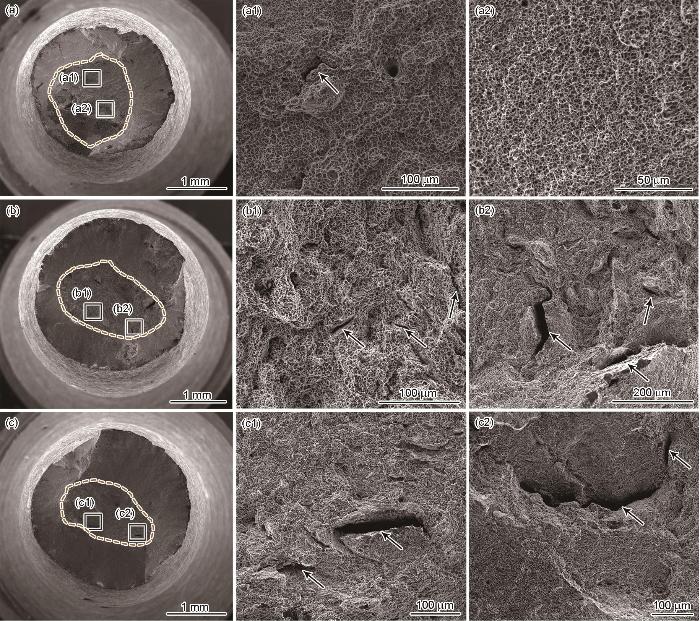
图11
不同Mo含量焊缝金属室温拉伸断口形貌的SEM像
Fig.11
Low (a-c) and locally high (a1-c1, a2-c2) magnified SEM images showing the tensile fracture morphologies of weld metals with different Mo contents at room temperature (Areas enclosed by dashed lines show the fiber regions. Arrows show the secondary cracks) (a, a1, a2) Mo00 (b, b1, b2) Mo03 (c, c1, c2) Mo07
图12
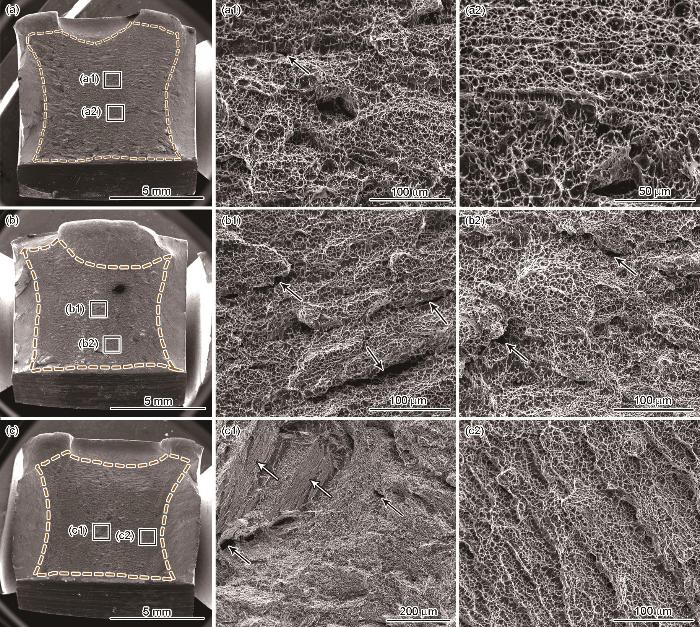
图12
不同Mo含量焊缝金属室温冲击断口形貌的SEM像
Fig.12
Low (a-c) and locally high (a1-c1, a2-c2) magnified SEM images showing the impact fracture morphologies of weld metal with different Mo contents at room temperature (Areas enclosed by dashed lines show the fiber regions. Black arrows show the secondary cracks. White arrows show the cleavage characteristics) (a, a1, a2) Mo00 (b, b1, b2) Mo03 (c, c1, c2) Mo07
3 分析与讨论
图13
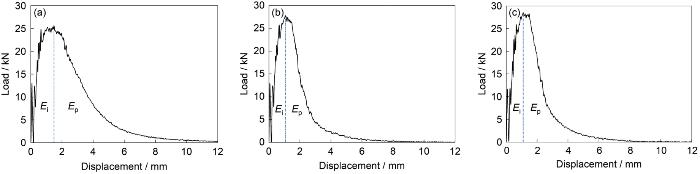
图13
不同Mo含量焊缝金属的室温冲击载荷-位移曲线
Fig.13
Impact load-displacement curves of weld metal with different Mo contents at room temperature (Ei—crack initiation energy, Ep—crack propagation energy)
(a) Mo00 (b) Mo03 (c) Mo07
裂纹的扩展路径可以直观反映焊缝金属组织对裂纹扩展的作用。在冲击断裂过程中,为了实现能量消耗的最小化,裂纹会沿着所需能量最小的路径扩展。不同微观组织对裂纹扩展的阻碍能力不同,从而导致裂纹的扩展方向发生偏折,改变裂纹的扩展路径。图14为Mo03和Mo07焊缝金属冲击试样断口横截面的SEM像。可以看出,一次裂纹在经过CB时,其扩展方向并没有受到有效阻碍,而是直接穿过CB扩展,说明CB对裂纹扩展的阻碍效果较弱,如图14a所示。一次裂纹在经过原奥氏体晶界(prior austenite grain boundary,PAGB)时,裂纹扩展方向发生明显偏折。Jiang等[36]研究表明,PAGB为大角度晶界,能够有效阻碍裂纹扩展。同时从图14b可以看出,二次裂纹也易穿过CB。
图14

图14
Mo03和Mo07焊缝金属冲击试样断口横截面的SEM像
Fig.14
Cross-sectional SEM images of impact fracture specimens (White arrows in Fig.14a show crack propagation paths)
(a) Mo03 (b) Mo07
不同Mo含量焊缝金属的晶界取向差分布如图15a~c所示,图15d为不同Mo含量焊缝金属组织中大角度晶界和小角度晶界频率的统计结果。随着Mo含量从0.04%增加到0.32%再到0.71%,焊缝金属组织中的大角度晶界占比下降,由70.4%下降至53.7%和56.7%。原因在于Mo含量增加促进了焊缝金属中板条贝氏体合并,使得界面数量减少,大角度晶界占比下降。但Mo含量的升高也增加了奥氏体的稳定性,RA含量增多,贝氏体板条与RA之间存在较大的取向差,其界面为大角度晶界[37],同时Mo07焊缝金属组织中的CB含量仅略高于Mo03焊缝金属,综合作用导致Mo07焊缝金属中的大角度晶界占比略高于Mo03焊缝金属。大角度晶界的晶界能更高[38],可以有效阻碍裂纹扩展,当裂纹扩展至大角度晶界时,裂纹扩展所需能量更多,导致Mo00焊缝金属裂纹扩展功最高,而Mo03焊缝金属裂纹扩展功最低。
图15
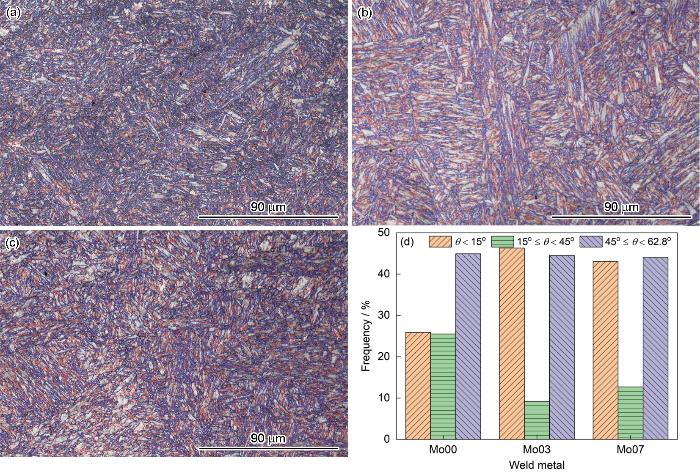
图15
不同Mo含量焊缝金属的晶界取向差分布及其统计结果
Fig.15
Grain boundary misorientation distributions in weld metals of Mo00 (a), Mo03 (b), and Mo07 (c); and the statistical results (d) (Red, black, and blue lines show the grain boundary misorientation angles (θ) with < 15°, 15°-45°, and 45°-62.8°, respectively)
对Mo00、Mo03和Mo07焊缝金属的室温冲击断口横截面进行EBSD表征,结果如图16所示。可以观察到Mo00焊缝金属中二次裂纹扩展受阻的典型位置,二次裂纹在该位置发生偏转,如图16a中圆圈所示。测量结果表明,二次裂纹偏折位置的界面取向差分别为54.19°、55.34°、59.03°和50.71°,均大于15°。大角度晶界两侧组织的晶体学取向不同,能对裂纹扩展产生阻碍,使得裂纹扩展方向发生转变,增加裂纹扩展过程中所消耗的能量,进而提高焊缝金属的冲击韧性。从图16b和c可以看出,Mo03和Mo07焊缝金属冲击断口的一次裂纹扩展路径较为平直,扩展方向很少发生转折。这主要是由于,虽然CB界面与基体交界处的界面取向差大于15°,为大角度晶界,对裂纹有一定的阻碍作用,但CB内部取向差接近零,对裂纹的阻碍效果差,Mo03和Mo07焊缝金属中CB较多,导致裂纹扩展功较低,恶化了焊缝金属冲击韧性。
图16
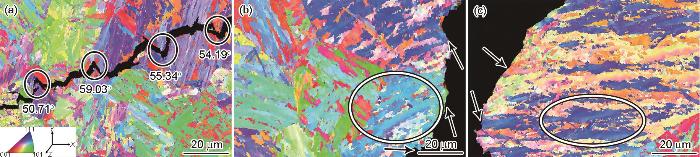
图16
不同Mo含量焊缝金属冲击断口横截面的反极图
Fig.16
Inverse pole figures of impact fracture cross-sections of weld metals with different Mo contents (Black and white circles show the significant crack deflection and CB, respectively. Black arrows indicate straight crack propagation through the CB)
(a) Mo00 (b) Mo03 (c) Mo07
4 结论
(1) Mo含量为0.04%、0.32%和0.71%的焊缝金属组织主要为LB和CB。随着焊缝金属中Mo含量增加,贝氏体相变点降低,相变驱动力提高,同时贝氏体板条平行排布,促进了贝氏体板条合并,使得焊缝金属中CB含量由8.53% ± 1.18%增加到13.43% ± 2.05%和15.11% ± 2.27%。
(2) 随着焊缝金属Mo含量增加,焊缝金属淬硬性提高,其屈服强度、抗拉强度和显微硬度均增加。Mo07焊缝金属的强韧性匹配最佳,其屈服强度达(939 ± 10) MPa,抗拉强度达(1181 ± 2) MPa,室温冲击功达(60 ± 3) J。
(3) 随着焊缝金属Mo含量增加,焊缝金属的冲击韧性先下降后略微上升。与Mo00焊缝金属相比,Mo03和Mo07焊缝金属Ep分别降低了37.5%和26.8%。冲击韧性下降的主要原因在于,焊缝金属中大角度晶界占比下降,焊缝金属组织形貌从交织状向平行状转变,焊缝金属中CB含量增多。由于Mo03和Mo07焊缝金属组织中CB含量差异较小,同时Mo07焊缝金属的大角度晶界占比和RA含量均高于Mo03焊缝金属,使得Mo07焊缝金属的冲击功略微高于Mo03焊缝金属。
参考文献
High strength steel (600-900 MPa) deposited metals: Microstructure and mechanical properties
[J].
The microstructure and mechanical properties of the deposited metals of five metal cored wires for welding 600–900 MPa ultralow carbon bainitic steels were investigated. It was found that lowering the C content and optimising the Mn, Ni, Mo and Cr contents of the deposited metal significantly improved the strength and toughness. At the lowest strength level (627 MPa), ferrite dominated, mainly acicular ferrite and proeutectoid ferrite. However, at the highest strength level (>800 MPa), bainite dominated, mainly degenerate upper bainite and granular bainite. Good strength toughness match was achieved by a deposited metal having an interlaced multiphase microstructure with degenerate upper bainite and martensite acting as main strengthening phases, and granular bainite and acicular ferrite acting as toughening phases.
Effect of nickel contents on the microstructure and mechanical properties for low-carbon bainitic weld metals
[J].
Influence mechanism of PWHT on strength and toughness of deposited metal with 1500 MPa grade ultra-high strength steel welding wire
[J].
Microalloying effects of Mo versus Cr in HSLA steels with ultrafine-grained ferrite microstructures
[J].
The effect of increasing Cu and Ni on a significant enhancement of mechanical properties of high strength low alloy, low carbon steels of HSLA-100 type
[J].
Fusion welding of ultra-high strength structural steels—A review
[J].
Ultimate strength and failure modes for fillet welds in high strength steels
[J].
Effect of ultrasonic treatment on microstructure and properties of 2000 MPa ultra-high-strength steel-welded joints
[J].The microstructure and mechanical properties of ultra-high-strength steel weld joints were examined for the effect of ultrasonic treatment. ER120S-G welding wire is necessary for welding 4 mm thick ultra-high-strength steel. After that, the weld toe region underwent different parameters of the ultrasonic stress relief process. As a means of surface treatment for weld seams, noticeable grain refinement and the formation of a fine-grained layer were observed in the weld toe region after ultrasonic treatment. The blind hole method was used to measure residual stresses in the weld seam, which indicated a transition from tensile stress to compressive stress in the treated portion of the joint. Different ultrasonic treatment processes resulted in a significant increase in hardness values near the weld toe region during hardness testing. The hardness of the weld joint that was treated with ultrasound increased initially but then stabilized after increasing the frequency. The ultrasound-treated joints showed a significant improvement in both tensile strength and fracture elongation, as demonstrated in the tensile tests.
Influence of chemical composition on the mechanical and microstructural properties of high strength steel weld metals submitted to PWHT
[J].
Effects of heat input on the mechanical properties of butt-welded high and ultra-high strength steels
[J].
Effects of heat input on the microstructure and impact toughness of weld metal processed by a new fluxnovel flux cored wire weld
[J].
热输入量对一种新型药芯焊丝熔敷金属组织及冲击韧性的影响
[J].采用自行研究开发的一种新型药芯焊丝, 通过实验室大热输入焊接实验, 研究分析了热输入量对焊缝熔敷金属组织与冲击韧性的影响规律. 结果表明: 在大热输入焊接条件下, 熔敷金属中形成了大量细小、弥散分布的夹杂物, 夹杂物周围诱导生成的大量相互交叉互锁的针状铁素体晶粒, 这是焊缝熔敷金属具有较高低温冲击韧性的主要原因; 随着焊接热输入量的增加, 尺寸为1 μm以下的夹杂物数量减少, 1 μm以上夹杂物分布无显著变化, 针状铁素体形核点减少, 熔敷金属中针状铁素体晶粒尺寸略有增加、低温冲击韧性略有降低.
Strengthening-toughening mechanism of cost-saving marine steel plate with 1000 MPa yield strength
[J].
Developing 1000 MPa grade LCLA steels through continuous cooling: Effects of Cr and cooling rate on bainitic and martensitic transformations
[J].
Improvement of strength and toughness of 1 GPa Cu-bearing HSLA steel by direct quenching
[J].
Addition of cerium and yttrium to ferritic steel weld metal to improve hydrogen trapping efficiency
[J].
Development of high-strength welding consumables using calculations and microstructural characterisation
[J].
Microstructure and mechanical properties of welded joint of a Fe-Cr-Ni-Mo steel with high-strength and high-toughness
[J].High-strength steel has the advantages of high strength, low cost and good hot and cold workability, etc., which is widely used in various fields of national economy as engineering steel, such as bridge, vehicle, ship, pressure vessel and so on. As increasing strength, the plasticity and toughness of high strength steel have not meet the demand in some industrial areas, especially the low temperature impact toughness. Recently, a Fe-Cr-Ni-Mo steel with high-strength and high-toughness has been deve-loped and has been successfully used to prepare high pressure vessels. In this work, metal active gas (MAG) welding with multi-pass welding was used to join a Fe-Cr-Ni-Mo high-strength and high-toughness steel. The microstructure and fracture morphologies of welded joint are investigated by SEM, EPMA and TEM and the micro-hardness, tensile strength and Charpy impact energy are tested as well. The results show that the morphologies of welded metal (WM) consist of columnar crystal (CC) and equiaxed crystal (EC), where the upper WM is predominantly CC and the proportion of EC increases in the lower WM. The microstructure of upper WM is tempered martensite for the faster cooling rate. Because the higher content of alloying elements in lower WM improves the hardening tendencies, the lower WM is granular bainite. The heat affected zone near WM is coarsen martensite and has the highest hardness (621 HV), which is significantly higher than that of the base metal (BM) (410 HV). The hardness of the upper WM is 365 HV, which is lower than that of BM and the lower WM has higher hardness (450 HV). Therefore, the upper tensile sample of welded joint was broken in the WM and the fracture strength is 1109 MPa and lower than that of BM (1190 MPa). While the fracture position of lower tensile sample is in the BM and the strength is about 1183 MPa. The welded joint of experimental Fe-Cr-Ni-Mo steel has higher strength and the welding factor is not lower than 0.93. Moreover, the impact energy of WM is 53 J.
一种Fe-Cr-Ni-Mo高强高韧合金钢焊接接头的组织和力学性能
[J].采用熔化极活性气体保护焊(MAG焊)对一种Fe-Cr-Ni-Mo高强高韧合金钢板进行多道次焊接,利用SEM、EPMA、TEM以及拉伸、冲击等实验研究了焊接接头的组织和力学性能。结果表明,焊缝金属由柱状晶和等轴晶组成,其中上部焊缝以柱状晶为主,而下部焊缝的等轴晶含量增加。焊缝上部因冷速较快形成回火马氏体组织;下部因合金元素含量较高,淬硬倾向较强,形成了粒状贝氏体组织。靠近焊缝的热影响区为较粗大的马氏体组织,其硬度最大(621 HV),明显高于母材(410 HV)。上部焊缝金属的硬度为365 HV,低于母材,而下部焊缝的硬度高于焊缝上部和母材,为450 HV。因此,焊接接头上部拉伸试样在焊缝处发生断裂,断裂强度为1109 MPa,而焊缝的下部拉伸试样在母材处发生断裂,断裂强度为1183 MPa。本实验用Fe-Cr-Ni-Mo合金钢的焊接接头强度较高,焊接强度系数不小于0.93,焊缝金属的冲击功为53 J。
Effect of carbon content on strength and toughness of deposited metal for 1000 MPa-grade high-strength welding wire
[J].
Local microstructure evolution of a V-containing Fe-Cr-Ni-Mo weld metal subjected to post-weld heat treatment
[J].
Effect of Ni on the microstructure evolution of Cr-Ni-Mo series high strength weld metal
[J].
Ni元素对Cr-Ni-Mo系高强焊缝组织演化的影响
[J].
Influence of carbon, manganese and nickel on microstructure and properties of strong steel weld metals: Part 3—Increased strength resulting from carbon additions
[J].Neural network predictions suggested that the strength of a high strength steel weld metal with 7 wt-% nickel and 0·5 wt-% manganese could be increased significantly at moderate expense to impact toughness by additions of carbon. Based on this, three experimental weld metals were produced with carbon contents between 0·03 and 0·11 wt-%. Mechanical test results were in agreement with predictions. At low carbon content the microstructure was largely bainitic in dendrite core regions whereas martensite was found at interdendritic regions. From microstructural studies and dilatometry experiments it was found that carbon stabilised austenite to lower transformation temperatures and that the microstructure became more martensitic in nature. Effects on strength and impact toughness were explainable in terms of a refinement of the microstructure and tempering behaviour.
Electron backscattering diffraction study of coalesced bainite in high strength steel weld metals
[J].Coalesced bainite is a coarse constituent recently found to develop along with the classical martensite, lower and upper bainite in steel weld metals. Its crystallography has been characterised using electron backscattering diffraction in combination with field emission gun scanning electron microscopy. It is confirmed that coalesced bainite grains are crystallographically homogeneous but do contain orientation gradients. The misorientations across different grains of coalesced bainite and relative to conventional bainite have also been studied. The observations are discussed in the context of the mechanism by which coalesced bainite evolves.
Microstructural evolution and mechanical properties of high strength 3-9% Ni-steel alloys weld metals produced by electron beam welding
[J].
Influence of chromium content on the bainite transformation nucleation mechanism and the properties of 800 MPa grade low carbon bainite weld deposited metal
[J].
Effect of nickel and molybdenum additions on weld metal toughness in a submerged arc welded HSLA line-pipe steel
[J].
Effect of welding process on the microstructure and mechanical properties of Fe-Cr-Ni-Mo deposited metals
[J].
焊接方法对Fe-Cr-Ni-Mo系熔敷金属组织和性能的影响
[J].分别采用钨极氩弧焊(TIG焊)和熔化极活性气体保护焊(MAG焊)方法制备了785 MPa级Fe-Cr-Ni-Mo系熔敷金属.利用扫描电子显微镜、透射电子显微镜和电子背散射衍射仪对熔敷金属的组织类型和晶体学特征进行了详细的表征分析,结果表明,采用不同焊接方法制备得到的熔敷金属组织均为贝氏体,但钨极氩弧焊熔敷金属(DM-TIG)中出现大量聚合贝氏体;由于焊接过程中使用的保护气体不同,熔化极活性气体保护焊熔敷金属(DM-MAG)中存在大量夹杂物. 经过电子背散射衍射分析结果表明,相比于DM-TIG,DM-MAG中由于存在大量自催化形核现象,晶体学取向非常复杂.力学性能测试结果表明,DM-MAG中大尺寸夹杂物在冲击过程中作为裂纹源,从而导致DM-MAG的韧性明显低于DM-TIG,实际工程应用中对于低温韧性要求较高的结构部件应合理选择焊接方法.
Research of heat affected zone on microstructure and performance of 960 MPa grade high strength steel for construction machinery
[D].
工程机械用960MPa级高强钢焊接热影响区组织与性能研究
[D].
Ultra-high-strength multi-alloyed steel with enhanced cryogenic toughness using thermally stable retained austenite
[J].
Microstructure control, strengthening and toughening mechanism of Cu-rich nanoprecipitate-strengthened steel
[D].
富铜纳米相强化钢的显微结构调控及强韧化机制研究
[D].
Effect of Mo content on microstructure and property of low-carbon bainitic steels
[J].In this work, three low-carbon bainitic steels, with different Mo contents, were designed to investigate the effects of Mo addition on microstructure and mechanical properties. Two-step cooling, i.e., initial accelerated cooling and subsequent slow cooling, was used to obtain the desired bainite microstructure. The results show that the product of strength and elongation first increases and then shows no significant change with increasing Mo. Compared with Mo-free steel, bainite in the Mo-containing steel tends to have a lath-like morphology due to a decrease in the bainitic transformation temperature. More martensite transformation occurs with the increasing Mo, resulting in greater hardness of the steel. Both the strength and elongation of the steel can be enhanced by Mo addition; however, the elongation may decrease with a further increase in Mo. From a practical viewpoint, the content of Mo could be ~0.14 wt. % for the composition design of low-carbon bainitic steels in the present work. To be noted, an optimal scheme may need to consider other situations such as the role of sheet thickness, toughness behavior and so on, which could require changes in the chemistry. Nevertheless, these results provide a reference for the composition design and processing method of low-carbon bainitic steels.
Microstructure of lower bainite formed at large undercoolings below bainite start temperature
[J].
Fundamentals and application of solid-state phase transformations for advanced high strength steels containing metastable retained austenite
[J].
Reversed austenite in additively manufactured martensitic stainless steel
[J].
Correlation of yield strength and tensile strength with hardness for steels
[J].
Effective grain size dependence of crack propagation resistance in low carbon steel
[J].
Microstructural characterization and impact toughness of a jackup rig rack steel treated by intercritical heat treatment
[J].
Effect of microalloying on the hot workability of ultra-fine bainite rail steel
[D].
微合金化对超细贝氏体轨道钢热加工性能的影响
[D].


