



然而,由于钛合金与钢这两种材料存在显著的物理性能差异和冶金不相容性,采用常规焊接方法很难直接将其连接在一起。尽管通过钎焊[3]、扩散焊[4,5]、摩擦焊[6,7]等非熔化焊方法可以实现钛合金与钢之间的高强连接,但受限于接头形式、特殊的焊接设备或被连接工件尺寸等原因,上述焊接方法难以在船舶建造领域大规模推广应用。Li等[8]通过偏置振荡激光焊接(bias oscillation laser welding)方式成功制备了TA2与304不锈钢焊接接头,其最大抗拉强度为395 MPa。Wang等[9]使用高熵合金作为中间层,实现了TC4钛合金与316L不锈钢的可靠连接,最大剪切强度为222.8 MPa。现阶段研究主要集中在通过调整工艺和设计优化中间层来改善接头力学性能,但界面脆性相的生成及控制仍是制约钛/钢异质金属复合接头综合性能的主要瓶颈。采用爆炸焊制备异质金属过渡接头,将异种金属焊接转变为同种金属焊接,是目前船舶领域制造异种金属混合结构的主要方法[10,11],该技术已在铝/钢混合船体焊接制造中得到成功应用。值得注意的是,过渡接头与上、下壁板结构焊接多采用角接形式,数次角接过程中的多重焊接热循环必然会对过渡接头的界面组织和性能产生影响。有研究[12~14]采用短时热处理模拟焊接工艺(保温时间分别为15和30 min),研究了爆炸焊接头界面黏结强度随温度的演变规律。王世宏等[12]和刘壮武等[15]发现,铝/钢接头的结合强度随温度升高而降低,表现为界面热致退化特性。温度高于350 ℃时,铝/钢界面的黏结强度显著下降,因此界面临界温度通常不允许超过350 ℃。爆炸焊界面通常具有较高的变形程度和储存能量,在附加热循环作用下极易转变为低能量平衡组织,诱导界面微观结构和结合性能发生转变。另外,界面处的高温会导致金属间化合物(IMCs)的生长,使IMCs层的厚度增加,恶化界面的力学性能。
为获得高强高韧的异质金属混合结构,科研人员采用爆炸焊接头作为中间层研究了钛合金与钢之间的电子束焊接[16]和激光焊接[17]。Gao等[18]采用TA2/Q235爆炸焊接复合板作为过渡接头成功实现了TC4钛合金与304不锈钢之间的可靠连接,接头拉伸断裂于爆炸焊过渡接头界面处,最大抗拉强度达548 MPa。毕宗岳等[19]使用TA1/X65复合板作为过渡接头成功制备了抗拉强度为546 MPa的钛/钢复合结构。Wang等[20]使用电子束焊接工艺对TA10/Q345复合板进行二次焊接,发现电子束焊缝距离爆炸焊接界面越近,IMCs层越厚。此外,有研究表明,在较高温度下脆性IMCs[21]和残余应力[22]会导致结合界面失效。Wu等[23,24]研究发现,随着热处理温度和脉冲电流的增加,钛/钢异质金属接头界面处FeTi和Fe2Ti化合物层的厚度急剧增加。Akbari Mousavi和Sartangi[25]通过将商业纯Ti/AISI 304不锈钢复合板在650~950 ℃区间进行热处理,发现在此温度区间内结合界面处形成了多种脆性IMCs。
在基于爆炸焊接头连接的铝/钢混合结构中,二次焊接热循环对界面组织和性能的影响已基本厘清,界面温度临界阈值为350 ℃。然而,在相同结构尺寸条件下的钛/钢混合结构焊接建造过程中,由于熔点、热导率、热膨胀系数等物理性能存在差异,因此接头界面温度更高,附加热循环的影响更加明显。此外,钛合金的屈服强度远高于铝合金,爆炸焊钛/钢接头界面组织的变形程度比铝/钢接头更剧烈,储存能量更高,为典型的极端非平衡组织状态。在外界热力耦合作用下,非平衡态组织极易向低能量平衡态转变,造成界面结合性能的非均匀变化。目前,针对附加二次焊接热循环对钛/钢接头界面性能的影响尚缺乏系统研究,钛/钢接头界面最高许用峰值温度仍然未知。因此,本工作采用模拟瞬态热处理(simulated transient heat treatment,STHT)方法对上述问题开展实验研究,以期揭示温度对爆炸焊钛/钢接头界面组织及结合性能的影响规律,明晰界面临界温度,为过渡接头的结构和焊接工艺优化提供理论依据。
1 实验方法
本工作所用实验材料为商用爆炸焊钛/钢接头,宽度为30 mm,其成形制备过程如图1a所示。其中907高强钢作为基板(厚度16 mm),TA2工业纯Ti作为覆板(厚度6 mm),907高强钢以及TA2纯Ti的化学成分见表1。为研究温度对界面组织和性能的影响规律,采用较大温度范围的STHT实验,工业纯Ti的α→β相转变温度大约为882.5 ℃,故最高温度设置为900 ℃。热处理温度依次为200、300、400、500、600、700、800和900 ℃。待炉腔温度升至预定值后装入样品并保温15 min,保温结束后取出,空冷至室温。热处理工艺如图1b所示。采用Gemini SEM 300扫描电子显微镜(SEM)、电子背散射衍射(EBSD)和能谱仪(EDS)对界面微观结构和元素分布进行表征,用AZtecCrystal软件对EBSD数据进行处理,计算得到接头再结晶情况及再结晶体积分数。采用DNS100型万能试验机在室温下对热处理前后的接头进行剪切和结合强度测试,试样尺寸及测试方法如图1c1和c2所示。黏结强度和剪切强度实验速率为1 mm/min,随后采用SEM和EDS对断裂面进行形貌观察和成分分析。采用Nanoindenter G200型纳米压痕测试仪测试不同热处理试样结合界面的硬度并得到测试点的载荷位移曲线和弹性模量,最大压痕深度为1000 nm。
图1
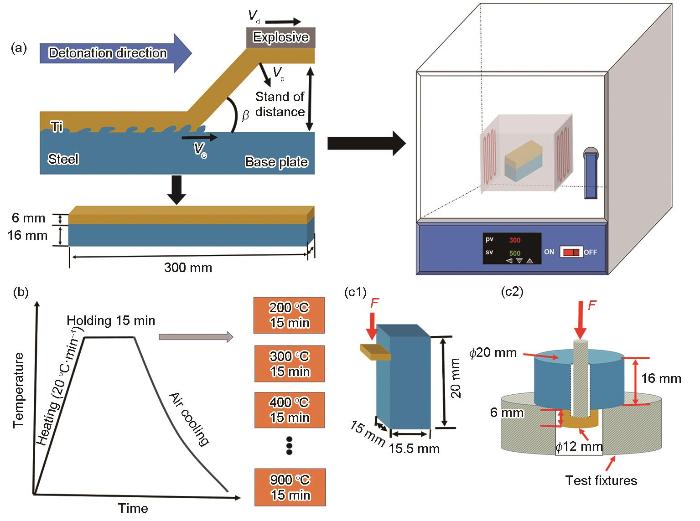
图1
实验过程示意图
Fig.1
Illustrations of the experiment process
(a) explosive welding (Vd—detonation velocity, Vc—impact velocity, Vp—plate collision velocity, β—impact angle)
(b) simulated transient heat treatment (STHT) experiment
(c1, c2) shear strength (c1) and bonding strength (c2) tests (F—applied force)
表1 TA2纯Ti和907钢的化学成分 (mass fraction / %)
Table 1
| Material | C | Cr | Fe | Mn | Si | Ti |
|---|---|---|---|---|---|---|
| TA2 | < 0.01 | - | < 0.01 | - | - | Bal. |
| 907 | 0.20 | 0.79 | Bal. | 0.93 | 0.50 | - |
2 实验结果与分析
2.1 温度对钛/钢接头界面显微组织的影响
图2
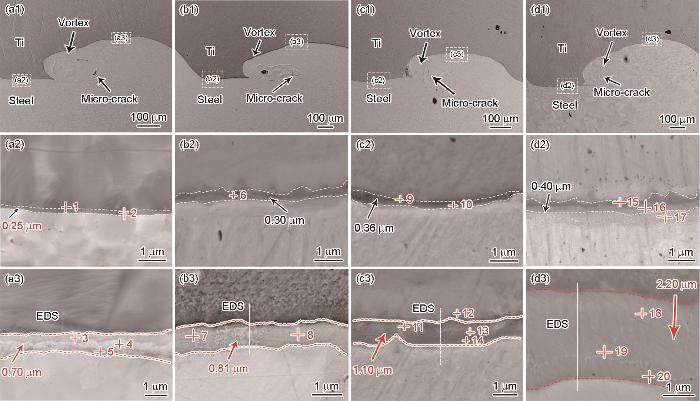
图2
不同温度模拟瞬态热处理(STHT)前后钛/钢接头界面微观组织的SEM像
Fig.2
SEM images showing the interfacial microstructures (a1-d1), enlarged images of the straight interface (a2-d2), and enlarged images of non-straight interface (a3-d3) in titanium/steel transit joint as-welded (a1-a3) and after STHT under 400 oC (b1-b3), 600 oC (c1-c3), and 700 oC (d1-d3)
图3
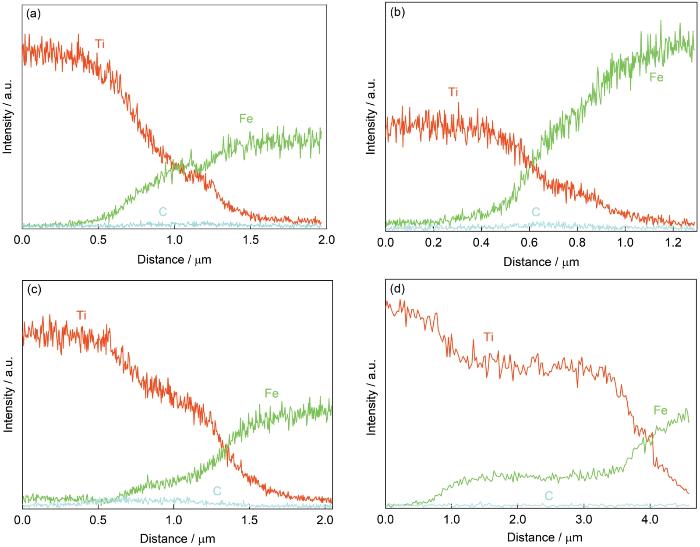
图3
不同温度STHT前后钛/钢接头界面微观组织的EDS线扫描结果
Fig.3
EDS line scanning results of the non-straight interface in titanium/steel transit joint as-welded (a) and after STHT under 400 oC (b), 600 oC (c), and 700 oC (d)
表2 图2中点1~20的EDS元素成分分析 (atomic fraction / %)
Table 2
| Position | C | Ti | Fe | Possible phase |
|---|---|---|---|---|
| 1 | 23.54 | 57.65 | 18.81 | TiC + FeTi |
| 2 | 33.36 | 43.83 | 22.82 | TiC + FeTi |
| 3 | 19.64 | 37.95 | 42.42 | TiC + Fe2Ti |
| 4 | 26.00 | 18.22 | 55.78 | FeTi + α-Fe |
| 5 | 25.98 | 4.02 | 70.00 | α-Fe |
| 6 | 28.31 | 50.56 | 21.13 | TiC + FeTi |
| 7 | 9.54 | 70.27 | 20.19 | FeTi + α-Ti |
| 8 | 10.43 | 60.42 | 25.15 | FeTi + α-Ti |
| 9 | 29.33 | 58.86 | 11.81 | TiC + FeTi |
| 10 | 26.72 | 25.30 | 47.98 | TiC + α-Fe |
| 11 | 37.05 | 46.47 | 16.49 | TiC + FeTi |
| 12 | 28.64 | 66.12 | 5.24 | TiC + α-Ti |
| 13 | 35.82 | 28.18 | 36.00 | TiC + α-Fe |
| 14 | 29.31 | 20.44 | 50.25 | FeTi + α-Fe |
| 15 | 35.73 | 58.06 | 6.20 | TiC + α-Ti |
| 16 | 42.08 | 39.82 | 18.11 | TiC + α-Fe |
| 17 | 43.68 | 24.01 | 32.31 | TiC + α-Fe |
| 18 | 9.92 | 64.52 | 25.56 | FeTi + α-Ti |
| 19 | 11.28 | 61.56 | 27.16 | FeTi + α-Ti |
| 20 | 13.84 | 40.30 | 45.86 | FeTi |
由图2可以看出,随温度升高,400和600 ℃瞬态热处理试样平直区域和非平直区域的IMC层厚度较焊态试样分别增加了0.05和0.11 μm及0.11和0.40 μm。600 ℃以下瞬态热处理对钛/钢接头界面微观组织无明显影响。当瞬态热处理温度达到700 ℃后,界面IMCs生长显著(图2d3)。非平直区域IMCs层厚度增加更为明显,由焊态的0.70 μm增加至2.20 μm,而平直区域IMCs层厚度仅由0.25 μm增加至0.40 μm。界面处的原子扩散迁移是IMCs生长的根本原因。通过对界面IMCs层进行EDS线扫描发现,600 ℃瞬态热处理试样的IMCs层中出现了C元素富集,如图3c所示。在200~1400 ℃范围内形成TiC所需要的Gibbs自由能远低于FeTi和Fe2Ti,说明TiC先于FeTi相在界面生成[27,28],连续TiC层的形成会阻碍Fe、Ti原子在界面处的互扩散[29,30],且随着温度的升高IMCs层厚度增大。由图2d3可以看出,当瞬态热处理温度升高到700 ℃时,界面处的TiC层破裂,FeTi和Fe2Ti IMCs层厚度迅速增加。这是因为爆炸焊接头界面因高速冲击应变而储存了更高能量,与平衡状态下的钛/钢界面扩散相比,爆炸焊钛/钢界面的原子扩散激活能更低,在瞬态热处理过程中,界面附近原子扩散更加充分,从而导致高温下界面IMCs生长显著。
图4为不同温度瞬态热处理前后钛/钢接头界面XOZ侧表面的反极图。从图4a可以看出,焊态钢侧晶粒呈平行于界面的流线形分布,而钛侧晶粒则为等轴晶,钢侧的塑性变形相较钛侧更为剧烈,这使得在瞬态热处理过程中钢侧微观组织转变的驱动力也更高。在紧邻界面处,钢侧形成了细小等轴晶层。这是由于钢的强度低于TA2纯Ti,因此变形主要发生在钢侧,其储存的能量更多,从而诱导低温再结晶发生,形成等轴细晶粒,这与Zhang等[31]的研究结果相吻合。600 ℃瞬态热处理后,如图4b所示,钢侧组织未见明显变化,仍保留了细长流线型晶粒特征,而钛侧出现了轻微的晶粒粗化。瞬态热处理温度达到700 ℃后,如图4c所示,钢侧变形组织特征完全消失,通过再结晶形成了粗大的等轴晶,钛侧则发生了显著的晶粒粗化。Ti的再结晶温度为723~775 ℃,由于钛/钢接头在爆炸焊接时钛侧金属存在变形,其内部的储存能较多,再结晶的驱动力增大,使得再结晶温度降低。再结晶完成后,等轴晶粒进一步长大,形成如图4c所示的粗大等轴晶。
图4
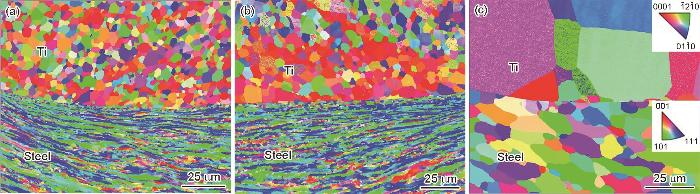
图4
不同温度STHT前后钛/钢接头界面的反极图
Fig.4
Inverse pole figures (IPFs) of the interface in titanium/steel transit joint as-welded (a) and after STHT under 600 oC (b) and 700 oC (c)
图5
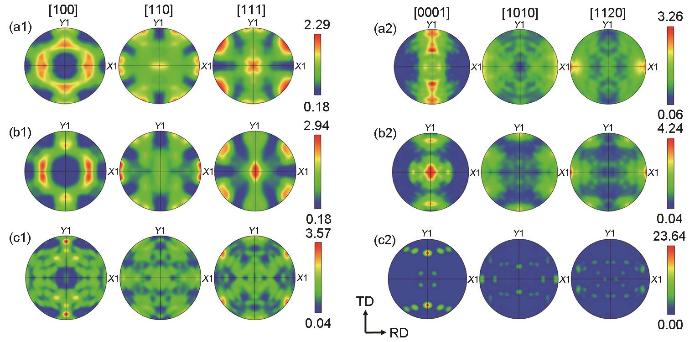
图5
不同温度STHT前后钛/钢接头两侧的极图
Fig.5
Pole figures (PFs) of titanium/steel transit joint for steel side (a1-c1) and Ti side (a2-c2) as-welded (a1, a2) and after STHT under 600 oC (b1, b2), and 700 oC (c1, c2) (TD—transverse direction, RD—rolling direction)
再结晶过程通常伴随着晶界两侧晶粒的取向变化。图6为不同温度瞬态热处理前后钛/钢接头界面的晶界分布及晶界取向差统计图。从图6a和b可以看出,焊态接头中大角度晶界(HAGBs)主要集中在钛侧,而钢基板中主要为小角度晶界(LAGBs),紧邻界面的等轴细晶区同样以HAGBs为主,这是由于塑性变形和再结晶引起的位错重构所致[32]。在600 ℃及以下短时受热后,如图6c和d所示,钛/钢接头中的晶界取向差无明显变化,与前文论述相吻合。而当瞬态热处理温度达到700 ℃时,如图6e和f所示,LAGBs体积分数显著降低(由600 ℃瞬态热处理的33.2%下降至7.8%),而HAGBs体积分数则大幅提升(由600 ℃瞬态热处理的66.8%增加至92.2%)。如前文所述,700 ℃瞬态热处理时钢侧发生再结晶,变形晶粒转变为等轴晶,LAGBs逐步转变为HAGBs,其本质为再结晶过程中位错重排和消失造成的晶界重构[33]。
图6
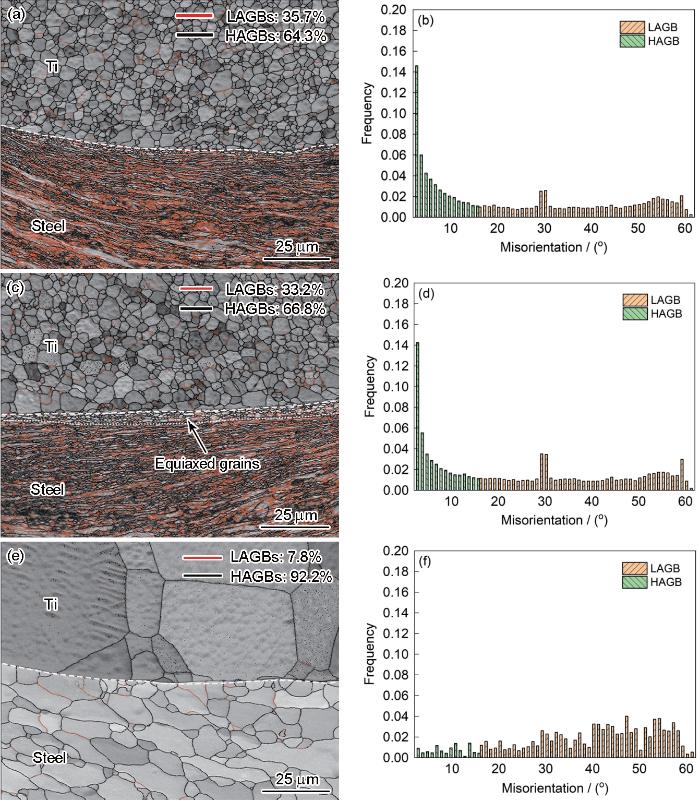
图6
不同温度STHT前后钛/钢接头界面的晶界分布及晶界取向差统计图
Fig.6
EBSD images (a, c, e) and grain boundary misorientation distributions (b, d, f) of the interface in titanium/steel transit joint as-welded (a, b) and after STHT under 600 oC (c, d) and 700 oC (e, f) (The black and red lines denote the high angle grain boundaries (HAGBs) with misorientation angle > 15° and low angle grain boundaries (LAGBs) with misorientation angle 2°-15°, respectively)
局部取向差(KAM)图是EBSD图像信息经过Gaussian平滑过滤和第三近邻法处理后得到的位错密度演变情况,平均取向差与几何必需位错密度成正比,可以表征局部位错密度分布[34]。几何必需位错密度可以反映材料内部残余应力大小,几何必需位错密度越高则残余应力越大。图7为不同温度瞬态热处理前后钛/钢接头界面的KAM图和平均取向差分布。可以看出,焊态样品的几何必需位错主要集中在钢侧变形晶粒中,而钛侧等轴晶粒中的几何必需位错数量相对较少。600 ℃及以下瞬态热处理后,钛/钢接头中的几何必需位错分布特征保持稳定,位错密度略有降低。瞬态热处理温度升高至700 ℃后,KAM数值大幅降低,表明钛/钢接头中的几何必需位错显著减少,这与再结晶转变过程中的微观组织变化一致。可见,随着温度的升高,材料内部残余应力逐渐减小。这是因为在爆炸焊过程中伴随着金属材料的剧烈变形,导致焊态下残余应力较大。随着热处理温度升高,变形组织发生回复和金属再结晶,残余应力随之逐渐降低。
图7
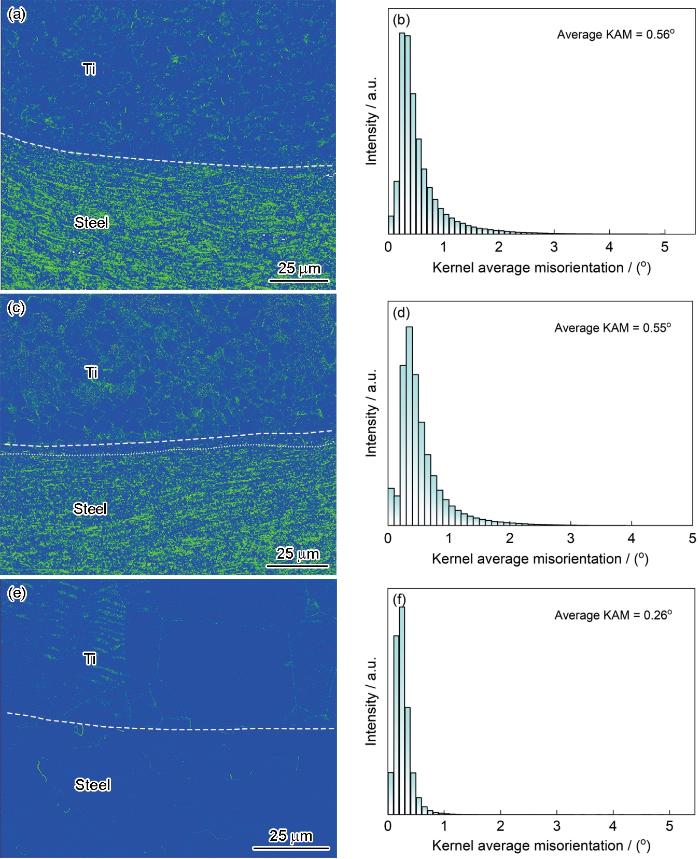
图7
不同温度STHT前后钛/钢接头界面局部取向差(KAM)图和平均取向差分布
Fig.7
Kernel average misorientation (KAM) maps (a, c, e) and average misorientation distributions (b, d, f) of the interface in titanium/steel transit joint as-welded (a, b) and after STHT under 600 oC (c, d) and 700 oC (e, f)
图8为不同温度瞬态热处理前后钛/钢接头变形组织、再结晶组织和亚结构的分布图及其体积分数统计结果。内部取向差角度小于2°的晶粒被确定为再结晶晶粒,取向差角度在2°~7°的晶粒被确定为亚结构,取向差角度大于7°的晶粒被确定为变形晶粒,分别用蓝、黄、红三种颜色标识,如图8所示。从图8a1~a3可以看出,焊态接头中再结晶晶粒集中分布于钛侧,钢侧则主要由变形晶粒组成。600 ℃及以下瞬态热处理后,如图8b1~b3所示,钛/钢接头中纯钛侧再结晶比例无明显变化,而钢侧变形晶粒则出现了向亚结构和再结晶的转变。瞬态热处理温度升高至700 ℃后,钛侧完全再结晶化,钢侧再结晶比例也大幅增加至80.8%,仅剩部分残留的亚结构(约19.2%)。上述分析表明,回复和再结晶是高温瞬态热处理过程中钛/钢接头界面组织结构演变的主要机制。
图8
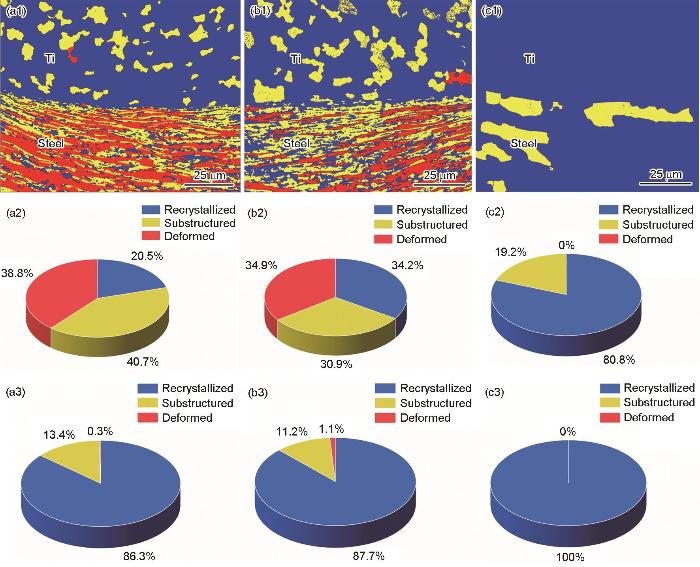
图8
不同温度STHT前后钛/钢接头微观结构特性分布及其统计结果
Fig.8
Structural characteristics (a1-c1), statistical results of the corresponding recrystallizd, substructured, and deformed proportions of the steel side (a2-c2) and titanium side (a3-c3) of titanium/steel transit joint as-welded (a1-a3) and after STHT under 600 oC (b1-b3) and 700 oC (c1-c3)
2.2 温度对钛/钢接头界面结合性能的影响
不同温度瞬态热处理前后钛/钢接头的黏结强度和剪切强度如图9所示。焊态界面的黏结强度与剪切强度分别为351和162 MPa。在中低温阶段(≤ 600 ℃),随瞬态热处理温度升高钛/钢接头界面黏结强度和剪切强度均有所提高。特别是当瞬态热处理温度升高至500 ℃时,黏结强度显著升高至579 MPa,温度继续提高至600 ℃后,黏结强度略有降低,为550 MPa,相比焊态提升57%;剪切强度则显著提高至284 MPa,相比焊态提升75%,表现为界面热致强化特性。进一步提高瞬态热处理温度(≥ 700 ℃)后,界面黏结强度和剪切强度均随温度升高而逐渐降低。
图9
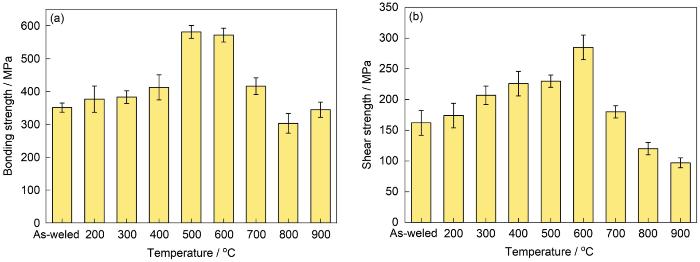
图9
不同温度STHT前后钛/钢接头界面的黏结强度和剪切强度
Fig.9
Bonding strengths (a) and shear strengths (b) of the interface in titanium/steel transit joint as-welded and after STHT under different temperatures
中低温(≤ 600 ℃)瞬态热处理时,钛/钢接头中发生回复,界面附近原子扩散能力增强,在应力释放的同时非平衡界面组织向低能量平衡态转变,同时界面脆性相(Ti-Fe IMCs和TiC)未出现显著生长,导致钛/钢接头界面黏结强度和剪切强度随温度升高而逐渐提高。而当瞬态热处理温度上升至700 ℃后,FeTi、Fe2Ti等脆性相在界面处的生长导致接头黏结强度和剪切强度迅速降低。综上所述,在船用钛/钢混合结构二次焊接时,接头界面临界温度为600 ℃,远高于接头生产建造时实测界面温度350 ℃。在钛/钢异质金属混合船体后续技术改进过程中,可通过缩小接头结构尺寸或增加焊接热输入的方式提高界面温度,改善界面结合强度的同时提升轻量化效果和生产效率。
不同温度瞬态热处理前后钛/钢接头断口形貌及断裂处的SEM像和EDS面扫描图如图10所示。可以看出,断裂模式主要分为解理断裂和准解理断裂两类。其中焊态接头断口为典型的解理断裂,断口表面较为平整光洁并伴有解理台阶等脆性断裂特征;600和700 ℃瞬态热处理样品断口表面解理台阶和撕裂棱同时存在,符合准解理断裂特征;其中700 ℃瞬态热处理样品断口表面存在少量孔洞,这可能是由于在较高温度下结合界面处原子扩散与脆性化合物共同作用的结果[35],也是接头结合性能降低的主要原因之一。经600 ℃瞬态热处理后,断口中有少量纯Ti基体被撕裂并粘附在钢侧(图10e),与500~600 ℃瞬态热处理后接头结合强度大幅升高相吻合。断口EDS成分测试结果(表3)表明,断面上存在FeTi IMCs,说明断裂发生在爆炸焊接界面结合处。高温热处理后脆性IMCs的生长是接头界面黏结强度和剪切强度下降的主要原因之一。在剪切实验中,硬脆性IMCs与基材变形程度不一致,进而在界面处产生应力集中,导致接头界面在较低应力作用下开裂。
图10
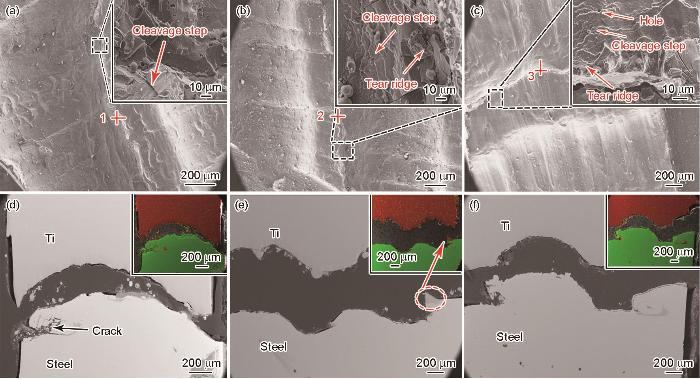
图10
不同温度STHT前后钛/钢接头断口形貌及断裂处的SEM像和EDS面扫描图
Fig.10
SEM images showing the fracture morphologies (a-c) and fracture positions (d-f) of titanium/steel transit joint as-welded (a, d) and after STHT under 600 oC (b, e) and 700 oC (c, f) (Insets in Figs.10a1-a3 and Figs.10d-f show the locally enlarged images of square regions and EDS mappings, respectively)
表3 图10中点1~3的EDS元素成分分析 (atomic fraction / %)
Table 3
| Position | Ti | Fe | Possible phase |
|---|---|---|---|
| 1 | 59.89 | 40.11 | FeTi |
| 2 | 58.86 | 41.14 | FeTi |
| 3 | 58.95 | 41.05 | FeTi |
钛/钢接头界面区域纳米压痕测试结果如图11所示。焊态接头界面漩涡中最高纳米硬度达16.80 GPa,远高于钢侧硬度8.37 GPa和钛侧硬度4.60 GPa。在爆炸焊过程中,漩涡区生成FeTi和Fe2Ti 硬脆IMCs,导致漩涡区硬度显著升高。同时爆炸焊过程中产生的较大残余应力也是漩涡区高硬度的原因之一。经不同温度瞬态热处理后,界面区域组织发生回复再结晶,内应力得到释放,界面处位错密度降低,从而导致界面区域纳米硬度逐渐降低。
图11
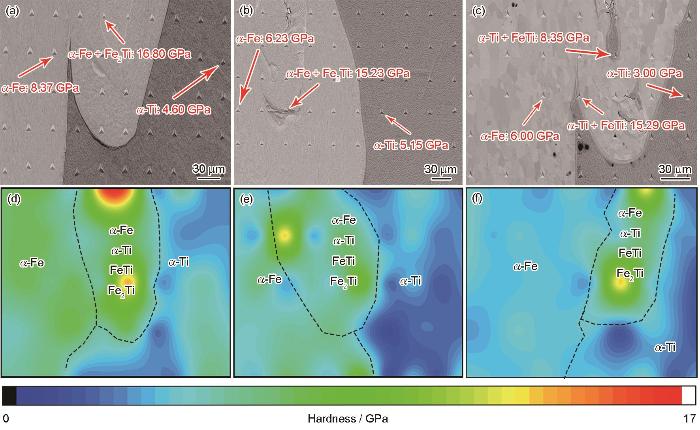
图11
不同温度下钛/钢接头纳米压痕测试位置SEM像和纳米硬度云图
Fig.11
SEM images showing the nanoindentation test locations (a-c) and nano-hardness maps (d-f) of titanium/steel joint as-welded (a, d) and after STHT under 600 oC (b, e) and 700 oC (c, f)
图12
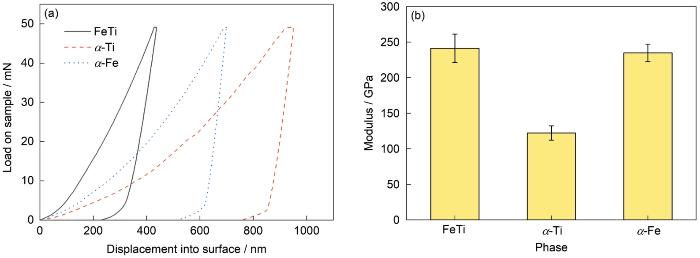
图12
焊态钛/钢接头纳米压痕载荷-位移曲线和弹性模量
Fig.12
Nanoindentation load-displacement curves (a) of FeTi, α-Ti, and α-Fe phases and the corresponding modulus of elasticity (b) of as-welded titanium/steel joint
3 结论
(1) 随瞬态热处理温度升高,钛/钢接头黏结强度和剪切强度先增加后降低,600 ℃以下表现为热致强化特性,600 ℃时接头剪切强度和黏结强度分别增加至284和550 MPa,相比焊态接头强度分别提升了75%和57%。超过700 ℃后接头黏结强度和剪切强度迅速下降,船用钛/钢混合结构二次焊接时接头界面临界温度应控制在600 ℃以下。
(2) 钛/钢接头界面微观组织在600 ℃以下保持稳定,温度进一步升高至700 ℃后,TiC层破裂,FeTi和Fe2Ti金属间化合物层厚度迅速增加,漩涡非平直界面IMCs层厚度由焊态的0.70 μm增加至2.20 μm,而相邻两个漩涡之间的平直界面处IMC层厚度仅由0.25 μm增加至0.40 μm,界面非平直区域IMCs层厚度增加更为显著。
(3) 回复再结晶的发生导致几何必需位错密度降低,纳米硬度和结合强度均随之降低。
参考文献
A new strategy for preparing advanced aluminum/steel joint using low-temperature explosive welding technology
[J].
Effects of heat treatments on mechanical properties of Fe/Al explosion-welded structural transition joints
[J].
Interfacial microstructure and shear strength of Ti6Al4V alloy/316L stainless steel joint brazed with Ti33.3Zr16.7Cu50 - x Ni x amorphous filler metals
[J].
Influence of interface microstructure on the mechanical properties of titanium/17-4 PH stainless steel solid state diffusion bonded joints
[J].
Diffusion brazing of Ti-6Al-4V and AISI 304: An EBSD study and mechanical properties
[J].
Inhomogeneous microstructure and mechanical properties of rotary friction welded joints between 5052 aluminum alloy and 304 stainless steel
[J].
High-strength titanium alloy/steel butt joint produced via friction stir welding
[J].
Microstructure and mechanical properties of TA2/304 weld seam with Cu transition layer under bias oscillation laser welding process
[J].
A novel high entropy composite interlayer for diffusion bonding of TC4 titanium alloy to 316L stainless steel
[J].
Property and welding procedure of the steel-aluminum structural transition joint
[J].
钢-铝结构过渡接头的性能特点及焊接工艺
[J].
Application of aluminum-steel transition joint in real ship construction
[J].
铝-钢过渡接头在实船建造中的应用
[J].
Effect of heat treatment temperature on interfacial microstructures and bonding properties of Al-steel clad plate
[J].
热处理温度对铝钢复合板界面组织和性能的影响
[J].
利用激光多普勒法测量50Hz下非晶合金带材的磁致伸缩曲线,研究了磁场退火对Fe80Si9B11非晶合金带材的磁致伸缩特性的影响。结果显示,在相同的磁场强度下非晶带材经横磁退火后磁致伸缩最大,无磁场退火次之,纵磁退火时最小。然后,采用Kerr方法观察了非晶合金带材的磁畴形貌,从微观结构上解释了经不同磁场退火后磁致伸缩大小不同的机理。最后,对无磁场退火、横磁退火和纵磁退火后的Fe80Si9B11铁基非晶合金铁芯进行了噪音测试。结果显示,在相同的频率和磁通密度下,非晶合金铁芯经横磁退火后噪音最大,无磁场退火次之,纵磁退火时噪音最小,与非晶合金带材经不同磁场热处理后磁致伸缩大小的规律一致。为解决非晶合金铁芯在实际应用中的噪音问题提供了参考。
Effect of thermal treatment on intermetallic phases of Fe/Al structural transition joints
[J].
Investigation on heat treatment process optimization of 304L/Q235B stainless steel clad plates
[J].
304L/Q235B不锈钢层状复合板热处理工艺优化研究
[J].
Relation of microstructure and mechanical property on aluminium/steel clad plate joining intererface under different heat treatment temperature
[J].
铝/钢复合板不同热处理温度结合界面显微结构与力学性能的关系
[J].
Microstructural and mechanical heterogeneity of electron beam welded thick pure titanium/Q235B steel bimetallic plate joint
[J].
Titanium/steel composites were prepared by composite interlayer and two pass laser welding
[J].
Two pass laser welding of TC4 titanium alloy and 304 stainless steel using TA2/Q235 composite interlayer
[J].
Investigation on the welding process and microstructure and mechanical property of butt joints of TA1/X65 clad plates
[J].Titanium/steel clad material with excellent mechanical properties and corrosion resistance has important application in storage and transportation equipment of oil and gas. Due to the metallurgical incompatibility of titanium and steel, the mechanical properties of weld joint would completely lose when the brittle intermetallic phase TixFey and TiC appeared in the fusion welding process. Therefore, the gas tungsten arced welding (TIG), metal inert-gas welding (MIG) and metal active-gas welding (MAG) with V/Cu composite filler metals for butt joint in this study was carried out on TA1/X65 pipeline steel clad plates with thickness 16 mm ( titanium cladding with thickness 2 mm, X65 pipeline steel with thickness 14 mm). The microstructure, interface element distribution, main phase, microhardness distribution on cross section and mechanical properties of butt welds were investigated by using OM, XRD, EDS element mapping, microhardness and tensile test. The results indicate that the design of “U-type” circular groove advantageous to the MIG of Cu transition-metals, because of the “U-type” circular groove does not cause stress concentration and crack initiation. The deposited metal of Ti, V, Cu and Fe have obvious zoning, interdiffusion melting phenomenon is not severe, and by using solid solution phases to transit zonings of deposited metal. The microstructure of Ti and V transition interface was composed of Ti-based solid solution, the microstructure of V and Cu transition interface was composed of V-based solid solution, and the microstructure of Cu and Fe transition interface was composed of Cu-based solid solution. The high hardness region of butt weld cross section appeared in the Ti/V transition-interface and V/Cu transition-interface, the hardness value was respectively 326 HV10 and 336 HV10, and weakened the ductility of transition interfacial layer. A joint with a tensile strength of 546 MPa, mainly of that of the carbon steel was obtained.
TA1/X65复合板焊接工艺及焊缝组织和性能研究
[J].采用TIG+MIG+MAG焊接工艺对TA1/ X65爆炸冶金复合板(复层Ti厚2 mm, 基层X65管线钢厚14 mm)试件进行了以V/Cu作为过渡填充金属的板-板对接焊实验. 利用OM, XRD, EDS面扫描, 显微硬度测试和拉伸实验, 研究了焊缝区组织特征、界面元素分布、主要物相、显微硬度分布及焊缝力学性能. 结果表明, 圆弧状“U”型坡口设计有利于过渡层Cu的MIG焊接, 在Cu-钢界面不会引起应力集中而萌生裂纹. 熔敷金属Ti, V, Cu和Fe有明显分区, 扩散互融现象不明显, 各区域间由固溶体相过渡连接, Ti/V过渡界面组织结构为钛基固溶体, V/Cu过渡界面组织结构为钒基固溶体, Cu/Fe过渡界面组织结构为铜基固溶体. 焊缝硬度较高区域出现在Ti/V过渡界面和V/Cu过渡界面处, 硬度达326和336 HV<sub>10</sub>, 对过渡界面层塑韧性有一定影响. 焊缝抗拉强度可达546 MPa, 主要由碳钢层贡献.
Interfacial evolution of explosively welded titanium/steel joint under subsequent EBW process
[J].
Interface microstructure and strength properties of Ti-6Al-4V and microduplex stainless steel diffusion bonded joints
[J].
Effect of intermetallic compounds on heat resistance of hot roll bonded titanium alloy-stainless steel transition joint
[J].
Interfacial evolution of titanium/steel clad plates during pulsed tungsten inert gas welding
[J].\n Joining titanium alloy with steel has important applications in the shipbuilding and aerospace industries. Successful titanium/steel joints fabricated by explosive welding have been reported recently. However, explosive welding is not ideal for welded structures with complex geometry. Here, pulsed tungsten inert gas (TIG) welding is introduced to promote the application of explosively welded transition joints. In this work, pulsed TIG of commercially pure titanium to mild steel with an explosively welded titanium/steel transition joint was carried out. The results showed that at peak current (I\n p\n ) ≤ 260 A, the TiC layer hampered the generation of FeTi and Fe\n 2\n Ti. However, at I\n p \n = 300 A, the TiC layer broke up, which resulted in the thickness of FeTi and Fe\n 2\n Ti increasing sharply to 0.8 μm.\n
Influence of pulse TIG welding thermal cycling on the microstructure and mechanical properties of explosively weld titanium/steel joint
[J].
Effect of post-weld heat treatment on the interface microstructure of explosively welded titanium-stainless steel composite
[J].
Investigations on the microstructure evolution and mechanical properties of explosive welded ODS-Cu/316L stainless steel composite
[J].
Effect of carbon content on interfacial microstructure and mechanical properties of a vacuum hot-compressed bonding titanium-steel composite
[J].
Hot roll bonding between commercially pure titanium and high-strength low-alloy steel using Fe interlayer
[J].
Mechanical properties and interfacial structure of hot-roll bonding TA2/Q235B plate using DT4 interlayer
[J].
Effects of carbon content on the diffusion bonding of iron and steel to titanium
[J].
Microstructure and mechanical properties investigations of copper-steel composite fabricated by explosive welding
[J].
Fabrication of high-quality platinum coating using explosive welding technology and its microstructure evolution mechanisms
[J].
Dynamic continuous recrystallization characteristics in two stage deformation of Mg-3Al-1Zn alloy sheet
[J].
Strain evaluation method around triple junctions using electron backscatter diffraction
[J].


