1
2014
... 塑性成形是汽车、航空航天和高端装备制造等领域的关键基础技术[1,2],也是材料、几何和接触非线性耦合的复杂物理过程.材料非线性的重要表现之一是应变路径敏感性,即材料的塑性应变张量在应变空间随时间演化的连续变化过程.已有研究[3]基于塑性应变张量和应变速率张量建立了对应变路径变化的定量描述框架.在实际成形过程中,材料往往经历多道次变形和复杂模具约束,形成连续或不连续的应变路径变化.此类变化会诱发背应力的积累与重排、非线性卸载、回弹以及Bauschinger效应等复杂力学响应,导致材料在屈服、硬化行为和各向异性等方面表现出显著的路径依赖性[4,5].同时,应变路径通过改变应力状态轨迹,影响损伤萌生与扩展机制,进而决定成形极限和断裂模式[6].在微观组织演化层面上,应变路径效应广泛影响位错组态分布、再结晶过程、孪生行为以及相变机制,对织构演化也有着重要调控作用[7,8].此外,不同合金体系、变形方式和路径序列也会导致微观组织演化呈现显著差异,进而影响最终性能表现[9,10].因此,系统揭示复杂应变路径下宏微观变形机制的耦合规律,是实现工艺优化和形性调控的重要基础. ...
1
2014
... 塑性成形是汽车、航空航天和高端装备制造等领域的关键基础技术[1,2],也是材料、几何和接触非线性耦合的复杂物理过程.材料非线性的重要表现之一是应变路径敏感性,即材料的塑性应变张量在应变空间随时间演化的连续变化过程.已有研究[3]基于塑性应变张量和应变速率张量建立了对应变路径变化的定量描述框架.在实际成形过程中,材料往往经历多道次变形和复杂模具约束,形成连续或不连续的应变路径变化.此类变化会诱发背应力的积累与重排、非线性卸载、回弹以及Bauschinger效应等复杂力学响应,导致材料在屈服、硬化行为和各向异性等方面表现出显著的路径依赖性[4,5].同时,应变路径通过改变应力状态轨迹,影响损伤萌生与扩展机制,进而决定成形极限和断裂模式[6].在微观组织演化层面上,应变路径效应广泛影响位错组态分布、再结晶过程、孪生行为以及相变机制,对织构演化也有着重要调控作用[7,8].此外,不同合金体系、变形方式和路径序列也会导致微观组织演化呈现显著差异,进而影响最终性能表现[9,10].因此,系统揭示复杂应变路径下宏微观变形机制的耦合规律,是实现工艺优化和形性调控的重要基础. ...
Major breakthrough and progress in metal forming technology and equipment of China in the last 30 years
1
2024
... 塑性成形是汽车、航空航天和高端装备制造等领域的关键基础技术[1,2],也是材料、几何和接触非线性耦合的复杂物理过程.材料非线性的重要表现之一是应变路径敏感性,即材料的塑性应变张量在应变空间随时间演化的连续变化过程.已有研究[3]基于塑性应变张量和应变速率张量建立了对应变路径变化的定量描述框架.在实际成形过程中,材料往往经历多道次变形和复杂模具约束,形成连续或不连续的应变路径变化.此类变化会诱发背应力的积累与重排、非线性卸载、回弹以及Bauschinger效应等复杂力学响应,导致材料在屈服、硬化行为和各向异性等方面表现出显著的路径依赖性[4,5].同时,应变路径通过改变应力状态轨迹,影响损伤萌生与扩展机制,进而决定成形极限和断裂模式[6].在微观组织演化层面上,应变路径效应广泛影响位错组态分布、再结晶过程、孪生行为以及相变机制,对织构演化也有着重要调控作用[7,8].此外,不同合金体系、变形方式和路径序列也会导致微观组织演化呈现显著差异,进而影响最终性能表现[9,10].因此,系统揭示复杂应变路径下宏微观变形机制的耦合规律,是实现工艺优化和形性调控的重要基础. ...
中国塑性成形技术和装备30年的重大突破与进展
1
2024
... 塑性成形是汽车、航空航天和高端装备制造等领域的关键基础技术[1,2],也是材料、几何和接触非线性耦合的复杂物理过程.材料非线性的重要表现之一是应变路径敏感性,即材料的塑性应变张量在应变空间随时间演化的连续变化过程.已有研究[3]基于塑性应变张量和应变速率张量建立了对应变路径变化的定量描述框架.在实际成形过程中,材料往往经历多道次变形和复杂模具约束,形成连续或不连续的应变路径变化.此类变化会诱发背应力的积累与重排、非线性卸载、回弹以及Bauschinger效应等复杂力学响应,导致材料在屈服、硬化行为和各向异性等方面表现出显著的路径依赖性[4,5].同时,应变路径通过改变应力状态轨迹,影响损伤萌生与扩展机制,进而决定成形极限和断裂模式[6].在微观组织演化层面上,应变路径效应广泛影响位错组态分布、再结晶过程、孪生行为以及相变机制,对织构演化也有着重要调控作用[7,8].此外,不同合金体系、变形方式和路径序列也会导致微观组织演化呈现显著差异,进而影响最终性能表现[9,10].因此,系统揭示复杂应变路径下宏微观变形机制的耦合规律,是实现工艺优化和形性调控的重要基础. ...
A parameter for measuring the magnitude of a change of strain path: Validation and comparison with experiments on low carbon steel
2
1994
... 塑性成形是汽车、航空航天和高端装备制造等领域的关键基础技术[1,2],也是材料、几何和接触非线性耦合的复杂物理过程.材料非线性的重要表现之一是应变路径敏感性,即材料的塑性应变张量在应变空间随时间演化的连续变化过程.已有研究[3]基于塑性应变张量和应变速率张量建立了对应变路径变化的定量描述框架.在实际成形过程中,材料往往经历多道次变形和复杂模具约束,形成连续或不连续的应变路径变化.此类变化会诱发背应力的积累与重排、非线性卸载、回弹以及Bauschinger效应等复杂力学响应,导致材料在屈服、硬化行为和各向异性等方面表现出显著的路径依赖性[4,5].同时,应变路径通过改变应力状态轨迹,影响损伤萌生与扩展机制,进而决定成形极限和断裂模式[6].在微观组织演化层面上,应变路径效应广泛影响位错组态分布、再结晶过程、孪生行为以及相变机制,对织构演化也有着重要调控作用[7,8].此外,不同合金体系、变形方式和路径序列也会导致微观组织演化呈现显著差异,进而影响最终性能表现[9,10].因此,系统揭示复杂应变路径下宏微观变形机制的耦合规律,是实现工艺优化和形性调控的重要基础. ...
... 经过多年探索,应变路径效应研究已形成清晰的发展脉络.早期工作[14]通过反向加载实验和成形极限描述揭示了路径改变引发的再屈服和瞬态硬化等现象.随后,Liao等[15]在屈服准则与硬化规律中引入路径依赖性,有效提升了回弹预测和非比例加载模拟精度.随着先进表征技术的发展,微观尺度的现象学观测和分析不断深入,建立了微观组织演化与宏观力学响应间的关联规律[16].在建模方面,跨尺度有限元方法和数据驱动模型不断完善和迭代,提升了模拟的精度和工程适用性[3,17,18].在此基础上,研究重点由机理探索扩展到工艺设计,路径优化在板料成形、锻造成形、轧制成形、挤压成形等诸多塑性成形领域中均展现出提升成形性和服役性能方面的显著潜力[7,19,20]. ...
Experiments and modeling of anisotropic aluminum extrusions under multi-axial loading—Part I: Plasticity
1
2012
... 塑性成形是汽车、航空航天和高端装备制造等领域的关键基础技术[1,2],也是材料、几何和接触非线性耦合的复杂物理过程.材料非线性的重要表现之一是应变路径敏感性,即材料的塑性应变张量在应变空间随时间演化的连续变化过程.已有研究[3]基于塑性应变张量和应变速率张量建立了对应变路径变化的定量描述框架.在实际成形过程中,材料往往经历多道次变形和复杂模具约束,形成连续或不连续的应变路径变化.此类变化会诱发背应力的积累与重排、非线性卸载、回弹以及Bauschinger效应等复杂力学响应,导致材料在屈服、硬化行为和各向异性等方面表现出显著的路径依赖性[4,5].同时,应变路径通过改变应力状态轨迹,影响损伤萌生与扩展机制,进而决定成形极限和断裂模式[6].在微观组织演化层面上,应变路径效应广泛影响位错组态分布、再结晶过程、孪生行为以及相变机制,对织构演化也有着重要调控作用[7,8].此外,不同合金体系、变形方式和路径序列也会导致微观组织演化呈现显著差异,进而影响最终性能表现[9,10].因此,系统揭示复杂应变路径下宏微观变形机制的耦合规律,是实现工艺优化和形性调控的重要基础. ...
Review on deformation behavior of sheet metal during biaxial compression
1
2024
... 塑性成形是汽车、航空航天和高端装备制造等领域的关键基础技术[1,2],也是材料、几何和接触非线性耦合的复杂物理过程.材料非线性的重要表现之一是应变路径敏感性,即材料的塑性应变张量在应变空间随时间演化的连续变化过程.已有研究[3]基于塑性应变张量和应变速率张量建立了对应变路径变化的定量描述框架.在实际成形过程中,材料往往经历多道次变形和复杂模具约束,形成连续或不连续的应变路径变化.此类变化会诱发背应力的积累与重排、非线性卸载、回弹以及Bauschinger效应等复杂力学响应,导致材料在屈服、硬化行为和各向异性等方面表现出显著的路径依赖性[4,5].同时,应变路径通过改变应力状态轨迹,影响损伤萌生与扩展机制,进而决定成形极限和断裂模式[6].在微观组织演化层面上,应变路径效应广泛影响位错组态分布、再结晶过程、孪生行为以及相变机制,对织构演化也有着重要调控作用[7,8].此外,不同合金体系、变形方式和路径序列也会导致微观组织演化呈现显著差异,进而影响最终性能表现[9,10].因此,系统揭示复杂应变路径下宏微观变形机制的耦合规律,是实现工艺优化和形性调控的重要基础. ...
金属板材双轴压缩变形行为研究进展
1
2024
... 塑性成形是汽车、航空航天和高端装备制造等领域的关键基础技术[1,2],也是材料、几何和接触非线性耦合的复杂物理过程.材料非线性的重要表现之一是应变路径敏感性,即材料的塑性应变张量在应变空间随时间演化的连续变化过程.已有研究[3]基于塑性应变张量和应变速率张量建立了对应变路径变化的定量描述框架.在实际成形过程中,材料往往经历多道次变形和复杂模具约束,形成连续或不连续的应变路径变化.此类变化会诱发背应力的积累与重排、非线性卸载、回弹以及Bauschinger效应等复杂力学响应,导致材料在屈服、硬化行为和各向异性等方面表现出显著的路径依赖性[4,5].同时,应变路径通过改变应力状态轨迹,影响损伤萌生与扩展机制,进而决定成形极限和断裂模式[6].在微观组织演化层面上,应变路径效应广泛影响位错组态分布、再结晶过程、孪生行为以及相变机制,对织构演化也有着重要调控作用[7,8].此外,不同合金体系、变形方式和路径序列也会导致微观组织演化呈现显著差异,进而影响最终性能表现[9,10].因此,系统揭示复杂应变路径下宏微观变形机制的耦合规律,是实现工艺优化和形性调控的重要基础. ...
Research progress on plastic flow instability during hot deformation of metal materials
1
2020
... 塑性成形是汽车、航空航天和高端装备制造等领域的关键基础技术[1,2],也是材料、几何和接触非线性耦合的复杂物理过程.材料非线性的重要表现之一是应变路径敏感性,即材料的塑性应变张量在应变空间随时间演化的连续变化过程.已有研究[3]基于塑性应变张量和应变速率张量建立了对应变路径变化的定量描述框架.在实际成形过程中,材料往往经历多道次变形和复杂模具约束,形成连续或不连续的应变路径变化.此类变化会诱发背应力的积累与重排、非线性卸载、回弹以及Bauschinger效应等复杂力学响应,导致材料在屈服、硬化行为和各向异性等方面表现出显著的路径依赖性[4,5].同时,应变路径通过改变应力状态轨迹,影响损伤萌生与扩展机制,进而决定成形极限和断裂模式[6].在微观组织演化层面上,应变路径效应广泛影响位错组态分布、再结晶过程、孪生行为以及相变机制,对织构演化也有着重要调控作用[7,8].此外,不同合金体系、变形方式和路径序列也会导致微观组织演化呈现显著差异,进而影响最终性能表现[9,10].因此,系统揭示复杂应变路径下宏微观变形机制的耦合规律,是实现工艺优化和形性调控的重要基础. ...
金属材料热变形中的塑性流动失稳研究进展
1
2020
... 塑性成形是汽车、航空航天和高端装备制造等领域的关键基础技术[1,2],也是材料、几何和接触非线性耦合的复杂物理过程.材料非线性的重要表现之一是应变路径敏感性,即材料的塑性应变张量在应变空间随时间演化的连续变化过程.已有研究[3]基于塑性应变张量和应变速率张量建立了对应变路径变化的定量描述框架.在实际成形过程中,材料往往经历多道次变形和复杂模具约束,形成连续或不连续的应变路径变化.此类变化会诱发背应力的积累与重排、非线性卸载、回弹以及Bauschinger效应等复杂力学响应,导致材料在屈服、硬化行为和各向异性等方面表现出显著的路径依赖性[4,5].同时,应变路径通过改变应力状态轨迹,影响损伤萌生与扩展机制,进而决定成形极限和断裂模式[6].在微观组织演化层面上,应变路径效应广泛影响位错组态分布、再结晶过程、孪生行为以及相变机制,对织构演化也有着重要调控作用[7,8].此外,不同合金体系、变形方式和路径序列也会导致微观组织演化呈现显著差异,进而影响最终性能表现[9,10].因此,系统揭示复杂应变路径下宏微观变形机制的耦合规律,是实现工艺优化和形性调控的重要基础. ...
Effect of ECAP strain path on deformation behaviour, microstructure, texture evolution, and mechanical properties in magnesium
3
2024
... 塑性成形是汽车、航空航天和高端装备制造等领域的关键基础技术[1,2],也是材料、几何和接触非线性耦合的复杂物理过程.材料非线性的重要表现之一是应变路径敏感性,即材料的塑性应变张量在应变空间随时间演化的连续变化过程.已有研究[3]基于塑性应变张量和应变速率张量建立了对应变路径变化的定量描述框架.在实际成形过程中,材料往往经历多道次变形和复杂模具约束,形成连续或不连续的应变路径变化.此类变化会诱发背应力的积累与重排、非线性卸载、回弹以及Bauschinger效应等复杂力学响应,导致材料在屈服、硬化行为和各向异性等方面表现出显著的路径依赖性[4,5].同时,应变路径通过改变应力状态轨迹,影响损伤萌生与扩展机制,进而决定成形极限和断裂模式[6].在微观组织演化层面上,应变路径效应广泛影响位错组态分布、再结晶过程、孪生行为以及相变机制,对织构演化也有着重要调控作用[7,8].此外,不同合金体系、变形方式和路径序列也会导致微观组织演化呈现显著差异,进而影响最终性能表现[9,10].因此,系统揭示复杂应变路径下宏微观变形机制的耦合规律,是实现工艺优化和形性调控的重要基础. ...
... 经过多年探索,应变路径效应研究已形成清晰的发展脉络.早期工作[14]通过反向加载实验和成形极限描述揭示了路径改变引发的再屈服和瞬态硬化等现象.随后,Liao等[15]在屈服准则与硬化规律中引入路径依赖性,有效提升了回弹预测和非比例加载模拟精度.随着先进表征技术的发展,微观尺度的现象学观测和分析不断深入,建立了微观组织演化与宏观力学响应间的关联规律[16].在建模方面,跨尺度有限元方法和数据驱动模型不断完善和迭代,提升了模拟的精度和工程适用性[3,17,18].在此基础上,研究重点由机理探索扩展到工艺设计,路径优化在板料成形、锻造成形、轧制成形、挤压成形等诸多塑性成形领域中均展现出提升成形性和服役性能方面的显著潜力[7,19,20]. ...
... 对于挤压成形工艺,应变路径的合理设计被广泛证明能够显著改善材料的成形稳定性与力学性能.张治民等[115]系统总结了多种挤压成形新技术,并首次提出将直线运动与旋转运动相匹配,主动增加强剪切变形的多向加载旋转挤压成形技术,实现材料的均匀强韧化和薄壁内环高筋构件的整体精确成形.Wang等[40]在CGP工艺研究中表明,交叉路径带来的晶粒细化和织构优化效果远优于传统路径,为复杂构件的局部强化提供了切实可行的方案.具体到ECAP技术(图15[116]),Gautam等[7]在对镁合金实验中发现路径A和路径BC能够有效细化晶粒并提升硬度和延展性,而路径C由于剪切方向抵消,导致性能退化.与之形成对比的是,Mills等[116]在锌合金ECAP研究中强调,路径BC和路径C的成形效果更好,分别在强度提升和成形性改善方面更具优势.这说明最优路径的选择需结合材料本征机制,不可一概而论. ...
Deformation response and microstructure evolution in 304LN stainless steel subjected to multiaxial fatigue loading under different strain paths
5
2025
... 塑性成形是汽车、航空航天和高端装备制造等领域的关键基础技术[1,2],也是材料、几何和接触非线性耦合的复杂物理过程.材料非线性的重要表现之一是应变路径敏感性,即材料的塑性应变张量在应变空间随时间演化的连续变化过程.已有研究[3]基于塑性应变张量和应变速率张量建立了对应变路径变化的定量描述框架.在实际成形过程中,材料往往经历多道次变形和复杂模具约束,形成连续或不连续的应变路径变化.此类变化会诱发背应力的积累与重排、非线性卸载、回弹以及Bauschinger效应等复杂力学响应,导致材料在屈服、硬化行为和各向异性等方面表现出显著的路径依赖性[4,5].同时,应变路径通过改变应力状态轨迹,影响损伤萌生与扩展机制,进而决定成形极限和断裂模式[6].在微观组织演化层面上,应变路径效应广泛影响位错组态分布、再结晶过程、孪生行为以及相变机制,对织构演化也有着重要调控作用[7,8].此外,不同合金体系、变形方式和路径序列也会导致微观组织演化呈现显著差异,进而影响最终性能表现[9,10].因此,系统揭示复杂应变路径下宏微观变形机制的耦合规律,是实现工艺优化和形性调控的重要基础. ...
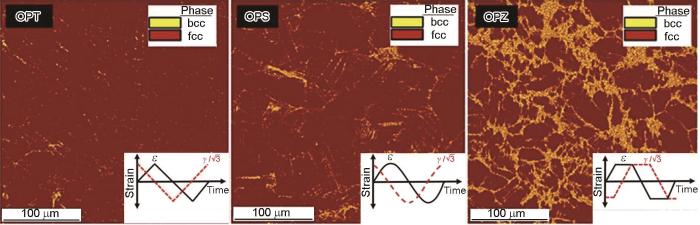
... 对于应变诱导相变行为,应变路径可以通过调控应变能积累与释放过程以及局部应力状态的变化,影响相变驱动力与动力学行为.Bharti等[8]对304LN不锈钢开展多种扭转疲劳实验,发现路径差异导致的应变能分布变化会改变马氏体相转变速率,进而影响力学响应.图9[8]反映了不同应变路径下的变形诱导马氏体相变程度差异.Yang等[46]进一步结合晶体塑性模拟研究了QP1180钢相变行为,发现以拉伸应变为主导的路径可显著加快相变速率,且残余奥氏体的织构特征在路径敏感性中起到关键作用. ...
... [8]反映了不同应变路径下的变形诱导马氏体相变程度差异.Yang等[46]进一步结合晶体塑性模拟研究了QP1180钢相变行为,发现以拉伸应变为主导的路径可显著加快相变速率,且残余奥氏体的织构特征在路径敏感性中起到关键作用. ...
... [
8]
Phase distribution of 304LN stainless steel under different strain paths<sup>[<xref ref-type="bibr" rid="R8">8</xref>]</sup> (Insets shows the strain <i>vs</i> time waveforms for different strain paths. OPT—out of phase triangular, OPS—out of phase sinusoidal, OPZ—out of phase trapezoidal, <i>ε</i>—applied axial strain, <i>γ</i>—applied shear strain)Fig.9![]() <strong>1.4</strong> 织构演化行为
<strong>1.4</strong> 织构演化行为织构演化是金属塑性变形过程中晶粒取向逐渐趋向特定分布集中的过程,对力学性能、塑性各向异性和成形极限具有深远影响.在复杂应变路径下,织构演化行为不仅依赖于变形方式和条件,还与材料的晶体结构类型和主导变形机制密切相关.为此,本节从hcp、fcc和bcc三类典型晶体结构出发,梳理不同合金体系的织构演化规律. ...
... [
8] (Insets shows the strain
vs time waveforms for different strain paths. OPT—out of phase triangular, OPS—out of phase sinusoidal, OPZ—out of phase trapezoidal,
ε—applied axial strain,
γ—applied shear strain)
Fig.9![]() <strong>1.4</strong> 织构演化行为
<strong>1.4</strong> 织构演化行为织构演化是金属塑性变形过程中晶粒取向逐渐趋向特定分布集中的过程,对力学性能、塑性各向异性和成形极限具有深远影响.在复杂应变路径下,织构演化行为不仅依赖于变形方式和条件,还与材料的晶体结构类型和主导变形机制密切相关.为此,本节从hcp、fcc和bcc三类典型晶体结构出发,梳理不同合金体系的织构演化规律. ...
Development of a novel testing methodology for in-situ microstructural characterisation during continuous strain path change
2
2022
... 塑性成形是汽车、航空航天和高端装备制造等领域的关键基础技术[1,2],也是材料、几何和接触非线性耦合的复杂物理过程.材料非线性的重要表现之一是应变路径敏感性,即材料的塑性应变张量在应变空间随时间演化的连续变化过程.已有研究[3]基于塑性应变张量和应变速率张量建立了对应变路径变化的定量描述框架.在实际成形过程中,材料往往经历多道次变形和复杂模具约束,形成连续或不连续的应变路径变化.此类变化会诱发背应力的积累与重排、非线性卸载、回弹以及Bauschinger效应等复杂力学响应,导致材料在屈服、硬化行为和各向异性等方面表现出显著的路径依赖性[4,5].同时,应变路径通过改变应力状态轨迹,影响损伤萌生与扩展机制,进而决定成形极限和断裂模式[6].在微观组织演化层面上,应变路径效应广泛影响位错组态分布、再结晶过程、孪生行为以及相变机制,对织构演化也有着重要调控作用[7,8].此外,不同合金体系、变形方式和路径序列也会导致微观组织演化呈现显著差异,进而影响最终性能表现[9,10].因此,系统揭示复杂应变路径下宏微观变形机制的耦合规律,是实现工艺优化和形性调控的重要基础. ...
... 对于立方晶体结构金属,Dhara等[9]通过对比铝合金和钢的力学响应,发现钢在路径转变下展现出更强的变形敏感性,这一现象同样归因于滑移变形行为的差异.Hou等[29]在双轴非比例加载实验中发现,淬火-配分(QP)钢在单轴拉-压和压-拉路径下的Bauschinger效应、瞬态硬化和永久软化行为均存在显著不同(图3[29]),而这种拉压不对称性与QP钢中应力诱发的马氏体相变紧密相关(除上述内容外,有关显微组织及织构演化对复杂路径下宏观力学响应的影响在1.3和1.4节作详细讨论). ...
Study on the correlation between strain localization and microstructure of TA15 titanium alloy and its prediction
1
2021
... 塑性成形是汽车、航空航天和高端装备制造等领域的关键基础技术[1,2],也是材料、几何和接触非线性耦合的复杂物理过程.材料非线性的重要表现之一是应变路径敏感性,即材料的塑性应变张量在应变空间随时间演化的连续变化过程.已有研究[3]基于塑性应变张量和应变速率张量建立了对应变路径变化的定量描述框架.在实际成形过程中,材料往往经历多道次变形和复杂模具约束,形成连续或不连续的应变路径变化.此类变化会诱发背应力的积累与重排、非线性卸载、回弹以及Bauschinger效应等复杂力学响应,导致材料在屈服、硬化行为和各向异性等方面表现出显著的路径依赖性[4,5].同时,应变路径通过改变应力状态轨迹,影响损伤萌生与扩展机制,进而决定成形极限和断裂模式[6].在微观组织演化层面上,应变路径效应广泛影响位错组态分布、再结晶过程、孪生行为以及相变机制,对织构演化也有着重要调控作用[7,8].此外,不同合金体系、变形方式和路径序列也会导致微观组织演化呈现显著差异,进而影响最终性能表现[9,10].因此,系统揭示复杂应变路径下宏微观变形机制的耦合规律,是实现工艺优化和形性调控的重要基础. ...
TA15钛合金应变局部化的组织相关性与预测研究
1
2021
... 塑性成形是汽车、航空航天和高端装备制造等领域的关键基础技术[1,2],也是材料、几何和接触非线性耦合的复杂物理过程.材料非线性的重要表现之一是应变路径敏感性,即材料的塑性应变张量在应变空间随时间演化的连续变化过程.已有研究[3]基于塑性应变张量和应变速率张量建立了对应变路径变化的定量描述框架.在实际成形过程中,材料往往经历多道次变形和复杂模具约束,形成连续或不连续的应变路径变化.此类变化会诱发背应力的积累与重排、非线性卸载、回弹以及Bauschinger效应等复杂力学响应,导致材料在屈服、硬化行为和各向异性等方面表现出显著的路径依赖性[4,5].同时,应变路径通过改变应力状态轨迹,影响损伤萌生与扩展机制,进而决定成形极限和断裂模式[6].在微观组织演化层面上,应变路径效应广泛影响位错组态分布、再结晶过程、孪生行为以及相变机制,对织构演化也有着重要调控作用[7,8].此外,不同合金体系、变形方式和路径序列也会导致微观组织演化呈现显著差异,进而影响最终性能表现[9,10].因此,系统揭示复杂应变路径下宏微观变形机制的耦合规律,是实现工艺优化和形性调控的重要基础. ...
Stepwise cooling spinning to achieve isotropic strength-ductility synergy of titanium alloy tube
1
2026
... 随着结构轻量化、复杂化以及高可靠性需求的持续增长,新材料体系不断涌现,复杂构件和高端服役场景对成形工艺提出了前所未有的挑战[11].在此背景下,传统的依赖简单路径和载荷控制的工艺模式,在满足多样化几何精度、力学性能与服役安全等方面已难以胜任,尤其面对高性能铝合金、高熵合金、先进镁合金、钛合金等新兴材料,以及轻量化、集成化等复杂结构的实际需求,更加多样化的应变路径设计成为提升材料利用率、优化组织和性能、实现性能按需调控的有效工具.系统深入地研究复杂应变路径对于调控材料微观组织、实现结构功能一体化以及突破现有工艺极限具有关键支撑作用.近年来,围绕复杂应变路径效应开展的多尺度、跨学科研究,为实现材料-结构-性能一体化优化提供了理论基础和技术储备,对高端装备制造领域的持续创新和高质量发展具有深远的战略意义[12,13]. ...
Research developments on multiscale modeling and simulation towards high-performance plastic forming
1
2024
... 随着结构轻量化、复杂化以及高可靠性需求的持续增长,新材料体系不断涌现,复杂构件和高端服役场景对成形工艺提出了前所未有的挑战[11].在此背景下,传统的依赖简单路径和载荷控制的工艺模式,在满足多样化几何精度、力学性能与服役安全等方面已难以胜任,尤其面对高性能铝合金、高熵合金、先进镁合金、钛合金等新兴材料,以及轻量化、集成化等复杂结构的实际需求,更加多样化的应变路径设计成为提升材料利用率、优化组织和性能、实现性能按需调控的有效工具.系统深入地研究复杂应变路径对于调控材料微观组织、实现结构功能一体化以及突破现有工艺极限具有关键支撑作用.近年来,围绕复杂应变路径效应开展的多尺度、跨学科研究,为实现材料-结构-性能一体化优化提供了理论基础和技术储备,对高端装备制造领域的持续创新和高质量发展具有深远的战略意义[12,13]. ...
面向高性能塑性成形的多尺度建模仿真研究进展
1
2024
... 随着结构轻量化、复杂化以及高可靠性需求的持续增长,新材料体系不断涌现,复杂构件和高端服役场景对成形工艺提出了前所未有的挑战[11].在此背景下,传统的依赖简单路径和载荷控制的工艺模式,在满足多样化几何精度、力学性能与服役安全等方面已难以胜任,尤其面对高性能铝合金、高熵合金、先进镁合金、钛合金等新兴材料,以及轻量化、集成化等复杂结构的实际需求,更加多样化的应变路径设计成为提升材料利用率、优化组织和性能、实现性能按需调控的有效工具.系统深入地研究复杂应变路径对于调控材料微观组织、实现结构功能一体化以及突破现有工艺极限具有关键支撑作用.近年来,围绕复杂应变路径效应开展的多尺度、跨学科研究,为实现材料-结构-性能一体化优化提供了理论基础和技术储备,对高端装备制造领域的持续创新和高质量发展具有深远的战略意义[12,13]. ...
Development of strain path effects on the mechanical behaviors of metals
1
2016
... 随着结构轻量化、复杂化以及高可靠性需求的持续增长,新材料体系不断涌现,复杂构件和高端服役场景对成形工艺提出了前所未有的挑战[11].在此背景下,传统的依赖简单路径和载荷控制的工艺模式,在满足多样化几何精度、力学性能与服役安全等方面已难以胜任,尤其面对高性能铝合金、高熵合金、先进镁合金、钛合金等新兴材料,以及轻量化、集成化等复杂结构的实际需求,更加多样化的应变路径设计成为提升材料利用率、优化组织和性能、实现性能按需调控的有效工具.系统深入地研究复杂应变路径对于调控材料微观组织、实现结构功能一体化以及突破现有工艺极限具有关键支撑作用.近年来,围绕复杂应变路径效应开展的多尺度、跨学科研究,为实现材料-结构-性能一体化优化提供了理论基础和技术储备,对高端装备制造领域的持续创新和高质量发展具有深远的战略意义[12,13]. ...
金属力学行为中应变路径效应的研究进展
1
2016
... 随着结构轻量化、复杂化以及高可靠性需求的持续增长,新材料体系不断涌现,复杂构件和高端服役场景对成形工艺提出了前所未有的挑战[11].在此背景下,传统的依赖简单路径和载荷控制的工艺模式,在满足多样化几何精度、力学性能与服役安全等方面已难以胜任,尤其面对高性能铝合金、高熵合金、先进镁合金、钛合金等新兴材料,以及轻量化、集成化等复杂结构的实际需求,更加多样化的应变路径设计成为提升材料利用率、优化组织和性能、实现性能按需调控的有效工具.系统深入地研究复杂应变路径对于调控材料微观组织、实现结构功能一体化以及突破现有工艺极限具有关键支撑作用.近年来,围绕复杂应变路径效应开展的多尺度、跨学科研究,为实现材料-结构-性能一体化优化提供了理论基础和技术储备,对高端装备制造领域的持续创新和高质量发展具有深远的战略意义[12,13]. ...
Continuous, large strain, tension/compression testing of sheet material
1
2005
... 经过多年探索,应变路径效应研究已形成清晰的发展脉络.早期工作[14]通过反向加载实验和成形极限描述揭示了路径改变引发的再屈服和瞬态硬化等现象.随后,Liao等[15]在屈服准则与硬化规律中引入路径依赖性,有效提升了回弹预测和非比例加载模拟精度.随着先进表征技术的发展,微观尺度的现象学观测和分析不断深入,建立了微观组织演化与宏观力学响应间的关联规律[16].在建模方面,跨尺度有限元方法和数据驱动模型不断完善和迭代,提升了模拟的精度和工程适用性[3,17,18].在此基础上,研究重点由机理探索扩展到工艺设计,路径优化在板料成形、锻造成形、轧制成形、挤压成形等诸多塑性成形领域中均展现出提升成形性和服役性能方面的显著潜力[7,19,20]. ...
Constitutive modeling for path-dependent behavior and its influence on twist springback
1
2017
... 经过多年探索,应变路径效应研究已形成清晰的发展脉络.早期工作[14]通过反向加载实验和成形极限描述揭示了路径改变引发的再屈服和瞬态硬化等现象.随后,Liao等[15]在屈服准则与硬化规律中引入路径依赖性,有效提升了回弹预测和非比例加载模拟精度.随着先进表征技术的发展,微观尺度的现象学观测和分析不断深入,建立了微观组织演化与宏观力学响应间的关联规律[16].在建模方面,跨尺度有限元方法和数据驱动模型不断完善和迭代,提升了模拟的精度和工程适用性[3,17,18].在此基础上,研究重点由机理探索扩展到工艺设计,路径优化在板料成形、锻造成形、轧制成形、挤压成形等诸多塑性成形领域中均展现出提升成形性和服役性能方面的显著潜力[7,19,20]. ...
In-situ neutron diffraction during biaxial deformation
1
2016
... 经过多年探索,应变路径效应研究已形成清晰的发展脉络.早期工作[14]通过反向加载实验和成形极限描述揭示了路径改变引发的再屈服和瞬态硬化等现象.随后,Liao等[15]在屈服准则与硬化规律中引入路径依赖性,有效提升了回弹预测和非比例加载模拟精度.随着先进表征技术的发展,微观尺度的现象学观测和分析不断深入,建立了微观组织演化与宏观力学响应间的关联规律[16].在建模方面,跨尺度有限元方法和数据驱动模型不断完善和迭代,提升了模拟的精度和工程适用性[3,17,18].在此基础上,研究重点由机理探索扩展到工艺设计,路径优化在板料成形、锻造成形、轧制成形、挤压成形等诸多塑性成形领域中均展现出提升成形性和服役性能方面的显著潜力[7,19,20]. ...
Review on fast numerical simulation method for plastic forming
1
2022
... 经过多年探索,应变路径效应研究已形成清晰的发展脉络.早期工作[14]通过反向加载实验和成形极限描述揭示了路径改变引发的再屈服和瞬态硬化等现象.随后,Liao等[15]在屈服准则与硬化规律中引入路径依赖性,有效提升了回弹预测和非比例加载模拟精度.随着先进表征技术的发展,微观尺度的现象学观测和分析不断深入,建立了微观组织演化与宏观力学响应间的关联规律[16].在建模方面,跨尺度有限元方法和数据驱动模型不断完善和迭代,提升了模拟的精度和工程适用性[3,17,18].在此基础上,研究重点由机理探索扩展到工艺设计,路径优化在板料成形、锻造成形、轧制成形、挤压成形等诸多塑性成形领域中均展现出提升成形性和服役性能方面的显著潜力[7,19,20]. ...
塑性成形快速数值仿真方法的研究进展
1
2022
... 经过多年探索,应变路径效应研究已形成清晰的发展脉络.早期工作[14]通过反向加载实验和成形极限描述揭示了路径改变引发的再屈服和瞬态硬化等现象.随后,Liao等[15]在屈服准则与硬化规律中引入路径依赖性,有效提升了回弹预测和非比例加载模拟精度.随着先进表征技术的发展,微观尺度的现象学观测和分析不断深入,建立了微观组织演化与宏观力学响应间的关联规律[16].在建模方面,跨尺度有限元方法和数据驱动模型不断完善和迭代,提升了模拟的精度和工程适用性[3,17,18].在此基础上,研究重点由机理探索扩展到工艺设计,路径优化在板料成形、锻造成形、轧制成形、挤压成形等诸多塑性成形领域中均展现出提升成形性和服役性能方面的显著潜力[7,19,20]. ...
A strain-path dependent unified constitutive model of titanium alloy coupling coarse grain subdivision and recrystallization: Application to multi-directional hot deformation
1
2025
... 经过多年探索,应变路径效应研究已形成清晰的发展脉络.早期工作[14]通过反向加载实验和成形极限描述揭示了路径改变引发的再屈服和瞬态硬化等现象.随后,Liao等[15]在屈服准则与硬化规律中引入路径依赖性,有效提升了回弹预测和非比例加载模拟精度.随着先进表征技术的发展,微观尺度的现象学观测和分析不断深入,建立了微观组织演化与宏观力学响应间的关联规律[16].在建模方面,跨尺度有限元方法和数据驱动模型不断完善和迭代,提升了模拟的精度和工程适用性[3,17,18].在此基础上,研究重点由机理探索扩展到工艺设计,路径优化在板料成形、锻造成形、轧制成形、挤压成形等诸多塑性成形领域中均展现出提升成形性和服役性能方面的显著潜力[7,19,20]. ...
Research progress of forming limit of sheet metal under nonlinear loading path
1
2024
... 经过多年探索,应变路径效应研究已形成清晰的发展脉络.早期工作[14]通过反向加载实验和成形极限描述揭示了路径改变引发的再屈服和瞬态硬化等现象.随后,Liao等[15]在屈服准则与硬化规律中引入路径依赖性,有效提升了回弹预测和非比例加载模拟精度.随着先进表征技术的发展,微观尺度的现象学观测和分析不断深入,建立了微观组织演化与宏观力学响应间的关联规律[16].在建模方面,跨尺度有限元方法和数据驱动模型不断完善和迭代,提升了模拟的精度和工程适用性[3,17,18].在此基础上,研究重点由机理探索扩展到工艺设计,路径优化在板料成形、锻造成形、轧制成形、挤压成形等诸多塑性成形领域中均展现出提升成形性和服役性能方面的显著潜力[7,19,20]. ...
非线性加载路径下金属薄板成形极限研究进展
1
2024
... 经过多年探索,应变路径效应研究已形成清晰的发展脉络.早期工作[14]通过反向加载实验和成形极限描述揭示了路径改变引发的再屈服和瞬态硬化等现象.随后,Liao等[15]在屈服准则与硬化规律中引入路径依赖性,有效提升了回弹预测和非比例加载模拟精度.随着先进表征技术的发展,微观尺度的现象学观测和分析不断深入,建立了微观组织演化与宏观力学响应间的关联规律[16].在建模方面,跨尺度有限元方法和数据驱动模型不断完善和迭代,提升了模拟的精度和工程适用性[3,17,18].在此基础上,研究重点由机理探索扩展到工艺设计,路径优化在板料成形、锻造成形、轧制成形、挤压成形等诸多塑性成形领域中均展现出提升成形性和服役性能方面的显著潜力[7,19,20]. ...
The study of loading path optimization for tube hydroforming process
1
2006
... 经过多年探索,应变路径效应研究已形成清晰的发展脉络.早期工作[14]通过反向加载实验和成形极限描述揭示了路径改变引发的再屈服和瞬态硬化等现象.随后,Liao等[15]在屈服准则与硬化规律中引入路径依赖性,有效提升了回弹预测和非比例加载模拟精度.随着先进表征技术的发展,微观尺度的现象学观测和分析不断深入,建立了微观组织演化与宏观力学响应间的关联规律[16].在建模方面,跨尺度有限元方法和数据驱动模型不断完善和迭代,提升了模拟的精度和工程适用性[3,17,18].在此基础上,研究重点由机理探索扩展到工艺设计,路径优化在板料成形、锻造成形、轧制成形、挤压成形等诸多塑性成形领域中均展现出提升成形性和服役性能方面的显著潜力[7,19,20]. ...
管件液压成形中加载路径的优化设计方法研究
1
2006
... 经过多年探索,应变路径效应研究已形成清晰的发展脉络.早期工作[14]通过反向加载实验和成形极限描述揭示了路径改变引发的再屈服和瞬态硬化等现象.随后,Liao等[15]在屈服准则与硬化规律中引入路径依赖性,有效提升了回弹预测和非比例加载模拟精度.随着先进表征技术的发展,微观尺度的现象学观测和分析不断深入,建立了微观组织演化与宏观力学响应间的关联规律[16].在建模方面,跨尺度有限元方法和数据驱动模型不断完善和迭代,提升了模拟的精度和工程适用性[3,17,18].在此基础上,研究重点由机理探索扩展到工艺设计,路径优化在板料成形、锻造成形、轧制成形、挤压成形等诸多塑性成形领域中均展现出提升成形性和服役性能方面的显著潜力[7,19,20]. ...
Multi-strain path deformation behavior of AA6016-T4: Experiments and crystal plasticity modeling
4
2022
... 背应力的演变机制在路径加载过程中表现尤为突出,是造成宏观力学响应显著差异的主要原因之一.Sharma等[21]针对AA6016-T4铝合金的研究显示,单轴预应变有助于背应力积累,显著提升后续拉伸性能;相比之下,复杂路径下背应力积累更加平缓,呈现更为平滑的弹塑性过渡(图1[21]).Daroju等[22]进一步指出,晶内、晶间背应力场与位错密度演化协同影响不同类型铝合金的循环硬化行为.此外,类似的路径依赖性也体现在钢铁材料中,李飞等[23]在对奥氏体不锈钢的研究中,同样发现屈服强度和硬化率高度依赖于加载方向与预应变共同影响下的背应力累积程度. ...
... [21]).Daroju等[22]进一步指出,晶内、晶间背应力场与位错密度演化协同影响不同类型铝合金的循环硬化行为.此外,类似的路径依赖性也体现在钢铁材料中,李飞等[23]在对奥氏体不锈钢的研究中,同样发现屈服强度和硬化率高度依赖于加载方向与预应变共同影响下的背应力累积程度. ...
... [
21]
Comparisons of work hardening behaviors of AA6016-T4 alloy under different strain paths<sup>[<xref ref-type="bibr" rid="R21">21</xref>]</sup>Fig.1![]()
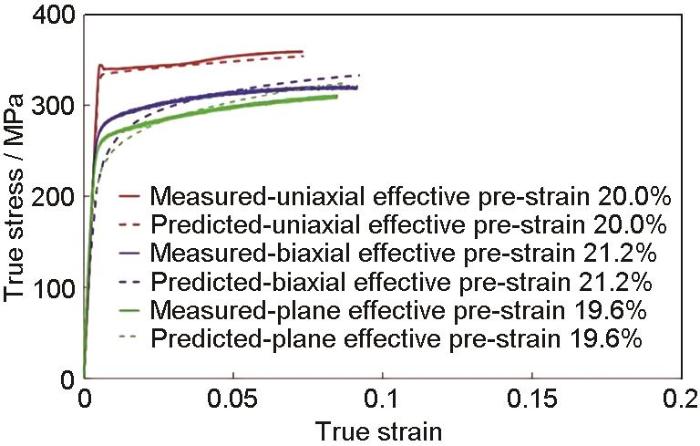
除背应力作用外,复杂路径下的微观组织演化亦是影响宏观力学响应的关键因素[24],目前的研究重点多聚焦于金属结构类型及合金体系的影响.Shi等[25]认为,不同晶体结构合金在非比例加载路径下的屈服行为存在差异,其中hcp结构镁合金的各向异性屈服行为主要受控于位错滑移和取向演化,这一观点在钛合金相关研究中亦被证实[26].此外,孪生变形起到的影响同样被广泛关注.Hama等[27]发现,商业纯Ti在不同应变路径下均表现出明显的Bauschinger效应,并强调了孪生与去孪生对加工硬化行为具有显著影响.Wroński等[28]进一步揭示了孪生、去孪生和二次孪生等微观机制的交替激活行为,使得材料在不同路径下呈现出截然不同的硬化特征(图2[28]). ...
... [
21]
Fig.1![]()
除背应力作用外,复杂路径下的微观组织演化亦是影响宏观力学响应的关键因素[24],目前的研究重点多聚焦于金属结构类型及合金体系的影响.Shi等[25]认为,不同晶体结构合金在非比例加载路径下的屈服行为存在差异,其中hcp结构镁合金的各向异性屈服行为主要受控于位错滑移和取向演化,这一观点在钛合金相关研究中亦被证实[26].此外,孪生变形起到的影响同样被广泛关注.Hama等[27]发现,商业纯Ti在不同应变路径下均表现出明显的Bauschinger效应,并强调了孪生与去孪生对加工硬化行为具有显著影响.Wroński等[28]进一步揭示了孪生、去孪生和二次孪生等微观机制的交替激活行为,使得材料在不同路径下呈现出截然不同的硬化特征(图2[28]). ...
Experimental characterization and crystal plasticity modeling for predicting load reversals in AA6016-T4 and AA7021-T79
1
2022
... 背应力的演变机制在路径加载过程中表现尤为突出,是造成宏观力学响应显著差异的主要原因之一.Sharma等[21]针对AA6016-T4铝合金的研究显示,单轴预应变有助于背应力积累,显著提升后续拉伸性能;相比之下,复杂路径下背应力积累更加平缓,呈现更为平滑的弹塑性过渡(图1[21]).Daroju等[22]进一步指出,晶内、晶间背应力场与位错密度演化协同影响不同类型铝合金的循环硬化行为.此外,类似的路径依赖性也体现在钢铁材料中,李飞等[23]在对奥氏体不锈钢的研究中,同样发现屈服强度和硬化率高度依赖于加载方向与预应变共同影响下的背应力累积程度. ...
Compression and tensile consecutive deformation behavior of Mn18Cr18N austenite stainless steel
1
2016
... 背应力的演变机制在路径加载过程中表现尤为突出,是造成宏观力学响应显著差异的主要原因之一.Sharma等[21]针对AA6016-T4铝合金的研究显示,单轴预应变有助于背应力积累,显著提升后续拉伸性能;相比之下,复杂路径下背应力积累更加平缓,呈现更为平滑的弹塑性过渡(图1[21]).Daroju等[22]进一步指出,晶内、晶间背应力场与位错密度演化协同影响不同类型铝合金的循环硬化行为.此外,类似的路径依赖性也体现在钢铁材料中,李飞等[23]在对奥氏体不锈钢的研究中,同样发现屈服强度和硬化率高度依赖于加载方向与预应变共同影响下的背应力累积程度. ...
Mn18Cr18N奥氏体不锈钢的压缩拉伸连续加载变形行为
1
2016
... 背应力的演变机制在路径加载过程中表现尤为突出,是造成宏观力学响应显著差异的主要原因之一.Sharma等[21]针对AA6016-T4铝合金的研究显示,单轴预应变有助于背应力积累,显著提升后续拉伸性能;相比之下,复杂路径下背应力积累更加平缓,呈现更为平滑的弹塑性过渡(图1[21]).Daroju等[22]进一步指出,晶内、晶间背应力场与位错密度演化协同影响不同类型铝合金的循环硬化行为.此外,类似的路径依赖性也体现在钢铁材料中,李飞等[23]在对奥氏体不锈钢的研究中,同样发现屈服强度和硬化率高度依赖于加载方向与预应变共同影响下的背应力累积程度. ...
Reducing the anisotropy of a pre-twinned hot-rolled Mg-3Al-1Zn alloy by plane-strain compression
1
2014
... 除背应力作用外,复杂路径下的微观组织演化亦是影响宏观力学响应的关键因素[24],目前的研究重点多聚焦于金属结构类型及合金体系的影响.Shi等[25]认为,不同晶体结构合金在非比例加载路径下的屈服行为存在差异,其中hcp结构镁合金的各向异性屈服行为主要受控于位错滑移和取向演化,这一观点在钛合金相关研究中亦被证实[26].此外,孪生变形起到的影响同样被广泛关注.Hama等[27]发现,商业纯Ti在不同应变路径下均表现出明显的Bauschinger效应,并强调了孪生与去孪生对加工硬化行为具有显著影响.Wroński等[28]进一步揭示了孪生、去孪生和二次孪生等微观机制的交替激活行为,使得材料在不同路径下呈现出截然不同的硬化特征(图2[28]). ...
Loading path dependent distortional hardening of Mg alloys: Experimental investigation and constitutive modeling
1
2017
... 除背应力作用外,复杂路径下的微观组织演化亦是影响宏观力学响应的关键因素[24],目前的研究重点多聚焦于金属结构类型及合金体系的影响.Shi等[25]认为,不同晶体结构合金在非比例加载路径下的屈服行为存在差异,其中hcp结构镁合金的各向异性屈服行为主要受控于位错滑移和取向演化,这一观点在钛合金相关研究中亦被证实[26].此外,孪生变形起到的影响同样被广泛关注.Hama等[27]发现,商业纯Ti在不同应变路径下均表现出明显的Bauschinger效应,并强调了孪生与去孪生对加工硬化行为具有显著影响.Wroński等[28]进一步揭示了孪生、去孪生和二次孪生等微观机制的交替激活行为,使得材料在不同路径下呈现出截然不同的硬化特征(图2[28]). ...
Microstructural mechanisms during multidirectional isothermal forging of as-cast Ti-6Al-4V alloy with an initial lamellar microstructure
2
2019
... 除背应力作用外,复杂路径下的微观组织演化亦是影响宏观力学响应的关键因素[24],目前的研究重点多聚焦于金属结构类型及合金体系的影响.Shi等[25]认为,不同晶体结构合金在非比例加载路径下的屈服行为存在差异,其中hcp结构镁合金的各向异性屈服行为主要受控于位错滑移和取向演化,这一观点在钛合金相关研究中亦被证实[26].此外,孪生变形起到的影响同样被广泛关注.Hama等[27]发现,商业纯Ti在不同应变路径下均表现出明显的Bauschinger效应,并强调了孪生与去孪生对加工硬化行为具有显著影响.Wroński等[28]进一步揭示了孪生、去孪生和二次孪生等微观机制的交替激活行为,使得材料在不同路径下呈现出截然不同的硬化特征(图2[28]). ...
... 再结晶行为是材料实现晶粒细化的主要方式,应变路径通过影响位错密度、亚结构和相界面演变,显著影响再结晶动力学和球化过程.Poths等[41]在钛合金等温扭转实验中发现,路径反转会抑制亚晶界形成,从而降低片层球化驱动力.相比之下,多向加载更易实现组织均匀化和晶粒细化.Zhang等[26]通过多向等温锻造促进片层钛合金发生充分动态再结晶.Zhao等[42]在TA15钛合金研究中发现,当两次压缩方向垂直时片层动态再结晶最为显著.此外,多轴压缩实验[43]还表明,α相几何取向的调整可促进球化进程,较大正向应变可使得球化程度进一步提高(图7[43]).由此可见,合理的路径设计不仅调控再结晶动力学,也通过几何约束促进片层组织均匀球化. ...
Work-hardening and twinning behaviors in a commercially pure titanium sheet under various loading paths
1
2015
... 除背应力作用外,复杂路径下的微观组织演化亦是影响宏观力学响应的关键因素[24],目前的研究重点多聚焦于金属结构类型及合金体系的影响.Shi等[25]认为,不同晶体结构合金在非比例加载路径下的屈服行为存在差异,其中hcp结构镁合金的各向异性屈服行为主要受控于位错滑移和取向演化,这一观点在钛合金相关研究中亦被证实[26].此外,孪生变形起到的影响同样被广泛关注.Hama等[27]发现,商业纯Ti在不同应变路径下均表现出明显的Bauschinger效应,并强调了孪生与去孪生对加工硬化行为具有显著影响.Wroński等[28]进一步揭示了孪生、去孪生和二次孪生等微观机制的交替激活行为,使得材料在不同路径下呈现出截然不同的硬化特征(图2[28]). ...
Deformation behavior of CP-titanium under strain path changes: Experiment and crystal plasticity modeling
4
2022
... 除背应力作用外,复杂路径下的微观组织演化亦是影响宏观力学响应的关键因素[24],目前的研究重点多聚焦于金属结构类型及合金体系的影响.Shi等[25]认为,不同晶体结构合金在非比例加载路径下的屈服行为存在差异,其中hcp结构镁合金的各向异性屈服行为主要受控于位错滑移和取向演化,这一观点在钛合金相关研究中亦被证实[26].此外,孪生变形起到的影响同样被广泛关注.Hama等[27]发现,商业纯Ti在不同应变路径下均表现出明显的Bauschinger效应,并强调了孪生与去孪生对加工硬化行为具有显著影响.Wroński等[28]进一步揭示了孪生、去孪生和二次孪生等微观机制的交替激活行为,使得材料在不同路径下呈现出截然不同的硬化特征(图2[28]). ...
... [28]). ...
... [
28]
Stress-strain curves of commercially pure titanium under different combinations of strain paths (RDC—rolling direction compression, NDC—normal direction compression, TDC—transverse direction compression)<sup>[<xref ref-type="bibr" rid="R28">28</xref>]</sup>Fig.2![]()
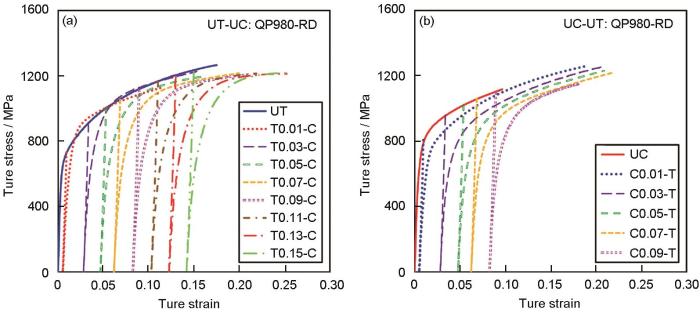
对于立方晶体结构金属,Dhara等[9]通过对比铝合金和钢的力学响应,发现钢在路径转变下展现出更强的变形敏感性,这一现象同样归因于滑移变形行为的差异.Hou等[29]在双轴非比例加载实验中发现,淬火-配分(QP)钢在单轴拉-压和压-拉路径下的Bauschinger效应、瞬态硬化和永久软化行为均存在显著不同(图3[29]),而这种拉压不对称性与QP钢中应力诱发的马氏体相变紧密相关(除上述内容外,有关显微组织及织构演化对复杂路径下宏观力学响应的影响在1.3和1.4节作详细讨论). ...
... [
28]
Fig.2![]()
对于立方晶体结构金属,Dhara等[9]通过对比铝合金和钢的力学响应,发现钢在路径转变下展现出更强的变形敏感性,这一现象同样归因于滑移变形行为的差异.Hou等[29]在双轴非比例加载实验中发现,淬火-配分(QP)钢在单轴拉-压和压-拉路径下的Bauschinger效应、瞬态硬化和永久软化行为均存在显著不同(图3[29]),而这种拉压不对称性与QP钢中应力诱发的马氏体相变紧密相关(除上述内容外,有关显微组织及织构演化对复杂路径下宏观力学响应的影响在1.3和1.4节作详细讨论). ...
Experimental characterization and modeling of complex anisotropic hardening in quenching and partitioning (Q&P) steel subject to biaxial non-proportional loadings
4
2022
... 对于立方晶体结构金属,Dhara等[9]通过对比铝合金和钢的力学响应,发现钢在路径转变下展现出更强的变形敏感性,这一现象同样归因于滑移变形行为的差异.Hou等[29]在双轴非比例加载实验中发现,淬火-配分(QP)钢在单轴拉-压和压-拉路径下的Bauschinger效应、瞬态硬化和永久软化行为均存在显著不同(图3[29]),而这种拉压不对称性与QP钢中应力诱发的马氏体相变紧密相关(除上述内容外,有关显微组织及织构演化对复杂路径下宏观力学响应的影响在1.3和1.4节作详细讨论). ...
... [29]),而这种拉压不对称性与QP钢中应力诱发的马氏体相变紧密相关(除上述内容外,有关显微组织及织构演化对复杂路径下宏观力学响应的影响在1.3和1.4节作详细讨论). ...
... [
29]
Stress-strain curves of quenching and partitioning steel (QP980) specimens at various pre-strain levels deformed along RD<sup>[<xref ref-type="bibr" rid="R29">29</xref>]</sup> (UT-UC<i>—</i>uniaxial tension (UT) followed by compression,UC-UT—uniaxial compression (UC) followed by tension, RD—rolling direction, T—tension, C—compression)(a) UT-UC (b) UC-UT ...
... [
29] (UT-UC
—uniaxial tension (UT) followed by compression,UC-UT—uniaxial compression (UC) followed by tension, RD—rolling direction, T—tension, C—compression)
(a) UT-UC (b) UC-UT ...
On the path-dependence of the fracture locus in ductile materials-Analysis
1
2012
... 复杂应变路径下的损伤行为主控机制可概括为“空洞(含微裂纹)的萌生-长大-联结”,其演化速率和失效阈值主要受应力三轴度(η,控制空洞长大倾向)、Lode参数(区分拉伸/剪切主导的断裂模式)以及加载历史(预应变大小、正反向和路径转角等)的共同调控[30].有研究[31]认为,比例加载下应力状态轨迹相对稳定,而非比例或反向路径会导致η和Lode参数在变形过程中显著波动,从而影响损伤累积速率,往往导致材料提前失效.但也有研究[32]表明,反向或弯-拉组合常在局部产生负三轴度区,诱发孔洞闭合效应,从而延缓损伤演化,即所谓的“损伤愈合”.因此,复杂路径对损伤演化的影响尚无明确定论. ...
A nonlinear model for ductile damage accumulation under multiaxial non-proportional loading conditions
1
2016
... 复杂应变路径下的损伤行为主控机制可概括为“空洞(含微裂纹)的萌生-长大-联结”,其演化速率和失效阈值主要受应力三轴度(η,控制空洞长大倾向)、Lode参数(区分拉伸/剪切主导的断裂模式)以及加载历史(预应变大小、正反向和路径转角等)的共同调控[30].有研究[31]认为,比例加载下应力状态轨迹相对稳定,而非比例或反向路径会导致η和Lode参数在变形过程中显著波动,从而影响损伤累积速率,往往导致材料提前失效.但也有研究[32]表明,反向或弯-拉组合常在局部产生负三轴度区,诱发孔洞闭合效应,从而延缓损伤演化,即所谓的“损伤愈合”.因此,复杂路径对损伤演化的影响尚无明确定论. ...
Characterizing the back stress of ultra-thin metallic sheet via pre-strain tension/bending process
1
2020
... 复杂应变路径下的损伤行为主控机制可概括为“空洞(含微裂纹)的萌生-长大-联结”,其演化速率和失效阈值主要受应力三轴度(η,控制空洞长大倾向)、Lode参数(区分拉伸/剪切主导的断裂模式)以及加载历史(预应变大小、正反向和路径转角等)的共同调控[30].有研究[31]认为,比例加载下应力状态轨迹相对稳定,而非比例或反向路径会导致η和Lode参数在变形过程中显著波动,从而影响损伤累积速率,往往导致材料提前失效.但也有研究[32]表明,反向或弯-拉组合常在局部产生负三轴度区,诱发孔洞闭合效应,从而延缓损伤演化,即所谓的“损伤愈合”.因此,复杂路径对损伤演化的影响尚无明确定论. ...
Numerical modeling of the evolution of ductile damage under proportional and non-proportional loading
1
2019
... 在认同路径效应促进损伤演化的研究中,加载历史被证明对断裂应变与损伤累积具有决定性作用.Fincato和Tsutsumi[33]通过数值模拟明确了比例和非比例载荷下材料的损伤演化差异,认为当主应力与应变方向不同时,损伤演化会加速.Itoh和Yang[34]则进一步将材料失效寿命缩短归因于非比例载荷下的附加硬化行为,同时也强调了材料晶体结构的影响.Yu等[35]在2219-W铝合金断裂行为研究中发现,合金的断裂响应由Portevin-Le Chatelier (PLC)带扩展、共轭剪切带形成以及最大剪切面连续旋转三大关键机制相互作用控制,这种耦合作用加速了剪切驱动的孔洞生长,并促进了不同应变路径下损伤模式的应力状态敏感性变化.图4[35]反映了2219-W铝合金在不同应变路径下的断裂机理. ...
Material dependence of multiaxial low cycle fatigue lives under non-proportional loading
1
2011
... 在认同路径效应促进损伤演化的研究中,加载历史被证明对断裂应变与损伤累积具有决定性作用.Fincato和Tsutsumi[33]通过数值模拟明确了比例和非比例载荷下材料的损伤演化差异,认为当主应力与应变方向不同时,损伤演化会加速.Itoh和Yang[34]则进一步将材料失效寿命缩短归因于非比例载荷下的附加硬化行为,同时也强调了材料晶体结构的影响.Yu等[35]在2219-W铝合金断裂行为研究中发现,合金的断裂响应由Portevin-Le Chatelier (PLC)带扩展、共轭剪切带形成以及最大剪切面连续旋转三大关键机制相互作用控制,这种耦合作用加速了剪切驱动的孔洞生长,并促进了不同应变路径下损伤模式的应力状态敏感性变化.图4[35]反映了2219-W铝合金在不同应变路径下的断裂机理. ...
Mechanism of the high elongation but low formability of high-strength aluminum alloy in W-temper
4
2025
... 在认同路径效应促进损伤演化的研究中,加载历史被证明对断裂应变与损伤累积具有决定性作用.Fincato和Tsutsumi[33]通过数值模拟明确了比例和非比例载荷下材料的损伤演化差异,认为当主应力与应变方向不同时,损伤演化会加速.Itoh和Yang[34]则进一步将材料失效寿命缩短归因于非比例载荷下的附加硬化行为,同时也强调了材料晶体结构的影响.Yu等[35]在2219-W铝合金断裂行为研究中发现,合金的断裂响应由Portevin-Le Chatelier (PLC)带扩展、共轭剪切带形成以及最大剪切面连续旋转三大关键机制相互作用控制,这种耦合作用加速了剪切驱动的孔洞生长,并促进了不同应变路径下损伤模式的应力状态敏感性变化.图4[35]反映了2219-W铝合金在不同应变路径下的断裂机理. ...
... [35]反映了2219-W铝合金在不同应变路径下的断裂机理. ...
... [
35]
Fracture mechanisms of 2219-W aluminum alloy under different strain paths<sup>[<xref ref-type="bibr" rid="R35">35</xref>]</sup> (MSP—maximum shear plane, ND—normal direction, KAM—kernel average misorientation, IPF—inverse pole figure) (a-c) plane strain tension (PST) specimen (Fig.4b is the RD <i>×</i> ND middle section of PST after fracture; Fig.4c shows the KAM maps and IPF-<i>Z</i> maps of two squared positions in Fig.4b) (d-f) shear (SH) specimen (d), stress components on the shear plane of the fracture element for SH specimen (e), and comparisons of the rigid body and MSP rotation angles of the same element as Fig.4e (f) (<i>σ<sub>xx</sub></i>, <i>σ<sub>yy</sub></i>, and <i>σ<sub>xy</sub></i> are stress com-ponents) (g, h) UC specimen (g) and SEM images of cross cracks on the RD × ND outer surface (h)Fig.4![]()
另一方面,部分研究则强调复杂路径具有延缓损伤的作用.以双相钢为例,Wollenweber等[36]在研究中发现,相较于单一拉伸,拉伸-弯曲等非比例路径可在局部产生负应力三轴度,抑制甚至闭合孔洞,从而降低整体损伤程度.Marcadet和Mohr[37]则通过大应变压缩-拉伸断裂实验证实预压缩能够明显提升反向拉伸时的断裂应变,增强延展性.相应地,Yu和Yoon[38]基于应变空间损伤指数,从另一角度揭示了预拉伸对压缩断裂行为的影响.他们发现经历大应变预拉伸的铝合金压缩试样在断裂处剪切带更为显著(图5[38]),反映出损伤模式从孔洞主导向剪切局部化的转变.由此可见,复杂路径下损伤演化往往伴随断裂机理的切换与混合. ...
... [
35] (MSP—maximum shear plane, ND—normal direction, KAM—kernel average misorientation, IPF—inverse pole figure) (a-c) plane strain tension (PST) specimen (Fig.4b is the RD
× ND middle section of PST after fracture; Fig.4c shows the KAM maps and IPF-
Z maps of two squared positions in Fig.4b) (d-f) shear (SH) specimen (d), stress components on the shear plane of the fracture element for SH specimen (e), and comparisons of the rigid body and MSP rotation angles of the same element as Fig.4e (f) (
σxx,
σyy, and
σxy are stress com-ponents) (g, h) UC specimen (g) and SEM images of cross cracks on the RD × ND outer surface (h)
Fig.4![]()
另一方面,部分研究则强调复杂路径具有延缓损伤的作用.以双相钢为例,Wollenweber等[36]在研究中发现,相较于单一拉伸,拉伸-弯曲等非比例路径可在局部产生负应力三轴度,抑制甚至闭合孔洞,从而降低整体损伤程度.Marcadet和Mohr[37]则通过大应变压缩-拉伸断裂实验证实预压缩能够明显提升反向拉伸时的断裂应变,增强延展性.相应地,Yu和Yoon[38]基于应变空间损伤指数,从另一角度揭示了预拉伸对压缩断裂行为的影响.他们发现经历大应变预拉伸的铝合金压缩试样在断裂处剪切带更为显著(图5[38]),反映出损伤模式从孔洞主导向剪切局部化的转变.由此可见,复杂路径下损伤演化往往伴随断裂机理的切换与混合. ...
On the damage behaviour in dual-phase DP800 steel deformed in single and combined strain paths
1
2023
... 另一方面,部分研究则强调复杂路径具有延缓损伤的作用.以双相钢为例,Wollenweber等[36]在研究中发现,相较于单一拉伸,拉伸-弯曲等非比例路径可在局部产生负应力三轴度,抑制甚至闭合孔洞,从而降低整体损伤程度.Marcadet和Mohr[37]则通过大应变压缩-拉伸断裂实验证实预压缩能够明显提升反向拉伸时的断裂应变,增强延展性.相应地,Yu和Yoon[38]基于应变空间损伤指数,从另一角度揭示了预拉伸对压缩断裂行为的影响.他们发现经历大应变预拉伸的铝合金压缩试样在断裂处剪切带更为显著(图5[38]),反映出损伤模式从孔洞主导向剪切局部化的转变.由此可见,复杂路径下损伤演化往往伴随断裂机理的切换与混合. ...
Effect of compression-tension loading reversal on the strain to fracture of dual phase steel sheets
1
2015
... 另一方面,部分研究则强调复杂路径具有延缓损伤的作用.以双相钢为例,Wollenweber等[36]在研究中发现,相较于单一拉伸,拉伸-弯曲等非比例路径可在局部产生负应力三轴度,抑制甚至闭合孔洞,从而降低整体损伤程度.Marcadet和Mohr[37]则通过大应变压缩-拉伸断裂实验证实预压缩能够明显提升反向拉伸时的断裂应变,增强延展性.相应地,Yu和Yoon[38]基于应变空间损伤指数,从另一角度揭示了预拉伸对压缩断裂行为的影响.他们发现经历大应变预拉伸的铝合金压缩试样在断裂处剪切带更为显著(图5[38]),反映出损伤模式从孔洞主导向剪切局部化的转变.由此可见,复杂路径下损伤演化往往伴随断裂机理的切换与混合. ...
Characterization of compressive fracture strain based on bilinear strain paths
4
2024
... 另一方面,部分研究则强调复杂路径具有延缓损伤的作用.以双相钢为例,Wollenweber等[36]在研究中发现,相较于单一拉伸,拉伸-弯曲等非比例路径可在局部产生负应力三轴度,抑制甚至闭合孔洞,从而降低整体损伤程度.Marcadet和Mohr[37]则通过大应变压缩-拉伸断裂实验证实预压缩能够明显提升反向拉伸时的断裂应变,增强延展性.相应地,Yu和Yoon[38]基于应变空间损伤指数,从另一角度揭示了预拉伸对压缩断裂行为的影响.他们发现经历大应变预拉伸的铝合金压缩试样在断裂处剪切带更为显著(图5[38]),反映出损伤模式从孔洞主导向剪切局部化的转变.由此可见,复杂路径下损伤演化往往伴随断裂机理的切换与混合. ...
... [38]),反映出损伤模式从孔洞主导向剪切局部化的转变.由此可见,复杂路径下损伤演化往往伴随断裂机理的切换与混合. ...
... [
38]
Damage index (DUCTCRT) and compressive fractured specimen shape of AA 2024-T3 alloy<sup>[<xref ref-type="bibr" rid="R38">38</xref>]</sup>(a) no pre-tensile strain (b) pre-tensile strain of 0.079 (c) pre-tensile strain of 0.093 ...
... [
38]
(a) no pre-tensile strain (b) pre-tensile strain of 0.079 (c) pre-tensile strain of 0.093 ...
Observation and modeling of strain gradients in AA6016—Influence of length-scale, microstructure, and strain path
1
2025
... 在位错结构和应变累积调控方面,应变路径的改变通过重新分配应变能及调控滑移系启动顺序,直接影响位错积累与重组.Sanderson等[39]对AA6016铝合金的研究揭示了单轴、双轴与平面应变之间的路径切换会引起几何必需位错密度的突跃.Wang等[40]通过约束槽挤压(CGP)证实复杂路径不仅优化了AZ31镁合金中的应变累积方式(图6[40]),还同步提高了晶粒细化效率及大角度晶界占比.上述结果表明,通过路径设计调控位错行为,可以实现显微组织优化与性能提升的协同统一. ...
Effect of strain path on microstructure and mechanical properties of AZ31 magnesium alloy sheets processed by constrained groove pressing
5
2021
... 在位错结构和应变累积调控方面,应变路径的改变通过重新分配应变能及调控滑移系启动顺序,直接影响位错积累与重组.Sanderson等[39]对AA6016铝合金的研究揭示了单轴、双轴与平面应变之间的路径切换会引起几何必需位错密度的突跃.Wang等[40]通过约束槽挤压(CGP)证实复杂路径不仅优化了AZ31镁合金中的应变累积方式(图6[40]),还同步提高了晶粒细化效率及大角度晶界占比.上述结果表明,通过路径设计调控位错行为,可以实现显微组织优化与性能提升的协同统一. ...
... [40]),还同步提高了晶粒细化效率及大角度晶界占比.上述结果表明,通过路径设计调控位错行为,可以实现显微组织优化与性能提升的协同统一. ...
... [
40]
Schematics of strain accumulation of AZ31 magnesium alloy during constrained groove pressing(CGP)<sup>[<xref ref-type="bibr" rid="R40">40</xref>]</sup> (TD—transverse direction)(a) one pass of CGP and two passes of 180° cross-CGP (b) two passes of 90° cross-CGP ...
... [
40] (TD—transverse direction)
(a) one pass of CGP and two passes of 180° cross-CGP (b) two passes of 90° cross-CGP ...
... 对于挤压成形工艺,应变路径的合理设计被广泛证明能够显著改善材料的成形稳定性与力学性能.张治民等[115]系统总结了多种挤压成形新技术,并首次提出将直线运动与旋转运动相匹配,主动增加强剪切变形的多向加载旋转挤压成形技术,实现材料的均匀强韧化和薄壁内环高筋构件的整体精确成形.Wang等[40]在CGP工艺研究中表明,交叉路径带来的晶粒细化和织构优化效果远优于传统路径,为复杂构件的局部强化提供了切实可行的方案.具体到ECAP技术(图15[116]),Gautam等[7]在对镁合金实验中发现路径A和路径BC能够有效细化晶粒并提升硬度和延展性,而路径C由于剪切方向抵消,导致性能退化.与之形成对比的是,Mills等[116]在锌合金ECAP研究中强调,路径BC和路径C的成形效果更好,分别在强度提升和成形性改善方面更具优势.这说明最优路径的选择需结合材料本征机制,不可一概而论. ...
Effect of strain reversal on the dynamic spheroidization of Ti-6Al-4V during hot deformation
1
2004
... 再结晶行为是材料实现晶粒细化的主要方式,应变路径通过影响位错密度、亚结构和相界面演变,显著影响再结晶动力学和球化过程.Poths等[41]在钛合金等温扭转实验中发现,路径反转会抑制亚晶界形成,从而降低片层球化驱动力.相比之下,多向加载更易实现组织均匀化和晶粒细化.Zhang等[26]通过多向等温锻造促进片层钛合金发生充分动态再结晶.Zhao等[42]在TA15钛合金研究中发现,当两次压缩方向垂直时片层动态再结晶最为显著.此外,多轴压缩实验[43]还表明,α相几何取向的调整可促进球化进程,较大正向应变可使得球化程度进一步提高(图7[43]).由此可见,合理的路径设计不仅调控再结晶动力学,也通过几何约束促进片层组织均匀球化. ...
The flow behavior and microstructure evolution during (α + β) deformation of β wrought TA15 titanium alloy
1
2016
... 再结晶行为是材料实现晶粒细化的主要方式,应变路径通过影响位错密度、亚结构和相界面演变,显著影响再结晶动力学和球化过程.Poths等[41]在钛合金等温扭转实验中发现,路径反转会抑制亚晶界形成,从而降低片层球化驱动力.相比之下,多向加载更易实现组织均匀化和晶粒细化.Zhang等[26]通过多向等温锻造促进片层钛合金发生充分动态再结晶.Zhao等[42]在TA15钛合金研究中发现,当两次压缩方向垂直时片层动态再结晶最为显著.此外,多轴压缩实验[43]还表明,α相几何取向的调整可促进球化进程,较大正向应变可使得球化程度进一步提高(图7[43]).由此可见,合理的路径设计不仅调控再结晶动力学,也通过几何约束促进片层组织均匀球化. ...
Experimental characterization and physical modeling of strain path dependent microstructure evolution: A case study of primary hot working of titanium alloy
5
2022
... 再结晶行为是材料实现晶粒细化的主要方式,应变路径通过影响位错密度、亚结构和相界面演变,显著影响再结晶动力学和球化过程.Poths等[41]在钛合金等温扭转实验中发现,路径反转会抑制亚晶界形成,从而降低片层球化驱动力.相比之下,多向加载更易实现组织均匀化和晶粒细化.Zhang等[26]通过多向等温锻造促进片层钛合金发生充分动态再结晶.Zhao等[42]在TA15钛合金研究中发现,当两次压缩方向垂直时片层动态再结晶最为显著.此外,多轴压缩实验[43]还表明,α相几何取向的调整可促进球化进程,较大正向应变可使得球化程度进一步提高(图7[43]).由此可见,合理的路径设计不仅调控再结晶动力学,也通过几何约束促进片层组织均匀球化. ...
... [43]).由此可见,合理的路径设计不仅调控再结晶动力学,也通过几何约束促进片层组织均匀球化. ...
... [
43]
Schematic of lamellar globularization behavior under different compression routes<sup>[<xref ref-type="bibr" rid="R43">43</xref>]</sup> (FD—forging direction, CA—compression axis)Fig.7![]()
孪生变形是塑性成形中一种重要的协调变形机制.应变路径的改变能够调控局部应力状态与晶格应变,从而显著影响孪晶的形核、长大以及去孪生过程.因此,利用路径效应实现孪生行为调控,成为优化材料性能的一种有效策略.Huang等[44]在高锰钢研究中发现,改变加载路径可以显著诱导孪晶形成(图8[44]),从而提高应变硬化能力和塑性稳定性.Xin等[45]指出,镁合金中{102}拉伸孪晶在二次压缩中发挥强化作用,通过晶粒细化和取向再分布改善拉压不对称性. ...
... [
43] (FD—forging direction, CA—compression axis)
Fig.7![]()
孪生变形是塑性成形中一种重要的协调变形机制.应变路径的改变能够调控局部应力状态与晶格应变,从而显著影响孪晶的形核、长大以及去孪生过程.因此,利用路径效应实现孪生行为调控,成为优化材料性能的一种有效策略.Huang等[44]在高锰钢研究中发现,改变加载路径可以显著诱导孪晶形成(图8[44]),从而提高应变硬化能力和塑性稳定性.Xin等[45]指出,镁合金中{102}拉伸孪晶在二次压缩中发挥强化作用,通过晶粒细化和取向再分布改善拉压不对称性. ...
... 在显微组织建模方面,学者们普遍通过位错密度演化、孪晶机制及动态再结晶过程的引入来表达路径依赖特征.Qiao等[92]基于EVPSC-TDT (elastic-viscoplastic self-consistent model with the consideration of twinning and detwinning)模型,考虑{102}-{102}二次孪晶对镁合金压缩路径改变的影响,指出在大预变形条件下该机制对预测精度尤为重要.Barrett等[93]提出了位错基础多晶塑性有限元模型,通过引入背应力和位错湮灭机制,成功再现实验中不同路径下的各向异性和组织演化.Upadhyay等[94]进一步将路径效应纳入不锈钢双轴加载模拟,捕捉了晶格应变演化并量化弹性各向异性、滑移与晶粒约束的协同作用.Wang等[43]也成功开发出结合位错密度、α/α亚结构与应变路径的物理模型,用于预测片层α钛合金在不同应变速率下的组织演化.上述研究成果共同表明,引入显微机制的路径敏感模型可显著提升对复杂变形行为的可预测性,但其普适性仍受限于材料类型和实验标定范围. ...
Mechanistic exploration of high strain-hardening and TWIP effects in Fe-15.5Mn-0.6C-1.4Al steel under compression-tensile loading
4
2025
... 孪生变形是塑性成形中一种重要的协调变形机制.应变路径的改变能够调控局部应力状态与晶格应变,从而显著影响孪晶的形核、长大以及去孪生过程.因此,利用路径效应实现孪生行为调控,成为优化材料性能的一种有效策略.Huang等[44]在高锰钢研究中发现,改变加载路径可以显著诱导孪晶形成(图8[44]),从而提高应变硬化能力和塑性稳定性.Xin等[45]指出,镁合金中{102}拉伸孪晶在二次压缩中发挥强化作用,通过晶粒细化和取向再分布改善拉压不对称性. ...
... [44]),从而提高应变硬化能力和塑性稳定性.Xin等[45]指出,镁合金中{102}拉伸孪晶在二次压缩中发挥强化作用,通过晶粒细化和取向再分布改善拉压不对称性. ...
... [
44]
Schematic of twinning behavior in high manganese steel under large pre-deformation tension-compression strain paths<sup>[<xref ref-type="bibr" rid="R44">44</xref>]</sup> (CG—coarse grain, FG—fine grain, HDI—hetero-deformation-induced)Fig.8![]()
对于应变诱导相变行为,应变路径可以通过调控应变能积累与释放过程以及局部应力状态的变化,影响相变驱动力与动力学行为.Bharti等[8]对304LN不锈钢开展多种扭转疲劳实验,发现路径差异导致的应变能分布变化会改变马氏体相转变速率,进而影响力学响应.图9[8]反映了不同应变路径下的变形诱导马氏体相变程度差异.Yang等[46]进一步结合晶体塑性模拟研究了QP1180钢相变行为,发现以拉伸应变为主导的路径可显著加快相变速率,且残余奥氏体的织构特征在路径敏感性中起到关键作用. ...
... [
44] (CG—coarse grain, FG—fine grain, HDI—hetero-deformation-induced)
Fig.8![]()
对于应变诱导相变行为,应变路径可以通过调控应变能积累与释放过程以及局部应力状态的变化,影响相变驱动力与动力学行为.Bharti等[8]对304LN不锈钢开展多种扭转疲劳实验,发现路径差异导致的应变能分布变化会改变马氏体相转变速率,进而影响力学响应.图9[8]反映了不同应变路径下的变形诱导马氏体相变程度差异.Yang等[46]进一步结合晶体塑性模拟研究了QP1180钢相变行为,发现以拉伸应变为主导的路径可显著加快相变速率,且残余奥氏体的织构特征在路径敏感性中起到关键作用. ...
Plastic deformation behavior of AZ31 magnesium alloy under multiple passes cross compression
1
2012
... 孪生变形是塑性成形中一种重要的协调变形机制.应变路径的改变能够调控局部应力状态与晶格应变,从而显著影响孪晶的形核、长大以及去孪生过程.因此,利用路径效应实现孪生行为调控,成为优化材料性能的一种有效策略.Huang等[44]在高锰钢研究中发现,改变加载路径可以显著诱导孪晶形成(图8[44]),从而提高应变硬化能力和塑性稳定性.Xin等[45]指出,镁合金中{102}拉伸孪晶在二次压缩中发挥强化作用,通过晶粒细化和取向再分布改善拉压不对称性. ...
Experimental and numerical study on strain path and crystal orientation dependences of phase transformation behaviors of QP1180 steel
1
2023
... 对于应变诱导相变行为,应变路径可以通过调控应变能积累与释放过程以及局部应力状态的变化,影响相变驱动力与动力学行为.Bharti等[8]对304LN不锈钢开展多种扭转疲劳实验,发现路径差异导致的应变能分布变化会改变马氏体相转变速率,进而影响力学响应.图9[8]反映了不同应变路径下的变形诱导马氏体相变程度差异.Yang等[46]进一步结合晶体塑性模拟研究了QP1180钢相变行为,发现以拉伸应变为主导的路径可显著加快相变速率,且残余奥氏体的织构特征在路径敏感性中起到关键作用. ...
Texture and microstructure evolution of commercially pure titanium during hot rolling: Role of strain-paths
1
2016
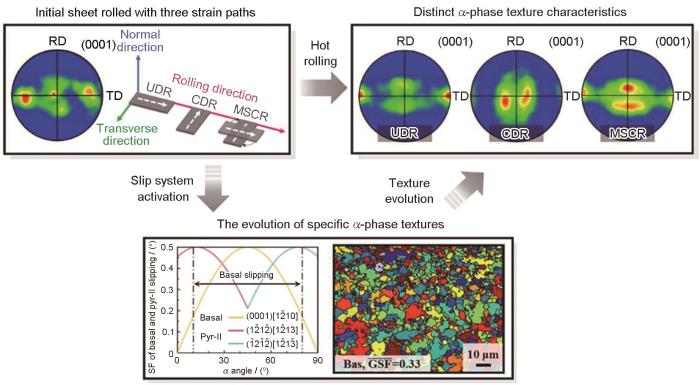
... 在钛合金和镁合金等hcp结构金属中,因滑移系开动能力有限,织构演化对晶格旋转与孪生变形机制尤为敏感.Sahoo等[47]研究表明,商业纯Ti在不同路径轧制中虽形成相似的织构类型,但织构强度存在明显差异,说明路径变化会通过晶粒旋转过程调控取向集中程度.Gupta等[48]在后续β钛合金的研究中,进一步利用大应变交叉轧制获得独特的织构类型,证明路径设计可主导织构类型.Fan等[49]在Ti65合金研究中揭示了路径变换会导致α相内全局Schmid因子分布差异,从而驱动织构多样化演变(图10[49]). ...
Texture development during multi-step cross rolling of a β titanium alloy: Experiments and simulation
1
2021
... 在钛合金和镁合金等hcp结构金属中,因滑移系开动能力有限,织构演化对晶格旋转与孪生变形机制尤为敏感.Sahoo等[47]研究表明,商业纯Ti在不同路径轧制中虽形成相似的织构类型,但织构强度存在明显差异,说明路径变化会通过晶粒旋转过程调控取向集中程度.Gupta等[48]在后续β钛合金的研究中,进一步利用大应变交叉轧制获得独特的织构类型,证明路径设计可主导织构类型.Fan等[49]在Ti65合金研究中揭示了路径变换会导致α相内全局Schmid因子分布差异,从而驱动织构多样化演变(图10[49]). ...
Tailoring texture in a near-α titanium alloy: Insights from strain paths and cooling rate influences
4
2024
... 在钛合金和镁合金等hcp结构金属中,因滑移系开动能力有限,织构演化对晶格旋转与孪生变形机制尤为敏感.Sahoo等[47]研究表明,商业纯Ti在不同路径轧制中虽形成相似的织构类型,但织构强度存在明显差异,说明路径变化会通过晶粒旋转过程调控取向集中程度.Gupta等[48]在后续β钛合金的研究中,进一步利用大应变交叉轧制获得独特的织构类型,证明路径设计可主导织构类型.Fan等[49]在Ti65合金研究中揭示了路径变换会导致α相内全局Schmid因子分布差异,从而驱动织构多样化演变(图10[49]). ...
... [49]). ...
... [
49]
Texture evolutions of Ti65 alloy during rolling process with different strain paths<sup>[<xref ref-type="bibr" rid="R49">49</xref>]</sup> (UDR—unidirectional rolling, CDR—cross-directional rolling, MSCR—multistep cross-rolling, Bas—basal slip, SF—Schmid factor, GSF—global Schmid factor)Fig.10![]()
镁合金在复杂路径下的织构演化同样表现出高度敏感性,主要体现在孪生诱导的取向重构和滑移模式的转变.Tang等[50]在AZ80镁合金的热压缩实验中发现,间歇保温过程中的硬化行为高度依赖于应变路径变化,且织构演化的路径敏感性明显高于晶粒尺寸变化.Li等[51]在AZ31镁合金研究中表明,变路径加载过程中{102}拉伸孪晶的激活引起晶粒细化、位错密度升高和取向迁移,形成孪晶织构增强与基面织构弱化并存的复合结构.Wu等[52]采用旋挤工艺引入附加周向剪切,发现剪切应变削弱了c轴平行于轴向的丝织构,同时促进c轴平行于法向的面织构形成,其机制与基面和柱面滑移的交替开动密切相关. ...
... [
49] (UDR—unidirectional rolling, CDR—cross-directional rolling, MSCR—multistep cross-rolling, Bas—basal slip, SF—Schmid factor, GSF—global Schmid factor)
Fig.10![]()
镁合金在复杂路径下的织构演化同样表现出高度敏感性,主要体现在孪生诱导的取向重构和滑移模式的转变.Tang等[50]在AZ80镁合金的热压缩实验中发现,间歇保温过程中的硬化行为高度依赖于应变路径变化,且织构演化的路径敏感性明显高于晶粒尺寸变化.Li等[51]在AZ31镁合金研究中表明,变路径加载过程中{102}拉伸孪晶的激活引起晶粒细化、位错密度升高和取向迁移,形成孪晶织构增强与基面织构弱化并存的复合结构.Wu等[52]采用旋挤工艺引入附加周向剪切,发现剪切应变削弱了c轴平行于轴向的丝织构,同时促进c轴平行于法向的面织构形成,其机制与基面和柱面滑移的交替开动密切相关. ...
Strain path dependent evolutions of microstructure and texture in AZ80 magnesium alloy during hot deformation
1
2019
... 镁合金在复杂路径下的织构演化同样表现出高度敏感性,主要体现在孪生诱导的取向重构和滑移模式的转变.Tang等[50]在AZ80镁合金的热压缩实验中发现,间歇保温过程中的硬化行为高度依赖于应变路径变化,且织构演化的路径敏感性明显高于晶粒尺寸变化.Li等[51]在AZ31镁合金研究中表明,变路径加载过程中{102}拉伸孪晶的激活引起晶粒细化、位错密度升高和取向迁移,形成孪晶织构增强与基面织构弱化并存的复合结构.Wu等[52]采用旋挤工艺引入附加周向剪切,发现剪切应变削弱了c轴平行于轴向的丝织构,同时促进c轴平行于法向的面织构形成,其机制与基面和柱面滑移的交替开动密切相关. ...
Effect of strain path on mechanical behavior of AZ31 magnesium alloy
1
2022
... 镁合金在复杂路径下的织构演化同样表现出高度敏感性,主要体现在孪生诱导的取向重构和滑移模式的转变.Tang等[50]在AZ80镁合金的热压缩实验中发现,间歇保温过程中的硬化行为高度依赖于应变路径变化,且织构演化的路径敏感性明显高于晶粒尺寸变化.Li等[51]在AZ31镁合金研究中表明,变路径加载过程中{102}拉伸孪晶的激活引起晶粒细化、位错密度升高和取向迁移,形成孪晶织构增强与基面织构弱化并存的复合结构.Wu等[52]采用旋挤工艺引入附加周向剪切,发现剪切应变削弱了c轴平行于轴向的丝织构,同时促进c轴平行于法向的面织构形成,其机制与基面和柱面滑移的交替开动密切相关. ...
Texture adjustment approach of magnesium alloys via variable strain path calculated by an integrated finite element-viscoplastic self-consistent model
1
2024
... 镁合金在复杂路径下的织构演化同样表现出高度敏感性,主要体现在孪生诱导的取向重构和滑移模式的转变.Tang等[50]在AZ80镁合金的热压缩实验中发现,间歇保温过程中的硬化行为高度依赖于应变路径变化,且织构演化的路径敏感性明显高于晶粒尺寸变化.Li等[51]在AZ31镁合金研究中表明,变路径加载过程中{102}拉伸孪晶的激活引起晶粒细化、位错密度升高和取向迁移,形成孪晶织构增强与基面织构弱化并存的复合结构.Wu等[52]采用旋挤工艺引入附加周向剪切,发现剪切应变削弱了c轴平行于轴向的丝织构,同时促进c轴平行于法向的面织构形成,其机制与基面和柱面滑移的交替开动密切相关. ...
Mechanical properties, microstructure and micro-texture evolution for 1050AA deformed by equal channel angular pressing (ECAP) and post ECAP plane strain compression using two loading schemes
1
2012
... 铝合金作为典型的fcc结构金属,其织构演化主要通过多滑移系协调变形实现,路径改变可有效诱发织构类型和强度的变化.El-Danaf[53]的研究表明,具有等通道转角挤压(ECAP)织构的1050AA合金在经历平面应变压缩时向典型轧制织构转变的趋势明显,说明路径变换可实现铝合金织构类型的有效调控.Dhara等[54]在AA6111-T4铝合金中对比了单轴与双轴路径,发现双轴应变促进低强度{111}织构形成,且卸载-重新加载过程会进一步影响织构强度,揭示了加载历史对织构稳定性的持续影响.Zeng等[55]还发现,2219铝合金在平面应变压缩中,因应变路径效应表现出明显塑性各向异性,并认为其机制与织构演化密切相关. ...
An X-ray diffraction study of the influence of linear and changing strain paths on strain and texture evolution in AA6111-T4 aluminium alloy sheets
1
2024
... 铝合金作为典型的fcc结构金属,其织构演化主要通过多滑移系协调变形实现,路径改变可有效诱发织构类型和强度的变化.El-Danaf[53]的研究表明,具有等通道转角挤压(ECAP)织构的1050AA合金在经历平面应变压缩时向典型轧制织构转变的趋势明显,说明路径变换可实现铝合金织构类型的有效调控.Dhara等[54]在AA6111-T4铝合金中对比了单轴与双轴路径,发现双轴应变促进低强度{111}织构形成,且卸载-重新加载过程会进一步影响织构强度,揭示了加载历史对织构稳定性的持续影响.Zeng等[55]还发现,2219铝合金在平面应变压缩中,因应变路径效应表现出明显塑性各向异性,并认为其机制与织构演化密切相关. ...
Grain refinement in hot working of 2219 aluminium alloy: On the effect of deformation mode and loading path
1
2020
... 铝合金作为典型的fcc结构金属,其织构演化主要通过多滑移系协调变形实现,路径改变可有效诱发织构类型和强度的变化.El-Danaf[53]的研究表明,具有等通道转角挤压(ECAP)织构的1050AA合金在经历平面应变压缩时向典型轧制织构转变的趋势明显,说明路径变换可实现铝合金织构类型的有效调控.Dhara等[54]在AA6111-T4铝合金中对比了单轴与双轴路径,发现双轴应变促进低强度{111}织构形成,且卸载-重新加载过程会进一步影响织构强度,揭示了加载历史对织构稳定性的持续影响.Zeng等[55]还发现,2219铝合金在平面应变压缩中,因应变路径效应表现出明显塑性各向异性,并认为其机制与织构演化密切相关. ...
A synchrotron X-ray diffraction study of non-proportional strain-path effects
1
2017
... 钢作为bcc结构金属材料,其织构演化对非比例加载尤为敏感.Collins等[56]利用原位X射线衍射研究DX54钢,发现晶格应变在最高载荷下沿加载轴快速累积,且不连续应变路径变化是诱导织构改变的主要原因.Akbarian等[57]对孪生诱发塑性(TWIP)钢进行了多轴锻造,证实了路径变化通过影响滑移和孪生行为实现织构调整和力学性能改善,具体的织构演化特征如图11[57]所示.Shaabani等[58]通过非对称单向/交叉轧制研究了低碳钢的织构演化行为,发现由于变形参考系的变化,交叉轧制能够更好地削弱整体织构强度. ...
Step-by-step texture modification through strain path change toward improvement of the hardening capacity in a twinning-induced-plasticity steel
4
2021
... 钢作为bcc结构金属材料,其织构演化对非比例加载尤为敏感.Collins等[56]利用原位X射线衍射研究DX54钢,发现晶格应变在最高载荷下沿加载轴快速累积,且不连续应变路径变化是诱导织构改变的主要原因.Akbarian等[57]对孪生诱发塑性(TWIP)钢进行了多轴锻造,证实了路径变化通过影响滑移和孪生行为实现织构调整和力学性能改善,具体的织构演化特征如图11[57]所示.Shaabani等[58]通过非对称单向/交叉轧制研究了低碳钢的织构演化行为,发现由于变形参考系的变化,交叉轧制能够更好地削弱整体织构强度. ...
... [57]所示.Shaabani等[58]通过非对称单向/交叉轧制研究了低碳钢的织构演化行为,发现由于变形参考系的变化,交叉轧制能够更好地削弱整体织构强度. ...
... [
57]
Texture evolution affected by strain path changes during multi axis forging process<sup>[<xref ref-type="bibr" rid="R57">57</xref>]</sup> (MAF—multi-axial forging; TI—texture intensity; <i>ϕ</i>, <i>φ</i><sub>1</sub>, and <i>φ</i><sub>2</sub>—Euler angles)Fig.11![]() <strong>2</strong> 应变路径效应的多尺度建模
<strong>2</strong> 应变路径效应的多尺度建模应变路径效应显著影响材料在复杂载荷下的力学响应及微观演化,对其精准建模是塑性成形理论和工艺优化的基础.当前的多尺度建模研究通常涵盖宏观、细观和微观三个层次.其中,细观和微观尺度建模能够通过位错演化、孪生激活、晶体取向变化及再结晶动力学等多种机制解析,为宏观模型的构建提供必要的物理机理支撑和参数化数据来源[59~63].而在应变路径效应的研究和应用中,宏观尺度建模依然处于核心地位.这不仅因为宏观本构框架能够直接捕捉屈服、硬化、回弹和断裂等工程上关切的力学行为,还因其便于与有限元模拟及实际工艺优化相结合,从而在工艺预测和设计中具有不可替代的重要性.因此,有关细观和微观建模的研究进展本文暂不详述,本节将聚焦于考虑应变路径效应的宏观尺度均匀化模型的研究现状,从材料本构模型、极限预测与损伤模型和微观组织演化模型三方面展开综述. ...
... [
57] (MAF—multi-axial forging; TI—texture intensity;
ϕ,
φ1, and
φ2—Euler angles)
Fig.11![]() <strong>2</strong> 应变路径效应的多尺度建模
<strong>2</strong> 应变路径效应的多尺度建模应变路径效应显著影响材料在复杂载荷下的力学响应及微观演化,对其精准建模是塑性成形理论和工艺优化的基础.当前的多尺度建模研究通常涵盖宏观、细观和微观三个层次.其中,细观和微观尺度建模能够通过位错演化、孪生激活、晶体取向变化及再结晶动力学等多种机制解析,为宏观模型的构建提供必要的物理机理支撑和参数化数据来源[59~63].而在应变路径效应的研究和应用中,宏观尺度建模依然处于核心地位.这不仅因为宏观本构框架能够直接捕捉屈服、硬化、回弹和断裂等工程上关切的力学行为,还因其便于与有限元模拟及实际工艺优化相结合,从而在工艺预测和设计中具有不可替代的重要性.因此,有关细观和微观建模的研究进展本文暂不详述,本节将聚焦于考虑应变路径效应的宏观尺度均匀化模型的研究现状,从材料本构模型、极限预测与损伤模型和微观组织演化模型三方面展开综述. ...
Effect of strain path and short-term post-annealing on the microstructure, texture, and mechanical anisotropy of low-carbon steel
1
2024
... 钢作为bcc结构金属材料,其织构演化对非比例加载尤为敏感.Collins等[56]利用原位X射线衍射研究DX54钢,发现晶格应变在最高载荷下沿加载轴快速累积,且不连续应变路径变化是诱导织构改变的主要原因.Akbarian等[57]对孪生诱发塑性(TWIP)钢进行了多轴锻造,证实了路径变化通过影响滑移和孪生行为实现织构调整和力学性能改善,具体的织构演化特征如图11[57]所示.Shaabani等[58]通过非对称单向/交叉轧制研究了低碳钢的织构演化行为,发现由于变形参考系的变化,交叉轧制能够更好地削弱整体织构强度. ...
Modeling the anisotropy of hot plastic deformation of two-phase titanium alloys with a colony microstructure
1
2018
... 应变路径效应显著影响材料在复杂载荷下的力学响应及微观演化,对其精准建模是塑性成形理论和工艺优化的基础.当前的多尺度建模研究通常涵盖宏观、细观和微观三个层次.其中,细观和微观尺度建模能够通过位错演化、孪生激活、晶体取向变化及再结晶动力学等多种机制解析,为宏观模型的构建提供必要的物理机理支撑和参数化数据来源[59~63].而在应变路径效应的研究和应用中,宏观尺度建模依然处于核心地位.这不仅因为宏观本构框架能够直接捕捉屈服、硬化、回弹和断裂等工程上关切的力学行为,还因其便于与有限元模拟及实际工艺优化相结合,从而在工艺预测和设计中具有不可替代的重要性.因此,有关细观和微观建模的研究进展本文暂不详述,本节将聚焦于考虑应变路径效应的宏观尺度均匀化模型的研究现状,从材料本构模型、极限预测与损伤模型和微观组织演化模型三方面展开综述. ...
A novel continuous dynamic recrystallization model to reveal grain refinement mechanism in constraining ring rolling of thin-walled conical structure with inner ribs
2025
Optimization and tolerance prediction of sheet metal forming process using response surface model
2008
Development and verification of crystal plasticity finite element model considering phase transformation
2025
Simulation of strain induced abnormal grain growth in aluminum alloy by coupling crystal plasticity and phase field methods
1
2022
... 应变路径效应显著影响材料在复杂载荷下的力学响应及微观演化,对其精准建模是塑性成形理论和工艺优化的基础.当前的多尺度建模研究通常涵盖宏观、细观和微观三个层次.其中,细观和微观尺度建模能够通过位错演化、孪生激活、晶体取向变化及再结晶动力学等多种机制解析,为宏观模型的构建提供必要的物理机理支撑和参数化数据来源[59~63].而在应变路径效应的研究和应用中,宏观尺度建模依然处于核心地位.这不仅因为宏观本构框架能够直接捕捉屈服、硬化、回弹和断裂等工程上关切的力学行为,还因其便于与有限元模拟及实际工艺优化相结合,从而在工艺预测和设计中具有不可替代的重要性.因此,有关细观和微观建模的研究进展本文暂不详述,本节将聚焦于考虑应变路径效应的宏观尺度均匀化模型的研究现状,从材料本构模型、极限预测与损伤模型和微观组织演化模型三方面展开综述. ...
Plane stress yield function for aluminum alloy sheets—part 1: Theory
1
2003
... 应变路径效应在宏观尺度上的研究经历了由“基本屈服与硬化理论”逐步拓展到“复杂路径依赖建模”的过程.Barlat等[64]和Yoon等[65]发展了Yld2000-2d、Yld2004-18p等非二次屈服函数,大幅提升了平面应力状态下的预测精度,并逐渐成为工业有限元模拟中的重要工具.随后,Deng等[66]基于改进的Yld2000-2d屈服准则构建出更适用于工程应用的路径依赖模型.Hou等[67]则运用由Stoughton2004和Min2016塑性势函数组成的非关联流动法则模型准确描述了双相钢在不同应变路径下的各向异性屈服行为.上述研究为复杂路径下的屈服行为建模奠定了理论与方法基础. ...
Plane stress yield function for aluminum alloy sheets-part II: FE formulation and its implementation
1
2004
... 应变路径效应在宏观尺度上的研究经历了由“基本屈服与硬化理论”逐步拓展到“复杂路径依赖建模”的过程.Barlat等[64]和Yoon等[65]发展了Yld2000-2d、Yld2004-18p等非二次屈服函数,大幅提升了平面应力状态下的预测精度,并逐渐成为工业有限元模拟中的重要工具.随后,Deng等[66]基于改进的Yld2000-2d屈服准则构建出更适用于工程应用的路径依赖模型.Hou等[67]则运用由Stoughton2004和Min2016塑性势函数组成的非关联流动法则模型准确描述了双相钢在不同应变路径下的各向异性屈服行为.上述研究为复杂路径下的屈服行为建模奠定了理论与方法基础. ...
On the non-linear unloading behavior of a biaxially loaded dual-phase steel sheet
1
2018
... 应变路径效应在宏观尺度上的研究经历了由“基本屈服与硬化理论”逐步拓展到“复杂路径依赖建模”的过程.Barlat等[64]和Yoon等[65]发展了Yld2000-2d、Yld2004-18p等非二次屈服函数,大幅提升了平面应力状态下的预测精度,并逐渐成为工业有限元模拟中的重要工具.随后,Deng等[66]基于改进的Yld2000-2d屈服准则构建出更适用于工程应用的路径依赖模型.Hou等[67]则运用由Stoughton2004和Min2016塑性势函数组成的非关联流动法则模型准确描述了双相钢在不同应变路径下的各向异性屈服行为.上述研究为复杂路径下的屈服行为建模奠定了理论与方法基础. ...
Investigation of evolving yield surfaces of dual-phase steels
1
2021
... 应变路径效应在宏观尺度上的研究经历了由“基本屈服与硬化理论”逐步拓展到“复杂路径依赖建模”的过程.Barlat等[64]和Yoon等[65]发展了Yld2000-2d、Yld2004-18p等非二次屈服函数,大幅提升了平面应力状态下的预测精度,并逐渐成为工业有限元模拟中的重要工具.随后,Deng等[66]基于改进的Yld2000-2d屈服准则构建出更适用于工程应用的路径依赖模型.Hou等[67]则运用由Stoughton2004和Min2016塑性势函数组成的非关联流动法则模型准确描述了双相钢在不同应变路径下的各向异性屈服行为.上述研究为复杂路径下的屈服行为建模奠定了理论与方法基础. ...
Constitutive equations for cyclic plasticity and cyclic viscoplasticity
1
1989
... 与屈服理论研究并行,硬化模型以及屈服-硬化耦合模型的研究成为另一个重要方向.Chaboche[68]提出的非线性多背应力叠加运动硬化模型能够准确反映循环与非比例加载下的路径依赖性,成为此后路径效应建模的基础.在此框架下,Haddag等[69]进一步将Chaboche模型与位错硬化机制结合,对回弹与路径依赖硬化进行了统一描述.与此同时,Barlat等[70]基于Bauschinger效应提出了当前被广泛应用的均质各向异性硬化(HAH)模型,为复杂路径下的硬化行为建模提供了思路. ...
Investigation of advanced strain-path dependent material models for sheet metal forming simulations
1
2007
... 与屈服理论研究并行,硬化模型以及屈服-硬化耦合模型的研究成为另一个重要方向.Chaboche[68]提出的非线性多背应力叠加运动硬化模型能够准确反映循环与非比例加载下的路径依赖性,成为此后路径效应建模的基础.在此框架下,Haddag等[69]进一步将Chaboche模型与位错硬化机制结合,对回弹与路径依赖硬化进行了统一描述.与此同时,Barlat等[70]基于Bauschinger效应提出了当前被广泛应用的均质各向异性硬化(HAH)模型,为复杂路径下的硬化行为建模提供了思路. ...
Extension of homogeneous anisotropic hardening model to cross-loading with latent effects
1
2013
... 与屈服理论研究并行,硬化模型以及屈服-硬化耦合模型的研究成为另一个重要方向.Chaboche[68]提出的非线性多背应力叠加运动硬化模型能够准确反映循环与非比例加载下的路径依赖性,成为此后路径效应建模的基础.在此框架下,Haddag等[69]进一步将Chaboche模型与位错硬化机制结合,对回弹与路径依赖硬化进行了统一描述.与此同时,Barlat等[70]基于Bauschinger效应提出了当前被广泛应用的均质各向异性硬化(HAH)模型,为复杂路径下的硬化行为建模提供了思路. ...
Prediction of the yield surface evolution and some apparent non-normality effects after abrupt strain-path change using classical plasticity
1
2019
... 随着研究进一步深入,速率效应与运动硬化的耦合模型也逐渐受到重视,Yang和Balan[71]通过实验结合数值模拟指出,路径改变的早期阶段受应变速率敏感性支配,而后期的非正交响应主要由运动硬化主导,明确揭示了两类效应在瞬态响应中的阶段性作用.Choi和Yoon[72]在最新研究中针对宏观模型参数获取困难、实验成本高的问题,提出了简化的变形硬化与速率相关模型,在保持路径依赖表征能力的同时有效降低了计算和标定成本,凸显了模型效率提升与工程适用性的结合. ...
A new simplified distortional hardening model for nonlinear strain paths
1
2023
... 随着研究进一步深入,速率效应与运动硬化的耦合模型也逐渐受到重视,Yang和Balan[71]通过实验结合数值模拟指出,路径改变的早期阶段受应变速率敏感性支配,而后期的非正交响应主要由运动硬化主导,明确揭示了两类效应在瞬态响应中的阶段性作用.Choi和Yoon[72]在最新研究中针对宏观模型参数获取困难、实验成本高的问题,提出了简化的变形硬化与速率相关模型,在保持路径依赖表征能力的同时有效降低了计算和标定成本,凸显了模型效率提升与工程适用性的结合. ...
Progress of crystal plasticity theory and simulations
1
2020
... 在当前研究发展阶段,宏观模型的构建和应用仍面临着实验数据获取难度大和工艺验证成本高的现实挑战.为突破这一瓶颈,研究者开展了基于物理机制的晶体塑性有限元模拟方法研究,并不断挖掘其显著优势[73].Zecevic等[74]基于几何必需位错提出新型晶体塑性模型,实现了对双相钢循环加载下硬化速率、非线性卸载及Bauschinger效应的准确预测.在此基础上,Kim等[75]提出VPSC-RGBV晶体塑性模型,将位错密度动态演化纳入其中,在保持与HAH模型近似精度的同时减少参数数量.Xu等[76]系统研究了晶粒尺寸与路径效应的耦合影响,并进一步考虑预变形效应以提升模型精度.其他研究如Iftikhar等[77]提出的Taylor型晶体塑性有限元框架以及周驰等[78]改进的Voce/Hollomon模型,也从数值方法和硬化规律修正角度推动了路径效应建模在铝合金、相变诱导塑性(TRIP)钢中的工程应用. ...
晶体塑性理论及模拟研究进展
1
2020
... 在当前研究发展阶段,宏观模型的构建和应用仍面临着实验数据获取难度大和工艺验证成本高的现实挑战.为突破这一瓶颈,研究者开展了基于物理机制的晶体塑性有限元模拟方法研究,并不断挖掘其显著优势[73].Zecevic等[74]基于几何必需位错提出新型晶体塑性模型,实现了对双相钢循环加载下硬化速率、非线性卸载及Bauschinger效应的准确预测.在此基础上,Kim等[75]提出VPSC-RGBV晶体塑性模型,将位错密度动态演化纳入其中,在保持与HAH模型近似精度的同时减少参数数量.Xu等[76]系统研究了晶粒尺寸与路径效应的耦合影响,并进一步考虑预变形效应以提升模型精度.其他研究如Iftikhar等[77]提出的Taylor型晶体塑性有限元框架以及周驰等[78]改进的Voce/Hollomon模型,也从数值方法和硬化规律修正角度推动了路径效应建模在铝合金、相变诱导塑性(TRIP)钢中的工程应用. ...
Dual-phase steel sheets under cyclic tension-compression to large strains: Experiments and crystal plasticity modeling
1
2016
... 在当前研究发展阶段,宏观模型的构建和应用仍面临着实验数据获取难度大和工艺验证成本高的现实挑战.为突破这一瓶颈,研究者开展了基于物理机制的晶体塑性有限元模拟方法研究,并不断挖掘其显著优势[73].Zecevic等[74]基于几何必需位错提出新型晶体塑性模型,实现了对双相钢循环加载下硬化速率、非线性卸载及Bauschinger效应的准确预测.在此基础上,Kim等[75]提出VPSC-RGBV晶体塑性模型,将位错密度动态演化纳入其中,在保持与HAH模型近似精度的同时减少参数数量.Xu等[76]系统研究了晶粒尺寸与路径效应的耦合影响,并进一步考虑预变形效应以提升模型精度.其他研究如Iftikhar等[77]提出的Taylor型晶体塑性有限元框架以及周驰等[78]改进的Voce/Hollomon模型,也从数值方法和硬化规律修正角度推动了路径效应建模在铝合金、相变诱导塑性(TRIP)钢中的工程应用. ...
A crystal plasticity model for describing the anisotropic hardening behavior of steel sheets during strain-path changes
1
2018
... 在当前研究发展阶段,宏观模型的构建和应用仍面临着实验数据获取难度大和工艺验证成本高的现实挑战.为突破这一瓶颈,研究者开展了基于物理机制的晶体塑性有限元模拟方法研究,并不断挖掘其显著优势[73].Zecevic等[74]基于几何必需位错提出新型晶体塑性模型,实现了对双相钢循环加载下硬化速率、非线性卸载及Bauschinger效应的准确预测.在此基础上,Kim等[75]提出VPSC-RGBV晶体塑性模型,将位错密度动态演化纳入其中,在保持与HAH模型近似精度的同时减少参数数量.Xu等[76]系统研究了晶粒尺寸与路径效应的耦合影响,并进一步考虑预变形效应以提升模型精度.其他研究如Iftikhar等[77]提出的Taylor型晶体塑性有限元框架以及周驰等[78]改进的Voce/Hollomon模型,也从数值方法和硬化规律修正角度推动了路径效应建模在铝合金、相变诱导塑性(TRIP)钢中的工程应用. ...
Crystal plasticity-based analysis and modelling of grain size and strain path dependent micro-scaled deformation mechanisms of ultra-thin sheet metals
1
2023
... 在当前研究发展阶段,宏观模型的构建和应用仍面临着实验数据获取难度大和工艺验证成本高的现实挑战.为突破这一瓶颈,研究者开展了基于物理机制的晶体塑性有限元模拟方法研究,并不断挖掘其显著优势[73].Zecevic等[74]基于几何必需位错提出新型晶体塑性模型,实现了对双相钢循环加载下硬化速率、非线性卸载及Bauschinger效应的准确预测.在此基础上,Kim等[75]提出VPSC-RGBV晶体塑性模型,将位错密度动态演化纳入其中,在保持与HAH模型近似精度的同时减少参数数量.Xu等[76]系统研究了晶粒尺寸与路径效应的耦合影响,并进一步考虑预变形效应以提升模型精度.其他研究如Iftikhar等[77]提出的Taylor型晶体塑性有限元框架以及周驰等[78]改进的Voce/Hollomon模型,也从数值方法和硬化规律修正角度推动了路径效应建模在铝合金、相变诱导塑性(TRIP)钢中的工程应用. ...
Evolution of subsequent yield surfaces with plastic deformation along proportional and non-proportional loading paths on annealed AA6061 alloy: Experiments and crystal plasticity finite element modeling
1
2021
... 在当前研究发展阶段,宏观模型的构建和应用仍面临着实验数据获取难度大和工艺验证成本高的现实挑战.为突破这一瓶颈,研究者开展了基于物理机制的晶体塑性有限元模拟方法研究,并不断挖掘其显著优势[73].Zecevic等[74]基于几何必需位错提出新型晶体塑性模型,实现了对双相钢循环加载下硬化速率、非线性卸载及Bauschinger效应的准确预测.在此基础上,Kim等[75]提出VPSC-RGBV晶体塑性模型,将位错密度动态演化纳入其中,在保持与HAH模型近似精度的同时减少参数数量.Xu等[76]系统研究了晶粒尺寸与路径效应的耦合影响,并进一步考虑预变形效应以提升模型精度.其他研究如Iftikhar等[77]提出的Taylor型晶体塑性有限元框架以及周驰等[78]改进的Voce/Hollomon模型,也从数值方法和硬化规律修正角度推动了路径效应建模在铝合金、相变诱导塑性(TRIP)钢中的工程应用. ...
A mixed hardening model for TRIP steel considering strain path change
1
2018
... 在当前研究发展阶段,宏观模型的构建和应用仍面临着实验数据获取难度大和工艺验证成本高的现实挑战.为突破这一瓶颈,研究者开展了基于物理机制的晶体塑性有限元模拟方法研究,并不断挖掘其显著优势[73].Zecevic等[74]基于几何必需位错提出新型晶体塑性模型,实现了对双相钢循环加载下硬化速率、非线性卸载及Bauschinger效应的准确预测.在此基础上,Kim等[75]提出VPSC-RGBV晶体塑性模型,将位错密度动态演化纳入其中,在保持与HAH模型近似精度的同时减少参数数量.Xu等[76]系统研究了晶粒尺寸与路径效应的耦合影响,并进一步考虑预变形效应以提升模型精度.其他研究如Iftikhar等[77]提出的Taylor型晶体塑性有限元框架以及周驰等[78]改进的Voce/Hollomon模型,也从数值方法和硬化规律修正角度推动了路径效应建模在铝合金、相变诱导塑性(TRIP)钢中的工程应用. ...
一种考虑应变路径变化的TRIP钢组合硬化模型
1
2018
... 在当前研究发展阶段,宏观模型的构建和应用仍面临着实验数据获取难度大和工艺验证成本高的现实挑战.为突破这一瓶颈,研究者开展了基于物理机制的晶体塑性有限元模拟方法研究,并不断挖掘其显著优势[73].Zecevic等[74]基于几何必需位错提出新型晶体塑性模型,实现了对双相钢循环加载下硬化速率、非线性卸载及Bauschinger效应的准确预测.在此基础上,Kim等[75]提出VPSC-RGBV晶体塑性模型,将位错密度动态演化纳入其中,在保持与HAH模型近似精度的同时减少参数数量.Xu等[76]系统研究了晶粒尺寸与路径效应的耦合影响,并进一步考虑预变形效应以提升模型精度.其他研究如Iftikhar等[77]提出的Taylor型晶体塑性有限元框架以及周驰等[78]改进的Voce/Hollomon模型,也从数值方法和硬化规律修正角度推动了路径效应建模在铝合金、相变诱导塑性(TRIP)钢中的工程应用. ...
A long short-term memory-based constitutive modeling framework for capturing strain path dependence in plastic deformation
1
2025
... 除晶体塑性有限元模拟方法外,机器学习等数据驱动技术的引入也极大地促进了材料本构建模的发展[79].当前,本领域的机器学习应用主要集中在两种模式,分别为通过机器学习算法识别特定本构模型公式的参数[80]和创建完全取代本构模型的元模型[81].在参数识别方面,机器学习元模型可以直接用于逆向识别,即通过输入力、位移和应变等力学实验数据获得元模型参数,随后将待表征材料的实验结果导入元模型中以预测材料本构参数;也可以与经典优化算法结合,采用参数输入、力学响应输出的形式,通过优化迭代寻找最佳参数使得实验结果与模型预测相吻合.相较于传统方法,机器学习模型在处理非线性关系和大数据样本时展现出更高的精度与效率.为进一步突破本构模型固有的局限,研究者也积极探索以机器学习元模型直接取代显式本构关系的可行性[82].Jang等[83]利用人工神经网络(ANN)创建了基于数据训练的元模型,取代了von Mises屈服和各向同性硬化准则,所建模型在多种应变路径下表现出良好泛化能力,并可有效嵌入有限元模拟框架.Gorji等[81]则采用回归神经网络(RNN)对AA5182和DC05钢在应变路径变化时的塑性变形进行建模,实现了对任意加载路径下材料变形响应的高精度预测,其准确性可与当前广泛应用的材料本构模型相当. ...
A mixture of experts approach to handle ambiguities in parameter identification problems in material modeling
1
2019
... 除晶体塑性有限元模拟方法外,机器学习等数据驱动技术的引入也极大地促进了材料本构建模的发展[79].当前,本领域的机器学习应用主要集中在两种模式,分别为通过机器学习算法识别特定本构模型公式的参数[80]和创建完全取代本构模型的元模型[81].在参数识别方面,机器学习元模型可以直接用于逆向识别,即通过输入力、位移和应变等力学实验数据获得元模型参数,随后将待表征材料的实验结果导入元模型中以预测材料本构参数;也可以与经典优化算法结合,采用参数输入、力学响应输出的形式,通过优化迭代寻找最佳参数使得实验结果与模型预测相吻合.相较于传统方法,机器学习模型在处理非线性关系和大数据样本时展现出更高的精度与效率.为进一步突破本构模型固有的局限,研究者也积极探索以机器学习元模型直接取代显式本构关系的可行性[82].Jang等[83]利用人工神经网络(ANN)创建了基于数据训练的元模型,取代了von Mises屈服和各向同性硬化准则,所建模型在多种应变路径下表现出良好泛化能力,并可有效嵌入有限元模拟框架.Gorji等[81]则采用回归神经网络(RNN)对AA5182和DC05钢在应变路径变化时的塑性变形进行建模,实现了对任意加载路径下材料变形响应的高精度预测,其准确性可与当前广泛应用的材料本构模型相当. ...
On the potential of recurrent neural networks for modeling path dependent plasticity
2
2020
... 除晶体塑性有限元模拟方法外,机器学习等数据驱动技术的引入也极大地促进了材料本构建模的发展[79].当前,本领域的机器学习应用主要集中在两种模式,分别为通过机器学习算法识别特定本构模型公式的参数[80]和创建完全取代本构模型的元模型[81].在参数识别方面,机器学习元模型可以直接用于逆向识别,即通过输入力、位移和应变等力学实验数据获得元模型参数,随后将待表征材料的实验结果导入元模型中以预测材料本构参数;也可以与经典优化算法结合,采用参数输入、力学响应输出的形式,通过优化迭代寻找最佳参数使得实验结果与模型预测相吻合.相较于传统方法,机器学习模型在处理非线性关系和大数据样本时展现出更高的精度与效率.为进一步突破本构模型固有的局限,研究者也积极探索以机器学习元模型直接取代显式本构关系的可行性[82].Jang等[83]利用人工神经网络(ANN)创建了基于数据训练的元模型,取代了von Mises屈服和各向同性硬化准则,所建模型在多种应变路径下表现出良好泛化能力,并可有效嵌入有限元模拟框架.Gorji等[81]则采用回归神经网络(RNN)对AA5182和DC05钢在应变路径变化时的塑性变形进行建模,实现了对任意加载路径下材料变形响应的高精度预测,其准确性可与当前广泛应用的材料本构模型相当. ...
... [81]则采用回归神经网络(RNN)对AA5182和DC05钢在应变路径变化时的塑性变形进行建模,实现了对任意加载路径下材料变形响应的高精度预测,其准确性可与当前广泛应用的材料本构模型相当. ...
Using neural networks to represent von Mises plasticity with isotropic hardening
1
2020
... 除晶体塑性有限元模拟方法外,机器学习等数据驱动技术的引入也极大地促进了材料本构建模的发展[79].当前,本领域的机器学习应用主要集中在两种模式,分别为通过机器学习算法识别特定本构模型公式的参数[80]和创建完全取代本构模型的元模型[81].在参数识别方面,机器学习元模型可以直接用于逆向识别,即通过输入力、位移和应变等力学实验数据获得元模型参数,随后将待表征材料的实验结果导入元模型中以预测材料本构参数;也可以与经典优化算法结合,采用参数输入、力学响应输出的形式,通过优化迭代寻找最佳参数使得实验结果与模型预测相吻合.相较于传统方法,机器学习模型在处理非线性关系和大数据样本时展现出更高的精度与效率.为进一步突破本构模型固有的局限,研究者也积极探索以机器学习元模型直接取代显式本构关系的可行性[82].Jang等[83]利用人工神经网络(ANN)创建了基于数据训练的元模型,取代了von Mises屈服和各向同性硬化准则,所建模型在多种应变路径下表现出良好泛化能力,并可有效嵌入有限元模拟框架.Gorji等[81]则采用回归神经网络(RNN)对AA5182和DC05钢在应变路径变化时的塑性变形进行建模,实现了对任意加载路径下材料变形响应的高精度预测,其准确性可与当前广泛应用的材料本构模型相当. ...
Machine learning-based constitutive model for J2- plasticity
1
2021
... 除晶体塑性有限元模拟方法外,机器学习等数据驱动技术的引入也极大地促进了材料本构建模的发展[79].当前,本领域的机器学习应用主要集中在两种模式,分别为通过机器学习算法识别特定本构模型公式的参数[80]和创建完全取代本构模型的元模型[81].在参数识别方面,机器学习元模型可以直接用于逆向识别,即通过输入力、位移和应变等力学实验数据获得元模型参数,随后将待表征材料的实验结果导入元模型中以预测材料本构参数;也可以与经典优化算法结合,采用参数输入、力学响应输出的形式,通过优化迭代寻找最佳参数使得实验结果与模型预测相吻合.相较于传统方法,机器学习模型在处理非线性关系和大数据样本时展现出更高的精度与效率.为进一步突破本构模型固有的局限,研究者也积极探索以机器学习元模型直接取代显式本构关系的可行性[82].Jang等[83]利用人工神经网络(ANN)创建了基于数据训练的元模型,取代了von Mises屈服和各向同性硬化准则,所建模型在多种应变路径下表现出良好泛化能力,并可有效嵌入有限元模拟框架.Gorji等[81]则采用回归神经网络(RNN)对AA5182和DC05钢在应变路径变化时的塑性变形进行建模,实现了对任意加载路径下材料变形响应的高精度预测,其准确性可与当前广泛应用的材料本构模型相当. ...
Research progress on anisotropic fracture models and fracture tests for sheet metals
1
2019
... 除材料本构模型外,另一个值得关注的研究方向是基于路径效应的成形极限预测与损伤模型[84].此类研究通常在经典成形极限理论框架下,通过引入多种硬化或损伤机制,有效捕捉复杂加载历程中材料的失效敏感性.Yoshida等[85]基于Marciniak-Kuczyński (MK)模型系统揭示了路径对成形极限的影响,并指出卸载过程会削弱路径依赖性.Nurcheshmeh和Green[86]借助各向同性与运动硬化耦合模型实现了对成形极限的准确预测,并且强调了预应变参数的重要作用. ...
金属板料各向异性断裂模型及断裂实验研究进展
1
2019
... 除材料本构模型外,另一个值得关注的研究方向是基于路径效应的成形极限预测与损伤模型[84].此类研究通常在经典成形极限理论框架下,通过引入多种硬化或损伤机制,有效捕捉复杂加载历程中材料的失效敏感性.Yoshida等[85]基于Marciniak-Kuczyński (MK)模型系统揭示了路径对成形极限的影响,并指出卸载过程会削弱路径依赖性.Nurcheshmeh和Green[86]借助各向同性与运动硬化耦合模型实现了对成形极限的准确预测,并且强调了预应变参数的重要作用. ...
Path-dependence of the forming limit stresses in a sheet metal
1
2007
... 除材料本构模型外,另一个值得关注的研究方向是基于路径效应的成形极限预测与损伤模型[84].此类研究通常在经典成形极限理论框架下,通过引入多种硬化或损伤机制,有效捕捉复杂加载历程中材料的失效敏感性.Yoshida等[85]基于Marciniak-Kuczyński (MK)模型系统揭示了路径对成形极限的影响,并指出卸载过程会削弱路径依赖性.Nurcheshmeh和Green[86]借助各向同性与运动硬化耦合模型实现了对成形极限的准确预测,并且强调了预应变参数的重要作用. ...
Prediction of sheet forming limits with Marciniak and Kuczynski analysis using combined isotropic-nonlinear kinematic hardening
1
2011
... 除材料本构模型外,另一个值得关注的研究方向是基于路径效应的成形极限预测与损伤模型[84].此类研究通常在经典成形极限理论框架下,通过引入多种硬化或损伤机制,有效捕捉复杂加载历程中材料的失效敏感性.Yoshida等[85]基于Marciniak-Kuczyński (MK)模型系统揭示了路径对成形极限的影响,并指出卸载过程会削弱路径依赖性.Nurcheshmeh和Green[86]借助各向同性与运动硬化耦合模型实现了对成形极限的准确预测,并且强调了预应变参数的重要作用. ...
Ductile damage evolution under cyclic non-proportional loading paths
1
2018
... 在损伤机制建模方面,模型的耦合能力显著提升了极限预测的精度.Fincato等[87]提出的Mohr-Coulomb弹塑性-损伤耦合模型能够合理反映非比例加载下的损伤演化;而范荣磊等[88]在MK框架中引入损伤演化模型,成功预测了TA32钛合金在高温下的成形极限,并强调初始织构差异在不同路径下对损伤行为和极限应变的关键影响. ...
Prediction of damage and hot forming limit of TA32 titanium alloy based on crystal plasticity model
1
2025
... 在损伤机制建模方面,模型的耦合能力显著提升了极限预测的精度.Fincato等[87]提出的Mohr-Coulomb弹塑性-损伤耦合模型能够合理反映非比例加载下的损伤演化;而范荣磊等[88]在MK框架中引入损伤演化模型,成功预测了TA32钛合金在高温下的成形极限,并强调初始织构差异在不同路径下对损伤行为和极限应变的关键影响. ...
基于晶体塑性模型预测TA32钛合金损伤及高温成形极限
1
2025
... 在损伤机制建模方面,模型的耦合能力显著提升了极限预测的精度.Fincato等[87]提出的Mohr-Coulomb弹塑性-损伤耦合模型能够合理反映非比例加载下的损伤演化;而范荣磊等[88]在MK框架中引入损伤演化模型,成功预测了TA32钛合金在高温下的成形极限,并强调初始织构差异在不同路径下对损伤行为和极限应变的关键影响. ...
Physics-guided machine learning for forming-limit assessments of advanced high-strength steels
1
2025
... 近年来,数据驱动技术也在成形极限和损伤预测领域展现出巨大潜力.Nguyen等[89]结合物理引导神经网络(PGNN)与材料物理定律,基于电子背散射衍射测量数据,对高强钢变形及成形极限进行高效精准预测,大幅降低了计算成本.Pandya等[90]则在改进的Johnson-Cook塑性模型基础上,利用神经网络元模型实现了对AA7075铝合金塑性变形及断裂响应的准确预测.Schowtjak等[91]还提出了一种基于ANN的损伤模型,可以仅依赖实验数据,准确描述以孔洞分数为表征的韧性损伤演化过程.相比于传统损伤本构,该模型既无需对损伤演化机理作出具体假设,又能够实现应变路径依赖下损伤行为的可视化预测. ...
Strain rate and temperature dependent fracture of aluminum alloy 7075: Experiments and neural network modeling
1
2020
... 近年来,数据驱动技术也在成形极限和损伤预测领域展现出巨大潜力.Nguyen等[89]结合物理引导神经网络(PGNN)与材料物理定律,基于电子背散射衍射测量数据,对高强钢变形及成形极限进行高效精准预测,大幅降低了计算成本.Pandya等[90]则在改进的Johnson-Cook塑性模型基础上,利用神经网络元模型实现了对AA7075铝合金塑性变形及断裂响应的准确预测.Schowtjak等[91]还提出了一种基于ANN的损伤模型,可以仅依赖实验数据,准确描述以孔洞分数为表征的韧性损伤演化过程.相比于传统损伤本构,该模型既无需对损伤演化机理作出具体假设,又能够实现应变路径依赖下损伤行为的可视化预测. ...
Prediction of ductile damage evolution based on experimental data using artificial neural networks
1
2022
... 近年来,数据驱动技术也在成形极限和损伤预测领域展现出巨大潜力.Nguyen等[89]结合物理引导神经网络(PGNN)与材料物理定律,基于电子背散射衍射测量数据,对高强钢变形及成形极限进行高效精准预测,大幅降低了计算成本.Pandya等[90]则在改进的Johnson-Cook塑性模型基础上,利用神经网络元模型实现了对AA7075铝合金塑性变形及断裂响应的准确预测.Schowtjak等[91]还提出了一种基于ANN的损伤模型,可以仅依赖实验数据,准确描述以孔洞分数为表征的韧性损伤演化过程.相比于传统损伤本构,该模型既无需对损伤演化机理作出具体假设,又能够实现应变路径依赖下损伤行为的可视化预测. ...
Modeling of {10-12}-{10-12} secondary twinning in pre-compressed Mg alloy AZ31
1
2017
... 在显微组织建模方面,学者们普遍通过位错密度演化、孪晶机制及动态再结晶过程的引入来表达路径依赖特征.Qiao等[92]基于EVPSC-TDT (elastic-viscoplastic self-consistent model with the consideration of twinning and detwinning)模型,考虑{102}-{102}二次孪晶对镁合金压缩路径改变的影响,指出在大预变形条件下该机制对预测精度尤为重要.Barrett等[93]提出了位错基础多晶塑性有限元模型,通过引入背应力和位错湮灭机制,成功再现实验中不同路径下的各向异性和组织演化.Upadhyay等[94]进一步将路径效应纳入不锈钢双轴加载模拟,捕捉了晶格应变演化并量化弹性各向异性、滑移与晶粒约束的协同作用.Wang等[43]也成功开发出结合位错密度、α/α亚结构与应变路径的物理模型,用于预测片层α钛合金在不同应变速率下的组织演化.上述研究成果共同表明,引入显微机制的路径敏感模型可显著提升对复杂变形行为的可预测性,但其普适性仍受限于材料类型和实验标定范围. ...
Predicting deformation behavior of α-uranium during tension, compression, load reversal, rolling, and sheet forming using elasto-plastic, multi-level crystal plasticity coupled with finite elements
1
2020
... 在显微组织建模方面,学者们普遍通过位错密度演化、孪晶机制及动态再结晶过程的引入来表达路径依赖特征.Qiao等[92]基于EVPSC-TDT (elastic-viscoplastic self-consistent model with the consideration of twinning and detwinning)模型,考虑{102}-{102}二次孪晶对镁合金压缩路径改变的影响,指出在大预变形条件下该机制对预测精度尤为重要.Barrett等[93]提出了位错基础多晶塑性有限元模型,通过引入背应力和位错湮灭机制,成功再现实验中不同路径下的各向异性和组织演化.Upadhyay等[94]进一步将路径效应纳入不锈钢双轴加载模拟,捕捉了晶格应变演化并量化弹性各向异性、滑移与晶粒约束的协同作用.Wang等[43]也成功开发出结合位错密度、α/α亚结构与应变路径的物理模型,用于预测片层α钛合金在不同应变速率下的组织演化.上述研究成果共同表明,引入显微机制的路径敏感模型可显著提升对复杂变形行为的可预测性,但其普适性仍受限于材料类型和实验标定范围. ...
Microstructure evolution of stainless steel subjected to biaxial load path changes: In-situ neutron diffraction and multi-scale modeling
1
2019
... 在显微组织建模方面,学者们普遍通过位错密度演化、孪晶机制及动态再结晶过程的引入来表达路径依赖特征.Qiao等[92]基于EVPSC-TDT (elastic-viscoplastic self-consistent model with the consideration of twinning and detwinning)模型,考虑{102}-{102}二次孪晶对镁合金压缩路径改变的影响,指出在大预变形条件下该机制对预测精度尤为重要.Barrett等[93]提出了位错基础多晶塑性有限元模型,通过引入背应力和位错湮灭机制,成功再现实验中不同路径下的各向异性和组织演化.Upadhyay等[94]进一步将路径效应纳入不锈钢双轴加载模拟,捕捉了晶格应变演化并量化弹性各向异性、滑移与晶粒约束的协同作用.Wang等[43]也成功开发出结合位错密度、α/α亚结构与应变路径的物理模型,用于预测片层α钛合金在不同应变速率下的组织演化.上述研究成果共同表明,引入显微机制的路径敏感模型可显著提升对复杂变形行为的可预测性,但其普适性仍受限于材料类型和实验标定范围. ...
A crystallographic dislocation model for describing hardening of polycrystals during strain path changes. Application to low carbon steels
1
2013
... 与显微组织模型相比,基于织构演化的建模方法更侧重晶粒旋转和滑移激活对力学响应的影响.Kitayama等[95]提出的晶体学位错硬化模型能够捕捉路径变化对织构演化的影响,并揭示晶粒旋转与应力-应变响应的耦合关系.Zhang等[96]基于Kurdjumov-Sachs关系构建层状代表性体积单元,模拟了低碳钢在不同路径下的组织和织构演化,表明原始奥氏体取向和路径变化共同决定硬化行为和织构特征.此外,Ibragimova等[97]还提出了一种融合机器学习和晶体塑性的模型框架,利用晶体塑性模拟所得数据对ANN模型进行训练,实现了对材料应力响应和织构演化的高效预测.该方法充分发挥了数值模拟与数据驱动模型的协同优势.总体来看,这些研究既体现了传统晶体塑性方法的成熟,也展示了智能算法在高效计算方面的潜力,但在跨尺度精度与计算效率之间的平衡仍待探索. ...
Crystal plasticity modeling of prior austenite orientation effects on deformation behaviors of martensitic steels under different strain paths
1
2024
... 与显微组织模型相比,基于织构演化的建模方法更侧重晶粒旋转和滑移激活对力学响应的影响.Kitayama等[95]提出的晶体学位错硬化模型能够捕捉路径变化对织构演化的影响,并揭示晶粒旋转与应力-应变响应的耦合关系.Zhang等[96]基于Kurdjumov-Sachs关系构建层状代表性体积单元,模拟了低碳钢在不同路径下的组织和织构演化,表明原始奥氏体取向和路径变化共同决定硬化行为和织构特征.此外,Ibragimova等[97]还提出了一种融合机器学习和晶体塑性的模型框架,利用晶体塑性模拟所得数据对ANN模型进行训练,实现了对材料应力响应和织构演化的高效预测.该方法充分发挥了数值模拟与数据驱动模型的协同优势.总体来看,这些研究既体现了传统晶体塑性方法的成熟,也展示了智能算法在高效计算方面的潜力,但在跨尺度精度与计算效率之间的平衡仍待探索. ...
A new ANN based crystal plasticity model for FCC materials and its application to non-monotonic strain paths
1
2021
... 与显微组织模型相比,基于织构演化的建模方法更侧重晶粒旋转和滑移激活对力学响应的影响.Kitayama等[95]提出的晶体学位错硬化模型能够捕捉路径变化对织构演化的影响,并揭示晶粒旋转与应力-应变响应的耦合关系.Zhang等[96]基于Kurdjumov-Sachs关系构建层状代表性体积单元,模拟了低碳钢在不同路径下的组织和织构演化,表明原始奥氏体取向和路径变化共同决定硬化行为和织构特征.此外,Ibragimova等[97]还提出了一种融合机器学习和晶体塑性的模型框架,利用晶体塑性模拟所得数据对ANN模型进行训练,实现了对材料应力响应和织构演化的高效预测.该方法充分发挥了数值模拟与数据驱动模型的协同优势.总体来看,这些研究既体现了传统晶体塑性方法的成熟,也展示了智能算法在高效计算方面的潜力,但在跨尺度精度与计算效率之间的平衡仍待探索. ...
A theoretical and experimental study on forming limit diagram for a seamed tube hydroforming
1
2011
... 在板料成形性优化领域,早期研究多以经典成形极限图(FLD)为判据[98],但随后的工作显示其对应变路径的敏感性远超早期预期,复杂应变路径下的极限演化已成为研究的热点.Dhara等[99]通过系统实验验证了不连续路径转换对铝合金板变形潜力的改善作用.然而,Leotoing和Guines[100]在AA5086合金中观察到当预应变接近20%时,后续双轴拉伸反而诱发过早失效,成形性急剧下降(图12[100]).这一矛盾说明,板料成形性的提升并非随预应变增加而线性改善,而取决于预应变水平、加载比例与显微组织的协同作用.另外,Schlosser等[101]在锌板成形研究中强调晶体取向和第二相分布可能削弱路径优化效果,认为板料成形的宏观路径设计需与组织、织构调控相结合. ...
Formability analysis of pre-strained AA5754-O sheet metal using Yld96 plasticity theory: Role of amount and direction of uni-axial pre-strain
1
2016
... 在板料成形性优化领域,早期研究多以经典成形极限图(FLD)为判据[98],但随后的工作显示其对应变路径的敏感性远超早期预期,复杂应变路径下的极限演化已成为研究的热点.Dhara等[99]通过系统实验验证了不连续路径转换对铝合金板变形潜力的改善作用.然而,Leotoing和Guines[100]在AA5086合金中观察到当预应变接近20%时,后续双轴拉伸反而诱发过早失效,成形性急剧下降(图12[100]).这一矛盾说明,板料成形性的提升并非随预应变增加而线性改善,而取决于预应变水平、加载比例与显微组织的协同作用.另外,Schlosser等[101]在锌板成形研究中强调晶体取向和第二相分布可能削弱路径优化效果,认为板料成形的宏观路径设计需与组织、织构调控相结合. ...
Investigations of the effect of strain path changes on forming limit curves using an in-plane biaxial tensile test
4
2015
... 在板料成形性优化领域,早期研究多以经典成形极限图(FLD)为判据[98],但随后的工作显示其对应变路径的敏感性远超早期预期,复杂应变路径下的极限演化已成为研究的热点.Dhara等[99]通过系统实验验证了不连续路径转换对铝合金板变形潜力的改善作用.然而,Leotoing和Guines[100]在AA5086合金中观察到当预应变接近20%时,后续双轴拉伸反而诱发过早失效,成形性急剧下降(图12[100]).这一矛盾说明,板料成形性的提升并非随预应变增加而线性改善,而取决于预应变水平、加载比例与显微组织的协同作用.另外,Schlosser等[101]在锌板成形研究中强调晶体取向和第二相分布可能削弱路径优化效果,认为板料成形的宏观路径设计需与组织、织构调控相结合. ...
... [100]).这一矛盾说明,板料成形性的提升并非随预应变增加而线性改善,而取决于预应变水平、加载比例与显微组织的协同作用.另外,Schlosser等[101]在锌板成形研究中强调晶体取向和第二相分布可能削弱路径优化效果,认为板料成形的宏观路径设计需与组织、织构调控相结合. ...
... [
100]
Equivalent strain ratio corresponding to different prestrains under nonlinear strain path<sup>[<xref ref-type="bibr" rid="R100">100</xref>]</sup>Fig.12![]()
在旋压成形领域,通过路径效应实现板料成形性提升的探索也在持续深入.詹梅团队[102,103]提出的环轧-旋压、重复剪切旋压等新工艺,较传统的旋压方法优化了路径设计,在提升构件成形性和力学性能方面效果更为显著.而针对管材液压成形,路径优化同样显示出重要工程价值.杨兵等[104]、Teng等[105]、Imaninejad等[106]以及Zhang等[107]分别利用模糊控制算法、有限元仿真和响应面法优化管材液压成形的加载历史,均显著改善了成形均匀性并有效抑制缺陷,进一步凸显了路径优化在管材成形工艺设计中的实用价值. ...
... [
100]
Fig.12![]()
在旋压成形领域,通过路径效应实现板料成形性提升的探索也在持续深入.詹梅团队[102,103]提出的环轧-旋压、重复剪切旋压等新工艺,较传统的旋压方法优化了路径设计,在提升构件成形性和力学性能方面效果更为显著.而针对管材液压成形,路径优化同样显示出重要工程价值.杨兵等[104]、Teng等[105]、Imaninejad等[106]以及Zhang等[107]分别利用模糊控制算法、有限元仿真和响应面法优化管材液压成形的加载历史,均显著改善了成形均匀性并有效抑制缺陷,进一步凸显了路径优化在管材成形工艺设计中的实用价值. ...
Influence of the strain path changes on the formability of a zinc sheet
1
2019
... 在板料成形性优化领域,早期研究多以经典成形极限图(FLD)为判据[98],但随后的工作显示其对应变路径的敏感性远超早期预期,复杂应变路径下的极限演化已成为研究的热点.Dhara等[99]通过系统实验验证了不连续路径转换对铝合金板变形潜力的改善作用.然而,Leotoing和Guines[100]在AA5086合金中观察到当预应变接近20%时,后续双轴拉伸反而诱发过早失效,成形性急剧下降(图12[100]).这一矛盾说明,板料成形性的提升并非随预应变增加而线性改善,而取决于预应变水平、加载比例与显微组织的协同作用.另外,Schlosser等[101]在锌板成形研究中强调晶体取向和第二相分布可能削弱路径优化效果,认为板料成形的宏观路径设计需与组织、织构调控相结合. ...
Advances in rolling-spinning technique of titanium tubes
1
2016
... 在旋压成形领域,通过路径效应实现板料成形性提升的探索也在持续深入.詹梅团队[102,103]提出的环轧-旋压、重复剪切旋压等新工艺,较传统的旋压方法优化了路径设计,在提升构件成形性和力学性能方面效果更为显著.而针对管材液压成形,路径优化同样显示出重要工程价值.杨兵等[104]、Teng等[105]、Imaninejad等[106]以及Zhang等[107]分别利用模糊控制算法、有限元仿真和响应面法优化管材液压成形的加载历史,均显著改善了成形均匀性并有效抑制缺陷,进一步凸显了路径优化在管材成形工艺设计中的实用价值. ...
钛合金筒形件轧-旋成形研究进展
1
2016
... 在旋压成形领域,通过路径效应实现板料成形性提升的探索也在持续深入.詹梅团队[102,103]提出的环轧-旋压、重复剪切旋压等新工艺,较传统的旋压方法优化了路径设计,在提升构件成形性和力学性能方面效果更为显著.而针对管材液压成形,路径优化同样显示出重要工程价值.杨兵等[104]、Teng等[105]、Imaninejad等[106]以及Zhang等[107]分别利用模糊控制算法、有限元仿真和响应面法优化管材液压成形的加载历史,均显著改善了成形均匀性并有效抑制缺陷,进一步凸显了路径优化在管材成形工艺设计中的实用价值. ...
Micromechanical behaviour of TA15 alloy cylindrical parts processed by multi-pass flow forming
1
2018
... 在旋压成形领域,通过路径效应实现板料成形性提升的探索也在持续深入.詹梅团队[102,103]提出的环轧-旋压、重复剪切旋压等新工艺,较传统的旋压方法优化了路径设计,在提升构件成形性和力学性能方面效果更为显著.而针对管材液压成形,路径优化同样显示出重要工程价值.杨兵等[104]、Teng等[105]、Imaninejad等[106]以及Zhang等[107]分别利用模糊控制算法、有限元仿真和响应面法优化管材液压成形的加载历史,均显著改善了成形均匀性并有效抑制缺陷,进一步凸显了路径优化在管材成形工艺设计中的实用价值. ...
A method to design the loading path for tube hydroforming process
1
2006
... 在旋压成形领域,通过路径效应实现板料成形性提升的探索也在持续深入.詹梅团队[102,103]提出的环轧-旋压、重复剪切旋压等新工艺,较传统的旋压方法优化了路径设计,在提升构件成形性和力学性能方面效果更为显著.而针对管材液压成形,路径优化同样显示出重要工程价值.杨兵等[104]、Teng等[105]、Imaninejad等[106]以及Zhang等[107]分别利用模糊控制算法、有限元仿真和响应面法优化管材液压成形的加载历史,均显著改善了成形均匀性并有效抑制缺陷,进一步凸显了路径优化在管材成形工艺设计中的实用价值. ...
一种管件液压成形加载路径的设计方法
1
2006
... 在旋压成形领域,通过路径效应实现板料成形性提升的探索也在持续深入.詹梅团队[102,103]提出的环轧-旋压、重复剪切旋压等新工艺,较传统的旋压方法优化了路径设计,在提升构件成形性和力学性能方面效果更为显著.而针对管材液压成形,路径优化同样显示出重要工程价值.杨兵等[104]、Teng等[105]、Imaninejad等[106]以及Zhang等[107]分别利用模糊控制算法、有限元仿真和响应面法优化管材液压成形的加载历史,均显著改善了成形均匀性并有效抑制缺陷,进一步凸显了路径优化在管材成形工艺设计中的实用价值. ...
Optimization of loading path in hydroforming T-shape using fuzzy control algorithm
1
2013
... 在旋压成形领域,通过路径效应实现板料成形性提升的探索也在持续深入.詹梅团队[102,103]提出的环轧-旋压、重复剪切旋压等新工艺,较传统的旋压方法优化了路径设计,在提升构件成形性和力学性能方面效果更为显著.而针对管材液压成形,路径优化同样显示出重要工程价值.杨兵等[104]、Teng等[105]、Imaninejad等[106]以及Zhang等[107]分别利用模糊控制算法、有限元仿真和响应面法优化管材液压成形的加载历史,均显著改善了成形均匀性并有效抑制缺陷,进一步凸显了路径优化在管材成形工艺设计中的实用价值. ...
Loading path optimization of tube hydroforming process
1
2005
... 在旋压成形领域,通过路径效应实现板料成形性提升的探索也在持续深入.詹梅团队[102,103]提出的环轧-旋压、重复剪切旋压等新工艺,较传统的旋压方法优化了路径设计,在提升构件成形性和力学性能方面效果更为显著.而针对管材液压成形,路径优化同样显示出重要工程价值.杨兵等[104]、Teng等[105]、Imaninejad等[106]以及Zhang等[107]分别利用模糊控制算法、有限元仿真和响应面法优化管材液压成形的加载历史,均显著改善了成形均匀性并有效抑制缺陷,进一步凸显了路径优化在管材成形工艺设计中的实用价值. ...
Process analysis of biconvex tube hydroforming based on loading path optimization by response surface method
1
2021
... 在旋压成形领域,通过路径效应实现板料成形性提升的探索也在持续深入.詹梅团队[102,103]提出的环轧-旋压、重复剪切旋压等新工艺,较传统的旋压方法优化了路径设计,在提升构件成形性和力学性能方面效果更为显著.而针对管材液压成形,路径优化同样显示出重要工程价值.杨兵等[104]、Teng等[105]、Imaninejad等[106]以及Zhang等[107]分别利用模糊控制算法、有限元仿真和响应面法优化管材液压成形的加载历史,均显著改善了成形均匀性并有效抑制缺陷,进一步凸显了路径优化在管材成形工艺设计中的实用价值. ...
Microstructure and superior mechanical properties of a multi-axially forged WE magnesium alloy
1
2017
... 在锻造成形过程中,应变路径的合理规划对于提升成形稳定性和综合性能具有关键作用.目前,通过调整锻造路径历史实现材料形性提升的研究重点普遍集中于晶粒细化、织构演化等方面.Salandari-Rabori等[108]针对多向锻造镁合金的显微组织和力学性能表现展开研究,发现多道次换向锻造后,组织内部动态再结晶程度明显增加,最终获得晶粒细小、取向分散的均匀等轴组织,对综合力学性能提升有明显帮助.值得注意的是,初始道次下材料表现为强塑性协同提升,随着后续多道次变形的进行,塑性改善愈加显著.王俐[109]和樊晓光等[110]在TB6合金药型罩的成形研究中采用拔长-多向锻造复合路径,系统比较了加载历史对构件均匀性的影响.结果表明,反向加载路径下构件成形效果最佳,其主要原因在于路径历史对片层α相几何取向和晶体取向的调整(图13[109]). ...
Study on the high-performance forming mechanism of TB6 titanium alloy shaped charge liner through controllable strain path forging
4
2024
... 在锻造成形过程中,应变路径的合理规划对于提升成形稳定性和综合性能具有关键作用.目前,通过调整锻造路径历史实现材料形性提升的研究重点普遍集中于晶粒细化、织构演化等方面.Salandari-Rabori等[108]针对多向锻造镁合金的显微组织和力学性能表现展开研究,发现多道次换向锻造后,组织内部动态再结晶程度明显增加,最终获得晶粒细小、取向分散的均匀等轴组织,对综合力学性能提升有明显帮助.值得注意的是,初始道次下材料表现为强塑性协同提升,随着后续多道次变形的进行,塑性改善愈加显著.王俐[109]和樊晓光等[110]在TB6合金药型罩的成形研究中采用拔长-多向锻造复合路径,系统比较了加载历史对构件均匀性的影响.结果表明,反向加载路径下构件成形效果最佳,其主要原因在于路径历史对片层α相几何取向和晶体取向的调整(图13[109]). ...
... [109]). ...
... [
109]
Characteristics of morphology and crystallographic orientation of <i>α</i> phase deformed along different loading paths<sup>[<xref ref-type="bibr" rid="R109">109</xref>]</sup> (GOS—grain orientation spread) (a1-a3) 0° compression (b1-b3) 45° compression (c1-c3) 90° compressionFig.13![]() <strong>3.3</strong> 轧制成形
<strong>3.3</strong> 轧制成形在轧制过程中,应变路径改变可在成形性、强塑性与各向异性之间实现再平衡.Chen等[111]提出的正反轧制和坯料预成形方法可有效减少带横肋圆柱构件填充不均匀的缺陷,显著提升成形质量.钛合金相关研究进一步证明了路径调控的潜力.Gao等[112]发现,相较于单向轧制,多级交叉轧制不仅保持了更高的屈服强度和延伸率,还显著降低了各向异性;Li等[113]同样采用交叉轧制实现了Ti60合金织构由横向向基面类型转变,从而有效改善了拉伸性能均匀性.Rouzbeh等[114]在Al/Mg复合板中利用交叉轧制路径诱导晶粒细化,从而实现成形性与强度同步提升,不同应变路径制备的Al/Mg复合板材拉伸性能对比如图14[114]所示. ...
... [
109] (GOS—grain orientation spread) (a1-a3) 0° compression (b1-b3) 45° compression (c1-c3) 90° compression
Fig.13![]() <strong>3.3</strong> 轧制成形
<strong>3.3</strong> 轧制成形在轧制过程中,应变路径改变可在成形性、强塑性与各向异性之间实现再平衡.Chen等[111]提出的正反轧制和坯料预成形方法可有效减少带横肋圆柱构件填充不均匀的缺陷,显著提升成形质量.钛合金相关研究进一步证明了路径调控的潜力.Gao等[112]发现,相较于单向轧制,多级交叉轧制不仅保持了更高的屈服强度和延伸率,还显著降低了各向异性;Li等[113]同样采用交叉轧制实现了Ti60合金织构由横向向基面类型转变,从而有效改善了拉伸性能均匀性.Rouzbeh等[114]在Al/Mg复合板中利用交叉轧制路径诱导晶粒细化,从而实现成形性与强度同步提升,不同应变路径制备的Al/Mg复合板材拉伸性能对比如图14[114]所示. ...
TB6钛合金药型罩可控应变路径锻造高性能成形机理研究
4
2024
... 在锻造成形过程中,应变路径的合理规划对于提升成形稳定性和综合性能具有关键作用.目前,通过调整锻造路径历史实现材料形性提升的研究重点普遍集中于晶粒细化、织构演化等方面.Salandari-Rabori等[108]针对多向锻造镁合金的显微组织和力学性能表现展开研究,发现多道次换向锻造后,组织内部动态再结晶程度明显增加,最终获得晶粒细小、取向分散的均匀等轴组织,对综合力学性能提升有明显帮助.值得注意的是,初始道次下材料表现为强塑性协同提升,随着后续多道次变形的进行,塑性改善愈加显著.王俐[109]和樊晓光等[110]在TB6合金药型罩的成形研究中采用拔长-多向锻造复合路径,系统比较了加载历史对构件均匀性的影响.结果表明,反向加载路径下构件成形效果最佳,其主要原因在于路径历史对片层α相几何取向和晶体取向的调整(图13[109]). ...
... [109]). ...
... [
109]
Characteristics of morphology and crystallographic orientation of <i>α</i> phase deformed along different loading paths<sup>[<xref ref-type="bibr" rid="R109">109</xref>]</sup> (GOS—grain orientation spread) (a1-a3) 0° compression (b1-b3) 45° compression (c1-c3) 90° compressionFig.13![]() <strong>3.3</strong> 轧制成形
<strong>3.3</strong> 轧制成形在轧制过程中,应变路径改变可在成形性、强塑性与各向异性之间实现再平衡.Chen等[111]提出的正反轧制和坯料预成形方法可有效减少带横肋圆柱构件填充不均匀的缺陷,显著提升成形质量.钛合金相关研究进一步证明了路径调控的潜力.Gao等[112]发现,相较于单向轧制,多级交叉轧制不仅保持了更高的屈服强度和延伸率,还显著降低了各向异性;Li等[113]同样采用交叉轧制实现了Ti60合金织构由横向向基面类型转变,从而有效改善了拉伸性能均匀性.Rouzbeh等[114]在Al/Mg复合板中利用交叉轧制路径诱导晶粒细化,从而实现成形性与强度同步提升,不同应变路径制备的Al/Mg复合板材拉伸性能对比如图14[114]所示. ...
... [
109] (GOS—grain orientation spread) (a1-a3) 0° compression (b1-b3) 45° compression (c1-c3) 90° compression
Fig.13![]() <strong>3.3</strong> 轧制成形
<strong>3.3</strong> 轧制成形在轧制过程中,应变路径改变可在成形性、强塑性与各向异性之间实现再平衡.Chen等[111]提出的正反轧制和坯料预成形方法可有效减少带横肋圆柱构件填充不均匀的缺陷,显著提升成形质量.钛合金相关研究进一步证明了路径调控的潜力.Gao等[112]发现,相较于单向轧制,多级交叉轧制不仅保持了更高的屈服强度和延伸率,还显著降低了各向异性;Li等[113]同样采用交叉轧制实现了Ti60合金织构由横向向基面类型转变,从而有效改善了拉伸性能均匀性.Rouzbeh等[114]在Al/Mg复合板中利用交叉轧制路径诱导晶粒细化,从而实现成形性与强度同步提升,不同应变路径制备的Al/Mg复合板材拉伸性能对比如图14[114]所示. ...
Method for pre-treating and matching reversing large deformation refined titanium alloy microstructure
1
... 在锻造成形过程中,应变路径的合理规划对于提升成形稳定性和综合性能具有关键作用.目前,通过调整锻造路径历史实现材料形性提升的研究重点普遍集中于晶粒细化、织构演化等方面.Salandari-Rabori等[108]针对多向锻造镁合金的显微组织和力学性能表现展开研究,发现多道次换向锻造后,组织内部动态再结晶程度明显增加,最终获得晶粒细小、取向分散的均匀等轴组织,对综合力学性能提升有明显帮助.值得注意的是,初始道次下材料表现为强塑性协同提升,随着后续多道次变形的进行,塑性改善愈加显著.王俐[109]和樊晓光等[110]在TB6合金药型罩的成形研究中采用拔长-多向锻造复合路径,系统比较了加载历史对构件均匀性的影响.结果表明,反向加载路径下构件成形效果最佳,其主要原因在于路径历史对片层α相几何取向和晶体取向的调整(图13[109]). ...
一种预处理匹配换向大变形细化钛合金微观组织的方法
1
... 在锻造成形过程中,应变路径的合理规划对于提升成形稳定性和综合性能具有关键作用.目前,通过调整锻造路径历史实现材料形性提升的研究重点普遍集中于晶粒细化、织构演化等方面.Salandari-Rabori等[108]针对多向锻造镁合金的显微组织和力学性能表现展开研究,发现多道次换向锻造后,组织内部动态再结晶程度明显增加,最终获得晶粒细小、取向分散的均匀等轴组织,对综合力学性能提升有明显帮助.值得注意的是,初始道次下材料表现为强塑性协同提升,随着后续多道次变形的进行,塑性改善愈加显著.王俐[109]和樊晓光等[110]在TB6合金药型罩的成形研究中采用拔长-多向锻造复合路径,系统比较了加载历史对构件均匀性的影响.结果表明,反向加载路径下构件成形效果最佳,其主要原因在于路径历史对片层α相几何取向和晶体取向的调整(图13[109]). ...
Study on generating rolling method for manufacturing cylindrical parts with external cross ribs
1
2024
... 在轧制过程中,应变路径改变可在成形性、强塑性与各向异性之间实现再平衡.Chen等[111]提出的正反轧制和坯料预成形方法可有效减少带横肋圆柱构件填充不均匀的缺陷,显著提升成形质量.钛合金相关研究进一步证明了路径调控的潜力.Gao等[112]发现,相较于单向轧制,多级交叉轧制不仅保持了更高的屈服强度和延伸率,还显著降低了各向异性;Li等[113]同样采用交叉轧制实现了Ti60合金织构由横向向基面类型转变,从而有效改善了拉伸性能均匀性.Rouzbeh等[114]在Al/Mg复合板中利用交叉轧制路径诱导晶粒细化,从而实现成形性与强度同步提升,不同应变路径制备的Al/Mg复合板材拉伸性能对比如图14[114]所示. ...
Comparative investigation of deformation mechanisms in Ti-6Mo-3.5Cr-1Zr metastable β titanium alloy subject to cold rolling strain paths
1
2025
... 在轧制过程中,应变路径改变可在成形性、强塑性与各向异性之间实现再平衡.Chen等[111]提出的正反轧制和坯料预成形方法可有效减少带横肋圆柱构件填充不均匀的缺陷,显著提升成形质量.钛合金相关研究进一步证明了路径调控的潜力.Gao等[112]发现,相较于单向轧制,多级交叉轧制不仅保持了更高的屈服强度和延伸率,还显著降低了各向异性;Li等[113]同样采用交叉轧制实现了Ti60合金织构由横向向基面类型转变,从而有效改善了拉伸性能均匀性.Rouzbeh等[114]在Al/Mg复合板中利用交叉轧制路径诱导晶粒细化,从而实现成形性与强度同步提升,不同应变路径制备的Al/Mg复合板材拉伸性能对比如图14[114]所示. ...
Rolling texture and its effect on tensile property of a near-α titanium alloy Ti60 plate
1
2019
... 在轧制过程中,应变路径改变可在成形性、强塑性与各向异性之间实现再平衡.Chen等[111]提出的正反轧制和坯料预成形方法可有效减少带横肋圆柱构件填充不均匀的缺陷,显著提升成形质量.钛合金相关研究进一步证明了路径调控的潜力.Gao等[112]发现,相较于单向轧制,多级交叉轧制不仅保持了更高的屈服强度和延伸率,还显著降低了各向异性;Li等[113]同样采用交叉轧制实现了Ti60合金织构由横向向基面类型转变,从而有效改善了拉伸性能均匀性.Rouzbeh等[114]在Al/Mg复合板中利用交叉轧制路径诱导晶粒细化,从而实现成形性与强度同步提升,不同应变路径制备的Al/Mg复合板材拉伸性能对比如图14[114]所示. ...
Effects of strain path on the microstructure, tensile properties, and formability of Al/Mg roll-bonded sheets
4
2023
... 在轧制过程中,应变路径改变可在成形性、强塑性与各向异性之间实现再平衡.Chen等[111]提出的正反轧制和坯料预成形方法可有效减少带横肋圆柱构件填充不均匀的缺陷,显著提升成形质量.钛合金相关研究进一步证明了路径调控的潜力.Gao等[112]发现,相较于单向轧制,多级交叉轧制不仅保持了更高的屈服强度和延伸率,还显著降低了各向异性;Li等[113]同样采用交叉轧制实现了Ti60合金织构由横向向基面类型转变,从而有效改善了拉伸性能均匀性.Rouzbeh等[114]在Al/Mg复合板中利用交叉轧制路径诱导晶粒细化,从而实现成形性与强度同步提升,不同应变路径制备的Al/Mg复合板材拉伸性能对比如图14[114]所示. ...
... [114]所示. ...
... [
114]
Comparisons of tensile properties of Al/Mg composite sheets fabricated under single pass (sp) and double passes by direct rolling (dpd), reverse rolling (dpr), and cross rolling (dpc)<sup>[<xref ref-type="bibr" rid="R114">114</xref>]</sup>Fig.14![]() <strong>3.4</strong> 挤压成形
<strong>3.4</strong> 挤压成形对于挤压成形工艺,应变路径的合理设计被广泛证明能够显著改善材料的成形稳定性与力学性能.张治民等[115]系统总结了多种挤压成形新技术,并首次提出将直线运动与旋转运动相匹配,主动增加强剪切变形的多向加载旋转挤压成形技术,实现材料的均匀强韧化和薄壁内环高筋构件的整体精确成形.Wang等[40]在CGP工艺研究中表明,交叉路径带来的晶粒细化和织构优化效果远优于传统路径,为复杂构件的局部强化提供了切实可行的方案.具体到ECAP技术(图15[116]),Gautam等[7]在对镁合金实验中发现路径A和路径BC能够有效细化晶粒并提升硬度和延展性,而路径C由于剪切方向抵消,导致性能退化.与之形成对比的是,Mills等[116]在锌合金ECAP研究中强调,路径BC和路径C的成形效果更好,分别在强度提升和成形性改善方面更具优势.这说明最优路径的选择需结合材料本征机制,不可一概而论. ...
... [
114]
Fig.14![]() <strong>3.4</strong> 挤压成形
<strong>3.4</strong> 挤压成形对于挤压成形工艺,应变路径的合理设计被广泛证明能够显著改善材料的成形稳定性与力学性能.张治民等[115]系统总结了多种挤压成形新技术,并首次提出将直线运动与旋转运动相匹配,主动增加强剪切变形的多向加载旋转挤压成形技术,实现材料的均匀强韧化和薄壁内环高筋构件的整体精确成形.Wang等[40]在CGP工艺研究中表明,交叉路径带来的晶粒细化和织构优化效果远优于传统路径,为复杂构件的局部强化提供了切实可行的方案.具体到ECAP技术(图15[116]),Gautam等[7]在对镁合金实验中发现路径A和路径BC能够有效细化晶粒并提升硬度和延展性,而路径C由于剪切方向抵消,导致性能退化.与之形成对比的是,Mills等[116]在锌合金ECAP研究中强调,路径BC和路径C的成形效果更好,分别在强度提升和成形性改善方面更具优势.这说明最优路径的选择需结合材料本征机制,不可一概而论. ...
Multi-directional loading rotary extrusion forming technology and equipment
1
2023
... 对于挤压成形工艺,应变路径的合理设计被广泛证明能够显著改善材料的成形稳定性与力学性能.张治民等[115]系统总结了多种挤压成形新技术,并首次提出将直线运动与旋转运动相匹配,主动增加强剪切变形的多向加载旋转挤压成形技术,实现材料的均匀强韧化和薄壁内环高筋构件的整体精确成形.Wang等[40]在CGP工艺研究中表明,交叉路径带来的晶粒细化和织构优化效果远优于传统路径,为复杂构件的局部强化提供了切实可行的方案.具体到ECAP技术(图15[116]),Gautam等[7]在对镁合金实验中发现路径A和路径BC能够有效细化晶粒并提升硬度和延展性,而路径C由于剪切方向抵消,导致性能退化.与之形成对比的是,Mills等[116]在锌合金ECAP研究中强调,路径BC和路径C的成形效果更好,分别在强度提升和成形性改善方面更具优势.这说明最优路径的选择需结合材料本征机制,不可一概而论. ...
多向加载旋转挤压成形技术及装备
1
2023
... 对于挤压成形工艺,应变路径的合理设计被广泛证明能够显著改善材料的成形稳定性与力学性能.张治民等[115]系统总结了多种挤压成形新技术,并首次提出将直线运动与旋转运动相匹配,主动增加强剪切变形的多向加载旋转挤压成形技术,实现材料的均匀强韧化和薄壁内环高筋构件的整体精确成形.Wang等[40]在CGP工艺研究中表明,交叉路径带来的晶粒细化和织构优化效果远优于传统路径,为复杂构件的局部强化提供了切实可行的方案.具体到ECAP技术(图15[116]),Gautam等[7]在对镁合金实验中发现路径A和路径BC能够有效细化晶粒并提升硬度和延展性,而路径C由于剪切方向抵消,导致性能退化.与之形成对比的是,Mills等[116]在锌合金ECAP研究中强调,路径BC和路径C的成形效果更好,分别在强度提升和成形性改善方面更具优势.这说明最优路径的选择需结合材料本征机制,不可一概而论. ...
Influence of ECAP deformation routes on grain refinement, mechanical properties and texture of zinc
4
2025
... 对于挤压成形工艺,应变路径的合理设计被广泛证明能够显著改善材料的成形稳定性与力学性能.张治民等[115]系统总结了多种挤压成形新技术,并首次提出将直线运动与旋转运动相匹配,主动增加强剪切变形的多向加载旋转挤压成形技术,实现材料的均匀强韧化和薄壁内环高筋构件的整体精确成形.Wang等[40]在CGP工艺研究中表明,交叉路径带来的晶粒细化和织构优化效果远优于传统路径,为复杂构件的局部强化提供了切实可行的方案.具体到ECAP技术(图15[116]),Gautam等[7]在对镁合金实验中发现路径A和路径BC能够有效细化晶粒并提升硬度和延展性,而路径C由于剪切方向抵消,导致性能退化.与之形成对比的是,Mills等[116]在锌合金ECAP研究中强调,路径BC和路径C的成形效果更好,分别在强度提升和成形性改善方面更具优势.这说明最优路径的选择需结合材料本征机制,不可一概而论. ...
... [116]在锌合金ECAP研究中强调,路径BC和路径C的成形效果更好,分别在强度提升和成形性改善方面更具优势.这说明最优路径的选择需结合材料本征机制,不可一概而论. ...
... [
116]
Deformation strain paths under standard equal channel angular pressing (ECAP) routes<sup>[<xref ref-type="bibr" rid="R116">116</xref>]</sup>(a) illustration of a cubic element undergoing defor-mation due to shearing after a single pass of ECAP ...
... [
116]
(a) illustration of a cubic element undergoing defor-mation due to shearing after a single pass of ECAP ...