



铝基复合材料(aluminum matrix composites,AMCs)因其优异的比强度和比刚度,良好的耐磨性、导热和导电性,以及较低的热膨胀系数等综合性能,在航空航天、交通运输、电子封装等高端装备领域展现出巨大的应用潜力[1~5]。提升铝基复合材料性能的关键在于引入高性能的增强相(如纳米陶瓷颗粒、晶须、纤维等),并实现其与Al基体的良好界面结合。然而,传统外加法制备铝基复合材料时,常存在界面润湿性差、增强相易团聚以及在高温加工或服役过程中易诱发有害界面反应等问题,严重制约了复合材料的力学性能和服役寿命[6~8]。相比之下,原位反应法为克服上述瓶颈问题提供了一条极具前景的技术路径,尤其是在纳米相增强铝基复合材料中具有出色的优势。该类材料主要包括两种类型的原位反应。一是增强体在金属基体内的原位反应,通过精确调控Al粉与反应前驱体(如碳材料、氧化物、金属间化合物等)之间的化学反应,可在基体内原位合成Al4C3[9,10]、Al2O3[11,12]、TiB2[13]、TiC[14,15]等增强相。原位反应形成的增强相表面干净、无污染,其尺寸通常是纳米或亚微米级,且在Al基体中分布均匀,有效抑制了团聚现象[16,17]。二是界面相的原位反应,即在金属基体与增强相界面处生成具有特定成分和结构的新相,从而改善界面结合状态,可显著提高载荷传递效率[18~20]。
界面作为连接基体与增强相之间的关键纽带,其微观结构直接影响复合材料的界面结合状态、应力传递和裂纹扩展行为以及综合力学性能[25,26]。其中,界面的晶体学取向关系是决定界面本征结合强度的重要因素。这种取向匹配程度显著影响着界面能以及原子间的化学键合特性,进而决定了界面的本征结合强度。良好的取向匹配有助于降低界面能,促进形成强界面结合[27,28]。另一方面,界面修饰是优化性能的有效策略,既可提升复合材料界面的化学稳定性,也能够改善界面应力传递效率。因此,深入解析并精确调控原位增强相与Al基体的界面微观结构、晶体取向匹配行为、界面反应层的形成机制及其修饰策略,是实现材料强韧化协同提升的关键科学问题[29~32]。
基于此,本文综述了粉末冶金铝基复合材料中各类原位反应体系的反应机理和特征,重点分析了原位增强相与Al基体界面的微观结构特征及其修饰调控策略,深入探讨了复合材料力学性能和强韧化机制。最后,基于当前发展趋势,展望了该领域的未来研究方向与应用前景,旨在推动高性能铝基复合材料的理论创新和工程应用,为开发新一代轻量化、高性能结构材料提供理论依据和技术支撑。
1 原位反应的体系类型
发展原位反应铝基复合材料的关键在于反应体系的选择与设计,这直接决定了增强相的种类、晶体结构、形貌尺寸以及热力学稳定性,进而影响增强相与Al基体的界面特性及复合材料的力学性能。根据反应前驱体类型的不同,目前广泛研究的原位反应体系主要包括铝-碳材料体系、铝-氧化物体系以及其他类型的反应体系。各类体系在反应驱动力、反应路径及工艺控制方面各具特点。深入理解各反应体系的基本原理、反应条件及增强相的形成机制,是实现复合材料可控制备的关键基础。下文将系统梳理上述几类典型原位反应体系的研究进展。
1.1 铝-碳材料
常用纳米碳材料包括碳纳米管(carbon nanotube,CNT)、石墨烯(graphene,GN)、氧化石墨烯(graphene oxide,GO)等,因具有高比表面积、高强度、高模量以及优异的导电/导热性能,已成为复合材料的重要增强体。近年来,纳米碳材料增强铝基复合材料取得了重要进展,目前基于界面原位反应策略制备的复合制备方法主要可分为两类:(1) 外加碳材料预分散;(2) 金属粉体中原位合成碳材料。
1.1.1 外加碳材料
作为纳米碳材料的典型代表,CNT凭借其高长径比和独特的一维中空薄壁结构,在铝基复合材料中得到了广泛研究和应用[33]。如图1a和b[34]所示,Chen等[34]采用粉末冶金工艺,在不同烧结温度下制备了CNT/Al复合材料,并系统研究了界面反应产物的演变行为。结果表明,随着烧结温度升高,界面结构由初始无碳化物的CNT-Al直接接触界面,逐渐转变为含有部分Al4C3的过渡态界面,最终CNT完全反应形成Al4C3纳米棒结构,显著增强了界面结合强度,从而提高了CNT与Al基体之间的载荷传递效率。Zhou等[35]系统研究了多壁碳纳米管(multi-walled carbon nanotube,MWCNT)增强铝基复合材料的热膨胀行为,发现在MWCNT端部形成的Al4C3可产生“锚定效应”,有效抑制界面局部滑移并约束基体的塑性变形(图1c~f[35])。与上述一维碳材料相比,二维碳材料如GN等具有更大的比表面积、更高的比强度和比模量,在电学、热学及力学领域展现出更为广阔的应用潜力[36]。Li等[37]以还原氧化石墨烯(reduced graphene oxide,RGO)为增强相,采用片层粉末冶金法制备了RGO/Al复合材料(图1g~i[37])。结果表明,在热压烧结过程中,RGO-Al界面处原位生成的微量Al4C3相有助于改善界面结合状态,进而提升复合材料的整体强化效果。
图1
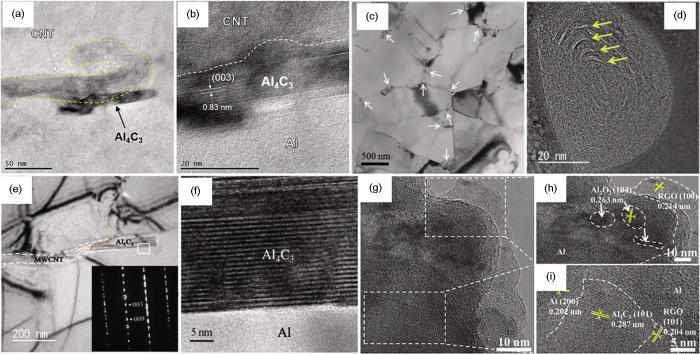
图1
基于界面原位反应的碳纳米管(CNT)/Al复合材料和还原氧化石墨烯(RGO)/Al复合材料的微观组织[34,35,37]
Fig.1
Microstructures of CNT/Al composites and RGO/Al composites based on interfacial in situ reactions (CNT—carbon nanotube, RGO—reduced graphene oxide)
(a, b) TEM (a) and HRTEM (b) images of the interface of CNT/Al composite[34]
(c-f) TEM images of the inner walls of deformed MWCNTs and HRTEM image of the interface of MWCNT/Al composite[35] (MWCNT—multi-walled carbon nanotube. White arrows in Fig.1c show the individually dispersed MWCNTs in the Al matrix; yellow arrows in Fig.1d indicate the inner-wall regularities in deformed MWCNTs during processing. Inset in Fig.1e is the SAED pattern of formed Al4C3)
(g-i) TEM (g) and HRTEM (h, i) images of the interface of RGO/Al composite[37]
由于以上碳纳米材料比表面积大,极易因Van der Waals力而发生团聚,因此外加碳材料在基体中的分散十分困难。研究者尝试通过优化制备工艺以改善分散效果。例如,Han等[38]采用分段球磨工艺实现了高含量石墨烯纳米片(GNPs)在Al基体中的均匀分散;Kwon等[39]采用放电等离子烧结(SPS)结合热挤压工艺制备了CNT/Al复合材料,通过大塑性变形实现了CNT的均匀有序分散,显著提高了复合材料的抗拉强度。然而,此类机械处理方法往往严重破坏碳材料的结构完整性,难以充分发挥其本征性能优势。总体而言,外加碳材料制备铝基复合材料仍面临三大挑战:(1) 碳材料比表面积大、易团聚,在Al基体中难以实现均匀分散;(2) 复合粉末制备过程中易对碳材料的结构完整性造成破坏;(3) 铝-碳界面反应产物Al4C3调控不当反而会增加复合材料的脆性。
1.1.2 原位合成碳材料
为了克服上述挑战,研究者提出了碳材料的原位合成策略,即在Al粉表面直接引入C源。目前常见的方法包括化学气相沉积(CVD)法[40~45],盐模板-冻干法[46]及热干法[47]等。He等[48]率先采用CVD法在Al粉体表面原位生长获得了CNTs,目前已成为应用较为广泛的一种方法,其原理是利用气态C源在加热条件下于Al粉表面发生裂解或化学反应,生成的固态C原子随后沉积并附着在Al粉表面。基于这一策略,如图2a~c[40]所示,Yang等[40]采用浸渍法将Co催化剂均匀地沉积在Al粉表面,并通过CVD技术在Al粉表面原位生长出CNTs,成功制备出CNTs/Al复合粉末。随后,通过短时球磨处理,使CNTs均匀分散并嵌入到Al基体中,最终获得界面结合良好的CNTs/Al复合材料,实现了复合材料强度与塑性的协同提升。Liu等[43]以Cu为催化剂,结合CVD技术与气体C源,在Al粉表面原位合成了网状结构的GNPs,并制备出GNPs/Al复合材料,其抗拉强度显著提高,主要强化机制归因于GNPs的载荷传递强化、Al2Cu的析出强化以及高密度位错强化(图2d~f[43])。
图2
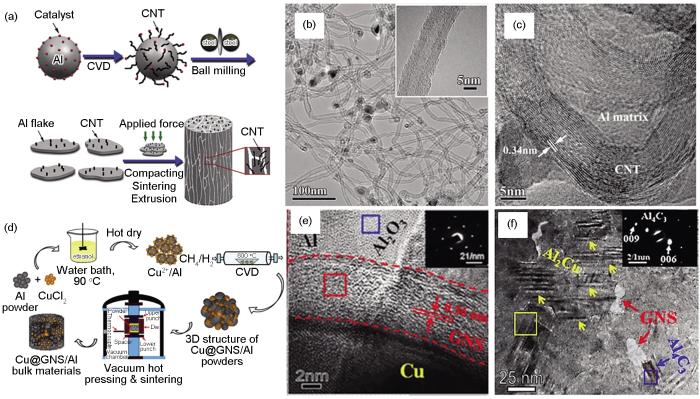
图2
通过化学气相沉积(CVD)技术原位合成CNT/Al复合材料和石墨烯纳米片(GNPs)/Al复合材料的制备过程示意图及微观组织[40,43]
Fig.2
Preparation process schematics and microstructures of the in situ synthesized CNT/Al composites and graphene nanosheets (GNPs)/Al composites by chemical vapor deposition (CVD) technology
(a) preparation process schematic of CNT/Al composites[40]
(b, c) TEM images of in situ synthesized CNTs (b) and CNT/Al composite (c)[40] (Inset in Fig.2b shows the magnified image of CNT)
(d) preparation process schematic of GNPs/Al composites[43]
(e, f) TEM images of in situ synthesized GNPs/Al composite powders (e) and CNT/Al composite (f)[43] (Inset in Fig.2e is the SAED pattern of the red solid box; and inset in Fig.2f is the SAED pattern of the blue solid box)
1.2 铝-氧化物
氧化物陶瓷(如CuO、B2O3和TiO2等)因其高熔点、优异的化学稳定性及抗氧化性能[51,52],在铝基复合材料中同样受到广泛关注。然而,在采用直接外加方式引入氧化物陶瓷增强相时,面临以下几方面问题[53]:(1) 陶瓷颗粒间存在较强的van der Waals力,极易发生团聚,特别是由于纳米陶瓷颗粒具有高比表面积和高表面能,导致其在基体中分布不均匀,从而引起局部应力集中;(2) 氧化物与Al基体之间的润湿性较差,界面结合力较弱,难以实现有效的载荷传递,限制了增强相本征性能的发挥;(3) 在高温制备或服役条件下,增强相与基体之间易发生界面反应,生成脆性化合物。此类反应不仅破坏增强相的结构完整性,还会诱发界面处微裂纹的萌生和扩展,最终导致材料过早断裂和失效。
对此,原位生成的氧化物陶瓷增强相在界面相容性和分散均匀性方面表现出显著优势。其形成过程基于元素或化合物之间的化学反应,能够在Al基体内形成热力学稳定的陶瓷增强相。该类增强相通常与基体形成结合强度高、界面洁净的冶金结合,且增强相尺寸和分布特征可有效调控。目前,Al-氧化物原位反应体系是实现陶瓷相原位生长的主要途径,其反应机制主要分为以下两类:(1) 以氧化物为前驱体,通过O原子固相扩散并与Al基体发生反应,最终生成Al2O3晶体。通常情况下,该反应路径需要选用与Al反应活化能较低的氧化物作为反应物,如CuO[54~56]、B2O3[57]等;(2) 利用Al粉表面自然形成的非晶Al2O3层,在后续固相烧结过程中发生晶化转变,由非晶态结构转变为Al2O3晶体。如图3a~h[55,56]所示,Al与CuO之间的铝热反应所释放的热量促进了与基体具有良好界面结合的晶内纳米Al2O3晶须和颗粒原位生长。相比于晶界强化相,晶内纳米Al2O3在变形过程中能够与可动位错发生强烈的相互作用,有助于位错在晶粒内部的累积和捕获,改善复合材料加工硬化和均匀变形能力,实现复合材料更优的强塑性协同。此外,晶内纳米增强相也能够缓解传统晶界强化相所导致的应力集中,促进复合材料协调变形。B2O3和TiO2也是用于实现铝基复合材料原位反应的重要前驱体。例如,Gao等[57]基于Al和B2O3体系,原位合成了纳米Al2O3和亚微米AlB2协同增强的铝基复合材料,细晶及晶内弥散强化提高了室温强度,而晶界处Al2O3网络对晶界的钉扎作用显著提升了高温力学性能(图3i和j[57])。基于Al-TiO2体系,Chao等[58]在材料内部原位合成了微米级块状Al3Ti和纳米级团簇状Al2O3,通过载荷传递和Orowan强化机制显著提升了复合材料高温强度,并实现了室温强塑性协同(图3k~n[58])。上述结果表明,原位反应策略在提升材料综合力学性能方面极具潜力。上述过程的化学反应可表示为:
式中,Al xMy 为氧化物Mx O y 中金属或非金属元素与Al基体反应形成的金属间化合物。
图3
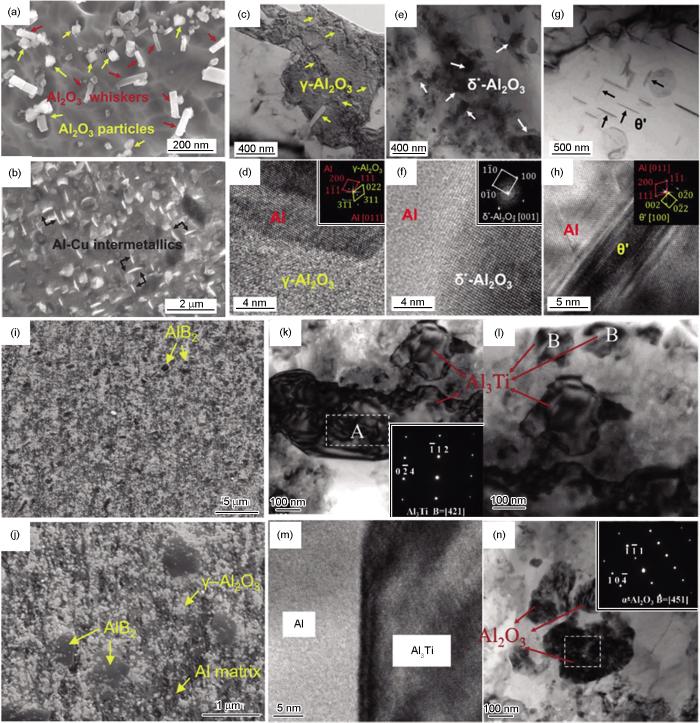
图3
CuO/Al复合材料、B2O3/Al复合材料和TiO2/Al复合材料的微观组织[55~58]
Fig.3
Microstructures of CuO/Al composite, B2O3/Al composite, and TiO2/Al composite (a, b) distributions of Al2O3 (a) and Al-Cu intermetallic compounds formed in CuO/Al composite (b)[55] (c-h) TEM (c, e, g) and HRTEM (d, f, h) images of secondary phases in the CuO/Al composite[56] (Insets in Figs.3d-f are corresponding fast Fourier transform (FFT)) (i, j) SEM images showing the distributions of Al2O3 and AlB2 in the B2O3/Al composites with different magnificaitons[57] (k-n) TEM images of Al3Ti (k, l), Al-Al3Ti interface (m), and Al2O3 (n) in the TiO2/Al composite[58] (Insets in Figs.3k and n are corresponding SAED patterns)
除上述基于O原子固相扩散与Al基体反应生成Al2O3陶瓷颗粒的方法外,通过调控制备工艺参数(如球磨工艺、烧结温度和压力等),还可获得以非晶态Al2O3 (amorphous Al2O3,am-Al2O3)为增强相的铝基复合材料。如图4a~c[59]所示,Zhou等[59]通过球磨结合热处理工艺制备了am-Al2O3与Al11La3颗粒协同增强的铝基复合材料。原位生成的am-Al2O3不仅可直接作为增强相,还可在Al11La3相表面形成包裹性非晶层,有效抑制其粗化行为。随着烧结温度的升高,am-Al2O3层转变为不连续的γ-Al2O3颗粒,从而导致Al11La3的快速粗化,进而引起强化效率降低。并且,在后续固相烧结过程中,此类am-Al2O3可能随温度、压力、时间及变形条件的变化,逐渐转变为晶态Al2O3颗粒或晶须。此外,Liu等[60]通过调控Al与CeO2之间的原位反应,构建了一种新型热稳定界面结构,该结构以am-Al2O3层包覆Al11Ce3和残留CeO2纳米颗粒,显著抑制了Al11Ce3相在高温下的粗化行为(图4d和e[60])。上述研究为基于原位反应策略设计高性能高温铝基复合材料提供了新途径。
图4
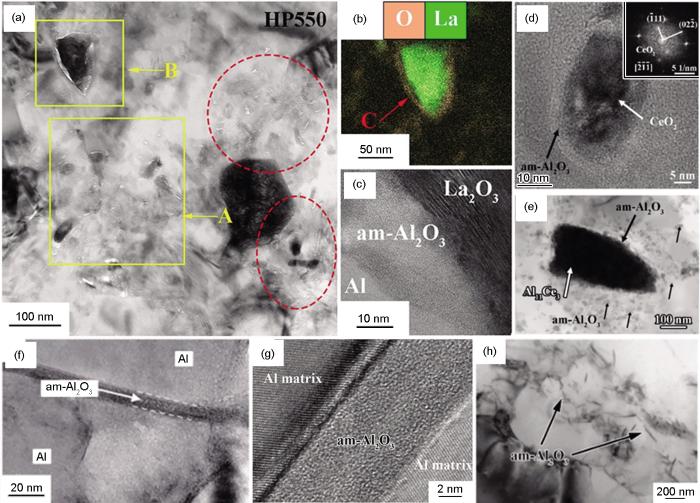
图4
La2O3/Al复合材料、CeO2/Al复合材料、B4C/Al复合材料和(B4C + Al2O3)/Al复合材料的微观组织[59~62]
Fig.4
Microstructures of La2O3/Al composite, CeO2/Al composite, B4C/Al composite, and (B4C + Al2O3)/Al composite
(a-c) TEM image (a), EDS mapping (area B in Fig.4a) (b), and HRTEM image (position C in Fig.4b) (c) of the La2O3/Al composite[59]
(d) a ring of amorphous Al2O3 (am-Al2O3) wrapped around unreacted CeO2 particles with corresponding FFT (inset)[60]
(e) a ring of am-Al2O3 wrapped around a nano-Al11Ce3 particle and isolated dispersed am-Al2O3[60]
(f) am-Al2O3 network at the grain boundary in B4C/Al composite[61]
(g, h) am-Al2O3 at grain boundaries (g) and intragranular distribution (h) in the (B4C + Al2O3)/Al composite[62]
1.3 其他反应体系
除了上述铝-碳材料和铝-氧化物原位反应体系,研究者还对碳化物、硼化物等增强相的原位合成以及其他类型的界面原位反应体系进行了广泛探索,以拓展铝基复合材料的增强相种类并优化其界面结构设计。
在增强体种类方面,Zhu等[63]通过铝热反应在Al-SiO2反应体系中引入C粉,Al与SiO2反应生成α-Al2O3和Si,随后部分Si与C结合形成细小的SiC增强相,降低了SiC在Al基体中原位合成所需的较高动力学和热力学能垒,实现了复合材料强度与塑性的同步提升。对于TiC、TiB2以及Ti5Si3等陶瓷颗粒的原位反应,多基于Al-Ti-X (X = C、B、Si等元素)体系中Ti-X的互扩散,通过改变C源类型及反应工艺参数调控反应相的尺寸、形貌和分布。Gao等[64]采用不同C源制备了TiC/Al复合材料,形成的原位纳米TiC颗粒弥散分布,复合材料表现出优异的抗拉强度。Zhang等[65]基于Al-Ti-B体系,采用真空热压烧结制备了原位TiB2/Al复合材料,利用添加的Cu和Zn细化了TiB2颗粒尺寸,改善了α-Al与TiB2界面结合强度,并促进原位反应进程。Zhang等[66]基于Al-Ti-Si体系,在Al基体中原位合成了Ti5Si3颗粒,促使Al-Ti5Si3界面由非共格状态转变为共格/半共格Al-TiSi-Ti5Si3界面,显著增强了界面结合力,提高了复合材料的协同变形能力和力学响应效率。
表1 原位反应粉末冶金铝基复合材料中涉及的主要原位反应体系、制备方法、特点及其应用领域[34,35,40,43,54,55,59,60,64~66]
Table 1
| System | Preparation method | Advantage | Disadvantage | Application field |
|---|---|---|---|---|
| Ex situ carbon materials/Al[34,35] | Ball milling + sintering | Simple process | Difficulty in dispersion control, interface reactions not easily regulated | High-strength conductive components, electronic packaging, precision instruments |
| In situ synthesized carbon materials/Al[40,43] | In situ growth by CVD | Uniform reinforcement distribution, good interface bonding | Complex process, high cost, limited production | |
| Sintering reaction | High reaction driving force, good thermal stability of reinforcements | Difficult to control precursor ratio and reaction kinetics | Lightweight structural components, wear-resistant parts, heat-resistant alloy substitutes | |
| Ball milling pre-treatment + sintering reaction | Good thermal stability and high-temperature performance | Possible crystallization of amorphous phase at high temperatures | ||
| Al-Ti-X (X = C, B, Si)[64-66] | Sintering reaction | High hardness and good thermal stability of reinforcements | Complex reaction pathways in multi-component systems |
2 原位反应的界面结构
2.1 界面取向
就复合材料而言,界面取向关系是指增强相与基体之间存在的特定晶体学位向,这直接影响界面的原子匹配状态(如共格、半共格或非共格界面)、界面能以及界面结合性质,进而决定了界面稳定性、载荷传递效率和位错-界面相互作用行为。以下根据原位反应路径的不同,分别探讨界面原位反应型和前驱体扩散原位反应型界面取向特征。
2.1.1 界面原位反应型
当增强相与Al基体直接发生界面原位反应时,其界面取向和结构依赖于反应动力学与增强相初始状态。通过对增强相进行预处理以调控其反应进程,可以实现界面结构和取向的优化。Chen等[73]采用氧化剥离法对CNTs进行构型调控,实现了CNTs从完整管状结构到半开放管状及全开放石墨烯纳米带(GNR)的可控转变。研究[73]表明,在完整管状CNTs/Al复合材料中,界面反应易形成粗大的外延Al4C3相,且与Al基体之间缺乏特定的晶体学位向关系;而经构型调控的CNT-GNR/Al和GNR/Al复合材料中Al4C3以“形核-生长”机制生长,其数量多且长度更小。这主要因为将CNT进行剥离后不仅能够降低Al4C3的形核能垒,且增加了形核位点。由于受限的C源会降低Al4C3生长速率,Al4C3附近的Al-C“混合过渡区”为Al4C3的逐层生长提供活性C原子。Al4C3与Al基体形成共格/半共格界面,具有良好的位向关系,从而显著改善界面结合强度和稳定性。Ma等[74]制备了具有Al-AlN-BNNSs过渡界面结构的BNNSs/Al复合材料,过渡层AlN与Al之间形成共格界面、与BNNSs之间形成具有近重合位置点阵(NCSL)特征的共格界面,从而形成了Al-AlN-BNNSs界面互锁结构,这主要是由于BNNs具有更多的活性边缘,BNNs-Al界面反应为形核扩散机制,原子在界面通常沿特定的晶面扩散,因此更容易形成择优取向。这显著增强了复合材料的界面稳定性,提高了载荷传递效率并有效抑制了界面处微裂纹的萌生。这种特殊的界面互锁结构在其他复合材料中也被广泛研究[75,76]。
2.1.2 前驱体扩散原位反应型
通过反应前驱体元素固相扩散生成的原位增强相,是与Al基体形成特定晶体学取向关系的另一途径。Wang等[77]以H3BO3作为B源和O源,结合球磨-热压-热挤压工艺,制备了MgAl2O4颗粒和MgAlB4纳米棒复合增强的铝基复合材料(图5a~f[77])。增强相与Al基体之间形成了MgAl2O4-Al共格界面,具有重合位置点阵(coincident site lattice,CSL)特征的MgAl2O4-Al界面,以及MgAlB4-Al界面。在较高的反应温度下,增强相可以同时依附于基体的低错配度和高错配度晶面形核,导致取向关系的多样性。CSL界面有助于平衡晶格失配引起的畸变,降低界面能,从而实现稳定的界面结合[78~81]。Rong等[54]对CuO/Al复合材料中形成的界面结构进行了表征,证明Al2O3与Al基体之间形成半共格界面,可作为几何失配位错形核或发射位点。由于原位Al2O3增强相借助固相烧结过程中的扩散辅助形核机制形成,促使形成混合过渡区(图5g~i[54]),有助于提升Al2O3-Al界面的塑性变形稳定性,并增强Al2O3与Al基体之间的协调变形能力。
图5
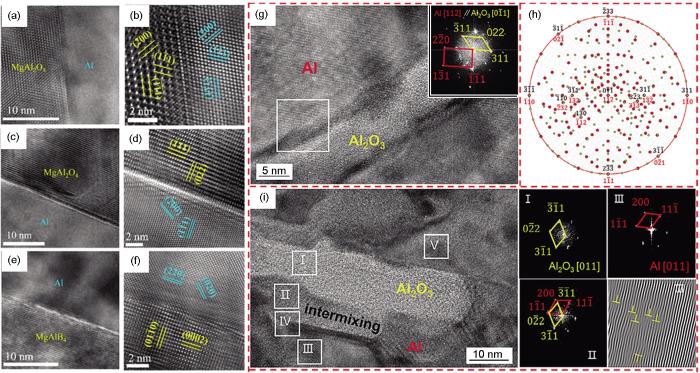
图5
基于固相扩散策略制备原位反应铝基复合材料界面的TEM像[54,77]
Fig.5
TEM images of the interfaces of in situ reaction AMCs fabricated by solid-phase diffusion strategy
(a-f) HRTEM images of MgAl2O4 interface (a-d) and MgAlB4/Al interface (e, f)[77]
(g) HRTEM image of the Al2O3/Al interface with corresponding FFT (inset)[54]
(h) stereographic projection on (2
(i) “Al2O3-intermixing region-Al” interface structure with corresponding FFT and inverse FFT (IFFT)[54]
综上所述,通过原位反应在复合材料体系中形成具有特定晶体学取向的界面结构,可以显著提升铝基复合材料的宏观力学性能。通过合理设计增强相构型,引入过渡界面层或利用特定制备工艺诱导形成低能界面结构(如共格界面、NCSL和CSL界面),能够有效优化界面结合状态、提高界面稳定性,并抑制微裂纹的萌生和扩展。因此,系统研究复合材料的界面性质并精准调控界面晶体学取向关系,是提升复合材料综合力学性能的关键,可对通过界面工程设计高性能铝基复合材料提供理论依据。
2.2 界面修饰
2.2.1 基体合金化
基体合金化是一种通过向Al基体中引入特定合金元素,以热力学驱动的方式优化界面结构和性能的关键策略。该方法利用合金元素在增强相/基体界面的选择性偏聚行为,通过改变界面化学成分和局部微观结构,实现对界面结合强度、界面反应及变形协调性的优化,其作用机理主要体现在以下三个方面。(1) 利用合金元素在界面处的偏聚降低界面能,改善增强相与Al基体之间的物理相容性和润湿性。这种优化的界面结合状态是实现高效载荷传递的关键。强界面结合可确保外部载荷有效地从Al基体传递到增强相,充分发挥增强相的强化潜力,同时避免因界面脱黏或增强相拔出而导致的过早失效。例如,Mg元素已被证实能在多种增强相与Al的界面处富集,通过增强界面键合,显著提高复合材料的强度[85,86]。(2) 通过巧妙的合金化设计,抑制界面有害反应。例如CNTs与Al基体易发生反应形成脆性Al4C3相,引入Si元素优先与C反应或改变界面处的局部化学势,在界面处形成过渡层,从而避免或减少连续网状Al4C3脆性层的形成,保证了界面的强韧结合[87,88]。(3) 利用合金元素偏聚改变界面附近的局部塑性变形机制。例如,Zhu等[89]将BNNSs引入Al-4Mg合金中,Mg倾向于在BNNSs-Al界面处发生偏聚,促进了位错的平面滑移,有利于应变在界面区域均匀再分布,缓解了因位错塞积引起的局部应力集中,从而延缓微裂纹的萌生。
因此,基体合金化是一种高效且易于操作的界面修饰方法。通过热力学驱动的界面偏聚,从强化界面结合、抑制有害反应和协调局部变形三个维度系统性地优化界面性能,为实现铝基复合材料强度与韧性的良好匹配提供了关键途径。
2.2.2 增强相表面处理
增强相表面处理是一种关键的界面工程策略,其在复合粉末制备阶段通过对增强相进行预先的物理或化学改性,从而主动构筑理想界面结构。该方法直接针对增强相表面进行精准设计,可有效解决增强相与Al基体之间固有的润湿性差、易发生有害界面反应等关键瓶颈问题。
Pu等[90]提出了一种GNPs包覆/负载Cu纳米颗粒增强铝基复合材料的新策略(图6a~f[90])。该方法首先原位合成GNPs@Cu/Al复合粉末,随后采用SPS技术促使GNPs表面负载的Cu纳米颗粒与Al基体发生反应,生成Al2Cu金属间化合物。由于Al2Cu与Al基体之间形成了晶格失配较低的共格界面,从而增强了界面结合力,使复合材料获得优异的力学性能。此外,Chen等[31]提出Cu纳米颗粒能够修复CNTs的结构缺陷,并钝化缺陷点的反应活性,抑制Al4C3的形成。类似地,Rong等[91]制备了纳米Cu2O包覆CNTs复合粉末,在后续烧结过程中利用可控的铝热反应,在CNTs-Al基体界面处生成Al2O3纳米层,并同时诱发晶内强化相的形成(图6g~l[91])。这一巧妙的界面结构设计,不仅提高了载荷传递效率,还显著增强了材料的位错存储能力。
图6
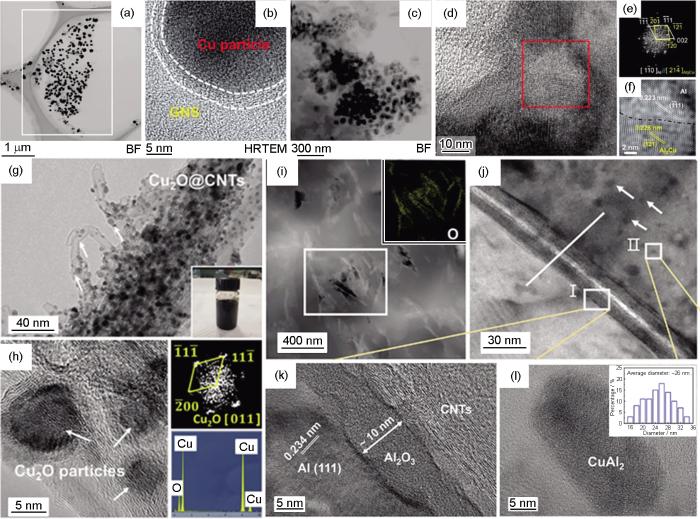
图6
基于界面修饰策略制备铝基复合材料的微观组织[90,91]
Fig.6
Microstructures of AMCs fabricated by interface decoration strategy
(a-f) STEM image of GNPs-Cu nanoplatelets (NPLs) (a), HRTEM image of GNPs-Cu hybrid structure (b), STEM image of GNPs-Cu/Al composite powders (c), and HRTEM image and corresponding FFT and IFFT of the marked box region at the interface between GNPs-Cu NPL and Al matrix (d-f)[90] (BF—bright field)
(g, h) TEM images of as-synthesized Cu2O@CNTs powders (Inset in Fig.6g is the related image of Cu2O@CNTs powders dispersed in ethanol; insets in Fig.6h are corresponding EDS mapping and FFT image)[91]
(i) typical HAADF-STEM image of the Cu2O@CNTs/Al composite (Inset shows the O element distribution)[91]
(j-l) TEM image of CNTs-Al interface (j) and magnified images of the frames I (k) and II (l) recorded in Fig.6j (Inset in Fig.6l shows the statistical result of the diameter of CuAl2 precipitates (indicated by white arrows in Fig.6j))[91]
综上所述,增强相表面处理作为一种前沿的界面调控手段,不仅从根本上改善了增强相与基体的相容性及结合强度,对于易发生剧烈界面反应的体系,更能通过引入阻挡层抑制元素的过度互扩散,从而避免脆性相的过量生成和界面脆性断裂,为实现复合材料强韧性协同提升提供了有效途径。
3 界面结构对力学行为的影响
界面作为铝基复合材料中的关键结构单元,其结构特征、结合强度及化学稳定性直接影响了材料在载荷作用下的应力分布、位错演变和裂纹扩展行为。界面结构对力学性能的影响主要体现在载荷传递能力、位错演化以及断裂行为方面。系统分析原位反应铝基复合材料的界面结构对力学行为的影响,不仅有助于揭示复合材料强化和韧化的微观机制,也可为界面设计优化、增强相选择及复合材料综合性能提升提供理论支撑。下文将从界面载荷传递、界面位错行为以及界面韧化与断裂行为三个方面进行详细讨论。
3.1 界面载荷传递
载荷传递是铝基复合材料中的关键强化机制,其效率直接决定了材料的宏观力学性能。本节首先剖析界面结构对载荷传递行为的内在影响规律,进而探讨不同维度增强相在界面载荷传递中所扮演的角色和差异,以阐明通过界面工程最大化载荷传递效率的策略。
3.1.1 界面结构对载荷传递行为的影响
界面的晶体学取向关系则决定了应力分布的均匀性。共格或半共格界面由于晶格错配度较低,界面能小,位错可以较低能量穿越界面,使得应力在界面分布更为均匀,有助于增强相与基体之间的协同变形,从而提高载荷传递效率;而非共格界面因错配度较高,界面处易发生位错塞积,造成显著的应力集中并促使裂纹萌生[93]。
界面过渡层的特性对载荷传递路径起到关键的调制作用。具有一定厚度的过渡层能够有效缓冲因基体与增强相之间弹性模量差异导致的应力集中,优化载荷传递路径;然而,若过渡层过厚或本征脆性较大(如粗大连续的Al4C3),其本身易成为裂纹扩展通道,反而可能损害材料的整体承载能力。因此,界面结构通过结合强度、取向关系与过渡层三者的协同作用,共同调控铝基复合材料中的载荷传递效率。
3.1.2 增强相维度对载荷传递行为的影响
外加载荷主要通过界面剪切作用实现传递,而不同维度的原位增强相在界面-力学耦合行为中表现出显著差异,直接影响复合材料的承载机制和面作用特征。对于零维纳米增强相(如Al2O3[54]、TiC[64]等),由于其界面接触面积有限,其整体载荷传递能力通常较弱。相比之下,一维增强相(如CNTs[31]、MgAlB4晶须[69]等)和二维增强相(如GNPs[46]、BNNSs[74]等)在载荷传递过程中表现出更明显的优势。这类增强相具有较高的长径比或比表面积,能够通过原位反应与Al基体形成强界面结合,从而有效承担并传递外加载荷,显著提高复合材料的强度和刚度。以CNTs为例,其在原位反应过程中,表面往往生成Al4C3过渡层,显著增强了与基体的界面结合,促进了应力传递。为进一步提升CNTs的载荷传递效率,Chen等[94]通过在Al基体与CNTs的界面处引入原位的Al2O3纳米颗粒,实现了界面性能优化。经Al2O3纳米颗粒修饰后,CNTs-Al界面载荷传递效率显著提高。原位拉伸实验表明,该条件下CNTs发生断裂而拔出,表现出更强的界面结合。此外,Bagchi等[95]采用密度泛函理论计算发现,Al2O3-GNPs界面的临界剪切强度比GNPs-Al界面高出一个数量级,从理论上证实Al2O相在增强界面结合和载荷传递中的贡献。在二维材料增强铝基复合材料方面,相关研究也表明,通过形成化学键或过渡界面相,可实现面内的高效载荷分配,展现出优异的强化潜力。Zhou等[96]制备了含微量界面原位反应的GNPs/Al复合材料,发现Al4C3纳米棒的形成有效促进了在GNPs-Al界面处的高效载荷传递,从而显著提升复合材料的强度。类似地,前文所提及的BNNSs/Al复合材料,通过构建结合强度较高的Al-AlN-BNNSs过渡界面,提供了良好的剪切强度,从而确保了载荷的有效传递。
综上,原位反应界面通过形成稳定的化学键结合和过渡层结构,有效克服了传统外加增强相复合材料中常见的界面脱黏问题,从而使增强相得以充分发挥其承载效率。一维和二维增强相因其较大的界面接触面积和连续的结构特征,在载荷传递过程中贡献更为显著。因此,在原位反应铝基复合材料的设计中,优化界面结构并合理选择增强相类型,是有效发挥载荷传递机制、实现强韧性协同提升的关键途径。
3.2 界面位错行为
铝基复合材料的塑性变形及其强化行为主要与位错和界面之间的相互作用密切相关,其独特的界面结构和增强相的维度影响着位错的增殖、运动和存储行为,进而主导复合材料的微观力学响应。本节针对界面结构对位错行为的影响以及增强相维度对界面位错行为的影响进行讨论。
3.2.1 界面结构对位错行为的影响
界面在铝基复合材料的塑性变形过程中发挥着核心作用,其与位错的相互作用是复合材料强韧化的微观基础。具体而言,界面扮演着双重角色,既是位错的重要来源,同时也是位错运动的关键障碍,二者在变形过程中的协同作用共同决定了复合材料的力学响应[93]。
在复合材料从制备或热处理高温冷却至室温的过程中,增强相与Al基体之间显著的弹性模量差异和热膨胀系数差异会在界面区域产生巨大的内应力场[84]。为了协调这种晶格不匹配或热失配引起的内应力,界面附近会通过应力释放机制诱发大量几何必需位错的形核和增殖。这一过程显著提高了基体的初始位错密度,为后续塑性变形提供了充足的可动位错源,从而降低了宏观屈服强度,并对复合材料加工硬化行为的早期阶段产生重要影响。
当界面结合强度高时,运动的位错难以穿越界面,会被阻挡并在界面前方形成位错塞积群。位错塞积会产生强大的背应力,显著提高后续位错开动和材料继续塑性变形所需的流变应力,这是复合材料直接强化的主要来源。此外,界面的晶体学结构决定了其与位错的交互方式,共格或半共格界面能提供较低的位错形核能垒,同时其固有的晶格错配也能有效钉扎位错;而结合良好的界面还能充当位错的临时存储场所,位错可被界面吸收,并在应力达到临界值时重新发射到基体中。这种“存储-再发射”机制有助于动态地重新分布局部应变,延缓微裂纹的早期形核,对于协调复合材料塑性变形至关重要。
3.2.2 增强相维度对界面位错行为的影响
增强相的维度(零维、一维、二维)是决定铝基复合材料界面位错行为及其主导强化机制的关键因素。不同维度的增强相通过与位错发生相互作用,显著影响复合材料的塑性变形能力和强化效果。
对于零维纳米增强相(特别是尺寸小于100 nm的增强相),Orowan绕过机制构成主要的强化方式。当运动的位错遇到不可穿过且弥散分布的原位纳米增强相时,会发生弓弯并绕过增强相,同时在其周围留下位错环。该过程需要额外的剪切应力以克服位错线张力,从而产生显著的强化效果。值得注意的是,每绕过一次增强相,留下的位错环将增大后续位错运动的有效障碍尺寸,从而形成一种逐步强化的动态过程。
Orowan机制强度贡献(
与零维增强相相比,一维和二维增强相表现出明显不同的界面位错行为。当CNT与Al基体通过原位反应生成Al4C3过渡层时,界面结合强度较高,位错在界面处不仅受到阻碍,还可能被存储并重新发射[10]。该界面与位错的相互作用有助于缓解局部应力集中,提高复合材料塑性变形的稳定性。二维增强相凭借其大比表面积和高弹性模量,同样展现出独特的界面位错效应。Yang等[99]以负载Ni纳米颗粒的GNPs为增强相制备铝基复合材料,形成了Al-Al3Ni-Ni-GNPs界面互锁结构。对拉伸后复合材料的界面区域进行表征分析,发现Al3Ni-Al界面在拉伸变形后出现了高密度的位错分布,而GNPs-Al界面处只出现了低密度位错分布,说明形变应力主要集中在Al3Ni-Al界面,其表现出更强的位错存储能力,从而获得更好的延伸率。此外,界面取向关系也对位错形核和扩展行为具有重要影响[100]。如前文所述,原位铝基复合材料中增强相与基体往往存在特定的晶体学取向关系,共格或半共格界面能够提供较低的位错形核能垒,并有效阻碍位错运动,从而协调塑性变形过程。
因此,铝基复合材料的宏观力学性能本质上取决于位错与界面的多种相互作用模式,从而共同构成了材料强塑性协同调控的基础。原位反应形成的界面因其特有的晶体学匹配性和热力学稳定性,为位错提供了独特的形核、存储及演化条件。增强相维度的差异使其主导的强化机制呈现显著区别,其中零维增强相主要依赖Orowan绕过机制,而一维、二维增强相通过界面应力传递、位错存储和发射等行为协调塑性变形。特别值得注意的是,界面结构及其取向关系可有效调控位错运动阻力和局部应力集中程度,从而实现应变的重新分布与材料塑性的提升。
3.3 界面韧化与断裂行为
界面不仅是载荷传递和位错调控的关键区域,同时也是影响裂纹萌生、扩展和断裂模式的重要因素。材料的韧化体现为其抵抗裂纹萌生和扩展的能力。尽管原位反应制备的铝基复合材料通常具备优异的强度,但其韧性提升仍面临着较大挑战,主要原因包括高强度增强相的本征脆性,以及增强相与基体界面性质对裂纹行为的显著影响。作为连接基体与增强相的关键区域,界面结构特征决定了材料的韧化机制和断裂模式。原位反应技术的优势在于能够生成与基体具有良好相容性的增强相,为复合材料的韧化提供基础。
从能量的角度分析,复合材料的韧性与其裂纹容限有关,推迟裂纹的萌生和稳定的裂纹扩展有助于复合材料韧性的提升。裂纹通常选择在材料中应力集中或微观缺陷处优先萌生,例如在BNNSs/Al复合材料体系中,原位形成的BNNSs-AlN-Al共格过渡界面结构发挥了多重作用[74]:在弹性变形阶段,具有中间模量的AlN层有效缓解了BNNSs与Al基体间因模量失配而引起的应力集中;在弹塑性及塑性变形阶段,强界面结合约束基体变形,增强组元间的协调变形能力,延缓界面处内应力的积累。原位共格过渡界面显著推迟了裂纹萌生点并提高了裂纹萌生能,从而提升了复合材料抵抗裂纹萌生的能力。因此,借助原位反应策略对增强相进行界面结构优化,可显著提升铝基复合材料的增韧潜力。
从复合材料的断裂过程出发,裂纹一旦形成,利用增强相和界面作为“障碍”以耗散裂纹扩展能量,是补偿基体韧性损失、提升材料断裂韧性的重要途径。例如,基于原位反应形成的Al2O3-Al界面结合牢固,能够有效传递载荷,并在裂纹扩展时延缓界面脱黏,同时诱发裂纹偏转与桥接等增韧行为(图7a和b[54])。相比之下,外加Al2O3-Al界面脱黏为主要断裂形式,限制了增强相本征性能的发挥(图7c[54]),增韧效果不显著。在Al-AlN-BNNSs互锁过渡界面中,强界面键合有效抑制了裂纹的萌生和扩展,裂纹继续扩展需更大的驱动力。即使裂纹形成,过渡界面仍继续承载并促进裂纹偏转(图7d~g[74])。而对于无过渡层的BNNSs-Al界面,裂纹扩展迅速且无明显偏转,断面较为平坦(图7h~k[74])。因此,通过原位反应构建结合力更强的增强相与基体界面结构,可有效抑制复合材料变形过程中的裂纹扩展行为,提高韧性。然而,若界面反应过度,生成脆性相层(如较厚的Al4C3相),则可能成为应力集中区,导致裂纹沿界面快速扩展,表现为脆性断裂模式。因此,界面韧化和断裂行为在很大程度上取决于界面相的种类、尺寸、分布以及厚度。适度的界面反应有助于实现载荷传递与能量耗散的平衡,而过度或不足的反应都会削弱韧化效果。
图7
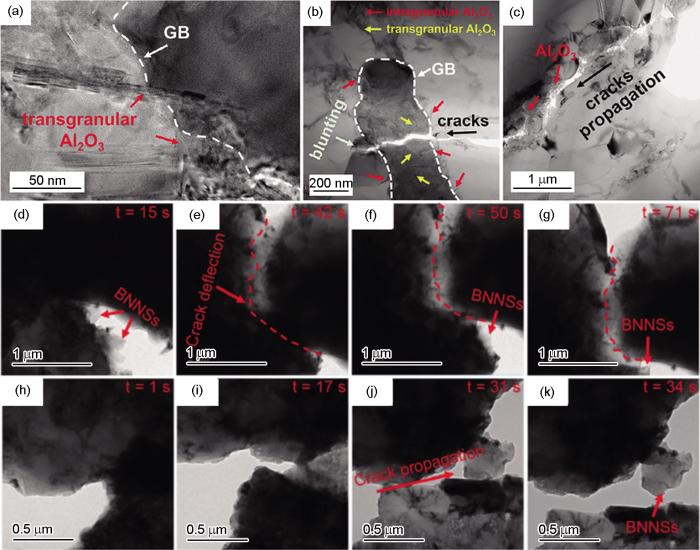
图7
CuO/Al复合材料和氮化硼纳米片(BNNS)/Al复合材料的裂纹扩展[54,74]
Fig.7
Crack propagation of CuO/Al composites and BNNS/Al composite
(a-c) fracture behaviors of the in situ CuO/Al composite (a, b) and the ex-Al2O3/Al-5.6Cu composite (c)[54] (GB—grain boundary)
(d-k) fracture behaviors of the 750 oC-BNNS/Al composite (d-g) and 600 oC-BNNS/Al composite (h-k)[74] (BNNS—boron nitride nanosheet, t—time)
原位反应技术通过构建强结合且结构可控的界面,不仅能有效缓解应力集中、推迟裂纹萌生,还能通过促进裂纹偏转、桥接和钝化等机制显著增强裂纹扩展过程中的能量耗散能力。因此,通过精准调控界面反应动力学与结构,有望在保证界面结合强度的同时,显著提升材料的断裂韧性和损伤容限。
4 总结与展望
基于原位反应的粉末冶金技术已成为制备高性能铝基复合材料的关键方法之一。本文系统总结了铝基复合材料的原位反应类型,界面结构及界面位错行为。通过可控的化学反应在基体内原位生成增强相,有效克服了传统外加增强相制备铝基复合材料的界面污染、增强相分布不均匀及润湿性差等不足。但现阶段仍面临诸多的关键科学问题:原位反应与界面机理不清晰、复杂构件成形受限、极端环境性能不足,且研发依赖经验试错,严重制约了其工程应用。未来研究可重点关注以下方向。
(1) 深度整合多层次理论计算模拟方法(如第一性原理、分子动力学、热力学与动力学计算等)及先进原位表征技术,以揭示复杂原位反应过程中的反应路径、中间相演变规律、增强相形核与生长机制,以及增强相与基体界面的动态形成机理,为原位反应过程与界面结构的精准调控提供理论依据和实时反馈。
(2) 进一步发展复合材料制备新技术和新工艺,将原位反应原理与先进制造技术(如粉末床熔融和定向能量沉积等增材制造技术)相结合,有望突破传统粉末冶金技术在复杂形状构件制备上的局限,实现高性能铝基复合材料构件的一体化、近净成形制备。
(3) 随着航空航天、核能等领域对材料极端环境下(如超高温/低温、强辐照、高腐蚀等)服役性能要求的不断提高,未来研究需着力开发多元原位反应体系,设计制备出能够在极端环境下保持优异性能的铝基复合材料。
(4) 利用机器学习与人工智能技术,系统集成并挖掘文献与实验数据资源,构建可预测原位反应路径、增强相-界面结构-性能关系以及工艺参数优化的智能模型,从而加速新型原位反应体系的设计和最优工艺窗口的筛选。例如,通过神经网络模型识别关键工艺参数(如球磨时间、烧结温度、前驱体比例)与增强相尺寸、分布之间的非线性关系;或利用Bayesian优化方法在多元反应体系中快速筛选出最优成分组合,以实现目标性能的最大化。这有助于推动“材料基因工程”理念在原位反应铝基复合材料领域的实践应用,大幅缩短研发周期。
参考文献
A bottom-up strategy toward metal nano-particles modified graphene nanoplates for fabricating aluminum matrix composites and interface study
[J].
To synthesize graphene economically and efficiently, as well as to improve the interface bonding between graphene and metal and to recede the aggregation issue of graphene, in this work, an easy and scalable bottom-up strategy for the mass production of metal nanoparticles modified graphene nanoplates (GNPs) was proposed. Cu nanoparticles modified GNPs (Cu-GNPs) and Ni nanoparticles modified GNPs (Ni-GNPs) were fabricated through this method, and then compounded with Al via ball milling technique. The as-obtained Ni-GNPs/Al composite showed simultaneously improved strength and toughness compared with unreinforced Al, while the Cu-GNPs/Al composite presented a greater strengthening effect. The microstructure and interface of the two composites were carefully characterized and investigated to reveal the difference. First principle study was also adopted to explore the binding energy of different interface structures. This study could provide new insights into the fabrication of GNPs and the control of interface in GNPs/Al composites.
Preparation of in-situ 5 vol% TiB2 particulate reinforced Al-4.5Cu alloy matrix composites assisted by improved mechanical stirring process
[J].
Heat-resistant super-dispersed oxide strengthened aluminium alloys
[J].
Cu atoms-assisted rapid fabrication of graphene/Al composites with tailored strain-delocalization effect by spark plasma sintering
[J].
Manipulating mechanical properties of graphene/Al composites by an in-situ synthesized hybrid reinforcement strategy
[J].
Enhanced distribution and mechanical properties of high content nanoparticles reinforced metal matrix composite prepared by flake dispersion
[J].
Evading the strength and ductility trade-off dilemma in titanium matrix composites through designing bimodal grains and micro-nano reinforcements
[J].
Progress on the creep resistance of aluminum matrix composites at high temperatures
[J].
铝基复合材料的高温蠕变性能研究进展
[J].
Length effect of carbon nanotubes on the strengthening mechanisms in metal matrix composites
[J].
Regulating microstructure of Al matrix composites with nanocarbon architecture design towards prominent strength-ductility combination
[J].
Effect of aging treatment on microstructure and mechanical properties of Al matrix composite reinforced by in-situ intragranular Al2O3
[J].
Macro- and meso-mechanic investigations on the mechanical properties of heterostructured Al matrix composites featuring intragranular reinforcement
[J].
Influence of surface integrity on the fatigue performance of TiB2/Al composite treated by ultrasonic deep rolling: Experiments and simulations
[J].
A novel core-shell TiC x particle by modifying TiC x with B element and the preparation of the (TiC x + AlN)/Al composite
[J].
Interface formation and bonding control in high-volume-fraction (TiC + TiB2)/Al composites and their roles in enhancing properties
[J].
Microstructure and properties of in situ generated MgAl2O4 spinel whisker reinforced aluminum matrix composites
[J].
High strength-ductility synergy of MgAlB4 whisker reinforced aluminum matrix composites achieved by in situ synthesis
[J].
A novel strengthening effect of in-situ nano Al2O3w on CNTs reinforced aluminum matrix nanocomposites and the matched strengthening mechanisms
[J].
Microstructures and mechanical properties of Al-Si alloy nanocomposites hybrid reinforced with nano-carbon and in-situ Al2O3
[J].
Harnessing laser-induced in-situ nanowhiskers for high-strength aluminum alloys via additive manufacturing
[J].
Investigation on the thermodynamic stability of phases evolved in Al-based hybrid metal matrix composite fabricated using in-situ stir casting route
[J].
Ductile fracture behavior of in situ TiB2 particle reinforced 7075 aluminum matrix composite in various stress states
[J].
Towards understanding the microstructure-mechanical property correlations of multi-level heterogeneous-structured Al matrix composites
[J].Constructing heterostructures is essential for tailoring the mechanical properties of Al matrix composites (AMCs). In this work, multi-level heterostructures were achieved in AMCs by manipulating the cold welding of initial composite powders and in-situ solid-state reaction. The resulting microstructure features band-like coarse grain (CG) regions embedded within fine grain (FG) regions, demonstrating a heterogeneous lamella (HL) grain structure. Moreover, the in-situ solid-state reaction between Al, Mg and CuO gives rise to the generation of intragranular nano-sized MgO particles, which are primarily distributed in FGs. This unique microstructure activates hetero-deformation induced (HDI) strengthening by exacerbating the mechanical property mismatch between distinct domains. Notably, the FG regions necessitate high stress for activating dislocations, causing a “yield drop” in the bulk composite. It was also elucidated that CGs experience higher stress in the early stages of deformation compared to FG domains, leading to the formation of dislocation walls. The aggregation and recovery of these dislocations facilitate the transformation of CGs into primary equiaxed grains or substructures during subsequent plastic deformation, thereby contributing to the exceptional strain hardening of the composite. Furthermore, the intragranular distribution of MgO reinforcement promotes significant dislocation proliferation and achieves stress redistribution, which rationalizes the considerable ductility of the composite. This work offers insights into the achievement of multi-level heterogeneous composites with superior mechanical properties by synergistically regulating grain structure and reinforcement distribution configuration.
Plain interface strategy toward the high corrosion performance of Al matrix composites
[J].
Metal/ceramic interface structures and segregation behavior in aluminum-based composites
[J].
In-situ solid-state deformation-driven rapid reaction towards higher strength-ductility Al-CuO composites
[J].
Research progress on the interface regulation and properties of carbon nanotube reinforced Al matrix composites
[J].
碳纳米管增强Al基复合材料界面调控及性能研究进展
[J].
Interfacial structure evolution of the growing composite precipitates in Al-Cu-Li alloys
[J].
Simultaneous enhancement of dispersion and interfacial adhesion in Al matrix composites reinforced with nanoceramic-decorated carbon nanotubes
[J].
Towards the strength-ductility synergy of Al2O3/Al composite through the design of roughened interface
[J].
Remarkable improvement of mechanical properties of layered CNTs/Al composites with Cu decorated on CNTs
[J].
Enhancement of strength and ductility by interfacial nano-decoration in carbon nanotube/aluminum matrix composites
[J].
Progress on multi-dimensional carbon nanomaterials reinforced aluminum matrix composites: A review
[J].Metal matrix composites (MMCs), especially aluminum matrix composites (AMCs), are widely used in the applications of aerospace, automotive, mechatronics and other areas due to the advantages of high specific strength, high specific modulus, and excellent thermal and electrical conductivity. In recent years, carbon nanomaterials as the reinforcement of MMCs, have attracted great attention for their outstanding mechanical and functional properties. This review focuses on the progress on preparation methods and mechanical properties of different dimensional carbon nanomaterials (0-D carbon nano-onions, 1-D carbon nanotubes, 2-D graphene et al.) reinforced AMCs. The design ideas of aluminum matrix composites with high strength and toughness through the structural construction have been summarized ranging from single- to multi-dimensional hybrid reinforcements, and the future research trends of MMCs have been prospected.
多维度碳纳米相增强铝基复合材料研究进展
[J].以铝基复合材料为代表的金属基复合材料,具有高的比强度、比模量及优异的导热、导电性能,在航空航天、汽车制造、机械电子及其它民用领域具有广泛的应用前景。近年来,碳纳米相作为复合材料的增强体凭借其优异的力学性能和物理性能以及自身结构特点,引起人们极大关注而成为铝基复合材料研究领域的新热点。本文从不同维度结构的碳纳米相(零维碳纳米洋葱、一维碳纳米管、二维石墨烯等)为增强相的角度,概述了这些碳纳米相增强铝基复合材料的制备方法及其在力学性能方面的研究进展,阐述了从单一相增强到多元多维度混杂增强的铝基复合材料在力学性能方面的优势,旨在阐明通过碳纳米相的结构设计和空间构筑实现高强韧性铝基复合材料的设计思路,并展望了高强韧轻金属基复合材料未来的研究趋势。
Solid-state interfacial reaction and load transfer efficiency in carbon nanotubes (CNTs)-reinforced aluminum matrix composites
[J].
Effectively enhanced load transfer by interfacial reactions in multi-walled carbon nanotube reinforced Al matrix composites
[J].
Progress on graphene/copper composites focusing on reinforcement configuration design: A review
[J].Copper matrix composites have extensive application prospects in electronics and electrical engineering because of their excellent functional and mechanical properties. Graphene has excellent properties and a two-dimensional structure, making it an ideal reinforcement material. Compared with other reinforcements such as particles and whiskers, graphene has better performance matching with copper. Moreover, its distribution in the copper matrix can be controlled well, which can significantly improve the comprehensive properties of the composite. Therefore, controlling the distribution of graphene using novel fabrication processes is essential. This review focuses on the configuration of graphene distributed in a copper matrix (uniform configuration, layered configuration, and network configuration) and the corresponding fabrication processes. The effects of different graphene configurations on the properties of various copper matrix composites are discussed. New ideas for graphene configuration design, future development trends, and potential applications of graphene/copper matrix composites with unique configurations are anticipated.
基于增强相构型设计的石墨烯/Cu复合材料研究进展
[J].铜基复合材料具有优异的功能特性及力学性能,在电子、电工等领域具有广阔的应用前景。作为一类理想的增强相,石墨烯具有优异的综合性能以及二维结构特征。相比于其他如颗粒增强相、晶须增强相,石墨烯与Cu的性能匹配性更好,同时其在Cu基体中的分布结构具有更强的可设计性,可显著改善铜基复合材料的综合性能,因此利用新工艺实现石墨烯分布构型的调控设计成为当今铜基复合材料研究的热点。本文总结了近年来石墨烯在Cu基体中分布的构型(均匀构型、层状构型以及网络构型)及其相应的制备工艺,讨论了石墨烯构型对于铜基复合材料性能的影响,并展望了石墨烯构型设计的新思路,以及特殊构型石墨烯/Cu复合材料未来的发展趋势以及应用领域。
Hierarchical microstructure architecture: A roadmap towards strengthening and toughening reduced graphene oxide/2024Al matrix composites synthesized by flake powder thixoforming
[J].
Simultaneously enhanced strength and ductility of Al matrix composites through the introduction of intragranular nano-sized graphene nanoplates
[J].
Combination of hot extrusion and spark plasma sintering for producing carbon nanotube reinforced aluminum matrix composites
[J].
Fabrication of carbon nanotube reinforced Al composites with well-balanced strength and ductility
[J].
Chemical vapor deposition synthesis of carbon nanospheres over Fe-based glassy alloy particles
[J].
In situ synthesis of CNTs in Mg powder at low temperature for fabricating reinforced Mg composites
[J].
In-situ synthesis of graphene nanosheets coated copper for preparing reinforced aluminum matrix composites
[J].
Fabrication of three-dimensional graphene/Cu composite by in-situ CVD and its strengthening mechanism
[J].
Gaining strength-ductility combination in Al matrix composites with in-situ synthesized three-dimensional nanocarbon network
[J].
In-situ synthesis of graphene decorated with nickel nanoparticles for fabricating reinforced 6061Al matrix composites
[J].
Effectively enhanced strength by interfacial reactions in in-situ carbon reinforced Al matrix composites
[J].
An approach to obtaining homogeneously dispersed carbon nanotubes in Al powders for preparing reinforced Al-matrix composites
[J].
Role of Cu foil in-situ annealing in controlling the size and thickness of CVD graphene domains
[J].
Fabrication and properties of carbon nanotubes reinforced Fe/hydroxyapatite composites by in situ chemical vapor deposition
[J].
Microstructural characteristic and mechanical properties of the in-situ MgAl2O4 reinforced Al matrix composite based on Al-Mg-ZnO system
[J].
The role of Mg content in regulating microstructures and mechanical properties of Al-Mg-ZnO composites fabricated via in-situ reaction sintering
[J].
Review: Recent progress in aluminum matrix composites reinforced by in situ oxide ceramics
[J].
In-situ Al2O3-Al interface contribution towards the strength-ductility synergy of Al-CuO composite fabricated by solid-state reactive sintering
[J].
Revealing the strengthening and toughening mechanisms of Al-CuO composite fabricated via in-situ solid-state reaction
[J].
Towards the work hardening and strain delocalization achieved via in-situ intragranular reinforcement in Al-CuO composite
[J].
In-situ synthesis of an Al-based composite reinforced with nanometric γ-Al2O3 and submicron AlB2 particles
[J].
Design, microstructure and high temperature properties of in-situ Al3Ti and nano-Al2O3 reinforced 2024Al matrix composites from Al-TiO2 system
[J].
Microstructure and mechanical properties of aluminum matrix composites produced by Al-La2O3 in-situ reaction
[J].
Microstructure and mechanical properties of Al matrix composites produced by Al-CeO2 in-situ reaction
[J].
Microstructure and mechanical properties of Al-B4C composite at elevated temperature strengthened with in situ Al2O3 network
[J].
Enhancing high-temperature strength of (B4C + Al2O3)/Al designed for neutron absorbing materials by constructing lamellar structure
[J].
Influences of carbon additions on reaction mechanisms and tensile properties of Al-based composites synthesized in-situ by Al-SiO2 powder system
[J].
Effects of carbon source on TiC particles' distribution, tensile, and abrasive wear properties of in situ TiC/Al-Cu nanocomposites prepared in the Al-Ti-C system
[J].The in situ TiC/Al-Cu nanocomposites were fabricated in the Al-Ti-C reaction systems with various carbon sources by the combined method of combustion synthesis, hot pressing, and hot extrusion. The carbon sources used in this paper were the pure C black, hybrid carbon source (50 wt.% C black + 50 wt.% CNTs) and pure CNTs. The average sizes of nano-TiC particles range from 67 nm to 239 nm. The TiC/Al-Cu nanocomposites fabricated by the hybrid carbon source showed more homogenously distributed nano-TiC particles, higher tensile strength and hardness, and better abrasive wear resistance than those of the nanocomposites fabricated by pure C black and pure CNTs. As the nano-TiC particles content increased, the tensile strength, hardness, and the abrasive wear resistance of the nanocomposites increased. The 30 vol.% TiC/Al-Cu nanocomposite fabricated by the hybrid carbon source showed the highest yield strength (531 MPa), tensile strength (656 MPa), hardness (331.2 HV), and the best abrasive wear resistance.
Effect of Cu and Zn elements on morphology of ceramic particles and interfacial bonding in TiB2/Al composites
[J].
Synthesis mechanism and interface contribution towards the strengthening effect of in-situ Ti5Si3 reinforced Al matrix composites
[J].
Achieving exceptional high-temperature resistant Al matrix composites via two-dimensional BN pinning grain rotation
[J].
Microstructure and mechanical properties of MoAlB particles reinforced Al matrix composites by interface modification with in situ formed Al12Mo
[J].
In-situ synthesis of MgAlB4 whiskers as a promising reinforcement for aluminum matrix composites
[J].
Enhanced strength and toughness of CNTs/Al composites via in-situ interface engineering with nanoscale tungsten
[J].
Enhanced interfacial strength in carbon-nanotubes-reinforced Al matrix composites via an interface substitution strategy
[J].
Regulating interface structure and shear performance of extruded NiTi fiber reinforced Al-based composites via heat treatments
[J].
Formation of the orientation relationship-dependent interfacial carbide in Al matrix composite affected by architectured carbon nanotube
[J].
Constructing the coherent transition interface structure for enhancing strength and ductility of hexagonal boron nitride nanosheets/Al composites
[J].The deformation incompatibility of components is a bottleneck restricting the exaltation of the strength and ductility of composites. Herein, the coherent transition interface was designed and produced in hexagonal boron nitride nanosheets (BNNSs)/Al composites by reaction sintering route, expecting to relieve the deformation incompatibility between BNNSs and Al. It is demonstrated that with the sintering temperature for composites raising from 600 °C to 650 °C, 700 °C and 750 °C, different interface bonding characteristics, which involve nucleation and growth of AlN continuous nanolayer, were confirmed. Furthermore, first-principles calculations show that the generation of the coherent transition interface improved the interfacial bonding strength of BNNSs/Al composites through covalent bonds. The composites with coherent transition interface exhibit excellent strength-toughness combination in tensile and impact tests. The finite element simulation and in-situ approach under tensile tests were applied to investigate the influence of transition interface structure on deformation behavior of BNNSs/Al composite. It is found that the generation of the transition interface can not only weaken the stress partitioning behavior in the elastic stage, but also constrain the crack initiation and propagation behavior in the elastic-plastic stage and plastic stage, thereby improving the deformation compatibility between BNNSs and Al. The present work provides a novel view into the breakthrough for the trade-off relationship of strength and ductility by coherent transition interface design in nanocomposites.
Microstructure and mech-anical properties of graphene nanoplatelets/Al composites with polysilazane-modulated interlocked interface
[J].
Root inspired in situ interlocked interface for strength and ductility combination of refractory high-entropy alloys/Ni composites by activated sintering
[J].
Orientation relationships and interface structure in MgAl2O4 and MgAlB4 co-reinforced Al matrix composites
[J].
Improving thermal expansion coefficients and mechanical properties of interconnect copper by doping Al2O3 nanoparticles: Insights from atomistic simulations
[J].This study improves the thermal expansion and mechanical properties of interconnect copper by introducing Al2O3 nanoparticles, and investigates different doping configurations to understand the thermal expansion mechanisms in Cu–Al2O3 nanocomposites.
Formation and strengthening mechanism of kink bands in an ultra-coarse-grained Fe-Cr-Al alloy
[J].Fe-Cr-Al alloys, owing to their absence of allotropic transformation, require multiple cycles of rolling and recrystallization annealing processes to achieve substantial grain refinement, ultimately leading to the attainment of outstanding mechanical properties. However, the corresponding manufacturing costs will also increase greatly. In this work, we have proposed a new microstructural preparation process. Simply using warm rolling for an ultra-coarse-grained Fe-Cr-Al alloy to introduce lamellar kink bands (KBs) into the matrix, the mechanical properties can be significantly improved. By using electron backscatter diffraction (EBSD) and transmission electron microscopy (TEM), and combined with Schmid factor (SF) calculation, the formation mechanism of KBs has been revealed. When the slip plane and direction are nearly perpendicular to the loading force direction (LFD) during the continuous grain rotation, the dislocation wall will evolve into the KBs boundaries. Simultaneously, a huge orientation separation between the matrix and KBs will be produced. As strain continues to rise, KBs undergo a transformation, transitioning from low-angle-grain boundaries (LAGBs) to high-angle-grain boundaries (HAGBs), occasionally adopting a configuration as coincident site lattice (CSL) boundaries with reduced interface energy. Results of the tensile test, cyclic loading-unloading-reloading tensile test, and the strengthening calculation show that KBs can pronouncedly enhance the strength by their heterogeneous refinement on the original grains and hetero-deformation induced (HDI) strengthening effect from the dislocation density discrepancy between the matrix and internal KBs, the grains containing KBs (KBGs) and the grains without KBs (or KBs-free-grains, KFGs). The theoretical calculation value of the strengthening contribution from KBs on yield strength can be up to 225.5 MPa, with a minimum value exceeding 153 MPa. On the other hand, the ductility can be retained to some extent through stimulating the KBs boundary delamination mechanism. The present study provides a low-cost and feasible processing method for fabricating Fe-Cr-Al alloy with high strength and good ductility.
Effect of interface structure on the mechanical properties of graphene nanosheets reinforced copper matrix composites
[J].
TEM investigation of interfaces during cuprous island growth
[J].
Interfacial modification enhancing corrosion resistance of boron nitride nanosheets/Al matrix composites
[J].The difference in electrochemical behavior between reinforcement and metal matrix usually damages the corrosion resistance of composites. Herein, the coherent BNNSs-AlN-Al transition interface is creatively constructed in the Aluminium-Boron nitride nanosheets (Al-BNNSs) system based on reactive sintering. It is demonstrated that BNNSs/Al composites exhibit good corrosion resistance via interfacial modification. The BNNSs-AlN-Al transition interface not only optimizes the interfacial structure of BNNSs/Al composites but also significantly enhances the interface bonding strength. Many low-angle grain boundaries (LAGBs) are induced during extrusion due to the pinning effect of strong bonding transition interface. Besides, density functional theory (DFT) calculation and geometric phase analysis (GPA) were executed to clarify the influence of interface design on the corrosion behavior of BNNSs/Al composites. It is found that the transition interface and LAGBs have strong valence electron constraint ability, thus weakening the galvanic effect in composites. Also, the construction of the transition interface reduces the geometrically necessary dislocations and lattice distortion in the grains of Al matrix, avoiding the decrease of corrosion potential of Al matrix. Ultimately, the coupling effect between LAGB and transition interface not only significantly enhances the ion erosion resistance of composites, but also shifts the corrosion mechanism from intergranular corrosion (IGC) to pitting corrosion (PC) in Al matrix. The current work provides a feasible route for the design of aluminum matrix composites (AMCs) with high corrosion resistance.
Achieving high mechanical properties and corrosion resistance of Al-Zn-Mg matrix composites via regulating intragranular reinforcements
[J].Al matrix composites generally possess high strength but sacrifice ductility and corrosion resistance resulting from the dense intergranular reinforcements. Herein, we report a solid-state reactive sintering pathway to construct an Al-Zn-Mg composite reinforced by intragranular Cu nanoparticles modified graphene nanosheets (Cu@GNS), which demonstrates both superior mechanical properties (∼630 MPa of tensile stress and ∼9.1% of fracture elongation) and exceptional corrosion resistance. It is shown that the “GNS-Cu/CuAl<sub>2</sub>-Al” interfacial structure greatly contributes to the load transfer, either by enhancing the GNS-Al adhesion or by elevating the interfacial slippage resistance in terms of the “drag effect” of hybrid particles. Meanwhile, the comprehensive characterization demonstrates that such intragranular Cu@GNS not only enhances the dislocation multiplication efficiency for work hardening but also contributes to the high corrosion resistance via decreasing the corrosion kinetics and suppressing the severely localized corrosion. This work provides a novel strategy for the exceptional mechanical-corrosion combination of composites by tailoring intragranular reinforcements.
Effect of MgO particles with in-situ graphene coating on mechanical and thermal expansion properties of aluminum matrix composites
[J].
Interfacial segregation and precipitates behavior in the ultrafine grained Al-based metal matrix composites
[J].
Microstructural evolution in graphene nanoplatelets reinforced magnesium matrix composites fabricated through thixomolding process
[J].
Mechanical and thermal properties of nanocarbon-reinforced aluminum matrix composites at elevated temperatures
[J].
Effect of carbon nanotube dispersion on mechanical properties of aluminum-silicon alloy matrix composites
[J].
Contribution of robust transitional interface featuring Mg segregation to the strength-ductility synergy of boron nitride nanosheets/Al composite
[J].
Exceptional mechanical properties of aluminum matrix composites with heterogeneous structure induced by in-situ graphene nanosheet-Cu hybrids
[J].
High mechanical strengthened CNTs/Al composite concepts with robust interface and intragranular reinforcement achieved via interfacial thermite reaction
[J].
Research process on interface modification and strengthening mechanism of nanocomposites
[J].
纳米复合材料界面调控与强化机制研究进展
[J].
Superior strength-plasticity synergy in a heterogeneous lamellar Ti2AlC/TiAl composite with unique interfacial microstructure
[J].
Enhanced mechanical properties of the surface-modified CNTs reinforced 2195 aluminum-based composite
[J].
Oxidation effect on the shear strength of graphene on aluminum and titanium surfaces
[J].
Interfacial reaction induced efficient load transfer in few-layer graphene reinforced Al matrix composites for high-performance conductor
[J].
Enhanced combination of strength and ductility in ultrafine-grained aluminum composites reinforced with high content intragranular nanoparticles
[J].
Fabrication, microstructure refinement and strengthening mechanisms of nanosized SiCP/Al composites assisted ultrasonic vibration
[J].
Architectured interfacial interlocking structure for enhancing mechanical properties of Al matrix composites reinforced with graphene nanosheets
[J].


