



钛合金因其强度高、密度小、耐腐蚀性能好等优点,被广泛应用于航空航天、生物医学等领域[1~3]。TA18合金是一种近α型钛合金,名义成分为Ti-3Al-2.5V (质量分数,%),微观组织以α相为主并有少量β相,其中α相为hcp结构,β相为bcc结构[4]。TA18合金具有优异的耐腐蚀性能、热/冷加工塑性、焊接能力以及良好的力学性能,成为航空燃油、液压管路系统的关键材料[5,6]。热加工是调控钛合金微观组织和织构的核心工艺环节,决定最终产品的综合性能。而在连续的多阶段热加工过程中,一个十分关键且棘手的现象是“组织遗传性”——即前序加工状态的微观组织特征会展现出显著的“遗传”或“记忆”特性,这种“遗传”特性可能会以某种方式影响后续加工过程中的相变、再结晶、织构演化等,进而影响该合金的服役性能[7]。组织遗传性表现为晶粒尺寸、形貌、亚结构(如位错组态和亚晶界)以及晶体取向等在加工过程中保持一定的继承性和稳定性,从而严重影响最终组织的形成和调控[8,9]。因此,组织遗传性是实现TA18合金全链条加工过程中微观组织和性能调控的重要科学问题。
传统的合金热加工研究主要集中在单一锻造或挤压工艺参数对微观组织及力学性能的影响。然而,在多阶段热加工过程中,合金每阶段的微观组织演化行为深受前一阶段的遗传组织制约[9,10]。如TB9合金铸锭底部<100>织构的柱状晶在热加工过程中具有较强的遗传性,可遗传至热轧后的棒材,形成粗大柱状组织,严重影响热处理后成品的强度和塑性[9]。含Ni的低温钢经热轧后形成具有不同原始奥氏体晶粒形态的板条马氏体组织,在后续淬火中表现出显著的遗传性,其细化的板条结构及高密度晶界特征被继承至最终微观组织中,通过细化基体与促进逆转变奥氏体形成,显著提升了其在77 K下的超低温冲击韧性[11]。此外,在锻造过程中,由于变形不均匀而形成的带状组织和变形织构等在后续热处理过程中也难以消除,从而影响其最终服役性能[12]。而在挤压过程中,由于变形而产生的纤维组织和强织构同样具有较强的遗传性,严重影响后续热加工和热处理过程中的相变与再结晶行为,导致其产生明显的各向异性等问题[13]。可见,目前针对多阶段热加工过程中微观组织遗传性的研究仍较为有限,对其遗传机理尚不明确,导致多阶段工艺链的微观组织调控只能“走一步看一步”,无法逆向设计或优化组织遗传路径。因此,孤立研究单一热加工工艺的组织演化存在一定局限,有必要将多阶段热加工作为一个具有前后遗传关联的整体进行研究。
因此,为探究TA18合金管坯热加工过程中微观组织的遗传演化规律及其对力学性能的影响,本工作以TA18合金铸锭、锻棒和热挤压管坯为研究对象,研究多阶段热加工过程中微观组织和织构的遗传规律及其对力学性能的影响,旨在揭示TA18合金从铸锭到管坯成型全流程中三类遗传特征的跨工序遗传与演变机制,并尝试建立晶粒尺寸、小角度晶界(LAGB)占比与宏观力学性能的半定量关联,为后续TA18合金管坯的遗传路径设计和工艺-结构-性能一体化控制提供指导。
1 实验方法
1.1 原料与加工
本工作所采用的原料为直径为700 mm的TA18合金铸锭(Ti3Al2.5V,质量分数,%)。铸锭在1150~950 ℃的β单相区和900 ℃的α + β两相区经过多火次锻造锻至直径为170 mm的粗锻棒,随后在850 ℃的α + β两相区将其锻至直径为125 mm的精锻棒,随后经去皮、钻孔、包套、热挤压成内径为28 mm、外径为42 mm的管坯,加工流程示意图如图1所示。
图1
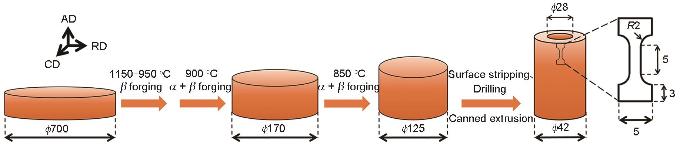
图1
TA18合金加工流程示意图和拉伸样品尺寸
Fig.1
Schematic of thermomechanical processing route and dimension of tensile sample of TA18 alloy (unit: mm. AD—axial direction, CD—circumferential direction, RD—radial direction)
1.2 微观结构表征
为观测不同热加工前后TA18合金的微观组织以及织构特征,使用Axio Observer型光学显微镜(OM)和Gemini 300型扫描电镜(SEM)的二次电子(SE)模式表征各热加工阶段的微观组织,采用配有Nordly max3电子背散射衍射(EBSD)探测器的Regulus 8100型场发射SEM表征样品的织构和晶粒尺寸。取样方式为:在TA18铸锭沿直径方向的边缘位置、D / 4 (D为铸锭直径)位置和D / 2 (中心)位置分别取样,粗锻、精锻和热挤压样品均取其横截面和纵截面,横截面为径向(RD)与周向(CD)所形成的平面,纵截面为RD与轴向(AD)所形成的截面。样品制备方法为:首先,使用金相砂纸对试样机械研磨至3000号;然后使用由HClO4、C4H9OH和CH3OH按体积比1∶3∶6配制的电解抛光液对试样进行电解抛光处理,电压30 V,抛光时长90 s;最后,在清洗完成后,采用HF、HNO3和H2O (体积比为4∶6∶90)混合溶液对试样进行腐蚀处理。
1.3 力学性能测试
为研究热加工工艺对TA18合金力学性能的影响,利用DF14.104D型电子万能试验机对样品进行单轴拉伸测试,并采用LVE-Pro型视频引伸计记录试样变形程度。在沿直径方向边缘位置、D / 4和D / 2位置,及热加工后各状态下沿AD均分别取三个拉伸试样。取样方式与试样尺寸如图1所示。试样标距为5 mm、厚度为2 mm。实验条件为:室温、应变速率1 × 10⁻³ s-1。
2 实验结果
2.1 微观组织演变
图2对比了TA18合金铸锭不同位置和多阶段热加工后的微观组织。铸态组织(图2a~f)整体良好,组织较为均匀,无明显的裂纹、分层、偏析以及金属或非金属夹杂物等肉眼可见的冶金缺陷,铸锭内部存在缩孔,如图2a、c和e中箭头所示。这主要是由于在凝固过程中,外层金属先凝固,内层后凝固,并且凝固过程中金属收缩,从而产生缩松、缩孔。铸锭沿直径方向的边缘和D / 4位置产生的缩孔尺寸较小且分散(图2a和c),而在D / 2处缩孔尺寸较大(图2e)。铸锭内晶粒尺寸为毫米级,由α相片层团构成,片层间距为微米级,α相片层之间为少量条状β相,其中α相与β相之间的相界面保持平直。沿铸锭直径方向由外向内,α相片层尺寸逐渐增加(图2b1、d1和f1)。这是由于铸锭边缘位置过冷度较大,冷却速率较快,故α相片层尺寸较小。反之,中心区域过冷度较小,α相尺寸相对较大。铸锭内毫米级的晶粒尺寸较大,对力学性能产生不利影响,因此在后续热加工过程中应打破粗大晶粒的遗传性,使晶粒充分细化。
图2
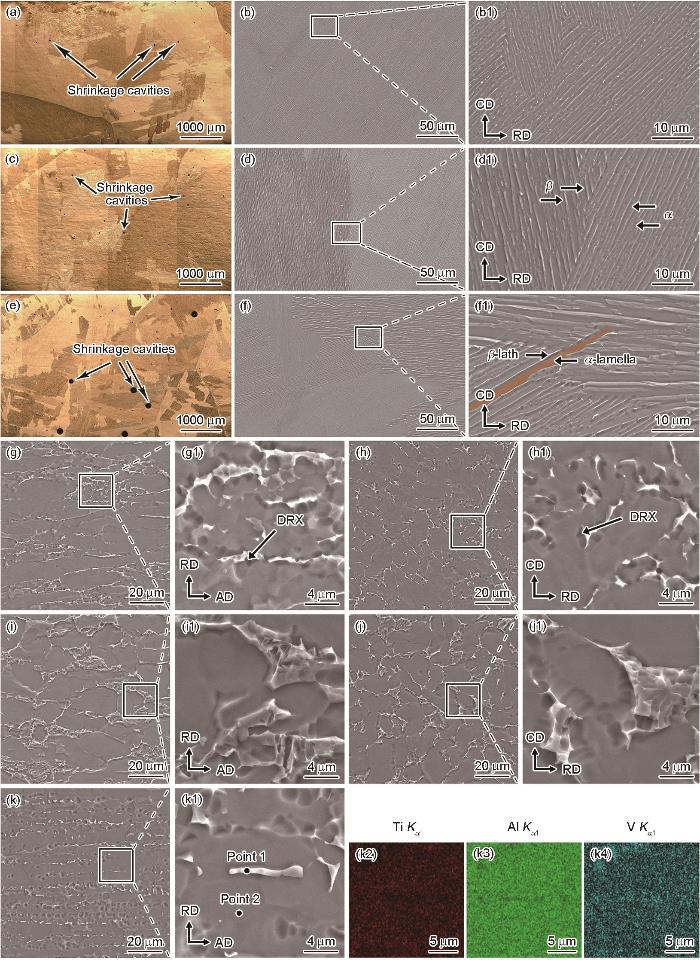
图2
TA18合金铸锭不同位置和多阶段热加工后微观组织的OM像、SEM像和EDS元素面扫描图
Fig.2
Microstructures and EDS elemental mappings of TA18 alloy ingots at different locations and after multi-stage hot processing (a, b, b1) OM image (a), low (b) and high (b1) magnified SEM images at edge of the ingot (c, d, d1) OM image (c), low (d) and high (d1) magnified SEM images at D / 4 position of the ingot (D—diameter of the ingot) (e, f, f1) OM image (e), low (f) and high (f1) magnified SEM images at D / 2 position of the ingot (g, g1, h, h1) low (g, h) and high (g1, h1) magnified SEM images of the rough-forged bar in longitudinal section (g, g1) and cross section (h, h1) (DRX—dynamic recrystallization) (i, i1, j, j1) low (i, j) and high (i1, j1) magnified SEM images of the finish-forged bar in longitudinal section (i, i1) and cross section (j, j1) (k, k1) low (k) and high (k1) magnified SEM images of the extruded billet (k2-k4) EDS elemental mappings corresponding to Fig.2k1
表1 图2k1中点1和2的EDS点扫描结果 (mass fraction / %)
Table 1
| Point | Ti | Al | V |
|---|---|---|---|
| 1 | 94.95 | 2.95 | 2.10 |
| 2 | 86.71 | 1.89 | 11.40 |
综上所述,铸锭组织的平直明锐相界面在后续热加工过程中具有较强的遗传性,粗锻样品组织的等轴α相形貌在后续热加工过程中具有较强的遗传性,其微米级晶粒尺寸发生轻微粗化。
图3对比了TA18合金铸锭不同位置和多阶段热加工后的晶粒取向与织构特征。从图3a1~f1的EBSD取向图可以看出,铸锭晶粒尺寸较大,为毫米级,在大晶粒之间存在部分小晶粒,大晶粒的取向对铸锭组织观测区域的取向起决定性作用(图3a1~c1);而粗锻后晶粒尺寸明显减小,为微米级(图3d1),并且在后续热加工过程中被遗传(图3e1和f1),这与SEM结果一致。此外,热加工后样品的α晶粒内部产生大量亚晶界,形成多个亚晶,同一晶粒内部不同部位亚晶取向可能存在差异,这是初次热加工即粗锻后形成的亚晶结构(图3d1),在后续精锻过程中,该亚晶结构基本得以保留(图3e1),但热挤压后大部分亚晶结构被消除(图3f1),这可能与晶粒的动态再结晶有关。
图3
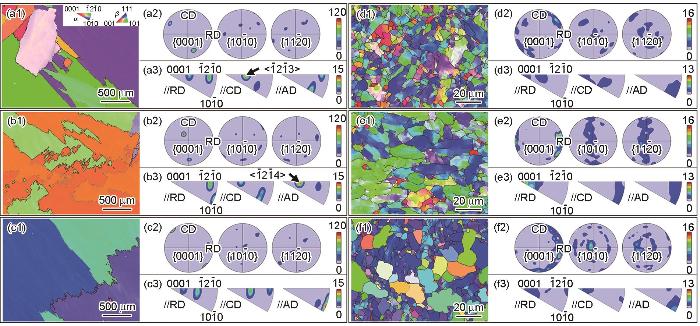
图3
TA18合金铸锭不同位置和多阶段热加工后的EBSD取向图、极图和反极图
Fig.3
EBSD orientation maps (a1-f1), pole figures (PFs) (a2-f2), and inverse pole figures (IPFs) (a3-f3) of TA18 alloy ingots at different locations and after multi-stage hot processing (a1-a3) edge of the ingot (b1-b3) D / 4 position of the ingot (c1-c3) D / 2 position of the ingot (d1-d3) rough-forged bar (e1-e3) finish-forged bar (f1-f3) extruded billet
在TA18合金铸锭沿直径方向的边缘位置,α相在{0001}晶面上存在一个强织构和一个弱织构(图3a2);D / 4位置的α相在{0001}晶面上也存在一个强织构和一个弱织构(图3b2);D / 2位置的α相在{0001}晶面上存在两个强织构和一个弱织构(图3c2)。此外,铸锭不同位置在
图4a~l为TA18合金铸锭不同位置和多阶段热加工后的晶界图、局部取向差(KAM)图,插图为KAM分布图。可见,TA18合金铸锭中α相的晶粒尺寸约为毫米级,铸锭粗大组织经粗锻后晶粒被完全细化,平均晶粒尺寸约为3.54 μm,表明铸锭粗大组织的遗传效应经粗锻加工后被消除。在随后的精锻和挤压过程中,晶粒逐渐粗化,平均尺寸分别达到了3.67和4.26 μm,表明粗锻后形成的等轴α晶粒在后续热加工过程中具有较强的稳定性。与晶粒尺寸细化相似,铸锭界面结构也发生改变,LAGB占比在粗锻和精锻后达到顶峰,分别为47.5%和64.5%,如图4m所示,标志着合金内部的变形储能和亚结构达到了最大化。这些高密度位错和亚晶界在后续加工过程中对微观组织演变有重要影响。首先,其储存的畸变能为后续热加工过程中的动态再结晶提供动力;其次,动态再结晶晶粒倾向于在高应变区域形核,并且某些亚晶取向极有可能在后续加工过程中保留。在随后的热挤压过程后,合金内LAGB占比降至36.4%,这可能与动态再结晶有关。KAM图为此提供了空间证据。如图4h、j和l所示,在粗锻和精锻后的合金内部,高应变区广泛分布于α相内;而在挤压后的合金内部,仅有少量高应变区残留于晶粒中。沿铸锭直径方向由外向内,KAM平均值(
图4

图4
TA18合金铸锭不同位置和多阶段热加工后的晶界图、局部取向差图及其分布、大/小角度晶界占比和取向差角分布图
Fig.4
Grain boundary maps (a, c, e, g, i, k), kernel average misorientation (KAM) maps (b, d, f, h, j, l) and corresponding distributions (insets), LAGB/HAGB fractions (m), and misorientation angle distributions (n) of TA18 alloy ingots at different locations and after multi-stage hot processing (LAGB—low angle grain boundary, HAGB—high angle grain boundary.
2.2 力学性能
图5
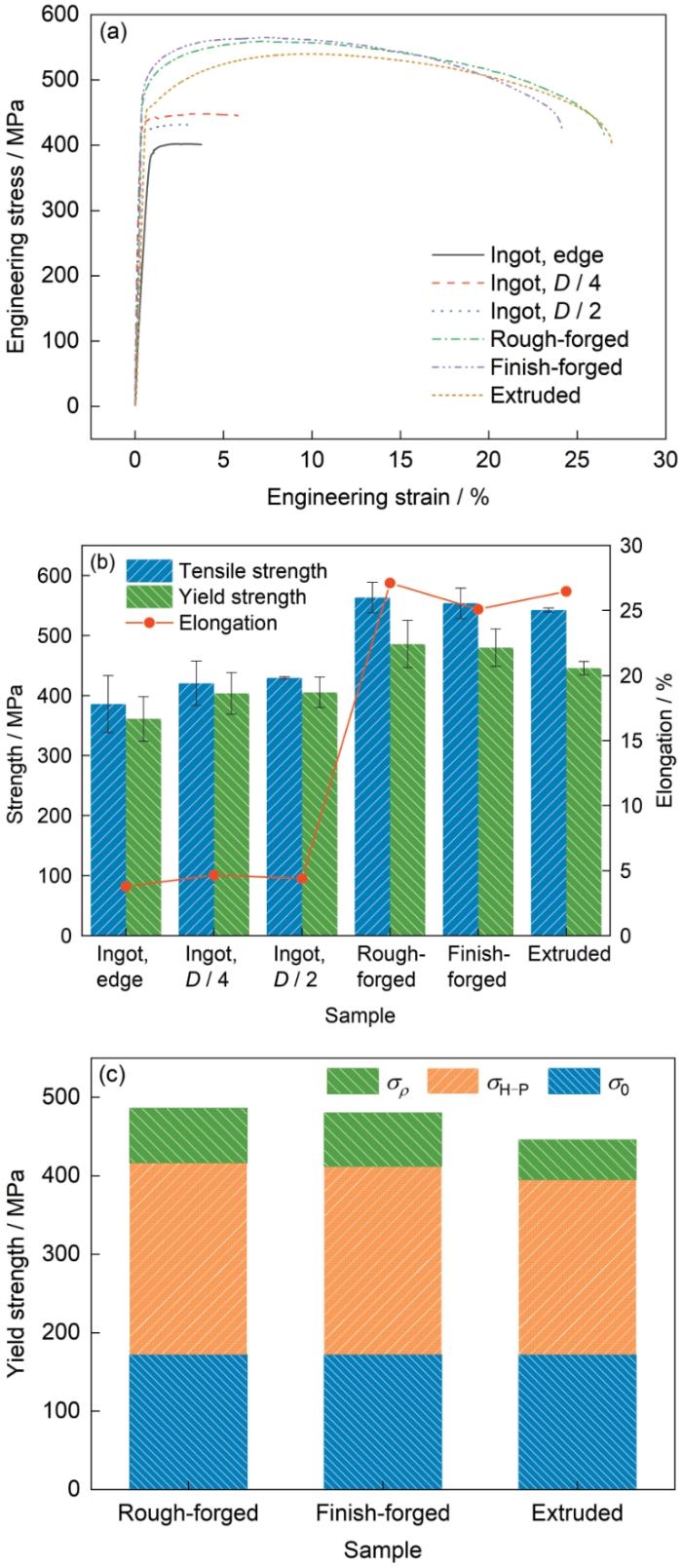
图5
TA18合金铸锭不同位置和多阶段热加工后的工程应力-应变曲线、力学性能对比和各强化机制对屈服强度的贡献
Fig.5
Engineering stress-strain curves (a), mechanical properties (b), and contributions from several strengthening mechanisms to yield strength (c) of TA18 alloy ingots at different locations and after multi-stage hot processing (σρ —contribution of dislocation strengthening to yield strength, σH-P—contribution of fine grain strengthening to yield strength, σ0—matrix strength)
式中,k为Hall-Petch系数[26],取0.46 MPa·m-1/2;d为平均晶粒尺寸,其数值根据EBSD数据计算。各计算项对TA18合金热加工后的屈服强度贡献如图5c所示。屈服强度的提升主要得益于两方面遗传性组织特征的贡献:首先,TA18合金铸锭经锻造(粗锻和精锻)产生并达到顶峰的变形亚结构遗传(高比例的LAGB)直接贡献了显著的加工硬化;其次,铸锭经锻造后打破的粗大晶粒遗传性和后续热加工过程中细小晶粒保持的遗传性是其强度提升的根本保证。经粗锻后形成的3.54 μm平均晶粒尺寸,打破了铸锭毫米级晶粒的遗传效应,根据图5c,σH-P在屈服强度的贡献中占据主导地位。塑性的演变同样与晶粒尺寸有关,细小晶粒的存在使得形变和位错塞积更加分散,不易因产生裂纹而断裂,使其塑性从根本上大幅提高。此外,变形亚结构也同样会对合金塑性产生显著影响。在精锻样品中,遗传自粗锻样品内的高密度位错亚结构以及精锻中变形产生的新的位错亚结构,使其内部具有高密度的位错缠结,表现为高比例的LAGB,最终导致其塑性下降。而挤压过程中变形亚结构含量的降低是其塑性提高的主因。此外,织构的存在可能导致塑性变形的各向异性,这也是影响宏观延伸率遗传性的晶体学因素。综上所述,TA18合金的最终力学性能是多工序组织遗传行为的宏观体现,强度主要来源于晶粒细化带来的细晶强化和中间工序累积的位错亚结构带来的位错强化;塑性则受制于亚结构含量,并通过后续工艺对其进行优化。这表明,通过对“组织遗传链”(尤其是晶粒尺寸与变形亚结构)的主动调控,可实现对合金强塑性匹配的精准设计。
2.3 断口特征
拉伸断口形貌的演变是合金宏观力学性能,特别是塑性与断裂行为的直接反映,可以直接反映合金的失效模式。图6为TA18合金铸锭不同部位与多阶段热加工后断口形貌的SEM像。如图6a~c和a1~c1所示,铸锭不同部位的断口形貌相似,宏观上无明显颈缩,均呈现出层状、褶皱状的微观形貌。这种层状变形形貌主要由剪切滑移主导,从而产生层叠式的变形痕迹[27,28]。铸锭中的粗大晶粒由片层状α相组成,位错滑移受到α片层阻碍使变形集中在晶界或相界,并且铸锭内存在成分偏析、缩松、缩孔等缺陷,在拉伸过程中易于在这些缺陷处产生应力集中,使其优先发生塑性变形,从而形成层状滑移形貌。其本质是片层滑移的累积,属于片层滑移型断口[29,30]。如图6d~f和d1~f1所示,锻造或挤压后的样品在拉伸过程中出现明显的颈缩现象,断口表面出现等轴韧窝、撕裂棱和微孔,属于典型的微孔聚集型韧性断裂[31]。这种断裂机制的根本性转变直接证实,初始的粗锻过程已完全打破了铸态粗大柱状晶组织的遗传,实现了断裂机制从脆性向韧性的跨越。尽管后续精锻和热挤压过程中的变形机制存在差异,但其断口形貌与粗锻状态并无本质区别,均表现为均匀的韧窝。EBSD分析结果(图3和4)表明,尽管不同状态的微观亚结构含量和织构强度发生剧烈演变,但细小的等轴α晶粒作为一种最根本的组织,自粗锻阶段形成后,在后续热加工过程中被成功继承,平均晶粒尺寸均在3~5 μm范围内。韧窝的形核与长大依赖于晶界等界面,而细小的等轴组织为其提供了大量均匀的形核位点,同时也阻碍了主裂纹的快速扩展,使裂纹扩展路径曲折化,从而导致了大量韧窝的产生[32]。因此,断口形貌的稳定性正是细小等轴晶组织这一核心特征在多工序间被成功遗传的最直接证明。综上所述,热加工工艺链对力学性能的调控,本质是通过打断不利的初始组织(粗大片层组织)遗传,并建立能够稳定遗传的新生组织(细小等轴晶组织)来实现的。虽然变形亚结构和织构遗传显著影响了强度-塑性的平衡,但最终决定断裂模式的仍然是晶粒尺寸与形貌这一最基础、最稳定的遗传特征。
图6
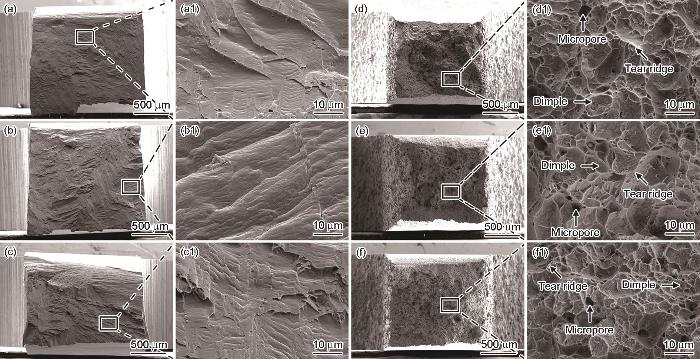
图6
TA18合金铸锭不同部位与多阶段热加工后断口形貌的SEM像
Fig.6
Low (a-f) and high (a1-f1) magnified SEM images of fracture morphologies of TA18 alloy ingot at different locations and after multi-stage hot processing (a, a1) edge of the ingot (b, b1) D / 4 position of the ingot (c, c1) D / 2 position of the ingot (d, d1) rough-forged bar (e, e1) finish-forged bar (f, f1) extruded billet
3 分析与讨论
3.1 铸态-加工态多尺度微观组织继承与演变
基于微观组织的演化行为,本工作讨论三类组织遗传特征:晶粒尺寸和形貌、晶粒亚结构和晶体取向。其中,晶粒尺寸遗传为晶粒等效圆平均直径和等轴度;亚结构遗传指LAGB占比和KAM值;织构遗传为极密度最大值和c轴取向。
3.1.1 晶粒尺寸和形貌的遗传机制
铸锭中α相的晶粒尺寸较大,由α相片层与条状β相交替构成,且含有部分缩松、缩孔等铸造缺陷,如图2a~f所示。粗锻后样品内缩松、缩孔完全消失,晶粒尺寸由毫米级细化为微米级,在横截面上表现为细小等轴的α晶粒,而纵截面上的α晶粒沿AD被拉长(图2g和h)。粗锻的具体工艺是在1150~950 ℃的β相区和900 ℃的α + β相区多火次锻造,在β锻过程中,毫米级的铸态晶粒在大变形量的锻造下,在晶界凹处变形不均匀,易产生高密度位错,形成能量梯度,LAGB不断汇聚形成大角度晶界(HAGB),表现为晶界向晶内延伸生长直至与另一个或多个晶界相交,最终使原始晶粒破碎成两个或多个晶粒,原始β晶粒冷却后形成由片层状α相组成的细小等轴晶粒,微观组织演变与遗传链示意图如图7所示。在随后的α + β锻过程中,晶粒尺寸继续细化,且晶粒形貌由片层状转化为等轴α相组织形貌(图2g和h)。由于锻造过程中样品径向受压、沿AD拉长,故在纵截面上形成扁平状晶粒。这种由粗锻产生的横截面上微米级等轴晶粒和纵截面上扁平状晶粒构成的等轴α相组织形貌,彻底打破了铸态粗大片层组织和缩松、缩孔等铸造缺陷的遗传,建立了微米级晶粒的等轴α相组织遗传新起点。在850 ℃ α + β双相区精锻时,等轴α相组织发生变形,粗锻阶段在横截面上产生的等轴晶经精锻后被继承下来,而纵截面上的扁平晶粒被进一步拉长,见图2i和j。与粗锻相比,精锻过程中变形量较低,晶粒略微粗化,平均晶粒尺寸由3.54 μm变为3.67 μm。热挤压过程同样使α相组织发生变形,继承了上一工艺产生的微米级晶粒尺寸,晶粒尺寸继续粗化至4.26 μm。热挤压后的合金继承了精锻后横截面的等轴α相组织形貌,纵截面上的扁平状晶粒进一步拉长。
图7
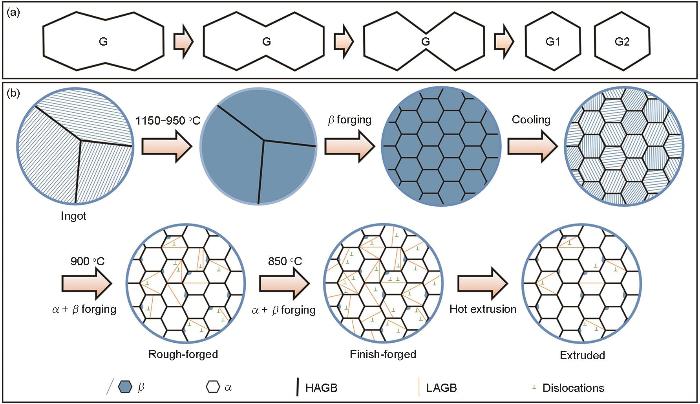
图7
微观组织演变与遗传链示意图
Fig.7
Schematics of microstructural evolution and inheritance chain
(a) grain fragmentation during hot working (G—original grain, G1—fragmented grain 1, G2—fragmented grain 2)
(b) microstructural inheritance chain during multi-stage thermomechanical processing from ingot to tube blank
3.1.2 亚结构的遗传机制
在精锻过程中,与粗锻中的α + β工艺相似,同样难以通过触发DRX消耗变形储能,并且精锻使得合金进一步变形,内部变形储能增加,LAGB占比增加(图7b),表明其内部位错亚结构含量进一步增加,
3.1.3 晶体学取向的遗传机制
图8
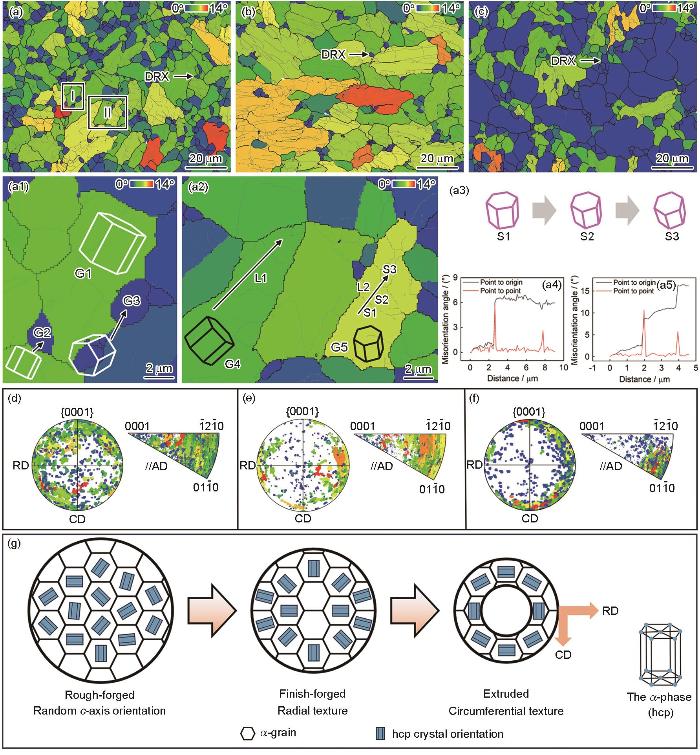
图8
TA18合金热加工过程中的EBSD分析和晶体取向演变示意图
Fig.8
EBSD analyses (a-f, a1-a5) and schematics showing the evolution of crystal orientation (g) during thermomechanical processing (a-c) grain orientation spread (GOS) maps corresponding to the rough-forged (a), finish-forged (b), and extruded (c) conditions (a1, a2) enlarged GOS maps of the rectangle regions I (a1) and II (a2) in Fig.8a (G1-G5 represent different grains, and S1-S3 represent different subgrains) (a3) schematic of the crystal structures for subgrains S1-S3 marked in Fig.8a2 (a4, a5) misorientation angle profiles along lines L1 (a4) and L2 (a5) in Fig.8a2, respectively (d-f) PFs and IPFs corresponding to the rough-forged (d), finish-forged (e), and extruded (f) conditions
图8a1和a2分别为图8a中区域I和II的局部放大图,其中G1~G5表示不同晶粒,S1~S3表示不同亚晶。图8a3为图8a2中亚晶S1~S3晶体结构示意图。研究表明,DRX机制分为连续动态再结晶(CDRX)和不连续动态再结晶(DDRX)[42],当晶内累积取向差大于15°时一般产生CDRX,小于15°时一般产生DDRX[43]。以粗锻样品为例,选取图8a2中G4和G5两个变形晶粒进行研究,G4晶粒沿箭头L1方向的累积取向差小于7° (图8a4),点对点取向差小于6°,表明形成此晶粒的方式为DDRX机制。DDRX的典型特征是应变诱导晶界凸出形核[44],如图8a1中G3晶粒所示,原始晶粒的晶界向高密度位错区域凸出,晶界扫过的区域位错密度降低,形成无畸变的再结晶晶粒。而G5晶粒中沿箭头L2方向的累积取向差大于15°,点对点取向差出现约5°和约10°两个数值(图8a5),表明亚晶产生旋转导致取向差增加,这属于CDRX的典型特征,也可以用图8a3显示的亚晶S1~S3的晶体结构旋转过程证实。CDRX主要通过相邻亚晶旋转增加取向差,同时LAGB通过吸收位错增加取向差逐渐转变为HAGB,从而形成CDRX晶粒。综上所述,热加工过程中同时发生CDRX与DDRX。
图8d~f为铸锭各阶段热加工后的极图和反极图。可以看出,部分DRX晶粒与变形晶粒具有特定取向,即{0001}晶面与<
铸锭中心位置具有{0001}//AD和<
在本工作中,尽管粗锻工艺显著改变了α相的形貌,但处于铸锭中心位置的α相,其晶体学取向信息很大程度上被继承下来,表现为强烈的基面织构,并在后续热加工过程中被持续遗传。如图8d和g所示,粗锻后合金中α相的c轴呈随机取向,初步形成{0001}//AD织构和<
综上所述,晶体学取向的遗传并不是简单的复制,而是具有继承性与发展性的双重特征:CDRX机制使新生成的再结晶晶粒继承母相的晶体学取向;通过DDRX机制产生随机取向的新晶粒,弱化原有织构,并与CDRX机制的遗传作用形成竞争。此外,应力的存在可以使变形晶粒发生旋转,且可以驱动β→α相变中α变体的选择,因此也可以通过调控应力方向决定遗传或打破某种织构。可见,晶体学取向的遗传是原始组织取向、DRX、变形等多种机制竞争与协同的结果,从而实现动态、有选择性的继承和演化。
3.2 微观组织与织构遗传对力学性能的耦合作用
铸锭的粗大组织是后续加工过程中组织遗传和力学性能调控的基础。需要指出,本工作所用的TA18合金样品,经粗锻后缩松、缩孔等铸造缺陷被消除,经精锻和挤压后更为致密,并且,TA18合金组织以α相为主,β相含量较低,因此不考虑缺陷和相比例对力学性能的影响。在变形过程中,α相晶粒破碎、球化,同时产生DRX,形成均匀、细小的等轴α相形貌,并在后续加工中被稳定遗传。根据Hall-Petch关系,细小的等轴α相起到细晶强化的作用[52,53]。此外,粗锻后产生的高密度亚结构起到加工硬化的作用,两者共同作用使其轴向抗拉强度由400 MPa左右提高至550 MPa左右。细小等轴晶粒的存在不仅是抗拉强度大幅提升的基础,而且还可使合金变形更为均匀,不易产生裂纹,从而大幅提高塑性。但是合金塑性同样受亚结构含量遗传所控制,精锻阶段遗传并强化的高含量LAGB导致了塑性低谷,挤压后LAGB占比降低促使塑性恢复。综上所述,细小等轴α相有利于提升合金强度和塑性,而高变形晶粒和高亚结构含量会严重损害合金塑性,故在加工过程中应保持细小等轴α相这一有益遗传特征,并在加工链中阻断或转化高变形晶粒和高亚结构含量这一有害遗传特征。
对于晶粒亚结构,LAGB占比从精锻样品的64.5%降至挤压样品的36.4%,延伸率有所回升,两者变化趋势对应,表明亚结构含量是塑性演变的主导因素。LAGB占比的变化是变形储能积累和再结晶消耗位错相互竞争、共同作用的结果。通过GOS图与KAM图对比,可以定性区分两者的贡献,但难以进行定量区分。此外,织构对塑性的定量影响分析较为复杂,本文未做深入讨论。
另一方面,TA18合金微观组织以hcp结构的α相为主,其五个滑移系统中基面({0001}<
基于以上分析,理想的组织遗传调控方案是:粗锻阶段通过大变形量彻底打破铸态缩松、缩孔和粗大片层组织的不利遗传,建立细小等轴晶和织构的微观组织基础;精锻阶段继承等轴α相组织以保证合金的强度和塑性,同时应避免高变形晶粒和高亚结构含量的产生与过度遗传;挤压阶段应充分促进DRX以消除有害的亚结构遗传,并利用DRX机制优化有益织构的遗传或打破有害织构的遗传。
DRX是实现晶粒细化并弱化甚至消除亚结构的有效机制。其中,通过CDRX机制形成的晶粒与母相取向相近,有助于织构遗传;通过DDRX机制形成的晶粒则随机取向,可用于调控晶粒尺寸与织构强度。此外,变形晶粒也可以使遗传特征延续,但含量过高会使亚结构增殖;应力诱导的α变体选择效应也可遗传或打破某些织构。因此,可通过增强CDRX以继承径向织构,或借助应力诱导选择有利于径向织构的α变体转变,但需注意避免晶粒粗化。同时,利用DDRX提高晶粒取向随机性,弱化周向织构或促进不利于该织构的α变体形成。此外,变形晶粒作为织构遗传的载体,其含量调控也可用于优化织构组成,消除不利织构,调控合金内部亚结构含量。综上所述,在TA18合金热加工过程中,应综合调控DRX机制(CDRX和DDRX机制)、应力诱导α变体选择效应以及变形晶粒含量,最终获得均匀、细小的等轴晶组织与径向织构,实现多尺度微观组织和性能的一体化协同控制。
4 结论
(1) 基于TA18合金从铸锭到管坯成型的热加工过程,构建了一条清晰的多尺度组织形貌遗传链。粗锻打破了铸态粗大组织和缩松、缩孔铸造缺陷的遗传,建立了微米级等轴α相和高亚结构含量的新遗传特征。精锻继承等轴α相形貌,但进一步强化遗传了高变形晶粒和高亚结构含量的特征。挤压最终优化了该遗传链,在保持等轴α相形貌遗传的同时弱化了有害的高亚结构含量的遗传。
(2) 晶体学取向的遗传表现出继承性与发展性的双重特征。铸锭中心的{0001}//AD和<
(3) 力学性能是微观组织与织构遗传特性的宏观体现,可通过调控遗传路径进行设计。强度的提升主要归功于细小等轴α晶粒形貌的成功建立与遗传,以及高密度亚结构加工硬化的贡献。塑性也同样与其相关,细小等轴晶是塑性大幅提高的基础,而高亚结构含量则会损害部分塑性。在整个加工过程中,细小等轴晶、适当的亚结构含量、径向织构等有益的组织遗传需要被强化,而高变形晶粒、高亚结构含量、强周向织构等有害的组织遗传需要在工艺链中被阻断或转化。
(4) 实现TA18合金高性能管坯制备的关键,在于对组织遗传全流程的协同调控。通过调控多阶段热加工参数,可以利用CDRX机制继承有利织构,通过DDRX弱化不利织构,并通过提高动态再结晶程度消除有害亚结构,最终实现组织、织构与性能的一体化优化。
参考文献
Classification and applications of titanium and its alloys: A review
[J].
Alloys-by-design: A low-modulus titanium alloy for additively manufactured biomedical implants
[J].
Research progress on the influence of the deep-sea environment on the stress corrosion of titanium alloys
[J].
Titanium alloys are extensively used in deep-sea exploration and resource-development equipment. The harsh environment of the deep sea hinders the performance of titanium alloys. Although titanium alloys exhibit outstanding corrosion resistance, they are susceptible to stress corrosion. This study conducted a detailed analysis of the key factors influencing titanium alloys in deep-sea environments, such as hydrostatic pressure, temperature, salinity, and trace substances. The effects of mechanical stresses such as tensile, residual, and alternating stresses on the stress corrosion of titanium alloys were also analyzed. Consequently, the influence of the compositional design and microstructure of titanium alloys on their susceptibility and sensitivity to stress corrosion were discussed. This study highlighted significant gaps, particularly in understanding the effect of microstructure on stress corrosion, stress corrosion mechanisms in titanium-welded joints, synergistic effects of multiple deep-sea environmental factors, and the effect of complex stress conditions. Current studies primarily focused on material-level analysis rather than structural-level assessments. Existing corrosion protection technologies for deep-sea applications, particularly coating technologies for such environments, remain underdeveloped. To address these limitations, this study proposed prospective research areas, including the synergistic mechanism involving multiple environmental factors, the synergistic effect between creep and stress corrosion, the effect of microstructure and residual stress in welded joints, the development of innovative protection technologies, and simulations of multi-axis stress conditions and their effect on stress corrosion.
深海环境对钛合金应力腐蚀影响的研究进展
[J].钛合金广泛用于深海探测和资源开发的装备设施,但深海的严酷环境对钛合金服役性能提出了严峻挑战。钛合金具有非常优异的耐腐蚀性能,但在深海环境中存在应力腐蚀风险。本文详细分析了深海环境中的关键影响因素(静水压力、温度、盐度和微量物质)以及多种应力(拉伸应力、残余应力和交变应力等)对钛合金应力腐蚀的影响,探讨了钛合金的成分设计和微观组织对应力腐蚀敏感性的影响。目前针对钛合金微观组织对应力腐蚀的影响、钛合金焊接接头的深海应力腐蚀规律、多环境因素耦合和复杂应力影响机制等方面的研究存在明显不足,且研究基本局限于材料水平而未拓展到结构水平,钛合金深海应力腐蚀防护技术也存在一定空白,急需开展钛合金深海防护涂层技术的研发,因此本文还展望了钛合金深海应力腐蚀的多环境因素耦合机制、蠕变-腐蚀协同效应、焊接接头微观组织及残余应力影响、新型防护技术开发,以及多轴复杂应力条件的模拟及其影响下的应力腐蚀行为探究等方面的研究方向。
Tensile deformation behavior of high-strength TA18 titanium alloy tube under warm forming conditions and constitutive model based on dislocation density
[J].
Finite element modeling and experimental investigation on manufacturing TA18 alloy pipes via hot free bending forming technology: Forming characteristics and process optimization
[J].
The texture evolution related to the interactions between α and β phases in dual-phase region annealing of a near α titanium alloy pipe after Pilger cold rolling
[J].
Optimal tensile properties of laser powder bed fusion hereditary basket-weave microstructure in additive manufactured Ti6Al4V
[J].
Effects of hot isostatic pressing parameters on microstructure and properties of TA15 titanium alloy
[J].
热等静压工艺参数对TA15钛合金组织及性能的影响
[J].
Effect of texture inheritance on microstructure of beta C titanium alloy
[J].
TB9钛合金棒材组织遗传效应与性能(英文)
[J].
Optimization in strength-ductility of Mg-Gd-Y-Zn-Al alloy through microstructural heredity process regulation
[J].
Microstructural heredity of Ni-containing cryogenic steel and its effect on the toughness at 77 K
[J].
Mechanistic understanding of banded microstructure and its effect on anisotropy of toughness in low carbon-low alloy steel
[J].
Microstructure, texture, and mechanical properties of the extruded and multi-directionally forged Mg-xGd alloys
[J].
An overview of the thermomechanical processing of α/β titanium alloys: Current status and future research opportunities
[J].
Research on the hot-temperature rheological behavior and microstructural evolution of TA18 titanium alloy
[J].
Analytical springback modelling for thermal-mechanical bending of TA18 tube under non-isothermal loading
[J].
Review: Microtextures in near α and α + β dual-phase titanium alloys
[J].
综述: 近α型和α + β两相钛合金的微织构
[J].近α和α + β两相钛合金是航空、航天关键工程领域的核心材料。提高钛合金锻件性能,特别是大型锻件的性能稳定性一直是工程领域的研究热点。钛合金锻件中普遍存在微织构,严重降低了锻件的疲劳等关键性能,是制约钛合金锻件综合性能的关键因素之一。通过优化热加工工艺提高材料晶体取向分布均匀性是进一步改善合金性能的可行手段。本文综述了钛合金锻件微织构产生原因以及潜在的负面影响,并讨论了其控制措施。最后,针对改善钛合金锻件组织均匀性进行了展望。
High-temperature tensile deformation behavior and damage model of TB6 alloy
[J].
TB6钛合金高温拉伸变形过程临界损伤模型
[J].
Grain refinement of ZALSi7Mg1 alloy by structure heredity
[J].
利用组织遗传性细化ZAlSi7Mg1合金晶粒的研究
[J].
Numerical simulation of macrosegregation heredity on TC4 titanium alloy ingot by vacuum arc remelting
[J].In this study, Fluent software is used to simulate the interaction between temperature and solute fields during the process of vacuum arc remelting. The heredity law of macrosegregation of the easily segregated Fe element between the primary and secondary ingots is examined. The results shows that macrosegregation of the primary ingot has a genetic effect on the macrosegregation of secondary ingots. Compared with the primary ingot, the negative segregation in the surface area of the secondary ingot leads to a certain increase. When the position and direction of the lower part of the primary ingot are unchanged, the negative segregation in the surface area of the secondary ingot exhibits the highest increase, and the negative segregation degree increases by 0.42. When the position and direction of the upper part of the primary ingot remains unchanged, the positive segregation in the core of the secondary ingot exhibits the highest increase, and the positive segregation degree increass by 0.57. When the upper and lower parts of the primary ingot are exchanged and the upper half is downward, the positive segregation degree of the secondary ingot core is reduced by 0.17. When upper and lower parts of the primary ingot switch positions and directions of the upper and lower parts are downward, the center segregation of the secondary ingot is improved when compared to that of the primary ingot, and processing of the primary ingot is not required. This is turn leads to greater significance in actual production.
Additive manufacturing of high strength near β titanium alloy Ti-55511 by engineering nanoscale secondary α laths via in-situ heat treatment
[J].
On the correlation among dislocation density, lath thickness and yield stress of bainite
[J].
Creep deformation and strength evolution mechanisms of a Ti-6Al-4V alloy during stress relaxation at elevated temperatures from elastic to plastic loading
[J].In this study, the stress relaxation (SR) behaviors of a Ti-6Al-4V alloy pre-loaded from elastic to plastic regions and corresponding strength evolution mechanisms at different temperatures were systematically studied. In order to quantitatively analyze the detailed deformation and strength evolution mechanisms during the whole SR tests, which is composed of the loading stage and subsequent SR stage, the evolutions of α/β structures and dislocations have been identified by a series of microstructural observations, i.e., scanning electron microscopy (SEM), electron backscatter diffraction (EBSD), high resolution transmission electron microscopy (HRTEM), energy dispersive spectroscopy (EDS). A great quantity of entangled dislocations in α phase introduced by the plastic loading at temperatures below 800 °C promotes the emergence of SR behavior with a higher creep rate, leading to the much higher SR level with larger pre-load levels. Diffusion is significantly enhanced by dislocations accumulated at interfaces with higher temperatures (> 800 °C), contributing to a similar SR phenomenon under different initial strain levels. Apparent strength loss has been observed after SR with high temperatures or pre-loaded to the plastic region, e.g., 94 MPa loss for 800 °C, pre-loaded with a stain of 10% and SR for 2400 s. The strength loss mainly comes from the loading stage where distorted and fragmented β layers occur. The subsequent SR stage facilitates interfacial diffusion and results in a higher fraction of granular β phases, leading to a further decrease in yield strength (YS). This study enhances the understanding on the deformation and strength evolution mechanisms of titanium alloys with lamellar structures in the whole SR process, providing a physical foundation for optimizing the processing parameters for manufacturing titanium alloy components with high accuracy and performance.
Dynamic recrystallization mechanism and improved mechanical properties of a near α high temperature titanium alloy processed by severe plastic deformation
[J].
Prediction of constitutive behavior and microstructure evolution in hot deformation of TA15 titanium alloy
[J].
Mesoscale modeling of dynamic recrystallization behavior, grain size evolution, dislocation density, processing map characteristic, and room temperature strength of Ti-6Al-4V alloy forged in the (α + β) region
[J].
Deformation of single crystals, polycrystalline materials, and thin films: A review
[J].With the rapid development of nano-preparation processes, nanocrystalline materials have been widely developed in the fields of mechanics, electricity, optics, and thermal physics. Compared to the case of coarse-grained or amorphous materials, plastic deformation in nanomaterials is limited by the reduction in feature size, so that they generally have high strength, but the toughness is relatively high. The “reciprocal relationship” between the strength and toughness of nanomaterials limits the large-scale application and development of nanomaterials. Therefore, the maintenance of high toughness while improving the strength of nanomaterials is an urgent problem to be solved. So far, although the relevant mechanism affecting the deformation of nanocrystalline materials has made a big breakthrough, it is still not very clear. Therefore, this paper introduces the basic deformation type, mechanism, and model of single crystals, polycrystalline materials, and thin films, and aims to provide literature support for future research.
Phase interface-induced dwell fatigue cracks in titanium alloy with lamellar microstructure
[J].
片层组织钛合金中相界面诱导保载疲劳裂纹形成(英文)
[J].
In situ fracture observations of distinct interface types within a fully lamellar intermetallic TiAl alloy
[J].\n Intermetallic γ‐TiAl‐based alloys are commonly used as structural materials for components in high‐temperature applications, although they generally suffer from a lack of ductility and crack resistance at ambient temperatures. Within this study, the process‐adapted 4th generation TNM\n +\n alloy, exhibiting a fully lamellar microstructure, was examined using notched micro‐cantilevers with defined orientations of lamellar interfaces. These configurations were tested\n in situ\n using superimposed continuous stiffness measurement methods during loading with simultaneous scanning electron microscopy observations. Subsequently, the video signal was used for visual crack length determination by computer vision and compared to values calculated from\n in situ\n changes in stiffness data. Applying this combinatorial approach enabled to determine the\n J\n ‐integral as a measure of the fracture toughness for microstructurally different local crack propagation paths. Thus, distinct differences in conditional fracture toughness could be determined from 3.7 MPa m\n 1/2\n for γ/γ‐interface to 4.4 MPa m\n 1/2\n for α\n 2\n /γ‐interface.\n
Ductile fracture due to adiabatic shear during the serrated chip formation in high speed cutting: A microscopic investigation
[J].
Effect of hot-pressing temperature on the microstructure and properties of the diffusion-bonded region of TC4 alloy
[J].Diffusion bonding has been gaining increasing attention in the manufacturing of precise and intricate structural components in aerospace and other industries. The bonding temperature is a critical factor that affects the performance of the parts produced by diffusion bonding. This study explores the impact of hot-pressing temperature on the microstructure, mechanical properties, and fracture mechanism of TC4 titanium alloy joints formed through diffusion bonding. Samples were prepared using a hot-pressing technique. The findings reveal that dynamic recrystallization occurs at the diffusion bonding interface during the process. At lower temperatures, this recrystallization results in the formation of a fine α-phase at the interface. As the hot-pressing temperature increases, the α-phase progressively coarsens. Notably, there is a substantial disparity between the size of the α-phase formed through dynamic recrystallization at the interface and that in the nondiffusion zone of the base material, leading to a crystallographic mismatch. This mismatch substantially reduces the properties at the diffusion interface and consequently leads to fracture in the diffusion-bonded joints within the bonding zone after hot pressing. In the post-heat treatment, the diffusion zone consists of primary α (αp) phase, needle-like secondary α (αs) phase, and β phase. Elevating the bonding temperature gradually increases the size of the α phase, thereby improving the crystallographic match at the bonding interface and facilitating interface migration. After the heat treatment at 970 oC, the tensile strength and elongation of the 950 oC diffusion-bonded TC4 Alloy joints were measured at 998.7 MPa and 17.5%, respectively, achieving the performance levels of the alloy before diffusion bonding.
热压温度对TC4合金扩散连接区组织与性能的影响
[J].扩散连接技术在航空航天等领域精密、复杂结构部件的生产中受到越来越多的关注,连接温度是影响部件扩散连接后使用性能的关键因素。本工作采用热压工艺制备了TC4钛合金扩散连接样品,研究了热压温度对扩散连接区显微组织、力学性能及断裂机理的影响规律。结果表明,热压过程中扩散连接界面处的合金会发生动态再结晶,温度较低时,在扩散界面处再结晶形成细小α相,随着热压温度的升高,界面处的α相逐渐粗化;动态再结晶形成的α相与合金内部非扩散区α相的尺寸存在较大差异,由此产生的晶体学失配现象会显著降低扩散界面的性能,导致热压后的合金均在扩散区发生断裂,合金延伸率较低。热处理后扩散区的组织由初生α (α<sub>p</sub>)相、针状次生α (α<sub>s</sub>)相和少量β相组成,随连接温度的升高,α相的尺寸逐渐增大,界面处的晶体学失配得到改善,界面迁移程度增加,合金的抗拉强度提高到998.7 MPa,延伸率提高到17.5%,达到扩散连接前TC4钛合金的性能。
Dislocation slip and crack nucleation mechanism in dual-phase microstructure of titanium alloys: A review
[J].
Deformation banding in β working of two-phase TA15 titanium alloy
[J].
Microscopic deformation behavior of Ti-6Ai-4V titanium alloy based on the characteristic of two phase
[D].
基于双相特征的Ti-6Al-4V钛合金微观变形行为研究
[D].
Interaction between phase transformation and static recrystallization during annealing of rolled TC18 titanium alloy
[J].TC18 titanium alloy was subjected to hot rolling at 840 °C, followed by annealing experiments at 830, 860, and 890 °C for different time lengths. The effects of annealing temperature and time on phase transformation and static recrystallization (SRX) behavior, as well as the interaction between phase transformation and SRX, were studied. The results showed that at the low annealing temperature of 830 °C, the microstructure underwent β → α phase transformation and α grain growth with the increase of annealing time, and the SRX of β phase proceeded through subgrain nucleation mechanism induced by α particles. At the middle annealing temperature (860 °C), the α → β phase transformation occurred before the SRX of β phase, and the SRX of β phase was dominated by the grain boundary (GB) bulge mechanism. Meanwhile, the reduction of α phase content accelerated the SRX rate and grain growth. As the annealing temperature (890 °C) exceeded the β transus temperature, the α phase completely transformed to the β phase, and the SRX of the β phase proceeded with a very fast grain growth rate. In addition, the interaction between phase transformation and SRX affected the distribution of α particles. The large-sized α particles (830 °C) were located at the triple GB junction and hindered the SRX β grain growth, while smaller α particles (860 °C) were bypassed by β GB and dispersed within the SRX β grains.
A comparative analysis of a unique DRX process in achieving a homogeneous distribution of β grains in the single phase region of as-cast Ti644321 alloy
[J].
Dynamic recrystallization mechanism and model of TC31 titanium alloy sheet during hot deformation
[J].
Microstructure and texture evolution of TB8 titanium alloys during hot compression
[J].In this study, microstructure and texture evolution of TB8 titanium alloys during hot deformation were investigated by using electron back‐scattered diffraction (EBSD) analysis. The results showed that dynamic recrystallization (DRX) behavior of TB8 titanium alloys was drastically sensitive to the strain. As the true strain raised from 0.2 to 0.8, the degree of DRX gradually increased. The nucleation mechanism of recrystallization was observed, including discontinuous dynamic recrystallization (DDRX) resulting from the bulging of original boundaries. Furthermore, continuous dynamic recrystallization (CDRX) occurred because of the transformation of low‐angle grain boundaries (LAGBs) to high‐angle grain boundaries (HAGBs) in the interior of the original deformed grains. The texture evolution of TB8 titanium alloy during hot deformation process was analyzed in detail, and five texture components were observed, including {001}, {011}, {112}, {111}, and {111}. As the true strain increased, deformation textures were gradually weakened due to an increase in the volume fraction of DRX grains. When the true strain was 0.8, the main texture components consisted of the recrystallization texture components of the {001} and {011} textures.
Nucleation and growth during recrystallization
[J].
A new grain orientation spread approach to analyze the dynamic recrystallization behavior of a cast-homogenized Mg-Zn-Zr alloy using electron backscattered diffraction
[J].
Twinning effects on the hot deformation behavior of AZ31 Mg alloy
[J].
A review of dynamic recrystallization phenomena in metallic materials
[J].
Flow behavior and dynamic recrystallization mechanism of a new near-alpha titanium alloy Ti-0.3Mo-0.8Ni-2Al-1.5Zr
[J].
Nucleation mechanism of discontinuous dynamic recrystallization with restrained grain boundary sliding
[J].
Crystallographic orientation related dynamic recrystallization behavior and its impact on texture development of high-temperature α phase in TiAl alloy
[J].
On the process of transition of the cubic-body-centered modification into the hexagonal-close-packed modification of zirconium
[J].
Deformation mechanism and microstructure control of high strength metastable β titanium alloy
[J].
高强亚稳β钛合金变形机制及其组织调控方法
[J].亚稳β钛合金具有密度低、比强度高以及成形能力好等优异的综合特征,已经在对强韧性要求极高的航空航天结构件上获得应用,用以替代传统的高强度钢,实现显著的结构减重的同时大幅度提升飞行器性能。热成形技术与热处理工艺相结合是制备高强亚稳β钛合金结构件的主要手段,而制定优化工艺的前提是对合金的变形机制形成完整的认识,进而实现合金构件的组织-性能一体化调控。同时,明晰高强亚稳β钛合金的变形机制与宏观力学性能间的关系也有助于进一步研发新型合金,满足飞行器对更高性能材料的需求。因此,本文围绕高强亚稳β钛合金变形机制及其组织调控方法,首先概述了合金的室温塑性变形机制研究进展,阐述了β基体稳定性的影响因素及其相应的变形机制演变规律,分析了α析出相的特征对位错运动的综合影响,以及由此所造成的力学性能表现。然后,总结了高强亚稳β钛合金的热变形行为与机制,分析了合金在不同相区以及不同变形阶段所对应的组织演变规律和变形机制,探讨了合金在热变形过程中的加工硬化与流变软化行为。最后,简述了高强亚稳β钛合金组织调控过程中动态回复/动态再结晶与动态相变的复杂交互作用,论述了多尺度计算模型在合金组织与性能预测方面的研究现状与发展趋势。
Dynamic transformation during the high temperature deformation of titanium alloys
[J].
Experimental assessment of variant selection rules for grain boundary α in titanium alloys
[J].
Texture evolution and controlling of high-strength titanium alloy tube in cold pilgering for properties tailoring
[J].
Dynamic recrystallization in titanium alloys: A comprehensive review
[J].
The deformation and ageing of mild steel: III Discussion of results
[J].
Deformation mechanisms in the α phase of the Ti-6Al-2Sn-4Zr-2Mo titanium alloy: In situ experiments and simulations
[J].
The effects of crystallographic texture on the mechanical and fracture properties of Ti-3Al-2.5V hydraulic tubing
[J].


