Corresponding authors:CHEN Shenghu, professor, Tel:(024)23971981, E-mail:chensh@imr.ac.cn;RONG Lijian, professor, Tel:(024)23971979, E-mail:ljrong@imr.ac.cn
Received:2025-07-15Revised:2025-09-03
Fund supported:
Strategic Priority Research Program of Chinese Academy of Sciences(XDA0410000) LingChuang Research Project of China National Nuclear Corporation
Austenitic stainless steels are utilized in the in-core and out-of-core structural components of various Generation-IV nuclear reactors owing to their excellent comprehensive properties, mature manufacturing processes, and decades of service experience in pressurized water reactors. However, after prolonged exposure to high temperature and high-intensity irradiation, these steels gradually exhibit some performance limitations, including lower creep strength, inadequate microstructural stabilities, and higher radiation embrittlement sensitivities. Recently, alloying with Nb has been proven to effectively regulate the precipitation behavior of secondary phases and the formation and evolution of irradiation defects in austenitic stainless steels, promising simultaneous improvements in creep strength and irradiation tolerance. Therefore, Nb alloying has emerged as a key pathway for the development of next-generation austenitic stainless steels with enhanced high-temperature performance, improved irradiation resistance, and extended service life. This paper systematically reviews the research progress of Nb-stabilized austenitic stainless steels for Generation-IV nuclear power applications, including the compositional design and optimization to improve the creep properties and irradiation resistance, the effects of Nb addition on austenite stability, the formation mechanisms of primary NbC, and the precipitation behavior of Nb-bearing secondary phases. Additionally, the mechanisms by which Nb alloying influences the strength-ductility balance, creep strength, high-temperature microstructural stability, and irradiation-induced defect evolution are discussed. Finally, some future research prospects of Nb-stabilized austenitic stainless steels for Generation-IV nuclear reactors are discussed.
CHEN Shenghu, XIE Ang, YANG Binbin, LIU Yongtao, CHEN Sihan, ZHAO Mingjiu, JIANG Haichang, RONG Lijian. Research Progress of the Niobium-Stabilized Austenitic Stainless Steels for Generation-IV Nuclear Reactors[J]. Acta Metallurgica Sinica, 2026, 62(7): 1175-1188 DOI:10.11900/0412.1961.2025.00203
Fig.2
Thermo-Calc calculation of NbC formation in Fe-15Cr-10Ni ausenitic stainless steels with different Nb contents (a) and OM image of as-cast samples with 0.9%Nb (b) (Inset in Fig.2b is the high magnification image of the primary NbC)
Fig.3
Nanoindentation load-depth curves of primary NbC and austenite (a) and TEM images near primary NbC after deformation to a true strain of 10% (b) in as-cast sample (SF—stacking fault. Inset in Fig.3b refers to the corresponding SAED pattern of NbC)[62]
Fig.4
Three-dimensional (3D) view of primary NbC in the as-cast Fe-15Cr-10Ni-0.9Nb ausenitic stainless steel (a) and SEM image of the fracture surface morphology (b) and corresponding EDS mapping of Nb (c)
Fig.6
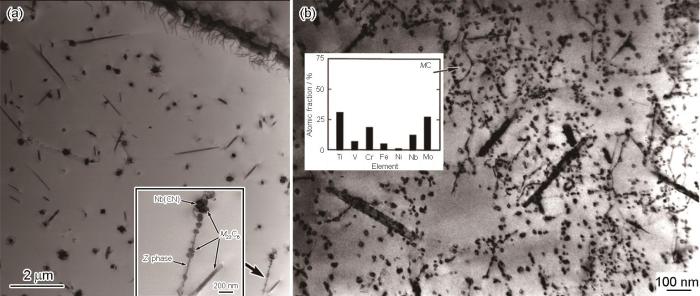
TEM images of secondary phase in Alloy 709 after aging at 650 oC for 500 h (Inset is the high magnification image of the dislocation (arrowed in Fig.6a)) (a)[76] and HT-UPS steel after creep-rupture test at 700 oC, 170 MPa for 18000 h (Inset is the analytical electron microscopy of MC carbides (arrowed in Fig.6b)) (b)[77]
Fig.8
Schematics of formation mechanisms of G-phase and σ-phase in Nb-stabilized austenitic stainless steel (a, b) transformation mechanism of Nb(C, N) to G-phase (c, d) formation mechanism of σ-phase adjacent to Nb(C, N)
Fig.10
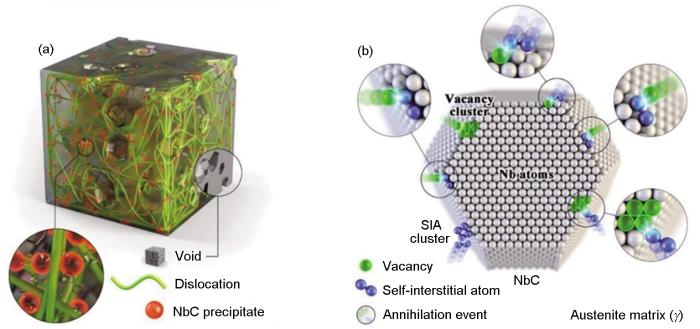
Schematic illustration of the 3D structure after irradiation (a) and evolution of irradiation-induced defects along the NbC/matrix interface (b)[96] (SIA—self-interstitial atom)
6 Nb稳定化奥氏体不锈钢在第四代核电领域的应用现状
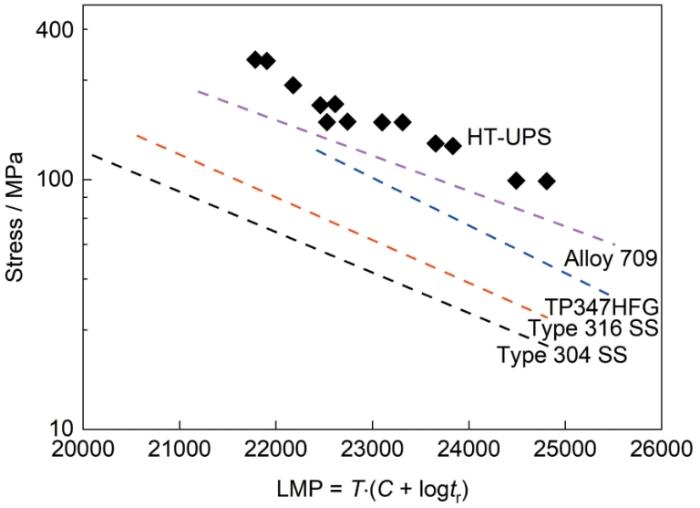
目前,部分Nb稳化奥氏体不锈钢已实现工程应用,EP302不锈钢应用于俄罗斯BREST-OD-300铅铋冷却快堆的堆容器和堆内构件[99],EI847不锈钢应用于俄罗斯BN-350、BN-600钠冷快堆的燃料包壳[100,101],PNC316不锈钢应用于日本JOYO、MONJU钠冷实验快堆[102,103]。Nb稳定化奥氏体不锈钢在第四代核电反应堆中的应用需要综合考虑各种因素,以钠冷快堆为例,需要考虑力学性能(强度、蠕变、蠕变-疲劳)、高温组织稳定性、钠相容性以及焊接性能。两种新型Nb稳定化奥氏体不锈钢HT-UPS和Alloy 709被视为取代现役316H不锈钢的候选材料,可以支撑反应堆运行温度提高、设计寿命延长的技术发展。图11[104]对比了HT-UPS、Alloy 709以及316H钢的综合性能。与316H不锈钢相比,HT-UPS和Alloy 709钢通过在奥氏体基体中引入细小弥散的第二相,显著提高了高温强度、蠕变强度、蠕变-疲劳性能以及高温组织稳定性,同时保持了良好的耐腐蚀性能和焊接性能。相比之下,Alloy 709钢的综合性能更加优异,正在进行纳入ASME III Rules for Construction of Nuclear Facility Components: D5 High Temperature Reactors标准的数据测试工作。美国核管理委员会(Nuclear Regulatory Commission)正在开展将Alloy 709钢用于先进长寿命(60~100 a)钠冷快堆堆容器、管道、堆芯支撑的评估工作[105,106]。
China Nuclear Energy Association, Hualong Nuclear Power Technology Co., Ltd. Blue Book of China Nuclear Energy Development Report [M]. Beijing: Scientific and Technical Documentaton Press, 2025: 1
Oxide scale formation on ultrafine-grained ferritic-martensitic steel during pre-oxidation and its effect on the corrosion performance in stagnant liquid Pb-Bi eutectic
In lead-cooled fast reactor (LFR) systems, the liquid lead-bismuth eutectic (LBE) coolant provides a corrosive environment that damages the steel components during high-temperature operation. This study investigated the microstructural deterioration of 9Cr ferritic/martensitic (F/M) steel under thermal aging at 550 °C for 2,000, 10,000, or 20,000 h and its effect on oxidation corrosion in an LBE environment using multiscale characterization techniques. The results indicated that the thickness of the internal oxidation zone (IOZ) increased significantly with extended thermal aging, whereas that of the spinel layer remained relatively constant. The abundant subgrain boundaries that emerged during extensive thermal aging facilitated Fe diffusion, and the enlarged Cr-rich M<sub>23</sub>C<sub>6</sub> carbides contributed to the formation of preferential oxidation regions, accelerating IOZ layer growth. The spinel layer formed from the IOZ was influenced by microstructural defects within the IOZ. A theoretical model describing the accelerated oxide layer growth due to thermal aging was developed. These findings support the advancement of LFR technology.
LiuS J, HuangQ Y, PengL, et al.
Microstructure and its influence on mechanical properties of CLAM steel
Influence of temperature on the microstructural evolution of SIMP and T91 steels in liquid lead-bismuth eutectic: Experiments and molecular dynamics simulations
Development of a novel structural material (SIMP steel) for nuclear equipment with balanced resistances to high temperature, radiation and liquid metal corrosion
Austenitic stainless steels are selected as candidate materials for in-core and out-of-core components of Generation-IV fast reactors due to their excellent operating experience in light-water reactors over several decades. However, the performance of conventional austenitic stainless steels proves to be inadequate through operation feedback in fast reactors. To withstand the demands for material performance exposure to the extreme operating environment of fast reactors, modified austenitic stainless steels for in-core and out-of-core components have been developed from the first-generation 300-series steels. The design of an appropriate microstructure becomes a top priority for improving material performance, and key metallurgical features including δ-ferrite content, grain size and secondary phase precipitation pertinent to austenitic stainless steel are focused on in this paper. δ-ferrite content and grain size are closely correlated with the fabrication program and their effects on mechanical properties, especially creep and fatigue properties are critically assessed. Moreover, the impacts of some major elements including nitrogen, stabilization elements (Nb, Ti, V), phosphorus and boron on secondary phase precipitation behaviors during aging or creep are reviewed in detail. Based on the role of the aforementioned metallurgical features, the recommended specification of nitrogen content, stabilization ratio, phosphorus content, boron content, δ-ferrite content and grain size are put forward to guarantee the best-expected performance, which could provide reactors designers with attractive options to optimize fast reactor systems.
WuX Q, RongL J, TanJ B, et al.
Research advance on liquid lead-bismuth eutectic corrosion resistant Si enhanced ferritic/martensitic and austenitic stainless steels
Structural materials are one of the major factors that restrict the lead-cooled fast reactor construction due to metallic elements that can dissolve in the liquid lead-bismuth eutectic (LBE), which may affect the structure's safety. T91 steel and 316 stainless steel are the leading structural materials for critical equipment such as fuel cladding, reactor vessels, and reactor core internals. The environmental compatibility of those steels with the liquid LBE needs to be systematically evaluated. However, T91 steel and 316 stainless steel suffer from rapid oxidation corrosion in oxygen-saturated LBE at 550oC. T91 steel's corrosion resistance in liquid LBE can be improved by decreasing the oxygen concentration (1.26 × 10⁻⁶%, mass fraction), but dissolved corrosion occurred at dissolved oxygen concentration below 1 × 10⁻⁶% for T91 steel and 316 stainless steel. T91 steel is sensitive to liquid metal embrittlement, significantly reducing its corrosion fatigue life in the liquid LBE. Compared to the standard (9%-12%)Cr ferritic/martensitic steel and 316 stainless steel, the microalloyed Si enhanced (9%-12%)Cr ferritic/martensitic steel (9Cr-Si and 12Cr-Si) and 316 stainless steel (ASS-Si) have good microstructural stability and comprehensive mechanical properties. The Si-rich oxide formation in liquid LBE improves the oxide film compactness and corrosion resistance. The dissolution corrosion was inhibited in static oxygen-saturation and oxygen-controlled (10-6%-10-7%) flowing liquid LBE (0.3 m/s) at 550oC for 9Cr-Si, 12Cr-Si, and ASS-Si. These alloys are expected to meet the design requirements for a lead-cooled fast reactor.
Evolution of precipitate and its effect on the degradation of impact toughness in a carbon and nitrogen-controlled 316 stainless steel during thermal aging at 650 oC
Microstructural evolution of the inner oxide layer of a Si-modified austenitic stainless steel exposed to oxygen-saturated lead-bismuth eutectic (LBE): Toward the origin of LBE penetration
The American Society of Mechanical Engineers. Boiler and pressure vessel code, section III: Rules for construction of nuclear power plant components, division 1, subsection NH: Class 1 components in elevated temperature service [S]. New York: ASME, 2015
The corrosion and mechanical properties of austenitic stainless steels can be enhanced considerably by adding Nb. Newly developed Nb-stabilized austenitic stainless steels, such as 347HFG, 316Nb, TP310HCb, NF709, and HT-UPS, exemplify this advancement. The required Nb content varies across these steels. Prior research has indicated that in the as-cast microstructure of these steels, coarse and unevenly distributed primary NbC often forms, adversely affecting their mechanical and corrosion properties. Furthermore, this coarse primary NbC depletes the solid solution of Nb, which is counterproductive for fine secondary NbC precipitation. Notably, modifying the morphology and size of primary NbC through hot working and heat treatment is challenging. To enhance the microstructure and mechanical properties of Nb-stabilized austenitic stainless steel, this study investigated the effects of Nb content and homogenization treatment on these steels. The microstructure and tensile properties of cast austenitic stainless steel were analyzed using OM, SEM, TEM, and tensile test. The findings reveal that varying Nb content influences the precipitation of primary NbC and M23C6 carbides. In Nb-free steel, M23C6 carbides precipitate continuously at grain boundaries. This precipitation still occurs in steel with 0.30%Nb (mass fraction), alongside the formation of NbC + γ eutectic structures. Increasing Nb content to 0.90% can suppress M23C6 carbide precipitation, although the eutectic structures become more prevalent. A notable enhancement in yield strength accompanies an increase in Nb content to 0.90%. This improvement is attributed to the solid solution strengthening by Cr (due to suppressed M23C6 carbides) and Nb, grain boundary strengthening from refined grain sizes, and precipitation strengthening by secondary NbC. However, microcracks are easily nucleated at primary NbC/γ interface under plastic deformation, leading to rapid crack propagation along primary NbC networks and resulting in trench-like brittle fractures. This mechanism significantly reduces elongation. Post-homogenization treatment at 1250 oC alters the primary NbC morphology from rod-like to spherical/ellipsoid. This change increases the critical stress required for microcrack nucleation at NbC/γ interfaces, thereby inhibiting microcrack initiation. Additionally, the primary NbC networks transform from continuous to discontinuous distributions, impeding microcrack propagation. Consequently, this treatment significantly enhances elongation without compromising strength.
The lead-cooled fast reactor is considered one of the promising Generation IV nuclear energy systems. Structural materials used in the construction of pressure vessels and internals for this reactor include 300 series austenitic stainless steels. Nb-containing austenitic stainless steels are developed to improve corrosion properties, mechanical properties, and irradiation resistance. However, coarse primary NbC carbides are formed during solidification in these steels and cannot be eliminated through subsequent hot working and heat treatment. Recently, researchers have found different oxidation behaviors between secondary phase particles and the matrix, which affect the material's corrosion properties. However, the oxidation behaviors of primary NbC are rarely reported. This study analyzes the corrosion behaviors of a solution-treated Nb-containing austenitic stainless steel plate after exposure to oxygen-saturated liquid lead-bismuth eutectic (LBE) at 550 and 600 oC using SEM, EPMA, XRD, and TEM. The results show that the oxidation probability of NbC is correlated with its location in the samples at 550 oC. NbC at the initial surface is easily oxidized, while NbC within the interior is difficult to oxidize due to the low equilibrium oxygen partial pressure in the inner oxide layer, which suppresses the oxidation of NbC. However, NbC at the initial surface and within the interior are prone to be oxidized as the temperature increases to 600 oC. Compared to the matrix, NbC oxidizes into Nb2O5, resulting in a higher Pilling-Bedworth ratio (PBR). This leads to high compressive stress and resultant microcrack formation in the surrounding oxide layer. Additionally, the presence of CO2 generated during the oxidation of NbC within the interior reduces the compactness of the oxide layer, leading to a higher growth rate.
TakechiH, HasimotoS, ImagumbaiM, translated by FuJ Y, ShangC J. How to Improve the Properties of Steel with Niobium: Production Technology of Niobium-Containing Steel [M]. Beijing: Metallurgical Industry Press, 2007: 1
Japan Society of Mechanical Engineers. Code for Nuclear Power Generation Facilities. Rules on Design and Construction for Nuclear Power Plants. Section II Fast Reactor Standards [S]. Tokyo: JSME, 2017
AFCEN. Design and Construction Rules for Mechanical Components of Nuclear Installations: High temperature research and fusion reactors [S]. RCC-MRx, 2015
Precipitation strengthening of Nb-stabilized TP347 austenitic steel by a dispersion of secondary Nb(C,N) formed upon a short-term hardening heat treatment
The creep-resistant austenitic stainless steel Alloy 709 (Fe-20Cr-25Ni (wt%) based steel) is being investigated as a candidate structural material for the next generation fast neutron reactors at service temperature of 500-550 degrees C. However, the study of microstructural evolution of Alloy 709 during aging is lacking. In this study, thus, the microstructure of Alloy 709 has been investigated using electron microscopy in the as-received state and after static aging at 550, 650 and 750 degrees C. The results show that the prominent precipitate in the as-received Alloy 709 is Nb(CN), with the rod-like Z phase (CrNbN) observed very occasionally. After aging at 550 degrees C even up to 2000 h, no significant microstructure change was observed, which means that Alloy 709 is fairly stable at 550 degrees C. Aging at 650 degrees C produced globular M23C6 phase on grain boundaries, plate-like M23C6 carbides at twin boundaries and in the grain interior, and blocky M23C6 carbide nucleated on Nb(CN). Fine dispersoid Z phases were found on dislocations after aging at 650 degrees C for 500 h; their amount increases with aging time and temperature. (Cr,Mo)(3)(Ni,Fe)(2)SiN theta phase forms at grain boundaries after aging at 650 degrees C for 1000 h. After aging at 750 degrees C, theta phase nucleated on M23C6 carbide and a transformation of M23C6 to theta phase was found, which suggests that theta phase is the more stable. Aging at 550 degrees C promotes the segregation of Cr and Mo to grain boundaries whereas clear Cr depletion was observed at 650 degrees C due to the precipitation of Cr-rich M23C6 carbides at grain boundaries. Such depletion nearly disappears at 750 degrees C. The implications of aging for the subsequent mechanical behaviour of Alloy 709 are discussed briefly.
MaziaszP J.
Development of creep-resistant and oxidation-resistant austenitic stainless steels for high temperature applications
The austenitic heat resistant-steels have been considered as important candidate materials for advanced supercritical boilers, nuclear reactors, super heaters and chemical reactors, due to their favorable combination of high strength, corrosion resistance, perfect mechanical properties, workability and low cost. Since the precipitation behavior of the steels during long-term service at elevated temperature would lead to the deterioration of mechanical properties, it is essential to clarify the evolution of secondary phases in the microstructure of the steels. Here, a summary of recent progress in the precipitation behavior and the coarsening mechanism of various precipitates during aging in austenitic steels is made. Various secondary phases are formed under service conditions, like MX carbonitrides, M23C6 carbides, Z phase, sigma phase and Laves phase. It is found that the coarsening rate of M23C6 carbides is much higher than that of MX carbonitrides. In order to understand the thermal deformation mechanism, a constitutive equation can be established, and thus obtained processing maps are beneficial to optimizing thermal processing parameters, leading to improved thermal processing properties of steels.
WangH T, DuH Y, WeiY H, et al.
Precipitation and properties at elevated temperature in austenitic heat-resistant steels—A review
Understanding sigma-phase precipitation in a stabilized austenitic stainless steel (316Nb) through complementary CALPHAD-based and experimental investigations
A unique feature of the environment of nuclear power reactors is the presence of high energy neutron radiation, which can lead to degradation processes in the materials of critical components. An understanding of the operative elevated temperature radiation damage mechanisms enables these effects to be minimised by appropriate alloy selection together with compositional optimisation. An overview of these aspects relevant to advanced fission and fusion reactor systems is presented. Several key examples are highlighted and include radiation embrittlement of low alloy pressure vessel steels for pressurised water reactors, coating designs for fuel in high temperature pebble bed reactors, and selection and design of low activation materials for proposed tokomak fusion reactor devices. In addition, void swelling, non-equilibrium solute segregation and radiation induced precipitation processes in alloys at high displacement doses and relevant to several reactor systems are covered. Likely trends in future nuclear power plant design and associated materials requirements are discussed.
ZinkleS J, SneadL L.
Designing radiation resistance in materials for fusion energy
Oxide scale formation on ultrafine-grained ferritic-martensitic steel during pre-oxidation and its effect on the corrosion performance in stagnant liquid Pb-Bi eutectic
0
2021
超细晶铁素体-马氏体钢的高温氧化成膜特性及其对Pb-Bi腐蚀行为的影响
0
2021
Effect of long-term thermal aging on lead-bismuth eutectic corrosion behavior of 9Cr ferritic/martensitic steel
0
2025
Microstructure and its influence on mechanical properties of CLAM steel
0
2012
Influence of temperature on the microstructural evolution of SIMP and T91 steels in liquid lead-bismuth eutectic: Experiments and molecular dynamics simulations
0
2023
Development of a novel structural material (SIMP steel) for nuclear equipment with balanced resistances to high temperature, radiation and liquid metal corrosion
Evolution of creep resistant 316 stainless steel for sodium cooled fast reactor applications
0
2010
Austenitic stainless steels for fast reactors-irradiation experiments, property evaluation and microstructural studies
0
2011
Precipitate phases in type 316 austenitic stainless steel resulting from long-term high temperature service
1
1981
... 奥氏体不锈钢通常采用固溶处理,目的是使合金元素充分溶解于奥氏体基体中.奥氏体不锈钢在高温下仍能保持稳定的奥氏体组织,因而展现出优异的高温力学性能,ASME BPVC Section III Division 5[41]针对高温反应堆的设计,规定了奥氏体不锈钢的允许使用温度范围,304H和316H不锈钢允许使用温度的上限为816 ℃.然而,奥氏体不锈钢的具体使用温度取决于设计寿命,这是由于其在高温长时服役过程中会析出有害第二相,导致力学性能退化,从而降低了允许使用温度.奥氏体不锈钢高温服役过程中产生的第二相主要包括M23C6、M6C等碳化物,以及σ相、χ相、η相等金属间化合物[34~40].此外,在四代核电反应堆的服役温度范围内,辐照离位损伤产生的空位浓度远超热平衡态浓度,过饱和空位聚集形成空洞而引起辐照肿胀[42,43],加之四代核电的辐照剂量高,辐照诱发的空洞肿胀也是影响奥氏体不锈钢使用温度和设计寿命的主要因素.因此,如何改善奥氏体不锈钢的高温组织稳定性和抗辐照肿胀性能是高性能奥氏体不锈钢研发的关键. ...
Evolution of secondary phases in austenitic stainless steels during long-term exposures at 600, 650 and 800 oC
0
2008
Evolution of precipitate and its effect on the degradation of impact toughness in a carbon and nitrogen-controlled 316 stainless steel during thermal aging at 650 oC
0
2024
Microstructural evolution of the inner oxide layer of a Si-modified austenitic stainless steel exposed to oxygen-saturated lead-bismuth eutectic (LBE): Toward the origin of LBE penetration
0
2024
Precipitation in AISI 316L(N) during creep tests at 550 and 600 oC up to 10 years
0
2007
Decomposition of austenite in austenitic stainless steels
0
2002
Precipitation in creep resistant austenitic stainless steels
... [62]Nanoindentation load-depth curves of primary NbC and austenite (a) and TEM images near primary NbC after deformation to a true strain of 10% (b) in as-cast sample (SF—stacking fault. Inset in Fig.3b refers to the corresponding SAED pattern of NbC)<sup>[<xref ref-type="bibr" rid="R62">62</xref>]</sup>Fig.3
Precipitation strengthening of Nb-stabilized TP347 austenitic steel by a dispersion of secondary Nb(C,N) formed upon a short-term hardening heat treatment
... [76,77]及MC碳化物EDS分析TEM images of secondary phase in Alloy 709 after aging at 650 <sup>o</sup>C for 500 h (Inset is the high magnification image of the dislocation (arrowed in Fig.6a)) (a)<sup>[<xref ref-type="bibr" rid="R76">76</xref>]</sup> and HT-UPS steel after creep-rupture test at 700 <sup>o</sup>C, 170 MPa for 18000 h (Inset is the analytical electron microscopy of <i>M</i>C carbides (arrowed in Fig.6b)) (b)<sup>[<xref ref-type="bibr" rid="R77">77</xref>]</sup>Fig.6<strong>4 Nb</strong>添加对高温组织稳定性的影响
... [76] and HT-UPS steel after creep-rupture test at 700 oC, 170 MPa for 18000 h (Inset is the analytical electron microscopy of MC carbides (arrowed in Fig.6b)) (b)[77]Fig.6<strong>4 Nb</strong>添加对高温组织稳定性的影响
... ,77]及MC碳化物EDS分析TEM images of secondary phase in Alloy 709 after aging at 650 <sup>o</sup>C for 500 h (Inset is the high magnification image of the dislocation (arrowed in Fig.6a)) (a)<sup>[<xref ref-type="bibr" rid="R76">76</xref>]</sup> and HT-UPS steel after creep-rupture test at 700 <sup>o</sup>C, 170 MPa for 18000 h (Inset is the analytical electron microscopy of <i>M</i>C carbides (arrowed in Fig.6b)) (b)<sup>[<xref ref-type="bibr" rid="R77">77</xref>]</sup>Fig.6<strong>4 Nb</strong>添加对高温组织稳定性的影响
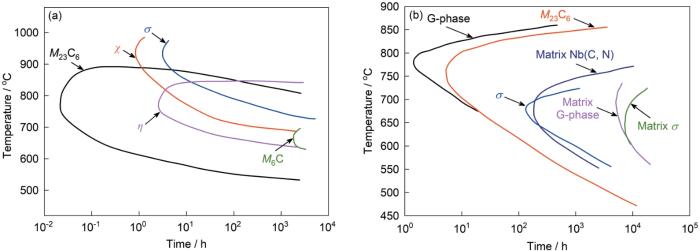
... [80,81]Temperature-time-precipitation phase diagrams of 316L steel (a)<sup>[<xref ref-type="bibr" rid="R80">80</xref>]</sup> and Fe-20Cr-25Ni-Nb stabilized austenitic stainless steel (b)<sup>[<xref ref-type="bibr" rid="R81">81</xref>]</sup>Fig.7
Nb稳定化奥氏体不锈钢中G相和<i>σ</i>相形成机理示意图
Schematics of formation mechanisms of G-phase and <i>σ</i>-phase in Nb-stabilized austenitic stainless steel (a, b) transformation mechanism of Nb(C, N) to G-phase (c, d) formation mechanism of <i>σ</i>-phase adjacent to Nb(C, N)Fig.8<strong>5 Nb</strong>添加对辐照损伤性能的影响
... [80] and Fe-20Cr-25Ni-Nb stabilized austenitic stainless steel (b)[81]Fig.7
Nb稳定化奥氏体不锈钢中G相和<i>σ</i>相形成机理示意图
Schematics of formation mechanisms of G-phase and <i>σ</i>-phase in Nb-stabilized austenitic stainless steel (a, b) transformation mechanism of Nb(C, N) to G-phase (c, d) formation mechanism of <i>σ</i>-phase adjacent to Nb(C, N)Fig.8<strong>5 Nb</strong>添加对辐照损伤性能的影响
... ,81]Temperature-time-precipitation phase diagrams of 316L steel (a)<sup>[<xref ref-type="bibr" rid="R80">80</xref>]</sup> and Fe-20Cr-25Ni-Nb stabilized austenitic stainless steel (b)<sup>[<xref ref-type="bibr" rid="R81">81</xref>]</sup>Fig.7
Nb稳定化奥氏体不锈钢中G相和<i>σ</i>相形成机理示意图
Schematics of formation mechanisms of G-phase and <i>σ</i>-phase in Nb-stabilized austenitic stainless steel (a, b) transformation mechanism of Nb(C, N) to G-phase (c, d) formation mechanism of <i>σ</i>-phase adjacent to Nb(C, N)Fig.8<strong>5 Nb</strong>添加对辐照损伤性能的影响
Schematics of formation mechanisms of G-phase and <i>σ</i>-phase in Nb-stabilized austenitic stainless steel (a, b) transformation mechanism of Nb(C, N) to G-phase (c, d) formation mechanism of <i>σ</i>-phase adjacent to Nb(C, N)Fig.8<strong>5 Nb</strong>添加对辐照损伤性能的影响
Precipitate evolution in a modified 25Cr-20Ni austenitic heat resistant stainless steel during creep rupture test at 750 oC
0
2018
新型25Cr-20Ni奥氏体耐热不锈钢750 ℃持久实验过程中析出相演变
0
2018
Understanding sigma-phase precipitation in a stabilized austenitic stainless steel (316Nb) through complementary CALPHAD-based and experimental investigations
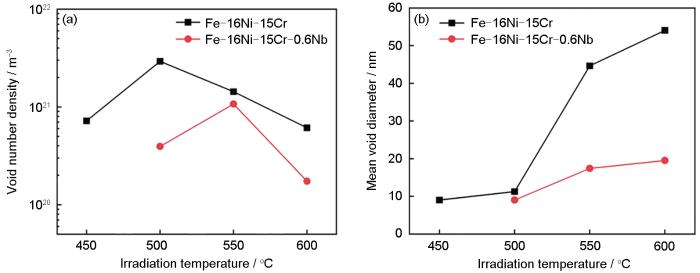
... [92]Variation in void number density (a) and mean void diameter (b) in Fe-16Ni-15Cr and Fe-16Ni-15Cr-0.6Nb alloys after irradiation to 50 dpa<sup>[<xref ref-type="bibr" rid="R92">92</xref>]</sup>Fig.9
... [96]Schematic illustration of the 3D structure after irradiation (a) and evolution of irradiation-induced defects along the NbC/matrix interface (b)<sup>[<xref ref-type="bibr" rid="R96">96</xref>]</sup> (SIA—self-interstitial atom)Fig.10<strong>6 Nb</strong>稳定化奥氏体不锈钢在第四代核电领域的应用现状
目前,部分Nb稳化奥氏体不锈钢已实现工程应用,EP302不锈钢应用于俄罗斯BREST-OD-300铅铋冷却快堆的堆容器和堆内构件[99],EI847不锈钢应用于俄罗斯BN-350、BN-600钠冷快堆的燃料包壳[100,101],PNC316不锈钢应用于日本JOYO、MONJU钠冷实验快堆[102,103].Nb稳定化奥氏体不锈钢在第四代核电反应堆中的应用需要综合考虑各种因素,以钠冷快堆为例,需要考虑力学性能(强度、蠕变、蠕变-疲劳)、高温组织稳定性、钠相容性以及焊接性能.两种新型Nb稳定化奥氏体不锈钢HT-UPS和Alloy 709被视为取代现役316H不锈钢的候选材料,可以支撑反应堆运行温度提高、设计寿命延长的技术发展.图11[104]对比了HT-UPS、Alloy 709以及316H钢的综合性能.与316H不锈钢相比,HT-UPS和Alloy 709钢通过在奥氏体基体中引入细小弥散的第二相,显著提高了高温强度、蠕变强度、蠕变-疲劳性能以及高温组织稳定性,同时保持了良好的耐腐蚀性能和焊接性能.相比之下,Alloy 709钢的综合性能更加优异,正在进行纳入ASME III Rules for Construction of Nuclear Facility Components: D5 High Temperature Reactors标准的数据测试工作.美国核管理委员会(Nuclear Regulatory Commission)正在开展将Alloy 709钢用于先进长寿命(60~100 a)钠冷快堆堆容器、管道、堆芯支撑的评估工作[105,106]. ...
目前,部分Nb稳化奥氏体不锈钢已实现工程应用,EP302不锈钢应用于俄罗斯BREST-OD-300铅铋冷却快堆的堆容器和堆内构件[99],EI847不锈钢应用于俄罗斯BN-350、BN-600钠冷快堆的燃料包壳[100,101],PNC316不锈钢应用于日本JOYO、MONJU钠冷实验快堆[102,103].Nb稳定化奥氏体不锈钢在第四代核电反应堆中的应用需要综合考虑各种因素,以钠冷快堆为例,需要考虑力学性能(强度、蠕变、蠕变-疲劳)、高温组织稳定性、钠相容性以及焊接性能.两种新型Nb稳定化奥氏体不锈钢HT-UPS和Alloy 709被视为取代现役316H不锈钢的候选材料,可以支撑反应堆运行温度提高、设计寿命延长的技术发展.图11[104]对比了HT-UPS、Alloy 709以及316H钢的综合性能.与316H不锈钢相比,HT-UPS和Alloy 709钢通过在奥氏体基体中引入细小弥散的第二相,显著提高了高温强度、蠕变强度、蠕变-疲劳性能以及高温组织稳定性,同时保持了良好的耐腐蚀性能和焊接性能.相比之下,Alloy 709钢的综合性能更加优异,正在进行纳入ASME III Rules for Construction of Nuclear Facility Components: D5 High Temperature Reactors标准的数据测试工作.美国核管理委员会(Nuclear Regulatory Commission)正在开展将Alloy 709钢用于先进长寿命(60~100 a)钠冷快堆堆容器、管道、堆芯支撑的评估工作[105,106]. ...
Void swelling resistance of phosphorus-modified austenitic stainless steels during HFIR irradiation at 300-500 oC to 57 dpa
Study of construction materials for a lead-cooled reactor
1
2013
... 目前,部分Nb稳化奥氏体不锈钢已实现工程应用,EP302不锈钢应用于俄罗斯BREST-OD-300铅铋冷却快堆的堆容器和堆内构件[99],EI847不锈钢应用于俄罗斯BN-350、BN-600钠冷快堆的燃料包壳[100,101],PNC316不锈钢应用于日本JOYO、MONJU钠冷实验快堆[102,103].Nb稳定化奥氏体不锈钢在第四代核电反应堆中的应用需要综合考虑各种因素,以钠冷快堆为例,需要考虑力学性能(强度、蠕变、蠕变-疲劳)、高温组织稳定性、钠相容性以及焊接性能.两种新型Nb稳定化奥氏体不锈钢HT-UPS和Alloy 709被视为取代现役316H不锈钢的候选材料,可以支撑反应堆运行温度提高、设计寿命延长的技术发展.图11[104]对比了HT-UPS、Alloy 709以及316H钢的综合性能.与316H不锈钢相比,HT-UPS和Alloy 709钢通过在奥氏体基体中引入细小弥散的第二相,显著提高了高温强度、蠕变强度、蠕变-疲劳性能以及高温组织稳定性,同时保持了良好的耐腐蚀性能和焊接性能.相比之下,Alloy 709钢的综合性能更加优异,正在进行纳入ASME III Rules for Construction of Nuclear Facility Components: D5 High Temperature Reactors标准的数据测试工作.美国核管理委员会(Nuclear Regulatory Commission)正在开展将Alloy 709钢用于先进长寿命(60~100 a)钠冷快堆堆容器、管道、堆芯支撑的评估工作[105,106]. ...
Influence of silicon on swelling and microstructure in Russian austenitic stainless steel EI-847 irradiated to high neutron doses
1
2008
... 目前,部分Nb稳化奥氏体不锈钢已实现工程应用,EP302不锈钢应用于俄罗斯BREST-OD-300铅铋冷却快堆的堆容器和堆内构件[99],EI847不锈钢应用于俄罗斯BN-350、BN-600钠冷快堆的燃料包壳[100,101],PNC316不锈钢应用于日本JOYO、MONJU钠冷实验快堆[102,103].Nb稳定化奥氏体不锈钢在第四代核电反应堆中的应用需要综合考虑各种因素,以钠冷快堆为例,需要考虑力学性能(强度、蠕变、蠕变-疲劳)、高温组织稳定性、钠相容性以及焊接性能.两种新型Nb稳定化奥氏体不锈钢HT-UPS和Alloy 709被视为取代现役316H不锈钢的候选材料,可以支撑反应堆运行温度提高、设计寿命延长的技术发展.图11[104]对比了HT-UPS、Alloy 709以及316H钢的综合性能.与316H不锈钢相比,HT-UPS和Alloy 709钢通过在奥氏体基体中引入细小弥散的第二相,显著提高了高温强度、蠕变强度、蠕变-疲劳性能以及高温组织稳定性,同时保持了良好的耐腐蚀性能和焊接性能.相比之下,Alloy 709钢的综合性能更加优异,正在进行纳入ASME III Rules for Construction of Nuclear Facility Components: D5 High Temperature Reactors标准的数据测试工作.美国核管理委员会(Nuclear Regulatory Commission)正在开展将Alloy 709钢用于先进长寿命(60~100 a)钠冷快堆堆容器、管道、堆芯支撑的评估工作[105,106]. ...
BN-600 and BN-800 operating experience
1
2018
... 目前,部分Nb稳化奥氏体不锈钢已实现工程应用,EP302不锈钢应用于俄罗斯BREST-OD-300铅铋冷却快堆的堆容器和堆内构件[99],EI847不锈钢应用于俄罗斯BN-350、BN-600钠冷快堆的燃料包壳[100,101],PNC316不锈钢应用于日本JOYO、MONJU钠冷实验快堆[102,103].Nb稳定化奥氏体不锈钢在第四代核电反应堆中的应用需要综合考虑各种因素,以钠冷快堆为例,需要考虑力学性能(强度、蠕变、蠕变-疲劳)、高温组织稳定性、钠相容性以及焊接性能.两种新型Nb稳定化奥氏体不锈钢HT-UPS和Alloy 709被视为取代现役316H不锈钢的候选材料,可以支撑反应堆运行温度提高、设计寿命延长的技术发展.图11[104]对比了HT-UPS、Alloy 709以及316H钢的综合性能.与316H不锈钢相比,HT-UPS和Alloy 709钢通过在奥氏体基体中引入细小弥散的第二相,显著提高了高温强度、蠕变强度、蠕变-疲劳性能以及高温组织稳定性,同时保持了良好的耐腐蚀性能和焊接性能.相比之下,Alloy 709钢的综合性能更加优异,正在进行纳入ASME III Rules for Construction of Nuclear Facility Components: D5 High Temperature Reactors标准的数据测试工作.美国核管理委员会(Nuclear Regulatory Commission)正在开展将Alloy 709钢用于先进长寿命(60~100 a)钠冷快堆堆容器、管道、堆芯支撑的评估工作[105,106]. ...
Experimental reactor Joyo
1
2022
... 目前,部分Nb稳化奥氏体不锈钢已实现工程应用,EP302不锈钢应用于俄罗斯BREST-OD-300铅铋冷却快堆的堆容器和堆内构件[99],EI847不锈钢应用于俄罗斯BN-350、BN-600钠冷快堆的燃料包壳[100,101],PNC316不锈钢应用于日本JOYO、MONJU钠冷实验快堆[102,103].Nb稳定化奥氏体不锈钢在第四代核电反应堆中的应用需要综合考虑各种因素,以钠冷快堆为例,需要考虑力学性能(强度、蠕变、蠕变-疲劳)、高温组织稳定性、钠相容性以及焊接性能.两种新型Nb稳定化奥氏体不锈钢HT-UPS和Alloy 709被视为取代现役316H不锈钢的候选材料,可以支撑反应堆运行温度提高、设计寿命延长的技术发展.图11[104]对比了HT-UPS、Alloy 709以及316H钢的综合性能.与316H不锈钢相比,HT-UPS和Alloy 709钢通过在奥氏体基体中引入细小弥散的第二相,显著提高了高温强度、蠕变强度、蠕变-疲劳性能以及高温组织稳定性,同时保持了良好的耐腐蚀性能和焊接性能.相比之下,Alloy 709钢的综合性能更加优异,正在进行纳入ASME III Rules for Construction of Nuclear Facility Components: D5 High Temperature Reactors标准的数据测试工作.美国核管理委员会(Nuclear Regulatory Commission)正在开展将Alloy 709钢用于先进长寿命(60~100 a)钠冷快堆堆容器、管道、堆芯支撑的评估工作[105,106]. ...
Irradiation performance of modified 316 stainless steel for Monju fuel
1
1993
... 目前,部分Nb稳化奥氏体不锈钢已实现工程应用,EP302不锈钢应用于俄罗斯BREST-OD-300铅铋冷却快堆的堆容器和堆内构件[99],EI847不锈钢应用于俄罗斯BN-350、BN-600钠冷快堆的燃料包壳[100,101],PNC316不锈钢应用于日本JOYO、MONJU钠冷实验快堆[102,103].Nb稳定化奥氏体不锈钢在第四代核电反应堆中的应用需要综合考虑各种因素,以钠冷快堆为例,需要考虑力学性能(强度、蠕变、蠕变-疲劳)、高温组织稳定性、钠相容性以及焊接性能.两种新型Nb稳定化奥氏体不锈钢HT-UPS和Alloy 709被视为取代现役316H不锈钢的候选材料,可以支撑反应堆运行温度提高、设计寿命延长的技术发展.图11[104]对比了HT-UPS、Alloy 709以及316H钢的综合性能.与316H不锈钢相比,HT-UPS和Alloy 709钢通过在奥氏体基体中引入细小弥散的第二相,显著提高了高温强度、蠕变强度、蠕变-疲劳性能以及高温组织稳定性,同时保持了良好的耐腐蚀性能和焊接性能.相比之下,Alloy 709钢的综合性能更加优异,正在进行纳入ASME III Rules for Construction of Nuclear Facility Components: D5 High Temperature Reactors标准的数据测试工作.美国核管理委员会(Nuclear Regulatory Commission)正在开展将Alloy 709钢用于先进长寿命(60~100 a)钠冷快堆堆容器、管道、堆芯支撑的评估工作[105,106]. ...
A709 qualification plan update and mechanical properties data assessment
3
2022
... 目前,部分Nb稳化奥氏体不锈钢已实现工程应用,EP302不锈钢应用于俄罗斯BREST-OD-300铅铋冷却快堆的堆容器和堆内构件[99],EI847不锈钢应用于俄罗斯BN-350、BN-600钠冷快堆的燃料包壳[100,101],PNC316不锈钢应用于日本JOYO、MONJU钠冷实验快堆[102,103].Nb稳定化奥氏体不锈钢在第四代核电反应堆中的应用需要综合考虑各种因素,以钠冷快堆为例,需要考虑力学性能(强度、蠕变、蠕变-疲劳)、高温组织稳定性、钠相容性以及焊接性能.两种新型Nb稳定化奥氏体不锈钢HT-UPS和Alloy 709被视为取代现役316H不锈钢的候选材料,可以支撑反应堆运行温度提高、设计寿命延长的技术发展.图11[104]对比了HT-UPS、Alloy 709以及316H钢的综合性能.与316H不锈钢相比,HT-UPS和Alloy 709钢通过在奥氏体基体中引入细小弥散的第二相,显著提高了高温强度、蠕变强度、蠕变-疲劳性能以及高温组织稳定性,同时保持了良好的耐腐蚀性能和焊接性能.相比之下,Alloy 709钢的综合性能更加优异,正在进行纳入ASME III Rules for Construction of Nuclear Facility Components: D5 High Temperature Reactors标准的数据测试工作.美国核管理委员会(Nuclear Regulatory Commission)正在开展将Alloy 709钢用于先进长寿命(60~100 a)钠冷快堆堆容器、管道、堆芯支撑的评估工作[105,106]. ...
... [104]Property ranking chart of Nb stabilized austenitic stainless steels<sup>[<xref ref-type="bibr" rid="R104">104</xref>]</sup>Fig.11<strong>7</strong> 总结与展望
Integrated FY-21 elevated-temperature mechanical-testing results for alloy 709 code case
1
2021
... 目前,部分Nb稳化奥氏体不锈钢已实现工程应用,EP302不锈钢应用于俄罗斯BREST-OD-300铅铋冷却快堆的堆容器和堆内构件[99],EI847不锈钢应用于俄罗斯BN-350、BN-600钠冷快堆的燃料包壳[100,101],PNC316不锈钢应用于日本JOYO、MONJU钠冷实验快堆[102,103].Nb稳定化奥氏体不锈钢在第四代核电反应堆中的应用需要综合考虑各种因素,以钠冷快堆为例,需要考虑力学性能(强度、蠕变、蠕变-疲劳)、高温组织稳定性、钠相容性以及焊接性能.两种新型Nb稳定化奥氏体不锈钢HT-UPS和Alloy 709被视为取代现役316H不锈钢的候选材料,可以支撑反应堆运行温度提高、设计寿命延长的技术发展.图11[104]对比了HT-UPS、Alloy 709以及316H钢的综合性能.与316H不锈钢相比,HT-UPS和Alloy 709钢通过在奥氏体基体中引入细小弥散的第二相,显著提高了高温强度、蠕变强度、蠕变-疲劳性能以及高温组织稳定性,同时保持了良好的耐腐蚀性能和焊接性能.相比之下,Alloy 709钢的综合性能更加优异,正在进行纳入ASME III Rules for Construction of Nuclear Facility Components: D5 High Temperature Reactors标准的数据测试工作.美国核管理委员会(Nuclear Regulatory Commission)正在开展将Alloy 709钢用于先进长寿命(60~100 a)钠冷快堆堆容器、管道、堆芯支撑的评估工作[105,106]. ...
Code qualification plan for an advanced austenitic stainless steel, alloy 709, for sodium fast reactor structural applications
1
2017
... 目前,部分Nb稳化奥氏体不锈钢已实现工程应用,EP302不锈钢应用于俄罗斯BREST-OD-300铅铋冷却快堆的堆容器和堆内构件[99],EI847不锈钢应用于俄罗斯BN-350、BN-600钠冷快堆的燃料包壳[100,101],PNC316不锈钢应用于日本JOYO、MONJU钠冷实验快堆[102,103].Nb稳定化奥氏体不锈钢在第四代核电反应堆中的应用需要综合考虑各种因素,以钠冷快堆为例,需要考虑力学性能(强度、蠕变、蠕变-疲劳)、高温组织稳定性、钠相容性以及焊接性能.两种新型Nb稳定化奥氏体不锈钢HT-UPS和Alloy 709被视为取代现役316H不锈钢的候选材料,可以支撑反应堆运行温度提高、设计寿命延长的技术发展.图11[104]对比了HT-UPS、Alloy 709以及316H钢的综合性能.与316H不锈钢相比,HT-UPS和Alloy 709钢通过在奥氏体基体中引入细小弥散的第二相,显著提高了高温强度、蠕变强度、蠕变-疲劳性能以及高温组织稳定性,同时保持了良好的耐腐蚀性能和焊接性能.相比之下,Alloy 709钢的综合性能更加优异,正在进行纳入ASME III Rules for Construction of Nuclear Facility Components: D5 High Temperature Reactors标准的数据测试工作.美国核管理委员会(Nuclear Regulatory Commission)正在开展将Alloy 709钢用于先进长寿命(60~100 a)钠冷快堆堆容器、管道、堆芯支撑的评估工作[105,106]. ...