



低膨胀合金作为一类关键的结构功能一体化材料,凭借其在特定温区内极低的热膨胀系数,满足了众多领域对部件尺寸稳定性的严苛要求。在精密仪器和测量领域,该类合金被用于制造高精度标准量具和测量系统构件,其优异的热稳定性保障了测量基准在温度波动环境下的长期可靠性和准确性[1];在电子和微波通信领域,它是构成波导管、谐振腔等关键无源器件的理想材料,其尺寸稳定性对维持系统谐振频率和信号传输质量起着决定性作用[2];在能源装备和低温工程中,该类合金广泛应用于低温流体储运系统,能够在极端温度条件下保持结构完整和密封安全[3]。此外,在光刻机等超精密制造装备中,其作为核心支撑结构有效抑制了热变形对工艺精度的不利影响[4]。由此可见,低膨胀合金在前沿科技领域发挥着不可替代的作用。
在低膨胀合金体系中,因瓦(Invar)合金因其独特的“Invar效应”成为低膨胀合金的典型代表,该效应使其在宽温域内呈现极低的热膨胀系数[5~7]。其机理在于,合金中磁矩有序引发的正磁致伸缩在宏观尺度抵消了晶格收缩,从而维持尺寸稳定性[8,9]。然而,Invar合金的室温屈服强度较低(约250 MPa),难以满足承重结构件对力学性能的要求[10,11]。尤其在对结构强度和可靠性均有严苛要求的应用场景中,传统Invar合金往往难以兼顾低膨胀与高强度的综合性能。近年来,基于多主元设计理念的高熵合金为低膨胀材料的发展提供了新途径[12,13]。其多主元特性所引发的“鸡尾酒效应”[14,15],能够实现多种元素性能的协同和互补,突破了传统合金以单一元素为主的性能调控局限,展现出同步优化低膨胀与力学性能的应用潜力[16]。
1 实验方法
实验所用低膨胀合金采用真空电弧熔炼法制备,设备为DHL-400型非自耗电弧熔炼炉。合金原料选用纯度为99.9% (质量分数)的纯金属颗粒,合金的名义成分如表1所示。为便于表述,将Al0.5Cr0.5(Fe65Co4Ni31)99、Al1Cr1(Fe65Co4Ni31)98和Al1.5Cr1.5-(Fe65Co4Ni31)97合金分别记作Al0.5Cr0.5、Al1Cr1和Al1.5Cr1.5合金。为确保成分均匀,铸锭在熔炼过程中被翻转并重复熔炼6次。所得铸态合金随后在OTF-1200X型立式热处理炉中进行均匀化热处理,在1050 ℃保温3 h后水冷。为进一步研究热机械处理对合金热膨胀行为及力学性能的影响,将合金在室温下冷轧,压下量为40.5%,随后在800 ℃下进行1 h的再结晶退火处理。冷轧过程在BF-YP30P型两辊轧机上完成。
表1 低膨胀合金的名义成分 (atomic fraction / %)
Table 1
| Alloy | Fe | Co | Ni | Al | Cr |
|---|---|---|---|---|---|
| Al0.5Cr0.5 | 64.35 | 3.96 | 30.69 | 0.50 | 0.50 |
| Al1Cr1 | 63.70 | 3.92 | 30.38 | 1.00 | 1.00 |
| Al1.5Cr1.5 | 63.05 | 3.88 | 30.07 | 1.50 | 1.50 |
微观组织表征使用JXA-8530F Plus型电子探针和JSM-7900F型场发射扫描电子显微镜(SEM)。其中,电子探针用于背散射电子(BSE)成像及元素面分布分析;SEM用于电子背散射衍射(EBSD)分析。用于微观组织表征的样品经机械抛光和电解抛光制备。电解抛光条件为:样品浸入-25 ℃的高氯酸/乙醇溶液(体积比1∶9),施加30 V直流电压,时间为30~60 s。
原位升温X射线衍射(XRD)测试采用SmartLab 9 kW型高功率XRD完成,测试条件为:温度40~100 ℃、升温速率5 ℃/min、扫描角度30°~100°、扫描速率2°/min。同步辐射XRD实验在上海光源BL14B线站进行,所用X射线能量为18 keV (对应波长0.06887 nm),并采用Pilatus 6M探测器在15°~40°范围内采集信号。采用DSC 404-F3型差示扫描量热分析仪对样品的相变行为进行分析。实验在Ar气保护下进行,将约20 mg样品置于Al2O3坩埚中,在25~600 ℃温度范围内进行测试,升/降温速率均保持为20 ℃/min。
室温力学性能测试在UTM-5105型万能试验机上进行,拉伸速率为10-3 s-1,试样为狗骨状拉伸片,标距尺寸5 mm × 2 mm × 2 mm (长 × 宽 × 厚)。应变测量采用NCM-2D型视频引伸计。合金热膨胀系数在DIL 402SE型膨胀仪上测试,样品尺寸为直径6 mm、长25 mm,测试条件为恒压7073 Pa,温度范围-60~100 ℃,升温速率5 ℃/min。测试前使用Al2O3标样进行标定,实验低温环境由循环液氮提供。
2 实验结果与讨论
2.1 均匀化热处理后合金的热膨胀及拉伸力学性能
首先对均匀化热处理后低膨胀合金的热膨胀行为以及室温拉伸力学性能进行了测试分析,结果如图1所示。图1a为合金的热膨胀系数曲线。可以看出,在-60~100 ℃范围内,Al0.5Cr0.5合金的热膨胀系数为3.38 × 10⁻⁶~5.02 × 10⁻⁶ ℃-1,且随温度升高持续增加,显著高于Al1Cr1和Al1.5Cr1.5合金。Al1Cr1和Al1.5Cr1.5合金的热膨胀系数随温度升高呈现先减小后增加的趋势。其中,Al1.5Cr1.5合金的热膨胀系数波动幅度较Al1Cr1合金更大,变化范围为1.42 × 10⁻⁶~2.88 × 10⁻⁶ ℃-1。Al1Cr1合金的热膨胀系数最低且波动范围最小,仅为1.37 × 10⁻⁶~2.34 × 10⁻⁶ ℃-1,表明该合金具有最佳的膨胀性能。
图1

图1
均匀化热处理后低膨胀合金的热膨胀系数和拉伸力学性能
Fig.1
Coefficients of thermal expansion (a) and tensile properties (b, c) of the low-expansion alloys after homogenization
(b) engineering stress-strain curves
(c) strain-hardening rate curves and true stress-strain curves
图1b和c分别为合金的工程应力-应变曲线和应变硬化率曲线及真应力-应变曲线。从图1b可以看出,随着Al、Cr含量的增加,合金强度逐渐提高,拉伸塑性则表现为先升高后降低。表2汇总了各合金的拉伸强度和塑性。可以看出,随着Al、Cr含量的增加,合金屈服强度由Al0.5Cr0.5合金的201 MPa提高到Al1Cr1合金的213 MPa,再进一步提高至Al1.5Cr1.5合金的263 MPa。屈服强度的提升源于Al、Cr原子固溶进合金基体产生的固溶强化效应,且Al、Cr含量越高,强化效果越显著。合金总延伸率由Al0.5Cr0.5合金的44%提高至Al1Cr1合金的50%,进一步降低至Al1.5Cr1.5合金的46%。从图1c可以看出,相较于Al1Cr1合金,Al0.5Cr0.5合金的应变硬化率低;Al1.5Cr1.5合金的应变硬化率虽然在塑性变形初始阶段与Al1Cr1合金相当,但随应变增加持续下降。因此,Al1Cr1合金的应变硬化能力最强。根据Considère理论[20],在应变硬化率曲线与真应力曲线出现交点后,合金塑性变形进入失稳阶段并发生颈缩。由图1c可以看出,Al1Cr1合金发生颈缩最晚,即均匀延伸率最高,为25.4%;Al0.5Cr0.5和Al1.5Cr1.5合金的均匀延伸率相近,分别为21.8%和21.1%。由此可见,Al1Cr1合金在更宽的应变范围内保持了较高的应变硬化能力,因此具有最高的抗拉强度和延伸率。
表2 均匀化热处理后低膨胀合金的拉伸强度和塑性
Table 2
| Alloy | YS / MPa | UTS / MPa | TE / % |
|---|---|---|---|
| Al0.5Cr0.5 | 201 | 316 | 44 |
| Al1Cr1 | 213 | 390 | 50 |
| Al1.5Cr1.5 | 263 | 378 | 46 |
2.2 均匀化热处理后合金的微观组织
对均匀化热处理后的低膨胀合金样品进行了电子探针表征,结果如图2所示。图2a和b分别为Al0.5Cr0.5和Al1Cr1合金的BSE像,图2d和e为Al1.5Cr1.5合金的BSE像。可以看出,所有合金均呈现毫米级粗大晶粒组织。不同之处在于,在Al1Cr1和Al1.5Cr1.5合金的晶粒内部均可观察到粒状组织,该组织与基体表现出明显的衬度差异,如图2b和e所示。其中,Al1Cr1合金中的粒状组织密度明显高于Al1.5Cr1.5合金。因此,以Al1Cr1合金为例,对粒状组织进行放大观察并进行元素面扫描,结果如图2c所示。可以看出,该粒状组织并非连续结构,而是由更细小的颗粒构成;该粒状组织与基体在化学成分上无显著差异,且各元素在检测区域内分布均匀。考虑到BSE模式下的图像衬度不仅与化学成分有关,还与晶体取向密切相关[21],因此推断该粒状组织可能为与基体成分一致但晶体结构不同的马氏体相。为进一步验证该推测,本工作结合相图计算和物相检测进行佐证。
图2
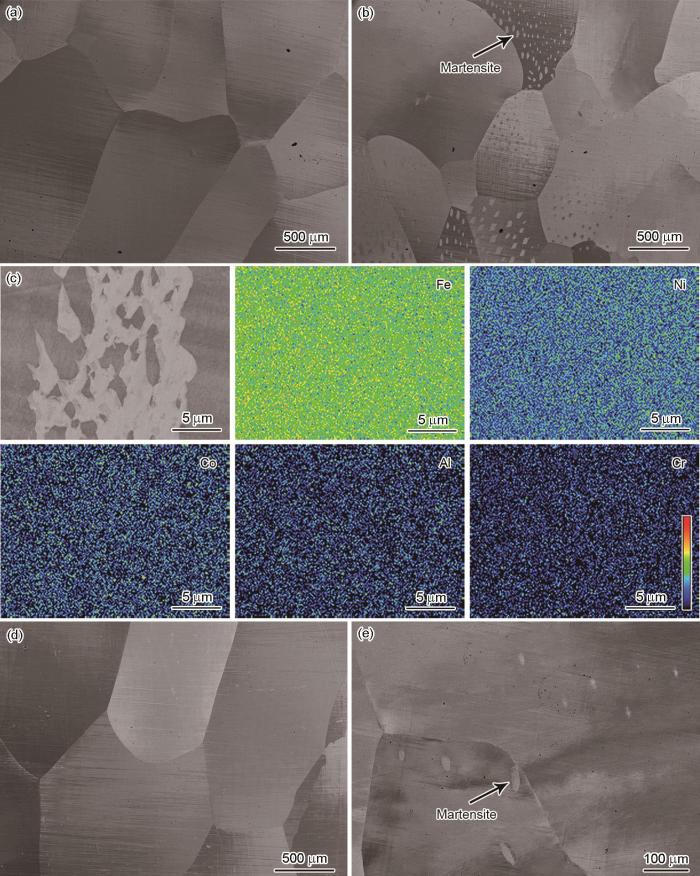
图2
均匀化热处理后低膨胀合金微观组织的电子探针表征
Fig.2
Electron probe characterizations of the low-expansion alloys after homogenization (a, b) BSE images of Al0.5Cr0.5 (a) and Al1Cr1 (b) alloys (c) enlarged BSE image of the Al1Cr1 alloy and the corresponding elemental mappings (d, e) low (d) and high (e) magnified BSE images of Al1.5Cr1.5 alloy
图3a为基于Pandat软件的Al1Cr1合金相图计算结果。结果表明,该合金的熔点约为1450 ℃。在凝固过程中,首先形成单相fcc固溶体;当温度降至约600 ℃时,发生由fcc向bcc结构的相变;温度进一步降至约500 ℃时,则发生由无序fcc向有序fcc结构的相变。模拟结果中的第一阶段转变对应于马氏体相变,这与实验观察结果(图2b)相符;但实验中并未观察到与第二阶段转变对应的有序fcc相。需要指出的是,相图模拟是基于现有热力学数据库进行计算的,预测结果反映的是平衡条件下的凝固行为,而实际实验条件多处于非平衡状态,因此两者不可避免地存在差异。然而,相图模拟结果依然对合金的成分设计和组织调控具有重要的指导意义。相图计算在理论上支持了马氏体相变的可能性,但仍需通过实验表征加以证实。同步辐射X射线具有超高亮度和高穿透性,利用其进行XRD检测能够准确获得合金物相信息并精确计算相体积分数。均匀化热处理后Al1Cr1合金的同步辐射XRD谱如图3b所示。可以看出,存在fcc和bcc结构相的衍射峰,但fcc结构相缺少(200)晶面衍射峰,而bcc结构仅出现(200)晶面衍射峰。这主要是由于均匀化热处理后合金的晶粒尺寸较大,X射线光斑无法覆盖所有取向的晶粒及马氏体相,因而仅检测到部分晶面的衍射峰。根据衍射峰的积分强度,可由下式计算各相的体积分数[22]:
式中,fγ 为fcc相的体积分数;
图3

图3
Al1Cr1合金的物相分析
Fig.3
Phase analyses of the Al1Cr1 alloy
(a) calculated phase diagram (b) synchrotron XRD pattern
(c) EBSD inverse pole figure (IPF) (d) EBSD phase distribution map
表3 图3b中衍射峰强度的理论值和不同温度下的测量值
Table 3
| Item | fcc (111) | bcc (110) | fcc (200) | bcc (200) | fcc (220) | bcc (211) | fcc (311) | fcc (222) |
|---|---|---|---|---|---|---|---|---|
| Rhkl | 100.0 | 100.0 | 42.2 | 50.0 | 17.6 | 80.0 | 6.5 | 4.5 |
| 40 oC | 13523.02 | 784.00 | 2114.34 | 497.25 | 1147.74 | 424.12 | 1189.31 | 544.36 |
| 50 oC | 13501.09 | 769.09 | 2104.07 | 447.97 | 1117.16 | 441.42 | 1092.35 | 524.49 |
| 60 oC | 13318.11 | 754.63 | 2138.23 | 489.52 | 1147.14 | 434.47 | 1270.59 | 530.41 |
| 70 oC | 13408.39 | 754.18 | 2162.88 | 478.25 | 1180.26 | 431.02 | 1263.75 | 516.45 |
| 80 oC | 13627.21 | 755.64 | 2149.57 | 477.47 | 1151.49 | 405.40 | 1178.39 | 539.94 |
| 90 oC | 13394.20 | 758.28 | 2137.34 | 435.91 | 1110.13 | 425.50 | 1136.75 | 549.34 |
| 100 oC | 13571.93 | 749.34 | 2143.34 | 443.71 | 1104.66 | 396.19 | 1149.75 | 535.87 |
结合相图计算的结果推测,均匀化热处理后合金中观察到的马氏体相主要在淬火过程中形成,其处于热力学不稳定状态。在升温过程中,马氏体的体积分数逐渐减少,从而部分抵消了因温度升高导致的晶格膨胀效应[23]。因此,马氏体相含量最高的Al1Cr1合金表现出最低的热膨胀系数。在力学性能方面,Al0.5Cr0.5合金的应变硬化率最低,这是由于该合金内部未形成马氏体相。bcc结构的马氏体在塑性变形过程中能够有效阻碍基体中的位错滑移,从而有利于位错的积累并提升合金的应变硬化能力[24]。相比之下,Al1.5Cr1.5合金的应变硬化率低于Al1Cr1合金,是因为其马氏体含量明显偏低。因此,尽管Al1Cr1合金的屈服强度低于Al1.5Cr1.5合金,但由于其较高的应变硬化率,使其在抗拉强度和塑性方面均优于Al1.5Cr1.5合金。
2.3 热机械处理后合金的性能和微观组织
图4

图4
热机械处理后Al1Cr1合金的热膨胀系数和拉伸力学性能
Fig.4
Coefficients of thermal expansion (a) and tensile properties (b) of the Al1Cr1 alloy after thermomechanical processing
合金性能的优化与其在热机械处理后微观组织的演化密切相关,因此对热机械处理后Al1Cr1合金的微观组织进行了系统表征,结果如图5所示。图5a为热机械处理后Al1Cr1合金的BSE像。可以看出,晶粒发生了显著细化,平均晶粒尺寸由均匀化态的毫米级减小至约150 μm。值得注意的是,热机械处理后,马氏体相仍保留在晶粒内部。同步辐射XRD检测结果(图5b)显示,此时获得了较完整的衍射峰,根据
图5

图5
热机械处理后Al1Cr1合金的微观组织表征
Fig.5
Microstructure characteristics of the Al1Cr1 alloy after thermomechanical processing
(a) BSE image (b) synchrotron XRD pattern
(c) EBSD IPF (d) EBSD phase distribution map
为了深入探究基体和马氏体相在温度升高过程中的演变规律,对热机械处理后的Al1Cr1合金进行了原位升温XRD检测,结果如图6所示。对40~100 ℃范围内获得的XRD谱进行分析,探究两相的晶格常数和体积分数的变化,结果列于表4。从图6可以看出,随着温度升高,fcc结构基体的衍射峰和bcc结构马氏体的衍射峰均向低角度偏移,计算结果表明,基体晶格常数从0.359257 nm增加至0.359346 nm,马氏体晶格常数从0.286765 nm增加至0.286820 nm,说明随温度升高两相均因晶格振动增强而产生热膨胀。然而,随着温度升高,马氏体体积分数由约7.98%降低至约7.50%。需要指出的是,由于普通XRD的测量精度低于同步辐射XRD,因此统计得到的马氏体体积分数略低于后者,但其随温度变化的趋势才是关键结论。该结果进一步证实了温度升高引起马氏体体积分数降低,从而部分抵消晶格热膨胀的作用机制。本工作中马氏体体积分数降低主要通过逆相变完成。而马氏体逆相变的驱动力主要有:化学自由能差、弹性应变能及界面能的释放和应力诱导。化学自由能差表现为在加热过程中,奥氏体相的化学自由能低于马氏体相,从而促使马氏体向奥氏体转变[27]。弹性应变能及界面能的释放表现为在逆相变过程中,马氏体相变形成的弹性应变能和界面能会得到部分或全部释放,为逆相变提供额外的驱动力,有助于降低系统的总自由能[28]。应力诱导则主要出现在形状记忆合金中,外部应力会影响其逆相变[29]。因此,基于以上分析,本工作中马氏体体积分数降低的主要热力学驱动力为化学自由能差和弹性应变能及界面能的释放。差示扫描量热分析结果如图7所示。合金在升、降温过程中出现了明显的吸热峰与放热峰,且热滞后较小。这表明合金中的马氏体相变为热弹性马氏体相变,其引起的低热膨胀特性具有可逆性[23]。Al1Cr1合金以超Invar合金为基体,其低膨胀特性除了受到马氏体体积分数变化的调控外,还与基体的Invar效应有关。Invar效应源于磁体积效应:在Curie温度以下,温度升高一方面通过降低饱和磁化强度使合金从铁磁态向顺磁态转变,产生晶格收缩的趋势;另一方面,原子热振动会引发晶格膨胀。这两种机制相互抵消,从而实现了宏观尺度上的低热膨胀特性。本工作通过添加Al和Cr原子,在一定程度上减弱了Invar效应。通过未生成马氏体的Al0.5Cr0.5合金与超Invar合金的热膨胀系数对比可证实这一点。Al1Cr1合金的低膨胀性能主要源于Invar效应与马氏体相变的共同作用,其中Invar效应的贡献占主导地位。
图6

图6
热机械处理后Al1Cr1合金的原位升温XRD谱
Fig.6
In situ heating XRD patterns of the Al1Cr1 alloy after thermomechanical processing
表4 热机械处理后Al1Cr1合金不同温度下各相的晶格常数和体积分数
Table 4
| Temperature oC | aγ nm | aα nm | fγ % | fα % |
|---|---|---|---|---|
| 40 | 0.359257 | 0.286765 | 92.0205 | 7.9795 |
| 50 | 0.359278 | 0.286786 | 92.1254 | 7.8746 |
| 60 | 0.359295 | 0.286788 | 92.1271 | 7.8729 |
| 70 | 0.359302 | 0.286802 | 92.2118 | 7.7882 |
| 80 | 0.359314 | 0.286807 | 92.3190 | 7.6810 |
| 90 | 0.359335 | 0.286810 | 92.4109 | 7.5891 |
| 100 | 0.359346 | 0.286820 | 92.4992 | 7.5008 |
图7

图7
Al1Cr1合金的差示扫描量热曲线
Fig.7
Differential scanning calorimetry curve of the Al1Cr1 alloy
在Fe-Ni系Invar合金中,低膨胀性能不仅源于马氏体相变,还受到磁结构转变的显著影响[30]。研究[31]表明,轧制热处理可改变原子间距,诱发磁-声子结构失稳,增强磁-声子交互作用,从而在升温过程中通过磁致体积收缩抵消声子热振动引起的晶格膨胀,使材料呈现低膨胀特性。此外,热机械处理带来的晶粒细化会引入大量晶界和退火孪晶,这些界面可有效抑制晶格振动,降低热膨胀系数[32,33]。同时,轧制过程中产生的残余应力和高密度位错等缺陷也会在晶体中形成局部应力场,共同抑制原子的非简谐振动[34,35]。鉴于低热膨胀行为本质上依赖于晶格振动非简谐性的降低,热机械处理通过上述多种机制协同作用,进一步优化了Al1Cr1合金的低膨胀性能。
最后,本工作统计了20~100 ℃区间典型低膨胀合金[10,11,36~49]的比强度和热膨胀系数,并将其与本工作所设计的合金进行对比,结果如图8所示。现有低膨胀合金大体可分为两类:一类为以Invar合金为代表的具备一定拉伸性能的合金;另一类主要由脆性相构成,不具备拉伸变形能力。相比之下,本工作所设计的合金在保持较低热膨胀系数的同时展现出最高的比强度,实现了力学性能与低膨胀特性的优异协同。此外,受高熵合金“鸡尾酒效应”的启发,少量Al和Cr元素的引入有望进一步改善合金的抗氧化和耐腐蚀性能。综上所述,本工作通过成分与工艺协同优化,成功制备出一种新型低膨胀合金,通过热机械处理使其展现出优异的综合性能。该合金体系及其制备策略为开发满足形变敏感构件需求的高性能低膨胀材料提供了可行路径。
图8

3 结论
(1) 以FeCoNi基合金为基础,通过Al、Cr元素合金化和热机械处理实现了合金低膨胀与高强度的协同优化。经均匀化热处理后,Al0.5Cr0.5、Al1Cr1和Al1.5Cr1.5合金均表现出毫米尺度的粗晶组织。其中,Al1Cr1和Al1.5Cr1.5合金的晶粒内析出了粒状马氏体,相比之下,前者的马氏体体积分数更高,达到8.49%。
(2) 马氏体对调控合金的热膨胀行为和拉伸力学性能均发挥了显著作用。在升温过程中,马氏体体积分数逐渐降低,从而部分抵消了由晶格振动导致的热膨胀效应;在变形过程中,马氏体能够有效阻碍位错滑移,增强合金的应变硬化能力。因此,均匀化热处理后的Al1Cr1合金表现出最佳的低膨胀与力学性能组合。
(3) 经过热机械处理后,Al1Cr1合金实现了晶粒细化,并引入了孪晶界等晶体缺陷,这些界面有效抑制了晶格非谐振动和位错运动。同时,马氏体体积分数的增加进一步促进了合金低膨胀特性和拉伸力学性能的提升。与典型低膨胀合金相比,该合金在保持较低热膨胀系数的同时展现出最高的比强度,实现了力学性能与低膨胀特性的优异协同。本工作证实了高熵合金设计理念可作为协同优化低膨胀与高强度的有效策略,为相关材料开发指明了新方向。
致谢
感谢大连理工大学分析测试中心为本实验提供高功率X射线衍射仪实验机时,感谢张环月老师对实验所作的贡献。
参考文献
Research on low expansion alloys, preparation technology of core components and key theoretical issues of the spectrometer
[D].
光谱仪用低膨胀合金和核心部件的制备技术及关键理论问题研究
[D].
Study of super-Invar alloy Fe-33Ni-4Co-1.2Nb
[J].
This paper studies a new low-expansion alloy Fe-33Ni-4Co-1.2Nb for radome link purpose. The alloy have very low expansion coefficient(α20~100℃<0.9×10⁻⁶/℃). At the same time, The alloy have Good mechanical properties and Processing performance. The results indicated that The alloy have fairly resolved the joining problems about radome and body. alloy Fe-33Ni-4Co-1.2Nb is a fine joining materials to manufacture radome link and sealing.
Fe-33Ni-4Co-1.2Nb超低膨胀合金研究
[J].本文研究了一种雷达天线罩连接环用Fe-33Ni-4Co-1.2Nb低膨胀合金,该合金具有极低的膨胀系数(α20~100℃<0.9×10⁻⁶/℃),同时,该合金也具有良好的机械力学性能和加工性能,试验表明,该合金较好地解决了天线罩与基体的连接问题,是制作天线罩连接环和其他需要低膨胀封接的良好材料。
Research progress on Ti-Mn based hydrogen storage alloys
[J].
Ti-Mn系储氢合金的研究进展
[J].
Anisotropy of microstructure, mechanical properties and thermal expansion in Invar 36 alloy fabricated via laser powder bed fusion
[J].
A thermodynamic explanation of the Invar effect
[J].
Achieving high strength and low thermal expansion coefficient in additively manufactured Invar alloys by leveraging the effect of alloying elements
[J].Strengthening of Invar alloys is often accompanied by compromising their low coefficient of thermal expansion (CTE), which has been restricting the development of high-strength yet low CTE Invar alloys. Herein, by leveraging the opposite effect of Co and V on CTE, we designed a novel high-strength and low CTE Invar alloy. Laser powder bed fusion (LPBF) technique was used to fabricate the material. Results showed that this novel Invar alloy demonstrates excellent printability, which can achieve near-full density (>99.5 %) in a wide processing window. An optimal direct aging treatment process of 3 h at 650 °C was determined to maximize its strength. TEM and in situ small-angle neutron scattering (SANS) analysis showed that VC nanoparticles as fine as 10 nm precipitate upon heat treatment. Tensile tests revealed that the peak-aged specimen possesses a high yield strength of 600 MPa, reflecting about 50 % enhancement compared with LPBF-processed conventional Invar alloys. Such a strength increase is primarily contributed by Orowan strengthening of those ultra-fine VC nanoparticles. Meanwhile, a relatively low CTE (1.41 × 10⁻⁶ °C-1, 30-150 °C) has been maintained. The combination of high strength and low CTE of this novel Invar alloy is superior to that of additively manufactured Invar in the literature. This work offers a pathway to increase the strength of Invar alloys without sacrificing their low CTE.
Origin of the Invar effect in iron-nickel alloys
[J].
A seawater-corrosion-resistant and isotropic zero thermal expansion (Zr,Ta)(Fe,Co)2 alloy
[J].
Thermal expansion of solids at low temperatures
[J].
Enhancing low thermal expansion behavior and strength via induced Zr-rich intermetallic phase in Fe-36Ni Invar Alloy
[J].
Strengthening of the Fe-Ni Invar alloy through chromium
[J].Invar alloys with both high strength and low thermal expansion are urgently needed in fields such as overhead power transmission, aero-molds, and so on. In this paper, Cr was introduced as a cost-efficient alloying element into the Fe-36Ni binary invar alloy to increase its mechanical strength. Our results confirmed that fine Cr7C3 precipitants, together with some Fe3C, in the invar alloy aged at 425 °C could be obtained with a short aging time. Those precipitants then grew and aggregated at grain or sub-grain boundaries with an increase in aging time. Simultaneously, mechanical strength and coefficient of thermal expansion (CTE) parabolically varied with the increase in aging time. The sample aged at 425 °C for 7 h presented a maximum strength of 644.4 MPa, together with a minimum coefficient of thermal expansion of 3.30 × 10⁻⁶ K−1 in the temperature range of 20–100 °C. This optimized result should be primarily attributed to the precipitation of the nanoscaled Cr7C3.
Nanostructured high-entropy alloys with multiple principal elements: Novel alloy design concepts and outcomes
[J].
Refractory high-entropy alloys: A focused review of preparation methods and properties
[J].In recent years, high-entropy alloys (HEAs) have become prominent metallic materials due to their unique design strategies and excellent mechanical properties. The HEAs-inherent high-entropy, lattice-distortion, sluggish-diffusion, and cocktail effects make HEAs maintain high strength, oxidation resistance, corrosion resistance, wear resistance, and other excellent comprehensive properties, showing stronger competitiveness relative to traditional alloys. Refractory high-entropy alloys (RHEAs) are considered as a new kind of high-temperature materials with great application prospects due to their excellent mechanical properties and have the potential to replace nickel-based superalloy as the next generation of high-temperature materials. We reviewed the research status and preparation methods of RHEAs in recent years, including the metallurgical smelting, powder metallurgy, magnetron sputtering, and additive manufacturing technologies. The microstructure and phase-transformation process of RHEAs were analyzed. The mechanical properties and main strengthening and toughening mechanisms of RHEAs, such as solid-solution strengthening, precipitation strengthening, and the transformation-induced plasticity (TRIP), were discussed, and the deformation mechanism of RHEAs was revealed. The properties of RHEAs, including high strength, oxidation resistance, corrosion and wear resistance were reviewed. RHEAs will meet the huge market demand in the engineering materials field, but there are still many challenges, such as the trade-off between high strength and high ductility, structural design, and performance optimization of RHEAs with brittle BCC structures. We believe that this combination of knowledge may shape the future of RHEAs and break through the mutually exclusive conundrum of high strength and high toughness for RHEAs.
Recent progress in high entropy alloys
[J].
High entropy materials for catalysis: A critical review of fundamental concepts and applications
[J].
Machine learning-enabled high-entropy alloy discovery
[J].High-entropy alloys are solid solutions of multiple principal elements that are capable of reaching composition and property regimes inaccessible for dilute materials. Discovering those with valuable properties, however, too often relies on serendipity, because thermodynamic alloy design rules alone often fail in high-dimensional composition spaces. We propose an active learning strategy to accelerate the design of high-entropy Invar alloys in a practically infinite compositional space based on very sparse data. Our approach works as a closed-loop, integrating machine learning with density-functional theory, thermodynamic calculations, and experiments. After processing and characterizing 17 new alloys out of millions of possible compositions, we identified two high-entropy Invar alloys with extremely low thermal expansion coefficients around 2 × 10 per degree kelvin at 300 kelvin. We believe this to be a suitable pathway for the fast and automated discovery of high-entropy alloys with optimal thermal, magnetic, and electrical properties.
Classification of bulk metallic glasses by atomic size difference, heat of mixing and period of constituent elements and its application to characterization of the main alloying element
[J].
Microstructure evolution of GH2909 low expansion superalloy during heat treatment
[J].GH2909 alloy is a low expansion superalloy developed on the base of GH2907 alloy. The mass fraction of Si is increased to accelerate the precipitation of ε phase, which improves resistance to stress-induced oxidative brittleness at grain boundaries. Increasing the mass fraction of Si also complicates the types of precipitates, and there is a long-time argument for determining precipitates in GH2909 alloy. The mechanical property is closely related to microstructure and precipitate. This work investigated the microstructure evolution of GH2909 low expansion superalloy during standard heat treatment by SEM, TEM, EPMA, and micro-chemical phase analysis. The Laves phase is the predominant phase in the wrought GH2909 alloy, according to the study. In the GH2909 alloy, the Si-rich Laves phase has a blocky form and a short rod shape. In solution treatment, the Laves phase dissolves gradually. After two-stage solution treatment, the short rod-shaped Laves phase almost completely dissolves. Slow cooling is needed to avoid re-precipitation of short rod shape Laves phase during solution treatment because Laves phase is sensitive to the cooling rate. Discontinuous G phase particles decorate grain boundaries after normal heat treatment, and a sizable discal phase precipitates in the matrix. There is also a fine phase rich in Ni and Ti in the matrix with the chemical formula Ni2.26Fe0.16Co0.50Nb0.62Ti0.43Al0.02. In the GH2909 alloy, the Laves phase, G phase, and ε phase are high in Si and Nb. During precipitation, these phases compete for Si and Nb elements. Furthermore, the micro-chemical phase analysis results demonstrate that 30% of the Si in the GH2909 alloy is finally precipitated. As a result, Si should be given special consideration in the microstructure control of the GH2909 alloy.
GH2909低膨胀高温合金热处理中的组织演变行为
[J].
Thermal expansion properties of Fe-Ni-Co super-Invar alloy with Mn
[J].
Mn元素对Fe-Ni-Co合金热膨胀性能影响
[J].
Theory and application of electron channelling contrast imaging under controlled diffraction conditions
[J].
Martensitic transformation-governed Lüders deformation enables large ductility and late-stage strain hardening in ultrafine-grained austenitic stainless steel at low temperatures
[J].
Ultrastrong negative thermal expansion compositionally complex alloy
[J].
Experimental and numerical investigation of the yield point phenomenon and strain partitioning behavior in a dual-phase steel with lamellar structure
[J].
Formation mechanism of faulted bands and its effect on α′-martensitic transformation
[J].
Dislocation mechanisms and 3D twin architectures generate exceptional strength-ductility-toughness combination in CrCoNi medium-entropy alloy
[J].Combinations of high strength and ductility are hard to attain in metals. Exceptions include materials exhibiting twinning-induced plasticity. To understand how the strength-ductility trade-off can be defeated, we apply in situ, and aberration-corrected scanning, transmission electron microscopy to examine deformation mechanisms in the medium-entropy alloy CrCoNi that exhibits one of the highest combinations of strength, ductility and toughness on record. Ab initio modelling suggests that it has negative stacking-fault energy at 0K and high propensity for twinning. With deformation we find that a three-dimensional (3D) hierarchical twin network forms from the activation of three twinning systems. This serves a dual function: conventional twin-boundary (TB) strengthening from blockage of dislocations impinging on TBs, coupled with the 3D twin network which offers pathways for dislocation glide along, and cross-slip between, intersecting TB-matrix interfaces. The stable twin architecture is not disrupted by interfacial dislocation glide, serving as a continuous source of strength, ductility and toughness.
Thermodynamics of fcc-fct martensitic transformation in Mn-X (X = Cu, Fe) alloys
[J].
The characteristic and thermodynamics/kinetics of martensitic transformation in Fe50Mn30Co10Cr10 high-entropy alloy during deformation/heat treatment
[J].
Shape memory alloy actuators for haptic wearables: A review
[J].
Negative thermal expansion in magnetic materials
[J].
Magnetic and Invar properties of Fe-35%Ni alloy after grinding of structure by hydroextrusion
[J].
Thermal expansion of solids: Review on theories
[J].
Effect of grain size on grain boundary segregation
[J].
How severe plastic deformation changes the mechanical properties of thermoelectric skutterudites and half Heusler alloys
[J].Thermoelectric leg materials with a high figure of merit, ZT, are the essential basis to build thermoelectric generators, directly converting waste heat into electricity. Skutterudites and half-Heusler alloys are promising candidates because they can be used in a wide temperature range, the starting material is available and cheap and in addition they are environmentally friendly. Severe plastic deformation via high-pressure torsion (HPT) is a technique to achieve very fine grains in micro- or even nano size with small and high angle grain boundaries and in parallel introduces a high level of defects like vacancies and dislocations. Therefore, this method was applied not only to enhance ZT of ball-milled and hot-pressed skutterudites and half-Heusler alloys but so far was also successful to directly produce dense nanostructured bulks from skutterudite powders. Although HPT compacted samples are chemically homogeneous, they are not homogeneous with respect to the shear strain increasing from the center to the rim. HPT changes the microstructure and density and thereby not only influences the thermoelectric but also the mechanical properties. In this work an overview is given of the influence of HPT on hardness, elastic moduli, indentation fracture toughness, thermal expansion and thermal shock resistance. The corresponding properties of hot-pressed skutterudites and half-Heusler alloys are compared with those after severe plastic deformation, dependent on the processing properties and position of the specimen in respect to shear strain. Data are collected from earlier investigations of the authors and from the literature, but also newly achieved and evaluated data are included.
The relationship of hot and cold rolling processes with the structure and properties of Invar 36
[J].
Process of producing expansion alloy Ni29Co18
[J].
定膨胀合金Ni29Co18的工艺
[J].
Research progress on microstructure and properties of Invar alloy
[J].The expansion and contraction of material caused by the change of ambient temperature is a common problem for precision instruments, optical components, aerospace equipment, etc. Due to the low coefficient of thermal expansion of less than 2.0 ppm/℃ at Curie temperature of 230 ℃ or below, Invar alloys have extremely high dimensional stability, and this unique property makes Invar alloys have an excellent advantage in the field of high-precision and high-stability dimensional change. However, combined with the actual working conditions and specific application environments, Invar alloys need to have other functions, such as high strength, magnetism, damping, etc., under the condition of low expansion characteristics, in order to meet the diversified needs for material properties in different fields. In order to promote the in-depth study of Invar alloys, this paper provides a comprehensive evaluation of the research progress of Invalid alloys, focusing on the six aspects of the strengthening pathways of Invar alloys, namely, precipitation strengthening, deformation strengthening, magnetism, damping, electrodeposition, and additive manufacturing, and puts forward some opinions on the direction of its development in the hope of providing a certain reference value for the future optimization of Invar alloy properties.
因瓦合金组织性能的研究进展
[J].由环境温度变化引起的材料尺寸的伸缩是精密仪器、光学元件、航空航天设备等结构件面临的共同问题。因瓦合金因在居里温度230 ℃以下具有小于2.0×10⁻⁶/℃的低热膨胀系数,而具有极高的尺寸稳定性,这种独特性质使得因瓦合金在高精度高稳定尺寸变化领域具备绝佳的优势地位。然而,结合实际工况条件和具体应用环境,迫使因瓦合金在具有低膨胀特性的条件下,还寄予它其他的功能,比如高强性、磁性、阻尼性等,以满足不同领域对材料性能的多样化需求。为推动因瓦合金的深入研究,对因瓦合金组织性能的研究进展进行了综合评价,着重从沉淀强化、形变强化、磁性、阻尼、电沉积、增材制造6个方面对因瓦合金组织性能的强化途径进行了概述,并对其发展方向提出了一些看法,希望对今后关于因瓦合金性能优化工作的开展提供一定的参考价值。
Studies of microstructures and Invar effect of the Fe-Ni-Co alloys
[D].
Fe-Ni-Co合金的微结构及其因瓦效应研究
[D].
A ductile high entropy alloy with attractive magnetic properties
[J].
Transforming thermal expansion from positive to negative: The case of cubic magnetic compounds of (Zr, Nb)Fe2
[J].
Interplanar ferromagnetism enhanced ultrawide zero thermal expansion in Kagome cubic intermetallic (Zr, Nb)Fe2
[J].
Interplanar magnetic orders and symmetry-tuned zero thermal expansion in Kagomé metal (Zr,Ta)Fe2
[J].
Negative thermal expansion in (Sc,Ti)Fe2 induced by an unconventional magnetovolume effect
[J].
Structural and magnetic properties of Sc1-xNbxFe2 intermetallics showing anomalous zero thermal expansion
[J].
High-temperature zero thermal expansion in HfFe2+δ from added ferromagnetic paths
[J].
Realization of ultra-low thermal expansion over a broad temperature interval in Gdx (Dy0.5Ho0.5)1-xCo2 compounds
[J].
Strong coupling of magnetism and lattice induces near-zero thermal expansion over broad temperature windows in ErFe10V2-xMox compounds
[J].
An isotropic zero thermal expansion alloy with super-high toughness
[J].Zero thermal expansion (ZTE) alloys with high mechanical response are crucial for their practical usage. Yet, unifying the ZTE behavior and mechanical response in one material is a grand obstacle, especially in multicomponent ZTE alloys. Herein, we report a near isotropic zero thermal expansion (α = 1.10 × 10K, 260-310 K) in the natural heterogeneous LaFeCoSi alloy, which exhibits a super-high toughness of 277.8 ± 14.7 J cm. Chemical partition, in the dual-phase structure, assumes the role of not only modulating thermal expansion through magnetic interaction but also enhancing mechanical properties via interface bonding. The comprehensive analysis reveals that the hierarchically synergistic enhancement among lattice, phase interface, and heterogeneous structure is significant for strong toughness. Our findings pave the way to tailor thermal expansion and obtain prominent mechanical properties in multicomponent alloys, which is essential to ultra-stable functional materials.© 2024. The Author(s).


