



硅钢在晶粒长大过程中织构发生变化。Yasuda等[11]研究了大压下率冷轧硅钢再结晶织构演变,结果表明,再结晶完成时{111}<112>为主要织构组分,在随后晶粒长大过程中{111}<112>织构减弱,具有初始尺寸优势的{114}<481>织构显著增强。Park等[12,13]研究表明,再结晶完成时Goss ({110}<001>)晶粒具有尺寸劣势且倾向于形成晶粒团簇,晶粒长大初期{111}<112>织构通过消耗Goss织构强化,晶粒充分长大后{111}<112>晶粒被具有尺寸优势的随机取向晶粒消耗。Mehdi等[14]也发现了晶粒长大过程中Goss晶粒团簇被吞噬而{111}<112>织构增强的现象。这些研究表明,依赖取向的再结晶完成时晶粒尺寸、晶界特性和空间分布,决定了晶粒长大过程中的织构演变。
晶界偏聚元素是调控再结晶织构的有效手段,广泛用于优化硅钢的再结晶织构[15~19]。研究[20,21]表明,晶界偏聚元素通过抑制晶界区域γ再结晶晶粒的形核和长大,为其他取向晶粒再结晶创造有利条件,从而削弱再结晶γ织构并强化其他织构。偏聚元素还可以帮助具有特殊晶界的织构组分建立长大优势,从而强化该织构组分[22,23]。实际上,由于晶界偏聚元素对各织构组分形核和长大的干预,依赖于织构组分和形核点位,其在改变初次再结晶织构的同时也将改变各组分的晶粒尺寸和空间分布,进而影响晶粒长大过程中的织构演变。目前,晶界偏聚元素对晶粒长大过程中织构演变的影响研究,极少同时考虑初次再结晶完成时的晶粒尺寸、晶界特征以及各组分空间分布等重要关联因素。
Sb是典型的晶界偏聚元素,本工作以无Sb和含Sb无取向硅钢为材料,采用电子背散射衍射(EBSD)技术考察晶界偏聚对晶粒长大过程中微结构和织构演变的影响,并解析晶界偏聚元素的作用机制,旨在为再结晶织构调控提供新的思路。
1 实验方法
实验材料为实验室制备的无取向硅钢,其化学成分如表1所示。不含Sb和含0.04%Sb (质量分数,下同)的无取向硅钢铸锭,经相同工艺的热轧、常化、冷轧和初次再结晶处理后,在用N2保护的管式炉中于850 ℃退火20 min,研究偏聚元素对晶粒长大过程中组织织构演变的影响。初次再结晶和晶粒长大样品的ND-RD面,经机械抛光后在92%C2H5OH + 8%HClO4 (体积分数)溶液中电解抛光。利用Crossbeam-550扫描电子显微镜(SEM)配备的Symmetry S3型EBSD系统进行微结构和织构表征,加速电压20 kV,步长0.6 μm。每个样品EBSD测试的晶粒数大于10000,以保证结果的统计性。部分经EBSD表征后的初次再结晶样品,在真空炉中进行晶粒长大退火后直接进行准原位EBSD观测,退火温度为850 ℃,退火时间为20 min,真空度< 1 × 10⁻⁴ Pa。划分织构组分的偏差角为15°,不同织构组分的晶粒尺寸由等效圆直径表示。在SY-8232型B-H分析仪上进行磁性能测试,分别沿轧向和横向测试样品的B50 (外场为5000 A/m时的磁感应强度)和P15/50 (50 Hz和磁感应强度为1.5 T时的铁损),样品尺寸为100 mm × 30 mm。
表1 无取向硅钢的化学成分 (mass fraction / %)
Table 1
| Sample | C | Si | Mn | P | S | Sb | Fe |
|---|---|---|---|---|---|---|---|
| 0Sb | 0.0030 | 3.02 | 0.27 | 0.009 | 0.0007 | - | Bal. |
| 4Sb | 0.0027 | 3.05 | 0.27 | 0.009 | 0.0005 | 0.04 | Bal. |
2 实验结果
2.1 微结构和织构演变
图1为无Sb和含Sb初次再结晶无取向硅钢板的取向成像图。初次再结晶微观组织呈现显著的不均匀性,相同取向的晶粒倾向于聚集分布并形成晶粒团簇,其中Goss晶粒的团聚程度最高。在无Sb样品中,Goss晶粒团簇倾向于被{111}<112>取向晶粒包围。这是由于Goss晶粒与{111}<112>晶粒分别形核于γ形变晶粒的内部和晶界区域,添加Sb可以有效抑制晶界区域的γ晶粒再结晶,显著改变Goss晶粒与{111}<112>晶粒的毗邻关系,导致Goss晶粒团簇周围分布各种取向的晶粒。
图1
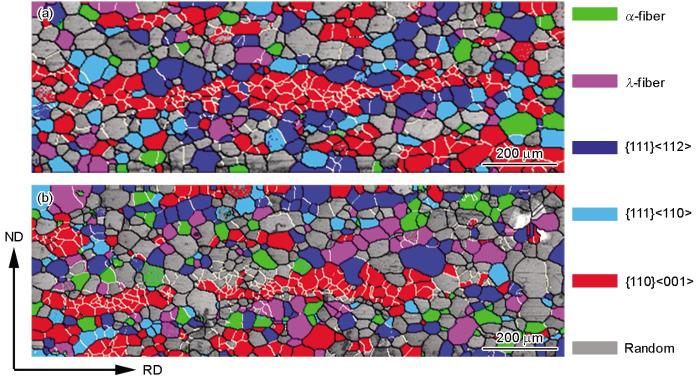
图1
无Sb和含Sb初次再结晶无取向硅钢板的取向成像图
Fig.1
Orientation image maps of non-oriented silicon steel sheets without (a) and with (b) Sb addition after primary recrystallization (RD—rolling direction, ND—normal direction)
图2为晶粒长大退火后无Sb和含Sb样品的取向成像图。两种成分样品的晶粒尺寸均显著增大,Goss晶粒团簇被周围晶粒消耗。在无Sb样品中,存在较多的大尺寸{111}<112>取向晶粒;而在含Sb样品中,大尺寸晶粒主要为λ取向和随机取向晶粒。这表明Sb元素显著改变了不同取向晶粒的长大行为。
图2
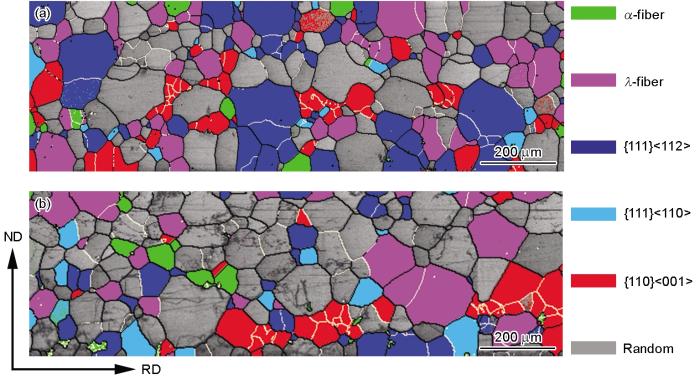
图2
无Sb和含Sb无取向硅钢板晶粒长大后的取向成像图
Fig.2
Orientation image maps of non-oriented silicon steel sheets without (a) and with (b) Sb addition after grain growth
图3给出了无Sb和含Sb样品取向分布函数(ODF)的φ2 = 0°和45° (φ2为Euler角)截面图。两种成分样品初次再结晶织构均由较强的η织构及较弱的γ和λ织构组成,γ和η织构强点分别位于{111}<112>和{110}<001>,而λ织构分布均匀。添加Sb元素未改变初次再结晶织构组分和强点,但使{111}<112>织构的取向密度由2.3降低至1.4。两种成分样品在晶粒长大退火过程中发生了不同变化。无Sb样品晶粒长大退火后,{111}<112>织构通过消耗Goss织构显著强化,其取向密度由2.3增加至4.3;含Sb样品晶粒长大退火后,{111}<112>织构强度基本不变,Goss织构减弱,而λ织构增强。
图3
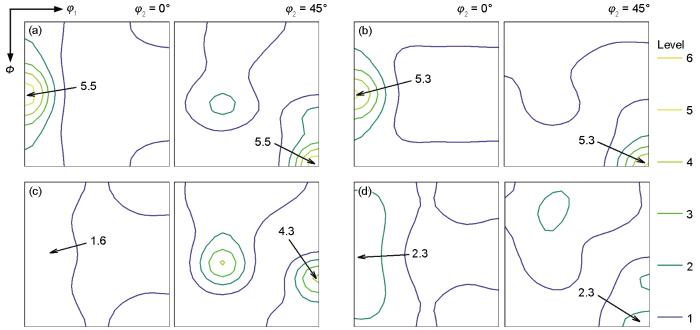
图3
无Sb和含Sb初次再结晶和晶粒长大无取向硅钢板取向分布函数(ODF)的φ2 = 0°和45°截面图 (φ2为Euler角)
Fig.3
Constant φ2 = 0° and 45° sections of ODFs of non-oriented silicon steel sheets without (a, c) and with (b, d) Sb addition after primary recrystallization (a, b) and grain growth (c, d) (ODF—orientation distribution function; φ1, φ2, and Φ—Euler angles)
图4给出了无Sb和含Sb晶粒长大样品退火前后主要织构组分的面积分数变化。无Sb样品中,Goss织构的面积分数由8.7%降低至4.4%,而{111}<112>织构和λ织构的面积分数分别增加了3.1%和2.3%,不具有尺寸优势的{111}<112>织构面积分数增加更为显著。含Sb样品中,Goss织构的面积分数降低了2.9%,其降低程度小于无Sb样品,具有初始尺寸优势的λ织构面积分数增加了3.0%。
图4
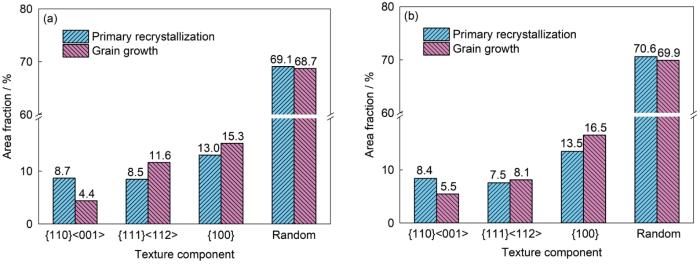
图4
无Sb和含Sb初次再结晶和晶粒长大无取向硅钢板主要织构组分的面积分数
Fig.4
Area fractions of major texture components in non-oriented silicon steel sheets without (a) and with (b) Sb addition after primary recrystallization and grain growth
Sb元素抑制了晶粒长大过程中{111}<112>织构的增加并促进了λ织构的发展,这对无取向硅钢的磁性能有积极影响。表2给出了晶粒长大退火后无Sb和含Sb无取向硅钢轧向和横向的磁性能。可见,含Sb无取向硅钢在轧向和横向上均具有更高的磁感应强度和更低的铁损。
表2 无取向硅钢板在晶粒长大退火后的磁性能
Table 2
| Sample | B50 / T | P15/50 / (W·kg-1) | ||
|---|---|---|---|---|
| RD | TD | RD | TD | |
| 0Sb | 1.67 | 1.63 | 3.14 | 3.25 |
| 4Sb | 1.71 | 1.66 | 3.03 | 3.18 |
2.2 晶粒尺寸演变
图5给出了无Sb和含Sb晶粒长大样品退火前后主要织构组分的平均晶粒尺寸和相对晶粒尺寸变化,其中相对晶粒尺寸定义为各织构组分平均晶粒尺寸与总体平均晶粒尺寸的比值。晶粒尺寸演变呈现显著的取向依赖性。在无Sb初次再结晶样品中,{111}<112>晶粒和随机取向晶粒的平均晶粒尺寸与总体平均晶粒尺寸相当,而Goss晶粒和λ晶粒的相对晶粒尺寸分别为0.80和1.07。无Sb样品经过晶粒长大退火后,Goss晶粒的相对晶粒尺寸由0.80降低至0.71,其尺寸劣势进一步扩大;λ晶粒的相对晶粒尺寸由1.07增大至1.09,其尺寸优势稍有扩大。具有相似晶粒尺寸的{111}<112>和随机取向晶粒经历了不同长大,{111}<112>晶粒的相对晶粒尺寸由1.01增大至1.11,而随机取向晶粒的相对晶粒尺寸由1.03减小至1.01。添加Sb元素导致Goss初次再结晶晶粒尺寸稍有增大,但基本不改变其他织构组分的初次再结晶晶粒尺寸。在晶粒长大过程中,Sb元素降低各织构组分晶粒长大速率,其中{111}<112>晶粒长大速率的降低最显著,晶粒长大后{111}<112>平均晶粒尺寸与总体平均晶粒尺寸接近,这与无Sb样品明显不同。
图5
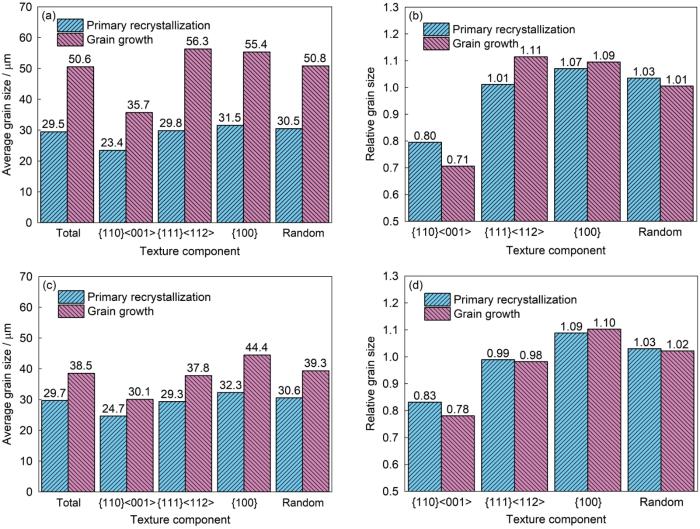
图5
无Sb和含Sb初次再结晶与晶粒长大无取向硅钢板主要织构组分的平均晶粒尺寸和相对晶粒尺寸
Fig.5
Average (a, c) and relative (b, d) grain sizes of major texture components in non-oriented silicon steel sheets without (a, b) and with (c, d) Sb addition after primary recrystallization and grain growth
图6进一步给出了无Sb和含Sb样品退火前后{111}<112>晶粒的面积加权晶粒尺寸分布。在初次再结晶样品中,两种成分样品中{111}<112>晶粒的尺寸分布具有单峰特征,且分布形状相似。晶粒长大后,两种成分样品中{111}<112>晶粒的尺寸均向大尺寸侧移动,但晶粒尺寸分布形状显著不同。无Sb晶粒长大样品中,面积加权频率密度在40~80 μm的晶粒尺寸范围内均匀分布,表明晶粒长大后{111}<112>晶粒的尺寸分布是由多个峰位不同的子分布叠加而成。含Sb晶粒长大样品中,{111}<112>晶粒的面积加权频率密度在60~70 μm范围内稍高,但总体保持单峰分布特征,表明Sb元素抑制了大尺寸{111}<112>晶粒的形成。
图6
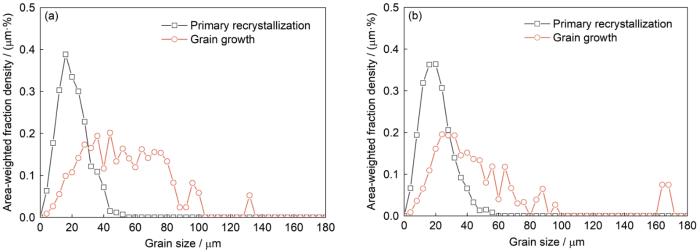
图6
无Sb和含Sb无取向硅钢板晶粒长大前后{111}<112>晶粒的尺寸分布
Fig.6
Grain size distributions of {111}<112> grains in non-oriented silicon steel sheets without (a) and with (b) Sb addition after primary recrystallization and grain growth
2.3 空间分布关联性
为解析Sb元素对{111}<112>晶粒长大的影响机制,对含Sb样品的晶粒长大过程进行了原位EBSD分析(图7)。Goss晶粒团簇内包含高比例的小角度晶界,导致显著的取向钉扎效应,而{111}<112>晶粒的长大行为与其局部尺寸和取向环境密切相关。
图7
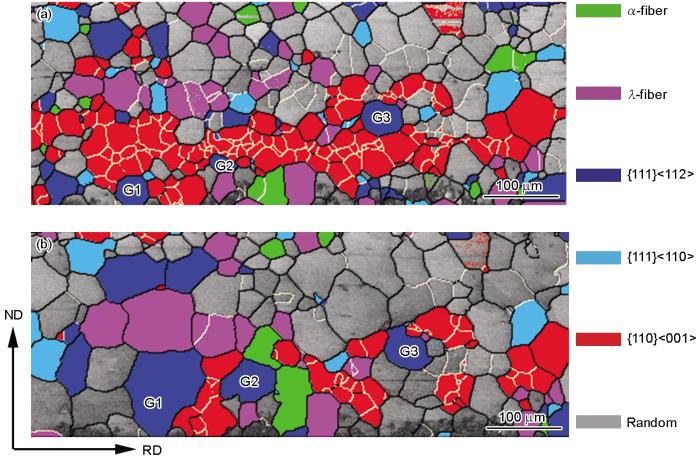
图7
含Sb无取向硅钢中{111}<112>晶粒的长大行为
Fig.7
Growth behavior of {111}<112>grains in non-oriented silicon steel sheets with Sb addition after primary recrystallization (a) and grain growth (b) (G1-G3 represent grains 1-3, respectively)
当{111}<112>晶粒远离Goss晶粒团簇时,{111}<112>晶粒和其周围的基体晶粒均被普通大角度晶界包围,此时具有局部尺寸优势的{111}<112>晶粒长大,而具有局部尺寸劣势的{111}<112>晶粒收缩。当{111}<112>晶粒与Goss晶粒团簇毗邻时,随局部晶界和尺寸环境的变化,{111}<112>晶粒呈现出多种长大行为。G1晶粒(Euler角φ1 = 151.4°,Φ = 53.9°,φ2 = 45.9°)与毗邻的Goss晶粒的取向差在36.7°~39.8°<034>范围内,接近Σ9 (~38°<110>)晶界。Σ9晶界具有高的可动性,帮助G1晶粒消耗毗邻Goss晶粒而快速长大,并建立了相对于其他晶粒的尺寸优势。G2晶粒(φ1 = 158.5°,Φ = 48.5°,φ2 = 48.3°)与毗邻的Goss晶粒间的晶界为普通大角度晶界,且其晶粒尺寸显著大于毗邻的Goss晶粒。晶粒长大过程中,G2晶粒吞噬了其周围的小晶粒尺寸Goss团簇,但在遇到较大晶粒尺寸的Goss团簇后,G2晶粒的长大受阻。G3晶粒(φ1 = 142.1°,Φ = 42.3°,φ2 = 50.7°)与团簇内Goss晶粒间形成大角度晶界,其晶粒尺寸稍大于毗邻的Goss晶粒,晶粒长大过程中G3未能吞噬Goss团簇中的晶粒。
3 分析与讨论
根据上述结果,初次再结晶完成后,Sb元素对{111}<112>晶粒尺寸影响不明显,但显著降低了{111}<112>晶粒与Goss晶粒团簇毗邻的概率并增大了Goss晶粒尺寸。晶粒长大退火后,{111}<112>晶粒随其局部环境呈现不同的长大行为,大尺寸{111}<112>晶粒起源于Goss团簇周围,而Sb元素改变{111}<112>晶粒的空间分布,进而抑制大尺寸{111}<112>晶粒的形成和{111}<112>织构的增强。因此,本节对Goss团簇及其周围晶粒的长大行为进行计算分析,探讨晶界偏聚元素通过空间分布影响织构演变的机制。
3.1 局部环境依赖的晶粒长大
晶粒长大过程中,每个晶粒仅与其毗邻晶粒发生作用。半径为
晶粒I的平均晶界能(
式中,
图8
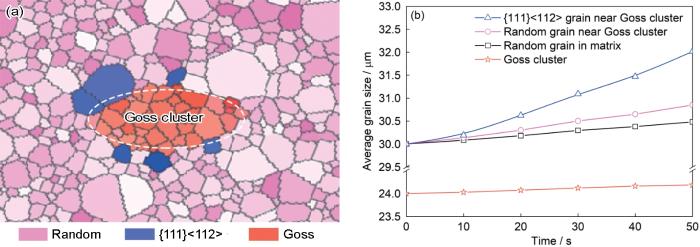
图8
初次再结晶组织结构示意图和平均晶粒尺寸随退火时间的演变
Fig.8
Schematic of primary recrystallization microstructure (a) and the evolution of average grain size during grain growth (b)
图8b给出了晶粒长大过程中各组分晶粒平均尺寸变化。由于Goss团簇内的晶粒被低可动性的小角度晶界包围,其长大速率远小于其他织构组分晶粒。Goss团簇相对于其他织构组分的尺寸劣势逐渐扩大,导致其在长大过程中被吞噬;而与Goss团簇毗邻的R晶粒的长大速率,较远离Goss团簇的R晶粒的大。Goss团簇晶粒尺寸较小,不仅为毗邻的{111}<112>晶粒的长大提供更高驱动力,二者间高可动性的近Σ9晶界又进一步加速了{111}<112>晶粒的长大,导致大尺寸{111}<112>晶粒的形成。
晶粒长大本质上是局部环境驱动的晶界迁移过程,具有低晶界能或大尺寸的晶粒倾向于通过吞噬周围的晶粒而长大,晶界可动性决定了其长大速率。晶界偏聚元素改变了初次再结晶完成时各种织构组分晶粒的空间不均匀分布,而差异化的晶界特性和尺寸环境使得织构竞争行为依赖各组分空间分布,并由此决定了晶粒长大过程中的织构演变。
3.2 偏聚干预织构竞争的机理
图9为偏聚元素干预再结晶织构竞争的机理示意图。初次再结晶过程中,γ晶粒形核于γ形变晶粒的晶界区域,Goss晶粒形核于γ形变晶粒内部的剪切带,λ晶粒形核于α形变晶粒晶界区域的λ取向形变带。
图9
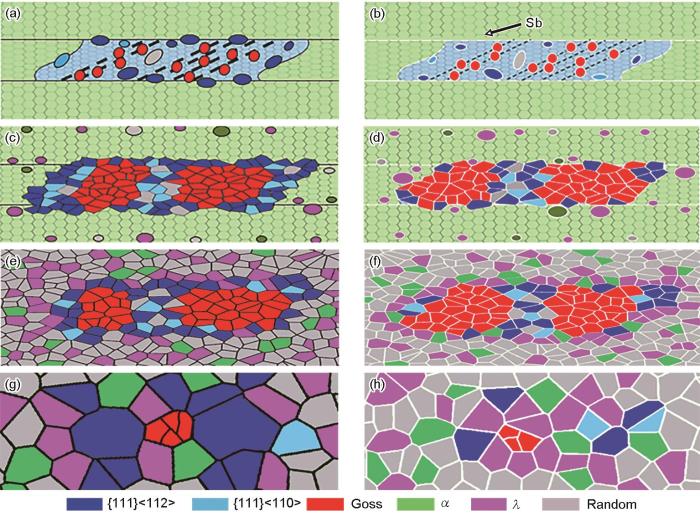
图9
晶界偏聚元素干预无取向硅钢再结晶织构竞争的示意图
Fig.9
Schematics of recrystallization texture competition mediated by segregation elements in non-oriented silicon steel sheets without (a, c, e, g) and with (b, d, f, h) Sb addition (a, b) early recrystallization stage (c, d) middle recrystallization stage (e, f) complete recrystallization (g, h) after grain growth
无偏聚元素的样品中,γ晶粒和Goss晶粒优先形核长大,部分γ晶粒可以侵入毗邻的α形变晶粒,抑制了λ晶粒的形核和长大(图9a和c);初次再结晶完成时,原γ形变晶粒内形成Goss晶粒团簇,部分γ晶粒向内长大并与Goss晶粒团簇接触(图9e);晶粒长大过程中,γ晶粒和少量λ晶粒凭借尺寸优势吞噬Goss晶粒团簇,因γ晶粒中{111}<112>与Goss形成近Σ9晶界,{111}<112>晶粒可更快速消耗Goss团簇,形成较多数量的大尺寸{111}<112>晶粒,{111}<112>织构因此强化(图9g)。含偏聚元素样品中,晶界偏聚元素抑制γ再结晶晶粒的形核、长大以及向毗邻α形变晶粒的入侵(图9b和d);初次再结晶完成时,Goss晶粒团簇周围{111}<112>晶粒数量减少而λ晶粒数量增多(图9f);在晶粒长大过程中,λ晶粒通过消耗Goss团簇长大,λ织构得以增强(图9h)。
4 结论
(1) Goss团簇内晶粒的长大行为及其与周围晶粒的交互作用显著影响晶粒长大过程中的组织演变。Goss团簇内晶粒长大缓慢且倾向于被周围晶粒吞噬,并可借助晶界可动性优势诱导毗邻{111}<112>晶粒快速长大,导致大尺寸{111}<112>晶粒数量增加和{111}<112>织构强化。
(2) Sb元素通过改变织构组分的空间分布改变织构间的竞争关系,从而改变了晶粒长大过程中的织构演变。Sb元素在弱化初次再结晶{111}<112>织构的同时,降低了Goss晶粒团簇周围{111}<112>晶粒数量,导致晶粒长大过程中具有尺寸优势的λ织构组分获得机会吞噬Goss晶粒团簇,使λ织构增强。
参考文献
Review of magnetic properties and texture evolution in non-oriented electrical steels
[J].
Recent developments in non-oriented electrical steels
[J].
無方向性電磁鋼板の最近の開発動向
[J].
Minimum force model. Effect of crystallographic texture on the magnetostriction and loss characteristics of non-oriented electrical steels
[J].
Recrystallization texture development in rare-earth (RE)-doped non-oriented silicon steel
[J].
Ultrastrong {100} texture in twin-roll strip cast non-oriented electrical steel through two-step annealing
[J].
Effect of grain size and magnetic texture on iron-loss components in NO electrical steel at different frequencies
[J].
Determining the effect of grain size and maximum induction upon coercive field of electrical steels
[J].
Effect of texture and grain size on magnetic flux density and core loss in non-oriented electrical steel containing 3.15% Si
[J].
Relative effect (s) of texture and grain size on magnetic properties in a low silicon non-grain oriented electrical steel
[J].
Texture evolution during recrystallization and grain growth in heavily cold-rolled Fe-3% Si alloy
[J].
Recrystallisation, grain growth and texture evolution in nonoriented electrical steels
[A]. 3rd International Conference on Recrystallization and Grain Growth, ReX & GG III [C].
Texture development during grain growth in nonoriented electrical steels
[J].
Texture evolution of a 2.8 wt pct Si non-oriented electrical steel and the elimination of the <111>//ND texture
[J].
A new non-oriented Si-steel with texture of {100}
[J].
Magnetic properties and recrystallization texture of phosphorus-added non-oriented electrical steel sheets
[J].
Effect of Sn addition on evolution of primary recrystallization texture in 3% Si steel
[J].
Effect of antimony on the structure, texture and magnetic properties of high efficiency non-oriented electrical steel
[J].
Texture and magnetic properties improvement of a 3% Si non-oriented electrical steel by Sb addition
[J].
How Sn addition influences texture development in single-phase Fe alloys: Correlation between local chemical information, microstructure and recrystallisation
[J].
Recrystallization texture competition mediated by segregation element in body-centered cubic metals
[J].
偏析干预下体心立方金属再结晶织构竞争
[J].
Segregation affecting the evolution of primary recrystallization textures in a ternary Fe-Si-Sn alloy
[J].
Effect of tin addition on primary and secondary recrystallizations of silicon steel
[J].
A discrete approach to grain growth based on pair interactions
[J].
Dislocation models of crystal grain boundaries
[J].
A unified theory of recovery, recrystallization and grain growth, based on the stability and growth of cellular microstructures—I. The basic model
[J].
Subgrain growth and low angle boundary mobility in aluminium crystals of orientation {110}<001>
[J].
Abnormal grain growth and texture development
[A].
Grain boundary energies in body-centered cubic metals
[J].
Modelling the evolution of recrystallization texture for a non-grain oriented electrical steel
[J].


