Accident tolerant fuels for LWRs: A perspective
1
2014
... 燃料组件是水冷反应堆的核心部件,燃料芯块中U的裂变为反应堆提供能量.燃料包壳在包容放射性物质和裂变气体的同时,将裂变能量传递给冷却剂,其结构的完整性对反应堆的运行安全至关重要.UO2-Zr核燃料组件在轻水堆内应用广泛.然而,在2011年日本福岛核事故中,UO2-Zr燃料元件的温度因堆芯失水而迅速升高,Zr与H2O反应产生大量H2和热量.短时间内释放的热量导致堆芯元件出现严重的破损和坍塌,包容放射性物质的第一道安全屏障被破坏[1,2].Zr与H2O反应产生的H2在安全壳内引发爆炸,导致第二、三道安全屏障破坏,引起放射性物质外泄,产生了灾难性后果. ...
Accident tolerant fuel cladding development: Promise, status, and challenges
3
2018
... 燃料组件是水冷反应堆的核心部件,燃料芯块中U的裂变为反应堆提供能量.燃料包壳在包容放射性物质和裂变气体的同时,将裂变能量传递给冷却剂,其结构的完整性对反应堆的运行安全至关重要.UO2-Zr核燃料组件在轻水堆内应用广泛.然而,在2011年日本福岛核事故中,UO2-Zr燃料元件的温度因堆芯失水而迅速升高,Zr与H2O反应产生大量H2和热量.短时间内释放的热量导致堆芯元件出现严重的破损和坍塌,包容放射性物质的第一道安全屏障被破坏[1,2].Zr与H2O反应产生的H2在安全壳内引发爆炸,导致第二、三道安全屏障破坏,引起放射性物质外泄,产生了灾难性后果. ...
... ATF包壳的研发主要集中于如下两个方向:(1) 仍以锆合金为包壳材料,在包壳管外侧制备保护涂层[5];(2) 研发新型包壳材料,如金属包壳(难熔金属,FeCrAl合金)、SiC复合包壳[2].锆合金包壳涂层种类众多,包括金属涂层(Cr、FeCrAl)、MAX相涂层(Ti-Al-C、Cr-Al-C、Ti-Si-C等)、SiC涂层、氮化物涂层(TiN、TiAlN、CrN)等[2,6].目前,综合考察经济性与安全性,Cr涂层表现最佳,发展速度最快,部分堆内辐照考验已完成.新型燃料包壳中,FeCrAl合金凭借其较高的热导率(约12 W/(m⋅K))和较低的热膨胀系数、良好的抗高温水和高温蒸汽氧化性能、良好的与UO2燃料的兼容性、可接受的中子吸收程度(约1.95 × 10-28~2.34 × 10⁻²⁸ m2)、良好的抗辐照损伤性能、较高的力学强度以及优秀的抗蠕变性能[7,8],已成为极具应用前景的候选材料.在成为候选材料前,FeCrAl合金便已广泛应用于火电厂中,美国橡树岭国家实验室率先对FeCrAl合金展开研究,在商业FeCrAl合金21Cr-5Al-3Mo (APMT)的基础上,通过调节合金成分开发了满足堆内复杂服役环境要求的核级FeCrAl合金(C26M)[9].FeCrAl合金作为新型燃料包壳材料,其发展速度较快,仅次于含Cr涂层锆合金,目前已进入装料入堆运行考验阶段[10]. ...
... [2,6].目前,综合考察经济性与安全性,Cr涂层表现最佳,发展速度最快,部分堆内辐照考验已完成.新型燃料包壳中,FeCrAl合金凭借其较高的热导率(约12 W/(m⋅K))和较低的热膨胀系数、良好的抗高温水和高温蒸汽氧化性能、良好的与UO2燃料的兼容性、可接受的中子吸收程度(约1.95 × 10-28~2.34 × 10⁻²⁸ m2)、良好的抗辐照损伤性能、较高的力学强度以及优秀的抗蠕变性能[7,8],已成为极具应用前景的候选材料.在成为候选材料前,FeCrAl合金便已广泛应用于火电厂中,美国橡树岭国家实验室率先对FeCrAl合金展开研究,在商业FeCrAl合金21Cr-5Al-3Mo (APMT)的基础上,通过调节合金成分开发了满足堆内复杂服役环境要求的核级FeCrAl合金(C26M)[9].FeCrAl合金作为新型燃料包壳材料,其发展速度较快,仅次于含Cr涂层锆合金,目前已进入装料入堆运行考验阶段[10]. ...
Current state and prospect on the development of advanced nuclear fuel system materials: A review
1
2021
... 福岛核事故后,为延长堆芯事故时响应时间、提高燃料组件的固有安全性,核电领域研究人员对耐事故燃料(ATF)进行了大量的研究,主要集中于如下两个方向:一是改善燃料芯块成分或结构;二是提高燃料包壳性能.在改善燃料芯块方面,主要是研发具有更优热物理性能和更强裂变产物包容能力的新型燃料,如对UO2芯块进行掺杂改性(添加改性颗粒:Cr、Mn、Mo、Cr2O3、Al2O3、SiC);开发全陶瓷微封装芯块,如硅化铀(U3Si2、U3Si5)、氮化铀(UN)、碳化铀(UC)等[3,4].新型燃料芯块的使用涉及一系列设计的改变,导致其研发难度大、周期长.相较于开发新型燃料芯块,提高现有包壳的性能或研发先进包壳是更容易实现的方案. ...
New ATF concepts and materials: Evaluation and investigations
1
2020
... 福岛核事故后,为延长堆芯事故时响应时间、提高燃料组件的固有安全性,核电领域研究人员对耐事故燃料(ATF)进行了大量的研究,主要集中于如下两个方向:一是改善燃料芯块成分或结构;二是提高燃料包壳性能.在改善燃料芯块方面,主要是研发具有更优热物理性能和更强裂变产物包容能力的新型燃料,如对UO2芯块进行掺杂改性(添加改性颗粒:Cr、Mn、Mo、Cr2O3、Al2O3、SiC);开发全陶瓷微封装芯块,如硅化铀(U3Si2、U3Si5)、氮化铀(UN)、碳化铀(UC)等[3,4].新型燃料芯块的使用涉及一系列设计的改变,导致其研发难度大、周期长.相较于开发新型燃料芯块,提高现有包壳的性能或研发先进包壳是更容易实现的方案. ...
Protective coatings on zirconium-based alloys as accident-tolerant fuel (ATF) claddings
1
2017
... ATF包壳的研发主要集中于如下两个方向:(1) 仍以锆合金为包壳材料,在包壳管外侧制备保护涂层[5];(2) 研发新型包壳材料,如金属包壳(难熔金属,FeCrAl合金)、SiC复合包壳[2].锆合金包壳涂层种类众多,包括金属涂层(Cr、FeCrAl)、MAX相涂层(Ti-Al-C、Cr-Al-C、Ti-Si-C等)、SiC涂层、氮化物涂层(TiN、TiAlN、CrN)等[2,6].目前,综合考察经济性与安全性,Cr涂层表现最佳,发展速度最快,部分堆内辐照考验已完成.新型燃料包壳中,FeCrAl合金凭借其较高的热导率(约12 W/(m⋅K))和较低的热膨胀系数、良好的抗高温水和高温蒸汽氧化性能、良好的与UO2燃料的兼容性、可接受的中子吸收程度(约1.95 × 10-28~2.34 × 10⁻²⁸ m2)、良好的抗辐照损伤性能、较高的力学强度以及优秀的抗蠕变性能[7,8],已成为极具应用前景的候选材料.在成为候选材料前,FeCrAl合金便已广泛应用于火电厂中,美国橡树岭国家实验室率先对FeCrAl合金展开研究,在商业FeCrAl合金21Cr-5Al-3Mo (APMT)的基础上,通过调节合金成分开发了满足堆内复杂服役环境要求的核级FeCrAl合金(C26M)[9].FeCrAl合金作为新型燃料包壳材料,其发展速度较快,仅次于含Cr涂层锆合金,目前已进入装料入堆运行考验阶段[10]. ...
A complete review and a prospect on the candidate materials for accident-tolerant fuel claddings
1
2018
... ATF包壳的研发主要集中于如下两个方向:(1) 仍以锆合金为包壳材料,在包壳管外侧制备保护涂层[5];(2) 研发新型包壳材料,如金属包壳(难熔金属,FeCrAl合金)、SiC复合包壳[2].锆合金包壳涂层种类众多,包括金属涂层(Cr、FeCrAl)、MAX相涂层(Ti-Al-C、Cr-Al-C、Ti-Si-C等)、SiC涂层、氮化物涂层(TiN、TiAlN、CrN)等[2,6].目前,综合考察经济性与安全性,Cr涂层表现最佳,发展速度最快,部分堆内辐照考验已完成.新型燃料包壳中,FeCrAl合金凭借其较高的热导率(约12 W/(m⋅K))和较低的热膨胀系数、良好的抗高温水和高温蒸汽氧化性能、良好的与UO2燃料的兼容性、可接受的中子吸收程度(约1.95 × 10-28~2.34 × 10⁻²⁸ m2)、良好的抗辐照损伤性能、较高的力学强度以及优秀的抗蠕变性能[7,8],已成为极具应用前景的候选材料.在成为候选材料前,FeCrAl合金便已广泛应用于火电厂中,美国橡树岭国家实验室率先对FeCrAl合金展开研究,在商业FeCrAl合金21Cr-5Al-3Mo (APMT)的基础上,通过调节合金成分开发了满足堆内复杂服役环境要求的核级FeCrAl合金(C26M)[9].FeCrAl合金作为新型燃料包壳材料,其发展速度较快,仅次于含Cr涂层锆合金,目前已进入装料入堆运行考验阶段[10]. ...
事故容错燃料包壳候选材料的研究现状及展望
1
2018
... ATF包壳的研发主要集中于如下两个方向:(1) 仍以锆合金为包壳材料,在包壳管外侧制备保护涂层[5];(2) 研发新型包壳材料,如金属包壳(难熔金属,FeCrAl合金)、SiC复合包壳[2].锆合金包壳涂层种类众多,包括金属涂层(Cr、FeCrAl)、MAX相涂层(Ti-Al-C、Cr-Al-C、Ti-Si-C等)、SiC涂层、氮化物涂层(TiN、TiAlN、CrN)等[2,6].目前,综合考察经济性与安全性,Cr涂层表现最佳,发展速度最快,部分堆内辐照考验已完成.新型燃料包壳中,FeCrAl合金凭借其较高的热导率(约12 W/(m⋅K))和较低的热膨胀系数、良好的抗高温水和高温蒸汽氧化性能、良好的与UO2燃料的兼容性、可接受的中子吸收程度(约1.95 × 10-28~2.34 × 10⁻²⁸ m2)、良好的抗辐照损伤性能、较高的力学强度以及优秀的抗蠕变性能[7,8],已成为极具应用前景的候选材料.在成为候选材料前,FeCrAl合金便已广泛应用于火电厂中,美国橡树岭国家实验室率先对FeCrAl合金展开研究,在商业FeCrAl合金21Cr-5Al-3Mo (APMT)的基础上,通过调节合金成分开发了满足堆内复杂服役环境要求的核级FeCrAl合金(C26M)[9].FeCrAl合金作为新型燃料包壳材料,其发展速度较快,仅次于含Cr涂层锆合金,目前已进入装料入堆运行考验阶段[10]. ...
A review of irradiation-induced hardening in FeCrAl alloy systems for accident-tolerant fuel cladding
2
2024
... ATF包壳的研发主要集中于如下两个方向:(1) 仍以锆合金为包壳材料,在包壳管外侧制备保护涂层[5];(2) 研发新型包壳材料,如金属包壳(难熔金属,FeCrAl合金)、SiC复合包壳[2].锆合金包壳涂层种类众多,包括金属涂层(Cr、FeCrAl)、MAX相涂层(Ti-Al-C、Cr-Al-C、Ti-Si-C等)、SiC涂层、氮化物涂层(TiN、TiAlN、CrN)等[2,6].目前,综合考察经济性与安全性,Cr涂层表现最佳,发展速度最快,部分堆内辐照考验已完成.新型燃料包壳中,FeCrAl合金凭借其较高的热导率(约12 W/(m⋅K))和较低的热膨胀系数、良好的抗高温水和高温蒸汽氧化性能、良好的与UO2燃料的兼容性、可接受的中子吸收程度(约1.95 × 10-28~2.34 × 10⁻²⁸ m2)、良好的抗辐照损伤性能、较高的力学强度以及优秀的抗蠕变性能[7,8],已成为极具应用前景的候选材料.在成为候选材料前,FeCrAl合金便已广泛应用于火电厂中,美国橡树岭国家实验室率先对FeCrAl合金展开研究,在商业FeCrAl合金21Cr-5Al-3Mo (APMT)的基础上,通过调节合金成分开发了满足堆内复杂服役环境要求的核级FeCrAl合金(C26M)[9].FeCrAl合金作为新型燃料包壳材料,其发展速度较快,仅次于含Cr涂层锆合金,目前已进入装料入堆运行考验阶段[10]. ...
... 燃料包壳内壁直接与燃料芯块接触,承受高温、高压和高剂量率的中子辐照;外部与冷却剂接触,受到冷却剂压力、冲刷、振动、腐蚀和氢脆的影响.在FeCrAl合金包壳管应用于反应堆之前,对其在正常服役环境和事故工况下的表现进行考察至关重要.目前,已针对FeCrAl合金开展广泛研究,也有较多文献[7,11~19]对其研究进展进行了总结.本文根据最新研究成果,重点关注FeCrAl合金的服役性能,系统梳理了高温腐蚀、辐照以及辐照与腐蚀耦合作用对合金性能的影响,分析了当前FeCrAl合金的研究现状,指出了当前研究的缺陷与不足,以及未来的研究方向,以期为FeCrAl合金包壳性能的进一步优化提供思路. ...
Advanced oxidation-resistant iron-based alloys for LWR fuel cladding
2
2014
... ATF包壳的研发主要集中于如下两个方向:(1) 仍以锆合金为包壳材料,在包壳管外侧制备保护涂层[5];(2) 研发新型包壳材料,如金属包壳(难熔金属,FeCrAl合金)、SiC复合包壳[2].锆合金包壳涂层种类众多,包括金属涂层(Cr、FeCrAl)、MAX相涂层(Ti-Al-C、Cr-Al-C、Ti-Si-C等)、SiC涂层、氮化物涂层(TiN、TiAlN、CrN)等[2,6].目前,综合考察经济性与安全性,Cr涂层表现最佳,发展速度最快,部分堆内辐照考验已完成.新型燃料包壳中,FeCrAl合金凭借其较高的热导率(约12 W/(m⋅K))和较低的热膨胀系数、良好的抗高温水和高温蒸汽氧化性能、良好的与UO2燃料的兼容性、可接受的中子吸收程度(约1.95 × 10-28~2.34 × 10⁻²⁸ m2)、良好的抗辐照损伤性能、较高的力学强度以及优秀的抗蠕变性能[7,8],已成为极具应用前景的候选材料.在成为候选材料前,FeCrAl合金便已广泛应用于火电厂中,美国橡树岭国家实验室率先对FeCrAl合金展开研究,在商业FeCrAl合金21Cr-5Al-3Mo (APMT)的基础上,通过调节合金成分开发了满足堆内复杂服役环境要求的核级FeCrAl合金(C26M)[9].FeCrAl合金作为新型燃料包壳材料,其发展速度较快,仅次于含Cr涂层锆合金,目前已进入装料入堆运行考验阶段[10]. ...
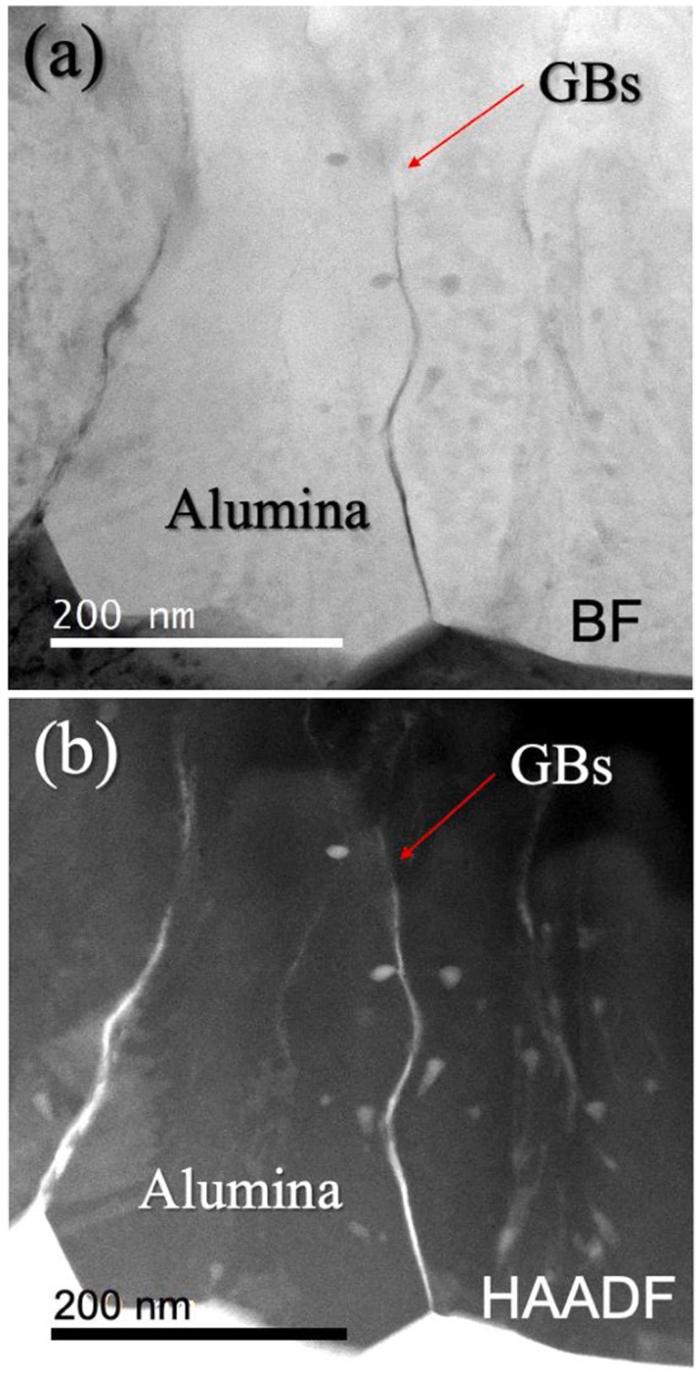
... 为了弥补对中子经济性的影响,FeCrAl合金包壳管壁厚度需要控制在0.3~0.4 mm[8],这对包壳管的完整性构成严峻挑战.一旦包壳管发生裂纹萌生并开始扩展,裂纹尖端的应力强度因子范围超过裂纹快速扩展临界值,或者裂纹尖端超越线弹性约束状态,导致包壳管失稳断裂.因此,FeCrAl合金在实际服役工况下的耐应力腐蚀裂纹萌生性能至关重要.Xie等[50]采用慢应变速率(5 × 10⁻⁸ s-1)对核级FeCrAl合金的耐应力腐蚀裂纹萌生性能进行了研究,发现FeCrAl合金在高温水中的应力腐蚀开裂敏感性很低.这主要是因为,在PWR环境中,合金表面生成一层均匀的多晶尖晶石结构氧化膜,氧化膜由纳米尺寸的晶粒组成,覆盖在晶界上方,如图3[50]所示.与应力腐蚀开裂敏感性较高的304不锈钢不同,FeCrAl合金腐蚀后原始晶界消失,未出现晶界优先氧化和晶界迁移现象.与锆合金不同,FeCrAl合金在裂变产物碘(I2)的作用下并未出现应力腐蚀开裂现象,表现出优异的耐碘致应力腐蚀开裂性能[51].然而,在偏离压水堆的正常水化学工况下(如水中同时含有微量Cu2+和Cl-的情况下),FeCrAl合金会出现严重的应力腐蚀开裂[52]. ...
Development and property evaluation of nuclear grade wrought FeCrAl fuel cladding for light water reactors
8
2015
... ATF包壳的研发主要集中于如下两个方向:(1) 仍以锆合金为包壳材料,在包壳管外侧制备保护涂层[5];(2) 研发新型包壳材料,如金属包壳(难熔金属,FeCrAl合金)、SiC复合包壳[2].锆合金包壳涂层种类众多,包括金属涂层(Cr、FeCrAl)、MAX相涂层(Ti-Al-C、Cr-Al-C、Ti-Si-C等)、SiC涂层、氮化物涂层(TiN、TiAlN、CrN)等[2,6].目前,综合考察经济性与安全性,Cr涂层表现最佳,发展速度最快,部分堆内辐照考验已完成.新型燃料包壳中,FeCrAl合金凭借其较高的热导率(约12 W/(m⋅K))和较低的热膨胀系数、良好的抗高温水和高温蒸汽氧化性能、良好的与UO2燃料的兼容性、可接受的中子吸收程度(约1.95 × 10-28~2.34 × 10⁻²⁸ m2)、良好的抗辐照损伤性能、较高的力学强度以及优秀的抗蠕变性能[7,8],已成为极具应用前景的候选材料.在成为候选材料前,FeCrAl合金便已广泛应用于火电厂中,美国橡树岭国家实验室率先对FeCrAl合金展开研究,在商业FeCrAl合金21Cr-5Al-3Mo (APMT)的基础上,通过调节合金成分开发了满足堆内复杂服役环境要求的核级FeCrAl合金(C26M)[9].FeCrAl合金作为新型燃料包壳材料,其发展速度较快,仅次于含Cr涂层锆合金,目前已进入装料入堆运行考验阶段[10]. ...
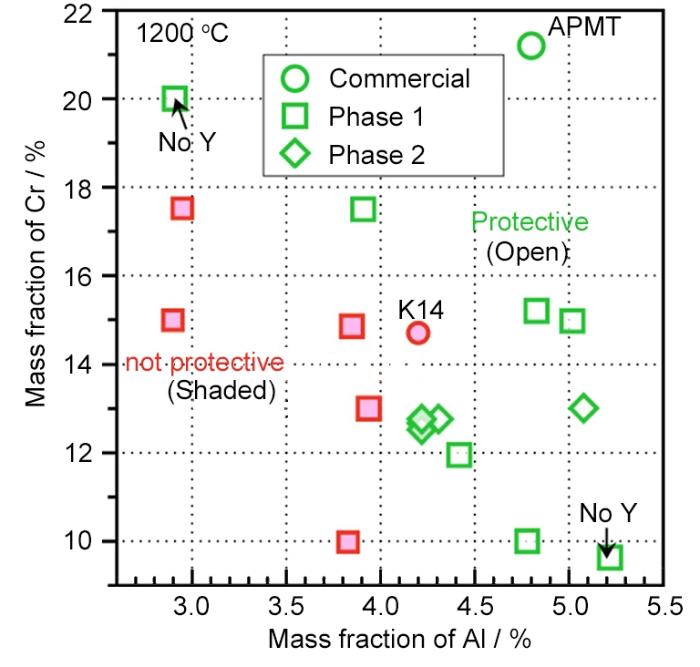
... Cr与Al元素的协同作用是FeCrAl合金在蒸汽环境中保持良好抗氧化性能的原因,Cr的“第三元素效应”使合金在较低的Al含量下仍能生成α-Al2O3保护性氧化膜.在Al含量较低的FeCrAl合金中,Cr使得Al的氧化方式由内氧化转变为外氧化,氧化过程中生成的α-Cr2O3促进α-Al2O3形核;但当Al含量较高时,Cr的这种作用不再显著[68,69].Al含量越低,在高温蒸汽环境中形成保护性α-Al2O3氧化膜所需要的Cr含量越高[9,70~73].Yamamoto等[9]结合Pint等[74]的腐蚀实验数据,总结出了能够保证FeCrAl合金具有良好抗高温氧化能力的Cr、Al元素组合,如图4[9]所示.Pint等[75]还发现,随着合金中Cr、Al含量的增加,合金的最高使用温度也随之上升.然而,Cr含量过高易导致合金在温度约300 ℃的辐照环境中产生富Cr的α′相,引起材料脆化,因此Cr含量通常应被控制在15%以下.Chen等[76]研究表明,合金中的Cr含量应高于7%,否则在高温蒸汽环境下合金表面不能生成Al2O3保护性氧化膜.过低的Al含量(1%~3%)难以支持合金形成连续致密的α-Al2O3氧化膜,过高的Al含量(> 6%)可能导致合金的韧脆转变温度升高,同时影响材料的加工制造和焊接性能[9,77].此外,当Al含量达到4%时,辐照位错环的形成受到显著抑制,缓解了材料的辐照硬化[78],并且随着Al含量增加,中子辐照后析出的α′相的体积分数也相应减少,缓解了材料的辐照脆化[79].因此,通常应将Al含量控制在4%~6%. ...
... [9]结合Pint等[74]的腐蚀实验数据,总结出了能够保证FeCrAl合金具有良好抗高温氧化能力的Cr、Al元素组合,如图4[9]所示.Pint等[75]还发现,随着合金中Cr、Al含量的增加,合金的最高使用温度也随之上升.然而,Cr含量过高易导致合金在温度约300 ℃的辐照环境中产生富Cr的α′相,引起材料脆化,因此Cr含量通常应被控制在15%以下.Chen等[76]研究表明,合金中的Cr含量应高于7%,否则在高温蒸汽环境下合金表面不能生成Al2O3保护性氧化膜.过低的Al含量(1%~3%)难以支持合金形成连续致密的α-Al2O3氧化膜,过高的Al含量(> 6%)可能导致合金的韧脆转变温度升高,同时影响材料的加工制造和焊接性能[9,77].此外,当Al含量达到4%时,辐照位错环的形成受到显著抑制,缓解了材料的辐照硬化[78],并且随着Al含量增加,中子辐照后析出的α′相的体积分数也相应减少,缓解了材料的辐照脆化[79].因此,通常应将Al含量控制在4%~6%. ...
... [9]所示.Pint等[75]还发现,随着合金中Cr、Al含量的增加,合金的最高使用温度也随之上升.然而,Cr含量过高易导致合金在温度约300 ℃的辐照环境中产生富Cr的α′相,引起材料脆化,因此Cr含量通常应被控制在15%以下.Chen等[76]研究表明,合金中的Cr含量应高于7%,否则在高温蒸汽环境下合金表面不能生成Al2O3保护性氧化膜.过低的Al含量(1%~3%)难以支持合金形成连续致密的α-Al2O3氧化膜,过高的Al含量(> 6%)可能导致合金的韧脆转变温度升高,同时影响材料的加工制造和焊接性能[9,77].此外,当Al含量达到4%时,辐照位错环的形成受到显著抑制,缓解了材料的辐照硬化[78],并且随着Al含量增加,中子辐照后析出的α′相的体积分数也相应减少,缓解了材料的辐照脆化[79].因此,通常应将Al含量控制在4%~6%. ...
... [9,77].此外,当Al含量达到4%时,辐照位错环的形成受到显著抑制,缓解了材料的辐照硬化[78],并且随着Al含量增加,中子辐照后析出的α′相的体积分数也相应减少,缓解了材料的辐照脆化[79].因此,通常应将Al含量控制在4%~6%. ...
... [
9]
Effect of Cr and Al contents on steam oxidation resistance of commercial and model FeCrAl alloys at 1200 <sup>o</sup>C<sup>[<xref ref-type="bibr" rid="R9">9</xref>]</sup> (APMT—advanced powder me-tallurgy tubing alloy)Fig.4![]()
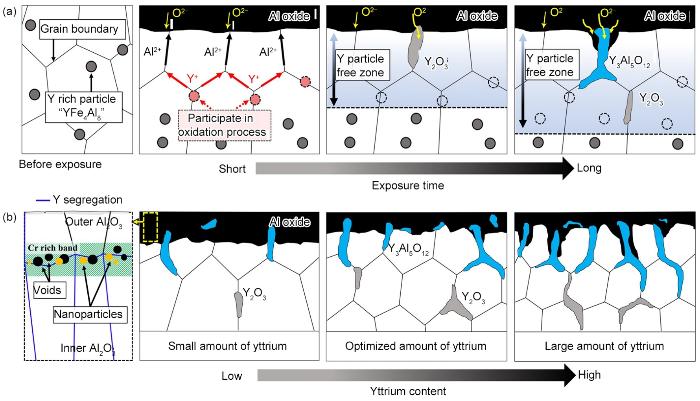
添加微量合金元素同样能够影响FeCrAl合金的氧化行为,如添加活性元素Y、La、Ce、Gd;IVA族元素Ti、Zr、Hf;II族元素Ca、Mg;其他元素Mo、Nb、Pt、Si等[40,51,56,65,67,80~97].与不含稀土元素的FeCrAl合金相比,Y和Gd能够降低合金氧化膜的生长速率,改善氧化膜在基体上的附着强度,提高合金的耐腐蚀性能.这可能是因为Y和Gd在α-Al2O3氧化物晶界偏析,从而抑制Al3+向外扩散,降低O元素的扩散速率,并使O元素的向内扩散成为合金的主要氧化方式.该过程使α-Al2O3的生长速率和内部应力降低,从而抑制了氧化物和基体界面孔洞的形成[80~83,86,87].但过量Y会导致“过渡掺杂”效应,使得合金晶粒严重细化并在晶界处形成大量的网状Y3Al5O12.图5[86]为含Y的FeCrAl合金在1200 ℃蒸汽环境中氧化行为随时间和Y含量变化的示意图.O元素更易沿着网状Y3Al5O12扩散,导致合金发生内氧化,减弱Y的有益作用[86].因此,存在一个最佳的Y添加量,保证FeCrAl合金具有最优的性能.Y的最优添加量受多种因素影响,如Y的添加形式(金属、氧化物)、合金加工方式、合金内其他微量化学成分及含量等.多数情况下,Y含量应控制在0.2%以下.此外,La有助于改善Al2O3氧化膜的结构,使其结构更稳定、表面积更大[98].综上所述,FeCrAl合金中添加的稀土元素主要通过以下三种方式提高合金的抗高温蒸汽氧化能力:(1) 稀土元素促进Al2O3氧化膜的形成,降低氧化物与基体界面的氧分压,抑制非稳定态Al2O3氧化膜的形成;(2) 稀土元素倾向于在晶界和氧化膜/基体界面偏析,阻碍元素的扩散,降低氧化膜的生长速率和生长应力;(3) 稀土元素防止氧化膜/基体界面产生孔洞等缺陷,提高氧化膜的附着能力,同时改善氧化膜的塑性,降低氧化膜的生长应力和热应力. ...
... [
9] (APMT—advanced powder me-tallurgy tubing alloy)
Fig.4![]()
添加微量合金元素同样能够影响FeCrAl合金的氧化行为,如添加活性元素Y、La、Ce、Gd;IVA族元素Ti、Zr、Hf;II族元素Ca、Mg;其他元素Mo、Nb、Pt、Si等[40,51,56,65,67,80~97].与不含稀土元素的FeCrAl合金相比,Y和Gd能够降低合金氧化膜的生长速率,改善氧化膜在基体上的附着强度,提高合金的耐腐蚀性能.这可能是因为Y和Gd在α-Al2O3氧化物晶界偏析,从而抑制Al3+向外扩散,降低O元素的扩散速率,并使O元素的向内扩散成为合金的主要氧化方式.该过程使α-Al2O3的生长速率和内部应力降低,从而抑制了氧化物和基体界面孔洞的形成[80~83,86,87].但过量Y会导致“过渡掺杂”效应,使得合金晶粒严重细化并在晶界处形成大量的网状Y3Al5O12.图5[86]为含Y的FeCrAl合金在1200 ℃蒸汽环境中氧化行为随时间和Y含量变化的示意图.O元素更易沿着网状Y3Al5O12扩散,导致合金发生内氧化,减弱Y的有益作用[86].因此,存在一个最佳的Y添加量,保证FeCrAl合金具有最优的性能.Y的最优添加量受多种因素影响,如Y的添加形式(金属、氧化物)、合金加工方式、合金内其他微量化学成分及含量等.多数情况下,Y含量应控制在0.2%以下.此外,La有助于改善Al2O3氧化膜的结构,使其结构更稳定、表面积更大[98].综上所述,FeCrAl合金中添加的稀土元素主要通过以下三种方式提高合金的抗高温蒸汽氧化能力:(1) 稀土元素促进Al2O3氧化膜的形成,降低氧化物与基体界面的氧分压,抑制非稳定态Al2O3氧化膜的形成;(2) 稀土元素倾向于在晶界和氧化膜/基体界面偏析,阻碍元素的扩散,降低氧化膜的生长速率和生长应力;(3) 稀土元素防止氧化膜/基体界面产生孔洞等缺陷,提高氧化膜的附着能力,同时改善氧化膜的塑性,降低氧化膜的生长应力和热应力. ...
... 为进一步提高FeCrAl合金的高温力学性能和抗辐照损伤性能,通常采用外加或原位生成的方式在合金中引入增强颗粒,其主要为氧化物颗粒和碳化物颗粒.位错在移动时会绕过这些颗粒,通过Orowan强化机制提高合金的力学性能;颗粒与界面之间是辐照缺陷的强吸收陷阱,能够提高空位和间隙原子的复合湮灭概率,增强合金的抗辐照损伤性能[148,149].氧化物颗粒主要采用活性元素Y的氧化物Y2O3作为增强相.但在FeCrAl合金中,Al容易与Y2O3反应生成Y-Al-O颗粒.Y-Al-O颗粒主要包含钙钛矿相YAlO3 (YAP)、石榴石相Y3Al5O12 (YAG)、单斜相Y4Al2O9 (YAM)和六方亚稳相YAlO3 (YAH)四种结构[9,150].其中,具有YAG结构与YAP结构的第二相粒子尺寸较大,通常为几十到上百纳米,导致FeCrAl合金内部弥散颗粒体系平均尺寸变大、数量密度降低,降低了合金的力学性能和抗辐照损伤能力.随着Y∶Al原子配比的增加,颗粒尺寸呈减小趋势[104].其他降低纳米氧化物颗粒尺寸的方法主要包括:添加Zr、Hf等元素以促使基体中析出细小的Y-Zr-O和Y-Hf-O相代替粗大的Y-Al-O颗粒[151];直接使用更细小的氧化物(如Ce2O3)代替Y2O3作为增强相[94].碳化物类颗粒主要包括TiC和ZrC.其中纳米ZrC具有稳定性高且难以与Al发生化学反应、中子截面低、硬度高、弥散界面多、熔点高(约3540 ℃,远高于TiC和Y2O3)等优势,是理想的增强合金高温力学性能和抗辐照损伤的强化相. ...
Post irradiation examinations of FeCrAl cladding in PWR conditions
4
2025
... ATF包壳的研发主要集中于如下两个方向:(1) 仍以锆合金为包壳材料,在包壳管外侧制备保护涂层[5];(2) 研发新型包壳材料,如金属包壳(难熔金属,FeCrAl合金)、SiC复合包壳[2].锆合金包壳涂层种类众多,包括金属涂层(Cr、FeCrAl)、MAX相涂层(Ti-Al-C、Cr-Al-C、Ti-Si-C等)、SiC涂层、氮化物涂层(TiN、TiAlN、CrN)等[2,6].目前,综合考察经济性与安全性,Cr涂层表现最佳,发展速度最快,部分堆内辐照考验已完成.新型燃料包壳中,FeCrAl合金凭借其较高的热导率(约12 W/(m⋅K))和较低的热膨胀系数、良好的抗高温水和高温蒸汽氧化性能、良好的与UO2燃料的兼容性、可接受的中子吸收程度(约1.95 × 10-28~2.34 × 10⁻²⁸ m2)、良好的抗辐照损伤性能、较高的力学强度以及优秀的抗蠕变性能[7,8],已成为极具应用前景的候选材料.在成为候选材料前,FeCrAl合金便已广泛应用于火电厂中,美国橡树岭国家实验室率先对FeCrAl合金展开研究,在商业FeCrAl合金21Cr-5Al-3Mo (APMT)的基础上,通过调节合金成分开发了满足堆内复杂服役环境要求的核级FeCrAl合金(C26M)[9].FeCrAl合金作为新型燃料包壳材料,其发展速度较快,仅次于含Cr涂层锆合金,目前已进入装料入堆运行考验阶段[10]. ...
... 作为燃料包壳,FeCrAl合金因具有良好的韧性从而在服役时能够保持结构完整性.FeCrAl合金的韧脆转变温度在室温以上,随着Al和/或Cr含量的增加,合金韧脆转变温度提高.第二代FeCrAl合金(C06M、C36M)在中子辐照至18.6 dpa (典型轻水堆中寿命末期累积损伤程度)后,在约330和500 ℃辐照条件下,合金的韧脆转变温度无显著变化;在约200 ℃的辐照条件下,两种不同Cr含量的FeCrAl合金的韧脆转变温度分别由110和180 ℃升高至290 ℃[158,162].然而,近期对堆内辐照(UO2燃料环境)的FeCrAl (C26M)合金的服役性能研究[10]表明,该合金在低于50 ℃条件下发生了脆性断裂. ...
... 中子辐照提高了稳态缺陷浓度和元素的扩散速率,使材料的微观结构和化学成分发生变化.水的辐照分解作用提高了腐蚀电位,进而改变材料的均匀腐蚀行为.辐照加速材料腐蚀的现象早有报道,Kammenzind等[166]对Zr-4合金在快中子堆中的辐照腐蚀行为研究表明,锆合金的腐蚀动力学行为与辐照剂量成正比,其均匀腐蚀速率是高压釜中腐蚀速率的40倍.Wang和Was[167]通过在线质子辐照实验,重现了中子辐照加速Zr-4合金腐蚀的现象.在BWR商业反应堆和麻省理工学院实验堆内分别对C26M合金及Kanthal AF、C36M3、C06M合金进行了辐照腐蚀实验,未观测到辐照明显加速合金腐蚀的现象[118,168].对美国爱达荷州国家实验室先进试验反应堆(ATR)内辐照后的C26M合金的研究[10]表明,其表面氧化膜厚度为高压釜实验结果的2倍.虽然,辐照可能促进了合金的腐蚀,但考虑到堆内燃料包壳壁存在温度梯度(与高压釜内单一温度条件不同),这种氧化膜增厚的现象也可能是温度梯度所导致. ...
... 大量应力腐蚀研究[173~176]表明,辐照后fcc结构材料的应力腐蚀开裂敏感性增加,导致其服役性能降低.而FeCrAl合金作为bcc结构材料,其抗辐照性能优于fcc结构材料.目前,仅有Ahmedabadi和Was[177]采用慢应变速率的方法研究了APMT合金(质子辐照5 dpa)在BWR环境下的辐照应力腐蚀开裂性能,实验结束后辐照材料表面未出现裂纹.然而,美国爱达荷州国家实验室ATR内辐照后的C26M合金包壳检验结果[10]表明,氧化物与基体间出现了长度为20~30 μm的裂纹,这是由于燃料芯块与包壳发生了接触,包壳外表面存在环向应力.由此可知,在中子辐照条件下FeCrAl合金有可能发生应力腐蚀开裂. ...
Improved and innovative accident-tolerant nuclear fuel materials considered for retrofitting light water reactors—A review
1
2023
... 燃料包壳内壁直接与燃料芯块接触,承受高温、高压和高剂量率的中子辐照;外部与冷却剂接触,受到冷却剂压力、冲刷、振动、腐蚀和氢脆的影响.在FeCrAl合金包壳管应用于反应堆之前,对其在正常服役环境和事故工况下的表现进行考察至关重要.目前,已针对FeCrAl合金开展广泛研究,也有较多文献[7,11~19]对其研究进展进行了总结.本文根据最新研究成果,重点关注FeCrAl合金的服役性能,系统梳理了高温腐蚀、辐照以及辐照与腐蚀耦合作用对合金性能的影响,分析了当前FeCrAl合金的研究现状,指出了当前研究的缺陷与不足,以及未来的研究方向,以期为FeCrAl合金包壳性能的进一步优化提供思路. ...
Research progress in high-temperature thermo-mechanical behavior for modelling FeCrAl cladding under loss-of-coolant accident condition
0
2023
Alloy design and characterization of a recrystallized FeCrAl-ODS cladding for accident-tolerant BWR fuels: An overview of research activity in Japan
0
2023
Research progress of ODS FeCrAl alloys—A review of composition design
0
2023
Research progress of nuclear FeCrAl cladding materials
0
2022
Research progress in FeCrAl alloys for accident-tolerant fuel cladding
0
2020
容错事故燃料包壳用FeCrAl合金的研究进展
0
2020
Research progress of FeCrAl alloy for cladding material of new type of light water reactor
0
2018
新型轻水反应堆包壳材料FeCrAl合金的研究进展
0
2018
Research progress in the FeCrAl alloys for accident tolerant fuel cladding
0
2017
耐事故燃料包壳用FeCrAl不锈钢的研究进展
0
2017
Corrosion of FeCrAl alloys used as fuel cladding in nuclear reactors
4
2021
... 燃料包壳内壁直接与燃料芯块接触,承受高温、高压和高剂量率的中子辐照;外部与冷却剂接触,受到冷却剂压力、冲刷、振动、腐蚀和氢脆的影响.在FeCrAl合金包壳管应用于反应堆之前,对其在正常服役环境和事故工况下的表现进行考察至关重要.目前,已针对FeCrAl合金开展广泛研究,也有较多文献[7,11~19]对其研究进展进行了总结.本文根据最新研究成果,重点关注FeCrAl合金的服役性能,系统梳理了高温腐蚀、辐照以及辐照与腐蚀耦合作用对合金性能的影响,分析了当前FeCrAl合金的研究现状,指出了当前研究的缺陷与不足,以及未来的研究方向,以期为FeCrAl合金包壳性能的进一步优化提供思路. ...
... 目前,针对FeCrAl合金在高温水中均匀腐蚀的研究[19~36]大多集中在288~360 ℃的温度区间.288~290 ℃对应沸水堆(BWR)内燃料包壳的服役温度,310~330 ℃对应压水堆(PWR)内燃料包壳的服役温度,而360 ℃是沿用了锆合金包壳管的加速评价方式.均匀腐蚀实验涉及的水化学条件主要包括:模拟BWR的含H水环境和含O水环境,以及模拟PWR的含H环境和低氧水环境(采用N2或Ar气除O2).部分实验在水环境中添加了H3BO3和LiOH,但多数研究仍采用纯H2O作为基础介质. ...
... 在堆芯严重失水事故工况下,堆内衰变热导致冷却剂转变为蒸汽,引起燃料组件温度升高.燃料包壳与高温蒸汽发生氧化反应,并释放出大量的热量,进一步升高堆芯内温度.FeCrAl合金具有优异的耐高温蒸汽氧化性能,能够缓解堆芯事故的发展进程,减轻堆芯安全系统负担,增加应急事故处理时间,进而提高反应堆安全裕度.因此,在新型FeCrAl合金的开发进程中,亟须对其耐高温蒸汽氧化性能进行分析.目前,已有大量关于FeCrAl合金在400~1500 ℃蒸汽环境中腐蚀的研究,文献[19]总结了高温蒸汽环境中可能发生的化学反应.FeCrAl合金在1000 ℃以上水蒸气中的氧化速率比锆合金低两个数量级,这一优异性能与FeCrAl合金在该温度下生成的α-Al2O3保护性氧化膜有关.FeCrAl合金腐蚀行为的分析表明,温度和合金成分是影响表面氧化膜结构与成分的主要因素. ...
... FeCrAl合金中添加Mo、Nb元素不仅起到固溶强化作用,还可以生成Laves相,使合金晶粒细化,力学性能提高[110~113].MoO3在800 ℃以上的环境中稳定性较差,因此Mo倾向于在内层氧化物中富集.氧化初期,Mo促进Al扩散,导致合金在氧化初期的增重速率较高,但随着腐蚀时间延长,合金的增重速率降低[89].然而,也有研究[97]表明,合金中添加Mo元素会对FeCrAl合金耐高温蒸汽腐蚀性能产生负面影响.对于Mo元素的真正影响,需要更多的实验结果来验证.不同温度下Nb元素对高温蒸汽腐蚀的影响机制不同,在1200 ℃的高温蒸汽环境中,Nb元素不仅导致合金的增重速率增加,还引起氧化膜的剥落,严重降低合金的耐腐蚀性能[114].Zhang等[90]研究表明,在500 ℃的高温蒸汽环境中,Nb元素通过抑制Al的内氧化,促进均匀连续的富Al氧化膜的形成,从而提高合金的耐腐蚀性能[54,115].综合考虑Nb对合金力学性能的增强作用以及对高温蒸汽中耐腐蚀性能的影响,建议将FeCrAl合金中Nb含量控制在0.5%左右.Pt元素能显著降低FeCrAl合金的增重速率,并且提高氧化膜的附着性[116,117].其他元素(如C、N、O、Ni、W、Ta、V等)对合金耐高温蒸汽腐蚀性能的影响可参考文献[19]. ...
Microstructural understanding of general and localized corrosion of Fe13Cr4Al2Mo1.2Nb alloy in high temperature aerated water and superheated steam
3
2022
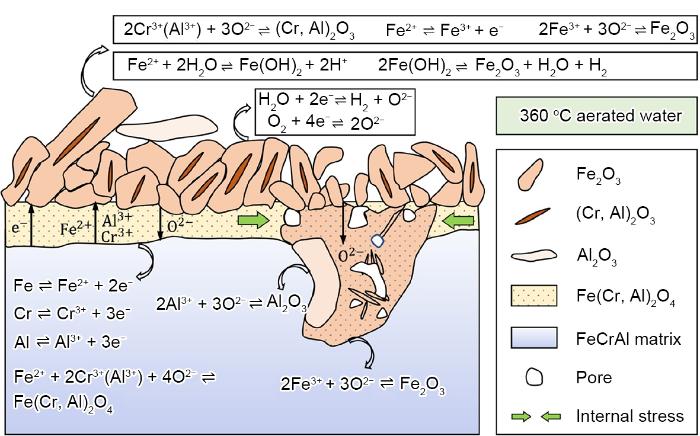
... 图1[20]为FeCrAl合金在高温水中的腐蚀过程示意图.在288~360 ℃区间内,材料表面生成双层结构氧化膜,其中外层为富Fe氧化物,内层为富Cr和Al的尖晶石氧化物[22,37,38].部分研究者[26]将过渡氧化层视为一层单独的氧化膜,而本文仍将过渡氧化层视为内层氧化膜的一部分.外层氧化物的生长主要依靠Fe元素向溶液/材料界面扩散和氧化以及溶液离子的再沉积,内层氧化物的生长主要依赖向内扩散的氧化性物质,如O2-、OH-或者H2O分子,符合固态相生长机制[39].由于O2-在尖晶石结构氧化物中的扩散速率较慢,内层氧化膜主要通过由空洞缺陷向内扩散的H2O分子引起的金属氧化而形成[40].金属元素的扩散速率影响合金的腐蚀速率,因此影响元素扩散速率的因素都可能影响合金的腐蚀速率,如环境温度、氧化膜晶体结构、微观缺陷等.环境温度越高,原子活性越大,原子/离子在介质中的扩散速率越快,化学反应加速.在相同腐蚀时间下,FeCrAl合金在BWR含H水环境(290 ℃)中的氧化膜厚度低于PWR含H水环境(330 ℃)[22]. ...
... [
20]
Schematic of corrosion process of the FeCrAl alloy in high-temperature water<sup>[<xref ref-type="bibr" rid="R20">20</xref>]</sup>Fig.1![]()
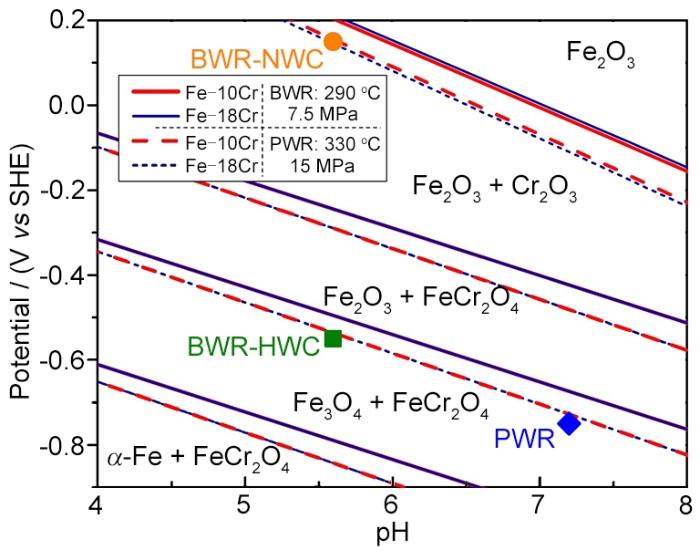
水化学对合金腐蚀的影响主要取决于高温水的腐蚀电位与pH值.图2[22]显示了Fe和Cr元素的氧化物种类随腐蚀电位和pH值的变化.在不同腐蚀电位下,Fe和Cr元素的稳定态氧化物不同.因此,实验过程中常发现含O水中FeCrAl合金表面的氧化物与含H水不同.在含O水环境中,内层氧化物中常形成一层薄薄的Cr2O3氧化膜,这种氧化膜结构致密,能显著降低氧化性物质的扩散速率.而在含H水环境中,内层氧化膜主要由尖晶石结构的Fe(Cr, Al)2O4组成,这种氧化膜对金属的保护性低于Cr2O3氧化膜[21,30].因此,在长期腐蚀浸泡实验中,FeCrAl合金通常在含H水环境中的氧化深度和失重量更大.在含B-Li的水化学环境中,合金的腐蚀增重和氧化膜厚度略低于去离子水环境[41]. ...
... [
20]
Fig.1![]()
水化学对合金腐蚀的影响主要取决于高温水的腐蚀电位与pH值.图2[22]显示了Fe和Cr元素的氧化物种类随腐蚀电位和pH值的变化.在不同腐蚀电位下,Fe和Cr元素的稳定态氧化物不同.因此,实验过程中常发现含O水中FeCrAl合金表面的氧化物与含H水不同.在含O水环境中,内层氧化物中常形成一层薄薄的Cr2O3氧化膜,这种氧化膜结构致密,能显著降低氧化性物质的扩散速率.而在含H水环境中,内层氧化膜主要由尖晶石结构的Fe(Cr, Al)2O4组成,这种氧化膜对金属的保护性低于Cr2O3氧化膜[21,30].因此,在长期腐蚀浸泡实验中,FeCrAl合金通常在含H水环境中的氧化深度和失重量更大.在含B-Li的水化学环境中,合金的腐蚀增重和氧化膜厚度略低于去离子水环境[41]. ...
Characterization of oxides formed on iron-chromium-aluminum alloy in simulated light water reactor environments
1
2017
... 水化学对合金腐蚀的影响主要取决于高温水的腐蚀电位与pH值.图2[22]显示了Fe和Cr元素的氧化物种类随腐蚀电位和pH值的变化.在不同腐蚀电位下,Fe和Cr元素的稳定态氧化物不同.因此,实验过程中常发现含O水中FeCrAl合金表面的氧化物与含H水不同.在含O水环境中,内层氧化物中常形成一层薄薄的Cr2O3氧化膜,这种氧化膜结构致密,能显著降低氧化性物质的扩散速率.而在含H水环境中,内层氧化膜主要由尖晶石结构的Fe(Cr, Al)2O4组成,这种氧化膜对金属的保护性低于Cr2O3氧化膜[21,30].因此,在长期腐蚀浸泡实验中,FeCrAl合金通常在含H水环境中的氧化深度和失重量更大.在含B-Li的水化学环境中,合金的腐蚀增重和氧化膜厚度略低于去离子水环境[41]. ...
Uniform corrosion of FeCrAl alloys in LWR coolant environments
8
2016
... 图1[20]为FeCrAl合金在高温水中的腐蚀过程示意图.在288~360 ℃区间内,材料表面生成双层结构氧化膜,其中外层为富Fe氧化物,内层为富Cr和Al的尖晶石氧化物[22,37,38].部分研究者[26]将过渡氧化层视为一层单独的氧化膜,而本文仍将过渡氧化层视为内层氧化膜的一部分.外层氧化物的生长主要依靠Fe元素向溶液/材料界面扩散和氧化以及溶液离子的再沉积,内层氧化物的生长主要依赖向内扩散的氧化性物质,如O2-、OH-或者H2O分子,符合固态相生长机制[39].由于O2-在尖晶石结构氧化物中的扩散速率较慢,内层氧化膜主要通过由空洞缺陷向内扩散的H2O分子引起的金属氧化而形成[40].金属元素的扩散速率影响合金的腐蚀速率,因此影响元素扩散速率的因素都可能影响合金的腐蚀速率,如环境温度、氧化膜晶体结构、微观缺陷等.环境温度越高,原子活性越大,原子/离子在介质中的扩散速率越快,化学反应加速.在相同腐蚀时间下,FeCrAl合金在BWR含H水环境(290 ℃)中的氧化膜厚度低于PWR含H水环境(330 ℃)[22]. ...
... [22]. ...
... 水化学对合金腐蚀的影响主要取决于高温水的腐蚀电位与pH值.图2[22]显示了Fe和Cr元素的氧化物种类随腐蚀电位和pH值的变化.在不同腐蚀电位下,Fe和Cr元素的稳定态氧化物不同.因此,实验过程中常发现含O水中FeCrAl合金表面的氧化物与含H水不同.在含O水环境中,内层氧化物中常形成一层薄薄的Cr2O3氧化膜,这种氧化膜结构致密,能显著降低氧化性物质的扩散速率.而在含H水环境中,内层氧化膜主要由尖晶石结构的Fe(Cr, Al)2O4组成,这种氧化膜对金属的保护性低于Cr2O3氧化膜[21,30].因此,在长期腐蚀浸泡实验中,FeCrAl合金通常在含H水环境中的氧化深度和失重量更大.在含B-Li的水化学环境中,合金的腐蚀增重和氧化膜厚度略低于去离子水环境[41]. ...
... [
22]
Pourbaix diagrams of Fe-10Cr and Fe-18Cr alloys under boiling water reactor (BWR) and pressurized water reactor (PWR) conditions<sup>[<xref ref-type="bibr" rid="R22">22</xref>]</sup> (SHE—standard hydrogen electrode, NWC—normal water chemistry, HWC—hydrogen water chemistry)Fig.2![]()
合金主元素Cr、Al与少量的Nb元素对FeCrAl合金的耐均匀腐蚀性能影响较大[32].在不同水化学条件下,Cr、Al元素对合金腐蚀行为的影响不同[30].Terrani等[22]研究表明,在含H水环境中,FeCrAl合金通常发生失重,且失重量与合金中Cr、Al含量密切相关.在Cr含量相同的条件下,Al含量越高失重量越大;在Al含量相同的条件下,Cr含量越高失重量越小.这是因为,Cr含量越高越容易生成富Cr的保护性氧化膜(FeCr2O4),而Al在高温水中生成的Al2O3易溶于水.在含O水环境中,FeCrAl合金多表现为增重,而只有当Al含量大于5% (质量分数,下同)时,FeCrAl合金表现为失重.FeCrAl合金在含O环境中的失重量约为含H环境中的1/10,这与含O环境中生成的Cr2O3氧化膜具有更好的保护性有关.Liao等[25]研究表明,添加0.5%Nb和1.0%Nb使得生成的氧化膜更加致密,有助于提高FeCrAl合金(Fe-13Cr-4.5Al-2Mo)的耐腐蚀性能.Raiman等[30]研究表明,添加0.96%Nb的C35MN6B合金的腐蚀失重低于未添加Nb的同种合金.然而,当Nb含量达到1.50%时,Nb的有益效应消失,甚至会引起氧化膜的脱落[25]. ...
... [
22] (SHE—standard hydrogen electrode, NWC—normal water chemistry, HWC—hydrogen water chemistry)
Fig.2![]()
合金主元素Cr、Al与少量的Nb元素对FeCrAl合金的耐均匀腐蚀性能影响较大[32].在不同水化学条件下,Cr、Al元素对合金腐蚀行为的影响不同[30].Terrani等[22]研究表明,在含H水环境中,FeCrAl合金通常发生失重,且失重量与合金中Cr、Al含量密切相关.在Cr含量相同的条件下,Al含量越高失重量越大;在Al含量相同的条件下,Cr含量越高失重量越小.这是因为,Cr含量越高越容易生成富Cr的保护性氧化膜(FeCr2O4),而Al在高温水中生成的Al2O3易溶于水.在含O水环境中,FeCrAl合金多表现为增重,而只有当Al含量大于5% (质量分数,下同)时,FeCrAl合金表现为失重.FeCrAl合金在含O环境中的失重量约为含H环境中的1/10,这与含O环境中生成的Cr2O3氧化膜具有更好的保护性有关.Liao等[25]研究表明,添加0.5%Nb和1.0%Nb使得生成的氧化膜更加致密,有助于提高FeCrAl合金(Fe-13Cr-4.5Al-2Mo)的耐腐蚀性能.Raiman等[30]研究表明,添加0.96%Nb的C35MN6B合金的腐蚀失重低于未添加Nb的同种合金.然而,当Nb含量达到1.50%时,Nb的有益效应消失,甚至会引起氧化膜的脱落[25]. ...
... 合金主元素Cr、Al与少量的Nb元素对FeCrAl合金的耐均匀腐蚀性能影响较大[32].在不同水化学条件下,Cr、Al元素对合金腐蚀行为的影响不同[30].Terrani等[22]研究表明,在含H水环境中,FeCrAl合金通常发生失重,且失重量与合金中Cr、Al含量密切相关.在Cr含量相同的条件下,Al含量越高失重量越大;在Al含量相同的条件下,Cr含量越高失重量越小.这是因为,Cr含量越高越容易生成富Cr的保护性氧化膜(FeCr2O4),而Al在高温水中生成的Al2O3易溶于水.在含O水环境中,FeCrAl合金多表现为增重,而只有当Al含量大于5% (质量分数,下同)时,FeCrAl合金表现为失重.FeCrAl合金在含O环境中的失重量约为含H环境中的1/10,这与含O环境中生成的Cr2O3氧化膜具有更好的保护性有关.Liao等[25]研究表明,添加0.5%Nb和1.0%Nb使得生成的氧化膜更加致密,有助于提高FeCrAl合金(Fe-13Cr-4.5Al-2Mo)的耐腐蚀性能.Raiman等[30]研究表明,添加0.96%Nb的C35MN6B合金的腐蚀失重低于未添加Nb的同种合金.然而,当Nb含量达到1.50%时,Nb的有益效应消失,甚至会引起氧化膜的脱落[25]. ...
... 基于现有研究结果,核级FeCrAl合金与现役轻水反应堆一回路水化学环境有良好的相容性.虽然其Cr含量低于APMT合金,但仍保持了优秀的耐高温水腐蚀能力.Terrani等[22]研究表明,在含H水环境中腐蚀1 a后,FeCrAl合金包壳厚度的最大减薄量为2 μm,表明其具有优越的耐均匀腐蚀能力.由此可推测,在整个服役期间,FeCrAl燃料包壳厚度的损失量低于2%,为锆合金包壳管的1/5~1/10.然而,堆内包壳管数量多且其腐蚀产物中含有大量易被中子活化的元素,应考虑进一步降低FeCrAl合金的腐蚀速率.添加(1%~3%)Ni元素能够提高FeCrAl合金在氧化性环境中的钝化速率,促进富Cr与Al的氧化膜形成,降低其在还原性环境中的失重量[45];即使在辐照环境下,通过添加Ni促使合金表面形成NiFe2O4或NiCr2O4,也能够保证内层氧化物的生长与稳定,提高合金的耐腐蚀性能[33].Rebak等[46,47]研究了冷却水中Zn2+对合金耐腐蚀性能的影响,发现溶液中的Zn2+参与了FeCrAl合金表面氧化膜的形成过程,降低了合金表面氧化膜的厚度和腐蚀失重速率.Xue等[48]也开展了类似研究,进一步证明了Zn对提高合金耐均匀腐蚀性能的有益作用. ...
... 根据FeCrAl合金的氧化动力学,温度(T)对其氧化行为的影响可大致分为三个区间:400 ℃ ≤ T < 900 ℃、1000 ℃ < T ≤ 1400 ℃、T > 1400℃.在400 ℃ ≤ T < 900 ℃的蒸汽环境中,FeCrAl合金表面氧化膜出现成分分层现象,从外向内氧化膜成分依次为富Fe、富Cr、富Al氧化物[53~55].富Fe氧化物可能为FeO、Fe2O3、Fe3O4;富Cr氧化物主要是Cr2O3、FeCr2O4;富Al氧化物为Al2O3、FeAl2O4.这主要与Fe、Cr、Al元素在金属基体及氧化膜中的扩散速率以及各自发生氧化所需要的氧分压不同有关.Fe的扩散速率远大于Cr、Al[22,26],而发生氧化所需要的氧分压表现为Fe < Cr < Al[56].在400 ℃ ≤ T < 900 ℃温度区间内,对合金起保护作用的主要是Cr2O3,这是因为在该温度范围内,合金表面生成的Al2O3 (γ-Al2O3、δ-Al2O3、θ-Al2O3)氧化膜处于热力学非稳定态,其生长速率高、缺陷密度大,对基体的保护性较差[57].随着腐蚀时间或温度的增加,γ-Al2O3、δ-Al2O3氧化膜最终转变为θ-Al2O3或α-Al2O3氧化膜[53]. ...
Environmental behavior of light water reactor accident tolerant candidate cladding materials under design conditions
0
2015
Corrosion of Zircaloy-4, Zr-1Nb and FeCrAl alloys in deaerated water at 330 oC and 14 MPa: Superior corrosion resistance and corrosion mechanism of FeCrAl alloy by experiments and molecular dynamics simulations
0
2023
Addition of niobium in Fe-13Cr-4.5Al-2Mo alloy used as ATF cladding: Effect on high temperature water corrosion and in-situ electrochemistry
2
2022
... 合金主元素Cr、Al与少量的Nb元素对FeCrAl合金的耐均匀腐蚀性能影响较大[32].在不同水化学条件下,Cr、Al元素对合金腐蚀行为的影响不同[30].Terrani等[22]研究表明,在含H水环境中,FeCrAl合金通常发生失重,且失重量与合金中Cr、Al含量密切相关.在Cr含量相同的条件下,Al含量越高失重量越大;在Al含量相同的条件下,Cr含量越高失重量越小.这是因为,Cr含量越高越容易生成富Cr的保护性氧化膜(FeCr2O4),而Al在高温水中生成的Al2O3易溶于水.在含O水环境中,FeCrAl合金多表现为增重,而只有当Al含量大于5% (质量分数,下同)时,FeCrAl合金表现为失重.FeCrAl合金在含O环境中的失重量约为含H环境中的1/10,这与含O环境中生成的Cr2O3氧化膜具有更好的保护性有关.Liao等[25]研究表明,添加0.5%Nb和1.0%Nb使得生成的氧化膜更加致密,有助于提高FeCrAl合金(Fe-13Cr-4.5Al-2Mo)的耐腐蚀性能.Raiman等[30]研究表明,添加0.96%Nb的C35MN6B合金的腐蚀失重低于未添加Nb的同种合金.然而,当Nb含量达到1.50%时,Nb的有益效应消失,甚至会引起氧化膜的脱落[25]. ...
... [25]. ...
Uniform corrosion behavior of FeCrAl alloys in borated and lithiated high temperature water
2
2021
... 图1[20]为FeCrAl合金在高温水中的腐蚀过程示意图.在288~360 ℃区间内,材料表面生成双层结构氧化膜,其中外层为富Fe氧化物,内层为富Cr和Al的尖晶石氧化物[22,37,38].部分研究者[26]将过渡氧化层视为一层单独的氧化膜,而本文仍将过渡氧化层视为内层氧化膜的一部分.外层氧化物的生长主要依靠Fe元素向溶液/材料界面扩散和氧化以及溶液离子的再沉积,内层氧化物的生长主要依赖向内扩散的氧化性物质,如O2-、OH-或者H2O分子,符合固态相生长机制[39].由于O2-在尖晶石结构氧化物中的扩散速率较慢,内层氧化膜主要通过由空洞缺陷向内扩散的H2O分子引起的金属氧化而形成[40].金属元素的扩散速率影响合金的腐蚀速率,因此影响元素扩散速率的因素都可能影响合金的腐蚀速率,如环境温度、氧化膜晶体结构、微观缺陷等.环境温度越高,原子活性越大,原子/离子在介质中的扩散速率越快,化学反应加速.在相同腐蚀时间下,FeCrAl合金在BWR含H水环境(290 ℃)中的氧化膜厚度低于PWR含H水环境(330 ℃)[22]. ...
... 根据FeCrAl合金的氧化动力学,温度(T)对其氧化行为的影响可大致分为三个区间:400 ℃ ≤ T < 900 ℃、1000 ℃ < T ≤ 1400 ℃、T > 1400℃.在400 ℃ ≤ T < 900 ℃的蒸汽环境中,FeCrAl合金表面氧化膜出现成分分层现象,从外向内氧化膜成分依次为富Fe、富Cr、富Al氧化物[53~55].富Fe氧化物可能为FeO、Fe2O3、Fe3O4;富Cr氧化物主要是Cr2O3、FeCr2O4;富Al氧化物为Al2O3、FeAl2O4.这主要与Fe、Cr、Al元素在金属基体及氧化膜中的扩散速率以及各自发生氧化所需要的氧分压不同有关.Fe的扩散速率远大于Cr、Al[22,26],而发生氧化所需要的氧分压表现为Fe < Cr < Al[56].在400 ℃ ≤ T < 900 ℃温度区间内,对合金起保护作用的主要是Cr2O3,这是因为在该温度范围内,合金表面生成的Al2O3 (γ-Al2O3、δ-Al2O3、θ-Al2O3)氧化膜处于热力学非稳定态,其生长速率高、缺陷密度大,对基体的保护性较差[57].随着腐蚀时间或温度的增加,γ-Al2O3、δ-Al2O3氧化膜最终转变为θ-Al2O3或α-Al2O3氧化膜[53]. ...
Incipient corrosion of FeCrAl alloys in H3BO3- and LiOH-containing pure water at 360 oC and 18.5 MPa
0
2021
Uniform corrosion of FeCrAl cladding tubing for accident tolerant fuels in light water reactors
1
2021
... 为考察正常服役环境中生成的氧化膜在事故工况下对合金耐高温蒸汽氧化性能的影响,Yin等[28]对高温水环境中浸泡腐蚀1 a的FeCrAl合金进行了1200 ℃高温蒸汽氧化实验.结果表明,合金表面生成的Al2O3保护性氧化膜厚度与未经高温水浸泡的样品无明显差异,前期生成的氧化膜对高温蒸汽环境中Al2O3的生长动力学无明显影响,这表明长期服役的FeCrAl合金包壳管在事故工况下仍然满足其设计功能.然而,研究[42~44]表明,高温预氧化后生成的Al2O3保护性氧化膜在高温水中稳定性较差,在长期服役条件下,Al2O3氧化膜发生溶解. ...
Study on corrosion resistance of ODS-FeCrAl tube for ATF
0
2021
ATF用ODS-FeCrAl管材的耐腐蚀性能研究
0
2021
Hydrothermal corrosion of 2nd generation FeCrAl alloys for accident tolerant fuel cladding
3
2020
... 水化学对合金腐蚀的影响主要取决于高温水的腐蚀电位与pH值.图2[22]显示了Fe和Cr元素的氧化物种类随腐蚀电位和pH值的变化.在不同腐蚀电位下,Fe和Cr元素的稳定态氧化物不同.因此,实验过程中常发现含O水中FeCrAl合金表面的氧化物与含H水不同.在含O水环境中,内层氧化物中常形成一层薄薄的Cr2O3氧化膜,这种氧化膜结构致密,能显著降低氧化性物质的扩散速率.而在含H水环境中,内层氧化膜主要由尖晶石结构的Fe(Cr, Al)2O4组成,这种氧化膜对金属的保护性低于Cr2O3氧化膜[21,30].因此,在长期腐蚀浸泡实验中,FeCrAl合金通常在含H水环境中的氧化深度和失重量更大.在含B-Li的水化学环境中,合金的腐蚀增重和氧化膜厚度略低于去离子水环境[41]. ...
... 合金主元素Cr、Al与少量的Nb元素对FeCrAl合金的耐均匀腐蚀性能影响较大[32].在不同水化学条件下,Cr、Al元素对合金腐蚀行为的影响不同[30].Terrani等[22]研究表明,在含H水环境中,FeCrAl合金通常发生失重,且失重量与合金中Cr、Al含量密切相关.在Cr含量相同的条件下,Al含量越高失重量越大;在Al含量相同的条件下,Cr含量越高失重量越小.这是因为,Cr含量越高越容易生成富Cr的保护性氧化膜(FeCr2O4),而Al在高温水中生成的Al2O3易溶于水.在含O水环境中,FeCrAl合金多表现为增重,而只有当Al含量大于5% (质量分数,下同)时,FeCrAl合金表现为失重.FeCrAl合金在含O环境中的失重量约为含H环境中的1/10,这与含O环境中生成的Cr2O3氧化膜具有更好的保护性有关.Liao等[25]研究表明,添加0.5%Nb和1.0%Nb使得生成的氧化膜更加致密,有助于提高FeCrAl合金(Fe-13Cr-4.5Al-2Mo)的耐腐蚀性能.Raiman等[30]研究表明,添加0.96%Nb的C35MN6B合金的腐蚀失重低于未添加Nb的同种合金.然而,当Nb含量达到1.50%时,Nb的有益效应消失,甚至会引起氧化膜的脱落[25]. ...
... [30]研究表明,添加0.96%Nb的C35MN6B合金的腐蚀失重低于未添加Nb的同种合金.然而,当Nb含量达到1.50%时,Nb的有益效应消失,甚至会引起氧化膜的脱落[25]. ...
Intermediate temperature corrosion behaviour of Fe-12Cr-6Al-2Mo-0.2Si-0.03Y alloy (C26M) at 300-600 °C
0
2019
A study of the oxidation of FeCrAl alloy in pressurized water and high-temperature steam environment
1
2015
... 合金主元素Cr、Al与少量的Nb元素对FeCrAl合金的耐均匀腐蚀性能影响较大[32].在不同水化学条件下,Cr、Al元素对合金腐蚀行为的影响不同[30].Terrani等[22]研究表明,在含H水环境中,FeCrAl合金通常发生失重,且失重量与合金中Cr、Al含量密切相关.在Cr含量相同的条件下,Al含量越高失重量越大;在Al含量相同的条件下,Cr含量越高失重量越小.这是因为,Cr含量越高越容易生成富Cr的保护性氧化膜(FeCr2O4),而Al在高温水中生成的Al2O3易溶于水.在含O水环境中,FeCrAl合金多表现为增重,而只有当Al含量大于5% (质量分数,下同)时,FeCrAl合金表现为失重.FeCrAl合金在含O环境中的失重量约为含H环境中的1/10,这与含O环境中生成的Cr2O3氧化膜具有更好的保护性有关.Liao等[25]研究表明,添加0.5%Nb和1.0%Nb使得生成的氧化膜更加致密,有助于提高FeCrAl合金(Fe-13Cr-4.5Al-2Mo)的耐腐蚀性能.Raiman等[30]研究表明,添加0.96%Nb的C35MN6B合金的腐蚀失重低于未添加Nb的同种合金.然而,当Nb含量达到1.50%时,Nb的有益效应消失,甚至会引起氧化膜的脱落[25]. ...
Oxide layers in Ni-doped FeCrAl alloy in 320 oC radioactive hydrogenated water
1
2024
... 基于现有研究结果,核级FeCrAl合金与现役轻水反应堆一回路水化学环境有良好的相容性.虽然其Cr含量低于APMT合金,但仍保持了优秀的耐高温水腐蚀能力.Terrani等[22]研究表明,在含H水环境中腐蚀1 a后,FeCrAl合金包壳厚度的最大减薄量为2 μm,表明其具有优越的耐均匀腐蚀能力.由此可推测,在整个服役期间,FeCrAl燃料包壳厚度的损失量低于2%,为锆合金包壳管的1/5~1/10.然而,堆内包壳管数量多且其腐蚀产物中含有大量易被中子活化的元素,应考虑进一步降低FeCrAl合金的腐蚀速率.添加(1%~3%)Ni元素能够提高FeCrAl合金在氧化性环境中的钝化速率,促进富Cr与Al的氧化膜形成,降低其在还原性环境中的失重量[45];即使在辐照环境下,通过添加Ni促使合金表面形成NiFe2O4或NiCr2O4,也能够保证内层氧化物的生长与稳定,提高合金的耐腐蚀性能[33].Rebak等[46,47]研究了冷却水中Zn2+对合金耐腐蚀性能的影响,发现溶液中的Zn2+参与了FeCrAl合金表面氧化膜的形成过程,降低了合金表面氧化膜的厚度和腐蚀失重速率.Xue等[48]也开展了类似研究,进一步证明了Zn对提高合金耐均匀腐蚀性能的有益作用. ...
Hydrothermal corrosion of latest generation of FeCrAl alloys for nuclear fuel cladding
0
2024
Corrosion of FeCrAl-1Nb alloy in deaerated water at 290 oC and 7 MPa: The oxidation behavior of grain boundary
0
2024
Corrosion behavior of Laves precipitates in FeCrAl-1Nb alloy at 290 oC and 7 MPa: The size effect and critical role of pH
1
2024
... 目前,针对FeCrAl合金在高温水中均匀腐蚀的研究[19~36]大多集中在288~360 ℃的温度区间.288~290 ℃对应沸水堆(BWR)内燃料包壳的服役温度,310~330 ℃对应压水堆(PWR)内燃料包壳的服役温度,而360 ℃是沿用了锆合金包壳管的加速评价方式.均匀腐蚀实验涉及的水化学条件主要包括:模拟BWR的含H水环境和含O水环境,以及模拟PWR的含H环境和低氧水环境(采用N2或Ar气除O2).部分实验在水环境中添加了H3BO3和LiOH,但多数研究仍采用纯H2O作为基础介质. ...
Microstructural characteristics of the oxide scale formed on 304 stainless steel in oxygenated high temperature water
1
2010
... 图1[20]为FeCrAl合金在高温水中的腐蚀过程示意图.在288~360 ℃区间内,材料表面生成双层结构氧化膜,其中外层为富Fe氧化物,内层为富Cr和Al的尖晶石氧化物[22,37,38].部分研究者[26]将过渡氧化层视为一层单独的氧化膜,而本文仍将过渡氧化层视为内层氧化膜的一部分.外层氧化物的生长主要依靠Fe元素向溶液/材料界面扩散和氧化以及溶液离子的再沉积,内层氧化物的生长主要依赖向内扩散的氧化性物质,如O2-、OH-或者H2O分子,符合固态相生长机制[39].由于O2-在尖晶石结构氧化物中的扩散速率较慢,内层氧化膜主要通过由空洞缺陷向内扩散的H2O分子引起的金属氧化而形成[40].金属元素的扩散速率影响合金的腐蚀速率,因此影响元素扩散速率的因素都可能影响合金的腐蚀速率,如环境温度、氧化膜晶体结构、微观缺陷等.环境温度越高,原子活性越大,原子/离子在介质中的扩散速率越快,化学反应加速.在相同腐蚀时间下,FeCrAl合金在BWR含H水环境(290 ℃)中的氧化膜厚度低于PWR含H水环境(330 ℃)[22]. ...
Characterization of oxide film behaviors on 316 stainless steels in high temperature water—Influence of hydrogen and oxygen considerations for initiation of SCC
1
2006
... 图1[20]为FeCrAl合金在高温水中的腐蚀过程示意图.在288~360 ℃区间内,材料表面生成双层结构氧化膜,其中外层为富Fe氧化物,内层为富Cr和Al的尖晶石氧化物[22,37,38].部分研究者[26]将过渡氧化层视为一层单独的氧化膜,而本文仍将过渡氧化层视为内层氧化膜的一部分.外层氧化物的生长主要依靠Fe元素向溶液/材料界面扩散和氧化以及溶液离子的再沉积,内层氧化物的生长主要依赖向内扩散的氧化性物质,如O2-、OH-或者H2O分子,符合固态相生长机制[39].由于O2-在尖晶石结构氧化物中的扩散速率较慢,内层氧化膜主要通过由空洞缺陷向内扩散的H2O分子引起的金属氧化而形成[40].金属元素的扩散速率影响合金的腐蚀速率,因此影响元素扩散速率的因素都可能影响合金的腐蚀速率,如环境温度、氧化膜晶体结构、微观缺陷等.环境温度越高,原子活性越大,原子/离子在介质中的扩散速率越快,化学反应加速.在相同腐蚀时间下,FeCrAl合金在BWR含H水环境(290 ℃)中的氧化膜厚度低于PWR含H水环境(330 ℃)[22]. ...
A review of the oxidation behaviour of structural alloys in steam
1
2010
... 图1[20]为FeCrAl合金在高温水中的腐蚀过程示意图.在288~360 ℃区间内,材料表面生成双层结构氧化膜,其中外层为富Fe氧化物,内层为富Cr和Al的尖晶石氧化物[22,37,38].部分研究者[26]将过渡氧化层视为一层单独的氧化膜,而本文仍将过渡氧化层视为内层氧化膜的一部分.外层氧化物的生长主要依靠Fe元素向溶液/材料界面扩散和氧化以及溶液离子的再沉积,内层氧化物的生长主要依赖向内扩散的氧化性物质,如O2-、OH-或者H2O分子,符合固态相生长机制[39].由于O2-在尖晶石结构氧化物中的扩散速率较慢,内层氧化膜主要通过由空洞缺陷向内扩散的H2O分子引起的金属氧化而形成[40].金属元素的扩散速率影响合金的腐蚀速率,因此影响元素扩散速率的因素都可能影响合金的腐蚀速率,如环境温度、氧化膜晶体结构、微观缺陷等.环境温度越高,原子活性越大,原子/离子在介质中的扩散速率越快,化学反应加速.在相同腐蚀时间下,FeCrAl合金在BWR含H水环境(290 ℃)中的氧化膜厚度低于PWR含H水环境(330 ℃)[22]. ...
The mechanism of high temperature aqueous corrosion of stainless steels
2
1991
... 图1[20]为FeCrAl合金在高温水中的腐蚀过程示意图.在288~360 ℃区间内,材料表面生成双层结构氧化膜,其中外层为富Fe氧化物,内层为富Cr和Al的尖晶石氧化物[22,37,38].部分研究者[26]将过渡氧化层视为一层单独的氧化膜,而本文仍将过渡氧化层视为内层氧化膜的一部分.外层氧化物的生长主要依靠Fe元素向溶液/材料界面扩散和氧化以及溶液离子的再沉积,内层氧化物的生长主要依赖向内扩散的氧化性物质,如O2-、OH-或者H2O分子,符合固态相生长机制[39].由于O2-在尖晶石结构氧化物中的扩散速率较慢,内层氧化膜主要通过由空洞缺陷向内扩散的H2O分子引起的金属氧化而形成[40].金属元素的扩散速率影响合金的腐蚀速率,因此影响元素扩散速率的因素都可能影响合金的腐蚀速率,如环境温度、氧化膜晶体结构、微观缺陷等.环境温度越高,原子活性越大,原子/离子在介质中的扩散速率越快,化学反应加速.在相同腐蚀时间下,FeCrAl合金在BWR含H水环境(290 ℃)中的氧化膜厚度低于PWR含H水环境(330 ℃)[22]. ...
... 添加微量合金元素同样能够影响FeCrAl合金的氧化行为,如添加活性元素Y、La、Ce、Gd;IVA族元素Ti、Zr、Hf;II族元素Ca、Mg;其他元素Mo、Nb、Pt、Si等[40,51,56,65,67,80~97].与不含稀土元素的FeCrAl合金相比,Y和Gd能够降低合金氧化膜的生长速率,改善氧化膜在基体上的附着强度,提高合金的耐腐蚀性能.这可能是因为Y和Gd在α-Al2O3氧化物晶界偏析,从而抑制Al3+向外扩散,降低O元素的扩散速率,并使O元素的向内扩散成为合金的主要氧化方式.该过程使α-Al2O3的生长速率和内部应力降低,从而抑制了氧化物和基体界面孔洞的形成[80~83,86,87].但过量Y会导致“过渡掺杂”效应,使得合金晶粒严重细化并在晶界处形成大量的网状Y3Al5O12.图5[86]为含Y的FeCrAl合金在1200 ℃蒸汽环境中氧化行为随时间和Y含量变化的示意图.O元素更易沿着网状Y3Al5O12扩散,导致合金发生内氧化,减弱Y的有益作用[86].因此,存在一个最佳的Y添加量,保证FeCrAl合金具有最优的性能.Y的最优添加量受多种因素影响,如Y的添加形式(金属、氧化物)、合金加工方式、合金内其他微量化学成分及含量等.多数情况下,Y含量应控制在0.2%以下.此外,La有助于改善Al2O3氧化膜的结构,使其结构更稳定、表面积更大[98].综上所述,FeCrAl合金中添加的稀土元素主要通过以下三种方式提高合金的抗高温蒸汽氧化能力:(1) 稀土元素促进Al2O3氧化膜的形成,降低氧化物与基体界面的氧分压,抑制非稳定态Al2O3氧化膜的形成;(2) 稀土元素倾向于在晶界和氧化膜/基体界面偏析,阻碍元素的扩散,降低氧化膜的生长速率和生长应力;(3) 稀土元素防止氧化膜/基体界面产生孔洞等缺陷,提高氧化膜的附着能力,同时改善氧化膜的塑性,降低氧化膜的生长应力和热应力. ...
Corrosion behaviors of Fe13Cr5Al4Mo alloy in high-temperature high-pressure water environments
1
2022
... 水化学对合金腐蚀的影响主要取决于高温水的腐蚀电位与pH值.图2[22]显示了Fe和Cr元素的氧化物种类随腐蚀电位和pH值的变化.在不同腐蚀电位下,Fe和Cr元素的稳定态氧化物不同.因此,实验过程中常发现含O水中FeCrAl合金表面的氧化物与含H水不同.在含O水环境中,内层氧化物中常形成一层薄薄的Cr2O3氧化膜,这种氧化膜结构致密,能显著降低氧化性物质的扩散速率.而在含H水环境中,内层氧化膜主要由尖晶石结构的Fe(Cr, Al)2O4组成,这种氧化膜对金属的保护性低于Cr2O3氧化膜[21,30].因此,在长期腐蚀浸泡实验中,FeCrAl合金通常在含H水环境中的氧化深度和失重量更大.在含B-Li的水化学环境中,合金的腐蚀增重和氧化膜厚度略低于去离子水环境[41]. ...
Fe13Cr5Al4Mo合金在高温高压水环境中的腐蚀行为
1
2022
... 水化学对合金腐蚀的影响主要取决于高温水的腐蚀电位与pH值.图2[22]显示了Fe和Cr元素的氧化物种类随腐蚀电位和pH值的变化.在不同腐蚀电位下,Fe和Cr元素的稳定态氧化物不同.因此,实验过程中常发现含O水中FeCrAl合金表面的氧化物与含H水不同.在含O水环境中,内层氧化物中常形成一层薄薄的Cr2O3氧化膜,这种氧化膜结构致密,能显著降低氧化性物质的扩散速率.而在含H水环境中,内层氧化膜主要由尖晶石结构的Fe(Cr, Al)2O4组成,这种氧化膜对金属的保护性低于Cr2O3氧化膜[21,30].因此,在长期腐蚀浸泡实验中,FeCrAl合金通常在含H水环境中的氧化深度和失重量更大.在含B-Li的水化学环境中,合金的腐蚀增重和氧化膜厚度略低于去离子水环境[41]. ...
Oxidation resistance of FeCrAl in simulated BWR and PWR water chemistries
1
2017
... 为考察正常服役环境中生成的氧化膜在事故工况下对合金耐高温蒸汽氧化性能的影响,Yin等[28]对高温水环境中浸泡腐蚀1 a的FeCrAl合金进行了1200 ℃高温蒸汽氧化实验.结果表明,合金表面生成的Al2O3保护性氧化膜厚度与未经高温水浸泡的样品无明显差异,前期生成的氧化膜对高温蒸汽环境中Al2O3的生长动力学无明显影响,这表明长期服役的FeCrAl合金包壳管在事故工况下仍然满足其设计功能.然而,研究[42~44]表明,高温预氧化后生成的Al2O3保护性氧化膜在高温水中稳定性较差,在长期服役条件下,Al2O3氧化膜发生溶解. ...
Improving the corrosion resistance of FeCrAl alloy in high temperature hydrogenated water through gaseous pre-oxidation
0
2024
Versatile oxide films protect FeCrAl alloys under normal operation and accident conditions in light water power reactors
1
2018
... 为考察正常服役环境中生成的氧化膜在事故工况下对合金耐高温蒸汽氧化性能的影响,Yin等[28]对高温水环境中浸泡腐蚀1 a的FeCrAl合金进行了1200 ℃高温蒸汽氧化实验.结果表明,合金表面生成的Al2O3保护性氧化膜厚度与未经高温水浸泡的样品无明显差异,前期生成的氧化膜对高温蒸汽环境中Al2O3的生长动力学无明显影响,这表明长期服役的FeCrAl合金包壳管在事故工况下仍然满足其设计功能.然而,研究[42~44]表明,高温预氧化后生成的Al2O3保护性氧化膜在高温水中稳定性较差,在长期服役条件下,Al2O3氧化膜发生溶解. ...
Effect of nickel on the oxidation behavior of FeCrAl alloy in simulated PWR and BWR conditions
1
2023
... 基于现有研究结果,核级FeCrAl合金与现役轻水反应堆一回路水化学环境有良好的相容性.虽然其Cr含量低于APMT合金,但仍保持了优秀的耐高温水腐蚀能力.Terrani等[22]研究表明,在含H水环境中腐蚀1 a后,FeCrAl合金包壳厚度的最大减薄量为2 μm,表明其具有优越的耐均匀腐蚀能力.由此可推测,在整个服役期间,FeCrAl燃料包壳厚度的损失量低于2%,为锆合金包壳管的1/5~1/10.然而,堆内包壳管数量多且其腐蚀产物中含有大量易被中子活化的元素,应考虑进一步降低FeCrAl合金的腐蚀速率.添加(1%~3%)Ni元素能够提高FeCrAl合金在氧化性环境中的钝化速率,促进富Cr与Al的氧化膜形成,降低其在还原性环境中的失重量[45];即使在辐照环境下,通过添加Ni促使合金表面形成NiFe2O4或NiCr2O4,也能够保证内层氧化物的生长与稳定,提高合金的耐腐蚀性能[33].Rebak等[46,47]研究了冷却水中Zn2+对合金耐腐蚀性能的影响,发现溶液中的Zn2+参与了FeCrAl合金表面氧化膜的形成过程,降低了合金表面氧化膜的厚度和腐蚀失重速率.Xue等[48]也开展了类似研究,进一步证明了Zn对提高合金耐均匀腐蚀性能的有益作用. ...
Effect of the redox potential on the general corrosion behavior of industrial nuclear alloys
1
2023
... 基于现有研究结果,核级FeCrAl合金与现役轻水反应堆一回路水化学环境有良好的相容性.虽然其Cr含量低于APMT合金,但仍保持了优秀的耐高温水腐蚀能力.Terrani等[22]研究表明,在含H水环境中腐蚀1 a后,FeCrAl合金包壳厚度的最大减薄量为2 μm,表明其具有优越的耐均匀腐蚀能力.由此可推测,在整个服役期间,FeCrAl燃料包壳厚度的损失量低于2%,为锆合金包壳管的1/5~1/10.然而,堆内包壳管数量多且其腐蚀产物中含有大量易被中子活化的元素,应考虑进一步降低FeCrAl合金的腐蚀速率.添加(1%~3%)Ni元素能够提高FeCrAl合金在氧化性环境中的钝化速率,促进富Cr与Al的氧化膜形成,降低其在还原性环境中的失重量[45];即使在辐照环境下,通过添加Ni促使合金表面形成NiFe2O4或NiCr2O4,也能够保证内层氧化物的生长与稳定,提高合金的耐腐蚀性能[33].Rebak等[46,47]研究了冷却水中Zn2+对合金耐腐蚀性能的影响,发现溶液中的Zn2+参与了FeCrAl合金表面氧化膜的形成过程,降低了合金表面氧化膜的厚度和腐蚀失重速率.Xue等[48]也开展了类似研究,进一步证明了Zn对提高合金耐均匀腐蚀性能的有益作用. ...
Zinc water chemistry reduces dissolution of FeCrAl for nuclear fuel cladding
1
2022
... 基于现有研究结果,核级FeCrAl合金与现役轻水反应堆一回路水化学环境有良好的相容性.虽然其Cr含量低于APMT合金,但仍保持了优秀的耐高温水腐蚀能力.Terrani等[22]研究表明,在含H水环境中腐蚀1 a后,FeCrAl合金包壳厚度的最大减薄量为2 μm,表明其具有优越的耐均匀腐蚀能力.由此可推测,在整个服役期间,FeCrAl燃料包壳厚度的损失量低于2%,为锆合金包壳管的1/5~1/10.然而,堆内包壳管数量多且其腐蚀产物中含有大量易被中子活化的元素,应考虑进一步降低FeCrAl合金的腐蚀速率.添加(1%~3%)Ni元素能够提高FeCrAl合金在氧化性环境中的钝化速率,促进富Cr与Al的氧化膜形成,降低其在还原性环境中的失重量[45];即使在辐照环境下,通过添加Ni促使合金表面形成NiFe2O4或NiCr2O4,也能够保证内层氧化物的生长与稳定,提高合金的耐腐蚀性能[33].Rebak等[46,47]研究了冷却水中Zn2+对合金耐腐蚀性能的影响,发现溶液中的Zn2+参与了FeCrAl合金表面氧化膜的形成过程,降低了合金表面氧化膜的厚度和腐蚀失重速率.Xue等[48]也开展了类似研究,进一步证明了Zn对提高合金耐均匀腐蚀性能的有益作用. ...
Effects of Zn injection on corrosion behavior and crud deposition of FeCrAl fuel cladding under subcooled nuclear boiling condition in high-temperature pressurized water
1
2023
... 基于现有研究结果,核级FeCrAl合金与现役轻水反应堆一回路水化学环境有良好的相容性.虽然其Cr含量低于APMT合金,但仍保持了优秀的耐高温水腐蚀能力.Terrani等[22]研究表明,在含H水环境中腐蚀1 a后,FeCrAl合金包壳厚度的最大减薄量为2 μm,表明其具有优越的耐均匀腐蚀能力.由此可推测,在整个服役期间,FeCrAl燃料包壳厚度的损失量低于2%,为锆合金包壳管的1/5~1/10.然而,堆内包壳管数量多且其腐蚀产物中含有大量易被中子活化的元素,应考虑进一步降低FeCrAl合金的腐蚀速率.添加(1%~3%)Ni元素能够提高FeCrAl合金在氧化性环境中的钝化速率,促进富Cr与Al的氧化膜形成,降低其在还原性环境中的失重量[45];即使在辐照环境下,通过添加Ni促使合金表面形成NiFe2O4或NiCr2O4,也能够保证内层氧化物的生长与稳定,提高合金的耐腐蚀性能[33].Rebak等[46,47]研究了冷却水中Zn2+对合金耐腐蚀性能的影响,发现溶液中的Zn2+参与了FeCrAl合金表面氧化膜的形成过程,降低了合金表面氧化膜的厚度和腐蚀失重速率.Xue等[48]也开展了类似研究,进一步证明了Zn对提高合金耐均匀腐蚀性能的有益作用. ...
Resistance of ferritic FeCrAl alloys to stress corrosion cracking for light water reactor fuel cladding applications
1
2020
... 燃料包壳管内外存在压力差,芯块与包壳接触等均会产生应力,这可能导致包壳管发生应力腐蚀开裂.为保证燃料包壳的服役安全,研究者对FeCrAl合金在高温水环境中的耐应力腐蚀开裂性能进行了考察.Rebak等[49]测量了约20%冷变形后的商用及核级FeCrAl合金在高温水环境中的应力腐蚀开裂速率,发现核级FeCrAl合金具有较强的耐应力腐蚀开裂能力.在应力强度因子范围小于40 MPa·m0.5的条件下,裂纹扩展速率仅为1.0 × 10⁻¹⁰ mm/s,他们认为只有在更高应力强度因子范围下才能观察到明显的裂纹扩展.然而,这种大变形、高应力强度因子范围的条件与包壳管的实际服役工况差别较大.相比于fcc结构,bcc结构材料拥有更多的滑移系,在变形过程中不会像奥氏体不锈钢那样在特定滑移平面累积较高的局部应力.此外,FeCrAl合金的晶界具有更强的抗氧化能力.因而,FeCrAl合金具有优异的耐应力腐蚀裂纹扩展能力. ...
Insights into the superior stress corrosion cracking resistance of FeCrAl alloy in high temperature hydrogenated water: the critical role of grain boundary oxidation
4
2022
... 为了弥补对中子经济性的影响,FeCrAl合金包壳管壁厚度需要控制在0.3~0.4 mm[8],这对包壳管的完整性构成严峻挑战.一旦包壳管发生裂纹萌生并开始扩展,裂纹尖端的应力强度因子范围超过裂纹快速扩展临界值,或者裂纹尖端超越线弹性约束状态,导致包壳管失稳断裂.因此,FeCrAl合金在实际服役工况下的耐应力腐蚀裂纹萌生性能至关重要.Xie等[50]采用慢应变速率(5 × 10⁻⁸ s-1)对核级FeCrAl合金的耐应力腐蚀裂纹萌生性能进行了研究,发现FeCrAl合金在高温水中的应力腐蚀开裂敏感性很低.这主要是因为,在PWR环境中,合金表面生成一层均匀的多晶尖晶石结构氧化膜,氧化膜由纳米尺寸的晶粒组成,覆盖在晶界上方,如图3[50]所示.与应力腐蚀开裂敏感性较高的304不锈钢不同,FeCrAl合金腐蚀后原始晶界消失,未出现晶界优先氧化和晶界迁移现象.与锆合金不同,FeCrAl合金在裂变产物碘(I2)的作用下并未出现应力腐蚀开裂现象,表现出优异的耐碘致应力腐蚀开裂性能[51].然而,在偏离压水堆的正常水化学工况下(如水中同时含有微量Cu2+和Cl-的情况下),FeCrAl合金会出现严重的应力腐蚀开裂[52]. ...
... [50]所示.与应力腐蚀开裂敏感性较高的304不锈钢不同,FeCrAl合金腐蚀后原始晶界消失,未出现晶界优先氧化和晶界迁移现象.与锆合金不同,FeCrAl合金在裂变产物碘(I2)的作用下并未出现应力腐蚀开裂现象,表现出优异的耐碘致应力腐蚀开裂性能[51].然而,在偏离压水堆的正常水化学工况下(如水中同时含有微量Cu2+和Cl-的情况下),FeCrAl合金会出现严重的应力腐蚀开裂[52]. ...
... [
50]
Characterizations of oxide film on the FeCrAl alloy sample after slow rate tensile test<sup>[<xref ref-type="bibr" rid="R50">50</xref>]</sup>(a) surface of FeCrAl alloy coupon(b) cross-section of FeCrAl alloy coupon(c) TEM images of oxide and corresponding SAED patterns (insets) (GB—grain boundary, d— interplanar spacing)(d) inverse pole figure of the surface oxide film ...
... [
50]
(a) surface of FeCrAl alloy coupon(b) cross-section of FeCrAl alloy coupon(c) TEM images of oxide and corresponding SAED patterns (insets) (GB—grain boundary, d— interplanar spacing)(d) inverse pole figure of the surface oxide film ...
Development of accident tolerant FeCrAl-ODS fuel cladding for BWRs in Japan
3
2021
... 为了弥补对中子经济性的影响,FeCrAl合金包壳管壁厚度需要控制在0.3~0.4 mm[8],这对包壳管的完整性构成严峻挑战.一旦包壳管发生裂纹萌生并开始扩展,裂纹尖端的应力强度因子范围超过裂纹快速扩展临界值,或者裂纹尖端超越线弹性约束状态,导致包壳管失稳断裂.因此,FeCrAl合金在实际服役工况下的耐应力腐蚀裂纹萌生性能至关重要.Xie等[50]采用慢应变速率(5 × 10⁻⁸ s-1)对核级FeCrAl合金的耐应力腐蚀裂纹萌生性能进行了研究,发现FeCrAl合金在高温水中的应力腐蚀开裂敏感性很低.这主要是因为,在PWR环境中,合金表面生成一层均匀的多晶尖晶石结构氧化膜,氧化膜由纳米尺寸的晶粒组成,覆盖在晶界上方,如图3[50]所示.与应力腐蚀开裂敏感性较高的304不锈钢不同,FeCrAl合金腐蚀后原始晶界消失,未出现晶界优先氧化和晶界迁移现象.与锆合金不同,FeCrAl合金在裂变产物碘(I2)的作用下并未出现应力腐蚀开裂现象,表现出优异的耐碘致应力腐蚀开裂性能[51].然而,在偏离压水堆的正常水化学工况下(如水中同时含有微量Cu2+和Cl-的情况下),FeCrAl合金会出现严重的应力腐蚀开裂[52]. ...
... 当T > 1400 ℃时,FeCrAl合金被迅速氧化,整个过程呈现出Fe的氧化动力学特征[51,53,62,63].发生快速氧化的温度决定了该合金的最高使用温度.研究[64,65]表明,氧化物弥散强化(ODS)-FeCrAl合金通常具有更高的快速氧化温度.目前,主要有两种解释合金快速氧化现象的理论[62]:(1) 生成Al2O3时释放的热量使合金表面温度升高,阻碍了Al2O3的连续形成,导致合金无法形成真正具有保护作用的氧化膜;(2) Al2O3保护性氧化膜的反复开裂和剥落导致基体内部Cr、Al元素匮乏,O的快速侵入导致表面形成过量的富Fe尖晶石氧化物.Al2O3保护性氧化膜的反复开裂和剥落与氧化物/基体界面形成的孔洞以及变形相关,界面变形是由氧化物生长和基体晶粒重结晶产生的应力所导致.在快速氧化过程中形成的液相FeO (熔点1377 ℃)中出现孔洞,导致材料的几何形状发生变化[53].而McMurray等[66]对固液相图进行分析,认为在T < 1560 ℃条件下,FeCrAl不会形成液相.因此,FeCrAl合金在高温蒸汽环境中形成孔洞的确切原因仍需进一步研究. ...
... 添加微量合金元素同样能够影响FeCrAl合金的氧化行为,如添加活性元素Y、La、Ce、Gd;IVA族元素Ti、Zr、Hf;II族元素Ca、Mg;其他元素Mo、Nb、Pt、Si等[40,51,56,65,67,80~97].与不含稀土元素的FeCrAl合金相比,Y和Gd能够降低合金氧化膜的生长速率,改善氧化膜在基体上的附着强度,提高合金的耐腐蚀性能.这可能是因为Y和Gd在α-Al2O3氧化物晶界偏析,从而抑制Al3+向外扩散,降低O元素的扩散速率,并使O元素的向内扩散成为合金的主要氧化方式.该过程使α-Al2O3的生长速率和内部应力降低,从而抑制了氧化物和基体界面孔洞的形成[80~83,86,87].但过量Y会导致“过渡掺杂”效应,使得合金晶粒严重细化并在晶界处形成大量的网状Y3Al5O12.图5[86]为含Y的FeCrAl合金在1200 ℃蒸汽环境中氧化行为随时间和Y含量变化的示意图.O元素更易沿着网状Y3Al5O12扩散,导致合金发生内氧化,减弱Y的有益作用[86].因此,存在一个最佳的Y添加量,保证FeCrAl合金具有最优的性能.Y的最优添加量受多种因素影响,如Y的添加形式(金属、氧化物)、合金加工方式、合金内其他微量化学成分及含量等.多数情况下,Y含量应控制在0.2%以下.此外,La有助于改善Al2O3氧化膜的结构,使其结构更稳定、表面积更大[98].综上所述,FeCrAl合金中添加的稀土元素主要通过以下三种方式提高合金的抗高温蒸汽氧化能力:(1) 稀土元素促进Al2O3氧化膜的形成,降低氧化物与基体界面的氧分压,抑制非稳定态Al2O3氧化膜的形成;(2) 稀土元素倾向于在晶界和氧化膜/基体界面偏析,阻碍元素的扩散,降低氧化膜的生长速率和生长应力;(3) 稀土元素防止氧化膜/基体界面产生孔洞等缺陷,提高氧化膜的附着能力,同时改善氧化膜的塑性,降低氧化膜的生长应力和热应力. ...
Stress corrosion behavior of FeCrAl ferrite stainless steel under PWR water deviation condition
1
2019
... 为了弥补对中子经济性的影响,FeCrAl合金包壳管壁厚度需要控制在0.3~0.4 mm[8],这对包壳管的完整性构成严峻挑战.一旦包壳管发生裂纹萌生并开始扩展,裂纹尖端的应力强度因子范围超过裂纹快速扩展临界值,或者裂纹尖端超越线弹性约束状态,导致包壳管失稳断裂.因此,FeCrAl合金在实际服役工况下的耐应力腐蚀裂纹萌生性能至关重要.Xie等[50]采用慢应变速率(5 × 10⁻⁸ s-1)对核级FeCrAl合金的耐应力腐蚀裂纹萌生性能进行了研究,发现FeCrAl合金在高温水中的应力腐蚀开裂敏感性很低.这主要是因为,在PWR环境中,合金表面生成一层均匀的多晶尖晶石结构氧化膜,氧化膜由纳米尺寸的晶粒组成,覆盖在晶界上方,如图3[50]所示.与应力腐蚀开裂敏感性较高的304不锈钢不同,FeCrAl合金腐蚀后原始晶界消失,未出现晶界优先氧化和晶界迁移现象.与锆合金不同,FeCrAl合金在裂变产物碘(I2)的作用下并未出现应力腐蚀开裂现象,表现出优异的耐碘致应力腐蚀开裂性能[51].然而,在偏离压水堆的正常水化学工况下(如水中同时含有微量Cu2+和Cl-的情况下),FeCrAl合金会出现严重的应力腐蚀开裂[52]. ...
FeCrAl铁素体不锈钢在压水堆水化学偏离工况下的应力腐蚀行为
1
2019
... 为了弥补对中子经济性的影响,FeCrAl合金包壳管壁厚度需要控制在0.3~0.4 mm[8],这对包壳管的完整性构成严峻挑战.一旦包壳管发生裂纹萌生并开始扩展,裂纹尖端的应力强度因子范围超过裂纹快速扩展临界值,或者裂纹尖端超越线弹性约束状态,导致包壳管失稳断裂.因此,FeCrAl合金在实际服役工况下的耐应力腐蚀裂纹萌生性能至关重要.Xie等[50]采用慢应变速率(5 × 10⁻⁸ s-1)对核级FeCrAl合金的耐应力腐蚀裂纹萌生性能进行了研究,发现FeCrAl合金在高温水中的应力腐蚀开裂敏感性很低.这主要是因为,在PWR环境中,合金表面生成一层均匀的多晶尖晶石结构氧化膜,氧化膜由纳米尺寸的晶粒组成,覆盖在晶界上方,如图3[50]所示.与应力腐蚀开裂敏感性较高的304不锈钢不同,FeCrAl合金腐蚀后原始晶界消失,未出现晶界优先氧化和晶界迁移现象.与锆合金不同,FeCrAl合金在裂变产物碘(I2)的作用下并未出现应力腐蚀开裂现象,表现出优异的耐碘致应力腐蚀开裂性能[51].然而,在偏离压水堆的正常水化学工况下(如水中同时含有微量Cu2+和Cl-的情况下),FeCrAl合金会出现严重的应力腐蚀开裂[52]. ...
Oxidation mechanism and kinetics of nuclear-grade FeCrAl alloys in the temperature range of 500-1500 oC in steam
6
2022
... 根据FeCrAl合金的氧化动力学,温度(T)对其氧化行为的影响可大致分为三个区间:400 ℃ ≤ T < 900 ℃、1000 ℃ < T ≤ 1400 ℃、T > 1400℃.在400 ℃ ≤ T < 900 ℃的蒸汽环境中,FeCrAl合金表面氧化膜出现成分分层现象,从外向内氧化膜成分依次为富Fe、富Cr、富Al氧化物[53~55].富Fe氧化物可能为FeO、Fe2O3、Fe3O4;富Cr氧化物主要是Cr2O3、FeCr2O4;富Al氧化物为Al2O3、FeAl2O4.这主要与Fe、Cr、Al元素在金属基体及氧化膜中的扩散速率以及各自发生氧化所需要的氧分压不同有关.Fe的扩散速率远大于Cr、Al[22,26],而发生氧化所需要的氧分压表现为Fe < Cr < Al[56].在400 ℃ ≤ T < 900 ℃温度区间内,对合金起保护作用的主要是Cr2O3,这是因为在该温度范围内,合金表面生成的Al2O3 (γ-Al2O3、δ-Al2O3、θ-Al2O3)氧化膜处于热力学非稳定态,其生长速率高、缺陷密度大,对基体的保护性较差[57].随着腐蚀时间或温度的增加,γ-Al2O3、δ-Al2O3氧化膜最终转变为θ-Al2O3或α-Al2O3氧化膜[53]. ...
... [53]. ...
... 在1000 ℃ < T ≤ 1400 ℃范围内,合金表面生成的Al2O3氧化膜全部为α型[53,58~60],基体内Fe、Cr元素的外扩散被抑制,已扩散至表面的Fe、Cr元素与高温蒸汽反应后挥发,合金氧化膜完全由α-Al2O3构成.α-Al2O3的氧化膜结构可再细分为两层,外层主要由亚稳态Al2O3转化形成,内层主要由向内扩散的氧化性介质氧化基体形成[61].α-Al2O3氧化膜结构致密,具有更好的保护性,腐蚀过程由Al、O元素的双向扩散控制转变为O元素由外向内的单向扩散控制[61].存在这样一个温度区间(900 ℃ < T < 1000 ℃),亚稳态的θ-Al2O3全部转变为稳态α-Al2O3[57],在该温度区间外合金的氧化机理发生变化. ...
... 当T > 1400 ℃时,FeCrAl合金被迅速氧化,整个过程呈现出Fe的氧化动力学特征[51,53,62,63].发生快速氧化的温度决定了该合金的最高使用温度.研究[64,65]表明,氧化物弥散强化(ODS)-FeCrAl合金通常具有更高的快速氧化温度.目前,主要有两种解释合金快速氧化现象的理论[62]:(1) 生成Al2O3时释放的热量使合金表面温度升高,阻碍了Al2O3的连续形成,导致合金无法形成真正具有保护作用的氧化膜;(2) Al2O3保护性氧化膜的反复开裂和剥落导致基体内部Cr、Al元素匮乏,O的快速侵入导致表面形成过量的富Fe尖晶石氧化物.Al2O3保护性氧化膜的反复开裂和剥落与氧化物/基体界面形成的孔洞以及变形相关,界面变形是由氧化物生长和基体晶粒重结晶产生的应力所导致.在快速氧化过程中形成的液相FeO (熔点1377 ℃)中出现孔洞,导致材料的几何形状发生变化[53].而McMurray等[66]对固液相图进行分析,认为在T < 1560 ℃条件下,FeCrAl不会形成液相.因此,FeCrAl合金在高温蒸汽环境中形成孔洞的确切原因仍需进一步研究. ...
... [53].而McMurray等[66]对固液相图进行分析,认为在T < 1560 ℃条件下,FeCrAl不会形成液相.因此,FeCrAl合金在高温蒸汽环境中形成孔洞的确切原因仍需进一步研究. ...
... 值得注意的是,FeCrAl合金在超设计基准事故下的氧化行为还受加热方式的影响.在连续升温实验中,升温速率越高,合金能承受的温度越低,这可能与Al2O3形成过程中的放热扰乱了连续保护性氧化膜的生成有关;或者因升温速率过高,导致合金暴露于蒸汽环境中的时间过短,表面还未及时生成较厚的保护性氧化膜,导致氧化物/基体界面氧分压过高,而基体中的Al来不及消耗过剩的O,引起Fe和Cr的快速氧化[53,65,67]. ...
Effect of Nb on microstructure and corrosion resistance of Fe22Cr5Al3Mo alloy
1
2020
... FeCrAl合金中添加Mo、Nb元素不仅起到固溶强化作用,还可以生成Laves相,使合金晶粒细化,力学性能提高[110~113].MoO3在800 ℃以上的环境中稳定性较差,因此Mo倾向于在内层氧化物中富集.氧化初期,Mo促进Al扩散,导致合金在氧化初期的增重速率较高,但随着腐蚀时间延长,合金的增重速率降低[89].然而,也有研究[97]表明,合金中添加Mo元素会对FeCrAl合金耐高温蒸汽腐蚀性能产生负面影响.对于Mo元素的真正影响,需要更多的实验结果来验证.不同温度下Nb元素对高温蒸汽腐蚀的影响机制不同,在1200 ℃的高温蒸汽环境中,Nb元素不仅导致合金的增重速率增加,还引起氧化膜的剥落,严重降低合金的耐腐蚀性能[114].Zhang等[90]研究表明,在500 ℃的高温蒸汽环境中,Nb元素通过抑制Al的内氧化,促进均匀连续的富Al氧化膜的形成,从而提高合金的耐腐蚀性能[54,115].综合考虑Nb对合金力学性能的增强作用以及对高温蒸汽中耐腐蚀性能的影响,建议将FeCrAl合金中Nb含量控制在0.5%左右.Pt元素能显著降低FeCrAl合金的增重速率,并且提高氧化膜的附着性[116,117].其他元素(如C、N、O、Ni、W、Ta、V等)对合金耐高温蒸汽腐蚀性能的影响可参考文献[19]. ...
Nb对Fe22Cr5Al3Mo合金显微组织和耐腐蚀性能的影响
1
2020
... FeCrAl合金中添加Mo、Nb元素不仅起到固溶强化作用,还可以生成Laves相,使合金晶粒细化,力学性能提高[110~113].MoO3在800 ℃以上的环境中稳定性较差,因此Mo倾向于在内层氧化物中富集.氧化初期,Mo促进Al扩散,导致合金在氧化初期的增重速率较高,但随着腐蚀时间延长,合金的增重速率降低[89].然而,也有研究[97]表明,合金中添加Mo元素会对FeCrAl合金耐高温蒸汽腐蚀性能产生负面影响.对于Mo元素的真正影响,需要更多的实验结果来验证.不同温度下Nb元素对高温蒸汽腐蚀的影响机制不同,在1200 ℃的高温蒸汽环境中,Nb元素不仅导致合金的增重速率增加,还引起氧化膜的剥落,严重降低合金的耐腐蚀性能[114].Zhang等[90]研究表明,在500 ℃的高温蒸汽环境中,Nb元素通过抑制Al的内氧化,促进均匀连续的富Al氧化膜的形成,从而提高合金的耐腐蚀性能[54,115].综合考虑Nb对合金力学性能的增强作用以及对高温蒸汽中耐腐蚀性能的影响,建议将FeCrAl合金中Nb含量控制在0.5%左右.Pt元素能显著降低FeCrAl合金的增重速率,并且提高氧化膜的附着性[116,117].其他元素(如C、N、O、Ni、W、Ta、V等)对合金耐高温蒸汽腐蚀性能的影响可参考文献[19]. ...
Effect of Ti on the corrosion behavior of Fe22Cr5Al3Mo alloy in 500 oC superheated steam
1
2022
... 根据FeCrAl合金的氧化动力学,温度(T)对其氧化行为的影响可大致分为三个区间:400 ℃ ≤ T < 900 ℃、1000 ℃ < T ≤ 1400 ℃、T > 1400℃.在400 ℃ ≤ T < 900 ℃的蒸汽环境中,FeCrAl合金表面氧化膜出现成分分层现象,从外向内氧化膜成分依次为富Fe、富Cr、富Al氧化物[53~55].富Fe氧化物可能为FeO、Fe2O3、Fe3O4;富Cr氧化物主要是Cr2O3、FeCr2O4;富Al氧化物为Al2O3、FeAl2O4.这主要与Fe、Cr、Al元素在金属基体及氧化膜中的扩散速率以及各自发生氧化所需要的氧分压不同有关.Fe的扩散速率远大于Cr、Al[22,26],而发生氧化所需要的氧分压表现为Fe < Cr < Al[56].在400 ℃ ≤ T < 900 ℃温度区间内,对合金起保护作用的主要是Cr2O3,这是因为在该温度范围内,合金表面生成的Al2O3 (γ-Al2O3、δ-Al2O3、θ-Al2O3)氧化膜处于热力学非稳定态,其生长速率高、缺陷密度大,对基体的保护性较差[57].随着腐蚀时间或温度的增加,γ-Al2O3、δ-Al2O3氧化膜最终转变为θ-Al2O3或α-Al2O3氧化膜[53]. ...
添加Ti对Fe22Cr5Al3Mo合金在500 ℃过热蒸汽中腐蚀行为的影响
1
2022
... 根据FeCrAl合金的氧化动力学,温度(T)对其氧化行为的影响可大致分为三个区间:400 ℃ ≤ T < 900 ℃、1000 ℃ < T ≤ 1400 ℃、T > 1400℃.在400 ℃ ≤ T < 900 ℃的蒸汽环境中,FeCrAl合金表面氧化膜出现成分分层现象,从外向内氧化膜成分依次为富Fe、富Cr、富Al氧化物[53~55].富Fe氧化物可能为FeO、Fe2O3、Fe3O4;富Cr氧化物主要是Cr2O3、FeCr2O4;富Al氧化物为Al2O3、FeAl2O4.这主要与Fe、Cr、Al元素在金属基体及氧化膜中的扩散速率以及各自发生氧化所需要的氧分压不同有关.Fe的扩散速率远大于Cr、Al[22,26],而发生氧化所需要的氧分压表现为Fe < Cr < Al[56].在400 ℃ ≤ T < 900 ℃温度区间内,对合金起保护作用的主要是Cr2O3,这是因为在该温度范围内,合金表面生成的Al2O3 (γ-Al2O3、δ-Al2O3、θ-Al2O3)氧化膜处于热力学非稳定态,其生长速率高、缺陷密度大,对基体的保护性较差[57].随着腐蚀时间或温度的增加,γ-Al2O3、δ-Al2O3氧化膜最终转变为θ-Al2O3或α-Al2O3氧化膜[53]. ...
Effect of Y on the corrosion behavior of Fe22Cr5Al3Mo alloy in 500 oC super-heated steam
2
2022
... 根据FeCrAl合金的氧化动力学,温度(T)对其氧化行为的影响可大致分为三个区间:400 ℃ ≤ T < 900 ℃、1000 ℃ < T ≤ 1400 ℃、T > 1400℃.在400 ℃ ≤ T < 900 ℃的蒸汽环境中,FeCrAl合金表面氧化膜出现成分分层现象,从外向内氧化膜成分依次为富Fe、富Cr、富Al氧化物[53~55].富Fe氧化物可能为FeO、Fe2O3、Fe3O4;富Cr氧化物主要是Cr2O3、FeCr2O4;富Al氧化物为Al2O3、FeAl2O4.这主要与Fe、Cr、Al元素在金属基体及氧化膜中的扩散速率以及各自发生氧化所需要的氧分压不同有关.Fe的扩散速率远大于Cr、Al[22,26],而发生氧化所需要的氧分压表现为Fe < Cr < Al[56].在400 ℃ ≤ T < 900 ℃温度区间内,对合金起保护作用的主要是Cr2O3,这是因为在该温度范围内,合金表面生成的Al2O3 (γ-Al2O3、δ-Al2O3、θ-Al2O3)氧化膜处于热力学非稳定态,其生长速率高、缺陷密度大,对基体的保护性较差[57].随着腐蚀时间或温度的增加,γ-Al2O3、δ-Al2O3氧化膜最终转变为θ-Al2O3或α-Al2O3氧化膜[53]. ...
... 添加微量合金元素同样能够影响FeCrAl合金的氧化行为,如添加活性元素Y、La、Ce、Gd;IVA族元素Ti、Zr、Hf;II族元素Ca、Mg;其他元素Mo、Nb、Pt、Si等[40,51,56,65,67,80~97].与不含稀土元素的FeCrAl合金相比,Y和Gd能够降低合金氧化膜的生长速率,改善氧化膜在基体上的附着强度,提高合金的耐腐蚀性能.这可能是因为Y和Gd在α-Al2O3氧化物晶界偏析,从而抑制Al3+向外扩散,降低O元素的扩散速率,并使O元素的向内扩散成为合金的主要氧化方式.该过程使α-Al2O3的生长速率和内部应力降低,从而抑制了氧化物和基体界面孔洞的形成[80~83,86,87].但过量Y会导致“过渡掺杂”效应,使得合金晶粒严重细化并在晶界处形成大量的网状Y3Al5O12.图5[86]为含Y的FeCrAl合金在1200 ℃蒸汽环境中氧化行为随时间和Y含量变化的示意图.O元素更易沿着网状Y3Al5O12扩散,导致合金发生内氧化,减弱Y的有益作用[86].因此,存在一个最佳的Y添加量,保证FeCrAl合金具有最优的性能.Y的最优添加量受多种因素影响,如Y的添加形式(金属、氧化物)、合金加工方式、合金内其他微量化学成分及含量等.多数情况下,Y含量应控制在0.2%以下.此外,La有助于改善Al2O3氧化膜的结构,使其结构更稳定、表面积更大[98].综上所述,FeCrAl合金中添加的稀土元素主要通过以下三种方式提高合金的抗高温蒸汽氧化能力:(1) 稀土元素促进Al2O3氧化膜的形成,降低氧化物与基体界面的氧分压,抑制非稳定态Al2O3氧化膜的形成;(2) 稀土元素倾向于在晶界和氧化膜/基体界面偏析,阻碍元素的扩散,降低氧化膜的生长速率和生长应力;(3) 稀土元素防止氧化膜/基体界面产生孔洞等缺陷,提高氧化膜的附着能力,同时改善氧化膜的塑性,降低氧化膜的生长应力和热应力. ...
Abnormal high growth rates of metastable aluminas on FeCrAl alloys
2
2005
... 根据FeCrAl合金的氧化动力学,温度(T)对其氧化行为的影响可大致分为三个区间:400 ℃ ≤ T < 900 ℃、1000 ℃ < T ≤ 1400 ℃、T > 1400℃.在400 ℃ ≤ T < 900 ℃的蒸汽环境中,FeCrAl合金表面氧化膜出现成分分层现象,从外向内氧化膜成分依次为富Fe、富Cr、富Al氧化物[53~55].富Fe氧化物可能为FeO、Fe2O3、Fe3O4;富Cr氧化物主要是Cr2O3、FeCr2O4;富Al氧化物为Al2O3、FeAl2O4.这主要与Fe、Cr、Al元素在金属基体及氧化膜中的扩散速率以及各自发生氧化所需要的氧分压不同有关.Fe的扩散速率远大于Cr、Al[22,26],而发生氧化所需要的氧分压表现为Fe < Cr < Al[56].在400 ℃ ≤ T < 900 ℃温度区间内,对合金起保护作用的主要是Cr2O3,这是因为在该温度范围内,合金表面生成的Al2O3 (γ-Al2O3、δ-Al2O3、θ-Al2O3)氧化膜处于热力学非稳定态,其生长速率高、缺陷密度大,对基体的保护性较差[57].随着腐蚀时间或温度的增加,γ-Al2O3、δ-Al2O3氧化膜最终转变为θ-Al2O3或α-Al2O3氧化膜[53]. ...
... 在1000 ℃ < T ≤ 1400 ℃范围内,合金表面生成的Al2O3氧化膜全部为α型[53,58~60],基体内Fe、Cr元素的外扩散被抑制,已扩散至表面的Fe、Cr元素与高温蒸汽反应后挥发,合金氧化膜完全由α-Al2O3构成.α-Al2O3的氧化膜结构可再细分为两层,外层主要由亚稳态Al2O3转化形成,内层主要由向内扩散的氧化性介质氧化基体形成[61].α-Al2O3氧化膜结构致密,具有更好的保护性,腐蚀过程由Al、O元素的双向扩散控制转变为O元素由外向内的单向扩散控制[61].存在这样一个温度区间(900 ℃ < T < 1000 ℃),亚稳态的θ-Al2O3全部转变为稳态α-Al2O3[57],在该温度区间外合金的氧化机理发生变化. ...
High-temperature steam oxidation behavior of alumina-forming duplex FeNiCrAl and ferritic FeCrAl alloys at 800 oC to 1050 oC
1
2021
... 在1000 ℃ < T ≤ 1400 ℃范围内,合金表面生成的Al2O3氧化膜全部为α型[53,58~60],基体内Fe、Cr元素的外扩散被抑制,已扩散至表面的Fe、Cr元素与高温蒸汽反应后挥发,合金氧化膜完全由α-Al2O3构成.α-Al2O3的氧化膜结构可再细分为两层,外层主要由亚稳态Al2O3转化形成,内层主要由向内扩散的氧化性介质氧化基体形成[61].α-Al2O3氧化膜结构致密,具有更好的保护性,腐蚀过程由Al、O元素的双向扩散控制转变为O元素由外向内的单向扩散控制[61].存在这样一个温度区间(900 ℃ < T < 1000 ℃),亚稳态的θ-Al2O3全部转变为稳态α-Al2O3[57],在该温度区间外合金的氧化机理发生变化. ...
Temperature dependence of metastable alumina formation during thermal oxidation of FeCrAl foils
0
2005
Oxidation characteristics of two FeCrAl alloys in air and steam from 800 oC to 1300 oC
1
2018
... 在1000 ℃ < T ≤ 1400 ℃范围内,合金表面生成的Al2O3氧化膜全部为α型[53,58~60],基体内Fe、Cr元素的外扩散被抑制,已扩散至表面的Fe、Cr元素与高温蒸汽反应后挥发,合金氧化膜完全由α-Al2O3构成.α-Al2O3的氧化膜结构可再细分为两层,外层主要由亚稳态Al2O3转化形成,内层主要由向内扩散的氧化性介质氧化基体形成[61].α-Al2O3氧化膜结构致密,具有更好的保护性,腐蚀过程由Al、O元素的双向扩散控制转变为O元素由外向内的单向扩散控制[61].存在这样一个温度区间(900 ℃ < T < 1000 ℃),亚稳态的θ-Al2O3全部转变为稳态α-Al2O3[57],在该温度区间外合金的氧化机理发生变化. ...
Microstructure of aluminium oxide formed on ferritic FeCrAl alloy after high-temperature steam oxidation
2
2020
... 在1000 ℃ < T ≤ 1400 ℃范围内,合金表面生成的Al2O3氧化膜全部为α型[53,58~60],基体内Fe、Cr元素的外扩散被抑制,已扩散至表面的Fe、Cr元素与高温蒸汽反应后挥发,合金氧化膜完全由α-Al2O3构成.α-Al2O3的氧化膜结构可再细分为两层,外层主要由亚稳态Al2O3转化形成,内层主要由向内扩散的氧化性介质氧化基体形成[61].α-Al2O3氧化膜结构致密,具有更好的保护性,腐蚀过程由Al、O元素的双向扩散控制转变为O元素由外向内的单向扩散控制[61].存在这样一个温度区间(900 ℃ < T < 1000 ℃),亚稳态的θ-Al2O3全部转变为稳态α-Al2O3[57],在该温度区间外合金的氧化机理发生变化. ...
... [61].存在这样一个温度区间(900 ℃ < T < 1000 ℃),亚稳态的θ-Al2O3全部转变为稳态α-Al2O3[57],在该温度区间外合金的氧化机理发生变化. ...
Development of low-Cr ODS FeCrAl alloys for accident-tolerant fuel cladding
3
2018
... 当T > 1400 ℃时,FeCrAl合金被迅速氧化,整个过程呈现出Fe的氧化动力学特征[51,53,62,63].发生快速氧化的温度决定了该合金的最高使用温度.研究[64,65]表明,氧化物弥散强化(ODS)-FeCrAl合金通常具有更高的快速氧化温度.目前,主要有两种解释合金快速氧化现象的理论[62]:(1) 生成Al2O3时释放的热量使合金表面温度升高,阻碍了Al2O3的连续形成,导致合金无法形成真正具有保护作用的氧化膜;(2) Al2O3保护性氧化膜的反复开裂和剥落导致基体内部Cr、Al元素匮乏,O的快速侵入导致表面形成过量的富Fe尖晶石氧化物.Al2O3保护性氧化膜的反复开裂和剥落与氧化物/基体界面形成的孔洞以及变形相关,界面变形是由氧化物生长和基体晶粒重结晶产生的应力所导致.在快速氧化过程中形成的液相FeO (熔点1377 ℃)中出现孔洞,导致材料的几何形状发生变化[53].而McMurray等[66]对固液相图进行分析,认为在T < 1560 ℃条件下,FeCrAl不会形成液相.因此,FeCrAl合金在高温蒸汽环境中形成孔洞的确切原因仍需进一步研究. ...
... [62]:(1) 生成Al2O3时释放的热量使合金表面温度升高,阻碍了Al2O3的连续形成,导致合金无法形成真正具有保护作用的氧化膜;(2) Al2O3保护性氧化膜的反复开裂和剥落导致基体内部Cr、Al元素匮乏,O的快速侵入导致表面形成过量的富Fe尖晶石氧化物.Al2O3保护性氧化膜的反复开裂和剥落与氧化物/基体界面形成的孔洞以及变形相关,界面变形是由氧化物生长和基体晶粒重结晶产生的应力所导致.在快速氧化过程中形成的液相FeO (熔点1377 ℃)中出现孔洞,导致材料的几何形状发生变化[53].而McMurray等[66]对固液相图进行分析,认为在T < 1560 ℃条件下,FeCrAl不会形成液相.因此,FeCrAl合金在高温蒸汽环境中形成孔洞的确切原因仍需进一步研究. ...
... 通常,通过向ODS-FeCrAl合金中添加Zr、Hf、Ti等元素,以减小氧化物颗粒尺寸、提高其弥散性和稳定性,进而增强合金的力学性能[62,67,99~104].在高温蒸汽环境中,添加Zr、Hf元素不仅显著改善了氧化膜的附着性,还影响了氧化膜形貌.Zr、Hf具有高亲氧性,在高温氧化初期,它们在α-Al2O3晶界处偏析,阻止Al元素向外扩散,同时抑制含Y氧化物的形成[80,92].随着腐蚀时间的延长,在晶界处偏析的Zr、Hf元素被氧化形成ZrO2和HfO2.ZrO2的形成有助于减小α-Al2O3氧化物的晶粒尺寸,增加O元素向内扩散的快速通道,提高氧化膜的生长速率[105].Hf元素进入α-Al2O3的机理与Zr类似,Hf的内氧化速率低于其被包裹进α-Al2O3氧化膜的速率,这是因为与Zr元素相比,Hf在FeCrAl合金中的移动性更低.此外,与ZrO2不同,HfO2未引起氧化膜的加速生长.与Zr、Hf元素不同,只有极少量的Ti在晶界偏析,由于TiO2的热力学稳定性低于Al2O3,Ti未在内部发生氧化.Ti元素快速从基体扩散至氧化膜/气体界面(钛离子的尺寸相对较小),并在α-Al2O3表面被氧化生成TiO2.与不含Ti元素的FeCrAl合金相比,含TiFeCrAl合金表面的柱状α-Al2O3氧化物晶粒上层出现一层小尺寸的等轴晶,其尺寸随腐蚀时间的增加而增大[91].外层等轴晶的形成与Al元素的向外扩散速率增加有关,这表明含Ti的FeCrAl合金的高温氧化速率高于不含Ti合金.Kim等[85]认为,氧化膜表面的TiO2促进水分解成H+和OH-.OH-的扩散速率大于O2-,能够促进O空位的形成,引起氧化膜中孔洞数量的上升,加速Al与Ti的扩散.然而,在1300 ℃时Ti对合金耐腐蚀效果的改善并不显著,这可能与在更高温度下Al2O3晶粒尺寸长大且Y的偏析抑制Ti的向外扩散有关.以TiC、TiN、ZrC、ZrN等纳米颗粒形式加入FeCrAl合金中的Ti、Zr等元素,虽然可以细化晶粒并提高合金力学性能[106~109],但会影响FeCrAl合金的氧化行为.随着合金表面Al2O3氧化膜的生长,碳化物/氮化物镶嵌于氧化膜中.最初,这些碳化物/氮化物无明显的负面作用,但随着腐蚀时间的增加,碳化物被氧化成CO,使得局部压力升高并引起微裂纹的形成,O元素扩散加速,最终导致合金的氧化速率提高[80]. ...
Performance of FeCrAl for accident-tolerant fuel cladding in high-temperature steam
1
2017
... 当T > 1400 ℃时,FeCrAl合金被迅速氧化,整个过程呈现出Fe的氧化动力学特征[51,53,62,63].发生快速氧化的温度决定了该合金的最高使用温度.研究[64,65]表明,氧化物弥散强化(ODS)-FeCrAl合金通常具有更高的快速氧化温度.目前,主要有两种解释合金快速氧化现象的理论[62]:(1) 生成Al2O3时释放的热量使合金表面温度升高,阻碍了Al2O3的连续形成,导致合金无法形成真正具有保护作用的氧化膜;(2) Al2O3保护性氧化膜的反复开裂和剥落导致基体内部Cr、Al元素匮乏,O的快速侵入导致表面形成过量的富Fe尖晶石氧化物.Al2O3保护性氧化膜的反复开裂和剥落与氧化物/基体界面形成的孔洞以及变形相关,界面变形是由氧化物生长和基体晶粒重结晶产生的应力所导致.在快速氧化过程中形成的液相FeO (熔点1377 ℃)中出现孔洞,导致材料的几何形状发生变化[53].而McMurray等[66]对固液相图进行分析,认为在T < 1560 ℃条件下,FeCrAl不会形成液相.因此,FeCrAl合金在高温蒸汽环境中形成孔洞的确切原因仍需进一步研究. ...
Oxidation and embrittlement behavior of FeCrAl-ODS cladding tube under loss-of-coolant accident conditions
1
2023
... 当T > 1400 ℃时,FeCrAl合金被迅速氧化,整个过程呈现出Fe的氧化动力学特征[51,53,62,63].发生快速氧化的温度决定了该合金的最高使用温度.研究[64,65]表明,氧化物弥散强化(ODS)-FeCrAl合金通常具有更高的快速氧化温度.目前,主要有两种解释合金快速氧化现象的理论[62]:(1) 生成Al2O3时释放的热量使合金表面温度升高,阻碍了Al2O3的连续形成,导致合金无法形成真正具有保护作用的氧化膜;(2) Al2O3保护性氧化膜的反复开裂和剥落导致基体内部Cr、Al元素匮乏,O的快速侵入导致表面形成过量的富Fe尖晶石氧化物.Al2O3保护性氧化膜的反复开裂和剥落与氧化物/基体界面形成的孔洞以及变形相关,界面变形是由氧化物生长和基体晶粒重结晶产生的应力所导致.在快速氧化过程中形成的液相FeO (熔点1377 ℃)中出现孔洞,导致材料的几何形状发生变化[53].而McMurray等[66]对固液相图进行分析,认为在T < 1560 ℃条件下,FeCrAl不会形成液相.因此,FeCrAl合金在高温蒸汽环境中形成孔洞的确切原因仍需进一步研究. ...
A study of the oxidation behaviour of FeCrAl-ODS in air and steam environments up to 1400 oC
3
2020
... 当T > 1400 ℃时,FeCrAl合金被迅速氧化,整个过程呈现出Fe的氧化动力学特征[51,53,62,63].发生快速氧化的温度决定了该合金的最高使用温度.研究[64,65]表明,氧化物弥散强化(ODS)-FeCrAl合金通常具有更高的快速氧化温度.目前,主要有两种解释合金快速氧化现象的理论[62]:(1) 生成Al2O3时释放的热量使合金表面温度升高,阻碍了Al2O3的连续形成,导致合金无法形成真正具有保护作用的氧化膜;(2) Al2O3保护性氧化膜的反复开裂和剥落导致基体内部Cr、Al元素匮乏,O的快速侵入导致表面形成过量的富Fe尖晶石氧化物.Al2O3保护性氧化膜的反复开裂和剥落与氧化物/基体界面形成的孔洞以及变形相关,界面变形是由氧化物生长和基体晶粒重结晶产生的应力所导致.在快速氧化过程中形成的液相FeO (熔点1377 ℃)中出现孔洞,导致材料的几何形状发生变化[53].而McMurray等[66]对固液相图进行分析,认为在T < 1560 ℃条件下,FeCrAl不会形成液相.因此,FeCrAl合金在高温蒸汽环境中形成孔洞的确切原因仍需进一步研究. ...
... 值得注意的是,FeCrAl合金在超设计基准事故下的氧化行为还受加热方式的影响.在连续升温实验中,升温速率越高,合金能承受的温度越低,这可能与Al2O3形成过程中的放热扰乱了连续保护性氧化膜的生成有关;或者因升温速率过高,导致合金暴露于蒸汽环境中的时间过短,表面还未及时生成较厚的保护性氧化膜,导致氧化物/基体界面氧分压过高,而基体中的Al来不及消耗过剩的O,引起Fe和Cr的快速氧化[53,65,67]. ...
... 添加微量合金元素同样能够影响FeCrAl合金的氧化行为,如添加活性元素Y、La、Ce、Gd;IVA族元素Ti、Zr、Hf;II族元素Ca、Mg;其他元素Mo、Nb、Pt、Si等[40,51,56,65,67,80~97].与不含稀土元素的FeCrAl合金相比,Y和Gd能够降低合金氧化膜的生长速率,改善氧化膜在基体上的附着强度,提高合金的耐腐蚀性能.这可能是因为Y和Gd在α-Al2O3氧化物晶界偏析,从而抑制Al3+向外扩散,降低O元素的扩散速率,并使O元素的向内扩散成为合金的主要氧化方式.该过程使α-Al2O3的生长速率和内部应力降低,从而抑制了氧化物和基体界面孔洞的形成[80~83,86,87].但过量Y会导致“过渡掺杂”效应,使得合金晶粒严重细化并在晶界处形成大量的网状Y3Al5O12.图5[86]为含Y的FeCrAl合金在1200 ℃蒸汽环境中氧化行为随时间和Y含量变化的示意图.O元素更易沿着网状Y3Al5O12扩散,导致合金发生内氧化,减弱Y的有益作用[86].因此,存在一个最佳的Y添加量,保证FeCrAl合金具有最优的性能.Y的最优添加量受多种因素影响,如Y的添加形式(金属、氧化物)、合金加工方式、合金内其他微量化学成分及含量等.多数情况下,Y含量应控制在0.2%以下.此外,La有助于改善Al2O3氧化膜的结构,使其结构更稳定、表面积更大[98].综上所述,FeCrAl合金中添加的稀土元素主要通过以下三种方式提高合金的抗高温蒸汽氧化能力:(1) 稀土元素促进Al2O3氧化膜的形成,降低氧化物与基体界面的氧分压,抑制非稳定态Al2O3氧化膜的形成;(2) 稀土元素倾向于在晶界和氧化膜/基体界面偏析,阻碍元素的扩散,降低氧化膜的生长速率和生长应力;(3) 稀土元素防止氧化膜/基体界面产生孔洞等缺陷,提高氧化膜的附着能力,同时改善氧化膜的塑性,降低氧化膜的生长应力和热应力. ...
Solid-liquid phase equilibria of Fe-Cr-Al alloys and spinels
1
2017
... 当T > 1400 ℃时,FeCrAl合金被迅速氧化,整个过程呈现出Fe的氧化动力学特征[51,53,62,63].发生快速氧化的温度决定了该合金的最高使用温度.研究[64,65]表明,氧化物弥散强化(ODS)-FeCrAl合金通常具有更高的快速氧化温度.目前,主要有两种解释合金快速氧化现象的理论[62]:(1) 生成Al2O3时释放的热量使合金表面温度升高,阻碍了Al2O3的连续形成,导致合金无法形成真正具有保护作用的氧化膜;(2) Al2O3保护性氧化膜的反复开裂和剥落导致基体内部Cr、Al元素匮乏,O的快速侵入导致表面形成过量的富Fe尖晶石氧化物.Al2O3保护性氧化膜的反复开裂和剥落与氧化物/基体界面形成的孔洞以及变形相关,界面变形是由氧化物生长和基体晶粒重结晶产生的应力所导致.在快速氧化过程中形成的液相FeO (熔点1377 ℃)中出现孔洞,导致材料的几何形状发生变化[53].而McMurray等[66]对固液相图进行分析,认为在T < 1560 ℃条件下,FeCrAl不会形成液相.因此,FeCrAl合金在高温蒸汽环境中形成孔洞的确切原因仍需进一步研究. ...
Effects of zirconium and oxygen on the oxidation of FeCrAl-ODS alloys under air and steam conditions up to 1500 oC
3
2019
... 值得注意的是,FeCrAl合金在超设计基准事故下的氧化行为还受加热方式的影响.在连续升温实验中,升温速率越高,合金能承受的温度越低,这可能与Al2O3形成过程中的放热扰乱了连续保护性氧化膜的生成有关;或者因升温速率过高,导致合金暴露于蒸汽环境中的时间过短,表面还未及时生成较厚的保护性氧化膜,导致氧化物/基体界面氧分压过高,而基体中的Al来不及消耗过剩的O,引起Fe和Cr的快速氧化[53,65,67]. ...
... 添加微量合金元素同样能够影响FeCrAl合金的氧化行为,如添加活性元素Y、La、Ce、Gd;IVA族元素Ti、Zr、Hf;II族元素Ca、Mg;其他元素Mo、Nb、Pt、Si等[40,51,56,65,67,80~97].与不含稀土元素的FeCrAl合金相比,Y和Gd能够降低合金氧化膜的生长速率,改善氧化膜在基体上的附着强度,提高合金的耐腐蚀性能.这可能是因为Y和Gd在α-Al2O3氧化物晶界偏析,从而抑制Al3+向外扩散,降低O元素的扩散速率,并使O元素的向内扩散成为合金的主要氧化方式.该过程使α-Al2O3的生长速率和内部应力降低,从而抑制了氧化物和基体界面孔洞的形成[80~83,86,87].但过量Y会导致“过渡掺杂”效应,使得合金晶粒严重细化并在晶界处形成大量的网状Y3Al5O12.图5[86]为含Y的FeCrAl合金在1200 ℃蒸汽环境中氧化行为随时间和Y含量变化的示意图.O元素更易沿着网状Y3Al5O12扩散,导致合金发生内氧化,减弱Y的有益作用[86].因此,存在一个最佳的Y添加量,保证FeCrAl合金具有最优的性能.Y的最优添加量受多种因素影响,如Y的添加形式(金属、氧化物)、合金加工方式、合金内其他微量化学成分及含量等.多数情况下,Y含量应控制在0.2%以下.此外,La有助于改善Al2O3氧化膜的结构,使其结构更稳定、表面积更大[98].综上所述,FeCrAl合金中添加的稀土元素主要通过以下三种方式提高合金的抗高温蒸汽氧化能力:(1) 稀土元素促进Al2O3氧化膜的形成,降低氧化物与基体界面的氧分压,抑制非稳定态Al2O3氧化膜的形成;(2) 稀土元素倾向于在晶界和氧化膜/基体界面偏析,阻碍元素的扩散,降低氧化膜的生长速率和生长应力;(3) 稀土元素防止氧化膜/基体界面产生孔洞等缺陷,提高氧化膜的附着能力,同时改善氧化膜的塑性,降低氧化膜的生长应力和热应力. ...
... 通常,通过向ODS-FeCrAl合金中添加Zr、Hf、Ti等元素,以减小氧化物颗粒尺寸、提高其弥散性和稳定性,进而增强合金的力学性能[62,67,99~104].在高温蒸汽环境中,添加Zr、Hf元素不仅显著改善了氧化膜的附着性,还影响了氧化膜形貌.Zr、Hf具有高亲氧性,在高温氧化初期,它们在α-Al2O3晶界处偏析,阻止Al元素向外扩散,同时抑制含Y氧化物的形成[80,92].随着腐蚀时间的延长,在晶界处偏析的Zr、Hf元素被氧化形成ZrO2和HfO2.ZrO2的形成有助于减小α-Al2O3氧化物的晶粒尺寸,增加O元素向内扩散的快速通道,提高氧化膜的生长速率[105].Hf元素进入α-Al2O3的机理与Zr类似,Hf的内氧化速率低于其被包裹进α-Al2O3氧化膜的速率,这是因为与Zr元素相比,Hf在FeCrAl合金中的移动性更低.此外,与ZrO2不同,HfO2未引起氧化膜的加速生长.与Zr、Hf元素不同,只有极少量的Ti在晶界偏析,由于TiO2的热力学稳定性低于Al2O3,Ti未在内部发生氧化.Ti元素快速从基体扩散至氧化膜/气体界面(钛离子的尺寸相对较小),并在α-Al2O3表面被氧化生成TiO2.与不含Ti元素的FeCrAl合金相比,含TiFeCrAl合金表面的柱状α-Al2O3氧化物晶粒上层出现一层小尺寸的等轴晶,其尺寸随腐蚀时间的增加而增大[91].外层等轴晶的形成与Al元素的向外扩散速率增加有关,这表明含Ti的FeCrAl合金的高温氧化速率高于不含Ti合金.Kim等[85]认为,氧化膜表面的TiO2促进水分解成H+和OH-.OH-的扩散速率大于O2-,能够促进O空位的形成,引起氧化膜中孔洞数量的上升,加速Al与Ti的扩散.然而,在1300 ℃时Ti对合金耐腐蚀效果的改善并不显著,这可能与在更高温度下Al2O3晶粒尺寸长大且Y的偏析抑制Ti的向外扩散有关.以TiC、TiN、ZrC、ZrN等纳米颗粒形式加入FeCrAl合金中的Ti、Zr等元素,虽然可以细化晶粒并提高合金力学性能[106~109],但会影响FeCrAl合金的氧化行为.随着合金表面Al2O3氧化膜的生长,碳化物/氮化物镶嵌于氧化膜中.最初,这些碳化物/氮化物无明显的负面作用,但随着腐蚀时间的增加,碳化物被氧化成CO,使得局部压力升高并引起微裂纹的形成,O元素扩散加速,最终导致合金的氧化速率提高[80]. ...
Influence of Cr and Fe on formation of α-Al2O3 from γ-Al2O3
1
1974
... Cr与Al元素的协同作用是FeCrAl合金在蒸汽环境中保持良好抗氧化性能的原因,Cr的“第三元素效应”使合金在较低的Al含量下仍能生成α-Al2O3保护性氧化膜.在Al含量较低的FeCrAl合金中,Cr使得Al的氧化方式由内氧化转变为外氧化,氧化过程中生成的α-Cr2O3促进α-Al2O3形核;但当Al含量较高时,Cr的这种作用不再显著[68,69].Al含量越低,在高温蒸汽环境中形成保护性α-Al2O3氧化膜所需要的Cr含量越高[9,70~73].Yamamoto等[9]结合Pint等[74]的腐蚀实验数据,总结出了能够保证FeCrAl合金具有良好抗高温氧化能力的Cr、Al元素组合,如图4[9]所示.Pint等[75]还发现,随着合金中Cr、Al含量的增加,合金的最高使用温度也随之上升.然而,Cr含量过高易导致合金在温度约300 ℃的辐照环境中产生富Cr的α′相,引起材料脆化,因此Cr含量通常应被控制在15%以下.Chen等[76]研究表明,合金中的Cr含量应高于7%,否则在高温蒸汽环境下合金表面不能生成Al2O3保护性氧化膜.过低的Al含量(1%~3%)难以支持合金形成连续致密的α-Al2O3氧化膜,过高的Al含量(> 6%)可能导致合金的韧脆转变温度升高,同时影响材料的加工制造和焊接性能[9,77].此外,当Al含量达到4%时,辐照位错环的形成受到显著抑制,缓解了材料的辐照硬化[78],并且随着Al含量增加,中子辐照后析出的α′相的体积分数也相应减少,缓解了材料的辐照脆化[79].因此,通常应将Al含量控制在4%~6%. ...
The transition from transient oxide to protective Al2O3 scale on Fe-Cr-Al alloys during heating to 1000 oC
1
2018
... Cr与Al元素的协同作用是FeCrAl合金在蒸汽环境中保持良好抗氧化性能的原因,Cr的“第三元素效应”使合金在较低的Al含量下仍能生成α-Al2O3保护性氧化膜.在Al含量较低的FeCrAl合金中,Cr使得Al的氧化方式由内氧化转变为外氧化,氧化过程中生成的α-Cr2O3促进α-Al2O3形核;但当Al含量较高时,Cr的这种作用不再显著[68,69].Al含量越低,在高温蒸汽环境中形成保护性α-Al2O3氧化膜所需要的Cr含量越高[9,70~73].Yamamoto等[9]结合Pint等[74]的腐蚀实验数据,总结出了能够保证FeCrAl合金具有良好抗高温氧化能力的Cr、Al元素组合,如图4[9]所示.Pint等[75]还发现,随着合金中Cr、Al含量的增加,合金的最高使用温度也随之上升.然而,Cr含量过高易导致合金在温度约300 ℃的辐照环境中产生富Cr的α′相,引起材料脆化,因此Cr含量通常应被控制在15%以下.Chen等[76]研究表明,合金中的Cr含量应高于7%,否则在高温蒸汽环境下合金表面不能生成Al2O3保护性氧化膜.过低的Al含量(1%~3%)难以支持合金形成连续致密的α-Al2O3氧化膜,过高的Al含量(> 6%)可能导致合金的韧脆转变温度升高,同时影响材料的加工制造和焊接性能[9,77].此外,当Al含量达到4%时,辐照位错环的形成受到显著抑制,缓解了材料的辐照硬化[78],并且随着Al含量增加,中子辐照后析出的α′相的体积分数也相应减少,缓解了材料的辐照脆化[79].因此,通常应将Al含量控制在4%~6%. ...
The nature of the third-element effect in the oxidation of Fe-xCr-3at.% Al alloys in 1atm O2 at 1000 oC
1
2008
... Cr与Al元素的协同作用是FeCrAl合金在蒸汽环境中保持良好抗氧化性能的原因,Cr的“第三元素效应”使合金在较低的Al含量下仍能生成α-Al2O3保护性氧化膜.在Al含量较低的FeCrAl合金中,Cr使得Al的氧化方式由内氧化转变为外氧化,氧化过程中生成的α-Cr2O3促进α-Al2O3形核;但当Al含量较高时,Cr的这种作用不再显著[68,69].Al含量越低,在高温蒸汽环境中形成保护性α-Al2O3氧化膜所需要的Cr含量越高[9,70~73].Yamamoto等[9]结合Pint等[74]的腐蚀实验数据,总结出了能够保证FeCrAl合金具有良好抗高温氧化能力的Cr、Al元素组合,如图4[9]所示.Pint等[75]还发现,随着合金中Cr、Al含量的增加,合金的最高使用温度也随之上升.然而,Cr含量过高易导致合金在温度约300 ℃的辐照环境中产生富Cr的α′相,引起材料脆化,因此Cr含量通常应被控制在15%以下.Chen等[76]研究表明,合金中的Cr含量应高于7%,否则在高温蒸汽环境下合金表面不能生成Al2O3保护性氧化膜.过低的Al含量(1%~3%)难以支持合金形成连续致密的α-Al2O3氧化膜,过高的Al含量(> 6%)可能导致合金的韧脆转变温度升高,同时影响材料的加工制造和焊接性能[9,77].此外,当Al含量达到4%时,辐照位错环的形成受到显著抑制,缓解了材料的辐照硬化[78],并且随着Al含量增加,中子辐照后析出的α′相的体积分数也相应减少,缓解了材料的辐照脆化[79].因此,通常应将Al含量控制在4%~6%. ...
Influence of composition and heating schedules on compatibility of FeCrAl alloys with high-temperature steam
0
2018
The influence of alloying elements on the development and maintenance of protective scales
0
1995
Effect of Al and Cr content on air and steam oxidation of FeCrAl alloys and commercial APMT alloy
1
2017
... Cr与Al元素的协同作用是FeCrAl合金在蒸汽环境中保持良好抗氧化性能的原因,Cr的“第三元素效应”使合金在较低的Al含量下仍能生成α-Al2O3保护性氧化膜.在Al含量较低的FeCrAl合金中,Cr使得Al的氧化方式由内氧化转变为外氧化,氧化过程中生成的α-Cr2O3促进α-Al2O3形核;但当Al含量较高时,Cr的这种作用不再显著[68,69].Al含量越低,在高温蒸汽环境中形成保护性α-Al2O3氧化膜所需要的Cr含量越高[9,70~73].Yamamoto等[9]结合Pint等[74]的腐蚀实验数据,总结出了能够保证FeCrAl合金具有良好抗高温氧化能力的Cr、Al元素组合,如图4[9]所示.Pint等[75]还发现,随着合金中Cr、Al含量的增加,合金的最高使用温度也随之上升.然而,Cr含量过高易导致合金在温度约300 ℃的辐照环境中产生富Cr的α′相,引起材料脆化,因此Cr含量通常应被控制在15%以下.Chen等[76]研究表明,合金中的Cr含量应高于7%,否则在高温蒸汽环境下合金表面不能生成Al2O3保护性氧化膜.过低的Al含量(1%~3%)难以支持合金形成连续致密的α-Al2O3氧化膜,过高的Al含量(> 6%)可能导致合金的韧脆转变温度升高,同时影响材料的加工制造和焊接性能[9,77].此外,当Al含量达到4%时,辐照位错环的形成受到显著抑制,缓解了材料的辐照硬化[78],并且随着Al含量增加,中子辐照后析出的α′相的体积分数也相应减少,缓解了材料的辐照脆化[79].因此,通常应将Al含量控制在4%~6%. ...
Material selection for accident tolerant fuel cladding
1
2015
... Cr与Al元素的协同作用是FeCrAl合金在蒸汽环境中保持良好抗氧化性能的原因,Cr的“第三元素效应”使合金在较低的Al含量下仍能生成α-Al2O3保护性氧化膜.在Al含量较低的FeCrAl合金中,Cr使得Al的氧化方式由内氧化转变为外氧化,氧化过程中生成的α-Cr2O3促进α-Al2O3形核;但当Al含量较高时,Cr的这种作用不再显著[68,69].Al含量越低,在高温蒸汽环境中形成保护性α-Al2O3氧化膜所需要的Cr含量越高[9,70~73].Yamamoto等[9]结合Pint等[74]的腐蚀实验数据,总结出了能够保证FeCrAl合金具有良好抗高温氧化能力的Cr、Al元素组合,如图4[9]所示.Pint等[75]还发现,随着合金中Cr、Al含量的增加,合金的最高使用温度也随之上升.然而,Cr含量过高易导致合金在温度约300 ℃的辐照环境中产生富Cr的α′相,引起材料脆化,因此Cr含量通常应被控制在15%以下.Chen等[76]研究表明,合金中的Cr含量应高于7%,否则在高温蒸汽环境下合金表面不能生成Al2O3保护性氧化膜.过低的Al含量(1%~3%)难以支持合金形成连续致密的α-Al2O3氧化膜,过高的Al含量(> 6%)可能导致合金的韧脆转变温度升高,同时影响材料的加工制造和焊接性能[9,77].此外,当Al含量达到4%时,辐照位错环的形成受到显著抑制,缓解了材料的辐照硬化[78],并且随着Al含量增加,中子辐照后析出的α′相的体积分数也相应减少,缓解了材料的辐照脆化[79].因此,通常应将Al含量控制在4%~6%. ...
Effect of steam on high temperature oxidation behaviour of alumina-forming alloys
1
2015
... Cr与Al元素的协同作用是FeCrAl合金在蒸汽环境中保持良好抗氧化性能的原因,Cr的“第三元素效应”使合金在较低的Al含量下仍能生成α-Al2O3保护性氧化膜.在Al含量较低的FeCrAl合金中,Cr使得Al的氧化方式由内氧化转变为外氧化,氧化过程中生成的α-Cr2O3促进α-Al2O3形核;但当Al含量较高时,Cr的这种作用不再显著[68,69].Al含量越低,在高温蒸汽环境中形成保护性α-Al2O3氧化膜所需要的Cr含量越高[9,70~73].Yamamoto等[9]结合Pint等[74]的腐蚀实验数据,总结出了能够保证FeCrAl合金具有良好抗高温氧化能力的Cr、Al元素组合,如图4[9]所示.Pint等[75]还发现,随着合金中Cr、Al含量的增加,合金的最高使用温度也随之上升.然而,Cr含量过高易导致合金在温度约300 ℃的辐照环境中产生富Cr的α′相,引起材料脆化,因此Cr含量通常应被控制在15%以下.Chen等[76]研究表明,合金中的Cr含量应高于7%,否则在高温蒸汽环境下合金表面不能生成Al2O3保护性氧化膜.过低的Al含量(1%~3%)难以支持合金形成连续致密的α-Al2O3氧化膜,过高的Al含量(> 6%)可能导致合金的韧脆转变温度升高,同时影响材料的加工制造和焊接性能[9,77].此外,当Al含量达到4%时,辐照位错环的形成受到显著抑制,缓解了材料的辐照硬化[78],并且随着Al含量增加,中子辐照后析出的α′相的体积分数也相应减少,缓解了材料的辐照脆化[79].因此,通常应将Al含量控制在4%~6%. ...
Exploring the high-temperature steam oxidation behaviors of the lean-Cr (7-10 wt%) FeCrAl alloys
1
2022
... Cr与Al元素的协同作用是FeCrAl合金在蒸汽环境中保持良好抗氧化性能的原因,Cr的“第三元素效应”使合金在较低的Al含量下仍能生成α-Al2O3保护性氧化膜.在Al含量较低的FeCrAl合金中,Cr使得Al的氧化方式由内氧化转变为外氧化,氧化过程中生成的α-Cr2O3促进α-Al2O3形核;但当Al含量较高时,Cr的这种作用不再显著[68,69].Al含量越低,在高温蒸汽环境中形成保护性α-Al2O3氧化膜所需要的Cr含量越高[9,70~73].Yamamoto等[9]结合Pint等[74]的腐蚀实验数据,总结出了能够保证FeCrAl合金具有良好抗高温氧化能力的Cr、Al元素组合,如图4[9]所示.Pint等[75]还发现,随着合金中Cr、Al含量的增加,合金的最高使用温度也随之上升.然而,Cr含量过高易导致合金在温度约300 ℃的辐照环境中产生富Cr的α′相,引起材料脆化,因此Cr含量通常应被控制在15%以下.Chen等[76]研究表明,合金中的Cr含量应高于7%,否则在高温蒸汽环境下合金表面不能生成Al2O3保护性氧化膜.过低的Al含量(1%~3%)难以支持合金形成连续致密的α-Al2O3氧化膜,过高的Al含量(> 6%)可能导致合金的韧脆转变温度升高,同时影响材料的加工制造和焊接性能[9,77].此外,当Al含量达到4%时,辐照位错环的形成受到显著抑制,缓解了材料的辐照硬化[78],并且随着Al含量增加,中子辐照后析出的α′相的体积分数也相应减少,缓解了材料的辐照脆化[79].因此,通常应将Al含量控制在4%~6%. ...
Design, properties, and weldability of advanced oxidation-resistant FeCrAl alloys
1
2017
... Cr与Al元素的协同作用是FeCrAl合金在蒸汽环境中保持良好抗氧化性能的原因,Cr的“第三元素效应”使合金在较低的Al含量下仍能生成α-Al2O3保护性氧化膜.在Al含量较低的FeCrAl合金中,Cr使得Al的氧化方式由内氧化转变为外氧化,氧化过程中生成的α-Cr2O3促进α-Al2O3形核;但当Al含量较高时,Cr的这种作用不再显著[68,69].Al含量越低,在高温蒸汽环境中形成保护性α-Al2O3氧化膜所需要的Cr含量越高[9,70~73].Yamamoto等[9]结合Pint等[74]的腐蚀实验数据,总结出了能够保证FeCrAl合金具有良好抗高温氧化能力的Cr、Al元素组合,如图4[9]所示.Pint等[75]还发现,随着合金中Cr、Al含量的增加,合金的最高使用温度也随之上升.然而,Cr含量过高易导致合金在温度约300 ℃的辐照环境中产生富Cr的α′相,引起材料脆化,因此Cr含量通常应被控制在15%以下.Chen等[76]研究表明,合金中的Cr含量应高于7%,否则在高温蒸汽环境下合金表面不能生成Al2O3保护性氧化膜.过低的Al含量(1%~3%)难以支持合金形成连续致密的α-Al2O3氧化膜,过高的Al含量(> 6%)可能导致合金的韧脆转变温度升高,同时影响材料的加工制造和焊接性能[9,77].此外,当Al含量达到4%时,辐照位错环的形成受到显著抑制,缓解了材料的辐照硬化[78],并且随着Al含量增加,中子辐照后析出的α′相的体积分数也相应减少,缓解了材料的辐照脆化[79].因此,通常应将Al含量控制在4%~6%. ...
Effect of aluminum content on dislocation loops in model FeCrAl alloys
2
2019
... Cr与Al元素的协同作用是FeCrAl合金在蒸汽环境中保持良好抗氧化性能的原因,Cr的“第三元素效应”使合金在较低的Al含量下仍能生成α-Al2O3保护性氧化膜.在Al含量较低的FeCrAl合金中,Cr使得Al的氧化方式由内氧化转变为外氧化,氧化过程中生成的α-Cr2O3促进α-Al2O3形核;但当Al含量较高时,Cr的这种作用不再显著[68,69].Al含量越低,在高温蒸汽环境中形成保护性α-Al2O3氧化膜所需要的Cr含量越高[9,70~73].Yamamoto等[9]结合Pint等[74]的腐蚀实验数据,总结出了能够保证FeCrAl合金具有良好抗高温氧化能力的Cr、Al元素组合,如图4[9]所示.Pint等[75]还发现,随着合金中Cr、Al含量的增加,合金的最高使用温度也随之上升.然而,Cr含量过高易导致合金在温度约300 ℃的辐照环境中产生富Cr的α′相,引起材料脆化,因此Cr含量通常应被控制在15%以下.Chen等[76]研究表明,合金中的Cr含量应高于7%,否则在高温蒸汽环境下合金表面不能生成Al2O3保护性氧化膜.过低的Al含量(1%~3%)难以支持合金形成连续致密的α-Al2O3氧化膜,过高的Al含量(> 6%)可能导致合金的韧脆转变温度升高,同时影响材料的加工制造和焊接性能[9,77].此外,当Al含量达到4%时,辐照位错环的形成受到显著抑制,缓解了材料的辐照硬化[78],并且随着Al含量增加,中子辐照后析出的α′相的体积分数也相应减少,缓解了材料的辐照脆化[79].因此,通常应将Al含量控制在4%~6%. ...
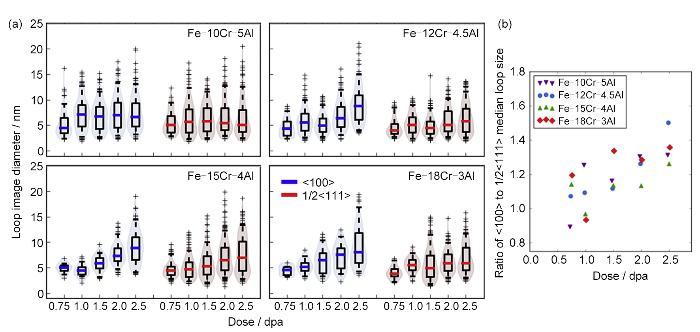
... 位错环密度和不同种类位错环的占比受合金成分影响.Cr含量越高,位错环密度越高,同时a<100>位错环占比也越高[79,123],如图6[121]所示.然而,离子辐照(Fe2+、300 ℃、16 dpa)实验[124]表明,a<100>位错环占比随Cr含量增加而下降,但考虑到离子辐照与中子辐照的差异,本文以中子辐照实验结果为准.Al元素对位错环密度的影响,目前尚无一致结论.Zhou等[78]对离子辐照FeCrAl合金((0~8%)Al)的研究表明,Al对位错环有钉扎作用,随着Al含量的增加,位错环尺寸减小而数量密度上升;当Al含量为4%时a<100>位错环占比最大.其他微量元素对位错环的演化也存在一定影响,合金中添加Y元素能提高a<100>位错环占比,同时Y还能够减少α′相的析出,降低硬化速率[125].当Nb含量为0~1.2%时,a<100>位错环占比先上升后下降,并在Nb含量为0.8%时达到最大[126]. ...
Improved irradiation resistance of accident-tolerant high-strength FeCrAl alloys with heterogeneous structures
6
2022
... Cr与Al元素的协同作用是FeCrAl合金在蒸汽环境中保持良好抗氧化性能的原因,Cr的“第三元素效应”使合金在较低的Al含量下仍能生成α-Al2O3保护性氧化膜.在Al含量较低的FeCrAl合金中,Cr使得Al的氧化方式由内氧化转变为外氧化,氧化过程中生成的α-Cr2O3促进α-Al2O3形核;但当Al含量较高时,Cr的这种作用不再显著[68,69].Al含量越低,在高温蒸汽环境中形成保护性α-Al2O3氧化膜所需要的Cr含量越高[9,70~73].Yamamoto等[9]结合Pint等[74]的腐蚀实验数据,总结出了能够保证FeCrAl合金具有良好抗高温氧化能力的Cr、Al元素组合,如图4[9]所示.Pint等[75]还发现,随着合金中Cr、Al含量的增加,合金的最高使用温度也随之上升.然而,Cr含量过高易导致合金在温度约300 ℃的辐照环境中产生富Cr的α′相,引起材料脆化,因此Cr含量通常应被控制在15%以下.Chen等[76]研究表明,合金中的Cr含量应高于7%,否则在高温蒸汽环境下合金表面不能生成Al2O3保护性氧化膜.过低的Al含量(1%~3%)难以支持合金形成连续致密的α-Al2O3氧化膜,过高的Al含量(> 6%)可能导致合金的韧脆转变温度升高,同时影响材料的加工制造和焊接性能[9,77].此外,当Al含量达到4%时,辐照位错环的形成受到显著抑制,缓解了材料的辐照硬化[78],并且随着Al含量增加,中子辐照后析出的α′相的体积分数也相应减少,缓解了材料的辐照脆化[79].因此,通常应将Al含量控制在4%~6%. ...
... 位错环密度和不同种类位错环的占比受合金成分影响.Cr含量越高,位错环密度越高,同时a<100>位错环占比也越高[79,123],如图6[121]所示.然而,离子辐照(Fe2+、300 ℃、16 dpa)实验[124]表明,a<100>位错环占比随Cr含量增加而下降,但考虑到离子辐照与中子辐照的差异,本文以中子辐照实验结果为准.Al元素对位错环密度的影响,目前尚无一致结论.Zhou等[78]对离子辐照FeCrAl合金((0~8%)Al)的研究表明,Al对位错环有钉扎作用,随着Al含量的增加,位错环尺寸减小而数量密度上升;当Al含量为4%时a<100>位错环占比最大.其他微量元素对位错环的演化也存在一定影响,合金中添加Y元素能提高a<100>位错环占比,同时Y还能够减少α′相的析出,降低硬化速率[125].当Nb含量为0~1.2%时,a<100>位错环占比先上升后下降,并在Nb含量为0.8%时达到最大[126]. ...
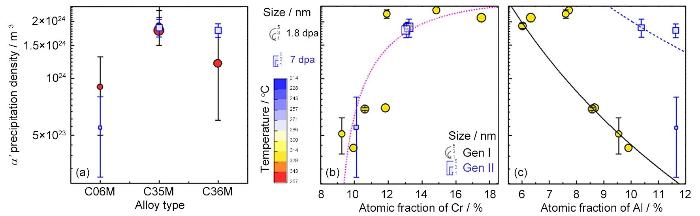
... 中子辐照后,FeCrAl合金中析出富Cr的α′相,导致合金硬化和脆化,成为限制FeCrAl合金在反应堆内使用寿命的关键因素之一.在475 ℃以下,Cr含量高于9% (原子分数,下同)的Fe-Cr二元合金会在热老化过程中出现低温稳定的脆性α′相[133,134].在热老化过程中,α′相缓慢析出,而中子辐照能够促进α′相在更低温度和更低Cr含量的条件下析出.随着辐照剂量的增加,α′相的数量密度呈现先增大后减小的趋势,其体积分数和尺寸均呈抛物线型增长,最终趋于平稳[135].目前,对辐照条件下FeCrAl合金中α′相的析出行为已经有较为系统的研究.合金的成分、微观组织和辐照参数均显著影响α′相的析出行为.合金中的Cr含量对α′相的形成产生较大影响,中子辐照后,α′相的体积分数和数量密度都随Cr含量的升高而增加;而Al元素则能降低α′相的稳定性,并减少其中Cr的含量[135].然而,当Cr含量高于10%时,即使Al含量高达9.3%,合金中仍能析出α′相[136~139].随辐照剂量增加,α′相发生粗化,其数量密度降低、平均尺寸增大.图7[79]展示了第二代核级FeCrAl合金的α′相数量密度及其与Cr、Al元素含量的关系.可见,在中子辐照剂量为7 dpa的条件下,α′相的数量密度随Cr含量的上升而增加,随Al含量的增加而降低. ...
... [
79]
Number densities of <i>α</i>ʹ precipitate densities for each Gen II type FeCrAl alloy (a) and as a function of Cr (b) and Al (c) contents in FeCrAl alloys after radiation at 7 dpa<sup>[<xref ref-type="bibr" rid="R79">79</xref>]</sup>Fig.7![]()
为提高FeCrAl合金的高温强度和耐辐照性能而添加的纳米氧化颗粒,同样会影响α′相的析出行为.纳米氧化颗粒/基体界面为缺陷的强吸收陷阱,能降低辐照过程中产生的缺陷密度,从而降低α′相的析出速率.Massey等[140]研究表明,ODS-FeCrAl合金中α′相的数量密度比非ODS合金低1个数量级.Field等[141]还发现,在中子辐照FeCrAl合金中,晶界附近α′相的数量密度比晶粒内部低,进一步证实缺陷陷阱具有抑制α′相析出的作用.研究[79]表明,α′相具有抑制位错环形核的作用,从而降低位错环的数量密度. ...
... [
79]
Fig.7![]()
为提高FeCrAl合金的高温强度和耐辐照性能而添加的纳米氧化颗粒,同样会影响α′相的析出行为.纳米氧化颗粒/基体界面为缺陷的强吸收陷阱,能降低辐照过程中产生的缺陷密度,从而降低α′相的析出速率.Massey等[140]研究表明,ODS-FeCrAl合金中α′相的数量密度比非ODS合金低1个数量级.Field等[141]还发现,在中子辐照FeCrAl合金中,晶界附近α′相的数量密度比晶粒内部低,进一步证实缺陷陷阱具有抑制α′相析出的作用.研究[79]表明,α′相具有抑制位错环形核的作用,从而降低位错环的数量密度. ...
... 为提高FeCrAl合金的高温强度和耐辐照性能而添加的纳米氧化颗粒,同样会影响α′相的析出行为.纳米氧化颗粒/基体界面为缺陷的强吸收陷阱,能降低辐照过程中产生的缺陷密度,从而降低α′相的析出速率.Massey等[140]研究表明,ODS-FeCrAl合金中α′相的数量密度比非ODS合金低1个数量级.Field等[141]还发现,在中子辐照FeCrAl合金中,晶界附近α′相的数量密度比晶粒内部低,进一步证实缺陷陷阱具有抑制α′相析出的作用.研究[79]表明,α′相具有抑制位错环形核的作用,从而降低位错环的数量密度. ...
Current thoughts on reactive element effects in alumina-forming systems: In memory of John Stringer
4
2016
... 添加微量合金元素同样能够影响FeCrAl合金的氧化行为,如添加活性元素Y、La、Ce、Gd;IVA族元素Ti、Zr、Hf;II族元素Ca、Mg;其他元素Mo、Nb、Pt、Si等[40,51,56,65,67,80~97].与不含稀土元素的FeCrAl合金相比,Y和Gd能够降低合金氧化膜的生长速率,改善氧化膜在基体上的附着强度,提高合金的耐腐蚀性能.这可能是因为Y和Gd在α-Al2O3氧化物晶界偏析,从而抑制Al3+向外扩散,降低O元素的扩散速率,并使O元素的向内扩散成为合金的主要氧化方式.该过程使α-Al2O3的生长速率和内部应力降低,从而抑制了氧化物和基体界面孔洞的形成[80~83,86,87].但过量Y会导致“过渡掺杂”效应,使得合金晶粒严重细化并在晶界处形成大量的网状Y3Al5O12.图5[86]为含Y的FeCrAl合金在1200 ℃蒸汽环境中氧化行为随时间和Y含量变化的示意图.O元素更易沿着网状Y3Al5O12扩散,导致合金发生内氧化,减弱Y的有益作用[86].因此,存在一个最佳的Y添加量,保证FeCrAl合金具有最优的性能.Y的最优添加量受多种因素影响,如Y的添加形式(金属、氧化物)、合金加工方式、合金内其他微量化学成分及含量等.多数情况下,Y含量应控制在0.2%以下.此外,La有助于改善Al2O3氧化膜的结构,使其结构更稳定、表面积更大[98].综上所述,FeCrAl合金中添加的稀土元素主要通过以下三种方式提高合金的抗高温蒸汽氧化能力:(1) 稀土元素促进Al2O3氧化膜的形成,降低氧化物与基体界面的氧分压,抑制非稳定态Al2O3氧化膜的形成;(2) 稀土元素倾向于在晶界和氧化膜/基体界面偏析,阻碍元素的扩散,降低氧化膜的生长速率和生长应力;(3) 稀土元素防止氧化膜/基体界面产生孔洞等缺陷,提高氧化膜的附着能力,同时改善氧化膜的塑性,降低氧化膜的生长应力和热应力. ...
... [80~83,86,87].但过量Y会导致“过渡掺杂”效应,使得合金晶粒严重细化并在晶界处形成大量的网状Y3Al5O12.图5[86]为含Y的FeCrAl合金在1200 ℃蒸汽环境中氧化行为随时间和Y含量变化的示意图.O元素更易沿着网状Y3Al5O12扩散,导致合金发生内氧化,减弱Y的有益作用[86].因此,存在一个最佳的Y添加量,保证FeCrAl合金具有最优的性能.Y的最优添加量受多种因素影响,如Y的添加形式(金属、氧化物)、合金加工方式、合金内其他微量化学成分及含量等.多数情况下,Y含量应控制在0.2%以下.此外,La有助于改善Al2O3氧化膜的结构,使其结构更稳定、表面积更大[98].综上所述,FeCrAl合金中添加的稀土元素主要通过以下三种方式提高合金的抗高温蒸汽氧化能力:(1) 稀土元素促进Al2O3氧化膜的形成,降低氧化物与基体界面的氧分压,抑制非稳定态Al2O3氧化膜的形成;(2) 稀土元素倾向于在晶界和氧化膜/基体界面偏析,阻碍元素的扩散,降低氧化膜的生长速率和生长应力;(3) 稀土元素防止氧化膜/基体界面产生孔洞等缺陷,提高氧化膜的附着能力,同时改善氧化膜的塑性,降低氧化膜的生长应力和热应力. ...
... 通常,通过向ODS-FeCrAl合金中添加Zr、Hf、Ti等元素,以减小氧化物颗粒尺寸、提高其弥散性和稳定性,进而增强合金的力学性能[62,67,99~104].在高温蒸汽环境中,添加Zr、Hf元素不仅显著改善了氧化膜的附着性,还影响了氧化膜形貌.Zr、Hf具有高亲氧性,在高温氧化初期,它们在α-Al2O3晶界处偏析,阻止Al元素向外扩散,同时抑制含Y氧化物的形成[80,92].随着腐蚀时间的延长,在晶界处偏析的Zr、Hf元素被氧化形成ZrO2和HfO2.ZrO2的形成有助于减小α-Al2O3氧化物的晶粒尺寸,增加O元素向内扩散的快速通道,提高氧化膜的生长速率[105].Hf元素进入α-Al2O3的机理与Zr类似,Hf的内氧化速率低于其被包裹进α-Al2O3氧化膜的速率,这是因为与Zr元素相比,Hf在FeCrAl合金中的移动性更低.此外,与ZrO2不同,HfO2未引起氧化膜的加速生长.与Zr、Hf元素不同,只有极少量的Ti在晶界偏析,由于TiO2的热力学稳定性低于Al2O3,Ti未在内部发生氧化.Ti元素快速从基体扩散至氧化膜/气体界面(钛离子的尺寸相对较小),并在α-Al2O3表面被氧化生成TiO2.与不含Ti元素的FeCrAl合金相比,含TiFeCrAl合金表面的柱状α-Al2O3氧化物晶粒上层出现一层小尺寸的等轴晶,其尺寸随腐蚀时间的增加而增大[91].外层等轴晶的形成与Al元素的向外扩散速率增加有关,这表明含Ti的FeCrAl合金的高温氧化速率高于不含Ti合金.Kim等[85]认为,氧化膜表面的TiO2促进水分解成H+和OH-.OH-的扩散速率大于O2-,能够促进O空位的形成,引起氧化膜中孔洞数量的上升,加速Al与Ti的扩散.然而,在1300 ℃时Ti对合金耐腐蚀效果的改善并不显著,这可能与在更高温度下Al2O3晶粒尺寸长大且Y的偏析抑制Ti的向外扩散有关.以TiC、TiN、ZrC、ZrN等纳米颗粒形式加入FeCrAl合金中的Ti、Zr等元素,虽然可以细化晶粒并提高合金力学性能[106~109],但会影响FeCrAl合金的氧化行为.随着合金表面Al2O3氧化膜的生长,碳化物/氮化物镶嵌于氧化膜中.最初,这些碳化物/氮化物无明显的负面作用,但随着腐蚀时间的增加,碳化物被氧化成CO,使得局部压力升高并引起微裂纹的形成,O元素扩散加速,最终导致合金的氧化速率提高[80]. ...
... [80]. ...
Oxide adherence of Fe-20Cr-4Al alloys with small amounts of sulfur and reactive elements (Y, Hf)
0
2000
The influence of yttrium additions on the oxide-scale adhesion to an iron-chromium-aluminum alloy
0
1976
New insights into the mechanism of yttrium changing high-temperature oxide growth of Fe-13Cr-6Al-2Mo-0.5Nb alloy for fuel cladding
1
2020
... 添加微量合金元素同样能够影响FeCrAl合金的氧化行为,如添加活性元素Y、La、Ce、Gd;IVA族元素Ti、Zr、Hf;II族元素Ca、Mg;其他元素Mo、Nb、Pt、Si等[40,51,56,65,67,80~97].与不含稀土元素的FeCrAl合金相比,Y和Gd能够降低合金氧化膜的生长速率,改善氧化膜在基体上的附着强度,提高合金的耐腐蚀性能.这可能是因为Y和Gd在α-Al2O3氧化物晶界偏析,从而抑制Al3+向外扩散,降低O元素的扩散速率,并使O元素的向内扩散成为合金的主要氧化方式.该过程使α-Al2O3的生长速率和内部应力降低,从而抑制了氧化物和基体界面孔洞的形成[80~83,86,87].但过量Y会导致“过渡掺杂”效应,使得合金晶粒严重细化并在晶界处形成大量的网状Y3Al5O12.图5[86]为含Y的FeCrAl合金在1200 ℃蒸汽环境中氧化行为随时间和Y含量变化的示意图.O元素更易沿着网状Y3Al5O12扩散,导致合金发生内氧化,减弱Y的有益作用[86].因此,存在一个最佳的Y添加量,保证FeCrAl合金具有最优的性能.Y的最优添加量受多种因素影响,如Y的添加形式(金属、氧化物)、合金加工方式、合金内其他微量化学成分及含量等.多数情况下,Y含量应控制在0.2%以下.此外,La有助于改善Al2O3氧化膜的结构,使其结构更稳定、表面积更大[98].综上所述,FeCrAl合金中添加的稀土元素主要通过以下三种方式提高合金的抗高温蒸汽氧化能力:(1) 稀土元素促进Al2O3氧化膜的形成,降低氧化物与基体界面的氧分压,抑制非稳定态Al2O3氧化膜的形成;(2) 稀土元素倾向于在晶界和氧化膜/基体界面偏析,阻碍元素的扩散,降低氧化膜的生长速率和生长应力;(3) 稀土元素防止氧化膜/基体界面产生孔洞等缺陷,提高氧化膜的附着能力,同时改善氧化膜的塑性,降低氧化膜的生长应力和热应力. ...
Development of nano-oxide particles dispersed alumina scale formed on Zr-added FeCrAl ODS ferritic alloys
0
2020
High-temperature steam oxidation of (Ti, Mo)C-forming FeCrAlY alloy
1
2023
... 通常,通过向ODS-FeCrAl合金中添加Zr、Hf、Ti等元素,以减小氧化物颗粒尺寸、提高其弥散性和稳定性,进而增强合金的力学性能[62,67,99~104].在高温蒸汽环境中,添加Zr、Hf元素不仅显著改善了氧化膜的附着性,还影响了氧化膜形貌.Zr、Hf具有高亲氧性,在高温氧化初期,它们在α-Al2O3晶界处偏析,阻止Al元素向外扩散,同时抑制含Y氧化物的形成[80,92].随着腐蚀时间的延长,在晶界处偏析的Zr、Hf元素被氧化形成ZrO2和HfO2.ZrO2的形成有助于减小α-Al2O3氧化物的晶粒尺寸,增加O元素向内扩散的快速通道,提高氧化膜的生长速率[105].Hf元素进入α-Al2O3的机理与Zr类似,Hf的内氧化速率低于其被包裹进α-Al2O3氧化膜的速率,这是因为与Zr元素相比,Hf在FeCrAl合金中的移动性更低.此外,与ZrO2不同,HfO2未引起氧化膜的加速生长.与Zr、Hf元素不同,只有极少量的Ti在晶界偏析,由于TiO2的热力学稳定性低于Al2O3,Ti未在内部发生氧化.Ti元素快速从基体扩散至氧化膜/气体界面(钛离子的尺寸相对较小),并在α-Al2O3表面被氧化生成TiO2.与不含Ti元素的FeCrAl合金相比,含TiFeCrAl合金表面的柱状α-Al2O3氧化物晶粒上层出现一层小尺寸的等轴晶,其尺寸随腐蚀时间的增加而增大[91].外层等轴晶的形成与Al元素的向外扩散速率增加有关,这表明含Ti的FeCrAl合金的高温氧化速率高于不含Ti合金.Kim等[85]认为,氧化膜表面的TiO2促进水分解成H+和OH-.OH-的扩散速率大于O2-,能够促进O空位的形成,引起氧化膜中孔洞数量的上升,加速Al与Ti的扩散.然而,在1300 ℃时Ti对合金耐腐蚀效果的改善并不显著,这可能与在更高温度下Al2O3晶粒尺寸长大且Y的偏析抑制Ti的向外扩散有关.以TiC、TiN、ZrC、ZrN等纳米颗粒形式加入FeCrAl合金中的Ti、Zr等元素,虽然可以细化晶粒并提高合金力学性能[106~109],但会影响FeCrAl合金的氧化行为.随着合金表面Al2O3氧化膜的生长,碳化物/氮化物镶嵌于氧化膜中.最初,这些碳化物/氮化物无明显的负面作用,但随着腐蚀时间的增加,碳化物被氧化成CO,使得局部压力升高并引起微裂纹的形成,O元素扩散加速,最终导致合金的氧化速率提高[80]. ...
Effects of yttrium on the oxidation behavior of Fe13Cr6AlY alloys under 1200 oC steam
5
2023
... 添加微量合金元素同样能够影响FeCrAl合金的氧化行为,如添加活性元素Y、La、Ce、Gd;IVA族元素Ti、Zr、Hf;II族元素Ca、Mg;其他元素Mo、Nb、Pt、Si等[40,51,56,65,67,80~97].与不含稀土元素的FeCrAl合金相比,Y和Gd能够降低合金氧化膜的生长速率,改善氧化膜在基体上的附着强度,提高合金的耐腐蚀性能.这可能是因为Y和Gd在α-Al2O3氧化物晶界偏析,从而抑制Al3+向外扩散,降低O元素的扩散速率,并使O元素的向内扩散成为合金的主要氧化方式.该过程使α-Al2O3的生长速率和内部应力降低,从而抑制了氧化物和基体界面孔洞的形成[80~83,86,87].但过量Y会导致“过渡掺杂”效应,使得合金晶粒严重细化并在晶界处形成大量的网状Y3Al5O12.图5[86]为含Y的FeCrAl合金在1200 ℃蒸汽环境中氧化行为随时间和Y含量变化的示意图.O元素更易沿着网状Y3Al5O12扩散,导致合金发生内氧化,减弱Y的有益作用[86].因此,存在一个最佳的Y添加量,保证FeCrAl合金具有最优的性能.Y的最优添加量受多种因素影响,如Y的添加形式(金属、氧化物)、合金加工方式、合金内其他微量化学成分及含量等.多数情况下,Y含量应控制在0.2%以下.此外,La有助于改善Al2O3氧化膜的结构,使其结构更稳定、表面积更大[98].综上所述,FeCrAl合金中添加的稀土元素主要通过以下三种方式提高合金的抗高温蒸汽氧化能力:(1) 稀土元素促进Al2O3氧化膜的形成,降低氧化物与基体界面的氧分压,抑制非稳定态Al2O3氧化膜的形成;(2) 稀土元素倾向于在晶界和氧化膜/基体界面偏析,阻碍元素的扩散,降低氧化膜的生长速率和生长应力;(3) 稀土元素防止氧化膜/基体界面产生孔洞等缺陷,提高氧化膜的附着能力,同时改善氧化膜的塑性,降低氧化膜的生长应力和热应力. ...
... [86]为含Y的FeCrAl合金在1200 ℃蒸汽环境中氧化行为随时间和Y含量变化的示意图.O元素更易沿着网状Y3Al5O12扩散,导致合金发生内氧化,减弱Y的有益作用[86].因此,存在一个最佳的Y添加量,保证FeCrAl合金具有最优的性能.Y的最优添加量受多种因素影响,如Y的添加形式(金属、氧化物)、合金加工方式、合金内其他微量化学成分及含量等.多数情况下,Y含量应控制在0.2%以下.此外,La有助于改善Al2O3氧化膜的结构,使其结构更稳定、表面积更大[98].综上所述,FeCrAl合金中添加的稀土元素主要通过以下三种方式提高合金的抗高温蒸汽氧化能力:(1) 稀土元素促进Al2O3氧化膜的形成,降低氧化物与基体界面的氧分压,抑制非稳定态Al2O3氧化膜的形成;(2) 稀土元素倾向于在晶界和氧化膜/基体界面偏析,阻碍元素的扩散,降低氧化膜的生长速率和生长应力;(3) 稀土元素防止氧化膜/基体界面产生孔洞等缺陷,提高氧化膜的附着能力,同时改善氧化膜的塑性,降低氧化膜的生长应力和热应力. ...
... [86].因此,存在一个最佳的Y添加量,保证FeCrAl合金具有最优的性能.Y的最优添加量受多种因素影响,如Y的添加形式(金属、氧化物)、合金加工方式、合金内其他微量化学成分及含量等.多数情况下,Y含量应控制在0.2%以下.此外,La有助于改善Al2O3氧化膜的结构,使其结构更稳定、表面积更大[98].综上所述,FeCrAl合金中添加的稀土元素主要通过以下三种方式提高合金的抗高温蒸汽氧化能力:(1) 稀土元素促进Al2O3氧化膜的形成,降低氧化物与基体界面的氧分压,抑制非稳定态Al2O3氧化膜的形成;(2) 稀土元素倾向于在晶界和氧化膜/基体界面偏析,阻碍元素的扩散,降低氧化膜的生长速率和生长应力;(3) 稀土元素防止氧化膜/基体界面产生孔洞等缺陷,提高氧化膜的附着能力,同时改善氧化膜的塑性,降低氧化膜的生长应力和热应力. ...
... [
86]
Schematics of the oxidation behavior evolutions with time (a) and Y content (b) for Y-containing FeCrAl alloys in a 1200 <sup>o</sup>C steam environment<sup>[<xref ref-type="bibr" rid="R86">86</xref>]</sup>Fig.5![]()
通常,通过向ODS-FeCrAl合金中添加Zr、Hf、Ti等元素,以减小氧化物颗粒尺寸、提高其弥散性和稳定性,进而增强合金的力学性能[62,67,99~104].在高温蒸汽环境中,添加Zr、Hf元素不仅显著改善了氧化膜的附着性,还影响了氧化膜形貌.Zr、Hf具有高亲氧性,在高温氧化初期,它们在α-Al2O3晶界处偏析,阻止Al元素向外扩散,同时抑制含Y氧化物的形成[80,92].随着腐蚀时间的延长,在晶界处偏析的Zr、Hf元素被氧化形成ZrO2和HfO2.ZrO2的形成有助于减小α-Al2O3氧化物的晶粒尺寸,增加O元素向内扩散的快速通道,提高氧化膜的生长速率[105].Hf元素进入α-Al2O3的机理与Zr类似,Hf的内氧化速率低于其被包裹进α-Al2O3氧化膜的速率,这是因为与Zr元素相比,Hf在FeCrAl合金中的移动性更低.此外,与ZrO2不同,HfO2未引起氧化膜的加速生长.与Zr、Hf元素不同,只有极少量的Ti在晶界偏析,由于TiO2的热力学稳定性低于Al2O3,Ti未在内部发生氧化.Ti元素快速从基体扩散至氧化膜/气体界面(钛离子的尺寸相对较小),并在α-Al2O3表面被氧化生成TiO2.与不含Ti元素的FeCrAl合金相比,含TiFeCrAl合金表面的柱状α-Al2O3氧化物晶粒上层出现一层小尺寸的等轴晶,其尺寸随腐蚀时间的增加而增大[91].外层等轴晶的形成与Al元素的向外扩散速率增加有关,这表明含Ti的FeCrAl合金的高温氧化速率高于不含Ti合金.Kim等[85]认为,氧化膜表面的TiO2促进水分解成H+和OH-.OH-的扩散速率大于O2-,能够促进O空位的形成,引起氧化膜中孔洞数量的上升,加速Al与Ti的扩散.然而,在1300 ℃时Ti对合金耐腐蚀效果的改善并不显著,这可能与在更高温度下Al2O3晶粒尺寸长大且Y的偏析抑制Ti的向外扩散有关.以TiC、TiN、ZrC、ZrN等纳米颗粒形式加入FeCrAl合金中的Ti、Zr等元素,虽然可以细化晶粒并提高合金力学性能[106~109],但会影响FeCrAl合金的氧化行为.随着合金表面Al2O3氧化膜的生长,碳化物/氮化物镶嵌于氧化膜中.最初,这些碳化物/氮化物无明显的负面作用,但随着腐蚀时间的增加,碳化物被氧化成CO,使得局部压力升高并引起微裂纹的形成,O元素扩散加速,最终导致合金的氧化速率提高[80]. ...
... [
86]
Fig.5![]()
通常,通过向ODS-FeCrAl合金中添加Zr、Hf、Ti等元素,以减小氧化物颗粒尺寸、提高其弥散性和稳定性,进而增强合金的力学性能[62,67,99~104].在高温蒸汽环境中,添加Zr、Hf元素不仅显著改善了氧化膜的附着性,还影响了氧化膜形貌.Zr、Hf具有高亲氧性,在高温氧化初期,它们在α-Al2O3晶界处偏析,阻止Al元素向外扩散,同时抑制含Y氧化物的形成[80,92].随着腐蚀时间的延长,在晶界处偏析的Zr、Hf元素被氧化形成ZrO2和HfO2.ZrO2的形成有助于减小α-Al2O3氧化物的晶粒尺寸,增加O元素向内扩散的快速通道,提高氧化膜的生长速率[105].Hf元素进入α-Al2O3的机理与Zr类似,Hf的内氧化速率低于其被包裹进α-Al2O3氧化膜的速率,这是因为与Zr元素相比,Hf在FeCrAl合金中的移动性更低.此外,与ZrO2不同,HfO2未引起氧化膜的加速生长.与Zr、Hf元素不同,只有极少量的Ti在晶界偏析,由于TiO2的热力学稳定性低于Al2O3,Ti未在内部发生氧化.Ti元素快速从基体扩散至氧化膜/气体界面(钛离子的尺寸相对较小),并在α-Al2O3表面被氧化生成TiO2.与不含Ti元素的FeCrAl合金相比,含TiFeCrAl合金表面的柱状α-Al2O3氧化物晶粒上层出现一层小尺寸的等轴晶,其尺寸随腐蚀时间的增加而增大[91].外层等轴晶的形成与Al元素的向外扩散速率增加有关,这表明含Ti的FeCrAl合金的高温氧化速率高于不含Ti合金.Kim等[85]认为,氧化膜表面的TiO2促进水分解成H+和OH-.OH-的扩散速率大于O2-,能够促进O空位的形成,引起氧化膜中孔洞数量的上升,加速Al与Ti的扩散.然而,在1300 ℃时Ti对合金耐腐蚀效果的改善并不显著,这可能与在更高温度下Al2O3晶粒尺寸长大且Y的偏析抑制Ti的向外扩散有关.以TiC、TiN、ZrC、ZrN等纳米颗粒形式加入FeCrAl合金中的Ti、Zr等元素,虽然可以细化晶粒并提高合金力学性能[106~109],但会影响FeCrAl合金的氧化行为.随着合金表面Al2O3氧化膜的生长,碳化物/氮化物镶嵌于氧化膜中.最初,这些碳化物/氮化物无明显的负面作用,但随着腐蚀时间的增加,碳化物被氧化成CO,使得局部压力升高并引起微裂纹的形成,O元素扩散加速,最终导致合金的氧化速率提高[80]. ...
A study of the oxidation of Gd-doped FeCrAl in 1000 oC steam environments
1
2023
... 添加微量合金元素同样能够影响FeCrAl合金的氧化行为,如添加活性元素Y、La、Ce、Gd;IVA族元素Ti、Zr、Hf;II族元素Ca、Mg;其他元素Mo、Nb、Pt、Si等[40,51,56,65,67,80~97].与不含稀土元素的FeCrAl合金相比,Y和Gd能够降低合金氧化膜的生长速率,改善氧化膜在基体上的附着强度,提高合金的耐腐蚀性能.这可能是因为Y和Gd在α-Al2O3氧化物晶界偏析,从而抑制Al3+向外扩散,降低O元素的扩散速率,并使O元素的向内扩散成为合金的主要氧化方式.该过程使α-Al2O3的生长速率和内部应力降低,从而抑制了氧化物和基体界面孔洞的形成[80~83,86,87].但过量Y会导致“过渡掺杂”效应,使得合金晶粒严重细化并在晶界处形成大量的网状Y3Al5O12.图5[86]为含Y的FeCrAl合金在1200 ℃蒸汽环境中氧化行为随时间和Y含量变化的示意图.O元素更易沿着网状Y3Al5O12扩散,导致合金发生内氧化,减弱Y的有益作用[86].因此,存在一个最佳的Y添加量,保证FeCrAl合金具有最优的性能.Y的最优添加量受多种因素影响,如Y的添加形式(金属、氧化物)、合金加工方式、合金内其他微量化学成分及含量等.多数情况下,Y含量应控制在0.2%以下.此外,La有助于改善Al2O3氧化膜的结构,使其结构更稳定、表面积更大[98].综上所述,FeCrAl合金中添加的稀土元素主要通过以下三种方式提高合金的抗高温蒸汽氧化能力:(1) 稀土元素促进Al2O3氧化膜的形成,降低氧化物与基体界面的氧分压,抑制非稳定态Al2O3氧化膜的形成;(2) 稀土元素倾向于在晶界和氧化膜/基体界面偏析,阻碍元素的扩散,降低氧化膜的生长速率和生长应力;(3) 稀土元素防止氧化膜/基体界面产生孔洞等缺陷,提高氧化膜的附着能力,同时改善氧化膜的塑性,降低氧化膜的生长应力和热应力. ...
Alumina grain growth and grain boundary segregation of FeCrAl-based oxide dispersion-strengthened alloys at high temperature
0
2022
High-temperature steam oxidation behavior of an FeCrAl alloy with controlled addition of Mo
1
2022
... FeCrAl合金中添加Mo、Nb元素不仅起到固溶强化作用,还可以生成Laves相,使合金晶粒细化,力学性能提高[110~113].MoO3在800 ℃以上的环境中稳定性较差,因此Mo倾向于在内层氧化物中富集.氧化初期,Mo促进Al扩散,导致合金在氧化初期的增重速率较高,但随着腐蚀时间延长,合金的增重速率降低[89].然而,也有研究[97]表明,合金中添加Mo元素会对FeCrAl合金耐高温蒸汽腐蚀性能产生负面影响.对于Mo元素的真正影响,需要更多的实验结果来验证.不同温度下Nb元素对高温蒸汽腐蚀的影响机制不同,在1200 ℃的高温蒸汽环境中,Nb元素不仅导致合金的增重速率增加,还引起氧化膜的剥落,严重降低合金的耐腐蚀性能[114].Zhang等[90]研究表明,在500 ℃的高温蒸汽环境中,Nb元素通过抑制Al的内氧化,促进均匀连续的富Al氧化膜的形成,从而提高合金的耐腐蚀性能[54,115].综合考虑Nb对合金力学性能的增强作用以及对高温蒸汽中耐腐蚀性能的影响,建议将FeCrAl合金中Nb含量控制在0.5%左右.Pt元素能显著降低FeCrAl合金的增重速率,并且提高氧化膜的附着性[116,117].其他元素(如C、N、O、Ni、W、Ta、V等)对合金耐高温蒸汽腐蚀性能的影响可参考文献[19]. ...
Oxidation characteristics of Fe22Cr5Al3Mo-xNb alloys in high temperature steam
1
2021
... FeCrAl合金中添加Mo、Nb元素不仅起到固溶强化作用,还可以生成Laves相,使合金晶粒细化,力学性能提高[110~113].MoO3在800 ℃以上的环境中稳定性较差,因此Mo倾向于在内层氧化物中富集.氧化初期,Mo促进Al扩散,导致合金在氧化初期的增重速率较高,但随着腐蚀时间延长,合金的增重速率降低[89].然而,也有研究[97]表明,合金中添加Mo元素会对FeCrAl合金耐高温蒸汽腐蚀性能产生负面影响.对于Mo元素的真正影响,需要更多的实验结果来验证.不同温度下Nb元素对高温蒸汽腐蚀的影响机制不同,在1200 ℃的高温蒸汽环境中,Nb元素不仅导致合金的增重速率增加,还引起氧化膜的剥落,严重降低合金的耐腐蚀性能[114].Zhang等[90]研究表明,在500 ℃的高温蒸汽环境中,Nb元素通过抑制Al的内氧化,促进均匀连续的富Al氧化膜的形成,从而提高合金的耐腐蚀性能[54,115].综合考虑Nb对合金力学性能的增强作用以及对高温蒸汽中耐腐蚀性能的影响,建议将FeCrAl合金中Nb含量控制在0.5%左右.Pt元素能显著降低FeCrAl合金的增重速率,并且提高氧化膜的附着性[116,117].其他元素(如C、N、O、Ni、W、Ta、V等)对合金耐高温蒸汽腐蚀性能的影响可参考文献[19]. ...
Effect of titanium addition on alumina growth mechanism on yttria-containing FeCrAl-base alloy
1
2018
... 通常,通过向ODS-FeCrAl合金中添加Zr、Hf、Ti等元素,以减小氧化物颗粒尺寸、提高其弥散性和稳定性,进而增强合金的力学性能[62,67,99~104].在高温蒸汽环境中,添加Zr、Hf元素不仅显著改善了氧化膜的附着性,还影响了氧化膜形貌.Zr、Hf具有高亲氧性,在高温氧化初期,它们在α-Al2O3晶界处偏析,阻止Al元素向外扩散,同时抑制含Y氧化物的形成[80,92].随着腐蚀时间的延长,在晶界处偏析的Zr、Hf元素被氧化形成ZrO2和HfO2.ZrO2的形成有助于减小α-Al2O3氧化物的晶粒尺寸,增加O元素向内扩散的快速通道,提高氧化膜的生长速率[105].Hf元素进入α-Al2O3的机理与Zr类似,Hf的内氧化速率低于其被包裹进α-Al2O3氧化膜的速率,这是因为与Zr元素相比,Hf在FeCrAl合金中的移动性更低.此外,与ZrO2不同,HfO2未引起氧化膜的加速生长.与Zr、Hf元素不同,只有极少量的Ti在晶界偏析,由于TiO2的热力学稳定性低于Al2O3,Ti未在内部发生氧化.Ti元素快速从基体扩散至氧化膜/气体界面(钛离子的尺寸相对较小),并在α-Al2O3表面被氧化生成TiO2.与不含Ti元素的FeCrAl合金相比,含TiFeCrAl合金表面的柱状α-Al2O3氧化物晶粒上层出现一层小尺寸的等轴晶,其尺寸随腐蚀时间的增加而增大[91].外层等轴晶的形成与Al元素的向外扩散速率增加有关,这表明含Ti的FeCrAl合金的高温氧化速率高于不含Ti合金.Kim等[85]认为,氧化膜表面的TiO2促进水分解成H+和OH-.OH-的扩散速率大于O2-,能够促进O空位的形成,引起氧化膜中孔洞数量的上升,加速Al与Ti的扩散.然而,在1300 ℃时Ti对合金耐腐蚀效果的改善并不显著,这可能与在更高温度下Al2O3晶粒尺寸长大且Y的偏析抑制Ti的向外扩散有关.以TiC、TiN、ZrC、ZrN等纳米颗粒形式加入FeCrAl合金中的Ti、Zr等元素,虽然可以细化晶粒并提高合金力学性能[106~109],但会影响FeCrAl合金的氧化行为.随着合金表面Al2O3氧化膜的生长,碳化物/氮化物镶嵌于氧化膜中.最初,这些碳化物/氮化物无明显的负面作用,但随着腐蚀时间的增加,碳化物被氧化成CO,使得局部压力升高并引起微裂纹的形成,O元素扩散加速,最终导致合金的氧化速率提高[80]. ...
Effect of Zr on initial oxidation behavior of FeCrAl alloys
1
2020
... 通常,通过向ODS-FeCrAl合金中添加Zr、Hf、Ti等元素,以减小氧化物颗粒尺寸、提高其弥散性和稳定性,进而增强合金的力学性能[62,67,99~104].在高温蒸汽环境中,添加Zr、Hf元素不仅显著改善了氧化膜的附着性,还影响了氧化膜形貌.Zr、Hf具有高亲氧性,在高温氧化初期,它们在α-Al2O3晶界处偏析,阻止Al元素向外扩散,同时抑制含Y氧化物的形成[80,92].随着腐蚀时间的延长,在晶界处偏析的Zr、Hf元素被氧化形成ZrO2和HfO2.ZrO2的形成有助于减小α-Al2O3氧化物的晶粒尺寸,增加O元素向内扩散的快速通道,提高氧化膜的生长速率[105].Hf元素进入α-Al2O3的机理与Zr类似,Hf的内氧化速率低于其被包裹进α-Al2O3氧化膜的速率,这是因为与Zr元素相比,Hf在FeCrAl合金中的移动性更低.此外,与ZrO2不同,HfO2未引起氧化膜的加速生长.与Zr、Hf元素不同,只有极少量的Ti在晶界偏析,由于TiO2的热力学稳定性低于Al2O3,Ti未在内部发生氧化.Ti元素快速从基体扩散至氧化膜/气体界面(钛离子的尺寸相对较小),并在α-Al2O3表面被氧化生成TiO2.与不含Ti元素的FeCrAl合金相比,含TiFeCrAl合金表面的柱状α-Al2O3氧化物晶粒上层出现一层小尺寸的等轴晶,其尺寸随腐蚀时间的增加而增大[91].外层等轴晶的形成与Al元素的向外扩散速率增加有关,这表明含Ti的FeCrAl合金的高温氧化速率高于不含Ti合金.Kim等[85]认为,氧化膜表面的TiO2促进水分解成H+和OH-.OH-的扩散速率大于O2-,能够促进O空位的形成,引起氧化膜中孔洞数量的上升,加速Al与Ti的扩散.然而,在1300 ℃时Ti对合金耐腐蚀效果的改善并不显著,这可能与在更高温度下Al2O3晶粒尺寸长大且Y的偏析抑制Ti的向外扩散有关.以TiC、TiN、ZrC、ZrN等纳米颗粒形式加入FeCrAl合金中的Ti、Zr等元素,虽然可以细化晶粒并提高合金力学性能[106~109],但会影响FeCrAl合金的氧化行为.随着合金表面Al2O3氧化膜的生长,碳化物/氮化物镶嵌于氧化膜中.最初,这些碳化物/氮化物无明显的负面作用,但随着腐蚀时间的增加,碳化物被氧化成CO,使得局部压力升高并引起微裂纹的形成,O元素扩散加速,最终导致合金的氧化速率提高[80]. ...
Adherence behavior of oxide grown in air and synthetic exhaust gas on Fe-Cr-Al alloys containing strong sulfide-forming elements: Ca, Mg, Y, Ce, La, Ti, and Zr
0
1993
Development of accident tolerant FeCrAl-ODS steels utilizing Ce-oxide particles dispersion
1
2018
... 为进一步提高FeCrAl合金的高温力学性能和抗辐照损伤性能,通常采用外加或原位生成的方式在合金中引入增强颗粒,其主要为氧化物颗粒和碳化物颗粒.位错在移动时会绕过这些颗粒,通过Orowan强化机制提高合金的力学性能;颗粒与界面之间是辐照缺陷的强吸收陷阱,能够提高空位和间隙原子的复合湮灭概率,增强合金的抗辐照损伤性能[148,149].氧化物颗粒主要采用活性元素Y的氧化物Y2O3作为增强相.但在FeCrAl合金中,Al容易与Y2O3反应生成Y-Al-O颗粒.Y-Al-O颗粒主要包含钙钛矿相YAlO3 (YAP)、石榴石相Y3Al5O12 (YAG)、单斜相Y4Al2O9 (YAM)和六方亚稳相YAlO3 (YAH)四种结构[9,150].其中,具有YAG结构与YAP结构的第二相粒子尺寸较大,通常为几十到上百纳米,导致FeCrAl合金内部弥散颗粒体系平均尺寸变大、数量密度降低,降低了合金的力学性能和抗辐照损伤能力.随着Y∶Al原子配比的增加,颗粒尺寸呈减小趋势[104].其他降低纳米氧化物颗粒尺寸的方法主要包括:添加Zr、Hf等元素以促使基体中析出细小的Y-Zr-O和Y-Hf-O相代替粗大的Y-Al-O颗粒[151];直接使用更细小的氧化物(如Ce2O3)代替Y2O3作为增强相[94].碳化物类颗粒主要包括TiC和ZrC.其中纳米ZrC具有稳定性高且难以与Al发生化学反应、中子截面低、硬度高、弥散界面多、熔点高(约3540 ℃,远高于TiC和Y2O3)等优势,是理想的增强合金高温力学性能和抗辐照损伤的强化相. ...
Initial oxidation mechanism of FeCrAl thin films with Nb and Si additions
0
2023
Effect of trace Y on mechanical and oxidation properties of FeCrAl alloy cladding
0
2023
微量Y对FeCrAl合金包壳力学与氧化性能的影响
0
2023
Effect of molybdenum on the oxidation resistance of FeCrAl alloy in lower temperature (400 oC) and higher temperature (1200 oC) steam environments
2
2024
... 添加微量合金元素同样能够影响FeCrAl合金的氧化行为,如添加活性元素Y、La、Ce、Gd;IVA族元素Ti、Zr、Hf;II族元素Ca、Mg;其他元素Mo、Nb、Pt、Si等[40,51,56,65,67,80~97].与不含稀土元素的FeCrAl合金相比,Y和Gd能够降低合金氧化膜的生长速率,改善氧化膜在基体上的附着强度,提高合金的耐腐蚀性能.这可能是因为Y和Gd在α-Al2O3氧化物晶界偏析,从而抑制Al3+向外扩散,降低O元素的扩散速率,并使O元素的向内扩散成为合金的主要氧化方式.该过程使α-Al2O3的生长速率和内部应力降低,从而抑制了氧化物和基体界面孔洞的形成[80~83,86,87].但过量Y会导致“过渡掺杂”效应,使得合金晶粒严重细化并在晶界处形成大量的网状Y3Al5O12.图5[86]为含Y的FeCrAl合金在1200 ℃蒸汽环境中氧化行为随时间和Y含量变化的示意图.O元素更易沿着网状Y3Al5O12扩散,导致合金发生内氧化,减弱Y的有益作用[86].因此,存在一个最佳的Y添加量,保证FeCrAl合金具有最优的性能.Y的最优添加量受多种因素影响,如Y的添加形式(金属、氧化物)、合金加工方式、合金内其他微量化学成分及含量等.多数情况下,Y含量应控制在0.2%以下.此外,La有助于改善Al2O3氧化膜的结构,使其结构更稳定、表面积更大[98].综上所述,FeCrAl合金中添加的稀土元素主要通过以下三种方式提高合金的抗高温蒸汽氧化能力:(1) 稀土元素促进Al2O3氧化膜的形成,降低氧化物与基体界面的氧分压,抑制非稳定态Al2O3氧化膜的形成;(2) 稀土元素倾向于在晶界和氧化膜/基体界面偏析,阻碍元素的扩散,降低氧化膜的生长速率和生长应力;(3) 稀土元素防止氧化膜/基体界面产生孔洞等缺陷,提高氧化膜的附着能力,同时改善氧化膜的塑性,降低氧化膜的生长应力和热应力. ...
... FeCrAl合金中添加Mo、Nb元素不仅起到固溶强化作用,还可以生成Laves相,使合金晶粒细化,力学性能提高[110~113].MoO3在800 ℃以上的环境中稳定性较差,因此Mo倾向于在内层氧化物中富集.氧化初期,Mo促进Al扩散,导致合金在氧化初期的增重速率较高,但随着腐蚀时间延长,合金的增重速率降低[89].然而,也有研究[97]表明,合金中添加Mo元素会对FeCrAl合金耐高温蒸汽腐蚀性能产生负面影响.对于Mo元素的真正影响,需要更多的实验结果来验证.不同温度下Nb元素对高温蒸汽腐蚀的影响机制不同,在1200 ℃的高温蒸汽环境中,Nb元素不仅导致合金的增重速率增加,还引起氧化膜的剥落,严重降低合金的耐腐蚀性能[114].Zhang等[90]研究表明,在500 ℃的高温蒸汽环境中,Nb元素通过抑制Al的内氧化,促进均匀连续的富Al氧化膜的形成,从而提高合金的耐腐蚀性能[54,115].综合考虑Nb对合金力学性能的增强作用以及对高温蒸汽中耐腐蚀性能的影响,建议将FeCrAl合金中Nb含量控制在0.5%左右.Pt元素能显著降低FeCrAl合金的增重速率,并且提高氧化膜的附着性[116,117].其他元素(如C、N、O、Ni、W、Ta、V等)对合金耐高温蒸汽腐蚀性能的影响可参考文献[19]. ...
Effect of La modification on the stability of coating alumina layer on FeCrAl alloy substrate
1
2015
... 添加微量合金元素同样能够影响FeCrAl合金的氧化行为,如添加活性元素Y、La、Ce、Gd;IVA族元素Ti、Zr、Hf;II族元素Ca、Mg;其他元素Mo、Nb、Pt、Si等[40,51,56,65,67,80~97].与不含稀土元素的FeCrAl合金相比,Y和Gd能够降低合金氧化膜的生长速率,改善氧化膜在基体上的附着强度,提高合金的耐腐蚀性能.这可能是因为Y和Gd在α-Al2O3氧化物晶界偏析,从而抑制Al3+向外扩散,降低O元素的扩散速率,并使O元素的向内扩散成为合金的主要氧化方式.该过程使α-Al2O3的生长速率和内部应力降低,从而抑制了氧化物和基体界面孔洞的形成[80~83,86,87].但过量Y会导致“过渡掺杂”效应,使得合金晶粒严重细化并在晶界处形成大量的网状Y3Al5O12.图5[86]为含Y的FeCrAl合金在1200 ℃蒸汽环境中氧化行为随时间和Y含量变化的示意图.O元素更易沿着网状Y3Al5O12扩散,导致合金发生内氧化,减弱Y的有益作用[86].因此,存在一个最佳的Y添加量,保证FeCrAl合金具有最优的性能.Y的最优添加量受多种因素影响,如Y的添加形式(金属、氧化物)、合金加工方式、合金内其他微量化学成分及含量等.多数情况下,Y含量应控制在0.2%以下.此外,La有助于改善Al2O3氧化膜的结构,使其结构更稳定、表面积更大[98].综上所述,FeCrAl合金中添加的稀土元素主要通过以下三种方式提高合金的抗高温蒸汽氧化能力:(1) 稀土元素促进Al2O3氧化膜的形成,降低氧化物与基体界面的氧分压,抑制非稳定态Al2O3氧化膜的形成;(2) 稀土元素倾向于在晶界和氧化膜/基体界面偏析,阻碍元素的扩散,降低氧化膜的生长速率和生长应力;(3) 稀土元素防止氧化膜/基体界面产生孔洞等缺陷,提高氧化膜的附着能力,同时改善氧化膜的塑性,降低氧化膜的生长应力和热应力. ...
The effect of Zr on precipitation in oxide dispersion strengthened FeCrAl alloys
1
2020
... 通常,通过向ODS-FeCrAl合金中添加Zr、Hf、Ti等元素,以减小氧化物颗粒尺寸、提高其弥散性和稳定性,进而增强合金的力学性能[62,67,99~104].在高温蒸汽环境中,添加Zr、Hf元素不仅显著改善了氧化膜的附着性,还影响了氧化膜形貌.Zr、Hf具有高亲氧性,在高温氧化初期,它们在α-Al2O3晶界处偏析,阻止Al元素向外扩散,同时抑制含Y氧化物的形成[80,92].随着腐蚀时间的延长,在晶界处偏析的Zr、Hf元素被氧化形成ZrO2和HfO2.ZrO2的形成有助于减小α-Al2O3氧化物的晶粒尺寸,增加O元素向内扩散的快速通道,提高氧化膜的生长速率[105].Hf元素进入α-Al2O3的机理与Zr类似,Hf的内氧化速率低于其被包裹进α-Al2O3氧化膜的速率,这是因为与Zr元素相比,Hf在FeCrAl合金中的移动性更低.此外,与ZrO2不同,HfO2未引起氧化膜的加速生长.与Zr、Hf元素不同,只有极少量的Ti在晶界偏析,由于TiO2的热力学稳定性低于Al2O3,Ti未在内部发生氧化.Ti元素快速从基体扩散至氧化膜/气体界面(钛离子的尺寸相对较小),并在α-Al2O3表面被氧化生成TiO2.与不含Ti元素的FeCrAl合金相比,含TiFeCrAl合金表面的柱状α-Al2O3氧化物晶粒上层出现一层小尺寸的等轴晶,其尺寸随腐蚀时间的增加而增大[91].外层等轴晶的形成与Al元素的向外扩散速率增加有关,这表明含Ti的FeCrAl合金的高温氧化速率高于不含Ti合金.Kim等[85]认为,氧化膜表面的TiO2促进水分解成H+和OH-.OH-的扩散速率大于O2-,能够促进O空位的形成,引起氧化膜中孔洞数量的上升,加速Al与Ti的扩散.然而,在1300 ℃时Ti对合金耐腐蚀效果的改善并不显著,这可能与在更高温度下Al2O3晶粒尺寸长大且Y的偏析抑制Ti的向外扩散有关.以TiC、TiN、ZrC、ZrN等纳米颗粒形式加入FeCrAl合金中的Ti、Zr等元素,虽然可以细化晶粒并提高合金力学性能[106~109],但会影响FeCrAl合金的氧化行为.随着合金表面Al2O3氧化膜的生长,碳化物/氮化物镶嵌于氧化膜中.最初,这些碳化物/氮化物无明显的负面作用,但随着腐蚀时间的增加,碳化物被氧化成CO,使得局部压力升高并引起微裂纹的形成,O元素扩散加速,最终导致合金的氧化速率提高[80]. ...
Effect of zirconium content on mechanical properties of ODS FeCrAl alloy
0
2022
Effect of Zr addition on the stability of precipitated Laves phase and mechanical properties of Fe-Cr-Al-based alloys at high temperatures
0
2022
Effect of zirconium content on the microstructure of ODS FeCrAl alloys
0
2021
Microstructure and tensile properties of Zr-containing ODS-FeCrAl alloy fabricated by laser additive manufacturing
0
2020
Multiscale investigations of nanoprecipitate nucleation, growth, and coarsening in annealed low-Cr oxide dispersion strengthened FeCrAl powder
2
2019
... 通常,通过向ODS-FeCrAl合金中添加Zr、Hf、Ti等元素,以减小氧化物颗粒尺寸、提高其弥散性和稳定性,进而增强合金的力学性能[62,67,99~104].在高温蒸汽环境中,添加Zr、Hf元素不仅显著改善了氧化膜的附着性,还影响了氧化膜形貌.Zr、Hf具有高亲氧性,在高温氧化初期,它们在α-Al2O3晶界处偏析,阻止Al元素向外扩散,同时抑制含Y氧化物的形成[80,92].随着腐蚀时间的延长,在晶界处偏析的Zr、Hf元素被氧化形成ZrO2和HfO2.ZrO2的形成有助于减小α-Al2O3氧化物的晶粒尺寸,增加O元素向内扩散的快速通道,提高氧化膜的生长速率[105].Hf元素进入α-Al2O3的机理与Zr类似,Hf的内氧化速率低于其被包裹进α-Al2O3氧化膜的速率,这是因为与Zr元素相比,Hf在FeCrAl合金中的移动性更低.此外,与ZrO2不同,HfO2未引起氧化膜的加速生长.与Zr、Hf元素不同,只有极少量的Ti在晶界偏析,由于TiO2的热力学稳定性低于Al2O3,Ti未在内部发生氧化.Ti元素快速从基体扩散至氧化膜/气体界面(钛离子的尺寸相对较小),并在α-Al2O3表面被氧化生成TiO2.与不含Ti元素的FeCrAl合金相比,含TiFeCrAl合金表面的柱状α-Al2O3氧化物晶粒上层出现一层小尺寸的等轴晶,其尺寸随腐蚀时间的增加而增大[91].外层等轴晶的形成与Al元素的向外扩散速率增加有关,这表明含Ti的FeCrAl合金的高温氧化速率高于不含Ti合金.Kim等[85]认为,氧化膜表面的TiO2促进水分解成H+和OH-.OH-的扩散速率大于O2-,能够促进O空位的形成,引起氧化膜中孔洞数量的上升,加速Al与Ti的扩散.然而,在1300 ℃时Ti对合金耐腐蚀效果的改善并不显著,这可能与在更高温度下Al2O3晶粒尺寸长大且Y的偏析抑制Ti的向外扩散有关.以TiC、TiN、ZrC、ZrN等纳米颗粒形式加入FeCrAl合金中的Ti、Zr等元素,虽然可以细化晶粒并提高合金力学性能[106~109],但会影响FeCrAl合金的氧化行为.随着合金表面Al2O3氧化膜的生长,碳化物/氮化物镶嵌于氧化膜中.最初,这些碳化物/氮化物无明显的负面作用,但随着腐蚀时间的增加,碳化物被氧化成CO,使得局部压力升高并引起微裂纹的形成,O元素扩散加速,最终导致合金的氧化速率提高[80]. ...
... 为进一步提高FeCrAl合金的高温力学性能和抗辐照损伤性能,通常采用外加或原位生成的方式在合金中引入增强颗粒,其主要为氧化物颗粒和碳化物颗粒.位错在移动时会绕过这些颗粒,通过Orowan强化机制提高合金的力学性能;颗粒与界面之间是辐照缺陷的强吸收陷阱,能够提高空位和间隙原子的复合湮灭概率,增强合金的抗辐照损伤性能[148,149].氧化物颗粒主要采用活性元素Y的氧化物Y2O3作为增强相.但在FeCrAl合金中,Al容易与Y2O3反应生成Y-Al-O颗粒.Y-Al-O颗粒主要包含钙钛矿相YAlO3 (YAP)、石榴石相Y3Al5O12 (YAG)、单斜相Y4Al2O9 (YAM)和六方亚稳相YAlO3 (YAH)四种结构[9,150].其中,具有YAG结构与YAP结构的第二相粒子尺寸较大,通常为几十到上百纳米,导致FeCrAl合金内部弥散颗粒体系平均尺寸变大、数量密度降低,降低了合金的力学性能和抗辐照损伤能力.随着Y∶Al原子配比的增加,颗粒尺寸呈减小趋势[104].其他降低纳米氧化物颗粒尺寸的方法主要包括:添加Zr、Hf等元素以促使基体中析出细小的Y-Zr-O和Y-Hf-O相代替粗大的Y-Al-O颗粒[151];直接使用更细小的氧化物(如Ce2O3)代替Y2O3作为增强相[94].碳化物类颗粒主要包括TiC和ZrC.其中纳米ZrC具有稳定性高且难以与Al发生化学反应、中子截面低、硬度高、弥散界面多、熔点高(约3540 ℃,远高于TiC和Y2O3)等优势,是理想的增强合金高温力学性能和抗辐照损伤的强化相. ...
Modification of alumina scale formation on FeCrAlY alloys by minor additions of group IVa elements
1
2008
... 通常,通过向ODS-FeCrAl合金中添加Zr、Hf、Ti等元素,以减小氧化物颗粒尺寸、提高其弥散性和稳定性,进而增强合金的力学性能[62,67,99~104].在高温蒸汽环境中,添加Zr、Hf元素不仅显著改善了氧化膜的附着性,还影响了氧化膜形貌.Zr、Hf具有高亲氧性,在高温氧化初期,它们在α-Al2O3晶界处偏析,阻止Al元素向外扩散,同时抑制含Y氧化物的形成[80,92].随着腐蚀时间的延长,在晶界处偏析的Zr、Hf元素被氧化形成ZrO2和HfO2.ZrO2的形成有助于减小α-Al2O3氧化物的晶粒尺寸,增加O元素向内扩散的快速通道,提高氧化膜的生长速率[105].Hf元素进入α-Al2O3的机理与Zr类似,Hf的内氧化速率低于其被包裹进α-Al2O3氧化膜的速率,这是因为与Zr元素相比,Hf在FeCrAl合金中的移动性更低.此外,与ZrO2不同,HfO2未引起氧化膜的加速生长.与Zr、Hf元素不同,只有极少量的Ti在晶界偏析,由于TiO2的热力学稳定性低于Al2O3,Ti未在内部发生氧化.Ti元素快速从基体扩散至氧化膜/气体界面(钛离子的尺寸相对较小),并在α-Al2O3表面被氧化生成TiO2.与不含Ti元素的FeCrAl合金相比,含TiFeCrAl合金表面的柱状α-Al2O3氧化物晶粒上层出现一层小尺寸的等轴晶,其尺寸随腐蚀时间的增加而增大[91].外层等轴晶的形成与Al元素的向外扩散速率增加有关,这表明含Ti的FeCrAl合金的高温氧化速率高于不含Ti合金.Kim等[85]认为,氧化膜表面的TiO2促进水分解成H+和OH-.OH-的扩散速率大于O2-,能够促进O空位的形成,引起氧化膜中孔洞数量的上升,加速Al与Ti的扩散.然而,在1300 ℃时Ti对合金耐腐蚀效果的改善并不显著,这可能与在更高温度下Al2O3晶粒尺寸长大且Y的偏析抑制Ti的向外扩散有关.以TiC、TiN、ZrC、ZrN等纳米颗粒形式加入FeCrAl合金中的Ti、Zr等元素,虽然可以细化晶粒并提高合金力学性能[106~109],但会影响FeCrAl合金的氧化行为.随着合金表面Al2O3氧化膜的生长,碳化物/氮化物镶嵌于氧化膜中.最初,这些碳化物/氮化物无明显的负面作用,但随着腐蚀时间的增加,碳化物被氧化成CO,使得局部压力升高并引起微裂纹的形成,O元素扩散加速,最终导致合金的氧化速率提高[80]. ...
Cracking inhibition and strengthening of FeCrAlY alloy through addition of TiC nanoparticles during laser melting deposition
1
2023
... 通常,通过向ODS-FeCrAl合金中添加Zr、Hf、Ti等元素,以减小氧化物颗粒尺寸、提高其弥散性和稳定性,进而增强合金的力学性能[62,67,99~104].在高温蒸汽环境中,添加Zr、Hf元素不仅显著改善了氧化膜的附着性,还影响了氧化膜形貌.Zr、Hf具有高亲氧性,在高温氧化初期,它们在α-Al2O3晶界处偏析,阻止Al元素向外扩散,同时抑制含Y氧化物的形成[80,92].随着腐蚀时间的延长,在晶界处偏析的Zr、Hf元素被氧化形成ZrO2和HfO2.ZrO2的形成有助于减小α-Al2O3氧化物的晶粒尺寸,增加O元素向内扩散的快速通道,提高氧化膜的生长速率[105].Hf元素进入α-Al2O3的机理与Zr类似,Hf的内氧化速率低于其被包裹进α-Al2O3氧化膜的速率,这是因为与Zr元素相比,Hf在FeCrAl合金中的移动性更低.此外,与ZrO2不同,HfO2未引起氧化膜的加速生长.与Zr、Hf元素不同,只有极少量的Ti在晶界偏析,由于TiO2的热力学稳定性低于Al2O3,Ti未在内部发生氧化.Ti元素快速从基体扩散至氧化膜/气体界面(钛离子的尺寸相对较小),并在α-Al2O3表面被氧化生成TiO2.与不含Ti元素的FeCrAl合金相比,含TiFeCrAl合金表面的柱状α-Al2O3氧化物晶粒上层出现一层小尺寸的等轴晶,其尺寸随腐蚀时间的增加而增大[91].外层等轴晶的形成与Al元素的向外扩散速率增加有关,这表明含Ti的FeCrAl合金的高温氧化速率高于不含Ti合金.Kim等[85]认为,氧化膜表面的TiO2促进水分解成H+和OH-.OH-的扩散速率大于O2-,能够促进O空位的形成,引起氧化膜中孔洞数量的上升,加速Al与Ti的扩散.然而,在1300 ℃时Ti对合金耐腐蚀效果的改善并不显著,这可能与在更高温度下Al2O3晶粒尺寸长大且Y的偏析抑制Ti的向外扩散有关.以TiC、TiN、ZrC、ZrN等纳米颗粒形式加入FeCrAl合金中的Ti、Zr等元素,虽然可以细化晶粒并提高合金力学性能[106~109],但会影响FeCrAl合金的氧化行为.随着合金表面Al2O3氧化膜的生长,碳化物/氮化物镶嵌于氧化膜中.最初,这些碳化物/氮化物无明显的负面作用,但随着腐蚀时间的增加,碳化物被氧化成CO,使得局部压力升高并引起微裂纹的形成,O元素扩散加速,最终导致合金的氧化速率提高[80]. ...
Effects of TiC nanoparticle additions on microstructure and mechanical properties of FeCrAl alloys prepared by directed energy deposition
0
2021
Fabrication of ultrafine grained FeCrAl-0.6wt.%ZrC alloys with enhanced mechanical properties by spark plasma sintering
0
2021
Effects of ZrC addition on the microstructure and mechanical properties of Fe-Cr-Al alloys fabricated by spark plasma sintering
1
2019
... 通常,通过向ODS-FeCrAl合金中添加Zr、Hf、Ti等元素,以减小氧化物颗粒尺寸、提高其弥散性和稳定性,进而增强合金的力学性能[62,67,99~104].在高温蒸汽环境中,添加Zr、Hf元素不仅显著改善了氧化膜的附着性,还影响了氧化膜形貌.Zr、Hf具有高亲氧性,在高温氧化初期,它们在α-Al2O3晶界处偏析,阻止Al元素向外扩散,同时抑制含Y氧化物的形成[80,92].随着腐蚀时间的延长,在晶界处偏析的Zr、Hf元素被氧化形成ZrO2和HfO2.ZrO2的形成有助于减小α-Al2O3氧化物的晶粒尺寸,增加O元素向内扩散的快速通道,提高氧化膜的生长速率[105].Hf元素进入α-Al2O3的机理与Zr类似,Hf的内氧化速率低于其被包裹进α-Al2O3氧化膜的速率,这是因为与Zr元素相比,Hf在FeCrAl合金中的移动性更低.此外,与ZrO2不同,HfO2未引起氧化膜的加速生长.与Zr、Hf元素不同,只有极少量的Ti在晶界偏析,由于TiO2的热力学稳定性低于Al2O3,Ti未在内部发生氧化.Ti元素快速从基体扩散至氧化膜/气体界面(钛离子的尺寸相对较小),并在α-Al2O3表面被氧化生成TiO2.与不含Ti元素的FeCrAl合金相比,含TiFeCrAl合金表面的柱状α-Al2O3氧化物晶粒上层出现一层小尺寸的等轴晶,其尺寸随腐蚀时间的增加而增大[91].外层等轴晶的形成与Al元素的向外扩散速率增加有关,这表明含Ti的FeCrAl合金的高温氧化速率高于不含Ti合金.Kim等[85]认为,氧化膜表面的TiO2促进水分解成H+和OH-.OH-的扩散速率大于O2-,能够促进O空位的形成,引起氧化膜中孔洞数量的上升,加速Al与Ti的扩散.然而,在1300 ℃时Ti对合金耐腐蚀效果的改善并不显著,这可能与在更高温度下Al2O3晶粒尺寸长大且Y的偏析抑制Ti的向外扩散有关.以TiC、TiN、ZrC、ZrN等纳米颗粒形式加入FeCrAl合金中的Ti、Zr等元素,虽然可以细化晶粒并提高合金力学性能[106~109],但会影响FeCrAl合金的氧化行为.随着合金表面Al2O3氧化膜的生长,碳化物/氮化物镶嵌于氧化膜中.最初,这些碳化物/氮化物无明显的负面作用,但随着腐蚀时间的增加,碳化物被氧化成CO,使得局部压力升高并引起微裂纹的形成,O元素扩散加速,最终导致合金的氧化速率提高[80]. ...
Strengthening mechanism of Nb addition in Fe-13Cr-4.5Al-2Mo alloys assessed by internal friction measurement
1
2020
... FeCrAl合金中添加Mo、Nb元素不仅起到固溶强化作用,还可以生成Laves相,使合金晶粒细化,力学性能提高[110~113].MoO3在800 ℃以上的环境中稳定性较差,因此Mo倾向于在内层氧化物中富集.氧化初期,Mo促进Al扩散,导致合金在氧化初期的增重速率较高,但随着腐蚀时间延长,合金的增重速率降低[89].然而,也有研究[97]表明,合金中添加Mo元素会对FeCrAl合金耐高温蒸汽腐蚀性能产生负面影响.对于Mo元素的真正影响,需要更多的实验结果来验证.不同温度下Nb元素对高温蒸汽腐蚀的影响机制不同,在1200 ℃的高温蒸汽环境中,Nb元素不仅导致合金的增重速率增加,还引起氧化膜的剥落,严重降低合金的耐腐蚀性能[114].Zhang等[90]研究表明,在500 ℃的高温蒸汽环境中,Nb元素通过抑制Al的内氧化,促进均匀连续的富Al氧化膜的形成,从而提高合金的耐腐蚀性能[54,115].综合考虑Nb对合金力学性能的增强作用以及对高温蒸汽中耐腐蚀性能的影响,建议将FeCrAl合金中Nb含量控制在0.5%左右.Pt元素能显著降低FeCrAl合金的增重速率,并且提高氧化膜的附着性[116,117].其他元素(如C、N、O、Ni、W、Ta、V等)对合金耐高温蒸汽腐蚀性能的影响可参考文献[19]. ...
Microstructural control of FeCrAl alloys using Mo and Nb additions
0
2017
Effects of Nb addition and heat treatment on the microstructure, mechanical property and internal friction behavior of FeCrAlMo cladding alloys
0
2022
Microstructure evolution at elevated temperature and mechanical properties of MoNb-modified FeCrAl stainless steel
1
2022
... FeCrAl合金中添加Mo、Nb元素不仅起到固溶强化作用,还可以生成Laves相,使合金晶粒细化,力学性能提高[110~113].MoO3在800 ℃以上的环境中稳定性较差,因此Mo倾向于在内层氧化物中富集.氧化初期,Mo促进Al扩散,导致合金在氧化初期的增重速率较高,但随着腐蚀时间延长,合金的增重速率降低[89].然而,也有研究[97]表明,合金中添加Mo元素会对FeCrAl合金耐高温蒸汽腐蚀性能产生负面影响.对于Mo元素的真正影响,需要更多的实验结果来验证.不同温度下Nb元素对高温蒸汽腐蚀的影响机制不同,在1200 ℃的高温蒸汽环境中,Nb元素不仅导致合金的增重速率增加,还引起氧化膜的剥落,严重降低合金的耐腐蚀性能[114].Zhang等[90]研究表明,在500 ℃的高温蒸汽环境中,Nb元素通过抑制Al的内氧化,促进均匀连续的富Al氧化膜的形成,从而提高合金的耐腐蚀性能[54,115].综合考虑Nb对合金力学性能的增强作用以及对高温蒸汽中耐腐蚀性能的影响,建议将FeCrAl合金中Nb含量控制在0.5%左右.Pt元素能显著降低FeCrAl合金的增重速率,并且提高氧化膜的附着性[116,117].其他元素(如C、N、O、Ni、W、Ta、V等)对合金耐高温蒸汽腐蚀性能的影响可参考文献[19]. ...
MoNb改性FeCrAl不锈钢高温组织演变和力学性能
1
2022
... FeCrAl合金中添加Mo、Nb元素不仅起到固溶强化作用,还可以生成Laves相,使合金晶粒细化,力学性能提高[110~113].MoO3在800 ℃以上的环境中稳定性较差,因此Mo倾向于在内层氧化物中富集.氧化初期,Mo促进Al扩散,导致合金在氧化初期的增重速率较高,但随着腐蚀时间延长,合金的增重速率降低[89].然而,也有研究[97]表明,合金中添加Mo元素会对FeCrAl合金耐高温蒸汽腐蚀性能产生负面影响.对于Mo元素的真正影响,需要更多的实验结果来验证.不同温度下Nb元素对高温蒸汽腐蚀的影响机制不同,在1200 ℃的高温蒸汽环境中,Nb元素不仅导致合金的增重速率增加,还引起氧化膜的剥落,严重降低合金的耐腐蚀性能[114].Zhang等[90]研究表明,在500 ℃的高温蒸汽环境中,Nb元素通过抑制Al的内氧化,促进均匀连续的富Al氧化膜的形成,从而提高合金的耐腐蚀性能[54,115].综合考虑Nb对合金力学性能的增强作用以及对高温蒸汽中耐腐蚀性能的影响,建议将FeCrAl合金中Nb含量控制在0.5%左右.Pt元素能显著降低FeCrAl合金的增重速率,并且提高氧化膜的附着性[116,117].其他元素(如C、N、O、Ni、W、Ta、V等)对合金耐高温蒸汽腐蚀性能的影响可参考文献[19]. ...
Effects of Nb-doping on the mechanical properties and high-temperature steam oxidation of annealing FeCrAl fuel cladding alloys
1
2021
... FeCrAl合金中添加Mo、Nb元素不仅起到固溶强化作用,还可以生成Laves相,使合金晶粒细化,力学性能提高[110~113].MoO3在800 ℃以上的环境中稳定性较差,因此Mo倾向于在内层氧化物中富集.氧化初期,Mo促进Al扩散,导致合金在氧化初期的增重速率较高,但随着腐蚀时间延长,合金的增重速率降低[89].然而,也有研究[97]表明,合金中添加Mo元素会对FeCrAl合金耐高温蒸汽腐蚀性能产生负面影响.对于Mo元素的真正影响,需要更多的实验结果来验证.不同温度下Nb元素对高温蒸汽腐蚀的影响机制不同,在1200 ℃的高温蒸汽环境中,Nb元素不仅导致合金的增重速率增加,还引起氧化膜的剥落,严重降低合金的耐腐蚀性能[114].Zhang等[90]研究表明,在500 ℃的高温蒸汽环境中,Nb元素通过抑制Al的内氧化,促进均匀连续的富Al氧化膜的形成,从而提高合金的耐腐蚀性能[54,115].综合考虑Nb对合金力学性能的增强作用以及对高温蒸汽中耐腐蚀性能的影响,建议将FeCrAl合金中Nb含量控制在0.5%左右.Pt元素能显著降低FeCrAl合金的增重速率,并且提高氧化膜的附着性[116,117].其他元素(如C、N、O、Ni、W、Ta、V等)对合金耐高温蒸汽腐蚀性能的影响可参考文献[19]. ...
Corrosion behavior of Nb-doped FeCrAl alloy in 500 oC steam
1
2024
... FeCrAl合金中添加Mo、Nb元素不仅起到固溶强化作用,还可以生成Laves相,使合金晶粒细化,力学性能提高[110~113].MoO3在800 ℃以上的环境中稳定性较差,因此Mo倾向于在内层氧化物中富集.氧化初期,Mo促进Al扩散,导致合金在氧化初期的增重速率较高,但随着腐蚀时间延长,合金的增重速率降低[89].然而,也有研究[97]表明,合金中添加Mo元素会对FeCrAl合金耐高温蒸汽腐蚀性能产生负面影响.对于Mo元素的真正影响,需要更多的实验结果来验证.不同温度下Nb元素对高温蒸汽腐蚀的影响机制不同,在1200 ℃的高温蒸汽环境中,Nb元素不仅导致合金的增重速率增加,还引起氧化膜的剥落,严重降低合金的耐腐蚀性能[114].Zhang等[90]研究表明,在500 ℃的高温蒸汽环境中,Nb元素通过抑制Al的内氧化,促进均匀连续的富Al氧化膜的形成,从而提高合金的耐腐蚀性能[54,115].综合考虑Nb对合金力学性能的增强作用以及对高温蒸汽中耐腐蚀性能的影响,建议将FeCrAl合金中Nb含量控制在0.5%左右.Pt元素能显著降低FeCrAl合金的增重速率,并且提高氧化膜的附着性[116,117].其他元素(如C、N、O、Ni、W、Ta、V等)对合金耐高温蒸汽腐蚀性能的影响可参考文献[19]. ...
Effect of Pt doping on oxide scale formation on yttria-dispersion FeCrAl alloy at 1200 oC
1
2020
... FeCrAl合金中添加Mo、Nb元素不仅起到固溶强化作用,还可以生成Laves相,使合金晶粒细化,力学性能提高[110~113].MoO3在800 ℃以上的环境中稳定性较差,因此Mo倾向于在内层氧化物中富集.氧化初期,Mo促进Al扩散,导致合金在氧化初期的增重速率较高,但随着腐蚀时间延长,合金的增重速率降低[89].然而,也有研究[97]表明,合金中添加Mo元素会对FeCrAl合金耐高温蒸汽腐蚀性能产生负面影响.对于Mo元素的真正影响,需要更多的实验结果来验证.不同温度下Nb元素对高温蒸汽腐蚀的影响机制不同,在1200 ℃的高温蒸汽环境中,Nb元素不仅导致合金的增重速率增加,还引起氧化膜的剥落,严重降低合金的耐腐蚀性能[114].Zhang等[90]研究表明,在500 ℃的高温蒸汽环境中,Nb元素通过抑制Al的内氧化,促进均匀连续的富Al氧化膜的形成,从而提高合金的耐腐蚀性能[54,115].综合考虑Nb对合金力学性能的增强作用以及对高温蒸汽中耐腐蚀性能的影响,建议将FeCrAl合金中Nb含量控制在0.5%左右.Pt元素能显著降低FeCrAl合金的增重速率,并且提高氧化膜的附着性[116,117].其他元素(如C、N、O、Ni、W、Ta、V等)对合金耐高温蒸汽腐蚀性能的影响可参考文献[19]. ...
High-temperature oxidation of FeCrAl(Y, Pt) alloys in oxygen-water vapour
1
2011
... FeCrAl合金中添加Mo、Nb元素不仅起到固溶强化作用,还可以生成Laves相,使合金晶粒细化,力学性能提高[110~113].MoO3在800 ℃以上的环境中稳定性较差,因此Mo倾向于在内层氧化物中富集.氧化初期,Mo促进Al扩散,导致合金在氧化初期的增重速率较高,但随着腐蚀时间延长,合金的增重速率降低[89].然而,也有研究[97]表明,合金中添加Mo元素会对FeCrAl合金耐高温蒸汽腐蚀性能产生负面影响.对于Mo元素的真正影响,需要更多的实验结果来验证.不同温度下Nb元素对高温蒸汽腐蚀的影响机制不同,在1200 ℃的高温蒸汽环境中,Nb元素不仅导致合金的增重速率增加,还引起氧化膜的剥落,严重降低合金的耐腐蚀性能[114].Zhang等[90]研究表明,在500 ℃的高温蒸汽环境中,Nb元素通过抑制Al的内氧化,促进均匀连续的富Al氧化膜的形成,从而提高合金的耐腐蚀性能[54,115].综合考虑Nb对合金力学性能的增强作用以及对高温蒸汽中耐腐蚀性能的影响,建议将FeCrAl合金中Nb含量控制在0.5%左右.Pt元素能显著降低FeCrAl合金的增重速率,并且提高氧化膜的附着性[116,117].其他元素(如C、N、O、Ni、W、Ta、V等)对合金耐高温蒸汽腐蚀性能的影响可参考文献[19]. ...
Radiation effects in FeCrAl alloys for nuclear power applications
2
2020
... 辐照产生的空洞和气泡是导致材料出现肿胀的主要原因.研究[118,119]表明,在195~595 ℃的辐照温度范围内,即使中子辐照剂量达到23 dpa时,核级FeCrAl合金中仅能观察到零星分布的空洞,无明显的辐照肿胀.Gelles[120]在快中子堆中将商业FeCrAlY合金辐照至99.4 dpa (辐照温度425 ℃)后,发现其辐照肿胀率仅为0.12%.因此,业界普遍认为核级FeCrAl合金在水冷反应堆内使用时肿胀率较小,辐照肿胀不是影响其服役性能的主要因素. ...
... 中子辐照提高了稳态缺陷浓度和元素的扩散速率,使材料的微观结构和化学成分发生变化.水的辐照分解作用提高了腐蚀电位,进而改变材料的均匀腐蚀行为.辐照加速材料腐蚀的现象早有报道,Kammenzind等[166]对Zr-4合金在快中子堆中的辐照腐蚀行为研究表明,锆合金的腐蚀动力学行为与辐照剂量成正比,其均匀腐蚀速率是高压釜中腐蚀速率的40倍.Wang和Was[167]通过在线质子辐照实验,重现了中子辐照加速Zr-4合金腐蚀的现象.在BWR商业反应堆和麻省理工学院实验堆内分别对C26M合金及Kanthal AF、C36M3、C06M合金进行了辐照腐蚀实验,未观测到辐照明显加速合金腐蚀的现象[118,168].对美国爱达荷州国家实验室先进试验反应堆(ATR)内辐照后的C26M合金的研究[10]表明,其表面氧化膜厚度为高压釜实验结果的2倍.虽然,辐照可能促进了合金的腐蚀,但考虑到堆内燃料包壳壁存在温度梯度(与高压釜内单一温度条件不同),这种氧化膜增厚的现象也可能是温度梯度所导致. ...
Void-swelling in irons and ferritic steels: II. An experimental survey of materials irradiated in a fast reactor
1
1979
... 辐照产生的空洞和气泡是导致材料出现肿胀的主要原因.研究[118,119]表明,在195~595 ℃的辐照温度范围内,即使中子辐照剂量达到23 dpa时,核级FeCrAl合金中仅能观察到零星分布的空洞,无明显的辐照肿胀.Gelles[120]在快中子堆中将商业FeCrAlY合金辐照至99.4 dpa (辐照温度425 ℃)后,发现其辐照肿胀率仅为0.12%.因此,业界普遍认为核级FeCrAl合金在水冷反应堆内使用时肿胀率较小,辐照肿胀不是影响其服役性能的主要因素. ...
Microstructural examination of several commercial alloys neutron irradiated to 100 dpa
1
1987
... 辐照产生的空洞和气泡是导致材料出现肿胀的主要原因.研究[118,119]表明,在195~595 ℃的辐照温度范围内,即使中子辐照剂量达到23 dpa时,核级FeCrAl合金中仅能观察到零星分布的空洞,无明显的辐照肿胀.Gelles[120]在快中子堆中将商业FeCrAlY合金辐照至99.4 dpa (辐照温度425 ℃)后,发现其辐照肿胀率仅为0.12%.因此,业界普遍认为核级FeCrAl合金在水冷反应堆内使用时肿胀率较小,辐照肿胀不是影响其服役性能的主要因素. ...
Dislocation loop evolution during in-situ ion irradiation of model FeCrAl alloys
5
2017
... 在轻水堆运行温度下,FeCrAl合金经中子或离子辐照后,同时在{100}和{111}惯习面分别形成Burgers矢量方向为a<100>和a / 2<111>的位错环.a<100>位错环全部属于间隙原子型,而a / 2<111>位错环可以为空位型或间隙原子型[121].两种位错环在总位错中的占比及形貌受合金成分、局部微观组织结构、辐照条件影响.由于a<100>位错环对位错移动的阻挡效果更强,采用弥散障碍硬化模式(dispersed barrier hardening mode,DBH)模型计算材料硬化时,需要分别统计不同类型位错环的数量密度并分别进行计算[122]. ...
... 位错环密度和不同种类位错环的占比受合金成分影响.Cr含量越高,位错环密度越高,同时a<100>位错环占比也越高[79,123],如图6[121]所示.然而,离子辐照(Fe2+、300 ℃、16 dpa)实验[124]表明,a<100>位错环占比随Cr含量增加而下降,但考虑到离子辐照与中子辐照的差异,本文以中子辐照实验结果为准.Al元素对位错环密度的影响,目前尚无一致结论.Zhou等[78]对离子辐照FeCrAl合金((0~8%)Al)的研究表明,Al对位错环有钉扎作用,随着Al含量的增加,位错环尺寸减小而数量密度上升;当Al含量为4%时a<100>位错环占比最大.其他微量元素对位错环的演化也存在一定影响,合金中添加Y元素能提高a<100>位错环占比,同时Y还能够减少α′相的析出,降低硬化速率[125].当Nb含量为0~1.2%时,a<100>位错环占比先上升后下降,并在Nb含量为0.8%时达到最大[126]. ...
... [
121]
Loop image sizes for each Burgers vector (a) and ratio of <100> to 1/2<111> median loop size (b) as a function of irradiation dose<sup>[<xref ref-type="bibr" rid="R121">121</xref>]</sup>Fig.6![]()
辐照温度、剂量、剂量率等因素对合金中位错环的形成具有显著影响.研究[123]表明,FeCrAl合金位错环的形核剂量较低,在0.3~0.8 dpa范围内,位错环的数量密度开始下降.Haley等[121]的原位辐照研究表明,位错环的形核峰值在1 dpa (320 ℃).无论是离子辐照还是中子辐照,位错环随辐照剂量的变化规律基本一致,且该规律与合金成分无关,主要表现为在小的剂量下形成小尺寸高密度位错环,进一步辐照后位错环发生粗化.Li等[125]研究表明,位错环密度在辐照初始阶段相对稳定,其尺寸随辐照剂量增加快速增长,在辐照后期,随着位错网络的形成,位错环密度显著下降.位错的生长主要通过吸收高活性的点缺陷和缺陷团簇或者不同尺寸位错环间的相互合并实现[127].Monte Carlo计算结果[128]显示,bcc材料中a / 2<111>位错环合并形成1个大的a / 2<111>位错环或1个大的a<100>位错环.因此,位错环平均尺寸以及a<100>位错环占比随辐照剂量的增加而增大. ...
... [
121]
Fig.6![]()
辐照温度、剂量、剂量率等因素对合金中位错环的形成具有显著影响.研究[123]表明,FeCrAl合金位错环的形核剂量较低,在0.3~0.8 dpa范围内,位错环的数量密度开始下降.Haley等[121]的原位辐照研究表明,位错环的形核峰值在1 dpa (320 ℃).无论是离子辐照还是中子辐照,位错环随辐照剂量的变化规律基本一致,且该规律与合金成分无关,主要表现为在小的剂量下形成小尺寸高密度位错环,进一步辐照后位错环发生粗化.Li等[125]研究表明,位错环密度在辐照初始阶段相对稳定,其尺寸随辐照剂量增加快速增长,在辐照后期,随着位错网络的形成,位错环密度显著下降.位错的生长主要通过吸收高活性的点缺陷和缺陷团簇或者不同尺寸位错环间的相互合并实现[127].Monte Carlo计算结果[128]显示,bcc材料中a / 2<111>位错环合并形成1个大的a / 2<111>位错环或1个大的a<100>位错环.因此,位错环平均尺寸以及a<100>位错环占比随辐照剂量的增加而增大. ...
... 辐照温度、剂量、剂量率等因素对合金中位错环的形成具有显著影响.研究[123]表明,FeCrAl合金位错环的形核剂量较低,在0.3~0.8 dpa范围内,位错环的数量密度开始下降.Haley等[121]的原位辐照研究表明,位错环的形核峰值在1 dpa (320 ℃).无论是离子辐照还是中子辐照,位错环随辐照剂量的变化规律基本一致,且该规律与合金成分无关,主要表现为在小的剂量下形成小尺寸高密度位错环,进一步辐照后位错环发生粗化.Li等[125]研究表明,位错环密度在辐照初始阶段相对稳定,其尺寸随辐照剂量增加快速增长,在辐照后期,随着位错网络的形成,位错环密度显著下降.位错的生长主要通过吸收高活性的点缺陷和缺陷团簇或者不同尺寸位错环间的相互合并实现[127].Monte Carlo计算结果[128]显示,bcc材料中a / 2<111>位错环合并形成1个大的a / 2<111>位错环或1个大的a<100>位错环.因此,位错环平均尺寸以及a<100>位错环占比随辐照剂量的增加而增大. ...
Radiation tolerance of neutron-irradiated model Fe-Cr-Al alloys
4
2015
... 在轻水堆运行温度下,FeCrAl合金经中子或离子辐照后,同时在{100}和{111}惯习面分别形成Burgers矢量方向为a<100>和a / 2<111>的位错环.a<100>位错环全部属于间隙原子型,而a / 2<111>位错环可以为空位型或间隙原子型[121].两种位错环在总位错中的占比及形貌受合金成分、局部微观组织结构、辐照条件影响.由于a<100>位错环对位错移动的阻挡效果更强,采用弥散障碍硬化模式(dispersed barrier hardening mode,DBH)模型计算材料硬化时,需要分别统计不同类型位错环的数量密度并分别进行计算[122]. ...
... 中子辐照后,FeCrAl合金的硬度和强度上升,塑性下降.图9[124]展示了离子辐照时FeCrAl合金纳米压痕硬度与辐照剂量的关系.当辐照剂量较小时,合金硬化程度随辐照剂量增加变化明显;随辐照剂量进一步增加,合金的硬度在7 dpa附近达到饱和[157].辐照过程中产生的位错环和α′相是影响FeCrAl合金力学性能的关键因素.相较于位错环,α′相对位错移动的阻挡较弱,对合金的强化效果低于位错环.但当α′相的数量密度超过1024 m-3时,其强化效果较为显著.研究[157]表明,低温(< 400 ℃)中子辐照条件下,当Cr含量(质量分数)高于8%时,辐照硬化与脆化主要受α′相影响,而受位错环的影响较小.一些Cr含量(质量分数) > 18%的FeCrAl合金会在拉伸的弹性变形阶段发生断裂.当Cr含量低于8%时,辐照硬化与脆化主要受位错环影响[122].Al元素可抑制α′相的析出,因此调节合金中的Al含量能够缓解材料的辐照硬化效应.随着辐照温度升高,合金辐照硬化程度降低[158].Gussev等[159]研究表明,在温度> 500 ℃时进行中子辐照(< 2 dpa)后,FeCrAl合金的力学性能并未出现显著变化. ...
... 采用简化的DBH模型计算辐照后合金强度的变化(Δσy),该模型是基于移动位错与辐照缺陷的相互作用提出的,计算公式如下[122]: ...
... 式中,M为Taylor因子;α为辐照缺陷对位错移动的阻挡强度,取值范围在0~1之间;μ为剪切模量;b为Burgers矢量模;ρ为某一类辐照缺陷的数量密度;d'为该辐照缺陷相应的尺寸. 式(1)仅适用于计算尺寸固定的特定辐照缺陷.为计算不同种类、尺寸和数量密度缺陷对材料硬化的综合贡献,需对各缺陷的贡献进行叠加.常用的累加方法主要有两种:一种是线性累加法,适用于对材料强化作用差别较大的不同种类缺陷;另一种是平方根法,适用于对材料作用效应差别较小的不同种类缺陷[122]. 式(1)的估算结果与拉伸测试结果具有很好的一致性,但难以达到精确吻合,主要是因为这种估算方法受表征手段(如TEM的分辨率)和分析方法(如缺陷的统计方法)的影响较大.此外,不同缺陷强化系数的选择也会对估算结果产生较大影响. ...
Dislocation loop formation in model FeCrAl alloys after neutron irradiation below 1 dpa
2
2017
... 位错环密度和不同种类位错环的占比受合金成分影响.Cr含量越高,位错环密度越高,同时a<100>位错环占比也越高[79,123],如图6[121]所示.然而,离子辐照(Fe2+、300 ℃、16 dpa)实验[124]表明,a<100>位错环占比随Cr含量增加而下降,但考虑到离子辐照与中子辐照的差异,本文以中子辐照实验结果为准.Al元素对位错环密度的影响,目前尚无一致结论.Zhou等[78]对离子辐照FeCrAl合金((0~8%)Al)的研究表明,Al对位错环有钉扎作用,随着Al含量的增加,位错环尺寸减小而数量密度上升;当Al含量为4%时a<100>位错环占比最大.其他微量元素对位错环的演化也存在一定影响,合金中添加Y元素能提高a<100>位错环占比,同时Y还能够减少α′相的析出,降低硬化速率[125].当Nb含量为0~1.2%时,a<100>位错环占比先上升后下降,并在Nb含量为0.8%时达到最大[126]. ...
... 辐照温度、剂量、剂量率等因素对合金中位错环的形成具有显著影响.研究[123]表明,FeCrAl合金位错环的形核剂量较低,在0.3~0.8 dpa范围内,位错环的数量密度开始下降.Haley等[121]的原位辐照研究表明,位错环的形核峰值在1 dpa (320 ℃).无论是离子辐照还是中子辐照,位错环随辐照剂量的变化规律基本一致,且该规律与合金成分无关,主要表现为在小的剂量下形成小尺寸高密度位错环,进一步辐照后位错环发生粗化.Li等[125]研究表明,位错环密度在辐照初始阶段相对稳定,其尺寸随辐照剂量增加快速增长,在辐照后期,随着位错网络的形成,位错环密度显著下降.位错的生长主要通过吸收高活性的点缺陷和缺陷团簇或者不同尺寸位错环间的相互合并实现[127].Monte Carlo计算结果[128]显示,bcc材料中a / 2<111>位错环合并形成1个大的a / 2<111>位错环或1个大的a<100>位错环.因此,位错环平均尺寸以及a<100>位错环占比随辐照剂量的增加而增大. ...
Microstructure and mechanical properties of FeCrAl alloys under heavy ion irradiations
5
2018
... 位错环密度和不同种类位错环的占比受合金成分影响.Cr含量越高,位错环密度越高,同时a<100>位错环占比也越高[79,123],如图6[121]所示.然而,离子辐照(Fe2+、300 ℃、16 dpa)实验[124]表明,a<100>位错环占比随Cr含量增加而下降,但考虑到离子辐照与中子辐照的差异,本文以中子辐照实验结果为准.Al元素对位错环密度的影响,目前尚无一致结论.Zhou等[78]对离子辐照FeCrAl合金((0~8%)Al)的研究表明,Al对位错环有钉扎作用,随着Al含量的增加,位错环尺寸减小而数量密度上升;当Al含量为4%时a<100>位错环占比最大.其他微量元素对位错环的演化也存在一定影响,合金中添加Y元素能提高a<100>位错环占比,同时Y还能够减少α′相的析出,降低硬化速率[125].当Nb含量为0~1.2%时,a<100>位错环占比先上升后下降,并在Nb含量为0.8%时达到最大[126]. ...
... 在离子辐照实验中,离子的剂量率和注入离子会影响α′相的析出行为,产生与中子辐照结果不一致的现象.剂量率对析出行为的影响源于辐照加速的元素扩散与弹道混合效应引起的元素复位之间的竞争.注入的间隙离子干扰空位和离位原子的平衡,大幅降低空位形核速率,从而抑制α′相析出.大量重离子辐照实验[124,126,130,142,143]表明,即使在215 dpa的高辐照剂量条件下,FeCrAl合金中仍未观察到α′相的析出.实验结果与相场模拟结果[144]均显示,当重离子辐照剂量率超过10-5 dpa/s或者电子辐照剂量率超过10-4 dpa/s时,剂量率对α′相析出行为产生显著影响.因此,在使用离子与电子辐照模拟FeCrAl合金在反应堆内α′相的析出行为时,应确定合适的剂量率. ...
... 中子辐照后,FeCrAl合金的硬度和强度上升,塑性下降.图9[124]展示了离子辐照时FeCrAl合金纳米压痕硬度与辐照剂量的关系.当辐照剂量较小时,合金硬化程度随辐照剂量增加变化明显;随辐照剂量进一步增加,合金的硬度在7 dpa附近达到饱和[157].辐照过程中产生的位错环和α′相是影响FeCrAl合金力学性能的关键因素.相较于位错环,α′相对位错移动的阻挡较弱,对合金的强化效果低于位错环.但当α′相的数量密度超过1024 m-3时,其强化效果较为显著.研究[157]表明,低温(< 400 ℃)中子辐照条件下,当Cr含量(质量分数)高于8%时,辐照硬化与脆化主要受α′相影响,而受位错环的影响较小.一些Cr含量(质量分数) > 18%的FeCrAl合金会在拉伸的弹性变形阶段发生断裂.当Cr含量低于8%时,辐照硬化与脆化主要受位错环影响[122].Al元素可抑制α′相的析出,因此调节合金中的Al含量能够缓解材料的辐照硬化效应.随着辐照温度升高,合金辐照硬化程度降低[158].Gussev等[159]研究表明,在温度> 500 ℃时进行中子辐照(< 2 dpa)后,FeCrAl合金的力学性能并未出现显著变化. ...
... [
124]
Relationships between nanoindentation hardness and irradiation dose of FeCrAl alloy after ion irradiation<sup>[<xref ref-type="bibr" rid="R124">124</xref>]</sup>Fig.9![]()
采用简化的DBH模型计算辐照后合金强度的变化(Δσy),该模型是基于移动位错与辐照缺陷的相互作用提出的,计算公式如下[122]: ...
... [
124]
Fig.9![]()
采用简化的DBH模型计算辐照后合金强度的变化(Δσy),该模型是基于移动位错与辐照缺陷的相互作用提出的,计算公式如下[122]: ...
Ion irradiation defects and hardening in FeCrAl alloy
2
2022
... 位错环密度和不同种类位错环的占比受合金成分影响.Cr含量越高,位错环密度越高,同时a<100>位错环占比也越高[79,123],如图6[121]所示.然而,离子辐照(Fe2+、300 ℃、16 dpa)实验[124]表明,a<100>位错环占比随Cr含量增加而下降,但考虑到离子辐照与中子辐照的差异,本文以中子辐照实验结果为准.Al元素对位错环密度的影响,目前尚无一致结论.Zhou等[78]对离子辐照FeCrAl合金((0~8%)Al)的研究表明,Al对位错环有钉扎作用,随着Al含量的增加,位错环尺寸减小而数量密度上升;当Al含量为4%时a<100>位错环占比最大.其他微量元素对位错环的演化也存在一定影响,合金中添加Y元素能提高a<100>位错环占比,同时Y还能够减少α′相的析出,降低硬化速率[125].当Nb含量为0~1.2%时,a<100>位错环占比先上升后下降,并在Nb含量为0.8%时达到最大[126]. ...
... 辐照温度、剂量、剂量率等因素对合金中位错环的形成具有显著影响.研究[123]表明,FeCrAl合金位错环的形核剂量较低,在0.3~0.8 dpa范围内,位错环的数量密度开始下降.Haley等[121]的原位辐照研究表明,位错环的形核峰值在1 dpa (320 ℃).无论是离子辐照还是中子辐照,位错环随辐照剂量的变化规律基本一致,且该规律与合金成分无关,主要表现为在小的剂量下形成小尺寸高密度位错环,进一步辐照后位错环发生粗化.Li等[125]研究表明,位错环密度在辐照初始阶段相对稳定,其尺寸随辐照剂量增加快速增长,在辐照后期,随着位错网络的形成,位错环密度显著下降.位错的生长主要通过吸收高活性的点缺陷和缺陷团簇或者不同尺寸位错环间的相互合并实现[127].Monte Carlo计算结果[128]显示,bcc材料中a / 2<111>位错环合并形成1个大的a / 2<111>位错环或1个大的a<100>位错环.因此,位错环平均尺寸以及a<100>位错环占比随辐照剂量的增加而增大. ...
Effect of niobium content on irradiation microstructure and hardening in FeCrAl-based alloys
3
2021
... 位错环密度和不同种类位错环的占比受合金成分影响.Cr含量越高,位错环密度越高,同时a<100>位错环占比也越高[79,123],如图6[121]所示.然而,离子辐照(Fe2+、300 ℃、16 dpa)实验[124]表明,a<100>位错环占比随Cr含量增加而下降,但考虑到离子辐照与中子辐照的差异,本文以中子辐照实验结果为准.Al元素对位错环密度的影响,目前尚无一致结论.Zhou等[78]对离子辐照FeCrAl合金((0~8%)Al)的研究表明,Al对位错环有钉扎作用,随着Al含量的增加,位错环尺寸减小而数量密度上升;当Al含量为4%时a<100>位错环占比最大.其他微量元素对位错环的演化也存在一定影响,合金中添加Y元素能提高a<100>位错环占比,同时Y还能够减少α′相的析出,降低硬化速率[125].当Nb含量为0~1.2%时,a<100>位错环占比先上升后下降,并在Nb含量为0.8%时达到最大[126]. ...
... 在离子辐照实验中,离子的剂量率和注入离子会影响α′相的析出行为,产生与中子辐照结果不一致的现象.剂量率对析出行为的影响源于辐照加速的元素扩散与弹道混合效应引起的元素复位之间的竞争.注入的间隙离子干扰空位和离位原子的平衡,大幅降低空位形核速率,从而抑制α′相析出.大量重离子辐照实验[124,126,130,142,143]表明,即使在215 dpa的高辐照剂量条件下,FeCrAl合金中仍未观察到α′相的析出.实验结果与相场模拟结果[144]均显示,当重离子辐照剂量率超过10-5 dpa/s或者电子辐照剂量率超过10-4 dpa/s时,剂量率对α′相析出行为产生显著影响.因此,在使用离子与电子辐照模拟FeCrAl合金在反应堆内α′相的析出行为时,应确定合适的剂量率. ...
... 向第二代核级FeCrAl合金中添加Mo、Si、Nb、V、Ti等元素,可实现固溶强化及第二相强化,从而提高合金的高温力学性能.含Mo、Nb元素的合金在热加工和热处理过程中析出Fe2Nb型Laves相,Laves相能够钉扎位错和晶界,抑制晶粒长大,有效提高合金的高温强度[144].因此,考察其在辐照环境下的稳定性对合金服役性能的影响至关重要.重离子辐照实验结果[126,145]表明,在室温下辐照1 dpa后,Laves相出现非晶化.原位Fe+辐照实验结果[146]表明,辐照温度能够影响Laves相非晶化所需的辐照剂量,辐照温度越高,Laves相非晶化所需的辐照剂量越高.如图8[146]所示,当温度低于748 K时,Laves相非晶化的辐照剂量阈值约为0.28 dpa;而在温度为823 K时,辐照剂量阈值为2.88 dpa.随着辐照剂量增加,离位原子不能回到原始位置,并逐渐形成无序的原子排列,最终导致析出相向非晶态转变[147].尽管Laves相出现了非晶化,但辐照剂量达到11.76 dpa时其仍未发生溶解.Laves相的非晶化机制主要有两种:一种是不均匀非晶化,即非晶化首先出现在Laves相的边缘并随着级联碰撞的过程逐渐向核心发展;另一种是均匀非晶化,辐照损伤缺陷浓度累积超过临界值之后立即出现.在高温下,Mo和Nb易与C和N结合,在基体中析出氮化物和碳化物,从而降低Laves相的强化效果.因此,应严格控制FeCrAl合金中C、N元素的含量. ...
Transmission electron microscopy investigation of the microstructure of Fe-Cr alloys induced by neutron and ion irradiation at 300 oC
1
2016
... 辐照温度、剂量、剂量率等因素对合金中位错环的形成具有显著影响.研究[123]表明,FeCrAl合金位错环的形核剂量较低,在0.3~0.8 dpa范围内,位错环的数量密度开始下降.Haley等[121]的原位辐照研究表明,位错环的形核峰值在1 dpa (320 ℃).无论是离子辐照还是中子辐照,位错环随辐照剂量的变化规律基本一致,且该规律与合金成分无关,主要表现为在小的剂量下形成小尺寸高密度位错环,进一步辐照后位错环发生粗化.Li等[125]研究表明,位错环密度在辐照初始阶段相对稳定,其尺寸随辐照剂量增加快速增长,在辐照后期,随着位错网络的形成,位错环密度显著下降.位错的生长主要通过吸收高活性的点缺陷和缺陷团簇或者不同尺寸位错环间的相互合并实现[127].Monte Carlo计算结果[128]显示,bcc材料中a / 2<111>位错环合并形成1个大的a / 2<111>位错环或1个大的a<100>位错环.因此,位错环平均尺寸以及a<100>位错环占比随辐照剂量的增加而增大. ...
Solving the puzzle of <100> interstitial loop formation in bcc Iron
1
2013
... 辐照温度、剂量、剂量率等因素对合金中位错环的形成具有显著影响.研究[123]表明,FeCrAl合金位错环的形核剂量较低,在0.3~0.8 dpa范围内,位错环的数量密度开始下降.Haley等[121]的原位辐照研究表明,位错环的形核峰值在1 dpa (320 ℃).无论是离子辐照还是中子辐照,位错环随辐照剂量的变化规律基本一致,且该规律与合金成分无关,主要表现为在小的剂量下形成小尺寸高密度位错环,进一步辐照后位错环发生粗化.Li等[125]研究表明,位错环密度在辐照初始阶段相对稳定,其尺寸随辐照剂量增加快速增长,在辐照后期,随着位错网络的形成,位错环密度显著下降.位错的生长主要通过吸收高活性的点缺陷和缺陷团簇或者不同尺寸位错环间的相互合并实现[127].Monte Carlo计算结果[128]显示,bcc材料中a / 2<111>位错环合并形成1个大的a / 2<111>位错环或1个大的a<100>位错环.因此,位错环平均尺寸以及a<100>位错环占比随辐照剂量的增加而增大. ...
Ion irradiation effects on FeCrAl-ODS ferritic steel
2
2018
... 此外,位错网络、晶界、相界面等同样影响位错环的形态和种类.冷变形FeCrAl合金的辐照实验结果[129~131]表明,在位错网络、晶界和难熔夹杂物周围形成的位错环密度低、尺寸大,而纳米颗粒强化FeCrAl合金在类似辐照剂量下不产生位错环,或者产生的位错环尺寸和密度都较小.位错网络、晶界和相界面作为能量势阱,捕获辐照产生的点缺陷并使其湮灭,降低形成位错环的概率,与已形成的位错环有竞争关系. ...
... 纳米氧化物颗粒在不同辐照环境下表现出不同的稳定性.Massey等[140]研究了ODS-FeCrAl合金中纳米颗粒在中子辐照至1.8 dpa后的稳定性,发现尽管纳米颗粒尺寸未发生变化,但其组成成分发生变化.Jung等[152]研究表明,中子辐照至21 dpa后,ODS-PM2000合金中多数弥散强化颗粒出现了非晶化,其形貌由多面体转变为圆形,虽然平均颗粒尺寸未发生变化,但颗粒的组成成分明显不同.然而,ODS-PM2000合金在150 keV Fe+辐照下(25~700 ℃),其弥散强化颗粒的组成成分并未发生变化[153].Kondo等[129]研究表明,在10.5 MeV Fe、300 ℃条件下辐照至20 dpa后,Fe-12Cr-6Al ODS钢中纳米氧化物颗粒的尺寸和分布未发生变化.Chen等[154]研究表明,在3.5 MeV Fe2+、450 ℃条件下辐照至180 dpa后,MA956合金中颗粒的数量密度仅发生轻微变化.虽然在轻水堆辐照环境下纳米氧化颗粒的结构和组成成分发生变化,但其在辐照剂量小于20~30 dpa条件下并未完全溶解.重离子辐照实验结果[142,155]显示,ZrC的尺寸和数量未明显变化,但是富Zr区域内C和Mo的含量随辐照剂量增加而减小,这是因为辐照促进C与Mo结合,形成MoC.合金中引入Zr元素可促使Al-O弥散体转变为Al-Zr-O,降低其与基体之间的界面能,抑制氧化颗粒弥散体在辐照过程中的破坏和重溶.Wharry等[156]总结了Fe-Cr二元bcc合金中纳米颗粒在辐照过程中演化的四种机制:弹道溶解、辐照增强扩散、Ostwald熟化和均匀形核.由于FeCrAl合金同属于bcc体系合金,其内部纳米颗粒在辐照下的演化可能同样遵循上述机制. ...
A comparison study of change in hardness and microstructures of a Zr-added FeCrAl ODS steel irradiated with heavy ions
1
2022
... 在离子辐照实验中,离子的剂量率和注入离子会影响α′相的析出行为,产生与中子辐照结果不一致的现象.剂量率对析出行为的影响源于辐照加速的元素扩散与弹道混合效应引起的元素复位之间的竞争.注入的间隙离子干扰空位和离位原子的平衡,大幅降低空位形核速率,从而抑制α′相析出.大量重离子辐照实验[124,126,130,142,143]表明,即使在215 dpa的高辐照剂量条件下,FeCrAl合金中仍未观察到α′相的析出.实验结果与相场模拟结果[144]均显示,当重离子辐照剂量率超过10-5 dpa/s或者电子辐照剂量率超过10-4 dpa/s时,剂量率对α′相析出行为产生显著影响.因此,在使用离子与电子辐照模拟FeCrAl合金在反应堆内α′相的析出行为时,应确定合适的剂量率. ...
Effects of Fe-ions irradiation on the microstructure and mechanical properties of FeCrAl-1.5wt.%ZrC alloys
1
2021
... 此外,位错网络、晶界、相界面等同样影响位错环的形态和种类.冷变形FeCrAl合金的辐照实验结果[129~131]表明,在位错网络、晶界和难熔夹杂物周围形成的位错环密度低、尺寸大,而纳米颗粒强化FeCrAl合金在类似辐照剂量下不产生位错环,或者产生的位错环尺寸和密度都较小.位错网络、晶界和相界面作为能量势阱,捕获辐照产生的点缺陷并使其湮灭,降低形成位错环的概率,与已形成的位错环有竞争关系. ...
Systematic study of radiation-induced segregation in neutron-irradiated FeCrAl alloys
1
2023
... 中子辐照后,FeCrAl合金的晶界处出现元素偏析,晶界富Cr、贫Al.Fe元素在不同区域会同时出现富集与贫化现象,Fe元素在晶界的偏析行为可以平衡Cr与Al元素在晶界处的偏析.因此,增加合金中Fe含量会导致晶界处Cr富集程度增加,同时Al贫化程度降低.然而,随着Cr∶Al质量比增加,Al的贫化程度也相应增大.合金中的其他元素(如Si等)也在晶界处富集,其中Mo和Y元素的偏析行为与Fe元素相似[132]. ...
On the α-α′ miscibility gap of Fe-Cr alloys
1
2008
... 中子辐照后,FeCrAl合金中析出富Cr的α′相,导致合金硬化和脆化,成为限制FeCrAl合金在反应堆内使用寿命的关键因素之一.在475 ℃以下,Cr含量高于9% (原子分数,下同)的Fe-Cr二元合金会在热老化过程中出现低温稳定的脆性α′相[133,134].在热老化过程中,α′相缓慢析出,而中子辐照能够促进α′相在更低温度和更低Cr含量的条件下析出.随着辐照剂量的增加,α′相的数量密度呈现先增大后减小的趋势,其体积分数和尺寸均呈抛物线型增长,最终趋于平稳[135].目前,对辐照条件下FeCrAl合金中α′相的析出行为已经有较为系统的研究.合金的成分、微观组织和辐照参数均显著影响α′相的析出行为.合金中的Cr含量对α′相的形成产生较大影响,中子辐照后,α′相的体积分数和数量密度都随Cr含量的升高而增加;而Al元素则能降低α′相的稳定性,并减少其中Cr的含量[135].然而,当Cr含量高于10%时,即使Al含量高达9.3%,合金中仍能析出α′相[136~139].随辐照剂量增加,α′相发生粗化,其数量密度降低、平均尺寸增大.图7[79]展示了第二代核级FeCrAl合金的α′相数量密度及其与Cr、Al元素含量的关系.可见,在中子辐照剂量为7 dpa的条件下,α′相的数量密度随Cr含量的上升而增加,随Al含量的增加而降低. ...
α′ precipitation in neutron-irradiated Fe-Cr alloys
1
2014
... 中子辐照后,FeCrAl合金中析出富Cr的α′相,导致合金硬化和脆化,成为限制FeCrAl合金在反应堆内使用寿命的关键因素之一.在475 ℃以下,Cr含量高于9% (原子分数,下同)的Fe-Cr二元合金会在热老化过程中出现低温稳定的脆性α′相[133,134].在热老化过程中,α′相缓慢析出,而中子辐照能够促进α′相在更低温度和更低Cr含量的条件下析出.随着辐照剂量的增加,α′相的数量密度呈现先增大后减小的趋势,其体积分数和尺寸均呈抛物线型增长,最终趋于平稳[135].目前,对辐照条件下FeCrAl合金中α′相的析出行为已经有较为系统的研究.合金的成分、微观组织和辐照参数均显著影响α′相的析出行为.合金中的Cr含量对α′相的形成产生较大影响,中子辐照后,α′相的体积分数和数量密度都随Cr含量的升高而增加;而Al元素则能降低α′相的稳定性,并减少其中Cr的含量[135].然而,当Cr含量高于10%时,即使Al含量高达9.3%,合金中仍能析出α′相[136~139].随辐照剂量增加,α′相发生粗化,其数量密度降低、平均尺寸增大.图7[79]展示了第二代核级FeCrAl合金的α′相数量密度及其与Cr、Al元素含量的关系.可见,在中子辐照剂量为7 dpa的条件下,α′相的数量密度随Cr含量的上升而增加,随Al含量的增加而降低. ...
Precipitation of α′ in neutron irradiated commercial FeCrAl alloys
2
2018
... 中子辐照后,FeCrAl合金中析出富Cr的α′相,导致合金硬化和脆化,成为限制FeCrAl合金在反应堆内使用寿命的关键因素之一.在475 ℃以下,Cr含量高于9% (原子分数,下同)的Fe-Cr二元合金会在热老化过程中出现低温稳定的脆性α′相[133,134].在热老化过程中,α′相缓慢析出,而中子辐照能够促进α′相在更低温度和更低Cr含量的条件下析出.随着辐照剂量的增加,α′相的数量密度呈现先增大后减小的趋势,其体积分数和尺寸均呈抛物线型增长,最终趋于平稳[135].目前,对辐照条件下FeCrAl合金中α′相的析出行为已经有较为系统的研究.合金的成分、微观组织和辐照参数均显著影响α′相的析出行为.合金中的Cr含量对α′相的形成产生较大影响,中子辐照后,α′相的体积分数和数量密度都随Cr含量的升高而增加;而Al元素则能降低α′相的稳定性,并减少其中Cr的含量[135].然而,当Cr含量高于10%时,即使Al含量高达9.3%,合金中仍能析出α′相[136~139].随辐照剂量增加,α′相发生粗化,其数量密度降低、平均尺寸增大.图7[79]展示了第二代核级FeCrAl合金的α′相数量密度及其与Cr、Al元素含量的关系.可见,在中子辐照剂量为7 dpa的条件下,α′相的数量密度随Cr含量的上升而增加,随Al含量的增加而降低. ...
... [135].然而,当Cr含量高于10%时,即使Al含量高达9.3%,合金中仍能析出α′相[136~139].随辐照剂量增加,α′相发生粗化,其数量密度降低、平均尺寸增大.图7[79]展示了第二代核级FeCrAl合金的α′相数量密度及其与Cr、Al元素含量的关系.可见,在中子辐照剂量为7 dpa的条件下,α′相的数量密度随Cr含量的上升而增加,随Al含量的增加而降低. ...
Irradiation-enhanced α′ precipitation in model FeCrAl alloys
1
2016
... 中子辐照后,FeCrAl合金中析出富Cr的α′相,导致合金硬化和脆化,成为限制FeCrAl合金在反应堆内使用寿命的关键因素之一.在475 ℃以下,Cr含量高于9% (原子分数,下同)的Fe-Cr二元合金会在热老化过程中出现低温稳定的脆性α′相[133,134].在热老化过程中,α′相缓慢析出,而中子辐照能够促进α′相在更低温度和更低Cr含量的条件下析出.随着辐照剂量的增加,α′相的数量密度呈现先增大后减小的趋势,其体积分数和尺寸均呈抛物线型增长,最终趋于平稳[135].目前,对辐照条件下FeCrAl合金中α′相的析出行为已经有较为系统的研究.合金的成分、微观组织和辐照参数均显著影响α′相的析出行为.合金中的Cr含量对α′相的形成产生较大影响,中子辐照后,α′相的体积分数和数量密度都随Cr含量的升高而增加;而Al元素则能降低α′相的稳定性,并减少其中Cr的含量[135].然而,当Cr含量高于10%时,即使Al含量高达9.3%,合金中仍能析出α′相[136~139].随辐照剂量增加,α′相发生粗化,其数量密度降低、平均尺寸增大.图7[79]展示了第二代核级FeCrAl合金的α′相数量密度及其与Cr、Al元素含量的关系.可见,在中子辐照剂量为7 dpa的条件下,α′相的数量密度随Cr含量的上升而增加,随Al含量的增加而降低. ...
A combined APT and SANS investigation of α′ phase precipitation in neutron-irradiated model FeCrAl alloys
0
2017
Deconvoluting the effect of chromium and aluminum on the radiation response of wrought FeCrAl alloys after low-dose neutron irradiation
0
2021
Influence of welding and neutron irradiation on dislocation loop formation and α′ precipitation in a FeCrAl alloy
1
2019
... 中子辐照后,FeCrAl合金中析出富Cr的α′相,导致合金硬化和脆化,成为限制FeCrAl合金在反应堆内使用寿命的关键因素之一.在475 ℃以下,Cr含量高于9% (原子分数,下同)的Fe-Cr二元合金会在热老化过程中出现低温稳定的脆性α′相[133,134].在热老化过程中,α′相缓慢析出,而中子辐照能够促进α′相在更低温度和更低Cr含量的条件下析出.随着辐照剂量的增加,α′相的数量密度呈现先增大后减小的趋势,其体积分数和尺寸均呈抛物线型增长,最终趋于平稳[135].目前,对辐照条件下FeCrAl合金中α′相的析出行为已经有较为系统的研究.合金的成分、微观组织和辐照参数均显著影响α′相的析出行为.合金中的Cr含量对α′相的形成产生较大影响,中子辐照后,α′相的体积分数和数量密度都随Cr含量的升高而增加;而Al元素则能降低α′相的稳定性,并减少其中Cr的含量[135].然而,当Cr含量高于10%时,即使Al含量高达9.3%,合金中仍能析出α′相[136~139].随辐照剂量增加,α′相发生粗化,其数量密度降低、平均尺寸增大.图7[79]展示了第二代核级FeCrAl合金的α′相数量密度及其与Cr、Al元素含量的关系.可见,在中子辐照剂量为7 dpa的条件下,α′相的数量密度随Cr含量的上升而增加,随Al含量的增加而降低. ...
Post irradiation examination of nanoprecipitate stability and α′ precipitation in an oxide dispersion strengthened Fe-12Cr-5Al alloy
2
2019
... 为提高FeCrAl合金的高温强度和耐辐照性能而添加的纳米氧化颗粒,同样会影响α′相的析出行为.纳米氧化颗粒/基体界面为缺陷的强吸收陷阱,能降低辐照过程中产生的缺陷密度,从而降低α′相的析出速率.Massey等[140]研究表明,ODS-FeCrAl合金中α′相的数量密度比非ODS合金低1个数量级.Field等[141]还发现,在中子辐照FeCrAl合金中,晶界附近α′相的数量密度比晶粒内部低,进一步证实缺陷陷阱具有抑制α′相析出的作用.研究[79]表明,α′相具有抑制位错环形核的作用,从而降低位错环的数量密度. ...
... 纳米氧化物颗粒在不同辐照环境下表现出不同的稳定性.Massey等[140]研究了ODS-FeCrAl合金中纳米颗粒在中子辐照至1.8 dpa后的稳定性,发现尽管纳米颗粒尺寸未发生变化,但其组成成分发生变化.Jung等[152]研究表明,中子辐照至21 dpa后,ODS-PM2000合金中多数弥散强化颗粒出现了非晶化,其形貌由多面体转变为圆形,虽然平均颗粒尺寸未发生变化,但颗粒的组成成分明显不同.然而,ODS-PM2000合金在150 keV Fe+辐照下(25~700 ℃),其弥散强化颗粒的组成成分并未发生变化[153].Kondo等[129]研究表明,在10.5 MeV Fe、300 ℃条件下辐照至20 dpa后,Fe-12Cr-6Al ODS钢中纳米氧化物颗粒的尺寸和分布未发生变化.Chen等[154]研究表明,在3.5 MeV Fe2+、450 ℃条件下辐照至180 dpa后,MA956合金中颗粒的数量密度仅发生轻微变化.虽然在轻水堆辐照环境下纳米氧化颗粒的结构和组成成分发生变化,但其在辐照剂量小于20~30 dpa条件下并未完全溶解.重离子辐照实验结果[142,155]显示,ZrC的尺寸和数量未明显变化,但是富Zr区域内C和Mo的含量随辐照剂量增加而减小,这是因为辐照促进C与Mo结合,形成MoC.合金中引入Zr元素可促使Al-O弥散体转变为Al-Zr-O,降低其与基体之间的界面能,抑制氧化颗粒弥散体在辐照过程中的破坏和重溶.Wharry等[156]总结了Fe-Cr二元bcc合金中纳米颗粒在辐照过程中演化的四种机制:弹道溶解、辐照增强扩散、Ostwald熟化和均匀形核.由于FeCrAl合金同属于bcc体系合金,其内部纳米颗粒在辐照下的演化可能同样遵循上述机制. ...
Evaluation on the effect of composition on radiation hardening and embrittlement in model FeCrAl alloys
1
2015
... 为提高FeCrAl合金的高温强度和耐辐照性能而添加的纳米氧化颗粒,同样会影响α′相的析出行为.纳米氧化颗粒/基体界面为缺陷的强吸收陷阱,能降低辐照过程中产生的缺陷密度,从而降低α′相的析出速率.Massey等[140]研究表明,ODS-FeCrAl合金中α′相的数量密度比非ODS合金低1个数量级.Field等[141]还发现,在中子辐照FeCrAl合金中,晶界附近α′相的数量密度比晶粒内部低,进一步证实缺陷陷阱具有抑制α′相析出的作用.研究[79]表明,α′相具有抑制位错环形核的作用,从而降低位错环的数量密度. ...
Microstructure and radiation stability of nano-dispersoids in particle-reinforced FeCrAl alloys with different Zr concentrations
2
2022
... 在离子辐照实验中,离子的剂量率和注入离子会影响α′相的析出行为,产生与中子辐照结果不一致的现象.剂量率对析出行为的影响源于辐照加速的元素扩散与弹道混合效应引起的元素复位之间的竞争.注入的间隙离子干扰空位和离位原子的平衡,大幅降低空位形核速率,从而抑制α′相析出.大量重离子辐照实验[124,126,130,142,143]表明,即使在215 dpa的高辐照剂量条件下,FeCrAl合金中仍未观察到α′相的析出.实验结果与相场模拟结果[144]均显示,当重离子辐照剂量率超过10-5 dpa/s或者电子辐照剂量率超过10-4 dpa/s时,剂量率对α′相析出行为产生显著影响.因此,在使用离子与电子辐照模拟FeCrAl合金在反应堆内α′相的析出行为时,应确定合适的剂量率. ...
... 纳米氧化物颗粒在不同辐照环境下表现出不同的稳定性.Massey等[140]研究了ODS-FeCrAl合金中纳米颗粒在中子辐照至1.8 dpa后的稳定性,发现尽管纳米颗粒尺寸未发生变化,但其组成成分发生变化.Jung等[152]研究表明,中子辐照至21 dpa后,ODS-PM2000合金中多数弥散强化颗粒出现了非晶化,其形貌由多面体转变为圆形,虽然平均颗粒尺寸未发生变化,但颗粒的组成成分明显不同.然而,ODS-PM2000合金在150 keV Fe+辐照下(25~700 ℃),其弥散强化颗粒的组成成分并未发生变化[153].Kondo等[129]研究表明,在10.5 MeV Fe、300 ℃条件下辐照至20 dpa后,Fe-12Cr-6Al ODS钢中纳米氧化物颗粒的尺寸和分布未发生变化.Chen等[154]研究表明,在3.5 MeV Fe2+、450 ℃条件下辐照至180 dpa后,MA956合金中颗粒的数量密度仅发生轻微变化.虽然在轻水堆辐照环境下纳米氧化颗粒的结构和组成成分发生变化,但其在辐照剂量小于20~30 dpa条件下并未完全溶解.重离子辐照实验结果[142,155]显示,ZrC的尺寸和数量未明显变化,但是富Zr区域内C和Mo的含量随辐照剂量增加而减小,这是因为辐照促进C与Mo结合,形成MoC.合金中引入Zr元素可促使Al-O弥散体转变为Al-Zr-O,降低其与基体之间的界面能,抑制氧化颗粒弥散体在辐照过程中的破坏和重溶.Wharry等[156]总结了Fe-Cr二元bcc合金中纳米颗粒在辐照过程中演化的四种机制:弹道溶解、辐照增强扩散、Ostwald熟化和均匀形核.由于FeCrAl合金同属于bcc体系合金,其内部纳米颗粒在辐照下的演化可能同样遵循上述机制. ...
The effect of dual Fe+/He+ ion beam irradiation on microstructural changes in FeCrAl ODS alloys
1
2014
... 在离子辐照实验中,离子的剂量率和注入离子会影响α′相的析出行为,产生与中子辐照结果不一致的现象.剂量率对析出行为的影响源于辐照加速的元素扩散与弹道混合效应引起的元素复位之间的竞争.注入的间隙离子干扰空位和离位原子的平衡,大幅降低空位形核速率,从而抑制α′相析出.大量重离子辐照实验[124,126,130,142,143]表明,即使在215 dpa的高辐照剂量条件下,FeCrAl合金中仍未观察到α′相的析出.实验结果与相场模拟结果[144]均显示,当重离子辐照剂量率超过10-5 dpa/s或者电子辐照剂量率超过10-4 dpa/s时,剂量率对α′相析出行为产生显著影响.因此,在使用离子与电子辐照模拟FeCrAl合金在反应堆内α′相的析出行为时,应确定合适的剂量率. ...
Flux effects in precipitation under irradiation—Simulation of Fe-Cr alloys
2
2019
... 在离子辐照实验中,离子的剂量率和注入离子会影响α′相的析出行为,产生与中子辐照结果不一致的现象.剂量率对析出行为的影响源于辐照加速的元素扩散与弹道混合效应引起的元素复位之间的竞争.注入的间隙离子干扰空位和离位原子的平衡,大幅降低空位形核速率,从而抑制α′相析出.大量重离子辐照实验[124,126,130,142,143]表明,即使在215 dpa的高辐照剂量条件下,FeCrAl合金中仍未观察到α′相的析出.实验结果与相场模拟结果[144]均显示,当重离子辐照剂量率超过10-5 dpa/s或者电子辐照剂量率超过10-4 dpa/s时,剂量率对α′相析出行为产生显著影响.因此,在使用离子与电子辐照模拟FeCrAl合金在反应堆内α′相的析出行为时,应确定合适的剂量率. ...
... 向第二代核级FeCrAl合金中添加Mo、Si、Nb、V、Ti等元素,可实现固溶强化及第二相强化,从而提高合金的高温力学性能.含Mo、Nb元素的合金在热加工和热处理过程中析出Fe2Nb型Laves相,Laves相能够钉扎位错和晶界,抑制晶粒长大,有效提高合金的高温强度[144].因此,考察其在辐照环境下的稳定性对合金服役性能的影响至关重要.重离子辐照实验结果[126,145]表明,在室温下辐照1 dpa后,Laves相出现非晶化.原位Fe+辐照实验结果[146]表明,辐照温度能够影响Laves相非晶化所需的辐照剂量,辐照温度越高,Laves相非晶化所需的辐照剂量越高.如图8[146]所示,当温度低于748 K时,Laves相非晶化的辐照剂量阈值约为0.28 dpa;而在温度为823 K时,辐照剂量阈值为2.88 dpa.随着辐照剂量增加,离位原子不能回到原始位置,并逐渐形成无序的原子排列,最终导致析出相向非晶态转变[147].尽管Laves相出现了非晶化,但辐照剂量达到11.76 dpa时其仍未发生溶解.Laves相的非晶化机制主要有两种:一种是不均匀非晶化,即非晶化首先出现在Laves相的边缘并随着级联碰撞的过程逐渐向核心发展;另一种是均匀非晶化,辐照损伤缺陷浓度累积超过临界值之后立即出现.在高温下,Mo和Nb易与C和N结合,在基体中析出氮化物和碳化物,从而降低Laves相的强化效果.因此,应严格控制FeCrAl合金中C、N元素的含量. ...
The effect of Laves phase on heavy-ion radiation response of Nb-containing FeCrAl alloy for accident-tolerant fuel cladding
1
2022
... 向第二代核级FeCrAl合金中添加Mo、Si、Nb、V、Ti等元素,可实现固溶强化及第二相强化,从而提高合金的高温力学性能.含Mo、Nb元素的合金在热加工和热处理过程中析出Fe2Nb型Laves相,Laves相能够钉扎位错和晶界,抑制晶粒长大,有效提高合金的高温强度[144].因此,考察其在辐照环境下的稳定性对合金服役性能的影响至关重要.重离子辐照实验结果[126,145]表明,在室温下辐照1 dpa后,Laves相出现非晶化.原位Fe+辐照实验结果[146]表明,辐照温度能够影响Laves相非晶化所需的辐照剂量,辐照温度越高,Laves相非晶化所需的辐照剂量越高.如图8[146]所示,当温度低于748 K时,Laves相非晶化的辐照剂量阈值约为0.28 dpa;而在温度为823 K时,辐照剂量阈值为2.88 dpa.随着辐照剂量增加,离位原子不能回到原始位置,并逐渐形成无序的原子排列,最终导致析出相向非晶态转变[147].尽管Laves相出现了非晶化,但辐照剂量达到11.76 dpa时其仍未发生溶解.Laves相的非晶化机制主要有两种:一种是不均匀非晶化,即非晶化首先出现在Laves相的边缘并随着级联碰撞的过程逐渐向核心发展;另一种是均匀非晶化,辐照损伤缺陷浓度累积超过临界值之后立即出现.在高温下,Mo和Nb易与C和N结合,在基体中析出氮化物和碳化物,从而降低Laves相的强化效果.因此,应严格控制FeCrAl合金中C、N元素的含量. ...
In-situ TEM study on composition change and amorphous transformation of Laves phase precipitates in FeCrAl alloy during Fe+ irradiation
4
2022
... 向第二代核级FeCrAl合金中添加Mo、Si、Nb、V、Ti等元素,可实现固溶强化及第二相强化,从而提高合金的高温力学性能.含Mo、Nb元素的合金在热加工和热处理过程中析出Fe2Nb型Laves相,Laves相能够钉扎位错和晶界,抑制晶粒长大,有效提高合金的高温强度[144].因此,考察其在辐照环境下的稳定性对合金服役性能的影响至关重要.重离子辐照实验结果[126,145]表明,在室温下辐照1 dpa后,Laves相出现非晶化.原位Fe+辐照实验结果[146]表明,辐照温度能够影响Laves相非晶化所需的辐照剂量,辐照温度越高,Laves相非晶化所需的辐照剂量越高.如图8[146]所示,当温度低于748 K时,Laves相非晶化的辐照剂量阈值约为0.28 dpa;而在温度为823 K时,辐照剂量阈值为2.88 dpa.随着辐照剂量增加,离位原子不能回到原始位置,并逐渐形成无序的原子排列,最终导致析出相向非晶态转变[147].尽管Laves相出现了非晶化,但辐照剂量达到11.76 dpa时其仍未发生溶解.Laves相的非晶化机制主要有两种:一种是不均匀非晶化,即非晶化首先出现在Laves相的边缘并随着级联碰撞的过程逐渐向核心发展;另一种是均匀非晶化,辐照损伤缺陷浓度累积超过临界值之后立即出现.在高温下,Mo和Nb易与C和N结合,在基体中析出氮化物和碳化物,从而降低Laves相的强化效果.因此,应严格控制FeCrAl合金中C、N元素的含量. ...
... [146]所示,当温度低于748 K时,Laves相非晶化的辐照剂量阈值约为0.28 dpa;而在温度为823 K时,辐照剂量阈值为2.88 dpa.随着辐照剂量增加,离位原子不能回到原始位置,并逐渐形成无序的原子排列,最终导致析出相向非晶态转变[147].尽管Laves相出现了非晶化,但辐照剂量达到11.76 dpa时其仍未发生溶解.Laves相的非晶化机制主要有两种:一种是不均匀非晶化,即非晶化首先出现在Laves相的边缘并随着级联碰撞的过程逐渐向核心发展;另一种是均匀非晶化,辐照损伤缺陷浓度累积超过临界值之后立即出现.在高温下,Mo和Nb易与C和N结合,在基体中析出氮化物和碳化物,从而降低Laves相的强化效果.因此,应严格控制FeCrAl合金中C、N元素的含量. ...
... [
146]
Effect of irradiation dose and temperature on the dissolution of Laves phase under 400 keV Fe<sup>+</sup> irradiation<sup>[<xref ref-type="bibr" rid="R146">146</xref>]</sup>Fig.8![]()
为进一步提高FeCrAl合金的高温力学性能和抗辐照损伤性能,通常采用外加或原位生成的方式在合金中引入增强颗粒,其主要为氧化物颗粒和碳化物颗粒.位错在移动时会绕过这些颗粒,通过Orowan强化机制提高合金的力学性能;颗粒与界面之间是辐照缺陷的强吸收陷阱,能够提高空位和间隙原子的复合湮灭概率,增强合金的抗辐照损伤性能[148,149].氧化物颗粒主要采用活性元素Y的氧化物Y2O3作为增强相.但在FeCrAl合金中,Al容易与Y2O3反应生成Y-Al-O颗粒.Y-Al-O颗粒主要包含钙钛矿相YAlO3 (YAP)、石榴石相Y3Al5O12 (YAG)、单斜相Y4Al2O9 (YAM)和六方亚稳相YAlO3 (YAH)四种结构[9,150].其中,具有YAG结构与YAP结构的第二相粒子尺寸较大,通常为几十到上百纳米,导致FeCrAl合金内部弥散颗粒体系平均尺寸变大、数量密度降低,降低了合金的力学性能和抗辐照损伤能力.随着Y∶Al原子配比的增加,颗粒尺寸呈减小趋势[104].其他降低纳米氧化物颗粒尺寸的方法主要包括:添加Zr、Hf等元素以促使基体中析出细小的Y-Zr-O和Y-Hf-O相代替粗大的Y-Al-O颗粒[151];直接使用更细小的氧化物(如Ce2O3)代替Y2O3作为增强相[94].碳化物类颗粒主要包括TiC和ZrC.其中纳米ZrC具有稳定性高且难以与Al发生化学反应、中子截面低、硬度高、弥散界面多、熔点高(约3540 ℃,远高于TiC和Y2O3)等优势,是理想的增强合金高温力学性能和抗辐照损伤的强化相. ...
... [
146]
Fig.8![]()
为进一步提高FeCrAl合金的高温力学性能和抗辐照损伤性能,通常采用外加或原位生成的方式在合金中引入增强颗粒,其主要为氧化物颗粒和碳化物颗粒.位错在移动时会绕过这些颗粒,通过Orowan强化机制提高合金的力学性能;颗粒与界面之间是辐照缺陷的强吸收陷阱,能够提高空位和间隙原子的复合湮灭概率,增强合金的抗辐照损伤性能[148,149].氧化物颗粒主要采用活性元素Y的氧化物Y2O3作为增强相.但在FeCrAl合金中,Al容易与Y2O3反应生成Y-Al-O颗粒.Y-Al-O颗粒主要包含钙钛矿相YAlO3 (YAP)、石榴石相Y3Al5O12 (YAG)、单斜相Y4Al2O9 (YAM)和六方亚稳相YAlO3 (YAH)四种结构[9,150].其中,具有YAG结构与YAP结构的第二相粒子尺寸较大,通常为几十到上百纳米,导致FeCrAl合金内部弥散颗粒体系平均尺寸变大、数量密度降低,降低了合金的力学性能和抗辐照损伤能力.随着Y∶Al原子配比的增加,颗粒尺寸呈减小趋势[104].其他降低纳米氧化物颗粒尺寸的方法主要包括:添加Zr、Hf等元素以促使基体中析出细小的Y-Zr-O和Y-Hf-O相代替粗大的Y-Al-O颗粒[151];直接使用更细小的氧化物(如Ce2O3)代替Y2O3作为增强相[94].碳化物类颗粒主要包括TiC和ZrC.其中纳米ZrC具有稳定性高且难以与Al发生化学反应、中子截面低、硬度高、弥散界面多、熔点高(约3540 ℃,远高于TiC和Y2O3)等优势,是理想的增强合金高温力学性能和抗辐照损伤的强化相. ...
In situ TEM investigation of amorphization and recrystallization of Zr(Fe, Cr, Nb)2 precipitates under Ne ion irradiation
1
2014
... 向第二代核级FeCrAl合金中添加Mo、Si、Nb、V、Ti等元素,可实现固溶强化及第二相强化,从而提高合金的高温力学性能.含Mo、Nb元素的合金在热加工和热处理过程中析出Fe2Nb型Laves相,Laves相能够钉扎位错和晶界,抑制晶粒长大,有效提高合金的高温强度[144].因此,考察其在辐照环境下的稳定性对合金服役性能的影响至关重要.重离子辐照实验结果[126,145]表明,在室温下辐照1 dpa后,Laves相出现非晶化.原位Fe+辐照实验结果[146]表明,辐照温度能够影响Laves相非晶化所需的辐照剂量,辐照温度越高,Laves相非晶化所需的辐照剂量越高.如图8[146]所示,当温度低于748 K时,Laves相非晶化的辐照剂量阈值约为0.28 dpa;而在温度为823 K时,辐照剂量阈值为2.88 dpa.随着辐照剂量增加,离位原子不能回到原始位置,并逐渐形成无序的原子排列,最终导致析出相向非晶态转变[147].尽管Laves相出现了非晶化,但辐照剂量达到11.76 dpa时其仍未发生溶解.Laves相的非晶化机制主要有两种:一种是不均匀非晶化,即非晶化首先出现在Laves相的边缘并随着级联碰撞的过程逐渐向核心发展;另一种是均匀非晶化,辐照损伤缺陷浓度累积超过临界值之后立即出现.在高温下,Mo和Nb易与C和N结合,在基体中析出氮化物和碳化物,从而降低Laves相的强化效果.因此,应严格控制FeCrAl合金中C、N元素的含量. ...
Recent progress on creep properties of ODS FeCrAl alloys for advanced reactors
1
2023
... 为进一步提高FeCrAl合金的高温力学性能和抗辐照损伤性能,通常采用外加或原位生成的方式在合金中引入增强颗粒,其主要为氧化物颗粒和碳化物颗粒.位错在移动时会绕过这些颗粒,通过Orowan强化机制提高合金的力学性能;颗粒与界面之间是辐照缺陷的强吸收陷阱,能够提高空位和间隙原子的复合湮灭概率,增强合金的抗辐照损伤性能[148,149].氧化物颗粒主要采用活性元素Y的氧化物Y2O3作为增强相.但在FeCrAl合金中,Al容易与Y2O3反应生成Y-Al-O颗粒.Y-Al-O颗粒主要包含钙钛矿相YAlO3 (YAP)、石榴石相Y3Al5O12 (YAG)、单斜相Y4Al2O9 (YAM)和六方亚稳相YAlO3 (YAH)四种结构[9,150].其中,具有YAG结构与YAP结构的第二相粒子尺寸较大,通常为几十到上百纳米,导致FeCrAl合金内部弥散颗粒体系平均尺寸变大、数量密度降低,降低了合金的力学性能和抗辐照损伤能力.随着Y∶Al原子配比的增加,颗粒尺寸呈减小趋势[104].其他降低纳米氧化物颗粒尺寸的方法主要包括:添加Zr、Hf等元素以促使基体中析出细小的Y-Zr-O和Y-Hf-O相代替粗大的Y-Al-O颗粒[151];直接使用更细小的氧化物(如Ce2O3)代替Y2O3作为增强相[94].碳化物类颗粒主要包括TiC和ZrC.其中纳米ZrC具有稳定性高且难以与Al发生化学反应、中子截面低、硬度高、弥散界面多、熔点高(约3540 ℃,远高于TiC和Y2O3)等优势,是理想的增强合金高温力学性能和抗辐照损伤的强化相. ...
Significant suppression of void swelling and irradiation hardening in a nanograined/nanoprecipitated 14YWT-ODS steel irradiated by helium ions
1
2022
... 为进一步提高FeCrAl合金的高温力学性能和抗辐照损伤性能,通常采用外加或原位生成的方式在合金中引入增强颗粒,其主要为氧化物颗粒和碳化物颗粒.位错在移动时会绕过这些颗粒,通过Orowan强化机制提高合金的力学性能;颗粒与界面之间是辐照缺陷的强吸收陷阱,能够提高空位和间隙原子的复合湮灭概率,增强合金的抗辐照损伤性能[148,149].氧化物颗粒主要采用活性元素Y的氧化物Y2O3作为增强相.但在FeCrAl合金中,Al容易与Y2O3反应生成Y-Al-O颗粒.Y-Al-O颗粒主要包含钙钛矿相YAlO3 (YAP)、石榴石相Y3Al5O12 (YAG)、单斜相Y4Al2O9 (YAM)和六方亚稳相YAlO3 (YAH)四种结构[9,150].其中,具有YAG结构与YAP结构的第二相粒子尺寸较大,通常为几十到上百纳米,导致FeCrAl合金内部弥散颗粒体系平均尺寸变大、数量密度降低,降低了合金的力学性能和抗辐照损伤能力.随着Y∶Al原子配比的增加,颗粒尺寸呈减小趋势[104].其他降低纳米氧化物颗粒尺寸的方法主要包括:添加Zr、Hf等元素以促使基体中析出细小的Y-Zr-O和Y-Hf-O相代替粗大的Y-Al-O颗粒[151];直接使用更细小的氧化物(如Ce2O3)代替Y2O3作为增强相[94].碳化物类颗粒主要包括TiC和ZrC.其中纳米ZrC具有稳定性高且难以与Al发生化学反应、中子截面低、硬度高、弥散界面多、熔点高(约3540 ℃,远高于TiC和Y2O3)等优势,是理想的增强合金高温力学性能和抗辐照损伤的强化相. ...
Research progress in microstructure and service performance of high-strength and corrosion-resistant ODS FeCrAl alloy
1
2022
... 为进一步提高FeCrAl合金的高温力学性能和抗辐照损伤性能,通常采用外加或原位生成的方式在合金中引入增强颗粒,其主要为氧化物颗粒和碳化物颗粒.位错在移动时会绕过这些颗粒,通过Orowan强化机制提高合金的力学性能;颗粒与界面之间是辐照缺陷的强吸收陷阱,能够提高空位和间隙原子的复合湮灭概率,增强合金的抗辐照损伤性能[148,149].氧化物颗粒主要采用活性元素Y的氧化物Y2O3作为增强相.但在FeCrAl合金中,Al容易与Y2O3反应生成Y-Al-O颗粒.Y-Al-O颗粒主要包含钙钛矿相YAlO3 (YAP)、石榴石相Y3Al5O12 (YAG)、单斜相Y4Al2O9 (YAM)和六方亚稳相YAlO3 (YAH)四种结构[9,150].其中,具有YAG结构与YAP结构的第二相粒子尺寸较大,通常为几十到上百纳米,导致FeCrAl合金内部弥散颗粒体系平均尺寸变大、数量密度降低,降低了合金的力学性能和抗辐照损伤能力.随着Y∶Al原子配比的增加,颗粒尺寸呈减小趋势[104].其他降低纳米氧化物颗粒尺寸的方法主要包括:添加Zr、Hf等元素以促使基体中析出细小的Y-Zr-O和Y-Hf-O相代替粗大的Y-Al-O颗粒[151];直接使用更细小的氧化物(如Ce2O3)代替Y2O3作为增强相[94].碳化物类颗粒主要包括TiC和ZrC.其中纳米ZrC具有稳定性高且难以与Al发生化学反应、中子截面低、硬度高、弥散界面多、熔点高(约3540 ℃,远高于TiC和Y2O3)等优势,是理想的增强合金高温力学性能和抗辐照损伤的强化相. ...
高强度耐腐蚀ODS-FeCrAl合金微观结构、力学性能研究进展
1
2022
... 为进一步提高FeCrAl合金的高温力学性能和抗辐照损伤性能,通常采用外加或原位生成的方式在合金中引入增强颗粒,其主要为氧化物颗粒和碳化物颗粒.位错在移动时会绕过这些颗粒,通过Orowan强化机制提高合金的力学性能;颗粒与界面之间是辐照缺陷的强吸收陷阱,能够提高空位和间隙原子的复合湮灭概率,增强合金的抗辐照损伤性能[148,149].氧化物颗粒主要采用活性元素Y的氧化物Y2O3作为增强相.但在FeCrAl合金中,Al容易与Y2O3反应生成Y-Al-O颗粒.Y-Al-O颗粒主要包含钙钛矿相YAlO3 (YAP)、石榴石相Y3Al5O12 (YAG)、单斜相Y4Al2O9 (YAM)和六方亚稳相YAlO3 (YAH)四种结构[9,150].其中,具有YAG结构与YAP结构的第二相粒子尺寸较大,通常为几十到上百纳米,导致FeCrAl合金内部弥散颗粒体系平均尺寸变大、数量密度降低,降低了合金的力学性能和抗辐照损伤能力.随着Y∶Al原子配比的增加,颗粒尺寸呈减小趋势[104].其他降低纳米氧化物颗粒尺寸的方法主要包括:添加Zr、Hf等元素以促使基体中析出细小的Y-Zr-O和Y-Hf-O相代替粗大的Y-Al-O颗粒[151];直接使用更细小的氧化物(如Ce2O3)代替Y2O3作为增强相[94].碳化物类颗粒主要包括TiC和ZrC.其中纳米ZrC具有稳定性高且难以与Al发生化学反应、中子截面低、硬度高、弥散界面多、熔点高(约3540 ℃,远高于TiC和Y2O3)等优势,是理想的增强合金高温力学性能和抗辐照损伤的强化相. ...
Irradiation hardening of FeCrAl ODS alloys with Zr/Hf addition after high-energy self-ions irradiation
1
2023
... 为进一步提高FeCrAl合金的高温力学性能和抗辐照损伤性能,通常采用外加或原位生成的方式在合金中引入增强颗粒,其主要为氧化物颗粒和碳化物颗粒.位错在移动时会绕过这些颗粒,通过Orowan强化机制提高合金的力学性能;颗粒与界面之间是辐照缺陷的强吸收陷阱,能够提高空位和间隙原子的复合湮灭概率,增强合金的抗辐照损伤性能[148,149].氧化物颗粒主要采用活性元素Y的氧化物Y2O3作为增强相.但在FeCrAl合金中,Al容易与Y2O3反应生成Y-Al-O颗粒.Y-Al-O颗粒主要包含钙钛矿相YAlO3 (YAP)、石榴石相Y3Al5O12 (YAG)、单斜相Y4Al2O9 (YAM)和六方亚稳相YAlO3 (YAH)四种结构[9,150].其中,具有YAG结构与YAP结构的第二相粒子尺寸较大,通常为几十到上百纳米,导致FeCrAl合金内部弥散颗粒体系平均尺寸变大、数量密度降低,降低了合金的力学性能和抗辐照损伤能力.随着Y∶Al原子配比的增加,颗粒尺寸呈减小趋势[104].其他降低纳米氧化物颗粒尺寸的方法主要包括:添加Zr、Hf等元素以促使基体中析出细小的Y-Zr-O和Y-Hf-O相代替粗大的Y-Al-O颗粒[151];直接使用更细小的氧化物(如Ce2O3)代替Y2O3作为增强相[94].碳化物类颗粒主要包括TiC和ZrC.其中纳米ZrC具有稳定性高且难以与Al发生化学反应、中子截面低、硬度高、弥散界面多、熔点高(约3540 ℃,远高于TiC和Y2O3)等优势,是理想的增强合金高温力学性能和抗辐照损伤的强化相. ...
Structural and chemical evolution in neutron irradiated and helium-injected ferritic ODS PM2000 alloy
1
2017
... 纳米氧化物颗粒在不同辐照环境下表现出不同的稳定性.Massey等[140]研究了ODS-FeCrAl合金中纳米颗粒在中子辐照至1.8 dpa后的稳定性,发现尽管纳米颗粒尺寸未发生变化,但其组成成分发生变化.Jung等[152]研究表明,中子辐照至21 dpa后,ODS-PM2000合金中多数弥散强化颗粒出现了非晶化,其形貌由多面体转变为圆形,虽然平均颗粒尺寸未发生变化,但颗粒的组成成分明显不同.然而,ODS-PM2000合金在150 keV Fe+辐照下(25~700 ℃),其弥散强化颗粒的组成成分并未发生变化[153].Kondo等[129]研究表明,在10.5 MeV Fe、300 ℃条件下辐照至20 dpa后,Fe-12Cr-6Al ODS钢中纳米氧化物颗粒的尺寸和分布未发生变化.Chen等[154]研究表明,在3.5 MeV Fe2+、450 ℃条件下辐照至180 dpa后,MA956合金中颗粒的数量密度仅发生轻微变化.虽然在轻水堆辐照环境下纳米氧化颗粒的结构和组成成分发生变化,但其在辐照剂量小于20~30 dpa条件下并未完全溶解.重离子辐照实验结果[142,155]显示,ZrC的尺寸和数量未明显变化,但是富Zr区域内C和Mo的含量随辐照剂量增加而减小,这是因为辐照促进C与Mo结合,形成MoC.合金中引入Zr元素可促使Al-O弥散体转变为Al-Zr-O,降低其与基体之间的界面能,抑制氧化颗粒弥散体在辐照过程中的破坏和重溶.Wharry等[156]总结了Fe-Cr二元bcc合金中纳米颗粒在辐照过程中演化的四种机制:弹道溶解、辐照增强扩散、Ostwald熟化和均匀形核.由于FeCrAl合金同属于bcc体系合金,其内部纳米颗粒在辐照下的演化可能同样遵循上述机制. ...
In-situ Fe+ ion irradiation of an oxide dispersion strengthened steel
1
2014
... 纳米氧化物颗粒在不同辐照环境下表现出不同的稳定性.Massey等[140]研究了ODS-FeCrAl合金中纳米颗粒在中子辐照至1.8 dpa后的稳定性,发现尽管纳米颗粒尺寸未发生变化,但其组成成分发生变化.Jung等[152]研究表明,中子辐照至21 dpa后,ODS-PM2000合金中多数弥散强化颗粒出现了非晶化,其形貌由多面体转变为圆形,虽然平均颗粒尺寸未发生变化,但颗粒的组成成分明显不同.然而,ODS-PM2000合金在150 keV Fe+辐照下(25~700 ℃),其弥散强化颗粒的组成成分并未发生变化[153].Kondo等[129]研究表明,在10.5 MeV Fe、300 ℃条件下辐照至20 dpa后,Fe-12Cr-6Al ODS钢中纳米氧化物颗粒的尺寸和分布未发生变化.Chen等[154]研究表明,在3.5 MeV Fe2+、450 ℃条件下辐照至180 dpa后,MA956合金中颗粒的数量密度仅发生轻微变化.虽然在轻水堆辐照环境下纳米氧化颗粒的结构和组成成分发生变化,但其在辐照剂量小于20~30 dpa条件下并未完全溶解.重离子辐照实验结果[142,155]显示,ZrC的尺寸和数量未明显变化,但是富Zr区域内C和Mo的含量随辐照剂量增加而减小,这是因为辐照促进C与Mo结合,形成MoC.合金中引入Zr元素可促使Al-O弥散体转变为Al-Zr-O,降低其与基体之间的界面能,抑制氧化颗粒弥散体在辐照过程中的破坏和重溶.Wharry等[156]总结了Fe-Cr二元bcc合金中纳米颗粒在辐照过程中演化的四种机制:弹道溶解、辐照增强扩散、Ostwald熟化和均匀形核.由于FeCrAl合金同属于bcc体系合金,其内部纳米颗粒在辐照下的演化可能同样遵循上述机制. ...
Radiation response of oxide-dispersion-strengthened alloy MA956 after self-ion irradiation
1
2017
... 纳米氧化物颗粒在不同辐照环境下表现出不同的稳定性.Massey等[140]研究了ODS-FeCrAl合金中纳米颗粒在中子辐照至1.8 dpa后的稳定性,发现尽管纳米颗粒尺寸未发生变化,但其组成成分发生变化.Jung等[152]研究表明,中子辐照至21 dpa后,ODS-PM2000合金中多数弥散强化颗粒出现了非晶化,其形貌由多面体转变为圆形,虽然平均颗粒尺寸未发生变化,但颗粒的组成成分明显不同.然而,ODS-PM2000合金在150 keV Fe+辐照下(25~700 ℃),其弥散强化颗粒的组成成分并未发生变化[153].Kondo等[129]研究表明,在10.5 MeV Fe、300 ℃条件下辐照至20 dpa后,Fe-12Cr-6Al ODS钢中纳米氧化物颗粒的尺寸和分布未发生变化.Chen等[154]研究表明,在3.5 MeV Fe2+、450 ℃条件下辐照至180 dpa后,MA956合金中颗粒的数量密度仅发生轻微变化.虽然在轻水堆辐照环境下纳米氧化颗粒的结构和组成成分发生变化,但其在辐照剂量小于20~30 dpa条件下并未完全溶解.重离子辐照实验结果[142,155]显示,ZrC的尺寸和数量未明显变化,但是富Zr区域内C和Mo的含量随辐照剂量增加而减小,这是因为辐照促进C与Mo结合,形成MoC.合金中引入Zr元素可促使Al-O弥散体转变为Al-Zr-O,降低其与基体之间的界面能,抑制氧化颗粒弥散体在辐照过程中的破坏和重溶.Wharry等[156]总结了Fe-Cr二元bcc合金中纳米颗粒在辐照过程中演化的四种机制:弹道溶解、辐照增强扩散、Ostwald熟化和均匀形核.由于FeCrAl合金同属于bcc体系合金,其内部纳米颗粒在辐照下的演化可能同样遵循上述机制. ...
Evolution of microstructure and mechanical properties of ZrC reinforced FeCrAl alloy after Fe-ions irradiation
1
2021
... 纳米氧化物颗粒在不同辐照环境下表现出不同的稳定性.Massey等[140]研究了ODS-FeCrAl合金中纳米颗粒在中子辐照至1.8 dpa后的稳定性,发现尽管纳米颗粒尺寸未发生变化,但其组成成分发生变化.Jung等[152]研究表明,中子辐照至21 dpa后,ODS-PM2000合金中多数弥散强化颗粒出现了非晶化,其形貌由多面体转变为圆形,虽然平均颗粒尺寸未发生变化,但颗粒的组成成分明显不同.然而,ODS-PM2000合金在150 keV Fe+辐照下(25~700 ℃),其弥散强化颗粒的组成成分并未发生变化[153].Kondo等[129]研究表明,在10.5 MeV Fe、300 ℃条件下辐照至20 dpa后,Fe-12Cr-6Al ODS钢中纳米氧化物颗粒的尺寸和分布未发生变化.Chen等[154]研究表明,在3.5 MeV Fe2+、450 ℃条件下辐照至180 dpa后,MA956合金中颗粒的数量密度仅发生轻微变化.虽然在轻水堆辐照环境下纳米氧化颗粒的结构和组成成分发生变化,但其在辐照剂量小于20~30 dpa条件下并未完全溶解.重离子辐照实验结果[142,155]显示,ZrC的尺寸和数量未明显变化,但是富Zr区域内C和Mo的含量随辐照剂量增加而减小,这是因为辐照促进C与Mo结合,形成MoC.合金中引入Zr元素可促使Al-O弥散体转变为Al-Zr-O,降低其与基体之间的界面能,抑制氧化颗粒弥散体在辐照过程中的破坏和重溶.Wharry等[156]总结了Fe-Cr二元bcc合金中纳米颗粒在辐照过程中演化的四种机制:弹道溶解、辐照增强扩散、Ostwald熟化和均匀形核.由于FeCrAl合金同属于bcc体系合金,其内部纳米颗粒在辐照下的演化可能同样遵循上述机制. ...
A review of the irradiation evolution of dispersed oxide nanoparticles in the b.c.c. Fe-Cr system: Current understanding and future directions
1
2017
... 纳米氧化物颗粒在不同辐照环境下表现出不同的稳定性.Massey等[140]研究了ODS-FeCrAl合金中纳米颗粒在中子辐照至1.8 dpa后的稳定性,发现尽管纳米颗粒尺寸未发生变化,但其组成成分发生变化.Jung等[152]研究表明,中子辐照至21 dpa后,ODS-PM2000合金中多数弥散强化颗粒出现了非晶化,其形貌由多面体转变为圆形,虽然平均颗粒尺寸未发生变化,但颗粒的组成成分明显不同.然而,ODS-PM2000合金在150 keV Fe+辐照下(25~700 ℃),其弥散强化颗粒的组成成分并未发生变化[153].Kondo等[129]研究表明,在10.5 MeV Fe、300 ℃条件下辐照至20 dpa后,Fe-12Cr-6Al ODS钢中纳米氧化物颗粒的尺寸和分布未发生变化.Chen等[154]研究表明,在3.5 MeV Fe2+、450 ℃条件下辐照至180 dpa后,MA956合金中颗粒的数量密度仅发生轻微变化.虽然在轻水堆辐照环境下纳米氧化颗粒的结构和组成成分发生变化,但其在辐照剂量小于20~30 dpa条件下并未完全溶解.重离子辐照实验结果[142,155]显示,ZrC的尺寸和数量未明显变化,但是富Zr区域内C和Mo的含量随辐照剂量增加而减小,这是因为辐照促进C与Mo结合,形成MoC.合金中引入Zr元素可促使Al-O弥散体转变为Al-Zr-O,降低其与基体之间的界面能,抑制氧化颗粒弥散体在辐照过程中的破坏和重溶.Wharry等[156]总结了Fe-Cr二元bcc合金中纳米颗粒在辐照过程中演化的四种机制:弹道溶解、辐照增强扩散、Ostwald熟化和均匀形核.由于FeCrAl合金同属于bcc体系合金,其内部纳米颗粒在辐照下的演化可能同样遵循上述机制. ...
Mechanical properties of neutron-irradiated model and commercial FeCrAl alloys
2
2017
... 中子辐照后,FeCrAl合金的硬度和强度上升,塑性下降.图9[124]展示了离子辐照时FeCrAl合金纳米压痕硬度与辐照剂量的关系.当辐照剂量较小时,合金硬化程度随辐照剂量增加变化明显;随辐照剂量进一步增加,合金的硬度在7 dpa附近达到饱和[157].辐照过程中产生的位错环和α′相是影响FeCrAl合金力学性能的关键因素.相较于位错环,α′相对位错移动的阻挡较弱,对合金的强化效果低于位错环.但当α′相的数量密度超过1024 m-3时,其强化效果较为显著.研究[157]表明,低温(< 400 ℃)中子辐照条件下,当Cr含量(质量分数)高于8%时,辐照硬化与脆化主要受α′相影响,而受位错环的影响较小.一些Cr含量(质量分数) > 18%的FeCrAl合金会在拉伸的弹性变形阶段发生断裂.当Cr含量低于8%时,辐照硬化与脆化主要受位错环影响[122].Al元素可抑制α′相的析出,因此调节合金中的Al含量能够缓解材料的辐照硬化效应.随着辐照温度升高,合金辐照硬化程度降低[158].Gussev等[159]研究表明,在温度> 500 ℃时进行中子辐照(< 2 dpa)后,FeCrAl合金的力学性能并未出现显著变化. ...
... [157]表明,低温(< 400 ℃)中子辐照条件下,当Cr含量(质量分数)高于8%时,辐照硬化与脆化主要受α′相影响,而受位错环的影响较小.一些Cr含量(质量分数) > 18%的FeCrAl合金会在拉伸的弹性变形阶段发生断裂.当Cr含量低于8%时,辐照硬化与脆化主要受位错环影响[122].Al元素可抑制α′相的析出,因此调节合金中的Al含量能够缓解材料的辐照硬化效应.随着辐照温度升高,合金辐照硬化程度降低[158].Gussev等[159]研究表明,在温度> 500 ℃时进行中子辐照(< 2 dpa)后,FeCrAl合金的力学性能并未出现显著变化. ...
Post-irradiation fracture toughness characterization of generation II FeCrAl alloys
2
2022
... 中子辐照后,FeCrAl合金的硬度和强度上升,塑性下降.图9[124]展示了离子辐照时FeCrAl合金纳米压痕硬度与辐照剂量的关系.当辐照剂量较小时,合金硬化程度随辐照剂量增加变化明显;随辐照剂量进一步增加,合金的硬度在7 dpa附近达到饱和[157].辐照过程中产生的位错环和α′相是影响FeCrAl合金力学性能的关键因素.相较于位错环,α′相对位错移动的阻挡较弱,对合金的强化效果低于位错环.但当α′相的数量密度超过1024 m-3时,其强化效果较为显著.研究[157]表明,低温(< 400 ℃)中子辐照条件下,当Cr含量(质量分数)高于8%时,辐照硬化与脆化主要受α′相影响,而受位错环的影响较小.一些Cr含量(质量分数) > 18%的FeCrAl合金会在拉伸的弹性变形阶段发生断裂.当Cr含量低于8%时,辐照硬化与脆化主要受位错环影响[122].Al元素可抑制α′相的析出,因此调节合金中的Al含量能够缓解材料的辐照硬化效应.随着辐照温度升高,合金辐照硬化程度降低[158].Gussev等[159]研究表明,在温度> 500 ℃时进行中子辐照(< 2 dpa)后,FeCrAl合金的力学性能并未出现显著变化. ...
... 作为燃料包壳,FeCrAl合金因具有良好的韧性从而在服役时能够保持结构完整性.FeCrAl合金的韧脆转变温度在室温以上,随着Al和/或Cr含量的增加,合金韧脆转变温度提高.第二代FeCrAl合金(C06M、C36M)在中子辐照至18.6 dpa (典型轻水堆中寿命末期累积损伤程度)后,在约330和500 ℃辐照条件下,合金的韧脆转变温度无显著变化;在约200 ℃的辐照条件下,两种不同Cr含量的FeCrAl合金的韧脆转变温度分别由110和180 ℃升高至290 ℃[158,162].然而,近期对堆内辐照(UO2燃料环境)的FeCrAl (C26M)合金的服役性能研究[10]表明,该合金在低于50 ℃条件下发生了脆性断裂. ...
Impact of neutron irradiation on mechanical performance of FeCrAl alloy laser-beam weldments
1
2018
... 中子辐照后,FeCrAl合金的硬度和强度上升,塑性下降.图9[124]展示了离子辐照时FeCrAl合金纳米压痕硬度与辐照剂量的关系.当辐照剂量较小时,合金硬化程度随辐照剂量增加变化明显;随辐照剂量进一步增加,合金的硬度在7 dpa附近达到饱和[157].辐照过程中产生的位错环和α′相是影响FeCrAl合金力学性能的关键因素.相较于位错环,α′相对位错移动的阻挡较弱,对合金的强化效果低于位错环.但当α′相的数量密度超过1024 m-3时,其强化效果较为显著.研究[157]表明,低温(< 400 ℃)中子辐照条件下,当Cr含量(质量分数)高于8%时,辐照硬化与脆化主要受α′相影响,而受位错环的影响较小.一些Cr含量(质量分数) > 18%的FeCrAl合金会在拉伸的弹性变形阶段发生断裂.当Cr含量低于8%时,辐照硬化与脆化主要受位错环影响[122].Al元素可抑制α′相的析出,因此调节合金中的Al含量能够缓解材料的辐照硬化效应.随着辐照温度升高,合金辐照硬化程度降低[158].Gussev等[159]研究表明,在温度> 500 ℃时进行中子辐照(< 2 dpa)后,FeCrAl合金的力学性能并未出现显著变化. ...
A correlation between micro- and nano-indentation on materials irradiated by high-energy heavy ions
1
2018
... 显微硬度和纳米硬度能够很好地反映合金在辐照后的力学性能变化,其测量方法简单便捷.采用离子辐照时,由于辐照深度较小(< 25 μm)难以制备拉伸试样,测量材料的显微硬度或者纳米硬度成为研究力学性能变化的有效手段.Yang等[160]对多种钢辐照后硬度变化的研究表明,纳米压痕硬度(H0)与显微Vickers硬度(HV0)存在以下关系: ...
The relationship between hardness and yield stress in irradiated austenitic and ferritic steels
1
2005
... Busby等[161]统计了大量辐照样品的显微Vickers硬度及屈服强度数据,发现辐照引起的铁素体钢屈服强度增量与显微Vickers硬度增量满足以下关系: ...
Fracture toughness characterization of generation II FeCrAl alloys after ~18 dpa irradiation
1
2021
... 作为燃料包壳,FeCrAl合金因具有良好的韧性从而在服役时能够保持结构完整性.FeCrAl合金的韧脆转变温度在室温以上,随着Al和/或Cr含量的增加,合金韧脆转变温度提高.第二代FeCrAl合金(C06M、C36M)在中子辐照至18.6 dpa (典型轻水堆中寿命末期累积损伤程度)后,在约330和500 ℃辐照条件下,合金的韧脆转变温度无显著变化;在约200 ℃的辐照条件下,两种不同Cr含量的FeCrAl合金的韧脆转变温度分别由110和180 ℃升高至290 ℃[158,162].然而,近期对堆内辐照(UO2燃料环境)的FeCrAl (C26M)合金的服役性能研究[10]表明,该合金在低于50 ℃条件下发生了脆性断裂. ...
Input correlations for irradiation creep of FeCrAl and SiC based on in-pile Halden test results
2
2016
... 核级FeCrAl合金燃料包壳在常规服役温度下的蠕变行为会导致包壳尺寸发生变化,进而改变燃料芯块和包壳间的应力,最终影响燃料的燃耗深度.当温度低于600 ℃时,核级FeCrAl合金的蠕变速率可用以下方程表示[163]: ...
... 式中,为蠕变速率,s-1;σ为施加的应力,Pa;R为气体常数(8.314 J/(mol·K)).Yao等[164]通过分子动力学计算发现,FeCrAl合金的热蠕变速率高于辐照蠕变速率,在低应力下温度对蠕变速率影响较小,当应力超过0.8 GPa后,温度对蠕变速率的影响增大;辐照蠕变速率随着辐照温度线性增加.在Halden反应堆内测量的蠕变速率与分子动力学计算结果无显著差别,FeCrAl合金的辐照蠕变速率约为5 × 10⁻⁶ MPa-1·dpa-1[163],与文献[165]中报道的bcc合金辐照蠕变速率有较好的一致性.考虑到FeCrAl合金在反应堆内表现出较低的蠕变速率,须对燃料芯块几何尺寸进行优化设计,以确保燃料组件具有良好的热传导性. ...
Creep properties of FeCrAl alloy at high temperature under neutron irradiation
1
2022
... 式中,为蠕变速率,s-1;σ为施加的应力,Pa;R为气体常数(8.314 J/(mol·K)).Yao等[164]通过分子动力学计算发现,FeCrAl合金的热蠕变速率高于辐照蠕变速率,在低应力下温度对蠕变速率影响较小,当应力超过0.8 GPa后,温度对蠕变速率的影响增大;辐照蠕变速率随着辐照温度线性增加.在Halden反应堆内测量的蠕变速率与分子动力学计算结果无显著差别,FeCrAl合金的辐照蠕变速率约为5 × 10⁻⁶ MPa-1·dpa-1[163],与文献[165]中报道的bcc合金辐照蠕变速率有较好的一致性.考虑到FeCrAl合金在反应堆内表现出较低的蠕变速率,须对燃料芯块几何尺寸进行优化设计,以确保燃料组件具有良好的热传导性. ...
Irradiation creep and interrelation with swelling in austenitic stainless steels
1
1981
... 式中,为蠕变速率,s-1;σ为施加的应力,Pa;R为气体常数(8.314 J/(mol·K)).Yao等[164]通过分子动力学计算发现,FeCrAl合金的热蠕变速率高于辐照蠕变速率,在低应力下温度对蠕变速率影响较小,当应力超过0.8 GPa后,温度对蠕变速率的影响增大;辐照蠕变速率随着辐照温度线性增加.在Halden反应堆内测量的蠕变速率与分子动力学计算结果无显著差别,FeCrAl合金的辐照蠕变速率约为5 × 10⁻⁶ MPa-1·dpa-1[163],与文献[165]中报道的bcc合金辐照蠕变速率有较好的一致性.考虑到FeCrAl合金在反应堆内表现出较低的蠕变速率,须对燃料芯块几何尺寸进行优化设计,以确保燃料组件具有良好的热传导性. ...
Neutron irradiation effects on the corrosion of zircaloy-4 in a pressurized water reactor environment
1
2018
... 中子辐照提高了稳态缺陷浓度和元素的扩散速率,使材料的微观结构和化学成分发生变化.水的辐照分解作用提高了腐蚀电位,进而改变材料的均匀腐蚀行为.辐照加速材料腐蚀的现象早有报道,Kammenzind等[166]对Zr-4合金在快中子堆中的辐照腐蚀行为研究表明,锆合金的腐蚀动力学行为与辐照剂量成正比,其均匀腐蚀速率是高压釜中腐蚀速率的40倍.Wang和Was[167]通过在线质子辐照实验,重现了中子辐照加速Zr-4合金腐蚀的现象.在BWR商业反应堆和麻省理工学院实验堆内分别对C26M合金及Kanthal AF、C36M3、C06M合金进行了辐照腐蚀实验,未观测到辐照明显加速合金腐蚀的现象[118,168].对美国爱达荷州国家实验室先进试验反应堆(ATR)内辐照后的C26M合金的研究[10]表明,其表面氧化膜厚度为高压釜实验结果的2倍.虽然,辐照可能促进了合金的腐蚀,但考虑到堆内燃料包壳壁存在温度梯度(与高压釜内单一温度条件不同),这种氧化膜增厚的现象也可能是温度梯度所导致. ...
Oxidation of Zircaloy-4 during in situ proton irradiation and corrosion in PWR primary water
1
2015
... 中子辐照提高了稳态缺陷浓度和元素的扩散速率,使材料的微观结构和化学成分发生变化.水的辐照分解作用提高了腐蚀电位,进而改变材料的均匀腐蚀行为.辐照加速材料腐蚀的现象早有报道,Kammenzind等[166]对Zr-4合金在快中子堆中的辐照腐蚀行为研究表明,锆合金的腐蚀动力学行为与辐照剂量成正比,其均匀腐蚀速率是高压釜中腐蚀速率的40倍.Wang和Was[167]通过在线质子辐照实验,重现了中子辐照加速Zr-4合金腐蚀的现象.在BWR商业反应堆和麻省理工学院实验堆内分别对C26M合金及Kanthal AF、C36M3、C06M合金进行了辐照腐蚀实验,未观测到辐照明显加速合金腐蚀的现象[118,168].对美国爱达荷州国家实验室先进试验反应堆(ATR)内辐照后的C26M合金的研究[10]表明,其表面氧化膜厚度为高压釜实验结果的2倍.虽然,辐照可能促进了合金的腐蚀,但考虑到堆内燃料包壳壁存在温度梯度(与高压釜内单一温度条件不同),这种氧化膜增厚的现象也可能是温度梯度所导致. ...
Path towards industrialization of enhanced accident tolerant fuel
1
2018
... 中子辐照提高了稳态缺陷浓度和元素的扩散速率,使材料的微观结构和化学成分发生变化.水的辐照分解作用提高了腐蚀电位,进而改变材料的均匀腐蚀行为.辐照加速材料腐蚀的现象早有报道,Kammenzind等[166]对Zr-4合金在快中子堆中的辐照腐蚀行为研究表明,锆合金的腐蚀动力学行为与辐照剂量成正比,其均匀腐蚀速率是高压釜中腐蚀速率的40倍.Wang和Was[167]通过在线质子辐照实验,重现了中子辐照加速Zr-4合金腐蚀的现象.在BWR商业反应堆和麻省理工学院实验堆内分别对C26M合金及Kanthal AF、C36M3、C06M合金进行了辐照腐蚀实验,未观测到辐照明显加速合金腐蚀的现象[118,168].对美国爱达荷州国家实验室先进试验反应堆(ATR)内辐照后的C26M合金的研究[10]表明,其表面氧化膜厚度为高压釜实验结果的2倍.虽然,辐照可能促进了合金的腐蚀,但考虑到堆内燃料包壳壁存在温度梯度(与高压釜内单一温度条件不同),这种氧化膜增厚的现象也可能是温度梯度所导致. ...
Early corrosion behaviour of irradiated FeCrAl alloy in a simulated pressurized water reactor environment
2
2020
... Wu等[169]和Wang等[170,171]分别开展了重离子(Fe+)辐照以及原位质子和电子辐照腐蚀实验研究.结果表明,在初始腐蚀阶段(< 150 h),由于辐照导致FeCrAl合金表面Cr元素富集和粗糙度变化,合金的腐蚀增重小于未辐照样品;而当腐蚀时间超过150 h后,合金的腐蚀增重则超过未辐照样品[169],这主要是由于辐照缺陷加速原子扩散,进而加速腐蚀.Qu等[172]研究表明,辐照后FeCrAl合金外层氧化物的分布以及内层氧化物的化学成分发生变化,同时离子辐照抑制了均匀腐蚀速率而促进局部腐蚀.原位质子辐照实验结果[170,171]表明,水辐照分解产生的H2O2提高了局部腐蚀电位,导致富Cr氧化膜过钝化溶解,从而提高材料均匀腐蚀速率.氧化膜的溶解速率受基体中Cr含量的影响,Cr含量越高,氧化膜的溶解速率越低.图10[170]展示了FeCrAl合金(T35Y2)在模拟PWR环境耦合质子辐照下的腐蚀形貌.该合金未辐照区域表面氧化物颗粒尺寸较大且分布稀疏,主要由Fe3O4组成(图10a1[170]);辐照区域中氧化物颗粒尺寸更小且更密集,主要由Fe2O3组成(图10c1[170]);辐照分解影响区表面氧化颗粒兼具稀疏大尺寸及小尺寸密集颗粒两种形貌(图10b1[170]).截面氧化膜形貌显示,未辐照区域形成双层氧化膜,内层氧化膜厚度约为117 nm,未观察到空洞(图10a2[170]);辐照区域只形成一层具有孔洞的氧化膜,孔洞的形成与辐照引起的富Cr氧化物的溶解有关(图10c2[170]);辐照分解影响区形成了双层氧化膜,内层氧化膜厚约为100 nm,在外层与内层氧化膜间观察到孔洞(图10b2[170]). ...
... [169],这主要是由于辐照缺陷加速原子扩散,进而加速腐蚀.Qu等[172]研究表明,辐照后FeCrAl合金外层氧化物的分布以及内层氧化物的化学成分发生变化,同时离子辐照抑制了均匀腐蚀速率而促进局部腐蚀.原位质子辐照实验结果[170,171]表明,水辐照分解产生的H2O2提高了局部腐蚀电位,导致富Cr氧化膜过钝化溶解,从而提高材料均匀腐蚀速率.氧化膜的溶解速率受基体中Cr含量的影响,Cr含量越高,氧化膜的溶解速率越低.图10[170]展示了FeCrAl合金(T35Y2)在模拟PWR环境耦合质子辐照下的腐蚀形貌.该合金未辐照区域表面氧化物颗粒尺寸较大且分布稀疏,主要由Fe3O4组成(图10a1[170]);辐照区域中氧化物颗粒尺寸更小且更密集,主要由Fe2O3组成(图10c1[170]);辐照分解影响区表面氧化颗粒兼具稀疏大尺寸及小尺寸密集颗粒两种形貌(图10b1[170]).截面氧化膜形貌显示,未辐照区域形成双层氧化膜,内层氧化膜厚度约为117 nm,未观察到空洞(图10a2[170]);辐照区域只形成一层具有孔洞的氧化膜,孔洞的形成与辐照引起的富Cr氧化物的溶解有关(图10c2[170]);辐照分解影响区形成了双层氧化膜,内层氧化膜厚约为100 nm,在外层与内层氧化膜间观察到孔洞(图10b2[170]). ...
Effect of radiation damage and water radiolysis on corrosion of FeCrAl alloys in hydrogenated water
11
2020
... Wu等[169]和Wang等[170,171]分别开展了重离子(Fe+)辐照以及原位质子和电子辐照腐蚀实验研究.结果表明,在初始腐蚀阶段(< 150 h),由于辐照导致FeCrAl合金表面Cr元素富集和粗糙度变化,合金的腐蚀增重小于未辐照样品;而当腐蚀时间超过150 h后,合金的腐蚀增重则超过未辐照样品[169],这主要是由于辐照缺陷加速原子扩散,进而加速腐蚀.Qu等[172]研究表明,辐照后FeCrAl合金外层氧化物的分布以及内层氧化物的化学成分发生变化,同时离子辐照抑制了均匀腐蚀速率而促进局部腐蚀.原位质子辐照实验结果[170,171]表明,水辐照分解产生的H2O2提高了局部腐蚀电位,导致富Cr氧化膜过钝化溶解,从而提高材料均匀腐蚀速率.氧化膜的溶解速率受基体中Cr含量的影响,Cr含量越高,氧化膜的溶解速率越低.图10[170]展示了FeCrAl合金(T35Y2)在模拟PWR环境耦合质子辐照下的腐蚀形貌.该合金未辐照区域表面氧化物颗粒尺寸较大且分布稀疏,主要由Fe3O4组成(图10a1[170]);辐照区域中氧化物颗粒尺寸更小且更密集,主要由Fe2O3组成(图10c1[170]);辐照分解影响区表面氧化颗粒兼具稀疏大尺寸及小尺寸密集颗粒两种形貌(图10b1[170]).截面氧化膜形貌显示,未辐照区域形成双层氧化膜,内层氧化膜厚度约为117 nm,未观察到空洞(图10a2[170]);辐照区域只形成一层具有孔洞的氧化膜,孔洞的形成与辐照引起的富Cr氧化物的溶解有关(图10c2[170]);辐照分解影响区形成了双层氧化膜,内层氧化膜厚约为100 nm,在外层与内层氧化膜间观察到孔洞(图10b2[170]). ...
... [170,171]表明,水辐照分解产生的H2O2提高了局部腐蚀电位,导致富Cr氧化膜过钝化溶解,从而提高材料均匀腐蚀速率.氧化膜的溶解速率受基体中Cr含量的影响,Cr含量越高,氧化膜的溶解速率越低.图10[170]展示了FeCrAl合金(T35Y2)在模拟PWR环境耦合质子辐照下的腐蚀形貌.该合金未辐照区域表面氧化物颗粒尺寸较大且分布稀疏,主要由Fe3O4组成(图10a1[170]);辐照区域中氧化物颗粒尺寸更小且更密集,主要由Fe2O3组成(图10c1[170]);辐照分解影响区表面氧化颗粒兼具稀疏大尺寸及小尺寸密集颗粒两种形貌(图10b1[170]).截面氧化膜形貌显示,未辐照区域形成双层氧化膜,内层氧化膜厚度约为117 nm,未观察到空洞(图10a2[170]);辐照区域只形成一层具有孔洞的氧化膜,孔洞的形成与辐照引起的富Cr氧化物的溶解有关(图10c2[170]);辐照分解影响区形成了双层氧化膜,内层氧化膜厚约为100 nm,在外层与内层氧化膜间观察到孔洞(图10b2[170]). ...
... [170]展示了FeCrAl合金(T35Y2)在模拟PWR环境耦合质子辐照下的腐蚀形貌.该合金未辐照区域表面氧化物颗粒尺寸较大且分布稀疏,主要由Fe3O4组成(图10a1[170]);辐照区域中氧化物颗粒尺寸更小且更密集,主要由Fe2O3组成(图10c1[170]);辐照分解影响区表面氧化颗粒兼具稀疏大尺寸及小尺寸密集颗粒两种形貌(图10b1[170]).截面氧化膜形貌显示,未辐照区域形成双层氧化膜,内层氧化膜厚度约为117 nm,未观察到空洞(图10a2[170]);辐照区域只形成一层具有孔洞的氧化膜,孔洞的形成与辐照引起的富Cr氧化物的溶解有关(图10c2[170]);辐照分解影响区形成了双层氧化膜,内层氧化膜厚约为100 nm,在外层与内层氧化膜间观察到孔洞(图10b2[170]). ...
... [170]);辐照区域中氧化物颗粒尺寸更小且更密集,主要由Fe2O3组成(图10c1[170]);辐照分解影响区表面氧化颗粒兼具稀疏大尺寸及小尺寸密集颗粒两种形貌(图10b1[170]).截面氧化膜形貌显示,未辐照区域形成双层氧化膜,内层氧化膜厚度约为117 nm,未观察到空洞(图10a2[170]);辐照区域只形成一层具有孔洞的氧化膜,孔洞的形成与辐照引起的富Cr氧化物的溶解有关(图10c2[170]);辐照分解影响区形成了双层氧化膜,内层氧化膜厚约为100 nm,在外层与内层氧化膜间观察到孔洞(图10b2[170]). ...
... [170]);辐照分解影响区表面氧化颗粒兼具稀疏大尺寸及小尺寸密集颗粒两种形貌(图10b1[170]).截面氧化膜形貌显示,未辐照区域形成双层氧化膜,内层氧化膜厚度约为117 nm,未观察到空洞(图10a2[170]);辐照区域只形成一层具有孔洞的氧化膜,孔洞的形成与辐照引起的富Cr氧化物的溶解有关(图10c2[170]);辐照分解影响区形成了双层氧化膜,内层氧化膜厚约为100 nm,在外层与内层氧化膜间观察到孔洞(图10b2[170]). ...
... [170]).截面氧化膜形貌显示,未辐照区域形成双层氧化膜,内层氧化膜厚度约为117 nm,未观察到空洞(图10a2[170]);辐照区域只形成一层具有孔洞的氧化膜,孔洞的形成与辐照引起的富Cr氧化物的溶解有关(图10c2[170]);辐照分解影响区形成了双层氧化膜,内层氧化膜厚约为100 nm,在外层与内层氧化膜间观察到孔洞(图10b2[170]). ...
... [170]);辐照区域只形成一层具有孔洞的氧化膜,孔洞的形成与辐照引起的富Cr氧化物的溶解有关(图10c2[170]);辐照分解影响区形成了双层氧化膜,内层氧化膜厚约为100 nm,在外层与内层氧化膜间观察到孔洞(图10b2[170]). ...
... [170]);辐照分解影响区形成了双层氧化膜,内层氧化膜厚约为100 nm,在外层与内层氧化膜间观察到孔洞(图10b2[170]). ...
... [170]). ...
... [
170]
Surface (a1-c1) and cross section (a2-c2) corrosion morphologies of T35Y2 alloys under coupled proton irradiation in simulated PWR environment<sup>[<xref ref-type="bibr" rid="R170">170</xref>]</sup>(a1, a2) unirradiated region (UR) (b1, b2) radiolysis affected region (RAR) (c1, c2) irradiation region (IR) ...
... [
170]
(a1, a2) unirradiated region (UR) (b1, b2) radiolysis affected region (RAR) (c1, c2) irradiation region (IR) ...
Corrosion behavior of ferritic FeCrAl alloys in simulated BWR normal water chemistry
2
2021
... Wu等[169]和Wang等[170,171]分别开展了重离子(Fe+)辐照以及原位质子和电子辐照腐蚀实验研究.结果表明,在初始腐蚀阶段(< 150 h),由于辐照导致FeCrAl合金表面Cr元素富集和粗糙度变化,合金的腐蚀增重小于未辐照样品;而当腐蚀时间超过150 h后,合金的腐蚀增重则超过未辐照样品[169],这主要是由于辐照缺陷加速原子扩散,进而加速腐蚀.Qu等[172]研究表明,辐照后FeCrAl合金外层氧化物的分布以及内层氧化物的化学成分发生变化,同时离子辐照抑制了均匀腐蚀速率而促进局部腐蚀.原位质子辐照实验结果[170,171]表明,水辐照分解产生的H2O2提高了局部腐蚀电位,导致富Cr氧化膜过钝化溶解,从而提高材料均匀腐蚀速率.氧化膜的溶解速率受基体中Cr含量的影响,Cr含量越高,氧化膜的溶解速率越低.图10[170]展示了FeCrAl合金(T35Y2)在模拟PWR环境耦合质子辐照下的腐蚀形貌.该合金未辐照区域表面氧化物颗粒尺寸较大且分布稀疏,主要由Fe3O4组成(图10a1[170]);辐照区域中氧化物颗粒尺寸更小且更密集,主要由Fe2O3组成(图10c1[170]);辐照分解影响区表面氧化颗粒兼具稀疏大尺寸及小尺寸密集颗粒两种形貌(图10b1[170]).截面氧化膜形貌显示,未辐照区域形成双层氧化膜,内层氧化膜厚度约为117 nm,未观察到空洞(图10a2[170]);辐照区域只形成一层具有孔洞的氧化膜,孔洞的形成与辐照引起的富Cr氧化物的溶解有关(图10c2[170]);辐照分解影响区形成了双层氧化膜,内层氧化膜厚约为100 nm,在外层与内层氧化膜间观察到孔洞(图10b2[170]). ...
... ,171]表明,水辐照分解产生的H2O2提高了局部腐蚀电位,导致富Cr氧化膜过钝化溶解,从而提高材料均匀腐蚀速率.氧化膜的溶解速率受基体中Cr含量的影响,Cr含量越高,氧化膜的溶解速率越低.图10[170]展示了FeCrAl合金(T35Y2)在模拟PWR环境耦合质子辐照下的腐蚀形貌.该合金未辐照区域表面氧化物颗粒尺寸较大且分布稀疏,主要由Fe3O4组成(图10a1[170]);辐照区域中氧化物颗粒尺寸更小且更密集,主要由Fe2O3组成(图10c1[170]);辐照分解影响区表面氧化颗粒兼具稀疏大尺寸及小尺寸密集颗粒两种形貌(图10b1[170]).截面氧化膜形貌显示,未辐照区域形成双层氧化膜,内层氧化膜厚度约为117 nm,未观察到空洞(图10a2[170]);辐照区域只形成一层具有孔洞的氧化膜,孔洞的形成与辐照引起的富Cr氧化物的溶解有关(图10c2[170]);辐照分解影响区形成了双层氧化膜,内层氧化膜厚约为100 nm,在外层与内层氧化膜间观察到孔洞(图10b2[170]). ...
Unveiling the dual role of ion irradiation on the corrosion behavior of lean-Cr FeCrAl alloys in a simulated PWR environment
1
2024
... Wu等[169]和Wang等[170,171]分别开展了重离子(Fe+)辐照以及原位质子和电子辐照腐蚀实验研究.结果表明,在初始腐蚀阶段(< 150 h),由于辐照导致FeCrAl合金表面Cr元素富集和粗糙度变化,合金的腐蚀增重小于未辐照样品;而当腐蚀时间超过150 h后,合金的腐蚀增重则超过未辐照样品[169],这主要是由于辐照缺陷加速原子扩散,进而加速腐蚀.Qu等[172]研究表明,辐照后FeCrAl合金外层氧化物的分布以及内层氧化物的化学成分发生变化,同时离子辐照抑制了均匀腐蚀速率而促进局部腐蚀.原位质子辐照实验结果[170,171]表明,水辐照分解产生的H2O2提高了局部腐蚀电位,导致富Cr氧化膜过钝化溶解,从而提高材料均匀腐蚀速率.氧化膜的溶解速率受基体中Cr含量的影响,Cr含量越高,氧化膜的溶解速率越低.图10[170]展示了FeCrAl合金(T35Y2)在模拟PWR环境耦合质子辐照下的腐蚀形貌.该合金未辐照区域表面氧化物颗粒尺寸较大且分布稀疏,主要由Fe3O4组成(图10a1[170]);辐照区域中氧化物颗粒尺寸更小且更密集,主要由Fe2O3组成(图10c1[170]);辐照分解影响区表面氧化颗粒兼具稀疏大尺寸及小尺寸密集颗粒两种形貌(图10b1[170]).截面氧化膜形貌显示,未辐照区域形成双层氧化膜,内层氧化膜厚度约为117 nm,未观察到空洞(图10a2[170]);辐照区域只形成一层具有孔洞的氧化膜,孔洞的形成与辐照引起的富Cr氧化物的溶解有关(图10c2[170]);辐照分解影响区形成了双层氧化膜,内层氧化膜厚约为100 nm,在外层与内层氧化膜间观察到孔洞(图10b2[170]). ...
Development of radiation resistant materials for advanced nuclear power plant
1
2006
... 大量应力腐蚀研究[173~176]表明,辐照后fcc结构材料的应力腐蚀开裂敏感性增加,导致其服役性能降低.而FeCrAl合金作为bcc结构材料,其抗辐照性能优于fcc结构材料.目前,仅有Ahmedabadi和Was[177]采用慢应变速率的方法研究了APMT合金(质子辐照5 dpa)在BWR环境下的辐照应力腐蚀开裂性能,实验结束后辐照材料表面未出现裂纹.然而,美国爱达荷州国家实验室ATR内辐照后的C26M合金包壳检验结果[10]表明,氧化物与基体间出现了长度为20~30 μm的裂纹,这是由于燃料芯块与包壳发生了接触,包壳外表面存在环向应力.由此可知,在中子辐照条件下FeCrAl合金有可能发生应力腐蚀开裂. ...
IASCC of neutron irradiated 316 stainless steel to 125 dpa
0
2021
Irradiation assisted stress corrosion cracking of commercial and advanced alloys for light water reactor core internals
0
2019
Crack initiation of neutron-irradiated 304L stainless steel in PWR primary water
1
2021
... 大量应力腐蚀研究[173~176]表明,辐照后fcc结构材料的应力腐蚀开裂敏感性增加,导致其服役性能降低.而FeCrAl合金作为bcc结构材料,其抗辐照性能优于fcc结构材料.目前,仅有Ahmedabadi和Was[177]采用慢应变速率的方法研究了APMT合金(质子辐照5 dpa)在BWR环境下的辐照应力腐蚀开裂性能,实验结束后辐照材料表面未出现裂纹.然而,美国爱达荷州国家实验室ATR内辐照后的C26M合金包壳检验结果[10]表明,氧化物与基体间出现了长度为20~30 μm的裂纹,这是由于燃料芯块与包壳发生了接触,包壳外表面存在环向应力.由此可知,在中子辐照条件下FeCrAl合金有可能发生应力腐蚀开裂. ...
Stress corrosion cracking of ferritic-martensitic steels in simulated boiling water reactor environment
1
2016
... 大量应力腐蚀研究[173~176]表明,辐照后fcc结构材料的应力腐蚀开裂敏感性增加,导致其服役性能降低.而FeCrAl合金作为bcc结构材料,其抗辐照性能优于fcc结构材料.目前,仅有Ahmedabadi和Was[177]采用慢应变速率的方法研究了APMT合金(质子辐照5 dpa)在BWR环境下的辐照应力腐蚀开裂性能,实验结束后辐照材料表面未出现裂纹.然而,美国爱达荷州国家实验室ATR内辐照后的C26M合金包壳检验结果[10]表明,氧化物与基体间出现了长度为20~30 μm的裂纹,这是由于燃料芯块与包壳发生了接触,包壳外表面存在环向应力.由此可知,在中子辐照条件下FeCrAl合金有可能发生应力腐蚀开裂. ...
Radiation tolerance of alumina scale formed on FeCrAl ODS ferritic alloy
4
2021
... FeCrAl合金在高温环境中能够形成Al2O3保护性氧化膜,因此除作为水冷堆燃料包壳外,FeCrAl合金在四代堆和聚变堆中也有巨大的应用潜力.在高温苛刻环境中服役时,包壳的完整性取决于Al2O3氧化膜的保护性,因此,Al2O3氧化膜在中子辐照环境下的结构演变直接影响其保护性.Yu等[178]通过预氧化在ODS-FeCrAl合金表面生成厚度为0.7 μm的α-Al2O3氧化膜,对其辐照后的形貌分析发现,α-Al2O3氧化膜经2 dpa的Fe3+辐照后,α-Al2O3晶粒出现轻微长大,但仍保持α相结构;Y-Zr氧化物部分溶解并粗化,活性元素(Y、Zr)在Al2O3晶界偏析,α-Al2O3氧化膜的硬度随之降低,如图11[178]所示.活性元素在氧化物晶界的偏析导致晶界结合力降低,氧化物在外力作用下出现沿晶开裂. ...
... [178]所示.活性元素在氧化物晶界的偏析导致晶界结合力降低,氧化物在外力作用下出现沿晶开裂. ...
... [
178](ODS表示氧化物弥散强化)
Bright field (BF) TEM (a) and high-angle annular dark-field (HAADF) (b) images of distribution of Y-Zr at alumina GBs in ODS-FeCrAl Al<sub>2</sub>O<sub>3</sub> oxide film after irradiation<sup>[<xref ref-type="bibr" rid="R178">178</xref>]</sup> (ODS—oxide dispersion-strengthened)Fig.11![]() <strong>3</strong> 总结与展望
FeCrAl合金能够提高轻水堆的运行安全裕度,在PWR、资源可再生沸水反应堆(RBWR)、超临界水冷堆、小型模块化堆和Pb-Bi堆中也有极为广阔的应用前景.本文结合最新成果,总结并分析了十几年来核级FeCrAl合金在腐蚀和辐照方面的研究进展,对其研究结果总结如下. ...
... [
178] (ODS—oxide dispersion-strengthened)
Fig.11![]() <strong>3</strong> 总结与展望
FeCrAl合金能够提高轻水堆的运行安全裕度,在PWR、资源可再生沸水反应堆(RBWR)、超临界水冷堆、小型模块化堆和Pb-Bi堆中也有极为广阔的应用前景.本文结合最新成果,总结并分析了十几年来核级FeCrAl合金在腐蚀和辐照方面的研究进展,对其研究结果总结如下. ...