|
|
|
| Design and Fabrication of High-Strength, High-Conductivity Copper Matrix Composites Reinforced with In Situ-Formed Borides |
LIANG Shuhua1,2( ), JIANG Yihui1,2, SHI Hao1,2, CAO Fei1,2 |
1 Engineering Research Center of Conducting Materials and Composite Technology (Ministry of Education), School of Materials Science and Engineering, Xi'an University of Technology, Xi'an 710048, China
2 Shaanxi Province Key Laboratory of Electrical Materials and Infiltration Technology, School of Materials Science and Engineering, Xi'an University of Technology, Xi'an 710048, China |
|
Cite this article:
LIANG Shuhua, JIANG Yihui, SHI Hao, CAO Fei. Design and Fabrication of High-Strength, High-Conductivity Copper Matrix Composites Reinforced with In Situ-Formed Borides. Acta Metall Sin, 2026, 62(10): 1627-1634.
|
|
|
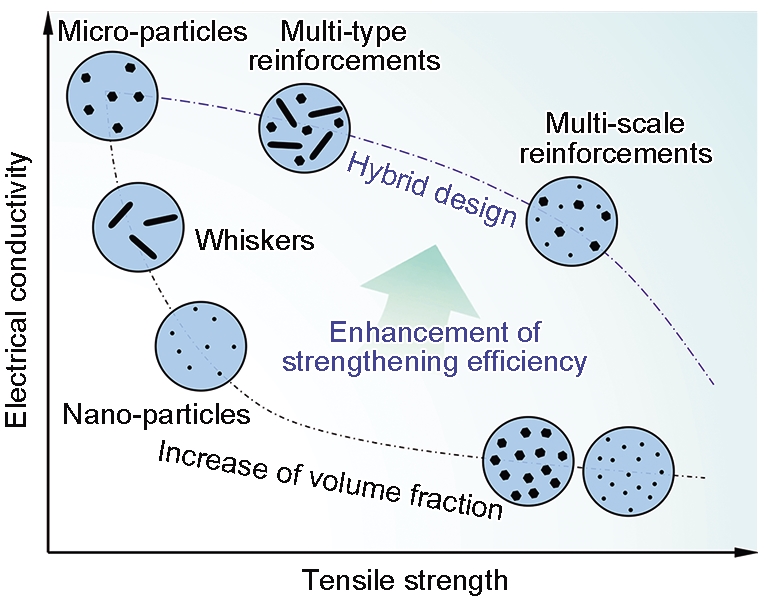
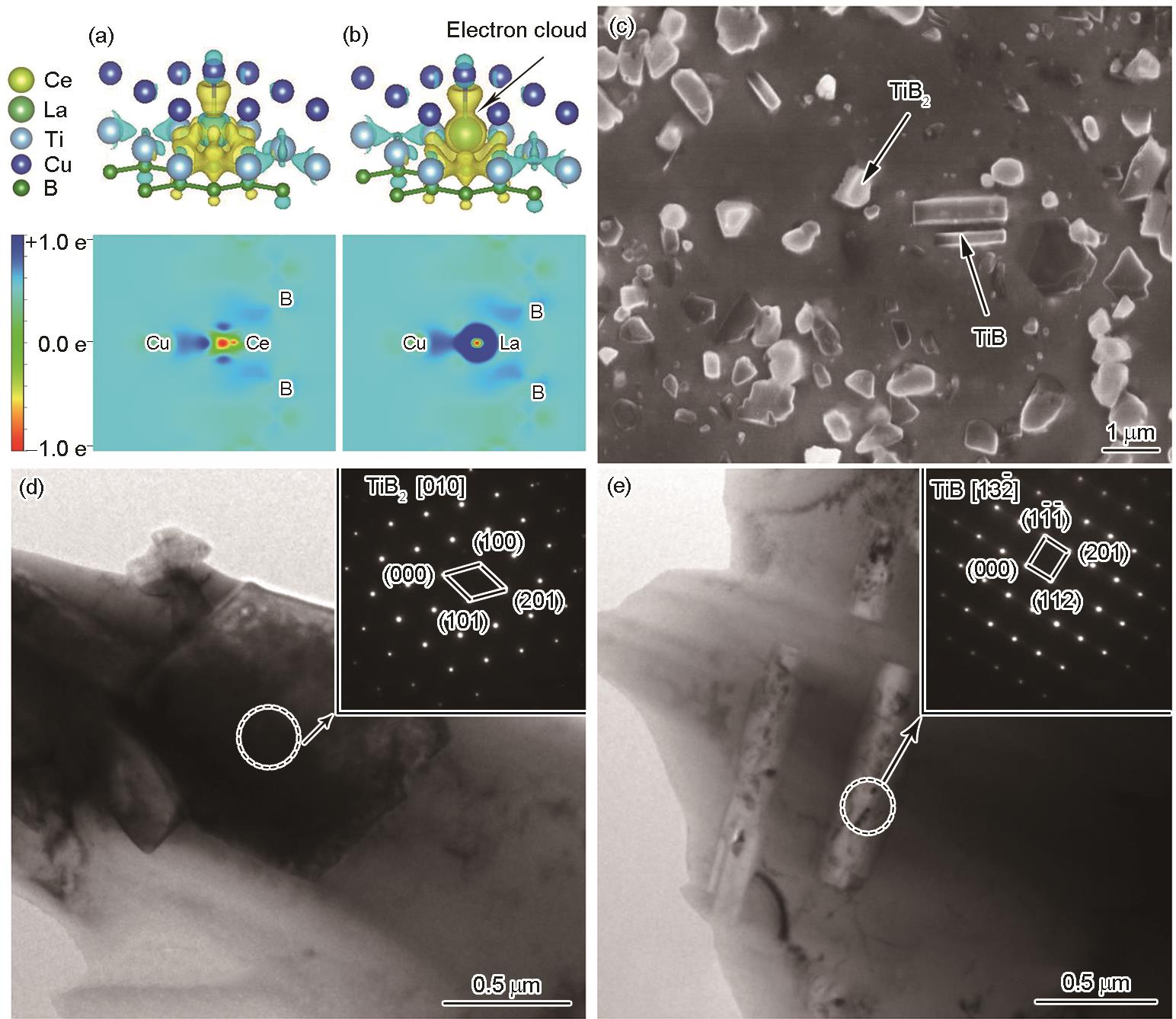
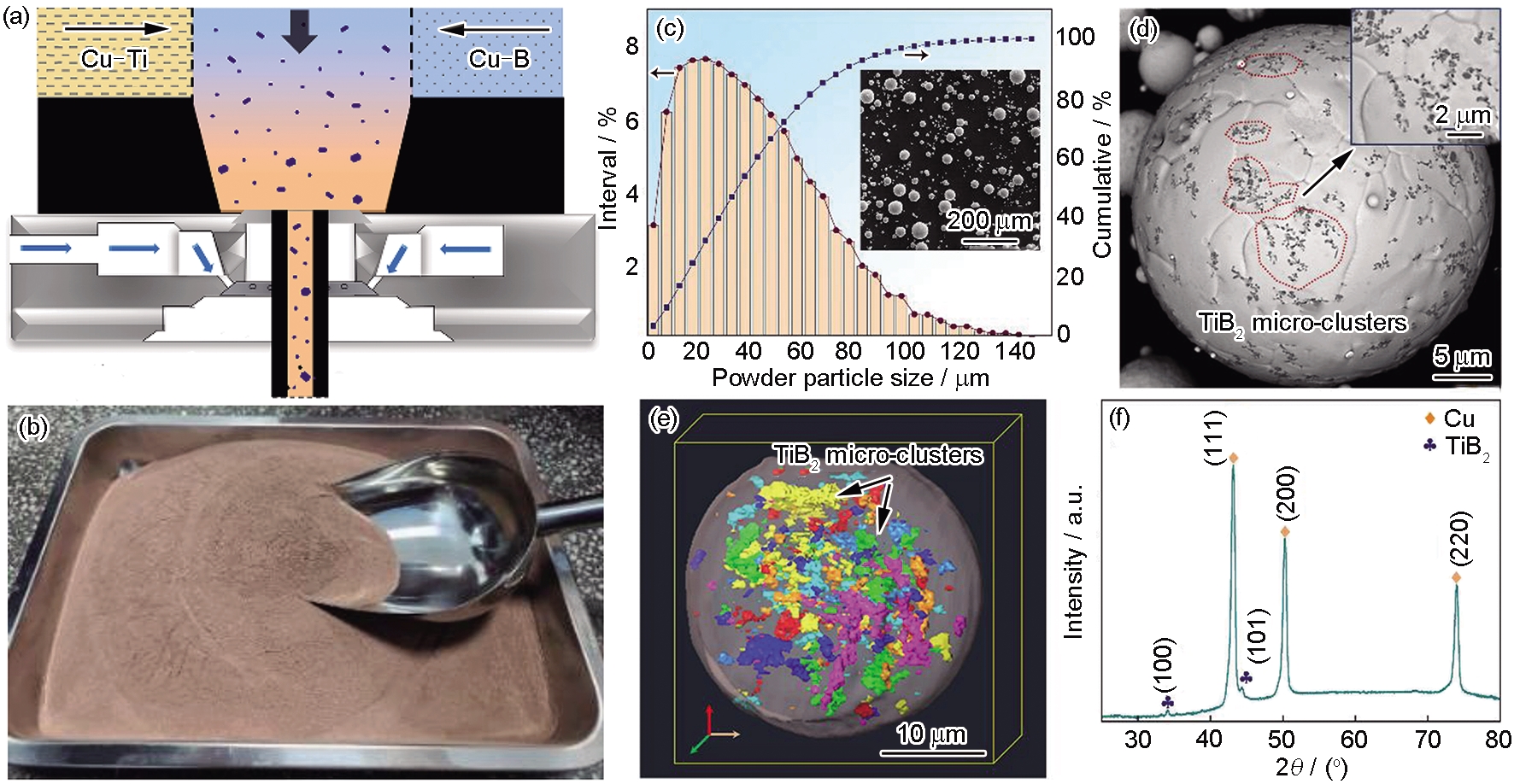
Abstract Copper matrix composites exhibit excellent softening resistance at elevated temperatures. Therefore, they are promising electrically conductive materials for applications in demanding service environments. However, conventional copper matrix composites face a persistent tradeoff between mechanical strength and electrical conductivity. Therefore, to address this challenge, this study proposes a design strategy based on the precise control of in situ reaction timings during copper matrix composites fabrication via dual-beam melt mixing control technique, enabling the formation of reinforcements with multiple compositions, morphologies, and length scales. Considering the different processing characteristics of casting and powder metallurgy, copper matrix composites are designed and fabricated with hybrid and hierarchical reinforcement architectures. The strengthening efficiency of these reinforcements is improved via the synergistic effects of multitype and multiscale reinforcements, thereby overcoming the tradeoff between mechanical strength and electrical conductivity. Using copper matrix composites containing in situ-formed boride phases as a representative material system, this study systematically examines microstructural design principles for developing high-strength, high-conductivity materials. The analysis integrates the intrinsic characteristics of the Cu-boride system with the processing features of conventional metallic manufacturing routes, including casting and powder metallurgy. This study presents several design strategies, including the hybridization of particle and whisker reinforcements, hybridization of microscale and nanoscale reinforcements, and construction of hierarchical architectures comprising particle microclusters and nanoprecipitates. These strategies enable the simultaneous improvement of mechanical strength and electrical conductivity.
|
|
Received: 30 March 2026
|
|
|
| Fund: National Natural Science Foundation of China(52127802);National Natural Science Foundation of China(52431008);National Natural Science Foundation of China(52322409) |
Corresponding Authors:
LIANG Shuhua, professor, Tel: (029)82312185, E-mail: liangsh@xaut.edu.cn
|
| [1] |
Yang K, Wang Y H, Guo M X, et al. Recent development of advanced precipitation-strengthened Cu alloys with high strength and conductivity: A review[J]. Prog. Mater. Sci., 2023, 138: 101141
doi: 10.1016/j.pmatsci.2023.101141
|
| [2] |
Zhang Z F, Hou J P, Liu R, et al. Quantitative relationships between the strength-plasticity and strength-electrical conductivity of metallic materials[J]. Acta Metall. Sin., 2026, 62: 253
|
|
张哲峰, 侯嘉鹏, 刘 睿 等. 金属材料强度-塑性及强度-电导率定量关系[J]. 金属学报, 2026, 62: 253
doi: 10.11900/0412.1961.2025.00248
|
| [3] |
Jiang Y H, Zhang X D, Cai P T, et al. Precipitation behavior and microstructural evolution during thermo-mechanical processing of precipitation hardened Cu-Hf based alloys[J]. Acta Mater., 2023, 245: 118659
doi: 10.1016/j.actamat.2022.118659
|
| [4] |
Wang H, Min X M, Wang W M, et al. Quantum chemistry calculation on titanium diboride crystal[J]. Chin. J. Nonferrous Met., 2002, 12: 1229
|
|
王 皓, 闵新民, 王为民 等. 二硼化钛电子结构的量子化学计算[J]. 中国有色金属学报, 2002, 12: 1229
|
| [5] |
Liang S H, Li W Z, Jiang Y H, et al. Microstructures and properties of hybrid copper matrix composites reinforced by TiB whiskers and TiB2 particles[J]. J. Alloys Compd., 2019, 797: 589
doi: 10.1016/j.jallcom.2019.05.129
|
| [6] |
Zhang X D, Jiang Y H, Cao F, et al. Hybrid effect on mechanical properties and high-temperature performance of copper matrix composite reinforced with micro-nano dual-scale particles[J]. J. Mater. Sci. Technol., 2024, 172: 94
doi: 10.1016/j.jmst.2023.06.054
|
| [7] |
Huang B, Duan Y H, Hu W C, et al. Structural, anisotropic elastic and thermal properties of MB (M = Ti, Zr and Hf) monoborides[J]. Ceram. Int., 2015, 41: 6831
doi: 10.1016/j.ceramint.2015.01.132
|
| [8] |
Paul B, Okamoto N L, Kusakari M, et al. Plastic deformation of single crystals of CrB2, TiB2 and ZrB2 with the hexagonal AlB2 structure[J]. Acta Mater., 2021, 211: 116857
doi: 10.1016/j.actamat.2021.116857
|
| [9] |
Jiang Y H, Li D, Liang S H, et al. Phase selection of titanium boride in copper matrix composites during solidification[J]. J. Mater. Sci., 2017, 52: 2957
doi: 10.1007/s10853-016-0592-2
|
| [10] |
Xu Q, Zhang X H, Han J C, et al. Combustion synthesis and densification of titanium diboride-copper matrix composite[J]. Mater. Lett., 2003, 57: 4439
doi: 10.1016/S0167-577X(03)00338-0
|
| [11] |
Pang Y H, Li P T, Jiang Y H, et al. First-principles calculations reveal two interface mechanisms to improve dispersion and strength of TiB2/Cu composites[J]. Mater. Lett., 2026, 409: 140159
doi: 10.1016/j.matlet.2026.140159
|
| [12] |
Cao F, Zhang X D, Dong G Z, et al. Microstructures and properties of in situ (TiB2p + TiBw)/Cu composites with different Ce content[J]. Adv. Eng. Mater., 2022, 24: 2200251
doi: 10.1002/adem.v24.8
|
| [13] |
Cao F, Dong G Z, Jiang Y H, et al. Effect of La addition on microstructures and properties of TiB2(-TiB)/Cu hybrid composites prepared by in situ reaction[J]. Mater. Sci. Eng., 2020, A789: 139605
|
| [14] |
Ren J Q, Liang S H, Jiang Y H, et al. Research on the microstructure and properties of in situ (TiB2-TiB)/Cu composites[J]. Acta Metall. Sin., 2019, 55: 126
|
|
任建强, 梁淑华, 姜伊辉 等. 原位(TiB2-TiB)/Cu复合材料组织与性能研究[J]. 金属学报, 2019, 55: 126
doi: 10.11900/0412.1961.2017.00532
|
| [15] |
Shi H, Zhao Y, Gao H B, et al. In-situ spherical TiB2/Cu composite powder: A new method of liquid phase reaction coupled with gas atomization[J]. Mater. Charact., 2022, 191: 112096
doi: 10.1016/j.matchar.2022.112096
|
| [16] |
Perminov A, Bartzsch G, Franke A, et al. Manufacturing Fe-TiC composite powder via inert gas atomization by forming reinforcement phase in situ[J]. Adv. Eng. Mater., 2021, 23: 2000717
doi: 10.1002/adem.v23.3
|
| [17] |
Li X G, Heisterüber L, Achelis L, et al. Multiscale descriptions of particle-droplet interactions in multiphase spray processing[J]. Int. J. Multiphase Flow, 2016, 80: 15
doi: 10.1016/j.ijmultiphaseflow.2015.10.013
|
| [18] |
Shi H, Jiang Y H, Li P T, et al. A novel hierarchical structure of in-situ copper matrix composites reinforced with micro-clusters of TiB2 particles and nano-precipitates of B24Cu particles[J]. Composites, 2025, 297B: 112311
|
| [19] |
Shi H, Cao F, Zhang H D, et al. Densification behavior, mechanical and electrical properties of in-situ TiB2p/Cu composite powder via vacuum hot pressing[J]. Mater. Charact., 2023, 202: 113004
doi: 10.1016/j.matchar.2023.113004
|
| [20] |
Davis J R. ASM Specialty Handbook: Copper and Copper Alloys[M]. Materials Park: ASM International, 2001: 1
|
| No Suggested Reading articles found! |
|
|
Viewed |
|
|
|
Full text
|
|
|
|
|
Abstract
|
|
|
|
|
Cited |
|
|
|
|
| |
Shared |
|
|
|
|
| |
Discussed |
|
|
|
|