|
|
|
| Molecular Dynamics Simulation on the Interfacial Behavior of Mg/Mg-Zn-Al Brazing with Ultrasonic Assistance |
JIANG Guolong, ZHOU Xia( ) ) |
| State Key Laboratory of Structural Analysis for Industrial Equipment, School of Mechanics and Aerospace Engineering, Dalian University of Technology, Dalian 116024, China |
|
Cite this article:
JIANG Guolong, ZHOU Xia. Molecular Dynamics Simulation on the Interfacial Behavior of Mg/Mg-Zn-Al Brazing with Ultrasonic Assistance. Acta Metall Sin, 2026, 62(2): 372-382.
|
|
|
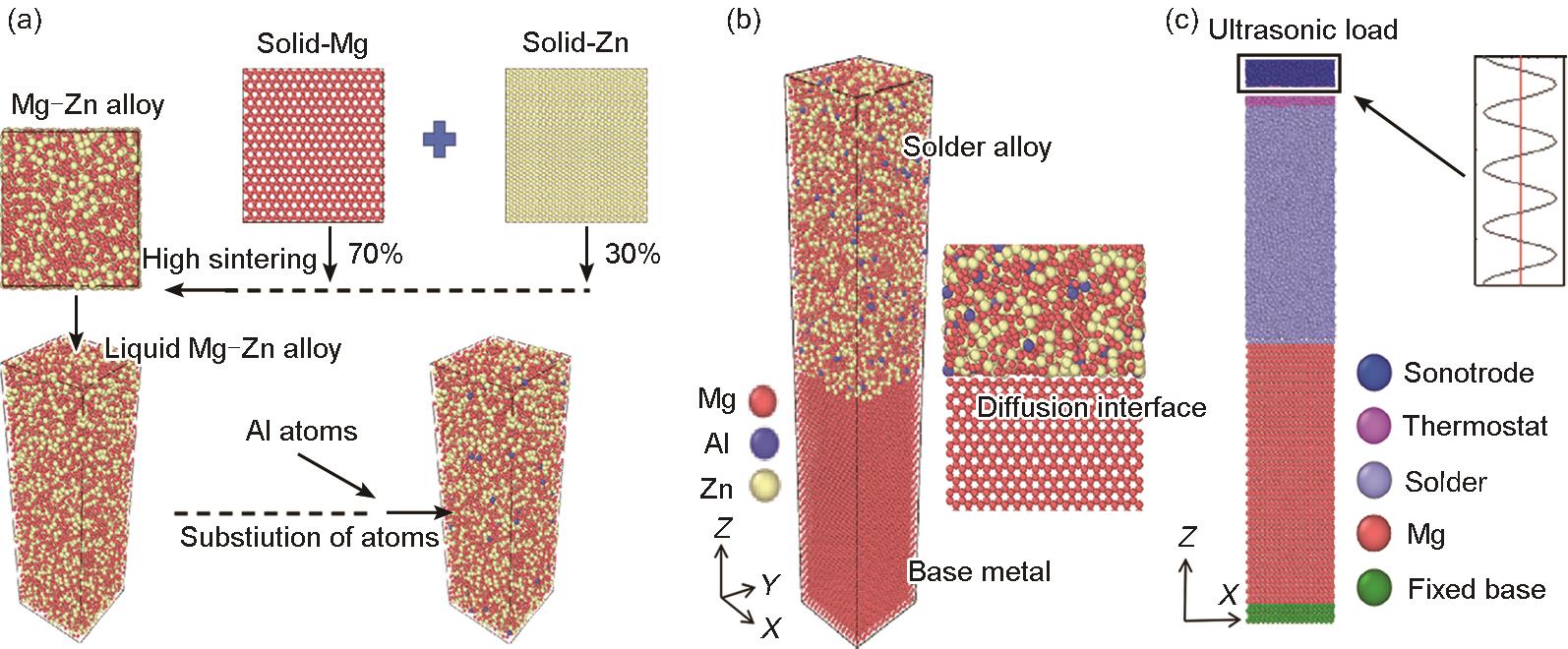
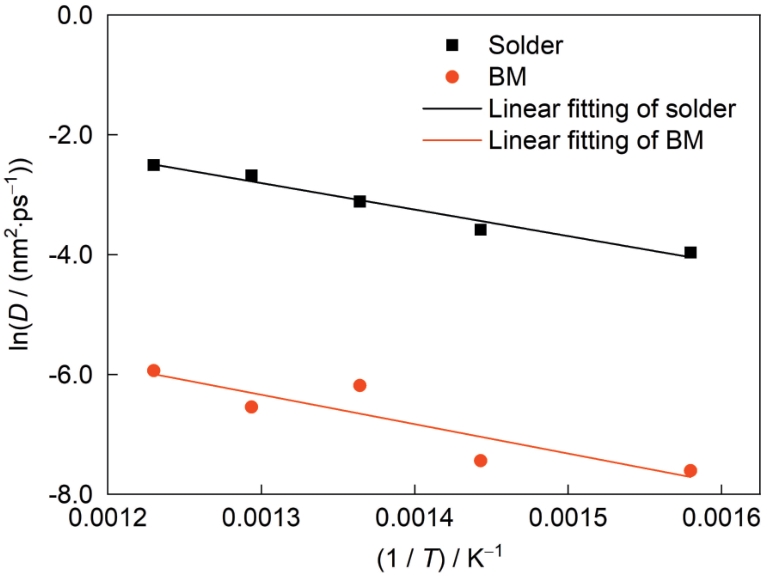
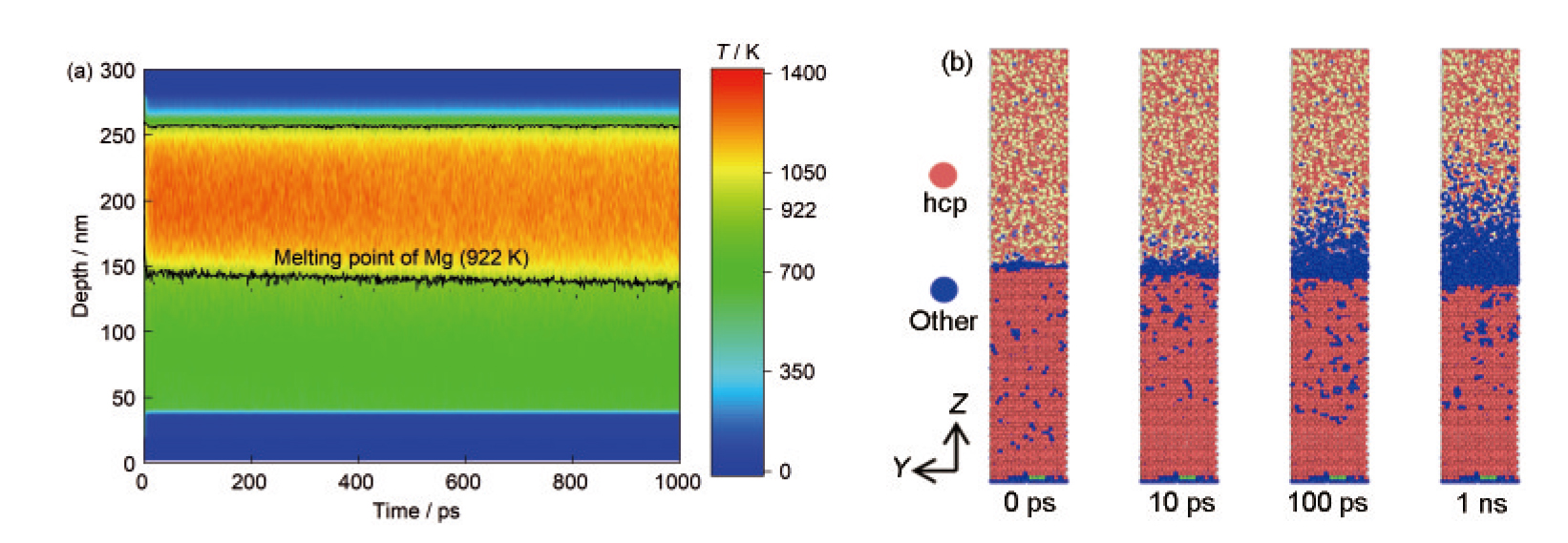
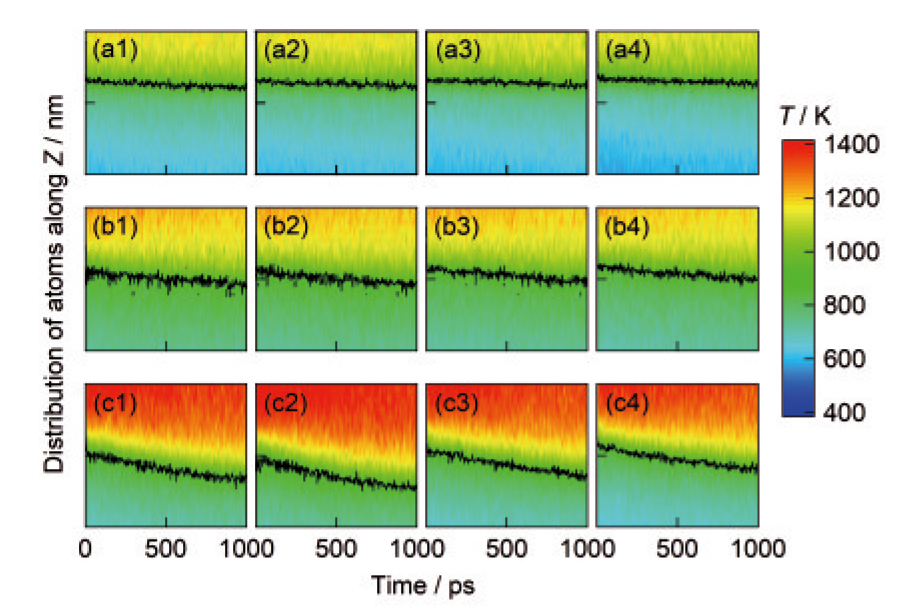
Abstract Magnesium alloys are characterized by low density, high specific strength, high specific modulus, and excellent heat dissipation, which have garnered increasing attention from both academia and industry. Brazing, as a metal and alloy joining technique, is highly valued for its stability in forming and its ability to preserve the microstructure and properties of the base metal. However, due to magnesium's high chemical activity, low melting point, high thermal and electrical conductivity, and tendency to oxidize easily, selecting and designing suitable solder for the brazing process present significant challenges. The Mg-Zn-Al alloy, with its low melting point and composition matching the base metal, is considered a suitable filler metal for brazing magnesium alloys. To study the interfacial diffusion behavior of the molten Mg-Zn-Al alloy during the brazing of Mg-based metals and the influence of the ultrasonic-assisted vibration parameters on the brazing process, a Mg/Mg-Zn-Al interface molecular model was constructed to study the microscopic mechanisms involved. The diffusion behavior at the Mg/Mg-Zn-Al interface was simulated using molecular dynamics on the nanoscale, exploring how ultrasonic assistance on the mechanical properties of the interface, including an analysis of the temperature and strain rate response at the brazing interface under ultrasonic assistance. The results show that ultrasonic assistance increases the diffusion coefficient of the system by 5-10 times and the thickness of the bonding layer by 2.5-7.6 times, significantly lowering the required brazing temperature. Furthermore, while both ultrasonic frequency and amplitude enhance interface equilibrium, increasing the ultrasonic frequency leads to a thicker and more uniformly distributed bonding layer. In terms of mechanical properties, the tensile strength of the ultrasonic-assisted brazing interface, with an amplitude of 0.2 nm and a frequency of 1000 GHz, is 11.5% higher than that of a high-temperature brazing interface. Meanwhile, compared with the mechanical behavior of the interface under various loading conditions, the mechanical properties of the brazing interface are more temperature-sensitive than strain-rate-sensitive, with high-temperature conditions amplifying strain-rate sensitivity for maximum tensile stress.
|
|
Received: 23 January 2024
|
|
|
Corresponding Authors:
ZHOU Xia, professor, Tel: (0411)84706782, E-mail: zhouxia@dlut.edu.cn
|
| [1] |
Wang F, Bai S W, Wang Z, et al. Research progress on hot tearing behavior of Mg-Zn series alloys [J]. Acta Metall. Sin., 2024, 60: 743
doi: 10.11900/0412.1961.2023.00393
|
|
王 峰, 白盛巍, 王 志 等. Mg-Zn系合金热裂行为的研究进展 [J]. 金属学报, 2024, 60: 743
|
| [2] |
Shen Z, Wang Z P, Hu B, et al. Research progress on the mechanisms controlling high-temperature oxidation resistance of Mg alloys [J]. Acta Metall. Sin., 2023, 59: 371
doi: 10.11900/0412.1961.2022.00495
|
|
沈 朝, 王志鹏, 胡 波 等. 镁合金抗高温氧化机理研究进展 [J]. 金属学报, 2023, 59: 371
|
| [3] |
Wu Y C, Qu W Q, Wang Z, et al. Experimental study on brazing AZ31B magnesium alloy by magnalium alloys [J]. Weld. World, 2020, 64: 233
doi: 10.1007/s40194-019-00809-x
|
| [4] |
Li H, Li Z X, Gao C, et al. Interface structure and strength of fluxless ultrasonic soldered joints of magnesium alloy [J]. Weld. World, 2011, 55: 78
|
| [5] |
Sato T, Saitoh K I, Shinke N. Molecular dynamics study on microscopic mechanism for phase transformation of Ni-Ti alloy [J]. Modell. Simul. Mater. Sci. Eng., 2006, 14: S39
doi: 10.1088/0965-0393/14/5/S05
|
| [6] |
Chen J X, Li P T, Lin E E. A molecular dynamics study on the mechanical properties of Fe-Ni alloy nanowires and their temperature dependence [J]. RSC Adv., 2020, 10: 40084
doi: 10.1039/d0ra07831j
pmid: 35520820
|
| [7] |
Trybula M E, Szafrański P W, Korzhavyi P A. Structure and chemistry of liquid Al-Cu alloys: Molecular dynamics study versus thermodynamics-based modelling [J]. J. Mater. Sci., 2018, 53: 8285
doi: 10.1007/s10853-018-2116-8
|
| [8] |
Shibuta Y, Takamoto S, Suzuki T. Dependence of the grain boundary energy on the alloy composition in the bcc iron-chromium alloy: A molecular dynamics study [J]. Comput. Mater. Sci., 2009, 44: 1025
doi: 10.1016/j.commatsci.2008.07.013
|
| [9] |
Chen K T, Wei T J, Li G C, et al. Mechanical properties and deformation mechanisms in CoCrFeMnNi high entropy alloys: A molecular dynamics study [J]. Mater. Chem. Phys., 2021, 271: 124912
doi: 10.1016/j.matchemphys.2021.124912
|
| [10] |
Liu J. Molecular dynamic study of temperature dependence of mechanical properties and plastic inception of CoCrCuFeNi high-entropy alloy [J]. Phys. Lett., 2020, 384A: 126516
|
| [11] |
Dai Y, Li J H, Liu B X. First-principles molecular dynamics simulations to study the crystal-to-amorphous transition in the Mg-Zn system [J]. Intermetallics, 2012, 29: 75
doi: 10.1016/j.intermet.2012.05.001
|
| [12] |
Yang Y, Liang Y X, Bi J, et al. The wetting characteristics of molten Ag-Cu-Au on Cu substrates: A molecular dynamics study [J]. Phys. Chem. Chem. Phys., 2020, 22: 25904
doi: 10.1039/d0cp03337e
pmid: 33164003
|
| [13] |
Chen X, Sun X G, Deng H Q, et al. The wetting properties of Li droplet on Cu surfaces: A molecular dynamics study [J]. Comput. Mater. Sci., 2016, 119: 114
|
| [14] |
Hsieh J Y, Chen J L, Chen C, et al. Reactive wetting behaviors of Sn/Cu systems: A molecular dynamics study [J]. Nano-Micro Lett., 2010, 2: 60
doi: 10.1007/BF03353620
|
| [15] |
Timoshenko V, Bochenkov V, Traskine V, et al. Anisotropy of wetting and spreading in binary Cu-Pb metallic system: Experimental facts and MD modeling [J]. J. Mater. Eng. Perform., 2012, 21: 575
doi: 10.1007/s11665-012-0184-5
|
| [16] |
Yang Y, Li S R, Liang Y X, et al. The wetting phenomenon and precursor film characteristics of Sn-37Pb/Cu under ultrasonic fields [J]. Mater. Lett., 2019, 234: 92
doi: 10.1016/j.matlet.2018.09.005
|
| [17] |
Kuboy A, Makino T, Sugiyama D, et al. Molecular dynamics analysis of the wetting front structure in metal/metal systems [J]. J. Mater. Sci., 2005, 40: 2395
doi: 10.1007/s10853-005-1965-0
|
| [18] |
Webb III E B, Grest G S. Molecular dynamics simulations of reactive wetting [J]. Scr. Mater., 2002, 47: 393
doi: 10.1016/S1359-6462(02)00155-0
|
| [19] |
Swiler T P. The role of liquid-substrate interactions on wetting in metallic embedded atom method systems [J]. Acta Mater., 2000, 48: 4775
doi: 10.1016/S1359-6454(00)00274-3
|
| [20] |
Benhassine M, Saiz E, Tomsia A P, et al. Nonreactive wetting kinetics of binary alloys: A molecular dynamics study [J]. Acta Mater., 2011, 59: 1087
doi: 10.1016/j.actamat.2010.10.039
|
| [21] |
De Tafen N, Lewis L J. Structure and energetics of Ni and Au nanoclusters deposited on the (001), (110), and (111) surfaces of Au and Ni: A molecular dynamics study [J]. Phys. Rev., 2008, 77B: 075429
|
| [22] |
Lin L, Hui S, Lu G, et al. Molecular dynamics study of high temperature wetting kinetics for Al/NiAl and Al/Ni3Al systems: Effects of grain boundaries [J]. Chem. Eng. Sci., 2017, 174: 127
doi: 10.1016/j.ces.2017.09.008
|
| [23] |
Lin L, Hui S, Lu G, et al. Molecular dynamics simulations on dissolutive wetting of Al-Ni alloy droplets on NiAl substrate [J]. J. Taiwan Inst. Chem. Eng., 2017, 75: 51
doi: 10.1016/j.jtice.2017.03.035
|
| [24] |
Lv Y, Chong P L, Liu S. The wettability of molten aluminum droplets on the 3C-SiC surface: Molecular dynamics study [J]. Mater. Sci. Semicond. Process., 2022, 142: 106452
doi: 10.1016/j.mssp.2022.106452
|
| [25] |
Lv Y, Peng C C, Liao F, et al. Molecular dynamics study on the contribution of 4H-SiC surface morphology and crystal orientation to the wetting behavior of molten Al droplet [J]. Mater. Sci. Semicond. Process., 2022, 146: 106685
doi: 10.1016/j.mssp.2022.106685
|
| [26] |
Baskes M I. Modified embedded-atom potentials for cubic materials and impurities [J]. Phys. Rev., 1992, 46B: 2727
|
| [27] |
Dickel D E, Baskes M I, Aslam I, et al. New interatomic potential for Mg-Al-Zn alloys with specific application to dilute Mg-based alloys [J]. Modell. Simul. Mater. Sci. Eng., 2018, 26: 045010
|
| [28] |
Mendelev M I, Kramer M J, Ott R T, et al. Molecular dynamics simulation of diffusion in supercooled Cu-Zr alloys [J]. Philos. Mag., 2009, 89: 109
doi: 10.1080/14786430802570648
|
| [29] |
Zhang T T, Wang W X, Zhou J, et al. Molecular dynamics simulations and experimental investigations of atomic diffusion behavior at bonding interface in an explosively welded Al/Mg alloy composite plate [J]. Acta Metall. Sin. (Engl. Lett.), 2017, 30: 983
doi: 10.1007/s40195-017-0628-x
|
| [30] |
Qin J Y, Li X X, Wang J, et al. The self-diffusion coefficients of liquid binary M-Si (M = Al, Fe, Mg and Au) alloy systems by first principles molecular dynamics simulation [J]. AIP Adv., 2019, 9: 035328
|
| [31] |
Simonnin P, Schreiber D K, Rosso K M. Predicting the temperature dependence of self-diffusion behavior in Ni-Cr alloys via molecular dynamics [J]. Mater. Today Commun., 2021, 26: 101982
|
| [32] |
Barnard L, Morgan D. Ab initio molecular dynamics simulation of interstitial diffusion in Ni-Cr alloys and implications for radiation induced segregation [J]. J. Nucl. Mater., 2014, 449: 225
doi: 10.1016/j.jnucmat.2013.10.022
|
| [33] |
Li P, Wang L S, Yan S L, et al. Temperature effect on the diffusion welding process and mechanism of B2-O interface in the Ti2AlNb-based alloy: A molecular dynamics simulation [J]. Vacuum, 2020, 173: 109118
doi: 10.1016/j.vacuum.2019.109118
|
| No Suggested Reading articles found! |
|
|
Viewed |
|
|
|
Full text
|
|
|
|
|
Abstract
|
|
|
|
|
Cited |
|
|
|
|
| |
Shared |
|
|
|
|
| |
Discussed |
|
|
|
|