



大型舰船螺旋桨常用的锰铝青铜(MAB)合金是一种具有一定量Al、Mn、Fe、Ni元素的铜基合金,其力学性能和耐腐蚀性能良好[1~3]。然而,随着海洋资源的广泛开发和利用,深海环境下的腐蚀问题已成为制约海洋工程和装备服役寿命的关键因素。尽管国内外已经针对铜合金的腐蚀问题进行了大量研究,但主要集中在微观腐蚀形貌分析[4~6]、显微组织调控[7~10]、工艺处理[11~13]、电化学腐蚀控制[14]等方面,而基于海水力学因素,特别是深海压力对铜合金微观结构的影响及其腐蚀耦合规律的研究还相对较少。因此,深入研究深海腐蚀环境下,铜合金在深海压力作用下的微观结构演变及其失效动力学机理,对于优化铜合金选材、开发有效的失效防护措施、延长服役寿命具有重要意义。
在深海环境下,螺旋桨铜合金的失效过程较为复杂,受多种因素影响,其中海水静压力、Cl-对腐蚀行为的影响尤为显著。合金/溶液界面通常会随着静水压力增加而发生变化,这为揭示深海环境中合金的腐蚀机制提供了新见解。研究[15]表明,静水压力会非均匀压缩双电层,从而促进界面发生化学反应,进而加剧合金的局部腐蚀过程。Xiong等[16]研究了Fe/溶液界面上的双电层分布,发现静水压力的增大会提高双电层容量,导致平衡电位附近电流密度的增加。Liu等[17]通过分子动力学(MD)模拟研究了静水压力促进纯Fe在3.5%NaCl (质量分数,下同)溶液中腐蚀的机理,发现静水压力改变了金属/溶液界面处H2O分子的密度,增强了H2O分子与金属表面的相互作用,从而导致界面处金属阳离子密度增加,溶解加快。从热力学和动力学的角度分析,静水压力通过提高材料表面、环境中的离子及溶解气体的活度,显著促进了腐蚀反应的动力学过程[18]。此外,Ma等[19]研究了不同静水压力下Cr过渡金属层的溶解行为,发现静水压力促进了Cl-在其表面的吸附,加速了过渡金属Cr层的溶解。Song和Tegus[20]通过研究Cu-20%Sn铜合金在NaCl溶液中的腐蚀过程,发现腐蚀电流密度随着Cl-浓度的增加而增加,表明Cl-浓度的增加促进了铜合金的腐蚀。研究[21]表明,在较高的静水压力下,铜合金的腐蚀电位与零电荷电位间的电位差增加、Cl-在合金表面的吸附能力增强,导致合金溶解失效过程加快。当静水压力与拉伸应力交互作用时,金属离子在表面的水解过程加快,从而导致表面积累更多的H+,进一步增加了腐蚀敏感性[22]。铜合金在服役过程中,面对复杂的深海环境和多变的海水应力载荷,铸造和加工过程中残余的应力场与服役环境中的力学作用相耦合,导致合金可能遭受更严重的腐蚀失效问题。因此,亟须研究螺旋桨铜合金在深海环境下的腐蚀机理,建立其微观结构模型,以及分析深海压力对其结构演变和应力耦合失效动力学过程的影响。
本工作以MAB合金为研究对象,采用模拟计算与实验相结合的方法,在合金微观结构和成分偏析表征的基础上,基于密度泛函理论(DFT),在原子水平上构建了铜合金微观结构模型,并对其微观结构演变以及海水压力耦合作用下的失效机制进行了定量研究和腐蚀速率预测。通过失重实验研究了海水压力(0.1~10 MPa)对铜合金腐蚀行为的影响;采用MD方法,模拟了不同海水压力下铜合金与3.5%NaCl溶液的界面行为,并探究了压力对腐蚀加速的作用机制。本工作旨在进一步揭示在合金内应力、海水压力、Cl-浓度等多种关键因素耦合作用下铜合金的失效行为和加速机制,为优化深海环境下螺旋桨防护措施提供理论依据。
1 实验方法
1.1 实验材料
1.2 微观结构表征
式中,D为粒子直径,β′为半峰宽(FWHM),θ为衍射角。
1.3 模型建立及模拟计算
1.3.1 DFT计算
使用Materials Studio软件中的Dmol3模块建立合金的几何构型,采用Perdew-Burke-Ernzerhof (PBE)函数的广义梯度近似(GGA)方法进行优化[30]。利用DFT半核赝势(DSPP)方法引入相对论效应对核电子进行处理。本工作选择双重数值加极化(DNP)基集。进行合金结构优化时,收敛公差和自洽场(SCF)的收敛标准均设置为2.72 × 10⁻³ eV/atom。采用Monkhorst-Pack方法在(2 × 2 × 1) k点网格上对合金表面的Brillouin区进行采样,fcc结构Cu的晶格常数为0.366 nm,与先前DFT计算结果[31,32]一致。为了防止与相邻板的相互作用,建立了一个在z方向上1.5 nm的真空层。顶部的两层原子被完全释放以表示合金的表面,而其他层的原子则被固定以模拟合金的内部结构。将合金的形成能(
式中,Etotal为合金模型的总能量,Ealloy为单个原子完全取代合金结构时的能量,N为模型中某一类型原子的数量。将内聚能(
式中,Ealloy-v为真空中的单原子能量。合金的空位能(
式中,Evac为存在空位模型的能量,Esingle为单个Cu原子的能量。
式中,
式中,Eslab1为吸附Cl-的第一个层的能量;Eslab2为第一层以外其余部分的能量;n为每一层的原子总数,3 × 3超晶胞的n为9。
式中,Evacuum为电子在真空中相对于Fermi能级的能量,EFermi为金属内部的Fermi能级。考虑耐腐蚀性能时,通常认为电化学电位(ψ)与反映电子稳定性的功函数密切相关[37],它们的关系表示为:
式中,
式中,kTST为反应速率常数,T为反应温度,σ为反应路径的简并度,kb为Boltzmann常数,h为Planck常数,R为气体常数,pθ 为标准气压。
1.3.2 分子动力学模拟
采用MD模拟研究了合金与NaCl溶液在不同深海压力(0.1、4.0、6.0、8.0和10.0 MPa)下的界面结构,探讨了不同深海压力下合金表面附近Cu2+和H2O分子的分布。为简化研究,依据Gibbs-Capman-Stern (GCS)理论模拟界面附近的离子分布[42]。模拟系统由NaCl水溶液组成,在2.66 nm × 3.07 nm × 5.31 nm的正交盒中,包含一个6 × 12的具有Al原子表面偏析的MAB (MAB-Alseg)超晶胞。在固相中,4层不带电的原子排列在盒子的底部;在溶液相中,537个H2O分子和6个NaCl分子组成3.5%NaCl溶液,28个Cu2+代表溶解的第一层Cu原子,另有一定量的Cl-和OH-代表阴极反应产物,保持溶液处于电中性。这些离子都是自由弛豫的,并随机地放置在电解质区域中[43,44]。第二代分子势能原子模拟力场(COMPASSII)用于描述分子与原子之间的相互作用,其可靠性和准确性已在先前的研究[45,46]中得到证明。为了将计算成本降至最低,使用0.95 nm的截止值。所有模拟都以至少500 ps的间隔进行,以确保系统有足够的时间达到平衡。
1.4 腐蚀失重实验
在自制的模拟实验装置上进行不同海水压力条件下的失重实验。装置由深海高压釜装置、气体增压系统、循环控温系统、仪表电器控制台组成。实验介质为按照GB/T 10834—2008标准中的人造海水配方配制的人工海水,pH值为8.2~8.4,实验周期为10 h。腐蚀失重实验采用50 mm × 25 mm × 5 mm片状试样,试样表面用SiC耐水砂纸逐级打磨,然后用去离子水、无水乙醇清洗吹干待用。实验结束后,根据GB/T 16545—2015标准,对合金试样进行3 min超声处理,然后进行酸洗(HCl与H2O的体积比为1∶1)以去除表面腐蚀产物。样本清洁、干燥、称重后,根据JB/T 7901—1999标准计算腐蚀速率:
式中,R′为腐蚀速率,mm/a;K为常数(K = 8.76 × 10⁷);W为质量损失,g;S为样品的表面面积,m2;t为腐蚀时间,h;ρ′为合金密度,kg/mm3。本工作所使用的人工海水(1000 L)组成为:NaCl 24530 g,MgCl2 5200 g,Na2SO4 4090 g,KCl 695 g,NaHCO3 201 g,KBr 101 g,CaCl2 1160 g。
2 结果与讨论
2.1 铜合金原子级微观结构的构建及其内应力作用下的溶解行为
图1a~f为合金形貌的SEM像及元素EDS面分布图。可以看出,合金中的主要元素为Cu、Mn、Al以及少量的Fe、Ni,元素呈均匀分布状态。如图1g所示,合金中各种元素相对含量(质量分数,%)为:Cu 70.7,Mn 12.5,Al 8.3,Fe 3.1,Ni 2.2。根据上述合金的成分比例,采用DFT构建了铜合金的原子级微观结构模型。首先建立了具有fcc结构的纯Cu晶体模型,如图1h所示。随机选取上述晶格位点并用Mn、Al、Fe和Ni原子替代部分Cu原子,使合金元素尽量均匀分布。通过几何优化和能量迭代,使体系总能量收敛,直至体系自由能最小,最终形成了MAB合金模型,如图1i所示。在此基础上,考虑到Al原子在铜合金表面的偏析现象[47],采用随机占位法,将合金表面的Cu替换为Al原子,并逐步增加合金表面的Al原子数量,计算不同Al原子数量的体系的自由能。结果表明,当表面Al原子占比达29.7%时,体系总能量最低。因此,建立了MAB-Alseg合金模型,如图1j所示。由内聚能的计算结果(表1)可知,两种合金模型的内聚能均接近纯Cu的内聚能(3.35 eV/atom),这表明合金结构模型是能够稳定存在的。此外,基于合金的置换机制,形成能可用于证明合金结构的形成趋势[48]。在合金形成能的计算中,MAB-Alseg合金的形成能(-3.63 eV)比MAB合金更负,因此MAB-Alseg合金结构具有更高的热力学稳定性,其表面易于形成部分Al原子富集的偏析结构。
图1
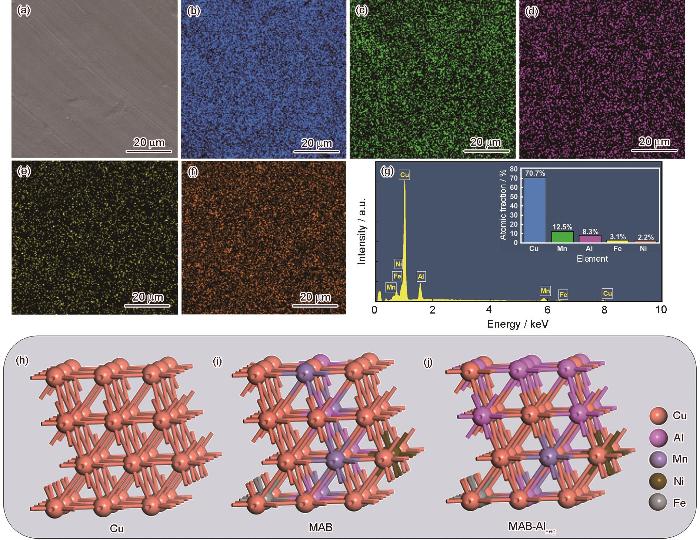
图1
锰铝青铜(MAB)合金的微观形貌、EDS分析及纯Cu、MAB合金和MAB-Alseg合金结构模型(MAB-Alseg合金为部分表面Cu原子被Al原子替代的MAB合金)
Fig.1
SEM image (a); EDS mappings of Cu (b), Al (c), Mn (d), Fe (e), and Ni (f); EDS spectrum (g) of manganese aluminum bronze (MAB) alloy; and schematics of atomic structure models of pure Cu (h), MAB alloy (i), and MAB-Alseg alloy (j) (Inset in Fig.1g is EDS point result of MAB alloy elements. MAB-Alseg alloy is an MAB alloy with partial substitution of surface Cu atoms by Al atoms)
表1 纯Cu、MAB合金和MAB-Alseg合金模型的总能量、键能、形成能及内聚能
Table 1
| Structure | Total energy eV | Binding energy eV | Formation energy eV | Cohesive energy eV·atom-1 |
|---|---|---|---|---|
| Pure Cu | -218001.33 | -115.09 | - | 3.35 |
| MAB | -220162.94 | -117.87 | -1.14 | 3.42 |
| MAB-Alseg | -224480.77 | -122.97 | -3.63 | 3.53 |
图2a为MAB合金的Rietveld精修拟合XRD谱。可以看出,在43.31°、50.45°、74.13°和89.94°处出现了4个明显的衍射峰,与具有fcc结构的金属Cu (PDF#98-000-0172)的(111)、(200)、(220)、(311)晶面位置基本一致,说明合金具有典型的fcc结构[49]。此外,可根据合金4个XRD峰的位置、宽度等参数来研究不同晶面的微应变水平和位错密度变化情况。如图2b和c所示,MAB合金(111)和(200)晶面的弹性微应力-应变水平分别为0.77%和1.23%,(220)和(311)晶面的微应变分别为0.76%和0.82%,可见(111)、(220)和(311)晶面的应变水平相对较小。值得注意的是,在标定晶面中,(111)晶面的位错密度最小,为6.37 × 10⁻³ nm-2 (图2c)。结合微应变水平和位错密度的分析可知,(111)晶面具有较高的稳定性。此外,采用HRTEM对合金结构进行了深入表征,结果如图2d所示。可以观察到清晰的原子级晶格条纹。然后,对HRTEM像中方框区域内进行逆快速Fourier变换(IFFT),结果如图2e所示。合金晶面存在刃型位错和晶格扭曲现象,由该晶面测得的晶格间距为0.21 nm (图2f),该晶面的晶格间距与纯Cu (111)晶面相近,与XRD结果(图2a)一致。为了进一步探索原子水平上的微观应力场分布,对选定的合金区域进行了几何相位分析(GPA),拟合得到的弹性应力-应变场如图2g~i所示,图中颜色变化表示应变/应力的变化情况,其中绿色到深蓝色代表压缩应变,而红色到亮黄色代表拉伸应变。由图2g~i可以观察到合金受到的拉压耦合应力的影响。应力具有一定的矢量特性,x、y、xy方向上的拉应力均大于压应力,且y方向上最为显著。此外,合金中还存在一定的压缩-拉伸位错偶极子(图2g~i中方框所示区域),这些偶极子通常归因于刃型位错的存在,而晶格中的位错倾向于产生压缩-拉伸相互作用型应力集中[50]。径向分布函数(RDF)方法通常用于描述合金系统中原子或分子在空间上的分布规律,有助于从原子水平深入了解合金整体的微观结构和晶格畸变[51]。为了进一步分析应变在合金空间的分布情况,采用RDF进行表征。针对MAB-Alseg合金的表层、亚表层及基体,分别绘制了相应的径向分布密度图(图2j~l)。与亚表层和基体相比,MAB-Alseg合金表层结构具有最低的径向分布密度,表明合金表面处的晶格畸变最严重。这主要是由于Al原子在表面偏析导致Cu晶格的对称性发生改变,从而形成显著的表面应力集中区。
图2
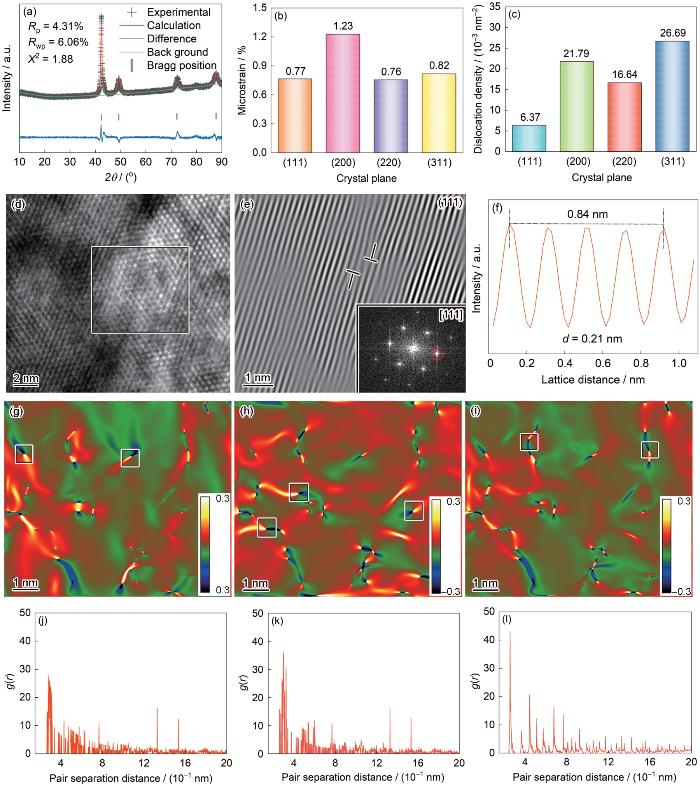
图2
MAB合金和MAB-Alseg合金的晶格结构和内应力分析
Fig.2
Analyses of lattice structures and internal stresses of MAB (a-i) and MAB-Alseg (j-l) alloys
(a) refined XRD pattern (Rp—profile R-factor, Rwp—weighted profile R-factor, X2—Chi-squared)
(b, c) microstrains (b) and dislocation densities (c) of different crystal planes
(d, e) HRTEM image (d) and the corresponding inverse fast Fouries transform (IFFT) image (e) (Inset in Fig.2e is corresponding fast Fouries transform (FFT) patterns, red circle repre-sents [111] crystal orientation)
(f) statistical diagram of (111) lattice space (d)
(g-i) strain/stress field maps in the x direction (g), y direction (h), and xy direction (i) (Rectangle areas refer to dipoles)
(j-l) radial distribution functions of surface (j), subsurface (k), and matrix (l) regions (g(r) is the relative density of atoms or molecules)
由于铜合金的微应力/应变与其溶解失效密切相关,应力集中区域易成为Cu原子的溶解敏感点。研究[52]表明,合金表面金属原子的空位形成能可以定量描述金属原子从表面溶解逸出的情况,是评估合金耐腐蚀性能的一种有效方法。基于此,在MAB-Alseg合金稳定结构模型(图1j)的基础上,进行了合金中Cu原子的迁移-溶解路径设计和能垒的分析。图3a为合金中Cu原子在迁移-溶解过程中的动力学状态。具体状态如下:(1) MAB-Alseg合金初始状态(IS);(2) 表层存在一个Cu原子空位(VAC1);(3) 过渡状态(TS),亚表层Cu原子迁移到表层空位;(4) 亚表层Cu原子自发迁移至表面空位处,形成亚表层空位(VAC2);(5) 最终状态(FS),Cu原子进一步溶解,形成双空位结构。在Cu原子的迁移过程中,即使沿着最小能量迁移路径,也会出现一个能量最高的一阶鞍点,即过渡态[53]。因此,VAC1结构中,亚表层Cu原子在迁移过程中需克服活化能垒形成TS,随后自发迁移形成VAC2结构。本工作通过LST/QST的搜索方法找到了过渡态,并采用微动弹性带(NEB)方法确认了TS[54]。由于该步骤中的迁移活化能垒是决定Cu原子迁移-溶解动力学过程的关键,因此该步骤被视为速控步(RDS)[55]。
图3
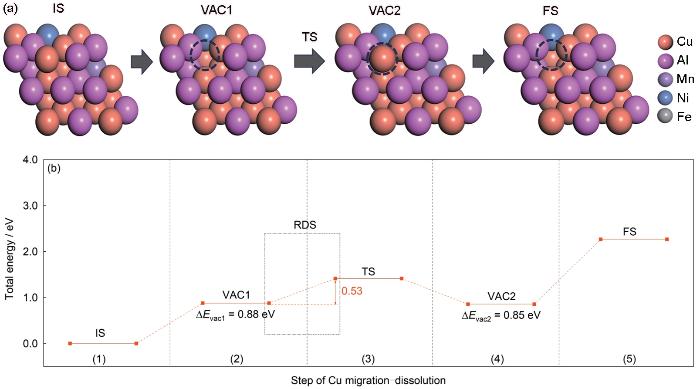
图3
MAB-Alseg合金表层Cu原子迁移-溶解的动力学过程示意图及各阶段Cu原子溶解的能量图
Fig.3
Processes of surface Cu atom migration-dissolution of MAB-Alseg alloy (Black dotted circles represent Cu atomic vacancies. IS—initial state, VAC1—surface vacancy, TS—transition state, VAC2—subsurface vacancy, FS—final state (two-vacancy structure)) (a) and energy diagram of each step in the dynamic process of Cu atom migration-dissolution (b) in the MAB-Alseg alloy (RDS—rate determining step, ΔEvac1—vacancy formation energy of the surface Cu atom, ΔEvac2—vacancy formation energy of the subsurface Cu atom)
为了深入解析内应力对MAB-Alseg合金中Cu原子迁移-溶解行为的影响,基于图3a所示的Cu原子迁移-溶解路径,绘制了该动态过程各阶段的能量图,结果如图3b所示。由图可知,VAC1的空位形成能为0.88 eV;VAC2的空位形成能为0.85 eV,而在VAC1结构中,亚表层Cu原子在迁移过程中需克服的活化能垒为0.53 eV。为了进一步预测MAB-Alseg合金中Cu原子的溶解速率,基于配分函数的过渡态理论(TST),排除了振动分配函数中与反应坐标自由度相对应的虚频,从而将反应的动力学特征等效为活化能垒形式,进而建立了活化能垒与反应速率常数之间的关系[41],如
2.2 海水压力对铜合金腐蚀行为及动力学过程的影响
图4a为不同海水静压力下MAB合金腐蚀10 h前后的宏观腐蚀形貌。腐蚀前,铜合金表面具有金属光泽。微观形貌(图4b)显示,表面仅存在均匀的打磨痕迹。腐蚀后,随着海水压力的增加,合金表面由局部腐蚀逐步发展为均匀腐蚀。为了进一步探究不同海水压力下螺旋桨铜合金的腐蚀行为特征,对在海水中腐蚀10 h后的微观形貌进行SEM表征,结果如图4c~g所示。在0.1 MPa下,合金表面局部位置被麻点状的腐蚀产物覆盖(图4c);随着海水压力升高至4.0 MPa,合金表面的腐蚀产物开始出现鳞片状(图4d);当海水压力为6.0 MPa时,大部分合金表面被鳞片状腐蚀产物覆盖(图4e);当海水压力为8.0 MPa时,合金表面的腐蚀产物形貌不变,但腐蚀区域进一步扩大(图4f);当海水压力达到10.0 MPa时,合金表面由鳞片状的腐蚀产物逐渐堆积,形成了大块颗粒状的腐蚀产物,并且出现了裂纹(图4g)。腐蚀产物形貌的演变规律表明,海水压力显著加速了腐蚀过程。
图4
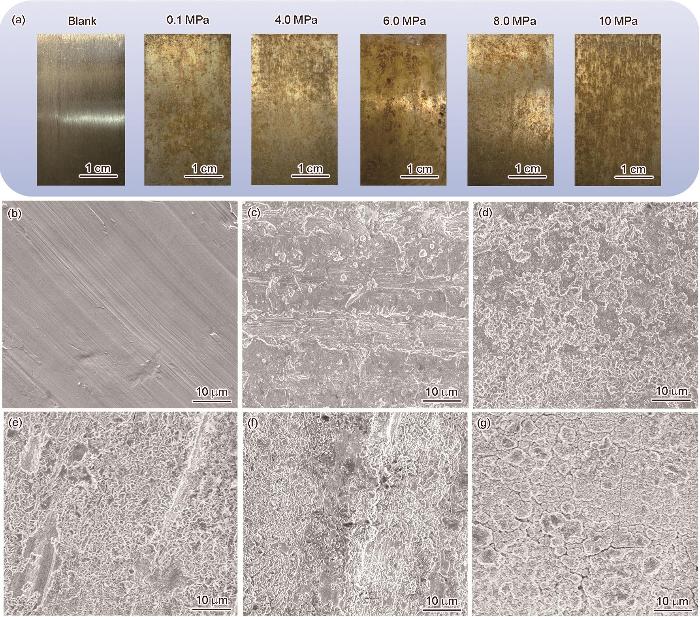
图4
不同海水压力下MAB合金腐蚀10 h前后的宏观形貌及SEM像
Fig.4
Macroscopic corrosion morphologies of MAB alloy before and after corrosion for 10 h under different seawater pressures (a); SEM images of MAB alloys before corrosion (b) and after corrosion for 10 h under 0.1 MPa (c), 4.0 MPa (d), 6.0 MPa (e), 8.0 MPa (f), and 10.0 MPa (g) seawater pressures
此外,在不同海水压力下,铜合金腐蚀10 h后的质量损失和腐蚀速率如图5a~c所示。随着海水压力增大,质量损失和腐蚀速率不断升高,特别是压力为6.0 MPa时,合金的质量损失和腐蚀速率均显著上升,存在一个使腐蚀速率加速上升的临界压力值(约为6.0 MPa),与腐蚀形貌的观察结果基本一致。由此可见,海水压力的增大显著降低了铜合金在海水中的耐腐蚀性能。为了进一步定量评估不同压力下铜合金的微观结构演变和微应变水平,对腐蚀10 h后合金进行XRD分析,结果如图5d所示。图5e和f分别为由图5d解析得到的合金微应变和位错密度变化图。由图可见,随着深海压力的增加,合金(111)晶面的微应变和位错密度逐渐增大,在6.0 MPa的海水压力下,合金(111)晶面的微应变水平和位错密度分别达到1.56%和12.45 × 10⁻³ nm-2。此时,微应变比未腐蚀样品增大了0.79%,位错密度增加了6.08 × 10⁻³ nm-2,而当海水压力超过6.0 MPa时,微应变和位错密度增加幅度显著增大(图2b和c)。这表明铜合金表现出更高的结构缺陷和应力状态,意味着合金晶体结构受到更强的变形应力,增加了其腐蚀敏感性。同时,铜合金基体的衍射峰强度减弱(图5d),与文献[27]结果一致,表明在高海水压力下,微观缺陷的积累是驱动合金基体相腐蚀失效的重要因素。
图5
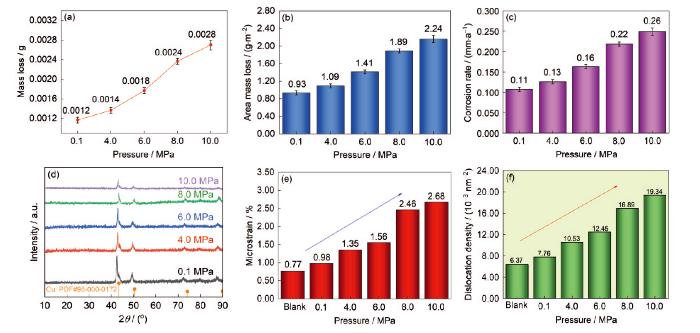
图5
不同海水压力下MAB合金的质量损失、腐蚀速率、XRD谱、(111)晶面微应变水平及位错密度
Fig.5
Mass loss (a), area mass loss (b), corrosion rate (c), XRD pattern (d), microstrain level of (111) crystal plane (e), and dislocation density of (111) crystal plane (f) of MAB alloy after 10 h corrosion under different seawater pressures
为了深入探究不同海水压力下,铜合金微观结构的演变和腐蚀动力学过程,采用MD方法模拟海水静压力对合金微观结构的作用,建立了MAB-Alseg合金/海水界面溶剂化模型(图6a)。在不同海水压力下,H2O分子与合金表面的压缩距离及其在合金表面密度分布定量表示了海水静压力作用的大小。如图6b所示,当海水压力为0.1、4.0、6.0、8.0、10.0 MPa时,H2O分子到合金表面的距离依次为0.28、0.24、0.22、0.20、0.16 nm。可见,随着海水压力的增加,距离合金表面最近的H2O分子与合金表面的距离从0.28 nm减小到0.16 nm。MAB-Alseg合金表面上Cu2+的密度分布情况如图6c所示。距离合金表面最近的Cu2+的位置在0.1 nm左右。随着海水压力从0.1 MPa增加到10.0 MPa,该位置的Cu2+密度增加,峰值密度分别为0.16、0.20、0.25、0.28和0.59 g/cm3。上述结果表明,海水压力使得H2O分子更接近合金表面,金属原子与H2O分子的相互作用增强,海水压力加速了合金Cu原子的溶解过程[56]。在此基础上,为了进一步定量研究海水压力对合金表面Cu原子溶解动力学过程的影响,利用不同海水压力下H2O分子与合金表面之间距离的定量关系,建立了海水溶剂化模型及在不同海水压力作用下Cu原子迁移-溶解动力学模型(图6d),计算结果如图6e所示。随着海水压力的增加,表层Cu原子的空位形成能和迁移-溶解活化能垒逐渐下降,特别是在6.0 MPa下,下降趋势明显。RDS的活化能垒随着海水压力的增加由0.51 eV下降到0.37 eV,与无海水压力(0.53 eV)相比显著下降。这进一步表明,海水压力促进了合金溶解失效动力学过程,当海水压力大于临界值(6.0 MPa)时,腐蚀动力学显著加快,这与上述实验结果基本一致。此外,由不同海水压力下铜合金的溶解速率预测结果(图6f)可知,随着压力增加,溶解速率常数增大。当海水压力大于6.0 MPa时,溶解速率常数明显增大。该结果与上述实验失重规律基本一致,这说明该溶解速率常数能够准确表征深海中铜合金的腐蚀倾向性。
图6
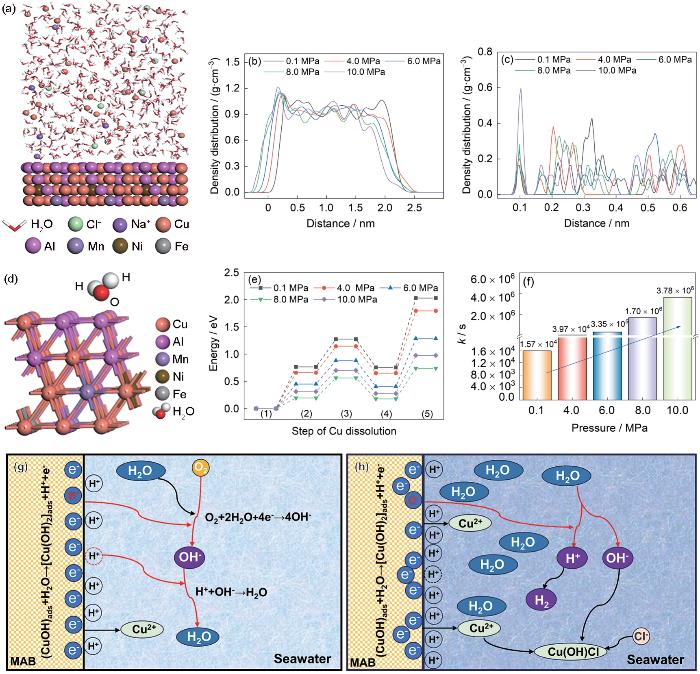
图6
海水压力下MAB-Alseg合金/海水界面的分子动力学模拟、MAB-Alseg合金表面H2O和Cu2+密度分布、压力作用下MAB-Alseg合金表面Cu原子迁移-溶解的预测模型、Cu原子迁移-溶解过程的能量、金属溶解速率常数预测及腐蚀机制示意图
Fig.6
Molecular dynamics simulation snapshot of the MAB-Alseg alloy/seawater interface under seawater pressure (a); density distributions of H2O molecules (b) and Cu2+ (c) on the MAB-Alseg alloy surface under different seawater pressures; predictive model of Cu atom migration-dissolution on the surface of MAB-Alseg alloy under seawater pressure (d); energy diagram of Cu atom migration-dissolution (e); dissolution rate constant (k) of Cu atoms (f); and schematics of the alloy surface dissolution process of hyperoxic zone (g) and hypoxic zone (h) (ads—intermediate corrosion products formed by adsorption of H2O or OH-)
然后,
电子积聚在合金表面,H+由于静电力作用被吸引到合金与溶液之间的界面。溶解氧捕获从钝化膜传递的电子,发生如下反应:
由反应(17)~(19)组合的反应如下:
在浅海区,由于O2的溶解度较高,与O2反应产生的OH-被传递到金属与钝化膜界面并与H+发生反应,最终产生H2O。在深海工况下,随着海水深度的增加,海水中的O2浓度不断下降,当O2浓度较低时,反应(20)会受到抑制,这导致两个后果:首先,反应(14)和(15)过程中产生的电子不能被消耗而积累在合金表面;其次,反应(18)和(19)中产生的OH-减少,反应(14)和(15)中产生的H+不能被中和。因此,H+浓度的增加反过来又抑制反应(14)和(15)的进行,导致更少的Cu2O在合金表面生成,从而导致合金耐腐蚀性能降低。此外,随着H+浓度的增加,在铜合金表面形成H+富集区,在高酸的氧化环境下,H+获得金属氧化产生的电子,形成H2。此时,铜合金的腐蚀主要按照反应(14)和(15)进行,腐蚀反应的去极化剂为H2O。析氢反应产生的OH-与Cu2+、Cl-等结合生成Cu(OH)Cl等,因此导致合金在深海乏氧环境下发生严重腐蚀。
2.3 海水压力与Cl-耦合作用对铜合金腐蚀规律的影响
在海水环境中,Cl-具有半径小、吸附能力强的特点,易于吸附在合金表面,从而加速腐蚀,尤其在深海高压环境下[21,57]。因此,研究海水压力与Cl-耦合作用对MAB-Alseg合金腐蚀动力学过程的影响,对于深入理解铜合金的腐蚀失效机制具有重要意义。图7a为不同海水压力下Cl-吸附的MAB-Alseg合金模型。可见,Cl-在MAB-Alseg合金表面最稳定的吸附位点在Al原子的顶部,其吸附能随着海水压力的增加而增大(见图7b),表明海水压力促进了Cl-的吸附。在相同压力条件下,与无Cl-的情况相比,深海环境稳定的Cl-吸附层使表层与合金基体的结合能显著正移(图7c),这表明Cl-降低了铜合金结构的稳定性。此外,如图7d所示,在深海压力下,随着海水压力的增加,MAB-Alseg合金的功函数从4.84 eV降低到4.61 eV;而在深海压力与Cl-的耦合作用下,功函数从4.71 eV降低到4.52 eV,表明海水压力与Cl-耦合作用增强了MAB-Alseg合金表面原子的电子活跃程度,提高了合金表面与腐蚀介质的反应倾向,使腐蚀更易发生。图7e为耦合作用下MAB-Alseg合金模型表层Cu原子迁移-溶解各阶段的能量图。图7e直观地显示了海水压力与Cl-耦合对MAB-Alseg合金腐蚀动力学的影响。耦合作用显著降低了合金表层Cu原子在溶解过程中的空位形成能和迁移能垒,且在6.0 MPa压力下影响最显著。进一步预测了耦合作用下Cu原子的溶解速率常数,结果如图7f所示。耦合作用对MAB-Alseg合金溶解速率的影响比深海压力的影响高出1~2个数量级,说明深海环境中高压与Cl-耦合作用显著降低了合金的稳定性,导致铜合金腐蚀速率加快。
图7
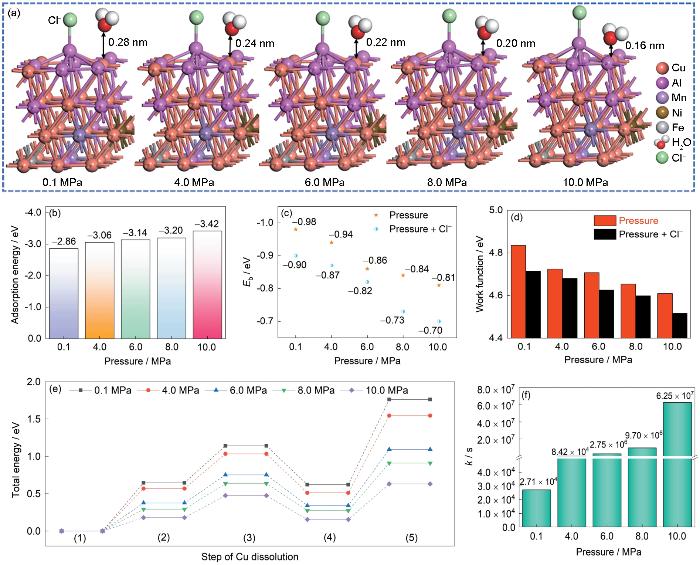
图7
基于不同海水压力下H2O分子与合金表面距离变化建立的Cl-吸附的MAB-Alseg合金模型及溶解过程腐蚀动力学参数分析
Fig.7
Schematic of MAB-Alseg alloy model with by Cl- adsorption (a), adsorption energy at stable adsorption site (top of Al atom) on the surface of MAB-Alseg alloy (b), binding energy (Eb) between Cl- adsorption layer and matrix (c), work function of MAB-Alseg alloy after Cl- adsorption (d), energy diagram of Cu atom migration-dissolution processes of MAB-Alseg alloy after Cl- adsorption (e), and k of Cu atoms (f) at different seawater pressures
为了进一步探究高深海压力下Cl-浓度对铜合金腐蚀倾向的影响规律,建立了10.0 MPa下不同浓度Cl-吸附的合金模型(图8a)。图8b为电荷密度分布图,图中蓝色部分表示得到电子,红色部分表示失去电子。可见,Cl-吸附后,表面电子结构发生显著变化。Cl-在MAB-Alseg合金表面的稳定吸附导致表面电子增加。通过Mulliken电荷分析发现,当Cl-与邻近Cu/Al原子相互作用时,Al原子从Cl-中获得约0.4|e|的电荷。随着Cl-吸附浓度的增大,电子转移量逐渐增多(图8b)。图8c显示了合金表层与基体之间的结合能变化规律。随着Cl-吸附数量达到饱和,表面吸附层与基体之间的键合作用减弱。这可能归因于表面多个Cl-之间的相互排斥作用逐渐增大,从而导致其对合金的破坏作用降低[34,58]。这一规律在Cu原子迁移溶解能量图中表现得尤为明显。随着Cl-浓度的增加,表层Cu原子的空位形成能和迁移活化能垒均下降,当Cl-浓度达到饱和时,Cu原子溶解阻力增加(图8d)。图8e为10.0 MPa压力下,不同浓度Cl-吸附后Cu原子的溶解速率常数的预测结果。由于受到Cl-浓度的影响,溶解速率常数呈现先增大后减小的趋势,进一步说明当MAB-Alseg合金表面Cl-浓度达到饱和时,Cu原子的迁移-溶解动力学过程受到抑制。此外,综合考虑海水压力、Cl-浓度及耦合作用对溶解速率的影响可知,耦合作用明显加快了铜合金失效动力学过程;但当合金表层Cl-浓度饱和时,溶解速率会略有下降。
图8

图8
10.0 MPa海水压力下不同浓度Cl-在MAB-Alseg合金表面吸附的模型、电荷密度分布图及腐蚀动力学参数预测
Fig.8
Adsorption model of different concentrations of Cl- on the surface of MAB-Alseg alloy (a), charge density distribution plots at different Cl- concentration (b), binding energy between Cl- adsorption layer and matrix (c), energy diagram of Cu atom migration-dissolution steps (d), and k of Cu atoms (e) at 10.0 MPa seawater pressure
3 结论
(1) 在海水中螺旋桨铜合金表面形成了部分Al原子富集的偏析结构。由于Al原子在合金表面出现偏析,表层结构相对于亚表层和合金内部具有明显的晶格畸变,导致应力集中。合金中的应力场受到拉压耦合应力的影响,其中合金(111)晶面的微应变水平为0.77%,位错密度为6.37 × 10⁻³ nm-2。MAB-Alseg合金在内应力的促进下表层Cu原子的溶解动力学过程加快。
(2) 当深海压力达到临界值(6.0 MPa)后,腐蚀速率显著增加。腐蚀产物形貌由麻点状向鳞片状转变,并在10.0 MPa下形成大量腐蚀产物。铜合金(111)晶面的微应变和位错密度显著上升,进一步证实海水压力作用下腐蚀后的(111)晶面具有更高的应力。溶解速率常数预测表明,在海水压力从4.0 MPa增加至8.0 MPa的过程中,每增加2.0 MPa,溶解速率加快约一个数量级。
(3) 在深海压力与Cl-耦合作用下,压力能够促进Cl-的化学吸附,引起Cu原子溶解-迁移的加剧。但在较高的Cl-浓度条件下,饱和吸附的Cl-会导致Cu原子的迁移-溶解能垒升高,从而抑制铜合金的失效动力学过程。
参考文献
Corrosion evaluation of welded nickel aluminum bronze and manganese aluminum bronze in synthetic sea water
[J].
Heat treatment effect on the microstructure and the corrosion resistance of manganese-aluminum bronzes
[J].
Corrosion behavior of heat-treated nickel-aluminum bronze and manganese-aluminum bronze in natural waters
[J].
Nickel Aluminum Bronze (NAB) and Manganese Aluminum Bronze (MAB) are high-alloyed bronzes that are increasingly employed in several industrial sectors, mainly related to hostile environments due to their excellent properties against corrosion, cavitation, erosion and improved mechanical properties in relation to other copper-based alloys. These materials are very sensitive against thermal treatments due to a multiphase microstructure in as-cast condition. To contribute to the knowledge of the behavior of both alloys, the effect of thermal treatments on the corrosion behavior of NAB (CuAl10Fe5Ni5) and MAB (CuMn12Al8Fe4Ni2) was studied. As-cast material was subjected to various combinations of quenching and quenching and tempering at 850 °C and 600 °C. Corrosion testing was carried out using simulated sea and fresh water. The microstructures of the as-cast and heat-treated samples were characterized by metallography using two chemical agents with FeCl3 and NH4OH solutions and examination by optical and scanning electron microscopy. The major effect of thermal treatments on corrosion was found in influencing the amount and distribution of β-phase, which is prone to selective corrosion in both electrolytes.
Microstructure and corrosion properties of nickel aluminum bronze (NAB)
[J].
镍铝青铜(NAB)的微观组织及腐蚀性能
[J].
Research progress in corrosion behavior of nickel aluminum bronze alloys in seawater
[J].
镍铝青铜合金海水腐蚀行为研究进展
[J].如何提高镍铝青铜的综合性能,尤其是在更苛刻海水环境条件下的耐腐蚀性能,成为亟待解决的问题。本文针对镍铝青铜合金的腐蚀特点、影响因素、提高耐蚀性的方法等进行了系统讨论,分析了存在的问题,提出了相应的解决途径,并对其未来的研究发展方向进行了展望。
Corrosion behavior of copper alloys in deep ocean environment of south China sea
[J].The corrosion in deep ocean environment has been paied more and more attentions to the exploitation of marine resources. Different from shallow marine environments, deep ocean environments are specially characterized by high hydrostatic pressure, low temperature, variable dissolved oxygen content and pH value in deep ocean, etc.. So the corrosion behaviour of materials, such as ferrous and nonferrous metal and coatings, in deep ocean environments is different from that in shallow marine environments. A number of researches have been carried out to investigate the corrosion behaviour of metals in natural deep ocean in a few developed countries. Such researches, however, began until 2008 in South China Sea. In this work, the corrosion behavior of H62 brass, QAl9-2 and QSn6.5-0.1 bronze in 800 and 1200 m deep ocean environments of South China Sea was studied using field tests. The results indicated that the corrosion rates of copper alloys decreased in the following order: H62 (0.042 mm/a) > QSn6.5-0.1 (0.004-0.007 mm/a) > QAl9-2 (0.003 mm/a). The corrosion rate of H62 brass decreased linearly with the increase in depth. While the corrosion rates of QAl9-2 and QSn6.5-0.1 bronze decreased first and then increased with the increase in depth. The minimum value of corrosion rate occurred between 800-1200 m. The morphology and composition of corrosion products were investigated using SEM, EDS and XRD. The results demonstrated that the dezincification corrosion obeying solution-redeposition mechanism in H62 brass occurred. The corrosion products were composed of Cu, ZnO, Zn5(OH)8Cl2H2O and Cu(OH)2H2O. And the dealloying corrosion in QAl9-2 and QSn6.5-0.1 bronze occurred. The corrosion products of QAl9-2 bronze consist of Cu2O and CuCl2, and those of QSn6.5-0.1 bronze Cu2O, CuCl2 and Cu2Cl(OH)3.
铜合金在中国南海深海环境下的腐蚀行为研究
[J].通过实海暴露实验, 研究了H62黄铜,QAl9-2铝青铜和QSn6.5-0.1锡青铜在中国南海海域800和1200 m深海环境下浸泡3a的腐蚀行为. 结果表明: H62黄铜的腐蚀速率最高, 达到0.042 mm/a;QAl9-2铝青铜最低, 仅为0.003 mm/a; QSn6.5-0.1锡青铜居中, 约为0.004-0.007 mm/a.分析表明: 随着水深的增加, H62黄铜的腐蚀速率呈线性降低;QAl9-2铝青铜和QSn6.5-0.1锡青铜的腐蚀速率随水深的增加先降低后升高,腐蚀速率的最小值出现在水深800-1200 m之间. 采用SEM, EDS和XRD技术,进行了腐蚀形貌观察和腐蚀产物成分及相组成分析, 结果表明:H62黄铜发生了严重的脱锌腐蚀, 腐蚀产物由Cu, ZnO,Zn<sub>5</sub>(OH)<sub>8</sub>Cl<sub>2</sub>H<sub>2</sub>O和Cu(OH)<sub>2</sub>H<sub>2</sub>O组成,符合溶解-再沉积机制; QAl9-2铝青铜和QSn6.5-0.1锡青铜发生了脱成分(Al, Sn)腐蚀,QAl9-2铝青铜的腐蚀产物由Cu<sub>2</sub>O和CuCl<sub>2</sub>组成,QSn6.5-0.1锡青铜的腐蚀产物由Cu<sub>2</sub>O,CuCl<sub>2</sub>和Cu<sub>2</sub>Cl(OH)<sub>3</sub>组成.
Correlation between microstructure and corrosion and cavitation erosion behaviors of nickel aluminum bronze
[J].
Study on the relationship between microstructure and corrosion behavior of typical marine copper alloys
[D].
典型船用铜合金微观组织与腐蚀行为关系研究
[D].
Effect of Al / Ni ratio on the microstructure and properties of nickel-aluminum bronze alloys
[J].To study the effect of aluminum and nickel elements on the microstructures and properties of the nickel–aluminum bronze (NAB) alloy, four kinds of alloys with different compositions, ZCuAl7–7–4–2, ZCuAl8-6-4-2, ZCuAl9-5-4-2, and ZCuAl10-4-4-2, are prepared by vacuum-melting technology. The effects of different Al/Ni ratios on the microstructures of NAB are investigated using a metalloscope, scanning electron microscopy, transmission electron microscopy, and XPS analysis. The mechanical property is evaluated with microhardness testing and tensile mechanical testing. The corrosion resistance is evaluated using mass-loss testing, electrochemical testing, and corrosion-product characterization. The results show that with the increase of the Al/Ni ratio, the content of precipitated phases increases, while β′ and hard κ, which have a different morphology, appear. As the Al/Ni ratio rises from 1 to 2.5, the hardness increases from 104 HV to 202 HV, and the tensile strength increases by 394 MPa from 356 MPa to 751 MPa, but the elongation decreases substantially from 50.50% to 11.00%. The best corrosion resistance is shown on ZCuAl7-7-4-2, with a corrosion rate of 0.00267 mm/a after 30 d of static immersion corrosion in 3.5 wt.% NaCl solution. Through electrochemical testing and corrosion-product characterization, it is found that ZCuAl7-7-4-2 has the largest polarization resistance Rp, and the selective corrosion of the surface is mild.
Morphological evolution of Fe-rich precipitates in a Cu-2.0Fe alloy during isothermal treatment
[J].The morphology of precipitates changes during coarsening regimes, thereby resulting in the modification of mechanical properties of metallic materials. Hence, understanding the morphological evolution in precipitates is critical to tailor the macroscopic properties of industrial alloys. In particular, the morphology of Fe-rich precipitates in Cu alloys is complex, and it evolves from sphere to cube to petal and finally splits, which has been observed during casting and furnace cooling. However, morphological changes in Fe-rich precipitates during isothermal treatment remain unclear; thus, revealing the mechanism of morphological evolution is necessary. In this study, the relationship among the morphological evolution behavior of Fe-rich precipitates in Cu-2.0Fe (mass fraction, %) alloy, temperature, and time under different isothermal-treated processes was analyzed using SEM and TEM coupled with phase-field modeling. Results show morphology changes from a sphere in nanoscale to a cube in submicron scale to a four-branched petal in the submicron scale, and to a multi-branched petal in micron scale during coarsening of Fe-rich precipitates in Cu-2.0Fe alloy isothermally treated at 924, 964, and 984oC (i.e., the temperature range of the fcc Fe phase). The size of multi-branched petal-like Fe-rich precipitates and the number of branches increase with the increase of isothermal temperature and holding time. During coarsening of multi-branched petal-like precipitates, the surrounding small Fe-rich precipitates are engulfed, and thence the number density of the smaller ones in nano and submicron scales decreases when the temperature increases. The modeling result elucidates the multiple morphological evolution of Fe-rich precipitates, which is identical to the experiments, under the effects of interfacial energy, elastic energy, and chemical driving force. In particular, the combined effect of the latter two energies induces the initiation and growth of secondary branches out of primary branches in the four-branched petals, thereby producing multi-branched petal-like precipitates.
Cu-2.0Fe合金等温处理过程中富Fe析出相的形态演变
[J].研究了Cu-2.0Fe (质量分数,%)合金中富Fe析出相形态的演变行为及其与等温温度和保温时间的关系。结果表明,Cu-2.0Fe合金在Fe相fcc温区内的924、964和984℃保温时,富Fe相粗化并伴随着球状(纳米级)→立方状(亚微米级)→四分支花瓣状(亚微米级)→多分支花瓣状(微米级)的形态演变。随着等温温度和保温时间的增加,多分支花瓣状颗粒的尺寸逐步增大,分支数量逐步增加。多分支花瓣状颗粒的长大需要吞噬周边的小颗粒,导致温度升高时纳米~亚微米级富Fe颗粒的数量密度下降。基于相场模拟的分析表明,界面能、弹性能和化学驱动力的综合作用诱发富Fe相的多重形态演变,其中四分支花瓣状颗粒长大过程中,在弹性应变能和化学驱动力相互角逐作用下,从一次分支上生长出二次分支,进而产生了多分支花瓣状的形态。
Preparation and corrosion behavior of additive manufactured nickel-aluminum bronze alloys
[J].
增材制造镍铝青铜合金的制备与腐蚀行为研究进展
[J].
Study on welding and heat treatment technology of nickel-aluminium bronze C63000
[J].
镍铝青铜C63000材料的焊接及热处理工艺研究
[J].
Effect of hot treatment on microstructure and corrosion resistance of NAB alloy
[D].
热处理对镍铝青铜合金组织和耐蚀性的影响研究
[D].
A comparative assessment on cavitation erosion behavior of typical copper alloys used for ship propeller
[J].
三种典型船舶螺旋桨用铜合金的空蚀行为对比研究
[J].
Effect of hydrostatic pressure on the anodic dissolution process of X80 steel
[J].
Hydrostatic pressure effect on double layer capacity of iron
[J].
Study on the mechanism of hydrostatic pressure promoting electrochemical corrosion of pure iron in 3.5% NaCl solution
[J].
Influence of hydrostatic pressure on the thermodynamics and kinetics of metal corrosion
[J].In recent years, researches on deep sea corrosion have attracted much attention of many researchers. The high hydrostatic pressure is a distinctive feature of deep-sea environment. The hydrostatic pressure affects the corrosive behavior of metallic materials by modifying the composition, structure and compactness of corrosion products, changing the polarization processes of cathode electrode and anode electrode, altering pitting nucleation rate and growth rate, impacting on chemical reaction rate and equilibrium constant, and varying hydrogen diffusion rate and coverage. However, in essence, the influence of hydrostatic pressure on the corrosion behavior of different metal materials is the manifestation of the thermodynamic and kinetic parameters of the corrosion electrode process caused by hydrostatic pressure. At present, the mechanism of effect of hydrostatic pressure on the thermodynamics and kinetics of corroding electrode processes is unclear yet. In addition, the concerns about the effects of hydrostatic pressure on the chemical properties of materials and seawater are comparatively low. Based on thermodynamics and kinetics, the effects of hydrostatic pressure on the activities of electrode material and ions in environment, including on the solubility, fugacity or activity of gases in environment are analyzed. The influence of hydrostatic pressure on pH value and chemical equilibrium is also discussed. The relationships between hydrostatic pressure and equilibrium electrode potential, as well as the exchange current density, are analyzed. The theoretical model of the effect of hydrostatic pressure on the corrosion behavior of active metals is established. The studies have shown that hydrostatic pressure would increase the activities of materials, ions and dissolved gas in environments, and this is closely related to their partial molar volume. The hydrostatic pressure would magnify the difference in the activity of heterogeneous materials. The larger the partial molar volume difference of the heterogeneous materials, the more obvious the difference in activity. Increasing hydrostatic pressure reduces the equilibrium electrode potential of iron and aluminum anode dissolution reaction while reducing its exchange current density. Increasing hydrostatic pressure increases the equilibrium electrode potential of oxygen reaction and decreases its exchange current density. Increasing hydrostatic pressure reduces the equilibrium electrode potential of hydrogen evolution reaction and increases its exchange current density.
静水压力对金属腐蚀热力学及动力学的影响
[J].以热力学和动力学为基础,分析了静水压力对电极反应中材料的活度、环境中离子的活度、气体的溶解度、活度或逸度的影响,讨论了静水压力对海水环境中的pH值及化学平衡的作用,给出了静水压力与电极反应平衡电极电位和交换电流密度的关系式,并建立了静水压力影响活性金属腐蚀行为的理论模型。研究表明,静水压力可提高材料、环境中离子及溶解气体的活度,且这与其偏摩尔体积密切相关;静水压力对异相材料的活度差异具有放大效应,异相材料的偏摩尔体积相差越大,活度的差异越明显。升高静水压力可降低金属Fe和Al阳极溶解反应的平衡电极电位,同时降低其交换电流密度;升高静水压力可提高吸氧反应的平衡电极电位,降低其交换电流密度;升高静水压力可降低析氢反应的平衡电极电位,增大其交换电流密度。
The effect law of different hydrostatic pressures on the failure of multilayer Cr/GLC coatings in 3.5 wt% NaCl solution
[J].
The corrosion properties of bronze alloys in NaCl solutions
[J].Chloride ions play an important role in the corrosion of bronze through their active reactivity to copper alloys. The corrosion behavior of bronze alloys in NaCl solution was investigated by using X-ray diffraction (XRD), a scanning electron microscope (SEM), and electrochemical tests, with a special emphasis on the corrosion resistance of the α and δ phases in Cu-20 wt%Sn bronze alloys. The experimental results show that the corrosion current density of Cu-20 wt%Sn bronze alloys increases from 1.1 × 10⁻⁷ A/cm2 to 2.7 × 10⁻⁶ A/cm2 with the increase in the chloride ion concentration from 10−3 mol/L to 1 mol/L. After a soaking duration of 30 days, the matrix corrosion depth reaches 50 μm. The α phase of the alloys is easily corroded in NaCl solution, while the δ phase with high Sn content has strong corrosion resistance. This study provides relevant data for the analysis and protection of ancient bronze alloys.
Influence of hydrostatic pressure on the corrosion behavior of 90/10 copper-nickel alloy tube under alternating dry and wet condition
[J].
Stress corrosion behavior of Ni-Cr-Mo-V steel in 3.5%NaCl solution under the interaction of hydrostatic pressure and tensile stress
[J].
静水压力和拉伸应力交互作用下Ni-Cr-Mo-V钢在3.5%NaCl溶液中的应力腐蚀行为
[J].Ni-Cr-Mo-V钢在深海环境的长期服役过程中会受到复杂力学环境的影响,可能会引发严重的腐蚀失效。为探究静水压力环境中Ni-Cr-Mo-V钢的应力腐蚀开裂敏感性,采用电化学测试方法、微观形貌表征手段和慢应变速率拉伸实验研究了静水压力和拉伸应力交互作用下Ni-Cr-Mo-V钢的局部腐蚀行为和应力腐蚀行为。结果表明,静水压力和拉伸应力交互作用对Ni-Cr-Mo-V钢局部腐蚀行为的双重作用会影响其应力腐蚀行为。一方面,拉伸应力与静水压力的交互作用加速了点蚀坑的扩展,并影响了腐蚀产物在基体表面的附着。另一方面,静水压力和拉伸应力促进了金属离子在Ni-Cr-Mo-V钢表面的水解,从而导致金属表面积累更多的H<sup>+</sup>。
Effect of heat treatment on microstructural changes in aluminium bronze
[J].
Evolution of the corrosion product film on nickel-aluminum bronze and its corrosion behavior in 3.5 wt% NaCl solution
[J].The in-situ studies of the corrosion product film on nickel-aluminum bronze are significant for explaining the mechanism of its corrosion resistance. In this paper, the corrosion behavior of nickel-aluminum bronze and the formation process of the protective film in 3.5 wt % NaCl solution are systematically investigated. The results of scanning electron microscope analysis and electrochemical tests indicate that the corrosion resistance of nickel-aluminum bronze is improved due to the formation of the corrosion product film. The change of local electrochemical property on the corrosion product film during the immersion time is evaluated via in-situ scanning vibrating electrode technique, and it reveals the evolution rules of ionic flux in real time. The formation process of the protective film on different phases in nickel-aluminum bronze is observed directly by in-situ atomic force microscopy as height change measurements. The α phases at different locations present different corrosion behaviors, and the lamellar α phase within the α + κIII eutectoid structure gets more serious corrosion attack. The κ phases establish a stable and dense protective film in short time, preventing the corrosion attack effectively. The β′ phase, however, suffers the most serious corrosion damage until a protective film is formed after 150 min of immersion.
De-alloying corrosion in the heat-affected zone in Mn-Al bronze weld
[J].
Comparison of the corrosion and cavitation erosion behaviors of the cast and surface-modified manganese-aluminum bronzes in sodium chloride solution
[J].
Elucidating different selective corrosion behavior of two typical marine aluminum bronze alloys from the perspective of constituent phases
[J].
X-ray analysis of ZnO nanoparticles by Williamson-Hall and size-strain plot methods
[J].
Explicit microstructure, corrosion, and stress analysis of value-added Al-3.7%Cu-1.4%Mg/1.5% rice husk ash nanoparticles for pump impeller application
[J].
An all-electron numerical method for solving the local density functional for polyatomic molecules
[J].
1,2,3-Benzotriazole derivatives adsorption on Cu(111) surface: A DFT study
[J].
Lattice parameters, densities, expansion coefficients and perfection of structure of Cu and of Cu-In α phase
[J].
Atomistic understanding of Pt-based medium entropy alloys for oxygen reduction electrocatalysis based on first principles
[J].
Density-functional theory investigation of Al pitting corrosion in electrolyte containing chloride ions
[J].
DFT study of imidazoles adsorption on the grain boundary of Cu (100) surface
[J].
Characterization of passive film on 2205 duplex stainless steel in sodium thiosulphate solution
[J].
Interfacial valence electron localization and the corrosion resistance of Al-SiC nanocomposite
[J].Microstructural inhomogeneity generally deteriorates the corrosion resistance of materials due to the galvanic effect and interfacial issues. However, the situation may change for nanostructured materials. This article reports our studies on the corrosion behavior of SiC nanoparticle-reinforced Al6061 matrix composite. It was observed that the corrosion resistance of Al6061 increased when SiC nanoparticles were added. Overall electron work function (EWF) of the Al-SiC nanocomposite increased, along with an increase in the corrosion potential. The electron localization function of the Al-SiC nanocomposite was calculated and the results revealed that valence electrons were localized in the region of SiC-Al interface, resulting in an increase in the overall work function and thus building a higher barrier to hinder electrons in the nano-composite to participate in corrosion reactions.
Understanding the low corrosion potential and high corrosion resistance of nano-zinc electrodeposit based on electron work function and interfacial potential difference
[J].
The conductor-like screening model for polymers and surfaces
[J].
The synchronous-transit method for determining reaction pathways and locating molecular transition states
[J].
KiSThelP: A program to predict thermodynamic properties and rate constants from quantum chemistry results
[J].Kinetic and Statistical Thermodynamical Package (KiSThelP) is a cross-platform free open-source program developed to estimate molecular and reaction properties from electronic structure data. To date, three computational chemistry software formats are supported (Gaussian, GAMESS, and NWChem). Some key features are: gas-phase molecular thermodynamic properties (offering hindered rotor treatment), thermal equilibrium constants, transition state theory rate coefficients (transition state theory (TST), variational transition state theory (VTST)) including one-dimensional (1D) tunnelling effects (Wigner, and Eckart) and Rice-Ramsperger-Kassel-Marcus (RRKM) rate constants, for elementary reactions with well-defined barriers. KiSThelP is intended as a working tool both for the general public and also for more expert users. It provides graphical front-end capabilities designed to facilitate calculations and interpreting results. KiSThelP enables to change input data and simulation parameters directly through the graphical user interface and to visually probe how it affects results. Users can access results in the form of graphs and tables. The graphical tool offers customizing of 2D plots, exporting images and data files. These features make this program also well-suited to support and enhance students learning and can serve as a very attractive courseware, taking the teaching content directly from results in molecular and kinetic modelling.© 2013 Wiley Periodicals, Inc.
Allen J. Bard, Larry. R. Faulkner, Henry S. White: Electrochemical methods: Fundamentals and applications
[J].
Toward an atomic-scale understanding of electrochemical interface structure and dynamics
[J].For the knowledged-based development of electrochemical processes, a better fundamental understanding of the interfaces between electrodes and electrolytes is necessary. This requires insight into the interface structure and dynamics on the atomic-scale, including that of the liquid electrolyte in the near-surface region, i.e., in the inner and outer part of the electrochemical double layer. This perspective describes current studies of simple and well-defined electrochemical interfaces by first-principles electronic structure calculations and in situ structure-sensitive methods. It is shown that these experimental and theoretical studies are now approaching a level, where they can operate on the same footing, making direct comparison of the obtained results feasible. Using selected examples, progress in clarifying the structure and dynamics of the double layer, of adsorbed species on electrode surfaces, and of initial steps in electrochemical phase formation processes is discussed.
Molecular dynamics simulations of water and ion dynamics in the electrochemical double layer
[J].
Experimental and theoretical studies for corrosion inhibition of carbon steel by imidazoline derivative in 5% NaCl saturated Ca(OH)2 solution
[J].
Adsorption of organosilanes at a Zn-terminated ZnO (0001) surface: Molecular dynamics study
[J].Four different organosilanes (octyltrihydroxysilane, butyltrihydroxysilane, aminopropyltrihydroxysilane, and thiolpropyltrihydroxysilane) adsorbed at a reconstructed Zn-terminated polar ZnO (0001) surface are studied via constant temperature (298 K) molecular dynamics simulations. Both single adsorbed silane molecules as well as adsorbed silane layers are modeled, and the energy, distance, orientation, and alignment of these adsorbates are analyzed. The adsorbed silane molecules exhibit behavior depending on the chemical nature of their tail (nonpolar or polar) as well as on the silane concentration at the solid surface (single adsorption or silane layer). In contrast to the O-terminated ZnO surface studied previously, now adsorption can only occur at the vacancies of this reconstructed crystal surface, thus leading to an arched structure of the liquid phase near the crystal surface. Nevertheless, both nonpolar and polar single adsorbed silanes show a similar orientation and alignment at the surface (orthogonal in the former, parallel in the latter case) as for the O-terminated ZnO surface, although the interaction energy with the surface is considerably increased for nonpolar silanes while it is nearly unaffected for the polar ones. For adsorbed silanes within silane layers, the difference to single adsorbed silanes depends on the polarity of the tail: nonpolar silanes again show an orthogonal alignment, while polar silanes exhibit two different orientations at the solid surface-a head and a tail down configuration. This leads to two completely different but nevertheless stable orientations of these silanes at the Zn-terminated ZnO surface.
Chemical and electrical characterisation of the segregation of Al from a CuAl alloy (90% :10% wt) with thermal anneal
[J].
Efficient and superiorly durable Pt-lean electrocatalysts of Pt-W alloys for the oxygen reduction reaction
[J].
Microstructure and properties of QAl10-4-4 alloy fabricated by rheological squeeze casting
[J].
The deformations of carbon nanotubes under cutting
[J].The determination of structural evolution at the atomic level is essential to understanding the intrinsic physics and chemistries of nanomaterials. Mechanochemistry represents a promising method to trace structural evolution, but conventional mechanical tension generates random breaking points, which makes it unavailable for effective analysis. It remains difficult to find an appropriate model to study shear deformations. Here, we synthesize high-modulus carbon nanotubes that can be cut precisely, and the structural evolution is efficiently investigated through a combination of geometry phase analysis and first-principles calculations. The lattice fluctuation depends on the anisotropy, chirality, curvature, and slicing rate. The strain distribution further reveals a plastic breaking mechanism for the conjugated carbon atoms under cutting. The resulting sliced carbon nanotubes with controllable sizes and open ends are promising for various applications, for example, as an anode material for lithium-ion batteries.
Experimental study of corrosion rate supplied with an ab-initio elucidation of corrosion mechanism of biodegradable implants based on Ag-doped Zn alloys
[J].
First-principles modeling of anisotropic anodic dissolution of metals and alloys in corrosive environments
[J].
Conjugate peak refinement: An algorithm for finding reaction paths and accurate transition states in systems with many degrees of freedom
[J].
Ab initio DFT study of hydrogen dissociation on MoS2, NiMoS, and CoMoS: Mechanism, kinetics, and vibrational frequencies
[J].
Microstructural evolution and dynamic failure mechanism of B10 Cu-Ni alloy under multiple stress coupling in flowing seawater
[J].To address the critical issue of microstructural degradation and dynamic failure of Cu-Ni alloys subjected to multiple stress couplings in flowing seawater, this study systematically investigates the microstructural evolution and failure characteristics of the alloy in a complex service environment. Focusing on the widely used B10 Cu-Ni alloy in pipeline systems, a combined experimental and computational simulation approach was employed. A molecular dynamics method was used to construct an alloy/seawater solvation model, with emphasis on the effects of seawater flow rate, pressure, and their coupled interactions on microstructural evolution and corrosion kinetics. In flowing seawater, the strain level of the alloy increases markedly, accompanied by a rise in microstructural defects. The results reveal that corrosion of Cu-Ni alloys proceeds through a multi-step coupled mechanism governed by the migration-dissolution energy barrier of Cu atoms. Density functional theory calculations show that as seawater pressure increases from 0.1 MPa to 12 MPa, the migration-dissolution energy barrier decreases from 1.76 eV to 1.54 eV, significantly accelerating the corrosion rate. Furthermore, increasing seawater flow rate induces atomic-level axial elastic tensile strain on the (111) crystal plane of the alloy, further reducing the migration-dissolution energy barrier. A critical flow rate of 4 m/s has been identified as exacerbating corrosion. Under the coupled influence of flow rate and pressure, the migration-dissolution energy barrier is further reduced, the work function decreases, and corrosion kinetics are significantly accelerated. The corrosion rate constants obtained from simulations exhibit highly consistent trends with experimentally measured corrosion rates, enabling reliable assessment and prediction of the corrosion tendency of the B10 Cu-Ni alloy during dynamic failure under real operational conditions.
流动海水中多重应力耦合作用下B10 Cu-Ni合金的微观结构演变与动态失效机制
[J].针对Cu-Ni合金在流动海水中承受多重应力耦合作用时易发生微观结构劣化与动态失效的关键问题,本工作以管路系统广泛应用的B10 Cu-Ni合金为研究对象,研究了其在复杂服役环境下的微观结构演变规律与动态失效特征。采用实验与模拟计算相结合的研究策略,通过分子动力学(MD)方法构建了合金/海水溶剂化模型,重点研究了海水流速、压力及其耦合作用对B10 Cu-Ni合金微观结构演变及其腐蚀动力学过程的影响机制。结果表明,Cu-Ni合金的腐蚀过程受多步耦合的Cu原子迁移-溶解能垒控制。基于密度泛函理论(DFT)的计算分析表明,随着海水压力从0.1 MPa增至12 MPa,迁移-溶解能垒由1.76 eV降至1.54 eV,腐蚀速率显著提升。此外,随着海水流速的增加,合金(111)晶面产生原子级轴向弹性拉伸应变,迁移-溶解能垒进一步降低,存在使腐蚀加剧的临界流速(4 m/s)。在海水流速与压力耦合作用下,迁移-溶解能垒进一步减小,功函数降低,腐蚀动力学过程显著加快。模拟计算所得的腐蚀速率常数与实测腐蚀速率的变化趋势基本一致,有效实现了对B10 Cu-Ni合金在实际工况环境下动态失效过程中腐蚀倾向的评估与预测。
Modeling of the electrochemical double layer and its impact on intercalation reactions
[J].We deduce a generic interface theory to describe charge and electron transfer reactions at electrified interfaces based on fundamental principles. Considering the contact between a solid electrode and a liquid electrolyte, the model allows the consistent determination of emerging electric fields and space charge layers at the interface. The interaction between charge transport and the electrochemical double layer at the boundary between the electrode and electrolyte is investigated. Time scales of interfacial reaction and transport processes are analyzed. Further, we present a reduced bulk model of the electrochemical interface, which allows us to incorporate properties of the electrochemical double layer as extended boundary conditions in transport models of lithium-ion batteries. Numerically less intensive, the reduced model builds a bridge between our detailed description of reactions at electrified interfaces and commonly used modeling approaches for electrode reactions. With both the full and the reduced model, we simulate the impedance response of an electrochemical cell.
Research progress on the influence of anions in typical corrosive media on corrosion behavior of magnesium alloys
[J].
典型腐蚀介质中阴离子对镁合金腐蚀行为影响的研究进展
[J].


