



在高品质钢生产过程中,为了提升钢材的洁净度,通常会在钢液精炼的最后阶段预留一段静置时间。此时,钢液中的夹杂物由于密度小于钢液密度,会在浮力的作用下向钢-渣界面移动,并最终被精炼渣溶解去除。在钢包静置过程中,由于没有额外的搅拌操作,钢包内熔体的流动较弱,使得在钢液上表面能够形成完整的渣面,防止了渣眼的产生,有效地避免了钢液的二次氧化;同时,钢-渣界面也相对平静,避免了卷渣现象的发生。一般情况下,钢包的静置时间越长,钢液中夹杂物的上浮去除效果越好。然而,需要指出的是,在实际生产中,钢包向周围环境散热是不可避免的,这会导致钢水温度逐渐下降。为了确保连铸过程的顺利进行,需要精准控制钢水温度。因此,在实际炼钢生产过程中,需要对钢包的静置时间进行合理控制[1~5]。
随着计算机技术和数值计算方法的发展,采用数值模拟研究冶金生产过程已成为研究热点之一[6~21]。1987年,Ilegbusi和Szekley[6]建立了钢包静置过程热分层的二维轴对称模型,讨论了钢液的流动以及温度分布,并分析了磁力搅拌对减弱钢液热分层的作用。Austin等[7]采用简化边界条件计算了钢包静置和浇铸过程中钢液温度场及速度场的演变,分析了冷却速率、钢包结构、静置时间等参数对钢包内热分层的影响。Chakraborty和Sahai[8,9]假设,钢液上表面存在两种不同的散热边界条件,研究了渣层厚度对钢包静置和浇铸过程中流场和温度场的影响。结果表明,当假设钢液上表面为绝热边界条件(对应厚渣层)时,尽管静置过程中钢液存在明显热分层,但浇铸过程中钢液流出温度变化较小;而当假设钢液上表面存在较大热流密度(对应薄渣层)时,尽管静置时钢液内部温度趋于均匀,但在浇铸过程中钢液流出温度随着浇铸的进行而逐渐降低。Olika等[10]将TEMPSIM与PHOENICS软件进行耦合,利用TEMPSIM软件计算钢包侧壁温度和换热边界条件,再利用PHOENICS软件计算钢液流动和热分层,讨论了初始钢包热状态和钢包形状结构对钢液流动和热分层的影响。Pan等[14~16]通过数学实验系统研究了钢包热面温度、精炼渣厚度和静置时间等参数对钢包静置瞬态流场和传热的影响。2019年,本课题组[19]研究了钢包静置过程中的流动和传热行为,并讨论了钢包静置过程中夹杂物的运动和去除情况。然而,上述模型均只考虑了钢液,通过假设钢液与钢包壁间的换热边界条件来考虑钢包静置过程中的热量传输,而忽略了钢包壁内的传热。
对于耦合了钢包壁内耐火材料热传导的钢包静置过程中的流动与传热数值模型,能够追溯到的最早研究为2001年由Xia和Ahokainen[12,13]提出的模型。该模型假设钢包耐火材料的温度分布是均匀的,但这与实际生产过程存在显著偏差。近些年,陆续有耦合了瞬态流动与钢液-钢包壁传热的数值模型的报道。Lu等[18]通过两步法建模研究了钢包静置过程中钢液的流动和传热。第一步进行钢包壁与精炼渣层的稳态传热计算,以获取钢包静置过程的初始热状态;第二步是以第一步得到的热状态为初始条件,计算钢包静置过程中流场和温度场的瞬态变化。Gopala Krishna等[20]针对浇铸球墨铸铁的780 kg扇形小钢包进行建模,预测了静置和浇铸过程的瞬态流动和温度分布。需要指出的是,目前关于钢包静置过程流动和传热的数值模拟研究已有较为详细的报道。然而,针对钢包静置过程中夹杂物去除的数值模拟研究相对匮乏。本课题组前期工作虽然对夹杂物在钢液中的运动和去除进行了模拟分析,但忽略了多相流动和固体导热对结果的影响。
本工作首先通过工业试验调研了钢包吹氩密封成分调整(CAS)精炼生产商用热轧低碳钢(SPHC低碳钢)过程中钢包静置时夹杂物数密度和面积分数的演变,然后基于钢包静置过程中钢液流动和传热的数值模型[20],采用离散相模型建立了钢包静置过程中夹杂物运动和去除的数值模型,讨论了不同尺寸夹杂物在钢包静置过程中的运动行为,并定量分析了钢包静置过程中不同尺寸夹杂物的去除率与静置时间之间的关系,从而为高品质钢的工业生产实践提供理论指导。
1 钢包静置过程夹杂物去除的工业试验与分析
本工作针对国内某厂生产的SPHC低碳钢的钢包静置过程进行工业试验与调研,分析了钢包静置过程钢中夹杂物数密度和面积分数随静置时间的演变规律。该厂采用转炉-CAS精炼-连铸(BOF-CAS-CC)工艺流程生产SPHC低碳钢,在CAS精炼后期,通过钢包静置过程去除钢中的夹杂物。整个CAS精炼过程主要包含四个阶段,分别为预吹氩阶段、合金化阶段、吹氩搅拌阶段和钢包静置阶段。具体的合金化操作和钢包吹氩流量变化如图1所示。在CAS精炼的第34 min关闭钢包吹氩,开始进入钢包静置阶段,本工作采用专用提桶取样器对钢包静置过程中的钢水进行密集取样,取样点为远离吹氩砖一侧的钢液面下约300 mm位置,取样时间分别为静置0 (即开始静置时)、3、6、9、12和15 min,共6个样品,取样信息如图1所示。钢包静置15 min后的钢液成分(质量分数,%)为:C 0.0342,Si 0.0073,Mn 0.2017,P 0.0103,S 0.0130,Ti 0.0015,总Al含量(T.Al) 0.0373,总Ca含量(T.Ca) 0.0001,Fe余量。在所取钢样的底部进行切割获得金相样品,然后采用酚醛树脂进行镶嵌,再通过自动磨样机进行磨抛,最后采用配有能谱仪(EDS)的Quattro S自动扫描电镜(SEM)观察和分析夹杂物的成分、数量、尺寸和形貌等信息,其中每个样品的扫描面积约为30 mm2。此外,沿所取钢样的纵向取一个氧氮棒,采用LECO氧氮氢分析仪测量钢样中的总O含量(T.O)。去除率的计算方法为:钢包静置初始时刻的数值与相应时刻数值的差值除以钢包静置初始时刻的数值。
图1
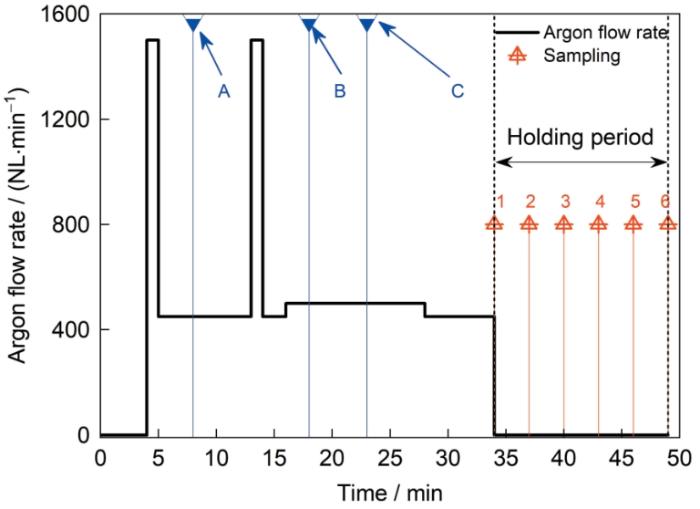
图1
钢包吹氩密封成分调整(CAS)精炼的工艺操作和取样记录示意图
Fig.1
Schematic of operations and sampling processes during composition adjustment by sealed argon bubbling (CAS) refining (A represents adding 51 kg FeAl and 135 kg Al; B represents adding 51 kg high carbon FeMn, 526 kg middle carbon FeMn, and 48 kg FeAl; C represents adding 80 kg FeAl)
图2
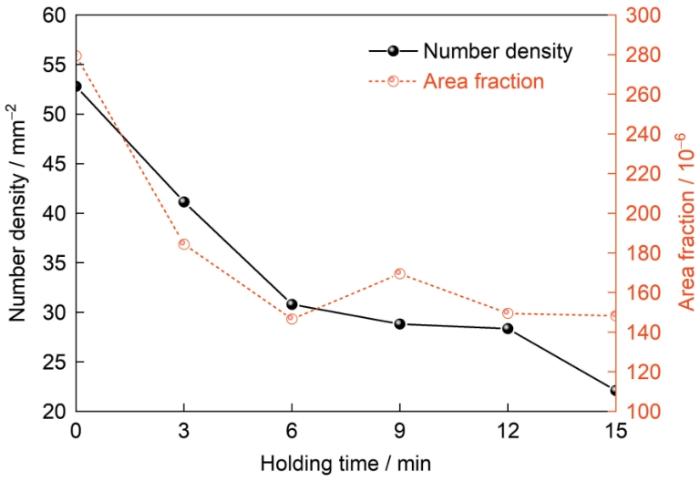
图2
钢包静置过程钢中夹杂物数密度和面积分数的演变
Fig.2
Evolution of number density and area fraction of inclusions in the molten steel during ladle holding period
图3

图3
钢包静置过程钢液中总O含量的演变
Fig.3
Evolution of T.O in the molten steel during ladle holding period (T.O—total oxygen content)
图4为钢包静置0、6和15 min时钢液中夹杂物形貌的演变。整个钢包静置过程中,钢液中夹杂物基本上都是纯Al2O3夹杂物。在钢包静置初期,钢液中含有大量团簇状的Al2O3夹杂物,这些团簇通常由较小的Al2O3颗粒聚集而成,尺寸多在十几微米。同时,钢液中还存在大量尺寸在5~10 μm的大尺寸夹杂物。随着钢包静置时间的延长,钢液中大尺寸团簇的数量逐渐减少,而残留的多为尺寸较小的团簇状或单颗粒的Al2O3夹杂物。例如,经过6 min静置后,钢液中团簇夹杂物的尺寸多集中在5~10 μm之间;而继续静置到15 min时,团簇夹杂物的尺寸进一步减小,通常在5 μm左右。
图4

图4
钢包静置过程中夹杂物形貌演变的SEM像
Fig.4
SEM images showing morphology evolutions of inclusions in the molten steel during ladle holding for 0 min (a-c), 6 min (d-f), and 15 min (g-i)
2 钢包静置过程夹杂物运动与去除数学模型
本工作采用离散相模型(discrete phase model,DPM)对钢包静置过程夹杂物在钢液中的运动和去除进行建模。将夹杂物视为球形的离散相粒子,忽略夹杂物间的相互作用以及化学成分变化。夹杂物在钢液中主要受到浮力、曳力、虚拟质量力和压力梯度力的作用,通过分析其受力来求解夹杂物的运动方程[22]:
式中, vp和 vl分别为夹杂物粒子的运动速度和钢液的流速,m/s;ρp和ρl分别为夹杂物粒子的密度和钢液的密度,kg/m3,本工作中认为夹杂物粒子均为Al2O3,ρp= 3500 kg/m3、ρl= 7080 kg/m3;μl为钢液的黏度,μl= 0.0067 Pa·s;g为重力加速度,m/s2;dp为夹杂物粒子的直径,m;Rep为夹杂物粒子的Reynolds数,由
式中,a1、a2和a3为常数,取值参考文献[23]。
夹杂物粒子在钢液中的运动轨迹可以通过将其运动方程对时间进行积分而得到:
式中, xp为夹杂物粒子在钢液中的位置坐标,m。
此外,本工作采用了随机游走模型(random walk model)[24]模拟钢液湍流流动对夹杂物粒子运动的影响。在随机游走模型中,钢液的瞬时流速为时均速率与脉动速率之和,时均速率可以由流场计算直接得到,而脉动速率是由湍动能和一个随机数组成的函数,如
式中,
钢包静置过程夹杂物运动和去除模型是基于钢包静置过程流动和传热模型而建立的,关于钢包静置过程的流动和传热模型可参考本课题组前期工作[25]。求解钢包静置过程夹杂物在钢液中运动和去除的具体过程为:在已经计算得到的钢包吹氩多相流[22,26,27]的基础上,通过用户自定义程序(user defined function,UDF)将直径分别为1、10、100和1000 μm的夹杂物粒子均匀地注入钢液中(如图5所示),每种夹杂物粒子的注入数量均为19200,作为钢包静置的初始条件,然后求解钢包静置过程中流场、温度场和夹杂物的运动。由于钢液中夹杂物的总量很少,因此在求解过程中采用单向耦合,即只考虑钢液流动对夹杂物运动的影响,而忽略夹杂物运动对钢液流动的影响。同时,在夹杂物粒子的运动过程中,设置其边界条件为:夹杂物粒子在钢包的侧壁和底部为反弹(reflect)边界条件;在钢-渣界面处(定义渣相体积分数等于0.5的区域为钢-渣界面),夹杂物被精炼渣捕获;在渣眼位置(定义空气相体积分数等于0.5的区域为渣眼)的钢液表面,夹杂物也将被反弹回钢液内部。此外,本工作还通过UDF对每个夹杂物粒子被钢-渣界面所捕获的位置和时间进行了记录和输出,以便于计算夹杂物去除率随静置时间的变化关系。
图5

图5
钢包静置过程中夹杂物在钢液中的初始位置分布
Fig.5
Initial distribution of inclusions in the molten steel during ladle holding period
3 钢包静置过程钢液中不同尺寸夹杂物的运动与去除
本课题组前期工作[25]已经详细讨论了钢包静置过程中的流场变化。在钢包静置初期,由于钢包吹氩的影响,钢液内部会形成一个大的循环流动,此时钢液的运动主要由惯性驱动。随着流动能量逐渐耗散,钢液流速快速下降,至钢包静置300 s时钢液流速显著变慢。随后,在钢液的左上方形成一个小的循环流,整体流动模式转变为双循环流。接着,自然对流逐步发展,成为主导钢液流动的驱动力,两个循环流也都随之增强。在静置700 s时,大循环流再次充分发展,导致钢液底部的流速明显增大。此后,大循环流逐渐减弱,而小循环流逐渐增强,流动呈现出左右对称的发展趋势。图6为钢包静置过程钢液中直径为1 μm的夹杂物(简称1 μm夹杂物)的运动和去除情况。可见,在钢包静置初期(前300 s,尤其是前100 s),1 μm夹杂物主要跟随钢液流动,钢液底部的夹杂物沿左侧向上运动,钢液上部的夹杂物沿右侧向下运动。随后,夹杂物一方面跟随着钢液流动;另一方面由于湍流的作用而作随机运动。需要指出的是,当夹杂物运动到钢-渣界面时,会被精炼渣捕获去除,因此钢液中的夹杂物随着静置时间的推移而减少。同时还可以看到,在钢包静置初期,夹杂物的去除速率较快;而在钢包静置的中后期,夹杂物的去除速率减慢;在钢包静置1800 s后,钢液中还存在很多1 μm夹杂物。这是因为在钢包静置初期,钢液的流动主要受钢包吹氩残余流场的影响,钢液流速较快,能够较快地将钢液内部的夹杂物带到钢-渣界面;而当钢包吹氩残余流场逐渐减弱后,钢液流动主要受热浮力的作用,流速较慢,因此夹杂物的上浮去除速率也减慢。
图6

图6
钢包静置过程中直径为1 μm的夹杂物在钢液中的运动和去除
Fig.6
Motions and removals of 1 μm inclusions in the molten steel during ladle holding for 10 s (a), 50 s (b), 100 s (c), 300 s (d), 600 s (e), 900 s (f), 1200 s (g), 1500 s (h), and 1800 s (i)
图7为钢包静置过程直径为10 μm的夹杂物(简称10 μm夹杂物)在钢液中的运动和去除情况。可以看出,10 μm夹杂物与1 μm夹杂物的运动和去除情况非常接近,这是因为当夹杂物直径小于10 μm时,夹杂物自身上浮速率很小,远小于钢包静置过程钢液的流速,因此其运动和去除主要受钢液流动的影响,夹杂物尺寸对其影响很小,这部分将在后文进行详细讨论。而当夹杂物直径增大到100 μm后,夹杂物的运动除了跟随钢液流动和湍流随机运动外,还需要考虑自身的上浮,因此相对于直径小于10 μm的夹杂物,其上浮去除速率相对较快,在相同的静置时间内,钢液中直径为100 μm的夹杂物(简称100 μm夹杂物)数量少于钢液中1和10 μm夹杂物,如图8所示。
图7

图7
钢包静置过程中直径为10 μm的夹杂物在钢液中的运动和去除
Fig.7
Motions and removals of 10 μm inclusions in the molten steel during ladle holding for 100 s (a), 600 s (b), and 1800 s (c)
图8

图8
钢包静置过程中直径为100 μm的夹杂物在钢液中的运动和去除
Fig.8
Motions and removals of 100 μm inclusions in the molten steel during ladle holding time for 100 s (a), 600 s (b), and 1800 s (c)
图9为钢包静置过程直径为1000 μm的夹杂物(简称1000 μm夹杂物)在钢液中的运动和去除情况。可以看到,1000 μm夹杂物的运动主要为自身上浮运动,当上浮到钢-渣界面时,会被精炼渣捕获去除,只有极少数随着钢液流动而再次进入钢液内部。在钢包静置过程的前60 s,大部分1000 μm夹杂物已上浮去除;钢包静置120 s后,钢液中只剩下少数夹杂物,而且这些夹杂物也均位于钢-渣界面附近。1000 μm夹杂物的运动和去除相较于直径小于100 μm夹杂物存在显著差别。在炉外精炼过程中,钢液中的外来夹杂物(如卷渣、耐火材料脱落等原因产生的夹杂物)多为毫米级夹杂物,因此这部分内容可以为钢包静置过程去除外来夹杂物提供参考。
图9

图9
钢包静置过程中直径为1000 μm的夹杂物在钢液中的运动和去除
Fig.9
Motions and removals of 1000 μm inclusions in the molten steel during ladle holding for 5 s (a), 10 s (b), 20 s (c), 30 s (d), 40 s (e), 60 s (f), 80 s (g), 100 s (h), and 120 s (i)
图10

图10
钢包静置过程中钢液平均流速和夹杂物上浮速率的对比
Fig.10
Comparisons of average velocity of molten steel and rising rates of inclusions during ladle holding period
由图10可以看出,1和10 μm夹杂物的上浮速率比钢包静置过程钢液的平均流速分别小5和3个数量级,即直径小于10 μm的夹杂物的上浮速率远小于钢液的平均流速,所以夹杂物的运动主要由钢液的流动决定,夹杂物尺寸的影响可以忽略不计。当夹杂物直径为100 μm时,虽然夹杂物的上浮速率依然小于钢液的平均流速,但两者基本处于同一数量级,因此,100 μm夹杂物的运动不仅受到钢液流动影响,而且还需要考虑夹杂物在钢液中的上浮。而当夹杂物直径继续增大到1000 μm后,夹杂物的上浮速率将大于钢液的平均流速,此时,夹杂物的运动将主要为自身上浮。
对不同尺寸夹杂物的去除率与钢包静置时间的关系进行定量分析,结果如图11所示。可以看出,1 μm夹杂物的去除率曲线与10 μm夹杂物的去除率曲线基本重合,这也说明了直径小于10 μm的夹杂物在钢包静置过程钢液中的运动主要由钢液流动决定,而夹杂物尺寸的影响很小。在钢包静置的前300 s,夹杂物的去除速率较快;在静置300 s后,夹杂物的去除速率显著减慢,而且随着静置时间的延长,去除速率进一步减慢。钢包静置300 s时,夹杂物的去除率为37.6%,而钢包静置600、900和1800 s后,夹杂物的去除率分别为44.0%、51.6%和66.7%。对于100 μm夹杂物,其运动除了受到钢液流动的影响之外,还存在自身上浮运动。因此,在相同静置时间内,100 μm夹杂物的去除率高于10 μm夹杂物的去除率,钢包静置300、600、900和1800 s后,夹杂物的去除率分别为46.6%、62.0%、70.2%和89.2%。当夹杂物直径为1000 μm时,其运动主要为自身上浮,钢包静置120 s后,夹杂物去除率已接近100%。
图11

图11
由工业试验测量的钢包静置过程中钢液的总O含量、夹杂物数密度以及基于夹杂物面积分数计算得到的夹杂物去除率
Fig.11
T.O and inclusion number density of molten steel during ladle holding measured by industrial trials, and inclusion removal rate calculated based on inclusion area fraction
4 结论
(1) 通过生产试验取样分析,研究了CAS精炼生产SPHC低碳钢过程中,钢包静置时夹杂物数密度和面积分数的演变,发现其分别从静置初始时的52.8 mm-2和279 × 10-6下降至静置15 min后的22.1 mm-2和148 × 10-6;同时,钢中T.O由初始时的32 × 10-6下降至14 × 10-6。
(2) 采用离散相模型对钢包静置过程夹杂物在钢液中的运动和去除进行了建模,计算结果表明,直径小于10 μm的夹杂物的运动主要跟随钢液流动,100 μm夹杂物的运动由钢液流动和自身上浮共同决定,而1000 μm夹杂物则主要依靠自身上浮运动。
(3) 对数值计算结果统计分析得到,直径小于10 μm的夹杂物在钢包静置900和1800 s后,夹杂物的去除率分别为51.6%和66.7%;直径为100 μm夹杂物在钢包静置900和1800 s后的去除率分别为70.2%和89.2%;而1000 μm夹杂物在钢包静置120 s后,去除率已接近100%。
参考文献
State of the art in evaluation and control of steel cleanliness
[J].
Nucleation, growth, transport, and entrapment of inclusions during steel casting
[J].
Modelling of non-metallic inclusions in steel
[J].
Melt stratification in ladles
[J].
Mathematical modelling of thermal stratification and drainage of steel ladles
[J].
Effect of holding time and surface cover in ladles on liquid steel flow in continuous casting tundishes
[J].
Effect of slag cover on heat loss and liquid steel flow in ladles before and during teeming to a continuous casting tundish
[J].
Numerical simulation and industrial investigation on the melt stratification phenomena in ladles holding molten steel
[J].
Numerical prediction and experimental verification of thermal stratification during holding in pilot plant and production ladles
[J].
Transient flow and heat transfer in a steelmaking ladle during the holding period
[J].
Thermal stratification in a steel ladle
[J].
Numerical analysis on the similarity between steel ladles and hot-water models regarding natural convection phenomena
[J].
Physical and mathematical modelling of thermal stratification phenomena in steel ladles
[J].
Numerical studies on the parameters influencing steel ladle heat loss rate, thermal stratification during holding and steel stream temperature during teeming
[J].
Numerical experiments were performed on fluid flow and heat transfer in 107‐tonne steel ladles by 3‐step implementations of numerical models. In the first step, a 1‐dimensional numerical model was used to predict heat conduction fluxes through the ladle wall, bottom and top slag layer. In the second step, by means of computational fluid dynamics (CFD) modelling and employing the predicted heat loss fluxes as thermal boundary conditions, a 2‐dimensional CFD model was applied to simulate natural convection in steel ladles during the holding period before teeming. In the third step, a 3‐dimensional CFD model was implemented to further simulate fluid dynamics in the same ladles with drainage flows during teeming. Using these mathematical numerical models, the bulk cooling rate of the steel melt, the extent of thermal stratification during holding and the steel stream temperature during teeming were investigated for 2 types of 107‐tonne steel ladles lined, respectively, with alumina and spinel in walls. In these investigations, the following 4 parameters were considered: (i) ladle lining inside surface (hot‐face) temperature before tapping, (ii) top slag layer thickness, (iii) holding time and (iv) teeming rate. An important result of these investigations is that the concerned parameters all significantly influence the steel stream temperature during teeming, and the differences in teeming stream temperatures among different ladles, caused by these parameters, can be up to 20°C, which may be essential to temperature control in tundishes during continuous casting.
Analysis of temperture drop during 80 t ladle standing
[J].
80 t钢包静置过程温降分析
[J].
Numerical analysis for the heat transfer behavior of steel ladle as the thermoelectric waste-heat source
[J].
Fluid flow, thermal stratification, and inclusion motion during holding period in steel ladles
[J].
Numerical simulation of fluid flow and heat transfer in a ductile iron ladle during holding and teeming
[J].
Numerical simulation of heat transfer during ladle holding period
[J].
钢包静置过程中传热现象的数值模拟
[J].
Modeling of motion of inclusions in argon-stirred steel ladles
[J].
An investigation of particle trajectories in two-phase flow systems
[J].This paper describes a theoretical investigation into (i) the response of a spherical particle to a one-dimensional fluid flow, (ii) the motion of a spherical particle in a uniform two-dimensional fluid flow about a circular cylinder and (iii) the motion of a particle about a lifting aerofoil section. In all three cases the drag of the particle is allowed to vary with (instantaneous) Reynolds number by using an analytical approximation to the standard experimental drag-Reynolds-number relationship for spherical particles.
Numerical simulation of transient flow and heat transfer in a steel ladle during holding period
[J].
Effects of interphase forces on fluid flow in gas-stirred steel ladles using the Eulerian-Lagrangian multiphase approach
[J].
Fluid flow, dissolution, and mixing phenomena in argon-stirred steel ladles
[J].


