



LPBF工艺涉及多个关键工艺参数(如激光功率、扫描速率、粉末层厚及扫描间距等),这些参数与成形质量之间呈现高度非线性和强耦合关系,进一步增加了工艺优化的复杂性,并影响成形过程的稳定性和精度[16]。传统方法通常依赖经验性试错,即在有限的参数空间内通过调控体积能量密度以改善成形质量[17]。然而,即使体积能量密度相同,不同样品的显微组织和力学性能仍可能存在显著差异[18],这充分反映了LPBF工艺的复杂性和非线性特征。尽管后处理方法如热处理[19,20]和微合金化[21]能够在一定程度上改善组织和性能,但其通常存在工艺流程复杂、周期冗长、成本高昂和性能不稳定等问题。因此,针对LPBF工艺优化,传统的试错法已难以满足现代制造在精度和效率方面的高要求。
近年来,机器学习(machine learning,ML)因其能够从实验数据中挖掘潜在规律,并构建具备泛化能力的预测模型,在材料制造领域受到广泛关注,已成为高性能合金设计、性能预测和工艺优化的重要工具[22~24]。例如,Gao等[25]采用多层感知机模型建立了LPBF制备Al-Si-(Mg)合金过程中“成分-工艺-性能”之间的定量关系,据此设计出抗拉强度为549 MPa、延伸率达16%的高性能合金;Liu等[26]基于Gaussian过程回归模型优化了LPBF制备AlSi10Mg合金的工艺窗口,实现了相对密度不低于99%的完全致密试样;Ma等[27]建立了反向传播神经网络模型,用于预测采用定向能量沉积工艺制备的SS316L/IN718合金的表面粗糙度和密度,其决定系数(R2)分别达到0.93和0.92,并进一步结合非支配排序遗传算法II (non-dominated sorting genetic algorithm II,NSGA-II)同步优化了表面粗糙度和密度;Maitra等[28]则采用Gaussian过程回归对LPBF制备Ti-6Al-4V合金的相对密度进行预测,其预测误差低至0.27%。上述研究表明,ML在增材制造领域展现出良好的可扩展性和应用潜力。然而,针对304L不锈钢体系,关于LPBF过程的性能预测和工艺参数优化仍缺乏系统性研究。为解决这一问题,需在有限数据条件下,构建适用于复杂LPBF工艺、具备高精度和强泛化能力的快速预测模型。此外,还需基于前向预测结果,针对目标力学性能进行工艺参数的反向寻优,这具有重要的研究价值。
本工作针对304L奥氏体不锈钢LPBF工艺的开发和优化,构建了一种融合Stacking集成学习、可解释ML及多目标优化的混合智能策略。通过Stacking集成学习模型构建性能预测代理模型,该模型能够在无需大量实验的情况下,快速、精准地预测抗拉强度(UTS)、屈服强度(YS)和断后延伸率(EL)。基于该代理模型,采用NSGA-II开展Pareto多目标优化,以获得在强度与延展性之间实现最优平衡的工艺参数组合。本工作提出的优化框架不仅在较大的工艺参数范围内展现出优异的预测精度和优化效率,而且能够为LPBF构件强度与塑性的协同优化提供一种可行且有效的策略。
1 实验方法
1.1 方法框架
本工作构建了一个用于优化LPBF 304L不锈钢工艺参数的整体研究框架(图1),主要包含五个环节:(1) 数据集构建;(2) 特征相关性分析;(3) Stacking集成学习建模;(4) 可解释机器学习(SHAP (Shapley additive explanations)方法)与多目标优化;(5) 实验验证与显微组织表征。首先,系统收集并整理已有文献数据,构建了一个针对采用LPBF技术制备的304L不锈钢拉伸性能的数据集,其中包含UTS、YS、EL及其对应的工艺参数。其次,通过Pearson相关系数对所有特征进行线性相关性分析,识别冗余特征,以防止模型中出现多重共线性问题。在此基础上,构建Stacking集成学习的预测模型,以提升模型的泛化能力和稳健性。随后,基于SHAP分析揭示关键工艺参数对拉伸性能的作用机制,进而筛选能够实现强度与塑性协同提升的工艺窗口,并通过多目标优化算法获得最优工艺参数组合。最后,通过实验验证和显微组织表征,阐释强度与塑性协同增强的微观机制。
图1
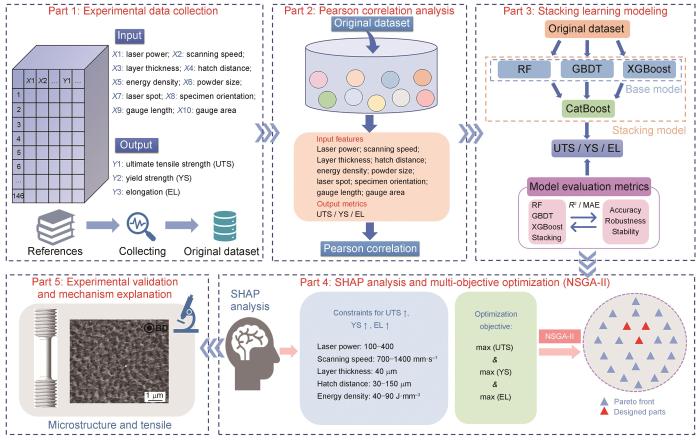
图1
激光粉末床熔融(LPBF)技术制备304L不锈钢工艺参数优化方法框架示意图
Fig.1
Schematic of the proposed methodological framework for optimizing the process parameters of laser powder bed fusion (LPBF) 304L stainless steel (RF—random forest, GBDT—gradient boosting decision tree, XGBoost—extreme gradient boosting, CatBoost—categorical boosting, R2—coefficient of determination, MAE—mean absolute error, BD—building direction, SHAP—Shapley additive explanations, NSGA-II—non-dominated sorting genetic algorithm II)
1.2 数据集收集
将所有可获取的LPBF工艺参数纳入机器学习模型的输入特征,包括:激光功率、扫描速率、粉末层厚、扫描间距、体积能量密度、粉末粒径、激光光斑直径、试样取向以及拉伸试样的标距长度和截面积。模型的输出为三项力学性能指标(UTS、YS和EL)。为提升数据多样性并增强模型的泛化能力,系统收集并整理了已发表的采用LPBF制备304L和316L不锈钢的研究数据,重点纳入能够对力学性能进行定量表征的文献。如图2所示,304L和316L不锈钢样本在激光功率、扫描速率、层厚、扫描间距及力学性能(UTS、YS、EL)上的分布高度重叠且均匀集中,这表明两类材料在工艺参数的可行范围及其力学性能方面具有相似性。由于304L不锈钢在LPBF过程中的能量输入、熔池凝固行为和缺陷形成机制与316L不锈钢较为接近,工艺参数对其力学性能的影响趋势也基本一致[29]。因此,将这两类数据进行融合建模在统计学和物理学上均具备合理性。鉴于304L不锈钢样本量较小,引入316L不锈钢数据有助于缓解样本不足导致的过拟合风险。为了确保研究数据的完整性和可靠性,所有纳入的数据均需满足以下筛选标准:每条数据必须提供完整的实验条件,具有四项可调LPBF工艺参数(激光功率、扫描速率、层厚、扫描间距)和三项力学性能指标(UTS、YS、EL)。所有样品均为打印态,以确保数据的一致性和可靠性。对实验条件不明确或存在特征缺失的数据进行了清洗,确保所使用数据集的完整性。最终,共得到来自34篇文献的146组高质量工艺和性能数据,其参数取值范围和统计分布见表1和2。
图2

图2
LPBF激光工艺参数和力学性能的可视化数据分布范围
Fig.2
Visualizations of data distribution ranges for LPBF process parameters and mechanical properties (Colored areas indicate the distribution density of the dataset)
(a) laser power and scanning speed (b) layer thickness and hatch distance (c) UTS, YS, and EL
表1 数据集中输入特征的取值范围
Table 1
Value type | Powder size μm | Laser spot μm | Laser power W | Scanning speed mm·s-1 | Layer thickness μm | Hatch distance μm | Gauge length mm | Gauge area mm2 | Specimen orientation |
|---|---|---|---|---|---|---|---|---|---|
| Minimum value | 9.00 | 50.00 | 50.00 | 100.00 | 20.00 | 30.00 | 6.00 | 1.00 | Horizontal |
| Maximum value | 46.37 | 200.00 | 380.00 | 2000.00 | 120.00 | 200.00 | 51.00 | 63.61 | Vertical |
| Mean value | 35.02 | 101.78 | 201.86 | 844.96 | 38.83 | 95.61 | 21.16 | 14.18 | - |
| Standard deviation | 7.60 | 38.93 | 80.43 | 397.04 | 13.45 | 26.89 | 9.49 | 11.02 | - |
式中,Z为标准化后的数值,μ和σ分别为输入特征
1.3 特征相关性分析
在完成数据收集和预处理后,为有效识别冗余特征并防止模型中出现多重共线性问题,采用Pearson相关系数进行分析,计算公式如下[31]:
式中,ρXY 为相关系数,X和Y为任意两种不同特征参数,
为进一步揭示工艺参数与拉伸性能之间的关系,采用SHAP分析方法[32]对所构建的预测模型进行可解释性分析。该方法基于博弈论中的Shapley值框架,可量化每个特征对模型预测结果的具体贡献,并通过SHAP值评估复杂ML模型中各个工艺参数对拉伸性能的贡献和影响权重。
表2 数据集中各输出指标的取值范围
Table 2
| Value type | UTS / MPa | YS / MPa | EL / % |
|---|---|---|---|
| Minimum value | 43.09 | 36.12 | 0.68 |
| Maximum value | 841.00 | 690.00 | 63.25 |
| Mean value | 563.29 | 427.97 | 34.38 |
| Standard deviation | 175.45 | 149.31 | 16.75 |
1.4 多模型融合Stacking集成学习建模
为实现对关键力学性能指标的高精度预测,构建了一种基于特征组合的Stacking融合模型框架(图3)。该框架由两层组成:第一层为基学习器,包括随机森林、梯度提升决策树(gradient boosting decision tree,GBDT)和极端梯度提升(extreme gradient boosting,XGBoost);第二层为元学习器,采用类别特征提升(categorical boosting,CatBoost)算法。在建模过程中,首先利用训练集分别训练各基学习器并获得其预测结果;随后,将训练集的原始特征与基学习器预测结果拼接为新的特征矩阵,作为元学习器的输入,以生成最终预测结果。传统Stacking模型仅将基学习器的预测值输入至元学习器,当基学习器拟合度过高时,容易导致过拟合。针对这一问题,本工作在元学习器的输入中保留了原始特征信息:一方面,利用原始特征数据对整体学习过程进行约束;另一方面,有效抑制了高拟合度基学习器带来的过拟合风险,从而提升模型的整体预测能力。
图3
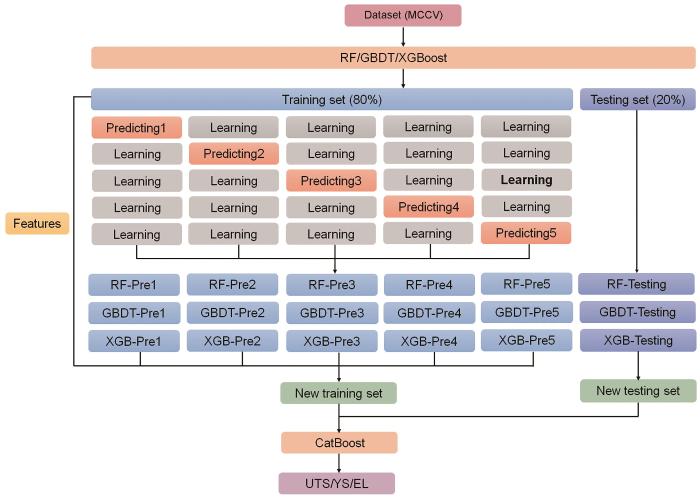
图3
基于特征组合的Stacking融合模型训练框架图
Fig.3
Training framework of the feature-combination-based Stacking ensemble model (MCCV—Monte Carlo cross validation)
为确定最优超参数组合,采用结合K折交叉验证的网格搜索方法。同时,引入Monte Carlo交叉验证(Monte Carlo cross validation,MCCV)对数据集进行多次随机重采样和划分,使模型在更为多样的样本分布下进行训练和验证,从而避免对单一样本划分方案的依赖[33]。该策略有助于更全面地评估模型的稳定性和泛化能力。在本工作中,MCCV的迭代次数设为50,K折交叉验证的K值设为5。模型性能评价指标选用决定系数(R2)和平均绝对误差(MAE),其计算公式分别如
式中,
为了更全面地评估所构建的Stacking集成模型的性能,选取了多种典型机器学习模型进行性能对比分析。上述模型代表了不同的学习范式,旨在确保对比的广泛性和公正性。除作为Stacking模型自身的基学习器外,本工作还将其与支持向量回归(support vector regression,SVR)和Gaussian过程回归(gaussian process regression,GPR)进行对比。为确保对比结果的公平性和可重复性,所有对比模型均采用统一的Z-score标准化处理,并使用相同的训练集与测试集划分比例(8∶2)。此外,所有模型均通过结合五折交叉验证的网格搜索法进行超参数优化,并基于50 cyc独立的MCCV评估其性能。
1.5 Stacking集成模型与NSGA-II-TOPSIS结合的多目标优化设计
为实现目标力学性能下的工艺参数优化,构建了Stacking-NSGA-II-TOPSIS多目标优化框架(其中,TOPSIS为逼近理想解排序法(technique for order preference by similarity to ideal solution))。优化目标为同时获得最优UTS、YS和EL。由于大多数金属材料的强度与塑性之间存在相互制约的关系,提升强度通常需要以牺牲塑性为代价,反之亦然,因此必须在两者之间寻求平衡点。该方法能够有效解决性能优化时强度与延伸率之间冲突的问题。具体而言,首先采用NSGA-II算法(图1),以Stacking集成模型作为快速预测的代理模型,通过快速非支配排序与拥挤度距离计算,在全局搜索空间中求解得到Pareto前沿[34]。随后,从非支配解集中生成候选解集,并利用TOPSIS进行决策排序[35]。TOPSIS的核心在于构建正理想解和负理想解,并计算各候选解到二者的Euclidean距离,以实现全序排序并确定最终最优解。需要强调的是,在本工作所考虑的十个工艺参数中,仅有激光功率、扫描速率、扫描间距和粉末层厚四个参数可在制造过程中实际调节;而粉末粒径、激光光斑直径及拉伸试样标距等参数受限于设备条件和材料特性,无法直接调整。为确保优化结果的可行性并提高优化效率,在优化迭代过程中引入了体积能量密度(volumetric energy density,VED)作为物理约束,以获得更高的成形质量。该能量密度区间的确定依据主要包括以下两个方面。(1) 基于1.2节所收集的原始数据集进行统计分析。如图4所示,样本的体积能量密度主要集中在40~90 J/mm3区间内,且该范围内的样品普遍表现出较高的力学性能。(2) 体积能量密度不仅反映了工艺参数的综合热输入水平,还与所使用设备的硬件性能密切相关。不同型号的LPBF设备在激光功率、扫描速率及层厚控制范围上存在差异,从而影响合理的能量密度窗口[36]。本工作在后续实验验证中采用EOS M290设备进行打印,该设备在40~90 J/mm3能量密度范围内具有优异的工艺稳定性和成形质量[37,38]。能量密度低于该范围时,可能导致出现未完全熔化的区域;而过高的能量密度则可能引发孔隙、热裂纹等缺陷[39]。因此,该区间既反映了文献统计和数据分布的特征,又符合LPBF工艺的物理规律。此外,将能量密度约束纳入优化计算能够有效缩小不合理解的搜索空间,提升遗传算法的收敛速率,降低计算资源的消耗,从而显著提高整体优化效率。在NSGA-II优化过程中,结合实验设备的约束条件,各工艺参数的取值范围列于表3。
表3 非支配排序遗传算法II (NSGA-II)中工艺参数的约束范围
Table 3
| Process parameter | Unit | Constraint range |
|---|---|---|
| Powder size | μm | 32.1 |
| Laser spot | μm | 100 |
| Laser power | W | 100-400 |
| Scanning speed | mm·s-1 | 700-1400 |
| Hatch distance | μm | 30-150 |
Layer thickness Energy density | μm J·mm-3 | 40 40-90 |
| Gauge length | mm | 15 |
| Gauge area | mm2 | 7.07 |
| Specimen orientation | - | Horizontal |
图4

图4
不同体积能量密度下304L不锈钢的力学性能
Fig.4
Mechanical properties of 304L stainless steel at different volumetric energy densities
1.6 实验验证方法
为验证所构建的Stacking-NSGA-II-TOPSIS多目标优化框架在实际工艺参数优化过程中的有效性和可行性,开展基于LPBF工艺的验证实验。实验所用金属粉末为气雾化304L不锈钢粉末,粒径分布在10~53 μm。成形过程在EOS M290设备上进行,采用Ar气作为保护气氛,腔室O含量控制在500 × 10-6以下,激光光斑直径为100 μm。根据Stacking-NSGA-II-TOPSIS框架的优化参数进行试样制备,铺粉层厚均设为40 μm。成形过程中,相邻层间扫描方向相差67°,试样长轴与激光扫描平面(Xʹ-Yʹ平面)保持平行。
将采用LPBF制备的304L不锈钢试样加工为统一规格的圆柱形拉伸试样,标距长度15 mm,截面积7.07 mm2,如图5所示。采用50 kN Zwick Proline测试机在室温条件下进行拉伸实验,加载方向垂直于构建方向,加载应变速率5 × 10⁻⁴ s-1。为减少实验测量误差,每组实验条件下测试两个试样,并取其平均值作为最终结果。采用Gemini SEM 300场发射扫描电子显微镜(SEM)观察试样的显微组织。用于SEM观察的水平试样表面经过金相磨抛处理,并采用粒径为0.04 μm的SiO2抛光液进行最终的机械抛光;随后在10%草酸溶液(质量分数,下同)中进行电解腐蚀,电压5 V,时间45 s。采用电子背散射衍射(EBSD)技术分析试样的晶粒尺寸和取向等信息,步长设为0.4 μm,并采用TSL OIM分析软件(版本8.6)对采集的数据进行后处理与分析。为消除EBSD测试前试样表面的加工变形层,首先将试样机械抛光至镜面状态,随后在10%HClO4 + 90%C2H6O电解液(体积分数)中进行电解抛光。
图5

图5
拉伸试样尺寸和显微组织取样示意图
Fig.5
Schematic of tensile specimen dimension and microstructure sampling position (unit: mm)
2 模拟结果与讨论
2.1 特征之间的相关性分布
图6为各工艺参数与拉伸性能之间的Pearson相关系数热图。图中的坐标轴分别表示各工艺参数和力学性能;色标的数值表示任意两个特征之间的Pearson相关系数,红色代表正相关,蓝色代表负相关,颜色越深表示相关性越强。结果表明,任意两个输入特征之间的相关系数绝对值均小于0.8,表明它们之间不存在显著的多重共线性问题。然而,这些参数对LPBF工艺中合金实际的成形质量具有重要影响。因此,本工作将所有工艺参数作为模型的输入特征,以确保全面反映其对拉伸性能的潜在作用。
图6

图6
各工艺参数和拉伸性能间的Pearson相关系数热图
Fig.6
Pearson correlation coefficient heatmap of process parameters and tensile properties
2.2 Stacking集成模型性能评估
2.2.1 Stacking集成模型与基学习模型性能对比
为全面评估所构建的Stacking集成模型的有效性,将其与基模型(RF、GBDT和XGBoost)进行对比和分析。通过统计50 cyc独立重复实验中R2和MAE的平均值及标准差(standard deviation,SD),从预测精度、泛化能力和稳定性三个方面对各模型的综合性能进行评估。表4汇总了各模型在UTS、YS和EL三个关键力学性能指标预测方面的综合结果。
表4 各模型在训练集和测试集上的性能指标
Table 4
| Mechanical property | Model | Training set | Testing set | ||||||
|---|---|---|---|---|---|---|---|---|---|
| UTS | RF | 0.963 | 0.004 | 25.735 | 1.254 | 0.897 | 0.045 | 40.136 | 5.141 |
| GBDT | 0.980 | 0.002 | 18.750 | 0.919 | 0.915 | 0.033 | 37.071 | 4.601 | |
| XGBoost | 0.980 | 0.002 | 18.321 | 0.919 | 0.918 | 0.030 | 36.185 | 4.951 | |
| Stacking | 0.976 | 0.017 | 19.026 | 7.712 | 0.923 | 0.023 | 33.650 | 3.952 | |
| YS | RF | 0.959 | 0.005 | 23.183 | 1.528 | 0.893 | 0.035 | 35.612 | 4.543 |
| GBDT | 0.992 | 0.002 | 9.160 | 1.055 | 0.900 | 0.030 | 34.078 | 4.751 | |
| XGBoost | 0.979 | 0.002 | 16.967 | 0.856 | 0.906 | 0.027 | 33.184 | 4.042 | |
| Stacking | 0.958 | 0.021 | 22.802 | 6.027 | 0.919 | 0.021 | 31.444 | 3.587 | |
| EL | RF | 0.925 | 0.008 | 3.181 | 0.180 | 0.808 | 0.106 | 4.806 | 1.027 |
| GBDT | 0.935 | 0.002 | 3.450 | 0.117 | 0.748 | 0.094 | 6.554 | 0.978 | |
| XGBoost | 0.953 | 0.006 | 2.601 | 0.164 | 0.809 | 0.089 | 4.910 | 1.055 | |
| Stacking | 0.940 | 0.016 | 3.022 | 0.457 | 0.820 | 0.075 | 3.718 | 0.802 | |
在UTS预测中,GBDT和XGBoost模型在训练集上均展现出较高的预测精度,R2的平均值(
图7

图7
各模型基于Monte Carlo交叉验证(MCCV)的50 cyc独立重复实验所得测试集性能箱型图对比
Fig.7
Boxplot comparisons of testing set performances of different models based on 50 cyc independent MCCV trials (Points represent outliers, boxes represent interquartile range (IQR))
(a-c) R2 distributions for UTS (a), YS (b), and EL (c)
(d-f) MAE distributions for UTS (d), YS (e), and EL (f)
综上所述,尽管GBDT和XGBoost模型在训练阶段展现出较强的学习能力,但在测试阶段的泛化能力和稳定性仍存在一定不足。Stacking集成模型在对UTS、YS和EL三项力学性能的预测任务中,均表现出最优的测试集预测性能,全面优于各单一基模型。此外,由于304L和316L不锈钢在化学成分(特别是Mo含量)上存在微小差异,这可能对耐腐蚀性能、高温强度及加工硬化行为等性能产生一定影响。理论上,这些成分的微小差异可能会对模型的泛化能力构成潜在风险。然而,Stacking集成模型在多次随机重采样中仍展现出极高的预测稳定性,表现为R2和MAE的标准差极低。若304L与316L不锈钢之间的“工艺-性能”关系存在根本性差异,模型在多次随机抽样中的预测结果将会表现出显著的波动和离散。然而,目前该模型预测性能稳定,表明在研究工艺窗口和力学性能目标下,二者具有相似的行为模式,且具备一定的互通性。因此,微小的成分差异对模型的预测结果并未产生显著影响。这一结果充分验证了Stacking集成模型在LPBF工艺下进行性能预测的有效性,并为后续工艺参数优化和性能定向设计提供了有力支撑。
2.2.2 Stacking集成模型的代表性预测结果
为进一步评估Stacking模型的预测性能,从50 cyc独立重复实验中选取最接近整体平均水平的结果作为代表,即第13 cyc迭代的UTS预测模型、第30 cyc迭代的YS预测模型和第39 cyc迭代的EL预测模型。图8为数据集中预测值和实际值的对比情况。如图8a所示,训练集和测试集的预测值均接近对角线,且预测精度达到0.928,表明该模型在预测UTS方面具有较好的拟合能力和泛化性能。如图8b所示,该模型在YS预测中的精度亦维持在较高水平,预测精度为0.915。然而,与UTS和YS的预测结果相比,EL的预测精度较低,仅为0.822。该差异可能源于延伸率受晶粒尺寸、孪晶界分布及局部应变集中等微观结构因素的显著影响[40,41]。这些因素在现有特征体系中难以充分表征,从而影响了预测精度。此外,拉伸实验过程中延伸率同样易受其他随机因素干扰。在以往相关研究中,Dong等[42]对镁合金的UTS、YS和EL进行预测,得到其R2分别为0.93、0.80和0.71;Hou等[43]发现,镁合金UTS和YS的R2均高于0.92,而EL仅为0.78。上述结果表明,EL与输入特征之间的关系相较于UTS或YS更为复杂,且具有更强的非线性特性。因此,本工作中EL的预测精度处于合理范围内。未来研究应进一步探索和挖掘与延伸率密切相关的关键特征,以提升其预测能力。综上所述,本工作开发的Stacking模型在304L不锈钢的UTS、YS和EL预测中表现出了较好的稳定性和可行性。
图8
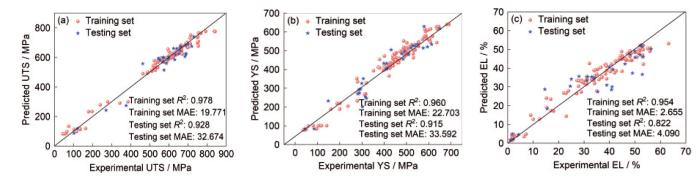
图8
数据集中三个力学性能的预测值与实际值对比
Fig.8
Comparisons of predicted and actual values for UTS (a), YS (b), and EL (c) in training and testing sets
2.3 Stacking集成模型与其他典型机器学习模型性能对比
为系统评估Stacking集成模型的性能优势,将其与其他两种典型机器学习模型(SVR和GPR)进行对比和分析。基于50 cyc独立重复实验,通过计算R2和MAE的均值和标准差,从而评价各模型在预测精度、泛化能力及稳定性三个维度的综合表现。由表5可知,Stacking模型在预测三个力学性能时均表现出最优的泛化能力和稳定性,而SVR和GPR模型则表现相对较差,尤其在测试集上出现明显的性能下降。具体而言,在UTS预测任务中,Stacking模型在训练集上的
表5 各模型在训练集和测试集上的性能指标
Table 5
| Mechanical property | Model | Training set | Testing set | ||||||
|---|---|---|---|---|---|---|---|---|---|
| UTS | SVR | 0.926 | 0.041 | 28.768 | 9.797 | 0.854 | 0.056 | 46.561 | 7.273 |
| GPR | 0.937 | 0.043 | 32.289 | 9.971 | 0.803 | 0.069 | 56.619 | 8.956 | |
| Stacking | 0.976 | 0.017 | 19.026 | 7.712 | 0.923 | 0.023 | 33.650 | 3.952 | |
| YS | SVR | 0.923 | 0.035 | 25.527 | 7.055 | 0.840 | 0.036 | 43.442 | 7.329 |
| GPR | 0.934 | 0.042 | 28.410 | 7.131 | 0.810 | 0.065 | 50.098 | 7.447 | |
| Stacking | 0.958 | 0.021 | 22.802 | 6.027 | 0.919 | 0.021 | 31.444 | 3.587 | |
| EL | SVR | 0.901 | 0.057 | 5.413 | 1.113 | 0.791 | 0.095 | 4.736 | 1.657 |
| GPR | 0.906 | 0.064 | 5.294 | 1.093 | 0.766 | 0.106 | 5.861 | 1.437 | |
| Stacking | 0.940 | 0.016 | 3.022 | 0.457 | 0.820 | 0.075 | 3.718 | 0.802 | |
2.4 基于SHAP分析的工艺参数与性能之间的关系
为进一步阐明工艺参数与拉伸性能之间的关系,采用SHAP方法进行可解释性分析,量化各个特征的重要性,并评估其对模型预测结果的具体贡献,从而为工艺参数优化提供依据。图9为UTS、YS和EL的SHAP平均绝对值排名及各样本的SHAP值分布,描述了各工艺参数对不同性能的整体影响。图中横轴为SHAP值,纵轴为不同特征;正值和负值分别表示该特征对模型输出的正向或负向作用;散点代表数据集中的样本。对于某一特征而言,其散点在水平方向上的分布范围越宽,表明该特征对预测结果的贡献程度越高,其重要性越显著。如图9a、c和e所示,激光功率对UTS、YS和EL三项力学性能的影响程度最大,其平均绝对SHAP值分别为16.75、13.94和2.07;其次为扫描速率,其平均绝对SHAP值分别为13.24、10.57和1.45。结果表明,304L不锈钢的拉伸性能对激光功率和扫描速率最为敏感。如图9b、d和f所示,同一特征在不同样本中的纵向离散度较大,说明其影响存在显著的非线性效应,并受到其他工艺参数交互作用的影响。这一现象表明,LPBF过程并非由单一参数主导,而是由多个参数协同决定熔池稳定性、热输入和凝固速率,进而影响显微组织和力学性能,该结果与文献[44]结论一致。因此,工艺优化应以激光功率和扫描速率为核心,同时结合扫描间距、粉末层厚等参数进行协同调控,从而进一步提升综合力学性能。
图9

图9
三个力学性能的平均绝对SHAP值特征重要性排序及各样本的SHAP值分布
Fig.9
Mean absolute SHAP value feature importance ranking (a, c, e) and SHAP value distribution (b, d, f) of UTS (a, b), YS (c, d), and EL (e, f) for each sample
在识别关键工艺参数的基础上,为进一步揭示其对拉伸性能的具体影响,绘制了单变量SHAP依赖图(图10),图中圆形、三角形散点分别表示对目标性能的正向/负向贡献,纵轴为SHAP值(即贡献强度),横轴为工艺参数取值。如图10a~c所示,在150~300 W的中等激光功率范围内,激光功率对强度和延伸率均呈正向贡献,且其影响程度随功率升高而增强。这主要是由于适当提高激光功率有助于熔池稳定与晶粒细化,而功率过高则会引入过量热输入,诱发气孔缺陷并促进晶粒粗化;功率过低则易形成未熔合孔隙,上述两种情况均会降低拉伸性能[45]。如图10d~f所示,在800~1200 mm/s的中等扫描速率范围内,SHAP值总体较高,表明该区间内可同时获得更优的强度和延伸率。当扫描速率过低时,过量热输入会导致熔池不稳定并增加飞溅与缺陷,而过高的扫描速率则易造成熔化不足与孔隙形成,从而降低拉伸性能[46]。
图10
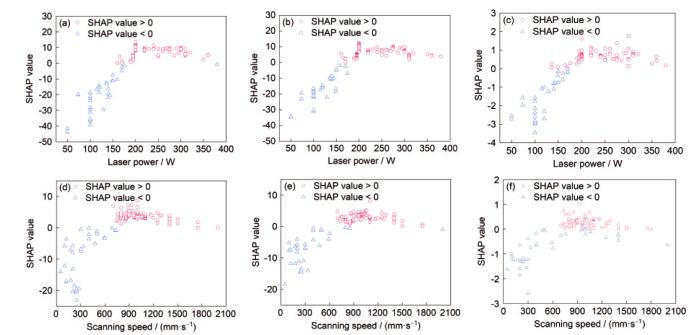
图10
不同激光功率和扫描速率下三项力学性能的SHAP值分布
Fig.8
SHAP value distributions of UTS (a, d), YS (b, e), and EL (c, f) for samples under various laser powers (a-c) and scanning speeds (d-f)
此外,为深入探究工艺参数间的耦合效应,采用SHAP交互值系统分析了激光功率和扫描速率对力学性能的协同影响,结果如图11所示,图中横轴为激光功率,左纵轴为SHAP交互值强度,色标反映扫描速率的大小。由图可知,在激光功率为150~300 W、扫描速率为800~1200 mm/s的参数区间(图11中色标浅色调区域),二者交互作用均呈现出较高的正向SHAP值,表明该参数组合对强度与塑性的协同提升具有显著积极影响。该现象与LPBF过程中热输入与冷却速率之间的平衡机制相符,有助于形成稳定的熔池与均匀的微观组织[45,46]。相反,当参数组合偏离该窗口时,例如低功率与高扫描速率相结合(图11中色标深色调区域),交互作用则呈现明显的负向贡献,易导致未熔合等成形缺陷,进而引起力学性能的下降。综上可知,150~300 W激光功率和800~1200 mm/s扫描速率构成的工艺窗口能够有效兼顾高强度与良好延伸率。该结果不仅与已有LPBF研究的实验规律一致,也为工艺参数优化提供了可解释的定量依据。
图11

图11
不同激光功率与扫描速率交互作用下三项力学性能的SHAP值分布
Fig.11
SHAP value distributions of UTS (a), YS (b), and EL (c) for samples under interactions between laser power and scanning speed
2.5 Stacking集成模型与NSGA-II-TOPSIS结合的多目标优化设计与结果
基于2.2节构建的UTS、YS和EL数据驱动模型,并结合1.5节设定的工艺参数约束条件,采用NSGA-II开展多目标优化,以获得Pareto最优解。NSGA-II中的快速非支配排序根据个体的非劣等级对种群进行分层,从而引导搜索逐步逼近全局Pareto前沿。本工作的优化目标是在给定参数范围内同时获得最优强度和塑性。算法参数设置为:种群规模100,迭代次数50,目标函数数量3,设计变量数量3。通过优化计算,共获得52组Pareto解,代表了多目标优化的可行解集。图12a直观展示了强度与延伸率之间的权衡关系。可见,多数解表明,强度的提升通常会以牺牲塑性为代价,反之亦然。为进一步揭示最优解的分布特征,对Pareto解集中三项可调工艺参数(激光功率、扫描速率、扫描间距)的分布规律进行了统计分析(图13)。结果显示,在部分参数区间内候选解出现频率较高,说明这些区间更可能包含最优解,可作为工艺优化的重要参考。基于此,进一步采用TOPSIS进行决策。图12b为TOPSIS的评价结果,其中综合指数最高的解被记为S1。该方案的激光功率、扫描速率及扫描间距均位于Pareto解集的高频分布区间,符合参数分布规律所揭示的优选趋势,因此S1方案被确定为综合最优解。为验证优化结果的合理性,从Pareto前沿中选取了两个对照方案S2和S3:其中S2与S1试样的工艺参数分布相似,仅在激光功率上存在差异;S3与S1试样则仅在扫描速率上不同。三组候选解的具体工艺参数列于表6,得到的试样分别命名S1、S2、S3试样。后文将通过实验进一步验证和分析。
图12

图12
基于NSGA-II-TOPSIS算法获得的解集(其中TOPSIS为逼近理想解排序法)
Fig.12
Pareto front distribution identified by NSGA-II (a) and optimal solution identified by the TOPSIS (b) (TOPSIS—technique for order preference by similarity to ideal solution. S1, S2, and S3—three process parameters)
图13

图13
Pareto前沿曲线上不同工艺参数的分布
Fig.13
Distributions of laser power (a), scanning speed (b), and hatch distance (c) along the Pareto front
表6 验证实验的工艺参数
Table 6
Sample | Laser power W | Scanning speed mm·s-1 | Layer thickness μm | Hatch distance μm |
|---|---|---|---|---|
| S1 | 220 | 1100 | 40 | 80 |
| S2 | 278 | 1100 | 40 | 80 |
| S3 | 220 | 985 | 40 | 80 |
3 实验验证结果与分析
3.1 力学性能
图14a~c为在优化工艺参数条件下制备的S1、S2和S3试样的工程应力-应变曲线。可见,S1、S2和S3试样均表现出优异的力学性能。如图14d所示,实验测得的力学性能与Stacking-NSGA-II-TOPSIS优化模型的预测结果高度一致,验证了该优化框架的可靠性。通过对比三组试样的拉伸性能可知,拉伸性能对激光功率变化的敏感度高于扫描速率,这与2.4节中SHAP分析结果一致。将本工作测得的LPBF 304L不锈钢的拉伸性能与多种增材制造工艺以及传统锻造[47~55]进行系统对比,结果如图14e所示。S1试样的性能表现最佳(UTS = 671 MPa,YS = (458.5 ± 0.5) MPa,EL = (63 ± 0.5)%),而S2试样性能相对最差(UTS = (647.5 ± 0.5) MPa,YS = (436.5 ± 2.5) MPa,EL = (60.25 ± 0.25)%)。与打印态304L不锈钢[47~55]相比,本工作采用优化工艺参数制备的试样在强度与断裂延伸率之间实现了更优的平衡,获得了优异的强塑性匹配。上述结果充分证明,本工作构建的多目标优化框架在预测LPBF 304L不锈钢拉伸性能并指导其工艺参数优化方面具有显著的有效性和可行性。
图14
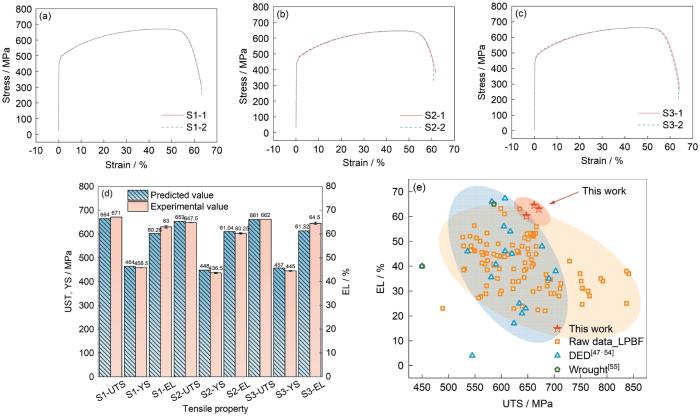
图14
试样S1、S2和S3的应力-应变曲线,力学性能预测值和测量值对比,以及与采用不同增材制造和锻造工艺制备的304L不锈钢的拉伸性能[47~55]对比
Fig.14
Stress-strain curves of S1 (a), S2 (b), and S3 (c) samples from three validation experiments; comparison between predicted and measured tensile properties of S1-S3 samples (d); comparison of tensile properties of 304L stainless steels obtained by this work and other various additive manufacturing and forging processes[47-55] (e) (DED—directed energy deposition)
3.2 微观结构表征
基于2.4节的SHAP分析结果,为进一步阐明最重要的工艺参数(即激光功率)在显微尺度上对拉伸性能的影响,对不同激光功率条件下的LPBF 304L不锈钢试样进行微观结构表征。图15为S1和S2试样显微组织的SEM像。可见,两组试样均具有等轴晶特征,等轴晶内部存在均匀分布的超细胞状亚结构,该特征与以往关于LPBF成形奥氏体不锈钢的报道[56]一致。值得注意的是,S1试样中的胞状结构比S2试样更为精细,表明胞状结构的尺寸随着激光功率的增加而增大。这一现象可归因于成形过程中快速加热和凝固所导致的冷却速率差异:较高的激光功率引入更多能量,使冷却速率降低,从而促进显微组织的粗化并生成更大的胞状结构[57]。
图15

图15
S1和S2试样显微组织的SEM像
Fig.15
Low and high (insets) magnified SEM images of S1 sample processed at 220 W (a) and S2 sample processed at 278 W (b)
图16

图16
S1和S2试样的EBSD分析
Fig.16
Inverse pole figures (IPFs) (a, d), kernel average misorientation (KAM) maps (b, e), and grain boundary distribution maps (c, f) of S1 sample processed at 220 W (a-c) and S2 sample processed at 278 W (d-f) (Insets in Figs.16a and d are grain size distribution histograms; insets in Figs.16b and e are KAM distribution histograms)
式中,φKAM为取向角,
4 结论
(1) 构建的Stacking集成学习模型准确建立了工艺参数与拉伸性能之间的非线性映射关系。在50 cyc独立重复实验中,该模型在UTS、YS和EL的预测精度、泛化能力和稳定性方面均显著优于单一机器学习模型。基于SHAP分析结果,激光功率被识别为影响三项关键力学性能指标的最主要因素,同时揭示了激光功率与其他工艺参数之间显著的非线性耦合关系,并进一步确定了最优工艺参数窗口。
(2) 以Stacking模型为代理模型,结合NSGA-II实现了对UTS、YS和EL三个力学性能指标的快速多目标优化,并生成了Pareto前沿曲线。通过TOPSIS决策分析,最终筛选最优工艺参数组合S1,体现了该方法在处理多目标权衡问题方面的优势。
(3) 采用所得的优化工艺参数进行实验验证。实验测得的力学性能与模型预测结果高度一致,进一步验证了Stacking模型具备较高的预测精度。与现有文献相比,S1试样在强度与延展性之间实现了更优平衡,充分展现了所提出优化框架的有效性和适用性。
(4) 结合Stacking集成模型与NSGA-II-TOPSIS的混合智能优化框架能够高效优化LPBF工艺参数,相较于传统试错法,显著提升了优化效率并降低了实验成本。
参考文献
The effect of laser scanning strategies on texture, mechanical properties, and site-specific grain orientation in selective laser melted 316L SS
[J].
Heat treatment effect on the microstructure, mechanical properties, and wear behaviors of stainless steel 316L prepared via selective laser melting
[J].
Study on performance optimization of 316L stainless steel parts by high-efficiency selective laser melting
[J].
Numerical modelling of coal seam depressurization during coal seam gas production and its effect on the geomechanical stability of faults and coal beds
[J].
On the stress corrosion crack growth behaviour in high temperature water of 316L stainless steel made by laser powder bed fusion additive manufacturing
[J].
Selective laser melting of stainless steels: A review of process, microstructure and properties
[J].
Investigation on porosity and microhardness of 316L stainless steel fabricated by selective laser melting
[J].
This study investigates the porosity and microhardness of 316L stainless steel samples fabricated by selective laser melting (SLM). The porosity content was measured using the Archimedes method and the advanced X-ray computed tomography (XCT) scan. High densification level (≥99%) with a low average porosity content (~0.82%) were obtained from the Archimedes method. The highest porosity content in the XCT-scanned sample was ~0.61. However, the pores in the SLM samples for both cases (optical microscopy and XCT) were not uniformly distributed. The higher average microhardness values in the SLM samples compared to the wrought manufactured counterpart are attributed to the fine microstructures from the localised melting and rapid solidification rate of the SLM process.
On the anisotropic mechanical properties of selective laser-melted stainless steel
[J].The thorough description of the peculiarities of additively manufactured (AM) structures represents a current challenge for aspiring freeform fabrication methods, such as selective laser melting (SLM). These methods have an immense advantage in the fast fabrication (no special tooling or moulds required) of components, geometrical flexibility in their design, and efficiency when only small quantities are required. However, designs demand precise knowledge of the material properties, which in the case of additively manufactured structures are anisotropic and, under certain circumstances, inhomogeneous in nature. Furthermore, these characteristics are highly dependent on the fabrication settings. In this study, the anisotropic tensile properties of selective laser-melted stainless steel (1.4404, 316L) are investigated: the Young’s modulus ranged from 148 to 227 GPa, the ultimate tensile strength from 512 to 699 MPa, and the breaking elongation ranged, respectively, from 12% to 43%. The results were compared to related studies in order to classify the influence of the fabrication settings. Furthermore, the influence of the chosen raw material was addressed by comparing deviations on the directional dependencies reasoned from differing microstructural developments during manufacture. Stainless steel was found to possess its maximum strength at a 45° layer versus loading offset, which is precisely where AlSi10Mg was previously reported to be at its weakest.
Enhanced mechanical properties and formability of 316L stainless steel materials 3D-printed using selective laser melting
[J].
Influence of size design on microstructure and properties of 304L stainless steel by selective laser melting
[J].As one of the most promising metal additive manufacturing methods, selective laser melting (SLM) is very attractive for fabricating complex-shaped structure components of austenitic stainless steels in the nuclear field. SLMed austenitic 304L stainless steel has been demonstrated to have excellent mechanical properties and superior corrosion resistance due to the unique hierarchical microstructure produced by the ultrafast cooling rate and high-thermal gradient. Scanning tracks (T) and depositing layers (L) are key factors for geometry design by affecting the processing efficiency and the solidification structure of the components. Hence, it is essential to clarify the effecting mechanism of sample size and geometry on material performance. In this work, samples of different sizes are designed to study the influence of geometry on the microstructure and mechanical properties of 304L stainless steel components made via SLM. Various solidification conditions are achieved by varying the temperature gradients and cooling rates by adjusting T and L. Metallographic microscopic observations in samples with various T × L combinations demonstrate that a columnar structure is formed along the build direction, which is significantly impacted by the geometry effect. The columnar grains grow preferentially along the heat dissipation direction with an increase in the sample size. The columnar grains gradually change from having a low length-diameter ratio (LDR) with a rice grain shape to a higher LDR with a short rod-like shape and then a long strip shape. Grain coarsening could also be identified along with the formation of “long strip” columnar grains. Moreover, consistent microstructure evolution behavior is observed in large-sized samples. The influence of geometry on the mechanical properties is examined via tensile testing to demonstrate the decrease in yield strength and increased plastic elongation with the rise in sample size. As the sample size increases, the mechanical properties become consistent. The comprehensive analysis concludes that grain size and columnar grains play critical roles in determining the mechanical properties according to the Hall-Petch relationship. In larger-sized samples, “long strip” columnar grains with a high proportion could lead to a decrease in material strength and an increase in plasticity. The geometry mechanism affecting the solidification process, microstructure formation, and mechanical properties of 304L stainless steel processed by SLM is explored by combining the solidification rate and thermal gradient simulation results using ANSYS ADDITIVE.
尺寸设计对选区激光熔化304L不锈钢显微组织与性能的影响
[J].
Cold spray additive manufacturing of Invar 36 alloy: Microstructure, thermal expansion and mechanical properties
[J].In this work, the Invar 36 alloys were manufactured using cold spray (CS) additive manufacturing technique. The systematic investigations were made on the microstructural evolution, thermal expansion and mechanical properties under as-sprayed (AS) and heat-treated (HT) conditions. XRD (X-ray diffraction) and ICP-AES (inductively coupled plasma atomic emission spectroscopy) analyses show that no phase transformation, oxidation, nor element content change have occurred. The X-ray computed tomography (XCT) exhibited a near fully dense structure with a porosity of 0.025% in the helium-produced sample under as-sprayed condition, whereas the nitrogen-produced samples produced at 5 MPa and 800 °C show more irregular pore defects. He-AS sample shows a more prominent grain refinement than that of nitrogen samples due to the more extensive plastic deformation. The post heat-treatment exhibited a promoted grain growth, inter-particle diffusion, as well as the formation of annealing twins. Between 25 °C and 200 °C, the nitrogen samples possessed lower CTE (coefficient of thermal expansion) values (1.53 × 10⁻⁶/°C) compared with those produced by casting and laser additive manufacturing. The He-AS samples exhibited a noticeable negative CTE value between 25 °C and 200 °C, which may due to the significant compressive residual stress (-272 MPa) compensating its displacement with temperature increase during CTE test. The N2-HT and He-HT Invar 36 samples present a notable balance between strength and ductility. In conclusion, the CS technique can be considered as a potential method to produce the Invar 36 component with high thermal and mechanical performance.
Microstructure evolution and mechanical properties at high temperature of selective laser melted AlSi10Mg
[J].In this study, the microstructure and tensile properties of selective laser melted AlSi10Mg at elevated temperature were investigated with focus on the interfacial region. In-situ SEM and in-situ EBSD analysis were proposed to characterize the microstructural evolution with temperature. The as-fabricated AlSi10Mg sample presents high tensile strength with the ultimate tensile strength (UTS) of ~450 MPa and yield strength (YS) of ~300 MPa, which results from the mixed strengthening mechanism among grain boundary, solid solution, dislocation and Orowan looping mechanism. When holding at the temperature below 200 °C for 30 min, the microstructure presents little change, and only a slight decrement of yield strength appears due to the relief of the residual stress. However, when the holding temperature further increases to 300 °C and 400 °C, the coarsening and precipitation of Si particles in α-Al matrix occur obviously, which leads to an obvious decrease of solid solution strength. At the same time, matrix softening and the weakness of dislocation strengthening also play important roles. When the holding temperature reaches to 400 °C, the yield strength decreases significantly to about 25 MPa which is very similar to the as-cast Al alloy. This might be concluded that the YS is dominated by the matrix materials. Because the softening mechanism counteracts work hardening, the extremely high elongation occurs.
Selective laser melting additive manufacturing of Inconel 718 superalloy parts: Densification, microstructure and properties
[J].
Effects of laser scanning speed and building direction on the microstructure and mechanical properties of selective laser melted Inconel 718 superalloy
[J].
Selective laser melting of 304L stainless steel: Role of volumetric energy density on the microstructure, texture and mechanical properties
[J].
Research and development in materials and processes of superalloy fabricated by laser additive manufacturing
[J].The research and development progress of laser additive manufacturing technology in superalloys are summarized in this paper. The technical characteristics and application of additive manufacturing in superalloys, formation mechanism, and the types of microstructure and metallurgical defects are introduced in detail. Moreover, the defect control methods of additive manufacturing of superalloys are summarized from the aspects of laser parameters and composition design, and the direction of laser process parameter optimization and composition optimization is clarified. Finally, the future development trend and research direction of laser additive manufacturing in superalloys are summarized and prospected from the aspects of process optimization and material design.
激光增材制造高温合金材料与工艺研究进展
[J].概述了激光增材制造技术在高温合金中的进展。介绍了增材制造高温合金的技术特点和应用、微观组织及冶金缺陷的形成机制与种类,并从激光参数以及成分设计2个方面综述了增材制造高温合金的缺陷控制方法,明确了激光工艺参数优化与成分优化的方向。最后,从工艺和材料2个方面对激光增材制造在高温合金中的未来发展趋势与研究方向进行了展望。
Influence of processing parameters on AlSi10Mg lattice structure during selective laser melting: Manufacturing defects, thermal behavior and compression properties
[J].
Effect of process parameters on density and compressive properties of Ti5553 alloy block prepared by SLM
[J].Bulk Ti-5Al-5Mo-5V-3Cr (Ti5553) alloy was prepared by selective laser melting (SLM) technique, then the effect of laser power and scanning speed on the relative density, microstructural defects, and mechanical properties of the prepared alloy was assessed. The results indicate that as laser energy density increases, defects in the Ti5553 alloy decrease and relative density is improved. By laser power within the range 110-120 W and scanning speed 300-500 mm/s, the relative density of the alloy exceeded 99.99%. The main defects in the alloy include irregularly shaped lack-of-fusion defects and regular keyholes. Lack-of-fusion defects mainly existed in the alloys prepared by laser of lower energy densities (~111 J/mm³) however which decrease with the increasing laser energy density. Excessive energy density (~167 J/mm³) results in the formation of keyholes of a small volume fraction with regular shape, and good sphericity. Compression test results show that alloys of relative density above 99% exhibit high yield strength, reaching up to 864 MPa. These findings may provide a reference for the research and development in the application selective laser melting for manufacturing workpieces of Ti5553 alloy.
激光功率和扫描速度对SLM制备Ti5553合金性能的影响
[J].
Microstructure and mechanical performance of 304 stainless steel fabricated by laser powder bed fusion: The effect of post-processing heat treatment
[J].
Effect of annealing treatment on microstructure evolution and deformation behavior of 304 L stainless steel made by laser powder bed fusion
[J].
Laser powder bed fusion of a novel high strength Al-Mg alloy via Si and Zn microalloying
[J].
Machine learning for advanced additive manufacturing
[J].
Prediction of mechanical properties of biodegradable zinc alloys based on machine learning
[J].
基于机器学习的生物可降解锌合金力学性能预测
[J].
Development of composition and heat treatment process of 2000 MPa grade spring steels assisted by machine learning
[J].
机器学习辅助2000 MPa级弹簧钢成分和热处理工艺开发
[J].
Development of an accurate “composition-process-properties” dataset for SLMed Al-Si-(Mg) alloys and its application in alloy design
[J].
Machine-learning assisted laser powder bed fusion process optimization for AlSi10Mg: New microstructure description indices and fracture mechanisms
[J].
Optimization of density and surface morphology of SS 316L/IN718 functionally graded thin-walled structures using hybrid prediction-multi-objective optimization method
[J].
Robust prediction and validation of as-built density of Ti-6Al-4V parts manufactured via selective laser melting using a machine learning approach
[J].
Selective laser melting of 304L and 316L stainless steels: A comparative study of microstructures and mechanical properties
[J].
Suitability of data preprocessing methods for landslide displacement forecasting
[J].
Regression models of Pearson correlation coefficient
[J].
Improving audit opinion prediction accuracy using metaheuristics-tuned XGBoost algorithm with interpretable results through SHAP value analysis
[J].
Monte Carlo cross‐validation for selecting a model and estimating the prediction error in multivariate calibration
[J].
A fast and elitist multiobjective genetic algorithm: NSGA-II
[J].
A state-of the-art survey of TOPSIS applications
[J].
Comparison of the porosity and mechanical performance of 316L stainless steel manufactured on different laser powder bed fusion metal additive manufacturing machines
[J].
Investigation into the effect of process parameters on density, surface roughness, and mechanical properties of 316L stainless steel fabricated by selective laser melting
[J].
Effect of process parameters on the microstructure, tensile strength and productivity of 316L parts produced by laser powder bed fusion
[J].
Regulation of heat treatment and synergistic mechanism of strength-ductility in precipitation-strengthened high-entropy alloy fabricated by laser powder bed fusion
[J].
激光粉末床熔化制备沉淀强化高熵合金的热处理调控及强塑性协同机制
[J].
Fracture toughness of 304L austenitic stainless steel produced by laser powder bed fusion
[J].
Microstructure-toughness relationships in 316L stainless steel produced by laser powder bed fusion
[J].
Machine learning aided prediction and design for the mechanical properties of magnesium alloys
[J].
Prediction of mechanical properties of biomedical magnesium alloys based on ensemble machine learning
[J].
Effect of process parameters and post-treatment on room temperature tensile properties of GH3536 superalloy fabricated by laser powder bed fusion
[J].
成形工艺参数及后处理对激光粉末床熔融成形GH3536合金室温拉伸性能的影响
[J].
Influence of laser power on mechanical properties and pitting corrosion behavior of additively manufactured 316L stainless steel by laser powder bed fusion (L-PBF)
[J].
Effect of scanning speed on mechanical, corrosion, and fretting-tribocorrosion behavior of austenitic 316L stainless steel produced by laser powder bed fusion process
[J].
Mechanical properties of 304 austenite stainless steel manufactured by laser metal deposition
[J].
Effects of layer-by-layer ultrasonic impact treatment on microstructure and mechanical properties of 304 stainless steel manufactured by directed energy deposition
[J].
A comparison of 316L stainless steel parts manufactured by directed energy deposition using gas-atomized and mechanically-generated feedstock
[J].
Achieving high strength 316L stainless steel by laser directed energy deposition-ultrasonic rolling hybrid process
[J].
An investigation on the effect of deposition pattern on the microstructure, mechanical properties and residual stress of 316L produced by directed energy deposition
[J].
Process-structure-property relationships for 316L stainless steel fabricated by additive manufacturing and its implication for component engineering
[J].
Synchronous-hammer-forging-assisted laser directed energy deposition additive manufacturing of high-performance 316L samples
[J].
Characterization of stainless steel parts by laser metal deposition shaping
[J].
Improvement of fatigue properties in type 304 stainless steel by annealing treatment in nitrogen gas
[J].
Microstructure, tensile properties and mechanical anisotropy of selective laser melted 304L stainless steel
[J].The microstructure and mechanical properties of 304 L stainless steel fabricated by selective laser melting are investigated in this study. With the optimized laser processing parameters, a relative density of 99.9% is achieved with fine austenite grains and nanoscale cellular subgrains in size of approximately 0.5 μm. The presence of δ-ferrite and σ phase precipitates is identified by the x-ray diffraction and transmission electron microscopy. Moreover, the microstructure is identified as an austenite matrix with about 4% δ ferrite and a trace amount of σ phase by using electron backscattered diffraction analysis. These small σ phase particles are mainly distributed along austenite grain boundaries. Furthermore, the presence of nanoscale cellular subgrains contributes to the good tensile strength and ductility of the selective laser melted 304 L, along with precipitate strengthening and strain hardening. Tensile property anisotropy is also identified in this 304 L, which is attributed to the microstructure difference on vertical and horizontal planes.
Effect of laser power on hydrogen embrittlement and microstructural evolution in selective laser melted 304L austenitic stainless steel
[J].
High-power laser powder bed fusion of 316L stainless steel: Defects, microstructure, and mechanical properties
[J].
Additively manufactured high-performance AZ91D magnesium alloys with excellent strength and ductility via nanoparticles reinforcement
[J].
Microstructure, mechanical property and heat treatment schedule of the Inconel 718 manufactured by low and high power laser powder bed fusion
[J].
New insights on dislocation forming mechanism of nickel-based superalloy fabricated by laser powder bed fusion
[J].


