



高熵合金(HEAs)通常由多种元素以近等摩尔比构成,其较高的构型熵被认为有助于稳定固溶体结构,从而赋予其良好的力学性能[1]和多样化的功能特性[2]。近年来,高熵合金研究已从块体合金迅速扩展至高熵薄膜。借助磁控溅射、脉冲激光沉积及原子层沉积等薄膜制备技术,能够实现非平衡态下的快速凝固,大幅抑制块体HEAs中常见的元素偏析现象。为进一步拓展高熵薄膜的性能调控区间以满足特定领域的应用,添加非金属小原子(SAs),如C、N、O等,是一种切实有效的策略[3,4]。这类原子凭借其小尺寸特性占据间隙位,并通过与金属元素间的化学性质差异,改变局域电子结构与化学键合环境。随着SAs含量增加,其占位行为呈现从无序填充,到形成有序阴离子亚晶格的连续演化。这一过程不仅提高了构型熵与结构复杂性[5],还驱动晶体结构从简单固溶体向岩盐、萤石、尖晶石及钙钛矿等多种有序晶体相或非晶态转变,同时伴随着局域化学序(LCO)的显著变化。
为系统阐明SAs填隙对高熵薄膜结构及性能的调控作用,本文以高熵薄膜为主要研究对象,构建了从结构演变到逾渗理论再到性能解析的分析框架。首先,概述了SAs引起的高熵薄膜结构变化;然后,结合块体HEAs中关于LCO的研究基础,系统阐述LCO的演变规律,并论证逾渗理论与LCO结合的可行性;其次,应用此理论,分别阐释SAs填隙对高熵薄膜力学、磁学及电学性能的调控机制;最后,总结当前挑战并展望未来研究方向,以期为新型高性能高熵薄膜的成分设计提供理论参考及实践指导。
1 小原子填隙引起的高熵薄膜结构变化
图1
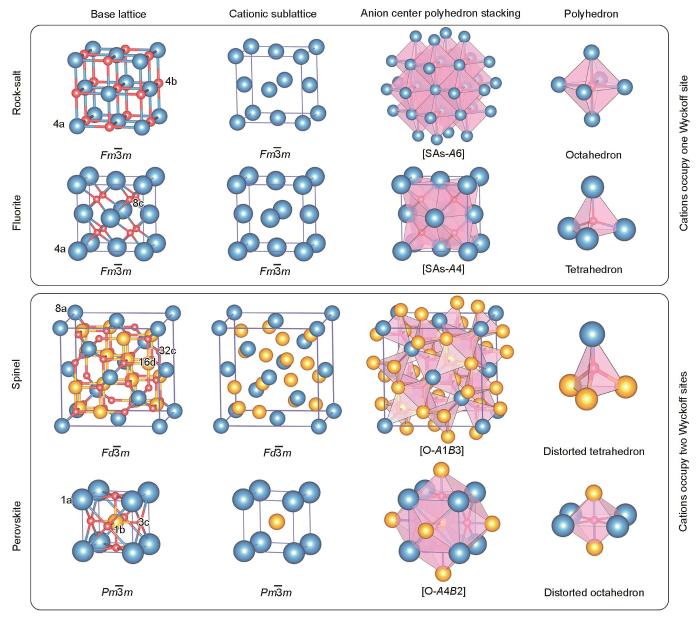
图1
非金属小原子(SAs)填隙后的常见晶体结构类型:岩盐结构、萤石结构、尖晶石结构和钙钛矿结构
Fig.1
Common types of crystal structures after non-metallic small atoms (SAs) interstitial filling: rock-salt structure, fluorite structure, spinel structure, and perovskite structure
1.1 阳离子占据单一Wyckoff位置
此情况以岩盐和萤石结构最为典型。二者均具有fcc排列的阳离子亚晶格,但阴离子占位不同:岩盐结构中,阴离子占据八面体间隙,形成[SAs-A6]八面体配位,其中A是金属元素的统称;萤石结构中,阴离子占据全部四面体间隙,形成[SAs-A4]四面体配位。
1.2 阳离子占据两种Wyckoff位置
鉴于高熵薄膜中的阳离子在尺寸、价态和化学性质上的差异,它们有时无法完全占据单一Wyckoff位置,添加SAs后会形成尖晶石(AB2O4)和钙钛矿(ABO3)结构。需要说明的是,在SAs中,通常只有O元素容易形成这两种结构。其中,尖晶石中的O呈现fcc排列,A位离子占据四面体间隙,B位离子占据八面体间隙,形成独特的[O-A1B3]四面体连接网络。在高熵薄膜中,A位和B位往往由多种阳离子共同占据。此外,具有多价态的过渡族金属,往往也会占据多个位置。例如在尖晶石结构的(Mg0.2Ni0.2Fe0.2Co0.2-Cu0.2)Fe2O4薄膜中[7],铁离子同时占据八面体(Fe2+和Fe3+)和四面体(Fe3+)位置。钙钛矿结构中的A位离子位于简立方晶格顶点,B位离子占据体心位置,与周围的O2-形成[O-A4B2]八面体。同样地,这些位点均可容纳多种阳离子,例如La(Cr0.2Mn0.2Fe0.2Co0.2-Ni0.2)O3薄膜[8]。
1.3 非晶结构
除了形成上述晶体结构外,SAs的添加也显著增强了高熵薄膜形成非晶态的倾向。根据非晶形成能力判据[9],SAs与金属原子间的显著原子尺寸差异和强负混合焓会导致非晶形成能力进一步增强。与晶态高熵薄膜相比,非晶态的显著特征是其原子排列缺乏长程周期性,因此无固定的Wyckoff位置。同时,SAs填隙位置也呈无序分布,导致整体无序度进一步增加。
2 小原子填隙对高熵合金局域化学序的影响
理解SAs填隙对晶体结构影响的关键是确定其对LCO的重构作用。由于目前块体HEAs中LCO的直接实验观测已有较为系统的研究,因此,本节将分别阐述SAs添加前,晶态和非晶态块体HEAs本身的LCO典型特征。在此基础上,讨论SAs添加后对LCO的影响机制,为后续SAs填隙对高熵薄膜性能的调控作用提供理论支撑。
2.1 高熵合金本身的局域化学序
HEAs中的原子并非完全随机分布,即便未引入SAs,不同金属元素之间的混合焓差异亦可驱动多尺度LCO的形成。根据尺度由小到大,LCO可分为:短程序(SRO,尺寸在1 nm左右)、中程序(MRO,尺寸在1∼5 nm)和长程序(LRO,尺寸大于5 nm)[10]。
对于晶态HEAs,倒空间中的衍射特征能够直接反映其有序状态[11],从而判断LCO的尺寸差异。图2[12~14]示意性总结了fcc基体中三种尺寸LCO的典型选区电子衍射(SAED)特征。其中,纳米尺寸SRO的SAED谱呈现位于基体衍射斑点之间的额外弥散圆盘(图2a[12]);MRO则表现为比基体衍射弱得多的额外衍射斑点(图2b[13]);当有序度进一步提高发展为LRO时,已经成为有序析出相,可观察到强度更高、更清晰的衍射点(图2c[14])。这一演变过程直观表明,SRO是LCO的初期阶段,LRO是LCO生长为析出相的最终阶段,而MRO是LCO生长的中间阶段。由于LRO已经是一种独立的析出相,因此本文后续讨论的LCO将主要聚焦于SRO和MRO尺度,并探究其对性能的影响机制。
图2
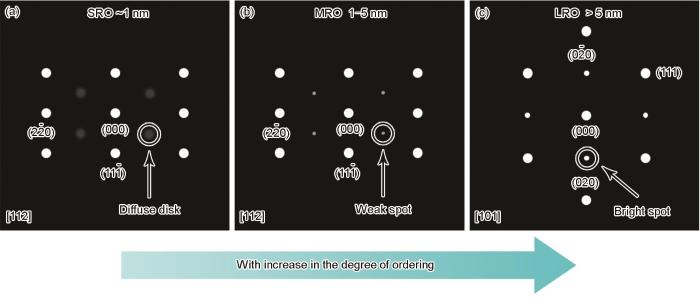
图2
fcc合金中不同尺度局域化学序(LCO)的典型倒空间衍射特征示意图[12~14]
Fig.2
Schematics of typical diffraction features in reciprocal space for local chemical ordering (LCO) at different length scales in an fcc alloy
(a) diffuse disk corresponding to short-range order (SRO)[12]
(b) weak diffraction spot corresponding to medium-range order (MRO)[13]
(c) bright diffraction spot corresponding to long-range order (LRO)[14]
非晶态HEAs虽缺乏长程周期性,但其SRO结构与对应晶态相相似,本质差异在于SRO的连接方式导致的MRO变化。以Ti20Zr20Hf20Cu20Ni20金属玻璃为例[16],其径向分布函数的第一个峰呈现双峰分裂,分别对应理想bcc晶体中的第一近邻和第二近邻壳层。其中,Cu/Ni倾向于占据bcc晶格的体心位置,而Ti/Zr/Hf倾向于占据其顶点。而第二个宽化峰偏离理想bcc排列,表明非晶与晶体在MRO尺度上存在显著差异。在非晶中,SRO团簇可通过点共享、边共享及面共享等模式相互连接。其中,点共享模式在非晶中的占比高于理想bcc晶体,导致堆垛更为松散。因此其SRO连接形成的MRO会与晶态存在很大区别,偏离晶体学约束,从而使长程尺度上的原子排列与对应晶相存在本质差异。将非晶升温结晶后,SRO团簇的连接模式由以点共享为主向边共享转变,驱动MRO的堆垛向bcc结构演化。这证实了非晶与晶体在SRO尺度上的相似性及MRO尺度上的差异性。同样地,在CoCrFeNiMn由非晶态向晶态转变过程中[17],模拟计算结果表明相关函数的第一近邻峰位置仅发生轻微变化,而第二近邻峰有显著差异,这也进一步佐证了上述观点。
值得注意的是,高熵金属玻璃中往往会出现多形性转变[18],即同一成分可存在两种或两种以上结构、能量及性能各异的非晶态。这一现象源于不同类型SRO之间的竞争,因此更易发生于具有多相结晶倾向的体系中。图3[18]呈现了高熵金属玻璃在不同处理工艺下的结构演变过程。其液态存在两类SRO结构,在缓慢冷却条件下,两类SRO可分别形成不同晶体相,最终形成双相晶态结构;而在快速冷却条件下,这两类SRO被同时“冻结”,形成结构均匀但能量较高的玻璃态I;对此玻璃进行加热时,原本相互独立的SRO逐步发生连接与重排,进而形成MRO。这一过程使体系从高能态向低能态转变,形成结构更有序、能量更低的玻璃态II。因此,两种玻璃态中SRO的连接方式及其形成的MRO均存在显著差异,表明其LCO的显著不同,这种结构差异会进一步反映在材料的宏观性能上。以NbNiZrTiCo非晶为例,其发生多形性转变时硬度从6.78 GPa增加到9.46 GPa[19],正是因为在转变过程中,SRO相互连接形成更稳定、致密的MRO结构。
图3
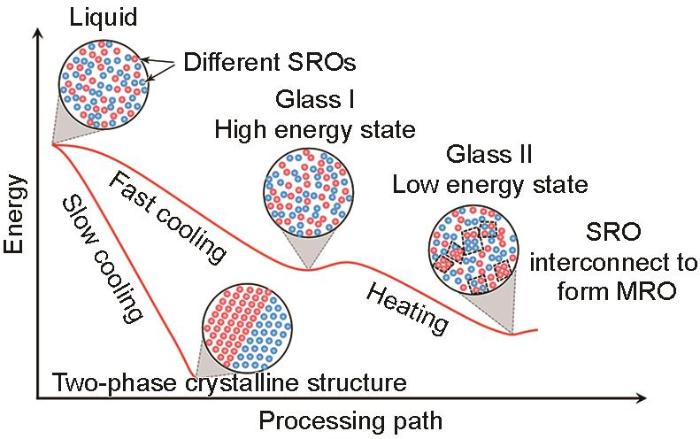
图3
高熵金属玻璃多形性转变机制示意图[18]:液态中存在两类不同的短程序(SRO),快冷形成高能玻璃态I,加热时SRO连接形成中程序(MRO)并转变为低能玻璃态II;慢冷则形成稳定的双相晶体
Fig.3
Schematic illustration of the polyamorphous transition mechanism in high-entropy metallic glasses[18]: two distinct types of SRO exist in the liquid state; rapid quenching forms a high energy glassy state I, which transforms into a low energy glassy state II upon heating as SRO units interconnect to form MRO; slow cooling leads to the formation of a stable two-phase crystalline structure (Red and blue circles represent the two different types of SRO structures)
因此,调控SRO和MRO对高熵玻璃的性能优化至关重要,其中,成分设计是最直接有效的调控手段之一。低熵Cu50Zr50合金中存在局域MRO,将其高熵化为(CuNiBe)50(ZrTiHf)50非晶后,其构型熵显著提升,导致MRO连接性增强,从而提高其非晶形成能力[20]。热处理也对LCO的调控起关键作用。对于Zr20Nb20Cu20Ni20Ti20非晶,当温度上升到过冷液相区时[21],强键合原子对增多,使硬度提升1.8 GPa,并影响电子散射机制,使电阻温度系数由负转正。此外,应力也会影响LCO的形成。在Zr41.2Ti13.8Cu12.5Ni10Be22.5金属玻璃[22]中,以Zr为中心的SRO团簇,通过键角和键长的协调变化来调整彼此之间的连接方式,进而适应拉伸或压缩应变。
因此,无论是晶态还是非晶态HEAs,在未引入SAs时已存在由混合焓驱动的LCO。在此基础上,SAs的添加会进一步改变LCO结构,从而实现对性能的大幅调控。因此,后续将分别讨论SAs对晶态和非晶态HEAs中LCO的具体影响。
2.2 小原子填隙后的局域化学序变化
在晶态HEAs中,SAs通过占据晶格间隙位点及其与金属元素间的占位偏好,诱导特定金属元素的局域富集与重排,从而重构SRO与MRO等不同尺度的LCO,并进一步影响其性能。在Fe46.8Mn30Co10-Cr10N3.2合金中[26],N占据间隙位,导致SRO和MRO围绕其形成,这被称为间隙驱动局域化学序。这种多尺度LCO使合金达到1.34 GPa的超高屈服强度。此外,SAs经常呈现有序填隙,形成有序络合物。例如,在TiZrHfNb合金[27]中加入2% (原子分数,下同)的O原子后,O优先占据富含Ti和Zr的晶格区域,并有序占位形成富(O, Zr, Ti)的络合物。这种结构介于随机间隙固溶体与氧化物之间,不仅显著提高强度,还可作为位错钉扎中心,大幅提高延展性。N的添加也有类似效果,在CoCrFeMnNi合金中加入N后可形成有序络合物,同时提高其强度和延展性[28]。LCO的形成还显著依赖于基体金属元素的种类和含量。Ti-30Zr-xNb合金[29]中的(Ti, Zr)富集SRO为O提供了优先占据位点,有助于有序络合物的形成。而Nb会抑制该SRO的形成。类似地,在bcc结构的ZrHfTiNb合金[30]中,O原子倾向于占据富Hf/Ti区域的八面体间隙,分别形成富Hf-O和Ti-O团簇。这不仅能够提升强度,还诱发多组Snoek型弛豫机制,实现宽温域的高阻尼性能。
这种成分偏好导致的LCO重构的调控思路同样适用于非晶态HEAs,只是由于缺乏长程有序晶格的约束,其具体影响形式存在一定差异。在非晶态HEAs中,SAs通过调控原子间距和局域堆垛密度改变LCO,进而影响其磁性和力学性能。在Fe40Co20Ni20(B, C, P)20金属玻璃中[31],原子尺寸较小的B和C倾向于占据间隙位置,增加Fe-Fe对距离;而较大的P原子替代金属位点,减小了Co-Co及Ni-Ni对间距。这种距离变化均有利于提高饱和磁化强度(MS)。在Zr20Cu20Hf20Ti20Ni20玻璃[32]中添加微量O、C、N等SAs,会形成局部致密堆积区(LDPRs)。其高密度、低势能特性使其成为纳米级的“硬点”,增强了金属玻璃的结构异质性。在变形过程中,LDPRs周围的低密度区域优先被激活,当激活区域含量达到逾渗阈值时,局部剪切相互连接,从而实现宏观塑性流动。因此,SAs提高了变形过程中易激活区域的密度,同时增强了硬度和塑性。这种从局部变形受限到协调变形的性能突变,本质上是逾渗理论在非晶体系中的应用。
综合SAs对晶态与非晶态HEAs中LCO的调控可以发现,其虽因基体长程有序性的不同而呈现差异,但核心机制均在于SAs与金属间的化学性质差异驱动了LCO的重构。无论是晶体中有序占位形成的络合物,还是非晶中的LDPRs,这些由SAs主导产生的LCO,与周围基体的性质会有显著区别。因此,其含量会从根本上影响硬度、塑性及磁性等诸多性能。这为后续引入逾渗理论定量关联LCO含量与性能的关系提供了直接依据。
3 逾渗理论及其在高熵体系中的应用
逾渗理论通常用于分析成分连续变化时,高度无序体系中的性能突变行为[33~35]。其核心思想可通过经典的双球逾渗模型[33]直观理解:将大量的导电球与绝缘球混合在玻璃杯中,仅当导电球的含量达到某一临界值,即逾渗阈值(pc)时,才会产生电流的连通。该理论与含SAs的高熵薄膜高度契合:一方面其阴阳离子亚晶格的无序分布[36]构成了典型的逾渗介质;另一方面,LCO与基体之间的性质差异使其可被映射为两种不同性质的基本单元,类似于双球逾渗模型中的导电球与绝缘球。根据逾渗单元的差异,主要存在两种逾渗模式:座逾渗(晶格位点作为逾渗单元)和键逾渗(位点之间的键作为逾渗单元)。不同晶体结构因配位数(z)和堆积密度(v)不同,其座逾渗阈值(p
表1 不同晶格体系逾渗阈值与配位数和堆积密度的关系[33]
Table 1
| Structure | z | v | p | p | z·p | v·p |
|---|---|---|---|---|---|---|
| fcc | 12 | 0.7405 | 0.198 | 0.119 | 1.43 | 0.147 |
| bcc | 8 | 0.6802 | 0.245 | 0.179 | 1.43 | 0.167 |
| Simple cubic | 6 | 0.5236 | 0.311 | 0.247 | 1.48 | 0.163 |
| Diamond | 4 | 0.3401 | 0.428 | 0.388 | 1.55 | 0.146 |
早期逾渗理论主要应用于二元合金的耐腐蚀设计,近年来,其应用范围已扩展至高熵体系的成分设计。Takeuchi等[37]发现,五元等原子比fcc结构HEAs中每种元素含量为20%,约等于表1[33]中fcc晶格的座逾渗阈值(0.198,即19.8%),此时五种原子各自在空间中形成完整逾渗通路,使其整体处于临界逾渗状态,诠释了HEAs早期成分设计中经常用等原子比设计的原因。据此设计了Fe12Ir20Re20Rh20Ru28合金[38],其Ru含量大于液相逾渗阈值(0.27,即27%),导致hcp相的形成。随着研究的深入,逾渗理论的应用已扩展至对性能突变的解析中。例如,影响LiTi2(PO4)3导电性能的关键因素在于Li+的迁移。将其高熵化为Li(TiZrSnHf)2(PO4)3可引入大量晶格畸变[39],显著降低Li+迁移所需能量,在邻近晶格中形成Li+迁移的座逾渗网络,提高了离子电导率。因此,应用逾渗理论的核心在于识别主导性能的关键微观单元,这往往与LCO结构密切相关。
逾渗理论与LCO的结合,为理解材料的性能变化提供了基础。这一思路在非晶体系中早有先例,常将SRO团簇视为逾渗单元。例如在Cu-Zr-Ag非晶中,含Ag团簇形成的逾渗通路可提升其塑性[40]。随着压力的增加,SiO2玻璃维持非晶结构,但其内部LCO持续变化,逐步形成由不同配位多面体组成的(SiOn-SiOm)长程逾渗团簇,并导致压缩过程中的力学异常行为[41]。受此启发,在高熵薄膜中,可将LCO等效为“导电球”,将无序基体映射为“绝缘球”,从而将复杂的多组元逾渗问题转化为经典的双球逾渗模型。例如,在HfNbTaTiZr合金[42]中,导电的Hf-Ti近邻SRO团簇在阈值以上形成逾渗通道,使晶格热导率提高了12%。
综上,逾渗理论为理解LCO含量与性能变化之间的关系提供了有效的理论框架。尽管块体HEAs为理解LCO的形成及其逾渗行为提供了重要的物理基础,但在较高SAs含量下,大尺寸析出相的形成会显著破坏其无序性,使其偏离理想的逾渗模型;同时,有限的SAs固溶度也使SRO与MRO的含量难以连续调节,进而增加了逾渗理论的解析难度。相比之下,高熵薄膜由于其制备方式,具有更高的SAs固溶度及亚稳结构保持能力,从而成为分析LCO形成及其逾渗行为的理想体系。基于此,下文以高熵薄膜为主要研究对象,系统分析SAs的添加对其力学、磁学及电学性能的调控,并阐述逾渗理论在其中的应用,进而为高熵薄膜的成分设计及性能优化提供全新视角。
4 小原子填隙对高熵薄膜力学性能的影响
SAs的添加通过改变高熵薄膜的局域原子环境和微观结构,显著影响其力学性能。理解SAs如何通过这些LCO结构影响位错运动、晶界滑移和相变行为,是优化高熵薄膜力学性能的关键。本节将从LCO从小到大的角度(间隙-偏析-析出相),综述SAs添加对力学性能的调控效应,重点阐释其背后的LCO根源,并探讨逾渗行为在性能变化中可能扮演的角色。
4.1 小原子填隙的强化机制
图4
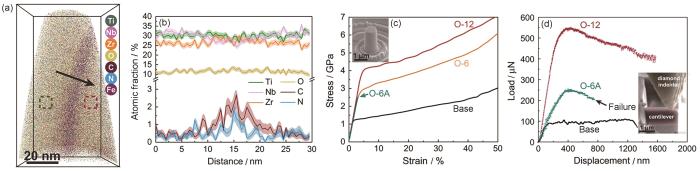
图4
(TiNbZr)86O12C1N1薄膜经原子探针层析呈现的元素分布及沿所示箭头方向的一维成分分布,微柱压缩的工程应力-应变曲线,以及通过悬臂梁弯曲测得的载荷-位移曲线[45]
Fig.4
Atom probe tomography elemental mapping of (TiNbZr)86O12C1N1 film (a), one-dimensional compositional profile along the arrow direction in Fig.4a (b), engineering stress-strain curves from microcompression testing (c), and load-displacement curves measured via cantilever beam bending (d)[45] (Inset in Fig.4c shows the O-12 massive interstitial solid solution (MISS) alloy pillar prior to compression; inset in Fig.4d shows the position of the diamond indenter tool, deforming the O-12 cantilever)
当SAs含量继续增加,[SAs-A6]八面体所带来的晶格畸变可能超出原始晶格的容纳极限,从而引发结构相变,显著改变力学性能。例如,非晶CoCrFeMnNi薄膜[46]随N含量增加转变为fcc结构,硬度呈现先升高后降低的趋势。在NbMoTaWV薄膜[47]中,当O含量超过25%时,薄膜非晶化导致硬度和弹性模量下降。对于(NbTaMoW)Nx 薄膜[48],当N含量较低时(x = 0.09),薄膜保持bcc结构,呈现较高的硬度和弹性模量(分别为25.6和287 GPa)。随着N含量增加,薄膜逐渐转变为fcc结构,且在x = 0.48时,薄膜表现出最佳的力学性能,硬度提升至30.8 GPa,弹性模量达到280 GPa,同时兼具较高的断裂韧性及耐磨性。此外,由于SAs与不同金属元素间的混合焓差异,会驱动相分离形成硬质第二相,通过阻碍位错运动强化基体。(CuNiTiNbCr)Nx 薄膜[49]在高N含量下转变为由硬质(Ti, Nb, Cr)N纳米晶与Cu/Ni富集区组成的纳米复合材料,表现出高硬度与耐磨性。在FeCoNiCr薄膜[50]中,低N含量会促进Cr2N相析出,实现强度与韧性的平衡;然而,过量的N使薄膜内部形成连通的Cr2N刚性骨架,虽提高了硬度但损害了韧性和耐磨性。
当前研究尝试从SRO逾渗连通的视角来理解相结构变化。以Gd掺杂CeO2为例[51],随Gd含量增加,立方纳米畴(可视为SRO)相互连接形成MRO;当Gd含量达到简立方晶格座逾渗阈值(0.311)时,立方纳米畴渗透至每个晶粒内,导致LRO的转变,诱导萤石结构向立方结构转变。在此成分下,电子自旋共振谱呈现阶梯性跳跃,也与逾渗过程高度相似。基于此,逾渗理论为理解高熵薄膜中SAs填隙驱动的结构转变提供了新视角。例如,在SAs填隙过程中,其形成的[SAs-A6]八面体浓度增至临界值时,可能通过SRO-MRO-LRO的有序演化驱动结构转变,并伴随力学性能变化。未来研究应关注SRO单元逾渗连通性与性能突变的关联。
4.2 不同小原子的强化效果对比
图5
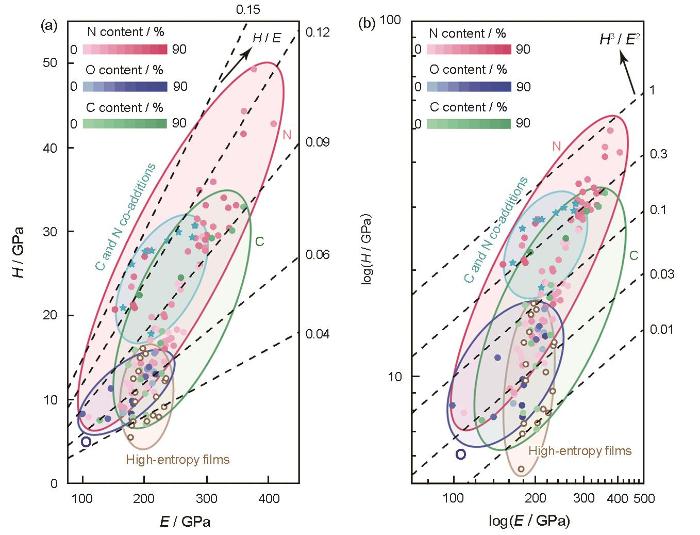
图5
高熵薄膜添加不同SAs的硬度与Young's模量的Ashby型图
Fig.5
Ashby-type maps of hardness (H) vs Young's modulus (E) for high-entropy films incorporating different SAs (Data are sourced from: high-entropy films without SAs[54-56], N-containing high-entropy films[46,48,49,52,53,57-65], C-containing high-entropy films[66-69], O-containing high-entropy films[47,70,71], and high-entropy films with combined C and N additions[72,73]. Content here refers to atomic percentage)
(a) relationship of H / E (b) relationship of H3/E2
图5a和b中的虚线分别表示H / E与H3 / E2的值,其中H / E反映材料抵抗塑性变形的能力,而H3 / E2反映其对磨损损伤的抵抗力[53]。因此处于同一条虚线上的薄膜,理论上具有相似的抗磨损性能[74]。对于未添加SAs的高熵薄膜,其H / E和H3 / E2分别集中于0.03~0.09和0.01~0.1之间。添加N元素后,二者范围分别提升至0.06~0.15和0.03~1,结合其硬度的显著提升,表明N能有效增强薄膜抵抗塑性变形和磨损损伤的能力。添加C元素后,H / E和H3 / E2分别集中于0.09~0.12和0.1~0.3,其最高值虽不及添加N时,但最低值亦有大幅提升。需要强调的是,H / E和H3 / E2主要反映材料本征的抗变形和抗磨损能力,并不能全面预测实际摩擦工况下的表现,因为其受到表面状态、界面黏着及润滑效应等因素影响。例如,高C含量高熵薄膜在摩擦过程中会形成润滑非晶碳相[66],能显著降低摩擦系数。添加O元素后,H / E和H3 / E2分别集中于0.04~0.09和0.01~0.1,且硬度较低,表明其抗磨损能力提升有限。因此,N掺杂对硬度及抗损伤能力的提升效果显著,而C能通过润滑效应有效改善抗磨损性能。相比之下,O的强化作用较弱。
在此基础上,复合添加SAs往往可实现力学性能的协同优化。以(CrNbSiTiZr)CxNy 薄膜[72]为例,仅添加N时,薄膜硬度高达28.8 GPa,但因与基体附着力不足,导致摩擦系数和磨损率显著升高。降低N含量并增加C含量后,硬度虽然有所降低,但其在摩擦过程中会形成润滑非晶碳相,降低摩擦系数和磨损率。因此,通过调控C和N含量,可使薄膜在保持较高硬度的同时,显著降低弹性模量,有效提升H / E和H3 / E2,为平衡高硬度与低摩擦提供了有效途径。
5 小原子填隙对高熵薄膜磁性能的影响
原子间的磁交换作用是影响磁性能的根本因素。高熵薄膜因包含多种磁性原子,不同原子对之间呈现多样的磁交换作用,可以在很大程度上对磁性能进行调控。对于由纯金属元素组成的高熵薄膜,对磁性能起到直接影响的是过渡金属间(TM-TM)电子云交叠产生的直接交换作用[75~77]。例如,在CoCrFeNi2Al0.5薄膜[78]中,各原子对有不同的磁交换作用,其中Fe、Co、Ni原子对呈现铁磁(FM)作用,而Cr原子对呈现反铁磁(AFM)作用。SAs的添加往往会对磁交换作用产生更大影响。尤其是O2-的加入会导致TM-TM直接交换作用转变为通过O2-发生的间接交换作用[79~81],即TM-O-TM。相比之下,N和C对磁性能的影响相对较弱,故本节重点讨论O的调控作用。
5.1 晶体结构与磁有序的关系
晶体结构虽然为磁有序提供了基础框架,但阳离子晶格的具体组成及其引发的LCO变化,会对局域磁矩的形成、交换作用的强度和类型,乃至最终的长程磁有序状态具有决定性影响。因此,高熵薄膜中经常呈现FM与AFM对相互竞争的现象。例如,在钙钛矿结构的La(Cr0.2Mn0.2Fe0.2Co0.2Ni0.2)O3薄膜[79]中,其B位由多种磁性离子占据,B—O—B键的间接交换作用既存在FM性,又存在AFM性。这种竞争往往会导致磁阻挫的形成,并诱发自旋玻璃态转变。在尖晶石(FeCoNiCrMn)3O4薄膜[87]中也观察到类似行为,其中Cr、Mn、Ni的磁矩与外加磁场平行,而Fe、Co磁矩呈反平行排列,从而抑制长程磁有序并增强磁阻挫。这种复杂的FM/AFM竞争网络,可通过磁交换作用示意图直观呈现。如图6a[88]所示,在钙钛矿La(Cr0.2Mn0.2Fe0.2Co0.2Ni0.2)O3薄膜[88]中,同时存在FM与AFM作用,且AFM作用占主导地位,使图6b[88]中的磁滞回线呈现黄蜂腰型。此外,FM/AFM竞争网络增强了局部自旋钉扎,导致薄膜产生垂直交换偏置。将AFM性的La(Cr0.2Mn0.2Fe0.2Co0.2Ni0.2)O3与FM性的La0.7Sr0.3MnO3薄膜组装成异质结构后,仍能保持显著的交换偏置,如图6c[88]所示。这表明高熵薄膜中FM/AFM竞争网络所导致的磁无序与磁阻挫对交换偏置等特性具有重要影响。
图6
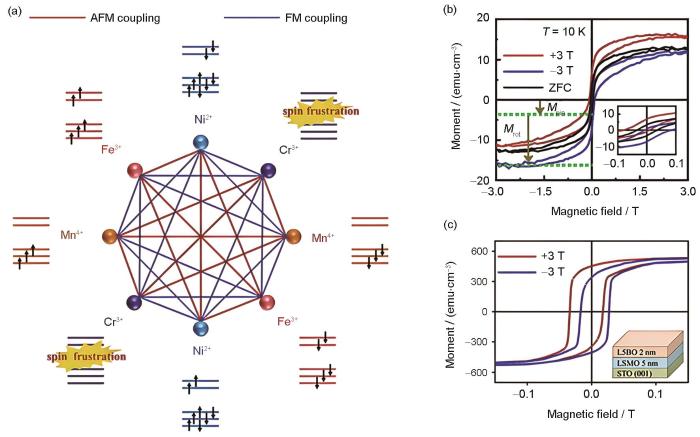
图6
La(Cr0.2Mn0.2Fe0.2Co0.2Ni0.2)O3薄膜不同元素之间多样的磁交换作用、磁滞回线以及多层膜的交换偏置[88]
Fig.6
Diverse magnetic exchange interactions between different elements in the La(Cr0.2Mn0.2Fe0.2Co0.2Ni0.2)O3 (L5BO) film (a), magnetic hysteresis loops of the L5BO film (b), and exchange bias in the L5BO/LSMO multilayer on STO (001) (c)[88] (FM—ferromagnetic; AFM—antiferromagnetic; ZFC—zero field cooling; T—temperature; Mpin and Mrot—pinned and rotated uncompensated magnetizations, respectively; LSMO—La0.7Sr0.3MnO3; STO—SrTiO3)
5.2 O填隙对高熵薄膜磁性能的影响
O在填隙过程中会优先与电负性差异较大的金属元素键合,这种选择性氧化会重构FM与AFM作用。在(CoCrCuFeNi)Ox 薄膜[89]中,O优先与Cr结合。随着O含量增加,相分离尺寸逐渐变小。这表明O会减少元素偏析,改变富(Cr, O)、富Cu和富(Fe, Co)相的比例,产生丰富的磁性可调相,大幅调控MS。经本征氧化的CoCrFeNi薄膜[90]会形成一种新颖的核壳结构:FM性的Fe、Co、Ni富集在柱状晶内部作为核心,AFM性Cr元素与O偏析于晶界作为壳层。该结构减少了晶粒内AFM键的比例,导致薄膜MS增强。添加Al元素后,由于Al与O的电负性差异更大,导致Cr氧化物壳层被Al氧化物取代,使AFM的Cr回到晶粒中,进而导致MS下降。因此,通过调控阳离子种类可以显著改变LCO,从而调控MS。除了本征氧化和溅射过程中引入O外,还可通过热处理引入O,例如在Ar + O2气氛下对CrMnFeCoNi薄膜进行热处理,形成的(CrMnFeCoNi)3O4薄膜[91]具有双层尖晶石结构,内层为富Cr尖晶石,外层为贫Cr尖晶石。其阻塞温度高于常规纳米颗粒,这源于高熵效应诱导的强磁晶各向异性。
5.3 磁性能变化的逾渗理论解析
综上,含O高熵薄膜中复杂的磁结构会导致FM与AFM之间的竞争,这与逾渗理论中的经典双球逾渗模型十分相似。因此可以运用逾渗理论对其MS变化进行解析。
在钙钛矿结构的La(Cr0.2Mn0.2Fe0.2Co0.2Ni0.2)O3薄膜中[79],磁性由TM—O—TM键的磁性决定,其中Mn—O—TM键呈现较强的FM作用,而其他键多呈现AFM作用。如图7a~c[79]所示,随着Mn含量增加,磁滞回线中的交换偏置行为逐渐消失。这表明薄膜当中FM与AFM键的竞争作用减弱,薄膜整体趋向于FM性。相应的Monte Carlo模拟表明,随Mn含量增加,薄膜由原来的仅AFM键逾渗通路(图7d[79]),转变为FM及AFM键逾渗通路共存(图7e[79]),最终转变为只有FM逾渗通路(图7f[79])。因此,通过调节Mn含量,可在逾渗阈值附近实现对MS的有效调控。
图7

图7
La(Cr0.2Mn0.2Fe0.2Co0.2Ni0.2)O3薄膜在不同Mn含量下的磁滞回线与交换偏置场的变化,以及对应的Monte Carlo模拟展现了铁磁(FM)与反铁磁(AFM)交换作用逾渗网络的演变[79]
Fig.7
Magnetic hysteresis loops and the variation of exchange bias field in La(Cr0.2Mn0.2Fe0.2Co0.2Ni0.2)O3 films with different Mn contents (a-c); and corresponding Monte Carlo simulation results, showing the evolution of percolating networks for FM (red) and AFM (blue) exchange interactions, where the color depth represents the magnetic exchange interaction strength (d-f)[79] (M—magnetization, μB—Bohr magneton per unit cell, FC—field cooling, μ0—vacuum permeability, H—magnetic field intensity)
6 小原子填隙对高熵薄膜电性能的影响
SAs填隙通过重构LCO显著改变电子局域化程度与输运路径,从而实现对电阻率及带隙等电学性能的精准调控。本节系统综述SAs添加对电学性能的调控机制,重点阐释其背后的LCO根源,并详细探讨逾渗理论在解释电学性能突变中的应用。
6.1 电阻率变化的逾渗理论解析
电阻率是衡量薄膜电输运性能的关键指标。图8a和b分别总结了N和O含量对不同高熵薄膜电阻率的影响(相关数据取自文献[47,58,92~94])。随着SAs含量的增加,无论是过渡金属基还是难熔金属基高熵薄膜,其电阻率均呈单调上升趋势。这是因为SAs填充八面体间隙后,会导致原有的金属键转变为金属-非金属之间的共价/离子键,束缚周围电子运动,进而导致电阻率大幅提高。不同SAs对电阻率的提升效果差异显著。含N高熵薄膜的电阻率基本在103 μΩ⋅cm以下,而含O高熵薄膜的电阻率则大幅提升,当O含量低于50%时,电阻率可达104 μΩ⋅cm,进一步增加O含量可提升至107 μΩ⋅cm。O元素更强的电阻率提升能力源于其与金属之间更大的电负性差及更强的离子键特性。
图8
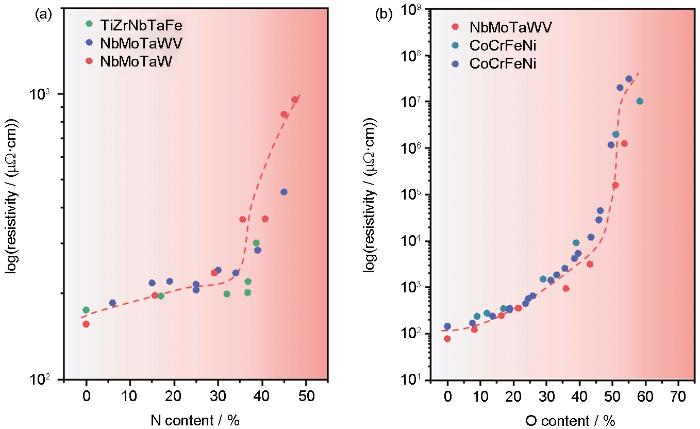
此外,通过图8可以发现,在SAs填隙过程中,电阻率往往在特定成分下发生大幅变化,且并非由相变引起。例如,在(AlCrTaTiZr)Ox 薄膜中[71],随O含量增加,电阻率从1.7 × 10² μΩ⋅cm增加到5 × 10¹¹ μΩ⋅cm,而薄膜始终保持非晶态。对于bcc结构的NbMoTaW薄膜[58],其在N含量大于29.1%后始终呈现岩盐结构。但当N含量从40.7%增至45%时,电阻率从364.7 μΩ·cm跃升至848.8 μΩ·cm,突变点对应的N含量约为43.6%,再次证明电阻率突变非相变所致。这表明电阻率变化与SAs的含量密切相关,其行为类似于导电球与绝缘球混合体系:仅当导电球的含量达到逾渗阈值时,体系中才会形成导电通路,导致电流突变。因此,应用逾渗理论解析此类问题的关键在于识别出类似导电球的基本逾渗单元。
以O含量调控的CoCrFeNi薄膜为例进行说明[94]。在O含量约为45.1%时,薄膜出现电阻率突变。在填隙过程中,O不断填充fcc晶格的八面体间隙,形成岩盐结构。当金属元素M与O含量比为1∶1时,薄膜为标准化学计量比的MO岩盐化合物。如图9a[94]所示,此时无O空位,整个晶体结构由[O-M6]八面体以边共享模式按fcc堆垛形成。M周围的电子被O—M键束缚,导致薄膜电阻率较大。随着O含量降低,晶格中出现O空位(□),部分[O-M6]八面体转变为[□-M6]空位八面体,两类八面体仍以fcc形式堆垛,如图9b[94]所示。由于O与金属形成的化学键会抢夺部分电子,两类八面体的电学性质差异显著。因此,可将高阻的[O-M6]团簇视为绝缘球,将低阻的[□-M6]团簇视为导电球。由此,高熵薄膜中复杂的多组元逾渗问题,被简化为经典的双球逾渗模型,如图9c[33]所示。当[□-M6]含量达到fcc晶格的座逾渗阈值(p
图9
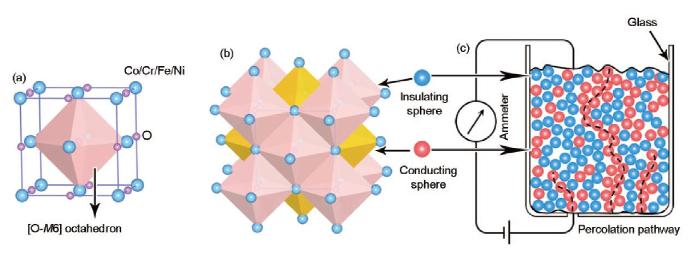
图9
标准化学计量比(CoCrFeNi)O晶体结构[94]及其八面体堆积[94]与双球逾渗模型等效示意图[33]
Fig.9
Schematic of the stoichiometric (CoCrFeNi)O crystal structure (a)[94], fcc stacking configuration of [O-M6] and [□-M6] (□ represents vacancy) octahedrons in space (b)[94], and octahedral equivalence in the classic two-sphere percolation model (c)[33]
6.2 小原子填隙对高熵薄膜带隙的影响
6.3 小原子填隙对高熵薄膜超导性能的影响
7 总结与展望
本文系统阐述了SAs填隙对高熵薄膜晶体结构、LCO及力学、磁学和电学性能的调控机制与影响规律。SAs凭借其小尺寸的特点,占据间隙位置,诱导局部晶格畸变,驱动高熵薄膜由简单固溶体向有序晶体相或非晶结构转变。此外,SAs与金属元素间的化学性质差异会重构局域配位环境,从而改变LCO结构。这一结构变化过程高度依赖于SAs种类、含量及基体金属元素特性。在此基础上,引入逾渗理论,将具有不同性质的LCO结构视为逾渗单元,从而建立LCO含量与宏观性能变化之间的内在联系。该理论视角为理解高熵薄膜中的力学强化、磁有序调控以及电学输运行为的演变机制提供了统一解释。
展望未来,应充分融合高熵薄膜的非平衡制备优势、SAs填隙带来的性能调控潜力以及逾渗理论所揭示的性能变化规律,推动高熵薄膜走向功能化设计与器件应用。具体而言,首先需深化对高熵薄膜本征无序特性及多样化成膜技术的理解,为功能涂层与微型器件的应用奠定基础。其次,通过精准调控SAs的种类与含量,定制力学、电学与磁学等性能,以满足多元化的应用需求。在此基础上,发展基于逾渗理论的定量设计方法,阐明SAs含量、LCO特征与宏观性能之间的精确对应关系,从而建立性能突变的阈值规律与预测框架。最终,推动高熵薄膜在航空航天、新能源及电子信息等前沿领域的应用,进而引领其实现从基础研究到工程应用的实质性发展。
参考文献
Data-driven design of novel lightweight refractory high-entropy alloys with superb hardness and corrosion resistance
[J].
Lightweight refractory high-entropy alloys (LW-RHEAs) hold significant potential in the fields of aviation, aerospace, and nuclear energy due to their low density, high strength, high hardness, and corrosion resistance. However, the enormous composition space has severely hindered the development of novel LW-RHEAs with excellent comprehensive performance. In this paper, an machine learning (ML)-based alloy design strategy combined with a multi-objective optimization method was proposed and applied for a rational design of Al-Nb-Ti-V-Zr-Cr-Mo-Hf LW-RHEAs. The quantitative relation of “composition-structure-property” was first established by ML modeling. Then, feature analysis reveals that Cr content greater than 12 at.% is a key criterion for alloys with high corrosion resistance. The phase structure, density, melting point, hardness and corrosion resistance of the alloys were screened layer by layer, and finally, three LW-RHEAs with superb hard and corrosion resistance were successfully designed. Key experimental validation indicates that three target alloys have densities around 6.5 g/cm3, and all alloys are disordered bcc_A2 single-phase with the highest hardness of 593 HV and the largest pitting potential of 2.5 VSCE, which far exceeds all the literature reports. The successful demonstration in this paper clearly demonstrates that the present design strategy driven by the ML technique should be generally applicable to other RHEA systems.
Weldability of high entropy alloys: Microstructure, mechanical property, and corrosion resistance
[J].
A review on improving mechanical properties of high entropy alloy: Interstitial atom doping
[J].
Atomic-scale understanding of interstitial-strengthened high-entropy alloys
[J].Interstitial alloying has emerged as a powerful strategy to tune microstructure and microproperties of high‐entropy alloys (HEAs) due to the strong interaction of interstitials with constituent elements and crystal defects, which enables the development of advanced alloys with superior mechanical and functional properties. The paper reviews the latest progress in the atomic‐scale understanding of the effects of various interstitials, including carbon, boron, nitrogen, oxygen, and hydrogen, on the microstructure, stability, mechanical properties, and deformation behavior of HEAs. Emphases are placed on the in‐depth insights on the interaction of interstitials with constituent elements and crystal defects, such as vacancies, stacking faults, and grain boundaries. Key parameters for rapid prediction of intrinsic properties of HEAs are also discussed. Finally, we highlight some unsolved issues and provide perspectives for future research directions.
High-entropy oxides as energy materials: From complexity to rational design
[J].
Review on the deposition, structure and properties of high entropy oxide films: Current and future perspectives
[J].
Magnetic texture in insulating single crystal high entropy oxide spinel films
[J].
Magnetic anisotropy in single-crystal high-entropy perovskite oxide La(Cr0.2 Mn0.2Fe0.2Co0.2Ni0.2)O3 films
[J].
Effect of additional elements on glass transition behavior and glass formation tendency of Zr-Al-Cu-Ni alloys
[J].
Negative enthalpy alloys and local chemical ordering: A concept and route leading to synergy of strength and ductility
[J].
Chemical short-range orders in high-/medium-entropy alloys
[J].High (or medium)-entropy alloys (H/MEAs) are complex concentrated solid solutions prone to develop the chemical short-range orders (CSROs), as an indispensable structural constituent to make H/MEAs essentially different from the traditional alloys. The CSROs are predicted to play roles in dislocation behaviors and mechanical properties. So far, the image of CSROs is built up by the theoretical modeling and computational simulations in terms of the conventional concept, i.e., the preference/avoidance of elemental species to satisfy the short-ranged ordering in the first and the next couple of nearest-neighbor atomic shells. In these simulated CSROs, however, the structural image is missing on the atomic scale, even though the lattice periodicity does not exist in the CSROs. Further, it is pending as to the issues if and what kind of CSRO may be formed in a specific H/MEA. All these are ascribed to the challenge of experimentally seeing the CSROs. Until recently, the breakthrough does not appear to convincingly identify the CSROs in the H/MEAs by using the state-of-the-art transmission electron microscope. To be specific, the electron diffractions provide solid evidence to doubtlessly ascertain CSROs. The structure motif of CSROs is then constructed, showing both the lattice structure and species ordering occupation, along with the stereoscopic topography of the CSRO. It is suggested that the CSROs, as the first landscape along the path of development of the local chemical ordering, offer one more route to substantially develop the ordered structure on the atomic scale in the H/MEAs, parallel to the existing grain-leveled microstructure. The findings of CSROs make a step forward to understand the CSROs-oriented relationship between the microstructure and mechanical properties. This review focuses on the recent progress mainly in the experimental aspects of the identification, structure motif, and mechanical stability in CSROs, along with the chemical medium-range orders as the growing CSROs.
Direct observation of chemical short-range order in a medium-entropy alloy
[J].
Chemical medium-range order in a medium-entropy alloy
[J].High-/medium-entropy alloys (H/MEA) have the inherent local chemical order. Yet, as a structural link between the incipient short-range order and mature long-range counterpart, the chemical medium-range order (CMRO) is conjectural and remains open questions as to if, and what kind of, CMRO would be produced and if CMRO is mechanically stable during plastic deformation. Here, we show compelling evidences for CMRO in an AlCrCoNi MEA. Specifically, the electron diffraction under both [[Formula: see text]] and [[Formula: see text]] zone axis show the definite spots for CMRO of lattice periodicity. CMRO entities are seen directly of medium-ranged in sizes by using dark-field imaging, along with the tendency towards like-pair avoidance and unlike-pair preference based on atomic-resolution EDS mapping. These findings substantiate CMRO with a realistic structural picture in view of crystal periodicity and chemical species occupation, shedding light on understanding the microstructural link at an extended length scale beyond the short-range order.© 2022. The Author(s).
Tuning the degree of chemical ordering in the solid solution of a complex concentrated alloy and its impact on mechanical properties
[J].
Tuning element distribution, structure and properties by composition in high-entropy alloys
[J].
Phase selection rule of high-entropy metallic glasses with different short-to-medium-range orders
[J].\n When an equiatomic multi‐component alloy is quenched from its molten state down to room temperature, either a solid solution crystalline alloy or a metallic glass is formed. The former is called a high‐entropy alloy, whereas the latter is referred as a high‐entropy metallic glass (HE‐MG). In such multicomponent alloys, thermodynamic parameters, e.g., the mixing entropy, the mixing enthalpy and other parameters such as atomic size mismatch, determine the resulting phases. In this work, we studied the phase selection rule applied to the equiatomic multicomponent Ti\n 20\n Zr\n 20\n Hf\n 20\n Cu\n 20\n Ni\n 20\n HE‐MG from a structural perspective, by analyzing the short‐to‐medium‐range orders. It was found that the short‐range order in this MG resembles a body‐centered cube structure, while the medium‐range order is comprised of different orders. The experimental data suggest that different packing schemes, at the medium‐range scale, play a critical role in the phase selection rule with regard to an amorphous phase or solid solution.\n
Quasilocalized modes in crystalline and partially crystalline high-entropy alloys
[J].
Structure and entropy control of polyamorphous transition in high-entropy metallic glasses
[J].
High-entropy induced a glass-to-glass transition in a metallic glass
[J].Glass-to-glass transitions are useful for us to understand the glass nature, but it remains difficult to tune the metallic glass into significantly different glass states. Here, we have demonstrated that the high-entropy can enhance the degree of disorder in an equiatomic high-entropy metallic glass NbNiZrTiCo and elevate it to a high-energy glass state. An unusual glass-to-glass phase transition is discovered during heating with an enormous heat release even larger than that of the following crystallization at higher temperatures. Dramatic atomic rearrangement with a short- and medium-range ordering is revealed by in-situ synchrotron X-ray diffraction analyses. This glass-to-glass transition leads to a significant improvement in the modulus, hardness, and thermal stability, all of which could promote their applications. Based on the proposed high-entropy effect, two high-entropy metallic glasses are developed and they show similar glass-to-glass transitions. These findings uncover a high-entropy effect in metallic glasses and create a pathway for tuning the glass states and properties.© 2022. The Author(s).
In-depth analysis of structural heterogeneity in high entropy bulk metallic glasses using 4D-STEM
[J].
Highly variable chemical short-range order in a high-entropy metallic glass
[J].
Revealing in situ stress-induced short- and medium-range atomic structure evolution in a multicomponent metallic glassy alloy
[J].
Classification of bulk metallic glasses by atomic size difference, heat of mixing and period of constituent elements and its application to characterization of the main alloying element
[J].
Electronegativity values from thermochemical data
[J].
Enhancing properties of high-entropy alloys via manipulation of local chemical ordering
[J].It is gradually accepted that the presence of local chemical orderings (LCOs) is a common structural feature of high-entropy alloys (HEAs) due to their large chemical complexity and high configuration entropy. The formation and characterization of LCOs in HEAs, as well as the challenges regarding this topic were discussed in our previous viewpoint paper. In this short communication, we highlight the significant effects of LCOs on physical and mechanical properties. In addition, efforts on how to improve the properties via manipulation of these LCOs will be summarized and explored. Apparently, this paper attempts to understand the unique properties of HEAs from the standpoint of their intrinsic atomic-scale structural fingerprints, and ultimately to establish a link between their prominent properties and distinct structural characteristics.
Interstitial-driven local chemical order enables ultrastrong face-centered cubic multicomponent alloys
[J].
Enhanced strength and ductility in a high-entropy alloy via ordered oxygen complexes
[J].
Ordered nitrogen complexes overcoming strength-ductility trade-off in an additively manufactured high-entropy alloy
[J].
Manipulating the ordered oxygen complexes to achieve high strength and ductility in medium-entropy alloys
[J].Oxygen solute strengthening is an effective strategy to harden alloys, yet, it often deteriorates the ductility. Ordered oxygen complexes (OOCs), a state between random interstitials and oxides, can simultaneously enhance strength and ductility in high-entropy alloys. However, whether this particular strengthening mechanism holds in other alloys and how these OOCs are tailored remain unclear. Herein, we demonstrate that OOCs can be obtained in bcc (body-centered-cubic) Ti-Zr-Nb medium-entropy alloys via adjusting the content of Nb and oxygen. Decreasing the phase stability enhances the degree of (Ti, Zr)-rich chemical short-range orderings, and then favors formation of OOCs after doping oxygen. Moreover, the number density of OOCs increases with oxygen contents in a given alloy, but adding excessive oxygen (>3.0 at.%) causes grain boundary segregation. Consequently, the tensile yield strength is enhanced by ~75% and ductility is substantially improved by ~164% with addition of 3.0 at.% O in the Ti-30Zr-14Nb MEA.© 2023. The Author(s).
Achieving high damping capacity in oxygen-enhanced BCC Zr-Hf-Ti-Nb multi-principal-element alloys with low Young's modulus
[J].
Connecting the composition, structure, and magnetic property in high-entropy metallic glasses
[J].
Substantially enhanced plasticity of bulk metallic glasses by densifying local atomic packing
[J].Introducing regions of looser atomic packing in bulk metallic glasses (BMGs) was reported to facilitate plastic deformation, rendering BMGs more ductile at room temperature. Here, we present a different alloy design approach, namely, doping the nonmetallic elements to form densely packed motifs. The enhanced structural fluctuations in Ti-, Zr- and Cu-based BMG systems leads to improved strength and renders these solutes' atomic neighborhoods more prone to plastic deformation at an increased critical stress. As a result, we simultaneously increased the compressive plasticity (from ∼8% to unfractured), strength (from ∼1725 to 1925 MPa) and toughness (from 87 ± 10 to 165 ± 15 MPa√m), as exemplarily demonstrated for the ZrCuHfTiNi BMG. Our study advances the understanding of the atomic-scale origin of structure-property relationships in amorphous solids and provides a new strategy for ductilizing BMG without sacrificing strength.© 2021. The Author(s).
Critical density in percolation processes
[J].
Entropy-stabilized oxides
[J].Rost, Christina M.; Sachet, Edward; Borman, Trent; Moballegh, Ali; Dickey, Elizabeth C.; Hou, Dong; Jones, Jacob L.; Maria, Jon-Paul N Carolina State Univ, Dept Mat Sci & Engn, Raleigh, NC 27695 USA. Curtarolo, Stefano Duke Univ, Dept Mech Engn & Mat Sci, Ctr Mat Genom, Durham, NC 27708 USA.
Critically percolated states in high-entropy alloys with exact equi-atomicity
[J].The formation of site-percolated states of exact equiatomic high-entropy alloys (HEAs) with body-centered-cubic (bcc) and face-centered-cubic (fcc) structures was investigated where their critical concentrations (p(c)(site)) are given as 0.245 and 0.198, respectively, from conventional percolation theory. Molecular dynamics simulations were performed for WNbMoTa and WNbMoTaV HEAs with a bcc structure and AuCuNiPt and AuCuNiPdPt HEAs with an fcc structure. The simulation conditions included a generalized embedded atom method potential under NTp ensemble where the number of elements (N), absolute temperature (T), and pressure (p) were maintained constant. N-element alloys (N = 4 and 5) with a fraction of constituent elements (x = 1/N) were initially prepared in 10 x 10 x 10 supercells randomly in terms of chemical species and were simulated under atmospheric pressure at T = 1000 K. The total pair-distribution functions of the alloys revealed that the nearest neighbor distance (d(n)) for fcc ranged from 0.20 to 0.33 nm, whereas d(n) and the second neighbor distance (d(nn)) for bcc ranged from 0.235 to 0.305nm and 0.305 to 0.370 nm, respectively. A 3-dimensional topological analysis for atomic correlations revealed that the alloys were in percolated and isolated states, respectively, when x >= p(c)(site) and x < p(c)(site) and that the values of 1/p(c)(site) correspond to the ideal values of N for exact equi-atomic HEAs. Furthermore, it was observed that exact equi-atomic quaternary alloys (N = 4) with a bcc structure and quinary alloys (N = 5) with an fcc structure are in the critically percolated states.
Os-free Fe12Ir20Re20Rh20Ru28 high-entropy alloy with single hcp structure including Fe from late transition metals
[J].
Cation-disordered rocksalt-type high-entropy cathodes for Li-ion batteries
[J].High-entropy (HE) ceramics, by analogy with HE metallic alloys, are an emerging class of solid solutions composed of a large number of species. These materials offer the benefit of large compositional flexibility and can be used in a wide variety of applications, including thermoelectrics, catalysts, superionic conductors and battery electrodes. We show here that the HE concept can lead to very substantial improvements in performance in battery cathodes. Among lithium-ion cathodes, cation-disordered rocksalt (DRX)-type materials are an ideal platform within which to design HE materials because of their demonstrated chemical flexibility. By comparing a group of DRX cathodes containing two, four or six transition metal (TM) species, we show that short-range order systematically decreases, whereas energy density and rate capability systematically increase, as more TM cation species are mixed together, despite the total metal content remaining fixed. A DRX cathode with six TM species achieves 307 mAh g (955 Wh kg) at a low rate (20 mA g), and retains more than 170 mAh g when cycling at a high rate of 2,000 mA g. To facilitate further design in this HE DRX space, we also present a compatibility analysis of 23 different TM ions, and successfully synthesize a phase-pure HE DRX compound containing 12 TM species as a proof of concept.
Role of atomic-scale chemical heterogeneities in improving the plasticity of Cu-Zr-Ag bulk amorphous alloys
[J].
Percolation transitions in compressed SiO2 glasses
[J].
Chemical short-range order increases the phonon heat conductivity in a refractory high-entropy alloy
[J].We study the effects of the chemical short-range order (SRO) on the thermal conductivity of the refractory high-entropy alloy HfNbTaTiZr using atomistic simulation. Samples with different degrees of chemical SRO are prepared by a Monte Carlo scheme. With increasing SRO, a tendency of forming HfTi and TiZr clusters is found. The phonon density of states is determined from the velocity auto-correlation function and chemical SRO modifies the high-frequency part of the phonon density of states. Lattice heat conductivity is calculated by non-equilibrium molecular dynamics simulations. The heat conductivity of the random alloy is lower than that of the segregated binary alloys. Phonon scattering by SRO precipitates might be expected to reduce scattering times and, therefore, decrease thermal conductivity. We find that, in contrast, due to the increase of the conductivity alongside SRO cluster percolation pathways, SRO increases the lattice heat conductivity by around 12 %. This is expected to be a general result, extending to other HEAs.© 2024. The Author(s).
High-entropy oxide thin films based on Al-Cr-Nb-Ta-Ti
[J].
Hard and crack resistant carbon supersaturated refractory nanostructured multicomponent coatings
[J].The combination of ceramic hardness with high crack resistance is a major challenge in the design of protective thin films. High entropy alloys have shown in earlier studies promising mechanical properties with a potential use as thin film materials. In this study, we show that small amounts of carbon in magnetron-sputtered multicomponent CrNbTaTiW films can lead to a significant increase in hardness. The film properties were strongly dependent on the metal composition and the most promising results were observed for TaW-rich films. They crystallised in a bcc structure with a strong (110) texture and coherent grain boundaries. It was possible to deposit films with 8 at.% C in a supersaturated solid-solution into the bcc structure without carbide formation. A major effect of carbon was a significant grain refinement, reducing the column diameter from approximately 35 to 10 nm. This resulted in an increase in hardness from 14.7 to 19.1 GPa while the reduced E-modulus stayed constant at 322 GPa. The carbon-containing films exhibited extremely little plastic deformation around the indent and no cracks were observed. These results show that supersaturation of carbon into high entropy films can be a promising concept to combine superior hardness with high crack resistance.
Massive interstitial solid solution alloys achieve near-theoretical strength
[J].Interstitials, e.g., C, N, and O, are attractive alloying elements as small atoms on interstitial sites create strong lattice distortions and hence substantially strengthen metals. However, brittle ceramics such as oxides and carbides usually form, instead of solid solutions, when the interstitial content exceeds a critical yet low value (e.g., 2 at.%). Here we introduce a class of massive interstitial solid solution (MISS) alloys by using a highly distorted substitutional host lattice, which enables solution of massive amounts of interstitials as an additional principal element class, without forming ceramic phases. For a TiNbZr-O-C-N MISS model system, the content of interstitial O reaches 12 at.%, with no oxides formed. The alloy reveals an ultrahigh compressive yield strength of 4.2 GPa, approaching the theoretical limit, and large deformability (65% strain) at ambient temperature, without localized shear deformation. The MISS concept thus offers a new avenue in the development of metallic materials with excellent mechanical properties.© 2022. The Author(s).
Phase formation and unusual interstitial solid-solution strengthening behavior of (CoCrFeMnNi)Nx high-entropy ceramic films
[J].
Performance and local structure evolution of NbMoTaWV entropy-stabilized oxide thin films with variable oxygen content
[J].
Hard and tough (NbTaMoW)Nx high entropy nitride films with sub-stoichiometric nitrogen
[J].
Integration of hardness and toughness in (CuNiTiNbCr)Nx high entropy films through nitrogen-induced nanocomposite structure
[J].
Enhancing wear resistance: In-situ ceramic phase precipitation for strengthening and toughening FeCoNiCrNx high-entropy alloy films
[J].
Percolating hierarchical defect structures drive phase transformation in Ce1-xGdxO2-x/2: A total scattering study
[J].A new hierarchical approach is presented for elucidating the structural disorder in Ce1-xGdxO2-x/2 solid solutions on different scale lengths. The primary goal of this investigation is to shed light on the relations between the short-range and the average structure of these materials via an analysis of disorder on the mesocopic scale. Real-space (pair distribution function) and reciprocal-space (Rietveld refinement and microstructure probing) analysis of X-ray powder diffraction data and electron spin resonance (ESR) investigations were carried out following this approach. On the local scale, Gd- and Ce-rich droplets (i.e. small regions a few angstroms wide) form, exhibiting either a distorted fluorite (CeO2) or a C-type (Gd2O3) structure in the whole compositional range. These droplets can then form C-type nanodomains which, for Gd concentrations xGd <= 0.25, are embedded in the fluorite matrix. At the site percolation threshold pC for a cubic lattice (xGd = pC similar or equal to 0.311), C-type nanodomains percolate inside each crystallite and a structural phase transformation is observed. When this occurs, the peak-to-peak ESR line width Delta H-pp shows a step-like behaviour, which can be associated with the increase in Gd-Gd dipolar interactions. A general crystallographic rationale is presented to explain the fluorite-to-C-type phase transformation. The approach shown here could be adopted more generally in the analysis of disorder in other highly doped materials.
FeMnNiCoCr-based high entropy alloy coatings: Effect of nitrogen additions on microstructural development, mechanical properties and tribological performance
[J].
Interstitial engineering enabling superior mechanical properties of nitrogen-supersaturated Fe50Mn30-Co10Cr10 high-entropy alloys
[J].
Extremely hard, α-Mn type high entropy alloy coatings
[J].
High entropy alloy FeMnNiCoCr coatings: Enhanced hardness and damage-tolerance through a dual-phase structure and nanotwins
[J].
Size effects on the mechanical properties of nanocrystalline NbMoTaW refractory high entropy alloy thin films
[J].
Super-hard and anti-corrosion (AlCrMoSiTi)Nx high entropy nitride coatings by multi-arc cathodic vacuum magnetic filtration deposition
[J].
Utilizing cluster percolation theory to analyze electrical resistivity jumps in high-entropy alloy thin films containing small atoms
[J].
Microstructure, mechanical and corrosion performance of magnetron sputtered (Al0.5CoCrFeNi)Nx high-entropy alloy nitride films
[J].
Effect of the N2/(Ar + N2) ratio on mechanical properties of high entropy nitride (Cr0.35Al0.25Nb0.12Si0.08-V0.20)Nx films
[J].
Tailoring the microstructure, mechanical and tribocorrosion performance of (CrNbTiAlV)Nx high-entropy nitride films by controlling nitrogen flow
[J].
Microstructure and mechanical properties of (AlCrTiZrV)Nx high-entropy alloy nitride films by reactive magnetron sputtering
[J].
Effect of nitrogen content on structural and mechanical properties of AlTiZrTaHf(-N) high entropy films deposited by reactive magnetron sputtering
[J].
Effects of nitrogen content on microstructures and mechanical properties of (AlCrTiZrHf)N high-entropy alloy nitride films
[J].
Effect of nitrogen content and substrate bias on mechanical and corrosion properties of high-entropy films (AlCrSiTiZr)100-xNx
[J].
Hard yet tough and self-lubricating (CuNiTiNbCr)Cx high-entropy nanocomposite films: Effects of carbon content on structure and properties
[J].
Enhancing corrosion resistance, hardness, and crack resistance in magnetron sputtered high entropy CoCrFeMnNi coatings by adding carbon
[J].
Effects of CH4 flow ratio on the structure and properties of reactively sputtered (CrNbSiTiZr)Cx coatings
[J].
Carbon-driven microstructural tuning enhances tribological and corrosion performance in FeCoNiCrCx high-entropy alloy films
[J].
Nanostructured AlCoCrCu0.5FeNi high entropy oxide (HEO) thin films fabricated using reactive magnetron sputtering
[J].
Evolution of structure and properties of multi-component (AlCrTaTiZr)Ox films
[J].
Effects of the carbon-to-nitrogen ratio on the microstructure and properties of (CrNbSiTiZr)CxNy high-entropy carbonitride films
[J].
Microstructures and mechanical properties of multi-component (AlCrTaTiZr)NxCy nanocomposite coatings
[J].
Property maps for abrasion resistance of materials
[J].Using mechanics models of contacting surfaces under both normal and tangential loads, a mechanistic framework has been developed for assessing material resistance to initiation of abrasive damage. Solutions are presented for the critical loads to initiate yielding and cracking at blunt contacts, as well as those to attain a prescribed plastic penetration depth and cause cracking from within the plastic zone at sharp contacts. Material property groups that characterize abrasion resistance emerge from the models. Guided by these groups, illustrative property maps are constructed and used to make comparative assessments of a wide range of engineering materials.
Flexomagnetic effect enhanced ferromagnetism and magnetoelectrochemistry in freestanding high-entropy alloy films
[J].
An advancement in the synthesis of unique soft magnetic CoCuFeNiZn high entropy alloy thin films
[J].Discovery of advanced soft-magnetic high entropy alloy (HEA) thin films are highly pursued to obtain unidentified functional materials. The figure of merit in current nanocrystalline HEA thin films relies in integration of a simple single-step electrochemical approach with a complex HEA system containing multiple elements with dissimilar crystal structures and large variation of melting points. A new family of Cobalt-Copper-Iron-Nickel-Zinc (Co-Cu-Fe-Ni-Zn) HEA thin films are prepared through pulse electrodeposition in aqueous medium, hosts nanocrystalline features in the range of ~ 5-20 nm having FCC and BCC dual phases. The fabricated Co-Cu-Fe-Ni-Zn HEA thin films exhibited high saturation magnetization value of ~ 82 emu/g, relatively low coercivity value of 19.5 Oe and remanent magnetization of 1.17%. Irrespective of the alloying of diamagnetic Zn and Cu with ferromagnetic Fe, Co, Ni elements, the HEA thin film has resulted in relatively high saturation magnetization which can provide useful insights for its potential unexplored applications.
Accelerated and conventional development of magnetic high entropy alloys
[J].
Role of the structure order in the transport and magnetic properties of high-entropy alloy films
[J].The fabrication and development of high-entropy alloys (HEAs) with exceptional functionalities is a rapidly expanding field with numerous applications. When the role of entropy in HEAs is considered, the extrinsic factors, such as the existence of grains and different phases, need to be separated from the intrinsic configurations of the atomic lattice. Here, we fabricated the CoCrFeNi2Al0.5 HEA/muscovite heterostructures, and some were prepared as epitaxial bilayers and others were prepared as an amorphous system. These two systems are classified into atomic-site disordered (ASD) and structurally disordered (SD) states, respectively, without the extrinsic effects for the determination of the crystal lattice role in high-entropy states. In this study, we determined the role of the structure order in correlation with the structural, electronic, and magnetic properties of HEAs using a combination of energy-dispersive X-ray spectrometry, X-ray diffraction, transmission electron microscopy, magneto-transport, ac magnetometry, and X-ray absorption spectroscopy with magnetic circular dichroism. The ASD state showed fully metallic behavior. In contrast, the SD state showed a metallic behavior with intense magnetic saturation, which was called Kondo-like behavior, under 50 K with a low-temperature coefficient of resistivity of ~64 ppm/°C. The difference between the saturation magnetic moment and the electron relaxation behavior in the ASD and SD states resulted from the existence of the structural order affecting the atomic distance and periodicity to modify the exchange interaction and tune the electron-phonon interaction for scattering. The ferromagnetic behavior contributed by Co, Fe, and Ni atoms was probed by X-ray absorption and magnetic circular dichroism to understand the magnetic interactions in the ASD and SD states.
Designing magnetism in high entropy oxides
[J].
Magnetic properties of high entropy oxides
[J].High entropy oxides (HEOs) are single phase solid solutions consisting of five or more elements in equiatomic or near-equiatomic proportions incorporated into the cationic sub-lattice(s). The uniqueness of the HEOs lies in their extreme chemical complexity enveloped in a single crystallographic structure, which in many cases results in novel functionalities. From the local structure perspective, HEOs consist of an unusually large number of different metal-oxygen-metal couples. Consequently, magnetic correlations in HEOs that inherently depend on the coordination geometry, valence, spin state and type of the metal cations that are hybridized with the bridging oxygen, are naturally affected by an extreme diversity of neighboring ionic configurations. In these conditions, a complex magneto-electronic free-energy landscape in HEOs can be expected, potentially leading to stabilization of unconventional spin-electronic states. This Frontier article provides an overview of the unique magnetic features stemming from the extreme chemical disorder in HEOs along with the possible opportunities for further research and exploration of potential functionalities.
Magnetic structures of MnO, FeO, CoO, and NiO
[J].
Magnetic moments at the surface of antiferromagnetic NiO(100)
[J].The orientation of magnetic moments at the (100) surface of antiferromagnetic NiO single crystals is studied by x-ray linear magnetic dichroism in photoemission microscopy. T domains are observed terminating at the surface, with domain boundaries running mostly along in-plane [10] directions. From the detailed polarization dependence we find that the magnetic surface structure of a cleaved crystal is bulk terminated. This is in contrast to sputtered surfaces, where magnetic moments lie within the surface plane, forming a magnetically relaxed structure. These findings are of importance for understanding the exchange bias phenomenon.
Magnetic structure of CoFe2O4
[J].
Electronic structure, magnetic and optic properties of spinel compound NiFe2O4
[J].
Crystalline magnetic anisotropy in high entropy (Fe, Co, Ni, Cr, Mn)3O4 oxide driven by single-element orbital anisotropy
[J].
Enhanced exchange bias in epitaxial high-entropy oxide heterostructures
[J].
Partial oxidation of high entropy alloys: A route toward nanostructured ferromagnets
[J].
Native oxidation and complex magnetic anisotropy-dominated soft magnetic CoCrFeNi-based high-entropy alloy thin films
[J].
Formation mechanism of high-entropy spinel thin film and its mechanical and magnetic properties: Linking high-entropy alloy to high-entropy ceramic
[J].
Fabrication of TiZrNb-TaFeN high-entropy alloys coatings by HiPIMS: Effect of nitrogen flow rate on the microstructural development, mechanical and tribological performance, electrical properties and corrosion characteristics
[J].
Influence of the nitrogen content on the structure and properties of MoNbTaVW high entropy alloy thin films
[J].
Percolation theory analysis on the variation of magnetic and electrical properties in oxygen-containing CoCrFeNi high-entropy films
[J].
Synthesis and characterization of multi-element oxynitride semiconductor film prepared by reactive sputtering deposition
[J].
Hard transparent conducting hex-element complex oxide films by reactive sputtering
[J].Hard transparent conducting oxide films of hex-element AlxCoCrCuFeNi were deposited by reactive direct current (dc) magnetron sputtering using homogeneous alloy targets. The composition–property relation was investigated by changing the aluminum molar ratio, x value, from 0.5 to 2. The films comprise only a cubic spinel phase without other accompanying crystalline oxide phases and exhibit a high hardness up to 22.2 GPa. A small, negative deviation from Vegard’s law was observed for the spinel phase, which indicated changes in cation distribution. The optical transmittance in both the visible and infrared region is increased with aluminum content, however, together with a loss of film conductivity. The Hall measurements reveal a p-type conducting behavior for the Al0.5CoCrCuFeNi oxide film with a conductivity of 40.1 Ω−1cm−1, a carrier density of 5.81 × 1018 cm−3, and a mobility as high as 43.2 cm2V−1s−1. Moreover, Hall measurements show metallic conduction behavior for the Al0.5CoCrCuFeNi oxide film and thermal activated semiconducting properties for the Al1CoCrCuFeNi and Al2CoCrCuFeNi oxide films. Combine the crystal field theory and the x-ray photoelectron spectroscopy (XPS) measurements, the decrease of film conductivity is explained by the decreases of available carriers and mobility due to the fact that increasing aluminum content reduces the number of conducting cations at octahedral sites and increases the activation energy for electrical conduction. XPS analyses also show lots of excess oxygen originated from anion-rich growth condition in the films deposited at high oxygen partial pressure that produce p-type carriers lowering the electrical resistivity. The amount of excess oxygen decreases with increasing Al content and also contributes to the variation of conductivity with x value.
Multiple transition temperature enhancement in superconducting TiNbMoTaW high entropy alloy films through tailored N incorporation
[J].
Superconductivity, magnetism, and stoichiometry of single crystals of Fe1+y (Te1-xSx)z
[J].


