Grid-plainification enables medium-temperature PbSe thermoelectrics to cool better than Bi2 Te3
2
2024
... 面对能源危机和环境保护这两大全球性挑战,热电科技作为环境友好型和可持续发展的清洁能源转换技术,是进一步提高能源效率的方法之一.热电材料具有将废热转化为电能的能力,因此在深空探测和低品位热能收集方面受到关注[1 ] .然而,热电材料因其低转换效率限制了其广泛应用.热电转换效率取决于热电材料的性能,其通过无量纲热电优值(ZT 值)表示: ...
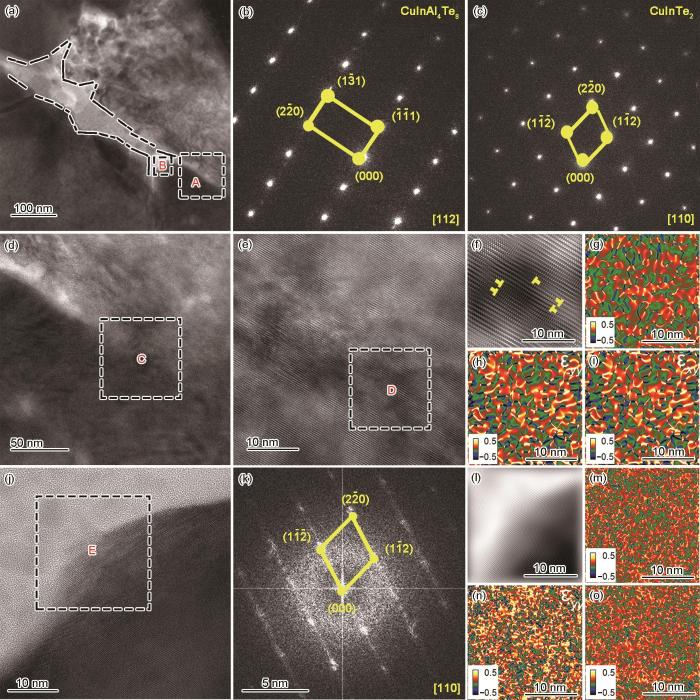
... 对x = 0.2样品中的纳米析出相及其与CuInTe2 间的界面进行分析,结果如图5 所示.图5a 为样品的TEM像,图5b 为纳米析出相CuInAl4 Te8 沿[112]晶带轴方向的(220)和(111)晶面的SAED花样(对应图5a 中的右上方区域),图5c 为CuInTe2 沿[110]晶带轴方向的(112)和(112)晶面的SAED花样(对应图5a 中的左下方区域).CuInTe2 和纳米析出相之间的相界如图5d 所示(图5a 中A区放大图).图5e 为图5d 中C区放大图,对图5e 中D区域进行逆快速Fourier变换(IFFT)处理,结果如图5f 所示.在图中可清晰地观察到若干位错,这主要与相界面处原子错排密切相关.为进一步探究位错周围的应变状态,对图5f 进行了几何相位分析(GPA),图5g~i 为不同方向的应变剖面图.图5j 为图5a 中B区的HRTEM像,可观察到CuInTe2 和界面过渡层,从而明确了相界位置.对图5j 中E区进行快速Fourier变换(FFT),结果如图5k 所示,经分析其为四方结构的CuInTe2 .对图5j 中E区进行IFFT处理,结果如图5l 所示,表明CuInTe2 与第二相之间存在共格关系.图5m~o 为图5l 不同方向的应变剖面图,可观察到明显的应变分布.这些点缺陷、位错和纳米析出相,协同增强了声子散射,促使晶格热导率降低[1 ,7 ,13 ,19 ,21 ] . ...
Tetrahedral distortion and thermoelectric performance of the Ag-substituted CuInTe2 chalcopyrite compound
4
2020
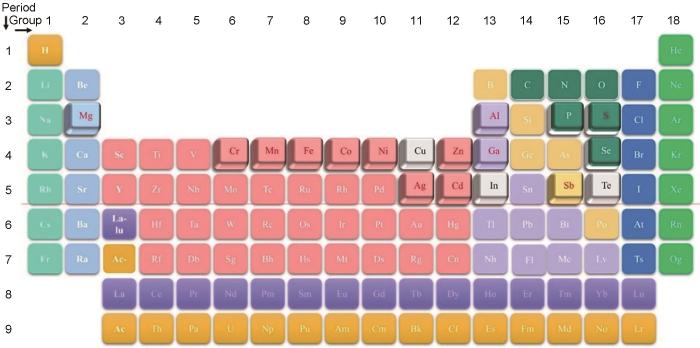
... CuInTe2 ,可以视为两个立方闪锌矿ZnTe结构堆叠,Cu、In原子交替取代Zn原子形成的短程无序、长程有序的晶体结构,从而获得比ZnTe更低的热导率,因此它被认为是一种有巨大潜力的P型热电材料.化学元素掺杂促进了CuInTe2 的发展.已报道的掺杂元素如图1 所示.掺杂金属元素,如Cu位Ag[2 ] 、Ni[3 ,4 ] 、Zn[5 ] 掺杂或者本征空位调整,In位Cr[6 ] 、Co[6 ] 、Mg[7 ] 、Ag[2 ,8 ] 、Cd[9 ] 、Hg[10 ] 、Zn[5 ] 、Mn[11 ,12 ] 、Sb (半金属)[13 ] 掺杂或者本征空位调整,通过这些元素掺杂可以调控能带结构或者载流子浓度,从而增强电输运性能.除了阳离子位调控外,阴离子位调控策略也用于增强热电性能.Te位S合金化[14 ] 和本征空位调控可以引入强烈的点缺陷声子散射从而明显降低κ L .Te位B、P元素掺杂可以调控载流子浓度提高Seebeck系数,从而提升CuInTe2 的热电性能[15 ] .通过在CuInTe2 中引入SnTe[16 ,17 ] 、GeTe[16 ,18 ] 、InTe[19 ] 、In2 Te3 [20 ] 、Zn (S/Se)[21 ] 、石墨烯(graphene)[22 ] 、AgSbTe2 [23 ] 等纳米级异质结或第二相也可调控电性能和热性能.此外,高压能够在调整能带结构的同时增大载流子浓度和迁移率,并且其引入的全尺寸缺陷结构可实现晶格热导率的明显下降[24 ] . ...
... [2 ,8 ]、Cd[9 ] 、Hg[10 ] 、Zn[5 ] 、Mn[11 ,12 ] 、Sb (半金属)[13 ] 掺杂或者本征空位调整,通过这些元素掺杂可以调控能带结构或者载流子浓度,从而增强电输运性能.除了阳离子位调控外,阴离子位调控策略也用于增强热电性能.Te位S合金化[14 ] 和本征空位调控可以引入强烈的点缺陷声子散射从而明显降低κ L .Te位B、P元素掺杂可以调控载流子浓度提高Seebeck系数,从而提升CuInTe2 的热电性能[15 ] .通过在CuInTe2 中引入SnTe[16 ,17 ] 、GeTe[16 ,18 ] 、InTe[19 ] 、In2 Te3 [20 ] 、Zn (S/Se)[21 ] 、石墨烯(graphene)[22 ] 、AgSbTe2 [23 ] 等纳米级异质结或第二相也可调控电性能和热性能.此外,高压能够在调整能带结构的同时增大载流子浓度和迁移率,并且其引入的全尺寸缺陷结构可实现晶格热导率的明显下降[24 ] . ...
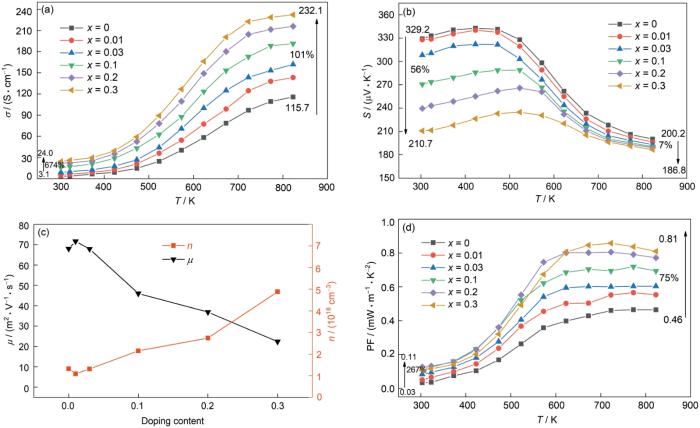
... CuIn1- x x 2 (x = 0、0.01、0.03、0.1、0.2和0.3)样品随温度变化的电输运性能曲线如图6 所示.电导率均表现出随温度变化的相似行为,在303~723 K之间时,掺杂样品的电导率随温度升高而增加,显示出典型的本征半导体行为.然而,随温度继续升高,电导率增幅逐渐趋缓并趋于稳定,在高温区域甚至出现微弱下降趋势,这种现象在其他类金刚石化合物(如AgGaTe2 [28 ] 和CuGaTe2 [29 ] )中更明显,且转变温度点(723 K,如图6a 所示)要比AgGaTe2 和AgInTe2 (约100 K)高[30 ] .在303 K时,纯CuInTe2 的电导率为3.1 S/cm.随Al掺杂量逐渐增加,CuIn1- x x 2 系列样品的电导率显著增加.303 K时CuIn0.7 Al0.3 Te2 的电导率提升至24 S/cm,相比纯CuInTe2 增幅达674%.这主要由增大的载流子浓度所致,如图6c 所示.随着温度的升高,在473 K以下温度范围,CuIn1- x x 2 电导率缓慢增加,在473 K以上温度范围则快速增加,这种急剧变化趋势也见于其他文献报道中[2 ,14 ,15 ,21 ,23 ,24 ,31 ~35 ] .在823 K时,CuIn0.7 Al0.3 Te2 的最大电导率为232.1 S/cm,比纯CuInTe2 增加101%.Seebeck系数与电导率呈现相反变化趋势,这也是由于增大的载流子浓度所致.如图6b 所示,在303 K时,纯CuInTe2 的Seebeck系数为329.2 μV/K,而CuIn0.7 Al0.3 Te2 的Seebeck系数降至210.7 μV/K,比纯CuInTe2 下降了56%.这主要归因于CuInAl4 Te8 第二相中的空位浓度比基体CuInTe2 大,如图6c 所示.第二相的析出(图2 、4 和5 )消耗了掺杂的Al原子,同时生成的CuInAl4 Te8 第二相提供的空位数量增多,进而导致空位浓度逐渐上升.同时,第二相的形成增强了载流子散射,致使载流子迁移率降低.在823 K时,CuIn1- x x 2 (x = 0、0.01、0.03、0.1、0.2和0.3)样品的Seebeck系数稳定在185~200 μV/K.如图6d 所示,在823 K时,CuIn1- x x 2 样品显著增大的电导率与适度降低的Seebeck系数的协同作用提升了功率因子,进而有效改善了材料的电传输性能.CuIn1- x x 2 的功率因子远高于AgGaTe2 和AgInTe2 [30 ] .如图6d 所示,在303 K时,CuIn0.7 Al0.3 Te2 样品的功率因子比纯CuInTe2 提高了267%;在823 K时,CuIn0.7 Al0.3 Te2 样品的功率因子比纯CuInTe2 提高了75%,这有利于提升CuIn0.7 Al0.3 Te2 样品的热电性能. ...
... 综合Sb[13 ] 、Al元素单一同价掺杂对CuInTe2 性能改善的实验结果,以及相关文献报道[2 ,5 ,11 ] ,单纯在阳离子In位进行同价掺杂对提升CuInTe2 黄铜矿体系性能的效果有限.基于载流子浓度调控与热导率优化的需求,在阳离子位点采用多元掺杂策略[7 ,17 ,18 ,45 ] ,有望进一步提升该体系的热电性能. ...
Thermoelectric properties of Ni-doped CuInTe2
2
2015
... CuInTe2 ,可以视为两个立方闪锌矿ZnTe结构堆叠,Cu、In原子交替取代Zn原子形成的短程无序、长程有序的晶体结构,从而获得比ZnTe更低的热导率,因此它被认为是一种有巨大潜力的P型热电材料.化学元素掺杂促进了CuInTe2 的发展.已报道的掺杂元素如图1 所示.掺杂金属元素,如Cu位Ag[2 ] 、Ni[3 ,4 ] 、Zn[5 ] 掺杂或者本征空位调整,In位Cr[6 ] 、Co[6 ] 、Mg[7 ] 、Ag[2 ,8 ] 、Cd[9 ] 、Hg[10 ] 、Zn[5 ] 、Mn[11 ,12 ] 、Sb (半金属)[13 ] 掺杂或者本征空位调整,通过这些元素掺杂可以调控能带结构或者载流子浓度,从而增强电输运性能.除了阳离子位调控外,阴离子位调控策略也用于增强热电性能.Te位S合金化[14 ] 和本征空位调控可以引入强烈的点缺陷声子散射从而明显降低κ L .Te位B、P元素掺杂可以调控载流子浓度提高Seebeck系数,从而提升CuInTe2 的热电性能[15 ] .通过在CuInTe2 中引入SnTe[16 ,17 ] 、GeTe[16 ,18 ] 、InTe[19 ] 、In2 Te3 [20 ] 、Zn (S/Se)[21 ] 、石墨烯(graphene)[22 ] 、AgSbTe2 [23 ] 等纳米级异质结或第二相也可调控电性能和热性能.此外,高压能够在调整能带结构的同时增大载流子浓度和迁移率,并且其引入的全尺寸缺陷结构可实现晶格热导率的明显下降[24 ] . ...
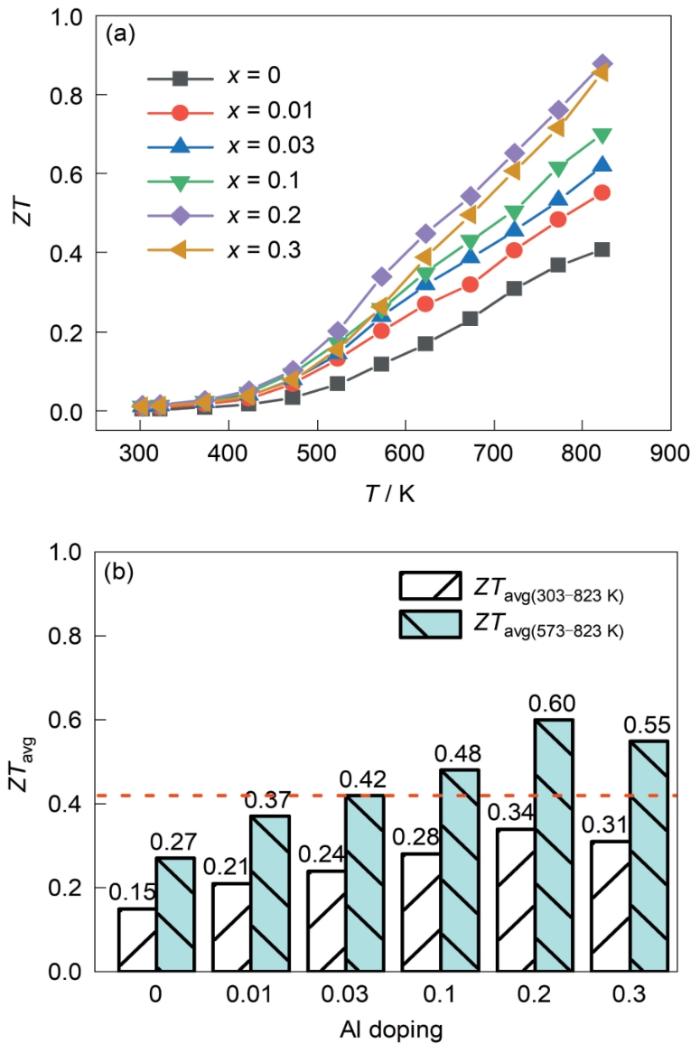
... CuIn1- x x 2 (x = 0、0.01、0.03、0.1、0.2和0.3)化合物随温度变化的ZT 值曲线如图8 所示.在303 K时,由于增大的功率因子和减小的热导率,Al掺杂样品的ZT 值随掺杂量增加而先增加后逐渐降低,CuIn0.8 Al0.2 Te2 样品获得最大ZT 值(0.014).CuIn1- x x 2 的ZT 值随着温度的上升而增大,尤其在423 K以上,CuIn1- x x 2 的ZT 值因温度的上升呈现显著的快速增长趋势.在823 K时,CuIn0.8 Al0.2 Te2 样品的ZT 值达到峰值,为0.88,比CuInTe2 提高了115%.这一ZT 值(0.88)与文献报道的同类材料性能相当:在854 K时CuIn1- x x 2 的ZT 值为0.82[34 ] ,在813 K时CuIn1- x x 2 的ZT 值为0.80[11 ] ,在820 K时Cu0.96 InTe2 的ZT 值为0.83[44 ] ,在737 K时Cu1- x 1- x 2 x 2 的ZT 值为0.67[5 ] ,以及在675 K时Cu1- x x 2 的ZT 值为0.35[3 ] .鉴于热电材料的平均ZT 值对实际应用非常重要,本工作计算了303~823和573~823 K之间的平均ZT 值(ZT avg(303-823 K) 和ZT avg(573-823 K) ),以评估CuIn1- x x 2 (x = 0、0.01、0.03、0.1、0.2和0.3)的热电性能.如图8b 所示,在303~823和573~823 K范围,Al掺杂显著提升了CuIn1- x x 2 在上述温度区间内的平均ZT 值.在303~823 K范围,所有掺杂Al样品CuIn1- x x 2 的平均ZT 值超过0.21,比纯CuInTe2 (0.15)增加了40%,CuIn0.8 Al0.2 Te2 样品的平均ZT 值比纯CuInTe2 提高了127%.在573~823 K范围,CuIn0.8 Al0.2 Te2 样品的平均ZT 值达到了0.60,比纯CuInTe2 (0.27)提高了122%. ...
Transport properties of Cd- and Ni-doped CuIn(S,Se,Te)2 -based semiconductors
1
2024
... CuInTe2 ,可以视为两个立方闪锌矿ZnTe结构堆叠,Cu、In原子交替取代Zn原子形成的短程无序、长程有序的晶体结构,从而获得比ZnTe更低的热导率,因此它被认为是一种有巨大潜力的P型热电材料.化学元素掺杂促进了CuInTe2 的发展.已报道的掺杂元素如图1 所示.掺杂金属元素,如Cu位Ag[2 ] 、Ni[3 ,4 ] 、Zn[5 ] 掺杂或者本征空位调整,In位Cr[6 ] 、Co[6 ] 、Mg[7 ] 、Ag[2 ,8 ] 、Cd[9 ] 、Hg[10 ] 、Zn[5 ] 、Mn[11 ,12 ] 、Sb (半金属)[13 ] 掺杂或者本征空位调整,通过这些元素掺杂可以调控能带结构或者载流子浓度,从而增强电输运性能.除了阳离子位调控外,阴离子位调控策略也用于增强热电性能.Te位S合金化[14 ] 和本征空位调控可以引入强烈的点缺陷声子散射从而明显降低κ L .Te位B、P元素掺杂可以调控载流子浓度提高Seebeck系数,从而提升CuInTe2 的热电性能[15 ] .通过在CuInTe2 中引入SnTe[16 ,17 ] 、GeTe[16 ,18 ] 、InTe[19 ] 、In2 Te3 [20 ] 、Zn (S/Se)[21 ] 、石墨烯(graphene)[22 ] 、AgSbTe2 [23 ] 等纳米级异质结或第二相也可调控电性能和热性能.此外,高压能够在调整能带结构的同时增大载流子浓度和迁移率,并且其引入的全尺寸缺陷结构可实现晶格热导率的明显下降[24 ] . ...
Lattice defects and thermoelectric properties: The case of p-type CuInTe2 chalcopyrite on introduction of zinc
5
2014
... CuInTe2 ,可以视为两个立方闪锌矿ZnTe结构堆叠,Cu、In原子交替取代Zn原子形成的短程无序、长程有序的晶体结构,从而获得比ZnTe更低的热导率,因此它被认为是一种有巨大潜力的P型热电材料.化学元素掺杂促进了CuInTe2 的发展.已报道的掺杂元素如图1 所示.掺杂金属元素,如Cu位Ag[2 ] 、Ni[3 ,4 ] 、Zn[5 ] 掺杂或者本征空位调整,In位Cr[6 ] 、Co[6 ] 、Mg[7 ] 、Ag[2 ,8 ] 、Cd[9 ] 、Hg[10 ] 、Zn[5 ] 、Mn[11 ,12 ] 、Sb (半金属)[13 ] 掺杂或者本征空位调整,通过这些元素掺杂可以调控能带结构或者载流子浓度,从而增强电输运性能.除了阳离子位调控外,阴离子位调控策略也用于增强热电性能.Te位S合金化[14 ] 和本征空位调控可以引入强烈的点缺陷声子散射从而明显降低κ L .Te位B、P元素掺杂可以调控载流子浓度提高Seebeck系数,从而提升CuInTe2 的热电性能[15 ] .通过在CuInTe2 中引入SnTe[16 ,17 ] 、GeTe[16 ,18 ] 、InTe[19 ] 、In2 Te3 [20 ] 、Zn (S/Se)[21 ] 、石墨烯(graphene)[22 ] 、AgSbTe2 [23 ] 等纳米级异质结或第二相也可调控电性能和热性能.此外,高压能够在调整能带结构的同时增大载流子浓度和迁移率,并且其引入的全尺寸缺陷结构可实现晶格热导率的明显下降[24 ] . ...
... [5 ]、Mn[11 ,12 ] 、Sb (半金属)[13 ] 掺杂或者本征空位调整,通过这些元素掺杂可以调控能带结构或者载流子浓度,从而增强电输运性能.除了阳离子位调控外,阴离子位调控策略也用于增强热电性能.Te位S合金化[14 ] 和本征空位调控可以引入强烈的点缺陷声子散射从而明显降低κ L .Te位B、P元素掺杂可以调控载流子浓度提高Seebeck系数,从而提升CuInTe2 的热电性能[15 ] .通过在CuInTe2 中引入SnTe[16 ,17 ] 、GeTe[16 ,18 ] 、InTe[19 ] 、In2 Te3 [20 ] 、Zn (S/Se)[21 ] 、石墨烯(graphene)[22 ] 、AgSbTe2 [23 ] 等纳米级异质结或第二相也可调控电性能和热性能.此外,高压能够在调整能带结构的同时增大载流子浓度和迁移率,并且其引入的全尺寸缺陷结构可实现晶格热导率的明显下降[24 ] . ...
... CuIn1- x x 2 (x = 0、0.01、0.03、0.1、0.2和0.3)化合物随温度变化的总热导率曲线如图7a 所示.在303 K时,纯CuInTe2 的总热导率为3.95 W/(m·K),该数值与文献报道[5 ,15 ,21 ,31 ,32 ] 相当.在该温度下的Al掺杂样品中,随掺杂量增加,CuIn1- x x 2 (x < 0.1)的总热导率逐渐降低,而CuIn1- x x 2 (x > 0.1)的总热导率开始升高;CuIn0.8 Al0.2 Te2 样品获得最低总热导率,为2.79 W/(m·K),比纯CuInTe2 降低了29%;CuIn0.7 -Al0.3 Te2 样品的总热导率最大,这归因于CuInAl4 Te8 纳米析出相含量增多以及晶粒增大[13 ,18 ] .随着温度的升高,所有样品的总热导率均呈现下降趋势.在823 K时,CuIn0.8 Al0.2 Te2 样品获得最小总热导率,为0.72 W/(m·K).增加的空位浓度导致电子热导率增加,如图7b 所示.根据Wiedemann-Franz关系,晶格热导率由总热导率减去电子热导率确定.由于电子热导率较低,晶格热导率主导总热导率.如图7c 所示,在303 K时,掺杂Al后CuIn1- x x 2 的晶格热导率显著降低,这表明Al掺杂的声子-声子的Umklapp散射和第二相增强的声子散射是导致热导率下降的主要机制.在303 K时,CuIn0.8 Al0.2 Te2 样品的晶格热导率最小,为2.78 W/(m·K).随着温度的升高,所有样品的晶格热导率都逐步下降,在823 K时,CuIn0.8 Al0.2 Te2 样品的晶格热导率达到最小,为0.54 W/(m·K),如图7d 所示,均低于其他热电材料,如β -FeSi2 [36 ] 、高熵Ti0.57 Zr0.4 Al0.02 Ta0.01 NiSn0.98 Sb0.02 [37 ] 、MnSi1.74 [38 ] 、SmMg2 Sb2 [39 ] 、(PbTe)0.97 (Ag2 Te)0.03 [40 ] 、Sn0.93 -Mn0.1 Te[41 ] 、Pb0.991 Ag0.003 Te[42 ] 以及GaGeTe[43 ] 等.与采用不同优化策略的相似体系对比,在823 K时,CuIn0.8 Al0.2 Te2 样品的晶格热导率(0.54 W/(m·K))仍低于大多数的CuInTe2 基热电材料,如CuInTe2 + 0.5%SnO2 [32 ] 、CuInTe2 + 9%ZnS/Se[21 ] 、CuInTe2 + 7 SnTe[16 ] 及(CuInTe2 )1.85 (In2 Te3 )0.15 [20 ] 等. ...
... CuIn1- x x 2 (x = 0、0.01、0.03、0.1、0.2和0.3)化合物随温度变化的ZT 值曲线如图8 所示.在303 K时,由于增大的功率因子和减小的热导率,Al掺杂样品的ZT 值随掺杂量增加而先增加后逐渐降低,CuIn0.8 Al0.2 Te2 样品获得最大ZT 值(0.014).CuIn1- x x 2 的ZT 值随着温度的上升而增大,尤其在423 K以上,CuIn1- x x 2 的ZT 值因温度的上升呈现显著的快速增长趋势.在823 K时,CuIn0.8 Al0.2 Te2 样品的ZT 值达到峰值,为0.88,比CuInTe2 提高了115%.这一ZT 值(0.88)与文献报道的同类材料性能相当:在854 K时CuIn1- x x 2 的ZT 值为0.82[34 ] ,在813 K时CuIn1- x x 2 的ZT 值为0.80[11 ] ,在820 K时Cu0.96 InTe2 的ZT 值为0.83[44 ] ,在737 K时Cu1- x 1- x 2 x 2 的ZT 值为0.67[5 ] ,以及在675 K时Cu1- x x 2 的ZT 值为0.35[3 ] .鉴于热电材料的平均ZT 值对实际应用非常重要,本工作计算了303~823和573~823 K之间的平均ZT 值(ZT avg(303-823 K) 和ZT avg(573-823 K) ),以评估CuIn1- x x 2 (x = 0、0.01、0.03、0.1、0.2和0.3)的热电性能.如图8b 所示,在303~823和573~823 K范围,Al掺杂显著提升了CuIn1- x x 2 在上述温度区间内的平均ZT 值.在303~823 K范围,所有掺杂Al样品CuIn1- x x 2 的平均ZT 值超过0.21,比纯CuInTe2 (0.15)增加了40%,CuIn0.8 Al0.2 Te2 样品的平均ZT 值比纯CuInTe2 提高了127%.在573~823 K范围,CuIn0.8 Al0.2 Te2 样品的平均ZT 值达到了0.60,比纯CuInTe2 (0.27)提高了122%. ...
... 综合Sb[13 ] 、Al元素单一同价掺杂对CuInTe2 性能改善的实验结果,以及相关文献报道[2 ,5 ,11 ] ,单纯在阳离子In位进行同价掺杂对提升CuInTe2 黄铜矿体系性能的效果有限.基于载流子浓度调控与热导率优化的需求,在阳离子位点采用多元掺杂策略[7 ,17 ,18 ,45 ] ,有望进一步提升该体系的热电性能. ...
Investigation on the chalcopyrite CuInTe2 based thermoelectric materials
2
2016
... CuInTe2 ,可以视为两个立方闪锌矿ZnTe结构堆叠,Cu、In原子交替取代Zn原子形成的短程无序、长程有序的晶体结构,从而获得比ZnTe更低的热导率,因此它被认为是一种有巨大潜力的P型热电材料.化学元素掺杂促进了CuInTe2 的发展.已报道的掺杂元素如图1 所示.掺杂金属元素,如Cu位Ag[2 ] 、Ni[3 ,4 ] 、Zn[5 ] 掺杂或者本征空位调整,In位Cr[6 ] 、Co[6 ] 、Mg[7 ] 、Ag[2 ,8 ] 、Cd[9 ] 、Hg[10 ] 、Zn[5 ] 、Mn[11 ,12 ] 、Sb (半金属)[13 ] 掺杂或者本征空位调整,通过这些元素掺杂可以调控能带结构或者载流子浓度,从而增强电输运性能.除了阳离子位调控外,阴离子位调控策略也用于增强热电性能.Te位S合金化[14 ] 和本征空位调控可以引入强烈的点缺陷声子散射从而明显降低κ L .Te位B、P元素掺杂可以调控载流子浓度提高Seebeck系数,从而提升CuInTe2 的热电性能[15 ] .通过在CuInTe2 中引入SnTe[16 ,17 ] 、GeTe[16 ,18 ] 、InTe[19 ] 、In2 Te3 [20 ] 、Zn (S/Se)[21 ] 、石墨烯(graphene)[22 ] 、AgSbTe2 [23 ] 等纳米级异质结或第二相也可调控电性能和热性能.此外,高压能够在调整能带结构的同时增大载流子浓度和迁移率,并且其引入的全尺寸缺陷结构可实现晶格热导率的明显下降[24 ] . ...
... [6 ]、Mg[7 ] 、Ag[2 ,8 ] 、Cd[9 ] 、Hg[10 ] 、Zn[5 ] 、Mn[11 ,12 ] 、Sb (半金属)[13 ] 掺杂或者本征空位调整,通过这些元素掺杂可以调控能带结构或者载流子浓度,从而增强电输运性能.除了阳离子位调控外,阴离子位调控策略也用于增强热电性能.Te位S合金化[14 ] 和本征空位调控可以引入强烈的点缺陷声子散射从而明显降低κ L .Te位B、P元素掺杂可以调控载流子浓度提高Seebeck系数,从而提升CuInTe2 的热电性能[15 ] .通过在CuInTe2 中引入SnTe[16 ,17 ] 、GeTe[16 ,18 ] 、InTe[19 ] 、In2 Te3 [20 ] 、Zn (S/Se)[21 ] 、石墨烯(graphene)[22 ] 、AgSbTe2 [23 ] 等纳米级异质结或第二相也可调控电性能和热性能.此外,高压能够在调整能带结构的同时增大载流子浓度和迁移率,并且其引入的全尺寸缺陷结构可实现晶格热导率的明显下降[24 ] . ...
黄铜矿结构CuInTe2 基热电材料研究
2
2016
... CuInTe2 ,可以视为两个立方闪锌矿ZnTe结构堆叠,Cu、In原子交替取代Zn原子形成的短程无序、长程有序的晶体结构,从而获得比ZnTe更低的热导率,因此它被认为是一种有巨大潜力的P型热电材料.化学元素掺杂促进了CuInTe2 的发展.已报道的掺杂元素如图1 所示.掺杂金属元素,如Cu位Ag[2 ] 、Ni[3 ,4 ] 、Zn[5 ] 掺杂或者本征空位调整,In位Cr[6 ] 、Co[6 ] 、Mg[7 ] 、Ag[2 ,8 ] 、Cd[9 ] 、Hg[10 ] 、Zn[5 ] 、Mn[11 ,12 ] 、Sb (半金属)[13 ] 掺杂或者本征空位调整,通过这些元素掺杂可以调控能带结构或者载流子浓度,从而增强电输运性能.除了阳离子位调控外,阴离子位调控策略也用于增强热电性能.Te位S合金化[14 ] 和本征空位调控可以引入强烈的点缺陷声子散射从而明显降低κ L .Te位B、P元素掺杂可以调控载流子浓度提高Seebeck系数,从而提升CuInTe2 的热电性能[15 ] .通过在CuInTe2 中引入SnTe[16 ,17 ] 、GeTe[16 ,18 ] 、InTe[19 ] 、In2 Te3 [20 ] 、Zn (S/Se)[21 ] 、石墨烯(graphene)[22 ] 、AgSbTe2 [23 ] 等纳米级异质结或第二相也可调控电性能和热性能.此外,高压能够在调整能带结构的同时增大载流子浓度和迁移率,并且其引入的全尺寸缺陷结构可实现晶格热导率的明显下降[24 ] . ...
... [6 ]、Mg[7 ] 、Ag[2 ,8 ] 、Cd[9 ] 、Hg[10 ] 、Zn[5 ] 、Mn[11 ,12 ] 、Sb (半金属)[13 ] 掺杂或者本征空位调整,通过这些元素掺杂可以调控能带结构或者载流子浓度,从而增强电输运性能.除了阳离子位调控外,阴离子位调控策略也用于增强热电性能.Te位S合金化[14 ] 和本征空位调控可以引入强烈的点缺陷声子散射从而明显降低κ L .Te位B、P元素掺杂可以调控载流子浓度提高Seebeck系数,从而提升CuInTe2 的热电性能[15 ] .通过在CuInTe2 中引入SnTe[16 ,17 ] 、GeTe[16 ,18 ] 、InTe[19 ] 、In2 Te3 [20 ] 、Zn (S/Se)[21 ] 、石墨烯(graphene)[22 ] 、AgSbTe2 [23 ] 等纳米级异质结或第二相也可调控电性能和热性能.此外,高压能够在调整能带结构的同时增大载流子浓度和迁移率,并且其引入的全尺寸缺陷结构可实现晶格热导率的明显下降[24 ] . ...
Realizing high thermoelectric performance and thermal stability in CuInTe2 through heavy dose Mg doping
3
2024
... CuInTe2 ,可以视为两个立方闪锌矿ZnTe结构堆叠,Cu、In原子交替取代Zn原子形成的短程无序、长程有序的晶体结构,从而获得比ZnTe更低的热导率,因此它被认为是一种有巨大潜力的P型热电材料.化学元素掺杂促进了CuInTe2 的发展.已报道的掺杂元素如图1 所示.掺杂金属元素,如Cu位Ag[2 ] 、Ni[3 ,4 ] 、Zn[5 ] 掺杂或者本征空位调整,In位Cr[6 ] 、Co[6 ] 、Mg[7 ] 、Ag[2 ,8 ] 、Cd[9 ] 、Hg[10 ] 、Zn[5 ] 、Mn[11 ,12 ] 、Sb (半金属)[13 ] 掺杂或者本征空位调整,通过这些元素掺杂可以调控能带结构或者载流子浓度,从而增强电输运性能.除了阳离子位调控外,阴离子位调控策略也用于增强热电性能.Te位S合金化[14 ] 和本征空位调控可以引入强烈的点缺陷声子散射从而明显降低κ L .Te位B、P元素掺杂可以调控载流子浓度提高Seebeck系数,从而提升CuInTe2 的热电性能[15 ] .通过在CuInTe2 中引入SnTe[16 ,17 ] 、GeTe[16 ,18 ] 、InTe[19 ] 、In2 Te3 [20 ] 、Zn (S/Se)[21 ] 、石墨烯(graphene)[22 ] 、AgSbTe2 [23 ] 等纳米级异质结或第二相也可调控电性能和热性能.此外,高压能够在调整能带结构的同时增大载流子浓度和迁移率,并且其引入的全尺寸缺陷结构可实现晶格热导率的明显下降[24 ] . ...
... 对x = 0.2样品中的纳米析出相及其与CuInTe2 间的界面进行分析,结果如图5 所示.图5a 为样品的TEM像,图5b 为纳米析出相CuInAl4 Te8 沿[112]晶带轴方向的(220)和(111)晶面的SAED花样(对应图5a 中的右上方区域),图5c 为CuInTe2 沿[110]晶带轴方向的(112)和(112)晶面的SAED花样(对应图5a 中的左下方区域).CuInTe2 和纳米析出相之间的相界如图5d 所示(图5a 中A区放大图).图5e 为图5d 中C区放大图,对图5e 中D区域进行逆快速Fourier变换(IFFT)处理,结果如图5f 所示.在图中可清晰地观察到若干位错,这主要与相界面处原子错排密切相关.为进一步探究位错周围的应变状态,对图5f 进行了几何相位分析(GPA),图5g~i 为不同方向的应变剖面图.图5j 为图5a 中B区的HRTEM像,可观察到CuInTe2 和界面过渡层,从而明确了相界位置.对图5j 中E区进行快速Fourier变换(FFT),结果如图5k 所示,经分析其为四方结构的CuInTe2 .对图5j 中E区进行IFFT处理,结果如图5l 所示,表明CuInTe2 与第二相之间存在共格关系.图5m~o 为图5l 不同方向的应变剖面图,可观察到明显的应变分布.这些点缺陷、位错和纳米析出相,协同增强了声子散射,促使晶格热导率降低[1 ,7 ,13 ,19 ,21 ] . ...
... 综合Sb[13 ] 、Al元素单一同价掺杂对CuInTe2 性能改善的实验结果,以及相关文献报道[2 ,5 ,11 ] ,单纯在阳离子In位进行同价掺杂对提升CuInTe2 黄铜矿体系性能的效果有限.基于载流子浓度调控与热导率优化的需求,在阳离子位点采用多元掺杂策略[7 ,17 ,18 ,45 ] ,有望进一步提升该体系的热电性能. ...
Enhancing thermoelectric performance of CuInTe2 via trace Ag doping at indium sites
2
2023
... CuInTe2 ,可以视为两个立方闪锌矿ZnTe结构堆叠,Cu、In原子交替取代Zn原子形成的短程无序、长程有序的晶体结构,从而获得比ZnTe更低的热导率,因此它被认为是一种有巨大潜力的P型热电材料.化学元素掺杂促进了CuInTe2 的发展.已报道的掺杂元素如图1 所示.掺杂金属元素,如Cu位Ag[2 ] 、Ni[3 ,4 ] 、Zn[5 ] 掺杂或者本征空位调整,In位Cr[6 ] 、Co[6 ] 、Mg[7 ] 、Ag[2 ,8 ] 、Cd[9 ] 、Hg[10 ] 、Zn[5 ] 、Mn[11 ,12 ] 、Sb (半金属)[13 ] 掺杂或者本征空位调整,通过这些元素掺杂可以调控能带结构或者载流子浓度,从而增强电输运性能.除了阳离子位调控外,阴离子位调控策略也用于增强热电性能.Te位S合金化[14 ] 和本征空位调控可以引入强烈的点缺陷声子散射从而明显降低κ L .Te位B、P元素掺杂可以调控载流子浓度提高Seebeck系数,从而提升CuInTe2 的热电性能[15 ] .通过在CuInTe2 中引入SnTe[16 ,17 ] 、GeTe[16 ,18 ] 、InTe[19 ] 、In2 Te3 [20 ] 、Zn (S/Se)[21 ] 、石墨烯(graphene)[22 ] 、AgSbTe2 [23 ] 等纳米级异质结或第二相也可调控电性能和热性能.此外,高压能够在调整能带结构的同时增大载流子浓度和迁移率,并且其引入的全尺寸缺陷结构可实现晶格热导率的明显下降[24 ] . ...
... 式中,τ B 为晶界散射机制贡献,τ D 为点缺陷散射机制贡献,τ U 为声子-声子的Umklapp散射机制贡献,τ R 为声子共振散射机制贡献,τ B 、τ D 和τ U 被认为是重要的散射机制.Debye-Callaway模型的总散射参数(Γ tot )主要取决于应变场波动(Γ S )和质量场波动(Γ M )[8 ] .随温度升高CuIn1- x x 2 的晶格热导率降低表明,声子-声子的Umklapp散射过程是主要的声子散射机制.如表1 所示,随着Al掺杂量的增加,Γ tot 也在增加,这与图7 中晶格热导率的减小情况一致.Γ S 主导CuIn1- x x 2 (x = 0.01、0.03、0.1)晶格热导率的减小,但随着Al掺杂含量的进一步增加,Γ M 主导了CuIn1- x x 2 (x = 0.2、0.3)晶格热导率的减小,与CuIn1- x x 2 化合物中Γ S 主导晶格热导率减小的波动趋势不同[13 ] .这一现象归因于掺杂的Al原子和In原子之间的质量和半径差异. ...
Enhanced thermoelectric performance in Cd doped CuInTe2 compounds
1
2014
... CuInTe2 ,可以视为两个立方闪锌矿ZnTe结构堆叠,Cu、In原子交替取代Zn原子形成的短程无序、长程有序的晶体结构,从而获得比ZnTe更低的热导率,因此它被认为是一种有巨大潜力的P型热电材料.化学元素掺杂促进了CuInTe2 的发展.已报道的掺杂元素如图1 所示.掺杂金属元素,如Cu位Ag[2 ] 、Ni[3 ,4 ] 、Zn[5 ] 掺杂或者本征空位调整,In位Cr[6 ] 、Co[6 ] 、Mg[7 ] 、Ag[2 ,8 ] 、Cd[9 ] 、Hg[10 ] 、Zn[5 ] 、Mn[11 ,12 ] 、Sb (半金属)[13 ] 掺杂或者本征空位调整,通过这些元素掺杂可以调控能带结构或者载流子浓度,从而增强电输运性能.除了阳离子位调控外,阴离子位调控策略也用于增强热电性能.Te位S合金化[14 ] 和本征空位调控可以引入强烈的点缺陷声子散射从而明显降低κ L .Te位B、P元素掺杂可以调控载流子浓度提高Seebeck系数,从而提升CuInTe2 的热电性能[15 ] .通过在CuInTe2 中引入SnTe[16 ,17 ] 、GeTe[16 ,18 ] 、InTe[19 ] 、In2 Te3 [20 ] 、Zn (S/Se)[21 ] 、石墨烯(graphene)[22 ] 、AgSbTe2 [23 ] 等纳米级异质结或第二相也可调控电性能和热性能.此外,高压能够在调整能带结构的同时增大载流子浓度和迁移率,并且其引入的全尺寸缺陷结构可实现晶格热导率的明显下降[24 ] . ...
High-temperature thermoelectric properties of Hg-doped CuInTe2
1
2015
... CuInTe2 ,可以视为两个立方闪锌矿ZnTe结构堆叠,Cu、In原子交替取代Zn原子形成的短程无序、长程有序的晶体结构,从而获得比ZnTe更低的热导率,因此它被认为是一种有巨大潜力的P型热电材料.化学元素掺杂促进了CuInTe2 的发展.已报道的掺杂元素如图1 所示.掺杂金属元素,如Cu位Ag[2 ] 、Ni[3 ,4 ] 、Zn[5 ] 掺杂或者本征空位调整,In位Cr[6 ] 、Co[6 ] 、Mg[7 ] 、Ag[2 ,8 ] 、Cd[9 ] 、Hg[10 ] 、Zn[5 ] 、Mn[11 ,12 ] 、Sb (半金属)[13 ] 掺杂或者本征空位调整,通过这些元素掺杂可以调控能带结构或者载流子浓度,从而增强电输运性能.除了阳离子位调控外,阴离子位调控策略也用于增强热电性能.Te位S合金化[14 ] 和本征空位调控可以引入强烈的点缺陷声子散射从而明显降低κ L .Te位B、P元素掺杂可以调控载流子浓度提高Seebeck系数,从而提升CuInTe2 的热电性能[15 ] .通过在CuInTe2 中引入SnTe[16 ,17 ] 、GeTe[16 ,18 ] 、InTe[19 ] 、In2 Te3 [20 ] 、Zn (S/Se)[21 ] 、石墨烯(graphene)[22 ] 、AgSbTe2 [23 ] 等纳米级异质结或第二相也可调控电性能和热性能.此外,高压能够在调整能带结构的同时增大载流子浓度和迁移率,并且其引入的全尺寸缺陷结构可实现晶格热导率的明显下降[24 ] . ...
Effects of Mn substitution on thermoelectric properties of CuIn1- x x 2
3
2017
... CuInTe2 ,可以视为两个立方闪锌矿ZnTe结构堆叠,Cu、In原子交替取代Zn原子形成的短程无序、长程有序的晶体结构,从而获得比ZnTe更低的热导率,因此它被认为是一种有巨大潜力的P型热电材料.化学元素掺杂促进了CuInTe2 的发展.已报道的掺杂元素如图1 所示.掺杂金属元素,如Cu位Ag[2 ] 、Ni[3 ,4 ] 、Zn[5 ] 掺杂或者本征空位调整,In位Cr[6 ] 、Co[6 ] 、Mg[7 ] 、Ag[2 ,8 ] 、Cd[9 ] 、Hg[10 ] 、Zn[5 ] 、Mn[11 ,12 ] 、Sb (半金属)[13 ] 掺杂或者本征空位调整,通过这些元素掺杂可以调控能带结构或者载流子浓度,从而增强电输运性能.除了阳离子位调控外,阴离子位调控策略也用于增强热电性能.Te位S合金化[14 ] 和本征空位调控可以引入强烈的点缺陷声子散射从而明显降低κ L .Te位B、P元素掺杂可以调控载流子浓度提高Seebeck系数,从而提升CuInTe2 的热电性能[15 ] .通过在CuInTe2 中引入SnTe[16 ,17 ] 、GeTe[16 ,18 ] 、InTe[19 ] 、In2 Te3 [20 ] 、Zn (S/Se)[21 ] 、石墨烯(graphene)[22 ] 、AgSbTe2 [23 ] 等纳米级异质结或第二相也可调控电性能和热性能.此外,高压能够在调整能带结构的同时增大载流子浓度和迁移率,并且其引入的全尺寸缺陷结构可实现晶格热导率的明显下降[24 ] . ...
... CuIn1- x x 2 (x = 0、0.01、0.03、0.1、0.2和0.3)化合物随温度变化的ZT 值曲线如图8 所示.在303 K时,由于增大的功率因子和减小的热导率,Al掺杂样品的ZT 值随掺杂量增加而先增加后逐渐降低,CuIn0.8 Al0.2 Te2 样品获得最大ZT 值(0.014).CuIn1- x x 2 的ZT 值随着温度的上升而增大,尤其在423 K以上,CuIn1- x x 2 的ZT 值因温度的上升呈现显著的快速增长趋势.在823 K时,CuIn0.8 Al0.2 Te2 样品的ZT 值达到峰值,为0.88,比CuInTe2 提高了115%.这一ZT 值(0.88)与文献报道的同类材料性能相当:在854 K时CuIn1- x x 2 的ZT 值为0.82[34 ] ,在813 K时CuIn1- x x 2 的ZT 值为0.80[11 ] ,在820 K时Cu0.96 InTe2 的ZT 值为0.83[44 ] ,在737 K时Cu1- x 1- x 2 x 2 的ZT 值为0.67[5 ] ,以及在675 K时Cu1- x x 2 的ZT 值为0.35[3 ] .鉴于热电材料的平均ZT 值对实际应用非常重要,本工作计算了303~823和573~823 K之间的平均ZT 值(ZT avg(303-823 K) 和ZT avg(573-823 K) ),以评估CuIn1- x x 2 (x = 0、0.01、0.03、0.1、0.2和0.3)的热电性能.如图8b 所示,在303~823和573~823 K范围,Al掺杂显著提升了CuIn1- x x 2 在上述温度区间内的平均ZT 值.在303~823 K范围,所有掺杂Al样品CuIn1- x x 2 的平均ZT 值超过0.21,比纯CuInTe2 (0.15)增加了40%,CuIn0.8 Al0.2 Te2 样品的平均ZT 值比纯CuInTe2 提高了127%.在573~823 K范围,CuIn0.8 Al0.2 Te2 样品的平均ZT 值达到了0.60,比纯CuInTe2 (0.27)提高了122%. ...
... 综合Sb[13 ] 、Al元素单一同价掺杂对CuInTe2 性能改善的实验结果,以及相关文献报道[2 ,5 ,11 ] ,单纯在阳离子In位进行同价掺杂对提升CuInTe2 黄铜矿体系性能的效果有限.基于载流子浓度调控与热导率优化的需求,在阳离子位点采用多元掺杂策略[7 ,17 ,18 ,45 ] ,有望进一步提升该体系的热电性能. ...
Defects and thermoelectric performance of ternary chalcopyrite CuInTe2 -based semiconductors doped with Mn
1
2016
... CuInTe2 ,可以视为两个立方闪锌矿ZnTe结构堆叠,Cu、In原子交替取代Zn原子形成的短程无序、长程有序的晶体结构,从而获得比ZnTe更低的热导率,因此它被认为是一种有巨大潜力的P型热电材料.化学元素掺杂促进了CuInTe2 的发展.已报道的掺杂元素如图1 所示.掺杂金属元素,如Cu位Ag[2 ] 、Ni[3 ,4 ] 、Zn[5 ] 掺杂或者本征空位调整,In位Cr[6 ] 、Co[6 ] 、Mg[7 ] 、Ag[2 ,8 ] 、Cd[9 ] 、Hg[10 ] 、Zn[5 ] 、Mn[11 ,12 ] 、Sb (半金属)[13 ] 掺杂或者本征空位调整,通过这些元素掺杂可以调控能带结构或者载流子浓度,从而增强电输运性能.除了阳离子位调控外,阴离子位调控策略也用于增强热电性能.Te位S合金化[14 ] 和本征空位调控可以引入强烈的点缺陷声子散射从而明显降低κ L .Te位B、P元素掺杂可以调控载流子浓度提高Seebeck系数,从而提升CuInTe2 的热电性能[15 ] .通过在CuInTe2 中引入SnTe[16 ,17 ] 、GeTe[16 ,18 ] 、InTe[19 ] 、In2 Te3 [20 ] 、Zn (S/Se)[21 ] 、石墨烯(graphene)[22 ] 、AgSbTe2 [23 ] 等纳米级异质结或第二相也可调控电性能和热性能.此外,高压能够在调整能带结构的同时增大载流子浓度和迁移率,并且其引入的全尺寸缺陷结构可实现晶格热导率的明显下降[24 ] . ...
Mn掺杂后三元黄铜矿结构半导体CuInTe2 的缺陷特征与热电性能
1
2016
... CuInTe2 ,可以视为两个立方闪锌矿ZnTe结构堆叠,Cu、In原子交替取代Zn原子形成的短程无序、长程有序的晶体结构,从而获得比ZnTe更低的热导率,因此它被认为是一种有巨大潜力的P型热电材料.化学元素掺杂促进了CuInTe2 的发展.已报道的掺杂元素如图1 所示.掺杂金属元素,如Cu位Ag[2 ] 、Ni[3 ,4 ] 、Zn[5 ] 掺杂或者本征空位调整,In位Cr[6 ] 、Co[6 ] 、Mg[7 ] 、Ag[2 ,8 ] 、Cd[9 ] 、Hg[10 ] 、Zn[5 ] 、Mn[11 ,12 ] 、Sb (半金属)[13 ] 掺杂或者本征空位调整,通过这些元素掺杂可以调控能带结构或者载流子浓度,从而增强电输运性能.除了阳离子位调控外,阴离子位调控策略也用于增强热电性能.Te位S合金化[14 ] 和本征空位调控可以引入强烈的点缺陷声子散射从而明显降低κ L .Te位B、P元素掺杂可以调控载流子浓度提高Seebeck系数,从而提升CuInTe2 的热电性能[15 ] .通过在CuInTe2 中引入SnTe[16 ,17 ] 、GeTe[16 ,18 ] 、InTe[19 ] 、In2 Te3 [20 ] 、Zn (S/Se)[21 ] 、石墨烯(graphene)[22 ] 、AgSbTe2 [23 ] 等纳米级异质结或第二相也可调控电性能和热性能.此外,高压能够在调整能带结构的同时增大载流子浓度和迁移率,并且其引入的全尺寸缺陷结构可实现晶格热导率的明显下降[24 ] . ...
Second phases and dislocations to boost the thermoelectric properties of CuInTe2 by Sb doping at in site
5
2024
... CuInTe2 ,可以视为两个立方闪锌矿ZnTe结构堆叠,Cu、In原子交替取代Zn原子形成的短程无序、长程有序的晶体结构,从而获得比ZnTe更低的热导率,因此它被认为是一种有巨大潜力的P型热电材料.化学元素掺杂促进了CuInTe2 的发展.已报道的掺杂元素如图1 所示.掺杂金属元素,如Cu位Ag[2 ] 、Ni[3 ,4 ] 、Zn[5 ] 掺杂或者本征空位调整,In位Cr[6 ] 、Co[6 ] 、Mg[7 ] 、Ag[2 ,8 ] 、Cd[9 ] 、Hg[10 ] 、Zn[5 ] 、Mn[11 ,12 ] 、Sb (半金属)[13 ] 掺杂或者本征空位调整,通过这些元素掺杂可以调控能带结构或者载流子浓度,从而增强电输运性能.除了阳离子位调控外,阴离子位调控策略也用于增强热电性能.Te位S合金化[14 ] 和本征空位调控可以引入强烈的点缺陷声子散射从而明显降低κ L .Te位B、P元素掺杂可以调控载流子浓度提高Seebeck系数,从而提升CuInTe2 的热电性能[15 ] .通过在CuInTe2 中引入SnTe[16 ,17 ] 、GeTe[16 ,18 ] 、InTe[19 ] 、In2 Te3 [20 ] 、Zn (S/Se)[21 ] 、石墨烯(graphene)[22 ] 、AgSbTe2 [23 ] 等纳米级异质结或第二相也可调控电性能和热性能.此外,高压能够在调整能带结构的同时增大载流子浓度和迁移率,并且其引入的全尺寸缺陷结构可实现晶格热导率的明显下降[24 ] . ...
... 对x = 0.2样品中的纳米析出相及其与CuInTe2 间的界面进行分析,结果如图5 所示.图5a 为样品的TEM像,图5b 为纳米析出相CuInAl4 Te8 沿[112]晶带轴方向的(220)和(111)晶面的SAED花样(对应图5a 中的右上方区域),图5c 为CuInTe2 沿[110]晶带轴方向的(112)和(112)晶面的SAED花样(对应图5a 中的左下方区域).CuInTe2 和纳米析出相之间的相界如图5d 所示(图5a 中A区放大图).图5e 为图5d 中C区放大图,对图5e 中D区域进行逆快速Fourier变换(IFFT)处理,结果如图5f 所示.在图中可清晰地观察到若干位错,这主要与相界面处原子错排密切相关.为进一步探究位错周围的应变状态,对图5f 进行了几何相位分析(GPA),图5g~i 为不同方向的应变剖面图.图5j 为图5a 中B区的HRTEM像,可观察到CuInTe2 和界面过渡层,从而明确了相界位置.对图5j 中E区进行快速Fourier变换(FFT),结果如图5k 所示,经分析其为四方结构的CuInTe2 .对图5j 中E区进行IFFT处理,结果如图5l 所示,表明CuInTe2 与第二相之间存在共格关系.图5m~o 为图5l 不同方向的应变剖面图,可观察到明显的应变分布.这些点缺陷、位错和纳米析出相,协同增强了声子散射,促使晶格热导率降低[1 ,7 ,13 ,19 ,21 ] . ...
... CuIn1- x x 2 (x = 0、0.01、0.03、0.1、0.2和0.3)化合物随温度变化的总热导率曲线如图7a 所示.在303 K时,纯CuInTe2 的总热导率为3.95 W/(m·K),该数值与文献报道[5 ,15 ,21 ,31 ,32 ] 相当.在该温度下的Al掺杂样品中,随掺杂量增加,CuIn1- x x 2 (x < 0.1)的总热导率逐渐降低,而CuIn1- x x 2 (x > 0.1)的总热导率开始升高;CuIn0.8 Al0.2 Te2 样品获得最低总热导率,为2.79 W/(m·K),比纯CuInTe2 降低了29%;CuIn0.7 -Al0.3 Te2 样品的总热导率最大,这归因于CuInAl4 Te8 纳米析出相含量增多以及晶粒增大[13 ,18 ] .随着温度的升高,所有样品的总热导率均呈现下降趋势.在823 K时,CuIn0.8 Al0.2 Te2 样品获得最小总热导率,为0.72 W/(m·K).增加的空位浓度导致电子热导率增加,如图7b 所示.根据Wiedemann-Franz关系,晶格热导率由总热导率减去电子热导率确定.由于电子热导率较低,晶格热导率主导总热导率.如图7c 所示,在303 K时,掺杂Al后CuIn1- x x 2 的晶格热导率显著降低,这表明Al掺杂的声子-声子的Umklapp散射和第二相增强的声子散射是导致热导率下降的主要机制.在303 K时,CuIn0.8 Al0.2 Te2 样品的晶格热导率最小,为2.78 W/(m·K).随着温度的升高,所有样品的晶格热导率都逐步下降,在823 K时,CuIn0.8 Al0.2 Te2 样品的晶格热导率达到最小,为0.54 W/(m·K),如图7d 所示,均低于其他热电材料,如β -FeSi2 [36 ] 、高熵Ti0.57 Zr0.4 Al0.02 Ta0.01 NiSn0.98 Sb0.02 [37 ] 、MnSi1.74 [38 ] 、SmMg2 Sb2 [39 ] 、(PbTe)0.97 (Ag2 Te)0.03 [40 ] 、Sn0.93 -Mn0.1 Te[41 ] 、Pb0.991 Ag0.003 Te[42 ] 以及GaGeTe[43 ] 等.与采用不同优化策略的相似体系对比,在823 K时,CuIn0.8 Al0.2 Te2 样品的晶格热导率(0.54 W/(m·K))仍低于大多数的CuInTe2 基热电材料,如CuInTe2 + 0.5%SnO2 [32 ] 、CuInTe2 + 9%ZnS/Se[21 ] 、CuInTe2 + 7 SnTe[16 ] 及(CuInTe2 )1.85 (In2 Te3 )0.15 [20 ] 等. ...
... 式中,τ B 为晶界散射机制贡献,τ D 为点缺陷散射机制贡献,τ U 为声子-声子的Umklapp散射机制贡献,τ R 为声子共振散射机制贡献,τ B 、τ D 和τ U 被认为是重要的散射机制.Debye-Callaway模型的总散射参数(Γ tot )主要取决于应变场波动(Γ S )和质量场波动(Γ M )[8 ] .随温度升高CuIn1- x x 2 的晶格热导率降低表明,声子-声子的Umklapp散射过程是主要的声子散射机制.如表1 所示,随着Al掺杂量的增加,Γ tot 也在增加,这与图7 中晶格热导率的减小情况一致.Γ S 主导CuIn1- x x 2 (x = 0.01、0.03、0.1)晶格热导率的减小,但随着Al掺杂含量的进一步增加,Γ M 主导了CuIn1- x x 2 (x = 0.2、0.3)晶格热导率的减小,与CuIn1- x x 2 化合物中Γ S 主导晶格热导率减小的波动趋势不同[13 ] .这一现象归因于掺杂的Al原子和In原子之间的质量和半径差异. ...
... 综合Sb[13 ] 、Al元素单一同价掺杂对CuInTe2 性能改善的实验结果,以及相关文献报道[2 ,5 ,11 ] ,单纯在阳离子In位进行同价掺杂对提升CuInTe2 黄铜矿体系性能的效果有限.基于载流子浓度调控与热导率优化的需求,在阳离子位点采用多元掺杂策略[7 ,17 ,18 ,45 ] ,有望进一步提升该体系的热电性能. ...
Thermoelectric properties for CuInTe2- x x x = 0, 0.05, 0.1, 0.15) solid solution
2
2017
... CuInTe2 ,可以视为两个立方闪锌矿ZnTe结构堆叠,Cu、In原子交替取代Zn原子形成的短程无序、长程有序的晶体结构,从而获得比ZnTe更低的热导率,因此它被认为是一种有巨大潜力的P型热电材料.化学元素掺杂促进了CuInTe2 的发展.已报道的掺杂元素如图1 所示.掺杂金属元素,如Cu位Ag[2 ] 、Ni[3 ,4 ] 、Zn[5 ] 掺杂或者本征空位调整,In位Cr[6 ] 、Co[6 ] 、Mg[7 ] 、Ag[2 ,8 ] 、Cd[9 ] 、Hg[10 ] 、Zn[5 ] 、Mn[11 ,12 ] 、Sb (半金属)[13 ] 掺杂或者本征空位调整,通过这些元素掺杂可以调控能带结构或者载流子浓度,从而增强电输运性能.除了阳离子位调控外,阴离子位调控策略也用于增强热电性能.Te位S合金化[14 ] 和本征空位调控可以引入强烈的点缺陷声子散射从而明显降低κ L .Te位B、P元素掺杂可以调控载流子浓度提高Seebeck系数,从而提升CuInTe2 的热电性能[15 ] .通过在CuInTe2 中引入SnTe[16 ,17 ] 、GeTe[16 ,18 ] 、InTe[19 ] 、In2 Te3 [20 ] 、Zn (S/Se)[21 ] 、石墨烯(graphene)[22 ] 、AgSbTe2 [23 ] 等纳米级异质结或第二相也可调控电性能和热性能.此外,高压能够在调整能带结构的同时增大载流子浓度和迁移率,并且其引入的全尺寸缺陷结构可实现晶格热导率的明显下降[24 ] . ...
... CuIn1- x x 2 (x = 0、0.01、0.03、0.1、0.2和0.3)样品随温度变化的电输运性能曲线如图6 所示.电导率均表现出随温度变化的相似行为,在303~723 K之间时,掺杂样品的电导率随温度升高而增加,显示出典型的本征半导体行为.然而,随温度继续升高,电导率增幅逐渐趋缓并趋于稳定,在高温区域甚至出现微弱下降趋势,这种现象在其他类金刚石化合物(如AgGaTe2 [28 ] 和CuGaTe2 [29 ] )中更明显,且转变温度点(723 K,如图6a 所示)要比AgGaTe2 和AgInTe2 (约100 K)高[30 ] .在303 K时,纯CuInTe2 的电导率为3.1 S/cm.随Al掺杂量逐渐增加,CuIn1- x x 2 系列样品的电导率显著增加.303 K时CuIn0.7 Al0.3 Te2 的电导率提升至24 S/cm,相比纯CuInTe2 增幅达674%.这主要由增大的载流子浓度所致,如图6c 所示.随着温度的升高,在473 K以下温度范围,CuIn1- x x 2 电导率缓慢增加,在473 K以上温度范围则快速增加,这种急剧变化趋势也见于其他文献报道中[2 ,14 ,15 ,21 ,23 ,24 ,31 ~35 ] .在823 K时,CuIn0.7 Al0.3 Te2 的最大电导率为232.1 S/cm,比纯CuInTe2 增加101%.Seebeck系数与电导率呈现相反变化趋势,这也是由于增大的载流子浓度所致.如图6b 所示,在303 K时,纯CuInTe2 的Seebeck系数为329.2 μV/K,而CuIn0.7 Al0.3 Te2 的Seebeck系数降至210.7 μV/K,比纯CuInTe2 下降了56%.这主要归因于CuInAl4 Te8 第二相中的空位浓度比基体CuInTe2 大,如图6c 所示.第二相的析出(图2 、4 和5 )消耗了掺杂的Al原子,同时生成的CuInAl4 Te8 第二相提供的空位数量增多,进而导致空位浓度逐渐上升.同时,第二相的形成增强了载流子散射,致使载流子迁移率降低.在823 K时,CuIn1- x x 2 (x = 0、0.01、0.03、0.1、0.2和0.3)样品的Seebeck系数稳定在185~200 μV/K.如图6d 所示,在823 K时,CuIn1- x x 2 样品显著增大的电导率与适度降低的Seebeck系数的协同作用提升了功率因子,进而有效改善了材料的电传输性能.CuIn1- x x 2 的功率因子远高于AgGaTe2 和AgInTe2 [30 ] .如图6d 所示,在303 K时,CuIn0.7 Al0.3 Te2 样品的功率因子比纯CuInTe2 提高了267%;在823 K时,CuIn0.7 Al0.3 Te2 样品的功率因子比纯CuInTe2 提高了75%,这有利于提升CuIn0.7 Al0.3 Te2 样品的热电性能. ...
CuInTe2- x x x = 0, 0.05, 0.1, 0.15)固溶体的热电性能
2
2017
... CuInTe2 ,可以视为两个立方闪锌矿ZnTe结构堆叠,Cu、In原子交替取代Zn原子形成的短程无序、长程有序的晶体结构,从而获得比ZnTe更低的热导率,因此它被认为是一种有巨大潜力的P型热电材料.化学元素掺杂促进了CuInTe2 的发展.已报道的掺杂元素如图1 所示.掺杂金属元素,如Cu位Ag[2 ] 、Ni[3 ,4 ] 、Zn[5 ] 掺杂或者本征空位调整,In位Cr[6 ] 、Co[6 ] 、Mg[7 ] 、Ag[2 ,8 ] 、Cd[9 ] 、Hg[10 ] 、Zn[5 ] 、Mn[11 ,12 ] 、Sb (半金属)[13 ] 掺杂或者本征空位调整,通过这些元素掺杂可以调控能带结构或者载流子浓度,从而增强电输运性能.除了阳离子位调控外,阴离子位调控策略也用于增强热电性能.Te位S合金化[14 ] 和本征空位调控可以引入强烈的点缺陷声子散射从而明显降低κ L .Te位B、P元素掺杂可以调控载流子浓度提高Seebeck系数,从而提升CuInTe2 的热电性能[15 ] .通过在CuInTe2 中引入SnTe[16 ,17 ] 、GeTe[16 ,18 ] 、InTe[19 ] 、In2 Te3 [20 ] 、Zn (S/Se)[21 ] 、石墨烯(graphene)[22 ] 、AgSbTe2 [23 ] 等纳米级异质结或第二相也可调控电性能和热性能.此外,高压能够在调整能带结构的同时增大载流子浓度和迁移率,并且其引入的全尺寸缺陷结构可实现晶格热导率的明显下降[24 ] . ...
... CuIn1- x x 2 (x = 0、0.01、0.03、0.1、0.2和0.3)样品随温度变化的电输运性能曲线如图6 所示.电导率均表现出随温度变化的相似行为,在303~723 K之间时,掺杂样品的电导率随温度升高而增加,显示出典型的本征半导体行为.然而,随温度继续升高,电导率增幅逐渐趋缓并趋于稳定,在高温区域甚至出现微弱下降趋势,这种现象在其他类金刚石化合物(如AgGaTe2 [28 ] 和CuGaTe2 [29 ] )中更明显,且转变温度点(723 K,如图6a 所示)要比AgGaTe2 和AgInTe2 (约100 K)高[30 ] .在303 K时,纯CuInTe2 的电导率为3.1 S/cm.随Al掺杂量逐渐增加,CuIn1- x x 2 系列样品的电导率显著增加.303 K时CuIn0.7 Al0.3 Te2 的电导率提升至24 S/cm,相比纯CuInTe2 增幅达674%.这主要由增大的载流子浓度所致,如图6c 所示.随着温度的升高,在473 K以下温度范围,CuIn1- x x 2 电导率缓慢增加,在473 K以上温度范围则快速增加,这种急剧变化趋势也见于其他文献报道中[2 ,14 ,15 ,21 ,23 ,24 ,31 ~35 ] .在823 K时,CuIn0.7 Al0.3 Te2 的最大电导率为232.1 S/cm,比纯CuInTe2 增加101%.Seebeck系数与电导率呈现相反变化趋势,这也是由于增大的载流子浓度所致.如图6b 所示,在303 K时,纯CuInTe2 的Seebeck系数为329.2 μV/K,而CuIn0.7 Al0.3 Te2 的Seebeck系数降至210.7 μV/K,比纯CuInTe2 下降了56%.这主要归因于CuInAl4 Te8 第二相中的空位浓度比基体CuInTe2 大,如图6c 所示.第二相的析出(图2 、4 和5 )消耗了掺杂的Al原子,同时生成的CuInAl4 Te8 第二相提供的空位数量增多,进而导致空位浓度逐渐上升.同时,第二相的形成增强了载流子散射,致使载流子迁移率降低.在823 K时,CuIn1- x x 2 (x = 0、0.01、0.03、0.1、0.2和0.3)样品的Seebeck系数稳定在185~200 μV/K.如图6d 所示,在823 K时,CuIn1- x x 2 样品显著增大的电导率与适度降低的Seebeck系数的协同作用提升了功率因子,进而有效改善了材料的电传输性能.CuIn1- x x 2 的功率因子远高于AgGaTe2 和AgInTe2 [30 ] .如图6d 所示,在303 K时,CuIn0.7 Al0.3 Te2 样品的功率因子比纯CuInTe2 提高了267%;在823 K时,CuIn0.7 Al0.3 Te2 样品的功率因子比纯CuInTe2 提高了75%,这有利于提升CuIn0.7 Al0.3 Te2 样品的热电性能. ...
Progressive regulation of electrical and thermal transport properties to high-performance CuInTe2 thermoelectric materials
3
2016
... CuInTe2 ,可以视为两个立方闪锌矿ZnTe结构堆叠,Cu、In原子交替取代Zn原子形成的短程无序、长程有序的晶体结构,从而获得比ZnTe更低的热导率,因此它被认为是一种有巨大潜力的P型热电材料.化学元素掺杂促进了CuInTe2 的发展.已报道的掺杂元素如图1 所示.掺杂金属元素,如Cu位Ag[2 ] 、Ni[3 ,4 ] 、Zn[5 ] 掺杂或者本征空位调整,In位Cr[6 ] 、Co[6 ] 、Mg[7 ] 、Ag[2 ,8 ] 、Cd[9 ] 、Hg[10 ] 、Zn[5 ] 、Mn[11 ,12 ] 、Sb (半金属)[13 ] 掺杂或者本征空位调整,通过这些元素掺杂可以调控能带结构或者载流子浓度,从而增强电输运性能.除了阳离子位调控外,阴离子位调控策略也用于增强热电性能.Te位S合金化[14 ] 和本征空位调控可以引入强烈的点缺陷声子散射从而明显降低κ L .Te位B、P元素掺杂可以调控载流子浓度提高Seebeck系数,从而提升CuInTe2 的热电性能[15 ] .通过在CuInTe2 中引入SnTe[16 ,17 ] 、GeTe[16 ,18 ] 、InTe[19 ] 、In2 Te3 [20 ] 、Zn (S/Se)[21 ] 、石墨烯(graphene)[22 ] 、AgSbTe2 [23 ] 等纳米级异质结或第二相也可调控电性能和热性能.此外,高压能够在调整能带结构的同时增大载流子浓度和迁移率,并且其引入的全尺寸缺陷结构可实现晶格热导率的明显下降[24 ] . ...
... CuIn1- x x 2 (x = 0、0.01、0.03、0.1、0.2和0.3)样品随温度变化的电输运性能曲线如图6 所示.电导率均表现出随温度变化的相似行为,在303~723 K之间时,掺杂样品的电导率随温度升高而增加,显示出典型的本征半导体行为.然而,随温度继续升高,电导率增幅逐渐趋缓并趋于稳定,在高温区域甚至出现微弱下降趋势,这种现象在其他类金刚石化合物(如AgGaTe2 [28 ] 和CuGaTe2 [29 ] )中更明显,且转变温度点(723 K,如图6a 所示)要比AgGaTe2 和AgInTe2 (约100 K)高[30 ] .在303 K时,纯CuInTe2 的电导率为3.1 S/cm.随Al掺杂量逐渐增加,CuIn1- x x 2 系列样品的电导率显著增加.303 K时CuIn0.7 Al0.3 Te2 的电导率提升至24 S/cm,相比纯CuInTe2 增幅达674%.这主要由增大的载流子浓度所致,如图6c 所示.随着温度的升高,在473 K以下温度范围,CuIn1- x x 2 电导率缓慢增加,在473 K以上温度范围则快速增加,这种急剧变化趋势也见于其他文献报道中[2 ,14 ,15 ,21 ,23 ,24 ,31 ~35 ] .在823 K时,CuIn0.7 Al0.3 Te2 的最大电导率为232.1 S/cm,比纯CuInTe2 增加101%.Seebeck系数与电导率呈现相反变化趋势,这也是由于增大的载流子浓度所致.如图6b 所示,在303 K时,纯CuInTe2 的Seebeck系数为329.2 μV/K,而CuIn0.7 Al0.3 Te2 的Seebeck系数降至210.7 μV/K,比纯CuInTe2 下降了56%.这主要归因于CuInAl4 Te8 第二相中的空位浓度比基体CuInTe2 大,如图6c 所示.第二相的析出(图2 、4 和5 )消耗了掺杂的Al原子,同时生成的CuInAl4 Te8 第二相提供的空位数量增多,进而导致空位浓度逐渐上升.同时,第二相的形成增强了载流子散射,致使载流子迁移率降低.在823 K时,CuIn1- x x 2 (x = 0、0.01、0.03、0.1、0.2和0.3)样品的Seebeck系数稳定在185~200 μV/K.如图6d 所示,在823 K时,CuIn1- x x 2 样品显著增大的电导率与适度降低的Seebeck系数的协同作用提升了功率因子,进而有效改善了材料的电传输性能.CuIn1- x x 2 的功率因子远高于AgGaTe2 和AgInTe2 [30 ] .如图6d 所示,在303 K时,CuIn0.7 Al0.3 Te2 样品的功率因子比纯CuInTe2 提高了267%;在823 K时,CuIn0.7 Al0.3 Te2 样品的功率因子比纯CuInTe2 提高了75%,这有利于提升CuIn0.7 Al0.3 Te2 样品的热电性能. ...
... CuIn1- x x 2 (x = 0、0.01、0.03、0.1、0.2和0.3)化合物随温度变化的总热导率曲线如图7a 所示.在303 K时,纯CuInTe2 的总热导率为3.95 W/(m·K),该数值与文献报道[5 ,15 ,21 ,31 ,32 ] 相当.在该温度下的Al掺杂样品中,随掺杂量增加,CuIn1- x x 2 (x < 0.1)的总热导率逐渐降低,而CuIn1- x x 2 (x > 0.1)的总热导率开始升高;CuIn0.8 Al0.2 Te2 样品获得最低总热导率,为2.79 W/(m·K),比纯CuInTe2 降低了29%;CuIn0.7 -Al0.3 Te2 样品的总热导率最大,这归因于CuInAl4 Te8 纳米析出相含量增多以及晶粒增大[13 ,18 ] .随着温度的升高,所有样品的总热导率均呈现下降趋势.在823 K时,CuIn0.8 Al0.2 Te2 样品获得最小总热导率,为0.72 W/(m·K).增加的空位浓度导致电子热导率增加,如图7b 所示.根据Wiedemann-Franz关系,晶格热导率由总热导率减去电子热导率确定.由于电子热导率较低,晶格热导率主导总热导率.如图7c 所示,在303 K时,掺杂Al后CuIn1- x x 2 的晶格热导率显著降低,这表明Al掺杂的声子-声子的Umklapp散射和第二相增强的声子散射是导致热导率下降的主要机制.在303 K时,CuIn0.8 Al0.2 Te2 样品的晶格热导率最小,为2.78 W/(m·K).随着温度的升高,所有样品的晶格热导率都逐步下降,在823 K时,CuIn0.8 Al0.2 Te2 样品的晶格热导率达到最小,为0.54 W/(m·K),如图7d 所示,均低于其他热电材料,如β -FeSi2 [36 ] 、高熵Ti0.57 Zr0.4 Al0.02 Ta0.01 NiSn0.98 Sb0.02 [37 ] 、MnSi1.74 [38 ] 、SmMg2 Sb2 [39 ] 、(PbTe)0.97 (Ag2 Te)0.03 [40 ] 、Sn0.93 -Mn0.1 Te[41 ] 、Pb0.991 Ag0.003 Te[42 ] 以及GaGeTe[43 ] 等.与采用不同优化策略的相似体系对比,在823 K时,CuIn0.8 Al0.2 Te2 样品的晶格热导率(0.54 W/(m·K))仍低于大多数的CuInTe2 基热电材料,如CuInTe2 + 0.5%SnO2 [32 ] 、CuInTe2 + 9%ZnS/Se[21 ] 、CuInTe2 + 7 SnTe[16 ] 及(CuInTe2 )1.85 (In2 Te3 )0.15 [20 ] 等. ...
Strategy to optimize the overall thermoelectric properties of SnTe via compositing with its property-counter CuInTe2
5
2017
... CuInTe2 ,可以视为两个立方闪锌矿ZnTe结构堆叠,Cu、In原子交替取代Zn原子形成的短程无序、长程有序的晶体结构,从而获得比ZnTe更低的热导率,因此它被认为是一种有巨大潜力的P型热电材料.化学元素掺杂促进了CuInTe2 的发展.已报道的掺杂元素如图1 所示.掺杂金属元素,如Cu位Ag[2 ] 、Ni[3 ,4 ] 、Zn[5 ] 掺杂或者本征空位调整,In位Cr[6 ] 、Co[6 ] 、Mg[7 ] 、Ag[2 ,8 ] 、Cd[9 ] 、Hg[10 ] 、Zn[5 ] 、Mn[11 ,12 ] 、Sb (半金属)[13 ] 掺杂或者本征空位调整,通过这些元素掺杂可以调控能带结构或者载流子浓度,从而增强电输运性能.除了阳离子位调控外,阴离子位调控策略也用于增强热电性能.Te位S合金化[14 ] 和本征空位调控可以引入强烈的点缺陷声子散射从而明显降低κ L .Te位B、P元素掺杂可以调控载流子浓度提高Seebeck系数,从而提升CuInTe2 的热电性能[15 ] .通过在CuInTe2 中引入SnTe[16 ,17 ] 、GeTe[16 ,18 ] 、InTe[19 ] 、In2 Te3 [20 ] 、Zn (S/Se)[21 ] 、石墨烯(graphene)[22 ] 、AgSbTe2 [23 ] 等纳米级异质结或第二相也可调控电性能和热性能.此外,高压能够在调整能带结构的同时增大载流子浓度和迁移率,并且其引入的全尺寸缺陷结构可实现晶格热导率的明显下降[24 ] . ...
... [16 ,18 ]、InTe[19 ] 、In2 Te3 [20 ] 、Zn (S/Se)[21 ] 、石墨烯(graphene)[22 ] 、AgSbTe2 [23 ] 等纳米级异质结或第二相也可调控电性能和热性能.此外,高压能够在调整能带结构的同时增大载流子浓度和迁移率,并且其引入的全尺寸缺陷结构可实现晶格热导率的明显下降[24 ] . ...
... CuIn1- x x 2 (x = 0、0.01、0.03、0.1、0.2和0.3)化合物随温度变化的总热导率曲线如图7a 所示.在303 K时,纯CuInTe2 的总热导率为3.95 W/(m·K),该数值与文献报道[5 ,15 ,21 ,31 ,32 ] 相当.在该温度下的Al掺杂样品中,随掺杂量增加,CuIn1- x x 2 (x < 0.1)的总热导率逐渐降低,而CuIn1- x x 2 (x > 0.1)的总热导率开始升高;CuIn0.8 Al0.2 Te2 样品获得最低总热导率,为2.79 W/(m·K),比纯CuInTe2 降低了29%;CuIn0.7 -Al0.3 Te2 样品的总热导率最大,这归因于CuInAl4 Te8 纳米析出相含量增多以及晶粒增大[13 ,18 ] .随着温度的升高,所有样品的总热导率均呈现下降趋势.在823 K时,CuIn0.8 Al0.2 Te2 样品获得最小总热导率,为0.72 W/(m·K).增加的空位浓度导致电子热导率增加,如图7b 所示.根据Wiedemann-Franz关系,晶格热导率由总热导率减去电子热导率确定.由于电子热导率较低,晶格热导率主导总热导率.如图7c 所示,在303 K时,掺杂Al后CuIn1- x x 2 的晶格热导率显著降低,这表明Al掺杂的声子-声子的Umklapp散射和第二相增强的声子散射是导致热导率下降的主要机制.在303 K时,CuIn0.8 Al0.2 Te2 样品的晶格热导率最小,为2.78 W/(m·K).随着温度的升高,所有样品的晶格热导率都逐步下降,在823 K时,CuIn0.8 Al0.2 Te2 样品的晶格热导率达到最小,为0.54 W/(m·K),如图7d 所示,均低于其他热电材料,如β -FeSi2 [36 ] 、高熵Ti0.57 Zr0.4 Al0.02 Ta0.01 NiSn0.98 Sb0.02 [37 ] 、MnSi1.74 [38 ] 、SmMg2 Sb2 [39 ] 、(PbTe)0.97 (Ag2 Te)0.03 [40 ] 、Sn0.93 -Mn0.1 Te[41 ] 、Pb0.991 Ag0.003 Te[42 ] 以及GaGeTe[43 ] 等.与采用不同优化策略的相似体系对比,在823 K时,CuIn0.8 Al0.2 Te2 样品的晶格热导率(0.54 W/(m·K))仍低于大多数的CuInTe2 基热电材料,如CuInTe2 + 0.5%SnO2 [32 ] 、CuInTe2 + 9%ZnS/Se[21 ] 、CuInTe2 + 7 SnTe[16 ] 及(CuInTe2 )1.85 (In2 Te3 )0.15 [20 ] 等. ...
... [
16 ,
20 ,
21 ,
30 ,
36 ,
40 ~
45 ]的对比
Thermal transport properties of CuIn<sub>1-</sub><i><sub>x</sub></i>Al<i><sub>x</sub></i>Te<sub>2</sub> (<i>x</i> = 0, 0.01, 0.03, 0.1, 0.2, and 0.3) (a) total thermal conductivity (κ T ) ...
... (d) comparation of the lattice thermal conductivity with other system[16 ,20 ,21 ,30 ,36 ,40 -45 ] ...
Enhancement of thermoelectric performance in a non-toxic CuInTe2 /SnTe coated grain nanocomposite
2
2021
... CuInTe2 ,可以视为两个立方闪锌矿ZnTe结构堆叠,Cu、In原子交替取代Zn原子形成的短程无序、长程有序的晶体结构,从而获得比ZnTe更低的热导率,因此它被认为是一种有巨大潜力的P型热电材料.化学元素掺杂促进了CuInTe2 的发展.已报道的掺杂元素如图1 所示.掺杂金属元素,如Cu位Ag[2 ] 、Ni[3 ,4 ] 、Zn[5 ] 掺杂或者本征空位调整,In位Cr[6 ] 、Co[6 ] 、Mg[7 ] 、Ag[2 ,8 ] 、Cd[9 ] 、Hg[10 ] 、Zn[5 ] 、Mn[11 ,12 ] 、Sb (半金属)[13 ] 掺杂或者本征空位调整,通过这些元素掺杂可以调控能带结构或者载流子浓度,从而增强电输运性能.除了阳离子位调控外,阴离子位调控策略也用于增强热电性能.Te位S合金化[14 ] 和本征空位调控可以引入强烈的点缺陷声子散射从而明显降低κ L .Te位B、P元素掺杂可以调控载流子浓度提高Seebeck系数,从而提升CuInTe2 的热电性能[15 ] .通过在CuInTe2 中引入SnTe[16 ,17 ] 、GeTe[16 ,18 ] 、InTe[19 ] 、In2 Te3 [20 ] 、Zn (S/Se)[21 ] 、石墨烯(graphene)[22 ] 、AgSbTe2 [23 ] 等纳米级异质结或第二相也可调控电性能和热性能.此外,高压能够在调整能带结构的同时增大载流子浓度和迁移率,并且其引入的全尺寸缺陷结构可实现晶格热导率的明显下降[24 ] . ...
... 综合Sb[13 ] 、Al元素单一同价掺杂对CuInTe2 性能改善的实验结果,以及相关文献报道[2 ,5 ,11 ] ,单纯在阳离子In位进行同价掺杂对提升CuInTe2 黄铜矿体系性能的效果有限.基于载流子浓度调控与热导率优化的需求,在阳离子位点采用多元掺杂策略[7 ,17 ,18 ,45 ] ,有望进一步提升该体系的热电性能. ...
High thermoelectric and mechanical performance achieved by a hyperconverged electronic structure and low lattice thermal conductivity in GeTe through CuInTe2 alloying
3
2023
... CuInTe2 ,可以视为两个立方闪锌矿ZnTe结构堆叠,Cu、In原子交替取代Zn原子形成的短程无序、长程有序的晶体结构,从而获得比ZnTe更低的热导率,因此它被认为是一种有巨大潜力的P型热电材料.化学元素掺杂促进了CuInTe2 的发展.已报道的掺杂元素如图1 所示.掺杂金属元素,如Cu位Ag[2 ] 、Ni[3 ,4 ] 、Zn[5 ] 掺杂或者本征空位调整,In位Cr[6 ] 、Co[6 ] 、Mg[7 ] 、Ag[2 ,8 ] 、Cd[9 ] 、Hg[10 ] 、Zn[5 ] 、Mn[11 ,12 ] 、Sb (半金属)[13 ] 掺杂或者本征空位调整,通过这些元素掺杂可以调控能带结构或者载流子浓度,从而增强电输运性能.除了阳离子位调控外,阴离子位调控策略也用于增强热电性能.Te位S合金化[14 ] 和本征空位调控可以引入强烈的点缺陷声子散射从而明显降低κ L .Te位B、P元素掺杂可以调控载流子浓度提高Seebeck系数,从而提升CuInTe2 的热电性能[15 ] .通过在CuInTe2 中引入SnTe[16 ,17 ] 、GeTe[16 ,18 ] 、InTe[19 ] 、In2 Te3 [20 ] 、Zn (S/Se)[21 ] 、石墨烯(graphene)[22 ] 、AgSbTe2 [23 ] 等纳米级异质结或第二相也可调控电性能和热性能.此外,高压能够在调整能带结构的同时增大载流子浓度和迁移率,并且其引入的全尺寸缺陷结构可实现晶格热导率的明显下降[24 ] . ...
... CuIn1- x x 2 (x = 0、0.01、0.03、0.1、0.2和0.3)化合物随温度变化的总热导率曲线如图7a 所示.在303 K时,纯CuInTe2 的总热导率为3.95 W/(m·K),该数值与文献报道[5 ,15 ,21 ,31 ,32 ] 相当.在该温度下的Al掺杂样品中,随掺杂量增加,CuIn1- x x 2 (x < 0.1)的总热导率逐渐降低,而CuIn1- x x 2 (x > 0.1)的总热导率开始升高;CuIn0.8 Al0.2 Te2 样品获得最低总热导率,为2.79 W/(m·K),比纯CuInTe2 降低了29%;CuIn0.7 -Al0.3 Te2 样品的总热导率最大,这归因于CuInAl4 Te8 纳米析出相含量增多以及晶粒增大[13 ,18 ] .随着温度的升高,所有样品的总热导率均呈现下降趋势.在823 K时,CuIn0.8 Al0.2 Te2 样品获得最小总热导率,为0.72 W/(m·K).增加的空位浓度导致电子热导率增加,如图7b 所示.根据Wiedemann-Franz关系,晶格热导率由总热导率减去电子热导率确定.由于电子热导率较低,晶格热导率主导总热导率.如图7c 所示,在303 K时,掺杂Al后CuIn1- x x 2 的晶格热导率显著降低,这表明Al掺杂的声子-声子的Umklapp散射和第二相增强的声子散射是导致热导率下降的主要机制.在303 K时,CuIn0.8 Al0.2 Te2 样品的晶格热导率最小,为2.78 W/(m·K).随着温度的升高,所有样品的晶格热导率都逐步下降,在823 K时,CuIn0.8 Al0.2 Te2 样品的晶格热导率达到最小,为0.54 W/(m·K),如图7d 所示,均低于其他热电材料,如β -FeSi2 [36 ] 、高熵Ti0.57 Zr0.4 Al0.02 Ta0.01 NiSn0.98 Sb0.02 [37 ] 、MnSi1.74 [38 ] 、SmMg2 Sb2 [39 ] 、(PbTe)0.97 (Ag2 Te)0.03 [40 ] 、Sn0.93 -Mn0.1 Te[41 ] 、Pb0.991 Ag0.003 Te[42 ] 以及GaGeTe[43 ] 等.与采用不同优化策略的相似体系对比,在823 K时,CuIn0.8 Al0.2 Te2 样品的晶格热导率(0.54 W/(m·K))仍低于大多数的CuInTe2 基热电材料,如CuInTe2 + 0.5%SnO2 [32 ] 、CuInTe2 + 9%ZnS/Se[21 ] 、CuInTe2 + 7 SnTe[16 ] 及(CuInTe2 )1.85 (In2 Te3 )0.15 [20 ] 等. ...
... 综合Sb[13 ] 、Al元素单一同价掺杂对CuInTe2 性能改善的实验结果,以及相关文献报道[2 ,5 ,11 ] ,单纯在阳离子In位进行同价掺杂对提升CuInTe2 黄铜矿体系性能的效果有限.基于载流子浓度调控与热导率优化的需求,在阳离子位点采用多元掺杂策略[7 ,17 ,18 ,45 ] ,有望进一步提升该体系的热电性能. ...
Large enhancement of thermoelectric performance of InTe compound by sintering and CuInTe2 doping
2
2019
... CuInTe2 ,可以视为两个立方闪锌矿ZnTe结构堆叠,Cu、In原子交替取代Zn原子形成的短程无序、长程有序的晶体结构,从而获得比ZnTe更低的热导率,因此它被认为是一种有巨大潜力的P型热电材料.化学元素掺杂促进了CuInTe2 的发展.已报道的掺杂元素如图1 所示.掺杂金属元素,如Cu位Ag[2 ] 、Ni[3 ,4 ] 、Zn[5 ] 掺杂或者本征空位调整,In位Cr[6 ] 、Co[6 ] 、Mg[7 ] 、Ag[2 ,8 ] 、Cd[9 ] 、Hg[10 ] 、Zn[5 ] 、Mn[11 ,12 ] 、Sb (半金属)[13 ] 掺杂或者本征空位调整,通过这些元素掺杂可以调控能带结构或者载流子浓度,从而增强电输运性能.除了阳离子位调控外,阴离子位调控策略也用于增强热电性能.Te位S合金化[14 ] 和本征空位调控可以引入强烈的点缺陷声子散射从而明显降低κ L .Te位B、P元素掺杂可以调控载流子浓度提高Seebeck系数,从而提升CuInTe2 的热电性能[15 ] .通过在CuInTe2 中引入SnTe[16 ,17 ] 、GeTe[16 ,18 ] 、InTe[19 ] 、In2 Te3 [20 ] 、Zn (S/Se)[21 ] 、石墨烯(graphene)[22 ] 、AgSbTe2 [23 ] 等纳米级异质结或第二相也可调控电性能和热性能.此外,高压能够在调整能带结构的同时增大载流子浓度和迁移率,并且其引入的全尺寸缺陷结构可实现晶格热导率的明显下降[24 ] . ...
... 对x = 0.2样品中的纳米析出相及其与CuInTe2 间的界面进行分析,结果如图5 所示.图5a 为样品的TEM像,图5b 为纳米析出相CuInAl4 Te8 沿[112]晶带轴方向的(220)和(111)晶面的SAED花样(对应图5a 中的右上方区域),图5c 为CuInTe2 沿[110]晶带轴方向的(112)和(112)晶面的SAED花样(对应图5a 中的左下方区域).CuInTe2 和纳米析出相之间的相界如图5d 所示(图5a 中A区放大图).图5e 为图5d 中C区放大图,对图5e 中D区域进行逆快速Fourier变换(IFFT)处理,结果如图5f 所示.在图中可清晰地观察到若干位错,这主要与相界面处原子错排密切相关.为进一步探究位错周围的应变状态,对图5f 进行了几何相位分析(GPA),图5g~i 为不同方向的应变剖面图.图5j 为图5a 中B区的HRTEM像,可观察到CuInTe2 和界面过渡层,从而明确了相界位置.对图5j 中E区进行快速Fourier变换(FFT),结果如图5k 所示,经分析其为四方结构的CuInTe2 .对图5j 中E区进行IFFT处理,结果如图5l 所示,表明CuInTe2 与第二相之间存在共格关系.图5m~o 为图5l 不同方向的应变剖面图,可观察到明显的应变分布.这些点缺陷、位错和纳米析出相,协同增强了声子散射,促使晶格热导率降低[1 ,7 ,13 ,19 ,21 ] . ...
ZT = 1.1 in CuInTe2 solid solutions enabled by rational defect engineering
4
2020
... CuInTe2 ,可以视为两个立方闪锌矿ZnTe结构堆叠,Cu、In原子交替取代Zn原子形成的短程无序、长程有序的晶体结构,从而获得比ZnTe更低的热导率,因此它被认为是一种有巨大潜力的P型热电材料.化学元素掺杂促进了CuInTe2 的发展.已报道的掺杂元素如图1 所示.掺杂金属元素,如Cu位Ag[2 ] 、Ni[3 ,4 ] 、Zn[5 ] 掺杂或者本征空位调整,In位Cr[6 ] 、Co[6 ] 、Mg[7 ] 、Ag[2 ,8 ] 、Cd[9 ] 、Hg[10 ] 、Zn[5 ] 、Mn[11 ,12 ] 、Sb (半金属)[13 ] 掺杂或者本征空位调整,通过这些元素掺杂可以调控能带结构或者载流子浓度,从而增强电输运性能.除了阳离子位调控外,阴离子位调控策略也用于增强热电性能.Te位S合金化[14 ] 和本征空位调控可以引入强烈的点缺陷声子散射从而明显降低κ L .Te位B、P元素掺杂可以调控载流子浓度提高Seebeck系数,从而提升CuInTe2 的热电性能[15 ] .通过在CuInTe2 中引入SnTe[16 ,17 ] 、GeTe[16 ,18 ] 、InTe[19 ] 、In2 Te3 [20 ] 、Zn (S/Se)[21 ] 、石墨烯(graphene)[22 ] 、AgSbTe2 [23 ] 等纳米级异质结或第二相也可调控电性能和热性能.此外,高压能够在调整能带结构的同时增大载流子浓度和迁移率,并且其引入的全尺寸缺陷结构可实现晶格热导率的明显下降[24 ] . ...
... CuIn1- x x 2 (x = 0、0.01、0.03、0.1、0.2和0.3)化合物随温度变化的总热导率曲线如图7a 所示.在303 K时,纯CuInTe2 的总热导率为3.95 W/(m·K),该数值与文献报道[5 ,15 ,21 ,31 ,32 ] 相当.在该温度下的Al掺杂样品中,随掺杂量增加,CuIn1- x x 2 (x < 0.1)的总热导率逐渐降低,而CuIn1- x x 2 (x > 0.1)的总热导率开始升高;CuIn0.8 Al0.2 Te2 样品获得最低总热导率,为2.79 W/(m·K),比纯CuInTe2 降低了29%;CuIn0.7 -Al0.3 Te2 样品的总热导率最大,这归因于CuInAl4 Te8 纳米析出相含量增多以及晶粒增大[13 ,18 ] .随着温度的升高,所有样品的总热导率均呈现下降趋势.在823 K时,CuIn0.8 Al0.2 Te2 样品获得最小总热导率,为0.72 W/(m·K).增加的空位浓度导致电子热导率增加,如图7b 所示.根据Wiedemann-Franz关系,晶格热导率由总热导率减去电子热导率确定.由于电子热导率较低,晶格热导率主导总热导率.如图7c 所示,在303 K时,掺杂Al后CuIn1- x x 2 的晶格热导率显著降低,这表明Al掺杂的声子-声子的Umklapp散射和第二相增强的声子散射是导致热导率下降的主要机制.在303 K时,CuIn0.8 Al0.2 Te2 样品的晶格热导率最小,为2.78 W/(m·K).随着温度的升高,所有样品的晶格热导率都逐步下降,在823 K时,CuIn0.8 Al0.2 Te2 样品的晶格热导率达到最小,为0.54 W/(m·K),如图7d 所示,均低于其他热电材料,如β -FeSi2 [36 ] 、高熵Ti0.57 Zr0.4 Al0.02 Ta0.01 NiSn0.98 Sb0.02 [37 ] 、MnSi1.74 [38 ] 、SmMg2 Sb2 [39 ] 、(PbTe)0.97 (Ag2 Te)0.03 [40 ] 、Sn0.93 -Mn0.1 Te[41 ] 、Pb0.991 Ag0.003 Te[42 ] 以及GaGeTe[43 ] 等.与采用不同优化策略的相似体系对比,在823 K时,CuIn0.8 Al0.2 Te2 样品的晶格热导率(0.54 W/(m·K))仍低于大多数的CuInTe2 基热电材料,如CuInTe2 + 0.5%SnO2 [32 ] 、CuInTe2 + 9%ZnS/Se[21 ] 、CuInTe2 + 7 SnTe[16 ] 及(CuInTe2 )1.85 (In2 Te3 )0.15 [20 ] 等. ...
... ,
20 ,
21 ,
30 ,
36 ,
40 ~
45 ]的对比
Thermal transport properties of CuIn<sub>1-</sub><i><sub>x</sub></i>Al<i><sub>x</sub></i>Te<sub>2</sub> (<i>x</i> = 0, 0.01, 0.03, 0.1, 0.2, and 0.3) (a) total thermal conductivity (κ T ) ...
... (d) comparation of the lattice thermal conductivity with other system[16 ,20 ,21 ,30 ,36 ,40 -45 ] ...
Simultaneous regulation of electrical and thermal transport properties in CuInTe2 by directly incorporating excess ZnX (X = S, Se)
7
2017
... CuInTe2 ,可以视为两个立方闪锌矿ZnTe结构堆叠,Cu、In原子交替取代Zn原子形成的短程无序、长程有序的晶体结构,从而获得比ZnTe更低的热导率,因此它被认为是一种有巨大潜力的P型热电材料.化学元素掺杂促进了CuInTe2 的发展.已报道的掺杂元素如图1 所示.掺杂金属元素,如Cu位Ag[2 ] 、Ni[3 ,4 ] 、Zn[5 ] 掺杂或者本征空位调整,In位Cr[6 ] 、Co[6 ] 、Mg[7 ] 、Ag[2 ,8 ] 、Cd[9 ] 、Hg[10 ] 、Zn[5 ] 、Mn[11 ,12 ] 、Sb (半金属)[13 ] 掺杂或者本征空位调整,通过这些元素掺杂可以调控能带结构或者载流子浓度,从而增强电输运性能.除了阳离子位调控外,阴离子位调控策略也用于增强热电性能.Te位S合金化[14 ] 和本征空位调控可以引入强烈的点缺陷声子散射从而明显降低κ L .Te位B、P元素掺杂可以调控载流子浓度提高Seebeck系数,从而提升CuInTe2 的热电性能[15 ] .通过在CuInTe2 中引入SnTe[16 ,17 ] 、GeTe[16 ,18 ] 、InTe[19 ] 、In2 Te3 [20 ] 、Zn (S/Se)[21 ] 、石墨烯(graphene)[22 ] 、AgSbTe2 [23 ] 等纳米级异质结或第二相也可调控电性能和热性能.此外,高压能够在调整能带结构的同时增大载流子浓度和迁移率,并且其引入的全尺寸缺陷结构可实现晶格热导率的明显下降[24 ] . ...
... 对x = 0.2样品中的纳米析出相及其与CuInTe2 间的界面进行分析,结果如图5 所示.图5a 为样品的TEM像,图5b 为纳米析出相CuInAl4 Te8 沿[112]晶带轴方向的(220)和(111)晶面的SAED花样(对应图5a 中的右上方区域),图5c 为CuInTe2 沿[110]晶带轴方向的(112)和(112)晶面的SAED花样(对应图5a 中的左下方区域).CuInTe2 和纳米析出相之间的相界如图5d 所示(图5a 中A区放大图).图5e 为图5d 中C区放大图,对图5e 中D区域进行逆快速Fourier变换(IFFT)处理,结果如图5f 所示.在图中可清晰地观察到若干位错,这主要与相界面处原子错排密切相关.为进一步探究位错周围的应变状态,对图5f 进行了几何相位分析(GPA),图5g~i 为不同方向的应变剖面图.图5j 为图5a 中B区的HRTEM像,可观察到CuInTe2 和界面过渡层,从而明确了相界位置.对图5j 中E区进行快速Fourier变换(FFT),结果如图5k 所示,经分析其为四方结构的CuInTe2 .对图5j 中E区进行IFFT处理,结果如图5l 所示,表明CuInTe2 与第二相之间存在共格关系.图5m~o 为图5l 不同方向的应变剖面图,可观察到明显的应变分布.这些点缺陷、位错和纳米析出相,协同增强了声子散射,促使晶格热导率降低[1 ,7 ,13 ,19 ,21 ] . ...
... CuIn1- x x 2 (x = 0、0.01、0.03、0.1、0.2和0.3)样品随温度变化的电输运性能曲线如图6 所示.电导率均表现出随温度变化的相似行为,在303~723 K之间时,掺杂样品的电导率随温度升高而增加,显示出典型的本征半导体行为.然而,随温度继续升高,电导率增幅逐渐趋缓并趋于稳定,在高温区域甚至出现微弱下降趋势,这种现象在其他类金刚石化合物(如AgGaTe2 [28 ] 和CuGaTe2 [29 ] )中更明显,且转变温度点(723 K,如图6a 所示)要比AgGaTe2 和AgInTe2 (约100 K)高[30 ] .在303 K时,纯CuInTe2 的电导率为3.1 S/cm.随Al掺杂量逐渐增加,CuIn1- x x 2 系列样品的电导率显著增加.303 K时CuIn0.7 Al0.3 Te2 的电导率提升至24 S/cm,相比纯CuInTe2 增幅达674%.这主要由增大的载流子浓度所致,如图6c 所示.随着温度的升高,在473 K以下温度范围,CuIn1- x x 2 电导率缓慢增加,在473 K以上温度范围则快速增加,这种急剧变化趋势也见于其他文献报道中[2 ,14 ,15 ,21 ,23 ,24 ,31 ~35 ] .在823 K时,CuIn0.7 Al0.3 Te2 的最大电导率为232.1 S/cm,比纯CuInTe2 增加101%.Seebeck系数与电导率呈现相反变化趋势,这也是由于增大的载流子浓度所致.如图6b 所示,在303 K时,纯CuInTe2 的Seebeck系数为329.2 μV/K,而CuIn0.7 Al0.3 Te2 的Seebeck系数降至210.7 μV/K,比纯CuInTe2 下降了56%.这主要归因于CuInAl4 Te8 第二相中的空位浓度比基体CuInTe2 大,如图6c 所示.第二相的析出(图2 、4 和5 )消耗了掺杂的Al原子,同时生成的CuInAl4 Te8 第二相提供的空位数量增多,进而导致空位浓度逐渐上升.同时,第二相的形成增强了载流子散射,致使载流子迁移率降低.在823 K时,CuIn1- x x 2 (x = 0、0.01、0.03、0.1、0.2和0.3)样品的Seebeck系数稳定在185~200 μV/K.如图6d 所示,在823 K时,CuIn1- x x 2 样品显著增大的电导率与适度降低的Seebeck系数的协同作用提升了功率因子,进而有效改善了材料的电传输性能.CuIn1- x x 2 的功率因子远高于AgGaTe2 和AgInTe2 [30 ] .如图6d 所示,在303 K时,CuIn0.7 Al0.3 Te2 样品的功率因子比纯CuInTe2 提高了267%;在823 K时,CuIn0.7 Al0.3 Te2 样品的功率因子比纯CuInTe2 提高了75%,这有利于提升CuIn0.7 Al0.3 Te2 样品的热电性能. ...
... CuIn1- x x 2 (x = 0、0.01、0.03、0.1、0.2和0.3)化合物随温度变化的总热导率曲线如图7a 所示.在303 K时,纯CuInTe2 的总热导率为3.95 W/(m·K),该数值与文献报道[5 ,15 ,21 ,31 ,32 ] 相当.在该温度下的Al掺杂样品中,随掺杂量增加,CuIn1- x x 2 (x < 0.1)的总热导率逐渐降低,而CuIn1- x x 2 (x > 0.1)的总热导率开始升高;CuIn0.8 Al0.2 Te2 样品获得最低总热导率,为2.79 W/(m·K),比纯CuInTe2 降低了29%;CuIn0.7 -Al0.3 Te2 样品的总热导率最大,这归因于CuInAl4 Te8 纳米析出相含量增多以及晶粒增大[13 ,18 ] .随着温度的升高,所有样品的总热导率均呈现下降趋势.在823 K时,CuIn0.8 Al0.2 Te2 样品获得最小总热导率,为0.72 W/(m·K).增加的空位浓度导致电子热导率增加,如图7b 所示.根据Wiedemann-Franz关系,晶格热导率由总热导率减去电子热导率确定.由于电子热导率较低,晶格热导率主导总热导率.如图7c 所示,在303 K时,掺杂Al后CuIn1- x x 2 的晶格热导率显著降低,这表明Al掺杂的声子-声子的Umklapp散射和第二相增强的声子散射是导致热导率下降的主要机制.在303 K时,CuIn0.8 Al0.2 Te2 样品的晶格热导率最小,为2.78 W/(m·K).随着温度的升高,所有样品的晶格热导率都逐步下降,在823 K时,CuIn0.8 Al0.2 Te2 样品的晶格热导率达到最小,为0.54 W/(m·K),如图7d 所示,均低于其他热电材料,如β -FeSi2 [36 ] 、高熵Ti0.57 Zr0.4 Al0.02 Ta0.01 NiSn0.98 Sb0.02 [37 ] 、MnSi1.74 [38 ] 、SmMg2 Sb2 [39 ] 、(PbTe)0.97 (Ag2 Te)0.03 [40 ] 、Sn0.93 -Mn0.1 Te[41 ] 、Pb0.991 Ag0.003 Te[42 ] 以及GaGeTe[43 ] 等.与采用不同优化策略的相似体系对比,在823 K时,CuIn0.8 Al0.2 Te2 样品的晶格热导率(0.54 W/(m·K))仍低于大多数的CuInTe2 基热电材料,如CuInTe2 + 0.5%SnO2 [32 ] 、CuInTe2 + 9%ZnS/Se[21 ] 、CuInTe2 + 7 SnTe[16 ] 及(CuInTe2 )1.85 (In2 Te3 )0.15 [20 ] 等. ...
... [21 ]、CuInTe2 + 7 SnTe[16 ] 及(CuInTe2 )1.85 (In2 Te3 )0.15 [20 ] 等. ...
... ,
21 ,
30 ,
36 ,
40 ~
45 ]的对比
Thermal transport properties of CuIn<sub>1-</sub><i><sub>x</sub></i>Al<i><sub>x</sub></i>Te<sub>2</sub> (<i>x</i> = 0, 0.01, 0.03, 0.1, 0.2, and 0.3) (a) total thermal conductivity (κ T ) ...
... (d) comparation of the lattice thermal conductivity with other system[16 ,20 ,21 ,30 ,36 ,40 -45 ] ...
Thermoelectric properties of CuInTe2 /graphene composites
1
2013
... CuInTe2 ,可以视为两个立方闪锌矿ZnTe结构堆叠,Cu、In原子交替取代Zn原子形成的短程无序、长程有序的晶体结构,从而获得比ZnTe更低的热导率,因此它被认为是一种有巨大潜力的P型热电材料.化学元素掺杂促进了CuInTe2 的发展.已报道的掺杂元素如图1 所示.掺杂金属元素,如Cu位Ag[2 ] 、Ni[3 ,4 ] 、Zn[5 ] 掺杂或者本征空位调整,In位Cr[6 ] 、Co[6 ] 、Mg[7 ] 、Ag[2 ,8 ] 、Cd[9 ] 、Hg[10 ] 、Zn[5 ] 、Mn[11 ,12 ] 、Sb (半金属)[13 ] 掺杂或者本征空位调整,通过这些元素掺杂可以调控能带结构或者载流子浓度,从而增强电输运性能.除了阳离子位调控外,阴离子位调控策略也用于增强热电性能.Te位S合金化[14 ] 和本征空位调控可以引入强烈的点缺陷声子散射从而明显降低κ L .Te位B、P元素掺杂可以调控载流子浓度提高Seebeck系数,从而提升CuInTe2 的热电性能[15 ] .通过在CuInTe2 中引入SnTe[16 ,17 ] 、GeTe[16 ,18 ] 、InTe[19 ] 、In2 Te3 [20 ] 、Zn (S/Se)[21 ] 、石墨烯(graphene)[22 ] 、AgSbTe2 [23 ] 等纳米级异质结或第二相也可调控电性能和热性能.此外,高压能够在调整能带结构的同时增大载流子浓度和迁移率,并且其引入的全尺寸缺陷结构可实现晶格热导率的明显下降[24 ] . ...
Strong anharmonicity induced low lattice thermal conductivity and high thermoelectric performance in (CuInTe2 )1- x 2 )x
2
2022
... CuInTe2 ,可以视为两个立方闪锌矿ZnTe结构堆叠,Cu、In原子交替取代Zn原子形成的短程无序、长程有序的晶体结构,从而获得比ZnTe更低的热导率,因此它被认为是一种有巨大潜力的P型热电材料.化学元素掺杂促进了CuInTe2 的发展.已报道的掺杂元素如图1 所示.掺杂金属元素,如Cu位Ag[2 ] 、Ni[3 ,4 ] 、Zn[5 ] 掺杂或者本征空位调整,In位Cr[6 ] 、Co[6 ] 、Mg[7 ] 、Ag[2 ,8 ] 、Cd[9 ] 、Hg[10 ] 、Zn[5 ] 、Mn[11 ,12 ] 、Sb (半金属)[13 ] 掺杂或者本征空位调整,通过这些元素掺杂可以调控能带结构或者载流子浓度,从而增强电输运性能.除了阳离子位调控外,阴离子位调控策略也用于增强热电性能.Te位S合金化[14 ] 和本征空位调控可以引入强烈的点缺陷声子散射从而明显降低κ L .Te位B、P元素掺杂可以调控载流子浓度提高Seebeck系数,从而提升CuInTe2 的热电性能[15 ] .通过在CuInTe2 中引入SnTe[16 ,17 ] 、GeTe[16 ,18 ] 、InTe[19 ] 、In2 Te3 [20 ] 、Zn (S/Se)[21 ] 、石墨烯(graphene)[22 ] 、AgSbTe2 [23 ] 等纳米级异质结或第二相也可调控电性能和热性能.此外,高压能够在调整能带结构的同时增大载流子浓度和迁移率,并且其引入的全尺寸缺陷结构可实现晶格热导率的明显下降[24 ] . ...
... CuIn1- x x 2 (x = 0、0.01、0.03、0.1、0.2和0.3)样品随温度变化的电输运性能曲线如图6 所示.电导率均表现出随温度变化的相似行为,在303~723 K之间时,掺杂样品的电导率随温度升高而增加,显示出典型的本征半导体行为.然而,随温度继续升高,电导率增幅逐渐趋缓并趋于稳定,在高温区域甚至出现微弱下降趋势,这种现象在其他类金刚石化合物(如AgGaTe2 [28 ] 和CuGaTe2 [29 ] )中更明显,且转变温度点(723 K,如图6a 所示)要比AgGaTe2 和AgInTe2 (约100 K)高[30 ] .在303 K时,纯CuInTe2 的电导率为3.1 S/cm.随Al掺杂量逐渐增加,CuIn1- x x 2 系列样品的电导率显著增加.303 K时CuIn0.7 Al0.3 Te2 的电导率提升至24 S/cm,相比纯CuInTe2 增幅达674%.这主要由增大的载流子浓度所致,如图6c 所示.随着温度的升高,在473 K以下温度范围,CuIn1- x x 2 电导率缓慢增加,在473 K以上温度范围则快速增加,这种急剧变化趋势也见于其他文献报道中[2 ,14 ,15 ,21 ,23 ,24 ,31 ~35 ] .在823 K时,CuIn0.7 Al0.3 Te2 的最大电导率为232.1 S/cm,比纯CuInTe2 增加101%.Seebeck系数与电导率呈现相反变化趋势,这也是由于增大的载流子浓度所致.如图6b 所示,在303 K时,纯CuInTe2 的Seebeck系数为329.2 μV/K,而CuIn0.7 Al0.3 Te2 的Seebeck系数降至210.7 μV/K,比纯CuInTe2 下降了56%.这主要归因于CuInAl4 Te8 第二相中的空位浓度比基体CuInTe2 大,如图6c 所示.第二相的析出(图2 、4 和5 )消耗了掺杂的Al原子,同时生成的CuInAl4 Te8 第二相提供的空位数量增多,进而导致空位浓度逐渐上升.同时,第二相的形成增强了载流子散射,致使载流子迁移率降低.在823 K时,CuIn1- x x 2 (x = 0、0.01、0.03、0.1、0.2和0.3)样品的Seebeck系数稳定在185~200 μV/K.如图6d 所示,在823 K时,CuIn1- x x 2 样品显著增大的电导率与适度降低的Seebeck系数的协同作用提升了功率因子,进而有效改善了材料的电传输性能.CuIn1- x x 2 的功率因子远高于AgGaTe2 和AgInTe2 [30 ] .如图6d 所示,在303 K时,CuIn0.7 Al0.3 Te2 样品的功率因子比纯CuInTe2 提高了267%;在823 K时,CuIn0.7 Al0.3 Te2 样品的功率因子比纯CuInTe2 提高了75%,这有利于提升CuIn0.7 Al0.3 Te2 样品的热电性能. ...
Dual-optimization of transport properties enabled by high-pressure treatments for CuInTe2 thermoelectric materials
2
2024
... CuInTe2 ,可以视为两个立方闪锌矿ZnTe结构堆叠,Cu、In原子交替取代Zn原子形成的短程无序、长程有序的晶体结构,从而获得比ZnTe更低的热导率,因此它被认为是一种有巨大潜力的P型热电材料.化学元素掺杂促进了CuInTe2 的发展.已报道的掺杂元素如图1 所示.掺杂金属元素,如Cu位Ag[2 ] 、Ni[3 ,4 ] 、Zn[5 ] 掺杂或者本征空位调整,In位Cr[6 ] 、Co[6 ] 、Mg[7 ] 、Ag[2 ,8 ] 、Cd[9 ] 、Hg[10 ] 、Zn[5 ] 、Mn[11 ,12 ] 、Sb (半金属)[13 ] 掺杂或者本征空位调整,通过这些元素掺杂可以调控能带结构或者载流子浓度,从而增强电输运性能.除了阳离子位调控外,阴离子位调控策略也用于增强热电性能.Te位S合金化[14 ] 和本征空位调控可以引入强烈的点缺陷声子散射从而明显降低κ L .Te位B、P元素掺杂可以调控载流子浓度提高Seebeck系数,从而提升CuInTe2 的热电性能[15 ] .通过在CuInTe2 中引入SnTe[16 ,17 ] 、GeTe[16 ,18 ] 、InTe[19 ] 、In2 Te3 [20 ] 、Zn (S/Se)[21 ] 、石墨烯(graphene)[22 ] 、AgSbTe2 [23 ] 等纳米级异质结或第二相也可调控电性能和热性能.此外,高压能够在调整能带结构的同时增大载流子浓度和迁移率,并且其引入的全尺寸缺陷结构可实现晶格热导率的明显下降[24 ] . ...
... CuIn1- x x 2 (x = 0、0.01、0.03、0.1、0.2和0.3)样品随温度变化的电输运性能曲线如图6 所示.电导率均表现出随温度变化的相似行为,在303~723 K之间时,掺杂样品的电导率随温度升高而增加,显示出典型的本征半导体行为.然而,随温度继续升高,电导率增幅逐渐趋缓并趋于稳定,在高温区域甚至出现微弱下降趋势,这种现象在其他类金刚石化合物(如AgGaTe2 [28 ] 和CuGaTe2 [29 ] )中更明显,且转变温度点(723 K,如图6a 所示)要比AgGaTe2 和AgInTe2 (约100 K)高[30 ] .在303 K时,纯CuInTe2 的电导率为3.1 S/cm.随Al掺杂量逐渐增加,CuIn1- x x 2 系列样品的电导率显著增加.303 K时CuIn0.7 Al0.3 Te2 的电导率提升至24 S/cm,相比纯CuInTe2 增幅达674%.这主要由增大的载流子浓度所致,如图6c 所示.随着温度的升高,在473 K以下温度范围,CuIn1- x x 2 电导率缓慢增加,在473 K以上温度范围则快速增加,这种急剧变化趋势也见于其他文献报道中[2 ,14 ,15 ,21 ,23 ,24 ,31 ~35 ] .在823 K时,CuIn0.7 Al0.3 Te2 的最大电导率为232.1 S/cm,比纯CuInTe2 增加101%.Seebeck系数与电导率呈现相反变化趋势,这也是由于增大的载流子浓度所致.如图6b 所示,在303 K时,纯CuInTe2 的Seebeck系数为329.2 μV/K,而CuIn0.7 Al0.3 Te2 的Seebeck系数降至210.7 μV/K,比纯CuInTe2 下降了56%.这主要归因于CuInAl4 Te8 第二相中的空位浓度比基体CuInTe2 大,如图6c 所示.第二相的析出(图2 、4 和5 )消耗了掺杂的Al原子,同时生成的CuInAl4 Te8 第二相提供的空位数量增多,进而导致空位浓度逐渐上升.同时,第二相的形成增强了载流子散射,致使载流子迁移率降低.在823 K时,CuIn1- x x 2 (x = 0、0.01、0.03、0.1、0.2和0.3)样品的Seebeck系数稳定在185~200 μV/K.如图6d 所示,在823 K时,CuIn1- x x 2 样品显著增大的电导率与适度降低的Seebeck系数的协同作用提升了功率因子,进而有效改善了材料的电传输性能.CuIn1- x x 2 的功率因子远高于AgGaTe2 和AgInTe2 [30 ] .如图6d 所示,在303 K时,CuIn0.7 Al0.3 Te2 样品的功率因子比纯CuInTe2 提高了267%;在823 K时,CuIn0.7 Al0.3 Te2 样品的功率因子比纯CuInTe2 提高了75%,这有利于提升CuIn0.7 Al0.3 Te2 样品的热电性能. ...
Tailoring local chemical fluctuation of high-entropy structures in thermoelectric materials
1
2024
... 就成本、地壳自然储量而言,Al价格低廉且比上述其他掺杂元素储量丰富.就电负性而言,Al的电负性为1.61,小于掺杂剂Zn (1.65)、In (1.78)和Cu (1.9),但大于Mn (1.55)[25 ,26 ] ,因此,更容易占据阳离子位(Cu或In),而非阴离子位(Te).CuIn1- x x 2 (x = 0、0.2、0.4、0.6、0.8和1.0)在1170 K保温12 h合成条件下是均匀的固溶体[27 ] ,本工作与其区别在于1373 K保温24 h合成条件下合成的CuInTe2 中有富Al相出现.本工作通过高温熔融、退火及等离子热压烧结工艺制备了Al掺杂的CuIn1- x x 2 化合物,并系统研究了Al掺杂量对微观结构和热电性能的影响,旨在通过热电性能的明显提升证实CuInTe2 的In位掺杂有效性. ...
The phonon-glass electron-crystal approach to thermoelectric materials research
1
2001
... 就成本、地壳自然储量而言,Al价格低廉且比上述其他掺杂元素储量丰富.就电负性而言,Al的电负性为1.61,小于掺杂剂Zn (1.65)、In (1.78)和Cu (1.9),但大于Mn (1.55)[25 ,26 ] ,因此,更容易占据阳离子位(Cu或In),而非阴离子位(Te).CuIn1- x x 2 (x = 0、0.2、0.4、0.6、0.8和1.0)在1170 K保温12 h合成条件下是均匀的固溶体[27 ] ,本工作与其区别在于1373 K保温24 h合成条件下合成的CuInTe2 中有富Al相出现.本工作通过高温熔融、退火及等离子热压烧结工艺制备了Al掺杂的CuIn1- x x 2 化合物,并系统研究了Al掺杂量对微观结构和热电性能的影响,旨在通过热电性能的明显提升证实CuInTe2 的In位掺杂有效性. ...
Significant reduction of lattice thermal conductivity observed in CuInTe2 -CuAlTe2 solid-solution alloys
1
2024
... 就成本、地壳自然储量而言,Al价格低廉且比上述其他掺杂元素储量丰富.就电负性而言,Al的电负性为1.61,小于掺杂剂Zn (1.65)、In (1.78)和Cu (1.9),但大于Mn (1.55)[25 ,26 ] ,因此,更容易占据阳离子位(Cu或In),而非阴离子位(Te).CuIn1- x x 2 (x = 0、0.2、0.4、0.6、0.8和1.0)在1170 K保温12 h合成条件下是均匀的固溶体[27 ] ,本工作与其区别在于1373 K保温24 h合成条件下合成的CuInTe2 中有富Al相出现.本工作通过高温熔融、退火及等离子热压烧结工艺制备了Al掺杂的CuIn1- x x 2 化合物,并系统研究了Al掺杂量对微观结构和热电性能的影响,旨在通过热电性能的明显提升证实CuInTe2 的In位掺杂有效性. ...
Origin of the distinct thermoelectric transport properties of chalcopyrite AB Te2 (A = Cu, Ag; B = Ga, In)
1
2020
... CuIn1- x x 2 (x = 0、0.01、0.03、0.1、0.2和0.3)样品随温度变化的电输运性能曲线如图6 所示.电导率均表现出随温度变化的相似行为,在303~723 K之间时,掺杂样品的电导率随温度升高而增加,显示出典型的本征半导体行为.然而,随温度继续升高,电导率增幅逐渐趋缓并趋于稳定,在高温区域甚至出现微弱下降趋势,这种现象在其他类金刚石化合物(如AgGaTe2 [28 ] 和CuGaTe2 [29 ] )中更明显,且转变温度点(723 K,如图6a 所示)要比AgGaTe2 和AgInTe2 (约100 K)高[30 ] .在303 K时,纯CuInTe2 的电导率为3.1 S/cm.随Al掺杂量逐渐增加,CuIn1- x x 2 系列样品的电导率显著增加.303 K时CuIn0.7 Al0.3 Te2 的电导率提升至24 S/cm,相比纯CuInTe2 增幅达674%.这主要由增大的载流子浓度所致,如图6c 所示.随着温度的升高,在473 K以下温度范围,CuIn1- x x 2 电导率缓慢增加,在473 K以上温度范围则快速增加,这种急剧变化趋势也见于其他文献报道中[2 ,14 ,15 ,21 ,23 ,24 ,31 ~35 ] .在823 K时,CuIn0.7 Al0.3 Te2 的最大电导率为232.1 S/cm,比纯CuInTe2 增加101%.Seebeck系数与电导率呈现相反变化趋势,这也是由于增大的载流子浓度所致.如图6b 所示,在303 K时,纯CuInTe2 的Seebeck系数为329.2 μV/K,而CuIn0.7 Al0.3 Te2 的Seebeck系数降至210.7 μV/K,比纯CuInTe2 下降了56%.这主要归因于CuInAl4 Te8 第二相中的空位浓度比基体CuInTe2 大,如图6c 所示.第二相的析出(图2 、4 和5 )消耗了掺杂的Al原子,同时生成的CuInAl4 Te8 第二相提供的空位数量增多,进而导致空位浓度逐渐上升.同时,第二相的形成增强了载流子散射,致使载流子迁移率降低.在823 K时,CuIn1- x x 2 (x = 0、0.01、0.03、0.1、0.2和0.3)样品的Seebeck系数稳定在185~200 μV/K.如图6d 所示,在823 K时,CuIn1- x x 2 样品显著增大的电导率与适度降低的Seebeck系数的协同作用提升了功率因子,进而有效改善了材料的电传输性能.CuIn1- x x 2 的功率因子远高于AgGaTe2 和AgInTe2 [30 ] .如图6d 所示,在303 K时,CuIn0.7 Al0.3 Te2 样品的功率因子比纯CuInTe2 提高了267%;在823 K时,CuIn0.7 Al0.3 Te2 样品的功率因子比纯CuInTe2 提高了75%,这有利于提升CuIn0.7 Al0.3 Te2 样品的热电性能. ...
High thermoelectric performance in the wide band-gap AgGa1- x 2 compounds: Directional negative thermal expansion and intrinsically low thermal conductivity
1
2019
... CuIn1- x x 2 (x = 0、0.01、0.03、0.1、0.2和0.3)样品随温度变化的电输运性能曲线如图6 所示.电导率均表现出随温度变化的相似行为,在303~723 K之间时,掺杂样品的电导率随温度升高而增加,显示出典型的本征半导体行为.然而,随温度继续升高,电导率增幅逐渐趋缓并趋于稳定,在高温区域甚至出现微弱下降趋势,这种现象在其他类金刚石化合物(如AgGaTe2 [28 ] 和CuGaTe2 [29 ] )中更明显,且转变温度点(723 K,如图6a 所示)要比AgGaTe2 和AgInTe2 (约100 K)高[30 ] .在303 K时,纯CuInTe2 的电导率为3.1 S/cm.随Al掺杂量逐渐增加,CuIn1- x x 2 系列样品的电导率显著增加.303 K时CuIn0.7 Al0.3 Te2 的电导率提升至24 S/cm,相比纯CuInTe2 增幅达674%.这主要由增大的载流子浓度所致,如图6c 所示.随着温度的升高,在473 K以下温度范围,CuIn1- x x 2 电导率缓慢增加,在473 K以上温度范围则快速增加,这种急剧变化趋势也见于其他文献报道中[2 ,14 ,15 ,21 ,23 ,24 ,31 ~35 ] .在823 K时,CuIn0.7 Al0.3 Te2 的最大电导率为232.1 S/cm,比纯CuInTe2 增加101%.Seebeck系数与电导率呈现相反变化趋势,这也是由于增大的载流子浓度所致.如图6b 所示,在303 K时,纯CuInTe2 的Seebeck系数为329.2 μV/K,而CuIn0.7 Al0.3 Te2 的Seebeck系数降至210.7 μV/K,比纯CuInTe2 下降了56%.这主要归因于CuInAl4 Te8 第二相中的空位浓度比基体CuInTe2 大,如图6c 所示.第二相的析出(图2 、4 和5 )消耗了掺杂的Al原子,同时生成的CuInAl4 Te8 第二相提供的空位数量增多,进而导致空位浓度逐渐上升.同时,第二相的形成增强了载流子散射,致使载流子迁移率降低.在823 K时,CuIn1- x x 2 (x = 0、0.01、0.03、0.1、0.2和0.3)样品的Seebeck系数稳定在185~200 μV/K.如图6d 所示,在823 K时,CuIn1- x x 2 样品显著增大的电导率与适度降低的Seebeck系数的协同作用提升了功率因子,进而有效改善了材料的电传输性能.CuIn1- x x 2 的功率因子远高于AgGaTe2 和AgInTe2 [30 ] .如图6d 所示,在303 K时,CuIn0.7 Al0.3 Te2 样品的功率因子比纯CuInTe2 提高了267%;在823 K时,CuIn0.7 Al0.3 Te2 样品的功率因子比纯CuInTe2 提高了75%,这有利于提升CuIn0.7 Al0.3 Te2 样品的热电性能. ...
Chalcopyrite CuGaTe2 : A high-efficiency bulk thermoelectric material
4
2012
... CuIn1- x x 2 (x = 0、0.01、0.03、0.1、0.2和0.3)样品随温度变化的电输运性能曲线如图6 所示.电导率均表现出随温度变化的相似行为,在303~723 K之间时,掺杂样品的电导率随温度升高而增加,显示出典型的本征半导体行为.然而,随温度继续升高,电导率增幅逐渐趋缓并趋于稳定,在高温区域甚至出现微弱下降趋势,这种现象在其他类金刚石化合物(如AgGaTe2 [28 ] 和CuGaTe2 [29 ] )中更明显,且转变温度点(723 K,如图6a 所示)要比AgGaTe2 和AgInTe2 (约100 K)高[30 ] .在303 K时,纯CuInTe2 的电导率为3.1 S/cm.随Al掺杂量逐渐增加,CuIn1- x x 2 系列样品的电导率显著增加.303 K时CuIn0.7 Al0.3 Te2 的电导率提升至24 S/cm,相比纯CuInTe2 增幅达674%.这主要由增大的载流子浓度所致,如图6c 所示.随着温度的升高,在473 K以下温度范围,CuIn1- x x 2 电导率缓慢增加,在473 K以上温度范围则快速增加,这种急剧变化趋势也见于其他文献报道中[2 ,14 ,15 ,21 ,23 ,24 ,31 ~35 ] .在823 K时,CuIn0.7 Al0.3 Te2 的最大电导率为232.1 S/cm,比纯CuInTe2 增加101%.Seebeck系数与电导率呈现相反变化趋势,这也是由于增大的载流子浓度所致.如图6b 所示,在303 K时,纯CuInTe2 的Seebeck系数为329.2 μV/K,而CuIn0.7 Al0.3 Te2 的Seebeck系数降至210.7 μV/K,比纯CuInTe2 下降了56%.这主要归因于CuInAl4 Te8 第二相中的空位浓度比基体CuInTe2 大,如图6c 所示.第二相的析出(图2 、4 和5 )消耗了掺杂的Al原子,同时生成的CuInAl4 Te8 第二相提供的空位数量增多,进而导致空位浓度逐渐上升.同时,第二相的形成增强了载流子散射,致使载流子迁移率降低.在823 K时,CuIn1- x x 2 (x = 0、0.01、0.03、0.1、0.2和0.3)样品的Seebeck系数稳定在185~200 μV/K.如图6d 所示,在823 K时,CuIn1- x x 2 样品显著增大的电导率与适度降低的Seebeck系数的协同作用提升了功率因子,进而有效改善了材料的电传输性能.CuIn1- x x 2 的功率因子远高于AgGaTe2 和AgInTe2 [30 ] .如图6d 所示,在303 K时,CuIn0.7 Al0.3 Te2 样品的功率因子比纯CuInTe2 提高了267%;在823 K时,CuIn0.7 Al0.3 Te2 样品的功率因子比纯CuInTe2 提高了75%,这有利于提升CuIn0.7 Al0.3 Te2 样品的热电性能. ...
... [30 ].如图6d 所示,在303 K时,CuIn0.7 Al0.3 Te2 样品的功率因子比纯CuInTe2 提高了267%;在823 K时,CuIn0.7 Al0.3 Te2 样品的功率因子比纯CuInTe2 提高了75%,这有利于提升CuIn0.7 Al0.3 Te2 样品的热电性能. ...
... CuIn
1- x Al
x Te
2 (
x = 0、0.01、0.03、0.1、0.2和0.3)化合物随温度变化的总热导率曲线如
图7a 所示.在303 K时,纯CuInTe
2 的总热导率为3.95 W/(m·K),该数值与文献报道
[5 ,15 ,21 ,31 ,32 ] 相当.在该温度下的Al掺杂样品中,随掺杂量增加,CuIn
1- x Al
x Te
2 (
x < 0.1)的总热导率逐渐降低,而CuIn
1- x Al
x Te
2 (
x > 0.1)的总热导率开始升高;CuIn
0.8 Al
0.2 Te
2 样品获得最低总热导率,为2.79 W/(m·K),比纯CuInTe
2 降低了29%;CuIn
0.7 -Al
0.3 Te
2 样品的总热导率最大,这归因于CuInAl
4 Te
8 纳米析出相含量增多以及晶粒增大
[13 ,18 ] .随着温度的升高,所有样品的总热导率均呈现下降趋势.在823 K时,CuIn
0.8 Al
0.2 Te
2 样品获得最小总热导率,为0.72 W/(m·K).增加的空位浓度导致电子热导率增加,如
图7b 所示.根据Wiedemann-Franz关系,晶格热导率由总热导率减去电子热导率确定.由于电子热导率较低,晶格热导率主导总热导率.如
图7c 所示,在303 K时,掺杂Al后CuIn
1- x Al
x Te
2 的晶格热导率显著降低,这表明Al掺杂的声子-声子的Umklapp散射和第二相增强的声子散射是导致热导率下降的主要机制.在303 K时,CuIn
0.8 Al
0.2 Te
2 样品的晶格热导率最小,为2.78 W/(m·K).随着温度的升高,所有样品的晶格热导率都逐步下降,在823 K时,CuIn
0.8 Al
0.2 Te
2 样品的晶格热导率达到最小,为0.54 W/(m·K),如
图7d 所示,均低于其他热电材料,如
β -FeSi
2 [36 ] 、高熵Ti
0.57 Zr
0.4 Al
0.02 Ta
0.01 NiSn
0.98 Sb
0.02 [37 ] 、MnSi
1.74 [38 ] 、SmMg
2 Sb
2 [39 ] 、(PbTe)
0.97 (Ag
2 Te)
0.03 [40 ] 、Sn
0.93 -Mn
0.1 Te
[41 ] 、Pb
0.991 Ag
0.003 Te
[42 ] 以及GaGeTe
[43 ] 等.与采用不同优化策略的相似体系对比,在823 K时,CuIn
0.8 Al
0.2 Te
2 样品的晶格热导率(0.54 W/(m·K))仍低于大多数的CuInTe
2 基热电材料,如CuInTe
2 + 0.5%SnO
2 [32 ] 、CuInTe
2 + 9%ZnS/Se
[21 ] 、CuInTe
2 + 7 SnTe
[16 ] 及(CuInTe
2 )
1.85 (In
2 Te
3 )
0.15 [20 ] 等.
图7 CuIn<sub>1-</sub><i><sub>x</sub></i>Al<i><sub>x</sub></i>Te<sub>2</sub> (<i>x</i> = 0、0.01、0.03、0.1、0.2和0.3)化合物的热运输性能及与其他热电材料<sup>[<xref ref-type="bibr" rid="R16">16</xref>,<xref ref-type="bibr" rid="R20">20</xref>,<xref ref-type="bibr" rid="R21">21</xref>,<xref ref-type="bibr" rid="R30">30</xref>,<xref ref-type="bibr" rid="R36">36</xref>,<xref ref-type="bibr" rid="R40">40</xref>~<xref ref-type="bibr" rid="R45">45</xref>]</sup>的对比 Thermal transport properties of CuIn<sub>1-</sub><i><sub>x</sub></i>Al<i><sub>x</sub></i>Te<sub>2</sub> (<i>x</i> = 0, 0.01, 0.03, 0.1, 0.2, and 0.3) (a) total thermal conductivity (κ T ) ...
... (d) comparation of the lattice thermal conductivity with other system[16 ,20 ,21 ,30 ,36 ,40 -45 ] ...
High thermoelectric performance from optimization of hole-doped CuInTe2
2
2016
... CuIn1- x x 2 (x = 0、0.01、0.03、0.1、0.2和0.3)样品随温度变化的电输运性能曲线如图6 所示.电导率均表现出随温度变化的相似行为,在303~723 K之间时,掺杂样品的电导率随温度升高而增加,显示出典型的本征半导体行为.然而,随温度继续升高,电导率增幅逐渐趋缓并趋于稳定,在高温区域甚至出现微弱下降趋势,这种现象在其他类金刚石化合物(如AgGaTe2 [28 ] 和CuGaTe2 [29 ] )中更明显,且转变温度点(723 K,如图6a 所示)要比AgGaTe2 和AgInTe2 (约100 K)高[30 ] .在303 K时,纯CuInTe2 的电导率为3.1 S/cm.随Al掺杂量逐渐增加,CuIn1- x x 2 系列样品的电导率显著增加.303 K时CuIn0.7 Al0.3 Te2 的电导率提升至24 S/cm,相比纯CuInTe2 增幅达674%.这主要由增大的载流子浓度所致,如图6c 所示.随着温度的升高,在473 K以下温度范围,CuIn1- x x 2 电导率缓慢增加,在473 K以上温度范围则快速增加,这种急剧变化趋势也见于其他文献报道中[2 ,14 ,15 ,21 ,23 ,24 ,31 ~35 ] .在823 K时,CuIn0.7 Al0.3 Te2 的最大电导率为232.1 S/cm,比纯CuInTe2 增加101%.Seebeck系数与电导率呈现相反变化趋势,这也是由于增大的载流子浓度所致.如图6b 所示,在303 K时,纯CuInTe2 的Seebeck系数为329.2 μV/K,而CuIn0.7 Al0.3 Te2 的Seebeck系数降至210.7 μV/K,比纯CuInTe2 下降了56%.这主要归因于CuInAl4 Te8 第二相中的空位浓度比基体CuInTe2 大,如图6c 所示.第二相的析出(图2 、4 和5 )消耗了掺杂的Al原子,同时生成的CuInAl4 Te8 第二相提供的空位数量增多,进而导致空位浓度逐渐上升.同时,第二相的形成增强了载流子散射,致使载流子迁移率降低.在823 K时,CuIn1- x x 2 (x = 0、0.01、0.03、0.1、0.2和0.3)样品的Seebeck系数稳定在185~200 μV/K.如图6d 所示,在823 K时,CuIn1- x x 2 样品显著增大的电导率与适度降低的Seebeck系数的协同作用提升了功率因子,进而有效改善了材料的电传输性能.CuIn1- x x 2 的功率因子远高于AgGaTe2 和AgInTe2 [30 ] .如图6d 所示,在303 K时,CuIn0.7 Al0.3 Te2 样品的功率因子比纯CuInTe2 提高了267%;在823 K时,CuIn0.7 Al0.3 Te2 样品的功率因子比纯CuInTe2 提高了75%,这有利于提升CuIn0.7 Al0.3 Te2 样品的热电性能. ...
... CuIn1- x x 2 (x = 0、0.01、0.03、0.1、0.2和0.3)化合物随温度变化的总热导率曲线如图7a 所示.在303 K时,纯CuInTe2 的总热导率为3.95 W/(m·K),该数值与文献报道[5 ,15 ,21 ,31 ,32 ] 相当.在该温度下的Al掺杂样品中,随掺杂量增加,CuIn1- x x 2 (x < 0.1)的总热导率逐渐降低,而CuIn1- x x 2 (x > 0.1)的总热导率开始升高;CuIn0.8 Al0.2 Te2 样品获得最低总热导率,为2.79 W/(m·K),比纯CuInTe2 降低了29%;CuIn0.7 -Al0.3 Te2 样品的总热导率最大,这归因于CuInAl4 Te8 纳米析出相含量增多以及晶粒增大[13 ,18 ] .随着温度的升高,所有样品的总热导率均呈现下降趋势.在823 K时,CuIn0.8 Al0.2 Te2 样品获得最小总热导率,为0.72 W/(m·K).增加的空位浓度导致电子热导率增加,如图7b 所示.根据Wiedemann-Franz关系,晶格热导率由总热导率减去电子热导率确定.由于电子热导率较低,晶格热导率主导总热导率.如图7c 所示,在303 K时,掺杂Al后CuIn1- x x 2 的晶格热导率显著降低,这表明Al掺杂的声子-声子的Umklapp散射和第二相增强的声子散射是导致热导率下降的主要机制.在303 K时,CuIn0.8 Al0.2 Te2 样品的晶格热导率最小,为2.78 W/(m·K).随着温度的升高,所有样品的晶格热导率都逐步下降,在823 K时,CuIn0.8 Al0.2 Te2 样品的晶格热导率达到最小,为0.54 W/(m·K),如图7d 所示,均低于其他热电材料,如β -FeSi2 [36 ] 、高熵Ti0.57 Zr0.4 Al0.02 Ta0.01 NiSn0.98 Sb0.02 [37 ] 、MnSi1.74 [38 ] 、SmMg2 Sb2 [39 ] 、(PbTe)0.97 (Ag2 Te)0.03 [40 ] 、Sn0.93 -Mn0.1 Te[41 ] 、Pb0.991 Ag0.003 Te[42 ] 以及GaGeTe[43 ] 等.与采用不同优化策略的相似体系对比,在823 K时,CuIn0.8 Al0.2 Te2 样品的晶格热导率(0.54 W/(m·K))仍低于大多数的CuInTe2 基热电材料,如CuInTe2 + 0.5%SnO2 [32 ] 、CuInTe2 + 9%ZnS/Se[21 ] 、CuInTe2 + 7 SnTe[16 ] 及(CuInTe2 )1.85 (In2 Te3 )0.15 [20 ] 等. ...
Enhancement of the thermoelectric performance of CuInTe2 via SnO2 in situ replacement
2
2018
... CuIn1- x x 2 (x = 0、0.01、0.03、0.1、0.2和0.3)化合物随温度变化的总热导率曲线如图7a 所示.在303 K时,纯CuInTe2 的总热导率为3.95 W/(m·K),该数值与文献报道[5 ,15 ,21 ,31 ,32 ] 相当.在该温度下的Al掺杂样品中,随掺杂量增加,CuIn1- x x 2 (x < 0.1)的总热导率逐渐降低,而CuIn1- x x 2 (x > 0.1)的总热导率开始升高;CuIn0.8 Al0.2 Te2 样品获得最低总热导率,为2.79 W/(m·K),比纯CuInTe2 降低了29%;CuIn0.7 -Al0.3 Te2 样品的总热导率最大,这归因于CuInAl4 Te8 纳米析出相含量增多以及晶粒增大[13 ,18 ] .随着温度的升高,所有样品的总热导率均呈现下降趋势.在823 K时,CuIn0.8 Al0.2 Te2 样品获得最小总热导率,为0.72 W/(m·K).增加的空位浓度导致电子热导率增加,如图7b 所示.根据Wiedemann-Franz关系,晶格热导率由总热导率减去电子热导率确定.由于电子热导率较低,晶格热导率主导总热导率.如图7c 所示,在303 K时,掺杂Al后CuIn1- x x 2 的晶格热导率显著降低,这表明Al掺杂的声子-声子的Umklapp散射和第二相增强的声子散射是导致热导率下降的主要机制.在303 K时,CuIn0.8 Al0.2 Te2 样品的晶格热导率最小,为2.78 W/(m·K).随着温度的升高,所有样品的晶格热导率都逐步下降,在823 K时,CuIn0.8 Al0.2 Te2 样品的晶格热导率达到最小,为0.54 W/(m·K),如图7d 所示,均低于其他热电材料,如β -FeSi2 [36 ] 、高熵Ti0.57 Zr0.4 Al0.02 Ta0.01 NiSn0.98 Sb0.02 [37 ] 、MnSi1.74 [38 ] 、SmMg2 Sb2 [39 ] 、(PbTe)0.97 (Ag2 Te)0.03 [40 ] 、Sn0.93 -Mn0.1 Te[41 ] 、Pb0.991 Ag0.003 Te[42 ] 以及GaGeTe[43 ] 等.与采用不同优化策略的相似体系对比,在823 K时,CuIn0.8 Al0.2 Te2 样品的晶格热导率(0.54 W/(m·K))仍低于大多数的CuInTe2 基热电材料,如CuInTe2 + 0.5%SnO2 [32 ] 、CuInTe2 + 9%ZnS/Se[21 ] 、CuInTe2 + 7 SnTe[16 ] 及(CuInTe2 )1.85 (In2 Te3 )0.15 [20 ] 等. ...
... [32 ]、CuInTe2 + 9%ZnS/Se[21 ] 、CuInTe2 + 7 SnTe[16 ] 及(CuInTe2 )1.85 (In2 Te3 )0.15 [20 ] 等. ...
Point defects control in non-stoichiometric CuInTe2 compounds and its corresponding effects on the microstructure and thermoelectric properties
0
2021
Influence of slight substitution (Mn/In) on thermoelectric and magnetic properties in chalcopyrite-type CuInTe2
1
2019
... CuIn1- x x 2 (x = 0、0.01、0.03、0.1、0.2和0.3)化合物随温度变化的ZT 值曲线如图8 所示.在303 K时,由于增大的功率因子和减小的热导率,Al掺杂样品的ZT 值随掺杂量增加而先增加后逐渐降低,CuIn0.8 Al0.2 Te2 样品获得最大ZT 值(0.014).CuIn1- x x 2 的ZT 值随着温度的上升而增大,尤其在423 K以上,CuIn1- x x 2 的ZT 值因温度的上升呈现显著的快速增长趋势.在823 K时,CuIn0.8 Al0.2 Te2 样品的ZT 值达到峰值,为0.88,比CuInTe2 提高了115%.这一ZT 值(0.88)与文献报道的同类材料性能相当:在854 K时CuIn1- x x 2 的ZT 值为0.82[34 ] ,在813 K时CuIn1- x x 2 的ZT 值为0.80[11 ] ,在820 K时Cu0.96 InTe2 的ZT 值为0.83[44 ] ,在737 K时Cu1- x 1- x 2 x 2 的ZT 值为0.67[5 ] ,以及在675 K时Cu1- x x 2 的ZT 值为0.35[3 ] .鉴于热电材料的平均ZT 值对实际应用非常重要,本工作计算了303~823和573~823 K之间的平均ZT 值(ZT avg(303-823 K) 和ZT avg(573-823 K) ),以评估CuIn1- x x 2 (x = 0、0.01、0.03、0.1、0.2和0.3)的热电性能.如图8b 所示,在303~823和573~823 K范围,Al掺杂显著提升了CuIn1- x x 2 在上述温度区间内的平均ZT 值.在303~823 K范围,所有掺杂Al样品CuIn1- x x 2 的平均ZT 值超过0.21,比纯CuInTe2 (0.15)增加了40%,CuIn0.8 Al0.2 Te2 样品的平均ZT 值比纯CuInTe2 提高了127%.在573~823 K范围,CuIn0.8 Al0.2 Te2 样品的平均ZT 值达到了0.60,比纯CuInTe2 (0.27)提高了122%. ...
Large enhancement of thermoelectric performance of CuInTe2 via a synergistic strategy of point defects and microstructure engineering
1
2015
... CuIn1- x x 2 (x = 0、0.01、0.03、0.1、0.2和0.3)样品随温度变化的电输运性能曲线如图6 所示.电导率均表现出随温度变化的相似行为,在303~723 K之间时,掺杂样品的电导率随温度升高而增加,显示出典型的本征半导体行为.然而,随温度继续升高,电导率增幅逐渐趋缓并趋于稳定,在高温区域甚至出现微弱下降趋势,这种现象在其他类金刚石化合物(如AgGaTe2 [28 ] 和CuGaTe2 [29 ] )中更明显,且转变温度点(723 K,如图6a 所示)要比AgGaTe2 和AgInTe2 (约100 K)高[30 ] .在303 K时,纯CuInTe2 的电导率为3.1 S/cm.随Al掺杂量逐渐增加,CuIn1- x x 2 系列样品的电导率显著增加.303 K时CuIn0.7 Al0.3 Te2 的电导率提升至24 S/cm,相比纯CuInTe2 增幅达674%.这主要由增大的载流子浓度所致,如图6c 所示.随着温度的升高,在473 K以下温度范围,CuIn1- x x 2 电导率缓慢增加,在473 K以上温度范围则快速增加,这种急剧变化趋势也见于其他文献报道中[2 ,14 ,15 ,21 ,23 ,24 ,31 ~35 ] .在823 K时,CuIn0.7 Al0.3 Te2 的最大电导率为232.1 S/cm,比纯CuInTe2 增加101%.Seebeck系数与电导率呈现相反变化趋势,这也是由于增大的载流子浓度所致.如图6b 所示,在303 K时,纯CuInTe2 的Seebeck系数为329.2 μV/K,而CuIn0.7 Al0.3 Te2 的Seebeck系数降至210.7 μV/K,比纯CuInTe2 下降了56%.这主要归因于CuInAl4 Te8 第二相中的空位浓度比基体CuInTe2 大,如图6c 所示.第二相的析出(图2 、4 和5 )消耗了掺杂的Al原子,同时生成的CuInAl4 Te8 第二相提供的空位数量增多,进而导致空位浓度逐渐上升.同时,第二相的形成增强了载流子散射,致使载流子迁移率降低.在823 K时,CuIn1- x x 2 (x = 0、0.01、0.03、0.1、0.2和0.3)样品的Seebeck系数稳定在185~200 μV/K.如图6d 所示,在823 K时,CuIn1- x x 2 样品显著增大的电导率与适度降低的Seebeck系数的协同作用提升了功率因子,进而有效改善了材料的电传输性能.CuIn1- x x 2 的功率因子远高于AgGaTe2 和AgInTe2 [30 ] .如图6d 所示,在303 K时,CuIn0.7 Al0.3 Te2 样品的功率因子比纯CuInTe2 提高了267%;在823 K时,CuIn0.7 Al0.3 Te2 样品的功率因子比纯CuInTe2 提高了75%,这有利于提升CuIn0.7 Al0.3 Te2 样品的热电性能. ...
Thermoelectric properties of heavily co-doped β -FeSi2
3
2024
... CuIn1- x x 2 (x = 0、0.01、0.03、0.1、0.2和0.3)化合物随温度变化的总热导率曲线如图7a 所示.在303 K时,纯CuInTe2 的总热导率为3.95 W/(m·K),该数值与文献报道[5 ,15 ,21 ,31 ,32 ] 相当.在该温度下的Al掺杂样品中,随掺杂量增加,CuIn1- x x 2 (x < 0.1)的总热导率逐渐降低,而CuIn1- x x 2 (x > 0.1)的总热导率开始升高;CuIn0.8 Al0.2 Te2 样品获得最低总热导率,为2.79 W/(m·K),比纯CuInTe2 降低了29%;CuIn0.7 -Al0.3 Te2 样品的总热导率最大,这归因于CuInAl4 Te8 纳米析出相含量增多以及晶粒增大[13 ,18 ] .随着温度的升高,所有样品的总热导率均呈现下降趋势.在823 K时,CuIn0.8 Al0.2 Te2 样品获得最小总热导率,为0.72 W/(m·K).增加的空位浓度导致电子热导率增加,如图7b 所示.根据Wiedemann-Franz关系,晶格热导率由总热导率减去电子热导率确定.由于电子热导率较低,晶格热导率主导总热导率.如图7c 所示,在303 K时,掺杂Al后CuIn1- x x 2 的晶格热导率显著降低,这表明Al掺杂的声子-声子的Umklapp散射和第二相增强的声子散射是导致热导率下降的主要机制.在303 K时,CuIn0.8 Al0.2 Te2 样品的晶格热导率最小,为2.78 W/(m·K).随着温度的升高,所有样品的晶格热导率都逐步下降,在823 K时,CuIn0.8 Al0.2 Te2 样品的晶格热导率达到最小,为0.54 W/(m·K),如图7d 所示,均低于其他热电材料,如β -FeSi2 [36 ] 、高熵Ti0.57 Zr0.4 Al0.02 Ta0.01 NiSn0.98 Sb0.02 [37 ] 、MnSi1.74 [38 ] 、SmMg2 Sb2 [39 ] 、(PbTe)0.97 (Ag2 Te)0.03 [40 ] 、Sn0.93 -Mn0.1 Te[41 ] 、Pb0.991 Ag0.003 Te[42 ] 以及GaGeTe[43 ] 等.与采用不同优化策略的相似体系对比,在823 K时,CuIn0.8 Al0.2 Te2 样品的晶格热导率(0.54 W/(m·K))仍低于大多数的CuInTe2 基热电材料,如CuInTe2 + 0.5%SnO2 [32 ] 、CuInTe2 + 9%ZnS/Se[21 ] 、CuInTe2 + 7 SnTe[16 ] 及(CuInTe2 )1.85 (In2 Te3 )0.15 [20 ] 等. ...
... ,
36 ,
40 ~
45 ]的对比
Thermal transport properties of CuIn<sub>1-</sub><i><sub>x</sub></i>Al<i><sub>x</sub></i>Te<sub>2</sub> (<i>x</i> = 0, 0.01, 0.03, 0.1, 0.2, and 0.3) (a) total thermal conductivity (κ T ) ...
... (d) comparation of the lattice thermal conductivity with other system[16 ,20 ,21 ,30 ,36 ,40 -45 ] ...
Ultralow lattice thermal conductivity and improved thermoelectric performance in a Hf-free half-Heusler compound modulated by entropy engineering
1
2023
... CuIn1- x x 2 (x = 0、0.01、0.03、0.1、0.2和0.3)化合物随温度变化的总热导率曲线如图7a 所示.在303 K时,纯CuInTe2 的总热导率为3.95 W/(m·K),该数值与文献报道[5 ,15 ,21 ,31 ,32 ] 相当.在该温度下的Al掺杂样品中,随掺杂量增加,CuIn1- x x 2 (x < 0.1)的总热导率逐渐降低,而CuIn1- x x 2 (x > 0.1)的总热导率开始升高;CuIn0.8 Al0.2 Te2 样品获得最低总热导率,为2.79 W/(m·K),比纯CuInTe2 降低了29%;CuIn0.7 -Al0.3 Te2 样品的总热导率最大,这归因于CuInAl4 Te8 纳米析出相含量增多以及晶粒增大[13 ,18 ] .随着温度的升高,所有样品的总热导率均呈现下降趋势.在823 K时,CuIn0.8 Al0.2 Te2 样品获得最小总热导率,为0.72 W/(m·K).增加的空位浓度导致电子热导率增加,如图7b 所示.根据Wiedemann-Franz关系,晶格热导率由总热导率减去电子热导率确定.由于电子热导率较低,晶格热导率主导总热导率.如图7c 所示,在303 K时,掺杂Al后CuIn1- x x 2 的晶格热导率显著降低,这表明Al掺杂的声子-声子的Umklapp散射和第二相增强的声子散射是导致热导率下降的主要机制.在303 K时,CuIn0.8 Al0.2 Te2 样品的晶格热导率最小,为2.78 W/(m·K).随着温度的升高,所有样品的晶格热导率都逐步下降,在823 K时,CuIn0.8 Al0.2 Te2 样品的晶格热导率达到最小,为0.54 W/(m·K),如图7d 所示,均低于其他热电材料,如β -FeSi2 [36 ] 、高熵Ti0.57 Zr0.4 Al0.02 Ta0.01 NiSn0.98 Sb0.02 [37 ] 、MnSi1.74 [38 ] 、SmMg2 Sb2 [39 ] 、(PbTe)0.97 (Ag2 Te)0.03 [40 ] 、Sn0.93 -Mn0.1 Te[41 ] 、Pb0.991 Ag0.003 Te[42 ] 以及GaGeTe[43 ] 等.与采用不同优化策略的相似体系对比,在823 K时,CuIn0.8 Al0.2 Te2 样品的晶格热导率(0.54 W/(m·K))仍低于大多数的CuInTe2 基热电材料,如CuInTe2 + 0.5%SnO2 [32 ] 、CuInTe2 + 9%ZnS/Se[21 ] 、CuInTe2 + 7 SnTe[16 ] 及(CuInTe2 )1.85 (In2 Te3 )0.15 [20 ] 等. ...
Odd-stoichiometry and secondary phase relations in higher manganese silicides
1
2024
... CuIn1- x x 2 (x = 0、0.01、0.03、0.1、0.2和0.3)化合物随温度变化的总热导率曲线如图7a 所示.在303 K时,纯CuInTe2 的总热导率为3.95 W/(m·K),该数值与文献报道[5 ,15 ,21 ,31 ,32 ] 相当.在该温度下的Al掺杂样品中,随掺杂量增加,CuIn1- x x 2 (x < 0.1)的总热导率逐渐降低,而CuIn1- x x 2 (x > 0.1)的总热导率开始升高;CuIn0.8 Al0.2 Te2 样品获得最低总热导率,为2.79 W/(m·K),比纯CuInTe2 降低了29%;CuIn0.7 -Al0.3 Te2 样品的总热导率最大,这归因于CuInAl4 Te8 纳米析出相含量增多以及晶粒增大[13 ,18 ] .随着温度的升高,所有样品的总热导率均呈现下降趋势.在823 K时,CuIn0.8 Al0.2 Te2 样品获得最小总热导率,为0.72 W/(m·K).增加的空位浓度导致电子热导率增加,如图7b 所示.根据Wiedemann-Franz关系,晶格热导率由总热导率减去电子热导率确定.由于电子热导率较低,晶格热导率主导总热导率.如图7c 所示,在303 K时,掺杂Al后CuIn1- x x 2 的晶格热导率显著降低,这表明Al掺杂的声子-声子的Umklapp散射和第二相增强的声子散射是导致热导率下降的主要机制.在303 K时,CuIn0.8 Al0.2 Te2 样品的晶格热导率最小,为2.78 W/(m·K).随着温度的升高,所有样品的晶格热导率都逐步下降,在823 K时,CuIn0.8 Al0.2 Te2 样品的晶格热导率达到最小,为0.54 W/(m·K),如图7d 所示,均低于其他热电材料,如β -FeSi2 [36 ] 、高熵Ti0.57 Zr0.4 Al0.02 Ta0.01 NiSn0.98 Sb0.02 [37 ] 、MnSi1.74 [38 ] 、SmMg2 Sb2 [39 ] 、(PbTe)0.97 (Ag2 Te)0.03 [40 ] 、Sn0.93 -Mn0.1 Te[41 ] 、Pb0.991 Ag0.003 Te[42 ] 以及GaGeTe[43 ] 等.与采用不同优化策略的相似体系对比,在823 K时,CuIn0.8 Al0.2 Te2 样品的晶格热导率(0.54 W/(m·K))仍低于大多数的CuInTe2 基热电材料,如CuInTe2 + 0.5%SnO2 [32 ] 、CuInTe2 + 9%ZnS/Se[21 ] 、CuInTe2 + 7 SnTe[16 ] 及(CuInTe2 )1.85 (In2 Te3 )0.15 [20 ] 等. ...
Identifying the promising n-type SmMg2 Sb2 -based Zintl phase thermoelectric material
1
2024
... CuIn1- x x 2 (x = 0、0.01、0.03、0.1、0.2和0.3)化合物随温度变化的总热导率曲线如图7a 所示.在303 K时,纯CuInTe2 的总热导率为3.95 W/(m·K),该数值与文献报道[5 ,15 ,21 ,31 ,32 ] 相当.在该温度下的Al掺杂样品中,随掺杂量增加,CuIn1- x x 2 (x < 0.1)的总热导率逐渐降低,而CuIn1- x x 2 (x > 0.1)的总热导率开始升高;CuIn0.8 Al0.2 Te2 样品获得最低总热导率,为2.79 W/(m·K),比纯CuInTe2 降低了29%;CuIn0.7 -Al0.3 Te2 样品的总热导率最大,这归因于CuInAl4 Te8 纳米析出相含量增多以及晶粒增大[13 ,18 ] .随着温度的升高,所有样品的总热导率均呈现下降趋势.在823 K时,CuIn0.8 Al0.2 Te2 样品获得最小总热导率,为0.72 W/(m·K).增加的空位浓度导致电子热导率增加,如图7b 所示.根据Wiedemann-Franz关系,晶格热导率由总热导率减去电子热导率确定.由于电子热导率较低,晶格热导率主导总热导率.如图7c 所示,在303 K时,掺杂Al后CuIn1- x x 2 的晶格热导率显著降低,这表明Al掺杂的声子-声子的Umklapp散射和第二相增强的声子散射是导致热导率下降的主要机制.在303 K时,CuIn0.8 Al0.2 Te2 样品的晶格热导率最小,为2.78 W/(m·K).随着温度的升高,所有样品的晶格热导率都逐步下降,在823 K时,CuIn0.8 Al0.2 Te2 样品的晶格热导率达到最小,为0.54 W/(m·K),如图7d 所示,均低于其他热电材料,如β -FeSi2 [36 ] 、高熵Ti0.57 Zr0.4 Al0.02 Ta0.01 NiSn0.98 Sb0.02 [37 ] 、MnSi1.74 [38 ] 、SmMg2 Sb2 [39 ] 、(PbTe)0.97 (Ag2 Te)0.03 [40 ] 、Sn0.93 -Mn0.1 Te[41 ] 、Pb0.991 Ag0.003 Te[42 ] 以及GaGeTe[43 ] 等.与采用不同优化策略的相似体系对比,在823 K时,CuIn0.8 Al0.2 Te2 样品的晶格热导率(0.54 W/(m·K))仍低于大多数的CuInTe2 基热电材料,如CuInTe2 + 0.5%SnO2 [32 ] 、CuInTe2 + 9%ZnS/Se[21 ] 、CuInTe2 + 7 SnTe[16 ] 及(CuInTe2 )1.85 (In2 Te3 )0.15 [20 ] 等. ...
Ostwald ripening of Ag2 Te precipitates in thermoelectric PbTe: Effects of crystallography, dislocations, and interatomic bonding
3
2024
... CuIn1- x x 2 (x = 0、0.01、0.03、0.1、0.2和0.3)化合物随温度变化的总热导率曲线如图7a 所示.在303 K时,纯CuInTe2 的总热导率为3.95 W/(m·K),该数值与文献报道[5 ,15 ,21 ,31 ,32 ] 相当.在该温度下的Al掺杂样品中,随掺杂量增加,CuIn1- x x 2 (x < 0.1)的总热导率逐渐降低,而CuIn1- x x 2 (x > 0.1)的总热导率开始升高;CuIn0.8 Al0.2 Te2 样品获得最低总热导率,为2.79 W/(m·K),比纯CuInTe2 降低了29%;CuIn0.7 -Al0.3 Te2 样品的总热导率最大,这归因于CuInAl4 Te8 纳米析出相含量增多以及晶粒增大[13 ,18 ] .随着温度的升高,所有样品的总热导率均呈现下降趋势.在823 K时,CuIn0.8 Al0.2 Te2 样品获得最小总热导率,为0.72 W/(m·K).增加的空位浓度导致电子热导率增加,如图7b 所示.根据Wiedemann-Franz关系,晶格热导率由总热导率减去电子热导率确定.由于电子热导率较低,晶格热导率主导总热导率.如图7c 所示,在303 K时,掺杂Al后CuIn1- x x 2 的晶格热导率显著降低,这表明Al掺杂的声子-声子的Umklapp散射和第二相增强的声子散射是导致热导率下降的主要机制.在303 K时,CuIn0.8 Al0.2 Te2 样品的晶格热导率最小,为2.78 W/(m·K).随着温度的升高,所有样品的晶格热导率都逐步下降,在823 K时,CuIn0.8 Al0.2 Te2 样品的晶格热导率达到最小,为0.54 W/(m·K),如图7d 所示,均低于其他热电材料,如β -FeSi2 [36 ] 、高熵Ti0.57 Zr0.4 Al0.02 Ta0.01 NiSn0.98 Sb0.02 [37 ] 、MnSi1.74 [38 ] 、SmMg2 Sb2 [39 ] 、(PbTe)0.97 (Ag2 Te)0.03 [40 ] 、Sn0.93 -Mn0.1 Te[41 ] 、Pb0.991 Ag0.003 Te[42 ] 以及GaGeTe[43 ] 等.与采用不同优化策略的相似体系对比,在823 K时,CuIn0.8 Al0.2 Te2 样品的晶格热导率(0.54 W/(m·K))仍低于大多数的CuInTe2 基热电材料,如CuInTe2 + 0.5%SnO2 [32 ] 、CuInTe2 + 9%ZnS/Se[21 ] 、CuInTe2 + 7 SnTe[16 ] 及(CuInTe2 )1.85 (In2 Te3 )0.15 [20 ] 等. ...
... ,
40 ~
45 ]的对比
Thermal transport properties of CuIn<sub>1-</sub><i><sub>x</sub></i>Al<i><sub>x</sub></i>Te<sub>2</sub> (<i>x</i> = 0, 0.01, 0.03, 0.1, 0.2, and 0.3) (a) total thermal conductivity (κ T ) ...
... (d) comparation of the lattice thermal conductivity with other system[16 ,20 ,21 ,30 ,36 ,40 -45 ] ...
Optimization of mechanical and thermoelectric properties of SnTe-based semiconductors by Mn alloying modulated precipitation evolution
1
2024
... CuIn1- x x 2 (x = 0、0.01、0.03、0.1、0.2和0.3)化合物随温度变化的总热导率曲线如图7a 所示.在303 K时,纯CuInTe2 的总热导率为3.95 W/(m·K),该数值与文献报道[5 ,15 ,21 ,31 ,32 ] 相当.在该温度下的Al掺杂样品中,随掺杂量增加,CuIn1- x x 2 (x < 0.1)的总热导率逐渐降低,而CuIn1- x x 2 (x > 0.1)的总热导率开始升高;CuIn0.8 Al0.2 Te2 样品获得最低总热导率,为2.79 W/(m·K),比纯CuInTe2 降低了29%;CuIn0.7 -Al0.3 Te2 样品的总热导率最大,这归因于CuInAl4 Te8 纳米析出相含量增多以及晶粒增大[13 ,18 ] .随着温度的升高,所有样品的总热导率均呈现下降趋势.在823 K时,CuIn0.8 Al0.2 Te2 样品获得最小总热导率,为0.72 W/(m·K).增加的空位浓度导致电子热导率增加,如图7b 所示.根据Wiedemann-Franz关系,晶格热导率由总热导率减去电子热导率确定.由于电子热导率较低,晶格热导率主导总热导率.如图7c 所示,在303 K时,掺杂Al后CuIn1- x x 2 的晶格热导率显著降低,这表明Al掺杂的声子-声子的Umklapp散射和第二相增强的声子散射是导致热导率下降的主要机制.在303 K时,CuIn0.8 Al0.2 Te2 样品的晶格热导率最小,为2.78 W/(m·K).随着温度的升高,所有样品的晶格热导率都逐步下降,在823 K时,CuIn0.8 Al0.2 Te2 样品的晶格热导率达到最小,为0.54 W/(m·K),如图7d 所示,均低于其他热电材料,如β -FeSi2 [36 ] 、高熵Ti0.57 Zr0.4 Al0.02 Ta0.01 NiSn0.98 Sb0.02 [37 ] 、MnSi1.74 [38 ] 、SmMg2 Sb2 [39 ] 、(PbTe)0.97 (Ag2 Te)0.03 [40 ] 、Sn0.93 -Mn0.1 Te[41 ] 、Pb0.991 Ag0.003 Te[42 ] 以及GaGeTe[43 ] 等.与采用不同优化策略的相似体系对比,在823 K时,CuIn0.8 Al0.2 Te2 样品的晶格热导率(0.54 W/(m·K))仍低于大多数的CuInTe2 基热电材料,如CuInTe2 + 0.5%SnO2 [32 ] 、CuInTe2 + 9%ZnS/Se[21 ] 、CuInTe2 + 7 SnTe[16 ] 及(CuInTe2 )1.85 (In2 Te3 )0.15 [20 ] 等. ...
Efforts toward the fabrication of thermoelectric cooling module based on n-type and p-type PbTe ingots
1
2024
... CuIn1- x x 2 (x = 0、0.01、0.03、0.1、0.2和0.3)化合物随温度变化的总热导率曲线如图7a 所示.在303 K时,纯CuInTe2 的总热导率为3.95 W/(m·K),该数值与文献报道[5 ,15 ,21 ,31 ,32 ] 相当.在该温度下的Al掺杂样品中,随掺杂量增加,CuIn1- x x 2 (x < 0.1)的总热导率逐渐降低,而CuIn1- x x 2 (x > 0.1)的总热导率开始升高;CuIn0.8 Al0.2 Te2 样品获得最低总热导率,为2.79 W/(m·K),比纯CuInTe2 降低了29%;CuIn0.7 -Al0.3 Te2 样品的总热导率最大,这归因于CuInAl4 Te8 纳米析出相含量增多以及晶粒增大[13 ,18 ] .随着温度的升高,所有样品的总热导率均呈现下降趋势.在823 K时,CuIn0.8 Al0.2 Te2 样品获得最小总热导率,为0.72 W/(m·K).增加的空位浓度导致电子热导率增加,如图7b 所示.根据Wiedemann-Franz关系,晶格热导率由总热导率减去电子热导率确定.由于电子热导率较低,晶格热导率主导总热导率.如图7c 所示,在303 K时,掺杂Al后CuIn1- x x 2 的晶格热导率显著降低,这表明Al掺杂的声子-声子的Umklapp散射和第二相增强的声子散射是导致热导率下降的主要机制.在303 K时,CuIn0.8 Al0.2 Te2 样品的晶格热导率最小,为2.78 W/(m·K).随着温度的升高,所有样品的晶格热导率都逐步下降,在823 K时,CuIn0.8 Al0.2 Te2 样品的晶格热导率达到最小,为0.54 W/(m·K),如图7d 所示,均低于其他热电材料,如β -FeSi2 [36 ] 、高熵Ti0.57 Zr0.4 Al0.02 Ta0.01 NiSn0.98 Sb0.02 [37 ] 、MnSi1.74 [38 ] 、SmMg2 Sb2 [39 ] 、(PbTe)0.97 (Ag2 Te)0.03 [40 ] 、Sn0.93 -Mn0.1 Te[41 ] 、Pb0.991 Ag0.003 Te[42 ] 以及GaGeTe[43 ] 等.与采用不同优化策略的相似体系对比,在823 K时,CuIn0.8 Al0.2 Te2 样品的晶格热导率(0.54 W/(m·K))仍低于大多数的CuInTe2 基热电材料,如CuInTe2 + 0.5%SnO2 [32 ] 、CuInTe2 + 9%ZnS/Se[21 ] 、CuInTe2 + 7 SnTe[16 ] 及(CuInTe2 )1.85 (In2 Te3 )0.15 [20 ] 等. ...
Layer-structured GaGeTe compound as a promising thermoelectric material
1
2023
... CuIn1- x x 2 (x = 0、0.01、0.03、0.1、0.2和0.3)化合物随温度变化的总热导率曲线如图7a 所示.在303 K时,纯CuInTe2 的总热导率为3.95 W/(m·K),该数值与文献报道[5 ,15 ,21 ,31 ,32 ] 相当.在该温度下的Al掺杂样品中,随掺杂量增加,CuIn1- x x 2 (x < 0.1)的总热导率逐渐降低,而CuIn1- x x 2 (x > 0.1)的总热导率开始升高;CuIn0.8 Al0.2 Te2 样品获得最低总热导率,为2.79 W/(m·K),比纯CuInTe2 降低了29%;CuIn0.7 -Al0.3 Te2 样品的总热导率最大,这归因于CuInAl4 Te8 纳米析出相含量增多以及晶粒增大[13 ,18 ] .随着温度的升高,所有样品的总热导率均呈现下降趋势.在823 K时,CuIn0.8 Al0.2 Te2 样品获得最小总热导率,为0.72 W/(m·K).增加的空位浓度导致电子热导率增加,如图7b 所示.根据Wiedemann-Franz关系,晶格热导率由总热导率减去电子热导率确定.由于电子热导率较低,晶格热导率主导总热导率.如图7c 所示,在303 K时,掺杂Al后CuIn1- x x 2 的晶格热导率显著降低,这表明Al掺杂的声子-声子的Umklapp散射和第二相增强的声子散射是导致热导率下降的主要机制.在303 K时,CuIn0.8 Al0.2 Te2 样品的晶格热导率最小,为2.78 W/(m·K).随着温度的升高,所有样品的晶格热导率都逐步下降,在823 K时,CuIn0.8 Al0.2 Te2 样品的晶格热导率达到最小,为0.54 W/(m·K),如图7d 所示,均低于其他热电材料,如β -FeSi2 [36 ] 、高熵Ti0.57 Zr0.4 Al0.02 Ta0.01 NiSn0.98 Sb0.02 [37 ] 、MnSi1.74 [38 ] 、SmMg2 Sb2 [39 ] 、(PbTe)0.97 (Ag2 Te)0.03 [40 ] 、Sn0.93 -Mn0.1 Te[41 ] 、Pb0.991 Ag0.003 Te[42 ] 以及GaGeTe[43 ] 等.与采用不同优化策略的相似体系对比,在823 K时,CuIn0.8 Al0.2 Te2 样品的晶格热导率(0.54 W/(m·K))仍低于大多数的CuInTe2 基热电材料,如CuInTe2 + 0.5%SnO2 [32 ] 、CuInTe2 + 9%ZnS/Se[21 ] 、CuInTe2 + 7 SnTe[16 ] 及(CuInTe2 )1.85 (In2 Te3 )0.15 [20 ] 等. ...
Effect of the Cu vacancy on the thermoelectric performance of p-type Cu1- x 2 compounds
1
2017
... CuIn1- x x 2 (x = 0、0.01、0.03、0.1、0.2和0.3)化合物随温度变化的ZT 值曲线如图8 所示.在303 K时,由于增大的功率因子和减小的热导率,Al掺杂样品的ZT 值随掺杂量增加而先增加后逐渐降低,CuIn0.8 Al0.2 Te2 样品获得最大ZT 值(0.014).CuIn1- x x 2 的ZT 值随着温度的上升而增大,尤其在423 K以上,CuIn1- x x 2 的ZT 值因温度的上升呈现显著的快速增长趋势.在823 K时,CuIn0.8 Al0.2 Te2 样品的ZT 值达到峰值,为0.88,比CuInTe2 提高了115%.这一ZT 值(0.88)与文献报道的同类材料性能相当:在854 K时CuIn1- x x 2 的ZT 值为0.82[34 ] ,在813 K时CuIn1- x x 2 的ZT 值为0.80[11 ] ,在820 K时Cu0.96 InTe2 的ZT 值为0.83[44 ] ,在737 K时Cu1- x 1- x 2 x 2 的ZT 值为0.67[5 ] ,以及在675 K时Cu1- x x 2 的ZT 值为0.35[3 ] .鉴于热电材料的平均ZT 值对实际应用非常重要,本工作计算了303~823和573~823 K之间的平均ZT 值(ZT avg(303-823 K) 和ZT avg(573-823 K) ),以评估CuIn1- x x 2 (x = 0、0.01、0.03、0.1、0.2和0.3)的热电性能.如图8b 所示,在303~823和573~823 K范围,Al掺杂显著提升了CuIn1- x x 2 在上述温度区间内的平均ZT 值.在303~823 K范围,所有掺杂Al样品CuIn1- x x 2 的平均ZT 值超过0.21,比纯CuInTe2 (0.15)增加了40%,CuIn0.8 Al0.2 Te2 样品的平均ZT 值比纯CuInTe2 提高了127%.在573~823 K范围,CuIn0.8 Al0.2 Te2 样品的平均ZT 值达到了0.60,比纯CuInTe2 (0.27)提高了122%. ...
Ultralow thermal conductivity and improved ZT of CuInTe2 by high-entropy structure design
3
2021
... CuIn
1- x Al
x Te
2 (
x = 0、0.01、0.03、0.1、0.2和0.3)化合物随温度变化的总热导率曲线如
图7a 所示.在303 K时,纯CuInTe
2 的总热导率为3.95 W/(m·K),该数值与文献报道
[5 ,15 ,21 ,31 ,32 ] 相当.在该温度下的Al掺杂样品中,随掺杂量增加,CuIn
1- x Al
x Te
2 (
x < 0.1)的总热导率逐渐降低,而CuIn
1- x Al
x Te
2 (
x > 0.1)的总热导率开始升高;CuIn
0.8 Al
0.2 Te
2 样品获得最低总热导率,为2.79 W/(m·K),比纯CuInTe
2 降低了29%;CuIn
0.7 -Al
0.3 Te
2 样品的总热导率最大,这归因于CuInAl
4 Te
8 纳米析出相含量增多以及晶粒增大
[13 ,18 ] .随着温度的升高,所有样品的总热导率均呈现下降趋势.在823 K时,CuIn
0.8 Al
0.2 Te
2 样品获得最小总热导率,为0.72 W/(m·K).增加的空位浓度导致电子热导率增加,如
图7b 所示.根据Wiedemann-Franz关系,晶格热导率由总热导率减去电子热导率确定.由于电子热导率较低,晶格热导率主导总热导率.如
图7c 所示,在303 K时,掺杂Al后CuIn
1- x Al
x Te
2 的晶格热导率显著降低,这表明Al掺杂的声子-声子的Umklapp散射和第二相增强的声子散射是导致热导率下降的主要机制.在303 K时,CuIn
0.8 Al
0.2 Te
2 样品的晶格热导率最小,为2.78 W/(m·K).随着温度的升高,所有样品的晶格热导率都逐步下降,在823 K时,CuIn
0.8 Al
0.2 Te
2 样品的晶格热导率达到最小,为0.54 W/(m·K),如
图7d 所示,均低于其他热电材料,如
β -FeSi
2 [36 ] 、高熵Ti
0.57 Zr
0.4 Al
0.02 Ta
0.01 NiSn
0.98 Sb
0.02 [37 ] 、MnSi
1.74 [38 ] 、SmMg
2 Sb
2 [39 ] 、(PbTe)
0.97 (Ag
2 Te)
0.03 [40 ] 、Sn
0.93 -Mn
0.1 Te
[41 ] 、Pb
0.991 Ag
0.003 Te
[42 ] 以及GaGeTe
[43 ] 等.与采用不同优化策略的相似体系对比,在823 K时,CuIn
0.8 Al
0.2 Te
2 样品的晶格热导率(0.54 W/(m·K))仍低于大多数的CuInTe
2 基热电材料,如CuInTe
2 + 0.5%SnO
2 [32 ] 、CuInTe
2 + 9%ZnS/Se
[21 ] 、CuInTe
2 + 7 SnTe
[16 ] 及(CuInTe
2 )
1.85 (In
2 Te
3 )
0.15 [20 ] 等.
图7 CuIn<sub>1-</sub><i><sub>x</sub></i>Al<i><sub>x</sub></i>Te<sub>2</sub> (<i>x</i> = 0、0.01、0.03、0.1、0.2和0.3)化合物的热运输性能及与其他热电材料<sup>[<xref ref-type="bibr" rid="R16">16</xref>,<xref ref-type="bibr" rid="R20">20</xref>,<xref ref-type="bibr" rid="R21">21</xref>,<xref ref-type="bibr" rid="R30">30</xref>,<xref ref-type="bibr" rid="R36">36</xref>,<xref ref-type="bibr" rid="R40">40</xref>~<xref ref-type="bibr" rid="R45">45</xref>]</sup>的对比 Thermal transport properties of CuIn<sub>1-</sub><i><sub>x</sub></i>Al<i><sub>x</sub></i>Te<sub>2</sub> (<i>x</i> = 0, 0.01, 0.03, 0.1, 0.2, and 0.3) (a) total thermal conductivity (κ T ) ...
... (d) comparation of the lattice thermal conductivity with other system[16 ,20 ,21 ,30 ,36 ,40 -45 ] ...
... 综合Sb[13 ] 、Al元素单一同价掺杂对CuInTe2 性能改善的实验结果,以及相关文献报道[2 ,5 ,11 ] ,单纯在阳离子In位进行同价掺杂对提升CuInTe2 黄铜矿体系性能的效果有限.基于载流子浓度调控与热导率优化的需求,在阳离子位点采用多元掺杂策略[7 ,17 ,18 ,45 ] ,有望进一步提升该体系的热电性能. ...