



目前,国内外学者已对高温合金及其NiCoCrAlY涂层的热腐蚀行为展开了大量研究,但关于第一类热腐蚀的研究主要集中于850~900 ℃下涂层的动力学行为及组织演变[10~12]。高温合金在第一类热腐蚀过程中,受Cl-与S2-的协同侵蚀,在硫化、氧化、碱性助熔等机制共同作用下,熔盐元素向基体快速扩散,同时形成疏松多孔的氧化物。这种结构特征导致氧化物易发生剥脱,从而导致合金整体失重[13~15]。Dong等[16]研究表明,熔盐元素内扩散至腐蚀层并在基体界面处形成以Ni3S2为主的夹杂物,裂纹在夹杂物附近萌生,从而引起层状腐蚀产物的剥落。刘明坤等[17]研究了镍基合金在850 ℃的热腐蚀行为,发现热腐蚀过程中表现为质量持续降低,且腐蚀失重速率随温度升高而加快。而MCrAlY涂层中含量较高的Al和Cr元素有助于涂层表面形成致密的保护性氧化膜,该氧化膜作为扩散阻挡层,能够减缓基体的进一步腐蚀[18~20]。合金在热暴露过程中,在MCrAlY涂层/基体界面处元素会发生互扩散,Al、Cr元素从基体向涂层表面扩散,难熔W、Ta等元素析出,从而形成互扩散区(inter diffusion zone,IDZ)。Zhan等[21]研究表明,尽管长时热腐蚀会消耗β-NiAl并最终导致MCrAlY涂层失效,互扩散区的存在可在短时间内提供Al元素从而修复消耗的Al2O3保护层,进而保护基体,但此时试样在动力学上表现出轻微的腐蚀失重。随着燃机性能的不断提高,叶片服役温度不断增加,深入理解涂层在900 ℃以上的热腐蚀机理具有重要意义。Sumner等[22]研究表明,涂层的热腐蚀敏感性具有显著的温度依赖性,当温度高于950 ℃时,材料的热腐蚀速率明显低于氧化速率。此外,混合盐在950 ℃时处于熔融态,热盐挥发对热腐蚀动力学行为的影响不可忽略,但相关研究鲜有报道。
本工作以DZ411镍基高温合金NiCoCrAlY涂层为研究对象,在950 ℃条件下进行Na2SO4盐膜和75%Na2SO4 + 25%NaCl (质量分数,下同)盐膜热腐蚀实验,并排除了热盐自身挥发和坩埚材质的影响,对热腐蚀动力学曲线进行校准,最后表征了热腐蚀后试样表面和截面的形貌,探究了不同腐蚀介质下涂层的热腐蚀失效形式。
1 实验方法
本工作以DZ411镍基高温合金为基体材料,其合金成分(质量分数,%,下同)为:Cr 13.44,Co 9.67,Al 3.26,Ti 4.85,W 4.17,Mo 1.63,Ta 3.24,Ni 余量。采用DH-4型多弧离子镀设备在合金表面制备厚度约40 μm的NiCoCrAlY涂层,涂层制备过程中离子镀背底真空度< 5 × 10⁻³ Pa,工作气压保持在0.1~0.5 Pa。采用XRF-1800型X射线荧光分析仪对NiCoCrAlY涂层成分进行分析,该涂层成分为:Cr 39.38,Co 20.90,Al 3.48,Y 0.32,Ni余量。
热腐蚀试样尺寸为8 mm × 8 mm × 1.76 mm。由于在涂盐热暴露前后陶瓷片质量基本未发生变化,因此采用相同尺寸的Al2O3陶瓷作为热盐挥发测试的校准样品。采用表面沉积一层盐膜的合金试样片和陶瓷片作为热腐蚀试样,同时将未沉积盐膜的试样片(简称无盐试样)作为对照组。每个实验条件下均采用两组平行试样以确保实验结果的可靠性。纯硫盐膜和混合盐膜沉积实验步骤如下:试样经乙醇超声清洗并干燥后,置于130 ℃加热台上,分别采用雾化喷枪将100%Na2SO4盐溶液、75%Na2SO4 + 25%NaCl混合盐溶液分多次均匀沉积在试样片的上、下表面[23],沉积盐膜后的合金试样片和陶瓷片置于恒温干燥箱中干燥,最终试样表面的盐膜沉积量为(3.0 ± 0.2) mg/cm2,实验得到的试样分别简称为纯硫盐试样和混合盐试样。
将试样置于刚玉坩埚中,在高温炉中进行950 ℃热腐蚀实验,热腐蚀时长为200 h。为保证试样两面均不接触坩埚,将试样片斜立放置于坩埚中,与坩埚底部为线接触,与坩埚侧壁为两点接触。腐蚀称重时,将样品冷却至室温后,采用精密天平分别称取每个试样片连同坩埚的总质量,取两组平行试样的平均总质量绘制质量变化曲线。
对热腐蚀后的样品横截面进行镶样和打磨抛光处理,用于组织形貌观察。采用Smart Lab 9kW型X射线衍射仪(XRD)分析表面腐蚀产物的物相组成。采用配有能谱仪(EDS)的JSM-IT800型扫描电子显微镜(SEM)的背散射电子(BSE)模式表征热腐蚀试样的形貌、产物和元素分布。利用HSC Chemistry 6.0软件计算合金元素可能形成的氧化物的标准生成自由能。
2 实验结果
2.1 腐蚀动力学曲线
图1为无盐及涂盐DZ411合金NiCoCrAlY涂层试样片和涂盐校准陶瓷片热腐蚀后的质量变化曲线。如图1a所示,合金试样片在无盐条件下持续增重,200 h后试样整体质量增加了0.938 mg/cm2。常规称重下,热腐蚀后的纯硫盐和混合盐试样均表现出轻微的腐蚀失重,其中混合盐试样的失重量高于纯硫盐试样。杨百顺等[24]研究表明,当合金在沸水处理以去除表面残留盐和反应产物之前,热盐挥发对热腐蚀过程中合金质量损失的测定有显著影响。涂盐陶瓷片的质量变化曲线(图1b)表明,热腐蚀后纯硫盐和混合盐陶瓷片同样呈现失重现象,且其失重程度远高于合金试样片。根据盐膜热力学数据[25]可知,950 ℃下盐膜挥发不可避免,但其挥发减重对腐蚀动力学的影响尚未见报道。
图1

图1
热腐蚀后无盐及涂盐合金试样片以及涂盐陶瓷片试样的质量变化曲线
Fig.1
Mass change curves of no-salted and salted alloy specimen sheets (a) and salted ceramic sheets (b) after hot corrosion (W—mass gain per uint area)
图2

图2
热盐挥发校准后DZ411合金NiCoCrAlY涂层的热腐蚀动力学曲线
Fig.2
Thermal corrosion kinetics curves of DZ411 alloy NiCoCrAlY coating after calibration for molten salt volatilization (t—corrosion time; Kp—corrosion rate constant)
(a) W-t curve (b)
利用
式中,t为腐蚀时间,C为常数。图2b是根据
2.2 热腐蚀产物相组成
图3
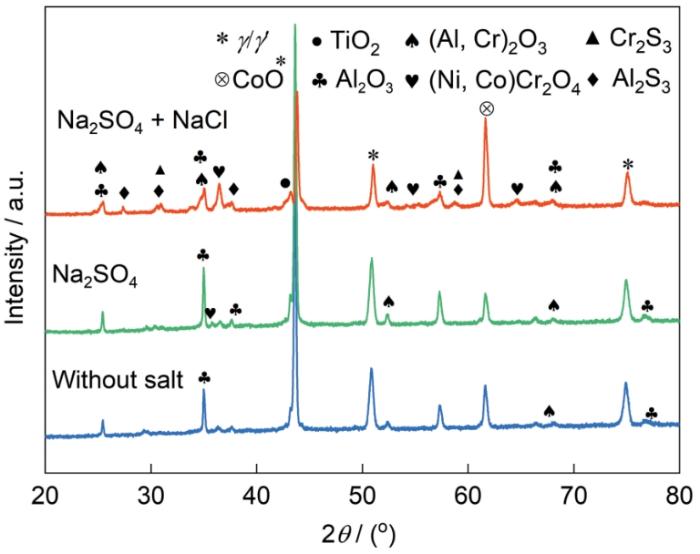
图3
热腐蚀200 h后试样表面的XRD谱
Fig.3
XRD patterns of surfaces of specimens after hot corrosion for 200 h
2.3 截面微观组织
不同盐膜条件下,热腐蚀200 h后试样截面形貌及表面宏观形貌如图4所示。可以看出,试样表面均无明显剥落特征,试样截面由表及里依次分为氧化层(oxide layer)、涂层(coating)、互扩散区(IDZ)和基体(substrate) 4个区域。无盐试样热腐蚀200 h后,其表面形成连续的保护性Al2O3氧化膜,涂层内部未观察到内氧化现象;涂层与基体界面处因Ni、Al、Cr等元素扩散形成了IDZ。纯硫盐试样热腐蚀200 h后,其涂层内部发生严重的内腐蚀,最外侧氧化层相较无盐试样明显增厚且IDZ厚度增加。混合盐膜条件下,试样外氧化层进一步变厚,涂层内腐蚀更加严重,针状腐蚀产物增加,最外氧化层的下方出现腐蚀性孔洞。
图4

图4
不同盐膜条件下热腐蚀200 h后试样截面形貌和表面形貌的SEM像
Fig.4
SEM images of cross-sectional (a-c) and surface (d-f) morphologies of specimens after 200 h hot corrosion under different salt film conditions (IDZ—inter diffusion zone) (a, d) without salt (b, e) Na2SO4 salt film (c, f) Na2SO4 + NaCl salt film
图5

图5
纯硫盐试样横截面形貌的高倍SEM像
Fig.5
High-magnified SEM images of cross-sectional morphologies of specimen under Na2SO4 salt film condition
(a) region I in Fig.4b (b) region II in Fig.4b
表1 图5中各点的EDS结果 (mass fraction / %)
Table 1
| Point | O | Al | Cr | Co | Ni | Ti | N | S | W | Si |
|---|---|---|---|---|---|---|---|---|---|---|
| 1 | 16.29 | 37.58 | 24.27 | - | - | 1.89 | 17.40 | 2.57 | - | - |
| 2 | 2.28 | 50.09 | 11.93 | - | - | - | 32.37 | 3.33 | - | - |
| 3 | - | - | 9.26 | - | 2.49 | 64.28 | 16.25 | – | 3.98 | 3.74 |
混合盐膜条件下,热腐蚀后试样横截面形貌的高倍SEM像如图6所示。如图6a所示,外侧氧化层主要由Al2O3组成;涂层区域已完全被腐蚀,涂层中分布大量热腐蚀后产生的孔洞。在热腐蚀引起的孔洞周围同时存在富S和富Cr的氧化物,表明热腐蚀过程中氯化与硫化反应同时进行。如图6b和表2所示,硫化物与氧化物在涂层与IDZ界面处交错分布,涂层下方析出不规则形状TiN (位置3)和针状TiN (位置5)。如图6c和表2所示,扩散区下方位置7处存在大量S元素,表明S元素可穿过互扩散区并扩散至基体;位置6处存在显著的S、Cr、Ti元素富集现象,基体内部的条状析出物中Ti与S呈现共偏聚趋势,并以TiS的形式向基体扩散。
图6

图6
混合盐试样横截面形貌的高倍SEM像
Fig.6
High-magnified SEM images of cross-sectional morphologies of specimen under Na2SO4 + NaCl salt film condition
(a) region I in Fig.4c (b) region II in Fig.4c (c) region III in Fig.4c
表2 图6中各点的EDS结果 (mass fraction / %)
Table 2
| Point | O | Al | Cr | Co | Ti | N | S | Ta | Ni |
|---|---|---|---|---|---|---|---|---|---|
| 1 | 23.76 | - | 5.76 | - | 19.39 | - | - | 51.09 | - |
| 2 | 26.27 | 28.35 | 27.29 | - | - | - | 18.39 | - | - |
| 3 | - | - | 4.77 | - | 72.72 | 19.02 | 3.49 | - | - |
| 4 | - | - | 20.09 | - | 43.01 | 20.96 | 12.69 | 3.25 | - |
| 5 | - | 0.68 | 6.71 | 0.47 | 62.25 | 23.27 | - | - | 6.62 |
| 6 | - | - | 41.95 | - | 19.89 | 11.41 | 26.75 | - | - |
| 7 | - | - | - | - | 68.18 | - | 22.66 | 9.16 | - |
图7

图7
热腐蚀200 h后纯硫盐和混合盐试样截面的EDS线扫描结果
Fig.7
EDS line scanning results of cross-section of specimens after 200 h hot corrosion under different salt film conditions (Insets are cross-sectional BSE images)
(a) Na2SO4 salt film (b) Na2SO4 + NaCl salt film
3 分析与讨论
3.1 热腐蚀增重机制
上述结果表明,在950 ℃热盐腐蚀条件下,盐膜挥发引起的质量变化导致简单的失重测量方法无法准确反映高温合金涂层的腐蚀程度,其校准后的实际腐蚀特征本质上为增重。高温合金涂层增重特性与氧化产物的形成、附着和挥发性产物的竞争有关[26]:(1) 腐蚀盐对氧化膜的溶解作用导致金属析出物逸出和少许氧化膜剥离,进而引起试样质量损失;(2) 氧化、硫化和氮化反应导致试样质量增加。在热腐蚀初期,涂层表面混合熔盐的附着和无连续性氧化物的形成导致试样发生明显增重。随着热暴露时间的增加,热盐溶解氧化膜并侵入涂层,涂层不断经历着氧化物形成、溶解和再生成的循环过程,外部腐蚀元素通过表面氧化层中的微裂纹快速扩散至涂层,导致涂层发生严重的内部腐蚀。图5和6组织形貌分析表明,热腐蚀产物能够附着在NiCoCrAlY涂层表面,未观察到明显的氧化物剥落现象,合金质量整体上呈现增加趋势。结合图2a的动力学曲线可知,该腐蚀增重过程主要受元素扩散机制控制。
图8
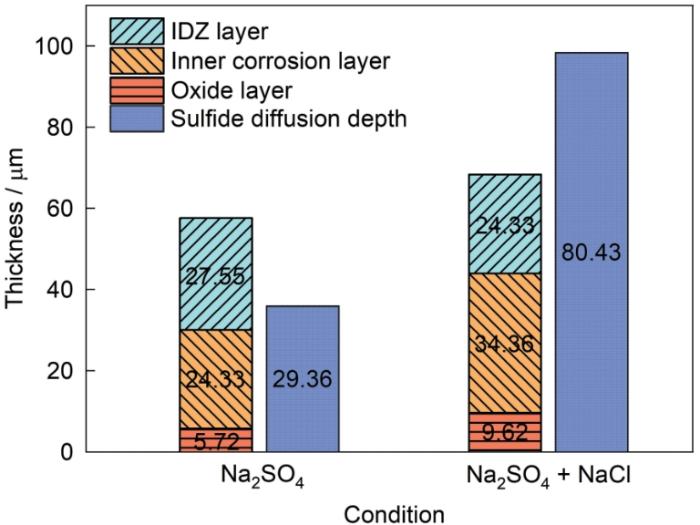
图8
各腐蚀层厚度和硫化物扩散深度统计
Fig.8
Statistics of corrosion layer thicknesses and sulfide diffusion depth
3.2 涂层在950 ℃热腐蚀环境中的劣化机理
图9
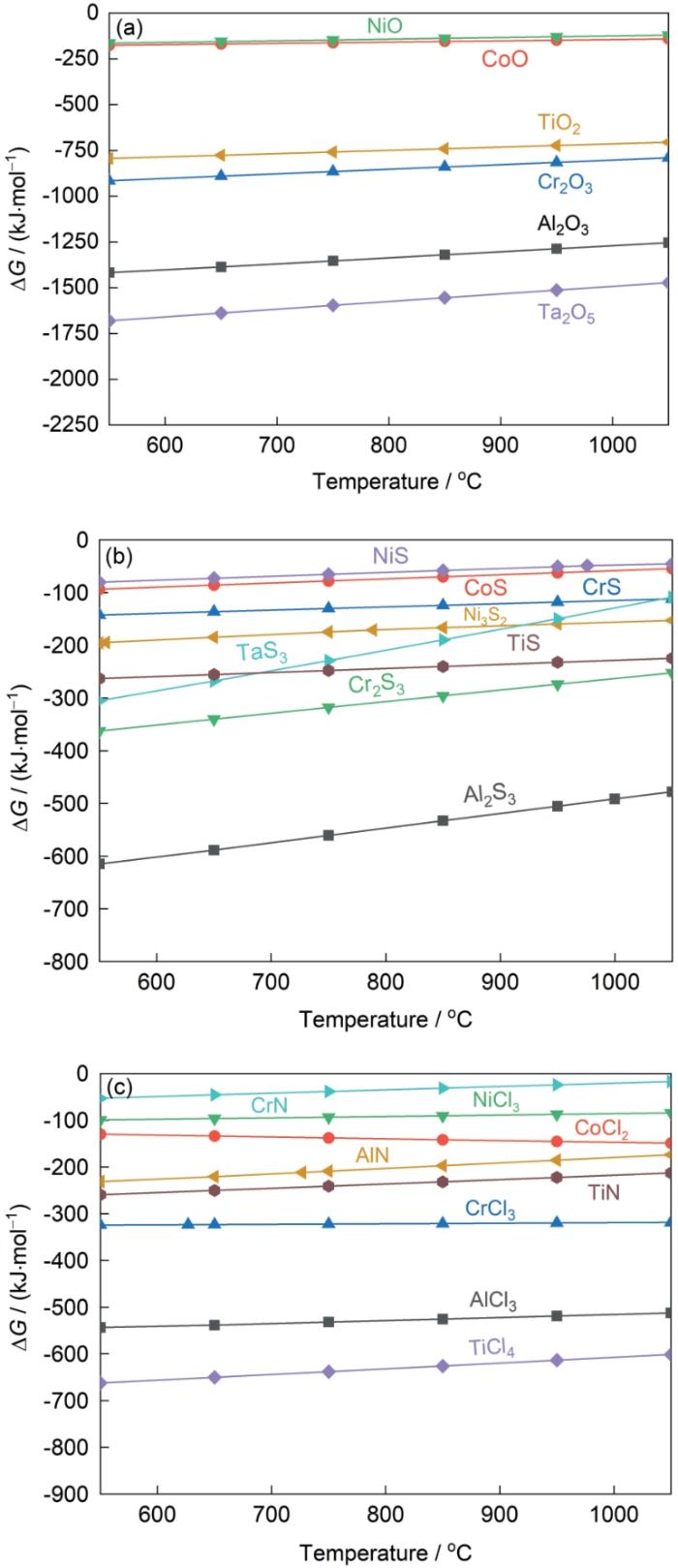
图9
DZ411合金NiCoCrAlY涂层中可能形成腐蚀产物的Gibbs自由能
Fig.9
Gibbs free energies (ΔG) of possible corrosion products forming in DZ411 alloy and NiCoCrAlY coating
(a) oxides (b) sulfides (c) chlorides/nitrides
图10
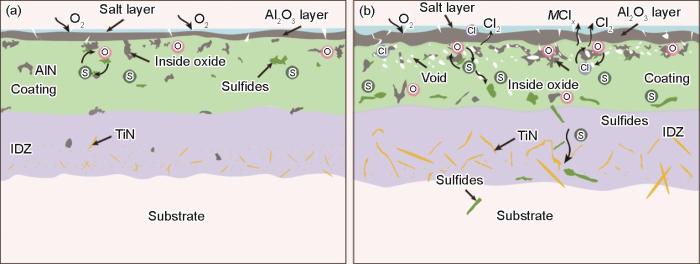
图10
DZ411合金在950 ℃下的熔盐腐蚀机理图
Fig.10
Schematics of molten salt corrosion mechanism of DZ411 alloy at 950 °C under different salt film conditions
(a) Na2SO4 salt film (b) Na2SO4 + NaCl salt film
另一部分Na2SO4会分解为碱性Na2O和酸性SO3,高温下SO3进一步分解为S2和O,导致熔盐体系中O2-活度增加,熔盐碱度增强,当熔盐的碱度增加到临界值时,氧化膜可发生碱性溶解[29],反应式如下:
Al2O3和Cr2O3发生碱性溶解后产生的
氯化物被氧化后生成的Cl2通过疏松氧化膜向内扩散,不断进行氯化/氧化循环过程,含氯盐的热腐蚀机理如图10b所示。随着涂层腐蚀产物层厚度不断增加,氧分压逐渐降低,S元素具有更快的扩散速率[33],在互扩散区形成Cr2S3和TiS的硫化物。同时大气中的N2逐渐透过氧化膜在界面处偏析,由图9b和c可知,TiN的Gibbs自由能与TiS相近,随着O2的耗尽,TiN在涂层与基体界面处形成。结合前文EDS分析结果(图7)可知,在混合盐试样中S元素可穿过互扩散区扩散至基体,而纯硫盐试样中S元素未扩散至互扩散区。因此,由NaCl参与的热腐蚀过程中存在氯化-氧化和硫化-氧化之间的协同作用,NaCl的存在导致形成疏松多孔的腐蚀层,该腐蚀层作为O和S元素内扩散的通道,为涂层的内氧化和内硫化反应提供必要条件。
4 结论
(1) DZ411高温合金NiCoCrAlY涂层的950 ℃热腐蚀动力学曲线表明,经热盐挥发校准后,常规腐蚀失重特征转变为腐蚀增重现象,其腐蚀增重速率常数从纯硫盐膜条件下的0.5583 × 10⁻⁵ mg2/(cm4·s)增加至混合盐膜条件下的0.7416 × 10-5 mg2/(cm4·s)。
(2) 在纯硫和混合盐膜条件下热腐蚀后,试样腐蚀产物的组成类似,外层腐蚀产物主要为Al2O3,内腐蚀区为富Al和Cr的氧化物及富Cr硫化物,涂层/基体界面处由于Al、Cr、Ti和N等元素扩散形成了互扩散区。与纯硫盐相比,混合盐膜条件下试样腐蚀区存在孔洞,硫化物以TiS和Cr2S3形式扩散至基体;两种条件下腐蚀产物均未发生显著剥落。
(3) 热腐蚀环境中涂层的腐蚀增重与氧化-硫化循环反应有关,NaCl参与的氯化-氧化过程有助于S、O元素的扩散,加速涂层内氧化和内硫化反应。
参考文献
Research status of environmental spectrum acceleration techniques for typical life sensitive parts in engines
[J].
发动机典型寿命敏感件环境谱加速技术研究现状
[J].
Corrosion failures in gas turbine hot components
[J].
Hot corrosion of shipboard gas turbine blades
[J].
Turbine blades removed from the first stage of a shipboard gas turbine engine for excessive degradation were characterized. Scanning electron microscopy coupled with energy-dispersive spectroscopy, X-ray diffraction, and inductively coupled optical emission spectroscopy was used to characterize corrosion deposits and features of field hardware that are not typically obtained in controlled laboratory settings. Corrosion was associated with deposits of varying compositions on the airfoil, beneath the platform, and within cooling passages. Deposits on the airfoil were primarily sodium sulfate presumably derived from seawater. Deposits below the platform and within cooling channels were crystalline aggregates of Ca, Mg, Al, and Si compounds presumably derived from dust and sand. FactSage thermochemical calculations were performed for gas turbine environments, and results are used to explain variations in deposit chemistry. The results show that solid sodium sulfate may not be retained in some gas turbine conditions, leaving the deposits rich in Ca and Mg compounds.
High temperature oxidation and corrosion property test of NiCoCrAlYTa coating on turbine blade
[J].
涡轮叶片NiCoCrAlYTa涂层抗高温氧化和腐蚀性能测试研究
[J].
Study advances of high temperature coating for aeroengine to resist marine atmospheric corrosion
[J].
航空发动机高温涂层耐海洋大气腐蚀研究进展
[J].
Advances in the regulation and interfacial behavior of coatings/superalloys
[J].With the continuous increase of turbine inlet temperature of advanced aero-engine, the protective coating technology plays a vital role in improving the oxidation and corrosion resistance of turbine blade materials to ensure the safe performance of turbine blades. However, an intrinsic physical and chemical property mismatch exists between protective coating and superalloy. Interfacial reaction leads to the degradation of interfacial microstructure and mechanical properties. It is the key factor to restrict the application of coating. In this paper, the evolution and diffusion behavior of typical coating/superalloy interface microstructure and its influencing factors are summarized. The influence of interfacial behavior on microstructural stability and mechanical properties of superalloys with coatings is also discussed. The control methods of coating/alloy interface are introduced from three aspects, including the optimization of microstructure composition, design of interfacial diffusion-resistant layer, and development of a new type of interfacial stabilizing coating. Furthermore, the key characteristics of the compatibility of the coating/superalloy interface are summarized, which will promote systematic studies on the effect of the interface on the coating/alloy properties, the combination of multiple methods to control the interface, and the computer-aided coating design.
涂层/高温合金界面行为及调控研究进展
[J].防护涂层技术对于提高涡轮叶片材料抗氧化腐蚀性能、保证涡轮叶片安全服役具有至关重要的作用,然而,防护涂层与高温合金间有本征的物理、化学性能不匹配性,其界面反应会导致界面组织退化,合金与涂层性能下降,成为制约涂层应用的关键因素。本文概述了典型涂层/高温合金界面组织演变与扩散行为及其影响因素,讨论了界面行为对含涂层高温合金组织稳定性和力学性能的影响,从涂层组织成分优化、界面阻扩散层设计和新型界面稳定涂层研发3个方面介绍了涂层/合金界面的调控方法。总结了涂层/高温合金界面相容性的关键特征,并提出未来应在界面对涂层/合金性能的影响规律与机制、调控界面的多手段联用、计算辅助涂层设计等方面开展系统性研究。
Hot corrosion behavior of a (NiCoCrAlYSiB + AlSiY) composite coating
[J].
(NiCoCrAlYSiB + AlSiY)复合涂层热腐蚀行为的研究
[J].采用电弧离子镀(AIP)技术在镍基单晶高温合金基体上制备了NiCoCrAlYSiB涂层 (普通涂层)和(Ni- CoCrAlYSiB+AlSiY)复合涂层, 研究了高温合金基体与2种涂层分别在900和700 ℃下的涂盐(Na2SO4+K2SO4和Na2SO4+NaCl)热腐蚀行为. 结果表明: 高温(900 ℃)热腐蚀条件下, 基体合金表面主要生成NiO; 普通涂层表面主要生成Cr2O3, 而且涂层内部出现内氧化和内硫化现象; 复合涂层表面主要生成Al2O3, 外层出现程度较轻的内氧化, 涂层表层Al含量仍然较高, 维持表面Al2O3膜的形成和修复. 低温(700 ℃)热腐蚀条件下, 基体合金表面主要生成NiO; 普通涂层表面主要生成Cr2O3, 涂层内部出现严重的内氧化; 复合涂层表面也出现了内氧化, 高Cr的内层未受腐蚀, 有助于提高涂层的抗腐蚀性能.
Researches on hot corrosion resistance of thermal barrier coating for turbine blade
[J].
涡轮叶片热障涂层热腐蚀性能研究
[J].
Hot corrosion behaviour of mullite thermal barrier coatings for marine diesel engines
[J].
Microstructure and hot corrosion performance of laser cladding NiCoCrAlYSi coating modified via high current pulsed electron beam
[D].
强流脉冲电子束作用下激光熔覆NiCoCrAlYSi涂层微观结构及热腐蚀性能研究
[D].
Fatigue behavior of uncoated and MCrAlY-coated DS nickel-based superalloys pre-exposed in hot corrosion condition
[J].The effects of a MCrAlY coating on low‐cycle fatigue (LCF) behavior of directionally solidified (DS) nickle‐based superalloy DZ125 were investigated. Before the fatigue testings, the specimens were pre‐exposed in high‐temperature hot corrosion (HTHC) environment generating by a burner rig at 850 °C. The results show that the coating in hot corrosion condition has beneficial effects on the fatigue resistance of superalloy. Under corrosion condition, the MCrAlY‐coated specimens tested have higher fatigue lives than the uncoated specimens at the same stress level. The coating failure results from fatigue process and numerous fatigue cracks were nucleated at the specimen surface, only one main crack propagates inward and the secondary cracks away from the fracture surface are perpendicular to the loading orientation.
High-temperature corrosion and protection of thermal barrier coatings for aeroengines and gas turbines
[J].
航空发动机及燃气轮机热障涂层高温腐蚀与防护
[J].
Hot corrosion behavior of Ni based inconel 617 and inconel 738 superalloys
[J].
Type-I hot corrosion of Ni-base superalloy CM247LC in presence of molten Na2SO4 film
[J].
Influence of temperature on hot corrosion behavior of GH4169 superalloy subjected to Na2SO4-NaCl salts attack
[J].
Hot-corrosion behavior associated with the evolution of corrosion scales of a Ni-based superalloy in molten salts
[J].
Hot corrosion behaviors test of DSM11 Ni-base superalloy under different temperature
[J].
不同温度下DSM11镍基高温合金热腐蚀试验
[J].
Research progress on corrosion failure of high-temperature coatings in aero-engines
[J].
航空发动机高温涂层腐蚀失效研究进展
[J].
Effect of pre-oxidation and sea salt on the hot corrosion behavior of MCrAlY coatings and Al-Si coatings
[J].
Hot corrosion resistance of Al2O3 nanoparticles reinforced CoNiCrAlY coatings deposited by LPPS and HVOF processes in molten Na2SO4-V2O5 at 850 oC
[J].
Effect of coating degradation on the hot corrosion behaviour of directionally solidified superalloy
[J].
Hot corrosion resistance of gas turbine materials in combusted syngas environments
[J].
Effect of hot corrosion on cycle deformation and fracture behavior of Ti-6Al-4V alloy under salt coating
[J].
High temperature hot corrosion of single crystal superalloy DD6 subject to varying amounts of sodium salt deposited
[J].
钠盐量影响下DD6单晶高温合金的高温热腐蚀规律研究
[J].
Hot corrosion behavior of Inconel 718 without and with aluminide coating in air beneath a thin film of salt mixture of Na2SO4 + 5%NaCl
[J].
Inconel 718及其渗铝涂层在Na2SO4 + 5%NaCl混合盐膜下的热腐蚀行为
[J].
Hot corrosion behavior and near-surface microstructure of a “low-temperature high-activity Cr-aluminide” coating on inconel 738LC exposed to Na2SO4, Na2SO4 + V2O5 and Na2SO4 + V2O5 + NaCl at 900 oC
[J].
Effect of Co on oxidation and hot corrosion behavior of two nickel-based superalloys under Na2SO4-NaCl at 900 oC
[J].
Corrosion study of HK-40m alloy exposed to molten sulfate/vanadate mixtures using the electrochemical noise technique
[J].
Influence of alloying elements on hot corrosion resistance of nickel-based single crystal superalloys coated with Na2SO4 salt at 900 oC
[J].
Effect of V2O5 on the hot corrosion resistance of β-(Ni, Pt)Al coating
[J].
V2O5对β-(Ni, Pt)Al涂层热腐蚀抗性的影响
[J].
Effect of element S on interfacial stability of matrix and thermal barrier coating in nickle-based superalloys
[J].The existence of elemental S in nickle-based superalloys negatively impacts their performance. The oxide film at the interface of the nickle-based superalloy peels off during the service process, leading to the failure of the alloy. However, the influence mechanism of the elemental S on the interface of the matrix and the coating layer is yet to be studied. Herein, the influence mechanism of the elemental S on the nickle-based superalloy and NiAl coating was studied using the first-principle calculation, especially focusing on the S segregation phenomenon. The interface adhesion work, segregation energy, and interface charge of the pure and S-doped interfaces of Ni3Al/NiAl and NiAl/Al2O3 were analyzed. The calculated results show that the interfacial adhesion work of the system decreases when the elemental S is present, resulting in reduced interface stability; in these systems, the elemental S tends to segregate toward the interface. By analyzing various aspects of the interface electronic structures (such as differential charge density, Bader charge, electron localization function, and densities of states), it was found that the bonding near the interface was weakened in the system with the elemental S, thereby reducing the tightness of the local connection. The influence mechanism of the elemental S on the interfacial stability of the system was finally revealed.
镍基高温合金中S元素对基体与热障涂层界面稳定性的影响
[J].镍基高温合金中的S元素会对合金性能产生负面影响,在服役过程中含S体系的界面处会发生氧化膜剥落等现象,进而导致合金发生失效。本工作利用第一性原理计算,围绕S元素在镍基高温合金及其涂层的偏聚现象,研究了S元素对合金及NiAl涂层的影响机制。分析了Ni3Al/NiAl、NiAl/Al2O3的纯净界面和含S元素界面2种模型的界面黏附功、偏聚能及界面电荷情况。结果表明,合金中含S元素的体系界面黏附功变小,进而降低了界面稳定性;S元素在各自的体系内均有向界面偏聚的倾向。通过分析其界面电子结构(如二次差分电荷密度、Bader电荷、局域电子密度、态密度等)的演变,发现S元素的存在会减弱界面附近的键合,进而降低局部连接的紧密性。最后揭示了S元素对体系界面稳定性的影响机制。
Synergistic effect of multiple molten salts on hot corrosion behaviour of Ni-based single crystal superalloy
[J].


