



为了应对日益增长的汽车节能需求,以铁素体基体中弥散分布大量纳米级碳化物为特征的新一代高强度汽车用钢得到广泛应用[1]。该铁素体高强钢强度高、拉伸凸缘性和焊接性优异[2~4],受到研究人员广泛关注。近年来,为进一步提高析出强化效果并降低生产成本,在铁素体基体中引入Cr元素的策略逐渐引起关注[4~10]。研究重点聚焦于含Cr复合碳化物成分体系,如Ti-Cr[7]、V-Nb-Cr和V-Mo-Nb-Cr[4,8]、V-Mo-Cr[9,10],证实了添加Cr有利于形成复合析出相、细化析出相尺寸和提高数密度,从而提高铁素体强度。然而,关于Cr对铁素体相变动力学影响的研究相对较少,且存在一些争议。Tsai等[7]认为,相比于Al元素,Cr元素延迟了铁素体的相变动力学过程,这与其他关于多相钢和贝氏体钢报道[11,12]的结论类似。Rodriguez-Galeano等[10]研究表明,Cr能够促进奥氏体向铁素体转变。Xu等[9]研究表明,Cr元素增加了奥氏体向铁素体转变的驱动力。此外,在高Cr含量不锈钢中,Cr促进了δ-铁素体的形成[13,14]。热力学相图分析表明,Cr是铁素体形成元素。因此,仍需要进一步探究Cr元素对铁素体相变动力学和相变驱动力的影响。
奥氏体(γ)向铁素体(α)相变是动态过程,其相变动力主要来自体相扩散场之间的相互作用以及C和合金元素在γ/α界面的扩散行为[15,16],铁素体生长涉及γ/α界面迁移和元素配分。在过去数十年间,低合金钢中铁素体生长的相关理论和模型已得到广泛研究[15,17~21]。对于扩散控制长大模型,在Fe-C合金中,铁素体生长受到C元素扩散控制[22,23]。添加合金元素后,由于同时存在C与合金元素,且二者扩散系数差异较大,在过冷度不太低的情况下铁素体生长分为两个阶段[24]:第一阶段由C扩散控制,合金元素在铁素体与奥氏体之间不发生配分,相变速率较快;随着相变进行,C在奥氏体中富集达到一定程度后,合金元素必须发生配分才能维持相变继续进行,于是相变进入由合金元素扩散控制的慢速阶段。针对这种铁素体生长过程,Hillert[25]、Coates[26,27]和Enomoto等[28]通过分析实验结果,构建了两种主要的理论模型,即准平衡(para-equilibrium,PE)和局域平衡(local equilibrium,LE)模型。众多学者从多个方面对铁素体相变行为展开研究,包括铁素体准稳态体积分数[29]、未转变奥氏体中C含量[29,30]和相变动力学发生转变时的临界温度[31,32]等。结果表明,大多数情况下,LE模型的预测结果优于PE模型,能够定性地描述Fe-C-Mn、Fe-C-Ni、Fe-C-Mn-Si等合金体系的奥氏体-铁素体相变动力学行为。相比于其他合金元素,目前关于Cr对铁素体生长和界面迁移的相关研究较少。在Fe-C-Cr三元合金体系,Van Landeghem等[33]使用三维原子探针研究了碳钢中的元素分布,发现界面处存在明显的Cr元素富集。Béché等[34]发现,Cr会阻碍铁素体生长,其延缓作用随着温度降低而增强。在实际生产中,低碳微合金钢的合金元素种类往往很多,因此在多元Fe-C-Mn-Si体系下,讨论Cr元素对铁素体生长动力学及界面迁移和元素配分行为的影响具有现实意义。
与Mo、Nb、V元素相比,Ti元素形成的碳化物的体积分数高[37],且Ti与Cr结合在成本上具有显著优势。因此,本工作以低碳含Ti微合金钢为基础,利用微观组织表征和Thermo-Calc软件模拟,从相变驱动力、元素扩散、γ/α界面迁移等角度系统研究了等温条件下奥氏体的分解行为,Cr对铁素体相变热力学和动力学行为的影响,以及其促进珠光体形成的机理。此外,借助第一性原理计算解释了Cr对渗碳体形成的影响机理。
1 实验方法
1.1 材料和工艺路线设计
图1
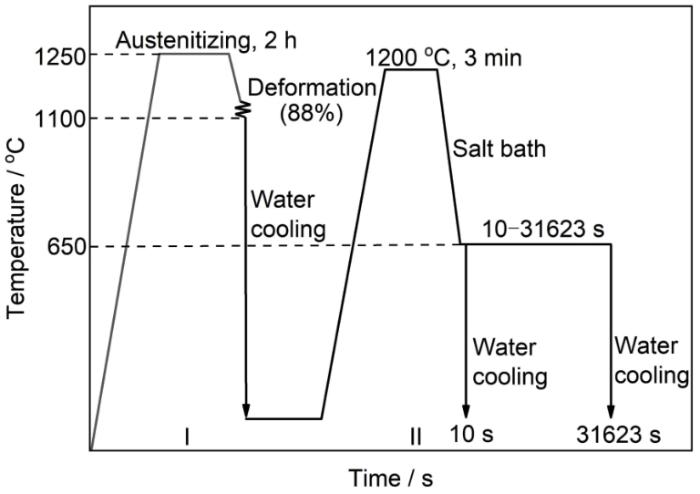
图1
实验用钢的热处理工艺示意图
Fig.1
Schematic of heat treatment process of experimental steel
表1 实验用钢的化学成分及奥氏体转变结束温度(Ae1)和开始温度(Ae3)
Table 1
| Steel | Mass fraction / % | Ae1 oC | Ae3 oC | |||||||
|---|---|---|---|---|---|---|---|---|---|---|
| C | Mn | Si | Ti | Cr | N | O | Fe | |||
| 0Cr | 0.093 | 1.71 | 0.107 | 0.072 | – | 0.0046 | 0.0013 | Bal. | 668 | 822 |
| 1Cr | 0.112 | 1.75 | 0.085 | 0.071 | 0.98 | 0.0038 | 0.0012 | Bal. | 684 | 805 |
在热轧板上切取尺寸为6 mm × 8 mm × 4.5 mm的矩形试样。如图1中阶段II所示,进行奥氏体等温分解实验,为避免试样加热产生的温度差异,将试样在箱式电阻炉中固定位置加热。具体实验步骤如下:首先,将试样加热至1200 ℃保温3 min,使其奥氏体化;随后,立即将试样在650 ℃盐浴炉中进行不同时间的等温处理(10、32、100、316、1000、3162、10000、31623 s);最后,将试样水冷至室温。依据SM EN ISO 643—2016标准,测得1Cr和0Cr钢的平均γ晶粒尺寸分别为(149.8 ± 54.8)和(150.3 ± 65.4) μm。统计结果表明,两种实验用钢的平均γ晶粒尺寸无显著差异,因此可以忽略γ晶粒尺寸对后续奥氏体等温分解的影响。
1.2 显微组织分析和表征
对热处理后的试样沿厚度方向截面进行机械研磨和抛光,然后用4% (体积分数)的硝酸酒精溶液蚀刻10~20 s。分别利用BX53M型号光学显微镜(OM)和JXA-8530F场发射电子探针显微分析仪(EPMA)观察样品显微组织和界面元素分布。利用Image J软件定量统计铁素体相分数。
1.3 热动力学计算
利用Thermo-Calc软件计算γ/α平衡转变温度和基体相的Gibbs自由能。为了降低平衡相转变(模拟计算)与非平衡相转变(实际制备过程)之间的误差,单独讨论Cr元素的影响,模拟计算过程中采用实验用钢的设计成分作为奥氏体和铁素体中的元素含量[38]。计算不同元素在奥氏体和铁素体中的示踪扩散系数,绘制Cr含量为0和1%时的Fe-C相图,得到平衡条件下的共析点温度和C含量。采用DICTRA模块模拟铁素体生长动力学以及相界面迁移和元素扩散行为,设置两相初始成分相同[38,39]。实验用钢在相变过程中可能会析出碳化物,但其对γ/α界面钉扎力很小,可以忽略[40,41]。因此,为简化模型,在Fe-C-Mn-Si体系下研究Cr对铁素体生长行为的影响,模型初始条件如图2所示。假设新相生长形貌为平面,每个相单元分为100个网格,网格间距按几何级数变化,比率分别为1.05和0.95。母相奥氏体尺寸为实际测量值的一半[42],即奥氏体侧的初始宽度设为75 µm,新相铁素体的初始宽度设为1 nm。热力学和动力学数据库版本分别为TCFE9.3和MOBFE4.0。
图2
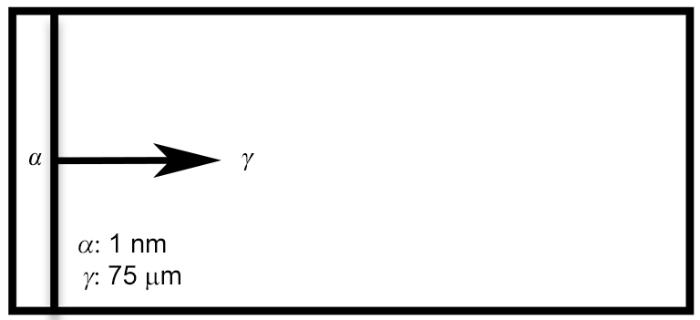
图2
DICTRA模块模拟铁素体生长过程的初始条件设置
Fig.2
Initial condition settings for simulation of ferrite growth using the DICTRA module (α—ferrite, γ—austenite)
1.4 第一性原理计算模拟
为了研究Cr掺杂对渗碳体形成的影响,利用VASP软件包[43]和投影缀加平面波(projector augmented wave,PAW)方法[44]进行第一性原理计算。交换关联泛函则通过广义梯度近似(generalized gradient approximation,GGA)[45]的Perdew-Burke-Ernzerhof (PBE)方法[46]进行描述。Fe、Mn、Cr和C的价电子分别为3d74s1、3p63d54s2、3p63d54s1和2s22p2。采用的晶胞模型为正交晶系的Fe3C (空间群为Pnma),晶胞包含12个Fe原子、4个C原子,模型的晶胞尺寸和原子位置都被允许弛豫,直到每个原子上的力小于0.3 eV/nm,晶胞总能量收敛精度设定为10-5 eV/cell。经测试,计算中使用的平面波截断能为400 eV,模型中应用基于Monkhorst-Pack方法[47]的7 × 7 × 5 k点网格。计算优化后,Fe3C的晶格常数为a = 0.447 nm、b = 0.502 nm、c = 0.671 nm,这与文献[48]的实验结果和文献[49]的第一性原理计算结果一致。
掺杂后渗碳体M3C的形成能(Ef)被定义为:
式中,
2 实验结果
2.1 光学显微组织
图3为650 ℃等温处理不同时间后0Cr和1Cr钢的OM像。可以看出,0Cr钢的显微组织均由铁素体和马氏体(M(γ))组成,等温过程中仅发生γ→α转变,马氏体由未转变奥氏体淬火后得到。如图3h所示,1Cr钢中奥氏体除了发生γ→α转变外,在相变后期还发生共析转变,生成了珠光体(P),表明Cr促进奥氏体分解为珠光体。在相变初期,铁素体在原奥氏体晶界处形核并生长,形成晶界铁素体(GBF),如图3a和f所示。随着等温时间的延长,由于奥氏体晶界位置逐渐被占据,新铁素体开始在原奥氏体晶粒内夹杂物上形核并长大,如图3c和g所示。这是因为铁素体在晶内夹杂物上形核所需的过冷度高于在晶界形核所需的过冷度[50]。
图3

图3
650 ℃等温处理不同时间后实验用钢的OM像
Fig.3
OM images of 0Cr (a-d) and 1Cr (e-h) steels after isothermal treatment at 650 oC for 10 s (a, e), 100 s (b, f), 1000 s (c, g), and 10000 s (d, h) (GBF—grain boundary ferrite, P—pearlite, M(γ)—martensite. Arrows in Figs.3c and g represent newly-formed ferrite)
2.2 γ/α 界面元素分布表征
图4
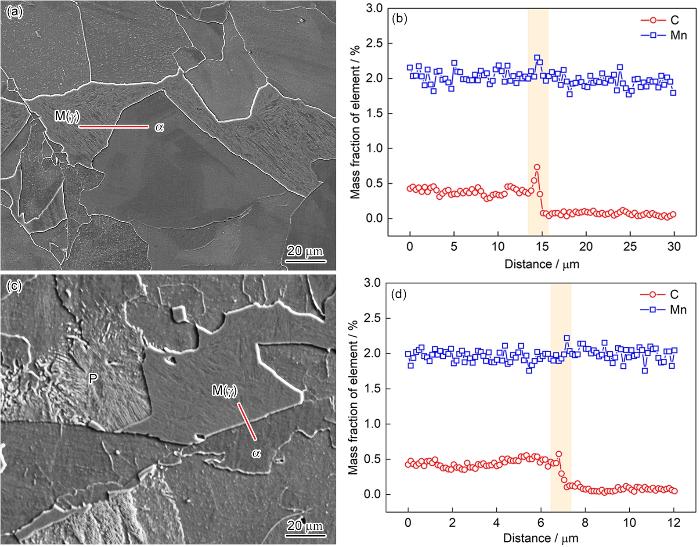
图4
650 ℃等温处理10000 s后实验用钢显微组织的SEM像及M(γ)/α界面附近C和Mn元素的EPMA线扫描结果(M(γ)表示马氏体)
Fig.4
SEM images of experimental steels after isothermal treatment at 650 oC for 10000 s (a, c) and EPMA line scanning results of C and Mn elements along the lines in Figs.4b and d (b, d) (a, b) 0Cr steel (c, d) 1Cr steel
2.3 铁素体和奥氏体的Gibbs自由能及元素扩散系数
图5a为不同温度和Cr含量下实验用钢的Gibbs自由能和两相Gibbs自由能差。可以看出,不同温度下铁素体的Gibbs自由能低于奥氏体,添加Cr元素后,奥氏体和铁素体的Gibbs自由能均轻微降低。如图5b所示,不同温度下,1Cr钢中两相的Gibbs自由能差(ΔG)高于0Cr钢,表明添加Cr降低了γ→α相变驱动力。当温度为650 ℃时(图5c),0Cr钢和1Cr钢的ΔG分别为-371.4和-331.1 J/mol;添加Cr元素后,1Cr钢的|ΔG|减小了40.3 J/mol,γ→α相变驱动力降低约11%。图5d为不同温度下Cr含量对ΔG影响的对比。可见,当温度相同时,随着Cr含量增加,|ΔG|缓慢降低;而当Cr含量相同时,随着温度降低,|ΔG|显著增加。这表明,Cr含量增加使得γ→α相变驱动力缓慢降低;而降低温度,则使γ→α相变驱动力显著增加。
图5
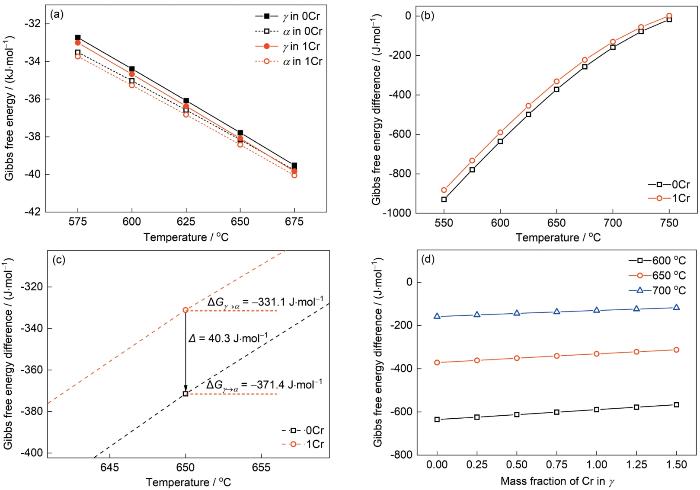
图5
不同温度和Cr含量下实验用钢的Gibbs自由能(G)和两相Gibbs自由能差(ΔGγ→α)
Fig.5
Gibbs free energy (G) (a) and Gibbs free energy difference (ΔG) of γ→α transformation (ΔGγ→α ) (b) of experimental steel under different temperatures, partially enlarged view of Fig.5b (c), and ΔG (d) of experimental steel under different Cr contents (ΔGγ→α = Gα - Gγ, Gα, Gγ —G of α and γ phase, respectively; Δ—difference in ΔG between 0Cr and 1Cr steels at 650 oC)
图6为不同温度下C和Mn元素在奥氏体和铁素体中示踪扩散系数的变化曲线。可以看出,C和Mn元素在铁素体和奥氏体中的扩散系数均随着温度降低而降低。如图6a和c所示,与0Cr钢相比,1Cr钢中C元素的扩散系数显著降低,尤其是在奥氏体中。表2为650 ℃时不同元素在奥氏体和铁素体中的示踪扩散系数。可以看出,C元素在奥氏体和铁素体中的扩散系数比其他元素高6~8个数量级。与0Cr钢相比,1Cr钢奥氏体中C元素扩散系数降低了12.1%,铁素体中C元素扩散系数降低了3.6%,而Mn、Si、Ti元素在奥氏体和铁素体中的扩散系数变化较小。由于γ→α相变是扩散型相变,添加Cr导致C元素在奥氏体中的扩散系数显著降低,因此对相变可能产生显著的影响。
图6
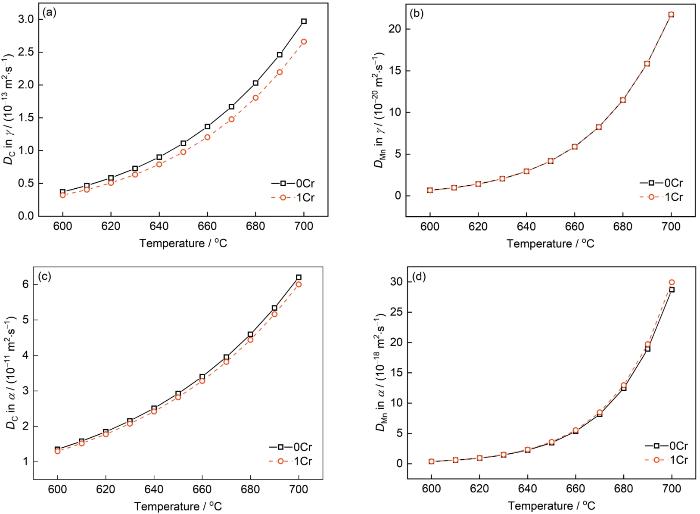
图6
不同温度下C和Mn元素在奥氏体和铁素体中的示踪扩散系数的变化曲线
Fig.6
Variation curves of tracer diffusion coefficients (Di ) of elements i in austenite (a, b) and ferrite (c, d) under different temperatures
(a, c) DC (b, d) DMn
表2 650 ℃下各元素在奥氏体和铁素体中的示踪扩散系数 (m2·s-1)
Table 2
| Steel | Phase | DC | DMn | DSi | DTi | DCr |
|---|---|---|---|---|---|---|
| 0Cr | γ | 1.1117 × 10⁻¹³ | 4.1738 × 10⁻²⁰ | 1.2467 × 10⁻¹⁹ | 9.4212 × 10⁻²⁰ | – |
| α | 2.9234 × 10⁻¹¹ | 3.4681 × 10⁻¹⁸ | 1.9886 × 10⁻¹⁸ | 1.1891 × 10⁻¹⁸ | – | |
| 1Cr | γ | 0.9776 × 10⁻¹³ | 4.1793 × 10⁻²⁰ | 1.2467 × 10⁻¹⁹ | 9.4212 × 10⁻²⁰ | 1.0616 × 10⁻²⁰ |
| α | 2.8178 × 10⁻¹¹ | 3.5914 × 10⁻¹⁸ | 2.0735 × 10⁻¹⁸ | 1.2390 × 10⁻¹⁸ | 7.0803 × 10⁻¹⁹ |
2.4 铁素体相变与元素扩散
2.4.1 铁素体相变动力学
基于实验用钢的实测化学成分,采用DICTRA模块进行模拟。图7为650 ℃等温过程中实验钢中铁素体相变动力学的计算和实验结果,图中点数据为铁素体体积分数的OM组织统计结果,曲线数据为模拟结果。可以看出,铁素体相变动力学分为两个阶段:快速增长阶段和慢速增长阶段。与0Cr钢相比,1Cr钢的铁素体相变动力学曲线右移,其慢速增长阶段的铁素体体积分数更低。0Cr钢慢速阶段开始时间约为6.4 × 10³ s,1Cr钢推迟至约13.1 × 10³ s,表明Cr元素抑制了铁素体的生长。此外,实验结果与模拟计算结果吻合较好,说明计算参数设置合理。
图7
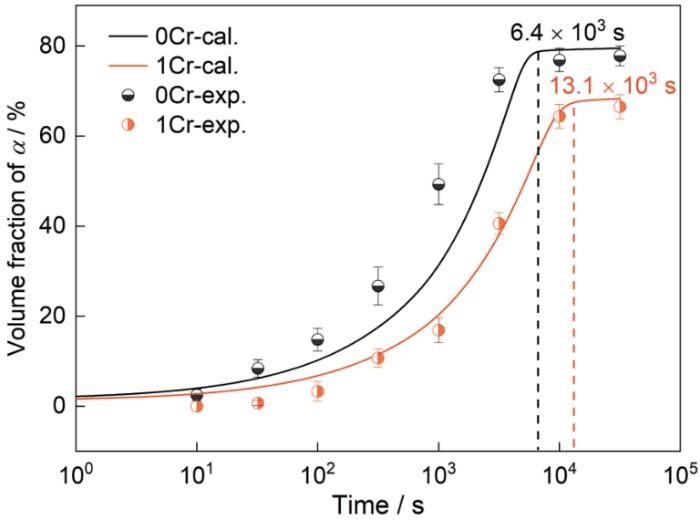
图7
650 ℃等温过程中实验用钢中铁素体相变动力学的计算和实验结果
Fig.7
Calculation and experimental results of phase transformation kinetics of ferrite in experimental steel during isothermal process at 650 oC
2.4.2 铁素体生长过程中相界面迁移和元素扩散行为
化学成分对实验用钢的铁素体相变动力学具有显著影响,为了单独讨论Cr元素的影响,接下来采用设计成分进行DICTRA模拟计算。图8a为铁素体生长过程中γ/α界面移动距离随时间的变化曲线。γ/α界面移动距离可以分为两个阶段:快速移动阶段和慢速移动阶段。在快速移动阶段,与0Cr钢相比,1Cr钢γ/α界面移动速率更慢,且随着时间的延长越来越慢。在慢速移动阶段,0Cr钢和1Cr钢的界面移动基本“停滞”。图8b显示了界面移动速率与铁素体体积分数的变化关系。可以看出,相变初期界面移动速率很大,随着相变的进行,铁素体体积分数增加,界面移动速率逐渐降低,这与图8a中界面移动距离结果一致。此外,在整个铁素体生长过程中,1Cr钢的界面移动速率低于0Cr钢。
图8
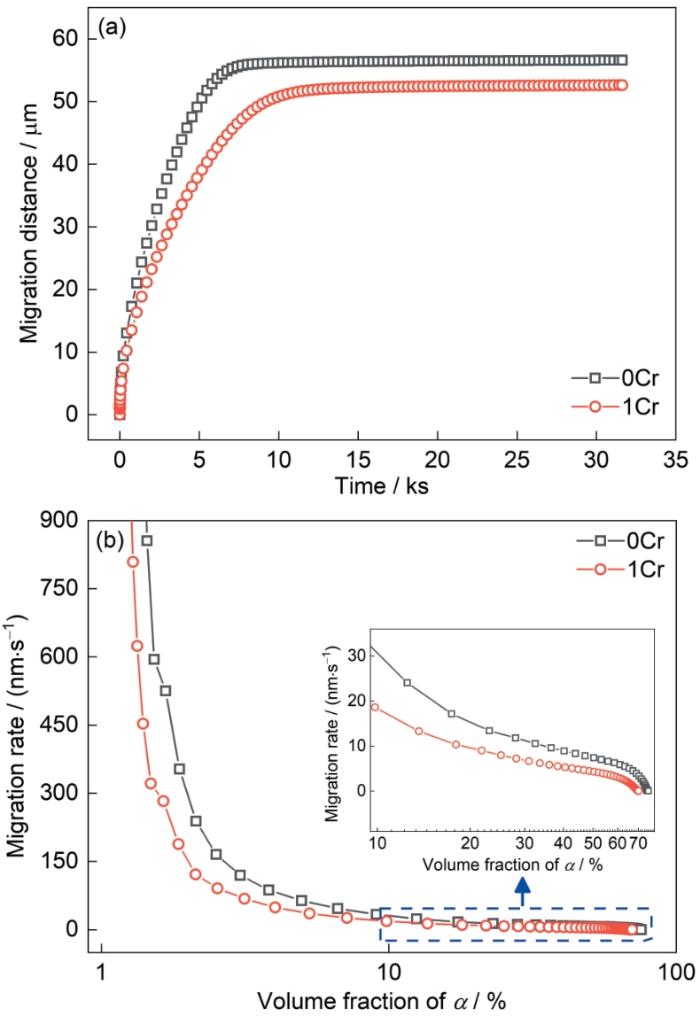
图8
铁素体生长过程中γ/α界面移动距离和移动速率的DICTRA模拟结果
Fig.8
DICTRA simulation results of the migration distance (a) and migration rate (b) of the γ/α interface during the growth process of ferrite (Inset in Fig.8b is the corresponding enlarged view)
图9为不同时间等温处理后实验用钢中γ/α界面元素分布的DICTRA模拟结果。图9a为C元素在γ/α界面处的分布。可以看出,随着等温时间延长,C元素在γ/α界面逐渐富集,并且0Cr钢中γ/α界面处的C浓度峰值始终高于1Cr钢,这与图4中观察到的结果一致。表明添加Cr元素降低了γ/α界面的C浓度峰值,这主要是因为Cr降低了C在奥氏体和铁素体中的扩散系数以及γ/α界面移动速率。Mn、Si、Cr元素在γ/α界面处的分布与C元素存在很大不同,分为两个阶段:第一阶段,Mn、Si、Cr元素在界面处不发生配分,对应图8a中界面快速移动阶段;第二阶段,Mn、Si、Cr元素在界面处发生配分,存在明显浓度尖峰,此时对应图8a中界面缓慢移动阶段。如图9b和c所示,0Cr钢在等温时间为10000和31623 s时,界面处的Mn、Si存在明显的浓度峰值和元素配分,且随着等温时间延长,界面处合金元素浓度峰值增加。与0Cr钢相比,1Cr钢在等温时间为10000 s时,界面处没有合金元素的浓度峰值,直到等温时间为31623 s 时,γ/α界面出现明显的Mn、Si、Cr浓度峰,这是因为等温时间为10000 s时,1Cr钢界面仍处于快速移动阶段。Cr元素导致的界面迁移和元素扩散行为差异的原因将在3.2节进一步讨论。
图9

图9
不同等温时间下0Cr钢和1Cr钢中γ/α界面元素分布的DICTRA模拟结果
Fig.9
DICTRA simulation results of element distribution at the γ/α interface in 0Cr steel (solid line) and 1Cr steel (dotted line) at different isothermal time (Insets in Figs.9b-d are the corresponding enlarged views)
(a) C (b) Mn (c) Si (d) Cr
2.5 Cr对珠光体转变的影响
图10a为0Cr钢和1Cr钢的Fe-C相图。可以看出,随着温度降低,实验用钢依次通过4个相区,①~④分别代表奥氏体单相区,奥氏体与铁素体双相区,奥氏体、铁素体和渗碳体三相区,以及铁素体与渗碳体双相区。与0Cr钢相比,1Cr钢的奥氏体转变开始温度(Ae3)线下移,奥氏体转变结束温度(Ae1)线上移,渗碳体开始形成温度线上移,共析点向左上方移动,表明添加Cr元素轻微扩大了铁素体相区,缩小了两相区,显著扩大了渗碳体相区。图10b为不同Cr含量下共析点的温度和C含量变化曲线。随着Cr含量增加,共析点的C含量近似线性降低,从0.72%降低至0.50%,而共析温度从712 ℃增加至736 ℃,表明添加Cr元素后,奥氏体可以在更低的C含量下发生共析转变,促进了珠光体的形成。
图10
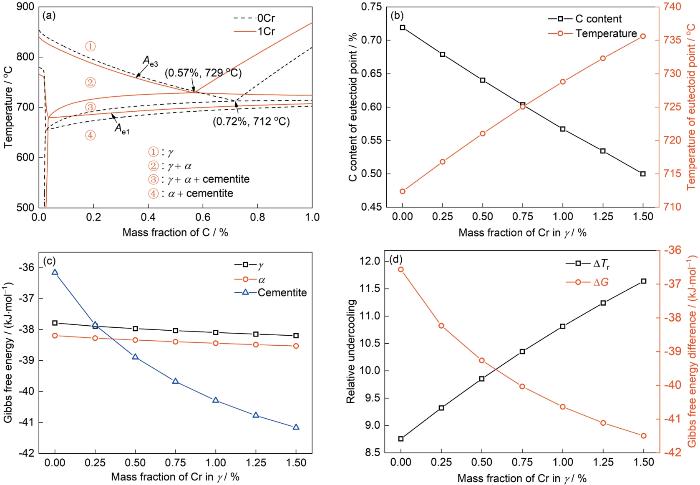
图10
实验钢的Fe-C相图、不同Cr含量下共析点的温度和C含量、各物相的G以及珠光体转变的相对过冷度(ΔTr)和驱动力(ΔGP)
Fig.10
Fe-C phase diagram (a); temperature and C content of the eutectoid point (b), G of each phase (c), and relative undercooling (ΔTr) and ΔG of pearlite transformation (ΔGP) (d) under different Cr contents (ΔGP = Gα + Gcementite - Gγ, Gcementite—G of cementite)
式中,Ps为珠光体转变温度,Te为Thermo-Calc软件计算的珠光体平衡转变温度。
综上,Cr元素对珠光体转变的影响主要为:(1) Cr元素降低了共析转变的C含量、提高了共析转变温度,增加了珠光体转变过冷度和珠光体转变驱动力;(2) Cr元素显著降低了渗碳体Gibbs自由能,促进了渗碳体形成,表明在奥氏体分解过程中,Cr元素通过促进渗碳体析出,进而促进珠光体转变。
3 分析与讨论
3.1 Cr对铁素体形核的影响
根据经典形核理论,固态相变均匀形核时,体系自由能的总变化为:
式中,V为新相的体积;ΔGv为新相与母相的单位体积自由能差;S为新相的表面积;σ为新相与母相之间的单位面积界面能;ΔGε 为形成新相时引起的单位体积弹性应变能。
为方便计算,假设新相呈半径为r的球形,则:
式中,r*为临界晶核尺寸,即晶胚变成晶核所要达到的临界尺寸;ΔG*为临界形核功,是晶胚变成晶核所要越过的能量门槛值。
表3 相关参数计算结果
Table 3
| Steel | Vm / (m3⋅mol-1) | ΔGv / (J⋅m-3) | r* / m | ΔG* / J | QC / J |
|---|---|---|---|---|---|
| 0Cr | 7.2958 × 10⁻⁶ | -5.0906 × 10⁷ | 1.9644 × 10⁻⁸ | 8.0821 × 10⁻¹⁶ | 2.4410 × 10⁻¹⁹ |
| 1Cr | 7.2963 × 10⁻⁶ | -4.5379 × 10⁷ | 2.2037 × 10⁻⁸ | 10.1707 × 10⁻¹⁶ | 2.4842 × 10⁻¹⁹ |
单位体积中的均匀形核率(I)的表达式为[51]:
式中,nv为单位体积中的形核位置数目;a*为临界核心的表面原子数目,正比于临界核心的表面积,因而正比于r*的平方,a*= Ar*2,其中A为比例常数;
分析
将1Cr与0Cr钢中铁素体形核率相除可得:
假设Cr元素对K的影响忽略不计,r*和ΔG*已知,k = 1.3807 × 10⁻²³ J/K,通过元素扩散系数求解奥氏体中C原子的扩散激活能(QC),结果如表3所示。相比于ΔG*,QC低3个数量级,可忽略不计,此时exp[(ΔG
需要注意的是,当形核方式为非均匀形核时,ΔG*显著降低,此时QC的作用将不可忽略。结合2.3节推断,添加Cr降低铁素体非均匀形核率、延长孕育期的原因如下:一方面,添加Cr导致相变驱动力降低,r*和ΔG*增加;另一方面,Cr显著降低奥氏体中C元素的扩散系数,增加QC。
3.2 局域平衡模型下Cr对铁素体生长的影响
铁素体生长过程与C和合金元素的扩散密切相关,特别是C和Mn元素。长期以来,局域平衡理论被用于解释先共析铁素体相变的热力学和动力学行为[15,18]。结合实验和DICTRA计算结果,采用局域平衡模型分析Cr对铁素体生长的影响。局域平衡模型[38,52]可根据合金元素是否发生长程扩散分为配分局域平衡(partitioned local equilibrium,PLE)和可忽略配分的局域平衡(negligible-partitioned local equilibrium,NPLE)。在NPLE模式下,新相中的合金元素可以从母相中继承,铁素体生长由C元素扩散控制,相变速率较快,这对应图8a中界面快速移动阶段。在PLE模式下,C元素和合金元素均在新相与母相间发生配分,铁素体生长受合金元素扩散控制,反应速率较慢,对应图8a中界面慢速移动阶段。
图11为650 ℃下铁素体生长的局域平衡模型示意图。Fe-C-Mn三元平衡相图在650 ℃的等温截面图分为三个区域:右上单相γ区,左下单相α区,中间(α + γ)两相区。研究[39,53,54]表明,NPLE与PLE间的边界可以粗略地由α/(α + γ)相界(图11中黑线)与Mn含量轴的交点(图11中点A)到γ/(α + γ)相界(图11中红线)与C含量轴的交点(图11中点B)绘制,如图11中蓝色虚线所示。如果忽略Cr元素对NPLE/PLE转变线的影响,仅考虑实验用钢在不同时间下γ/α界面的C和Mn元素峰值浓度,可以粗略地判断局域平衡条件下铁素体的生长模式。如图11所示,实验用钢的初始合金成分(图11中红色星号)位于NPLE区域,铁素体生长开始于NPLE模式,不同时间下界面处C和Mn元素浓度峰值绘制于图11中。等温时间为10~10000 s时,界面处C和Mn元素的浓度峰值均处于NPLE区域,铁素体生长为NPLE模式,相变速率较快;随着相变的进行,未转变奥氏体中C和Mn含量逐渐增加,当等温时间为31623 s时,界面处C和Mn元素的浓度峰值处于PLE区域,铁素体生长为PLE模式。表明两种实验用钢铁素体生长均经历了NPLE模式向PLE模式的转变。值得注意的是,根据图8计算结果可知,当等温时间为10000 s时,0Cr钢的界面距离处于慢速移动阶段,铁素体生长应为PLE模式,但是其界面处C和Mn元素的浓度峰值仍处于NPLE区域,可能的原因是合金元素改变了NPLE/PLE转变线。此外,由图9可知,NPLE模式下,在相界面前沿极其狭窄的区域中理论上应存在十分尖锐的合金元素浓度尖峰。而采用DICTRA计算时,图形结果显示存在这一浓度尖峰,但是在导出的数据中没有,由于这一浓度尖峰并不影响分析结果,因此以实际导出数据为准进行绘图。
图11
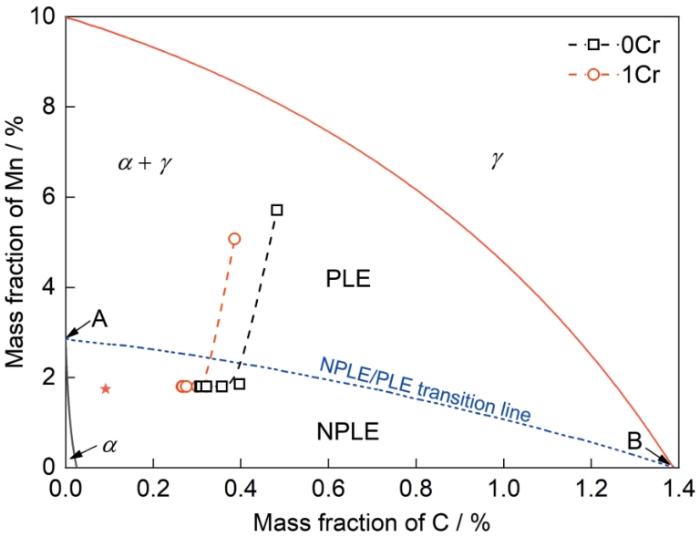
图11
650 ℃下铁素体生长的局域平衡模型示意图
Fig.11
Schematic of local equilibrium model of the ferrite formation at 650 oC (PLE—partitioned local equilibrium, NPLE—negligible-partitioned local equilibrium; A represents the intersection of the α/(α + γ) phase boundary with the axis of the Mn content, B represents the intersection of the γ/(α + γ) phase boundary with the axis of the C content, red pentagram represents the initial bulk composition of experimental steel)
综上,通过局域平衡模型可以较好地解释0Cr钢和1Cr钢中铁素体的生长过程。结合2.4节分析可知,钢中添加Cr元素后铁素体生长变慢的原因为:铁素体在NPLE生长模式下,相变由C扩散控制,相变速率快,Cr通过显著降低奥氏体中C原子的扩散系数,从而降低铁素体生长速率;铁素体在PLE生长模式下,相变由合金元素扩散控制,相变速率慢,由于650 ℃时奥氏体中Cr、Mn、Si元素示踪扩散系数(D)比C低6~7数量级,且DCr < DMn < DSi,因此,添加Cr元素后,相变过程中Cr元素参与配分,导致铁素体生长速率更慢。
3.3 Cr对渗碳体形成的影响
为了进一步研究Cr元素对渗碳体形成的影响,在热力学条件下,计算了650 ℃下不同Cr含量时渗碳体含量和渗碳体中各元素的摩尔分数,结果如图12所示。从图12a可以看出,随着Cr含量增加,渗碳体的摩尔分数增加。与0Cr钢相比,1Cr钢中渗碳体的摩尔分数增加了7.9%。图12b纵坐标为渗碳体中各元素的摩尔分数。可见,Fe、C、Mn、Cr元素占比很高,Si和Ti占比可以忽略。随着Cr含量增加,渗碳体中C的摩尔分数为25%,保持不变;Fe和Mn的摩尔分数逐渐降低,Fe的摩尔分数从58.3%降低至37.5%,Mn从16.7%降低至10%;而Cr的变化规律相反,摩尔分数从0增加至27%。相比于Mn原子,Fe原子变化曲线的斜率更大,表明Cr原子容易置换渗碳体中Fe和Mn原子,并且倾向于置换Fe原子。
图12
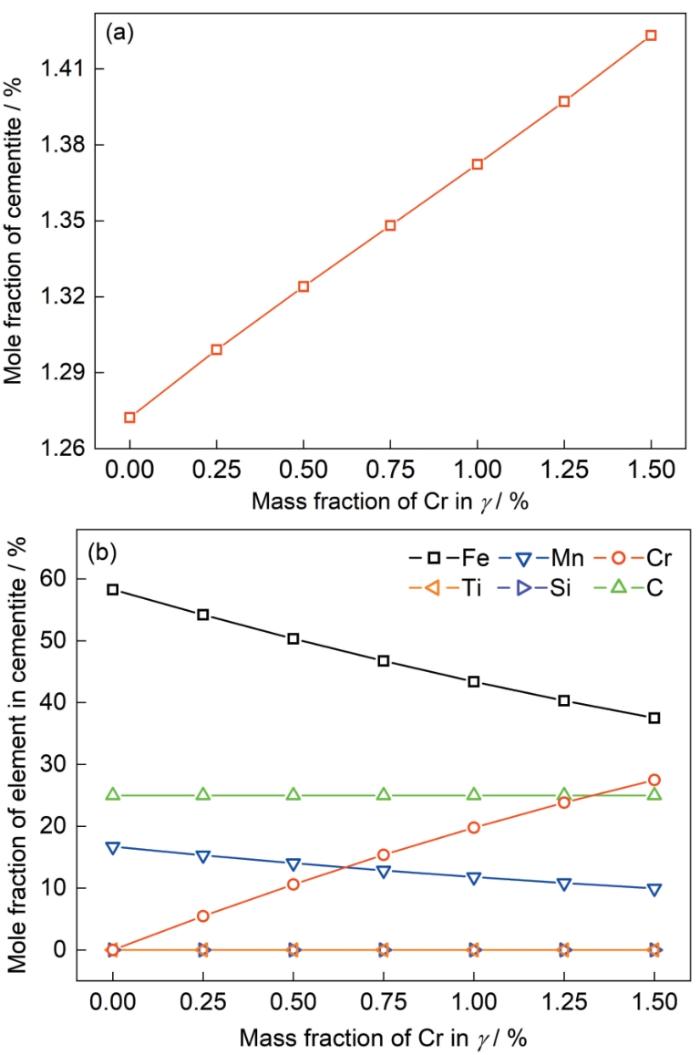
图12
渗碳体和渗碳体中各元素的摩尔分数随着Cr含量的变化曲线
Fig.12
Variation curves of mole fraction of cementite (a) and elements in cementite (b) as a function of Cr content
如图13所示,采用第一性原理计算讨论了Mn和Cr元素掺杂对Fe3C形成能的影响。由图12b可知,在0Cr钢中,Mn在渗碳体中总金属原子的占比为0.22,因此构建了无掺杂的Fe3C和含Mn的Fe3C (Mn占比为0.25),其晶体构型分别如图13a和b所示。关于置换原子的计算模型考虑了所有可能的原子构型,并选择了其中最稳定的构型。结果表明,Fe3C的形成能为1.35 eV,当Mn原子进入Fe3C中,置换Fe原子时,(Fe, Mn)3C渗碳体形成能大幅降低,降低幅度为53.6%。在(Fe, Mn)3C渗碳体基础上,讨论了Cr置换Mn和Fe原子对渗碳体形成能的影响。如图13c和d所示,当Cr原子置换Mn原子时,形成能为0.53 eV,降低幅度为15.8%;当Cr原子置换Fe原子时,形成能为0.34 eV,降低幅度为45.6%。表明Cr置换Mn和Fe原子均可降低渗碳体形成能,且置换Fe原子的降低幅度更大,这与热力学计算结果一致。因此,Cr促进渗碳体形成的原因是,Cr原子进入(Fe, Mn)3C渗碳体后,置换Fe和Mn原子,特别是Fe原子,从而显著降低渗碳体形成能。
图13
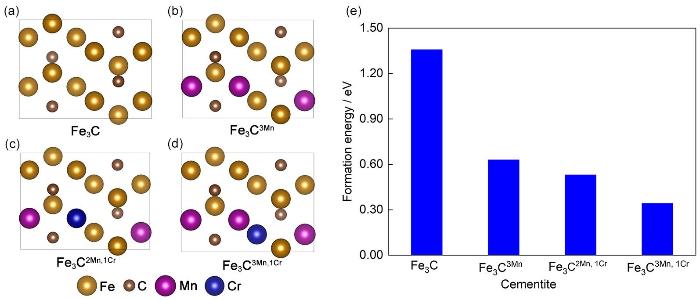
图13
Mn和Cr元素掺杂的渗碳体晶体构型和相应的形成能
Fig.13
Crystal configuration (a-d) and corresponding formation energies (e) of cementite (Fe3C) doped with Mn and Cr elements
(a) Fe3C (b) Fe3C with Mn atoms (Fe3C3Mn)
(c) Fe3C with Cr substituting for partial Mn atoms (Fe3C2Mn, 1Cr)
(d) Fe3C with Cr substituting for partial Fe atoms (Fe3C3Mn, 1Cr)
4 结论
(1) 热力学计算结果表明,Cr元素降低了γ→α相变驱动力,导致铁素体的r*和ΔG*增加,且Cr元素显著降低了C在奥氏体中的扩散系数,增加QC,二者综合作用导致铁素体形核速率降低,孕育期延长。
(2) Cr元素降低奥氏体共析转变的C含量及提高共析转变温度,增加了珠光体转变过冷度和珠光体转变驱动力;此外,Cr元素显著降低渗碳体的Gibbs自由能,抑制铁素体形成,显著促进渗碳体形成,在奥氏体分解过程中通过促进渗碳体析出,从而促进珠光体转变。
(3) 动力学计算表明,铁素体生长分为两个阶段,在NPLE生长模式下,铁素体生长由C原子扩散控制,速率较快;在后期PLE生长模式下,相变由合金元素扩散控制,速率较慢。添加Cr元素后,奥氏体中的C扩散系数降低,同时由于DCr < DMn < DSi,最终导致1Cr钢铁素体生长速率低于0Cr钢。
(4) 第一性原理计算表明,Cr原子倾向置换(Fe, Mn)3C渗碳体中的Mn和Fe原子,特别是Fe原子,可以显著降低渗碳体形成能,从而促进渗碳体析出。
参考文献
Development of high strength hot-rolled sheet steel consisting of ferrite and nanometer-sized carbides
[J].
Metallurgical features of NANOHITENTM and application to warm stamping
[J].
Control of precipitation morphology in the novel HSLA steel
[J].
Application of advanced experimental techniques to elucidate the strengthening mechanisms operating in microalloyed ferritic steels with interphase precipitation
[J].
Effects of interphase TiC precipitates on tensile properties and dislocation structures in a dual phase steel
[J].
Precipitation behavior and mechanical properties of a hot rolled Ti-bearing dual phase steel
[J].
Effect of Cr and Al additions on the development of interphase-precipitated carbides strengthened dual-phase Ti-bearing steels
[J].
Effect of processing parameters on interphase precipitation and mechanical properties in novel CrVNb microalloyed steel
[J].
Effect of Cr on the phase transformation and interphase nanoprecipitation behaviours of high-strength microalloyed steels
[J].
Influence of Cr and Cr + Nb on the interphase precipitation and mechanical properties of V-Mo microalloyed steels
[J].
Influence of Cr and Ni on microstructural evolution during heat treatment of low-carbon transformation induced plasticity steels
[J].
Influence of chromium content on the microstructure and mechanical properties of thermomechanically hot-rolled low-carbon bainitic steels containing niobium
[J].
The effect of chromium content in the range of 1 wt.%–4 wt.% on the microstructure and mechanical properties of controlled-rolled and direct-quenched 12 mm thick low-carbon (0.04 wt.%) steel plates containing 0.06 wt.% Nb has been studied. In these microalloyed 700 MPa grade steels, the aim was to achieve a robust bainitic microstructure with a yield strength of 700 MPa combined with good tensile ductility and impact toughness. Continuous cooling transformation diagrams of deformed and non-deformed austenite were recorded to study the effect of Cr and hot deformation on the transformation behavior of the investigated steels. Depending on the cooling rate, the microstructures consist of one or more of the following microstructural constituents: bainitic ferrite, granular bainite, polygonal ferrite, and pearlite. The fraction of bainitic ferrite decreases with decreasing cooling rate, giving an increasing fraction of granular bainite and polygonal ferrite and a reduction in the hardness of the transformation products. Polygonal ferrite formation depends mainly on the Cr content and the cooling rate. In both deformed and non-deformed austenite, increasing the Cr content enhances the hardenability and refines the final microstructure, shifting the ferrite start curve to lower cooling rates. Preceding austenite deformation promotes the formation of polygonal ferrite at lower cooling rates, which leads to a decrease in hardness. In hot-rolled and direct-quenched plates, decreasing the Cr content promotes the formation of polygonal ferrite leading to an increase in the impact toughness and elongation but also a loss of yield strength.
Control of ferrite content in 1Cr17Ni2 and its effect on mechanical properties
[J].
1Cr17Ni2铁素体含量的控制及其对性能的影响
[J].
Martensite microstructure of 9-12% Cr steels weld metals
[J].
Overview of the current issues in austenite to ferrite transformation and the role of migrating interfaces therein for low alloyed steels
[J].
ALEMI: A ten-year history of discussions of alloying-element interactions with migrating interfaces
[J].
Models for precipitate growth during the γ → α + γ transformation in Fe-C and Fe-C-M alloys
[J].
Modelling of the diffusional austenite-ferrite transformation
[J].
Austenite-to-ferrite phase transformation in low-alloyed steels
[J].
The austenite to polygonal ferrite transformation in low-alloy steel: Multi-phase-field simulation
[J].
Austenite/ferrite interface migration and alloying elements partitioning: An overview
[J].Phase transformation is one of the most effective methods to tailor microstructure of steels. In order to develop high performance steels, microstructure has to be precisely tuned, which requires a deep understanding of phase transformation. The austenite to ferrite transformation in steels has been of great interest for several decades due to its considerable importance in the processing of modern high performance steels, and it has been investigated from various aspects. Mechanism of interface migration and alloying elements partitioning during the austenite to ferrite transformation was regarded as one of the most significant and challenging topics in the field. This paper briefly summarized the recent progress in the understanding of this topic from both theoretical and experimental perspectives, and would also provide discussions and outlook of the unresolved issues.
奥氏体/铁素体界面迁移与元素配分的研究进展
[J].
On the growth of ferrite allotriomorphs in Fe-C alloys/das wachstum von allotriomorphem ferrit in Fe-C-legierungen: Dedicated to professor Dr. rer. nat. Wolfgang pitsch on the occasion of his 65th birthday
[J].
Ferrite formation in Fe-C alloys during austenite decomposition under non-equilibrium interface conditions
[J].
Paraequilibrium and other Restricted Equilibria
[J].After a review of the historic development of the concept of paraequilibrium in the field of alloyed steels, the basic principles of restricted thermodynamic equilibrium at a migrating interface during phase transformations are outlined. As a demonstration they are first applied to classical nucleation. In addition to the case of paraequilibrium they are then applied to adiabatic and to isochoric conditions. It is argued that a full equilibrium model, with a spike of the intensive property in front of the migrating interface may be more realistic. It is shown that the full equilibrium conditions require about twice as much undercooling or underpressure as the restricted equilibrium conditions because of the consumption of driving force in the spike.\nThe concept of restricted equilibrium only applies to heterogeneous phase transformations. For homogeneous reactions, the same experimental conditions will give full equilibrium.
Diffusion-controlled precipitate growth in ternary systems I
[J].
Diffusion controlled precipitate growth in ternary systems: II
[J].
Derivation of general conditions for paraequilibrium in multi-component systems
[J].
Direct measurement of carbon enrichment during austenite to ferrite transformation in hypoeutectoid Fe-2Mn-C alloys
[J].
Effects of Mo on carbon enrichment during proeutectoid ferrite transformation in hypoeutectoid Fe-C-Mn alloys
[J].
Prediction of Ar3 during very slow cooling in low alloy steels
[J].
PLE/NPLE transition temperature of γ→α transformation in Fe-C-X alloy steel under hot deformation condition
[J].
热变形条件下Fe-C-X合金钢γ→α相变的PLE/NPLE转变温度
[J].在已有合金元素的再分配和不分配局部平衡 (PLE/NPLE)转变温度的理论计算方法基础上, 考虑热变形 的影响,建立了热变形条件下Fe--C--X (X表示Mn, Si, Cr等一种或几种元素)合金钢的正平衡热力学方程, 从而 求解热变形体系的PLE/NPLE转变温度.并利用Gleeble--1500D热力模拟试验机进行了Fe--C0.073--Mn2.17--Si0.80--Cr0.88 (质量分数, %)合金钢的热变形γ → α等温转变实验,根据金相照片估测了实验 用钢的PLE/NPLE转变温度,实验估测值与理论计算值基本符合. 820 ℃以0.5s-1的应变速率对实验用钢加载40% 的名义应变, 其γ → α等温转变的PLE/NPLE转变温度提高了近10 ℃.
Investigation of solute/interphase interaction during ferrite growth
[J].
Quantifying the solute drag effect of Cr on ferrite growth using controlled decarburization experiments
[J].
Effects of alloying elements and cooling rates on the high-strength pearlite steels
[J].The effects of the alloying elements of Cr, Mn and the cooling rates after hot deformation on the microstructures and mechanical properties of pearlite steels were studied. Results show that increasing Cr and decreasing Mn significantly increase the eutectoid transformation temperature of steel. The grain sizes of prior austenite of the steels after hot deformation are ∼12 µm. However, the high-Cr–low-Mn steel exhibits a finer interlamellar spacing and some better mechanical properties than that of the high-Mn–low-Cr steel. A full pearlite microstructure with an interlamellar spacing of 97 nm was obtained on the former steel, which exhibits a hardness of HRC49, a tensile strength of 1700 MPa and an elongation of 19%.
Effect of Cr on lamellar spacing and high-temperature stability in eutectoid steels
[J].
Synergistic effects of carbon content and Ti/Mo ratio on precipitation behavior of HSLA steel: Insights from experiment and critical patent analysis
[J].
Analysis of phase transformation thermodynamics and kinetics and its relationship to structure-mechanical properties in a medium-Mn high strength steel
[J].
Difference in transformation behavior between ferrite and austenite formations in medium manganese steel
[J].
Analysis of the interaction between moving α/γ interfaces and interphase precipitated carbides during cyclic phase transformations in a Nb-containing Fe-C-Mn alloy
[J].
Unraveling the effects of Nb interface segregation on ferrite transformation kinetics in low carbon steels
[J].
Modelling and experimental validation of austenite growth from as-quenched martensite during intercritical annealing of a medium-Mn steel
[J].
Efficiency of ab-initio total energy calculations for metals and semiconductors using a plane-wave basis set
[J].
Electronic structure calculations with GPAW: A real-space implementation of the projector augmented-wave method
[J].
Atoms, molecules, solids, and surfaces: Applications of the generalized gradient approximation for exchange and correlation
[J].
Generalized gradient approximation made simple
[J].
Special points for Brillouin-zone integrations
[J].
Comparison of X-ray and neutron-diffraction refinements of the structure of cementite Fe3C
[J].
First-principles study of helium trapping in cementite Fe3C
[J].
Growth kinetics of the ferrites formed in grains and at boundaries in a low carbon microalloyed steel
[J].
低碳微合金钢中晶内和晶界铁素体长大动力学
[J].利用光学显微镜和晶体长大动力学理论对低碳微合金钢中晶内和晶界铁素体的长大动力学进行了实验测定和理论计算与分析. 在实验温度范围(650-750 ℃)内, 铁素体首先在晶界上形成, 在晶内夹杂物上形成较晚. 晶界与晶内铁素体形成的过冷度相差40 ℃以上, 铁素体在晶内夹杂物上形成比在晶界上形成需要更大的过冷度. 晶内铁素体长大速率常数的实测值小于计算值,晶界铁素体长大速率常数的实测值则大于计算值.
A calculation of partitional local equilibrium/negligible partitional local equilibrium boundaries in Fe-C-X systems
[J].
Fundamentals and application of solid-state phase transformations for advanced high strength steels containing metastable retained austenite
[J].


