



由稀土金属元素与过渡族金属元素组成的稀土永磁合金,因其高矫顽力和高磁能积的特性,被广泛应用于电工电子、医疗器械和新能源产业等领域[1~3]。第一代和第二代永磁体SmCo5基和Sm2Co17基合金具有高Curie温度(Tc)、高热稳定性、低矫顽力温度系数等特点[4],被普遍认为具有在高温环境下应用的潜力,但其室温的综合磁性能偏低。第三代钕铁硼永磁体具有高矫顽力和高磁能积,在室温下表现出优异的综合磁性能[5],然而钕铁硼磁体的Tc较低,在高温下磁损失较大,其矫顽力的耐热性较差。面对减少CO2排放的“绿色技术”的需求,基于“清洁能源”的新能源汽车等的应用被快速推广,其电机工作温度约为150 ℃,在此温度下需要矫顽力大于0.8 T的高矫顽力磁体[3],钕铁硼磁体难以满足牵引电机和发电机等方面的应用[6~8]。此外,在2010年稀土危机后,随着稀土元素价格的增长和对稀土资源需求量的提高,迫切需要开发贫稀土的新型永磁体。具有强单轴各向异性的四方ThMn12型晶体结构的SmFe12基永磁化合物具有优异的内禀磁性能μ0Ms= 1.64 T和μ0Ha = 12 T[9] (其中,μ0为真空磁导率,Ms为饱和磁化强度,Ha为各向异性场),并且稀土元素Sm占比是永磁材料里最低的。另一方面,SmFe12基合金富Fe,不受战略资源Co的影响,是新型永磁材料的有力候选之一。
然而,四方ThMn12型SmFe12相为亚稳相,在室温下不能稳定存在[10]。为了在室温下获得ThMn12型SmFe12相,需要添加Ti、V、Cr、Mn、Al、W、Si、Mo和Zr等非磁性元素[11~15]。其中Ti、V、Cr、Mn、Al、W、Si、Mo等元素主要占据Fe原子的8i、8j和8f位点,而Zr、Ce、Nd、Y等元素主要占据Sm原子的2a位点,掺杂B、C、N等原子半径较小的元素会占据晶体的间隙位置[7]。Dirba等[16]研究表明,Ti元素的掺杂,能最大化降低ThMn12型合金的形成能,对相稳定性的提升效果最好。但是,非磁性元素的大量引入也会导致材料的饱和磁化强度急剧下降。SmFe12基合金优异的内禀磁性能(如高饱和磁极化强度(Js))并未转化为高剩磁比,合金的高Ha仅转化为较低的磁体内禀矫顽力(Hcj)[17]。
目前,熔体快淬工艺是制备SmFe12基合金的主要工艺,可为液相烧结、快速热处理(rapid thermal processing)和放电等离子烧结(spark plasma sintering,SPS)等烧结工艺提供良好的前驱体原料[17~21]。Hadjipanayis等[18]通过熔体快淬法制备了SmFe12 - x Mo x 合金,发现仅有掺杂量x = 2时(x为相对摩尔比,下同)能获得稳定的1∶12相。Saito等[19]通过熔体快淬结合SPS方法制备的SmFe11Ti1合金仅由Sm(Fe, Ti)12相组成。透射电子显微镜(TEM)研究结果表明,SmFe11Ti1磁铁由直径约50 nm的细小等轴晶粒组成。尽管熔体快淬法一次可以生产大批量的薄带,但是对甩带速率的调控要求极高且难以获得大量均匀性良好的非晶薄带。高能球磨法工艺简单、生产效率高且可控性高,能够极大提高粉末活性并改善颗粒分布均匀性,可用来制备多种超细纳米粉末和非晶粉末,适合快速进行小批量的实验研究,探索新材料成分体系,被广泛用于超导陶瓷材料、Sm-Co基磁性材料、WC基硬质合金等领域[22]。但目前基于高能球磨法制备非晶粉末并将其烧结制备SmFe12基合金的研究鲜有报道。
本工作通过优化Ti元素掺杂量,利用非晶粉末晶化工艺和热处理工艺,协同优化合金的晶粒尺寸与微观组织,分析纳米结构和元素掺杂对SmFe12基合金相组成、显微组织和磁性能的影响,为制备高矫顽力SmFe12基磁体提供新的研究思路。
1 实验方法
1.1 材料制备
实验选用纯度为99.9%的Sm块、Fe块、Ti块等金属块体作为原料,利用TZGP60-100kW集成模块高频感应加热设备,采用感应熔炼法在高纯Ar气保护下制备SmFe12基合金铸锭,铸锭成分为SmFe12 - x Ti x (x = 0、0.5、1、1.5、2),感应加热最大功率为19 kW,熔炼时间300 s。额外添加25%Sm (质量分数)用于补偿其在熔炼过程中由于挥发造成的质量损失。为了保证合金铸锭的成分均匀,进行三次重熔处理,最终获得合金铸锭。为了细化合金晶粒尺寸,提高合金的矫顽力,将合金铸锭破碎至粒径100 μm左右,将破碎的粉末和磨球以20∶1的球料比在充满Ar气的Etelux GP20手套箱中密封于球磨罐,以500 r/min转速进行2~20 h的高能球磨。球磨后的粉末放入直径20 mm的硬质合金模具中,进行64 MPa预压。利用FHP-828型烧结设备,采用快速热压烧结技术在真空条件下对粉末进行烧结。烧结过程中,升温速率为50 ℃/min,烧结压力500 MPa,烧结温度600~680 ℃,保温1 min。利用KSL-1100X-S箱式炉对烧结块体合金进行热处理,热处理条件为加热速率10 ℃/min,保温温度500~800 ℃,保温时间5~60 min,之后水淬。
1.2 表征方法
采用PPMS-6000综合物性测量系统测试合金的磁性能,测试磁场为3 T。利用Ultima IV型X射线衍射仪(XRD)对铸锭、粉末和烧结的合金块体进行物相分析,扫描速率1°/min,步长0.02°。利用NANO SEM200场发射扫描电子显微镜(SEM)观察铸锭合金的组织形貌,利用其搭载的EDAX 9100能谱仪(EDS)对铸锭合金进行微区成分分析。利用Tecnai G2 F20 TEM分析烧结合金的微观结构和物相组成。利用Archimedes排水法测量合金的密度。
2 实验结果与讨论
2.1 Sm(Fe, Ti)12 铸锭合金的微观组织和磁性能
SmFe12 - x Ti x (x = 0、0.5、1、1.5、2)铸锭的XRD谱如图1a所示。当Ti的掺杂量x = 0时,合金中的主相为α-Fe相,并含有1∶9相,未见1∶12相。当x = 0.5时,合金中1∶12相显著增多,但仍含有大量α-Fe相。α-Fe相的大量存在不利于后续非晶粉末的制备。当x = 1时,铸锭合金基本由1∶12单相组成。进一步提高Ti的掺杂量,当x = 1.5和2时,合金中主相仍为1∶12相,过量的Ti掺杂导致α-Fe相消失的同时出现了少量Fe2Ti相。图1b~f为铸态合金的SEM背散射电子(SEM-BSE)像。可见,合金的微观组织均较为均匀。不掺杂Ti时,微观组织中主要包含两种衬度的物相。经EDS分析可知,灰色衬度的物相为1∶9相,黑色衬度的为α-Fe相。当x = 0.5时,合金主要含有三种衬度的物相:黑色衬度的α-Fe相,灰色衬度的1∶12相,同时出现了少量白色衬度的2∶17相。当x = 1时,微观组织基本无衬度变化,由1∶12单相组成。当x = 1.5和2时,合金中主要包含三种衬度的物相:白色衬度的1∶2相,黑色衬度的Fe2Ti相,及灰色衬度的1∶12主相。
图1

图1
SmFe12 - x Ti x (x = 0、0.5、1、1.5和2)铸锭的XRD谱及铸态合金的SEM-BSE像
Fig.1
XRD patterns of the SmFe12 - x Ti x (x = 0, 0.5, 1, 1.5, 2) ingots (a) and SEM-BSE images of the alloys with x = 0 (b), x = 0.5 (c), x = 1 (d), x = 1.5 (e), and x = 2 (f) (1∶12, 1∶9, 2∶17, and 1∶2 phases represent Sm-Fe-based phases)
图2为不同Ti掺杂量下,SmFe12 - x Ti x 铸态合金的第一象限和第二象限部分的磁滞回线,其中,J为磁极化强度,H为磁场强度。不掺杂Ti的SmFe12合金具有较高的饱和磁极化强度,达到了1.5 T。这是因为合金的Fe含量较高,Sm-Fe基合金的饱和磁极化强度一般会随着Fe含量的提高而提高[23]。随着Ti含量的升高,饱和磁极化强度逐渐降低。当掺杂Ti含量较多时(x = 1.5和2),饱和磁极化强度大幅下降。所有合金的矫顽力基本为零,低矫顽力主要是由于铸锭合金的晶粒尺寸粗大所致。磁滞回线结果表明,在粗晶铸态合金中,尽管通过掺杂Ti元素获得了高比例的1∶12主相,但仍然无法使SmFe12基合金获得高矫顽力和优异的综合磁性能。
图2
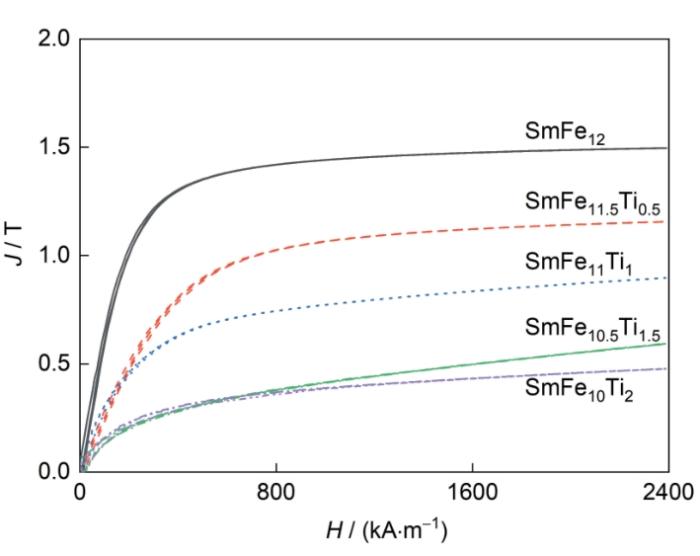
图2
SmFe12 - x Ti x (x = 0、0.5、1、1.5和2)铸态合金第一象限和第二象限部分的磁滞回线
Fig.2
Hysteresis loops of the SmFe12 - x Ti x (x = 0, 0.5, 1, 1.5, 2) ingots in the first and second quadrants (J—magnetic polarization, H—magnetic field intensity)
根据上述关于系列Ti掺杂铸态合金物相和磁性能的综合分析可知,SmFe11Ti1铸态合金不含α-Fe相且磁极化强度较高,因此优选出SmFe11Ti1合金进行后续的非晶粉末制备和烧结,以细化合金的晶粒尺寸,提高合金的矫顽力。
2.2 烧结合金的物相组成和磁性能
图3
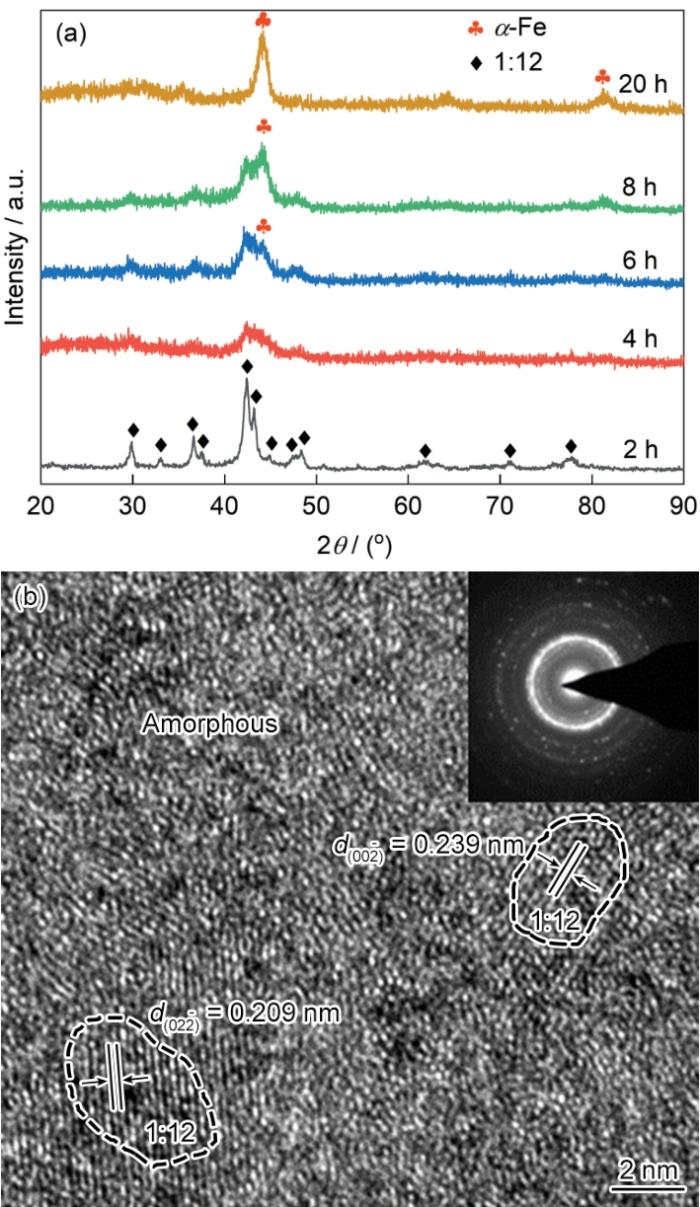
图3
不同高能球磨时间下SmFe11Ti1粉末的XRD谱及球磨4 h后粉末的HRTEM像和SAED花样
Fig.3
Effects of high-energy ball milling time on the phase constitution of SmFe11Ti1 powder
(a) XRD patterns of the powder after different ball milling time(b) HRTEM image of the powder and SAED pattern (inset) after ball milling for 4 h (d—interplanar spacing)
为了进一步确定球磨时间,用同一烧结工艺(650 ℃烧结,保温1 min)对不同球磨时间的SmFe11Ti1粉末进行快速热压烧结。如图4a所示,球磨2和4 h的粉末烧结得到的块体合金的物相组成为高体积比例的1∶12主相和少量的α-Fe相。随着球磨时间的延长,球磨8 h的粉末烧结得到的块体合金中α-Fe相比例增大,球磨20 h的粉末烧结得到的块体合金中α-Fe相成为主相。长时间的球磨会导致后续晶化过程α-Fe的大量析出和长大,不利于稳定1∶12相及获得优异的综合磁性能[16]。图4b为球磨2、4、8和20 h的粉末烧结得到的SmFe11Ti1块体的磁滞回线,对应的矫顽力分别为113.5、226.4、208.7和58.4 kA/m,较大的矫顽力差异也证明过长的球磨时间会导致粉末中α-Fe的大量析出[24,25]。
图4
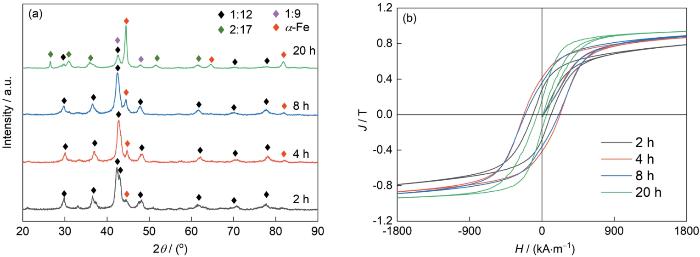
图4
粉末球磨时间对烧结合金物相组成和磁性能的影响
Fig.4
Effects of ball milling time applied for the powder on the phase constitution and magnetic properties of the sintered alloys
(a) XRD patterns (b) hysteresis loops
通过以上分析可知,高能球磨4 h得到的SmFe11Ti1合金粉末用于后续的烧结可以得到矫顽力更高的合金块体。Qian等[21]利用原位加热的方法,通过TEM观察热处理过程中非晶态向ThMn12型物相转变的行为,结果表明,在590 ℃以上,TbCu7型晶相与α-Fe纳米颗粒和非晶相发生反应,转变为ThMn12型物相。因此,本工作选择高于590 ℃的烧结温度对球磨4 h的SmFe11Ti1粉末进行烧结。为了获得致密的合金,选用600、650和680 ℃烧结温度、保温1 min的烧结条件。
图5a为烧结合金的XRD谱。可见,相比于铸态合金,烧结合金的衍射峰发生了明显的宽化,说明烧结合金的晶粒尺寸显著小于铸态合金。通过快速热压烧结获得的合金主相为1∶12相,此外还有少量α-Fe相和1∶9相。通过对XRD衍射峰的拟合计算可知,随着烧结温度的升高,合金中1∶12主相的体积分数逐渐升高,如图5b所示,尤其在680 ℃烧结工艺下,主相体积分数最大,达到90%以上。图5c为650 ℃烧结的SmFe11Ti1块体合金的磁极化强度随温度(J-T)变化曲线及其导数曲线。可以看出,导数曲线在305 ℃处具有明显的尖峰,此温度对应了1∶12相的Curie温度[26]。同时,观察到曲线在温度为427 ℃时的磁极化强度并没有降到零,说明合金除了1∶12主相外还含有少量α-Fe相。
图5
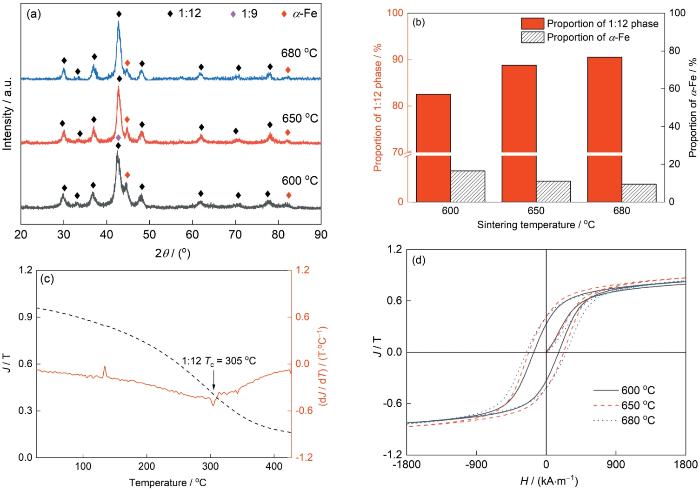
图5
快速热压烧结温度对SmFe11Ti1合金的物相组成和磁性能的影响
Fig.5
Effects of rapid hot-pressing sintering temperature on the phase constitution and magnetic properties of SmFe11Ti1 alloy
(a) XRD patterns of the alloys obtained from different sintering temperatures
(b) effect of sintering temperatures on the ratio of SmFe12 phase and α-Fe phase in the alloys
(c) temperature (T) dependence of the magnetic polarization (J-T) curve and its derivative curve of the alloy sintered at 650 oC (Tc—Curie temperature)
(d) hysteresis loops of the alloys obtained from different sintering temperatures
表1 不同烧结温度下SmFe11Ti1纳米晶合金的磁性能和密度
Table 1
| Sintering temperature / oC | Hc / (kA⋅m-1) | Js / T | Jr / T | ρ / (g⋅cm-3) | (BH)max / (kJ⋅m-3) |
|---|---|---|---|---|---|
| 600 | 161.7 | 0.86 | 0.33 | 6.53 | 8.84 |
| 650 | 226.4 | 0.90 | 0.41 | 6.80 | 15.92 |
| 680 | 257.7 | 0.88 | 0.41 | 6.91 | 16.88 |
为了进一步研究合金的磁性能与微观组织之间的关系,分别对烧结温度为600和680 ℃的样品进行TEM分析,结果分别如图6和7所示。由图6a和7a可知,当烧结温度从600 ℃升高到680 ℃时,SmFe11Ti1合金的平均晶粒尺寸由12.8 nm长大到23.5 nm。680 ℃烧结的合金晶粒尺寸更接近于54 nm的SmFe12单畴尺寸[27],有利于矫顽力的提升。实现高Hc的有效方法之一是形成薄的晶间相来分离晶粒[28]。如图6和7所示,两个试样的1∶12相晶粒之间均不含有晶间相,这与Jang和Stadelmaier[29]关于Sm-Fe-Ti相图中高温下没有与SmFe11Ti1平衡的液相的结论相一致。同时,从晶粒尺寸分布柱状图中明显观察到,680 ℃烧结得到的合金晶粒尺寸分布更均匀集中,有利于增强合金的晶间交换耦合作用,从而提高合金的剩磁比[30]。
图6
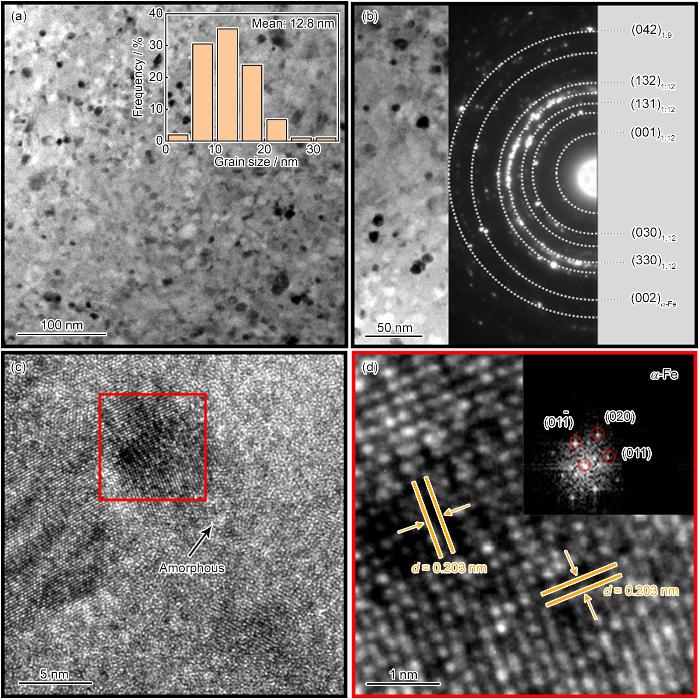
图6
600 ℃烧结得到的SmFe11Ti1试样的微观组织分析
Fig.6
Microstructure analyses of the SmFe11Ti1 sample sintered at 600 oC
(a) bright field TEM image (Inset is the statistical result of grain size distribution)
(b) SAED pattern (Left image is the local bright field image)
(c) HRTEM image
(d) HRTEM image and fast Fourier transform (FFT) (inset) of the rectangular region in Fig.6c
图7
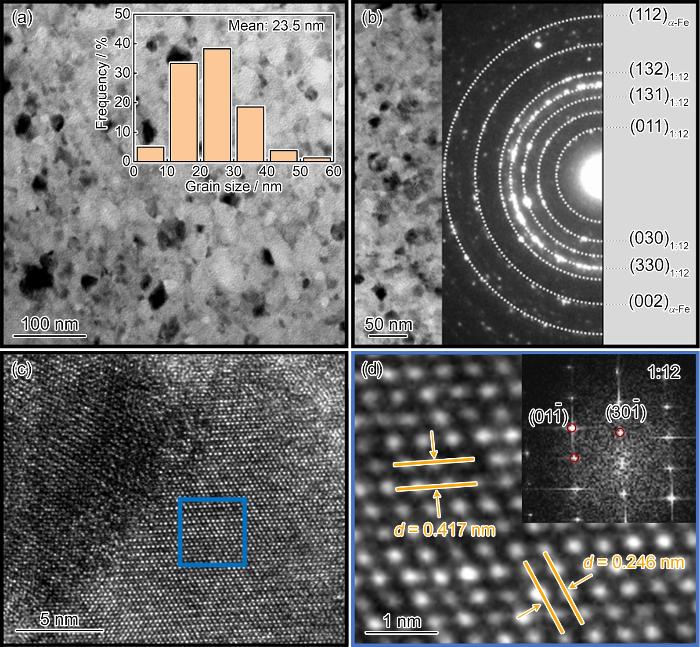
图7
680 ℃烧结得到的SmFe11Ti1试样的微观组织结构分析
Fig.7
Microstructure analyses of the SmFe11Ti1 sample sintered samples at 680 oC
(a) bright field TEM image (Inset is the statistical result of grain size distribution)
(b) SAED pattern (Left image is the local bright field image)
(c) HRTEM image
(d) HRTEM image and FFT (inset) of the rectangle region in Fig.7c
2.3 热处理对合金物相组成和磁性能的影响
图8
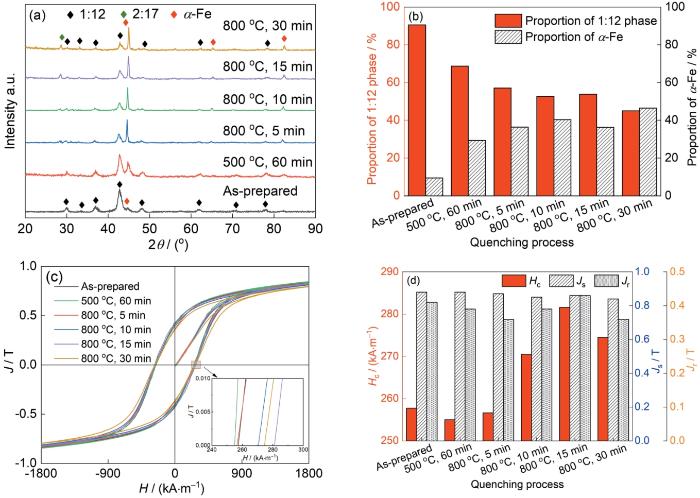
图8
纳米晶SmFe11Ti1合金经不同淬火工艺后的物相组成和磁性能
Fig.8
Phase constitution and magnetic properties of nanocrystalline SmFe11Ti1 alloy prepared by different quenching processes
(a) XRD patterns of alloys after different quenching processes
(b) effect of quenching process on the ratio of 1∶12 phase and α-Fe phase in the alloy
(c) hysteresis loops of SmFe11Ti1 bulks obtained from different quenching processes (Inset is the local enlarged diagram)
(d) magnetic property data read from the hysteresis loop in Fig.8c
为了使晶粒尺寸快速长大至接近单畴尺寸,进一步提高热处理温度至800 ℃,并保温不同时间。随着保温时间的延长,1∶12主相部分分解,α-Fe相增多,但磁体的矫顽力有所提高。当保温时间为15 min时,相较于制备态试样,矫顽力提升了9.3% (由257.7 kA/m增至281.6 kA/m),且剩磁比也提升至50%。随着保温时间进一步延长,合金的1∶12相进一步分解,同时伴随着α-Fe相的长大,矫顽力开始逐渐减小。当保温时间为30 min时,α-Fe软磁相成为合金主相,不利于矫顽力的提升。
由图8可知,经800 ℃保温15 min后淬火得到的试样具有最高的矫顽力和剩磁,对该条件试样进行微观组织分析,结果如图9所示。由图9a可知,合金的平均晶粒尺寸从23.5 nm长大至34.4 nm,晶粒尺寸的标准差(σ = 10.0 nm)相较于制备态样品(σ = 9.3 nm)基本不变,标准差相对于平均晶粒尺寸的比值下降,且消除了大于两倍平均尺寸的晶粒,表明晶粒尺寸分布变得更为集中,这有利于提升晶间交换耦合作用,从而提高剩磁比。热处理后试样的平均晶粒尺寸更加接近单畴尺寸,从而提高了合金的矫顽力。另一方面,Polin等[31]研究表明,在高于烧结温度时进行热处理可以有效消除合金中的晶体缺陷,从而进一步提高合金的矫顽力。由图9b中的SAED花样可以看出,1∶12相部分分解为α-Fe相和2∶17相。图9c为图9a中红框区域的HRTEM像。根据显微组织的明场TEM像(图9a)和相应区域的FFT结果可知,2∶17相以细小析出相状态存在。然而2∶17相的各向异性场远小于1∶12相,无法与纳米晶晶界一同钉扎磁畴来提高合金矫顽力[32]。同时,1∶12相分解产生的α-Fe软磁相也不利于合金矫顽力的提升。虽然淬火处理使合金的晶粒尺寸更加接近单畴尺寸,且部分消除了晶体缺陷,有利于提高矫顽力;但热处理带来的1∶12相的部分分解不利于矫顽力的提升。因此,协同调控合金晶粒尺寸与1∶12相的稳定性,优化晶粒尺寸接近单畴尺寸并保持高比例1∶12相的相组成,对提升SmFe12基合金的综合磁性能尤为重要。
图9
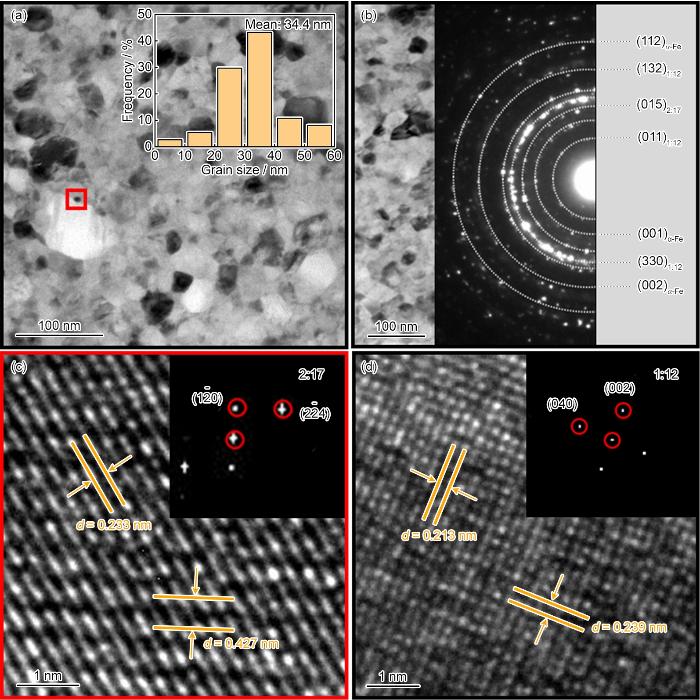
图9
800 ℃保温15 min后淬火得到的SmFe11Ti1试样的微观组织分析
Fig.9
Microstructure analyses of the SmFe11Ti1 sample obtained by quenching after holding at 800 oC for 15 min
(a) bright field TEM image (Inset is the statistical result of grain size distribution)
(b) SAED pattern (Left image is the local bright field image)
(c) HRTEM image and FFT (inset) of the precipitated phase in Fig.9a
(d) HRTEM image and FFT (inset) of the main phase
3 结论
(1) 掺杂Ti元素可以提高感应熔炼制备得到的SmFe12基合金中1∶12相的比例,适当的Ti掺杂量可以制备得到接近单相的1∶12基合金。由于铸态SmFe12基合金的粗晶组织特征,其矫顽力接近于零。
(2) 利用高能球磨法制备了SmFe12基合金的非晶粉末,并对粉末进行了快速热压烧结,制备得到了具有超过90%体积分数的高比例1∶12相的SmFe11Ti1纳米晶合金。合金具有高的饱和磁极化强度(0.88 T)和较高的矫顽力(257.7 kA/m),纳米晶组织对于获得高矫顽力至关重要。
(3) 对烧结块体合金进行了一系列热处理实验,得到的合金微观组织均匀,晶粒尺寸长大到更接近SmFe12相的单畴尺寸,且合金的主相依然为1∶12相。合金的矫顽力进一步提升至281.6 kA/m,且剩磁比也提升至50%。协同调控合金的晶粒尺寸与1∶12相的稳定性,对提升SmFe12基合金的综合磁性能尤为重要。
参考文献
Thermodynamic study on metastable phase: From polycrystalline to nanocrystalline system
[J].
First an approach based on the Debye model is developed to quantify the thermodynamic parameters of metastable phase in the conventional coarse-grained polycrystalline systems. Subsequently, by combining the experimental measurements on heat capacity with the nanothermodynamic calculations for nanocrystalline alloys, a method is established to determine the fundamental thermodynamic functions of the metastable phases in both polycrystalline and nanocrystalline alloy systems. Taking the typical metastable-phase SmCo7 alloy as an example, the thermodynamic properties of polycrystalline and nanocrystalline systems are studied, and good agreement between model calculations and experimental results is achieved.
Recent advances in SmFe12-based permanent magnets
[J].
Room- and high-temperature magnetic properties of Sm(CobalFe x Cu0.088Zr0.025)7.5 (x = 0-0.30) sintered magnets
[J].
Sm(CobalFe x Cu0.088Zr0.025)7.5 (x = 0~
用粉末冶金工艺制备了Sm(CobalFexCu0.088Zr0.025)7.5(x=0-0.30)烧结磁体,对Fe含量x对磁体的磁性及其高温特性的影响进行了系统研究.随Fe含量的增加,最大磁能积(BH)max和剩磁Br逐渐增加,分别在x为0.21和0.27时达到了最大值205 kJ/m3和1.055 T,然后迅速下降.当x≥0.24时,磁体中开始有FeCo软磁性相析出,破坏了磁体的永磁特性.Fe含量对磁体高温稳定性有巨大的影响,在Fe含量x=0.21时,磁体内禀矫顽力温度系数β为0.23%/K;当x=0.07时,β降至-0.14%/K(293-723K).制备出有很好的高温稳定性的永磁材料Sm(CobalFe0.07Cu0.088Zr0.025)7.5,在723 K时其磁性能为:Br=0.725 T,bHc=517 kA/m,iHc=764 kA/m,(BH)max=95kJ/m3,B-H退磁曲线保持为直线.
Angular dependence and thermal stability of coercivity of Nd-rich Ga-doped Nd-Fe-B sintered magnet
[J].
Cerium: An unlikely replacement of dysprosium in high performance Nd-Fe-B permanent magnets
[J].
Permanent magnetic properties of NdFe12N x sputtered films epitaxially grown on V buffer layer
[J].
Several issues on the development of grain boundary diffusion process for Nd-Fe-B permanent magnets
[J].
钕铁硼永磁晶界扩散技术和理论发展的几个问题
[J].钕铁硼永磁在新能源、信息通讯和智能制造等领域有着广泛的应用。电动汽车驱动电机、风电系统发电机等对钕铁硼磁体的高温性能和矫顽力提出了更高的要求。重稀土Tb和Dy可以显著提高钕铁硼磁体的各向异性场,但降低了剩磁,增加了成本。21世纪初出现的晶界扩散技术是稀土永磁制造领域的一项重大进展。它通过将重稀土元素或稀土合金以晶界扩散的方式渗透入磁体,在有效提高磁体矫顽力的同时,大幅降低重稀土含量,提高性价比。晶界扩散技术发展至今,引起业内的广泛关注并已实现工业化,但在技术和理论层面上仍存在一些关键问题。本文基于国内外最新进展和作者团队的研究工作,总结了晶界扩散工艺目前亟需解决的问题及可能的解决措施。对厚磁体的晶界扩散技术、晶界扩散中各向异性行为的利用、低成本扩散剂的选择、晶界扩散与现存工艺的结合、晶界扩散对其他服役性能的影响以及晶界扩散的相关理论发展等问题进行了阐述,并对晶界扩散的未来发展趋势进行了展望。
Intrinsic hard magnetic properties of Sm (Fe1 - x Co x )12 compound with the ThMn12 structure
[J].
Research progress on SmFe12-based permanent magnet alloys
[J].
SmFe12基永磁合金研究进展
[J].
Identification of the intermetallic compound consisting of Sm, Ti, Fe
[J]. J.
Effect of R-site substitution and the pressure on stability of RFe12: A first-principles study
[J].We theoretically study the structural stability of RFe12 with the ThMn12 structure (R: rare-earth element, La, Pr, Nd, Sm, Gd, Dy, Ho, Er, Tm, Lu, Y, or Sc, or group-IV element, Zr or Hf) based on density functional theory. The formation energy has a strong correlation with the atomic radius of R. The formation energy relative to simple substances decreases as the atomic radius decreases, except for R= Sc and Hf, while that relative to R2Fe17 and bcc Fe has a minimum for R= Dy. The present results are consistent with recent experimental reports in which the partial substitution of Zr at R sites stabilizes RFe12-type compounds with R= Nd or Sm. Our results also suggest that the partial substitution of Y, Dy, Ho, Er, or Tm for Nd or Sm is a possible way to enhance the stability of the ThMn12 structure. Under hydrostatic pressure, the formation enthalpy decreases up to ≈6 GPa and then starts to increase at higher pressures.
First-principles study on stability and magnetism of NdFe11 M and NdFe11Mn for M = Ti, V, Cr, Mn, Fe, Co, Ni, Cu, Zn
[J].
Intrinsic magnetic properties of SmTiFe10
[J].
Some novel ternary ThMn12-type compounds
[J]. J.
Thermal decomposition of ThMn12-type phase and its optimum stabilizing elements in SmFe12-based alloys
[J].
Role of V on the coercivity of SmFe12-based melt-spun ribbons revealed by machine learning and microstructure characterizations
[J].
ThMn12-type alloys for permanent magnets
[J].
Magnetic properties of SmFe12-based magnets produced by spark plasma sintering method
[J].
Novel method for preparation of high-performance SmFe12/α-Fe nanocomposite magnets by rapid thermal processing
[J].
Phase transformation and magnetic properties of fully dense Sm(Fe0.8Co0.2)11Ti bulk magnets
[J].
Processing of advanced materials using high-energy mechanical milling
[J].
Structure and permanent magnetic properties of SmFe x (x = 3~8) melt spun ribbons during heat treatment
[J].
Investigation by Mössbauer spectroscopy and atom probe tomography of the phase transformation of Nd-Fe-B alloys after high-energy ball milling
[J].The main goal of this paper is to investigate the behavior of mechanically milled Nd2Fe14B powders. The effect of the milling on the magnetic properties of the Nd2Fe14B intermetallic is measured and is compared to the structural analysis performed by Mössbauer spectroscopy and atom probe tomography (APT). The high energy ball milling of Nd2Fe14B powders for up to 12 h induces the progressive disappearance of the hard magnetic behavior. Mössbauer spectroscopy and APT analyses have shown the decomposition of the Nd2Fe14B phase in the early stages of milling into an amorphous, disordered Nd-Fe-B phase that is rich in neodymium and in an α-Fe phase. The corresponding microstructure is very characteristic, with the formation of submicrometric pure iron particles, surrounded by an amorphous shell enriched in neodymium and in boron. By using APT, each step of the process can be identified. This high-resolution technique allows us obtaining a 3D mapping in real space of the chemical species (Nd, Fe, and B) on the atomic scale. Three-dimensional reconstructions of the nanostructure of the analyzed samples are realized from the data and show the formation of the Nd2Fe14B nanocomposite that is composed of α-Fe soft magnetic nanosized crystallites embedded in the Nd2Fe14B hard magnetic matrix. These results confirm the decomposition of the initial Nd2Fe14B phase. After 2 h of high-energy mechanical milling, Fe particles with diameters of up to 100 nm are observed. By increasing the milling time, the element intermixing and grain size reduction of the decomposition products can be observed.
Phase transformation mechanism and magnetic properties of Sm-Fe alloys produced by melt-spinning and high-energy ball milling
[J].
Structure and magnetic properties of rapidly quenched Sm-Fe-Ti alloys
[J].
Coercivity and microstructure of melt-spun Sm(Fe11Ti)
[J].Amorphous Sm(Fe11Ti) ribbons were prepared by melt spinning. After heat treatment, very fine grains (≊50 nm) of the ThMn12-structure phase were obtained with no signs of a separate intergranular phase. Each grain appears to be a single domain. The maximum room-temperature coercivity is 0.56 T, rising to 1.20 T at 11 K. A model is proposed for the coercivity which is based on an analogy with the random anisotropy model of amorphous magnetism. It gives the correct magnitude of the coercivity, and suggests it should vary as the reciprocal of the crystallite size.
Prospects for the development of SmFe12-based permanent magnets with a ThMn12-type phase
[J].
Phase equilibria and magnetic properties of iron-rich Fe-Nd-Ti and Fe-Sm-Ti alloys
[J].
Remanence and coercivity in isotropic nanocrystalline permanent magnets
[J].
Understanding high coercivity in ThMn12-type Sm-Zr-Fe-Co-Ti permanent magnet powders through nanoscale analysis
[J].


