



锌合金是2010年前后发展起来的新一代医用可降解金属材料,相较于镁基和铁基合金在降解方面更具优势,能满足大部分体内植入物对降解速率的要求,在制造骨支架、血管支架等植入物方面具有很大的潜力[1~3]。到目前为止,锌合金作为可降解生物医用材料的研究时间比较短,很多临床研究还处于起步探索阶段。激光粉末床熔融(laser powder bed fusion,LPBF)作为一种新的金属材料增材制造技术,具有快速凝固的特点,成形过程中快速推进的固/液界面能够通过捕获效应抑制成分偏析,同时限制晶粒生长,获得细小、均匀的微观组织,从而实现部件力学性能的进一步提升[4,5]。此外,利用LPBF技术还可以制造出更为复杂且集成度更高的零部件,降低装配的需求,减少零部件之间的连接点,实现复杂微观结构的个性化制备,有助于模拟人体骨骼结构,在生物医疗领域具有广阔的应用前景[6~8]。
LPBF技术以粉末为原料进行逐层扫描和堆叠,最终形成一个完整的部件,部件的微观组织和力学性能与粉末粒径和形貌关系紧密。目前,电极感应气体雾化(EIGA)、等离子旋转电极(PREP)、等离子球化(PS)、真空感应熔炼气体雾化(VIGA)及水雾化等是金属粉末常用的制备方法[9]。特别是EIGA法和PREP法目前已广泛应用于镍基[10]、钛基[11]和铁基[12]合金等金属材料的制备,相较于PREP法,EIGA法更容易出现空心粉、卫星粉和不规则粉末,这往往是引起打印态部件孔隙和微裂纹等缺陷的主要原因[13,14]。例如,毕中南等[15]对比了VIGA、EIGA和PREP三种方法制备的GH3230合金粉末的质量和成形质量,发现相较于VIGA和EIGA法,PREP法制备的粉末表面光滑、平均球形度好,无明显的空心粉和卫星粉,打印过程中有着优异的流动性,相应地,成形后的部件缺陷更少、致密度更高。此外,还有一些研究[12,13,16]发现,粉末的形貌和粒径也会影响打印的工艺窗口和部件的力学性能,如Spierings等[12]在316L不锈钢的增材制造过程中发现,更宽的粒径分布显著影响合金的缺陷、致密度和拉伸断裂伸长率。因此,粉末特性和打印工艺与合金的微观组织及力学性能关系复杂,厘清三者的影响关系有助于后续开展更高效的打印工作和获得力学性能更优异的部件。
1 实验方法
本工作设计成分为Zn-1Mn-0.4Mg (质量分数,%)的锌合金,使用真空熔炼的方法制备锌合金棒材,并使用EIGA和PREP技术制备了合金粉末,尺寸分别为15~53和30~75 μm,两种粉末的化学成分如表1所示。使用SLM 125 HL金属打印机对两种粉末进行成形打印,打印前对粉末进行烘干处理,打印过程中使用Ar气作为保护性气氛,舱室内O2含量控制在0.04% (质量分数)以下。两种粉末采用相同的成形工艺参数,扫描间距为0.06 mm,层厚为30 µm,激光功率(P)为40、50、60、70和80 W,扫描速率(V)为500、600、700、800和900 mm/s。采用以上工艺参数制备尺寸为10 mm × 10 mm × 10 mm的金相试样,通过统计试样的孔隙率进一步优化两种粉末的打印工艺参数。在致密度超过99.50%的成形工艺(P = 50 W、V = 600 mm/s,力学测试和微观组织表征试样均基于该工艺制备)基础上,制备标距段尺寸为20 mm × 5 mm × 2 mm 的拉伸试样和直径10 mm、长15 mm的压缩试样。
表1 使用电极感应气体雾化(EIGA)和等离子旋转电极(PREP)方法制备的Zn-Mn-Mg合金粉末的化学成分 (mass fraction / %)
Table 1
| Method | Zn | Mn | Mg | O |
|---|---|---|---|---|
| EIGA | 98.56 | 0.92 | 0.43 | < 0.1 |
| PREP | 98.56 | 0.97 | 0.38 | < 0.1 |
采用MS2000激光粒度仪对粉末的粒度进行表征。使用G500场发射扫描电镜(SEM)观察粉末形貌和微观组织。制备完成的金相试样经过研磨和抛光后,使用CX23光学显微镜(OM)观察试样的成形效果,使用Image-J软件对各打印参数下的光学照片进行致密度统计。使用4% (体积分数)硝酸酒精试剂对成形效果好(即孔隙率较低)的试样进行侵蚀,并使用OM和EPMA-8050G电子探针(EPMA)进一步观察和分析试样的微观组织和元素分布。使用SmartLab X射线衍射仪(XRD)对两种粉末成形效果好的试样进行物相分析,采用配备Symmetry S2探测器的G500场发射SEM进行电子背散射衍射(EBSD)分析。EBSD分析之前,对抛光后的样品进行电解处理,电解液为50% (体积分数)磷酸酒精溶液,电解电压约为5 V,电解时间约为15 s。使用Titan Cu-be 80-300透射电镜(TEM)表征试样的微观特征,包括明场像、选区电子衍射(SAED)和能谱(EDS)分析。TEM分析之前,使用线切割机切下待观测的薄片(厚度约0.5 mm),再机械研磨至厚度15 μm左右,最后用离子减薄仪将样品减薄得到TEM试样。
室温准静态拉伸和压缩测试在SHT4205电子万能材料试验机上进行,拉伸和压缩速率均为1 mm/min,拉伸直至断裂,压缩至应变60%即停止实验,拉伸和压缩各进行三次平行实验。抗拉强度和屈服强度根据应力-应变曲线获得,延伸率通过断裂前后的标距变化获得,拉伸后的断口组织使用G500场发射SEM进行观察和分析。
2 实验结果
2.1 粉末形貌
图1
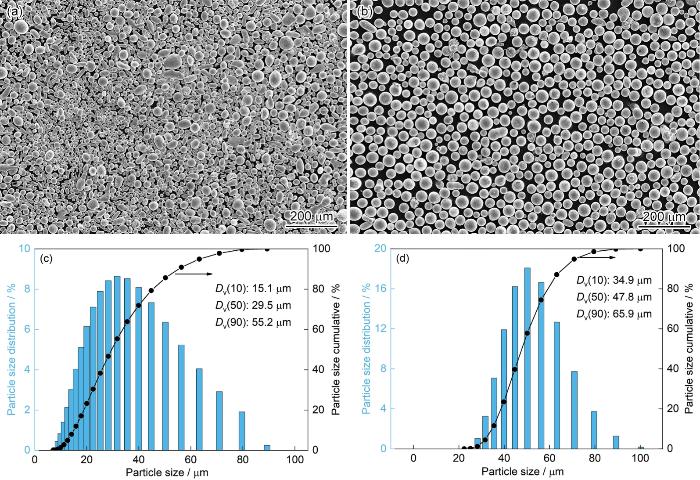
图1
EIGA和PREP方法制备的Zn-Mn-Mg合金粉末的SEM像和尺寸分布
Fig.1
SEM images (a, b) and particle size distributions (c, d) of Zn-Mn-Mg alloy powders prepared by EIGA (a, c) and PREP (b, d) methods (Dv(10), Dv(50), and Dv(90) indicate 10%, 50%, and 90% cumulative particle sizes, respectively)
2.2 LPBF成形工艺窗口
图2为EIGA方法制备的合金粉末经不同LPBF工艺成形后的块体试样的致密度等高线图和OM像。由致密度的统计结果可知,EIGA + LPBF制备的合金块体在所设计的工艺窗口中相对致密度有较大的变化,最低为78.37% (P = 80 W、V = 600 mm/s),最高则超过99.50% (如P = 50 W、V = 600 mm/s)。低致密度工艺区间主要处在中高功率(P = 60~80 W)、中低扫描速率(V = 500~700 mm/s),该工艺区域内的OM像存在明显尺寸不一的圆形孔隙,如P = 60 W、V = 600 mm/s (图2j),P = 70 W、V = 700 mm/s (图2k)和P = 80 W、V = 600 mm/s (图2g)等。成形较好、致密度相对较高的工艺主要为低功率(P = 40~50 W)、低扫描速率(V = 500~700 mm/s),在这一工艺区间内的OM像有少量的圆形孔隙或不规则的未熔合缺陷(图2f),但整体成形效果较其他成形工艺好。在其他工艺区间内,所统计的相对致密度在92.74%~98.76%不等,OM像主要呈不规则的未熔合缺陷(图2b)、圆形孔隙(图2c)或两者并存(图2d)的特征。基于相对致密度的统计结果和OM像特征,选取成形性相对较好,致密度超过99.50%的P = 50 W、V = 600 mm/s作为后续微观组织表征和力学测试所用试样的打印工艺。
图2
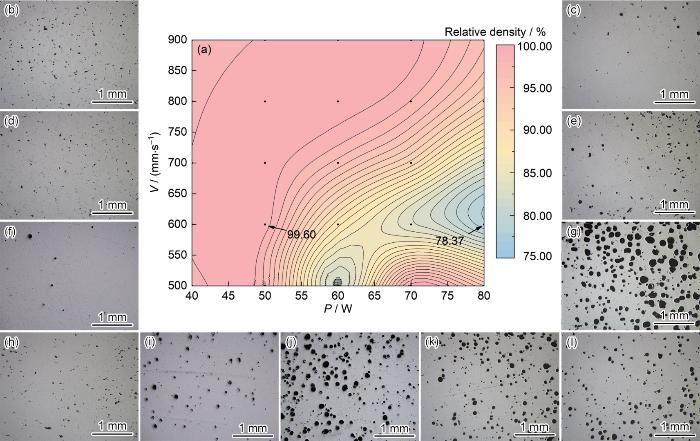
图2
EIGA方法制备的合金粉末经不同激光粉末床熔融(LPBF)工艺成形后的块体试样的致密度等高线图和OM像
Fig.2
Contour diagram of relative density (a) and OM images of laser powder bed fusion (LPBF) bulk samples prepared via EIGAed powders at P = 40 W, V = 900 mm/s (b), P = 70 W, V = 900 mm/s (c), P = 40 W, V = 800 mm/s (d), P = 80 W, V = 900 mm/s (e), P = 50 W, V = 600 mm/s (f), P = 80 W, V = 600 mm/s (g), P = 40 W, V = 500 mm/s (h), P = 50 W, V = 500 mm/s (i), P = 60 W, V = 600 mm/s (j), P = 70 W, V = 700 mm/s (k), and P = 80 W, V = 800 mm/s (l) (P—laser power, V—scanning rate)
PREP方法制备的合金粉末经不同LPBF工艺成形后的块体试样的致密度等高线图和OM像如图3所示。结果表明,使用PREP方法制备的合金粉末与EIGA制备的合金粉末成形工艺窗口高度一致,且成形质量相对较好,最高致密度的成形工艺为P = 50 W、V = 600 mm/s,致密度为99.93%,最低致密度(88.52%)的工艺为P = 80 W、V = 600 mm/s,且仅在该工艺下致密度低于90.00%。与图2相似,PREP + LPBF方法制备的合金块体在低功率(P = 40~50 W)的工艺区间内,致密度相对较高,但OM像呈现出不规则的未熔合缺陷(图3b和d);在中高功率(P = 60~80 W)、中低扫描速率(V = 500~700 mm/s)工艺区间内的致密度相对较低,OM像主要显示圆形孔隙(图3g、k和l);在其他工艺参数下,OM像主要呈不规则的未熔合缺陷(图3h)、圆形孔隙(图3i)或两者并存(图3j)的特征。相较而言,PREP方法制备的合金粉末,其高致密度成形工艺窗口更大,低致密度成形工艺窗口较小,且在相同的成形工艺下,OM像更致密(如P = 50 W、V = 600 mm/s)或孔隙更少(如P = 80 W、V = 600 mm/s)。选取成形性相对较好,致密度最高的P = 50 W、V = 600 mm/s打印工艺作为最佳工艺,后续的试样均基于该工艺制备。
图3
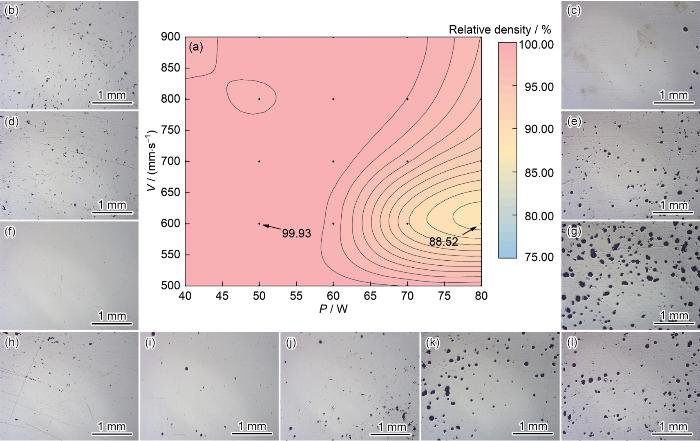
图3
PREP方法制备的合金粉末经不同LPBF工艺成形后的块体试样的致密度等高线图和OM像
Fig.3
Contour diagram of relative density (a) and OM images of LPBF bulk samples prepared via PREPed powders at P = 40 W, V = 900 mm/s (b), P = 70 W, V = 900 mm/s (c), P = 40 W, V = 800 mm/s (d), P = 80 W, V = 900 mm/s (e), P = 50 W, V = 600 mm/s (f), P = 80 W, V = 600 mm/s (g), P = 40 W, V = 500 mm/s (h), P = 50 W, V = 500 mm/s (i), P = 60 W, V = 600 mm/s (j), P = 70 W, V = 700 mm/s (k), and P = 80 W, V = 800 mm/s (l)
2.3 物相及显微组织
利用XRD对两种粉末经LPBF工艺(P = 50 W、V = 600 mm/s)制备的块体试样进行物相表征,结果如图4所示。结果表明,打印成形后的块体试样由Zn基体、Mg2Zn11和MnZn13相组成。两种粉末在相同成形工艺下的物相种类无明显差别。微观组织(图5a和b)观察结果表明,两种粉末制备的块体试样微观组织形貌特征相似,晶粒尺寸细小,多为长条状或针状,晶界处有析出相富集。EPMA观察表明,晶界处有Mn (图5d)和Mg (图5e)元素的富集,其中Mn元素主要分布在晶界处,但晶内也有少量的均匀分布,Mg元素则集中分布于晶界处。结合图4的XRD谱可知,晶界处富集的第二相主要为MnZn13和Mg2Zn11,这些第二相均匀、断续地分布于Zn基体晶界处。
图4

图4
EIGA和PREP方法制备的合金粉末经LPBF工艺(扫描功率P = 50 W、扫描速率V = 600 mm/s)成形后块体试样的XRD谱
Fig.4
Low (a) and locally high (b) magnified XRD patterns of bulk samples prepared via EIGA + LPBF and PREP + LPBF at P = 50 W, V = 600 mm/s
图5
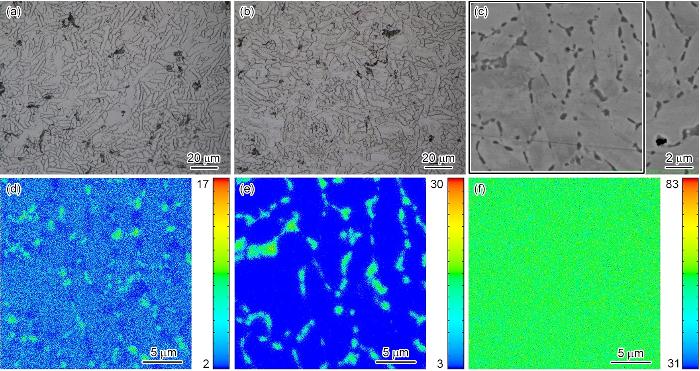
图5
EIGA和PREP方法制备的合金粉末经LPBF工艺(P = 50 W、 V = 600 mm/s)成形后块体试样的OM像、EPMA像及Mn、Mg和O元素分布
Fig.5
OM images of bulk samples prepared via EIGA + LPBF (a) and PREP + LPBF (b) at P = 50 W, V = 600 mm/s; EPMA image (c) and corresponding element mappings of Mn (d), Mg (e), and O (f) of bulk sample prepared via PREP + LPBF of rectangle area in Fig.5c
通过EBSD进一步表征两种粉末经LPBF工艺(P = 50 W、V = 600 mm/s)制备的块体试样的晶粒尺寸和晶体取向特征,结果如图6所示。从图6a和b可见,在相同的成形工艺下,两种合金粉末成形后的块体试样在建造方向(BD)表现出相似的晶体学特征,晶粒形貌与图5中的OM和EPMA像相似。EIGA + LPBF方法制备的块体试样的平均晶粒尺寸为(5.6 ± 2.2) µm,PREP + LPBF方法制备的块体试样的平均晶粒尺寸相对更小,为(4.6 ± 2.2) µm。从图6c和d可见,两种试样均在{0001}面上相较于{10
图6
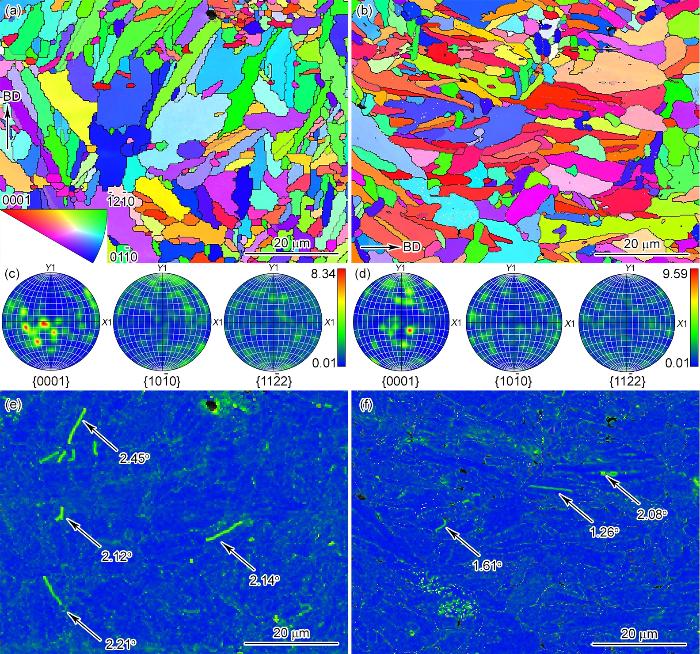
图6
EIGA和PREP方法制备的合金粉末经LPBF工艺(P = 50 W、 V = 600 mm/s)成形后块体试样的反极图、极图和局部取向差分布图
Fig.6
Inverse pole figures (a, b), pole figures (c, d), and kernel average misorientation figures (e, f) of LPBF bulk samples prepared via EIGA + LPBF (a, c, e) and PREP + LPBF (b, d, f) at P = 50 W, V = 600 mm/s (BD—building direction)
式中,θ'为局部取向差平均值,μ为扫描步长,b为Burgers矢量模(0.266 nm[21])。EIGA + LPBF和PREP + LPBF方法制备的块体试样的ρGND分别8.0 × 10¹⁵和6.8 × 10¹⁵ m-2。
2.4 拉伸和压缩性能
两种合金粉末经LPBF工艺(P = 50 W、 V = 600 mm/s)制备的块体试样的拉伸和压缩应力-应变曲线如图7所示。从图7a可见,两种试样的拉伸应力-应变曲线在弹性阶段高度重合,屈服强度和抗拉强度差异不大,但拉伸断裂应变差异显著。EIGA + LPBF方法制备的块体试样的拉伸屈服强度、抗拉强度和延伸率分别为(217.2 ± 5.3) MPa、(289.5 ± 10.5) MPa和3.3% ± 0.7%,PREP + LPBF方法制备的块体试样的拉伸屈服强度、抗拉强度和延伸率分别为(208.6 ± 7.8) MPa、(283.4 ± 7.1) MPa和21.8% ± 2.3%。压缩应力-应变曲线(图7b)与拉伸曲线变化趋势不同,随着应变的增加,压缩应力先急剧上升至300 MPa左右,之后随应变的增加应力缓慢持续地上升,当应变为60%时,两种试样的压缩应力都超过了750 MPa,且未发生断裂。两种试样的压缩应力-应变曲线变化趋势相似且重合度较高,EIGA + LPBF方法制备的块体试样的压缩屈服强度((288.2 ± 4.3) MPa)略高于PREP + LPBF方法制备的块体试样((258.5 ± 3.5) MPa),但两种试样的压缩屈服强度均明显大于拉伸时的屈服强度。
图7
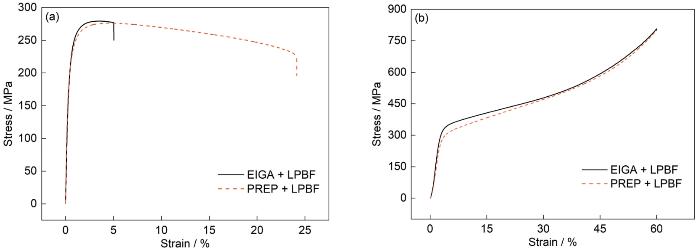
图7
EIGA和PREP方法制备的合金粉末经LPBF工艺(P = 50 W、 V = 600 mm/s)成形后块体试样的拉伸和压缩应力-应变曲线
Fig.7
Tensile (a) and compression (b) stress-strain curves of bulk samples prepared via EIGA + LPBF and PREP + LPBF at P = 50 W, V = 600 mm/s
图8
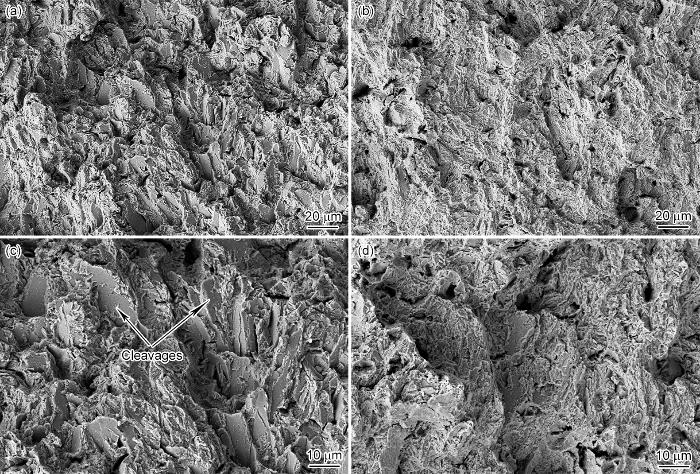
图8
EIGA和PREP方法制备的合金粉末经LPBF工艺(P = 50 W、 V = 600 mm/s)成形后块体试样拉伸断口的SEM像
Fig.8
Low (a, b) and high (c, d) magnified SEM images showing the tensile fracture surfaces of bulk samples prepared via EIGA + LPBF (a, c) and PREP + LPBF (b, d) at P = 50 W, V = 600 mm/s
3 分析与讨论
3.1 粉末熔融与凝固行为演化
在激光粉末床融合过程中,粉末的球形度、粒度和铺粉后的堆积情况显著影响后续的熔融和凝固的演化行为,最终出现不同的成形质量[22]。在每一层的铺粉过程中,粉末形貌球形度越好,其流动性也越好,粉末分布更加均匀,粉末床的整体堆积密度更高,这些都有助于粉末的均匀导热和均匀凝固[23~25]。EIGA方法制备的合金粉末形貌各异,球形度远不如PREP方法制备的合金粉末。在铺粉过程中,长条形等非球形粉末由于比表面积更大,在重力作用下,这些粉末之间黏附和相互摩擦的概率增大[26],这不仅影响周围其他粉末的流动,而且在激光熔融过程中由于存在较大堆垛孔隙,增加了气体进入熔池的概率[27],最终导致成形后的试样孔隙率较高。此外,更宽泛的粉末粒度范围有助于实现更高的堆积密度,更细粒度的粉末在铺粉过程中倾向于填充粗粉或中等粒度粉末之间的孔隙,从而实现更高的成形致密度[12,15]。相较而言,EIGA方法制备的合金粉末存在更多的细粉,尺寸小于15 µm的粉末占比约5%,PREP方法制备的合金粉末中尺寸小于30 µm的粉末占比不足5%。尽管理论上EIGA方法制备的粉末在铺粉过程中更容易实现高堆积度,但这是假设所有粉末为理想刚性球体的情况,实际上EIGA方法制备的粉末中存在许多长条形等不规则的粉末。另一方面,根据Coe和Pasebani[28]对316L不锈钢的研究结果可知,在采用更高功率的打印参数时,过细的粉末在熔融过程中发生汽化的可能性更高,而锌合金作为低熔点金属(汽化温度907 ℃左右[29]),在激光打印过程中汽化现象严重早已是行业共识。因此,在本工作中,在相同的打印参数工艺窗口中,球形度高、粉末粒度偏大的PREP方法制备的粉末具有更好的成形质量、更高的致密度和更宽泛的优质成形工艺窗口。在其他合金体系中,例如镍基高温合金,同样发现PREP方法制备的粉末相较于气体雾化(GA)方法制备的粉末具有更优的松装密度、更好的致密度、更稳定的成形质量和更宽泛的成形工艺窗口范围[15,30];此外,在钛合金中也发现当铺粉层厚度为30或60 µm时,球形度更好的粉末,其流动性、堆积密度和成形稳定性均要好于气雾化所制备的粉末[31]。
3.2 力学性能及强韧化分析
微观组织是影响材料力学性能的关键因素,微观组织的形成又与激光扫描过程中粉末的状态密切相关。图7的结果表明,粉末形貌对拉伸性能的影响更显著,具体体现在塑性(延伸率)方面,PREP方法制备粉末所打印的拉伸件具有超过20%的延伸率,而EIGA + LPBF方法制备的块体拉伸试样仅表现出3%左右的延伸率。另外,EIGA + LPBF方法制备的块体试样,除了压缩屈服强度较PREP + LPBF方法制备的块体试样高以外,其他指标差异并不显著。
两种粉末经LPBF工艺(P = 50 W、 V = 600 mm/s)制备的块体试样表现出相似的拉伸屈服强度和抗拉强度,分别超过了200和280 MPa,特别地,PREP + LPBF方法制备的块体试样的延伸率超过了20%,表现出高强塑性匹配,出色的力学性能在目前报道的增材制造可降解锌基合金的力学性能中独树一帜,已逐渐逼近临床上人体植入医用器械(骨板、骨钉等)的力学性能标准[32] (屈服强度超过230 MPa,抗拉强度超过300 MPa,延伸率超过15%~18%)。这源于Mn和Mg元素的添加,形成了大量MnZn13和Mg2Zn11等第二相,这些第二相一方面由于异质形核对Zn晶粒产生良好的细化作用[17,19],EIGA + LPBF和PREP + LPBF方法制备的块体试样的平均晶粒尺寸分别为(5.6 ± 2.2)和(4.6 ± 2.2) µm,这与本课题组之前报道的LPBF 制备纯Zn相比[19],细化效果接近10倍;另一方面,大量第二相在晶界和晶内形成,带来强烈的钉扎作用,如PREP + LPBF方法制备的块体试样的TEM表征结果(图9)所示,大量第二相颗粒(MnZn13和Mg2Zn11)断续、交替分布在晶界,晶内则主要为长条状、具有一定位相排布的MnZn13相,这些第二相在晶界和晶内起着双重强化作用[33,34],最终使得Zn-Mn-Mg合金获得接近300 MPa的高强度力学性能。此外,两种试样的压缩屈服强度均大于拉伸屈服强度。实际上,在hcp晶体结构的金属材料中,拉压不对称性现象[35~37]是客观存在的,且这种现象随着c / a比值 (c和a为晶格常数)的变化而有所差异。纯Zn的c / a比值约为1.856,显著大于理想hcp结构的c / a比值(1.633),因此在纯Zn中往往出现压缩屈服强度大于拉伸屈服强度的现象[37]。这主要是因为拉伸和压缩变形过程中所激活的滑移方式不同[37],拉伸时{10
图9
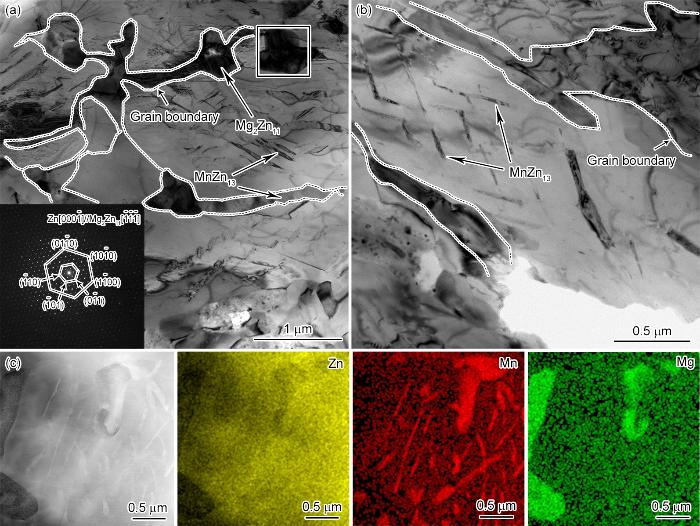
图9
PREP + LPBF方法制备的块体试样的TEM分析
Fig.9
Bright-field TEM images (a, b) and STEM image and corresponding EDS element mappings (c) of LPBF bulk samples prepared via PREPed powder (Inset in Fig.9a shows the SAED pattern of the rectangle area)
PREP + LPBF方法制备的块体拉伸试样的延伸率显著高于EIGA + LPBF方法制备的块体试样,这也与两种试样的微观组织密切相关。一般而言,激光快速凝固的微观组织易形成热裂纹和孔洞等缺陷,这些缺陷是影响材料力学性能的重要因素。然而,通过图2和3中的OM像可知,两种块体试样中均未观察到明显的裂纹,但存在明显的孔洞等缺陷。统计不同成形工艺下块体试样的致密度(图2a和3a),结果表明,当打印工艺参数为P = 50W、V = 600 mm/s时,PREP + LPBF和EIGA + LPBF方法制备的块体试样的致密度分别为99.93%和99.60%,表明这两种块体试样的孔隙率均小于0.5%,因此孔隙不是影响块体拉伸试样延伸率的主要因素。结合图1和6的结果可以看出,相较于球形度较低、粒径较小的EIGA制备粉末,经LPBF打印后,其对应块体试样的Zn晶粒平均尺寸为(5.6 ± 2.2) µm;而采用球形度更高、粒径更大的PREP制备粉末打印的块体试样,其Zn晶粒平均尺寸更小,为(4.6 ± 2.2) µm。这一结果与Chandra等[38]在316L不锈钢中发现的结果一致,这归因于即使在相同的能量密度下,球形度差的细粉对激光熔融过程中的热传导的阻碍作用相较于球形度好的粗粉要更大,从而在熔池边缘积聚大量热量,导致细粉打印试样的晶粒更粗。此外,不规则的粉末(如长条状的粉末)在打印过程中容易导致不均匀的热传导和更强烈的非平衡凝固[22,38],这极易在熔池边界或某些晶界处形成高度应变集中。如图6e所示,EIGA + LPBF方法制备的块体试样在某些晶界处的KAM值较高,平均几何必需位错密度也显著高于PREP + LPBF方法制备的块体试样。因此,在更大晶粒尺寸与更不均匀分布的应变分布的综合影响下,EIGA + LPBF方法制备的块体试样的塑性显著低于PREP + LPBF方法制备的块体试样。
4 结论
(1) 在低熔点可降解Zn-Mn-Mg合金的激光粉末床熔融制备过程中,球形度更好、粒度更大的PREP方法制备的粉末成形质量更高,优质成形工艺窗口大于EIGA方法制备的粉末。
(2) 两种合金粉末在致密度超过99.50%的成形工艺下制备的块体试样微观组织相似,EIGA + LPBF方法制备的块体试样部分晶界存在高应变区域,两种试样的第二相种类和分布无明显差异,但粒径更大的PREP方法制备的粉末所制备的块体试样的晶粒尺寸更小。
(3) 两种块体试样的强度无显著差异,但PREP + LPBF方法制备的块体试样的塑性明显高于EIGA + LPBF方法制备的块体试样,这源于PREP + LPBF方法制备的块体试样中更均匀的热传导和应变分布。
(4) PREP + LPBF方法制备的块体试样获得屈服强度超过200 MPa,抗拉强度超过280 MPa与延伸率超过20%的强塑性匹配组合,达到了目前临床人体植入医用器械的标准,展现出巨大的应用前景。
参考文献
Recent research and progress of biodegradable zinc alloys and composites for biomedical applications: Biomechanical and biocorrosion perspectives
[J].
Biodegradable metals (BMs) gradually degrade by releasing corrosion products once exposed to the physiological environment in the body. Complete dissolution of biodegradable implants assists tissue healing, with no implant residues in the surrounding tissues. In recent years, three classes of BMs have been extensively investigated, including magnesium (Mg)-based, iron (Fe)-based, and zinc (Zn)-based BMs. Among these three BMs, Mg-based materials have undergone the most clinical trials. However, Mg-based BMs generally exhibit faster degradation rates, which may not match the healing periods for bone tissue, whereas Fe-based BMs exhibit slower and less complete degradation. Zn-based BMs are now considered a new class of BMs due to their intermediate degradation rates, which fall between those of Mg-based BMs and Fe-based BMs, thus requiring extensive research to validate their suitability for biomedical applications. In the present study, recent research and development on Zn-based BMs are reviewed in conjunction with discussion of their advantages and limitations in relation to existing BMs. The underlying roles of alloy composition, microstructure, and processing technique on the mechanical and corrosion properties of Zn-based BMs are also discussed.© 2020 [The Author/The Authors].
Additive manufacturing of vascular stents
[J].With the advancement of additive manufacturing (AM), customized vascular stents can now be fabricated to fit the curvatures and sizes of a narrowed or blocked blood vessel, thereby reducing the possibility of thrombosis and restenosis. More importantly, AM enables the design and fabrication of complex and functional stent unit cells that would otherwise be impossible to realize with conventional manufacturing techniques. Additionally, AM makes fast design iterations possible while also shortening the development time of vascular stents. This has led to the emergence of a new treatment paradigm in which custom and on-demand-fabricated stents will be used for just-in-time treatments. This review is focused on the recent advances in AM vascular stents aimed at meeting the mechanical and biological requirements. First, the biomaterials suitable for AM vascular stents are listed and briefly described. Second, we review the AM technologies that have been so far used to fabricate vascular stents as well as the performances they have achieved. Subsequently, the design criteria for the clinical application of AM vascular stents are discussed considering the currently encountered limitations in materials and AM techniques. Finally, the remaining challenges are highlighted and some future research directions are proposed to realize clinically-viable AM vascular stents. STATEMENT OF SIGNIFICANCE: Vascular stents have been widely used for the treatment of vascular disease. The recent progress in additive manufacturing (AM) has provided unprecedented opportunities for revolutionizing traditional vascular stents. In this manuscript, we review the applications of AM to the design and fabrication of vascular stents. This is an interdisciplinary subject area that has not been previously covered in the published review articles. Our objective is to not only present the state-of-the-art of AM biomaterials and technologies but to also critically assess the limitations and challenges that need to be overcome to speed up the clinical adoption of AM vascular stents with both anatomical superiority and mechanical and biological functionalities that exceed those of the currently available mass-produced devices.Copyright © 2023. Published by Elsevier Ltd.
Zinc-based alloys for degradable vascular stent applications
[J].The search for biodegradable metals with mechanical properties equal or higher to those of currently used permanent biomaterials, such as stainless steels, cobalt chromium and titanium alloys, desirable in vivo degradation rate and uniform corrosion is still an open challenge. Magnesium (Mg), iron (Fe) and zinc (Zn)-based alloys have been proposed as biodegradable metals for medical applications. Over the last two decades, extensive research has been done on Mg and Fe. Fe-based alloys show appropriate mechanical properties, but their degradation rate is an order of magnitude below the benchmark value. In comparison, alongside the insufficient mechanical performance of most of its alloys, Mg degradation rate has proven to be too high in a physiological environment and corrosion is rarely uniform. During the last few years, Zn alloys have been explored by the biomedical community as potential materials for bioabsorbable vascular stents due to their tolerable corrosion rates and tunable mechanical properties. This review summarizes recent progress made in developing Zn alloys for vascular stenting application. Novel Zn alloys are discussed regarding their microstructural characteristics, mechanical properties, corrosion behavior and in vivo performance.Numerous studies on magnesium and iron materials have been reported to date, in an effort to formulate bioabsorbable stents with tailorable mechanical characteristics and corrosion behavior. Crucial concerns regarding poor ductility and remarkably rapid corrosion of magnesium, and very slow degradation of iron, seem to be still not desirably fulfilled. Zinc was introduced as a potential implant material in 2013 due to its promising biodegradability and biocompatibility. Since then, extensive investigations have been made toward development of zinc alloys that meet clinical benchmarks for vascular scaffolding. This review critically surveys the zinc alloys developed since 2013 from metallurgical and biodegradation points of view. Microstructural features, mechanical, corrosion and in vivo performances of these new alloys are thoroughly reviewed and evaluated.Copyright © 2018 Acta Materialia Inc. All rights reserved.
Microstructure tailoring in laser powder bed fusion (L-PBF): Strategies, challenges, and future outlooks
[J].
Alloy design and adaptation for additive manufacture
[J].
Additive manufacturing of biomaterials
[J].Biomaterials are used to engineer functional restoration of different tissues to improve human health and the quality of life. Biomaterials can be natural or synthetic. Additive manufacturing (AM) is a novel materials processing approach to create parts or prototypes layer-by-layer directly from a computer aided design (CAD) file. The combination of additive manufacturing and biomaterials is very promising, especially towards patient specific clinical applications. Challenges of AM technology along with related materials issues need to be realized to make this approach feasible for broader clinical needs. This approach is already making a significant gain towards numerous commercial biomedical devices. In this review, key additive manufacturing methods are first introduced followed by AM of different materials, and finally applications of AM in various treatment options. Realization of critical challenges and technical issues for different AM methods and biomaterial selections based on clinical needs are vital. Multidisciplinary research will be necessary to face those challenges and fully realize the potential of AM in the coming days.
Additively manufactured biodegradable metal implants
[J].
增材制造可降解金属医用植入物
[J].增材制造技术由于其高精度、高自由度等特点,可赋予医用金属植入物定制化的宏观与微观结构,使植入物与患者待修复缺损部位实现更好的生物力学适配,满足临床治疗个性化方案的需求,并为医用金属植入物的制造提供新途径。可降解金属目前是医用金属的研究热点,增材制造可降解金属医用植入物是个新方向,本文重点对增材制造镁基、锌基、铁基可降解金属的工艺流程及影响因素、力学性能、降解行为、生物相容性相关结果进行分析与总结,并展望了增材制造技术在医用可降解金属植入物领域的未来发展方向。
Additively manufactured biodegradable porous metals
[J].Partially due to the unavailability of ideal bone substitutes, the treatment of large bony defects remains one of the most important challenges of orthopedic surgery. Additively manufactured (AM) biodegradable porous metals that have emerged since 2018 provide unprecedented opportunities for fulfilling the requirements of an ideal bone implant. First, the multi-scale geometry of these implants can be customized to mimic the human bone in terms of both micro-architecture and mechanical properties. Second, a porous structure with interconnected pores possesses a large surface area, which is favorable for the adhesion and proliferation of cells and, thus, bony ingrowth. Finally, the freeform geometrical design of such biomaterials could be exploited to adjust their biodegradation behavior so as to maintain the structural integrity of the implant during the healing process while ensuring that the implant disappears afterwards, paving the way for full bone regeneration. While the AM biodegradable porous metals that have been studied so far have shown many unique properties as compared to their solid counterparts, the unprecedented degree of flexibility in their geometrical design has not yet been fully exploited to optimize their properties and performance. In order to develop the ideal bone implants, it is important to take advantage of the full potential of AM biodegradable porous metals through detailed and systematic study on their biodegradation behavior, mechanical properties, biocompatibility, and bone regeneration performance. This review paper presents the state of the art in AM biodegradable porous metals and is focused on the effects of material type, processing, geometrical design, and post-AM treatments on the mechanical properties, biodegradation behavior, in vitro biocompatibility, and in vivo bone regeneration performance of AM porous Mg, Fe, and Zn as well as their alloys. We also identify a number of knowledge gaps and the challenges encountered in adopting AM biodegradable porous metals for orthopedic applications and suggest some promising areas for future research.Copyright © 2020 Acta Materialia Inc. Published by Elsevier Ltd. All rights reserved.
Atomization processes of metal powders for 3D printing
[J].
Study on microstructure and mechanical properties of laser rapid forming Inconel 718
[J].
Porosity regrowth during heat treatment of hot isostatically pressed additively manufactured titanium components
[J].
Influence of the particle size distribution on surface quality and mechanical properties in AM steel parts
[J].
Property evaluation of 304L stainless steel fabricated by selective laser melting
[J].Additive manufacturing raw material cost has been recently confirmed as a significant obstacle to widespread deployment of these technologies in industry. Aiming at reducing the cost of the selective laser melting (SLM) process, the purpose of this paper is to evaluate the different properties of products fabricated by SLM using low‐cost ($10/Kg) feedstock 304L stainless steel powders. The entire process cost was also evaluated.
Influence of powder characteristics on processability of AlSi12 alloy fabricated by selective laser melting
[J].
Effect of metal powder characteristics on metallurgical quality of laser powder bed fusion additive manufacturing
[J].
金属粉末特征对激光粉末床熔融成形质量的影响
[J].
Influence of powder particle size distribution on microstructure and mechanical properties of 17-4 PH stainless steel fabricated by selective laser melting
[J].
Microalloyed Zn-Mn alloys: From extremely brittle to extraordinarily ductile at room temperature
[J].
Strengthening mechanism and biocompatibility of degradable Zn-Mn alloy with different Mn content
[J].
Mimicking the mechanical properties of cortical bone with an additively manufactured biodegradable Zn-3Mg alloy
[J].
Effect of multi-pass compression deformation on microstructure evolution of AZ80 magnesium alloy
[J].Magnesium alloy has a hexagonal close-packed crystal structure, and its plasticity is poor at room temperature. This is primarily due to the small number of movable slip systems at room temperature, which is prone to deformation texture. Therefore, temperature and compression deformation play an important role in the regulation of plastic deformation. In this work, AZ80 magnesium alloy was subjected to multi-pass compression deformation at a constant temperature and step-down temperature. The microstructure of the AZ80 magnesium alloy with different deformation degrees and deformation paths was observed and analyzed using EBSD. In addition, the grain boundary, dislocation density, Schmid factor, and polar figure evolution of the AZ80 magnesium alloy during hot compression deformation were primarily studied. Results show that the comprehensive effect of grain size, twinning, and texture on the plastic regulation of AZ80 magnesium alloy is better than that of single dynamic recrystallization. Moreover, three-time constant-temperature deformation (ε = 0.6) promotes dynamic recrystallization, whereas three-time step-cooling deformation (ε = 0.6) promotes plastic deformation. More 86°{101¯2} <12¯10> tensile twins are produced by reduced grain orientation difference, increased number of low-angle grain boundaries, and increased geometrically necessary dislocation density, which are important factors affecting the plastic regulation of three-time step-cooling deformation (ε = 0.6).
多道次压缩变形对AZ80镁合金微观组织演化的影响
[J].镁合金具有密排六方结构,可动滑移系少导致其室温塑性差,而热加工对调控镁合金塑性有重要作用。本工作对AZ80镁合金分别进行恒温、阶梯降温多道次压缩变形,利用电子背散射衍射(EBSD)技术观察分析了不同变形程度、不同变形路径下AZ80镁合金的微观组织,研究了AZ80镁合金热压缩变形过程中晶界、位错密度、Schmid因子和极图演化规律。结果表明:晶粒尺寸、孪晶、织构综合作用对AZ80镁合金塑性调控的影响优于单一动态再结晶对其塑性调控的影响,恒温三次变形(ε = 0.6) (3P)有利于发生动态再结晶,而阶梯降温三次变形(ε = 0.6) (3P)更有利于塑性变形。晶粒取向差减小、小角度晶界(LAGBs)数量增多、几何必需位错(GND)密度增加3者共同作用产生更多86°{101¯2} <12¯10>拉伸孪晶是影响阶梯降温三次变形塑性调控的重要因素。
Energetics of residual dislocations associated with slip-twin and slip-GBs interactions
[J].
Improved ductility by reducing powder size in laser powder bed fusion of AlSi10Mg
[J].
On thermal properties of metallic powder in laser powder bed fusion additive manufacturing
[J].
Model of radiation and heat transfer in laser-powder interaction zone at selective laser melting
[J].
Mesoscopic simulation of selective beam melting processes
[J].
A review of mechanical properties of additively manufactured Inconel 718
[J].
Impact of IN718 bimodal powder size distribution on the performance and productivity of laser powder bed fusion additive manufacturing process
[J].Bimodal powders of IN718 were obtained by adding a fine powder (D10-D90: 6.2-16.9 mu m) to a typical laser powder bed fusion (L-PBF) powder (coarse powder, D10-D90: 26.5-50.5 mu m) in various volume fractions. The fine powder was selected to generate an Alpha (Rosin-Rammler fit parameter) of 3.17 based on literature data and powder availability. The 83.75/16.25 Vol% of coarse/fine blend was chosen for the combination of reduced interparticle spacing/improved particle coordination number while retaining free flowing behavior. A new index, termed Raking Index (R), is defined to incorporate apparent density and Confined Specific Flow Energy as one parameter for assessing rakeability. Our results show that when R > 36 mJ/cm(3) IN718 forms a dense and rakeable powder bed. After L-PBF processing, the use of the 83.75/16.25 blend resulted in 10% increase in process productivity, higher IN718 tensile strength, and reduced mechanical anisotropy. (C) 2020 Elsevier B.V.
Use of bimodal particle size distribution in selective laser melting of 316L stainless steel
[J].Spherical powders with single-mode (D50 = 36.31 µm), and bimodal (D50,L = 36.31 µm, D50,s = 5.52 µm) particle size distribution were used in selective laser melting of 316L stainless steel in nitrogen atmosphere at volumetric energy densities ranging from 35.7–116.0 J/mm3. Bimodal particle size distribution could provide up to 2% greater tap density than single-mode powder. For low laser power (107–178 W), where relative density was <99%, bimodal feedstock resulted in higher density than single-mode feedstock. However, at higher power (>203 W), the density of bimodal-fed components decreased as the energy density increased due to vaporizing of the fine powder in bimodal distributions. Size of intergranular cell regions did not appear to vary significantly between single-mode and bimodal specimens (0.394–0.531 µm2 at 81–116 J/mm3). Despite higher packing densities in powder feedstock with bimodal particle size distribution, the results of this study suggest that differences in conduction melting and vaporization points between the two primary particle sizes would limit the maximum achievable density of additively manufactured components produced from bimodal powder size distribution.
Influence of laser energy input and shielding gas flow on evaporation fume during laser powder bed fusion of Zn metal
[J].
A comparative study on laser powder bed fusion of IN718 powders produced by gas atomization and plasma rotating electrode process
[J].
Influence of particle morphology and size distribution on the powder flowability and laser powder bed fusion manufacturability of Ti-6Al-4V alloy
[J].
The influence of alloying and fabrication techniques on the mechanical properties, biodegradability and biocompatibility of zinc: A comprehensive review
[J].Zinc has been identified as one of the most promising biodegradable metals along with magnesium and iron. Zinc appears to address some of the core engineering problems associated with magnesium and iron when applied to biomedical implant applications; hence the increase in the amount of research investigations on the metal in the last few years. In this review, the current state-of-the-art on biodegradable Zn, including recent developments, current opportunities and future directions of research are discussed. The discussions are presented with a specific focus on reviewing the relationships that exist between mechanical properties, biodegradability, and biocompatibility of zinc with alloying and fabrication techniques. This work hopes to guide future studies on biodegradable Zn that will help in advancing this field of research. STATEMENT OF SIGNIFICANCE: (i) The review offers an up-to-date and comprehensive review of the influence of alloying and fabrication technique on mechanical properties, biodegradability and biocompatibility of Zn; (ii) the work cites the most relevant biodegradable Zn fabrication processes including additive manufacturing techniques; (iii) the review includes a listing of research gap and future research directions for the field of biodegradable Zn.Copyright © 2019 Acta Materialia Inc. Published by Elsevier Ltd. All rights reserved.
Revealing the mechanical and degradation properties of the Zn-Cu-Ti alloy with ununiform heterostructure
[J].
300 MPa grade biodegradable high-strength ductile low-alloy (BHSDLA) Zn-Mn-Mg alloys: An in vitro study
[J].
Tension-compression asymmetry and the underlying slip/twinning activity in extruded Mg-Y sheets
[J].
A tomographic TEM study of tension-compression asymmetry response of pyramidal dislocations in a deformed Zr-2.5Nb alloy
[J].
Origin of high tension-compression yield asymmetry in as-extruded pure zinc
[J].


