



在双峰结构中,将具有较高持续应变硬化能力的大尺寸粗晶构成的域称为软域(soft zone),而硬化较差的细晶域称为硬域(hard zone)。一般而言,双峰结构的软域可分为三类:(1) 单个大尺寸晶粒(微米级)构成的域[13,15,19];(2) 多个大尺寸晶粒团簇形成的球状域[4,20,21];(3) 多个大尺寸晶粒并排形成的条状域[22]。对于均质结构来说,随晶粒尺寸降低、晶界占比增加,整体变形稳定性下降[23],导致局部颈缩和开裂的概率提升,拉伸塑性恶化;而双峰结构能够改善这种晶粒尺寸下降而导致的拉伸塑性降低,避免宏观颈缩的过早发生,保证了材料的强度与拉伸塑性的协同作用[6,24,25]。对于双峰结构来说,一般同时包含微米晶与纳米晶的组合,相比于均质结构,双峰结构在变形过程中软域(微米晶)被分配更多的应变,使域界面产生更大的应变梯度,增加位错塞积数量,在软域内形成了更大的背应力场,提升了软域及整体的强度[26~28]。也有研究[29,30]认为,几何必需位错(geometrically necessary dislocation,GND)的存在增加了晶内位错密度、缩短了位错滑移的平均自由程,使得软域具有更高的应变硬化能力。背应力的存在使得硬域在界面处存在与之相等的平衡力,即硬域内形成的前应力可激活在均质结构中难以开启的滑移系,使硬域中容纳更多的应变,增加整体的均匀变形能力,提高了材料的拉伸塑性[27,31~34]。实验研究发现,前应力不仅可促进硬域中特征应变带的形成,提升容纳应变[35~37],也能促进动态回复的发生[2],导致硬域的软化。
研究[38~40]发现,多数双峰结构材料仍遵循着“强度-拉伸塑性”倒置关系,仅通过实验方法难以对双峰异构组织进行高效设计和开发。基于此,Zhu等[27]和Li等[28]构建了双峰结构的细观力学模型,研究了晶粒的几何特征对背应力和综合力学性能的影响。Huang等[41]和Wang等[30]将硬域与软域之间的异构界面影响区引入材料的塑性本构关系,结合有限元方法研究了软域的几何特征对异构界面影响区占比和HDI效应的影响,结果表明,界面影响区在异构材料中的占比显著影响其力学性能。虽然上述模型提供了一些HDI效应的微观机理及其与异构组织和力学性能的关系,但目前并未构建出异构组织强化通用模型,以评估前应力对HDI效应及其整体力学性能的影响。
本工作主要基于Mori-Tanaka平均场方法,结合塑性应变梯度理论,构建细观力学异构模型;以双峰分布结构金属Cu (下文简称为双峰结构铜)为例,其中微米晶(尺寸约3 μm)作为软域粒子相、纳米晶(尺寸约230 nm)为硬域基体相,定量评估HDI效应对双峰结构铜拉伸力学行为的影响,并阐明微观变形的相关机制,据此提出双峰结构铜强塑兼备的组织设计方案。这些结果可为研究兼具高强塑性铜合金的异构组织设计提供理论指导。
1 模型描述
1.1 双峰结构异构基元平均场模型的几何建模
在细观力学平均场模型中,组成相可分为基体相和夹杂相,基体相是连续的,夹杂相被嵌入到基体中。以双峰结构铜为例,硬域(细晶)作为基体,软域(粗晶)作为夹杂相。硬域基体的相关变量记为下标“(0)”,软域夹杂的相关变量记为下标“(1)”,整体的相关变量记为下标“H”;二阶张量表示为“ a ”或“aij ”形式,四阶张量表示为“ A ”或“Aijkl ”形式。
平均场所需的几何模型建模过程如图1所示。具体步骤如下。
图1
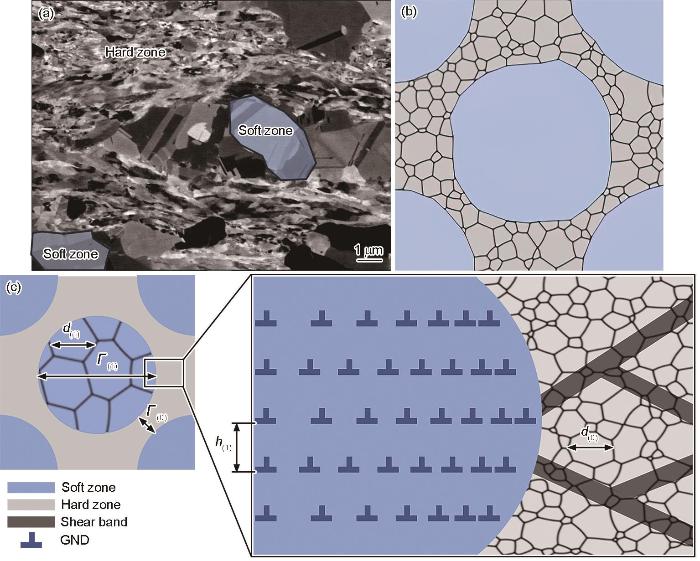
图1
双峰结构异构基元的几何建模
Fig.1
Geometric modelling of the basic structural units of bimodal structure
(a) SEM image for bimodal structure Cu
(b) schematic of grain boundary profile
(c) schematic of mean-field composite model based on spherical particulate phase simplification (GND—geometrically necessary dislocation; d(0)—grain size in hard zone, d(1)—grain size in soft zone, Γ(0)—average distance between the nearest neighbors of the soft zones, Γ(1)—soft zone size, h(1)—spacing between neighboring pileups in soft zone)
(1) 金属Cu部分再结晶的双峰组织如图1a所示。其中,再结晶长大的大尺寸晶粒所形成的区域为软域,其均匀分布在未再结晶的小尺寸晶粒构成的硬域基体中,构成双峰结构的异构基元;由于退火时间较短,软域含量较少,可视为硬域充分包围着软域,由此可将连续分布的硬域作为基体。
(4) 当球形软域均匀分布时,图1c展示的最小基础单元的尺寸为
式中,
1.2 基于位错密度的均质结构材料的本构模型
根据经典塑性理论,应变(
式中,
式中,
式中,
式中,k*为比例系数;
1.3 双峰结构异构基元的Mori-Tanaka平均场模型框架
式中,
式中,
式中,
此时,两域应变的差值,即扰动应变(
将其写为正应变和偏应变形式分别为:
根据平均应变定理[54],异构基元整体的正应变和偏应变可表示为两域内应变的加权平均值,从而有:
显然,对于均匀材料,各相以及整体的应力-应变关系都有
Weng[43]对比了割线模量方法与纯弹性方法(即基体和夹杂都采用
基于割线模量法,在单轴拉伸状态下,经过割线处理后,材料的割线Young's模量
在弹性状态下,
1.4 基于位错理论的双峰结构异构基元的受力分析及本构方程
图2
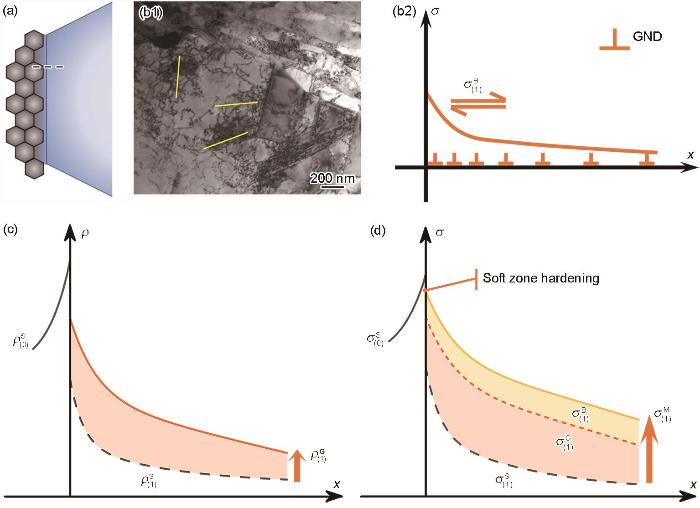
图2
软域硬化示意图
Fig.2
Schematics of soft zone hardening (
(a) schematic of the microstructure near the hetero-zone boundary
(b1, b2) TEM image of dislocation pile-ups within the soft zone (b1)[22] and schematic of GND distribution (b2) (The yellow lines are pile-ups of GNDs in a recrystallized grain after tensile deformation for a strain of 5%)
(c, d) dislocation density variation (c) and stress variation (d) near the black horizontal line at the hetero-zone boundaries in Fig.2a due to mismatch strengthening
由于
基于实验结果,本工作通过三个步骤将两域间协调变形机制引入平均场模型,建立了异构基元的本构关系,具体分析如下。
随着软域塑性变形的进行,其内GNDs的增殖与湮灭逐渐趋于平衡[64]。软域中GNDs由域间塑性剪切应变差
式中,
式中,
图3

图3
硬域软化示意图
Fig.3
Schematics of hard zone softening (
(a) dislocation evolution near hard/soft regions during plastic deformation (SSD—statistically stored dislocation)
(b, c) dislocation density variation (b) and stress variation (c) near the hetero-zone boundaries due to strain path change
塞积位错前端作用于硬域的应力构成了一部分前应力,由该应力(τ
式中,
(3) 硬/软域应力再协调。随着塑性变形的进一步发生,软域硬化和硬域软化并不足以持续协调硬域内的局部应力集中状态。软/硬域应当还存在由上述两种机制的引入而引发的再协调机制,从而保证协同变形的持续进行,而本工作依靠变形带的演变实现这一过程。
基于实验发现,双峰结构铜界面附近的硬域内会形成非等轴状的位错胞(微变形带),这些变形软带以叠加排列的形式扩展时会形成一种更宽的条带状变形区,即剪切带[19,70];而软域的存在可稳定这些本应失稳而快速扩展的剪切带,促进了大量且分散的剪切带在硬域中形成[71~73],如图4a[19]所示。这些剪切带内复杂的应力状态可激活在均质结构中难启动的变形机制,实现了去应变局域化;其在容纳更多应变的同时也为硬域带来了额外的应变硬化。剪切带内部位错由SSD和GND构成,在实验中观测到的高应变区多数由GND提供[74],其密度记为
图4
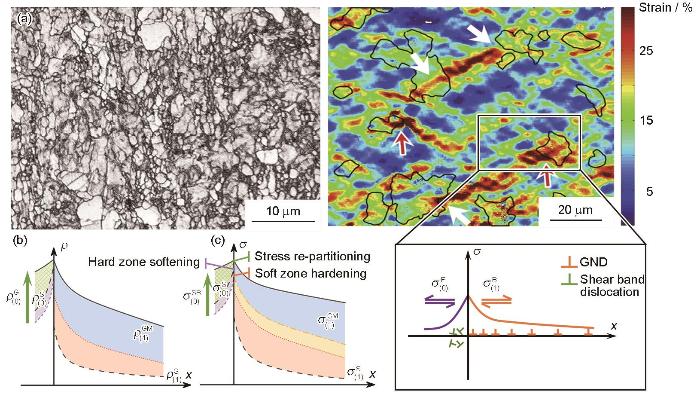
图4
应力再协调示意图
Fig.4
Schematics of stress re-partitioning (
(a) EBSD image of bimodal structure Cu and its strain maps with 13.54% strain (The solid lines outline the boundaries of soft zones)[19]
(b, c) dislocation density variation (b) and stress variation (c) near the hetero-zone boundaries after inter-zone stress re-partitioning
(1) 基于剪切带强化的硬域本构。
式中,上标“SB”表示剪切带;
式中,
(2) 失配强化的软域本构。随着塑性应变的进行,软域内的GNDs密度逐渐上升,这些位错所描述的局部晶格失配同样阻碍了内部SSDs的滑移[30],因而
式中,
综上所述,基于
因而,在单轴拉伸过程中,均匀牵引力边界条件下,拉伸方向的应力
1.5 异质变形诱导强化与应变硬化效应
此外,在本工作的断裂判据中,基元颈缩点对应的抗拉强度与均匀延伸率采用如下的Considère准则[76]进行计算:
式中,
综上,本工作基于Mori-Tanaka平均场方法,结合塑性应变梯度与位错理论,将塑性变形过程中产生的HDI效应以软域硬化、硬域软化和应力再协调三个阶段引入各相的本构关系中,最终构建出双峰结构细观力学模型的框架,如图5所示。
图5
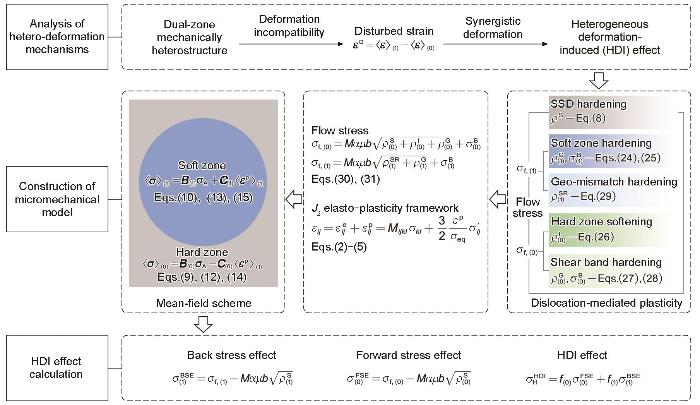
图5
双峰结构细观力学模型的框架
Fig.5
The framework of the micromechanics model for the bimodal structure (
2 模拟结果与讨论
2.1 双峰结构铜中异构基元的力学分析
表1 双峰结构铜的材料和模拟参数
Table 1
| Parameter type | Symbol | Unit | Parameter value | Note | |
|---|---|---|---|---|---|
| Hard zone | Soft zone | ||||
| Elastic modulus | E | GPa | 121.1 | 121.1 | 1* |
| Shear modulus | μ | GPa | 45.2 | 45.2 | |
| Poisson's ratio | v | - | 0.34 | 0.34 | |
| Burgers vector magnitude | b | nm | 0.256 | 0.256 | |
| Taylor factor | M | - | 3.06 | 3.06 | |
| Taylor constant | - | 0.33 | 0.33 | ||
| Rate sensitivity exponent | m | - | 20 | 20 | |
| Initial dislocation density | m-2 | 6.7 × 10¹⁴ | 1.89 × 10¹³ | 2* | |
| Geometric factor | - | 2.20 | 0.08 | ||
| Proportionality factor | - | 0.150 | 0.013 | ||
| Dynamic recovery factor | - | 39.8 | 1.31 | ||
| Size of zone | μm | - | 6 | ||
| Dislocation pileup spacing | nm | 15 | 42 | 3* | |
| Dynamic recovery factor of GNDs | - | 7 | |||
| Stress attenuation factor | λ | - | 0.1 | ||
| Saturation accumulated shear strain | - | 0.20 | - | ||
图6
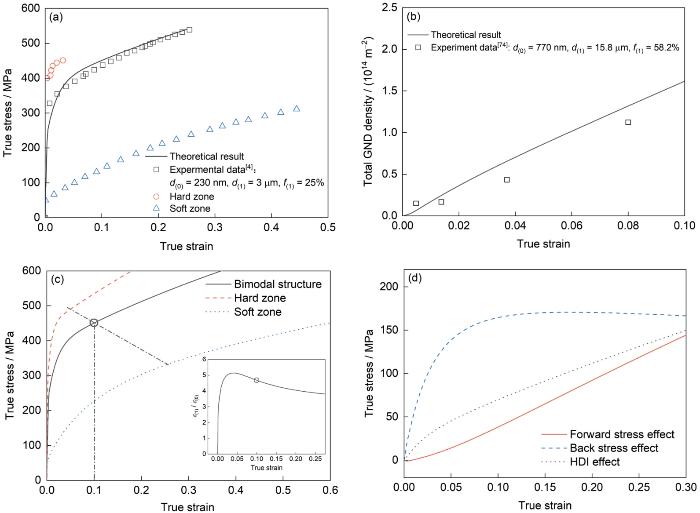
图6
双峰结构铜平均场模型的模拟结果及与实验值[4,74]的比较
Fig.6
Predicted results from the mean-field model for bimodal structure Cu during tensile loading (ε(0) and ε(1)—strains in hard zone and soft zone, respectively) and comparision with experiment results[4,74]
(a, b) comparison of the stress-strain relationship (a) and the GND density evolution (b) between the experiments[4,74] and theoretical results for bimodal structure Cu
(c) stress-strain curves and strain partitioning of each zone (inset) in bimodal structure Cu
(d) evaluation of hardening caused by HDI effect
图6c为拉伸过程中双峰结构铜内各域的应力-应变响应,虚线表示当外加应变为10%时,各域的应变分配状态。从软/硬域的应变比
2.2 HDI效应对双峰结构铜力学行为的影响
将双峰结构铜中HDI效应的各类强化、软化作用分成T1~T6项,研究各项对力学性能的贡献,基于
表2 考虑不同影响因素的本构方程
Table 2
| No. | Stress component | Constitutive equation | |
|---|---|---|---|
| T1 | With HDI effect | ||
| T2 | Without HDI effect | ||
| T3 | Without forward stress (FS) effect | ||
| T4 | Without hard zone softening | ||
| T5 | Without shear band hardening | ||
| T6 | Without compensating dislocation effect | ||
图7对比了不同HDI效应项的计算结果。当忽略HDI效应后(T2),延伸率降低了16.5%,表明HDI效应有效提升了双峰结构铜的应变硬化能力。当忽略前应力效应后(T3),延伸率下降了17.5%;由此可见,前应力效应是提升延伸率的主要因素,占据了整体延伸率的70.0%。在依次剔除硬域软化、剪切带强化、失配强化等作用后(T4~T6),延伸率分别下降了1.2%、18.0%、1.0%,说明硬域内的剪切带强化是HDI效应中提升延伸率的主要因素。
图7
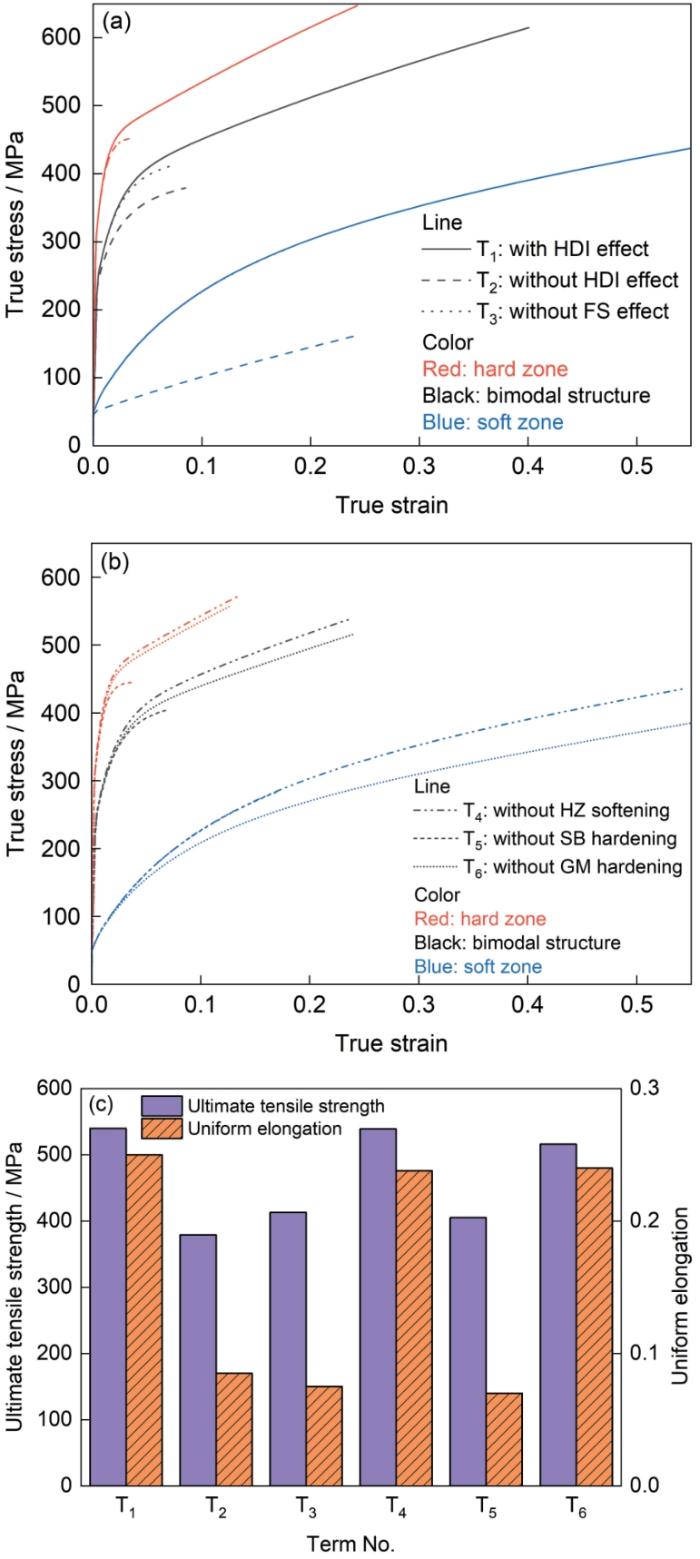
图7
双峰结构铜中各类强化/软化单一因素对力学性能的影响
Fig.7
Influences of strengthening/softening effects on the mechanical properties in bimodal structure Cu
(a, b) theoretical results of stress-strain curves for T1-T3 (a) and T4-T6 (b) considering various hardening and softening factors (HZ—hard zone, SB—shear band, GM—geo-mismatch)
(c) effect of different factors on ultimate tensile strength and uniform elongation
以上结果表明,在设计双峰结构时,软域作为夹杂相,主要作用是协调变形;硬域作为基体,其应变硬化行为显著影响整体的力学性能。硬域与软域的相对强度差异越大,软域承担的应变越多,则可以更好地保护硬域。此外,更软的软域具有更低的裂纹驱动力和更高的裂纹抵抗力,对裂纹扩展的抑制效果越好[84],进而促进硬域内剪切带的稳定扩展。
2.3 软域的体积含量对双峰结构铜力学性能的影响
为了进一步定量评估软域体积分数对双峰结构铜力学性能的影响,通过改变软域的体积分数(5%~65%),计算了不同软域体积分数下双峰结构铜的屈服强度和均匀延伸率。为了便于与实验值比较,将计算结果转换为工程应力/应变,计算结果如图8所示。
图8
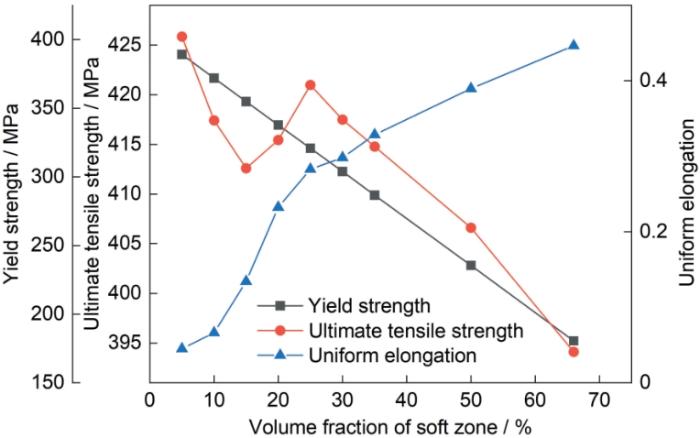
图8
当软域体积分数为5%~65%时,双峰结构铜的屈服强度、抗拉强度、均匀延伸率的变化趋势
Fig.8
Variations of yield strength, ultimate tensile strength, and uniform elongation of bimodal structure Cu when the volume fraction of the soft zone is 5%~65%
需要指出的是,本工作模型均建立在“软域在硬域中均匀分布”假设,根据
图9
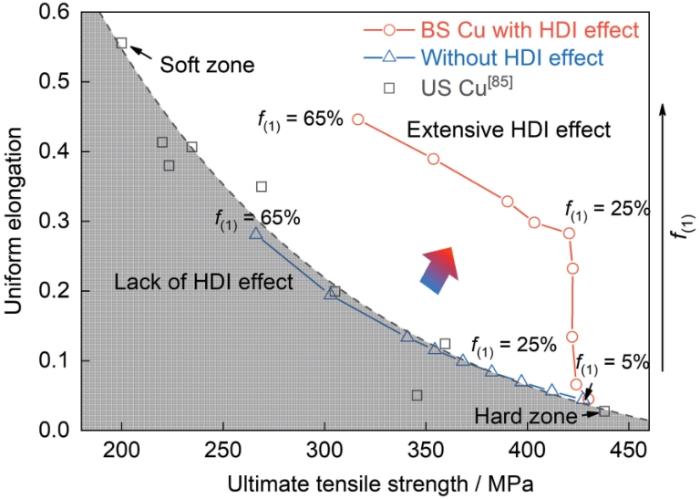
图9
双峰结构铜的强度-拉伸塑性关系图
Fig.9
Predicted strength-ductility map for Cu (BS—bimodal structure, US—uniform structure)
3 结论
(1) 基于Mori-Tanaka平均场方案结合位错理论,建立了双峰结构金属铜异构基元的细观力学模型,其中大尺寸微米级晶粒(3 μm)作为软域,小尺寸纳米级晶粒(230 nm)作为硬域。与拉伸实验数据相比,其整体应力误差小于5%,验证了模型的有效性。
(2) 提出了将塑性变形过程中产生的HDI效应以软域硬化、硬域软化和应力再协调三个阶段引入各相的本构关系中,可定量地评估HDI效应对双峰结构材料整体力学行为的影响。
(3) 模拟结果表明,当硬域完全包裹软域时,计算出的硬域软化与强化对协调异构组织变形的作用约占70.0%,因此HDI效应主要取决于前应力效应,硬域内的剪切带强化是HDI效应中提升延伸率的主要因素。
(4) 随着硬域体积分数的增加,前应力的作用减弱,整体强度增加而拉伸塑性下降;在软域体积分数为25%~30%时,存在强塑匹配最佳的峰值,双峰结构铜的抗拉强度为417~420 MPa、延伸率为28.2%~29.8%,相较于均质细晶,强度降低约7%、拉伸塑性提高约10倍,相较均质粗晶,强度提高了约100%,拉伸塑性降低约50%。
参考文献
Heterostructured materials
[J].
Heterostructured metallic materials: Plastic deformation and strain hardening
[J].
Strong and tough metallic materials are desired for light-weight structural applications in transportation and aerospace industries. Recently, heterostructures have been found to possess unprecedented strength-and-ductility synergy, which is until now considered impossible to achieve. Heterostructured metallic materials comprise heterogeneous zones with dramatic variations (> 100%) particularly in mechanical properties. The interaction in these hetero-zones produces a synergistic effect wherein the integrated property exceeds the prediction by the rule-of-mixtures. More importantly, the heterostructured materials can be produced by current industrial facilities at large scale and low cost. The superior properties of heterostructured materials are attributed to the heterodeformation induced (HDI) strengthening and strain hardening, which is produced by the piling-up of geometrically necessary dislocations (GNDs). These GNDs are needed to accommodate the strain gradient near hetero-zone boundaries, across which there is high mechanical incompatibility and strain partitioning. This paper classifies the types of heterostructures and delineates the deformation behavior and mechanisms of heterostructured materials.
异构金属材料及其塑性变形与应变硬化
[J].金属材料异构(heterostructure)是将具有显著流变应力差异的软硬相间区域作为基元进行有序构筑而成的微观组织,是旨在提高应变硬化能力和拉伸塑性的微结构设计策略,迄今应用于各种金属结构材料并获得了强度与塑性/韧性等力学性能的优异匹配。异构策略的出发点是其特征的力学响应,即塑性变形时在异构基元界面形成的应变梯度,异构的特征应力应变响应是力学迟滞环。相比均质结构中主导的林位错塑性和林硬化,异构为了协调界面应变梯度而产生几何必需位错,新增了基于几何必需位错的异质塑性变形并引起额外的应变硬化与额外的强化。本文综述了近期异构金属材料的研究进展,首先定义了异构中基元并据此把异构分类为基元异构、亚基元异构以及复合异构,随后分析并讨论了异构塑性变形时界面和位错等微结构演化,以及异质塑性变形、应变硬化和强化行为,最后展望了异构提升宏观力学性能匹配的潜力。
Mechanical behavior and microstructure of a thermally stable bulk nanostructured Al alloy
[J].
High tensile ductility in a nanostructured metal
[J].
Effect of thermal annealing on mechanical properties of a nanostructured copper prepared by means of dynamic plastic deformation
[J].
Deformation mechanisms and strain rate sensitivity of bimodal and ultrafine-grained copper
[J].Materials with ultrafine grain size in the range from 100 nm to 1 mu m exhibit very high strength paired with a satisfactory ductility when compared to their coarse grained (CG) counterparts. Although this typical behavior is already well known, the dominating deformation mechanisms are still controversially discussed in literature. One idea to explain the deformation behavior of ultrafine-grained metals is that deformation is mainly triggered by grain boundary sliding. Another explanation is that deformation in ultrafine-grained materials is controlled by the thermally activated dislocation annihilation of dislocations at grain boundaries. To gain deeper insights to the relevant deformation mechanisms in UFG metals a systematic study was conducted where the deformation behavior of UFG and bimodal copper (consisting of UFG and CG grains) is compared to the behavior of their CG counterparts. The UFG microstructure was obtained by equal channel angular pressing (ECAP). To achieve a bimodal or coarsened microstructure, specimens were annealed at 125 degrees C or, respectively, at 140 degrees C subsequent to the ECAP-process. Mechanical characterization and investigation on the strain-rate sensitivity were done by compression strain-rate jump tests at room-temperatures and elevated temperatures. It turned out clearly that the degree of bimodality determines the dominant deformation mechanism and the strain-rate sensitivity. In the UFG-state thermally activated annihilation of dislocations at the grain boundaries govern the mechanical behavior. For the bimodal microstructure the annihilation of dislocation at the interface of coarsened grains to the surrounding ultrafine-grained matrix dominate the mechanical behavior. For the fully coarsened state plastic deformation is mainly governed by dislocation interaction in the grain interior. In this regime, annihilation at grain boundaries plays only a minor role. (C) 2020 Acta Materialia Inc. Published by Elsevier Ltd.
Mechanical properties of nanocrystalline and ultrafine-grained nickel with bimodal microstructure
[J].
Microstructural evolution and mechanical characteristics in nanocrystalline nickel with a bimodal grain-size distribution
[J].
Plastic deformation of a nanostructured and ultra-fine grained Fe-1%Cr with a bimodal grain size distribution
[J].
Plastic deformation and fracture of ultrafine-grained Al-Mg alloys with a bimodal grain size distribution
[J].
Tensile deformation and fracture mechanism of bulk bimodal ultrafine-grained Al-Mg alloy
[J].
Microstructure, plastic deformation and strengthening mechanisms of an Al-Mg-Si alloy with a bimodal grain structure
[J].
Mechanical properties of Mg-8Gd-3Y-0.5Zr alloy with bimodal grain size distributions
[J].
Deformation behavior of ultra-strong and ductile Mg-Gd-Y-Zn-Zr alloy with bimodal microstructure
[J].
The synergy effect of fine and coarse grains on enhanced ductility of bimodal-structured Mg alloys
[J].
Exploring the Hall-Petch relation and strengthening mechanism of bimodal-grained Mg-Al-Zn alloys
[J].
High strength and ductility Mg-8Gd-3Y-0.5Zr alloy with bimodal structure and nano-precipitates
[J].To resolve the strength-ductility trade-off problem for high-strength Mg alloys, we prepared a high performance Mg-8Gd-3Y-0.5 Zr (wt%) alloy with yield strength of 371 MPa, ultimate tensile strength of 419 MPa and elongation of 15.8%. The processing route involves extrusion, pre-deformation and aging, which leads to a bimodal structure and nano-precipitates. Back-stress originated from the deformation-incompatibility in the bimodal-structure alloy can improve ductility. In addition, dislocation density in coarse grains increased during the pre-deformation strain of 2%, and the dislocations in coarse grains can promote the formation of chain-like nano-precipitates during aging treatment. The chain-like nano-precipitates can act as barriers for dislocations slip and the existing mobile dislocations enable good ductility.
Improving mechanical properties of heterogeneous Mg-Gd alloy laminate via accumulated extrusion bonding
[J].
Heterostructure induced dispersive shear bands in heterostructured Cu
[J].
Improvement of strength with maintaining ductility of harmonic structure pure copper by cold rolling and annealing process
[J].
Additional hardening in harmonic structured materials by strain partitioning and back stress
[J].
Heterogeneous lamella structure unites ultrafine-grain strength with coarse-grain ductility
[J].Grain refinement can make conventional metals several times stronger, but this comes at dramatic loss of ductility. Here we report a heterogeneous lamella structure in Ti produced by asymmetric rolling and partial recrystallization that can produce an unprecedented property combination: as strong as ultrafine-grained metal and at the same time as ductile as conventional coarse-grained metal. It also has higher strain hardening than coarse-grained Ti, which was hitherto believed impossible. The heterogeneous lamella structure is characterized with soft micrograined lamellae embedded in hard ultrafine-grained lamella matrix. The unusual high strength is obtained with the assistance of high back stress developed from heterogeneous yielding, whereas the high ductility is attributed to back-stress hardening and dislocation hardening. The process discovered here is amenable to large-scale industrial production at low cost, and might be applicable to other metal systems.
Stabilizing nanograins in metals with grain boundary relaxation
[J].
The grain size effect on strain hardening and necking instability revisited from the dislocation density evolution approach
[J].
Critical grain size for dislocation storage and consequences for strain hardening of nanocrystalline materials
[J].
Heterogeneous materials: A new class of materials with unprecedented mechanical properties
[J].
Modelling the plastic deformation of nanostructured metals with bimodal grain size distribution
[J].
Revealing extra strengthening and strain hardening in heterogeneous two-phase nanostructures
[J].
Unraveling the origin of extra strengthening in gradient nanotwinned metals
[J].
Hetero-zone boundary affected region: A primary microstructural factor controlling extra work hardening in heterostructure
[J].
An overview of tailoring strain delocalization for strength-ductility synergy
[J].
Shear instability in heterogeneous nanolayered Cu/Zr composites
[J].
Plastic accommodation during tensile deformation of gradient structure
[J].
Unraveling the strength-ductility synergy of heterostructured metallic materials from the perspective of local stress/strain
[J].The concurrent enhancement of strength and ductility is an unremitting pursuit in metallic material research. Recently, by deliberately controlling the spatial distribution of domains with substantially different mechanical properties, heterostructured architecture has overcome the limitation of strength-ductility synergy in metallic materials. Mainstream theories, such as hetero-deformation-induced hardening, strain partition, premature local necking delay, and interface affected zone, have provided crucial guidance for the designing of preferable heterostructured metallic materials. These theories suggest that the domains of heterostructured metallic materials present unique local stress and strain characteristics upon loading, accompanying deformation and fracture behaviors that deviate from the predictions of classical theories. In this study, the evolutions of local stress and strain during the early deformation, plastic deformation, and fracture stages of heterostructured metallic materials were reviewed. Moreover, interactions between deformation or fracture behaviors and local stress or strain as well as their effects on mechanical properties are summarized, presenting a new perspective for designing and developing high-performance heterostructured metallic materials.
从局域应力/应变视角理解异构金属材料的强韧化行为
[J].同步提升强度与塑性是金属材料研究的不懈追求之一。近年来,异构设计通过调控力学性质存在显著差异的组元相的空间分布,突破了金属材料强度与塑性难兼得的瓶颈。异构变形诱导强化、应变分配、延迟颈缩、界面影响区等主流理论为异构金属材料设计提供了有力指导,上述理论均指出,在受载过程中,异构金属材料组元相的局域应力与局域应变存在独特特征,并伴随偏离经典理论预测的变形和断裂行为。本文综述了异构金属材料在早期变形阶段、塑性变形阶段和断裂阶段中局域应力和局域应变演化,归纳了异构金属材料中变形行为、断裂行为与局域应力、局域应变的交互关系及对力学性能的影响,为高性能异构金属材料的设计和研发提供新的思路。
Homogenization of plastic deformation in heterogeneous lamella structures
[J].
What are the “dispersive shear bands” on the surfaces of layered heterostructured materials?
[J].
Dense dispersed shear bands in gradient-structured Ni
[J].
Extreme grain refinement by severe plastic deformation: A wealth of challenging science
[J].
Significant improvement in yield stress of Mg-Gd-Mn alloy by forming bimodal grain structure
[J].
Cyclic deformation behavior of a 316L austenitic stainless steel processed by high pressure torsion
[J].
Interface affected zone for optimal strength and ductility in heterogeneous laminate
[J].
A statistical model for predicting the mechanical properties of nanostructured metals with bimodal grain size distribution
[J].
The overall elastoplastic stress-strain relations of dual-phase metals
[J].
Structure-property optimization of ultrafine-grained dual-phase steels using a microstructure-based strain hardening model
[J].
Taylor-based nonlocal theory of plasticity
[J].
Zur kristallplastizität. III: Über den mechanismus des gleitvorganges
[J].
The mechanism of plastic deformation of crystals. Part I.—Theoretical
[J].
Dislocation-mechanics-based constitutive relations for material dynamics calculations
[J].An improved description of copper- and iron-cylinder impact (Taylor) test results has been obtained through the use of dislocation-mechanics-based constitutive relations in the Lagrangian material dynamics computer program EPIC-2. The effects of strain hardening, strain-rate hardening, and thermal softening based on thermal activation analysis have been incorporated into a reasonably accurate constitutive relation for copper. The relation has a relatively simple expression and should be applicable to a wide range of fcc materials. The effect of grain size is included. A relation for iron is also presented. It also has a simple expression and is applicable to other bcc materials but is presently incomplete, since the important effect of deformation twinning in bcc materials is not included. A possible method of acounting for twinning is discussed and will be reported on more fully in future work. A main point made here is that each material structure type (fcc, bcc, hcp) will have its own constitutive behavior, dependent on the dislocation characteristics for that particular structure.
A comparative review of multiscale models for effective properties of nano- and micro-composites
[J].
Average stress in matrix and average elastic energy of materials with misfitting inclusions
[J].
A new approach to the application of Mori-Tanaka's theory in composite materials
[J].
A micromechanical model for heterogeneous nanograined metals with shape effect of inclusions and geometrically necessary dislocation pileups at the domain boundary
[J].
A theory of the plastic distortion of a polycrystalline aggregate under combined stresses
[J].
Eliminating deformation incompatibility in composites by gradient nanolayer architectures
[J].Composite materials usually possess a severe deformation incompatibility between the soft and hard phases. Here, we show how this incompatibility problem is overcome by a novel composite design. A gradient nanolayer-structured Cu-Zr material has been synthesized by magnetron sputtering and tested by micropillar compression. The interface spacing between the alternating Cu and Zr nanolayers increases gradually by one order of magnitude from 10 nm at the surface to 100 nm in the centre. The interface spacing gradient creates a mechanical gradient in the depth direction, which generates a deformation gradient during loading that accumulates a substantial amount of geometrically necessary dislocations. These dislocations render the component layers of originally high mechanical contrast compatible. As a result, we revealed a synergetic mechanical response in the material, which is characterized by fully compatible deformation between the constituent Cu and Zr nanolayers with different thicknesses, resulting in a maximum uniform layer strain of up to 60% in the composite. The deformed pillars have a smooth surface, validating the absence of deformation incompatibility between the layers. The joint deformation response is discussed in terms of a micromechanical finite element simulation.
Deformation incompatibility enables hetero-deformation induced strengthening in Ti/Nb laminates
[J].
Indentation size effects in crystalline materials: A law for strain gradient plasticity
[J].
On the origin of the tensile flow stress in the stainless steel AISI 316L at 300 K: Back stress and effective stress
[J].
Back stress strengthening and strain hardening in gradient structure
[J].
In-situ observation of dislocation dynamics near heterostructured interfaces
[J].There has been a long-standing controversy on how dislocations interact with interfaces. Here we report in-situ observations that in a Cu-brass heterostructured TEM film Frank-Read sources are the primary dislocation sources. They were dynamically formed and deactivated throughout the deformation in grain interior, which has never been reported before. This observation indicates that strain gradient near interfaces cannot be quantitatively related to the density gradient of geometrically necessary dislocations, and it was primarily produced by Frank-Read source gradient instead of dislocation pile-ups. These findings provide new insights on how to design heterostructured interfaces to enhance mechanical properties. [GRAPHICS]
Forward and reverse rearrangements of dislocations in tangled walls
[J].
Micromechanical crystal plasticity back stress evolution within FCC dislocation substructure
[J].
Stability of the work hardened state against stress reversal in copper single crystals
[J].
Extraordinary strain hardening by gradient structure
[J].Gradient structures have evolved over millions of years through natural selection and optimization in many biological systems such as bones and plant stems, where the structures change gradually from the surface to interior. The advantage of gradient structures is their maximization of physical and mechanical performance while minimizing material cost. Here we report that the gradient structure in engineering materials such as metals renders a unique extra strain hardening, which leads to high ductility. The grain-size gradient under uniaxial tension induces a macroscopic strain gradient and converts the applied uniaxial stress to multiaxial stresses due to the evolution of incompatible deformation along the gradient depth. Thereby the accumulation and interaction of dislocations are promoted, resulting in an extra strain hardening and an obvious strain hardening rate up-turn. Such extraordinary strain hardening, which is inherent to gradient structures and does not exist in homogeneous materials, provides a hitherto unknown strategy to develop strong and ductile materials by architecting heterogeneous nanostructures.
Overview No.76: Mechanism of deformation and development of rolling textures in polycrystalline f.c.c. Metals—III. The influence of slip inhomogeneities and twinning
[J].
Shear band stability and uniform elongation of gradient structured material: Role of lateral constraint
[J].
Mechanical response of the constrained nanostructured layer in heterogeneous laminate
[J].
Activating dispersed strain bands in tensioned nanostructure layer for high ductility: The effects of microstructure inhomogeneity
[J].
Superior strength-ductility synergy in three-dimensional heterogeneous-nanostructured metals
[J].
Geometrically necessary dislocation and size-dependent plasticity
[J].
Catastrophic thermoplastic shear
[J].Dynamic plastic behavior of materials is influenced by internally generated temperature gradients. These gradients are a function of thermophysical properties as well as strain rate and shear strength. Criteria are presented for the prediction of catastrophic shear in materials. Catastrophic shear occurs when the local rate of change of temperature has a negative effect on strength which is equal to or greater than the positive effect of strain-hardening. Catastrophic slip is an influential deformation mechanism during high-speed machining and ballistic impact. Structural failure may occur during dynamic loading of components which are designed without regard to the specific sensitivity of certain materials to catastrophic shear.
Evolution of microstructure and shear-band formation in α-hcp titanium
[J].
Dislocation mechanics aspects of plastic instability and shear banding
[J].
Shear localization in dynamic deformation: Microstructural evolution
[J].
Extraordinary Bauschinger effect in gradient structured copper
[J].
Effect of bimodal grain size and gradient structure on heterogeneous deformation induced (HDI) stress and mechanical properties of Cu
[J].
Heterogeneous evolution of lattice defects leading to high strength and high ductility in harmonic structure materials through atomic and dislocation simulations
[J].
Temperature-dependent reversed fracture behavior of multilayered TiBw/Ti-Ti(Al) composites
[J].
Two-stage Hall-Petch relationship in Cu with recrystallized structure
[J].Although Cu was studied extensively, the Hall-Petch relationship was mainly reported in the coarse-grained regime. In this work, fully recrystallized Cu specimens with a wide grain size regime of 0.51-14.93 μm manifest a two-stage Hall-Petch relationship. There is a critical grain size of 3 μm that divides stages I and II where the Hall-Petch slope k value are quite different. The stage II is supposed to be validified down to 100 nm at least by comparing with a Cu-Ag alloy. The critical grain size varies in different materials systems, and the underline mechanisms are discussed based on the dislocation glide modes.


