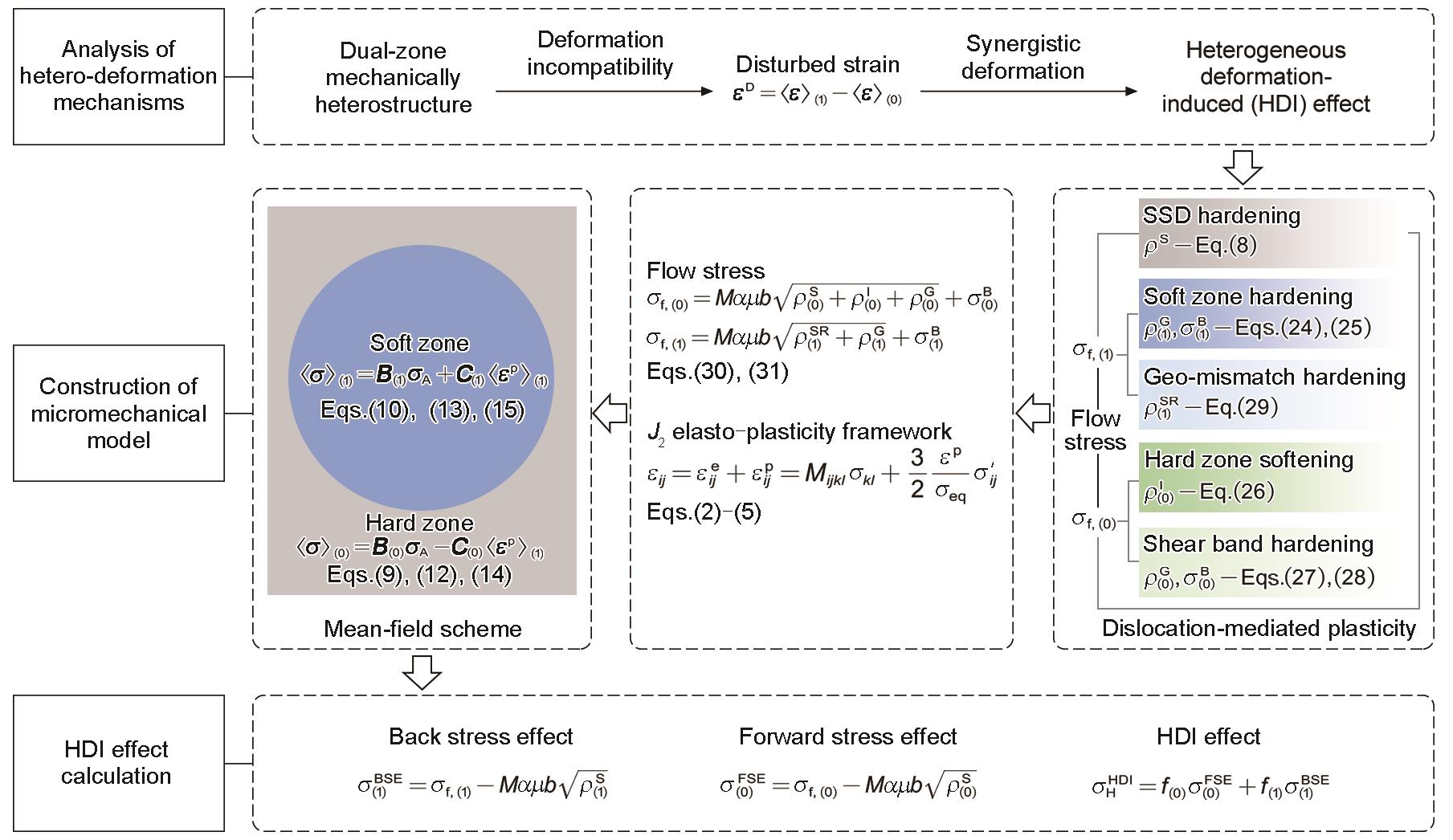
Fig.5 The framework of the micromechanics model for the bimodal structure ( and —average stresses within hard zone and soft zone, respectively;—applied stress; and —average strains within hard zone and soft zone, respectively; —disturbance strain; —accumulated plastic strain within soft zone; and —flow stresses of hard zone and soft zone, respectively; M, α, μ, and b—Taylor factor, Taylor constant, shear modulus, and Burgers vector magnitude, respectively; —back stress hardening of shear band; —revised statistically stored dislocation density; , , and —stresses caused by back stress effect, forward stress effect, and HDI effect, respectively; , , and —total strain, elastic strain, and plastic strain, respectively; —equivalent plastic strain; —equivalent stress; and —stress and deviatoric stress, respectively; —compliance tensor; , , , and —Mori-Tanaka mean-field scheme related tensors; f(0), f(1)—volume fractions of hard zone and soft zone, respectively)
|