|
|
|
| Effect and Characterization of O Accumulation Degree on Fatigue Properties and Grain Boundary Damage in GH4738 Ni-Based Superalloy |
ZHAO Xiao, XU Chao, JIANG He, YAO Zhihao, DONG Jianxin( ) ) |
| School of Materials Science and Engineering, University of Science and Technology Beijing, Beijing 100083, China |
|
Cite this article:
ZHAO Xiao, XU Chao, JIANG He, YAO Zhihao, DONG Jianxin. Effect and Characterization of O Accumulation Degree on Fatigue Properties and Grain Boundary Damage in GH4738 Ni-Based Superalloy. Acta Metall Sin, 2026, 62(2): 328-338.
|
|
|
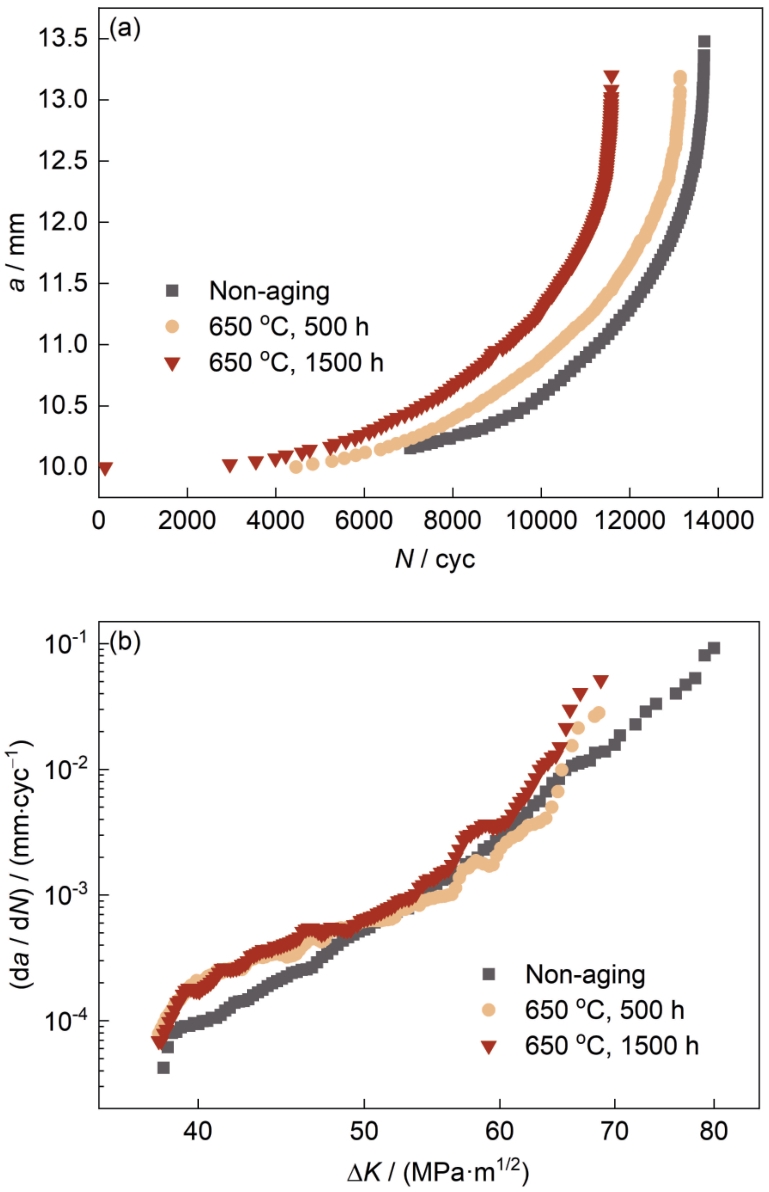
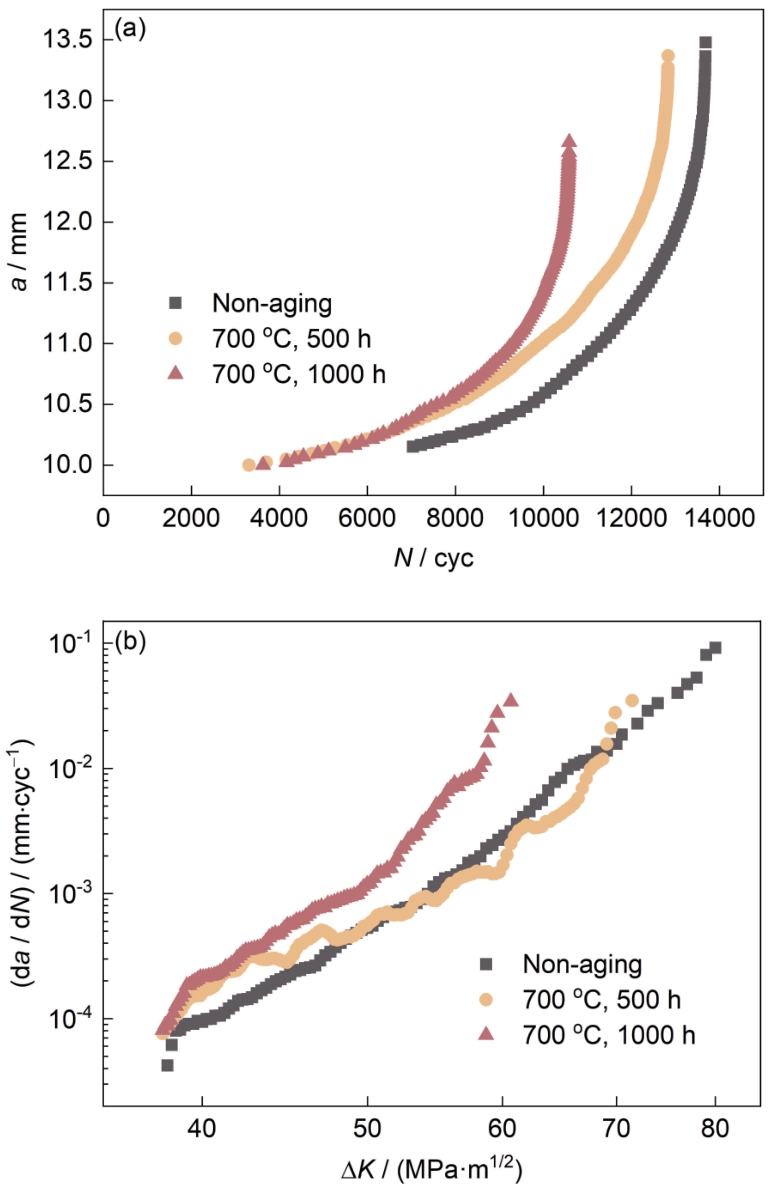
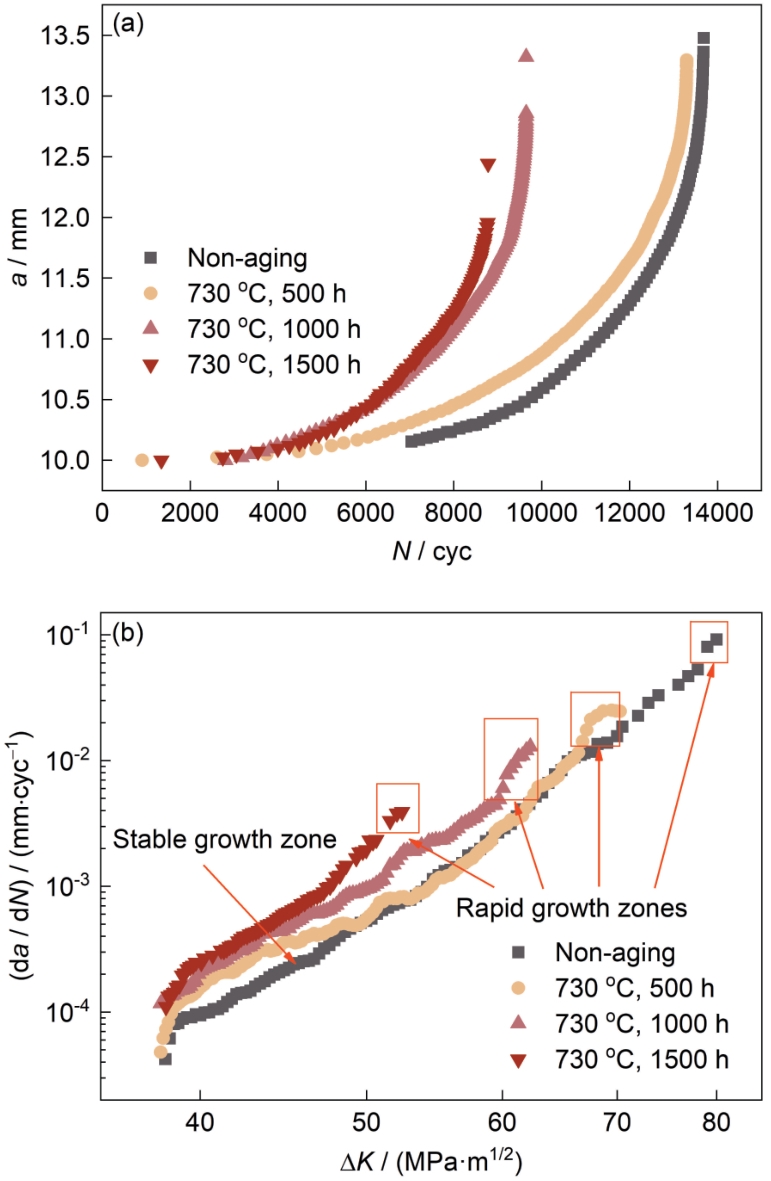
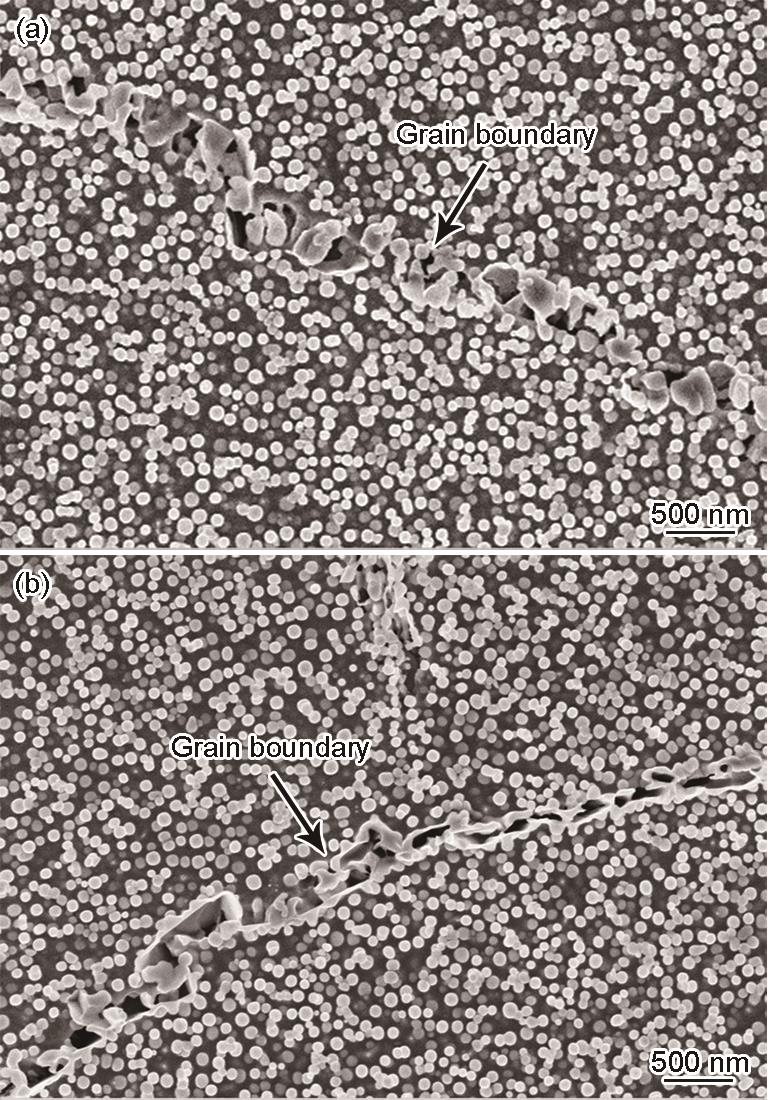
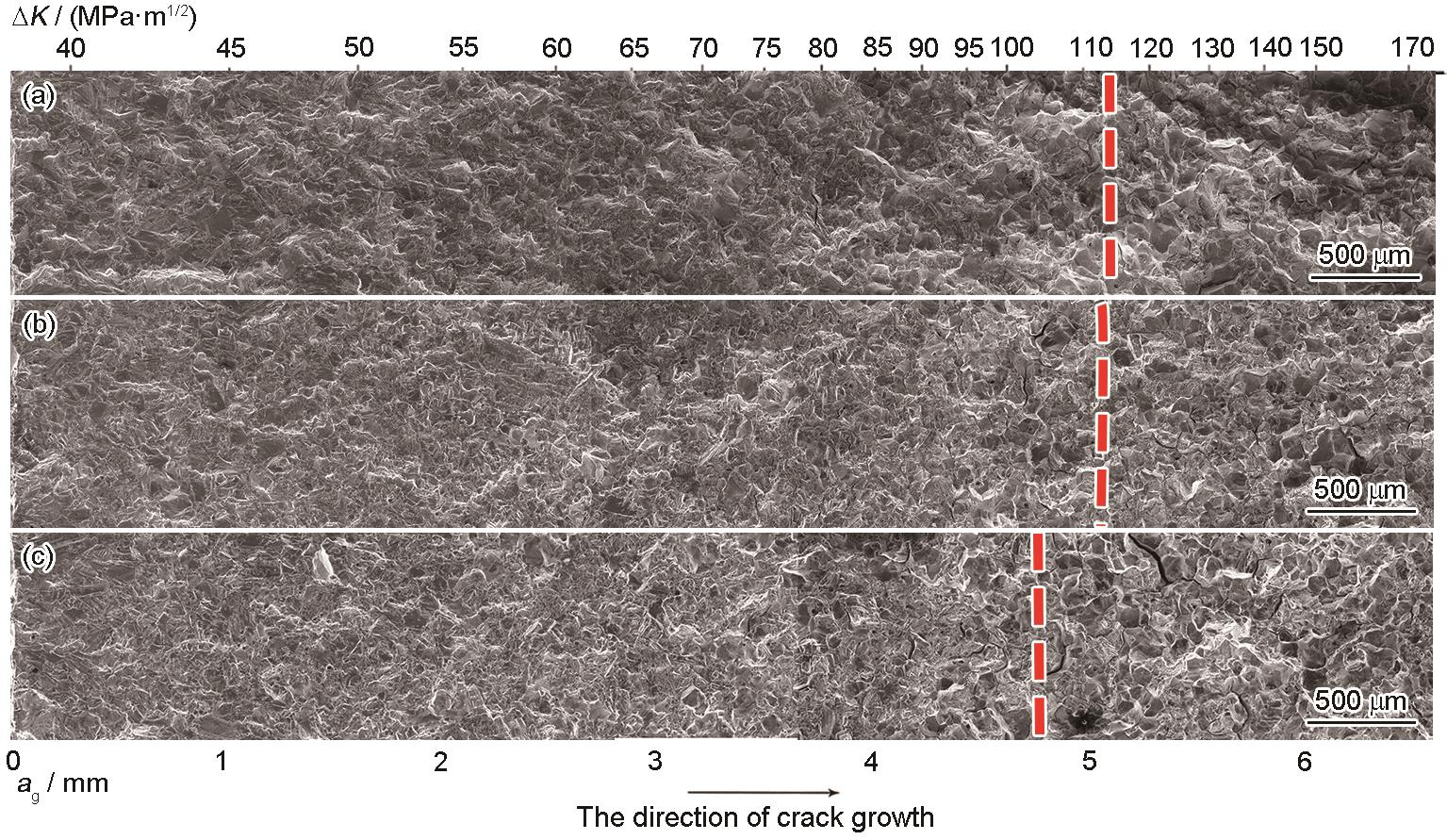
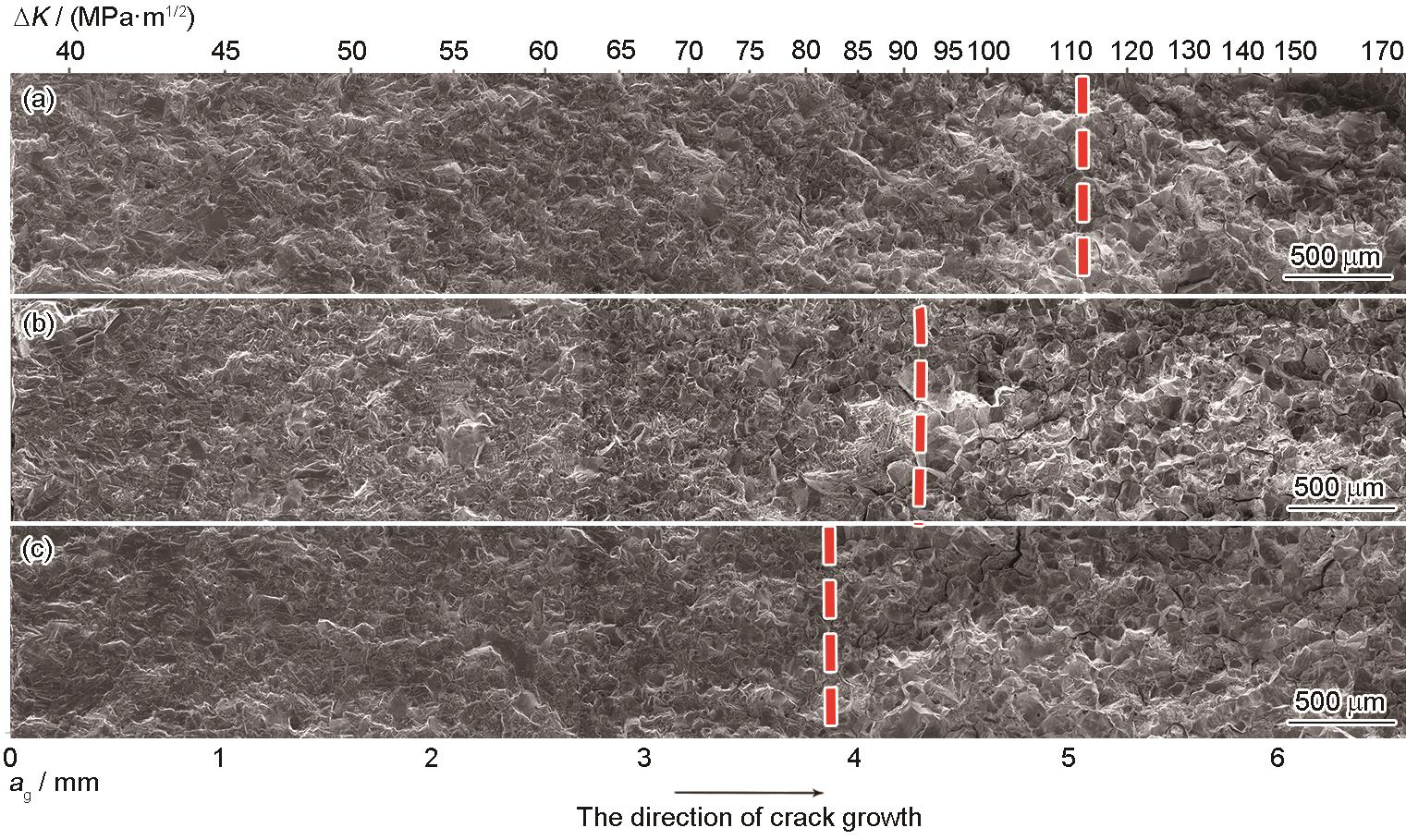
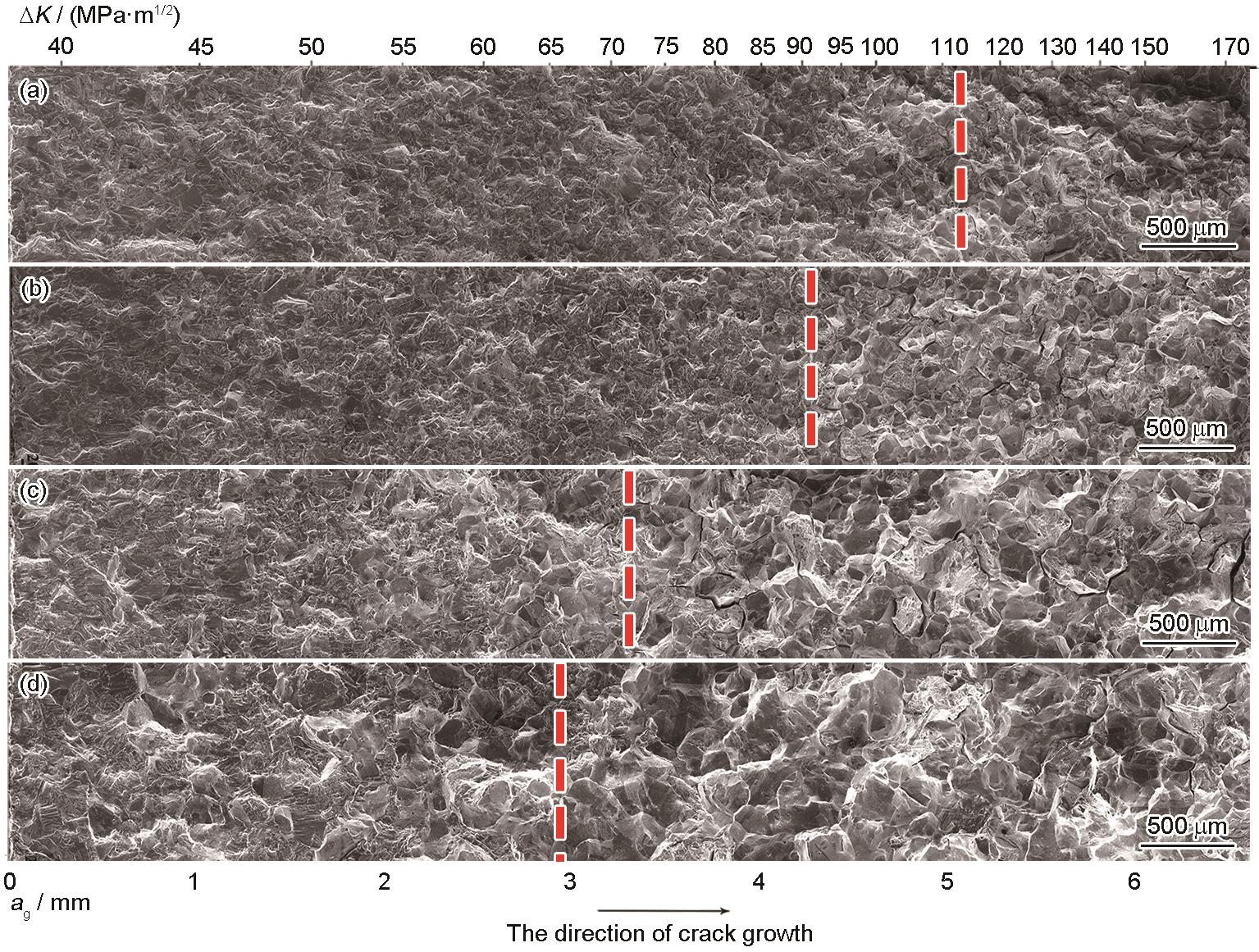
Abstract Fatigue is an important failure mode arising during the service conditions of superalloys. The fatigue crack propagation behavior of superalloys is influenced by many factors, such as temperature, stress, and ambient O. Among these, ambient O plays an important role. Numerous studies showed that fatigue crack propagation in a vacuum proceeds mainly as a transgranular fracture, while in air, it occurs mainly as an intergranular fracture. This is because the grain boundary is oxidized, making it weak. There is a lack of studies on the influence of different degrees of O accumulation on oxygen-induced grain boundary damage and ways to characterize this influence. The degree of O accumulation at the grain boundary is usually difficult to evaluate quantitatively. Therefore, to investigate the influence of O accumulation on the damage to grain boundary and to devise a method to characterize this influence, this study designed a series of aging experiments with different parameters to introduce different O accumulation variables. The fatigue crack growth test of aged nickel-based superalloy GH4738 was performed at room temperature ((23 ± 3) oC). For higher aging temperatures and longer aging time, the fatigue crack growth rate was higher, and the fatigue life was shorter. The fatigue fracture morphologies were observed. The grain boundary damage caused by the O accumulation was evaluated by considering the stress intensity factor range (ΔK), corresponding to the complete transformation of fatigue fracture from the transgranular mode to the intergranular mode. The grain boundary separation work calculated based on the molecular dynamics theory was used to verify the law of change in the turning point of the intergranular fracture mode observed experimentally. The experimental and theoretical results taken together showed that with an increase in O accumulation, the fatigue crack growth rate increases, service life decreases, and the turning point of the complete intergranular mode of fatigue fracture approaches the crack initiation end. O caused a reduction in the grain boundary separation work. As the O atom concentration increased, the weakening of the grain boundary became more pronounced. Addition, the higher temperature resulted in faster reduction rate of the grain boundary separation work.
|
|
Received: 29 February 2024
|
|
|
| Fund: National Natural Science Foundation of China(92160201) |
Corresponding Authors:
DONG Jianxin, professor, Tel: (010)62332884, E-mail: jxdong@ustb.edu.cn
|
| [1] |
Xu C. Research on the phenomenon and mechanisms of rapid crack propagation in the higher zone of service temperature range for nickel-based superalloys [D]. Beijing: University of Science and Technology Beijing, 2020
|
|
徐 超. 镍基高温合金服役温度范围高温区裂纹急速扩展的现象和本质研究 [D]. 北京: 北京科技大学, 2020
|
| [2] |
Wang G Q, Han X, Wang F, et al. Investigation on deoxidation of Ni-base superalloy [J]. Vacuum, 2005, 42: 40
|
|
王国全, 韩 笑, 王 飞 等. 镍基高温合金脱氧的研究 [J]. 真空, 2005, 42: 40
|
| [3] |
Jiang R, Everitt S, Lewandowski M, et al. Grain size effects in a Ni-based turbine disc alloy in the time and cycle dependent crack growth regimes [J]. Int. J. Fatigue, 2014, 62: 217
doi: 10.1016/j.ijfatigue.2013.07.014
|
| [4] |
Jiang R, Reed P A S. Critical assessment 21: Oxygen-assisted fatigue crack propagation in turbine disc superalloys [J]. Mater. Sci. Technol., 2016, 32: 401
|
| [5] |
Osinkolu G A, Onofrio G, Marchionni M. Fatigue crack growth in polycrystalline in 718 superalloy [J]. Mater. Sci. Eng., 2003, A356: 425
|
| [6] |
Markus O S. Effect of environment on fatigue crack growth of Ni-based superalloys In-738LC and In-939 at 850 oC [J]. Dev. Appl. Mater., 1982, (5): 13
|
|
Markus O S. 环境对镍基超合金In-738LC和In-939在850 ℃下疲劳裂纹增长的影响 [J]. 国外舰船技术(材料类), 1982, (5): 13
|
| [7] |
Nazmy M Y. The effect of environment on the high temperature low cycle fatigue behaviour of cast nickel-base IN-738 alloy [J]. Mater. Sci. Eng., 1982, 55: 231
doi: 10.1016/0025-5416(82)90136-7
|
| [8] |
Guo J T, Ranucci D, Picco E, et al. Effect of environment on the low cycle fatigue behaviour of cast nickel-base superalloy IN738LC [J]. Int. J. Fatigue, 1984, 6: 95
doi: 10.1016/0142-1123(84)90019-7
|
| [9] |
Xu C, Nai Q L, Yao Z H, et al. Grain boundary oxidation effect of GH4738 superalloy on fatigue crack growth [J]. Acta Metall. Sin., 2017, 53: 1453
doi: 10.11900/0412.1961.2017.00169
|
|
徐 超, 佴启亮, 姚志浩 等. 晶界氧化对GH4738高温合金疲劳裂纹扩展的作用 [J]. 金属学报, 2017, 53: 1453
|
| [10] |
Kitaguchi H S, Li H Y, Evans H E, et al. Oxidation ahead of a crack tip in an advanced Ni-based superalloy [J]. Acta Mater., 2013, 61: 1968
doi: 10.1016/j.actamat.2012.12.017
|
| [11] |
Piao Y, Balint D S. On the role of plastic relaxation in stress assisted grain boundary oxidation [J]. J. Mech. Phys. Solids, 2024, 185: 105552
doi: 10.1016/j.jmps.2024.105552
|
| [12] |
Pfaendtner J A, McMahon Jr C J. Oxygen-induced intergranular cracking of a Ni-base alloy at elevated temperatures—An example of dynamic embrittlement [J]. Acta Mater., 2001, 49: 3369
doi: 10.1016/S1359-6454(01)00005-2
|
| [13] |
de Vasconcelos Varela A, de Deus H D, de Siqueira M C, et al. Oxidation assisted intergranular cracking in 718 nickel superalloy: On the mechanism of dynamic embrittlement [J]. J. Mater. Res. Technol., 2018, 7: 319
doi: 10.1016/j.jmrt.2018.02.008
|
| [14] |
Krupp U, Kane W M, Laird C, et al. Brittle intergranular fracture of a Ni-base superalloy at high temperatures by dynamic embrittlement [J]. Mater. Sci. Eng., 2004, A387-389: 409
|
| [15] |
Liu L D, Ding B, Ren W L, et al. Multilayer structure of DZ445 Ni-based superalloy formed by long time oxidation at high temperature [J]. Acta Metall. Sin., 2023, 59: 387
doi: 10.11900/0412.1961.2021.00482
|
|
刘来娣, 丁 彪, 任维丽 等. DZ445镍基高温合金高温长时间氧化形成的多层膜结构 [J]. 金属学报, 2023, 59: 387
doi: 10.11900/0412.1961.2021.00482
|
| [16] |
Xie Y, Zhang J Q, Peng X. Research advances in high temperature corrosion of Ni-Cr alloys in CO2-rich environments [J]. Acta Metall. Sin., 2024, 60: 731
|
|
谢 云, Zhang J Q, 彭 晓. Ni-Cr合金在富CO2气氛中的高温腐蚀研究进展 [J]. 金属学报, 2024, 60: 731
|
| [17] |
Li T F. The role of metallic grain boundary in high temperature oxidation [J]. J. Chin. Soc. Corros. Prot., 2002, 22: 180
|
|
李铁藩. 金属晶界在高温氧化中的作用 [J]. 中国腐蚀与防护学报, 2002, 22: 180
|
| [18] |
Plimpton S. Fast parallel algorithms for short-range molecular dynamics [J]. J. Comput. Phys., 1995, 117: 1
|
| [19] |
Mishin Y, Farkas D, Mehl M J, et al. Interatomic potentials for monoatomic metals from experimental data and ab initio calculations [J]. Phys. Rev., 1999, 59B: 3393
|
| [20] |
Zhou Y, Jiang W G, Li D S, et al. Study on lightweight and strengthening effect of carbon nanotube in highly ordered nanoporous nickel: A molecular dynamics study [J]. Appl. Sci., 2019, 9(2): 352
doi: 10.3390/app9020352
|
| [21] |
Zhao C T, Zhou J M, Zhong K D, et al. Enhancing understanding metal matrix composites through molecular dynamics simulation: A comprehensive review [J]. Comput. Mater. Sci., 2024, 239: 112993
doi: 10.1016/j.commatsci.2024.112993
|
| [22] |
Všianská M, Šob M. The effect of segregated sp-impurities on grain-boundary and surface structure, magnetism and embrittlement in nickel [J]. Prog. Mater. Sci., 2011, 56: 817
doi: 10.1016/j.pmatsci.2011.01.008
|
| [23] |
Hirel P. Atomsk: A tool for manipulating and converting atomic data files [J]. Comput. Phys. Commun., 2015, 197: 212
doi: 10.1016/j.cpc.2015.07.012
|
| [24] |
Poplawsky J D, Pillai R, Ren Q Q, et al. Measuring oxygen solubility in Ni grains and boundaries after oxidation using atom probe tomography [J]. Scr. Mater., 2022, 210: 114411
doi: 10.1016/j.scriptamat.2021.114411
|
| [25] |
Liu L M, Duan M L, Liu C T, et al. On the physical nature of the Paris law [J]. Acta Mech. Sin., 2003, 35: 171
|
|
刘立名, 段梦兰, 柳春图 等. 对裂纹扩展规律Paris公式物理本质的探讨 [J]. 力学学报, 2003, 35: 171
|
| [26] |
Zhao W, Dong J X, Zhang M C, et al. High-temperature microstructure stability of GH4169, GH4169plus and GH4738 alloy [J]. Trans. Mater. Heat Treat., 2015, 36: 1
|
|
赵 薇, 董建新, 张麦仓 等. GH4169、GH4169plus和GH4738高温合金组织稳定性 [J]. 材料热处理学报, 2015, 36: 1
|
| [27] |
Zhao S Q, Xie X S. Mechanical properties and microstructure evolution of WASPALOY after long exposure [J]. Mater. Mech. Eng., 2006, 30: 62
|
|
赵双群, 谢锡善. WASPALOY合金长期时效过程中的组织演变和性能变化 [J]. 机械工程材料, 2006, 30: 62
|
| [28] |
Academic Committee of the Superalloys, CSM. China Superalloys Handbook [M]. Beijing: China Quality Inspection Press, China Standard Press, 2012: 876
|
|
中国金属学会高温材料分会. 中国高温合金手册 [M]. 北京: 中国质检出版社, 中国标准出版社, 2012: 876
|
| [29] |
Yao Z H, Dong J X, Chen X, et al. Gamma prime phase evolution during long-time exposure for GH738 superalloy [J]. Trans. Mater. Heat Treat., 2013, 34: 31
|
|
姚志浩, 董建新, 陈 旭 等. GH738高温合金长期时效过程中γ′相演变规律 [J]. 材料热处理学报, 2013, 34: 31
|
| [30] |
Yang C B, Li Z T, Qu J L, et al. Effect of long-term aging on microstructure and properties of GH4738 superalloy [J]. Trans. Mater. Heat Treat., 2024, 45: 160
|
|
杨成斌, 李振团, 曲敬龙 等. 长期时效对GH4738合金组织性能的影响 [J]. 材料热处理学报, 2024, 45: 160
|
| [31] |
Rice J R, Thomson R. Ductile versus brittle behaviour of crystals [J]. Phil. Mag., 1974, 29(1): 73
doi: 10.1080/14786437408213555
|
| [32] |
Rice J R, Wang J S. Embrittlement of interfaces by solute segregation [J]. Mater. Sci. Eng., 1989, A107: 23
|
| [33] |
Jensen I J T, Olden V, Løvvik O M. Decohesion energy of Σ5(012) grain boundaries in Ni as function of hydrogen content [J]. Metall. Mater. Trans., 2019, 50A: 451
|
| [34] |
Xue H T, Luo Y Q, Tang F L, et al. Segregation behavior of alloying elements at Ni Σ5[001](210) symmetrical tilt grain boundary in nickel-based superalloys and their stabilization and strengthening mechanisms for the grain boundary [J]. Mater. Chem. Phys., 2021, 258: 123977
doi: 10.1016/j.matchemphys.2020.123977
|
| [35] |
Chen J, Dongare A M. Role of grain boundary character on oxygen and hydrogen segregation-induced embrittlement in polycrystalline Ni [J]. J. Mater. Sci., 2017, 52: 30
doi: 10.1007/s10853-016-0389-3
|
| [36] |
Xiao Z Q, Bai X M. First-principle studies of oxidation effects on grain boundary strength in nickel [J]. Materialia, 2023, 28: 101745
doi: 10.1016/j.mtla.2023.101745
|
| [37] |
Pham H H, Cagin T. Fundamental studies on stress-corrosion cracking in iron and underlying mechanisms [J]. Acta Mater., 2010, 58: 5142
doi: 10.1016/j.actamat.2010.05.050
|
| [38] |
Chen Y H, Wang C P, Huang X, et al. Effects of transition metal elements and O on grain boundary energy and strength of Co by first-principles study [J]. Trans. Nonferrous Met. Soc. China, 2023, 33: 2428
doi: 10.1016/S1003-6326(23)66270-3
|
| [39] |
Kim J J, Seong H W, Ryu H J. First principles calculations of cohesive energy of fission-product-segregated grain boundary of UO2 [J]. J. Nucl. Mater., 2022, 566: 153780
doi: 10.1016/j.jnucmat.2022.153780
|
| [40] |
Razumovskiy V I, Lozovoi A Y, Razumovskii I M. First-principles-aided design of a new Ni-base superalloy: Influence of transition metal alloying elements on grain boundary and bulk cohesion [J]. Acta Mater., 2015, 82: 369
doi: 10.1016/j.actamat.2014.08.047
|
| [41] |
Razumovskiy V I, Lozovoi A Y, Razumovskii I M, et al. Analysis of the alloying system in Ni-base superalloys based on ab initio study of impurity segregation to Ni grain boundary [J]. Adv. Mater. Res., 2011, 278: 192
|
| [42] |
Li X, Jiang H, Yao Z H, et al. Theoretical calculation and analysis of the effect of oxygen atom on the grain boundary of superalloy matrices Ni, Co and NiCr [J]. Acta Metall. Sin., 2023, 59: 309
doi: 10.11900/0412.1961.2021.00176
|
|
李 昕, 江 河, 姚志浩 等. O原子对高温合金基体Ni、Co和NiCr晶界作用的理论计算分析 [J]. 金属学报, 2023, 59: 309
|
| No Suggested Reading articles found! |
|
|
Viewed |
|
|
|
Full text
|
|
|
|
|
Abstract
|
|
|
|
|
Cited |
|
|
|
|
| |
Shared |
|
|
|
|
| |
Discussed |
|
|
|
|