



近年来,随着我国铁路建设向高寒地区延伸,轮轨材料在低温环境下的服役行为,尤其是低温下的疲劳断裂特性已逐渐得到关注[4,5]。如Ma等[4]研究了珠光体轮轨材料在-60~20 ℃条件下的疲劳裂纹扩展行为,发现随着温度的降低,珠光体轮轨材料的脆性断裂倾向增加,导致疲劳损伤严重。Fang等[5]研究了ER8C高速车轮的低温疲劳裂纹扩展行为,发现在-20 ℃时出现明显的疲劳韧脆转变(fatigue ductile-to-brittle transition,FDBT),随着温度降低,车轮钢在近门槛区具有较低的疲劳裂纹扩展速率,但在Paris区裂纹扩展速率增加。此外,近期的研究[6,7]表明,低温环境还可能影响珠光体轮轨的磨损行为,加剧轮轨材料的接触疲劳损伤。
通常,温度降低可提高金属材料的强度,但对韧塑性的影响较复杂。对于具有bcc晶体结构的金属材料,在低温下会发生韧脆转变,断裂发生时裂纹尖端的塑性变形程度较小,可能导致裂纹迅速扩展。因此,对于以bcc结构为主的珠光体轮轨材料而言,其低温韧脆转变行为对疲劳裂纹扩展速率具有至关重要的影响。对于fcc晶体结构的材料,其韧性对温度不敏感,此外,在低温下fcc结构相的层错能和稳定性会发生变化,其对疲劳裂纹扩展可能产生更为复杂的影响。例如,Rackwitz等[8]研究了具有fcc结构的CrCoNi中熵合金的低温疲劳裂纹扩展行为,发现该材料在77 K (-196 ℃)的低温环境下表现出极其优异的低温疲劳裂纹扩展抗力。
鉴于此,为满足高寒地区对抗低温疲劳钢轨的工程需求,本工作研究了室温(20~25 ℃)和-40 ℃下贝氏体钢轨的疲劳裂纹扩展行为,研究了低温环境对钢轨强韧性和疲劳裂纹扩展行为的影响规律,揭示了显微组织的作用机制,为开发新一代抗低温疲劳的贝氏体钢轨提供理论基础和实验依据。
1 实验方法
实验所用材料为本课题组研发的U20Mn2SiCrNiMo (简称U20Mn)贝氏体钢轨,其化学成分(质量分数)为:C 0.2%,Mn 2.0%~2.5%,Si 0.8%~1.0%,Cr 0.8%~1.0%,Mo 0.3%~0.5%,Ni 0.5%~0.7%,Fe余量。其中,Si能抑制渗碳体析出,促使C在奥氏体富集,有助于在室温形成适量的残余奥氏体,Mn和Cr等合金元素能抑制先共析铁素体的形成,促进贝氏体组织的形成。贝氏体钢轨的制备工艺流程为“冶炼→连铸→热轧→自然空冷→矫直→回火”,其中回火温度为280 ℃。
常规力学性能和疲劳裂纹扩展速率试样的取样位置如图1所示。拉伸实验采用原始标距25 mm、直径6 mm的拉伸试样,在搭配低温环境箱的SANS5305拉伸试验机上进行。采用尺寸为10 mm × 10 mm × 55 mm的V型缺口标准冲击试样,在室温和-40 ℃下进行冲击实验。
图1

图1
力学性能测试取样位置示意图
Fig.1
Schematic of sampling positions for mechanical property testing (RD—rolling direction, ND—normal direction, TD—transverse direction)
疲劳裂纹扩展实验采用紧凑拉伸(compact tensile,CT)试样,其受力方向沿钢轨的轧制方向。实验按照GB/T 6398—2000《金属材料疲劳裂纹扩展速率试验方法》进行,CT试样尺寸如图2所示。采用搭配低温环境箱的MTS370.10电液伺服高频疲劳试验机,分别在室温和-40 ℃环境下进行实验;CT试样预制疲劳裂纹长度1.5~2.0 mm;测试阶段应力比为0.5,频率10 Hz,应力波形为正弦波。
图2

图2
疲劳裂纹扩展速率测试用紧凑拉伸(CT)试样示意图
Fig.2
Schematic of compact tensile (CT) specimen for fatigue crack growth rate test (unit: mm)
利用EVO18扫描电子显微镜(SEM)进行显微组织、疲劳断口、裂纹扩展路径观察;并利用SEM的电子背散射衍射(EBSD)附件进行数据采集,电压为20 kV,扫描步长为0.08~0.15 μm,用AZtecCrystal软件处理EBSD数据。金相试样腐蚀液为2% (体积分数)硝酸酒精溶液,EBSD试样采用机械抛光+氧化物抛光悬浮液(OPS)腐蚀抛光制备。残余奥氏体含量采用Dmax 2500-V X射线衍射仪(XRD)测试,Cu靶、工作电压40 kV,扫描速率为2°/min,扫描范围35°~95°;依据GB/T 8362—1987《钢中残余奥氏体定量测定 X射线衍射仪法》,选择奥氏体的(200) γ 、(220) γ 和(311) γ 衍射峰以及马氏体的(200) α 和(211) α 衍射峰,通过直接对比法获得残余奥氏体的体积分数[15];XRD试样制备采用机械抛光+电解抛光,电解抛光液为6% (体积分数)高氯酸酒精溶液。利用JEM-F200透射电子显微镜(TEM)观察组织形貌;TEM试样制备过程为:先将薄片试样机械减薄至30~40 μm厚,用冲片器冲成直径3 mm的圆片,再利用双喷电解减薄仪减薄成薄膜试样,双喷液为6% (体积分数) 高氯酸酒精溶液,双喷温度约为-20 ℃。
为了分析室温和低温环境下疲劳断口近表层的残余奥氏体含量变化,在不同的断口位置(对应不同的应力强度因子范围(ΔK))进行取样(样品边长为3 mm、厚度为1.5 mm),对所取断口样品直接机械抛光以减小断口的粗糙度,再进行电解抛光以消除机械制样带来的变形,之后采用XRD进行残余奥氏体含量的测定。
2 实验结果
2.1 微观组织及力学性能
图3a为贝氏体钢轨母材显微组织的SEM像。显微组织以粒状贝氏体(granular bainite,GB)为主,并含有少量的板条贝氏体(lath bainite,LB)组织;马氏体/奥氏体(martensite/austenite,M/A)岛分布在贝氏体铁素体基体中。图3b为贝氏体钢轨母材显微组织的EBSD像。可见,块状残余奥氏体主要沿原奥氏体晶界(prior austenite grain boundary,PAGB)或大角度晶界分布。同时测得钢中大角度晶界(取向差大于15°)的比例为71.5%,大角度晶界有利于提高钢的韧性,在裂纹扩展过程中迫使裂纹改变扩展方向,从而阻碍裂纹扩展[16]。采用TEM对残余奥氏体的微观形貌进行进一步表征,结果如图3c~f所示。图3c显示存在较大的块状M/A岛,且M/A岛中有孪晶马氏体(twinning martensite,TM)的形成;图3d显示了分布在贝氏体铁素体板条间的膜状残余奥氏体;图3e和f为块状残余奥氏体的TEM明场像、暗场像以及选区电子衍射花样。利用XRD测定钢轨中残余奥氏体的体积分数为10%~12%。
图3

图3
贝氏体钢轨母材显微组织的SEM和TEM观察
Fig.3
SEM and TEM observations of base microstructure of bainitic rail steel
(a) SEM image of base material (GB—granular bainite, LB—lath bainite, M/A—martensite/austenite)
(b) phase map of base material represented by EBSD
(c) TEM image showing the blocky M/A island and the twinning martensite (TM) (Inset shows locally enlarged image)
(d) TEM image showing the film-like retained austenite (RA)
(e, f) TEM bright field image (e) and TEM dark field image and SAED pattern (inset) (f) of blocky RA
表1 贝氏体钢轨在室温和低温(-40 ℃)下的力学性能
Table 1
| T | Rm / MPa | Rp0.2 / MPa | A / % | Z / % | Akv / J |
|---|---|---|---|---|---|
| RT | 1355 ± 3.0 | 1144 ± 4.5 | 16.95 ± 0.05 | 53.9 ± 0.4 | 38 |
| -40 oC | 1437 ± 1.0 | 1163 ± 4.5 | 19.35 ± 0.15 | 55.9 ± 0.3 | 17 |
图4

图4
贝氏体钢轨在室温和-40 ℃下的工程应力-应变曲线
Fig.4
Engineering stress-strain curves of bainitic rail steel at RT and -40 oC
图5

图5
贝氏体钢轨的冲击功(Akv)随温度的变化
Fig.5
Changes of Akv with test temperature for bainitic rail steel
图6
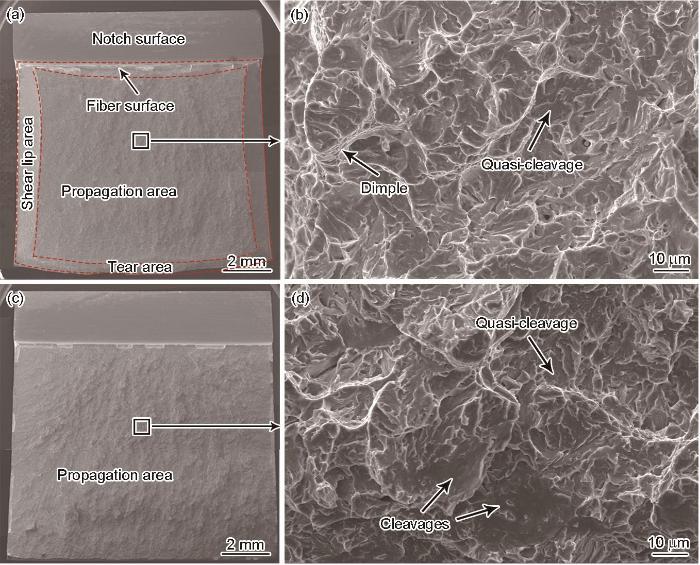
图6
贝氏体钢轨在室温和-40 ℃下冲击断口形貌的SEM像
Fig.6
Low (a, c) and locally high (b, d) magnified SEM images showing the impact fracture morphologies of bainitic rail steel tested at RT (a, b) and -40 oC (c, d)
2.2 疲劳裂纹扩展速率曲线
图7为不同温度下贝氏体钢轨的疲劳裂纹扩展速率与应力强度因子范围(da / dN-ΔK,其中,a为裂纹长度,N为循环周次)曲线,所测范围为稳定扩展阶段(ΔK: 8.0~18.0 MPa·m1/2)。在测试的∆K范围内,贝氏体钢轨在-40 ℃下的da / dN低于室温;例如当ΔK为10.0 MPa·m1/2时,在室温和-40 ℃下da / dN分别为1.247 × 10⁻⁵和5.969 × 10⁻⁶ mm/cyc。da / dN-ΔK在稳态扩展区符合Paris公式da / dN = C × ΔKm,其中,m和C为材料常数,与材料的微观组织、循环加载的频率和波形、环境、温度和应力比有关,拟合结果如表2所示。由于实验环境温度不同,m发生明显变化,低温下m为4.033,大于室温下的3.387。
图7
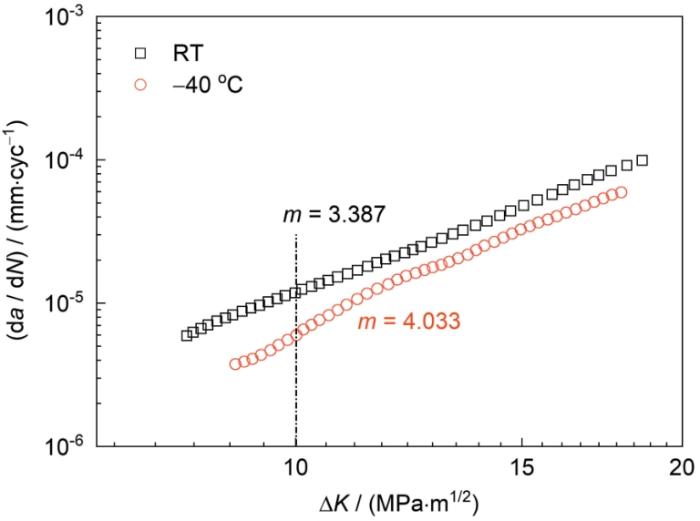
图7
贝氏体钢轨在室温和-40 ℃下的疲劳裂纹扩展速率与应力强度因子范围(da / dN-ΔK)曲线
Fig.7
da / dN-ΔK (fatigue crack propagation rate (da / dN) versus stress intensity factor range (ΔK)) curves of bainitic rail steel at RT and -40 oC (The constant m represents the slope of the fitted line)
表2 贝氏体钢轨在不同温度下疲劳裂纹扩展速率的Paris方程
Table 2
| T | Paris equation | R2 |
|---|---|---|
| RT | da / dN = 4.87 × 10⁻⁹ΔK3.387 | 0.998 |
| -40 oC | da / dN = 5.80 × 10⁻¹⁰ΔK4.033 | 0.996 |
2.3 疲劳断口形貌
图8
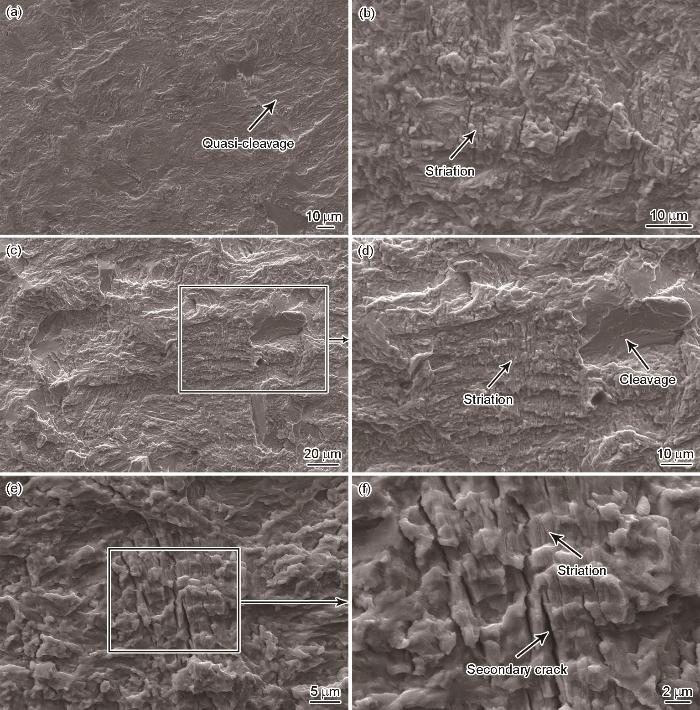
图8
不同ΔK时贝氏体钢轨在室温下疲劳断口形貌的SEM像
Fig.8
SEM images showing the fatigue fracture surface morphologies of bainitic rail steel tested under various ΔK at RT
(a) ΔK = 8.0 MPa·m1/2 (b) ΔK = 10.0 MPa·m1/2
(c-f) ΔK = 20.0 MPa·m1/2 (Figs.8d and f show the locally enlarged images of Figs.8c and e, respectively)
图9为不同ΔK时-40 ℃下贝氏体钢轨疲劳裂纹扩展区断口形貌的SEM像。与室温下的疲劳断口相比,在整个疲劳裂纹扩展区均观察到大量解理和沿晶形貌,这主要与钢轨的低温韧脆转变行为有关。研究[20]表明,由于加载方式和加载速率的不同,一般情况下疲劳的韧脆转变温度(fatigue ductile-brittle transition temperature,FDBTT)要低于冲击的韧脆转变温度(ductile-brittle transition temperature,DBTT)。但对比之下,低温疲劳断口中存在大量沿晶形貌(图9a、c和f),而低温冲击断口中并没有出现沿晶形貌(图6c和d),这主要与加载方式有关。冲击断口是在较高的加载速率下形成的,由于低温条件下材料的脆性增大,导致解理形貌增多。疲劳裂纹扩展则是在循环加载下进行,循环加载会在晶界处累积损伤[21]。而在轻微腐蚀后的疲劳断口中可以发现,在沿晶断面上及PAGB处存在大量的块状残余奥氏体或M/A岛,如图9g和h所示。与薄膜状残余奥氏体相比,块状残余奥氏体的稳定性较差,在循环载荷的作用下,晶界处的块状残余奥氏体更易转变成脆性的马氏体,进而诱导沿晶开裂[22]。此外,晶界也会因杂质偏聚而弱化,导致界面强度降低,促使低温条件下沿晶断裂的发生,进而使钢轨的疲劳断裂表面表现出脆性特征。同时,与室温环境相比,低温环境下疲劳断口中的辉纹数量增多,这是由于低温下材料的屈服强度和塑性增强(图4),在一定应力范围内材料的塑性变形与温度负相关,低温下能达到可观的塑性变形,促进了更多疲劳辉纹的形成。
图9
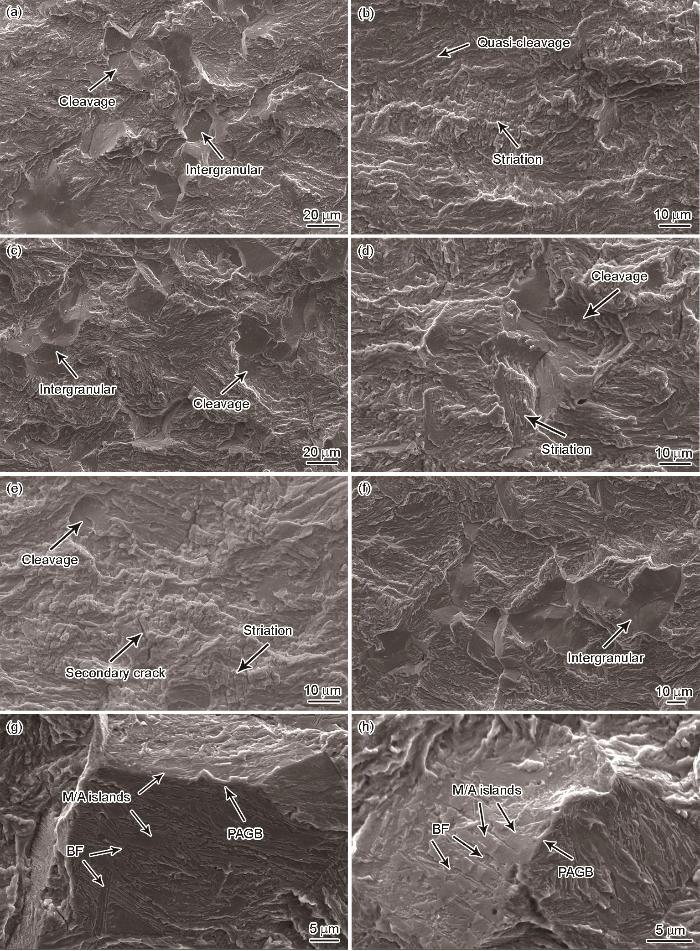
图9
不同∆K时贝氏体钢轨在-40 ℃下疲劳断口形貌的SEM像
Fig.9
SEM images showing the fatigue fracture surface morphologies of bainitic rail steel tested under various ΔK at -40 oC (BF—bainitic ferrite, PAGB—prior austenite grain boundary)
(a, b) ΔK = 9.0 MPa·m1/2 (c, d) ΔK = 13.5 MPa·m1/2
(e) ΔK = 16.5 MPa·m1/2 (f) ΔK = 18.0 MPa·m1/2
(g, h) etched fracture surface morphologies, where ΔK = 16.0-18.0 MPa·m1/2
2.4 疲劳裂纹扩展路径
图10显示了不同ΔK时贝氏体钢轨在室温下的疲劳裂纹扩展路径,裂纹扩展方向均为从左向右。在低ΔK时(即ΔK = 8.0~9.0 MPa·m1/2),疲劳裂纹穿过(图10a位置①)或绕过晶内的M/A岛(图10a位置②),说明晶内的M/A岛对裂纹扩展有一定的阻碍作用,使扩展路径出现多次转折。当裂纹在板条状组织中扩展时,裂纹会沿M/A岛界面在贝氏体铁素体中扩展(图10b),当裂纹扩展到PAGB时也会发生转折,对裂纹扩展起阻碍作用。随着ΔK提高,可观察到在粒状贝氏体铁素体中出现二次裂纹(图10c),这与在疲劳断口中观察到的与疲劳辉纹共生的二次裂纹(图8e和f)相符,即在该处疲劳辉纹形成的概率较大。随着∆K 增大(即ΔK = 13.0~15.0 MPa·m1/2),裂纹大多穿过M/A岛,并在相邻的板条束或板条块界面处发生转折(图10d)。
图10
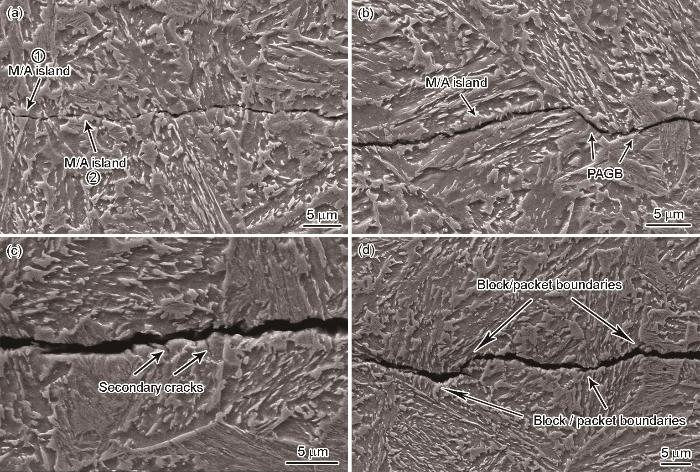
图10
不同ΔK时贝氏体钢轨在室温下的疲劳裂纹扩展路径
Fig.10
Fatigue crack propagation paths of bainitic rail steel tested under ΔK = 8.0-9.0 MPa·m1/2 (a, b) and ΔK = 13.0-15.0 MPa·m1/2 (c, d) at room temperature (The fatigue crack propagates through the M/A island ① and extends along the boundaries of the M/A island ② in Fig.10a)
进一步观察了不同ΔK时贝氏体钢轨在-40 ℃下的疲劳裂纹扩展路径,如图11所示。低温条件下的疲劳裂纹扩展路径同时呈现沿晶和穿晶扩展两种形式,可见疲劳裂纹穿过晶内的M/A岛(图11a),然而,如前文所述,晶界附近的M/A岛可能会诱发沿晶开裂。通过EBSD对疲劳裂纹周围的显微组织开展进一步的表征,结果如图11b所示。采用AZtecCrystal软件对图11b的局部区域进行原奥氏体晶粒重构,如图11c和d所示,证实了疲劳裂纹的沿晶扩展路径及其导致的疲劳裂纹转折(图11c),然而由于原奥氏体晶粒尺寸粗大,使得沿晶疲劳裂纹扩展路径的单元长度较大。而在穿晶扩展过程中裂纹扩展路径比较平直,少部分裂纹在PAGB或者大角度晶界处转折(图11d)。此外,当疲劳裂纹扩展方向与贝氏体板条方向平行时,裂纹也可平直穿过贝氏体板条(图11e)。在较高ΔK (即ΔK = 17.0 MPa·m1/2)时,观察到了较长的二次裂纹(图11f)。
图11

图11
不同ΔK时贝氏体钢轨在-40 ℃下的疲劳裂纹扩展路径
Fig.11
Fatigue crack propagation paths of bainitic rail steel tested under various ΔK at -40 oC
(a, b) SEM (a) and EBSD (b) images under ΔK = 10.0 MPa·m1/2
(c, d) grain reconstructions of square areas I (c) and II (d) in Fig.11b
(e, f) SEM images under ΔK = 17.0 MPa·m1/2
3 分析与讨论
3.1 低温环境对残余奥氏体稳定性的影响
式中,f为不同真应变(ε)时残余奥氏体的体积分数;f0为原始残余奥氏体体积分数;k为残余奥氏体机械稳定性参数,与奥氏体向马氏体转变的驱动力有关。通过拟合发现,室温下k = 7.09,而在-40 ℃时k = 17.27,说明在-40 ℃的环境温度下残余奥氏体的稳定性降低。研究[25]表明,马氏体相变的驱动力(ΔGγ-α )主要是新相(马氏体)与母相(奥氏体)之间的化学自由能差,在低温下,这种自由能差变得更加显著,从而为马氏体相变提供了更大的驱动力。
图12
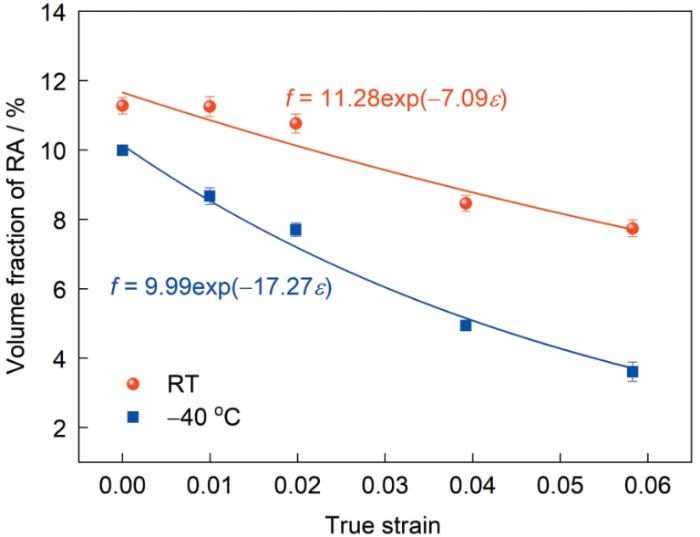
图12
不同温度下贝氏体钢轨中残余奥氏体的体积分数随真应变的变化
Fig.12
Changes of the volume fraction of RA (f) with true strain (ε) for bainitic rail steel tested at different temperatures
环境温度对金属材料强度的影响主要通过影响位错运动来实现,即位错运动要克服理想晶格带来的Peierls-Nabarro力(τp-N)。一般来说,材料的τp-N随温度降低而增大[21],从而使材料的屈服强度提高。但环境温度对金属材料塑韧性的影响并没有普适规律,这主要与材料组织结构有关。由于贝氏体钢轨中存在fcc结构的约10% (体积分数)的残余奥氏体(图12),当低温下残余奥氏体稳定性降低时,相变诱导塑性(transformation induced plasticity,TRIP)效应在应力/应变作用下得到进一步发挥。此外,由于贝氏体钢轨中包含块状和薄膜状残余奥氏体,与块状残余奥氏体相比,薄膜状残余奥氏体的稳定性相对较高,因此,在低温环境下当真应变达到0.06时,钢中依然含有4% (体积分数)的残余奥氏体(图12),这也意味着贝氏体钢轨中残余奥氏体在低温环境下的较大变形范围内可持续引发TRIP效应,有利于增加贝氏体钢轨的加工硬化能力并延缓颈缩的发生,进而提升贝氏体钢轨的低温塑性(图4)。
图13为贝氏体钢轨在室温和-40 ℃环境下的加工硬化曲线。可见,室温下钢轨的加工硬化曲线存在两个阶段,第一阶段为迅速降低阶段,当真应变达到0.02时出现加工硬化平台(第二阶段)。结合图12可知,在第一阶段中,钢中残余奥氏体转变并不多。在低温下钢轨的硬化曲线存在三个阶段,第一阶段为迅速降低阶段;第二阶段为随真应变增加钢轨加工硬化指数缓慢升高,并逐渐高于室温的硬化曲线,此时残余奥氏体的转变量早已大于室温环境,当真应变达到0.04时钢轨的加工硬化指数达到最高,之后随着真应变继续增大呈现缓慢降低(第三阶段),该阶段的加工硬化指数一直保持高于室温。由于低温下残余奥氏体的稳定性降低,并持续发挥TRIP效应,从而使真应变增加后的加工硬化指数一直高于室温环境。
图13

图13
室温和-40 ℃时贝氏体钢轨的加工硬化曲线
Fig.13
Instantaneous work hardening curves for bainitic rail steel tested at RT and -40 oC
3.2 残余奥氏体稳定性对疲劳裂纹扩展的影响
研究[5]表明,对于具有bcc结构的金属,尤其是低合金结构钢通常具有FDBTT,当环境温度高于FDBTT时,随着温度降低,疲劳裂纹扩展速率降低;而当环境温度低于FDBTT时,随着温度降低,疲劳裂纹扩展速率反而会增加。然而,对于fcc结构材料,随着温度降低疲劳裂扩展抗力增加[26]。根据本工作实验结果,虽然钢轨的疲劳断口中出现大量的沿晶和解理形貌,但疲劳裂纹扩展速率仍低于室温环境,即低温脆性增大并未导致疲劳裂纹扩展速率增加。对于贝氏体钢轨,低温环境对疲劳裂纹扩展行为的影响主要有以下三个方面:(1) 低温环境使钢轨的屈服强度增大,增强了疲劳裂纹扩展抗力;(2) 作为典型的疲劳裂纹扩展韧脆转变特征,低温疲劳断口中的沿晶和解理面增多,表明钢轨的脆性增加[18,27];(3) 由于低温下残余奥氏体的稳定性降低,裂尖塑性区内的残余奥氏体转变量增加,有利于钝化裂纹尖端从而减缓疲劳裂纹扩展速率。
贝氏体钢轨疲劳断口近表层的残余奥氏体转变率(发生转变的残余奥氏体体积分数/原有残余奥氏体体积分数)随ΔK的变化如图14所示。结果表明,断口近表层有大量的残余奥氏体发生了马氏体转变,而且随着ΔK的增大,残余奥氏体转变率增高;值得注意的是,无论ΔK大或小,低温环境下断口表层的残余奥氏体转变率均要高于室温。由图4可知,贝氏体钢轨在低温下的屈服强度增加,因此在低温环境下,裂尖循环塑性区的尺寸会减小[21],见
式中,RCPZ为循环塑性区半径,Rp0.2为屈服强度,α为几何因子。
图14

图14
贝氏体钢轨疲劳断口近表层的残余奥氏体转变率随ΔK的变化
Fig.14
Percentages of phase transformation of RA near the fracture surface of bainitic rail steel in response to variations in ΔK
图15

图15
温度对裂纹尖端循环塑性区半径(RCPZ)与相变诱导塑性发生区半径(RTRIP)影响的示意图
Fig.15
Schematic showing the influence of temperature on the radius of cyclic plastic zone (RCPZ) and radius of transformation-induced plasticity zone (RTRIP) (σ—stress)
研究[29~31]指出,在疲劳裂纹稳定扩展阶段,大量残余奥氏体在疲劳裂纹尖塑性区内发挥TRIP效应,可以显著提高疲劳裂纹扩展抗力。裂尖塑性区内的残余奥氏体会转变为马氏体(deformation induced martensite transformation,DIMT),发生马氏体相变时会使体积膨胀,对裂纹尖端产生残余压应力,减少裂纹开口位移,产生“裂纹闭合”,即会产生相变诱导裂纹闭合(transformation-induced crack closure,TICC)效应[32]。同时,低温环境下贝氏体钢轨的塑性提高(图4),有更大的“塑性尾迹”残留在裂尖后方,导致两个裂纹面过早接触从而提高裂纹闭合水平,降低了裂纹扩展的驱动力,其作用类似于塑性诱导裂纹闭合(plasticity-induced crack closure,PICC)效应[33]。另外,低温下更多的残余奥氏体转变消耗了裂纹扩展过程中的能量,产生相变诱导能量吸收(transformation-induced energy absorption,TIEA)效应[34]。低温环境下残余奥氏体稳定性降低(图12)提高了裂纹闭合效应,使疲劳裂纹扩展抗力增加,弥补了脆性解理和沿晶等造成的塑性损失,从而减缓疲劳裂纹扩展速率。
4 结论
(1) -40 ℃环境下贝氏体钢轨的强度和塑性同时升高,这是由于低温环境降低了贝氏体钢轨中残余奥氏体的机械稳定性,从而提高相变诱导塑性效应;贝氏体钢轨的冲击韧性随着温度降低急剧下降,-40 ℃时冲击功处于脆性下平台区域,冲击断口表现出脆性断裂特征。
(2) 贝氏体钢轨在-40 ℃时的疲劳裂纹扩展速率低于室温。然而,与室温疲劳断口相比,-40 ℃环境下疲劳断口中解理和沿晶形貌增多。-40 ℃时疲劳裂纹扩展速率降低主要归因于低温环境下钢轨强塑性的提升,以及裂尖塑性区内残余奥氏体转变率增加从而产生的相变诱导裂纹闭合效应。
参考文献
Characteristic S-N properties of high-carbon chromium-bearing steel under axial loading in long-life fatigue
[J].
\n ABSTRACT\n Owing to difficult economical conditions, machines and structures often have to be used beyond the design lifetime. In this study, fatigue properties of a bearing steel in the long‐life region were experimentally examined under cyclic axial loading. The complicated S–N behaviour was well explained as a combination of S–N curves for surface‐induced fracture and interior inclusion‐induced fracture. Fish‐eye marks were always observed on the fracture surfaces of specimens, which failed in the latter fracture mode, and an inclusion was found at the center of the fish‐eye. Finally, it was found that the fatigue fracture of this steel in the long‐life region occurred through the following three processes: (i) formation of the characteristic area as a fine granular area (FGA), (ii) crack propagation to form the fish‐eye and (iii) rapid crack propagation to cause the catastrophic fracture.\n
Very high-cycle fatigue behaviour of shot-peened high carbon-chromium bearing steel
[J].\n Effect of shot‐peening on fatigue behaviour in the gigacycle regime was investigated in order to clarify the duplex\n S–N\n curve characteristics. Cantilever‐type rotary bending fatigue tests were performed in laboratory air at room temperature by using hourglass‐shaped specimens of high‐carbon–chromium bearing steel, JIS SUJ2. Fatigue crack initiation site changed from the surface of untreated specimen to the subsurface of the specimen because of hardening and compressive residual stress with shot‐peening in the region of high‐stress amplitude. On the other hand, no difference in fatigue life controlled by the subsurface crack initiation between untreated specimen and shot‐peening one was observed in high‐cycle region. It was suggested that the\n S–N\n curve corresponding to the internal fracture mode is inherent in the material, as compared with the\n S–N\n curve of surface fracture mode, which is affected by surface conditions, environmental conditions and so on. Subsurface crack initiation and propagation behaviour were discussed under the detailed measurement of crack initiation area and shape of the fish‐eye fracture surface.\n
Mechanism of subsurface microstructural fatigue crack initiation during high and very-high cycle fatigue of advanced bainitic steels
[J].Advanced bainitic steels with the multiphase structure of bainitic ferrite, retained austenite and martensite exhibit distinctive fatigue crack initiation behavior during high cycle fatigue/very high cycle fatigue (HCF/VHCF) regimes. The subsurface microstructural fatigue crack initiation, referred to as “non-inclusion induced crack initiation, NIICI”, is a leading mode of failure of bainitic steels within the HCF/VHCF regimes. In this regard, there is currently a missing gap in the knowledge with respect to the cyclic response of multiphase structure during VHCF failure and the underlying mechanisms of fatigue crack initiation during VHCF. To address this aspect, we have developed a novel approach that explicitly identifies the knowledge gap through an examination of subsurface crack initiation and interaction with the local microstructure. This was accomplished by uniquely combining electron microscopy, three-dimensional confocal microscopy, focused ion beam, and transmission Kikuchi diffraction. Interestingly, the study indicated that there are multiple micro-mechanisms responsible for the NIICI failure of bainitic steels, including two scenarios of transgranular-crack-assisted NIICI and two scenarios of intergranular-crack-assisted NIICI, which resulted in the different distribution of fine grains in the crack initiation area. The fine grains were formed through fragmentation of bainitic ferrite lath caused by localized plastic deformation or via local continuous dynamic recrystallization because of repeated interaction between slip bands and prior austenite grain boundaries. The formation of fine grains assisted the advancement of small cracks. Another important aspect discussed is the role of retained austenite (RA) during cyclic loading, on crack initiation and propagation in terms of the morphology, distribution and stability of RA, which determined the development of localized cyclic plastic deformation in multiphase structure.
Fatigue crack growth and damage characteristics of high-speed rail at low ambient temperature
[J].
Evaluation of temperature-sensitive fatigue crack propagation of a high-speed railway wheel rim material
[J].
Role of ambient temperature in the adhesion and damage characteristics of wheel/rail interface during rolling-sliding contact
[J].
Study on the wear and damage behaviors of hypereutectoid rail steel in low temperature environment
[J].
Effects of cryogenic temperature and grain size on fatigue-crack propagation in the medium-entropy CrCoNi alloy
[J].CrCoNi-based high-entropy alloys have demonstrated outstanding mechanical properties, particularly at cryogenic temperatures. Here we investigate the fatigue-crack propagation properties of the equiatomic, single-phase, face -centered cubic, medium-entropy alloy (MEA), CrCoNi, that displays exceptional strength, ductility and toughness, all of which are enhanced at cryogenic temperatures. Fatigue-crack growth is examined, at a load ratio of 0.1 over a wide range of growth rates, from similar to 10(-11) to >10(-7) m/cycle, at room (293 K) and cryogenic (198 K, 77 K) temperatures for two grain sizes (similar to 7 and 68 mu m), with emphasis on near-threshold behavior. We find that the Delta K-th fatigue thresholds are increased with decreasing temperature and increasing grain size: from 5.7 MPa root m at 293 K to 8 MPa root m at 77 K in the fine-grained alloy, and from 9.4 MPa root m at 293 K to 13.7 MPa root m at 77 K in the coarse grained alloy. Mechanistically, transgranular cracking at 293 K transitions to a mixture of intergranular and transgranular at cryogenic temperatures, where the increased propensity of nano-twins appears to inhibit growth rates by deflecting the crack path. However, the main factor affecting near-threshold behavior is roughness-induced crack closure from interference between the crack flanks, which is enhanced by the rougher fracture surfaces at low temperatures, particularly in the coarser-grained microstructure. Fatigue-crack propagation behavior in CrCoNi is comparable to nickel-based superalloys but is superior to that of the high-entropy CrMnFeCoNi (Cantor) alloy and many high-strength steels, making the CrCoNi alloy an excellent candidate material for safety-critical applications, particularly involving low temperatures. Published by Elsevier Ltd on behalf of Acta Materialia Inc.
Effect of microstructure on wear and rolling contact fatigue behaviors of Bainitic/Martensitic rail steels
[J].
High strength bainitic steel rails for heavy haul railways with superior damage resistance
[J].
Influence of microstructure on mechanical properties of bainitic steels in railway applications
[J].Wheel–rail contact creates high stresses in both rails and wheels, which can lead to different damage, such as plastic deformation, wear and rolling contact fatigue (RCF). It is important to use high-quality steels that are resistant to these damages. Mechanical properties and failure of steels are determined by various microstructural features, such as grain size, phase fraction, as well as spatial distribution and morphology of these phases in the microstructure. To quantify the mechanical behavior of bainitic rail steels, uniaxial tensile experiments and hardness measurements were performed. In order to characterize the influence of microstructure on the mechanical behavior, various microscopy techniques, such as light optical microscopy (LOM), scanning electron microscopy (SEM) and electron backscatter diffraction (EBSD), were used. Three bainitic grades industrially known as B360, B1400 plus and Cr-Bainitic together with commonly used R350HT pearlitic grade were studied. Influence of isothermal bainitic heat treatment on the microstructure and mechanical properties of the bainitic grades was investigated and compared with B360, B1400 plus, Cr-Bainitic and R350HT in as-received (AR) condition from the industry. The results show that the carbide-free bainitic steel (B360) after an isothermal heat treatment offers the best mechanical performance among these steels due to a very fine, carbide-free bainitic microstructure consisting of bainitic ferrite and retained austenite laths.
High performance bainitic steels
[J].
Effect of bainitic transformation during BQ&P process on the mechanical properties in an ultrahigh strength Mn-Si-Cr-C steel
[J].
Role of retained austenite with different morphologies on sub-surface fatigue crack initiation in advanced bainitic steels
[J].
Structure-property relation in a quenched-partitioned low alloy steel involving bainite transformation
[J].
Development of air-cooled carbide-free bainite/martensite multiphase steel: Transformation kinetics, microstructure, and mechanical properties
[J].
Effect of finish cooling temperature on microstructure and low temperature toughness of Mn-series ultra-low carbon high strength low alloyed steel
[J].Recently, the steel plates used in the ship, pipeline and bridge generally required not only high strength but also excellent low temperature toughness. As a competitive candidate, the ultra-low carbon high strength low alloyed (HSLA) steel has been developed widely. The low temperature toughness depends on the microstructure of the steels. Therefore, the relationship of low temperature toughness and microstructure should be studied in detail. In the present work, the steel plates with 25 mm thickness after hot rolling were immediately water quenched to 550, 450 and 350 ℃(finish cooling temperature), respectively, and subsequently air cooled to room temperature. The effect of finish cooling temperature on the microstructure and low temperature toughness of Mn-series ultra-low carbon HSLA steel was investigated by SEM, TEM and crystallographic analysis. The results show that the granular bainite, lath bainite and martensite were obtained with finish cooling temperatures decreasing. There are three blocks with different orientations in a single packet for lath bainite microstructure in the sample with finish cooling temperature of 450 ℃, leading to the refinement of effective grain size and large amount of high-angle grain boundaries. Electron backscattered diffraction analyses of the cleavage crack path show that the bainite block boundaries can strongly hinder fracture propagation, and thus the refinement of bainite blocks can improve the low temperature toughness of Mn-series ultra-low carbon HSLA steel. Finally, the yield strength of 775 MPa and ductile-brittle transition temperature of -55 ℃can be achieved when the finish cooling temperature is 450 ℃.
冷温度对Mn系超低碳HSLA钢组织及低温韧性的影响
[J].研究了终冷温度(550, 450和350 ℃)对Mn系超低碳高强度低合金钢组织及低温韧性的影响. 力学性能的测试结果表明, 在终冷温度为450 ℃时, 实验钢获得良好的强韧性配合, 屈服强度为775 MPa, 韧脆转变温度为-55 ℃. 组织观察及晶体学表征结果表明, 随着终冷温度的降低, 组织逐渐由粒状贝氏体向板条贝氏体和板条马氏体转变; 终冷温度为450 ℃时, 组织以板条贝氏体为主, 多数的板条束包含三组不同的板条块, 有效晶粒尺寸最小, 大角晶界比例达到最大. 解理裂纹扩展路径的观察结果表明, 具有大角晶界的贝氏体板条块对解理裂纹扩展具有显著的阻碍作用, 因此板条块尺寸细化、大角晶界比例增加是低温韧性改善的主要原因.
Effect of crystallographic features on low-temperature fatigue ductile-to-brittle transition for simulated coarse-grained heat-affected zone of bainite steel weld
[J].
The influence of metallurgical structure on the mechanisms of fatigue crack propagation
[A].
Temperature-dependent characteristics of DH36 steel fatigue crack propagation
[J].
Crack propagation behavior of dual-phase steel at low temperature
[J].
The potential of mechanical twinning in ultrafine retained austenite to enhance high cycle fatigue property of advanced Bainitic steels
[J].
Ductility and strain-induced transformation in a high-strength transformation-induced plasticity-aided dual-phase steel
[J].
High strength-elongation product of Nb-microalloyed low-carbon steel by a novel quenching-partitioning-tempering process
[J].
Deformation behavior of TRIP and DP steels in tension at different temperatures over a wide range of strain rates
[J].
Effect of low‐temperature over load on fatigue crack growth retardation and prediction of post overload fatigue life
[J].
Low-temperature fatigue ductile-to-brittle transition behavior and mechanism for simulated coarse-grained heat-affected zone of a high-strength low-alloy bainite steel
[J].
低合金贝氏体高强钢模拟焊接粗晶热影响区低温疲劳韧脆转变行为及机制
[J].
Effect of hierarchical microstructures of lath Martensite on the transitional behavior of fatigue crack growth rate
[J].
Fatigue crack propagation behavior of a micro-bainitic TRIP steel
[J].
Effects of retained austenite and martensite microstructure on fatigue crack propagation in quenched and tempered high carbon steels
[J].
Cyclic deformation of advanced high-strength steels: Mechanical behavior and microstructural analysis
[J].
Influence of transformation-induced crack closure on slow fatigue crack growth under variable amplitude loading
[J].
The significance of fatigue crack closure
[A].
Fatigue crack growth in TRIP steel under positive R-ratios
[J].
The dual role of martensitic transformation in fatigue crack growth
[J].About 90% of all mechanical service failures are caused by fatigue. Avoiding fatigue failure requires addressing the wide knowledge gap regarding the micromechanical processes governing damage under cyclic loading, which may be fundamentally different from that under static loading. This is particularly true for deformation-induced martensitic transformation (DIMT), one of the most common strengthening mechanisms for alloys. Here, we identify two antagonistic mechanisms mediated by martensitic transformation during the fatigue process through in situ observations and demonstrate the dual role of DIMT in fatigue crack growth and its strong crack-size dependence. Our findings open up avenues for designing fatigue-resistant alloys through optimal use of DIMT. They also enable the development of physically based lifetime prediction models with higher fidelity.


