



钛合金凭借其高强度、优异的耐腐蚀性能、轻量化及良好的高温性能,在航空航天、汽车、深海油气开发等高端领域获得广泛应用[1,2]。其中,Ti551合金的抗拉强度可达1000 MPa及以上,其表面易形成致密的TiO2氧化膜,能有效阻止腐蚀介质入侵。此外,该合金在300~400 ℃下仍可保持80%以上的室温强度,优于大多数α型钛合金,成为深海石油钻杆等极端服役环境下的关键结构材料。然而,钛合金固有的低导热特性,导致其在热加工过程中极易出现变形不均匀的现象,并产生裂纹,严重影响工件的成形精度和力学性能[3,4]。因此,深入研究Ti551合金的热变形规律,对优化其热加工工艺参数、提高构件质量稳定性具有重要意义。
目前,关于钛合金热变形行为和微观组织演变的研究已有很多。Zhang等[5]采用Arrhenius方程计算出TB2合金的变形激活能为497.6 kJ/mol,通过热加工图确定了其最佳加工参数为:温度(T) = 900 ℃、应变速率(
本工作利用Gleeble-3500热模拟试验机在800~1100 ℃、0.001~10 s-1的变形条件下对Ti551合金进行单轴热压缩实验,研究合金的热变形行为。分别建立了SCA本构模型和BPANN本构模型,采用相关系数(R)、平均绝对相对误差(AARE)和相对误差(δ)评估了两个模型的准确性。基于动态材料模型(DMM)建立了热加工图,结合热加工图和热压缩过程中的微观组织演变确定了最佳加工区域。
1 实验方法
实验材料为由中国科学院金属研究所开发的一种新型钛合金Ti551合金,其化学成分(质量分数,%)为:Ti-5.5Al-1.5Mo-1Sn-1V-1Zr-1Cr。在Ti551合金锻件上切割出直径8 mm、长12 mm的圆柱形试样,采用Gleeble-3500热模拟试验机进行热压缩实验。T为800~1100 ℃,
图1

图1
热压缩实验示意图
Fig.1
Schematic of the hot compression experiment (Inset shows the shape change of the sample before and after the hot compression experiment)
2 实验结果与分析
2.1 Ti551合金的初始微观组织
图2
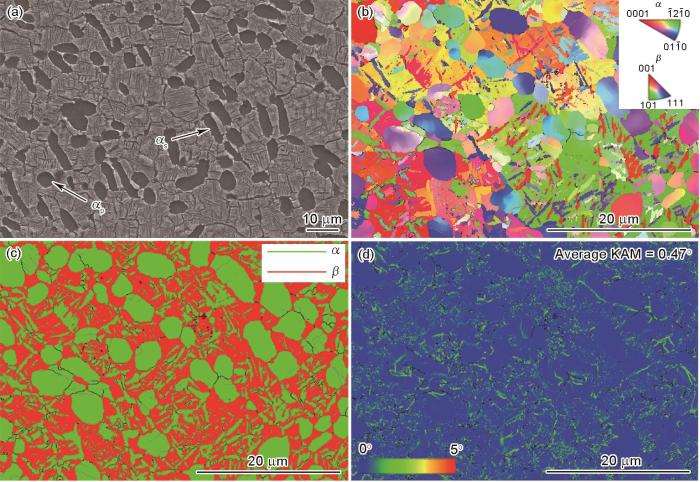
图2
Ti551合金初始微观组织的SEM像和EBSD结果
Fig.2
SEM image (a), inverse pole figure (IPF) (b), phase map (c), and kernel average misorientation (KAM) map (d) of the initial microstructure of Ti551 alloy (αp—primary α, αs—secondary α)
2.2 真应力-真应变曲线
图3中实线所示为Ti551合金在不同热压缩条件下的真应力-真应变曲线。在变形初期,流变应力随应变增加快速增大,在此变形阶段,材料内部的位错增殖速率显著高于动态回复(DRV)的软化速率,位错密度迅速增加,加工硬化占据主导地位。在达到峰值应力后,由于动态再结晶(DRX)晶粒的形成和生长,流变应力下降并逐渐趋于平衡,这种变化趋势在低温高应变速率(800 ℃、10 s-1)下更明显。最后,当加工硬化与动态软化达到平衡后,流变应力进入稳定状态。此外还可以看出,变形温度和应变速率对应力影响显著。随着温度下降或应变速率增加,应力明显增加。
图3

图3
Ti551合金在不同热压缩条件下真应力-应变曲线及经摩擦修正、温度修正后的真应力-应变曲线
Fig.3
True stress-strain curves at temperatures (T) of 800 oC (a), 900 oC (b), 1000 oC (c), and 1100 oC (d) under different strain rates (
在热压缩过程中,需要考虑试样两端与压头的摩擦对流变应力的影响。采用Ebrahimi和Najafizadeh[17]提出的方法对实验数据进行修正,摩擦修正的流变应力可以表示为:
式中,σ0和σf分别为实验测得的流变应力和摩擦修正后的流变应力,f为等效摩擦修正因子,C为与几何结构有关的因子,R0和H0分别为热变形前试样的平均半径和高度。μ为摩擦修正因子,可以表示为[18]:
式中,R和H分别为热压缩后试样的平均半径和高度,b为鼓形系数,RM和Rr分别为热变形后试样的最大半径和端面半径。
摩擦修正后的真应力-应变曲线如图3中的虚线所示。可以看出,摩擦修正后的流变应力与实验测得的流变应力相比有所减小,并且在相同的变形条件下,流变应力减小的幅度随应变速率的增大而增大。
摩擦修正完成后,还应考虑热压缩过程中温升对流变应力的影响。在热压缩过程中,由绝热温升效应导致的温度变化(ΔT)可以表示为[19]:
式中,γ为绝热因子(γ = 0~1);W为塑性变形能转换为变形热的比例,取0.95;ρ为Ti551合金的密度;cp 为Ti551合金的比热容;ε为真应变。
图4为Ti551合金在不同热压缩条件下的温度变化。可以看出,在相同的应变速率下,ΔT随温度的降低而增大。在相同的变形温度下,ΔT随应变速率的增大而增大。在应变速率为0.001 s-1时,ΔT最大值不超过2 ℃,当应变速率为10 s-1时,ΔT最大值增加至86.42 ℃。
图4
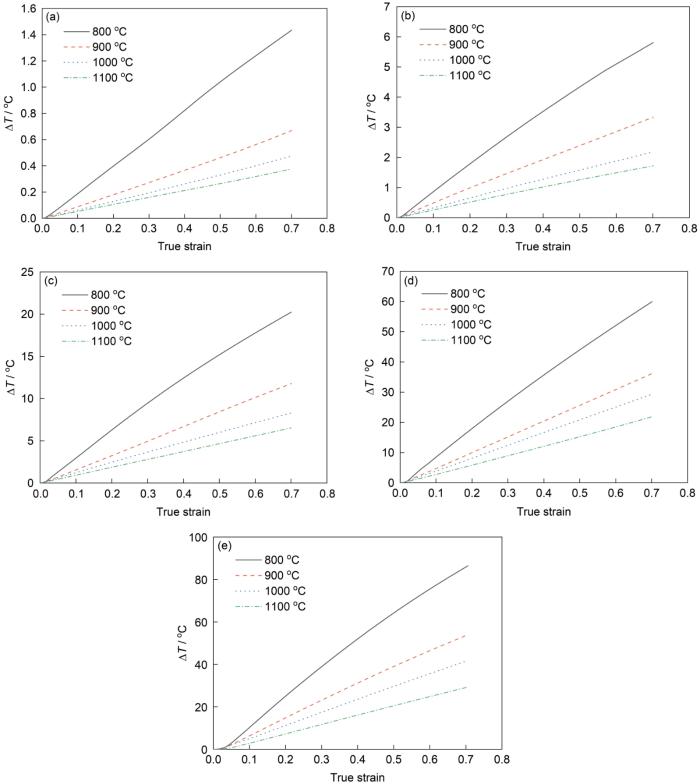
图4
Ti551合金在不同热压缩条件下的温度变化
Fig.4
Temperature changes (ΔT) of Ti551 alloy at
由温升引起的流变应力变化(Δσ)可以由下式表示[19]:
式中,Q为热变形激活能;R为气体常数,R = 8.314 J/(mol·K);n为应力指数;α为材料常数。
图3中点划线所示为经过温度修正后的真应力-应变曲线。可以看出,在相同变形条件下,温度修正后的流变应力变化随应变速率的增加而增大。
综上所述,摩擦修正和温度修正在一定程度上可以消除实验过程中摩擦和变形热带来的影响,使真应力-应变曲线更真实地反映材料的力学行为。
2.3 SCA模型
Sellars和McTegart[20]提出的Arrhenius型双曲正弦函数模型被广泛应用于描述高温变形条件下材料的应力、应变速率和温度三者之间的相互关系,其具体的数学表达式如下:
式中,A1、A2、A和β为材料常数;σ为流变应力;n1为应力指数。
基于摩擦修正和温度修正后的真应力-应变曲线计算了Ti551合金在真应变为0.3时的本构方程,根据热压缩实验得到的真应力-真应变曲线绘制出
图5
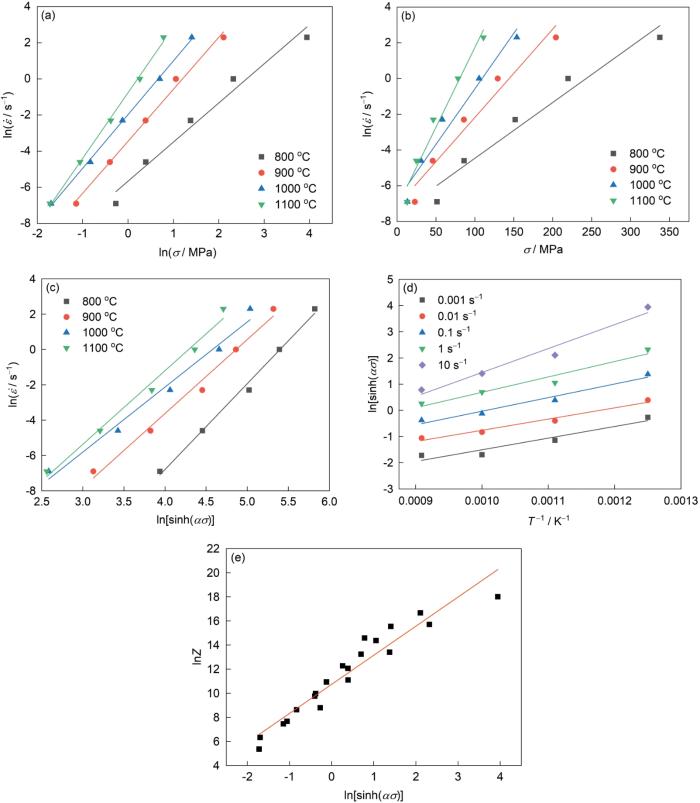
图5
Fig.5
Linear fitting curves of
将
根据
通过上述计算可得出Ti551合金在真应变为0.3时的本构方程为:
表1 不同真应变时的材料常数
Table 1
| ε | Q / (J·mol-1) | lnA | n | α / MPa-1 |
|---|---|---|---|---|
| 0.10 | 155144.74 | 12.0671 | 2.8780 | 0.01426 |
| 0.15 | 151640.37 | 11.8166 | 2.9379 | 0.01389 |
| 0.20 | 145891.04 | 11.4170 | 2.9533 | 0.01375 |
| 0.25 | 143261.63 | 11.0492 | 2.9686 | 0.01374 |
| 0.30 | 140042.85 | 10.7365 | 2.9704 | 0.01373 |
| 0.35 | 138616.43 | 10.6623 | 2.9957 | 0.01372 |
| 0.40 | 135233.88 | 10.3218 | 2.9992 | 0.01371 |
| 0.45 | 132736.45 | 10.0940 | 3.0369 | 0.01372 |
| 0.50 | 129037.86 | 9.7158 | 3.0727 | 0.01375 |
| 0.55 | 125617.22 | 9.3848 | 3.0967 | 0.01374 |
| 0.60 | 121303.17 | 8.9610 | 3.1285 | 0.01372 |
| 0.65 | 119952.93 | 8.8574 | 3.1801 | 0.01364 |
对Q、n、α和lnA进行五阶多项式拟合,得到如图6所示的拟合曲线。可以看出,随着真应变的增大,Q和lnA单调下降,表明热变形激活能降低、流变应力对温度的敏感性减弱;n单调上升,表明材料的应变速率敏感性增强;α急剧下降后趋于稳定,表明随着应变增加,材料从变形初期应力响应剧烈的非稳态阶段,快速过渡到微观组织与流变应力达到动态平衡的稳态热变形阶段。
图6
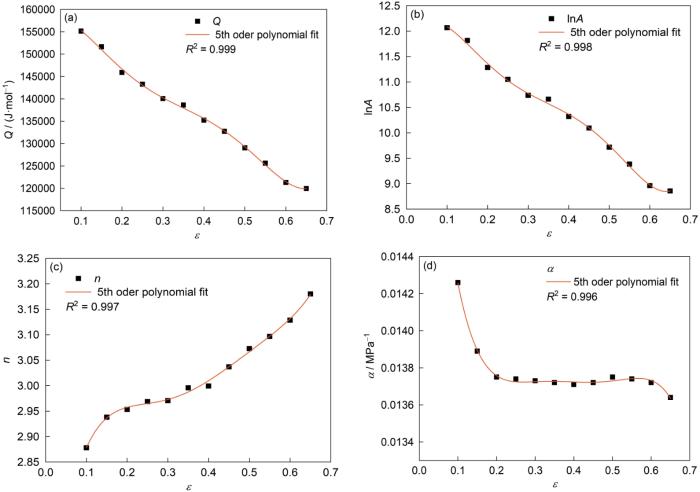
图6
材料常数与真应变的关系曲线
Fig.6
Curves of Q (a), lnA (b), n (c), and α (d) with true strain (R2—square of the correlation coefficient R)
结合多项式拟合结果,Ti551合金的热变形本构模型可以用
2.4 BPANN本构模型
图7
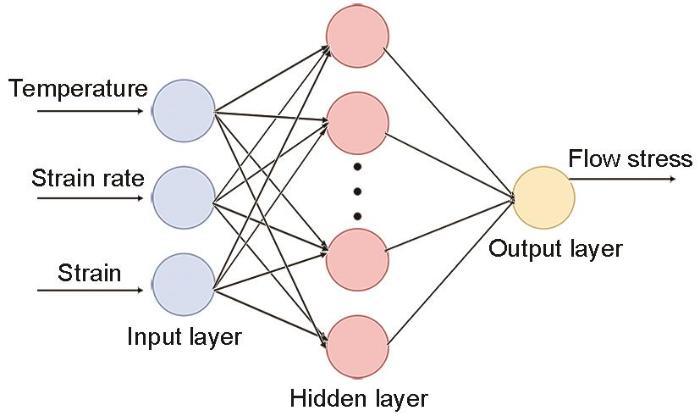
图7
反向传播人工神经网络(BPANN)模型结构图
Fig.7
Structural diagram of back-propagation artificial neural network (BPANN) model
由于输入和输出的数据变化范围很大,且单位也不统一,因此在训练开始前需要对原始数据进行归一化处理,使用下式将输入数据和输出数据归一化到[0, 1]:
式中,X为原始数据,Xmin和Xmax分别为X的最小值和最大值,X'为对应于X的归一化数据。
隐藏层中的神经元数量与BPANN模型的准确性密切相关[27]。神经元数量过少,模型无法充分学习输入数据与输出数据之间的复杂关系。神经元数量过多则会降低训练速度,甚至导致过拟合。可以通过试错法来确定神经元的数量,用均方误差评估模型的性能,表示为:
式中,MSE为均方误差,Ei 和Pi 分别为实验值和预测值,m为样本总数。图8显示了隐藏层中的神经元数量对MSE的影响。可以看出,当神经元数量为10时,MSE最小,此时BPANN模型的拟合性能最好。隐藏层和输出层的传递函数分别为“tansig”和“purelin”,训练函数为“trainlm”。将迭代次数设置为1000,目标误差为0.000001,学习率为0.01,最终建立了3 × 10 × 1结构的BPANN模型。
图8

图8
隐藏层中的神经元数量对均方误差(MSE)的影响
Fig.8
Effects of the number of neurons in the hidden layer on mean squared error (MSE)
在分别采用SCA和BPANN模型建立Ti551合金的本构关系后,计算了0.10~0.65真应变范围的流变应力,比较了两个模型的拟合准确性。如图9所示,在不同变形条件下,通过对SCA模型预测值与实验值对比分析可见,在温度为800 ℃时,应变速率较高时误差较大,在其余变形条件下,SCA模型预测值与实验测量值之间展现出良好的吻合度。相较于SCA模型,BPANN模型在所有变形条件下均表现出优异的拟合性能。
图9
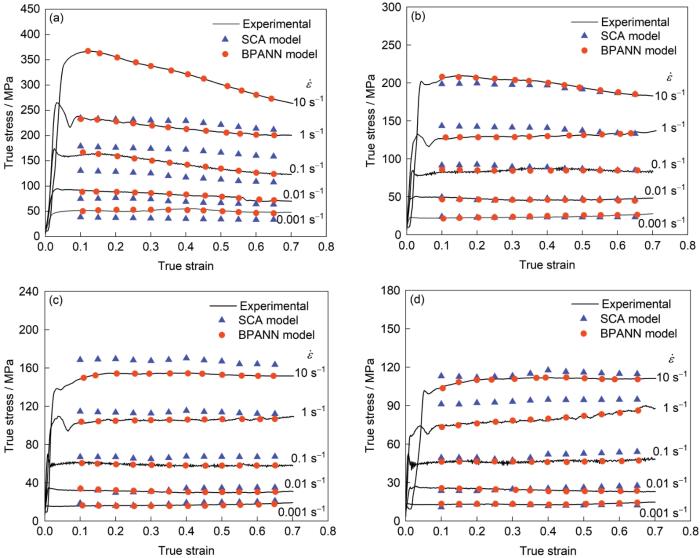
图9
不同热压缩条件下流变应力预测值与实验值对比
Fig.9
Comparisons of predicted and experimental flow stresses under different
为了更好地比较两个模型的准确性,使用R、AARE和δ作为评估标准,分别用以下公式表示:
式中,σei 为实验应力,σpi 为预测应力,
图10
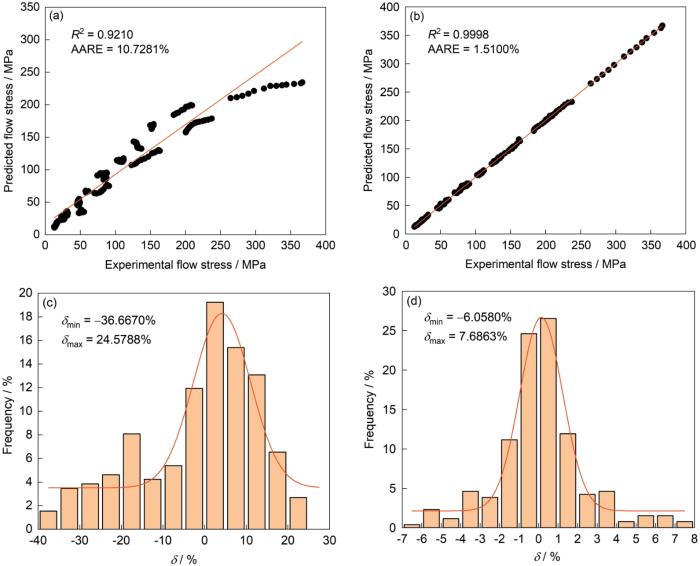
图10
应变补偿Arrhenius (SCA)模型和BPANN模型中流变应力预测值与实验值的比较及相对误差分布
Fig.10
Comparisons of predicted and experimental flow stresses (a, b) and distributions of relative error (c, d) in SCA model (a, c) and BPANN model (b, d) (AARE—average absolute relative error, δ—relative error, δmin—minimum relative error, δmax—maximum relative error)
本构模型的准确性可以通过有限元(FE)仿真进一步验证。有限元仿真的准确性取决于输入的应力-应变数据数量,而通过实验获得的数据是有限的。基于建立的SCA模型和BPANN模型,预测变形条件为T = 950 ℃、
图11

图11
Ti551合金的热压缩有限元模型和上模的载荷-行程曲线
Fig.11
Thermal compression finite element model (a) and load-stroke curves of upper die (b) of Ti551 alloy (v—moving speed of upper die)
2.5 热加工图
在DMM理论框架下,材料热加工过程被视为一个能量耗散系统。在材料变形时,外部输入的能量(P)一部分以热的形式耗散,称为耗散量(G);另一部分用于驱动材料内部的微观结构变化,称为耗散协量(J),可用下式表示:
式中,
图12
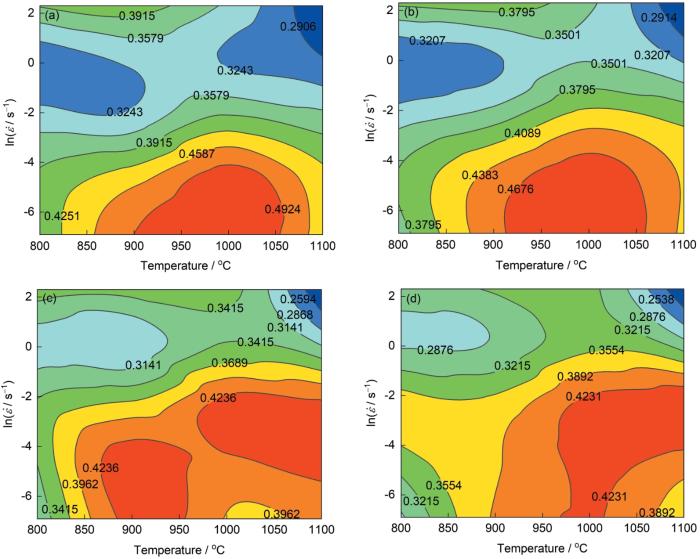
图12
不同真应变下Ti551合金的功率耗散图
Fig.12
Power dissipation maps of Ti551 alloy at true strains of 0.10 (a), 0.30 (b), 0.50 (c), and 0.69 (d) (The isoline values are power dissipation coefficients)
除了功率耗散图,构建失稳图对于避免热变形过程中的危险区域同样至关重要。失稳判据的表达式为:
式中,
图13
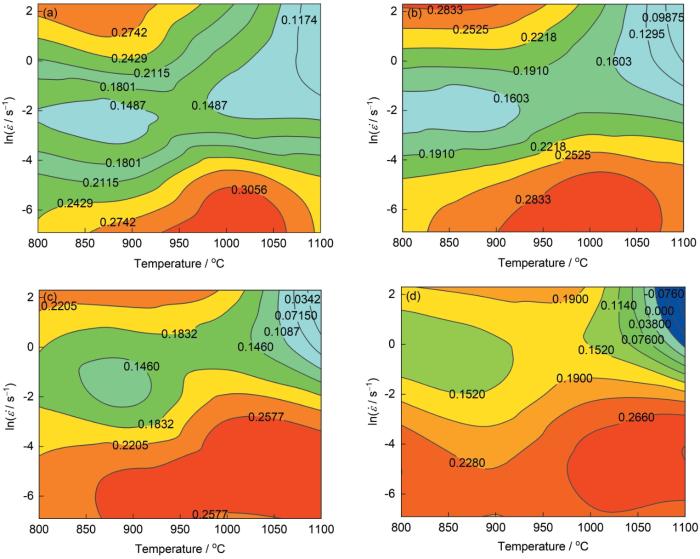
图13
Ti551合金在不同真应变下的失稳图
Fig.13
Instability maps of Ti551 alloy at true strains of 0.10 (a), 0.30 (b), 0.50 (c), and 0.69 (d) (The isoline values are instability coefficients)
将功率耗散图与失稳图叠加在一起,得到Ti551合金在真应变为0.10、0.30、0.50和0.69时的热加工图,如图14所示,等值线数值为η值。图中区域I代表Ti551合金的失稳区域,在此区域容易出现开裂和不均匀变形等缺陷。可以看出,在应变为0.10和0.30时,变形量较小,基本没有出现失稳区域。随着应变的增加,失稳区域出现在高温高应变速率区域。区域Ⅱ为Ti551合金的可加工区域,虽然成功避免了加工失稳区域,但η较小。区域Ⅲ为Ti551合金的最佳加工区域,主要集中在高温低应变速率区域。此区域的η相对较大,意味着Ti551合金在该区域加工时,能够更有效地促进微观组织演变,如DRX的充分进行,从而使晶粒细化,显著提升材料的强度、韧性和塑性等力学性能。
图14

图14
Ti551合金在不同真应变下的热加工图
Fig.14
Processing maps of Ti551 alloy at true strains of 0.10 (a), 0.30 (b), 0.50 (c), and 0.69 (d) (The isoline values are power dissipation coefficients. Region I—instability zone, region Ⅱ—safe processing region, region Ⅲ—optimal processing region)
从图14可以看出,当应变为0.10时,最佳加工区域为
2.6 微观组织演变
图15为Ti551合金在应变为0.69时不同热压缩条件下微观组织的OM像。在T = 900 ℃、
图15
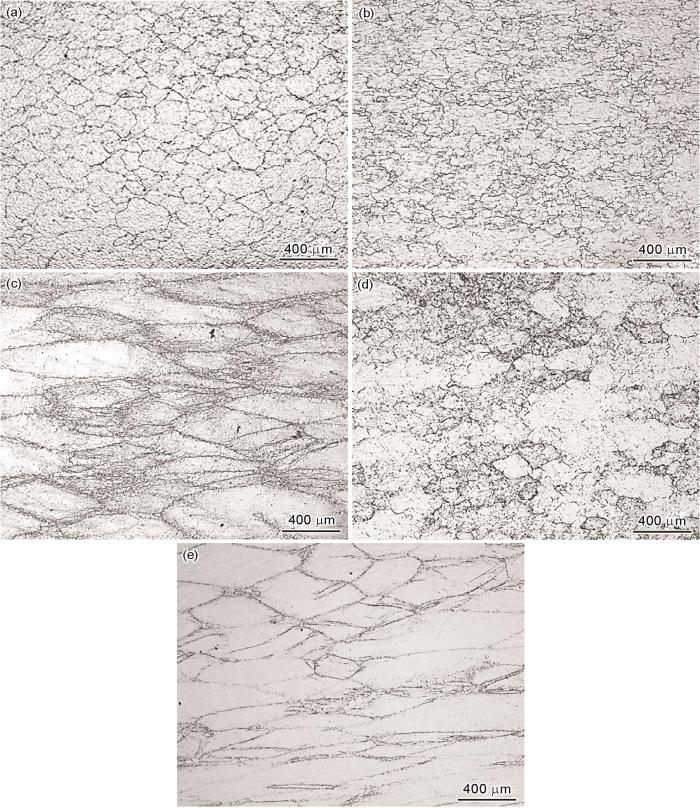
图15
Ti551合金在真应变为0.69时不同热压缩条件下微观组织的OM像
(a) 900 oC, 0.01 s-1 (b)
(c)
Fig.15
OM images of Ti551 alloy under different T and
对样品进行EBSD测试,发现在900 ℃时,α相已全部转化为β相。图16为Ti551合金在应变为0.69时不同热压缩条件下的IPF,灰色线表示取向差范围在2°~15°的小角度晶界(LAGBs),黑色线表示取向差大于15°的大角度晶界(HAGBs)。由图16a可以看出,当试样在T = 900 ℃、
图16
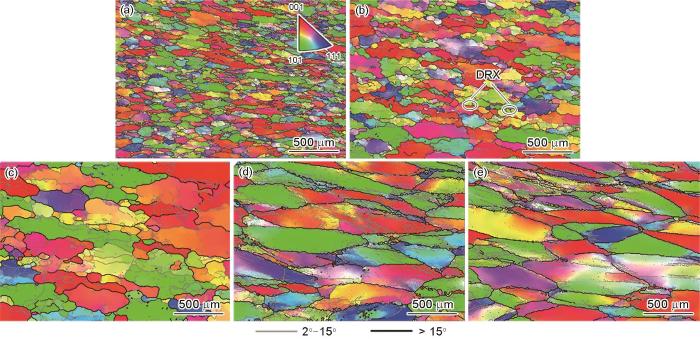
图16
Ti551合金在应变为0.69时不同热压缩条件下的反极图
(a) 900 oC, 0.01 s-1 (b)
(c)
Fig.16
IPFs of Ti551 alloy under different T and
图17
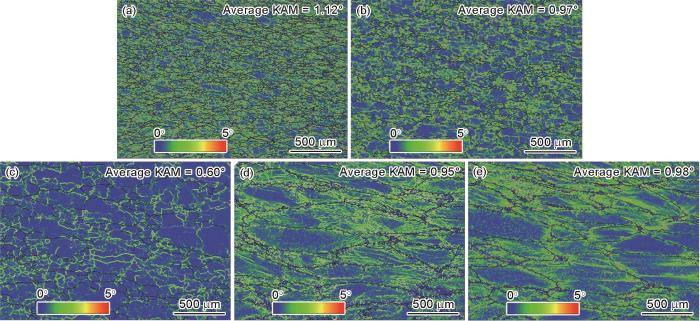
图17
Ti551合金在应变为0.69时不同热压缩条件下的局部取向差(KAM)分布图
(a) 900 oC, 0.01 s-1 (b)
(c)
Fig.17
KAM maps of Ti551 alloy under different T and
利用DEFORM-3D软件模拟Ti551合金的等温热压缩过程,获得了合金在T = 1000 ℃、
图18

图18
Ti551合金在1000 ℃、1 s-1变形条件下的应变场分布和不同区域微观组织的OM像
Fig.18
Strain distribution of Ti551 alloy at T = 1000 oC and
3 结论
(1) Ti551合金的流变应力对温度和应变速率非常敏感,随着温度下降或应变速率增加,流变应力明显增加。基于摩擦修正和温度修正后的真应力-应变曲线计算得到Ti551合金在真应变为0.30时的本构方程为:
(2) SCA模型具有一定的拟合准确性,R2和AARE分别为0.9210和10.7281%。BPANN模型比SCA模型精确度更高,预测值与实验值之间的相关性高达0.9998,AARE为1.5100%。
(3) 结合热加工图和微观组织演化分析确定了最佳加工区域为
(4) CDRX和DDRX是Ti551合金在热变形过程中的主要再结晶机制。CDRX主要发生在位错密度高的区域,而在低应变速率下,升高温度容易促进DDRX。
参考文献
Effect of hot-pressing temperature on the microstructure and properties of the diffusion-bonded region of TC4 alloy
[J].
热压温度对TC4合金扩散连接区组织与性能的影响
[J].
Dynamic recrystallization and texture evolution of a novel near-α Ti-6Al-1Mo-2Zr-0.55Fe-0.1B alloy during hot compression
[J].
Improved dynamic impact behavior of TC4 alloy coated with Ti-SiC
[J].
Deformation mechanism diagram and deformation instability of a Ti-5Al-5Mo-5V-1Cr-1Fe titanium alloy during the hot compression
[J].
Hot compression behavior and dynamic recrystallization mechanisms of Ti-5Mo-5V-8Cr-3Al alloy
[J].
Effect of high-strain-rate hot compression on the microstructural evolution and flow behaviors of Ti-55511 alloy
[J].
Mechanical behaviour and microstructural evolution of Ti-6Al-1Mo-1V-2Zr-2Cr-1Fe alloy subjected to hot compression deformation
[J].
Thermomechanical behaviour of Ti-42.5Al-4Nb-0.5Mo-0.1B-(C, W, Y) alloy during hot compression
[J].
Dynamic recrystallization and constitutive equation of 15Cr-10Mn-Ni-N steel under hot deformation
[J].
Thermal deformation behavior of Al19.3Co15Cr15Ni50.7 high entropy alloy
[J].
Al19.3Co15Cr15Ni50.7高熵合金的热变形行为
[J].
Hot deformation behavior of a 4Al alumina-forming austenitic heat-resistant steel: Constitutive equation, prediction model, processing map and dynamic recrystallization mechanism
[J].
Optimization of hot deformation parameters for multi-directional forging of Ti65 alloy based on the integration of processing maps and finite element method
[J].
Artificial neural network modified constitutive descriptions for hot deformation and kinetic models for dynamic recrystallization of novel AZE311 and AZX311 alloys
[J].
Comparison of flow behaviors of near beta Ti-55511 alloy during hot compression based on SCA and BPANN models
[J].
Comparative study on constitutive relationship of as-cast Ti60 titanium alloy during hot deformation based on Arrhenius-type and artificial neural network models
[J].
Artificial neural network applicability in studying hot deformation behaviour of high-entropy alloys
[J].
A new method for evaluation of friction in bulk metal forming
[J].
A comparative study on constitutive relationship of as-cast 904L austenitic stainless steel during hot deformation based on Arrhenius-type and artificial neural network models
[J].
Flow stress and dynamic recrystallization behavior and modeling of GH4738 superalloy during hot compression
[J].
On the mechanism of hot deformation
[J].
Softening behavior of 18.7Cr-1.0Ni-5.8Mn-0.2N low nickel-type duplex stainless steel during hot compression deformation under large strain
[J].
18.7Cr-1.0Ni-5.8Mn-0.2N节Ni型双相不锈钢的大变形热压缩软化行为
[J].
Exploring hot deformation behavior of the solutionized Cu-15Ni-8Sn alloy through constitutive equations and processing maps
[J].
Hot deformation behavior of aluminum alloys: A comprehensive review on deformation mechanism, processing maps analysis and constitutive model description
[J].
Hot deformation behavior and constitutive equation of TA15N titanium alloy
[J].
Strain-compensated constitutive model and hot processing map for extruded Al-Mg-Mn-Ti alloy based on reheating deformation behavior
[J].
Flow characteristics, ANN-based prediction, 3D processing map, and interface microstructure of titanium/stainless steel bimetallic composite
[J].
Predicting the flow stress of Inconel 617 superalloy using constitutive equation and artificial neural network approach
[J].
High-temperature hot deformation behavior and processing map of Ti-22Al-25Nb alloy
[J].
Construction of hot processing map of solutionized Mg-10Gd-6Y-1.5Zn-0.5Zr alloy and microstructure evolution
[J].
固溶态Mg-10Gd-6Y-1.5Zn-0.5Zr合金热加工图构建及微观组织演变
[J].
Hot compressive deformation behavior of Ti-8Al-1Mo-1V titanium alloy at elevated temperatures: Focus on flow behavior, constitutive modeling, and processing maps
[J].


