



惯性摩擦焊接作为一种先进固相连接技术,具有高效、节能及环保等显著优势,能有效避免高温合金焊接过程中常见的气孔及裂纹缺陷[4,5]。在航空发动机转子等关键部件设计中,为了兼顾结构轻量化和高可靠性要求,异质高温合金的惯性摩擦焊接工艺得到广泛应用[6,7]。Senkov等[8]研究了低固溶温度高熔点(LSHR)和Mar-M247镍基高温合金在惯性摩擦焊中的焊接行为,发现焊接界面的温度接近或超过γ′相溶解温度,高温合金经历剧烈的摩擦生热和塑性变形,导致焊接界面附近温度接近或超过材料的再结晶温度,引发动态再结晶并形成细晶层。此外,Huang等[9]研究了惯性摩擦焊IN718镍基高温合金的剧烈塑性变形过程,发现该过程引入了大量位错和亚结构。在高温阶段(如顶锻保压或冷却过程),上述变形储能驱动再结晶过程,显著改变了接头各区域的微观组织[10]。在这一动态再结晶过程中,镍基高温合金因其较低的堆垛层错能,易于通过晶界迁移或位错重组形成退火孪晶[11]。这是由于在低层错能材料中,孪晶界面的形成能较低,使孪生成为比传统晶界迁移更有利的晶界结构调整方式[12],这一机制普遍存在于fcc金属的退火孪晶形成过程中。
传统的IN718镍基高温合金广泛应用于航空发动机涡轮盘等关键部件,其在650 ℃服役温度以下具有优异的抗拉强度和蠕变性能,但高温强度和抗氧化能力相对有限[13]。GH4065A作为一种新型镍基高温合金,相较于传统的IN718高温合金,在高温环境下展现出更优异的蠕变强度、抗氧化性和热疲劳性能,在更高温度和应力等极端服役工况下具有明显的优势[13,14]。目前,国内外学者已针对GH4065A和IN718高温合金的惯性摩擦焊接工艺已开展了较为系统的研究,主要包括GH4065A同质组配[15,16]、IN718同质组配[17,18]、IN718/720Li异质组配[19]及IN718/FGH96异质组配[20~22]的惯性摩擦焊接工艺优化以及微观组织演变机理分析。然而,鲜有针对GH4065A/IN718异质组配高温合金惯性摩擦焊接工艺的报道,且焊后热处理对接头界面微观组织演变机理的影响尚不明晰,这在一定程度上限制了该材料组配在航空发动机关键部件中的工程化应用。
本工作以GH4065A和IN718异质高温合金作为焊接母材,采用惯性摩擦焊接技术成功制备了高质量焊接接头,并对其进行焊后热处理。系统研究了焊后热处理对接头界面微观组织演变的影响规律,建立了焊后热处理工艺与接头微观组织演变的映射关系,以期为推动航空发动机关键部件的高性能制造提供理论依据和技术支撑。
1 实验方法
采用GH4065A和IN718异质高温合金进行惯性摩擦焊接实验,其主要化学成分如表1所示。采用HWI-IFW-377轴向/径向惯性摩擦焊机进行焊接,其最大轴向力为3600 kN,最高转速为600 r/min。焊接工艺参数为:初始主轴转速300 r/min,转动惯量800 kg·m2,顶锻力300 MPa。焊接完成后,采用精密车削工艺去除接头飞边,并随后对焊件进行标准焊后热处理。焊后热处理工艺制度为:将焊件以10 ℃/min的升温速率加热至760 ℃,保温6 h后随炉冷却至室温。
表1 GH4065A和IN718高温合金的化学成分 (mass fraction / %)
Table 1
| Alloy | C | Cr | Co | W | Mo | Al | Ti | Nb | Zr | B | Fe | Ni |
|---|---|---|---|---|---|---|---|---|---|---|---|---|
| GH4065A | 0.011 | 16.00 | 13.0 | 4.0 | 4.00 | 2.10 | 3.70 | 0.70 | 0.05 | 0.015 | 1.00 | Bal. |
| IN718 | 0.010 | 19.39 | - | - | 3.05 | 0.53 | 1.02 | 5.21 | - | - | 16.69 | Bal. |
通过多尺度表征技术系统研究了焊后热处理对GH4065A/IN718异质高温合金接头界面微观组织的影响规律。采用电火花线切割技术沿GH4065A/IN718异质高温合金焊缝横截面切取微观组织分析试样。利用SiC砂纸对试样进行逐级研磨至2000号,并采用W1.5金刚石抛光膏进行抛光处理,随后采用50 g CuCl2 + 250 mL HCl + 250 mL C2H5OH溶液对试样进行化学腐蚀,制备出光学显微镜(OM)试样;采用150 mL H3PO4 + 10 mL H2SO4 + 15 g CrO3溶液对试样进行电解腐蚀以及电解抛光,制备出扫描电子显微镜(SEM)试样。采用DMi8 OM对接头焊缝微观组织形貌进行观察。采用JXA-8530F Plus电子探针显微分析仪(EPMA)对接头界面进行成分分析。采用配有电子背散射衍射(EBSD)系统的IT800-SHL型场发射SEM分析接头的强化相形貌和分布规律,接头轴向各区域在剧烈热力耦合作用下的动态再结晶机制,以及各区域晶粒尺寸和形态。采用JEM-2100 F高分辨透射电子显微镜(TEM)对焊接接头界面处的成分分布、晶格类型等进行精细化表征,以揭示焊后热处理与界面微观组织演变的映射关系。
采用HV-1000Z型Vickers显微硬度计进行显微硬度测试,载荷为200 g,保载时间为10 s。依据标准GB/T 228—2002,采用Instron 5982型万能材料试验机进行焊接接头的室温和高温拉伸测试,拉伸速率为0.5 mm/min。
2 实验结果与讨论
2.1 金相组织分析
异质合金惯性摩擦焊接头的界面质量直接决定了接头整体结构的服役可靠性。图1为焊态和热处理态接头沿轴向各区域显微组织的OM像。可见,GH4065A/IN718异质合金接头界面较为平滑且组织均匀致密,界面结合质量较好,无明显的孔洞或裂纹等缺陷。这表明焊接过程具有充足的热输入,且材料发生了充分的塑性流动和扩散,形成了良好的冶金结合。GH4065A/IN718异质高温合金接头沿轴向的主要特征区域为焊核区(weld zone,WZ)和热机械影响区(thermo-mechanically affected zone,TMAZ)。焊态接头WZ处于惯性摩擦焊接头的中心区域,该区域显微组织发生了剧烈且充分的动态再结晶,形成细小均匀的等轴晶组织,经过后续的热处理过程,热处理态WZ晶粒的分布和形貌与焊态相似,并未发生明显改变。焊接过程中摩擦界面及附近区域产生了较高的剪切塑性变形,促使大量的亚晶粒形成并作为潜在的再结晶形核点。由于焊接温度高于IN718和GH4065A高温合金的再结晶温度,因此进一步促进了形核及周围组织的再结晶过程。由于惯性摩擦焊具有升温快和高温持续时间短等特性,晶粒的长大受到很大程度的制约,因此整个焊接过程是一个完全动态再结晶过程,WZ处的晶粒转变成了细小的再结晶晶粒。焊态和热处理态接头TMAZ中晶粒呈粗晶与细晶共存的分布特征,其受到热-力耦合作用的影响仅次于WZ,部分变形晶粒在高温与机械双重作用下发生动态再结晶,由于此区域晶粒的变形量远小于WZ,因此该区域组织的再结晶程度相对较低。
图1

图1
焊态和热处理态接头沿轴向各区域显微组织的OM像
Fig.1
Low (a, e) and high (b-d, f-h) magnified OM images of welded joint (a-d) and post-weld heat treated joint (e-h) (The black and yellow arrows in Figs.1a and e denote the widths of the weld zone (WZ) and thermo-mechanically affected zone (TMAZ) on IN718 side, respectively) (b, f) WZ (c, g) TMAZ on GH4065A side (d, h) TMAZ on IN718 side
经焊后热处理后,接头WZ以及IN718和GH4065A侧TMAZ的宽度均有所增大。这主要是由于焊后热处理促进了WZ和TMAZ中冷变形组织的再结晶[24],尤其是在TMAZ,由于该区域在焊接过程中产生了较大的塑性变形,应变能积累较高,焊后热处理时更容易发生再结晶。焊后热处理过程中,再结晶晶粒逐渐长大,且TMAZ向低能量区域扩展,从而使得TMAZ的范围扩大。此外,热处理驱动了合金元素的扩散和成分均匀化,削弱了由焊接导致的成分梯度。二者共同导致WZ/TMAZ与母材间的显微组织差异减小,原焊接态下清晰的显微组织边界变得模糊,从而表现为WZ和TMAZ的宽度增加。
2.2 强化相形貌及分布
图2为焊态和热处理态接头沿轴向各区域微观组织的SEM像。由图可见,在焊态接头中,GH4065A侧TMAZ呈现出较为均匀、致密的微观结构。IN718/GH4065A接头界面平整,表明两种合金在惯性摩擦焊过程中实现了良好结合。在焊态接头WZ的细晶组织中,基本未观察到强化相析出。GH4065A侧TMAZ中有颗粒状γ′强化相弥散分布,IN718侧TMAZ中则以尺寸较小的γ′′相为主,同时部分区域存在由γ′′相转变而来的短棒状δ相。此外,两侧TMAZ中均有碳化物弥散分布于基体。上述组织特征与焊接过程的热循环密切相关,惯性摩擦焊过程具有快速、瞬时和局部加热的特点,焊接后接头区热量通过对流与传导迅速散失,温度骤降至强化相析出温度以下。WZ最高温度可达约1300 ℃,高于γ′′、γ′等强化相的固溶温度范围(1110~1120 ℃),导致该区域中的强化相完全固溶于基体,因此在焊态下WZ细晶组织中基本未见强化相析出。而TMAZ受到的高温影响相对较弱,热暴露时间较短,致使该区域仅部分强化相溶解于基体。其中,GH4065A侧中的γ′相以颗粒状保留,IN718侧则保留较多细小γ′′相,部分γ′′相在高温下转变为短棒状δ相,较大尺寸δ相的存在可能对接头力学性能产生不利影响[25]。由于惯性摩擦焊属于固态焊接工艺,界面区不会出现熔化和再凝固所形成的铸态组织,而是通过摩擦和塑性流动形成致密结合区。材料之间的冶金结合主要依靠扩散和再结晶实现,因此接头质量通常较高。在此过程中,TMAZ表现为带状分布的微观组织特征。这是由于焊接时界面区在摩擦和高压作用下发生剧烈塑性流动,导致材料局部形成变形带。这些变形带在宏观金相组织中呈现为较为规则的条带状结构,直观反映出该区域在焊接过程中经历了显著的高塑性变形。
图2
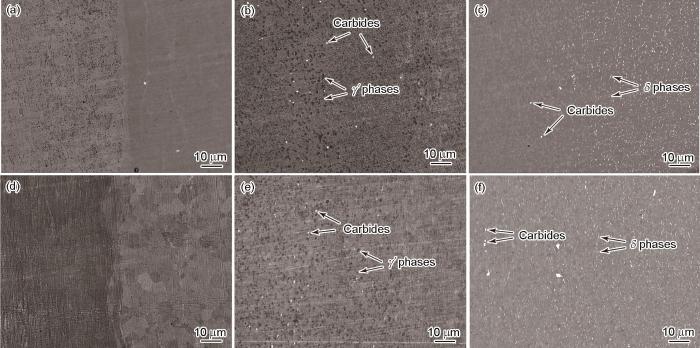
图2
焊态和热处理态接头沿轴向各区域微观组织的SEM像
Fig.2
SEM images of various axial regions in welded joint (a-c) and post-weld heat treated joint (d-f) (a, d) WZ (b, e) TMAZ on GH4065A side (c, f) TMAZ on IN718 side
如图2d所示,热处理态接头WZ仍未观察到明显的析出相,这是由于析出相尺寸较小,难以通过分辨率相对较低的SEM分辨。如图2e和f所示,热处理后,GH4065A和IN718侧的碳化物尺寸及分布未发生明显变化,但γʹ相和δ相的形态和分布发生了一定变化。GH4065A侧的γ′相主要呈现颗粒状,尺寸小于焊态接头中的γ′相,说明在热处理过程中γ′相发生了重熔并析出,且γʹ相的生长受到一定的控制。IN718侧均匀分布着较多的短棒状δ相,其尺寸与焊态相比明显减小,细小的短棒状δ相有助于力学性能的提升[26]。随着与WZ中心的距离增加,强化相的尺寸和体积分数均逐渐增加。热处理过程中,WZ和TMAZ中的强化相形成元素从过饱和基体中析出,相较于焊态接头,热处理态接头中强化相的体积分数增加,且平均尺寸变大,第二相强化作用增强[27]。
图3为焊态及热处理态接头界面的SEM像和EPMA像。由图可见,在焊态接头中,界面区域的元素扩散层宽度明显小于热处理态。接头左侧为GH4065A合金,含有固溶态的Co、W等合金元素,其主要强化相为γ′相(Ni3(Al, Ti));右侧为IN718合金,含有固溶态的Fe等元素,其主要强化相为γ′′相(Ni3Nb)。经过热处理后,界面两侧的材料发生了更充分的互扩散和混合,元素迁移距离显著增加。这种充分的元素互扩散有助于消除界面成分突变,从而增强界面的冶金结合强度。
图3
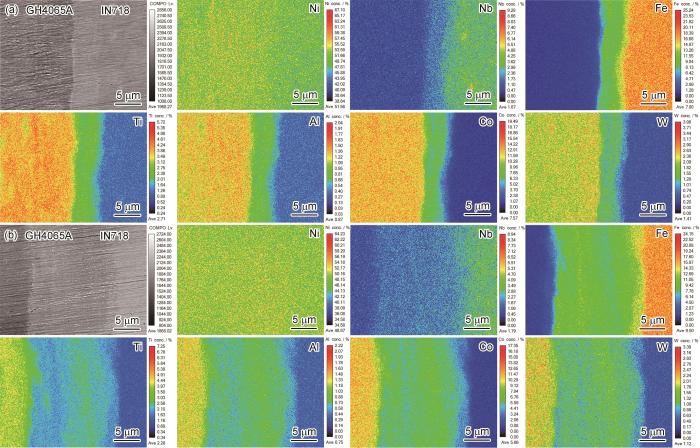
图3
焊态和热处理态接头界面的SEM像和EPMA像
Fig.3
SEM images and EPMA elemental distribution maps of interface in welded joint (a) and post-weld heat treated joint (b)
2.3 动态再结晶机制
图4为焊态GH4065A/IN718异质接头沿轴向各区域的EBSD分析结果。如图4a~d所示,焊态下WZ的晶粒均为细小的等轴晶,平均晶粒尺寸为2.93 μm,大于GH4065A侧和IN718侧TMAZ的晶粒尺寸,这一差异主要归因于WZ所经历的完全动态再结晶过程,在高温和较大应变作用下,WZ获得了充分的热力学驱动力,使得原始晶粒完全重组,并通过晶界迁移和晶粒吞并机制形成均匀细小的等轴晶组织,同时较高的热输入与相对较低的应变速率为晶粒的充分长大提供了条件,最终表现出相对TMAZ更大的平均晶粒尺寸。如图4e~l所示,GH4065A侧和IN718侧TMAZ的平均晶粒尺寸分别为1.85和2.21 μm,且TMAZ区域晶粒形态复杂、取向差异明显,部分区域晶粒较为粗大,另一部分区域则呈现细小晶粒,这种非均匀组织是不完全动态再结晶与应变局部化共同作用的结果[28],由于TMAZ在焊接过程中经历的温度较低但应变速率较高,其再结晶过程受到抑制,仅在高应变累积区域发生动态再结晶形成细晶,而相邻区域则保留部分原始粗晶,同时塑性变形引起的晶格旋转与位错重排导致明显的晶粒取向梯度,反映了该区域强烈的热‑力耦合效应及非均匀组织演化特征。
图4
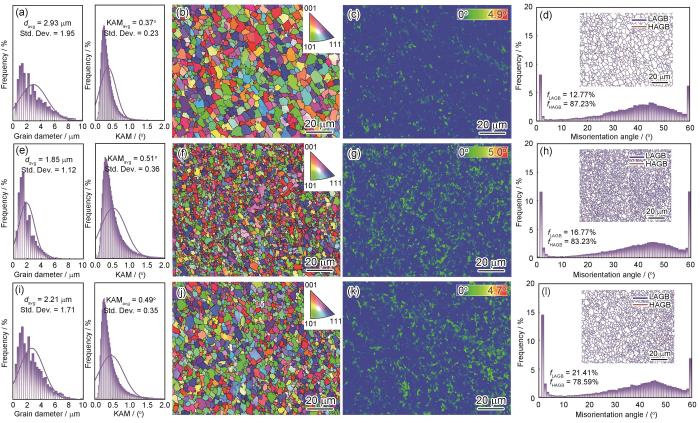
图4
焊态接头沿轴向各区域的EBSD分析
Fig.4
Grain size and kernel average misorientation (KAM) distributions (a, e, i), inverse pole figures (IPFs) (b, f, j), KAM maps (c, g, k), and misorientation angle distributions and grain boundary maps (insets) (d, h, l) of various axial regions in welded joint (davg—average grain diameter, KAMavg—average KAM, Std. Dev.—standard deviation, fLAGB—fraction of low angle grain boundary, fHAGB—fraction of high angle grain boundary) (a-d) WZ (e-h) TMAZ on GH4065A side (i-l) TMAZ on IN718 side
如图4d、h和l所示,WZ中大角度晶界(HAGB,取向差角θ > 15°)的占比为87.23%,略高于GH4065A侧TMAZ (83.23%)和IN718侧TMAZ (78.59%)。上述差异与各区域的再结晶程度及热暴露历史密切相关,在高温长时间作用下,WZ中小角度晶界(LAGB,2° < θ ≤ 15°)通过位错重组和晶界迁移逐渐转变为HAGB,提高了晶界的结构稳定性和力学兼容性;而TMAZ因热输入较低、再结晶不完全,保留了较多LAGB,这些晶界往往与亚晶结构和高位错密度区域相关联,可能成为微裂纹萌生和扩展的潜在位置。综上所述,WZ因经历完全再结晶和充分的微观应变释放而具有更均匀、稳定的显微组织,有利于提高接头的整体力学性能和服役可靠性;TMAZ则因组织非均匀性、较高的局部应变以及较多LAGB的存在,可能成为接头力学性能的薄弱区域,尤其在动态载荷或高温环境下其性能退化风险更为显著。
图5为热处理态接头沿轴向各区域的EBSD分析。由图可知,热处理后,接头各区域晶粒尺寸均有所增加,其中,WZ的晶粒尺寸仍为最大,WZ、GH4065A侧TMAZ和IN718侧TMAZ的晶粒尺寸分别达到3.31、3.20和2.68 μm,这是由于热处理为晶界迁移提供了必要的热激活能,从而驱动了晶粒长大。KAM统计结果表明,与焊态接头相比,热处理态接头WZ的KAM值仍然为0.37°,这是因为焊态接头WZ中应力较小,因此热处理对其KAM影响较小;GH4065A侧和IN718侧TMAZ的KAM值分别降低至0.41°和0.46°,这表明在热处理后上述两个区域的应力集中现象得到充分缓解,残余应力被消除。此外,热处理后WZ和IN718侧TMAZ中的HAGB占比均有小幅增加,而在GH4065A侧TMAZ,HAGB占比略有减小。总体来看,热处理对这三个区域HAGB占比的影响较小。
图5

图5
热处理态接头沿轴向各区域的EBSD分析
Fig.5
Grain size and KAM distributions (a, e, i), IPFs (b, f, j), KAM maps (c, g, k), and misorientation angle distributions and grain boundary maps (insets) (d, h, l) of various axial regions in post-weld heat treated joint (a-d) WZ (e-h) TMAZ on GH4065A side (i-l) TMAZ on IN718 side
2.4 位错及孪晶演变机理
采用TEM对焊态下WZ的位错、孪晶以及强化相等微观组织进行分析,结果如图6所示。焊态接头中晶界及晶内存在大量的位错,部分位错互相缠结(图6a和b),表明WZ中存在少量的应力集中。图6c和d分别为典型区域的高分辨TEM (HRTEM)像及选区电子衍射(SAED)花样。由图可知,WZ未析出强化相,WZ的SAED花样中仅能观察到基体的衍射斑点。这是由于在惯性摩擦焊过程中,WZ因剧烈的塑性变形和摩擦作用而显著升温,其峰值温度超过强化相的溶解温度,导致强化相完全固溶于基体。此外,WZ中存在部分退火孪晶,孪晶周围分布着较多的位错,如图6e~h所示。这是由于惯性摩擦焊的热作用过程持续时间短,并且在空气中冷却;此外,Ni基体本身层错能较低,位错难以交滑移,因此倾向于通过孪生机制协调塑性变形[29,30],因此,再结晶时层错容易扩展为退火孪晶。在冷却过程中形成的孪晶有助于释放焊接过程中WZ产生的高温残余应力,从而起到应力松弛的作用。
图6

图6
焊态接头焊核区(WZ)的TEM分析
Fig.6
TEM analyses of WZ in welded joint
(a) bright field (BF) TEM image
(b, e) BF TEM images of distributions of dislocation (b) and twin (e)
(c) high-resolution TEM (HRTEM) image
(d, h) selected area electron diffraction (SAED) patterns of matrix (d) and twin (h)
(f, g) dark field (DF) TEM images of twins observed in different directions (aʹ and bʹ represent matrix and twin, respectively)
图7为焊后热处理态接头WZ的TEM分析。经过热处理后,接头的WZ处仍保留部分孪晶(图7a),这是由于在热处理温度下,孪晶界迁移或晶粒吞并过程未能充分进行。值得注意的是,WZ中析出了大量细小的γ′/γ′′强化相(图7b~d),γ′相和γ′′相分别作为GH4065A和IN718合金的主要强化相,能够显著增强焊接接头的力学性能。这是由于γ′/γ′′相与γ基体之间存在共格关系,这种共格界面处的弹性应变场会阻碍位错运动,提高位错切割γ′/γ′′颗粒所需的应力[31]。此外,在拉伸、弯曲等机械变形过程中,位错需反复切割细小的γ′/γ′′强化相,显著增加变形阻力,提升接头强度。如图7e和f所示,热处理后接头的WZ出现了大量层错,这是由于位错在切割γ′/γ′′强化相的过程中会产生堆垛层错[32],这同时也会增加位错运动的阻力,从而对接头的WZ起到强化作用。
图7

图7
焊后热处理态接头WZ的TEM分析
Fig.7
TEM analyses of WZ in post-weld heat treated joint (a, d) low (a) and high (d) magnified BF TEM images (b, e) HRTEM images of γ′/γ′′ distribution (b) and stacking faults (e) (c, f) SAED patterns of γ′/γ′′ (c) and stacking faults (f)
2.5 力学性能
如图8a所示,在室温下,焊态接头的整体抗拉强度和屈服强度分别为1340和1067 MPa,断后伸长率为15.0%,这得益于惯性摩擦焊的固相连接特性避免了熔焊缺陷,同时剧烈的塑性变形引发动态再结晶,形成细晶强化组织;结合图6和7的TEM分析可知,焊态WZ中存在大量相互缠结的位错及退火孪晶,但强化相完全固溶于基体,未析出γ′/γ′′相,因此其强度主要来源于细晶强化、加工硬化及孪晶对残余应力的松弛作用。经焊后热处理后,接头在室温下的整体强度略有增加,这是由于热处理后WZ析出了大量细小的γ′/γ′′强化相,这些共格析出相通过阻碍位错运动显著增强了接头强度,同时位错切割析出相过程中产生的层错进一步增加了变形阻力,从而弥补了因位错密度下降可能带来的强度损失。如图8b所示,焊态接头的高温(650 ℃)屈服强度为920 MPa,略低于热处理态接头的925 MPa,这是由于焊态WZ缺乏强化相钉扎位错,高温下位错更易滑移和攀移,导致强度略有下降;而热处理态接头中细小的γ′/γ′′强化相在高温下仍能有效阻碍位错运动,同时高温促进了动态回复与再结晶,使断后伸长率从室温的15.9%提高至21.7%,展现出良好的高温塑性与强度匹配。如图8c和d所示,接头WZ处的显微硬度从GH4065A侧向IN718侧呈逐渐下降趋势,这是由于高温下GH4065A侧强化相的稳定性更好,在焊接过程中,强化相溶解比例较IN718侧更少。经焊后热处理后,各区域的硬度分布趋于均匀,尤其是WZ区域硬度显著提升,这是由于γ′/γ′′强化相的大量析出增强了沉淀强化效果,同时再结晶进一步消除残余应力,使得硬度整体分布更加平缓,接头力学性能的一致性得到改善。
图8
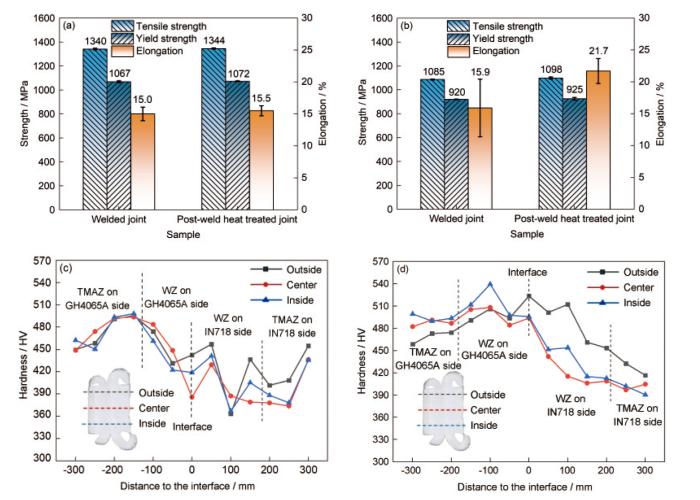
图8
焊态和热处理态接头的强度和硬度
Fig.8
Mechanical properties of welded joint and post-weld heat treated joint (Insets in Figs.8c and d are schematics of sampling position for hardness testing)
(a) room temperature strength
(b) high temperature (650 oC) strength
(c, d) hardnesses of welded joint (c) and post-weld heat treated joint (d)
3 结论
(1) 采用惯性摩擦焊成功实现了GH4065A/IN718异质高温合金的高质量连接,接头界面结合良好,无宏观缺陷。焊接过程中的热-力耦合作用使WZ发生完全动态再结晶,形成细小的等轴晶;GH4065A侧和IN718侧TMAZ则呈现粗晶与细晶共存的不均匀组织。焊后热处理进一步促进再结晶和晶界迁移,使WZ与TMAZ区域宽度显著增加,整体微观组织得到改善。
(2) 焊接热循环与热处理显著影响强化相的分布与形态。焊态接头WZ中的强化相完全溶解,TMAZ中强化相部分溶解。热处理后,强化相重新析出,GH4065A侧TMAZ中γ′相呈均匀颗粒状分布,IN718侧TMAZ中δ相尺寸有所减小,碳化物在两侧TMAZ中均弥散存在,整体组织更加均匀致密。
(3) 焊态接头的再结晶行为受热-力耦合作用控制,WZ形成细小等轴晶,TMAZ晶粒进一步细化。热处理后,晶粒略有长大,WZ的KAM值变化不明显,而TMAZ的KAM值显著降低,表明焊接应力集中得到缓解,各区域HAGB比例整体呈现升高趋势。
(4) 焊态接头WZ内存在大量位错缠结及局部应力集中,强化相完全溶解并形成部分退火孪晶,有助于释放残余应力。热处理后,WZ中析出细小γ′/γ′′强化相,这些析出相通过阻碍位错运动并诱导堆垛层错形成,进一步增加变形阻力,从而提升了接头的整体力学性能。
参考文献
Evolution of microstructure during static recrystallization in FGH96 superalloy
[J].
FGH96合金静态再结晶过程的显微组织演化
[J].
为系统揭示FGH96合金静态再结晶机制,指导其固溶处理工艺制定,本工作在1100~1260 ℃温度范围内对锻态FGH96合金进行固溶处理,采用EBSD及TEM等手段研究了FGH96合金静态再结晶过程中的显微组织演化规律,分析了FGH96合金静态再结晶机制及Σ3孪晶界的形成机理。结果表明,固溶温度会影响FGH96合金的晶粒尺寸及晶界特征(小角度晶界、大角度晶界和Σ3孪晶界),且随着固溶温度提高,晶粒尺寸及晶界特征呈现出特定的演化规律。FGH96合金的静态再结晶机制以亚晶形核长大机制为主,且在静态再结晶过程中,平行于(111¯)密排面的原子堆垛出现错排而形成层错,为了降低体系的自由能,后续在(111¯)密排面上堆垛的原子应以与该层错呈晶面对称的方式进行堆垛,以提高体系的对称性,降低体系能量,从而形成了Σ3孪晶界。
Effect of electron beam smelting power on microstructure, segregation, and γ′ phase precipitation behavior of GH4068 alloy
[J].
电子束熔炼功率对GH4068合金微观组织、偏析和γ′相析出行为的影响
[J].高合金化的变形高温合金铸态组织存在微观偏析较大、组织均匀性差等问题,严重影响了其后续热加工性能。为了优化变形高温合金的铸态组织,采用电子束熔炼(EBS)法熔炼GH4068合金,采用不同EBS功率熔炼10 min制备低偏析的GH4068合金铸锭。结果表明:经过EBS熔炼后的铸锭底部为细晶区,仅存在胞状偏析和胞状树枝晶,中部较大区域为竖直生长的柱状晶区,二次枝晶生长方向与柱状晶生长方向平行,顶部存在少量等轴晶,枝晶生长方向较为杂乱。成分分析表明,合金中Cr元素挥发最为明显,当EBS功率为17 kW时,其含量降低1.97%。EBS较传统真空感应熔炼(VIM) +电渣重熔熔炼(ESR)双联工艺所制备的铸锭组织更为均匀,当EBS功率为12 kW时,二次枝晶间距λ2为44.6 μm,与双联工艺相比,λ2减小了32.2%,铸锭枝晶区微观偏析程度明显降低,典型易偏析元素Ti和W的微观偏析程度分别降低了20.4%和18.6%。枝晶间γ′相尺寸较大、呈块状析出,而枝晶干的γ′相呈球状且尺寸较枝晶间更为均匀细小,在EBS功率为12 kW时所制备铸锭的γ′相尺寸最小且枝晶间不规则γ′相最少。在EBS过程中,熔体的实际温度远高于合金的熔化温度,熔体经过过热处理后团簇结构有效分解,元素分布更为均匀,在凝固过程中过冷度增加,熔体的均匀性遗传到凝固组织中使铸态组织细化,微观偏析程度降低。同时,在EBS过程中,由于电子束在熔池表面的轰击产生局部高温,能够有效降低合金中的N含量。
Research progress on inertial friction welding of nickel-based superalloy GH4065A and IN718
[J].
镍基高温合金GH4065A与IN718惯性摩擦焊接研究进展
[J].
Microstructural characterization and mechanical properties of inertia friction welded FGH96 joints
[J].
Omnidirectional simulation analysis of thermo-mechanical coupling mechanism in inertia friction welding of Ni-based superalloy
[J].
Elucidating the in-process interfacial friction regime and thermal responses during inertia friction welding of dissimilar superalloys
[J].
Research status of inertial friction welding of dissimilar alloys
[J].
异种合金惯性摩擦焊的研究现状
[J].
A comparison of the inertia friction welding behavior of similar and dissimilar Ni-based superalloys
[J].
A promising strategy of multicomponent alloy intermedium for enhancing the mechanical performance of inertia friction welding joints of Inconel 718 alloys
[J].
Analysis of microstructural evolution and mechanical properties of FGH101 powder superalloy and IN718 deformed superalloy via inertia friction welding
[J].Nickel-based superalloys are indispensable in aerospace engines due to their exceptional high-temperature strength, oxidation resistance, and corrosion resistance, making them critical for joining processes such as inertia friction welding (IFW), which is favored for its efficiency and superior joint quality. In this study, IFW was used to join FGH101 powder superalloy with IN718 deformed superalloy, resulting in significant plastic deformation that formed symmetrical ear-shaped flash on the IN718 side and minor upsetting on the FGH101 side, with a wavy interface due to heat dissipation. Microhardness analysis revealed higher hardness at the weld interface, followed by a sharp decline near the Heat Affected Zone (HAZ) on the IN718 side due to phase re-dissolution, while FGH101 showed quicker recovery. Post-weld aging treatments enhanced hardness and strength through γ′ and δ phase precipitation in FGH101 and γ″ phases in IN718. Room temperature tensile tests demonstrated impressive strength with failures occurring plastically within the IN718 base metal, whereas elevated temperatures shifted failure locations to the weld zone without necking. Fatigue tests exhibited varied lifespans, with fractures initiating either at stress concentrators or within the FGH101 base metal far from the weld center. Scanning electron microscope (SEM) analysis confirmed mixed-mode fracture patterns, underscoring the importance of microstructure on joint performance and suggesting that optimizing IFW parameters can lead to superior weld quality in aerospace components, thus providing valuable insights for future research and industrial applications.
Microstructure and mechanical properties of IN690 Ni-based alloy/316LN stainless-steel dissimilar ring joint welded by inertia friction welding
[J].Inertia friction welding (IFW) was used to join large-diameter hollow bars made of Inconel 690 and 316LN successfully. The interfacial characteristics, microstructure, mechanical properties and fracture mechanism of welded joints under different process parameters were investigated. The results indicated that a joining mechanism with mechanical interlocking and metallurgical bonding was found in IFW joints. There was a significant mechanical mixing zone at the welding interface. The elemental diffusion layer was found in the “wrinkles” of the mechanical mixing zone. A tiny quantity of C elements accumulated on the friction and secondary friction surfaces. The tensile strength and impact toughness of the joints increased with the total welding energy input. Increasing the friction pressure could make the grain in all parts of the joint uniformly refined, thus enhancing the mechanical properties of welded joints. The maximum tensile strength and impact toughness of the welded joint were 639 MPa and 146 J/cm2, reaching 94% and 68% of that for Inconel 690, respectively, when the flywheel was initially set at 760 rpm, 200 MPa for friction pressure, and 388 kg/m2 for rotary inertia. Due to the Kirkendall effect in the welded joint, superior metallurgical bonding was at the welding interface close to the Inconel 690 side compared to the 316LN side.
Thermal deformation behavior and dynamic recrystallization mechanism of GH4065A alloy considering the effect of γ′ phase
[J].
Heterogeneous precipitation of γ′′ along LAGBs during post-heat treatment of powder bed fusion additively manufactured IN718 superalloy
[J].
Eliminating embrittlement of GH4065A superalloy at intermediate temperature by a novel grain boundary strengthening mechanism
[J].
High-temperature fatigue behavior of inertia friction welded joints of GH4065A Ni-based superalloy
[J].
Microstructure characterization and mechanical property of the GH4065A superalloy inertia friction welded joints
[J].Structural characteristics and design requirements for the integration of the integral rotor and disc shaft of the engine, the welding quality, and mechanical properties of superalloy weldments have received more and more attention in recent years. Inertia friction welding (IFW) was carried out with the typical fiber structure of the solid solution GH4065A alloy as the research object, the microstructure evolution rules of the plastic deformation zone (PDMZ), the thermally affected zone (TMAZ), and the welding zone (WZ) were studied, and the formation mechanism of metallurgical joints was explored. The size difference of the γ′ phase at the grain boundary and in the fiber structure was revealed. The reason is that the γ′ phase located at the grain boundary has lower diffusion activation energy and higher diffusion rate. The microhardness and tensile properties of the IFW joints were explored, the study found that the microhardness of the TAMZ is the highest, followed by the PDMZ and the WZ. The tensile test results show that with the increase in temperature, the fracture position shifts from the BM to the WZ, the microstructure at the fracture changed significantly, and the yield strength decreased from 1372 to 1085 MPa.
Kissing bond defects in inertia friction welds of IN718 alloys: Experiment and prediction
[J].
Study on the enhanced accelerated-creep resistance and microstructural features of IN718 superalloy inertia friction welding joint containing a high entropy alloy interlayer
[J].
Inertia friction welding dissimilar nickel-based superalloys alloy 720Li to IN718
[J].
High temperature tensile fracture characteristics of FGH96/IN718 inertial friction welded joint
[J].
FGH96/IN718惯性摩擦焊接头高温拉伸断裂特征
[J].
Microstructure and texture distribution characteristics in weld zone of IN718/FGH96 inertial friction welded joint
[J].
IN718/FGH96惯性摩擦焊接头焊缝区微观组织状态与织构分布特征
[J].
Radial microstructural uniformity in inertia friction welded IN718/FGH96 dissimilar joints with post-weld heat treatment
[J].
Effect of aging treatment on the behavior of room temperature tensile of P/M superalloys used for inertia friction welding joints
[J].
时效处理对粉末高温合金惯性摩擦焊接头室温拉伸行为的影响
[J].对惯性摩擦焊扩散连接的FGH96合金试样经时效处理前后的室温拉伸行为进行了研究,并对其失效机制进行了评估。结果表明,对于焊接态(原状态)FGH96合金试样,由于焊缝区和热影响区的γ'相综合强化效果弱,晶界平直化,导致焊缝区和热影响区的强度低于基体,在室温拉伸过程中塑性应变量大;由于热影响区的晶粒尺寸大,晶界强化效果弱,且位错强化效果低于焊缝区,使热影响区成为整个试样强度的最薄弱区域,裂纹从该处萌生,断口表现出一定的塑性特征。对于时效处理后的FGH96合金试样,由于γ'相的粗化,强化相体积分数的提高,及γ'/γ之间错配度的增加,提高了γ'相的综合强化效果,使焊缝区和热影响区的强度较焊接态试样显著提高,并高于基体,在室温拉伸过程中基体的塑性应变量相对较大。连续或半连续析出的M23C6型碳化物弱化了焊缝区晶界的结合强度,导致试样从该处断裂,并出现了脆性断裂的特征。显微硬度的测试结果较好验证了焊接态和时效态试样强度的分布情况。
Effect of post-welding aging treatment on the microstructure and high-temperature properties of inertia friction welded GH4065A joint
[J].In this study, post-welding aging treatments were applied to a novel Ni-based superalloy GH4065A inertia friction welding (IFW) joint to improve its high-temperature properties. The effect of aging treatment on the microstructure and creep resistance of the IFW joint was systematically investigated. The results indicated that the original γ′ precipitates in the weld zone almost completely dissolved during the welding process, and fine tertiary γ′ precipitated during the subsequent cooling process. Aging treatment did not significantly change the characteristics of grain structures and primary γ′ in the IFW joint. After aging, the size of tertiary γ′ in the weld zone and secondary γ′ in the base material increased, but their morphology and volume fraction did not change evidently. After 760 °C, 5 h aging treatment, the tertiary γ′ in the weld zone of the joint grew from 12.4 nm to 17.6 nm. Correspondingly, the creep rupture time of the joint at 650 °C and 950 MPa increased from 7.51 h to 147.28 h, which is about 19.61 times higher than that of the as-welded joint. The creep rupture was more likely to occur in the base material instead of the weld zone for the IFW joint. This revealed that the creep resistance of the weld zone was significantly improved after aging due to the growth of tertiary γ′. However, increasing the aging temperature or extending the aging time promoted the growth of secondary γ′ in the base material, and meanwhile, M23C6 carbides tended to continuously precipitate at the grain boundaries of the base material. It might decrease the creep resistance of the base material.
Heat treatment of Inconel 718 produced by selective laser melting: Microstructure and mechanical properties
[J].
Microstructural characteristics of forged and heat treated Inconel-718 disks
[J].
Effect of heat treatment on microstructure and microhardness of FGH96 inertia friction welding
[J].
热处理工艺对FGH96合金惯性摩擦焊组织与显微硬度的影响
[J].
Effects of rotation rate on microstructures and mechanical properties of FGH96/GH4169 superalloy inertia friction welding joints
[J].
压力对FGH96/GH4169高温合金惯性摩擦焊接头性能的影响
[J].
Effect of micro-segregation of alloying elements on the precipitation behaviour in laser surface engineered alloy 718
[J].
Effects of sub-solvus ageing on the tensile and creep properties of a new cast nickel-based superalloy
[J].For nickel-based superalloys with medium volume-fraction γʹ phase (20 %-40 %), dual or multi-stage aging treatments are usually conducted to generate a microstructure containing the multimodal distribution of γʹ for a balance of strength and plasticity. In the present study, the microstructure and high-temperature properties of a novel cast nickel-based superalloy K4800 were investigated after being subjected to three heat treatments (HT) procedures, namely HT1: 1180 ℃/4 h+1090 ℃/2 h+800 ℃/16 h, HT2: 1180 ℃/4 h+1060 ℃/2 h+800 ℃/16 h and HT3: 1180 ℃/4 h+800 ℃/16 h. It was found that the sub-solvus aging treatments at 1090 and 1060 ℃ precipitated sub-micron-sized (~300 nm) primary γʹ phase which enhanced the ductility during 800 ℃ tensile (the total elongation of T1, T2, and T3 samples were 6.75 %, 7.3 %, and 3.25 %, respectively) without evidently impairing the strength. After careful microstructure observation and deformation mechanism analysis, the enhancement of elongation was rationalized that the precipitation of the sub-micron-sized primary γʹ phase decreased the volume-fraction and size of the nanometer-sized γʹ phase which was precipitated at 800 ℃, and simultaneously, promoted the dislocation movement by suppressing the non-planar slip. However, an excessive amount of the sub-micron-sized primary γʹphase led to a faster ripening process of the nanometer-sized γʹ during creep, which decreased the creep life at 800 ℃/430 MPa (T1: 125 h, T2: 199 h, and T3: 198 h). Based on this, we monitored the number density of nanometer-sized γʹ phase coexisting with different amounts of large γʹduring creep. An area fraction less than 7 % of the sub-micron-sized γʹ phase was considered to have little detrimental effect on the creep life of K4800 alloy, which corresponded to a sub-solvus temperature range about 1080-1090 ℃.
Knowledge of process-structure-property relationships to engineer better heat treatments for laser powder bed fusion additive manufactured Inconel 718
[J].


