



随着航空发动机和燃气轮机向高推重比、高效率和长寿命方向不断发展,其热端部件,特别是单晶涡轮叶片,面临着日益苛刻的服役环境。这些部件不仅长期承受高温、高应力的作用,还需应对循环载荷、剧烈温度变化以及氧化/热腐蚀等多场耦合的极端条件。在此背景下,单晶高温合金在近服役工况下的变形和损伤行为已成为决定涡轮叶片可靠性、安全性和寿命的关键因素,并构成了当前高温合金领域最重要的研究前沿和核心挑战之一。近年来,国内外学者借助先进的表征技术和模拟方法,在揭示微观损伤机理、建立宏微观性能关联以及发展性能优化策略等方面取得了显著进展。本文旨在综述近年来单晶高温合金在蠕变、疲劳及热机械疲劳等方面的研究现状,重点关注微观组织演化规律和损伤机制,以期为高性能单晶合金的设计和叶片安全服役提供坚实的理论依据。
1 蠕变行为
单晶涡轮叶片在服役过程中主要承受轴向离心载荷,由离心力导致的蠕变损伤是叶片的主要失效形式之一。目前,针对单晶高温合金在不同温度与应力区间内的蠕变行为已开展了广泛研究[1]。近年来,随着表征技术的进步和实验方法的创新,不断有新的微观变形和损伤机制被揭示,深化了对单晶高温合金蠕变行为的理解。例如,在高温蠕变稳态阶段就已出现大量在{100}面发生交滑移的a<100>超位错,并伴随Kear-Wilsdorf锁的形成[2];借助X射线计算机断层扫描(X-ray computed tomography,XCT)技术,发现诱发蠕变断裂的微孔多为形态不规则的大尺寸孔洞及局部高密度聚集的孔洞群体[3]。然而,随着叶片设计向薄壁化发展,氧化、热腐蚀及多轴应力状态对材料蠕变性能的协同作用已成为当前研究的关键问题。同时,面对航空发动机涡轮进口温度不断提升的趋势,单晶叶片在超高温、长时服役及短时超温等极端工况下的蠕变损伤机理、微观组织演化规律及其与性能的关联等也受到越来越多的关注。
1.1 环境-结构-蠕变交互作用
1.1.1 氧化协同效应
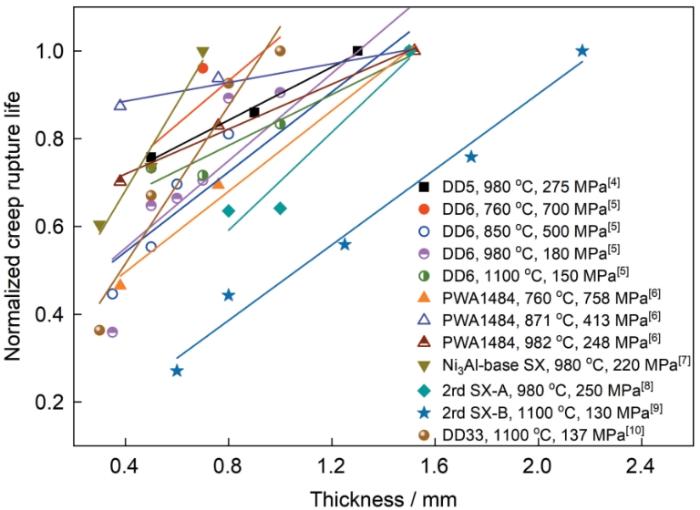
随着发动机叶片设计日益趋向薄壁化,单晶高温合金蠕变性能对壁厚的敏感性——即“薄壁效应” (如图1[4~10]所示)逐渐成为研究焦点。普遍认为,蠕变过程中表面氧化层的形成以及氧化导致的γ′相贫化层会减小有效承载截面,从而显著劣化材料的蠕变性能。因此,氧化损伤被认为是薄壁效应的重要诱因之一。研究[10,11]发现,氧化与塑性变形在薄壁效应中存在竞争机制:随着壁厚减小,氧化对性能损失的贡献显著增大。例如,在1100 ℃、137 MPa实验条件下,对于壁厚介于0.3~1.5 mm的DD33合金薄壁管状试样,氧化对薄壁效应的贡献率从55%降至15%[10]。此外,氧化引起的近表面微观组织损伤也严重影响蠕变性能,例如,γ′贫化层内析出的AlN[2]以及表面裂纹附近出现的再结晶晶粒[12],均可作为裂纹萌生与扩展的路径,进一步加速材料失效。
图1
1.1.2 热腐蚀协同效应
在燃气及海洋服役环境中,单晶叶片表面易沉积盐膜,引发热腐蚀。与纯氧化相比,热腐蚀对单晶高温合金蠕变性能的危害更为严重。研究[13~16]显示,热腐蚀层通常厚度较大、结构疏松多孔且富含微裂纹,其附近往往还伴随γ′贫化层的形成,这些因素共同导致合金的有效承载截面显著减小。Liu等[16]通过有限元模拟指出,表面腐蚀坑处存在明显应力集中,是微裂纹萌生的主要位置。在蠕变载荷作用下,裂纹向基体内部扩展,同时S、Cl、O等腐蚀性元素沿裂纹渗入。γ相与S、Cl等元素的反应活性高于γ′相,易生成硫化物、氯化物及微孔洞,从而进一步加剧材料性能退化[13]。值得注意的是,S元素因具有较强的扩散能力,其形成的硫化物甚至可在合金较深区域析出,对合金性能造成损害。
1.1.3 多轴应力效应
单晶涡轮叶片结构复杂,诸如冷却孔、叶根转接区等部位在服役中常处于多轴应力状态,导致其变形和损伤机制复杂。为模拟此类部位的蠕变行为,科研人员多采用带缺口试样进行研究。Caccuri等[17]通过设计V型缺口试样,引入应力三轴度(η)表征多轴应力状态,发现γ′筏排形貌与η之间存在显著相关性:当η = 0.33时,形成典型N型筏排;当η = 0.6时,筏排方向与加载轴呈45°;而当η = -0.33和-0.6时,均出现P型筏排。Cao等[18]则认为,最大主应力对筏排形貌的影响大于应力三轴度。近期研究[19~21]显示,缺口试样在高温蠕变下的寿命显著高于光滑试样。在宏观层面,Yang和Li[19]提出最大主应力与应力三轴度之间的竞争机制是导致缺口强化效应的主要原因。在微观机制方面,Huang等[20]发现,多轴应力状态可使γ基体通道宽度减小,增大位错运动阻力,抑制局部变形,并延缓裂纹扩展;Bao等[21]则指出,蠕变初期缺口根部形成的高位错密度有助于协调变形、释放应力集中,同时致密的界面位错网可削弱多轴应力分量的不利影响,维持晶体取向稳定性。
1.2 超高温蠕变/长时蠕变/短时超温蠕变行为
1.2.1 超高温蠕变行为
1.2.2 长时蠕变行为
燃气轮机叶片通常在较低应力下长期运行,其设计寿命可超过24000 h,因此对材料的长时组织稳定性和蠕变性能提出了更高要求。早在20世纪60年代,国际学术界已针对燃机用单晶高温合金开展了系统的长寿命性能测试、数据积累与寿命预测研究,但有关其长时蠕变微观机制的研究仍较为有限。Lukáš等[30]通过对比CMSX-4与CM186LC合金在长时(超过1000 h)蠕变后的组织演变,发现在750和850 ℃下γ′相形貌基本保持不变,仅在950 ℃条件下出现明显的γ′筏化。最近,对某型低γ′体积分数、低错配度燃机用单晶合金在900 ℃下进行的短时与长时(约5589 h)蠕变对比结果表明,两者变形机制相似,但长时蠕变中筏化过程极为缓慢,表现出显著的“持续时间效应”,即微观结构演化强烈依赖于蠕变时间[31]。
Dubiel和Czyrska-Filemonowicz[32]对实际服役12700 h的燃机叶片组织分析显示,不同部位的γ′相形貌存在明显差异:叶根区域γ′相仍保持立方体形态,变形以位错交滑移为主;而叶身中部则发生γ′筏化,变形受位错攀移控制。作者团队在对比燃机叶片(服役20000 h)和航空发动机叶片(累计服役900 h)时也发现,前者叶身仅出现γ′相合并粗化,而后者已发生显著筏化。这一结果表明,航空发动机叶片中常见的蠕变机制并不完全适用于燃机叶片的长时服役环境。因此,亟需深入开展针对燃机用单晶高温合金的长时蠕变微观机制与寿命预测研究。
1.2.3 短时超温蠕变行为
单晶涡轮叶片在稳态运行中主要发生等温蠕变损伤,但在特殊工况下,叶片温度可能瞬间超过最高允许工作温度(例如1100 ℃),导致短时超温蠕变。受限于能够模拟快速升降温过程的非等温蠕变实验设备,该领域研究自2007年起才逐步展开,且目前以欧美国家为主。
超温过程中最显著的组织变化是γ′强化相的大量溶解。Giraud等[33]发现,对CMSX-4单晶合金进行1200 ℃、1 min超温处理后,γ′相的体积分数从75%急剧下降至约48%,严重削弱了沉淀强化效应。Cormier等[34]进一步指出,γ′相溶解温度越低的合金,其非等温蠕变抗力通常越差。然而,超温造成的γ′相溶解也会导致基体中过饱和的γ′形成元素在后续冷却过程中重新析出细小弥散的γ′颗粒,使体积分数恢复至超温前水平[35]。尽管这些细小析出相可在一定程度上改善非等温蠕变抗力,特别是形成γ′微筏排后进一步阻碍位错运动[36],但超温仍会显著降低总体蠕变寿命[34,36],且寿命损失随超温频次增加而加剧[37]。研究[38]还表明,超温发生的蠕变阶段对蠕变性能影响显著:在蠕变初期或γ′筏化过程中发生超温将导致寿命显著缩短;而在筏化完成后的超温处理,则对寿命的负面影响相对较小。这表明,超温引发的γ′相溶解与再析出过程对非等温蠕变性能的影响存在竞争关系。
现有研究多集中于超温后γ/γ′微观结构演变对蠕变性能的宏观影响,而对非等温条件下位错层次的变形机制理解仍较匮乏。目前有限的研究主要关注超温对γ/γ′界面位错网的影响。Ge等[39]研究发现,超温处理后界面处形成大量锯齿状沟槽;Schwalbe等[40]则报道了在蠕变初期超温处理后,位错网呈现复杂形貌,部分从常规的{001}面转移至{111}面,表明超温使位错网处于非平衡状态。Duan等[41]进一步指出,随着超温次数增加,界面位错网逐渐失稳。一些研究[38,42]认为,蠕变初期的超温会促进位错攀移和湮灭,增大位错网间距,这是非等温蠕变寿命下降的关键因素;但Hantcherli等[43]在循环变温实验中并未观察到位错网形貌和间距的显著变化,表明该问题仍存在争议。Viguier等[44]提出,a<100>超位错的攀移是非等温蠕变的主要变形机制,但未能解释为何a<100>超位错在γ′相中极少出现。总体而言,短时超温影响非等温蠕变变形机制的具体途径尚不明确,制约了对超温服役条件下叶片寿命的准确预测和材料性能优化。
2 疲劳行为
2.1 疲劳变形机制
单晶高温合金的疲劳变形机制主要受γ′相强度、层错能和反相畴界能等参数之间交互作用的影响,这些参数的交互作用决定了不同温度下的位错运动模式。在低温区间(室温~650 ℃),变形以平面滑移为主,a / 2<101>位错对、a<101>超位错及层错等剪切γ′相,并伴随层错环或反相畴界的形成,高密度位错聚集可发展为明显的滑移带。随着温度升高,γ′相强度及层错能逐渐增大[47],进入中温范围(650~850 ℃)后,位错运动由平面滑移逐步过渡为波状滑移,主要表现为γ通道内的滑移与交滑移、γ/γ′界面处形成不规则位错网,以及少量层错剪切γ′相[48~52]。在高温阶段(850~1100 ℃),位错难以直接切割γ′相,在热激活作用下,更容易发生交滑移、攀移以及Orowan绕过γʹ相等行为[49]。
2.2 疲劳裂纹萌生机制
2.2.1 低周疲劳
2.2.2 高周疲劳
尽管碳化物可能开裂,但由于裂纹尖端应力场强度因子(ΔK)低于碳化物/基体界面的扩展门槛值(ΔKth-MC),裂纹难以穿越界面,故疲劳裂纹主要萌生于铸造孔洞。
2.2.3 超高周疲劳
研究[75,77~81]表明,VHCF寿命主要受最大铸孔尺寸控制,裂纹萌生阶段占据绝大部分寿命。孔周常出现粗糙区(rough zone,RZ),其面积与寿命正相关。目前关于粗糙区形成机制的研究较少,Cervellon等[75]研究发现,该区域存在晶体转动、再结晶及拓扑密堆(TCP)相析出等现象,与高度局域化的γ′相剪切密切相关,导致孔周应力强度因子门槛值下降,促进裂纹萌生。作者团队前期研究[82]显示,粗糙区内γ′相发生晶体转动(通常沿[112]或[110]与[112]合成的方向偏转),与孔边复杂应力状态下{111}<110>和{111}<112>滑移系启动有关。γ′相转动导致γ/γ′界面分离,从而诱发VHCF裂纹。
图2

图2
不同加载条件下单晶高温合金的疲劳裂纹萌生机制
Fig.2
Fatigue crack initiation mechanism under different loading conditions
(a) cracking of carbides is attributed to the combination of oxidizing and cyclic loading
(b) crack initiating from slip band shearing around casting pore
(c) γ′-rotation within the rough zone around casting pore is related to the operation of {111}<110> and {111}<112> slip systems (σ—stress)
(d) slip bands with different direction observed within eutectic show more uniform deformation
(e) hot isostatic pressing (HIP) specimens mainly fail from the surface oxidation and present the best fatigue property
2.3 近服役工况下单晶叶片的疲劳行为
2.4 工程构件的疲劳行为
振动疲劳是指材料或结构在振动、冲击、噪声等动态交变载荷作用下,因激励频率与固有频率接近发生共振而导致的疲劳破坏,是评价合金及构件综合性能的重要指标。构件的振动疲劳极限不仅取决于材料本身的振动疲劳性能,还受构件形状、尺寸及表面状态等因素的显著影响。尽管如此,材料级的振动疲劳性能仍是构件振动疲劳研究的基础[95]。振动疲劳行为受晶体取向[96]、薄壁厚度[97]、孔结构[98,99]等多因素调控。研究[97]发现,随试样厚度减小,其中温疲劳强度下降,该“厚度效应”主要归因于氧化介质渗透促进表面裂纹萌生。薄壁孔结构处易因应力集中诱发疲劳裂纹,在高温与交变应力耦合作用下,裂纹多源于孔边氧化损伤[98,99]。宏观上,高温下裂纹扩展方向受分解剪应力梯度控制;微观层面,中温裂纹扩展由位错滑移与攀移共同主导,而高温下则以位错攀移机制为主[99]。
然而,当前的相关研究仍存在明显不足:旋转弯曲疲劳侧重于材料微观组织的影响,而振动疲劳更关注结构力学响应,两者尚未充分融合。实际叶片构件的疲劳性能同时受材料本征特性、应力集中效应与结构约束效应的共同影响,因此建立材料-结构-性能之间的内在关联,是提升工程构件抗疲劳设计能力的关键挑战。
3 热机械疲劳行为
航空发动机在起飞、爬升、巡航和降落阶段,以及重型燃气轮机在调峰运行中的频繁启停,使涡轮叶片处于温度、应力和应变复杂耦合的服役环境下,极易诱发多因素疲劳失效。传统的蠕变、低周/高周疲劳及热疲劳试验通常采用单一机械应变循环或独立热循环加载方式,难以准确模拟叶片实际多场耦合工况。为此,热机械疲劳(thermal-mechanical fatigue,TMF)试验方法应运而生,能够同步施加热循环与机械应变循环,更真实地反映叶片服役状态。基于TMF测试技术,国内外学者针对单晶高温合金基体及其涂层-基体体系开展了系统性研究,重点关注温度-机械载荷相位关系、晶体取向、合金元素作用以及涂层与基体交互行为等因素对TMF性能的影响。
3.1 单晶高温合金的热机械疲劳行为
3.1.1 相位关系
单晶高温合金的TMF行为强烈依赖于温度与机械载荷之间的相位关系,其本质源于氧化、蠕变和疲劳等多种损伤机制在时间上的耦合与竞争。为模拟涡轮叶片的实际服役条件,通常采用同相位(in-phase,IP)和反相位(out-of-phase,OP)两种TMF加载模式。在IP-TMF中,最大拉应变与最高温度同步出现,高温阶段材料承受持续拉伸应力,低温阶段发生压缩塑性变形,近似模拟叶片冷却孔或内腔表面工况;而在OP-TMF中,最大拉应变对应最低温度,高温阶段材料处于压缩状态,主要用于模拟叶片外表面服役环境。
相位关系对TMF寿命与变形机制具有决定性影响。如图3所示,IP-TMF以高温蠕变损伤为主导,裂纹多萌生于碳化物/基体界面;而OP-TMF因氧化、孪晶与位错交互及TCP相析出等多重机制协同作用,损伤行为更为复杂,疲劳寿命通常显著低于IP-TMF[102]。OP-TMF条件下,高度局域化的孪晶成为主要变形方式,不同取向孪晶交汇处易诱发再结晶,裂纹沿孪晶面快速扩展导致{111}面晶体学断裂[103]。Hong等[104]进一步指出,OP-TMF在最低温度时施加的最大拉应变会加速表面裂纹的萌生与扩展;当裂纹达到临界尺寸后,尖端区域沿{111}面形成多组平行孪晶,为裂纹提供快速扩展通道,导致OP-TMF寿命明显低于等温低周疲劳,孪晶形成与{111}<112>滑移系中不全位错运动密切相关。另有研究[105]表明,当测试机械应变幅、试样晶体取向相近时,IP和OP-TMF的寿命与变形机制差异不大,合金失效主要源于局部变形带及由此引发的裂纹萌生;断裂模式取决于应变幅大小:高应变幅下{111}面滑移系广泛激活导致晶体学断裂,低应变幅下则因内部铸造缺陷、氧化裂纹扩展及γ′相筏化引发非晶体学断裂。
图3

图3
单晶高温合金热机械疲劳(TMF)变形机制示意图
Fig.3
Schematics of the thermal-mechanical fatigue (TMF) deformation mechanism in single-crystal superalloys (OP—out-of-phase, IP—in-phase)
(a) during IP-TMF cycling, alloy deformation mechanism is dominated by creep damage, with cracks preferentially initiating at carbides and casting pores
(b) under the OP-TMF cycling, highly localized twinning is the major deformation mechanism, and cracks propagate rapidly along the twinning planes. Recrystallization occurs within the deformation bands, with the interception of twins in different orientations serving as initiation sites (TCP—topologically close-packed phase)
3.1.2 晶体取向
近年来,晶体取向对TMF损伤与失效行为的影响引起广泛关注。Segersäll等[113]对比了<001>和<011>取向CMSX-4合金在OP-TMF下的行为,结果表明,相同机械应变范围内<001>取向试样寿命更高。随应变幅增大,两种取向均呈现从非晶体学断裂向{111}面晶体学断裂的转变,且<011>取向变形机制由孪生逐渐转为变形带剪切γ/γ′组织。TMF性能的晶体取向依赖性不仅源于弹性模量差异,更与滑移系激活能力密切相关。取向接近[001]的试样能够激活更多滑移系,促进变形协调和分散,延长疲劳寿命;而取向介于[011]和[111]之间时,可启动滑移系有限,导致变形局部化,降低TMF寿命[114]。Luo和Yuan[115]进一步验证了不同取向TMF寿命顺序为[001] > [011] > [111],[001]取向因低模量和高滑移系激活能力,表现出最优疲劳性能。
在镍基单晶涡轮叶片铸造过程中,通常控制叶片的[001]晶体生长方向与主应力轴的偏离角不大于15°,而叶片的二次取向保持随机。已有研究表明,二次取向对带气膜冷却孔单晶试样的TMF行为有显著影响。研究[116]发现,在OP-TMF测试条件下,二次取向靠近[110]的气孔裂纹扩展速率高于靠近[010]的气孔裂纹扩展速率,大部分主裂纹扩展发生在低温循环阶段。在IP-TMF中,[110]取向气膜孔附近的Schmid应力更高,导致更严重的损伤和更短寿命[117]。Zhang等[118]研究还发现,在相同IP-TMF载荷条件下,将叶片尾缘附近的扰流柱圆角二次取向由[010]转变为[110],叶片尾缘附近吸力侧扰流柱圆角的TMF损伤减小,而压力侧扰流柱圆角的TMF损伤增加。因此,在对叶片进行结构设计和TMF寿命评估时应考虑二次晶体取向对叶片疲劳性能的影响。
3.1.3 合金元素
合金元素对高温合金TMF行为及变形机制有显著影响。例如,添加0.25%Si (质量分数,下同)可显著提高合金在OP-TMF下的寿命,增幅可达2倍,这主要归因于Si提高了合金在低温下的屈服强度,细化滑移带并增强抗再结晶和抗开裂能力。相比之下,添加2%Re虽能明显改善合金的蠕变性能,但对TMF寿命的提升效果并不显著[119]。Ge等[120]研究了Ru对含Re单晶高温合金TMF行为的影响,发现添加3%Ru可显著延长合金在OP-TMF条件下的寿命。其强化机制主要包括两方面:一方面,Ru元素增强了基体强度,并在TMF初期促进层错的形成与稳定化;另一方面,Ru有效抑制了孪晶的形成,从而提高了合金在复杂热-机械载荷下的抗损伤能力。
3.2 带涂层高温合金热机械疲劳行为
为提高发动机推重比和热效率,先进燃气涡轮发动机的涡轮进口温度不断提升,对叶片材料的耐温能力提出了更高要求。除通过合金化提高基体承温能力外,在叶片表面施加涂层已成为降低表面温度、提升抗高温氧化与热腐蚀性能的有效途径。然而,涂层的引入会改变基体表面状态,可能对其力学性能产生复杂影响。疲劳裂纹易萌生于涂层/基体界面的孔洞及喷砂预处理引入的颗粒处,并向基体内部扩展,导致合金疲劳性能下降[121]。高温下涂层与基体间的互扩散会形成互扩散区(inter-diffusion zone,IDZ)、二次反应区(secondary reaction zone,SRZ)并析出TCP相。SRZ通常具有再结晶组织,可减少有效承载面积,并可能成为裂纹源[122];而涂层下方析出的TCP相则在疲劳中促进裂纹过早萌生,显著降低合金的抗疲劳性能[123]。另有研究[124]指出,尽管IDZ/SRZ会减小承载截面,并导致涂层合金在950 ℃时的抗疲劳性能降低,但疲劳裂纹仍多起源于合金内部缺陷而非扩散区本身。
涂覆热障涂层(thermal barrier coating,TBC)的叶片在服役中面临热-机械载荷耦合作用,易发生TBC过早开裂或剥落。TBC失效会加剧基体局部氧化甚至熔化,严重威胁叶片安全。TMF试验可较好地模拟此类工况。TBC在TMF下的损伤行为受机械应变幅的显著影响:高应变幅下,裂纹从黏结层/热生长氧化物(thermally grown oxide,TGO)界面萌生,穿透黏结层进入基体;低应变幅下,裂纹沿黏结层/TGO界面扩展,导致陶瓷层剥落[125]。损伤行为还受相位影响:OP加载下易形成垂直于应力方向的分割裂纹[126];IP加载下因高温氧化,裂纹多集中于陶瓷层/TGO界面[127]。
随着单晶叶片复杂冷却技术和TBC的应用,叶片内部与表面间形成显著温度梯度,实际工况更接近温度梯度热机械疲劳(temperature-gradient mechanical fatigue,TGMF)。相比TMF,TGMF测试中冷却气体降低了基体温度,延缓裂纹扩展,从而提高疲劳寿命[128]。此外,TGMF条件下温度梯度与机械应力的协同作用可能导致黏结层内部萌生疲劳裂纹,裂纹沿平行于陶瓷/黏结层界面的方向扩展,加剧陶瓷层剥落,此类行为为TGMF所特有[129,130]。近期,Zhan等[131]采用外覆TBC、内通冷却气的管状试样开展了TGMF研究,发现在300~1000 ℃、0.45%机械应变幅的IP-TGMF测试中,陶瓷层内裂纹扩展与合并导致剥落;而当温度升至1100 ℃、应变幅增至0.65%时,裂纹可贯穿陶瓷层进入黏结层及基体。当前,先进表征技术(如同步辐射)已被用于原位分析TBC在TGMF过程中的应变分布[132],但温度梯度与机械载荷耦合作用下TBC系统的损伤机制仍不明确,界面微观组织演化对裂纹行为的影响也有待深入研究。
4 原位表征技术在损伤行为研究中的进展
近年来,原位表征技术开始应用于单晶高温合金的损伤行为研究中,涵盖从微观尺度(如原位扫描电镜、透射电镜)到介观尺度(如同步辐射、中子衍射和散射)的多种先进手段。这些技术能够实时捕捉高温、应力及环境耦合条件下微观结构及关键参数的动态演化过程,从而在原子至介观尺度上揭示单晶高温合金的损伤机理。
Zhang等[133]结合扫描电子显微镜和优化的斑点制备技术,开发了可用于原位拉伸和疲劳测试的实验装置,系统研究了第四代镍基单晶高温合金的变形行为。通过数字图像相关(digital image correlation,DIC)技术和晶体塑性有限元(crystal plasticity finite element,CPFE)模拟,揭示了裂纹萌生与扩展的微观机制,并建立了基于位错密度的模型,有效表征了不同温度下滑移系阻力、位错密度和累积应变的动态演变,为联系微观变形机制与宏观力学响应提供了重要依据。Yang等[134]则在透射电镜中实现了高温力学测试与高分辨表征的同步进行,从原子尺度上解析了DD6合金的断裂过程,明确了60°全位错在裂纹尖端扩展中的作用,提出了沿γ/γ′相界面断裂的新模式。
高能同步辐射和中子源凭借其强穿透能力和无损探测特性,结合专用原位加载/加热装置,可实现单晶高温合金内部结构的动态表征,为合金设计和工艺优化提供关键数据。目前相关研究主要集中在原位技术开发和组织演化分析两个方面。
在同步辐射原位技术方面,Tréhorel等[135]提出了一种新型的远场双晶衍射(double-crystal diffractometry,DCD)技术,可以实时监测高温蠕变过程中的瞬态变化。DCD使用远场相机,在透射几何下捕获衍射斑点,结合高能同步辐射X射线(67 keV),通过快速二维探测器实现高角度精度(10-5)和高速记录(7 s/frame),比传统三晶衍射(triple-crystal diffractometry,TCD)快40倍。并采用DCD成功捕捉到AM1单晶高温合金在950 ℃高温突变载荷条件下错配度(δ⊥)的实时变化。该技术为时间分辨原位同步辐射研究奠定了良好的基础。
尽管同步辐射与中子源已为理解单晶高温合金损伤机制提供重要支持,但由于机时限制,针对长时蠕变与疲劳的原位研究仍较为有限。未来需进一步发展方法创新、专用原位装置与加速试验策略,推动长时损伤行为的动态表征。此外,虽然同步辐射与中子结果具有统计代表性,但需与微观原位扫描/透射等技术相结合,相互验证、补充,从而全面深化对单晶高温合金损伤机制的理解。因此,多尺度原位表征技术的联合应用是未来研究的重要方向。
5 总结与展望
近年来,单晶高温合金作为航空发动机和燃气轮机热端部件的关键材料,其近服役环境下的变形损伤行为研究已取得显著进展。本文系统综述了单晶高温合金在蠕变、疲劳及热机械疲劳等多场耦合条件下的微观组织演化、损伤机制和环境-结构交互作用,揭示了γ′相演化、位错运动、孔洞缺陷、元素协同效应以及氧化、热腐蚀等环境因素对材料性能的复杂影响。研究表明,单晶高温合金的变形损伤行为具有明显的温度、应力、时间、环境及晶体取向依赖性,尤其在极端条件(如超高温、长时、短时超温、多轴应力等)下,其损伤机制更趋复杂。
在蠕变方面,研究已从传统的等温蠕变拓展至非等温、多轴应力及环境耦合条件下的蠕变行为,并揭示了γ′相溶解与再析出、位错网稳定性、微孔演化等关键机制。疲劳研究则从裂纹萌生诱因(如铸孔、碳化物、共晶、氧化)出发,探讨了高周、超高周疲劳中裂纹萌生与早期扩展的微观机制,并初步建立了疲劳裂纹萌生机制随加载条件的转变规律。在热机械疲劳方面则开展了相位关系、晶体取向、合金元素及涂层/基体交互作用对TMF寿命与损伤行为的影响研究,为叶片在复杂热-机械载荷下的寿命预测提供了重要依据。
然而,当前研究仍存在若干挑战与不足:
(1) 极端条件下(如超高温、超长时、非等温)的蠕变损伤机制尚不清晰,尤其是位错动力学与微观组织演化的原位表征仍较为缺乏;
(2) 疲劳裂纹萌生机制虽已初步建立,但多种诱因(如铸孔/氧化、共晶/碳化物等)的耦合效应及其对裂纹萌生与扩展的影响仍需系统研究;
(3) 关于实际叶片构件在复杂几何、多轴应力、冷却效应及涂层保护下的疲劳和TMF行为研究仍较少,试样级结果与构件级行为之间的映射关系尚未建立;
(4) 环境-结构-载荷多场耦合下的损伤演化模型与寿命预测方法仍需进一步发展,尤其是在考虑微观组织退化、界面失效、元素扩散等复杂过程时。
未来需通过多尺度原位表征技术、跨尺度建模及机器学习等先进方法,深化对损伤机制的理解,推动高性能单晶合金的设计与叶片寿命可靠性的提升。
参考文献
Recent progress in research and development of nickel-based single crystal superalloys
[J].
Single crystal Ni-based superalloys are key materials used in the hot section of aeroengines and industrial gas turbines. In service, single crystal blades face harsh environments, including high temperatures, complex stresses, oxidation and hot corrosion. Therefore, they must meet strict technical specifications, such as impurity, defects and dimensional control. Single crystal components should be manufactured using complex technologies within a highly narrow processing window. The present paper reviews recent progress in the research and development of alloy design, microstructure and property evolution and characterization, evaluation in near-service conditions, and single crystal manufacture. Further, the development of “next generation” high-temperature structural materials, such as refractory high-entropy alloys, is briefly discussed.
镍基单晶高温合金的研发进展
[J].
Study on high temperature creep and very high cycle fatigue behaviors of a 3rd generation Ni-based single crystal superalloy
[D].
一种第三代镍基单晶高温合金高温蠕变与超高周疲劳行为研究
[D].
Evolution of micro-pores in a single crystal nickel-based superalloy during 980 oC creep
[J].
Thickness debit effect in Ni-based single crystal superalloys at different stress levels
[J].
A thickness debit effect characterization parameter for creep rupture behaviors of nickel-based single crystal superalloys
[J].
Thickness debit in creep properties of PWA 1484
[A].
Thickness debit effect in creep performance of a Ni3Al-based single-crystal superalloy with [001] orientation
[J].
Effect of wall thickness on micropores and stress-rupture properties of a single-crystal nickel-based superalloy
[J].
Stress state mechanism of thickness debit effect in creep performances of a Ni-based single crystal superalloy
[J].
The effect of secondary dendrite orientation on thickness debit effect of nickel-based single-crystal superalloy with tubular samples
[J].Secondary dendrite orientation and wall thickness considerably affect the stress rupture life of thin-walled samples. However, the effect of the secondary dendrite orientation on the thickness debit effect of nickel-based single-crystal superalloys has not been thoroughly investigated until now. Owing to geometrical constraints, typical sheet samples cannot reveal the mechanism responsible for the thickness debit effect in turbine blades. This study examined the effect of secondary dendrite orientation on the thickness debit effect of nickel-based single-crystal superalloys at 1100 °C/137 MPa in tubular samples. As the wall thickness decreased from 1.5 mm to 0.3 mm, the stress rupture life decreased from approximately 170 h to 64 h, demonstrating a noticeable thickness debit effect. Among the different secondary dendrite orientation areas, the variation in plastic deformation difference increased from 7 % (1.5 mm) to 45 % (0.5 mm) and subsequently decreased to 4 % (0.3 mm). In thinner samples, the thickness contraction and microstructure evolution were more pronounced in the [100] areas than that in the [110] and [210] areas. The theoretical calculation quantitatively indicated that for the effective stress increased, the contribution of plastic deformation (45 %) was slightly lower than that of oxidation (55 %) in 0.3 mm samples; nevertheless, plastic deformation played a prominent role in 0.5, 0.8, 1, and 1.5 mm samples and increased from 61 % (0.5 mm samples) to 85 % (1.5 mm samples). In thinner samples, the larger plastic deformation in the secondary dendrite orientation of the [100] areas and oxidation increased the effective stress, resulting in a shorter rupture life. These findings are conducive to the structural optimization and performance improvement of turbine blades.
Anisotropic creep properties of a 3rd generation nickel-base single crystal superalloy
[D].
一种第三代镍基单晶高温合金蠕变各向异性的研究
[D].
Oxidation-induced recrystallization and damage mechanism of a Ni-based single-crystal superalloy during creep
[J].
Creep rupture of smoothed and notched DD6 single crystal superalloy specimens subjected to high-temperature hot corrosion
[J].
Study on the hot corrosion-creep failure mechanism of Ni-based single crystal superalloy considering the stress dependence
[J].
The analysis on creep failure mechanism of nickel-based single crystal superalloys deposited with different molten salts
[J].
Experimental and chemo-mechanical analysis of hot corrosion influence on creep properties of DD6 single crystal superalloy in molten NaCl salt
[J].
γ′-rafting mechanisms under com-plex mechanical stress state in Ni-based single crystalline superalloys
[J].
How evolving multiaxial stress states affect the kinetics of rafting during creep of single crystal Ni-base superalloys
[J].
Creep notch effect in DD6 Ni-based single crystal superalloy: Experimental and modeling studies
[J].
Influence of loading sequence on notch creep behavior of Ni-based single crystal superalloy
[J].
Creep behavior and mechanism of a notched γ′-rich Ni-based single crystal superalloy at high temperature
[J].
Facilitating effect of interfacial grooves on the rafting of nickel-based single crystal superalloy at high temperature
[J].
The effect of chromium and cobalt segregation at dislocations on nickel-based superalloys
[J].
Dislocation network with pair-coupling structure in {111} γ/γ′ interface of Ni-based single crystal superalloy
[J].
Role of interfacial dislocation networks during secondary creep at elevated temperatures in a single crystal Ni-based superalloy
[J].
Stress effect on rupture mechanisms of a third generation single crystal superalloy crept at ultra-high temperature
[J].
应力对第3代单晶高温合金超高温蠕变断裂机制的影响
[J].
Exceptional ultra-high temperature creep resistance of a [111]-oriented single crystal superalloy
[J].
High-temperature creep behaviour and deformation mechanism of a high-concentration Re/Ru single-crystal nickel-based alloy
[J].
Design for 1200 oC creep properties of Ni-based single crystal superalloys: Effect of γ′-forming elements and its microscopic mechanism
[J].
Creep resistance of single crystal superalloys CMSX-4 and CM186LC
[J].
Duration-affected creep behaviors of Ni-based single crystal superalloys with/without rhenium addition designed for IGT application
[J].
TEM analyses of microstructure evolution in ex-service single crystal CMSX-4 gas turbine blade
[J].
Strain effect on the γ′ dissolution at high temperatures of a nickel-based single crystal superalloy
[J].
Non-isothermal creep at very high temperature of the nickel-based single crystal superalloy MC2
[J].
In situ measurement of the γ/γ′ lattice mismatch evolution of a nickel-based single-crystal superalloy during non-isothermal very high-temperature creep experiments
[J].
Effect of fine γ′ precipitation on non-isothermal creep and creep-fatigue behaviour of nickel base superalloy MC2
[J].
Thermal cycling creep resistance of Ni-based single crystal superalloys
[A].
On the role of the internal stress during non-isothermal creep life of a first generation nickel based single crystal superalloy
[J].
Microstructure and stress rupture properties degradation of a 2nd generation single crystal superalloy during short-duration overheating
[J].
Investigating the dislocation-driven micro-mechanical response under non-isothermal creep conditions in single-crystal superalloys
[J].
Effects of ultra-high-temperature thermal cycles on the microstructure evolution and creep behavior of a high γ′ volume fraction nickel-based single-crystal superalloy
[J].
The creep properties of nickel-based single crystal superalloy under overheating and overload conditions
[D].
镍基单晶合金超温超载蠕变性能研究
[D].
Evolution of interfacial dislocation network during anisothermal high-temperature creep of a nickel-based superalloy
[J].
High-temperature creep of single-crystal nickel-based superalloy: Microstructural changes and effects of thermal cycling
[J].
Recent progress in research and development of nickel-based single crystal superalloys
[J].
镍基单晶高温合金的研发进展
[J].
High cycle fatigue in aircraft gas turbines—An industry perspective
[J].
On the temperature dependence of the flow stress of nickel-base alloys
[J].
Temperature-dependent microscopic deformation mechanisms and performance enhancement prospects in high-cycle fatigue of nickel-based single crystal superalloys
[J].
Temperature effect on the low cycle fatigue behavior of a directionally solidified nickel-base superalloy
[J].
Comparison of low-cycle fatigue behaviors between two nickel-based single-crystal superalloys
[J].
Low-cycle fatigue of single crystal nickel-based superalloy—Mechanical testing and TEM characterisation
[J].
Experiment and modelling on the effect of microstructural morphology on fatigue life of a Ni-based superalloy
[J].
In situ SEM studies of the low cycle fatigue behavior of DZ4 superalloy at elevated temperature: Effect of partial recrystallization
[J].
Effects of microstructure in high temperature fatigue: Lifetime to crack initiation of a single crystal superalloy in high temperature low cycle fatigue
[J].
Fatigue variability of a single crystal superalloy at elevated temperature
[J].
Role of shrinkage pores, carbides on cyclic deformation behaviour of conventionally cast nickel base superalloy CM247LC® at 870 oC
[J].
Fatigue oxidation interaction in a superalloy—Application to life prediction in high temperature low cycle fatigue
[J].
In-situ scanning electron microscopy studies of small fatigue crack growth in recrystallized layer of a directionally solidified superalloy
[J].
In-situ SEM study of slip-controlled short-crack growth in single-crystal nickel superalloy
[J].
The effect of casting conditions on the high-cycle fatigue properties of the single-crystal nickel-base superalloy PWA 1483
[J].
LCF, HCF and VHCF life sensitivity to solution heat treatment of a third-generation Ni-based single crystal superalloy
[J].
The influence of high thermal gradient casting, hot isostatic pressing and alternate heat treatment on the structure and properties of a single crystal nickel base superalloy
[A].
Benefits of high gradient solidification for creep and low cycle fatigue of AM1 single crystal superalloy
[J].
Initiation of fatigue cracks in a single-crystal nickel-based superalloy at intermediate temperature
[A].
Fatigue crack initiation behavior at intermediate temperature under high stress amplitude for single crystal superalloy DD413
[J].The fatigue crack initiation behavior of a single crystal superalloy DD413 was investigated under high stress amplitude at intermediate temperature. The fracture surfaces and longitudinal section morphologies of the test specimens were characterized by scanning electron microscope (SEM). It was found that fatigue cracks mostly initiate from the cracked blocky carbides on the surface as well as the cracked skeleton-like carbides at subsurface. All the carbides on the surface of testing specimen crack due to the combined effect of oxidation and cyclic loading. Besides, at the subsurface of testing specimen, the carbides located on the propagation path of a micro-crack can crack as a result of oxidation and cyclic loading. The micro-crack connected to the surface in the specimen is the transportation channel of oxygen for the oxidation of the carbides at the subsurface. Carbides cracked and the micro-crack initiated at the early stage of fatigue, which induced the final failure.
第一代单晶高温合金中温高应力幅下的疲劳裂纹萌生行为
[J].通过应力控制的疲劳实验探究第一代镍基单晶高温合金DD413在中温(760℃)高应力幅下的疲劳裂纹萌生行为,并使用扫描电子显微镜观察和表征了疲劳样品的断口形貌和纵截面的显微组织。结果表明:在高应力幅条件下,疲劳裂纹主要萌生于表面开裂的块状碳化物和次表面开裂的骨架状碳化物。在疲劳过程中,氧化和循环加载的共同作用使样品表面的碳化物都发生了开裂。在样品的次表面,只有位于表面微裂纹扩展路径上的碳化物发生开裂,其原因也与氧化和循环加载有关。样品表面产生的微裂纹,是次表面碳化物发生氧化所需氧气的运输通道。在疲劳的早期阶段碳化物即发生开裂并产生微裂纹,最终使样品发生疲劳断裂。
Effect of porosity and eutectics on the high-temperature low-cycle fatigue performance of a nickel-base single-crystal superalloy
[J].
Effects of microporosity and precipitates on the cracking behavior in polycrystalline superalloy Inconel 718
[J].
On the role of boron on improving ductility in a new polycrystalline superalloy
[J].
On the effect of boron on grain boundary character in a new polycrystalline superalloy
[J].
Cyclic slip localisation and fatigue crack initiation in fcc single crystals
[J].
Processing to fatigue properties: Benefits of high gradient casting for single crystal airfoils
[A].
Ex-situ investigation of micro-pore evolution and crack initiation/propagation during fatigue in a single crystal Ni-based superalloy
[J].
High-temperature ultrasonic fatigue testing of single-crystal superalloys
[J].
Crack initiation mechanisms during very high cycle fatigue of Ni-based single crystal superalloys at high temperature
[J].Crack initiation mechanisms in the very high cycle fatigue (VHCF) regime of nickel-based single-crystal (SX) superalloys have been investigated at high temperature (1000 degrees C) and under fully reversed conditions (R = -1). For all Ni-based SX alloys tested, a discernible area called rough zone has been identified around the crack initiation site on the fracture surface and is for the first time described. By means of electron microscopy and atom probe analyses, localized and severe plastic activity occurring in the rough zone is evidenced. The high dislocation density provided by the slip bands induces single-phase recrystallized grains and phases precipitation (intermetallics or carbides) via the redistribution of interacting solutes in the rough zone. A crack initiation mechanism based on these observations and on the stress intensity parameter determined around the rough zone - which has been demonstrated to be a constant threshold dependent on the material - is finally proposed. (C) 2020 Acta Materialia Inc. Published by Elsevier Ltd.
Very high cycle fatigue at elevated temperatures: A review on high temperature ultrasonic fatigue
[J].
Study of thermal effects associated with crack propagation during very high cycle fatigue tests
[J].
Initiation and early-stage growth of internal fatigue cracking under very-high-cycle fatigue regime at high temperature
[J].
Very high cycle fatigue of a notched Ni-based single crystal superalloy at high temperature
[J].
Very high cycle fatigue of Ni-based single-crystal superalloys at high temperature
[J].
Damage mechanisms during very high cycle fatigue of a coated and grit-blasted Ni-based single-crystal superalloy
[J].
High temperature VHCF of a 3rd generation Ni-based single crystal superalloy with different casting pore sizes
[J].
Transition from internal to surface crack initiation of a single-crystal superalloy in the very-high-cycle fatigue regime at 1100 oC
[J].
Quantifying the impact of oxidized carbide expansion on fatigue crack initiation in a Ni-based single-crystal superalloy
[J].
Quasi in-situ investigation of very high cycle fatigue in a third generation nickel-based single crystal superalloy at high temperature
[A].
第三代镍基单晶高温合金高温超高周疲劳准原位研究
[A].
Crystal plasticity constitutive model and thermodynamics informed creep-fatigue life prediction model for Ni-based single crystal superalloy
[J].
Creep-fatigue behavior of nickel-based single crystal superalloy with different orientations: Experimental characterization and multi-scale simulation
[J].
A comparative study of creep-fatigue life prediction for complex geometrical specimens using supervised machine learning
[J].
Multiscale modeling of oxidation-fatigue damage mechanisms under compressive dwell-fatigue loading conditions for nickel-based single-crystal superalloy
[J].
Effect of oxidation on the competition between internal and external fatigue crack initiation of Ni-based single crystal superalloy
[J].
Low cycle fatigue/corrosion interactions at 950 oC of AM1 single crystal nickel-based superalloy
[J].
Fatigue behavior of additive manufactured 316L stainless steel under axial versus rotating-bending loading: Synergistic effects of stress gradient, surface roughness, and volumetric defects
[J].
Fatigue properties and material characteristics of additively manufactured AlSi10Mg—Effect of the contour parameter on the microstructure, density, residual stress, roughness and mechanical properties
[J].
Rotary bending high-cycle fatigue behavior of DD32 single crystal superalloy containing rhenium
[J].
Vibration fatigue properties and fracture mechanism of DD6 single crystal superalloy
[J].Room Temperature vibration fatigue <em>S-N</em> curves of single crystal superalloy DD6 with[001] orientation was investigated and room temperature vibration fatigue limit was obtained. The fracture mechanism was studied by OM, SEM and EBSD. The results show that based on <em>S-N</em> method, vibration fatigue limit of DD6 single crystal superalloy with[001] orientation is estimated to be around 337.5MPa. Vibration fatigue fracture presents single or several {111} octahedral slip planes. SEM observations show that fracture has two regions:fatigue source region and the fatigue crack propagation regions, the fatigue cracks initiate at the surface or internal defect of the cross-section with the maximum stress, and exhibits a single source feature, fatigue crack propagation region exhibits quasi-cleavage fracture, no typical fatigue striation feature. Crystal plane slip along {111} is the main deformation mechanism of RT vibration fatigue fracture of single crystal superalloy DD6, quasi-cleavage propagation plane in fracture and quasi-cleavage patterns in microstructure are the main features of RT vibration fatigue fracture of single crystal superalloy DD6.
DD6单晶高温合金振动疲劳性能及断裂机理
[J].研究[001]取向的DD6单晶高温合金的室温振动疲劳S-N曲线,并获得了其室温振动疲劳极限。利用体视显微镜、扫描电子显微镜、背散射衍射等手段对DD6单晶高温合金振动疲劳断裂机制进行分析。结果表明:采用S-N法估算得到的[001]取向的DD6单晶高温合金室温振动疲劳极限约为337.5MPa。振动疲劳裂纹断口呈现单个或多个沿{111}晶体学扩展平面组成的形貌特征,断口上分为疲劳源区和疲劳扩展区两个阶段,裂纹在应力最大截面处的表面或内部缺陷处萌生,呈单源特征,疲劳扩展区呈现类解理断裂特征,未出现典型的疲劳条带特征。说明沿{111}晶面滑移是DD6单晶高温合金室温振动疲劳断裂的主要变形机制,断口上的类解理扩展平面以及微观上类解理花样是DD6单晶高温合金室温振动疲劳断裂的主要特征。
Effect of orientation deviation on random vibration fatigue behavior of nickel based single crystal superalloy
[J].
Thickness debit effect of Ni-based single crystal superalloy thin-walled specimens in the VHCF regime based on a vibration fatigue test
[J].
Vibration fatigue of film cooling hole structure of Ni-based single crystal turbine blade: Failure behavior and life prediction
[J].
Vibration fatigue behavior and failure mechanism of Ni-based single-crystal film cooling hole structure under high temperature
[J].
A systematical investigation on the impact of coupling crystal orientations on vibration characteristics of a single crystal superalloy cooling turbine blade
[J].
Effects of shot peening on improving high-temperature fretting fatigue performance of nickel-based single crystal superalloy tenon attachment
[J].
Comparison of fatigue characteristics and failure analysis of Ni-based superalloy subjected to thermomechanical fatigue under different phase conditions
[J].
Deformation and damage mechanisms during thermal-mechanical fatigue of a single-crystal superalloy
[J].
A comparative study on thermomechanical and low cycle fatigue failures of a single crystal nickel-based superalloy
[J].
A comparative study between in- and out-of-phase thermomechanical fatigue behaviour of a single-crystal superalloy
[J].
Orientation and temperature dependence of yielding and deformation behavior of a nickel-base single crystal superalloy
[J].
Orientation dependence of plastic deformation in nickel-based single crystal superalloys: Discrete-continuous model simulations
[J].
Life assessment of anisotropic low cycle fatigue of nickel-base single crystal superalloy
[J].
Orientation and temperature dependence of some mechanical properties of the single-crystal nickel-base superalloy René N4 Part II. Low cycle fatigue behavior
[J].
Full-stage low cycle fatigue failure mechanisms of [001], [011] and [111] oriented single crystal superalloys by a combination of SEM, TEM and acoustic emission
[J].
Unveiling the orientation sensitivity of creep life in near [001] oriented Ni-based single crystal superalloys at intermediate temperatures
[J].
Orientation dependence of creep properties and deformation mechanism in DD6 single crystal superalloy at 760 oC and 785 MPa
[J].
Deformation and damage mechanisms during thermomechanical fatigue of a single-crystal superalloy in the <001> and <011> directions
[A].
Influence of crystal orientation on the thermomechanical fatigue behaviour in a single-crystal superalloy
[J].
Anisotropic thermomechanical fatigue of a nickel-base single-crystal superalloy Part I: Effects of crystal orientations and damage mechanisms
[J].
Thermomechanical fatigue crack growth from laser drilled holes in single crystal nickel based superalloy
[J].
In-phase thermomechanical fatigue lifetime prediction of nickel-based single crystal superalloys from smooth specimens to notched specimens based on coupling damage on critical plane
[J].
Damage simulation and experimental verification of thermomechanical fatigue in nickel-based single crystal turbine blades considering the influence of transverse crystal orientation
[J].
Thermal-mechanical fatigue behaviour of a new single crystal superalloy: Effects of Si and Re alloying
[J].
Influence of Ru on the thermomechanical fatigue deformation behavior of a single crystal superalloy
[J].
Influence of high-temperature protective coatings on the mechanical properties of nickel-based superalloys
[J].
A new type of microstructural instability in superalloys - SRZ
[A].
Effect of interface diffusion on low-cycle fatigue behaviors of MCrAlY coated single crystal superalloys
[J].
Relationships between microstructural instabilities and mechanical behaviour in new generation nickel-based single crystal superalloys
[A].
Failure of thermal barrier coating systems under cyclic thermomechanical loading
[J].
Behaviour of an EB-PVD thermal barrier coating system under thermal-mechanical fatigue loading
[J].
Phase-angle effects on damage mechanisms of thermal barrier coatings under thermomechanical fatigue
[J].
Damage mechanisms in an EB-PVD thermal barrier coating system during TMF and TGMF testing conditions under combustion environment
[J].
Fatigue cracks in a thermal barrier coating system on a superalloy in multiaxial thermomechanical testing
[J].
Defect evolution in thermal barrier coating systems under multi-axial thermomechanical loading
[J].
Damage of thermal barrier coated superalloy under thermal gradient mechanical fatigue
[A].
Monitoring local strain in a thermal barrier coating system under thermal mechanical gas turbine operating conditions
[J].
Study on plastic deformation mechanism of a fourth-generation nickel-based single crystal superalloy: In-situ SEM characterization and dislocation density-based model
[J].
Research on the atomic-scale fracture mechanism of nickel-based superalloy DD6 at high temperature by a new in-situ technique in transmission electron microscopy
[J].
Real-time study of transients during high-temperature creep of an Ni-base superalloy by far-field high-energy synchrotron X-ray diffraction
[J].The high-temperature mechanical behavior of single-crystal Ni-base superalloys has been formerly studied by in situ triple-crystal synchrotron X-ray diffractometry (TCD). However, the 1/300 s recording frequency does not allow real-time tests. It is shown here that real-time monitoring is possible with far-field diffractometry in transmission. The use of a far-field camera enables one to follow a diffraction spot with high angular precision and high recording speed. This technique allows measurement of the mechanical response of an AM1 Ni-base single-crystal superalloy following steep load jumps and relaxations during high-temperature creep tests. Local crystal misorientation is revealed and rafting (oriented coalescence) is examined. This new technique is compared with TCD, in order to highlight its benefits and drawbacks.
Measurement of the lattice misfit of the nickel-base superalloy SC16 by high-energy synchrotron radiation
[J].
Influence of Ta on the intermediate temperature creep behavior of a single crystal superalloy
[J].
Creep of a nickel-based single-crystal superalloy during very high-temperature jumps followed by synchrotron X-ray diffraction
[J].
The evolution of the lattice parameter mismatch of a nickel-based superalloy during a high-temperature creep test
[J].
Elastic microstrains during tension and creep of superalloys: Results from in situ neutron diffraction
[A].
In situ observation of morphological changes of γ′ precipitates in a pre-deformed single-crystal Ni-base superalloy
[J].Exposure of a superalloy to an external load results in anisotropic coarsening of the γ′ precipitates, so-called rafting. It was reported in the past that γ′ rafting can also occur as a result of purely thermal treatment, without the simultaneous presence of an external load, if the specimen has been pre-deformed at relatively low temperature. The evolution of γ′ morphology in pre-deformed specimens of SCA425 Ni-base superalloy was examined in the present study. Unlike in the previous experiments, the compressive stress was used for pre-straining.In situsmall-angle neutron scattering (SANS) was employed, which enabled the determination of the morphology directly at high temperature. Both for strong and for weak pre-straining, rounding of the originally cuboidal precipitates towards an ellipsoidal shape on heating was observed. Weak pre-straining (0.1, 0.5%) does not cause rafting on subsequent heating. On the other hand, the detailed evaluation of SANS data provides some indication of rafting during the subsequent heating after severe compressive pre-straining (2%). The experiment indicates the role of dislocation rearrangement at the matrix/precipitate interface during pre-straining.


