



金属凝固是熔融液态金属在降温过程中逐渐转变为固态的过程,是材料制备和微观组织演化的起点。作为铸造、焊接、增材制造等关键制造技术[1~4]的物理基础,凝固行为的调控对于获得良好的微观组织、提升综合力学性能和服役稳定性具有决定性作用。在长期的工业实践和基础研究中,金属凝固理论不断发展,从最初的热力学平衡凝固模型,到以成分过冷为核心的溶质驱动凝固理论,凝固过程已从单一热控逐步演化为多物理场耦合驱动的复杂过程[5,6]。近年来,溶质扩散驱动的凝固理论作为一种强调成分分布对固/液界面动力学主导作用的机制模型,在解释枝晶演化、组织形成乃至缺陷产生方面展现出强大的适应性及物理内涵,为复杂凝固现象的建模和预测提供了有力支持,也为定向凝固等先进工艺的机制研究奠定了理论基础[6,7]。
定向凝固作为最具工程价值的凝固技术之一,已广泛应用于高温合金单晶叶片、定向柱状晶结构件的制备过程中,尤其在航空航天、燃气轮机等高端制造领域具有不可替代的地位[6]。在典型的定向凝固过程中,液态金属在温度梯度控制下沿特定方向生长,通过枝晶的竞争和淘汰实现柱状晶或单晶组织的选择和调控。然而,在实际制造中常伴随取向偏离[8,9]、小角度晶界[10]、杂晶[11]、条纹晶[12]、雀斑[13,14]、再结晶[15]等典型组织缺陷的产生,对构件的性能和服役寿命造成显著影响[16]。因此,深入理解定向凝固过程中的多物理场演化行为和微观组织响应机制,成为优化工艺参数、凝固组织和服役性能的关键。当前针对定向凝固工艺和缺陷控制的研究主要依赖于实验观察和数值模拟两类方法。实验手段受限于其瞬态性和微观尺度,难以实现全过程原位表征,且实验周期长、资源投入大,限制了其在参数调控和机理探究中的应用效率[17]。相比之下,数值模拟可在多尺度、多物理场耦合框架下重构定向凝固过程中的热力学行为和组织演变路径,已成为揭示组织演变规律、预测缺陷形成趋势的重要工具。
当前,适用于定向凝固过程的主流模拟方法主要有:适用于预测宏观尺度物理场演变的有限元[9] (finite element,FE)和有限差分[18] (finite difference,FD)法;适用于预测介观尺度枝晶组织演变的元胞自动机[19] (cellular automaton,CA)和相场[20] (phase-field,PF)法;适用于预测原子尺度凝固形核行为的分子动力学[21,22] (molecular dynamics,MD)。随着计算能力的持续提升和多尺度建模理念的推进,多物理场耦合与不同模拟方法间的集成逐渐成为趋势,可以更全面地兼顾模拟的时空分辨能力与跨物理场的凝固过程重构。此外,人工智能技术的快速发展也为金属凝固过程的模拟带来了全新机遇[23~27]。借助机器学习、大模型等方法的数据驱动建模,有望辅助实现模型参数的智能优化和典型缺陷的快速预测,推动凝固模拟向高效率、高精度和智能化方向持续演进。
本文以枝晶生长为切入点,系统梳理了定向凝固数值模拟的研究现状和发展趋势。从基础凝固理论出发,系统回顾与枝晶生长密切相关的成分过冷理论。围绕定向凝固枝晶生长数值模拟的物理基础和边界条件,介绍高温合金单晶铸件制备的关键过程和常用工艺。综述适用于定向凝固过程的多尺度模拟方法,涵盖从宏观物理场模拟到微观组织演化建模的技术路径及其代表性成果,探讨模型之间的耦合机制和应用场景。总结了当前凝固模拟研究所面临的关键挑战,并展望在跨尺度模拟、多物理场耦合及智能化模拟等方向的发展趋势。
1 凝固成分过冷
凝固过程是金属从液态转变为固态的相变过程,伴随热量和溶质的传输。对于合金体系,固/液两相间的溶质分配系数(k)通常不为1 (以k < 1的合金为例),凝固时溶质会在界面处(Z = 0,Z为距固/液界面的距离)重新分配,使溶质在液相侧局部富集(图1a),液相的平衡凝固温度也会随溶质浓度变化而变化,界面前方可能出现成分过冷(constitutional undercooling)。
图1

图1
凝固前沿固/液界面处的溶质浓度分布和成分过冷区
Fig.1
Solute concentration at the solidification front (solid/liquid interface) (a) and constitutional undercooling zone indicated by the shadow region (b) (C—compositon; CS, CL, and C∞—compositions of solid, liquid, and alloys, respectively. Z—distance from solid/liquid interface. T—temperature, T(CL)—equilibrium liquidus temperature at the solidification front, T(C∞)—equilibrium liquidus temperature corresponding to C∞. G—applied thermal gradient, GTL—thermal gradient of equilibrium liquidus temperature)
在定向凝固条件下,热量主要由固相一侧导出,界面处的实际温度梯度(G)小于界面平衡温度梯度(GTL),则局部液相温度低于平衡凝固温度,熔体处于过冷状态(图1b阴影区),即为成分过冷。若该成分过冷区域中产生晶核,则可能生长形成新的晶粒结构,从而干扰柱状晶或枝晶的择优生长。成分过冷的形成条件如下:
式中,R为凝固速率,m为相图中的液相线斜率,C∞为合金成分,DL为液相中溶质扩散系数。
为了在定向凝固过程中实现柱状晶的稳定生长并抑制等轴晶形成,需要降低或消除凝固前沿的成分过冷。对于特定合金体系,参数m、k和DL均为材料常数,因此可通过优化凝固工艺参数(如提高温度梯度)[28]来促进“堆积”的溶质扩散,从而有效削弱成分过冷。可见,成分过冷的形成和调控构成了定向凝固过程中枝晶生长及其竞争淘汰的热力学基础。
2 定向凝固和单晶铸造
2.1 枝晶竞争生长和淘汰的理论模型
利用定向凝固技术制备单晶铸件的核心在于枝晶的竞争和生长过程,主要包括枝晶间距和晶粒取向的调控。
一次枝晶臂间距是表征合金元素偏析的最大空间尺度的指标。减小一次枝晶臂间距有利于减少铸造缺陷、缩短热处理时间,提高铸件的力学性能[29]。实验研究[30]表明,通过促进枝晶分枝可以有效减小枝晶臂间距,促进过度生长则能增大枝晶臂间距,直至结构达到动态稳定状态。相关研究[31~34]进一步指出,提高固相生长速率有利于减小一次枝晶臂间距。Dong[35]研究表明,枝晶堆积模式(立方体或六边形堆积模式)同样影响凝固过程中的一次枝晶臂间距,从而为优化铸造微观结构提供了新途径。Strickland等[36]提出了形状限制的一次枝晶臂间距(shape-limited primary spacing)算法,可用于推导枝晶尖端生长动力学、横向宏观偏析和宏观固/液界面形状,指出单晶阵列的六边形度是反映局部稳态生长和溶质场均匀性的关键指标,在定向凝固过程中,控制等温线曲率和对流可提高单晶阵列的六边形度,从而优化一次枝晶臂间距分布并减少缺陷。在定向凝固过程中,糊状区内枝晶若发生塑性变形,横向的宏观偏析导致小角度晶界的形成,增加了出现枝晶镶嵌的可能性[37]。这些认识为后续数值模拟中界面动力学和溶质输运的描述提供了重要参考。
晶粒取向的调控主要依靠不同取向晶粒的竞争生长。Walton和Chalmers[38]提出的W-C模型为枝晶竞争生长过程提供了理论基础,Rappaz和Gandin[19]对该模型进行了总结。如图2[19]所示,该模型基于热力学过冷与成分过冷的差异,揭示了择优晶粒与非择优晶粒之间的竞争生长机制,并认为无论是汇聚型竞争生长还是发散型竞争生长,择优晶粒最终会淘汰非择优晶粒。然而后续研究[39,40]发现,在特定条件下亦可能出现非择优晶粒淘汰择优晶粒的异常现象,被称为反常淘汰。进一步的实验和模拟研究[41~46]表明,除热流方向和晶体取向外,凝固过程中的溶质场、熔体流动、晶粒位向关系和抽拉速率也会对晶粒的竞争生长和最终凝固组织产生影响。这些复杂耦合行为进一步凸显了对竞争生长机制进行多尺度模拟的必要性。
图2

图2
定向凝固过程中枝晶竞争生长示意图[19]
Fig.2
Schematic of dendrite growth illustrating the mechanism of competitive growth during directional solidification[19] (θ—misorientation of the <100> cry-stallographic direction relative to the heat-flow direction. v—velocity, vL—velocity of the liquidus isotherm, vθ —growth velocity of dendrites with orientation θ. z—coordinate along the heat-flow direction. Δz0, ΔzN, and Δzθ —distances from the dendrite (or equiaxed grain) tip to the liquidus isotherm, for dendrite parallel to the heat-flow direction, for an equiaxed grain, and for dendrite at θ, respectively. ΔT—undercooling)
2.2 单晶铸造定向凝固温度梯度调控与晶粒选择
定向凝固工艺通过在凝固过程中施加单向温度梯度,使熔体按照预定热流方向凝固生长成为柱状枝晶;通过选晶器内柱状枝晶的竞争生长最终淘汰为单个晶粒。深刻了解定向凝固工艺对于准确描述宏观物理场分布和微观枝晶演化至关重要。在定向凝固中,通过构建“固相有效导热、液相中温度梯度为正且足够大”的热场分布,可以抑制成分过冷、促进柱状晶稳定生长并减少等轴晶形成,因此温度梯度成为决定组织形态的核心工艺参数。
为提高温度梯度,多种定向凝固方法被提出:发热铸型法和功率降低法所提供的温度梯度较小且难以控制,形成的定向凝固组织较差,故实际生产中应用较少;气冷(gas cooling casting,GCC)法[47]、流动床淬火(fluidized-bed quenching,FBQ)法[48]、薄壳降升(dipping and heaving technique,D&H)[47,49]法通过改变铸件已凝固部分的散热方式提高了散热效率,进一步提升了温度梯度,但尚处于研发阶段,工艺尚未成熟;目前工业应用最广泛的定向凝固工艺为高速凝固(high rate solidification,HRS)法[16]和液态金属冷却(liquid metal cooling,LMC)法[50,51],如图3[17]所示。HRS技术(图3a[17])设备简单、操作简便,是生产航空发动机涡轮叶片等精密零部件的主要方法,但散热方式主要为热辐射,温度梯度受限,易产生枝晶组织粗大、合金元素偏析[52,53]、枝晶侧向生长[54,55]和等轴晶形核[56]等凝固缺陷。LMC技术(图3b[17])在定向凝固炉的冷却区添加液态金属作为冷却介质,使模壳表面以更强的热传导和对流方式散热,显著提高了温度梯度,可达传统定向凝固技术的2~3倍[51],实验室条件下甚至可达800 K/cm[57~59]。HRS与LMC工艺所对应的热边界条件差异显著,可作为不同工况输入宏观物理场进行计算,并从多尺度决定凝固界面和枝晶组织的演化行为。
图3

为了在宏观热场控制下获得单晶结构铸件,主要采用选晶法或籽晶法。选晶法基于枝晶的竞争生长和淘汰机制,对不同取向的晶粒进行有效筛选,使最终仅有一个晶粒保存于铸件中[8,9]。相较于选晶效率低的限制型选晶器和易产生杂晶的角型选晶器[11,60],合适的形状及尺寸设计的螺旋型选晶器[8,61]凭借起晶段内晶粒竞争生长和淘汰机制及螺旋段几何阻挡机制,具有优良的单晶选择能力,且所得单晶的<001>方向与铸件轴线偏离角度通常小于15°。籽晶法通过在铸件底部预置一块具有已知三维晶体取向的单晶(籽晶),在浇注高温熔体后,籽晶表面经回熔后成为后续凝固外延生长基体,从而确保整个铸件继承籽晶的三维晶体取向,但在籽晶回熔和抽拉启动阶段仍可能形成杂晶[62]。对比选晶法与籽晶法,选晶法操作简单、生产效率高且成本低,但仅能控制所选单晶的一次取向,二次取向完全随机,难以充分发挥镍基单晶高温合金的性能优势,单晶叶片性能波动较大。籽晶法的工艺虽然相对复杂,但能精确控制单晶铸件的三维取向,从而充分发挥镍基单晶高温合金各取向的性能优势。对于数值模拟而言,铸件及选晶器的几何形状和尺寸、籽晶取向以及相应的热场条件共同决定了计算域的初始边界约束和晶体竞争生长过程,是构建可靠多尺度模拟框架的重要环节。
3 定向凝固过程数值模拟
定向凝固过程涉及热传导、溶质输运、相变和组织演化等诸多过程,呈现出强烈的多物理场耦合和多尺度特征[63]。从多尺度的角度来看,定向凝固模拟可视为一个由宏观传输过程到微观组织演化逐级细化的建模体系。根据模拟目标和尺度侧重的不同,近年来发展出多种建模方法:在宏观尺度上,FE、FD和有限体积法(finite volume method,FVM)等方法主要关注铸件或炉体层面的温度场、流场、溶质场和应力场分布,为宏观凝固速率、温度梯度及微观凝固组织及缺陷预测提供数据支持。在介观至微观尺度上,CA和PF等方法基于宏观物理场模拟进一步解析凝固界面的动力学行为和枝晶形貌演化,揭示枝晶竞争生长和淘汰、枝晶臂间距及择优取向形成等机理;基于固液相变的潜热释放、溶质再分配等特征为宏观物理场的精准预测提供反向耦合。由于单一尺度模型难以同时兼顾宏观场分布和微观组织细节,因此逐渐发展出跨尺度耦合方法(如CA-FE/FD或PF-FE/FD模型),以在有限计算资源下实现宏观与微观过程的协同仿真模拟。因此,定向凝固过程的数值模拟不仅涉及热量、质量、动量传输到组织演化,更体现了多尺度、多物理场的建模逻辑。定向凝固过程的典型数值模拟方法及其代表性应用如表1所示。
表1 定向凝固和枝晶生长的多尺度数值模拟方法
Table 1
| Scale | Representative method | Characteristic | Applicable problem |
|---|---|---|---|
| Macroscopic scale | Finite element (FE) method, finite difference (FD) method, finite volume method (FVM) | Capable of computing the temperature, flow, and stress fields of entire castings or furnaces | Process optimization, temperature gradient, cooling rate, deformation prediction |
Mesoscopic/microscopic scale | Phase-field (PF) method | Currently the most widely used method. By introducing phase-field variables, it avoids explicit interface tracking and can naturally simulate complex phenomena such as dendritic morphology, branching, and coarsening | Dendritic growth, interface evolution, micro segregation |
Cellular automaton (CA) | Simple rules, high computational efficiency, and easy coupling with macroscopic models | Grain structure evolution, competitive grain growth, stray grain prediction | |
Multiscale coupling | CA-FE/FD or PF-FE/FD | Couples macroscopic thermal/flow fields with mesoscopic grain/dendrite growth, balancing computational efficiency and microstructural detail | Microstructure prediction of practical industrial components (e.g., turbine blades) |
3.1 定向凝固过程宏观模拟
3.1.1 宏观物理场模拟
定向凝固过程中的宏观物理场,如温度场、应力场、流场和溶质场,是影响合金凝固行为及最终组织和性能的关键因素。其中,温度场不仅决定了凝固前沿的形貌,而且是进一步预测应力/应变分布、凝固组织演化及凝固缺陷形成的前提,因此对其精确建模和预测至关重要。
Dai等[64]利用有限元模拟软件ProCAST对制备单晶叶片时选晶过程中的温度分布进行了模拟,结果显示选晶器内等温线较为平直。Xu等[18]利用FD法研究了不同抽拉速率下利用HRS工艺和LMC工艺制备的航发叶片的温度分布,结果如图4[18]所示。可以看出,相较于HRS工艺,LMC工艺配合更大的抽拉速率可获得更高的温度梯度和更狭窄的糊状区。变抽拉速率下的定向凝固工艺[18,65]能够更好地控制叶片内的温度分布,使糊状区更加水平且稳定,从而有利于良好取向晶粒的生长并减少杂晶缺陷的产生。考虑到炉腔结构、型壳组模结构、抽拉过程中炉壁与型壳的相对位置变化会对定向凝固过程中炉壁温度产生影响,潘冬等[66]基于Monte Carlo射线追踪法处理热辐射,将炉壁温度的变化及其对叶片温度分布的影响引入FD数值模拟,改进了高温合金叶片定向凝固过程的温度场模拟模型,提高了叶片温度的模拟精度。
图4
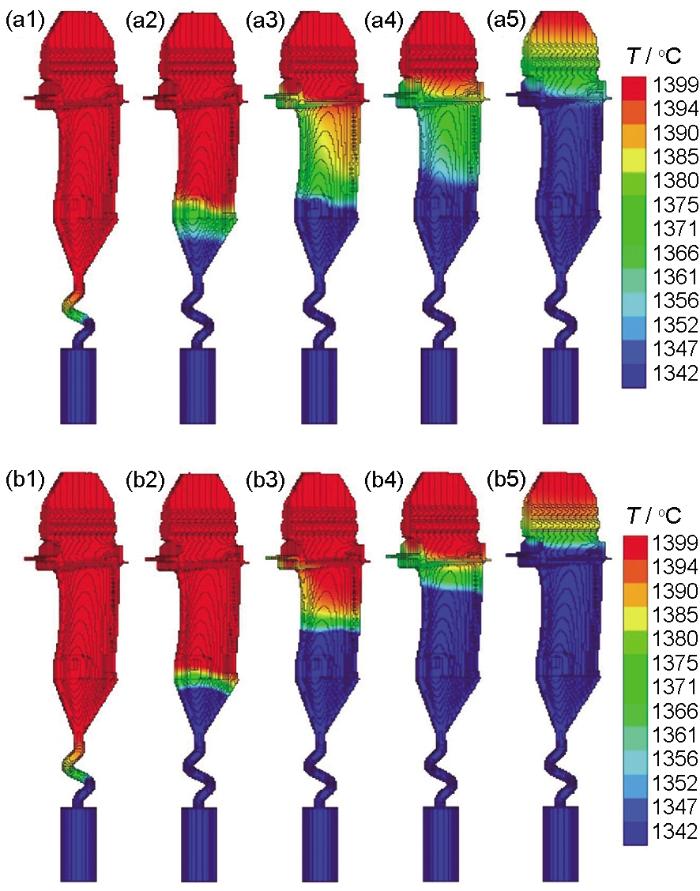
图4
利用高速凝固法(恒定抽拉速率3 mm/min)和液态金属冷却法(恒定抽拉速率8 mm/min)制备单晶叶片时的温度场和糊状区演变[18]
Fig.4
Temperature fields and mushy zone evolutions during single-crystal blade fabrication by high rate solidification at a constant withdrawal rate of 3 mm/min (a1-a5) and liquid metal cooling at a constant withdrawal rate of 8 mm/min (b1-b5)[18]
(a1) t = 241 s, fs = 30% (t—solidification time, fs—solid volume fraction)
(a2) t = 2028 s, fs = 40% (a3) t = 2411 s, fs = 50%
(a4) t = 2632 s, fs = 60% (a5) t = 2987 s, fs = 80%
(b1) t = 205 s, fs = 30% (b2) t = 689 s, fs = 40%
(b3) t = 910 s, fs = 50% (b4) t = 1031 s, fs = 60%
(b5) t = 1193 s, fs = 80%
李忠林[67]对定向凝固制备空心单晶涡轮叶片的应力/应变行为进行了模拟。结果表明,较大的塑性变形主要发生在叶片几何形状急剧变化的区域,如缘板根部、缘板与引晶条连接处、型芯截面处,该模拟结果与实际生产中易产生再结晶缺陷的位置相吻合。Ren等[14,68,69]针对单晶涡轮叶片的复杂薄壁和曲面几何,进一步发展了Euler两相宏观模型框架,系统预测了定向凝固过程中熔体对流、传热传质和组分输运的耦合过程,流场、溶质场模拟结果如图5[14]所示。可以看出,在定向凝固早期至中期,熔体流动呈现出由薄壁和凸面区域沿铸造方向的上升流与中心或凹面回流的竞争态势(图5a1~a3[14]);伴随局部冷却速率的升高和液相线等温面的鼓出,凸面和薄壁附近出现强烈的溶质羽流和近壁富集,促使通道状偏析沿铸造方向形成并稳定延伸,而铸件中心区的溶质羽流易受流动扰动而难以发展为稳定通道(图5b1~b3和c1~c3[14])。
图5

3.1.2 凝固组织模拟
凝固组织是决定铸件性能的关键因素。高温合金定向凝固铸件的组织结构常采用CA、FE或FD方法耦合进行模拟。受限于当前计算资源,单独采用CA方法难以在实际构件尺寸下直接预测宏观凝固组织(如晶粒竞争和选晶过程),因此通常与宏观模拟方法相结合,形成CA-FE/FD等跨尺度模型[70,71]。例如,FE或FD模型用于求解温度场,CA模型则在更精细的网格上模拟凝固组织演化;宏观和微观数据通过插值等手段传递实现信息交换。在理想的强耦合模式中,CA模拟的潜热释放会反馈输入至宏观温度场模拟中,以更准确地反映凝固潜热对枝晶生长的影响;弱耦合则以单向数据传递简化了计算流程。大型商业软件ProCAST中的元胞自动机有限元(CAFE)模型即采用弱耦合方案,其强大的晶粒形核、生长及可视化功能为定向凝固组织的模拟提供了有力支持。
值得强调的是,定向凝固过程中晶粒取向的选择和淘汰,本质上反映了枝晶在不同取向下的竞争生长和淘汰。CAFE/CAFD (元胞自动机有限差分)模型在晶粒尺度上对取向演化的描述,实质上源于枝晶生长动力学在更高空间尺度下的集体体现。因此,在定向凝固过程中,晶粒组织的演变与枝晶竞争机制密切相关,为理解宏观组织优化与微观枝晶动力学之间的关联提供了重要途径。
Dai等[64]利用CAFE方法对定向凝固的选晶过程开展了模拟研究,结果如图6[64]所示。图6a[64]为选晶器起晶块和螺旋段的三维晶粒组织结构模拟结果。图6b1~e1[64]为距底端不同高度横截面处晶粒结构的模拟结果。可见,在起晶块底部,大量晶粒以随机取向形核;在定向凝固过程中,不同取向的晶粒竞争生长,与热流方向平行取向的晶粒具有生长优势,可淘汰不良取向的晶粒,因此随高度的增加晶粒数量逐渐减少;在晶粒生长至起晶块顶部时,仅剩下少数几个晶粒,随后进入螺旋段生长阶段[8,72~75]。图6b2~e2[64]为不同高度处预测的<001>极图。可以看出,随着高度的增加,起晶块底部偏离角度大的晶粒被逐渐淘汰,形成<001>织构,模拟预测结果与实验观测[76,77]一致。
图6

图6
起晶块三维晶粒组织结构、距底部不同高度处横截面晶粒结构和相应<100>极图的元胞自动机有限元(CAFE)预测结果[64]
Fig.6
Cellular automaton finite element (CAFE) predicted results of 3D grain structures in the starter block of grain selector (a), the cross-section grain structures at different heights from the base (b1-e1) and corresponding <100> pole figures (b2-e2) at the height from the base of b—2 mm, c—5 mm, d—10 mm, e—29 mm shown in Fig.6a[64]
螺旋段晶粒组织CAFE模拟结果如图7[9]所示。图7a[9]为选晶器螺旋段三维晶粒组织结构的预测结果。图7b1~f1[9]为距底端不同高度横截面处晶粒结构的预测结果。可以看出,随着高度的增加,由于几何阻挡[8]的作用,进入螺旋段内的晶粒数量迅速减少并形成单晶结构。图7b2~f2和b3~f3[9]分别为不同高度处横截面晶粒取向所对应的<100>极图和晶粒偏转角度分布。可以看出,随着高度增加,螺旋段内虽然晶粒数量锐减,但存活下来的晶粒取向较为分散,并未形成明显的<001>织构,表明螺旋段在选晶过程中的作用为迅速减少晶粒数量以获得单晶,但并不能优化晶粒取向[8,9]。此外,相关模拟研究[8,9,78]还揭示,螺旋段的选晶效率可通过增大螺旋直径,减小螺旋通道管径、升角和螺距长度等参数进一步提升。
图7
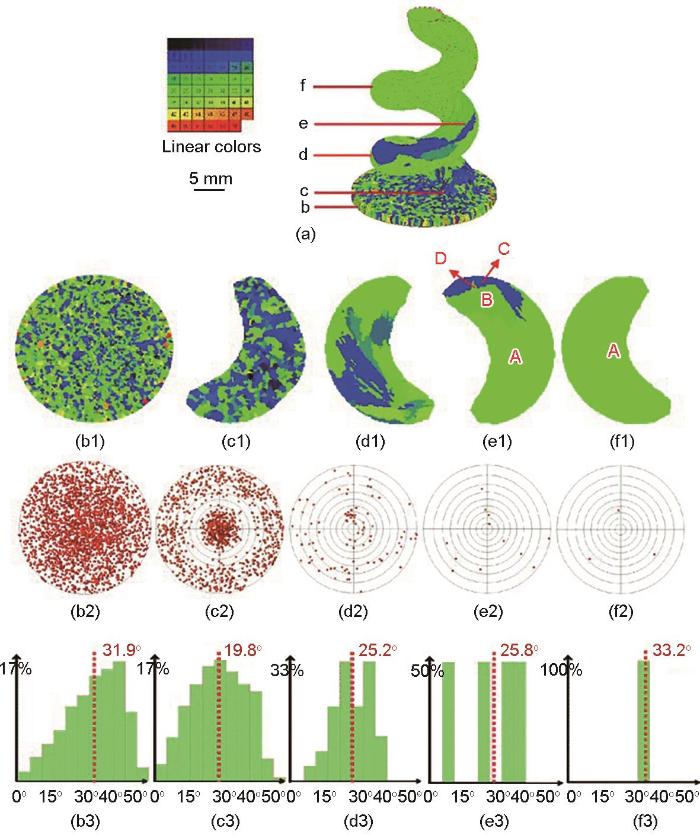
图7
螺旋段3D晶粒组织结构、不同高度处横截面晶粒组织结构和对应的<100>极图及晶粒偏转角度分布的CAFE预测结果[9]
Fig.7
CAFE predicted results of 3D grain structures in a spiral selector (a), the cross-section grain structures (b1-f1) and corresponding <001> pole figures along the direction of heat flux (b2-f2), and grain deviation distributions (b3-f3) for the cross sections at the height of b—0.1 mm, c—1.1 mm, d—6.25 mm, e—11.5 mm, and f—16.5 mm from the bottom shown in Fig.7a[9]
杂晶的产生严重影响单晶叶片的服役性能。杂晶一般形成于截面尺寸突变处,如选晶器与叶片之间的过渡段、平台等。Gao等[79]运用ProCAST和CAFE模型模拟了镍基单晶高温合金在铸造过程中平台杂晶的形成,发现平台杂晶一般形成于平台边缘。李亚峰[80]和马德新等[81]对镍基单晶高温合金杂晶的研究均发现,平台杂晶的形成受合金成分、叶片平台尺寸、凝固参数等多重因素影响。Meng等[82]研究了平台尺寸对杂晶成形的影响。结果表明,随着平台尺寸的增加,杂晶形成倾向增加;进一步分析平台处的温度场表明,叶片横截面突变的平台处产生了局部过冷,选晶器所选单晶的枝晶来不及生长至此,导致新晶粒的形核和长大,而基体枝晶来不及从叶身处长大到平台边缘,从而形成杂晶。
撒世鹏等[83]和杨文超等[84]利用ProCAST有限元模拟软件和CAFE模型,对采用不同叶片排列方式[83]和模组结构[84]生产的单晶叶片的凝固过程温度场和凝固组织进行模拟计算。结果表明,优化的叶片排列方式可改善凝固时的温度分布,进一步添加引晶杆可以消除叶片缘板上的孤立过冷区,有效减少缘板杂晶产生[83]。杨文超等[84]还对不同模组结构制备的18个单晶叶片定向凝固过程中的温度场和晶粒组织进行模拟仿真分析。结果表明,相较于单层模组,将叶片上下堆叠所形成的双层叠加模组缩小了模组直径,改善了凝固过程的温度场,避免了叶身和缘板边角形成大的过冷,且上下层叶片间的温度梯度差异较小,上下叶片的杂晶形成倾向均较小,可以实现单晶叶片的高效制备。
3.2 定向凝固微观模拟:枝晶生长
在定向凝固过程中,枝晶的竞争生长和淘汰是单晶形成的微观基础,而在宏观层面上则表现为晶粒的选择和取向优化。换言之,晶粒选择和淘汰过程可视为枝晶竞争生长在更大尺度上的集体现象。从建模角度看,3.1节中涉及的CAFE或CAFD模型正是这一微观-宏观关联的典型体现。该模型以FE或FD方法精确求解温度场、溶质场等宏观物理场分布,并将其作为边界条件输入,进而利用CA模型模拟局部凝固演化,实现了从宏观热传输到微观枝晶形貌的跨尺度模拟。然而,该类模型对枝晶尖端形貌、分枝和界面动力学等微观特征的模拟仍依赖简化处理,因此有必要从宏观模拟聚焦到微观层面开展枝晶生长过程的直接模拟。本节重点综述枝晶生长的微观模拟方法,包括CA方法和PF方法,探讨它们在揭示定向凝固中枝晶形貌演化、取向偏转和凝固缺陷中的应用和发展。
3.2.1 CA法
式中,n为形核密度,nmax为最大形核密度,ΔT为当前单元的过冷度,ΔTσ 为过冷度标准差,ΔTN为平均形核过冷度。晶体生长则依据固/液界面法向推进速率计算,该速率通常由局部过冷度驱动,可采用Kurz-Giovanola-Trivedi (KGT)模型[87]进行描述:
式中,vn为界面法向推进速率,α和β均为速度动力学系数。CA方法以计算效率高、可视化效果强和易于与热场、溶质场耦合的优势,在模拟晶粒形貌、择优生长和组织演变等方面表现出良好的适应性,尤其适用于大尺度定向凝固过程的微观结构预测。
图8

Wang等[32]基于溶质驱动的凝固理论,利用CAFD方法预测了定向凝固枝晶的一次臂间距。在模拟域内设定初始形核数量分别为两个稀疏分布和60个稠密分布条件下,模拟定向凝固枝晶生长的演变情况。当初始晶核数量较少时,已有晶粒的二次枝晶臂横向生长并生长出三次枝晶臂,部分三次枝晶生长迅速跟上了初始枝晶,大约经过40 s达到稳态;当初始晶核数量较多时,部分生长速率较快的枝晶生长出二次枝晶臂,遮挡了生长较慢的枝晶,大约经过40 s达到稳态。综上所述,无论初始形核稀疏或稠密,枝晶均可通过分枝或过度生长的方式最终达到稳态,且一次枝晶臂间距基本相等。Yang等[11]通过CAFD模型对定向凝固制备涡轮叶片过程中截面突变处的杂晶形成进行了模拟,探究了抽拉速率和等温线角度对叶片平台处杂晶形成的影响规律。抽拉速率和等温线角度的增大均会导致叶片平台处过冷度的增大,使杂晶的形核和生长更易发生。此外,由于枝晶尖端的过冷度对等温线角度更为敏感,因此相较于抽拉速率,等温线角度对叶片平台处杂晶形核和生长的影响更显著。
3.2.2 PF法
式中,ϕα 和ϕβ 分别为代表相α和β的相场变量,t为凝固时间,
图9

图9
利用相场法模拟定向凝固过程中汇聚侧枝晶的反常淘汰现象[40]
Fig.9
Abnormal elimination of dendrites on the converging side during directional solidification simulated by phase-field method[40] (θUO—unfavorably oriented (UO) grain inclination angle)
(a) 0.05 × 10⁶th step (1.3 s) (b) 0.25 × 10⁶th step (6.7 s) (c) 106th step (26.8 s)
(d) 3 × 10⁶th step (80.4 s) (e) 7 × 10⁶th step (187.5 s)
Yang等[95]利用多相-格子Boltzmann模型(multiphase-field-lattice Boltzmann model)对定向凝固过程中自然对流影响下的枝晶生长过程进行了模拟。结果表明,当温度梯度从5 K/mm提升至10 K/mm时,流体速率突然下降。在枝晶形貌方面,在温度梯度较低时发现了发达的二次枝晶臂,且二次枝晶臂的长度随温度梯度的降低而增加。当温度梯度降低时,由于凸起枝晶的出现,固相前沿由平直状转变为不规则形状。Xia等[96]采用耦合空间运动拓扑算法的三维相场模型对定向凝固过程中枝晶的取向偏转行为进行了模拟。结果表明,当断裂位置所在横截面的固相率高于某一定值时,即使枝晶发生断裂,由于周围枝晶的结构限制,也无法形成大角度偏离的条纹晶。
4 总结与展望
本文围绕定向凝固枝晶生长数值模拟中的应用,系统梳理了定向凝固过程中枝晶竞争生长和晶粒选择机制,并概述了典型的定向凝固工艺方法。针对定向凝固过程中的复杂物理场演化和组织演变行为,综述了涵盖不同尺度的多种数值模拟方法,包括有限元法、有限差分法、元胞自动机和相场法,论述了这些方法在从宏观物理场模拟到微观枝晶生长建模中的适用性和代表性成果。数值模拟为定向凝固过程中的温度场、溶质场、流场、应力场等多种物理场演化过程,液/固相变行为,枝晶竞争生长和淘汰,以及凝固组织演变规律的深入解析提供了关键手段;用以进一步揭示晶粒取向选择、杂晶和条纹晶等典型凝固缺陷的形成机理,从而为定向凝固单晶铸造的工艺参数优化和成品质量提升提供了重要的理论支撑和决策依据。
尽管当前在定向凝固枝晶生长模拟方面已取得显著进展,但仍面临诸多挑战。例如,多尺度模型中物理参量的统一描述仍不完善,复杂边界条件下的界面追踪和形貌演化精度不足,三维多枝晶竞争生长的计算开销巨大,且模拟结果与实验观测之间的定量校核机制尚不健全。这些问题限制了定向凝固枝晶生长数值模拟在对枝晶生长过程的精准预测和规律解析中的应用。未来研究可重点在以下方向深化。
(1) 枝晶尖端动力学和界面行为建模改进:改进枝晶竞争和淘汰理论,纳入界面各向异性及溶质-界面耦合引起的非平衡效应等因素,提升枝晶臂间距、枝晶竞争、择优取向预测的准确性,开展枝晶尖端溶质和流动耦合模拟,揭示雀斑、偏析等与枝晶生长相关的典型缺陷的形成机理。
(2) 多物理场多尺度耦合框架搭建:构建从宏观热-质量传输到微观枝晶尖端动力学的统一模拟框架,实现温度、溶质、流动和应力的协同计算,提升跨尺度模拟的准确性和适用性;发展自适应网格和局部模型切换策略,实现计算资源在枝晶尖端等关键区域的优化分配。
(3) 智能化和数据驱动模拟:基于高保真模拟或实验数据,融合机器学习与高通量计算,实现枝晶尖端参数的自动标定和不同工艺条件下枝晶组织形貌的快速预测,从而在保证精度的同时显著提高三维枝晶竞争生长模拟的效率。
参考文献
Atomic characteristics of heterogeneous nucleation during solidification of aluminum alloys: A critical review
[J].
Additive manufacturing of ultrafine-grained high-strength titanium alloys
[J].
Solute trapping and non-equilibrium microstructure during rapid solidification of additive manufacturing
[J].Solute transport during rapid and repeated thermal cycle in additive manufacturing (AM) leading to non-equilibrium, non-uniform microstructure remains to be studied. Here, a fully-coupled fluid dynamics and microstructure modelling is developed to rationalise the dynamic solute transport process and elemental segregation in AM, and to gain better understanding of non-equilibrium nature of intercellular solute segregation and cellular structures at sub-grain scale during the melting-solidification of the laser powder bed fusion process. It reveals the solute transport induced by melt convection dilutes the partitioned solute at the solidification front and promotes solute trapping, and elucidates the mechanisms of the subsequent microstructural morphology transitions to ultra-fine cells and then to coarse cells. These suggest solute trapping effect could be made used for reducing crack susceptibility by accelerating the solidification process. The rapid solidification characteristics exhibit promising potential of additive manufacturing for hard-to-print superalloys and aid in alloy design for better printability.© 2023. The Author(s).
Progress in modelling solidification microstructures in metals and alloys: Dendrites and cells from 1700 to 2000
[J].
Progress in modelling solidification microstructures in metals and alloys. Part II: Dendrites from 2001 to 2018
[J].
Single-crystal casting/directional solidification
[J].
Grain selection in spiral selectors during investment casting of single-crystal turbine blades: Part I. Experimental investigation
[J].
Grain selection in spiral selectors during investment casting of single-crystal components: Part II. Numerical modeling
[J].
Thermal-solutal convection-induced low-angle grain boundaries in single-crystal nickel-based superalloy solidification
[J].Low-angle grain boundaries (LAGBs) are one of the solidification defects in single-crystal nickel-based superalloys and are detrimental to the mechanical properties. The formation of LAGBs is related to dendrite deformation, while the mechanism has not been fully understood at the mesoscale. In this work, a model coupling dendrite growth, thermal-solutal-fluid flow, thermal stress and flow-induced dendrite deformation <em>via</em> cellular automaton-finite volume method and finite element method is developed to study the formation of LAGBs in single crystal superalloys. Results reveal that the bending of dendrites is primarily attributed to the thermal-solutal convection-induced dendrite deformation. The mechanical stress of dendrite deformation develops and stabilises as solidification proceeds. As the width of the mushy zone gets stable, stresses are built up and then dendritic elastoplastic bending occurs at some thin primary dendrites with the wider inter-dendritic space. There are three characteristic zones of stress distribution along the solidification direction: (i) no stress concentration in the fully solidified regions; (ii) stress developing in the primary dendrite bridging region, and (iii) stress decrease in the inter-dendritic uncontacted zone. The stresses reach maximum near the initial dendrite bridging position. The lower temperature gradients, the finer primary dendritic trunks and sudden reductions in local dendritic trunk radius jointly promote the elastoplastic deformation of the dendrites. Corresponding measures are suggested to reduce LAGBs.
Microscale simulation of stray grain formation in investment cast turbine blades
[J].
On the origin of sliver defects in single crystal investment castings
[J].
Freckle prediction model incorporating geometrical effects for Ni-based single-crystal superalloy components
[J].
Insight into the sensitivities of freckles in the directional solidification of single-crystal turbine blades
[J].
An in situ resistance-based method for tracking the temporal evolution of recovery and recrystallization in Ni-base single-crystal superalloy at super-solvus temperatures
[J].
Development of numerical simulation in nickel-based superalloy turbine blade directional solidification
[J].Ni-based superalloy turbine blades have been widely used in aerospace and industrial engine. Numerical simulation techniques can optimize the superalloy directional solidification process and enhance the rate of finished products. This paper summarized the existing macroscopic and microscopic numerical models in the superalloy blade directional solidification process. Simulations have been done on the temperature field evolution, grain structure and dendrite morphology in typical HRS and LMC directional solidification conditions, and the resulting microstructure features were investigated. In particular, the application of varying withdrawal rate in directional solidification of the superalloy blade was introduced. And the advantages of the varying withdrawal rate technique were emphasized by comparing it with the constant withdrawal rate method. The simulation results indicate that by applying varying withdrawal rate, the convex or concave shape of the mushy zone can be change to flat shape, so that parallel columnar grains can be obtained with enhanced high-temperature performance of the turbine blade.
高温合金涡轮叶片定向凝固过程数值模拟研究进展
[J].高温合金涡轮叶片被广泛应用于航空发动机与燃气轮机,数值模拟技术能优化和改进涡轮叶片定向凝固工艺,提高成品率。本文总结了国内外高温合金涡轮叶片定向凝固过程宏、微观数值模拟模型,介绍了其发展趋势。对高速凝固(HRS)和液态金属冷却(LMC) 2种工艺下高温合金叶片宏观温度场、介观晶粒组织与微观枝晶组织做了模拟仿真,对比分析了2种定向凝固工艺下的传热过程和微观组织演化规律。介绍了变抽拉速率工艺在高温合金定向凝固中的应用,以实际叶片作为算例,对比了常抽拉速率与优化的变抽拉速率对涡轮叶片温度场、晶粒组织的影响。结果表明,优化的变抽拉速率工艺能够改变上凸或者下凹的糊状区形状,得到平直的糊状区与平行的晶粒组织,有利于提升叶片高温力学性能。
Multiscale modeling and simulation of directional solidification process of Ni-based superalloy turbine blade casting
[J].Ni-based superalloy turbine blades have become indispensable structural parts in modern gas engines. An understanding of the solidification behavior and microstructure formation in directional solidified turbine blades is necessary for improving their high-temperature performance. The multiscale simulation model was developed to simulate the directional solidification process of superalloy turbine blades. The 3D cellular automaton-finite difference (CA-FD) method was used to calculate heat transfer and grain growth on the macroscopic scale, while the phase-field method was developed to simulate dendrite growth on the microscopic scale. Firstly, the evolution of temperature field of an aero-engine blade and a large industrial gas turbine blade was studied under high-rate solidification (HRS) and liquid-metal cooling (LMC) solidification processes. The varying withdrawal velocity was applied to change the curved mushy zone to a flat shape. Secondly, the grain growth in the aero-engine blade was simulated, and the grain structures in the starter block part and the spiral selector part in the HRS process were compared with those in the LMC process. The simulated grain structures were generally in agreement with experimental results. Finally, the dendrite growth in the typical HRS and LMC solidification process was investigated and the simulation results were compared with the experimental results in terms of dendrite morphology and primary dendritic spacing.
Probabilistic modelling of microstructure formation in solidification processes
[J].
A numerical approach to three-dimensional dendritic solidification
[J].
106-particle molecular-dynamics study of homogeneous nucleation of crystals in a supercooled atomic liquid
[J].
Solute adsorption energy criterion for discovering effective grain refiners in high-Si Al-Si alloys
[J].
Using deep neural network with small dataset to predict material defects
[J].
Artificial intelligence-powered materials science
[J].The advancement of materials has played a pivotal role in the advancement of human civilization, and the emergence of artificial intelligence (AI)-empowered materials science heralds a new era with substantial potential to tackle the escalating challenges related to energy, environment, and biomedical concerns in a sustainable manner. The exploration and development of sustainable materials are poised to assume a critical role in attaining technologically advanced solutions that are environmentally friendly, energy-efficient, and conducive to human well-being. This review provides a comprehensive overview of the current scholarly progress in artificial intelligence-powered materials science and its cutting-edge applications. We anticipate that AI technology will be extensively utilized in material research and development, thereby expediting the growth and implementation of novel materials. AI will serve as a catalyst for materials innovation, and in turn, advancements in materials innovation will further enhance the capabilities of AI and AI-powered materials science. Through the synergistic collaboration between AI and materials science, we stand to realize a future propelled by advanced AI-powered materials.© 2025. The Author(s).
AI4Materials: Transforming the landscape of materials science and enigneering
[J].
A data-driven approach for the fast prediction of macrosegregation
[J].
Feature selection for aero-engine fault detection
[A].
Simulation of the columnar-to-equiaxed transition in alloy solidification—The effect of nucleation undercooling, density of nuclei in bulk liquid and alloy solidification range on the transition
[J].
On directional dendritic growth and primary spacing—A review
[J].The primary spacing is intrinsically linked with the mechanical behavior of directionally solidified materials. Because of this relationship, a significant amount of solidification work is reported in the literature, which relates the primary spacing to the process variables. This review provides a comprehensive chronological narrative on the development of the directional dendritic growth problem over the past 85 years. A key focus within this review is detailing the relationship between key solidification parameters, the operating point of the dendrite tip, and the primary spacing. This review critiques the current state of directional dendritic growth and primary spacing modelling, briefly discusses dendritic growth computational and experimental research, and suggests areas for future investigation.
Steady state columnar and equiaxed growth of dendrites and eutectic
[J].
A model of solidification microstructures in nickel-based superalloys: Predicting primary dendrite spacing selection
[J].
Directional solidification of Ni base superalloy IN738LC to improve creep properties
[J].
Numerical modeling of cellular/dendritic array growth: Spacing and structure predictions
[J].
Evolution of dendritic patterns during directional solidification of Ni-base alloys: Towards hexagonally ordered, close-packed dendrite arrays
[J].
On the nature of hexagonality within the solidification structure of single crystal alloys: Mechanisms and applications
[J].Primary spacing is a key phenomenon during solidification of single crystal alloys. It determines microsegregation, defect formation, the time required to solutionise the solidified structure, and the final performance of single crystal components. A novel stereological characterisation algorithm: Shape-Limited Primary Spacing (SLPS) is developed and applied to study the formation of cellular and dendritic packing patterns in single crystal alloys solidified under different casting conditions. The results reveal the tendency for single crystals to form hexagonally packed structures under steady state conditions, while all other packing arrangements constitute a metastable state. Using the SLPS algorithm, it has been demonstrated that packing pattern formation and local primary spacing can be related to tip growth kinetics. Further, the role of curved isotherms that occur in directional solidification has been identified. Isotherm curvature results in non-uniform liquid compositional gradients developing parallel to a growing solid interface, leading to the formation of metastable packing, low-angle grain boundaries, and porosity formation within the microstructure. (C) 2020 Acta Materialia Inc. Published by Elsevier Ltd.
On the origin of mosaicity in directionally solidified Ni-base superalloys
[J].
The origin of the preferred orientation in the columnar zone of ingots
[J].
Two-dimensional phase-field simulations of dendrite competitive growth during the directional solidification of a binary alloy bicrystal
[J].
Large-scale phase-field studies of three-dimensional dendrite competitive growth at the converging grain boundary during directional solidification of a bicrystal binary alloy
[J].
Dendritic model for macrosegregation prediction of large scale castings
[J].
Melt flow-induced mechanical deformation of dendrites in alloy solidification: A coupled thermal fluid-solid mechanics approach
[J].
Melt flow-induced mechanical deformation and fracture behaviour of dendrites in alloy solidification
[J].
Effect of solidification rate on competitive grain growth in directional solidification of a nickel-base superalloy
[J].
Effect of weak transverse magnetic field on the competitive grain growth of Ni-based superalloy with divergent bi-crystals
[J].Ni-based single-crystal superalloys have excellent high-temperature mechanical properties and creep properties, rendering them as preferred turbine blade materials in advanced aerospace and gas engines. Controlling competitive grain growth during directional solidification is of great substantial importance for achieving high-quality single-crystal blades. As an external physical field, a static magnetic field can be used to effectively control material forming. The use of static magnetic fields during directional solidification has evolved as an effective method for controlling microstructures and grain growth. However, the influence of static magnetic fields on competitive grain growth during the directional solidification of Ni-based superalloys requires further investigation. Therefore, this study explored the competitive growth behavior of divergent grains during the directional solidification of Ni-based superalloy using bi-crystal seeds at various withdrawal rates under a weak transverse magnetic field (0.1 and 0.7 T). Results showed that the favorably oriented grain (grain A) overgrew the unfavorably oriented grain (grain B) without the application of a magnetic field, and the overgrowth rate was independent of the withdrawal rate. The application of a magnetic field substantially changed the overgrowth rate of divergent bi-crystals, and the overgrowth rate was affected by the placed patterns of the divergent bi-crystals and the withdrawal rate. When the divergent bi-crystal seeds were placed under the magnetic field in an A-to-B pattern, with the favorably oriented grain A positioned on the left side and the unfavorably oriented grain B on the right side, the side branching of favorably oriented grain was suppressed at the grain boundary (GB), decreasing the overgrowth rate of divergent bi-crystals. However, when the divergent bi-crystal seeds were placed under the magnetic field in a B-to-A pattern, with the unfavorably oriented grain B on the left side and the favorably oriented grain A on the right side, branching from the favorably oriented grain at the GB was enhanced, increasing the overgrowth rate of divergent bi-crystals. With increasing the withdrawal rate, the effect of the magnetic field on slowing down or accelerating the grain overgrowth rate gradually diminished. In addition, a tilted interface and refined dendrites were observed under a transverse magnetic field, especially at a low withdrawal rate. The application of a magnetic field produces a thermomagnetic convective effect at the interdendrite that changes the solute distribution at the divergent bi-crystal GBs, thereby affecting the side branching behavior of dendrites at GBs. With increasing withdrawal rate, the effect of thermoelectric magnetic convection on dendrite side branching at GBs is weakened.
横向弱磁场对镍基高温合金发散双晶竞争生长行为的影响
[J].静磁场作为外加物理场,可以有效调控材料成形过程,为调控镍基高温合金的凝固组织和晶体定向生长提供了新的思路。本工作研究了DD483镍基高温合金发散双晶在横向弱磁场下(0.1和0.7 T)的定向竞争生长规律和组织形貌演变特征。结果表明,未施加磁场时,发散双晶中择优取向晶粒(晶粒A)淘汰非择优取向晶粒(晶粒B),且晶粒淘汰速率与抽拉速率无关。磁场能显著影响发散双晶的竞争生长速率,且其受到双晶在磁场下的摆放方式和抽拉速率的影响。当发散双晶在磁场下按A-to-B方式摆放时,施加磁场抑制了晶粒A在晶界处的分枝,减缓了晶粒A的淘汰速率。当发散双晶按B-to-A方式摆放时,施加磁场进一步促进了晶粒A在晶界处的分枝,加速了晶粒A的淘汰速率。随着抽拉速率的提高,磁场对减缓或加速晶粒的竞争淘汰作用逐渐减弱。磁场在枝晶间产生的热电磁对流效应改变了发散双晶晶界处的溶质分布,从而影响枝晶在晶界处的侧枝生长,这是导致晶粒竞争生长行为发生变化的主要原因。随着抽拉速率的增加,磁场作用时间变短,热电磁对流对晶界处分枝作用的影响减弱。
Phase-field study of competitive dendritic growth of converging grains during directional solidification
[J].
Development of single crystal solidification technology for production of superalloy turbine blades
[J].
高温合金叶片单晶凝固技术的新发展
[J].
Single crystal casting with fluidized carbon bed cooling: A process innovation for quality improvement and cost reduction
[J].
Effect of local cooling rates on the microstructures of single crystal CMSX-6 superalloy: A comparative assessment of the Bridgman and the downward directional solidification processes
[J].
Liquid metal cooling: A new solidification technique
[J].
Directional solidification of large superalloy castings with radiation and liquid-metal cooling: A comparative assessment
[J].
The progress of investment casting of nickel-based superalloys
[J].
高温合金精密铸造技术研究进展
[J].
Effect of high-gradient directed crystallization on the structure and properties of rhenium-bearing single-crystal alloy
[J].
Development of dendritic structure in the liquid-metal-cooled, directional-solidification process
[J].
Simulation of diffusion-limited lateral growth of dendrites during solidification via liquid metal cooling
[J].
Stability of dendrite growth during directional solidification in the presence of a non-axial thermal field
[J].
High thermal gradient directional solidification and its application in the processing of nickel-based superalloys
[J].
Directional solidification under high thermal gradient and its application in superalloys processing
[J].<p>Industrial gas turbines (IGTs) are the key equipment to achieving energy strategy, such as energy conservation and clean power generation. When the large and complex IGT blades are fabricated by the conventional Bridgman directional solidification process, the thermal gradients at the solidification front are low and unstable, resulting in some disadvantages: the coarse dendrite structure with severe dendritic segregation, the increased occurrence of casting defects and the poor performance of mechanical properties. These disadvantages provide a good opportunity for rapid development of the directional solidification with high thermal gradient (HG), such as the liquid metal cooling (LMC). In the present work, the physical basis of HG process, the microstructure, mechanical properties, solution heat treatment, and casting defects of the superalloys processed by HG process, have been reviewed. The HG process increases the thermal gradient and the cooling rate, thus permitting microstructural improvements including a more homogeneous fine-dendrite structure with lower elemental segregation and shrinkage porosity, and refinement of carbide, <i>γ′</i> phase and eutectic, reducing the volume fraction of eutectic and shrinkage porosity. During the solution heat treatment, the HG process increases the incipient melting temperature and reduces the residual segregation as well as the content of solution pore. The HG process could effectively inhibit the formation of freckle chains, increase the critical withdrawal rate of the stray grain formation, and decrease the degree of the misorientation of the <001> grain orientation from the casting axis. Moreover, the HG process could improve the mechanical properties including the stress rupture life, low-cycle fatigue (LCF), high-cycle fatigue properties and short-term strength, but the improvement might be reduced at higher temperature or under the oxidation condition.</p>
高梯度定向凝固技术及其在高温合金制备中的应用
[J].
The effect of liquid metal cooling on thermal gradients in directional solidification of superalloys: Thermal analysis
[J].
The convergence-fault mechanism for low-angle boundary formation in single-crystal castings
[J].
Cost effective single crystals
[A].
Seeding of single-crystal superalloys—Role of constitutional undercooling and primary dendrite orientation on stray-grain nucleation and growth
[J].
Grain selection during solidification in spiral grain selector
[A].
Design of variable withdrawal rate for superalloy single-crystal blade fabrication
[J].
Modelling on directional solidification of superalloy blades with furnace wall temperature evolution
[J].Ni--based superalloy turbine blades produced by Bridgman directional solidification technology are widely used in both aeronautic and energy industries as key parts of the gas turbine engines. Because of existence of complex heat radiation between the shell surface and the furnace wall, precise control of the temperature distribution within the blade is a challenging task. A modified model based on the Monte Carlo ray tracing method was proposed for the three dimensional temperature simulation of the turbine blades during directional solidification process, in which the furnace wall temperature evolution was considered and calculated. Ray refinement in normal direction was applied to improve the heat radiation calculation precision. Three dimensional finite differential grids for turbine blades and two dimensional differential grids for furnace wall were used together to increase simulation efficiency and save memory consumption. Heat transfer calculation of the blades with the modified model was performed and compared with that of the simplified model in which the furnace wall temperature was treated as constant. Experiments were carried out to validate the proposed model in this paper. It was demonstrated that the modified model revealed the furnace wall temperature change during the withdrawal process and its impact on the blade, and simulated the temperature distribution of the turbine blade with a higher accuracy.
考虑炉壁温度变化的高温合金叶片定向凝固过程模拟
[J].
Experimental research and numerical simulation on primary recrystallization of nickel-based single crystal superalloy
[D].
镍基单晶高温合金静态再结晶实验研究及数值模拟
[D].
Thermal-solutal-fluid flow of channel segregation during directional solidification of single-crystal nickel-based superalloys
[J].
Solute enrichment induced dendritic fragmentation in directional solidification of nickel-based superalloys
[J].
Prediction of grain structures in various solidification processes
[J].
A coupled finite element-cellular automaton model for the prediction of dendritic grain structures in solidification processes
[J].
3-dimensional simulation of the grain formation in investment castings
[J].
Evolution of grain selection in spiral selector during directional solidification of nickel-base superalloys
[J].

The process of grain selection in the spiral selector was investigated by both a ProCAST simulation based on a cellular automaton finite element (CAFE) model and experimental confirmation. The results show that the height of starter block, the spiral diameter and initial angle play an important role in grain selection. The dimension of selector should be maintained in a stable range to optimize the grain orientation and select a single crystal efficiently. A selector which can efficiently select a single crystal had been successfully designed. Grain orientation fluctuation in the spiral part was also studied by means of the variation of thermal condition.
Modes of grain selection in spiral selector during directional solidification of nickel-base superalloys
[J].
Influence of spiral crystal selector on crystal orientation of single crystal superalloy
[J].
Simulation of grain selection during single crystal casting of a Ni-base superalloy
[J].
Process modelling of grain selection during the solidification of single crystal superalloy castings
[J].
Effect of spiral shape on grain selection during casting of single crystal turbine blades
[J].
Simulation of stray grain formation at the platform during Ni-base single crystal superalloy DD403 casting
[J].
Study on stray grain formation in the platform of Ni-based single crystal superalloys turbine blade
[D].
镍基单晶高温合金涡轮叶片平台杂晶缺陷研究
[D].
Study on sliver defects in single crystal castings of superalloys
[J].
高温合金单晶铸件中条纹晶缺陷的试验研究
[J].
Effect of platform dimension on the dendrite growth and stray grain formation in a Ni-base single-crystal superalloy
[J].
Numerical simulation of blade arrangement on stray grains in a fourth-generation single crystal superalloy blade
[J].
叶片排列方式对一种第四代单晶高温合金叶片杂晶影响的数值模拟研究
[J].
Temperature field and microstructure simulation of directional solidification process of single crystal blade prepared efficiently with different module structures
[J].
不同模组结构高效制备单晶叶片定向凝固过程的温度场及组织模拟
[J].
A 3D Cellular Automaton algorithm for the prediction of dendritic grain growth
[J].
Modeling of equiaxed microstructure formation in casting
[J].
Theory of microstructural development during rapid solidification
[J].
Simulation of the columnar-to-equiaxed transition in directionally solidified Al-Cu alloys
[J].
Phase-field modeling and simulations of dendrite growth
[J].
Prediction of dendritic growth and microsegregation patterns in a binary alloy using the phase-field method
[J].
Quantitative phase-field modeling of dendritic growth in two and three dimensions
[J].
Multi phase field model for solid state transformation with elastic strain
[J].
On the theory of superconductivity
[A].
Study of dendrite growth with natural convection in superalloy directional solidification via a multiphase-field-lattice Boltzmann model
[J].
Generation mechanism and motion behavior of sliver defect in single crystal Ni-based superalloy
[J].Sliver is a common but easily neglected defect in single crystal Ni-based superalloy castings. To date, there is still no unified viewpoint on its formation mechanism and generation causes. In this work, the orientation discontinuity and motion behavior of sliver defects were studied through experiments and numerical simulations. The ultrathin wedge-shaped specimen containing the grain boundary of the sliver and the matrix was prepared at the initial position of the sliver defect for the observation of equal thickness fringes. The discontinuity of equal thickness fringes on both sides of the grain boundary was observed through a transmission electron microscope, which directly confirms the abrupt change in the orientation between the sliver and matrix from the nanoscale. The crystal lattices at the smooth area and the bulging area of the grain boundary were found to have unusually different arrangements. The irregular lattice arrangement at the bulging area shows that the grain boundary has experienced high-stress deformation. Statistical results of sliver orientation deviation with a further composition analysis show the micro protuberance of the mold shell has a noticeable inductive effect on the sliver generation. Furthermore, a self-developed three-dimensional phase-field simulation model coupled with the spatial topology algorithm is established to simulate the orientation deflection behavior and orientation deviation threshold of fractured dendrites. The simulation results indicated that there is an upper limit of the cross-section solid fraction at the fracture position for the motion of the fractured dendrites. When the cross-section solid fraction at the fracture position is higher than this upper limit, it will be difficult to produce large deviation slivers due to the structural limitation of surrounding dendrites. This upper limit does not change with the solidification temperature gradient.


