



高熵合金最初被定义为由5种及以上金属主元以等原子比或近等原子比(5%~35%,下同)构成,基体为简单固溶体相的合金体系[1,2]。早期研究普遍认为,最大化构型熵能够稳定单相固溶体,加之显著的晶格畸变、缓慢的元素扩散及“鸡尾酒效应”,高熵合金表现出优于传统合金的力学性能。该阶段工作聚焦于成分设计,一方面通过遴选主元构建全新的合金体系,另一方面对现有合金体系进行高熵化以实现性能优化。已报道的合金主要可分为两类:(1) 以第IV周期元素(Fe、Co、Ni、Cr、Cu、Mn、Ti等)为主、具有fcc结构的体系,典型代表为CoCrFeNiMn,其塑性优异但强度相对有限[2];(2) 以难熔金属元素(Mo、Ti、V、Nb、Hf、Ta、Cr、W等)为主、具有bcc结构的体系,如MoNbTaW合金,其具备较高强度但塑性相对不足[6]。通过成分和微观结构调控,能够在上述体系中引入固溶强化、细晶强化、析出强化等强韧化机制,进一步优化其力学性能。
随着高熵合金研究的深入,人们逐渐认识到等原子比对应的高构型熵并非稳定单相固溶体的必要条件,其力学性能也并非只由构型熵决定。因此,高熵合金的设计范式逐渐突破等原子比成分和单相固溶体结构的限制,拓展至非等原子比、多相及复杂组织。高熵化由高熵即单相的唯象判据,演变为利用多主元协同效应调控材料组织和性能的设计理念,概念边界随之泛化[7]。高熵合金普遍存在跨尺度化学不均匀性,即使在单相固溶体中,不同主元在晶格点阵上的排布也并非完全随机,而是受焓驱动的原子间交互作用的影响,呈现近程-中程化学有序特征[8,9]。借助熵-焓协同效应调控这种局域有序结构,能够影响位错运动,进而调控力学性能[10,11]。通过成分与结构协同优化,高熵合金甚至能够突破传统合金固有的室温强度-塑性倒置关系。然而,在实际工程应用中并不总是需要如此高的室温力学性能指标[12]。此外,高熵合金因多主元设计常含贵金属或战略元素,原料成本显著高于钢铁等传统合金;复杂成分体系在常规熔铸制备过程中易产生成分偏析等缺陷;且与现有工业化生产体系的兼容性不足。这些都限制了高熵合金的工程化推广应用。
就材料应用的梯度适配性而言,极端服役条件为高熵合金提供了更具针对性的发展空间。在超高温、极低温、强辐照等严苛工况下,传统合金往往因相稳定性不足、低温韧脆转变、缺陷演化失控等问题面临难以逾越的性能瓶颈[13]。高熵合金依托多主元协同效应,可实现原子扩散迟滞,并可提高晶格稳定性、抑制缺陷团聚,在突破极端条件服役性能边界的同时,仍可保持优异的室温强塑性,展现出显著的服役潜力。此外,对这类场景而言,性能权重往往高于成本考量,高熵合金的性能优势能够覆盖其原料成本偏高、工艺窗口窄等短板,并可突破传统合金无法逾越的“卡脖子”技术难题。因此,面向极端服役条件,不仅能充分发挥高熵合金的性能优势,也是推动其由实验室走向工程化、为国家重大工程提供材料支撑的关键路径。值得指出的是,近年来高熵合金在磁、电、催化等功能领域亦展现出极大应用潜力[14,15],但本文主要聚焦其作为结构材料的应用。基于此,本文结合高熵合金结构特征,以超高温、极低温、强辐照为典型应用场景,阐述其极端服役性能优势并揭示高熵效应的作用机制,最后总结关键瓶颈并提出发展路径,为该材料体系的未来发展提供参考。
1 高熵合金的结构特点
高熵合金因多主元特性而表现出异于传统单一主元合金的结构特征,进而影响其力学性能。首先,高混合熵有利于促使合金以简单固溶体为基体,为获得优异力学性能奠定结构基础;尤其混合熵的影响程度随温度升高而增加,使合金在高温下表现出良好的相稳定性;优异的相稳定性极大拓宽了成分设计空间,使研究者能够在保持简单固溶体的前提下根据目标性能遴选具有不同特性的主元,并通过调整主元含量实现性能精准调控。其次,上述简单固溶体虽保持拓扑长程有序特性(即晶体点阵遵循周期性排列规律),但单胞晶格阵点由多种主元原子占据,呈现长程化学无序特征,能够为后续引入其他强化机制提供额外调控自由度。最后,对于多相高熵合金,各组成相通常仍为高熵固溶体相,具有简单晶体结构结合化学无序的核心特征,使整个多相体系仍能发挥多主元效应带来的性能优势[16]。
高熵合金的长程化学无序特征导致原子尺度上的复杂局域环境。与传统合金中基体原子普遍处于高度均一的近邻环境不同,高熵合金中任意金属原子的近邻位置均由多种主元以统计方式占据,因主元间的原子半径差异、弹性模量等物理性能不匹配,导致晶格势场起伏及局域弹性模量离散分布,诱发本征晶格畸变场[17,18]。除长程化学无序外,高熵合金还普遍存在近程-中程化学有序特征。由于各主元间的化学亲和性差异,负混合焓驱动最近邻元素倾向于成键,正混合焓则抑制成键,二者协同促进形成局域化学有序结构[8,9]。此类局域化学有序结构通过如下作用机制影响合金的力学性能:增大位错滑移局部阻力、改变滑移路径和交滑移频率[19];调控局域层错能水平,诱发孪晶形核并推动孪晶发生动态细化[20];作为预析出“胚核”,影响合金的相稳定性等。上述跨尺度无序-有序协同效应共同决定了高熵合金在超高温、极低温、强辐照等极端服役条件下的力学响应特性及变形机制。
2 耐超高温高熵合金
航空航天、能源动力等领域的发展对高温结构材料的力学性能提出了更为苛刻的要求。以航空推进系统为例,燃烧室材料的承温能力直接决定涡轮进口燃气温度(TIT)上限,TIT越高,发动机热效率越高,越容易实现更高的推重比[21,22]。目前,新一代飞行器燃烧室等热端部件用高温结构材料的承温需求已突破1600 ℃,超过常规镍基高温合金的熔点(1350~1453 ℃),并且热端部件在服役过程中还需同时承受机械载荷和热冲击,因此材料必须保持足够的高温强度。而复杂薄壁等结构的精密成型也对材料的室温塑性提出要求。传统高温结构材料以单一主元为基体,通过微合金化和工艺优化调控力学性能,已逼近性能极限,高熵合金理念的提出为开发新型高性能超高温结构材料提供了新思路。
难熔高熵合金以Nb、Mo、Ta、W、V等难熔金属元素为主元,兼具难熔金属元素高熔点特性与高熵合金性能优势,可在超高温下实现优异强度-稳定性协同,已成为新一代超高温结构材料的重要候选体系[23]。自2010年首次报道以来,研究者已相继开发出MoNbTaW、HfNbTiZr、NbTaTiVZr等系列合金体系,不同合金的屈服强度-温度关系见图1[24]。其中含高熔点Ta (3290 ℃)、W (3422 ℃)主元的难熔高熵合金在T >1600 ℃ (T为变形温度)的超高温条件下仍能够保持显著强度优势。其核心机理在于:当T / Tm > 0.6 (Tm为合金熔点)时,合金内部会发生剧烈的原子扩散进而导致材料显著软化[4]。因此,为确保材料在1600 ℃仍具备高强度,Tm需高于2666 ℃,这一严格的热力学约束,直接决定了合金必须以Ta、W等极高熔点元素为主元进行成分设计。至于HfNbTiZr、NbTaTiVZr等体系,虽可通过主动冷却或热障涂层降低构件表面温度,从而在超高环境温度下保持一定强度,但该方案会带来额外能量损耗同时大幅提高工艺复杂度。
图1
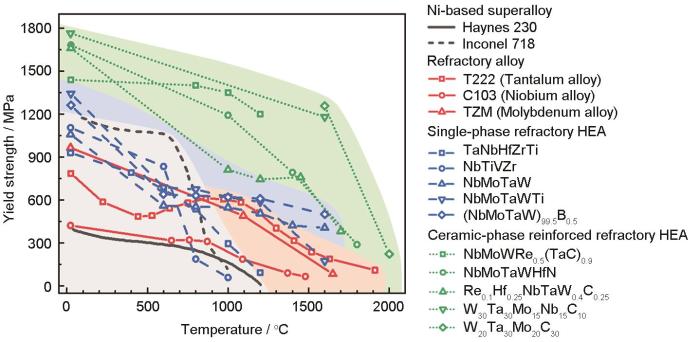
MoNbTaW是较早报道的难熔高熵合金之一,其室温屈服强度为1058 MPa,随温度升高,强度下降,但当温度超过600 ℃后强度下降速率显著减缓,即便在1600 ℃超高温下仍能维持> 400 MPa的屈服强度[4],表现出优异的高温承载能力。此外,该合金在高温变形过程中呈现近似稳定的塑性平台特征(即屈服后应力基本保持恒定),显著区别于传统合金的高温应变软化现象。MoNbTaW合金优异的高温力学性能与其多主元特性密切相关:首先,以多种高熔点难熔金属元素为主元,合金兼具高熔点(2904 ℃)和高混合熵(11.38R,R为气体常数),在超高温下能够保持良好的热力学稳定性,从而避免因相结构失稳而导致的强度下降[4];其次,复杂的局域原子环境影响位错运动,剧烈的晶格畸变和局部化学波动不仅能够增大位错滑移阻力,迫使位错运动路径发生弯曲从而提高材料强度[25,26],还可以改变螺位错的核心结构。在传统bcc结构材料中,热激活扭折形核(指螺位错在滑移过程中通过热激活克服晶格阻力、形成局部弯折的形核过程)是螺位错运动的典型限速机制。而难熔高熵合金中螺位错核心结构的改变使得这一限速机制失效,进而诱导形成由刃位错主导的变形模式,最终降低强度对温度的敏感性[27,28]。此外,难熔高熵合金中缓慢的原子扩散还可阻碍位错攀移,抑制因动态回复/动态再结晶造成的软化。
然而,耐超高温难熔高熵合金的室温塑性较差,如MoNbTaW合金室温压缩断裂应变仅为2.6%[4]。其脆化机制可主要归结为两点:(1) 紧密的位错核心具有更高的能量,室温下可动位错难以大量形核并激活[29];(2) 在制备过程中不可避免地引入氧杂质(约100 × 10-6),O在晶界富集并形成局域无序区域,削弱晶界结合强度,导致沿晶断裂[30,31]。降低W、Mo等本征脆性主元的含量或添加Ti、Zr等低价电子浓度(VEC)元素的含量虽可改善材料室温塑性,但导致高温强度显著下降[32,33]。Wang等[31]提出,可借助晶界工程调控策略在不影响高温性能的前提下改善难熔高熵合金的室温塑性。通过在MoNbTaW合金中添加微量B/C元素(5000 × 10-6~8000 × 10-6),利用其更低的晶界偏析能(比O低0.5 eV/atom)优先占据晶界位置,抑制脆性局域无序区域形成;同时通过B/C与金属原子之间的强电子相互作用增强晶界结合力和提高变形能力。该策略使MoNbTaW合金的室温压缩应变提高至> 10%,断裂模式由沿晶断裂转变为穿晶断裂,且在1600 ℃具有> 500 MPa的屈服强度(图2[31])。通过降低整体O含量或细化晶粒以分散晶界O含量,亦可抑制氧偏析致脆,优化室温塑性[34]。
图2
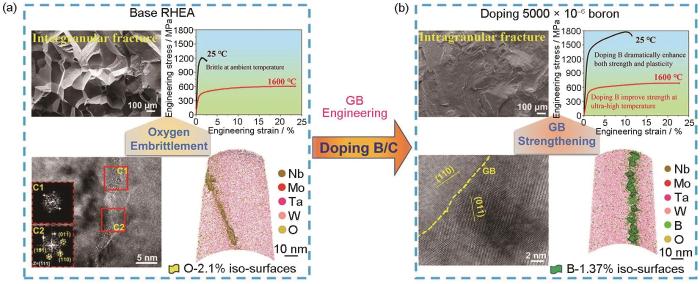
图2
通过晶界工程策略实现超高温难熔高熵合金室温塑性与超高温强度的协同提升[31]
Fig.2
Synergistic improvement of room-temperature plasticity and ultra-high-temperature strength of refractory HEA (RHEA) through grain boundary (GB) engineering strategies[31]
(a) microstructure, solute element distribution, and the mechanical properties of the MoNbTaW alloy
(b) microstructure, solute element distribution, and the mechanical properties of the MoNbTaW alloy doped with B
第二相强化是另一种有效的强韧化策略。通过在高熵合金基体中引入均匀弥散的第二相,并调控相界面匹配关系,能够达到增强增塑的效果。难熔金属的碳化物、硅化物和氮化物等陶瓷相一般具有高熔点、高强度、高硬度的特征,被认为是理想的高温强化相[35]。以C元素为例,C与Nb、Ta、W、Mo等难熔金属元素间存在极负的混合焓和显著的原子半径差异,易结合生成碳化物相;且二元相图表明,C-难熔金属体系普遍存在共晶反应[36]。因此,在耐超高温难熔高熵合金中引入C元素会在凝固过程中形成共晶碳化物强化相,这一现象已在MoNbTaWC x[37]、MoNbRe0.5W(TaC) x[36]、Hf0.25NbTaW0.5C x[38]、MoNbRe0.5TaW(TiC) x[39]、Re0.1Hf0.25-NbTaW0.4C0.25[40]和NbTaW0.5C0.25[41]等多种合金成分中得到实验验证。C元素的引入通常采用熔炼难熔金属与对应碳化物(如TaC、NbC、TiC、Mo2C等)或高纯石墨的混合物实现。
以(MoNb)40 - x Ta30W30C x 合金为例,x < 16时合金呈现亚共晶组织,在初生bcc结构高熵合金枝晶间分布着由微米尺度片层状交替分布的bcc结构高熵合金相和hcp结构复杂成分碳化物相组成的共晶组织,且共晶组织的体积分数随C含量增加而递增;当x = 16时,合金组织为完全共晶组织,如图3[42]所示。高熵合金和复杂成分碳化物相均具有多主元特性,可在高温下提供协同强化作用,两相满足近似Burgers取向关系,即(110)bcc//(0001)hcp,[111]bcc//[11
图3
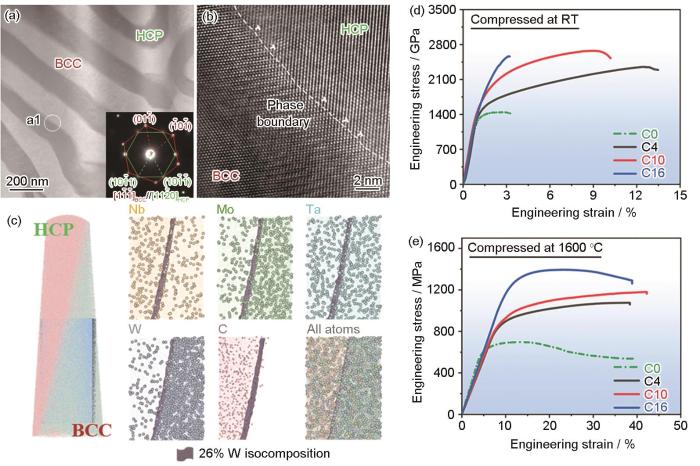
图3
通过引入共晶碳化物实现超高温难熔高熵合金室温/高温力学性能的协同提升[42]
Fig.3
Synergistic improvement of the room temperature (RT) and high-temperature mechanical properties of ultra-high-temperature RHEA through the introduction of eutectic carbides[42]
(a) dual-phase microstructure and corresponding SAED pattern of the a1 region (inset)
(b) atomic-level bcc/hcp phase interface
(c) solute element distribution(d) room-temperature mechanical properties (In W30Ta30(MoNb)40 - x C x alloy, where x represents the molar ratio of C, x = 0, 4, 10, and 16, hereafter referred to as C0, C4, C10, and C16, respectively)
(e) high-temperature mechanical properties
综上所述,高熵合金的本征特性使其在超高温应用方面具有极大潜力,通过选择Ta、W等高熔点元素作为主元,可构筑具有优异超高温力学性能的难熔高熵合金体系,实现优于传统合金的超高温强度和抗软化能力;通过晶界工程和原位自生陶瓷相等强化策略可进一步实现性能提高。然而,耐超高温高熵合金的工程化应用仍存在诸多科学问题和技术瓶颈亟待突破,包括如何进一步优化其塑性变形能力以获得室温拉伸塑性、如何同步提高抗氧化性能及降低密度以适配航空航天等领域的轻量化和极端环境防护需求、如何通过组织调控和缺陷控制技术克服高熔点多主元体系带来的制备难题以及发展面向工业化生产的短流程制备技术等。
3 耐极低温高熵合金
fcc结构CoCrFeNiMn高熵合金及其衍生体系(如CrCoNi)在低温下表现出显著区别于传统合金的“越低温、越强韧”行为,即随测试温度降低,其强度、塑性和断裂韧性均显著提高[45,46]。尤其在-253 ℃极低温下,CrCoNi合金的裂纹扩展韧性(KSS)高达544 MPa·m1/2,超越现有报道的所有金属结构材料(图4[47])。其优异性能源于低温变形过程中大量堆垛层错、纳米孪晶及ε马氏体的协同演化。在低温条件下,全位错滑移被抑制,低层错能促使不全位错大面积滑移,形成密集的低能界面并细化微观组织,通过动态Hall-Petch效应维持高应变硬化率,同时有效分散应力集中,抑制微裂纹萌生,最终实现优异的韧性。然而,受自身晶体结构本征限制,fcc单相高熵合金普遍存在屈服强度偏低的问题。
图4
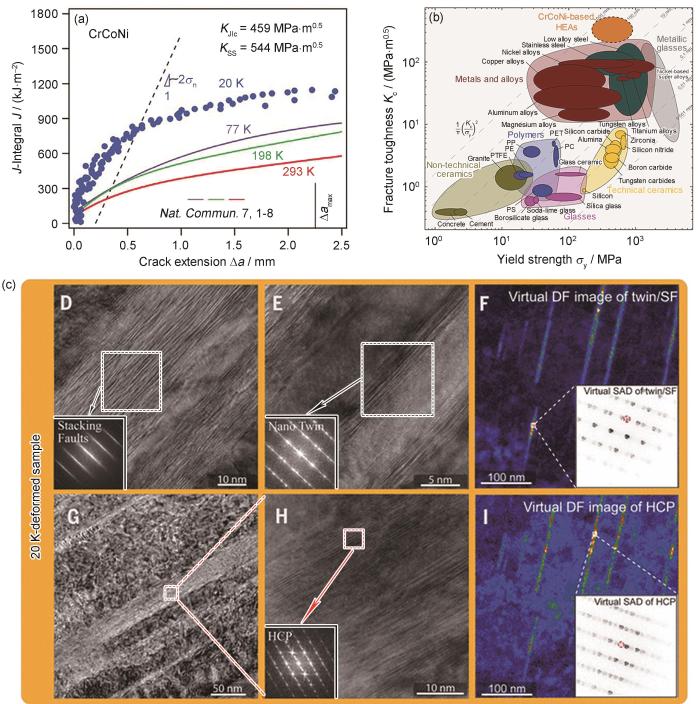
图4
CrCoNi合金的低温断裂韧性及变形组织分析[47]
Fig.4
Low-temperature fracture toughness and deformation microstructure of CrCoNi alloy[47]
(a) J-integral versus crack growth resistance curves and fracture toughness values for the CrCoNi alloy (KJIc—crack-initiation fracture toughness, KSS—crack-growth toughness, σn—strength, Δamax—maximum value of the crack extension)
(b) Ashby map in terms of the fracture toughness versus the yield strength for a broad class of materials (PC—polycarbonate, PE—polyethylene, PET—polyethylene terephthalate, PP—polypropylene, PS—polystyrene, PTFE—polytetrafluoroe-thylene)
(c) deformed microstructures of the CrCoNi alloy at 20 K (DF—dark-field, SF—stacking fault, SAD—selected area diffraction)
借助细晶、固溶、相变、第二相等传统强化机制能够提高高熵合金的低温力学性能,并获得优于传统合金的强韧化效果[48~51]。以第二相强化为例,在传统合金中引入非共格或半共格相界面虽能有效阻碍位错滑移,提高强度,但在低温下易诱发界面位错塞积和应力集中,导致塑性骤减。而在多主元AlCFeMnNi奥氏体基体中,通过形成高密度局域化学有序结构并结合显著固溶强化,可大幅提高晶格摩擦应力,改变第二相周围的变形机制,使位错在变形过程中能够直接剪切脆性B2相颗粒[52]。该脆性金属间化合物剪切机制不仅可以充分发挥纳米沉淀相的强化和应变硬化潜力,还通过颗粒连续剪切变形实现塑性变形,从而使合金在近液氮温度下兼具约2 GPa的拉伸强度与34%的伸长率。
引入低界面能共格相界面同样是低温条件下实现高强度、大塑韧性的有效途径[53]。在fcc高熵合金基体中构筑超高密度共格L12纳米析出相,可在变形初期作为位错障碍提高屈服强度;当局部应力达到临界值时,L12颗粒作为位错源被激活,持续提供不全位错以保证高加工硬化率,从而获得大均匀延伸率。值得注意的是,超高密度L12纳米析出相在诱发孪生变形的同时可显著提高流变应力,驱动fcc基体向bcc相转变,能够进一步增大加工硬化率[54]。与传统富C马氏体因fcc-bct相变诱发低温脆性不同,该转变生成的bcc相中螺位错与刃位错可动性相近,可有效抑制相变致脆倾向。此外,借助高熵合金本征结构特征,构筑纳米尺度有序微结构亦可优化低温力学性能。例如,通过调控主元间焓相互作用及原子尺寸/剪切模量差异,可在VCoNi合金中实现短程有序与纳米长程有序共存的双尺度结构[55],纳米长程有序区既阻碍位错运动、提高位错剪切应力,又通过形成新位错释放应力集中,从而使合金在近液氮温度下具有约1.8 GPa的抗拉强度和超过300 MPa·m1/2的断裂韧性。
图5
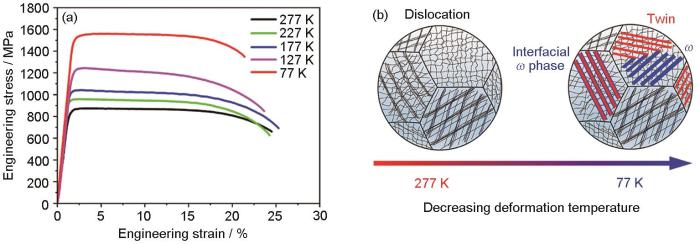
在HfNbTaTiZr高熵合金体系中,Hf、Zr、Ti在室温下呈hcp结构,通过调节β稳定元素Nb、Ta的含量,可连续调控相组成及bcc相稳定性,进而改变主导变形机制,实现力学性能定向设计[57]。例如,Hf15Nb45Ta25Ti15高熵合金具有优异的相稳定性,在-196~1200 ℃宽温域内稳定保持单相bcc结构,其塑性变形由位错滑移主导,具体表现为扭结带的形成和演化,通过晶体旋转协调应变,极大增强断裂韧性[58]。具体而言,螺位错与混合位错的滑移及交滑移提供初始应变硬化,随后<111>刃位错在{110}和{112}面上的协调滑移诱发扭折带成核;扭折带沿解析剪应力(resolved shear stress,指外加应力在“滑移面-滑移方向”组合上的有效剪应力分量,是驱动位错滑移的关键应力参数)较高的方向持续旋转晶格,抑制过度硬化,并将损伤分散至远离裂纹尖端的区域,最终实现优异断裂韧性。相反,降低Nb、Ta含量能够削弱bcc相稳定性,甚至可获得单相hcp结构高熵合金。该类合金在低温下以位错滑移为主导,缺乏孪晶、相变等辅助变形机制,虽然屈服强度提高,但拉伸塑性骤降,呈现明显的韧脆转变。
综上所述,随温度降低,高熵合金在变形过程中能够激活孪晶、相变、层错等多重变形机制,实现强度与延展性的同步提高;通过调控相稳定性和微观组织可进一步优化其低温力学性能,在极端低温工况下展现出巨大的应用潜力。值得强调的是,具有fcc和bcc结构的高熵合金,其低温性能和变形机制呈现显著差异性特征,适配不同的极端低温应用场景:fcc结构高熵合金无明显低温韧脆转变,在极低温下仍能保持超高断裂韧性,但室温及低温下屈服强度普遍偏低,其低温变形机制依赖于低层错能诱发的堆垛层错、纳米孪晶及ε马氏体相变的协同作用,通过动态细化组织维持高加工硬化率,进而实现优异低温韧性;bcc结构高熵合金则以高强度为显著特征,但相稳定性对成分敏感,降低β稳定元素含量易出现低温韧脆转变,其变形机制具有显著的温度依赖性,室温下以位错滑移和扭折带形成为主,低温下由纳米孪晶、bcc→ω相变与位错滑移等机制协同主导,部分体系通过扭折带协调应变提高断裂韧性。未来研究需针对性突破两类体系的性能短板,通过引入多尺度强化策略提高fcc高熵合金的屈服强度、通过优化主元配比和调控微观组织提高bcc合金宽温域塑性稳定性,或利用两相协同效应实现性能平衡,同时,鉴于高熵合金复杂的组织结构和丰富的变形模式,仍需系统阐明低温变形过程中的微观结构演化规律,深入揭示低温增韧和强化机理,为合金性能的定向设计提供理论依据。
4 耐强辐照高熵合金
核能作为高效可靠的低碳清洁能源,被视为保障未来能源供应和经济社会可持续发展的关键战略选择。反应堆结构材料长期服役于中子辐照、高温、应力及冷却剂侵蚀等多重极端工况,不仅需抵御辐照硬化、脆化、肿胀、氦脆及辐照加速应力腐蚀开裂等失效风险,还需具备优异的高温强度和塑性,以确保服役安全性和长期稳定性[59]。第四代先进裂变堆等新一代核能系统对运行温度和辐照剂量的要求进一步提高,且腐蚀环境更为严苛[60],现有核用结构材料已渐趋性能极限。高熵合金设计理念可兼顾抗辐照与强韧化需求:一方面,通过调控主元类型和比例优化“初级缺陷”形成能和迁移势垒,或引入纳米析出相、纳米晶界等高密度缺陷阱,可显著提高抗辐照性能;另一方面,高熵合金具有本征相稳定性和高强塑性。这些均为开发新型高性能堆芯结构材料提供了新途径。
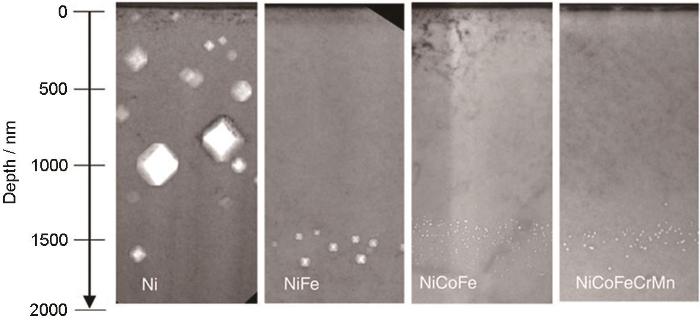
中子辐照损伤是核用结构材料长期服役时面临的核心失效机制之一。入射中子与晶格原子发生弹性碰撞后,会产生高能反冲原子,这类次级荷能粒子进一步与周围晶格原子引发级联碰撞,产生大量间隙原子和空位,这些点缺陷经扩散、聚集并演化为位错环、空洞等多种介观尺度缺陷团簇,诱发肿胀、相失稳、硬化/脆化等,最终影响材料服役的长期可靠性。早在20世纪70年代,Johnston 等[61]在Cr-Fe-Ni合金体系中即发现主元浓度变化可影响合金抗辐照肿胀性能,近期研究[62]进一步证实,在单相合金中,增加主元数可降低空位等缺陷的浓度,从而提高抗辐照损伤容限。以CoCrFeNiMn高熵合金及其衍生体系为例,在相同离子辐照条件下,其晶格损伤程度显著轻于传统单主元合金,缺陷分布范围更窄、损伤层深度更浅[63~65],如图6[65]所示。高熵合金的抗辐照性能优势在高温下尤为突出。尽管热效应与辐照效应的协同作用易诱发元素偏聚、介观尺度相分离及析出,高熵合金仍表现出更优的相稳定性。尤其是难熔高熵合金,凭借高熔点及本征结构特性可保持优异的相稳定性和抗肿胀性能,在高温辐照条件下具有显著优势[66]。
图6
高熵合金的优异抗辐照性能源于其本征多主元特性。一方面,高化学无序度可增强电子散射,提高电阻率并降低热导率,使级联碰撞过程中载能粒子的能量沉积和耗散速率减慢、热峰持续时间延长,进而促进间隙原子和空位的复合湮灭;另一方面,严重的晶格畸变、长程化学无序与局域化学有序协同提高缺陷形成能并抑制扩散迁移,可显著降低辐照后的残余缺陷浓度[67~70]。局域化学有序结构能够提高合金离位能,降低晶格原子的平均离位概率,从而减少辐照级联弹道阶段产生的Frenkel缺陷对(自间隙原子-空位对)数量。同时,局域化学有序结构能够显著提高点缺陷迁移势垒,计算结果表明,与随机固溶体相比,局域化学有序结构使空位迁移能由0.88 eV增至0.97 eV、间隙原子迁移能由0.41 eV增至0.47 eV,进而有效抑制点缺陷扩散和大尺寸空洞的聚集长大[71~73]。此外,在辐照损伤累积阶段,局域化学有序区域可作为缺陷团簇优先形核位点,提高间隙原子-空位复合概率,降低缺陷浓度,从而增强合金的抗辐照损伤容限,如图7[74]所示。
图7
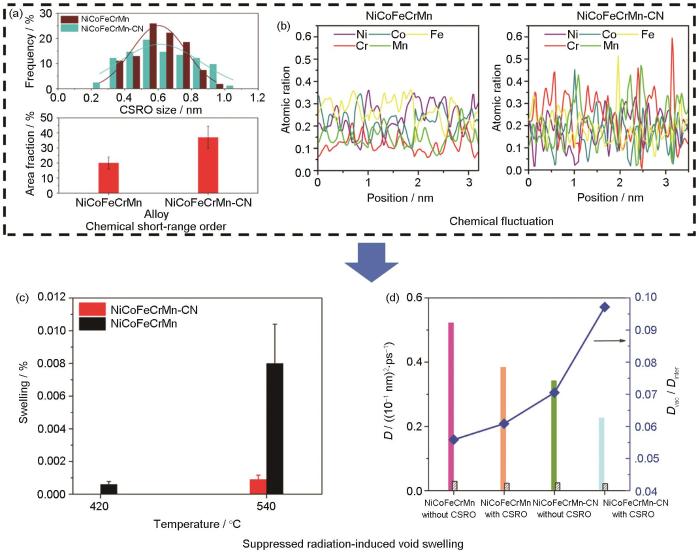
图7
局域化学有序结构和成分波动对高熵合金中辐照缺陷的影响[74]
Fig.7
More pronounced chemical short-range order (CSRO) (a) and chemical fluctuation (b) in NiCoCrFeMn-CN compared to NiCoCrFeMn suppress void swelling (c, d) showing the influence of local chemical ordered structures and compositional fluctuations on irradiation defects in HEAs[74] (D, Dvac, and Dinter represent the diffusion coefficient, diffusion coefficient of self-interstitial atoms, and diffusion coefficient of vacancies, respectively)
除主元数量外,主元种类(混合焓)及其原子分数也影响合金的抗辐照性能。在相同辐照条件下,不同主元组合的高熵合金的稳定性及力学性能存在较大乃至定性的差异。如在四元CoFeNiMn和CoCrFeNi合金、三元CoFeNi和CrCoNi合金中均观察到辐照损伤行为存在明显差异[75,76]。其根源在于多主元体系复杂的局域原子环境使构型熵与混合焓协同作用于电子结构,改变电子平均自由程,进而影响辐照级联中热峰的持续时间;同时,构型熵与混合焓共同调控点缺陷的形成能和迁移势垒。上述两种机制最终影响自间隙原子-空位复合动力学及缺陷演化行为。因此,抗辐照高熵合金的设计需同步优化构型熵与混合焓匹配。此外,从反应堆中子经济性和放射性废料后处理角度考虑,进行抗辐照高熵合金成分设计时还需兼顾中子吸收和中子活化问题[77]。
与钢中利用第二相捕获辐照缺陷的思路[80]一致,在高熵合金中引入第二相能够有效降低辐照损伤。以fcc结构高熵合金中引入γ'共格纳米析出相为例,在高温辐照条件下,γ'相发生“回溶-再析出”动态演变,促使离位溶质原子和空位等点缺陷短程重组,实现点缺陷湮灭;同时,大量共格相界面作为缺陷阱,进一步降低点缺陷浓度;此外,γ'析出相本身能够阻碍位错环聚集长大。以上多重机制协同提高了合金的抗辐照性能[81,82]。在bcc结构高熵合金中引入第二相也能获得类似效果,如NbSiTaV难熔共晶高熵合金中的β-Nb5Si3相可借助其独特的共晶结构分解并修复穿过其内部的He泡,有效抑制He泡长大,从而显著增强抗辐照损伤能力[83]。需注意的是,第二相的晶体结构、体积分数、尺寸分布及其与基体的界面能均会影响缺陷演化行为,因此,在设计含第二相的抗辐照高熵合金时,应综合权衡上述影响因素,以实现缺陷阱密度与界面稳定性的最佳匹配。
综上所述,高熵合金凭借多主元特征和局域化学-结构复杂性,在抗辐照领域展现出独特优势。通过主元种类和含量调控,能够实现抑制缺陷浓度、阻碍He泡长大及提高相稳定性的效果;进一步引入位错、晶界、共格析出等微观缺陷陷阱,可协同优化其抗辐照性能。然而,获得优异抗辐照行为需综合权衡构型熵、混合焓及缺陷结构等多尺度因素,目前仍存在相关技术瓶颈,如缺乏原位实验手段对缺陷产生-演化全过程进行实时解析、模拟计算结果缺乏充足实验验证致使机理认知受限等。耐强辐照高熵合金研究仍具备广阔的探索空间和发展前景。
5 总结与展望
高熵合金的多主元设计范式显著扩展了工程材料的成分设计空间和性能调控边界,为新型高性能先进金属结构材料的开发提供了全新路径,更凭借其独特的成分-结构特性,为突破传统单一主元合金在极端服役条件下的性能瓶颈提供了核心解决方案。本文以超高温、极低温、强辐照三类典型极端工况为核心,综述了高熵合金在该领域的研究进展。传统单一主元合金受限于相稳定性不足、低温韧脆转变及缺陷演化失控等问题,性能已逼近极限,成为制约高端装备升级的核心瓶颈;而高熵合金在极端条件下具有高热-力学稳定性、优异低温韧塑性和抗辐照损伤能力,被视为最具潜力的突破性能边界的合金体系。
高熵合金的优异宏观性能源于其区别于传统单一主元合金的独特物理机制。传统单一主元合金依赖单一组分的本征特性和微合金化调控,其性能受限于单一主元的固有属性,且均一的晶格环境不仅导致位错等变形载体运动阻力较小,还使缺陷易扩散聚集,在极端温度、辐照等作用下相稳定性易遭破坏,难以从根源上突破性能瓶颈;高熵合金则依托多主元协同优势,既可通过主元组合灵活调控目标性能,更能以高构型熵抑制极端条件下的相分解和粗化,其长程化学无序特征构建了原子尺度的复杂局域环境,且普遍存在近程-中程化学有序特征,这种多主元耦合形成的复杂结构,能够精准调控变形载体和缺陷的运动及演化规律,从本质上解决了传统合金的机制性局限。这也使得宏观性能层面的差异尤为突出:超高温下传统单一主元合金因结构简单、原子扩散快速易软化失效,高熵合金通过难熔主元协同和复杂结构特征,实现1600 ℃以上超高温强度和抗软化能力;极低温下传统合金变形机制简单,高熵合金则可激活孪晶、相变等多重变形机制,实现强度与延展性的同步提高;强辐照下传统合金易发生肿胀、脆化和相失稳,高熵合金通过化学无序与缺陷阱协同,显著降低辐照缺陷浓度和长大速率。这种从物理机制到宏观性能的系统性优势,使高熵合金在传统合金难以适配的极端工况下具备突出优势。
然而,当前高熵合金在极端服役条件下的关键应用仍面临诸多重大挑战,在高效设计、机理揭示和应用验证等关键环节仍存在诸多亟待突破的瓶颈。结合领域研究现状和工程化需求,未来相关研究应重点聚焦以下方向。
(1) 构建高效成分设计方法。高熵合金的多主元特征虽显著扩大了成分设计空间,但也为高性能合金成分的精准设计带来了挑战,传统试错法存在效率低、成本高的局限,亟需构建结合高通量实验、多尺度计算和机器学习的高效成分设计方法,实现极端工况服役性能驱动的高熵合金成分精准寻优。
(2) 突破高质量制备工艺瓶颈。高熵合金的多主元特征在带来优异性能的同时,也为合金制备带来困难。尤其对于耐超高温高熵合金,其高熔点、复杂成分特性极易引发成分偏析、疏松、缩孔等冶金缺陷,未来需重点突破多主元凝固偏析调控、高熵合金高温成形等关键技术,提高合金组织均匀性和制备稳定性。
(3) 建立极端环境性能评价体系。极端环境性能评价体系是高熵合金工程化应用的关键支撑,极端服役条件对测试设备的耐候性、检测精度及稳定性提出严苛要求,亟需建立适配超高温、极低温、强辐照场景的专项测试标准和性能评价方法,构建高熵合金极端服役性能数据库,为工程应用推广提供可靠依据。
(4) 揭示多场耦合下的作用机理。高熵合金的复杂结构特性与多场交互的非线性效应相互叠加,导致多场耦合下成分-结构-性能的动态关联难以精准解析,未来需借助多尺度表征技术结合计算模拟手段,系统解析服役过程中的组织演化规律,阐明多场耦合下的性能调控机制,为性能定向设计提供坚实理论支撑。
参考文献
Nanostructured high-entropy alloys with multiple principal elements: Novel alloy design concepts and outcomes
[J].
Microstructural development in equiatomic multicomponent alloys
[J].
Accelerated exploration of multi-principal element alloys with solid solution phases
[J].
Senkov, O. N.; Miller, J. D.; Miracle, D. B.; Woodward, C. Air Force Res Lab, Mat & Mfg Directorate, Wright Patterson AFB, OH 45433 USA.
Mechanical properties of Nb25Mo25Ta25W25 and V20Nb20Mo20Ta20W20 refractory high entropy alloys
[J].
Multiscale synthesis and performance regulation mechanisms of high-entropy materials
[J].Metals and their compounds are core materials in energy catalysis; however, their performance is often constrained by conventional few-component systems, which typically feature single active sites and limited electronic-structure tunability. These limitations hinder precise regulation of complex reaction pathways and product selectivity. High-entropy strategies offer a promising route to overcome these challenges by enabling multi-element synergistic effects. Nevertheless, introducing multiple elements increases the tendency toward phase separation, making the controllable synthesis of single-phase, compositionally uniform high-entropy materials a key bottleneck for practical applications. To address this issue, this study develops a series of controllable synthesis strategies for high-entropy alloys, high-entropy ceramics, and two-dimensional (2D) high-entropy phosphorus trichalcogenides. Specifically, melt extraction is employed to fabricate high-entropy alloy fibers; pressureless sintering is used to synthesize dense high-entropy metal carbides; solid-state synthesis combined with ultrasonic exfoliation enables the production of 2D high-entropy phosphorus trichalcogenides; and a metal-organic framework-derived strategy is adopted to construct high-entropy metal oxides. These methods enable key advances in high-entropy material synthesis, particularly in compositional homogenization, structural densification, dimensional control, and precursor design. Moreover, the role of high-entropy engineering in regulating catalytic performance is systematically elucidated, highlighting the critical contributions of multicomponent synergy to basal-plane activation, optimization of metal—oxygen covalency, and enhancement of structural stability. Overall, this study aims to provide practical technical pathways and a theoretical framework for developing high-performance high-entropy materials through innovative synthesis strategies and in-depth mechanistic insights.
高熵材料的多尺度制备及性能调控机制
[J].金属及其化合物作为能源催化领域的核心材料,其性能受限于传统少组元体系活性位点单一、电子结构调变能力不足,难以实现复杂反应路径和产物选择性的精准调控。高熵化策略虽为突破材料性能提供了全新途径,但其多组元的引入也带来了严重的相分离倾向,使得单相、均匀高熵材料的可控制备成为制约其应用研究的核心瓶颈。本文总结了针对高熵合金、高熵陶瓷及二维高熵磷硫化物等体系,发展的一系列可控制备技术:熔体抽丝法制备高熵合金纤维;无压烧结工艺实现致密高熵金属碳化物的合成;固相合成辅以超声剥离技术获得二维高熵磷硫化物;金属有机框架(MOF)前驱体衍生策略合成高熵金属氧化物。这些方法实现了高熵材料合成在成分均质化、结构致密化、材料维度控制以及前驱体设计等方面的突破。在此基础上,进一步阐述了高熵化在催化性能调控中的作用机制,揭示了多组元协同效应在激活惰性基面、优化金属—O键的共价性、增强结构稳定性等方面的关键作用。本文旨在通过制备方法的创新和机理的解析,为高性能高熵材料的发展提供切实可行的技术路径和理论依据。
Microstructure and room temperature properties of a high-entropy TaNbHfZrTi alloy
[J].
High-entropy alloys
[J].Alloying has long been used to confer desirable properties to materials. Typically, it involves the addition of relatively small amounts of secondary elements to a primary element. For the past decade and a half, however, a new alloying strategy that involves the combination of multiple principal elements in high concentrations to create new materials called high-entropy alloys has been in vogue. The multi-dimensional compositional space that can be tackled with this approach is practically limitless, and only tiny regions have been investigated so far. Nevertheless, a few high-entropy alloys have already been shown to possess exceptional properties, exceeding those of conventional alloys, and other outstanding high-entropy alloys are likely to be discovered in the future. Here, we review recent progress in understanding the salient features of high-entropy alloys. Model alloys whose behaviour has been carefully investigated are highlighted and their fundamental properties and underlying elementary mechanisms discussed. We also address the vast compositional space that remains to be explored and outline fruitful ways to identify regions within this space where high-entropy alloys with potentially interesting properties may be lurking.
Short-range ordering and its effects on mechanical properties of high-entropy alloys
[J].In this letter, we briefly summarize experimental and theoretical findings of formation and characterization of short-range orderings (SROs) as well as their effects on the deformation behavior of high-entropy alloys (HEAs). We show that existence of SROs is a common yet key structural feature of HEAs, and tuning the degree of SROs is an effective way for optimizing mechanical properties of HEAs. In additional, the challenges concerning about formation mechanism and characterization of SROs in HEAs are discussed, and future research activities in this regard are also proposed.
Enhancing properties of high-entropy alloys via manipulation of local chemical ordering
[J].It is gradually accepted that the presence of local chemical orderings (LCOs) is a common structural feature of high-entropy alloys (HEAs) due to their large chemical complexity and high configuration entropy. The formation and characterization of LCOs in HEAs, as well as the challenges regarding this topic were discussed in our previous viewpoint paper. In this short communication, we highlight the significant effects of LCOs on physical and mechanical properties. In addition, efforts on how to improve the properties via manipulation of these LCOs will be summarized and explored. Apparently, this paper attempts to understand the unique properties of HEAs from the standpoint of their intrinsic atomic-scale structural fingerprints, and ultimately to establish a link between their prominent properties and distinct structural characteristics.
Negative mixing enthalpy alloying to promote the development of alloys with high strength and ductility
[J].Achieving a synergistic improvement in the strength and ductility of metallic materials has long been a central challenge in materials science. Dislocation mobility limits both properties, making it difficult to strike a balance between them. The advent of multi-principal element alloys (also known as high-entropy alloys) offers a promising solution to this issue. Compared with conventional solid solution strengthened alloys, multi-principal element alloys exhibit greater lattice distortion. Consequently, dislocation movement must overcome higher and more frequent energy fluctuations, which consumes more energy. This increase in flow stress with increasing strain allows certain alloys to achieve enhanced work hardening capacity, leading to simultaneous improvements in both strength and ductility. However, two critical scientific questions in this area warrant further investigation: (1) Are multi-principal element alloys purely ideal random mixed structures, or is standardizing their local or multi-level microstructures necessary to achieve optimal performance? (2) How can we effectively standardize and regulate the microstructures of multi-principal element alloys? This study addresses these questions by proposing the concept of using negative mixing enthalpy (negative-enthalpy) alloying to standardize and regulate the microstructure of multi-principal element alloys. This study systematically explores how negative-enthalpy alloying can synergistically enhance strength and ductility while revealing new mechanisms of strengthening and toughening. Negative-enthalpy alloying affects the microstructure of metallic materials through three main effects: bond energy and slow diffusion, local chemical ordering, and interface and size effects. This approach provides a novel framework for designing and processing the microstructures of high-strength, high-ductility metallic materials at the atomic scale.
负混合焓合金化推动高强韧合金发展
[J].金属材料强度与塑性的协同提升始终是材料科学领域的核心挑战。由于材料的强度和塑性受位错可动性制约,2者通常难以协同兼顾,多主元合金(高熵合金)的出现为走出这一困境提供了新思路。相对于常规的固溶强化合金,多主元合金具有更大的晶格畸变,位错运动需要克服更高和更频繁的能量起伏,耗费更大的能量,合金流变应力随应变增加而增加,使得一些合金获得了较大加工硬化能力和强塑性协同提升。然而,该领域至少存在2个关键科学问题需要深入研究:(1) 多主元合金是完全理想的随机混合结构吗?是否需要规范其局域乃至多级微观结构来实现优异性能?(2) 如何规范和调控多主元合金微观结构?本文从规范和调控多主元合金微观结构出发,提出用负混合焓(负焓)合金化方法在原子尺度加工合金微观结构的学术思想,系统阐述利用负焓合金化方法实现合金强度与塑性协同提升,并揭示强韧化新机理。负焓合金化具有金属材料微观结构调控的3重效应:键能与慢扩散效应、局部化学有序效应、界面和尺寸效应,其为高强韧金属材料的微观结构在原子尺度设计加工提供了新维度和新范式。
Manipulating the ordered oxygen complexes to achieve high strength and ductility in medium-entropy alloys
[J].Oxygen solute strengthening is an effective strategy to harden alloys, yet, it often deteriorates the ductility. Ordered oxygen complexes (OOCs), a state between random interstitials and oxides, can simultaneously enhance strength and ductility in high-entropy alloys. However, whether this particular strengthening mechanism holds in other alloys and how these OOCs are tailored remain unclear. Herein, we demonstrate that OOCs can be obtained in bcc (body-centered-cubic) Ti-Zr-Nb medium-entropy alloys via adjusting the content of Nb and oxygen. Decreasing the phase stability enhances the degree of (Ti, Zr)-rich chemical short-range orderings, and then favors formation of OOCs after doping oxygen. Moreover, the number density of OOCs increases with oxygen contents in a given alloy, but adding excessive oxygen (>3.0 at.%) causes grain boundary segregation. Consequently, the tensile yield strength is enhanced by ~75% and ductility is substantially improved by ~164% with addition of 3.0 at.% O in the Ti-30Zr-14Nb MEA.© 2023. The Author(s).
Achieving alloys with concurrent high strength and high ductility
[J].Increasing the yield strength of metallic materials is observed to almost always substantially reduce their tensile ductility. Here we unravel the origin of this perplexing “strength-ductility trade-off”, and conclude that this dilemma does not necessarily preclude concurrent high strength and high ductility. We discuss several strengthening and work hardening mechanisms that regulate dislocation behavior, including traditional ones that have been pushed to their extreme in recent years, as well as new ones that take advantage of the heightened structural and chemical heterogeneities; all these mechanisms are rendered more powerful by emerging complex concentrated alloys that bring in multiple principal elements. These mechanisms, while offering elevated strength, contribute to sustainable strain hardening under high flow stresses, delaying strain localization to allow prolonged uniform elongation. The current status in the pursuit for concurrent high strength and high ductility is reviewed. The goal we set for high yield strength ~2 GPa (rivaling super steels) together with large uniform elongation ~30% (much like un-strengthened elemental metals) is projected to be soon within reach. These take-home messages shed light on some existing puzzles regarding the strength-ductility synergy, and offer new insight into the innovative design of alloys.
如何使合金兼具高强度与高塑性
[J].
Materials for extreme environments
[J].
Multifunctional high-entropy materials
[J].
High-entropy ferroelectric materials
[J].
Multicomponent intermetallic nanoparticles and superb mechanical behaviors of complex alloys
[J].Alloy design based on single-principal-element systems has approached its limit for performance enhancements. A substantial increase in strength up to gigapascal levels typically causes the premature failure of materials with reduced ductility. Here, we report a strategy to break this trade-off by controllably introducing high-density ductile multicomponent intermetallic nanoparticles (MCINPs) in complex alloy systems. Distinct from the intermetallic-induced embrittlement under conventional wisdom, such MCINP-strengthened alloys exhibit superior strengths of 1.5 gigapascals and ductility as high as 50% in tension at ambient temperature. The plastic instability, a major concern for high-strength materials, can be completely eliminated by generating a distinctive multistage work-hardening behavior, resulting from pronounced dislocation activities and deformation-induced microbands. This MCINP strategy offers a paradigm to develop next-generation materials for structural applications.Copyright © 2018 The Authors, some rights reserved; exclusive licensee American Association for the Advancement of Science. No claim to original U.S. Government Works.
Lattice distortion in a strong and ductile refractory high-entropy alloy
[J].
Lattice distortion tuning resistivity Invar effect in high-entropy alloys
[J].
Enhanced strength and ductility in a high-entropy alloy via ordered oxygen complexes
[J].
Tunable stacking fault energies by tailoring local chemical order in CrCoNi medium-entropy alloys
[J].High-entropy alloys (HEAs) are an intriguing new class of metallic materials due to their unique mechanical behavior. Achieving a detailed understanding of structure-property relationships in these materials has been challenged by the compositional disorder that underlies their unique mechanical behavior. Accordingly, in this work, we employ first-principles calculations to investigate the nature of local chemical order and establish its relationship to the intrinsic and extrinsic stacking fault energy (SFE) in CrCoNi medium-entropy solid-solution alloys, whose combination of strength, ductility, and toughness properties approaches the best on record. We find that the average intrinsic and extrinsic SFE are both highly tunable, with values ranging from -43 to 30 mJ⋅m and from -28 to 66 mJ⋅m, respectively, as the degree of local chemical order increases. The state of local ordering also strongly correlates with the energy difference between the face-centered cubic () and hexagonal close-packed () phases, which affects the occurrence of transformation-induced plasticity. This theoretical study demonstrates that chemical short-range order is thermodynamically favored in HEAs and can be tuned to affect the mechanical behavior of these alloys. It thus addresses the pressing need to establish robust processing-structure-property relationships to guide the science-based design of new HEAs with targeted mechanical behavior.
Ultrahigh-temperature materials for jet engines
[J].
Development and exploration of refractory high entropy alloys—A review
[J].
Research progress on mechanical properties of ultra-high temperature WTa-containing refractory multi-principal element alloys
[J].
Correlating dislocation mobility with local lattice distortion in refractory multi-principal element alloys
[J].
The hierarchical energy landscape of screw dislocation motion in refractory high-entropy alloys
[J].
Mechanistic origin of high strength in refractory BCC high entropy alloys up to 1900 K
[J].
Atomistic simulations of dislocation mobility in refractory high-entropy alloys and the effect of chemical short-range order
[J].Refractory high-entropy alloys (RHEAs) are designed for high elevated-temperature strength, with both edge and screw dislocations playing an important role for plastic deformation. However, they can also display a significant energetic driving force for chemical short-range ordering (SRO). Here, we investigate mechanisms underlying the mobilities of screw and edge dislocations in the body-centered cubic MoNbTaW RHEA over a wide temperature range using extensive molecular dynamics simulations based on a highly-accurate machine-learning interatomic potential. Further, we specifically evaluate how these mechanisms are affected by the presence of SRO. The mobility of edge dislocations is found to be enhanced by the presence of SRO, whereas the rate of double-kink nucleation in the motion of screw dislocations is reduced, although this influence of SRO appears to be attenuated at increasing temperature. Independent of the presence of SRO, a cross-slip locking mechanism is observed for the motion of screws, which provides for extra strengthening for refractory high-entropy alloy system.© 2021. The Author(s).
Intrinsic factors responsible for brittle versus ductile nature of refractory high-entropy alloys
[J].Refractory high-entropy alloys (RHEAs) are of interest for ultrahigh-temperature applications. To overcome their drawbacks - low-temperature brittleness and poor creep strength at high temperatures - improved fundamental understanding is needed. Using experiments, theory, and modeling, we investigated prototypical body-centered cubic (BCC) RHEAs, TiZrHfNbTa and VNbMoTaW. The former is compressible to 77 K, whereas the latter is not below 298 K. Hexagonal close-packed (HCP) elements in TiZrHfNbTa lower its dislocation core energy, increase lattice distortion, and lower its shear modulus relative to VNbMoTaW whose elements are all BCC. Screw dislocations dominate TiZrHfNbTa plasticity, but equal numbers of edges and screws exist in VNbTaMoW. Dislocation cores are compact in VNbTaMoW and extended in TiZrHfNbTa, and different macroscopic slip planes are activated in the two RHEAs, which we attribute to the concentration of HCP elements. Our findings demonstrate how ductility and strength can be controlled through the ratio of HCP to BCC elements in RHEAs.© 2024. The Author(s).
The role of interstitial constituents in refractory complex concentrated alloys
[J].
Solving oxygen embrittlement of refractory high-entropy alloy via grain boundary engineering
[J].
Microstructures and mechanical properties of Ti x NbMoTaW refractory high-entropy alloys
[J].
A novel ZrNbMoTaW refractory high-entropy alloy with in-situ forming heterogeneous structure
[J].
Ultrafine-grained refractory high-entropy alloy with oxygen control and high mechanical performance
[J].Grain boundary engineering plays a significant role in the improvement of strength and plasticity of alloys. However, in refractory high-entropy alloys, the susceptibility of grain boundaries to oxygen presents a bottleneck in achieving high mechanical performance. Creating a large number of clean grain boundaries in refractory high-entropy alloys is a challenge. In this study, an ultrafine-grained (UFG) NbMoTaW alloy with high grain-boundary cohesion was prepared by powder metallurgy, taking advantages of rapid hot-pressing sintering and full-process inert atmosphere protection from powder synthesis to sintering. By oxygen control and an increase in the proportion of grain boundaries, the segregation of oxygen and formation of oxides at grain boundaries were strongly mitigated, thus the intrinsic high cohesion of the interfaces was preserved. Compared to the coarse-grained alloys prepared by arc-melting and those sintered by traditional powder metallurgy methods, the UFG NbMoTaW alloy demonstrated simultaneously increased strength and plasticity at ambient temperature. The highly cohesive grain boundaries not only reduce brittle fractures effectively but also promote intragranular deformation. Consequently, the UFG NbMoTaW alloy achieved a high yield strength even at elevated temperatures, with a remarkable performance of 1117 MPa at 1200 °C. This work provides a feasible solution for producing refractory high-entropy alloys with low impurity content, refined microstructure, and excellent mechanical performance.
Review on ultra-high temperature boride ceramics
[J].
Metal-carbide eutectics with multiprincipal elements make superrefractory alloys
[J].
Structures and properties of the (NbMoTaW)100 - x C x high-entropy composites
[J].
Microstructure and mechanical properties of C x Hf0.25NbTaW0.5 refractory high-entropy alloys at room and high temperatures
[J].
Designing high entropy alloy-ceramic eutectic composites of MoNbRe0.5TaW(TiC) x with high compressive strength
[J].
Effect of Re and C on mechanical properties of NbTaW0.4 refractory medium-entropy alloy at elevated temperature
[J].
A novel NbTaW0.5 (Mo2C) x refractory high-entropy alloy with excellent mechanical properties
[J].
Enhancing mechanical properties of refractory multi-principal element alloys via compositionally complex carbides
[J].Advanced structural materials with superb mechanical properties at ultrahigh temperatures are essential for aerospace and power-generation sectors. Refractory multi-principal element alloys (RMPEAs) are promising candidates, but they face challenges such as limited plasticity at room temperatures and insufficient strength at ultrahigh temperatures. In this work, we investigated the mechanical properties and microstructures of RMPEA reinforced with compositional complex carbides and demonstrated that tailoring the carbon content can significantly alter their microstructures and enhance mechanical properties. Specifically, the W<sub>30</sub>Ta<sub>30</sub>Mo<sub>15</sub>Nb<sub>15</sub>C<sub>10</sub> alloy achieved an ultrahigh strength of 896 MPa at 1600 °C and a plasticity of ∼8% at room temperatures. The strengthening effect arises from multi-principal element mixing and robust dislocation hindering at the phase interfaces between the carbides and the matrix, while the room temperature plasticity is attributed to crack buffering facilitated by the highly saturated solid solution matrix. Our study highlights the potential of compositional complex carbide to enhance the mechanical properties of RMPEAs, offering a promising approach for the development of advanced structural materials for ultrahigh temperature applications.
The brittle-ductile transition in single-crystal iron
[J].
Progress of cryogenic deformation and strengthening-toughening mechanisms of high-entropy alloys
[J].Owing to the multi-principal element and higher intrinsic configurational entropy, high-entropy alloys exhibit excellent mechanical and physicochemical performance, which has garnered extensive attention from researchers. By virtue of the excellent performances in terms of superior strength, ductility, toughness, impact resistance property, and adjustable phase stability, especially in cryogenic environments, high-entropy alloys have broad application prospects in fields such as deep-space exploration, low temperature superconducting, and the gas industry. In this paper, the deformation and strengthening-toughening mechanisms of high-entropy alloys are summarized by reviewing the cryogenic progress. Furthermore, the promising research directions of high-entropy alloys in cryogenic engineering application combined with the performance of traditional cryogenic materials are also presented.
高熵合金的低温塑性变形机制及强韧化研究进展
[J].高熵合金是由多种主要元素组成的新型金属材料,固有的多主元和构型熵高等特点,使其具备诸多优异的力学及物理化学性能,从而引起了研究人员的广泛关注。在低温工程应用方面,高熵合金优异的强塑性、良好的韧性和抗冲击能力、较高的相稳定性等特点使其在深空探测、低温超导、气体工业等领域极具应用前景。本文综述了高熵合金的低温研究进展,详细总结了高熵合金在低温环境的变形机制及强韧化机理,并结合传统低温工程材料的性能对比,展望了高熵合金未来低温工程应用的主要方向。
A fracture-resistant high-entropy alloy for cryogenic applications
[J].High-entropy alloys are equiatomic, multi-element systems that can crystallize as a single phase, despite containing multiple elements with different crystal structures. A rationale for this is that the configurational entropy contribution to the total free energy in alloys with five or more major elements may stabilize the solid-solution state relative to multiphase microstructures. We examined a five-element high-entropy alloy, CrMnFeCoNi, which forms a single-phase face-centered cubic solid solution, and found it to have exceptional damage tolerance with tensile strengths above 1 GPa and fracture toughness values exceeding 200 MPa·m(1/2). Furthermore, its mechanical properties actually improve at cryogenic temperatures; we attribute this to a transition from planar-slip dislocation activity at room temperature to deformation by mechanical nanotwinning with decreasing temperature, which results in continuous steady strain hardening. Copyright © 2014, American Association for the Advancement of Science.
Exceptional damage-tolerance of a medium-entropy alloy CrCoNi at cryogenic temperatures
[J].High-entropy alloys are an intriguing new class of metallic materials that derive their properties from being multi-element systems that can crystallize as a single phase, despite containing high concentrations of five or more elements with different crystal structures. Here we examine an equiatomic medium-entropy alloy containing only three elements, CrCoNi, as a single-phase face-centred cubic solid solution, which displays strength-toughness properties that exceed those of all high-entropy alloys and most multi-phase alloys. At room temperature, the alloy shows tensile strengths of almost 1 GPa, failure strains of similar to 70% and K-JIc fracture-toughness values above 200 MPa m(1/2); at cryogenic temperatures strength, ductility and toughness of the CrCoNi alloy improve to strength levels above 1.3 GPa, failure strains up to 90% and K-JIc values of 275 MPa m(1/2). Such properties appear to result from continuous steady strain hardening, which acts to suppress plastic instability, resulting from pronounced dislocation activity and deformation-induced nano-twinning.
Exceptional fracture toughness of CrCoNi-based medium- and high-entropy alloys at 20 kelvin
[J].CrCoNi-based medium- and high-entropy alloys display outstanding damage tolerance, especially at cryogenic temperatures. In this study, we examined the fracture toughness values of the equiatomic CrCoNi and CrMnFeCoNi alloys at 20 kelvin (K). We found exceptionally high crack-initiation fracture toughnesses of 262 and 459 megapascal-meters (MPa·m) for CrMnFeCoNi and CrCoNi, respectively; CrCoNi displayed a crack-growth toughness exceeding 540 MPa·m after 2.25 millimeters of stable cracking. Crack-tip deformation structures at 20 K are quite distinct from those at higher temperatures. They involve nucleation and restricted growth of stacking faults, fine nanotwins, and transformed epsilon martensite, with coherent interfaces that can promote both arrest and transmission of dislocations to generate strength and ductility. We believe that these alloys develop fracture resistance through a progressive synergy of deformation mechanisms, dislocation glide, stacking-fault formation, nanotwinning, and phase transformation, which act in concert to prolong strain hardening that simultaneously elevates strength and ductility, leading to exceptional toughness.
Cryogenic strength improvement by utilizing room-temperature deformation twinning in a partially recrystallized VCrMnFeCoNi high-entropy alloy
[J].The excellent cryogenic tensile properties of the CrMnFeCoNi alloy are generally caused by deformation twinning, which is difficult to achieve at room temperature because of insufficient stress for twinning. Here, we induced twinning at room temperature to improve the cryogenic tensile properties of the CrMnFeCoNi alloy. Considering grain size effects on the critical stress for twinning, twins were readily formed in the coarse microstructure by cold rolling without grain refinement by hot rolling. These twins were retained by partial recrystallization and played an important role in improving strength, allowing yield strengths approaching 1GPa. The persistent elongation up to 46% as well as the tensile strength of 1.3 GPa are attributed to additional twinning in both recrystallized and non-recrystallization regions. Our results demonstrate that non-recrystallized grains, which are generally avoided in conventional alloys because of their deleterious effect on ductility, can be useful in achieving high-strength high-entropy alloys.
Short-range order strengthening in boron-doped high-entropy alloys for cryogenic applications
[J].Boron doping with an adequate concentration is highly desirable for alloy development because it profoundly improves the material's interface cohesion via interfacial segregation. However, scientific and applicable potentials of soluble boron that resides at the alloy internal grains are generally overlooked. Here we report a strategy for overcoming the typically low strengths of face-centered cubic high-entropy alloys (HEAs) through exploiting soluble boron instead of the interfacial boron. We find that soluble boron increases stress strain field at the recrystallized HEA grain structure, leading to the generation of short-range order (SRO) in those deformation structure under load at 77 K. The highly increased degree of SRO at planar dislocation slip band that forms during straining, proved by electron microscopy and synchrotron X-ray diffraction, strengthens a typical non-equimolar Fe40Mn40Co10Cr10 (at%) HEA, particularly increasing yield strengths by similar to 32%, to similar to 1.1 GPa compared to those of boron-free reference materials with similar grain sizes. The advent of deformation-induced SRO domains causes severe lattice distortion (specifically, contraction), leading to the increased cryogenic yield strength of similar to 210 MPa, but generating micro-voids at grain boundaries. This study on deformation-induced SRO via boron advances the fundamental understanding of SRO impacts on HEA grains and mechanical properties at cryogenic temperatures, which may pave a general pathway for developing a wide range of ultrastrong alloys for cryogenic applications. (C) 2020 Acta Materialia Inc. Published by Elsevier Ltd.
Directly cast bulk eutectic and near-eutectic high entropy alloys with balanced strength and ductility in a wide temperature range
[J].
Ultrahigh strength with suppressed flow instability at liquid helium temperature via coherent nanoprecipitation in a medium-entropy alloy
[J].
Shearing brittle intermetallics enhances cryogenic strength and ductility of steels
[J].Precipitates are crucial for crafting mechanically strong metallic materials. In this work, we report the dislocation cutting of B2 (ordered body-centered cubic) nanoprecipitates, typically considered nonshearable intermetallics, in a lightweight compositionally complex steel during cryogenic tensile loading. Shearing is enabled by the high strength level for dislocation glide within the austenitic matrix, attributed to the substantial strengthening from subnanoscale local chemical ordering zones and the pronounced solid solution strengthening from the multiprincipal elements in the matrix. This mechanism not only harnesses the intense strengthening and strain hardening provided by otherwise impenetrable brittle nanoprecipitates but also introduces ductility through their sequential shearing with ongoing deformation. Our steel thus showcases ultrahigh cryogenic tensile strength up to 2 gigapascal at a remarkable tensile elongation of 34%. This study reveals a new strategy for designing high-performance structural materials.
Nanoparticles-strengthened high-entropy alloys for cryogenic applications showing an exceptional strength-ductility synergy
[J].
A complex concentrated alloy with record-high strength-toughness at 77 K
[J].
Dual-scale chemical ordering for cryogenic properties in CoNiV-based alloys
[J].\n The mechanical properties of metallic materials often degrade under harsh cryogenic conditions, posing challenges for low-temperature infrastructures\n 1\n. Here we introduce a dual-scale atomic-ordering nanostructure, characterized by an exceptionally high number density of co-existing subnanoscale short-range ordering (approximately 2.4 × 10\n 26\n m\n −3\n ) and nanoscale long-range ordering (approximately 4.5 × 10\n 25\n m\n −3\n ) domains, within a metallic solid-solution matrix in a CoNiV-based alloy to improve the synergy of strength and ductility at low temperatures. We observe an ordering-induced increase in dislocation shear stress as well as a more rapid dislocation multiplication owing to the dislocation blocking effect of nanoscale long-range ordering and the associated generation of new dislocations. The latter effect also releases stress concentrations at nanoscale long-range-ordered obstacles that otherwise would promote damage initiation and failure. Consequently, the alloy shows a strength–elongation product of 76 GPa % with a yield strength of approximately 1.2 GPa at 87 K, outperforming materials devoid of such ordering hierarchy, containing only short-range ordered or coherent precipitates of a few tens of nanometres. Our results highlight the impact of dual co-existing chemical ordering on the mechanical properties of complex alloys and offer guidelines to control these ordering states to enhance their mechanical performance for cryogenic applications.\n
Mechanical instability and tensile properties of TiZrHfNbTa high entropy alloy at cryogenic temperatures
[J].
Effects of Nb on deformation-induced transformation and mechanical properties of HfNbxTa0.2-TiZr high entropy alloys
[J].
Kink bands promote exceptional fracture resistance in a NbTaTiHf refractory medium-entropy alloy
[J].Single-phase body-centered cubic (bcc) refractory medium- or high-entropy alloys can retain compressive strength at elevated temperatures but suffer from extremely low tensile ductility and fracture toughness. We examined the strength and fracture toughness of a bcc refractory alloy, NbTaTiHf, from 77 to 1473 kelvin. This alloy's behavior differed from that of comparable systems by having fracture toughness over 253 MPa·m, which we attribute to a dynamic competition between screw and edge dislocations in controlling the plasticity at a crack tip. Whereas the glide and intersection of screw and mixed dislocations promotes strain hardening controlling uniform deformation, the coordinated slip of <111> edge dislocations with {110} and {112} glide planes prolongs nonuniform strain through formation of kink bands. These bands suppress strain hardening by reorienting microscale bands of the crystal along directions of higher resolved shear stress and continually nucleate to accommodate localized strain and distribute damage away from a crack tip.
Materials challenges in nuclear energy
[J].
Structural materials for Gen-IV nuclear reactors: Challenges and opportunities
[J].
An experimental survey of swelling in commercial Fe-Cr-Ni alloys bombarded with 5 MeV Ni ions
[J].
In-situ TEM observation of structural changes in nano-crystalline CoCrCuFeNi multicomponent high-entropy alloy (HEA) under fast electron irradiation by high voltage electron microscopy (HVEM)
[J].
Influence of chemical disorder on energy dissipation and defect evolution in concentrated solid solution alloys
[J].Zhang, Yanwen; Stocks, G. Malcolm; Jin, Ke; Bei, Hongbin; Sales, Brian C.; Beland, Laurent K.; Stoller, Roger E.; Samolyuk, German D.; Weber, William J. Oak Ridge Natl Lab, Div Mat Sci & Technol, Oak Ridge, TN 37831 USA. Jin, Ke; Weber, William J. Univ Tennessee, Dept Mat Sci & Engn, Knoxville, TN 37996 USA. Lu, Chenyang; Wang, Lumin Univ Michigan, Dept Nucl Engn & Radiol Sci, Ann Arbor, MI 48109 USA. Caro, Magdalena; Caro, Alfredo Los Alamos Natl Lab, Los Alamos, NM 87545 USA.
Mechanism of radiation damage reduction in equiatomic multicomponent single phase alloys
[J].
Enhancing radiation tolerance by controlling defect mobility and migration pathways in multicomponent single-phase alloys
[J].A grand challenge in material science is to understand the correlation between intrinsic properties and defect dynamics. Radiation tolerant materials are in great demand for safe operation and advancement of nuclear and aerospace systems. Unlike traditional approaches that rely on microstructural and nanoscale features to mitigate radiation damage, this study demonstrates enhancement of radiation tolerance with the suppression of void formation by two orders magnitude at elevated temperatures in equiatomic single-phase concentrated solid solution alloys, and more importantly, reveals its controlling mechanism through a detailed analysis of the depth distribution of defect clusters and an atomistic computer simulation. The enhanced swelling resistance is attributed to the tailored interstitial defect cluster motion in the alloys from a long-range one-dimensional mode to a short-range three-dimensional mode, which leads to enhanced point defect recombination. The results suggest design criteria for next generation radiation tolerant structural alloys.
Helium ion irradiation enhanced precipitation and the impact on cavity formation in a HfNbZrTi refractory high entropy alloy
[J].
Research progress on laser cladding of refractory high-entropy alloy coatings
[J].Refractory high-entropy alloys (RHEAs) have emerged as an innovative and promising class of high-entropy alloys that are primarily composed of multiple refractory elements, such as Ta, Nb, Mo, W, and Hf. These elements confer to the RHEAs with exceptional mechanical properties at high temperature, including excellent strength and stability. In addition to their desirable high-temperature performance, RHEAs also exhibit remarkable resistance to oxidation, wear, corrosion, and radiation. These resistance characteristics grant them potential as application materials in extreme environments, such as aerospace, nuclear reactors, and high-performance industrial machinery. As application materials, RHEAs have attracted evergrowing attention as the candidate materials to replace the traditional nickel-based superalloys due to their single solid solution phases and excellent stability in terms of structure and performance. Although they are promising, RHEAs fabricated using traditional methods, such as casting and powder metallurgy, present several shortcomings that limit their widespread application. It is often difficult to achieve a uniform composition in RHEAs that are prepared by conventional arc melting, which results in significant elemental segregation. Additionally, the size of the ingots prepared by this way is restricted to a small, button-like scale due to the limitations of the casting molds. These drawbacks significantly restrict the development, customization, and application of RHEAs in various industries, underscoring the need for advanced manufacturing techniques that can overcome these restrictions. Laser additive manufacturing (LAM) has emerged as a transformative approach to addressing the abovementioned challenges. By utilizing a high-energy density laser beam as a heat source, LAM enables a “discrete-stacking” or layer-by-layer forming process that can be precisely controlled through computer-aided design. This process offers exceptional flexibility in the manufacture of complex shapes, the fine-tuning of alloy composition, and the achievement of a uniform microstructure, thereby minimizing problems such as elemental segregation. Additionally, laser cladding (LC), which is a subset of LAM, provides the ability to deposit coatings that demonstrate superior mechanical and chemical properties to the surface of substrates, which further expands the application potential of RHEAs. This study presents a comprehensive review of current research on the LC of RHEAs while focusing on the unique microstructures and properties of RHEA coatings (RHEACs). It delves into the influences of alloy composition and processing parameters on the phase composition, microstructure, microhardness, as well as abrasion, oxidation, and corrosion resistances of RHEACs. Furthermore, this review discusses the evolution of RHEAC microstructure during the LC process and how it affects the performance of the coatings. Lastly, this review summarizes the current state of research on LC-RHEAs and outlines future development trends. It also highlights key challenges such as optimizing processing parameters, improving coating-substrate bonding, and tailoring microstructures for enhanced performance to guide future research studies and industrial applications.
激光熔覆难熔高熵合金涂层研究进展
[J].难熔高熵合金(RHEAs)是一种由多种难熔元素组成的新型合金,具有优异的高温力学、高温抗氧化、摩擦磨损、耐腐蚀和抗辐照等综合性能,有望应用于航空、航天、核能、石油化工和医疗器械等领域。受限于传统合金熔炼技术,目前制备的高熔点难熔高熵合金存在成型尺寸较小、元素偏析严重以及密度大等问题,极大地限制了难熔高熵合金的发展和应用。激光增材成形技术以高能量密度激光束为加热源,通过计算机辅助设计与控制实现金属材料“离散-堆积”成形过程,为突破难熔高熵合金的研究瓶颈提供了一条行之有效的途径。本文综述了近几年采用激光熔覆技术制备的难熔高熵合金涂层(RHEACs)的加工特性、显微结构和性能特点。重点讨论了合金成分、加工工艺对难熔高熵合金涂层相组成,显微形貌,显微硬度,以及耐磨损、耐腐蚀和抗氧化性能的影响,指出目前激光熔覆难熔高熵合金的研究现状、不足和挑战,并对其未来的发展趋势进行了展望。
Single-phase concentrated solid-solution alloys: Bridging intrinsic transport properties and irradiation resistance
[J].
Influence of compositional complexity on interdiffusion in Ni-containing concentrated solid-solution alloys
[J].
Effect of d electrons on defect properties in equiatomic NiCoCr and NiCoFeCr concentrated solid solution alloys
[J].
Local chemical order in high-entropy alloys
[J].High-entropy alloys are designed based on the concept of multi-principle elements and high-configuration entropy. They exhibit excellent mechanical, high-temperature, and irradiation-tolerant properties, indicating their great potential for high-performance structural materials in the recent decade. Since the discovery of high-entropy alloys, most of the related research work was based on the classical assumption of ideal solid solution. However, recent investigation have showed the local chemical order in high-entropy alloys and how such atomic-level structure tunes the deformation mechanism, which has attracted significant attention. This study reviewed the recent progress in the theoretical description and experimental characterization of the local chemical order as well as its impact on the mechanical properties of high-entropy alloys. Besides, a brief perspective on the research of understanding and optimizing high-entropy alloys from the local chemical order is proposed.
高熵合金中的局域化学有序
[J].
The effects of irradiation on CrMnFeCoNi high-entropy alloy and its derivatives
[J].
Local chemical ordering and its impact on radiation damage behavior of multi-principal element alloys
[J].Multi-principal element alloys (MPEAs) have attracted much attention as future nuclear materials due to their extraordinary radiation resistances. In this work, we have elucidated the development of local chemical orderings (LCOs) and their influences on radiation damage behavior in the typical CrFeNi MPEA by hybrid-molecular dynamics and Monte Carlo simulations. It was found that considerable LCOs consisting of the Cr-Cr and Ni-Fe short-range orders existed in the ordered configuration with optimized system energy. Through modeling the accumulation cascades up to 1000 recoils, we revealed that the size of defect clusters and dislocation loops is smaller in the ordered configuration than those in the random one, although the former formed more Frenkel pairs (i.e., self-interstitials and vacancies). In addition, the distribution of dislocation loops is relatively more dispersed in the ordered configuration, and the stair-rod dislocations related to irradiation swelling are also smaller, implying that the existence of LCOs is conducive to enhancing radiation damage tolerance. To understand the underlying mechanism, the effects of LCOs on the formation and evolution of defects and radiation resistance were discussed from the aspects of atomic bonding, migration path, and energy of defect diffusion, which provides theoretical guidance for the design of MPEAs with enhanced radiation resistance.
Enhancing the radiation tolerance of high-entropy alloys via solute-promoted chemical heterogeneities
[J].
Damage accumulation in ion-irradiated Ni-based concentrated solid-solution alloys
[J].
Radiation damage behavior and the underlying mechanism of NiFeCr-based multi-principal element alloys by molecular dynamics simulations
[D].
NiFeCr系多主元合金辐照损伤行为及其机理的分子动力学研究
[D].
Design principles of low-activation high entropy alloys
[J].
Outstanding radiation tolerance and mechanical behavior in ultra-fine nanocrystalline Al1.5CoCrFeNi high entropy alloy films under He ion irradiation
[J].
Unusual He-ion irradiation strengthening and inverse layer thickness-dependent strain rate sensitivity in transformable high-entropy alloy/metal nanolaminates: A comparison of Fe50Mn30Co10Cr10/Cu vs Fe50Mn30Co10Ni10/Cu
[J].
Superior radiation tolerance via reversible disordering-ordering transition of coherent superlattices
[J].
Tuning mechanical properties and irradiation resistance of FCC-based multi-principal element alloys via nano-precipitation
[D].
基于纳米析出调控FCC系多主元合金的力学性能和辐照性能
[D].
On the origin of superior stability of coherent nanoparticles under ion irradiation
[J].
High-throughput design of a light and strong refractory eutectic medium entropy alloy with outstanding He-ion irradiation resistance
[J].\n Light, strong, and radiation-tolerant materials are essential for advanced nuclear systems and aerospace applications. However, the comprehensive properties of current radiation-tolerant materials are far from being satisfactory in harsh operating environments. In this study, a high-throughput–designed NbVTaSi refractory eutectic medium entropy alloy realizes the controllable formation of the β-Nb\n 5\n Si\n 3\n phase with a high content and has outstanding comprehensive properties, i.e., lightweight, high yield strengths at room temperature and 850°C, and excellent He-ion irradiation resistance. According to density functional theory calculations and experimental findings, the prefabricated lattice distortion of the Nb\n 50\n V\n 42\n Ta\n 8\n phase leads to great phase stability under severe He-ion irradiation conditions, while the dual characteristics of the semi-coherent interface and hyperstatic lattice structure of the high-content β-Nb\n 5\n Si\n 3\n phase dominate its outstanding He-ion irradiation resistance. This study sheds light on the design strategy for comprehensive properties and development of future radiation-tolerant materials for advanced nuclear systems and aerospace applications.\n


