Research and development of advanced copper matrix composites
1
2024
... 高性能导电铜材料是支撑尖端武器装备、先进轨道交通、特高压电网、新能源汽车等国家重大工程及未来新兴产业发展的关键基础材料之一.上述领域技术进步对其核心导电部件材料提出了高性能、多功能、长寿命及高可靠性等高要求[1 ] .铜基复合材料因其在高强度、高传导(导电及导热)、耐高温、耐磨及耐电弧烧蚀等多重性能匹配方面具有显著优势,成为突破传统导电型铜材料性能瓶颈的重要候选材料[2 ] ,有望为未来苛刻服役条件下的结构-功能一体化导电部件提供先进材料支撑. ...
Review of nano-phase effects in high strength and conductivity copper alloys
1
2019
... 高性能导电铜材料是支撑尖端武器装备、先进轨道交通、特高压电网、新能源汽车等国家重大工程及未来新兴产业发展的关键基础材料之一.上述领域技术进步对其核心导电部件材料提出了高性能、多功能、长寿命及高可靠性等高要求[1 ] .铜基复合材料因其在高强度、高传导(导电及导热)、耐高温、耐磨及耐电弧烧蚀等多重性能匹配方面具有显著优势,成为突破传统导电型铜材料性能瓶颈的重要候选材料[2 ] ,有望为未来苛刻服役条件下的结构-功能一体化导电部件提供先进材料支撑. ...
Investigation on microstructure and properties of Cu-Al2 O3 composites fabricated by a novel in-situ reactive synthesis
5
2016
... 铜基复合材料制备技术革新是开展材料设计的基础,基于制备技术开展显微组织和综合性能调控是开发新型材料体系的关键.近年来,国内外科研人员围绕先进铜基复合材料制备基础开展了深入研究,并取得了突破性的进展,有效缓解了铜材料中导电-强度矛盾、强度-塑性倒置等诸多难题[3 ,4 ] ,部分铜基复合材料体系取得了良好的应用效果[5 ~7 ] .因而,阐明基于不同铜基复合材料制备技术的组织和性能调控规律,有望进一步发掘铜基复合材料综合性能优势,从而推动铜基复合材料在相关技术领域中的应用[8 ,9 ] .本文以铜基复合材料中不同类型原位自生增强相的合成与调控为主线,从原位制备技术、显微组织设计及综合性能匹配等角度进行归纳,以期通过对已有成果的总结,为新型高性能导电铜基复合材料的设计和开发提供参考. ...
... 基于以上优势,通过合理调控纳米颗粒的含量、分布等参量有望实现铜基复合材料综合性能的合理匹配,获得具有不同应用场景的高性能铜基复合材料.如利用3D打印将低含量(1.86%,体积分数)纳米LaB6 颗粒引入Cu基体中,较低的添加量使其保持接近纯Cu的导电特性(98.4%IACS),同时弥散分布也显著提高了复合材料的强塑性(图8c [27 ] ),实现复合材料高导-中强性能匹配.而在较高增强相体积分数下,如2.75%Al2 O3 /Cu[3 ] 和5.48%TiB2 /Cu[60 ] 复合材料中,在损失少量导电率的条件下,可以显著提高材料强度,使复合材料实现高强-高导性能匹配(导电率≥ 80%IACS,抗拉强度≥ 600 MPa).此外,由于纳米Al2 O3 颗粒对基体晶粒生长的钉扎作用,使该类复合材料的抗软化温度大于900 ℃,并具有优异的抗蠕变、抗疲劳、抗应力松弛等高温性能[85 ] .此外,部分纳米W、Ta、Nb等硬质难溶颗粒对强度和导电的影响机理与纳米陶瓷颗粒类似[86 ,87 ] ,该类硬质相熔点较高,可以显著提升强度和高温性能,但又与基体不互溶或在Cu中的固溶度极低,使其保持较高导电特性.例如,利用溶胶-凝胶-烧结技术原位制备的7.6 nm W颗粒弥散分布在W/Cu复合材料中,其抗拉强度可达709 MPa,断后延伸率达20%,热导率为370 W/(m·K),在800 ℃下的高温强度可达251 MPa[86 ] .图9 [3 ,23 ,27 ,33 ,34 ,36 ,39 ,63 ,69 ,78 ,86 ,88 ~93 ] 给出了常见铜基复合材料的抗拉强度与导电率的对应关系. ...
... [3 ,23 ,27 ,33 ,34 ,36 ,39 ,63 ,69 ,78 ,86 ,88 ~93 ]给出了常见铜基复合材料的抗拉强度与导电率的对应关系. ...
... [
3 ,
23 ,
27 ,
33 ,
34 ,
36 ,
39 ,
63 ,
69 ,
78 ,
86 ,
88 ~
93 ]
Relationship between tensile strength and electrical conductivity of the common copper matrix composites<sup>[<xref ref-type="bibr" rid="R3">3</xref>,<xref ref-type="bibr" rid="R23">23</xref>,<xref ref-type="bibr" rid="R27">27</xref>,<xref ref-type="bibr" rid="R33">33</xref>,<xref ref-type="bibr" rid="R34">34</xref>,<xref ref-type="bibr" rid="R36">36</xref>,<xref ref-type="bibr" rid="R39">39</xref>,<xref ref-type="bibr" rid="R63">63</xref>,<xref ref-type="bibr" rid="R69">69</xref>,<xref ref-type="bibr" rid="R78">78</xref>,<xref ref-type="bibr" rid="R86">86</xref>,<xref ref-type="bibr" rid="R88">88</xref>-<xref ref-type="bibr" rid="R93">93</xref>]</sup> (CNTs—carbon nanotubes) Fig.9 ![]()
纳米碳(纳米碳颗粒、CNTs、Gr等)也是制备高强高导铜基复合材料的重要增强相.一方面,纳米碳材料不仅可通过发挥位错钉扎、位错增殖等作用,实现力学性能的优化[55 ] ;而且,多数纳米碳往往具备较大长径比,可在微观上形成“桥接”结构,从而发挥承担载荷和优化裂纹扩展模式等效果,在很大程度上可以协同改善复合材料的强塑性[54 ,94 ] .另一方面,纳米碳自身具有更优异的导电特性(载流子迁移率为2 × 105 cm2 /(V·s)),是制备高导铜基复合材料的重要增强相,微量添加有望获得导电性能高于Cu基体的复合材料[55 ] .由此,利用原位反应在Cu片层上沉积生成纳米石墨烯,之后经热压烧结和大变形制备成具有纳米片层的Gr/Cu复合材料,在石墨烯片层承载强化、加工硬化以及孪晶强化等综合作用下显著提高强度,获得抗拉强度和导电率分别为827 MPa和85.2%IACS的复合材料[88 ] .此外,利用纳米碳的高载流优势,也可借助工艺设计形成连通网状或者非均匀结构,为电子和声子传输提供通道,以此制备出导电率> 100%IACS和热导率> 400 W/(m·K)的高传导铜基复合材料[55 ] (详见2.5节).综上,利用纳米增强相在提升强度、传导性、塑性及其高温性能方面的巨大优势,可以制备出高性能铜基复合材料. ...
... [
3 ,
23 ,
27 ,
33 ,
34 ,
36 ,
39 ,
63 ,
69 ,
78 ,
86 ,
88 -
93 ] (CNTs—carbon nanotubes)
Fig.9 ![]()
纳米碳(纳米碳颗粒、CNTs、Gr等)也是制备高强高导铜基复合材料的重要增强相.一方面,纳米碳材料不仅可通过发挥位错钉扎、位错增殖等作用,实现力学性能的优化[55 ] ;而且,多数纳米碳往往具备较大长径比,可在微观上形成“桥接”结构,从而发挥承担载荷和优化裂纹扩展模式等效果,在很大程度上可以协同改善复合材料的强塑性[54 ,94 ] .另一方面,纳米碳自身具有更优异的导电特性(载流子迁移率为2 × 105 cm2 /(V·s)),是制备高导铜基复合材料的重要增强相,微量添加有望获得导电性能高于Cu基体的复合材料[55 ] .由此,利用原位反应在Cu片层上沉积生成纳米石墨烯,之后经热压烧结和大变形制备成具有纳米片层的Gr/Cu复合材料,在石墨烯片层承载强化、加工硬化以及孪晶强化等综合作用下显著提高强度,获得抗拉强度和导电率分别为827 MPa和85.2%IACS的复合材料[88 ] .此外,利用纳米碳的高载流优势,也可借助工艺设计形成连通网状或者非均匀结构,为电子和声子传输提供通道,以此制备出导电率> 100%IACS和热导率> 400 W/(m·K)的高传导铜基复合材料[55 ] (详见2.5节).综上,利用纳米增强相在提升强度、传导性、塑性及其高温性能方面的巨大优势,可以制备出高性能铜基复合材料. ...
Copper-based alloys for structural high-heat-flux applications: A review of development, properties, and performance of Cu-rich Cu-Cr-Nb alloys
1
2021
... 铜基复合材料制备技术革新是开展材料设计的基础,基于制备技术开展显微组织和综合性能调控是开发新型材料体系的关键.近年来,国内外科研人员围绕先进铜基复合材料制备基础开展了深入研究,并取得了突破性的进展,有效缓解了铜材料中导电-强度矛盾、强度-塑性倒置等诸多难题[3 ,4 ] ,部分铜基复合材料体系取得了良好的应用效果[5 ~7 ] .因而,阐明基于不同铜基复合材料制备技术的组织和性能调控规律,有望进一步发掘铜基复合材料综合性能优势,从而推动铜基复合材料在相关技术领域中的应用[8 ,9 ] .本文以铜基复合材料中不同类型原位自生增强相的合成与调控为主线,从原位制备技术、显微组织设计及综合性能匹配等角度进行归纳,以期通过对已有成果的总结,为新型高性能导电铜基复合材料的设计和开发提供参考. ...
Novel composite powders with uniform TiB2 nano-particle distribution for 3D printing
1
2017
... 铜基复合材料制备技术革新是开展材料设计的基础,基于制备技术开展显微组织和综合性能调控是开发新型材料体系的关键.近年来,国内外科研人员围绕先进铜基复合材料制备基础开展了深入研究,并取得了突破性的进展,有效缓解了铜材料中导电-强度矛盾、强度-塑性倒置等诸多难题[3 ,4 ] ,部分铜基复合材料体系取得了良好的应用效果[5 ~7 ] .因而,阐明基于不同铜基复合材料制备技术的组织和性能调控规律,有望进一步发掘铜基复合材料综合性能优势,从而推动铜基复合材料在相关技术领域中的应用[8 ,9 ] .本文以铜基复合材料中不同类型原位自生增强相的合成与调控为主线,从原位制备技术、显微组织设计及综合性能匹配等角度进行归纳,以期通过对已有成果的总结,为新型高性能导电铜基复合材料的设计和开发提供参考. ...
In-situ synthesis via laser metal deposition of a lean Cu-3.4Cr-0.6Nb (at%) conductive alloy hardened by Cr nano-scale precipitates and by Laves phase micro-particles
0
2020
Consideration of Orowan strengthening effect in particulate-reinforced metal matrix nanocomposites: A model for predicting their yield strength
1
2006
... 铜基复合材料制备技术革新是开展材料设计的基础,基于制备技术开展显微组织和综合性能调控是开发新型材料体系的关键.近年来,国内外科研人员围绕先进铜基复合材料制备基础开展了深入研究,并取得了突破性的进展,有效缓解了铜材料中导电-强度矛盾、强度-塑性倒置等诸多难题[3 ,4 ] ,部分铜基复合材料体系取得了良好的应用效果[5 ~7 ] .因而,阐明基于不同铜基复合材料制备技术的组织和性能调控规律,有望进一步发掘铜基复合材料综合性能优势,从而推动铜基复合材料在相关技术领域中的应用[8 ,9 ] .本文以铜基复合材料中不同类型原位自生增强相的合成与调控为主线,从原位制备技术、显微组织设计及综合性能匹配等角度进行归纳,以期通过对已有成果的总结,为新型高性能导电铜基复合材料的设计和开发提供参考. ...
Progress in research on hybrid metal matrix composites
2
2020
... 铜基复合材料制备技术革新是开展材料设计的基础,基于制备技术开展显微组织和综合性能调控是开发新型材料体系的关键.近年来,国内外科研人员围绕先进铜基复合材料制备基础开展了深入研究,并取得了突破性的进展,有效缓解了铜材料中导电-强度矛盾、强度-塑性倒置等诸多难题[3 ,4 ] ,部分铜基复合材料体系取得了良好的应用效果[5 ~7 ] .因而,阐明基于不同铜基复合材料制备技术的组织和性能调控规律,有望进一步发掘铜基复合材料综合性能优势,从而推动铜基复合材料在相关技术领域中的应用[8 ,9 ] .本文以铜基复合材料中不同类型原位自生增强相的合成与调控为主线,从原位制备技术、显微组织设计及综合性能匹配等角度进行归纳,以期通过对已有成果的总结,为新型高性能导电铜基复合材料的设计和开发提供参考. ...
... 在金属基复合材料中,不同类型增强相因自身特征差异对复合材料性能的贡献机理不同,而多数单组元增强相在复合材料制备过程中由于原理或技术瓶颈通常难以兼顾多项性能指标.因此,目前利用复合化思想设计出了颗粒与晶须混杂、颗粒与纤维混杂以及多相混杂等多组元混杂组织来克服单一增强相在某些性能上的不足[8 ] . ...
Metal matrix composites with microstructural architectures
1
2016
... 铜基复合材料制备技术革新是开展材料设计的基础,基于制备技术开展显微组织和综合性能调控是开发新型材料体系的关键.近年来,国内外科研人员围绕先进铜基复合材料制备基础开展了深入研究,并取得了突破性的进展,有效缓解了铜材料中导电-强度矛盾、强度-塑性倒置等诸多难题[3 ,4 ] ,部分铜基复合材料体系取得了良好的应用效果[5 ~7 ] .因而,阐明基于不同铜基复合材料制备技术的组织和性能调控规律,有望进一步发掘铜基复合材料综合性能优势,从而推动铜基复合材料在相关技术领域中的应用[8 ,9 ] .本文以铜基复合材料中不同类型原位自生增强相的合成与调控为主线,从原位制备技术、显微组织设计及综合性能匹配等角度进行归纳,以期通过对已有成果的总结,为新型高性能导电铜基复合材料的设计和开发提供参考. ...
金属材料的构型复合化
1
2016
... 铜基复合材料制备技术革新是开展材料设计的基础,基于制备技术开展显微组织和综合性能调控是开发新型材料体系的关键.近年来,国内外科研人员围绕先进铜基复合材料制备基础开展了深入研究,并取得了突破性的进展,有效缓解了铜材料中导电-强度矛盾、强度-塑性倒置等诸多难题[3 ,4 ] ,部分铜基复合材料体系取得了良好的应用效果[5 ~7 ] .因而,阐明基于不同铜基复合材料制备技术的组织和性能调控规律,有望进一步发掘铜基复合材料综合性能优势,从而推动铜基复合材料在相关技术领域中的应用[8 ,9 ] .本文以铜基复合材料中不同类型原位自生增强相的合成与调控为主线,从原位制备技术、显微组织设计及综合性能匹配等角度进行归纳,以期通过对已有成果的总结,为新型高性能导电铜基复合材料的设计和开发提供参考. ...
The effect of rotating magnetic field on the microstructure of in situ TiB2 /Cu composites
5
2016
... 液相原位法是利用溶质组元在铜熔体中快速扩散发生反应生成增强相的制备技术,反应过程通过消耗基体中的溶质元素使其恢复铜材料的高导电特征,而增强相则贡献强度和高温性能.该技术往往与传统铸造技术相结合,具有高效率、低成本的优势.然而,由于多数原位增强相与铜熔体存在比重差大、界面润湿性差等共性特点,其成形过程普遍面临增强相的宏观偏析和微观团聚等难题[10 ] .此外,由于液相中原位反应速率较快而易生成尺寸粗大的增强相,使增强相的细化和分散表现出矛盾特征.因此,液相原位技术制备铜基复合材料的关键在于在保证良好导电性前提下如何获得质地细小弥散的增强相.针对此,过往研究从原位反应方式、反应时机、反应机理、反应参数、凝固条件等多角度对液态成形技术进行优化,开发出适用于不同材料体系的液相原位制备技术. ...
... 基于铜基复合材料铸造成形特征,优化原位反应方式可以改善增强相微观组织,以此开发出外场辅助、真空自耗电弧、熔盐反应和混合反应等多种反应铸造技术.最简单的方式是直接在铜基复合材料熔融和凝固过程中施加外场(机械、电磁、超声搅拌等),通过外场功率调节达到促进原位反应、细化或者分散增强相等效果(图1a [10 ] ),但外场对不同材料体系的效果各有差异,且抑制微观团聚的效果较为有限,通常与其他技术结合来改善铜基复合材料的组织和性能[11 ,12 ] .此外,利用真空自耗电弧的逐步熔融凝固也可避免传统铸造过程中的严重宏观偏析,例如将不同组元先以粉末形式混粉、冷压、预烧结成坯料,将坯料加工成自耗电极,在自耗电极逐步熔化和凝固过程中原位形成增强相.但该方法中增强相的特征取决于熔炼电流和电极材料的下降,电流较大时反应温度较高,增强相容易粗化,而电极材料的下降较快则容易导致反应不充分而损害传导性能[13 ] . ...
... [
10 ,
14 ,
18 ,
19 ]
Casting technologies of copper matrix composites (a) electromagnetic stirring casting technology and microstructures[10 ] ...
... (a) electromagnetic stirring casting technology and microstructures[10 ] ...
... 除了制备技术及工艺参数对铜基复合材料组织性能的影响,复合材料的性能很大程度上还取决于对增强相特征组织(含量、尺寸、类型、分布等)的设计.例如,随增强相含量的增加,强度提升,但导电性、塑性降低[10 ] .因此,过往研究中,通常根据增强相的特点进行筛选、设计和调控,使其能够最大限度地发挥性能优势.与传统的追求单一类型增强相均匀弥散分布的设计思路不同,近年来发展出多元/多尺度混杂、构型化等诸多新型铜基复合材料设计理念,在综合提升材料性能方面表现出色.多元/多尺度混杂设计旨在弥补不同类型增强相的不足,达到取长补短的效果;而构型化设计则是通过对增强相的空间分布进行重新排列和设计,构筑出有利于应力-应变协调、导电-强度匹配的非均匀构型,从而破解不同性能匹配难题.本节以典型铜基复合材料显微组织设计为主线,总结了几种典型微观组织特点、形成机制、应用案例及其性能特点. ...
A review on the production of metal matrix composites through stir casting—Furnace design, properties, challenges, and research opportunities
1
2019
... 基于铜基复合材料铸造成形特征,优化原位反应方式可以改善增强相微观组织,以此开发出外场辅助、真空自耗电弧、熔盐反应和混合反应等多种反应铸造技术.最简单的方式是直接在铜基复合材料熔融和凝固过程中施加外场(机械、电磁、超声搅拌等),通过外场功率调节达到促进原位反应、细化或者分散增强相等效果(图1a [10 ] ),但外场对不同材料体系的效果各有差异,且抑制微观团聚的效果较为有限,通常与其他技术结合来改善铜基复合材料的组织和性能[11 ,12 ] .此外,利用真空自耗电弧的逐步熔融凝固也可避免传统铸造过程中的严重宏观偏析,例如将不同组元先以粉末形式混粉、冷压、预烧结成坯料,将坯料加工成自耗电极,在自耗电极逐步熔化和凝固过程中原位形成增强相.但该方法中增强相的特征取决于熔炼电流和电极材料的下降,电流较大时反应温度较高,增强相容易粗化,而电极材料的下降较快则容易导致反应不充分而损害传导性能[13 ] . ...
In situ synthesis of TiB2 particulate reinforced copper matrix composite with a rotating magnetic field
1
2015
... 基于铜基复合材料铸造成形特征,优化原位反应方式可以改善增强相微观组织,以此开发出外场辅助、真空自耗电弧、熔盐反应和混合反应等多种反应铸造技术.最简单的方式是直接在铜基复合材料熔融和凝固过程中施加外场(机械、电磁、超声搅拌等),通过外场功率调节达到促进原位反应、细化或者分散增强相等效果(图1a [10 ] ),但外场对不同材料体系的效果各有差异,且抑制微观团聚的效果较为有限,通常与其他技术结合来改善铜基复合材料的组织和性能[11 ,12 ] .此外,利用真空自耗电弧的逐步熔融凝固也可避免传统铸造过程中的严重宏观偏析,例如将不同组元先以粉末形式混粉、冷压、预烧结成坯料,将坯料加工成自耗电极,在自耗电极逐步熔化和凝固过程中原位形成增强相.但该方法中增强相的特征取决于熔炼电流和电极材料的下降,电流较大时反应温度较高,增强相容易粗化,而电极材料的下降较快则容易导致反应不充分而损害传导性能[13 ] . ...
Micro-nano dual-scale particle-reinforced TiB2 /Cu-0.5Cr composites prepared by vacuum arc melting
1
2020
... 基于铜基复合材料铸造成形特征,优化原位反应方式可以改善增强相微观组织,以此开发出外场辅助、真空自耗电弧、熔盐反应和混合反应等多种反应铸造技术.最简单的方式是直接在铜基复合材料熔融和凝固过程中施加外场(机械、电磁、超声搅拌等),通过外场功率调节达到促进原位反应、细化或者分散增强相等效果(图1a [10 ] ),但外场对不同材料体系的效果各有差异,且抑制微观团聚的效果较为有限,通常与其他技术结合来改善铜基复合材料的组织和性能[11 ,12 ] .此外,利用真空自耗电弧的逐步熔融凝固也可避免传统铸造过程中的严重宏观偏析,例如将不同组元先以粉末形式混粉、冷压、预烧结成坯料,将坯料加工成自耗电极,在自耗电极逐步熔化和凝固过程中原位形成增强相.但该方法中增强相的特征取决于熔炼电流和电极材料的下降,电流较大时反应温度较高,增强相容易粗化,而电极材料的下降较快则容易导致反应不充分而损害传导性能[13 ] . ...
High-strength and high-conductivity in situ Cu-TiB2 nanocomposites
3
2022
... 基于铜基复合材料铸造成形特征,优化原位反应方式可以改善增强相微观组织,以此开发出外场辅助、真空自耗电弧、熔盐反应和混合反应等多种反应铸造技术.最简单的方式是直接在铜基复合材料熔融和凝固过程中施加外场(机械、电磁、超声搅拌等),通过外场功率调节达到促进原位反应、细化或者分散增强相等效果(
图1a [10 ] ),但外场对不同材料体系的效果各有差异,且抑制微观团聚的效果较为有限,通常与其他技术结合来改善铜基复合材料的组织和性能
[11 ,12 ] .此外,利用真空自耗电弧的逐步熔融凝固也可避免传统铸造过程中的严重宏观偏析,例如将不同组元先以粉末形式混粉、冷压、预烧结成坯料,将坯料加工成自耗电极,在自耗电极逐步熔化和凝固过程中原位形成增强相.但该方法中增强相的特征取决于熔炼电流和电极材料的下降,电流较大时反应温度较高,增强相容易粗化,而电极材料的下降较快则容易导致反应不充分而损害传导性能
[13 ] .
图1 铜基复合材料的反应铸造技术<sup>[<xref ref-type="bibr" rid="R10">10</xref>,<xref ref-type="bibr" rid="R14">14</xref>,<xref ref-type="bibr" rid="R18">18</xref>,<xref ref-type="bibr" rid="R19">19</xref>]</sup> Casting technologies of copper matrix composites (a) electromagnetic stirring casting technology and microstructures[10 ] ...
... (b) molten salt reaction casting technology and microstructures[14 ] (T —temperature, t —time) ...
... 为了抑制溶质元素迅速反应生成粗大的增强相,熔盐铸造以添加卤盐的方式引入溶质元素,利用卤盐分解及缓慢扩散反应的方式来抑制增强相长大,如KBF4 和K2 TiF6 盐在不同反应路径下生成平均尺寸约200 nm的TiB2 颗粒,制备出TiB2 /Cu-Fe复合材料(图1b [14 ] ).然而,熔盐法制备铜基复合材料需要添加合金元素进行置换或净化基体,这使得部分合金元素残留在基体中而损害导电性能.为了使增强相质地弥散,混合铸造摒弃了以往直接添加溶质元素的反应方式,通过单独熔炼中间合金,在合适的工艺参数下将中间合金熔体混合并原位生成增强相,从而在一定维度上有效避免了溶质组元过早反应所引起的增强相宏/微观偏析以及尺寸粗大等问题.该方法已用于制备硼化物、氧化物、氮化物等多种陶瓷相增强铜基复合材料[15 ] .例如,将Cu-B和Cu-Ti熔体在直浇道混合器[16 ] 、“Y”型混合器[17 ] 或“Z”型混合器(图1c [18 ,19 ] )中混合后,反应生成尺寸为0.1~2.0 μm的TiB2 颗粒,在快速凝固后可以制备出均匀弥散的TiB2 /Cu复合材料.然而,虽然上述铸造技术已取得长足进步,但依然需依靠快速凝固才能有效保证复合材料性能的稳定性以及均一性,因此也会丧失铸造制备铜基复合材料规模化商用优势.因而,未来期望通过解决铸造成形的根本性难题来推动铸造技术在铜基复合材料中的广泛应用. ...
Effect of in situ reaction conditions on the microstructure changes of Cu-TiB2 alloys by combining in situ reaction and rapid solidification
2
2012
... 为了抑制溶质元素迅速反应生成粗大的增强相,熔盐铸造以添加卤盐的方式引入溶质元素,利用卤盐分解及缓慢扩散反应的方式来抑制增强相长大,如KBF4 和K2 TiF6 盐在不同反应路径下生成平均尺寸约200 nm的TiB2 颗粒,制备出TiB2 /Cu-Fe复合材料(图1b [14 ] ).然而,熔盐法制备铜基复合材料需要添加合金元素进行置换或净化基体,这使得部分合金元素残留在基体中而损害导电性能.为了使增强相质地弥散,混合铸造摒弃了以往直接添加溶质元素的反应方式,通过单独熔炼中间合金,在合适的工艺参数下将中间合金熔体混合并原位生成增强相,从而在一定维度上有效避免了溶质组元过早反应所引起的增强相宏/微观偏析以及尺寸粗大等问题.该方法已用于制备硼化物、氧化物、氮化物等多种陶瓷相增强铜基复合材料[15 ] .例如,将Cu-B和Cu-Ti熔体在直浇道混合器[16 ] 、“Y”型混合器[17 ] 或“Z”型混合器(图1c [18 ,19 ] )中混合后,反应生成尺寸为0.1~2.0 μm的TiB2 颗粒,在快速凝固后可以制备出均匀弥散的TiB2 /Cu复合材料.然而,虽然上述铸造技术已取得长足进步,但依然需依靠快速凝固才能有效保证复合材料性能的稳定性以及均一性,因此也会丧失铸造制备铜基复合材料规模化商用优势.因而,未来期望通过解决铸造成形的根本性难题来推动铸造技术在铜基复合材料中的广泛应用. ...
... 微米级增强相是复合材料制备过程中最常见且最容易原位生成的增强相,主要有颗粒、晶须或者纤维等,其形貌取决于晶体结构及界面生长速率等.对于微米颗粒,一般具有较高的熔化熵,原位过程中生长速率较快且界面平滑,容易形成具有六边形等固定形貌的粗大硬质颗粒[68 ] .以铸造制备TiB2 /Cu为例,由于反应阶段溶质元素在液相中的扩散速率较快而凝固阶段增强相与基体凝固速率不匹配,导致TiB2 颗粒尺寸粗大并在基体晶界处团聚[15 ] .基于微米颗粒与位错的尺度关系,微米TiB2 颗粒在变形过程中主要以钉扎位错为主(图6a [69 ] ),容易在界面处产生位错塞积(图6b 和c [19 ] )和诱导应力-应变集中(图6e [19 ] ),从而导致界面微裂纹萌生并引起界面脱黏(图6d [19 ] ),对复合材料强度的贡献有限且容易损害塑性.同样,微米颗粒只有在体积分数较高时才能有效钉扎基体晶界在高温下的移动,起到抗高温软化作用[70 ] .因此,微米颗粒对复合材料强塑性及高温性能的贡献相对有限. ...
Material with novel compositions and fine Microstructljres produced via the mixalloy process
1
1988
... 为了抑制溶质元素迅速反应生成粗大的增强相,熔盐铸造以添加卤盐的方式引入溶质元素,利用卤盐分解及缓慢扩散反应的方式来抑制增强相长大,如KBF4 和K2 TiF6 盐在不同反应路径下生成平均尺寸约200 nm的TiB2 颗粒,制备出TiB2 /Cu-Fe复合材料(图1b [14 ] ).然而,熔盐法制备铜基复合材料需要添加合金元素进行置换或净化基体,这使得部分合金元素残留在基体中而损害导电性能.为了使增强相质地弥散,混合铸造摒弃了以往直接添加溶质元素的反应方式,通过单独熔炼中间合金,在合适的工艺参数下将中间合金熔体混合并原位生成增强相,从而在一定维度上有效避免了溶质组元过早反应所引起的增强相宏/微观偏析以及尺寸粗大等问题.该方法已用于制备硼化物、氧化物、氮化物等多种陶瓷相增强铜基复合材料[15 ] .例如,将Cu-B和Cu-Ti熔体在直浇道混合器[16 ] 、“Y”型混合器[17 ] 或“Z”型混合器(图1c [18 ,19 ] )中混合后,反应生成尺寸为0.1~2.0 μm的TiB2 颗粒,在快速凝固后可以制备出均匀弥散的TiB2 /Cu复合材料.然而,虽然上述铸造技术已取得长足进步,但依然需依靠快速凝固才能有效保证复合材料性能的稳定性以及均一性,因此也会丧失铸造制备铜基复合材料规模化商用优势.因而,未来期望通过解决铸造成形的根本性难题来推动铸造技术在铜基复合材料中的广泛应用. ...
Relationship between microstructure, properties and reaction conditions for Cu-TiB2 alloys prepared by in situ reaction
1
2009
... 为了抑制溶质元素迅速反应生成粗大的增强相,熔盐铸造以添加卤盐的方式引入溶质元素,利用卤盐分解及缓慢扩散反应的方式来抑制增强相长大,如KBF4 和K2 TiF6 盐在不同反应路径下生成平均尺寸约200 nm的TiB2 颗粒,制备出TiB2 /Cu-Fe复合材料(图1b [14 ] ).然而,熔盐法制备铜基复合材料需要添加合金元素进行置换或净化基体,这使得部分合金元素残留在基体中而损害导电性能.为了使增强相质地弥散,混合铸造摒弃了以往直接添加溶质元素的反应方式,通过单独熔炼中间合金,在合适的工艺参数下将中间合金熔体混合并原位生成增强相,从而在一定维度上有效避免了溶质组元过早反应所引起的增强相宏/微观偏析以及尺寸粗大等问题.该方法已用于制备硼化物、氧化物、氮化物等多种陶瓷相增强铜基复合材料[15 ] .例如,将Cu-B和Cu-Ti熔体在直浇道混合器[16 ] 、“Y”型混合器[17 ] 或“Z”型混合器(图1c [18 ,19 ] )中混合后,反应生成尺寸为0.1~2.0 μm的TiB2 颗粒,在快速凝固后可以制备出均匀弥散的TiB2 /Cu复合材料.然而,虽然上述铸造技术已取得长足进步,但依然需依靠快速凝固才能有效保证复合材料性能的稳定性以及均一性,因此也会丧失铸造制备铜基复合材料规模化商用优势.因而,未来期望通过解决铸造成形的根本性难题来推动铸造技术在铜基复合材料中的广泛应用. ...
Microstructures and properties of hybrid copper matrix composites reinforced by TiB whiskers and TiB2 particles
3
2019
... 基于铜基复合材料铸造成形特征,优化原位反应方式可以改善增强相微观组织,以此开发出外场辅助、真空自耗电弧、熔盐反应和混合反应等多种反应铸造技术.最简单的方式是直接在铜基复合材料熔融和凝固过程中施加外场(机械、电磁、超声搅拌等),通过外场功率调节达到促进原位反应、细化或者分散增强相等效果(
图1a [10 ] ),但外场对不同材料体系的效果各有差异,且抑制微观团聚的效果较为有限,通常与其他技术结合来改善铜基复合材料的组织和性能
[11 ,12 ] .此外,利用真空自耗电弧的逐步熔融凝固也可避免传统铸造过程中的严重宏观偏析,例如将不同组元先以粉末形式混粉、冷压、预烧结成坯料,将坯料加工成自耗电极,在自耗电极逐步熔化和凝固过程中原位形成增强相.但该方法中增强相的特征取决于熔炼电流和电极材料的下降,电流较大时反应温度较高,增强相容易粗化,而电极材料的下降较快则容易导致反应不充分而损害传导性能
[13 ] .
图1 铜基复合材料的反应铸造技术<sup>[<xref ref-type="bibr" rid="R10">10</xref>,<xref ref-type="bibr" rid="R14">14</xref>,<xref ref-type="bibr" rid="R18">18</xref>,<xref ref-type="bibr" rid="R19">19</xref>]</sup> Casting technologies of copper matrix composites (a) electromagnetic stirring casting technology and microstructures[10 ] ...
... (c) mixed casting technology[18 ] and microstructures[19 ] ...
... 为了抑制溶质元素迅速反应生成粗大的增强相,熔盐铸造以添加卤盐的方式引入溶质元素,利用卤盐分解及缓慢扩散反应的方式来抑制增强相长大,如KBF4 和K2 TiF6 盐在不同反应路径下生成平均尺寸约200 nm的TiB2 颗粒,制备出TiB2 /Cu-Fe复合材料(图1b [14 ] ).然而,熔盐法制备铜基复合材料需要添加合金元素进行置换或净化基体,这使得部分合金元素残留在基体中而损害导电性能.为了使增强相质地弥散,混合铸造摒弃了以往直接添加溶质元素的反应方式,通过单独熔炼中间合金,在合适的工艺参数下将中间合金熔体混合并原位生成增强相,从而在一定维度上有效避免了溶质组元过早反应所引起的增强相宏/微观偏析以及尺寸粗大等问题.该方法已用于制备硼化物、氧化物、氮化物等多种陶瓷相增强铜基复合材料[15 ] .例如,将Cu-B和Cu-Ti熔体在直浇道混合器[16 ] 、“Y”型混合器[17 ] 或“Z”型混合器(图1c [18 ,19 ] )中混合后,反应生成尺寸为0.1~2.0 μm的TiB2 颗粒,在快速凝固后可以制备出均匀弥散的TiB2 /Cu复合材料.然而,虽然上述铸造技术已取得长足进步,但依然需依靠快速凝固才能有效保证复合材料性能的稳定性以及均一性,因此也会丧失铸造制备铜基复合材料规模化商用优势.因而,未来期望通过解决铸造成形的根本性难题来推动铸造技术在铜基复合材料中的广泛应用. ...
Effect of different rare earths on microstructures and tensile strength of in situ hybrid reinforced (TiB2p + TiBw )/Cu composites
13
2022
... 基于铜基复合材料铸造成形特征,优化原位反应方式可以改善增强相微观组织,以此开发出外场辅助、真空自耗电弧、熔盐反应和混合反应等多种反应铸造技术.最简单的方式是直接在铜基复合材料熔融和凝固过程中施加外场(机械、电磁、超声搅拌等),通过外场功率调节达到促进原位反应、细化或者分散增强相等效果(
图1a [10 ] ),但外场对不同材料体系的效果各有差异,且抑制微观团聚的效果较为有限,通常与其他技术结合来改善铜基复合材料的组织和性能
[11 ,12 ] .此外,利用真空自耗电弧的逐步熔融凝固也可避免传统铸造过程中的严重宏观偏析,例如将不同组元先以粉末形式混粉、冷压、预烧结成坯料,将坯料加工成自耗电极,在自耗电极逐步熔化和凝固过程中原位形成增强相.但该方法中增强相的特征取决于熔炼电流和电极材料的下降,电流较大时反应温度较高,增强相容易粗化,而电极材料的下降较快则容易导致反应不充分而损害传导性能
[13 ] .
图1 铜基复合材料的反应铸造技术<sup>[<xref ref-type="bibr" rid="R10">10</xref>,<xref ref-type="bibr" rid="R14">14</xref>,<xref ref-type="bibr" rid="R18">18</xref>,<xref ref-type="bibr" rid="R19">19</xref>]</sup> Casting technologies of copper matrix composites (a) electromagnetic stirring casting technology and microstructures[10 ] ...
... (c) mixed casting technology[18 ] and microstructures[19 ] ...
... 为了抑制溶质元素迅速反应生成粗大的增强相,熔盐铸造以添加卤盐的方式引入溶质元素,利用卤盐分解及缓慢扩散反应的方式来抑制增强相长大,如KBF4 和K2 TiF6 盐在不同反应路径下生成平均尺寸约200 nm的TiB2 颗粒,制备出TiB2 /Cu-Fe复合材料(图1b [14 ] ).然而,熔盐法制备铜基复合材料需要添加合金元素进行置换或净化基体,这使得部分合金元素残留在基体中而损害导电性能.为了使增强相质地弥散,混合铸造摒弃了以往直接添加溶质元素的反应方式,通过单独熔炼中间合金,在合适的工艺参数下将中间合金熔体混合并原位生成增强相,从而在一定维度上有效避免了溶质组元过早反应所引起的增强相宏/微观偏析以及尺寸粗大等问题.该方法已用于制备硼化物、氧化物、氮化物等多种陶瓷相增强铜基复合材料[15 ] .例如,将Cu-B和Cu-Ti熔体在直浇道混合器[16 ] 、“Y”型混合器[17 ] 或“Z”型混合器(图1c [18 ,19 ] )中混合后,反应生成尺寸为0.1~2.0 μm的TiB2 颗粒,在快速凝固后可以制备出均匀弥散的TiB2 /Cu复合材料.然而,虽然上述铸造技术已取得长足进步,但依然需依靠快速凝固才能有效保证复合材料性能的稳定性以及均一性,因此也会丧失铸造制备铜基复合材料规模化商用优势.因而,未来期望通过解决铸造成形的根本性难题来推动铸造技术在铜基复合材料中的广泛应用. ...
... 微米级增强相是复合材料制备过程中最常见且最容易原位生成的增强相,主要有颗粒、晶须或者纤维等,其形貌取决于晶体结构及界面生长速率等.对于微米颗粒,一般具有较高的熔化熵,原位过程中生长速率较快且界面平滑,容易形成具有六边形等固定形貌的粗大硬质颗粒[68 ] .以铸造制备TiB2 /Cu为例,由于反应阶段溶质元素在液相中的扩散速率较快而凝固阶段增强相与基体凝固速率不匹配,导致TiB2 颗粒尺寸粗大并在基体晶界处团聚[15 ] .基于微米颗粒与位错的尺度关系,微米TiB2 颗粒在变形过程中主要以钉扎位错为主(图6a [69 ] ),容易在界面处产生位错塞积(图6b 和c [19 ] )和诱导应力-应变集中(图6e [19 ] ),从而导致界面微裂纹萌生并引起界面脱黏(图6d [19 ] ),对复合材料强度的贡献有限且容易损害塑性.同样,微米颗粒只有在体积分数较高时才能有效钉扎基体晶界在高温下的移动,起到抗高温软化作用[70 ] .因此,微米颗粒对复合材料强塑性及高温性能的贡献相对有限. ...
... [19 ]),从而导致界面微裂纹萌生并引起界面脱黏(图6d [19 ] ),对复合材料强度的贡献有限且容易损害塑性.同样,微米颗粒只有在体积分数较高时才能有效钉扎基体晶界在高温下的移动,起到抗高温软化作用[70 ] .因此,微米颗粒对复合材料强塑性及高温性能的贡献相对有限. ...
... [19 ]),对复合材料强度的贡献有限且容易损害塑性.同样,微米颗粒只有在体积分数较高时才能有效钉扎基体晶界在高温下的移动,起到抗高温软化作用[70 ] .因此,微米颗粒对复合材料强塑性及高温性能的贡献相对有限. ...
... [
19 ,
69 ]
Effect of micro-reinforcements on mechanical properties of the copper matrix composites and corresponding mechanism (a) heterogeneous deformation caused by particle pinning dislocation[69 ] (IPF—inverse pole figure, IQ—image quality, KAM—kernel average misorientation) ...
... (b, c) dislocations accumulating at the reinforcement interface[19 ] ...
... (d) debonding of the reinforcements interface[19 ] ...
... (e) stress concentration occurs at interface[19 ] ...
... 区别于颗粒,微米晶须和纤维在生长过程中因某一晶面能量较高而生长速率远高于其他晶面,最终被低能界面包围形成短棒状或者纤维状增强相.该类增强相也可有效钉扎位错,但更注重因其晶体结构各向异性导致的高长径比对载荷的承载能力.当载荷与晶须(纤维)轴向方向平行时,两种增强相能够更高效地发挥载荷承担能力,显著提高抗拉强度[19 ] .同样,晶须(纤维)的各向异性对性能的影响也体现在传导性能上,当电子传输方向与SiC晶须轴向平行时要比垂直排列时对电子的散射作用弱,对应复合材料的导电率也较高,因而充分利用晶须和纤维各向异性特征有望制备出更高性能的铜基复合材料[80 ] .除了原位自生晶须/纤维外,通过大变形形成片层纤维也是纤维强化铜材料的重要应用之一,如Cu-Nb、Cu-Ag材料大变形后形成的Nb和Ag片层纤维,该纳米纤维片层可以充分发挥承担载荷作用,将铜材料的强度提升至1 GPa以上[81 ] .因而,利用微米增强相发展的具有某项性能优势的铜基复合材料在实际服役过程中具有重要应用. ...
... 对于纳米颗粒增强的铜基复合材料,从强化角度,纳米尺度颗粒具有显著的Orowan强化效应(图8a [82 ] ),颗粒尺寸越小、分布越均匀,Orowan强化对强度的贡献越显著,可大幅提升材料的力学性能[83 ] .此外,多数陶瓷颗粒与Cu基体在硬度、弹性模量、热膨胀系数等物性参数上存在较大差异,在原位自生过程中会在颗粒周围产生高密度热错配位错,该类位错不仅有效发挥强化作用,而且具有较高的热稳定性,使复合材料获得优异的高温拉伸性能和抗软化温度.从塑性变形角度,增强相的特征参量通过影响变形过程中的位错运动、应力/应变分布等来影响复合材料的塑性.其中,颗粒含量是影响塑性最主要的因素,含量越低塑性越好;当颗粒体积分数较高时,颗粒引起的内应力明显增加,从而在塑性变形早期便萌生裂纹[84 ] .同时,颗粒分布越均匀、尺寸越细小、圆整度越高,越不易引起应力-应变集中及裂纹萌生,有利于复合材料塑性提升[83 ] .反之,大尺寸颗粒或团聚体在变形过程中容易在界面引起位错塞积和应力-应变集中,并在界面处诱导萌生微裂纹,降低载荷传递效率,造成塑性显著降低[19 ] .从传导角度,纳米陶瓷颗粒对传导性能的影响主要取决于其含量、原位反应程度以及界面特征等,通常随含量增加传导性能降低;而反应越充分导电率也越高,反之则因残留溶质固溶严重而损害传导性能;纳米颗粒与基体的相界面也是造成电子(声子)散射的重要原因(图8b [71 ] ),相同体积分数下纳米颗粒的相界面面积高于微米颗粒,因而对传导性能的损害更大[72 ] .综上,纳米弥散颗粒有助于改善复合材料的强度、耐高温和塑性等性能. ...
... 多元混杂常见的应用之一是利用多种增强相混杂来协调复合材料基础性能(即强度和导电)匹配.例如,利用混合铸造制备出亚微米级TiB2 和Al2 O3 两种颗粒混杂增强铜基复合材料,两种颗粒混杂可在保持较高导电的同时提高复合材料的载荷承载能力(图11a [97 ] ).此外,从强化角度出发,通过Ti∶B成分调控可以从液相中原位生成TiB2 颗粒和短棒状TiB晶须混杂增强的(TiB2 + TiB)/Cu复合材料,其中晶须主要起到承担载荷作用,颗粒则缓解应力集中,混杂组织则通过协调应力-应变分配使复合材料获得较高强度和良好塑性(图11b [83 ] ).至此,颗粒和晶须混杂便可在较低体积分数下获得同等强度,也使复合材料具有较高的传导性能[19 ] ,最终获得抗拉强度≥ 600 MPa而导电率≥ 80%IACS的(TiB2 + TiB)/Cu-La[34 ] 复合材料. ...
The influence of reinforced particle fracture on strengthening of spray formed Cu-TiB2 composite
1
1998
... 选择合适时机发生原位反应可以避免溶质元素长时间反应引起的增强相尺寸粗大和团聚等问题,喷射沉积技术就是在熔体喷射瞬间与原位反应恰到好处地结合来制备铜基复合材料的方法.该技术利用惰性高压气体在雾化喷嘴处产生高速气流,将铜熔体冲击破碎为介观尺度熔滴,熔滴沉积在基板上得到沉积坯;若熔滴继续运动凝固形成球形粉末则为气雾化技术(详见1.3节).在熔滴沉积及快速凝固过程中发生原位反应生成增强相,可以消耗基体中的溶质元素使其保持良好导电特性,从而制备出弥散颗粒增强的导电铜基复合材料[20 ] .根据原位反应特点,喷射沉积制备复合材料可分为两大类:液-固/气反应沉积(图2a [21 ] )和液-液反应沉积(图2b [22 ] ).液-固/气反应沉积是先将含有部分反应物元素的中间合金熔化为金属熔体,另一部分反应物元素(O、N、C、B等)以气态或固态等形式引入熔体雾化过程,在熔滴或沉积坯中发生反应生成增强相[23 ] .例如,将B元素以Cu-B粉末形式引入Cu-Ti熔滴中可反应消耗基体中的Ti元素来生成TiB2 颗粒,从而制备出导电良好的TiB2 /Cu复合材料(图2a [21 ] );若将O2 与Ar气混合后引入铜合金熔滴中,通过溶质元素的氧化反应可得到纳米弥散的氧化物颗粒,用于制备性能优异的Al2 O3 /Cu、Y2 O3 /Cu、La2 O3 /Cu等复合材料[24 ] .液-液反应沉积则是将反应物元素以中间合金熔体形式引入,在气雾化或凝固过程中原位反应生成增强相.例如,将Cu-Ti和Cu-B合金熔体经混合和气雾化后沉积在沉积盘上,得到相对均匀弥散的TiB2 /Cu复合材料沉积坯(图2b [22 ] ),但由于Ti和B在液态Cu中扩散速率较快,导致该方法制备的TiB2 颗粒尺寸要比液-固反应的粗大.可见,在熔体喷射过程中以恰当时机和不同介质引入溶质元素,可以实现增强相尺寸、分布等特征调控. ...
Microstructure and properties of titanium boride dispersed Cu alloys fabricated by spray forming
4
2000
... 选择合适时机发生原位反应可以避免溶质元素长时间反应引起的增强相尺寸粗大和团聚等问题,喷射沉积技术就是在熔体喷射瞬间与原位反应恰到好处地结合来制备铜基复合材料的方法.该技术利用惰性高压气体在雾化喷嘴处产生高速气流,将铜熔体冲击破碎为介观尺度熔滴,熔滴沉积在基板上得到沉积坯;若熔滴继续运动凝固形成球形粉末则为气雾化技术(详见1.3节).在熔滴沉积及快速凝固过程中发生原位反应生成增强相,可以消耗基体中的溶质元素使其保持良好导电特性,从而制备出弥散颗粒增强的导电铜基复合材料[20 ] .根据原位反应特点,喷射沉积制备复合材料可分为两大类:液-固/气反应沉积(图2a [21 ] )和液-液反应沉积(图2b [22 ] ).液-固/气反应沉积是先将含有部分反应物元素的中间合金熔化为金属熔体,另一部分反应物元素(O、N、C、B等)以气态或固态等形式引入熔体雾化过程,在熔滴或沉积坯中发生反应生成增强相[23 ] .例如,将B元素以Cu-B粉末形式引入Cu-Ti熔滴中可反应消耗基体中的Ti元素来生成TiB2 颗粒,从而制备出导电良好的TiB2 /Cu复合材料(图2a [21 ] );若将O2 与Ar气混合后引入铜合金熔滴中,通过溶质元素的氧化反应可得到纳米弥散的氧化物颗粒,用于制备性能优异的Al2 O3 /Cu、Y2 O3 /Cu、La2 O3 /Cu等复合材料[24 ] .液-液反应沉积则是将反应物元素以中间合金熔体形式引入,在气雾化或凝固过程中原位反应生成增强相.例如,将Cu-Ti和Cu-B合金熔体经混合和气雾化后沉积在沉积盘上,得到相对均匀弥散的TiB2 /Cu复合材料沉积坯(图2b [22 ] ),但由于Ti和B在液态Cu中扩散速率较快,导致该方法制备的TiB2 颗粒尺寸要比液-固反应的粗大.可见,在熔体喷射过程中以恰当时机和不同介质引入溶质元素,可以实现增强相尺寸、分布等特征调控. ...
... [21 ]);若将O2 与Ar气混合后引入铜合金熔滴中,通过溶质元素的氧化反应可得到纳米弥散的氧化物颗粒,用于制备性能优异的Al2 O3 /Cu、Y2 O3 /Cu、La2 O3 /Cu等复合材料[24 ] .液-液反应沉积则是将反应物元素以中间合金熔体形式引入,在气雾化或凝固过程中原位反应生成增强相.例如,将Cu-Ti和Cu-B合金熔体经混合和气雾化后沉积在沉积盘上,得到相对均匀弥散的TiB2 /Cu复合材料沉积坯(图2b [22 ] ),但由于Ti和B在液态Cu中扩散速率较快,导致该方法制备的TiB2 颗粒尺寸要比液-固反应的粗大.可见,在熔体喷射过程中以恰当时机和不同介质引入溶质元素,可以实现增强相尺寸、分布等特征调控. ...
... [
21 ,
22 ]
Schematics and microstructures of liquid-solid<sup>[<xref ref-type="bibr" rid="R21">21</xref>]</sup> (a) and liquid-liquid<sup>[<xref ref-type="bibr" rid="R22">22</xref>]</sup> (b) reactive spray deposition technologies of copper matrix composites Fig.2 ![]()
1.1.3 增材制造技术 通过熔体快冷也可抑制液态成形复合材料中增强相的微观团聚和快速长大,因此,利用增材制造(又称3D打印)自身微小熔池、快速熔化和快速凝固等技术特征与原位反应过程有机结合,有望制备出增强相细小弥散分布的铜基复合材料,目前主要以激光粉床熔融(L-PBF)技术为主[25 ] .L-PBF制备铜基复合材料的优势之一在于可利用增强相降低纯Cu对激光的反射率,又可利用其技术特征为增强相细化和均匀化以及基体晶粒细化等提供热-动力学条件[26 ,27 ] .另一优势是打印过程中由于反复冷热循环(图3a [28 ] )和动态载荷作用(图3b [28 ] )在微区内产生残余应力以适应局部膨胀和收缩错配,在高温下诱发形成高密度热错配位错,有望进一步提高复合材料的室温强度和高温性能[28 ] .目前,3D打印制备铜基复合材料主要有三种方式:外加增强相打印[27 ] 、打印过程中原位形成增强相[29 ] 以及复合材料粉末直接打印[30 ~33 ] . ...
... [
21 ] (a) and liquid-liquid
[22 ] (b) reactive spray deposition technologies of copper matrix composites
Fig.2 ![]()
1.1.3 增材制造技术 通过熔体快冷也可抑制液态成形复合材料中增强相的微观团聚和快速长大,因此,利用增材制造(又称3D打印)自身微小熔池、快速熔化和快速凝固等技术特征与原位反应过程有机结合,有望制备出增强相细小弥散分布的铜基复合材料,目前主要以激光粉床熔融(L-PBF)技术为主[25 ] .L-PBF制备铜基复合材料的优势之一在于可利用增强相降低纯Cu对激光的反射率,又可利用其技术特征为增强相细化和均匀化以及基体晶粒细化等提供热-动力学条件[26 ,27 ] .另一优势是打印过程中由于反复冷热循环(图3a [28 ] )和动态载荷作用(图3b [28 ] )在微区内产生残余应力以适应局部膨胀和收缩错配,在高温下诱发形成高密度热错配位错,有望进一步提高复合材料的室温强度和高温性能[28 ] .目前,3D打印制备铜基复合材料主要有三种方式:外加增强相打印[27 ] 、打印过程中原位形成增强相[29 ] 以及复合材料粉末直接打印[30 ~33 ] . ...
In situ TiB2 /Cu composites fabricated by spray deposition using solid-liquid and liquid-liquid reactions
4
2020
... 选择合适时机发生原位反应可以避免溶质元素长时间反应引起的增强相尺寸粗大和团聚等问题,喷射沉积技术就是在熔体喷射瞬间与原位反应恰到好处地结合来制备铜基复合材料的方法.该技术利用惰性高压气体在雾化喷嘴处产生高速气流,将铜熔体冲击破碎为介观尺度熔滴,熔滴沉积在基板上得到沉积坯;若熔滴继续运动凝固形成球形粉末则为气雾化技术(详见1.3节).在熔滴沉积及快速凝固过程中发生原位反应生成增强相,可以消耗基体中的溶质元素使其保持良好导电特性,从而制备出弥散颗粒增强的导电铜基复合材料[20 ] .根据原位反应特点,喷射沉积制备复合材料可分为两大类:液-固/气反应沉积(图2a [21 ] )和液-液反应沉积(图2b [22 ] ).液-固/气反应沉积是先将含有部分反应物元素的中间合金熔化为金属熔体,另一部分反应物元素(O、N、C、B等)以气态或固态等形式引入熔体雾化过程,在熔滴或沉积坯中发生反应生成增强相[23 ] .例如,将B元素以Cu-B粉末形式引入Cu-Ti熔滴中可反应消耗基体中的Ti元素来生成TiB2 颗粒,从而制备出导电良好的TiB2 /Cu复合材料(图2a [21 ] );若将O2 与Ar气混合后引入铜合金熔滴中,通过溶质元素的氧化反应可得到纳米弥散的氧化物颗粒,用于制备性能优异的Al2 O3 /Cu、Y2 O3 /Cu、La2 O3 /Cu等复合材料[24 ] .液-液反应沉积则是将反应物元素以中间合金熔体形式引入,在气雾化或凝固过程中原位反应生成增强相.例如,将Cu-Ti和Cu-B合金熔体经混合和气雾化后沉积在沉积盘上,得到相对均匀弥散的TiB2 /Cu复合材料沉积坯(图2b [22 ] ),但由于Ti和B在液态Cu中扩散速率较快,导致该方法制备的TiB2 颗粒尺寸要比液-固反应的粗大.可见,在熔体喷射过程中以恰当时机和不同介质引入溶质元素,可以实现增强相尺寸、分布等特征调控. ...
... [22 ]),但由于Ti和B在液态Cu中扩散速率较快,导致该方法制备的TiB2 颗粒尺寸要比液-固反应的粗大.可见,在熔体喷射过程中以恰当时机和不同介质引入溶质元素,可以实现增强相尺寸、分布等特征调控. ...
... ,
22 ]
Schematics and microstructures of liquid-solid<sup>[<xref ref-type="bibr" rid="R21">21</xref>]</sup> (a) and liquid-liquid<sup>[<xref ref-type="bibr" rid="R22">22</xref>]</sup> (b) reactive spray deposition technologies of copper matrix composites Fig.2 ![]()
1.1.3 增材制造技术 通过熔体快冷也可抑制液态成形复合材料中增强相的微观团聚和快速长大,因此,利用增材制造(又称3D打印)自身微小熔池、快速熔化和快速凝固等技术特征与原位反应过程有机结合,有望制备出增强相细小弥散分布的铜基复合材料,目前主要以激光粉床熔融(L-PBF)技术为主[25 ] .L-PBF制备铜基复合材料的优势之一在于可利用增强相降低纯Cu对激光的反射率,又可利用其技术特征为增强相细化和均匀化以及基体晶粒细化等提供热-动力学条件[26 ,27 ] .另一优势是打印过程中由于反复冷热循环(图3a [28 ] )和动态载荷作用(图3b [28 ] )在微区内产生残余应力以适应局部膨胀和收缩错配,在高温下诱发形成高密度热错配位错,有望进一步提高复合材料的室温强度和高温性能[28 ] .目前,3D打印制备铜基复合材料主要有三种方式:外加增强相打印[27 ] 、打印过程中原位形成增强相[29 ] 以及复合材料粉末直接打印[30 ~33 ] . ...
... [
22 ] (b) reactive spray deposition technologies of copper matrix composites
Fig.2 ![]()
1.1.3 增材制造技术 通过熔体快冷也可抑制液态成形复合材料中增强相的微观团聚和快速长大,因此,利用增材制造(又称3D打印)自身微小熔池、快速熔化和快速凝固等技术特征与原位反应过程有机结合,有望制备出增强相细小弥散分布的铜基复合材料,目前主要以激光粉床熔融(L-PBF)技术为主[25 ] .L-PBF制备铜基复合材料的优势之一在于可利用增强相降低纯Cu对激光的反射率,又可利用其技术特征为增强相细化和均匀化以及基体晶粒细化等提供热-动力学条件[26 ,27 ] .另一优势是打印过程中由于反复冷热循环(图3a [28 ] )和动态载荷作用(图3b [28 ] )在微区内产生残余应力以适应局部膨胀和收缩错配,在高温下诱发形成高密度热错配位错,有望进一步提高复合材料的室温强度和高温性能[28 ] .目前,3D打印制备铜基复合材料主要有三种方式:外加增强相打印[27 ] 、打印过程中原位形成增强相[29 ] 以及复合材料粉末直接打印[30 ~33 ] . ...
Preparation and properties of TiB2 nanoparticle reinforced copper matrix composites by in situ processing
4
2002
... 选择合适时机发生原位反应可以避免溶质元素长时间反应引起的增强相尺寸粗大和团聚等问题,喷射沉积技术就是在熔体喷射瞬间与原位反应恰到好处地结合来制备铜基复合材料的方法.该技术利用惰性高压气体在雾化喷嘴处产生高速气流,将铜熔体冲击破碎为介观尺度熔滴,熔滴沉积在基板上得到沉积坯;若熔滴继续运动凝固形成球形粉末则为气雾化技术(详见1.3节).在熔滴沉积及快速凝固过程中发生原位反应生成增强相,可以消耗基体中的溶质元素使其保持良好导电特性,从而制备出弥散颗粒增强的导电铜基复合材料[20 ] .根据原位反应特点,喷射沉积制备复合材料可分为两大类:液-固/气反应沉积(图2a [21 ] )和液-液反应沉积(图2b [22 ] ).液-固/气反应沉积是先将含有部分反应物元素的中间合金熔化为金属熔体,另一部分反应物元素(O、N、C、B等)以气态或固态等形式引入熔体雾化过程,在熔滴或沉积坯中发生反应生成增强相[23 ] .例如,将B元素以Cu-B粉末形式引入Cu-Ti熔滴中可反应消耗基体中的Ti元素来生成TiB2 颗粒,从而制备出导电良好的TiB2 /Cu复合材料(图2a [21 ] );若将O2 与Ar气混合后引入铜合金熔滴中,通过溶质元素的氧化反应可得到纳米弥散的氧化物颗粒,用于制备性能优异的Al2 O3 /Cu、Y2 O3 /Cu、La2 O3 /Cu等复合材料[24 ] .液-液反应沉积则是将反应物元素以中间合金熔体形式引入,在气雾化或凝固过程中原位反应生成增强相.例如,将Cu-Ti和Cu-B合金熔体经混合和气雾化后沉积在沉积盘上,得到相对均匀弥散的TiB2 /Cu复合材料沉积坯(图2b [22 ] ),但由于Ti和B在液态Cu中扩散速率较快,导致该方法制备的TiB2 颗粒尺寸要比液-固反应的粗大.可见,在熔体喷射过程中以恰当时机和不同介质引入溶质元素,可以实现增强相尺寸、分布等特征调控. ...
... 基于以上优势,通过合理调控纳米颗粒的含量、分布等参量有望实现铜基复合材料综合性能的合理匹配,获得具有不同应用场景的高性能铜基复合材料.如利用3D打印将低含量(1.86%,体积分数)纳米LaB6 颗粒引入Cu基体中,较低的添加量使其保持接近纯Cu的导电特性(98.4%IACS),同时弥散分布也显著提高了复合材料的强塑性(图8c [27 ] ),实现复合材料高导-中强性能匹配.而在较高增强相体积分数下,如2.75%Al2 O3 /Cu[3 ] 和5.48%TiB2 /Cu[60 ] 复合材料中,在损失少量导电率的条件下,可以显著提高材料强度,使复合材料实现高强-高导性能匹配(导电率≥ 80%IACS,抗拉强度≥ 600 MPa).此外,由于纳米Al2 O3 颗粒对基体晶粒生长的钉扎作用,使该类复合材料的抗软化温度大于900 ℃,并具有优异的抗蠕变、抗疲劳、抗应力松弛等高温性能[85 ] .此外,部分纳米W、Ta、Nb等硬质难溶颗粒对强度和导电的影响机理与纳米陶瓷颗粒类似[86 ,87 ] ,该类硬质相熔点较高,可以显著提升强度和高温性能,但又与基体不互溶或在Cu中的固溶度极低,使其保持较高导电特性.例如,利用溶胶-凝胶-烧结技术原位制备的7.6 nm W颗粒弥散分布在W/Cu复合材料中,其抗拉强度可达709 MPa,断后延伸率达20%,热导率为370 W/(m·K),在800 ℃下的高温强度可达251 MPa[86 ] .图9 [3 ,23 ,27 ,33 ,34 ,36 ,39 ,63 ,69 ,78 ,86 ,88 ~93 ] 给出了常见铜基复合材料的抗拉强度与导电率的对应关系. ...
... ,
23 ,
27 ,
33 ,
34 ,
36 ,
39 ,
63 ,
69 ,
78 ,
86 ,
88 ~
93 ]
Relationship between tensile strength and electrical conductivity of the common copper matrix composites<sup>[<xref ref-type="bibr" rid="R3">3</xref>,<xref ref-type="bibr" rid="R23">23</xref>,<xref ref-type="bibr" rid="R27">27</xref>,<xref ref-type="bibr" rid="R33">33</xref>,<xref ref-type="bibr" rid="R34">34</xref>,<xref ref-type="bibr" rid="R36">36</xref>,<xref ref-type="bibr" rid="R39">39</xref>,<xref ref-type="bibr" rid="R63">63</xref>,<xref ref-type="bibr" rid="R69">69</xref>,<xref ref-type="bibr" rid="R78">78</xref>,<xref ref-type="bibr" rid="R86">86</xref>,<xref ref-type="bibr" rid="R88">88</xref>-<xref ref-type="bibr" rid="R93">93</xref>]</sup> (CNTs—carbon nanotubes) Fig.9 ![]()
纳米碳(纳米碳颗粒、CNTs、Gr等)也是制备高强高导铜基复合材料的重要增强相.一方面,纳米碳材料不仅可通过发挥位错钉扎、位错增殖等作用,实现力学性能的优化[55 ] ;而且,多数纳米碳往往具备较大长径比,可在微观上形成“桥接”结构,从而发挥承担载荷和优化裂纹扩展模式等效果,在很大程度上可以协同改善复合材料的强塑性[54 ,94 ] .另一方面,纳米碳自身具有更优异的导电特性(载流子迁移率为2 × 105 cm2 /(V·s)),是制备高导铜基复合材料的重要增强相,微量添加有望获得导电性能高于Cu基体的复合材料[55 ] .由此,利用原位反应在Cu片层上沉积生成纳米石墨烯,之后经热压烧结和大变形制备成具有纳米片层的Gr/Cu复合材料,在石墨烯片层承载强化、加工硬化以及孪晶强化等综合作用下显著提高强度,获得抗拉强度和导电率分别为827 MPa和85.2%IACS的复合材料[88 ] .此外,利用纳米碳的高载流优势,也可借助工艺设计形成连通网状或者非均匀结构,为电子和声子传输提供通道,以此制备出导电率> 100%IACS和热导率> 400 W/(m·K)的高传导铜基复合材料[55 ] (详见2.5节).综上,利用纳米增强相在提升强度、传导性、塑性及其高温性能方面的巨大优势,可以制备出高性能铜基复合材料. ...
... ,
23 ,
27 ,
33 ,
34 ,
36 ,
39 ,
63 ,
69 ,
78 ,
86 ,
88 -
93 ] (CNTs—carbon nanotubes)
Fig.9 ![]()
纳米碳(纳米碳颗粒、CNTs、Gr等)也是制备高强高导铜基复合材料的重要增强相.一方面,纳米碳材料不仅可通过发挥位错钉扎、位错增殖等作用,实现力学性能的优化[55 ] ;而且,多数纳米碳往往具备较大长径比,可在微观上形成“桥接”结构,从而发挥承担载荷和优化裂纹扩展模式等效果,在很大程度上可以协同改善复合材料的强塑性[54 ,94 ] .另一方面,纳米碳自身具有更优异的导电特性(载流子迁移率为2 × 105 cm2 /(V·s)),是制备高导铜基复合材料的重要增强相,微量添加有望获得导电性能高于Cu基体的复合材料[55 ] .由此,利用原位反应在Cu片层上沉积生成纳米石墨烯,之后经热压烧结和大变形制备成具有纳米片层的Gr/Cu复合材料,在石墨烯片层承载强化、加工硬化以及孪晶强化等综合作用下显著提高强度,获得抗拉强度和导电率分别为827 MPa和85.2%IACS的复合材料[88 ] .此外,利用纳米碳的高载流优势,也可借助工艺设计形成连通网状或者非均匀结构,为电子和声子传输提供通道,以此制备出导电率> 100%IACS和热导率> 400 W/(m·K)的高传导铜基复合材料[55 ] (详见2.5节).综上,利用纳米增强相在提升强度、传导性、塑性及其高温性能方面的巨大优势,可以制备出高性能铜基复合材料. ...
Wear behavior of Cu-La2 O3 composite with or without electrical current
1
2010
... 选择合适时机发生原位反应可以避免溶质元素长时间反应引起的增强相尺寸粗大和团聚等问题,喷射沉积技术就是在熔体喷射瞬间与原位反应恰到好处地结合来制备铜基复合材料的方法.该技术利用惰性高压气体在雾化喷嘴处产生高速气流,将铜熔体冲击破碎为介观尺度熔滴,熔滴沉积在基板上得到沉积坯;若熔滴继续运动凝固形成球形粉末则为气雾化技术(详见1.3节).在熔滴沉积及快速凝固过程中发生原位反应生成增强相,可以消耗基体中的溶质元素使其保持良好导电特性,从而制备出弥散颗粒增强的导电铜基复合材料[20 ] .根据原位反应特点,喷射沉积制备复合材料可分为两大类:液-固/气反应沉积(图2a [21 ] )和液-液反应沉积(图2b [22 ] ).液-固/气反应沉积是先将含有部分反应物元素的中间合金熔化为金属熔体,另一部分反应物元素(O、N、C、B等)以气态或固态等形式引入熔体雾化过程,在熔滴或沉积坯中发生反应生成增强相[23 ] .例如,将B元素以Cu-B粉末形式引入Cu-Ti熔滴中可反应消耗基体中的Ti元素来生成TiB2 颗粒,从而制备出导电良好的TiB2 /Cu复合材料(图2a [21 ] );若将O2 与Ar气混合后引入铜合金熔滴中,通过溶质元素的氧化反应可得到纳米弥散的氧化物颗粒,用于制备性能优异的Al2 O3 /Cu、Y2 O3 /Cu、La2 O3 /Cu等复合材料[24 ] .液-液反应沉积则是将反应物元素以中间合金熔体形式引入,在气雾化或凝固过程中原位反应生成增强相.例如,将Cu-Ti和Cu-B合金熔体经混合和气雾化后沉积在沉积盘上,得到相对均匀弥散的TiB2 /Cu复合材料沉积坯(图2b [22 ] ),但由于Ti和B在液态Cu中扩散速率较快,导致该方法制备的TiB2 颗粒尺寸要比液-固反应的粗大.可见,在熔体喷射过程中以恰当时机和不同介质引入溶质元素,可以实现增强相尺寸、分布等特征调控. ...
Enhanced nano-level mechanical responses on additively manufactured Cu-Cr-Zr copper alloy containing Cu2 O nano precipitates
1
2023
... 通过熔体快冷也可抑制液态成形复合材料中增强相的微观团聚和快速长大,因此,利用增材制造(又称3D打印)自身微小熔池、快速熔化和快速凝固等技术特征与原位反应过程有机结合,有望制备出增强相细小弥散分布的铜基复合材料,目前主要以激光粉床熔融(L-PBF)技术为主[25 ] .L-PBF制备铜基复合材料的优势之一在于可利用增强相降低纯Cu对激光的反射率,又可利用其技术特征为增强相细化和均匀化以及基体晶粒细化等提供热-动力学条件[26 ,27 ] .另一优势是打印过程中由于反复冷热循环(图3a [28 ] )和动态载荷作用(图3b [28 ] )在微区内产生残余应力以适应局部膨胀和收缩错配,在高温下诱发形成高密度热错配位错,有望进一步提高复合材料的室温强度和高温性能[28 ] .目前,3D打印制备铜基复合材料主要有三种方式:外加增强相打印[27 ] 、打印过程中原位形成增强相[29 ] 以及复合材料粉末直接打印[30 ~33 ] . ...
Laser powder bed fusion of copper matrix iron particle reinforced nanocomposite with high strength and high conductivity
1
2023
... 通过熔体快冷也可抑制液态成形复合材料中增强相的微观团聚和快速长大,因此,利用增材制造(又称3D打印)自身微小熔池、快速熔化和快速凝固等技术特征与原位反应过程有机结合,有望制备出增强相细小弥散分布的铜基复合材料,目前主要以激光粉床熔融(L-PBF)技术为主[25 ] .L-PBF制备铜基复合材料的优势之一在于可利用增强相降低纯Cu对激光的反射率,又可利用其技术特征为增强相细化和均匀化以及基体晶粒细化等提供热-动力学条件[26 ,27 ] .另一优势是打印过程中由于反复冷热循环(图3a [28 ] )和动态载荷作用(图3b [28 ] )在微区内产生残余应力以适应局部膨胀和收缩错配,在高温下诱发形成高密度热错配位错,有望进一步提高复合材料的室温强度和高温性能[28 ] .目前,3D打印制备铜基复合材料主要有三种方式:外加增强相打印[27 ] 、打印过程中原位形成增强相[29 ] 以及复合材料粉末直接打印[30 ~33 ] . ...
Manufacturing of high strength and high conductivity copper with laser powder bed fusion
10
2024
... 通过熔体快冷也可抑制液态成形复合材料中增强相的微观团聚和快速长大,因此,利用增材制造(又称3D打印)自身微小熔池、快速熔化和快速凝固等技术特征与原位反应过程有机结合,有望制备出增强相细小弥散分布的铜基复合材料,目前主要以激光粉床熔融(L-PBF)技术为主[25 ] .L-PBF制备铜基复合材料的优势之一在于可利用增强相降低纯Cu对激光的反射率,又可利用其技术特征为增强相细化和均匀化以及基体晶粒细化等提供热-动力学条件[26 ,27 ] .另一优势是打印过程中由于反复冷热循环(图3a [28 ] )和动态载荷作用(图3b [28 ] )在微区内产生残余应力以适应局部膨胀和收缩错配,在高温下诱发形成高密度热错配位错,有望进一步提高复合材料的室温强度和高温性能[28 ] .目前,3D打印制备铜基复合材料主要有三种方式:外加增强相打印[27 ] 、打印过程中原位形成增强相[29 ] 以及复合材料粉末直接打印[30 ~33 ] . ...
... [27 ]、打印过程中原位形成增强相[29 ] 以及复合材料粉末直接打印[30 ~33 ] . ...
... 最简单的打印方式是直接将Cu粉与增强相粉末混合均匀后进行沉积,增强相在打印过程中会被重熔(或部分重熔)后再析出形成增强相,再析出过程使其恢复良好传导特性,而增强相也被进一步细化和分散,在保持良好传导性能的同时提高强度和抗高温软化性能[27 ] .但为了避免外加增强相引起的界面污染等问题,可以在3D打印过程中原位生成增强相,例如将Cu粉、Ti粉、B粉混合后,打印时可以原位生成TiB2 颗粒,颗粒在微小熔池内来不及粗化和团聚,从而制备出细小弥散颗粒增强的TiB2 /Cu-Ti复合材料[29 ] .为了规避打印过程中原位反应的均匀性等问题,直接将复合材料粉末打印成形是当前制备高性能铜基复合材料的重要方法.国外早期通过优化L-PBF的激光功率和扫描速率等参数将气雾化制备的Cu-Cr-Nb粉末打印制成航空发动机燃烧室,原始气雾化粉末中的微米Cr2 Nb增强相在沉积过程中被熔化后再析出成纳米Cr2 Nb,显著提高Cu-Cr-Nb强度但又不明显降低导电性,实现了强度-传导-耐高温-抗疲劳-抗蠕变等性能的合理匹配[30 ~32 ] .国内也利用该技术针对Cu-Cr-Nb体系开展了相关研究,设计制备出多模态核-壳结构和纳米Cr2 Nb相增强的Cu-Cr-Nb薄壁复杂零件[33 ] ,具有50%IACS (IACS—international annealing copper standard)导电率的同时室温强度超过1 GPa,在700 ℃的高温拉伸强度仍高达225 MPa (图3c~g [33 ] ).因而,3D打印铜基复合材料在“高精尖特”等复杂部件的应用具有显著优势. ...
... 原位生成纳米弥散增强相是当前高性能铜基复合材料的研究热点,具体以纳米陶瓷颗粒和纳米碳两大类为主.与生成微米尺度增强相不同,原位自生纳米增强相主要以缓慢的固相扩散或者快速凝固等技术特征为主,相应生成的纳米相被约束在Cu基体中使其弥散分布,从而获得优异的综合性能,如依靠内氧化法制备的Al2 O3 /Cu[42 ] 、Y2 O3 /Cu[43 ] 以及3D打印制备的LaB6 /Cu等复合材料[27 ] . ...
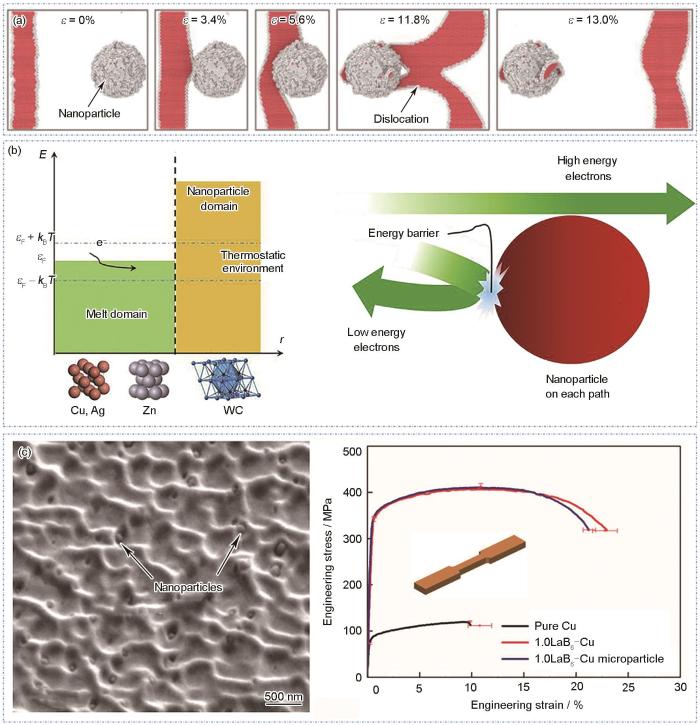
... 对于纳米颗粒增强的铜基复合材料,从强化角度,纳米尺度颗粒具有显著的Orowan强化效应(
图8a [82 ] ),颗粒尺寸越小、分布越均匀,Orowan强化对强度的贡献越显著,可大幅提升材料的力学性能
[83 ] .此外,多数陶瓷颗粒与Cu基体在硬度、弹性模量、热膨胀系数等物性参数上存在较大差异,在原位自生过程中会在颗粒周围产生高密度热错配位错,该类位错不仅有效发挥强化作用,而且具有较高的热稳定性,使复合材料获得优异的高温拉伸性能和抗软化温度.从塑性变形角度,增强相的特征参量通过影响变形过程中的位错运动、应力/应变分布等来影响复合材料的塑性.其中,颗粒含量是影响塑性最主要的因素,含量越低塑性越好;当颗粒体积分数较高时,颗粒引起的内应力明显增加,从而在塑性变形早期便萌生裂纹
[84 ] .同时,颗粒分布越均匀、尺寸越细小、圆整度越高,越不易引起应力-应变集中及裂纹萌生,有利于复合材料塑性提升
[83 ] .反之,大尺寸颗粒或团聚体在变形过程中容易在界面引起位错塞积和应力-应变集中,并在界面处诱导萌生微裂纹,降低载荷传递效率,造成塑性显著降低
[19 ] .从传导角度,纳米陶瓷颗粒对传导性能的影响主要取决于其含量、原位反应程度以及界面特征等,通常随含量增加传导性能降低;而反应越充分导电率也越高,反之则因残留溶质固溶严重而损害传导性能;纳米颗粒与基体的相界面也是造成电子(声子)散射的重要原因(
图8b [71 ] ),相同体积分数下纳米颗粒的相界面面积高于微米颗粒,因而对传导性能的损害更大
[72 ] .综上,纳米弥散颗粒有助于改善复合材料的强度、耐高温和塑性等性能.
图8 纳米尺度增强相对铜基复合材料力学和导电性能的影响<sup>[<xref ref-type="bibr" rid="R27">27</xref>,<xref ref-type="bibr" rid="R71">71</xref>,<xref ref-type="bibr" rid="R82">82</xref>]</sup> Effect of nano-reinforcements on mechanical properties and electrical conductivity of copper matrix composites (a) interaction mechanism between dislocation and nano-SiC particles[82 ] (ε —strain) ...
... (c) microstructure and strength-plasticity of LaB6 /Cu composites[27 ] ...
... 基于以上优势,通过合理调控纳米颗粒的含量、分布等参量有望实现铜基复合材料综合性能的合理匹配,获得具有不同应用场景的高性能铜基复合材料.如利用3D打印将低含量(1.86%,体积分数)纳米LaB6 颗粒引入Cu基体中,较低的添加量使其保持接近纯Cu的导电特性(98.4%IACS),同时弥散分布也显著提高了复合材料的强塑性(图8c [27 ] ),实现复合材料高导-中强性能匹配.而在较高增强相体积分数下,如2.75%Al2 O3 /Cu[3 ] 和5.48%TiB2 /Cu[60 ] 复合材料中,在损失少量导电率的条件下,可以显著提高材料强度,使复合材料实现高强-高导性能匹配(导电率≥ 80%IACS,抗拉强度≥ 600 MPa).此外,由于纳米Al2 O3 颗粒对基体晶粒生长的钉扎作用,使该类复合材料的抗软化温度大于900 ℃,并具有优异的抗蠕变、抗疲劳、抗应力松弛等高温性能[85 ] .此外,部分纳米W、Ta、Nb等硬质难溶颗粒对强度和导电的影响机理与纳米陶瓷颗粒类似[86 ,87 ] ,该类硬质相熔点较高,可以显著提升强度和高温性能,但又与基体不互溶或在Cu中的固溶度极低,使其保持较高导电特性.例如,利用溶胶-凝胶-烧结技术原位制备的7.6 nm W颗粒弥散分布在W/Cu复合材料中,其抗拉强度可达709 MPa,断后延伸率达20%,热导率为370 W/(m·K),在800 ℃下的高温强度可达251 MPa[86 ] .图9 [3 ,23 ,27 ,33 ,34 ,36 ,39 ,63 ,69 ,78 ,86 ,88 ~93 ] 给出了常见铜基复合材料的抗拉强度与导电率的对应关系. ...
... ,27 ,33 ,34 ,36 ,39 ,63 ,69 ,78 ,86 ,88 ~93 ]给出了常见铜基复合材料的抗拉强度与导电率的对应关系. ...
... ,
27 ,
33 ,
34 ,
36 ,
39 ,
63 ,
69 ,
78 ,
86 ,
88 ~
93 ]
Relationship between tensile strength and electrical conductivity of the common copper matrix composites<sup>[<xref ref-type="bibr" rid="R3">3</xref>,<xref ref-type="bibr" rid="R23">23</xref>,<xref ref-type="bibr" rid="R27">27</xref>,<xref ref-type="bibr" rid="R33">33</xref>,<xref ref-type="bibr" rid="R34">34</xref>,<xref ref-type="bibr" rid="R36">36</xref>,<xref ref-type="bibr" rid="R39">39</xref>,<xref ref-type="bibr" rid="R63">63</xref>,<xref ref-type="bibr" rid="R69">69</xref>,<xref ref-type="bibr" rid="R78">78</xref>,<xref ref-type="bibr" rid="R86">86</xref>,<xref ref-type="bibr" rid="R88">88</xref>-<xref ref-type="bibr" rid="R93">93</xref>]</sup> (CNTs—carbon nanotubes) Fig.9 ![]()
纳米碳(纳米碳颗粒、CNTs、Gr等)也是制备高强高导铜基复合材料的重要增强相.一方面,纳米碳材料不仅可通过发挥位错钉扎、位错增殖等作用,实现力学性能的优化[55 ] ;而且,多数纳米碳往往具备较大长径比,可在微观上形成“桥接”结构,从而发挥承担载荷和优化裂纹扩展模式等效果,在很大程度上可以协同改善复合材料的强塑性[54 ,94 ] .另一方面,纳米碳自身具有更优异的导电特性(载流子迁移率为2 × 105 cm2 /(V·s)),是制备高导铜基复合材料的重要增强相,微量添加有望获得导电性能高于Cu基体的复合材料[55 ] .由此,利用原位反应在Cu片层上沉积生成纳米石墨烯,之后经热压烧结和大变形制备成具有纳米片层的Gr/Cu复合材料,在石墨烯片层承载强化、加工硬化以及孪晶强化等综合作用下显著提高强度,获得抗拉强度和导电率分别为827 MPa和85.2%IACS的复合材料[88 ] .此外,利用纳米碳的高载流优势,也可借助工艺设计形成连通网状或者非均匀结构,为电子和声子传输提供通道,以此制备出导电率> 100%IACS和热导率> 400 W/(m·K)的高传导铜基复合材料[55 ] (详见2.5节).综上,利用纳米增强相在提升强度、传导性、塑性及其高温性能方面的巨大优势,可以制备出高性能铜基复合材料. ...
... ,
27 ,
33 ,
34 ,
36 ,
39 ,
63 ,
69 ,
78 ,
86 ,
88 -
93 ] (CNTs—carbon nanotubes)
Fig.9 ![]()
纳米碳(纳米碳颗粒、CNTs、Gr等)也是制备高强高导铜基复合材料的重要增强相.一方面,纳米碳材料不仅可通过发挥位错钉扎、位错增殖等作用,实现力学性能的优化[55 ] ;而且,多数纳米碳往往具备较大长径比,可在微观上形成“桥接”结构,从而发挥承担载荷和优化裂纹扩展模式等效果,在很大程度上可以协同改善复合材料的强塑性[54 ,94 ] .另一方面,纳米碳自身具有更优异的导电特性(载流子迁移率为2 × 105 cm2 /(V·s)),是制备高导铜基复合材料的重要增强相,微量添加有望获得导电性能高于Cu基体的复合材料[55 ] .由此,利用原位反应在Cu片层上沉积生成纳米石墨烯,之后经热压烧结和大变形制备成具有纳米片层的Gr/Cu复合材料,在石墨烯片层承载强化、加工硬化以及孪晶强化等综合作用下显著提高强度,获得抗拉强度和导电率分别为827 MPa和85.2%IACS的复合材料[88 ] .此外,利用纳米碳的高载流优势,也可借助工艺设计形成连通网状或者非均匀结构,为电子和声子传输提供通道,以此制备出导电率> 100%IACS和热导率> 400 W/(m·K)的高传导铜基复合材料[55 ] (详见2.5节).综上,利用纳米增强相在提升强度、传导性、塑性及其高温性能方面的巨大优势,可以制备出高性能铜基复合材料. ...
The origin of high-density dislocations in additively manufactured metals
5
2020
... 通过熔体快冷也可抑制液态成形复合材料中增强相的微观团聚和快速长大,因此,利用增材制造(又称3D打印)自身微小熔池、快速熔化和快速凝固等技术特征与原位反应过程有机结合,有望制备出增强相细小弥散分布的铜基复合材料,目前主要以激光粉床熔融(L-PBF)技术为主[25 ] .L-PBF制备铜基复合材料的优势之一在于可利用增强相降低纯Cu对激光的反射率,又可利用其技术特征为增强相细化和均匀化以及基体晶粒细化等提供热-动力学条件[26 ,27 ] .另一优势是打印过程中由于反复冷热循环(图3a [28 ] )和动态载荷作用(图3b [28 ] )在微区内产生残余应力以适应局部膨胀和收缩错配,在高温下诱发形成高密度热错配位错,有望进一步提高复合材料的室温强度和高温性能[28 ] .目前,3D打印制备铜基复合材料主要有三种方式:外加增强相打印[27 ] 、打印过程中原位形成增强相[29 ] 以及复合材料粉末直接打印[30 ~33 ] . ...
... [28 ])在微区内产生残余应力以适应局部膨胀和收缩错配,在高温下诱发形成高密度热错配位错,有望进一步提高复合材料的室温强度和高温性能[28 ] .目前,3D打印制备铜基复合材料主要有三种方式:外加增强相打印[27 ] 、打印过程中原位形成增强相[29 ] 以及复合材料粉末直接打印[30 ~33 ] . ...
... [28 ].目前,3D打印制备铜基复合材料主要有三种方式:外加增强相打印[27 ] 、打印过程中原位形成增强相[29 ] 以及复合材料粉末直接打印[30 ~33 ] . ...
... [
28 ,
33 ]
Additive manufacturing technologies of copper matrix composites (a, b) repeated hot and cold cycles during printing (a) and compression-tension simulation generated by the printing process (b)<sup>[<xref ref-type="bibr" rid="R28">28</xref>]</sup> (<i>σ<sub>XX</sub></i>, <i>σ<sub>YY</sub></i>, and <i>σ<sub>ZZ</sub></i> are stress components) (c-g) microstructures (c), mechanical (d) and conductivity (e) properties, heat transfer during printing (f), and products (g) of Cu-Cr-Nb alloy formed by additive manufacturing<sup>[<xref ref-type="bibr" rid="R33">33</xref>]</sup> (LPBF—laser powder-bed-fusion) Fig.3 ![]()
最简单的打印方式是直接将Cu粉与增强相粉末混合均匀后进行沉积,增强相在打印过程中会被重熔(或部分重熔)后再析出形成增强相,再析出过程使其恢复良好传导特性,而增强相也被进一步细化和分散,在保持良好传导性能的同时提高强度和抗高温软化性能[27 ] .但为了避免外加增强相引起的界面污染等问题,可以在3D打印过程中原位生成增强相,例如将Cu粉、Ti粉、B粉混合后,打印时可以原位生成TiB2 颗粒,颗粒在微小熔池内来不及粗化和团聚,从而制备出细小弥散颗粒增强的TiB2 /Cu-Ti复合材料[29 ] .为了规避打印过程中原位反应的均匀性等问题,直接将复合材料粉末打印成形是当前制备高性能铜基复合材料的重要方法.国外早期通过优化L-PBF的激光功率和扫描速率等参数将气雾化制备的Cu-Cr-Nb粉末打印制成航空发动机燃烧室,原始气雾化粉末中的微米Cr2 Nb增强相在沉积过程中被熔化后再析出成纳米Cr2 Nb,显著提高Cu-Cr-Nb强度但又不明显降低导电性,实现了强度-传导-耐高温-抗疲劳-抗蠕变等性能的合理匹配[30 ~32 ] .国内也利用该技术针对Cu-Cr-Nb体系开展了相关研究,设计制备出多模态核-壳结构和纳米Cr2 Nb相增强的Cu-Cr-Nb薄壁复杂零件[33 ] ,具有50%IACS (IACS—international annealing copper standard)导电率的同时室温强度超过1 GPa,在700 ℃的高温拉伸强度仍高达225 MPa (图3c~g [33 ] ).因而,3D打印铜基复合材料在“高精尖特”等复杂部件的应用具有显著优势. ...
... [
28 ] (
σXX ,
σYY , and
σZZ are stress components) (c-g) microstructures (c), mechanical (d) and conductivity (e) properties, heat transfer during printing (f), and products (g) of Cu-Cr-Nb alloy formed by additive manufacturing
[33 ] (LPBF—laser powder-bed-fusion)
Fig.3 ![]()
最简单的打印方式是直接将Cu粉与增强相粉末混合均匀后进行沉积,增强相在打印过程中会被重熔(或部分重熔)后再析出形成增强相,再析出过程使其恢复良好传导特性,而增强相也被进一步细化和分散,在保持良好传导性能的同时提高强度和抗高温软化性能[27 ] .但为了避免外加增强相引起的界面污染等问题,可以在3D打印过程中原位生成增强相,例如将Cu粉、Ti粉、B粉混合后,打印时可以原位生成TiB2 颗粒,颗粒在微小熔池内来不及粗化和团聚,从而制备出细小弥散颗粒增强的TiB2 /Cu-Ti复合材料[29 ] .为了规避打印过程中原位反应的均匀性等问题,直接将复合材料粉末打印成形是当前制备高性能铜基复合材料的重要方法.国外早期通过优化L-PBF的激光功率和扫描速率等参数将气雾化制备的Cu-Cr-Nb粉末打印制成航空发动机燃烧室,原始气雾化粉末中的微米Cr2 Nb增强相在沉积过程中被熔化后再析出成纳米Cr2 Nb,显著提高Cu-Cr-Nb强度但又不明显降低导电性,实现了强度-传导-耐高温-抗疲劳-抗蠕变等性能的合理匹配[30 ~32 ] .国内也利用该技术针对Cu-Cr-Nb体系开展了相关研究,设计制备出多模态核-壳结构和纳米Cr2 Nb相增强的Cu-Cr-Nb薄壁复杂零件[33 ] ,具有50%IACS (IACS—international annealing copper standard)导电率的同时室温强度超过1 GPa,在700 ℃的高温拉伸强度仍高达225 MPa (图3c~g [33 ] ).因而,3D打印铜基复合材料在“高精尖特”等复杂部件的应用具有显著优势. ...
Obtaining of reinforced Cu-Ti, Cu-Ti-TiB2 foils through green compact laser sintering
2
2018
... 通过熔体快冷也可抑制液态成形复合材料中增强相的微观团聚和快速长大,因此,利用增材制造(又称3D打印)自身微小熔池、快速熔化和快速凝固等技术特征与原位反应过程有机结合,有望制备出增强相细小弥散分布的铜基复合材料,目前主要以激光粉床熔融(L-PBF)技术为主[25 ] .L-PBF制备铜基复合材料的优势之一在于可利用增强相降低纯Cu对激光的反射率,又可利用其技术特征为增强相细化和均匀化以及基体晶粒细化等提供热-动力学条件[26 ,27 ] .另一优势是打印过程中由于反复冷热循环(图3a [28 ] )和动态载荷作用(图3b [28 ] )在微区内产生残余应力以适应局部膨胀和收缩错配,在高温下诱发形成高密度热错配位错,有望进一步提高复合材料的室温强度和高温性能[28 ] .目前,3D打印制备铜基复合材料主要有三种方式:外加增强相打印[27 ] 、打印过程中原位形成增强相[29 ] 以及复合材料粉末直接打印[30 ~33 ] . ...
... 最简单的打印方式是直接将Cu粉与增强相粉末混合均匀后进行沉积,增强相在打印过程中会被重熔(或部分重熔)后再析出形成增强相,再析出过程使其恢复良好传导特性,而增强相也被进一步细化和分散,在保持良好传导性能的同时提高强度和抗高温软化性能[27 ] .但为了避免外加增强相引起的界面污染等问题,可以在3D打印过程中原位生成增强相,例如将Cu粉、Ti粉、B粉混合后,打印时可以原位生成TiB2 颗粒,颗粒在微小熔池内来不及粗化和团聚,从而制备出细小弥散颗粒增强的TiB2 /Cu-Ti复合材料[29 ] .为了规避打印过程中原位反应的均匀性等问题,直接将复合材料粉末打印成形是当前制备高性能铜基复合材料的重要方法.国外早期通过优化L-PBF的激光功率和扫描速率等参数将气雾化制备的Cu-Cr-Nb粉末打印制成航空发动机燃烧室,原始气雾化粉末中的微米Cr2 Nb增强相在沉积过程中被熔化后再析出成纳米Cr2 Nb,显著提高Cu-Cr-Nb强度但又不明显降低导电性,实现了强度-传导-耐高温-抗疲劳-抗蠕变等性能的合理匹配[30 ~32 ] .国内也利用该技术针对Cu-Cr-Nb体系开展了相关研究,设计制备出多模态核-壳结构和纳米Cr2 Nb相增强的Cu-Cr-Nb薄壁复杂零件[33 ] ,具有50%IACS (IACS—international annealing copper standard)导电率的同时室温强度超过1 GPa,在700 ℃的高温拉伸强度仍高达225 MPa (图3c~g [33 ] ).因而,3D打印铜基复合材料在“高精尖特”等复杂部件的应用具有显著优势. ...
The current state of CuCrZr and CuCrNb alloys manufactured by additive manufacturing: A review
2
2022
... 通过熔体快冷也可抑制液态成形复合材料中增强相的微观团聚和快速长大,因此,利用增材制造(又称3D打印)自身微小熔池、快速熔化和快速凝固等技术特征与原位反应过程有机结合,有望制备出增强相细小弥散分布的铜基复合材料,目前主要以激光粉床熔融(L-PBF)技术为主[25 ] .L-PBF制备铜基复合材料的优势之一在于可利用增强相降低纯Cu对激光的反射率,又可利用其技术特征为增强相细化和均匀化以及基体晶粒细化等提供热-动力学条件[26 ,27 ] .另一优势是打印过程中由于反复冷热循环(图3a [28 ] )和动态载荷作用(图3b [28 ] )在微区内产生残余应力以适应局部膨胀和收缩错配,在高温下诱发形成高密度热错配位错,有望进一步提高复合材料的室温强度和高温性能[28 ] .目前,3D打印制备铜基复合材料主要有三种方式:外加增强相打印[27 ] 、打印过程中原位形成增强相[29 ] 以及复合材料粉末直接打印[30 ~33 ] . ...
... 最简单的打印方式是直接将Cu粉与增强相粉末混合均匀后进行沉积,增强相在打印过程中会被重熔(或部分重熔)后再析出形成增强相,再析出过程使其恢复良好传导特性,而增强相也被进一步细化和分散,在保持良好传导性能的同时提高强度和抗高温软化性能[27 ] .但为了避免外加增强相引起的界面污染等问题,可以在3D打印过程中原位生成增强相,例如将Cu粉、Ti粉、B粉混合后,打印时可以原位生成TiB2 颗粒,颗粒在微小熔池内来不及粗化和团聚,从而制备出细小弥散颗粒增强的TiB2 /Cu-Ti复合材料[29 ] .为了规避打印过程中原位反应的均匀性等问题,直接将复合材料粉末打印成形是当前制备高性能铜基复合材料的重要方法.国外早期通过优化L-PBF的激光功率和扫描速率等参数将气雾化制备的Cu-Cr-Nb粉末打印制成航空发动机燃烧室,原始气雾化粉末中的微米Cr2 Nb增强相在沉积过程中被熔化后再析出成纳米Cr2 Nb,显著提高Cu-Cr-Nb强度但又不明显降低导电性,实现了强度-传导-耐高温-抗疲劳-抗蠕变等性能的合理匹配[30 ~32 ] .国内也利用该技术针对Cu-Cr-Nb体系开展了相关研究,设计制备出多模态核-壳结构和纳米Cr2 Nb相增强的Cu-Cr-Nb薄壁复杂零件[33 ] ,具有50%IACS (IACS—international annealing copper standard)导电率的同时室温强度超过1 GPa,在700 ℃的高温拉伸强度仍高达225 MPa (图3c~g [33 ] ).因而,3D打印铜基复合材料在“高精尖特”等复杂部件的应用具有显著优势. ...
Extreme environment hot fire durability of post processed additively manufactured GRCop-alloy combustion chambers
0
2021
Fracture characteristics and heat treatment of laser powder bed fusion additively manufactured GRCop-84 copper
1
2021
... 最简单的打印方式是直接将Cu粉与增强相粉末混合均匀后进行沉积,增强相在打印过程中会被重熔(或部分重熔)后再析出形成增强相,再析出过程使其恢复良好传导特性,而增强相也被进一步细化和分散,在保持良好传导性能的同时提高强度和抗高温软化性能[27 ] .但为了避免外加增强相引起的界面污染等问题,可以在3D打印过程中原位生成增强相,例如将Cu粉、Ti粉、B粉混合后,打印时可以原位生成TiB2 颗粒,颗粒在微小熔池内来不及粗化和团聚,从而制备出细小弥散颗粒增强的TiB2 /Cu-Ti复合材料[29 ] .为了规避打印过程中原位反应的均匀性等问题,直接将复合材料粉末打印成形是当前制备高性能铜基复合材料的重要方法.国外早期通过优化L-PBF的激光功率和扫描速率等参数将气雾化制备的Cu-Cr-Nb粉末打印制成航空发动机燃烧室,原始气雾化粉末中的微米Cr2 Nb增强相在沉积过程中被熔化后再析出成纳米Cr2 Nb,显著提高Cu-Cr-Nb强度但又不明显降低导电性,实现了强度-传导-耐高温-抗疲劳-抗蠕变等性能的合理匹配[30 ~32 ] .国内也利用该技术针对Cu-Cr-Nb体系开展了相关研究,设计制备出多模态核-壳结构和纳米Cr2 Nb相增强的Cu-Cr-Nb薄壁复杂零件[33 ] ,具有50%IACS (IACS—international annealing copper standard)导电率的同时室温强度超过1 GPa,在700 ℃的高温拉伸强度仍高达225 MPa (图3c~g [33 ] ).因而,3D打印铜基复合材料在“高精尖特”等复杂部件的应用具有显著优势. ...
Additively manufactured copper alloy with heterogeneous nanoprecipitates-dislocation architecture for superior strength-ductility-conductivity synergy
9
2024
... 通过熔体快冷也可抑制液态成形复合材料中增强相的微观团聚和快速长大,因此,利用增材制造(又称3D打印)自身微小熔池、快速熔化和快速凝固等技术特征与原位反应过程有机结合,有望制备出增强相细小弥散分布的铜基复合材料,目前主要以激光粉床熔融(L-PBF)技术为主[25 ] .L-PBF制备铜基复合材料的优势之一在于可利用增强相降低纯Cu对激光的反射率,又可利用其技术特征为增强相细化和均匀化以及基体晶粒细化等提供热-动力学条件[26 ,27 ] .另一优势是打印过程中由于反复冷热循环(图3a [28 ] )和动态载荷作用(图3b [28 ] )在微区内产生残余应力以适应局部膨胀和收缩错配,在高温下诱发形成高密度热错配位错,有望进一步提高复合材料的室温强度和高温性能[28 ] .目前,3D打印制备铜基复合材料主要有三种方式:外加增强相打印[27 ] 、打印过程中原位形成增强相[29 ] 以及复合材料粉末直接打印[30 ~33 ] . ...
... ,
33 ]
Additive manufacturing technologies of copper matrix composites (a, b) repeated hot and cold cycles during printing (a) and compression-tension simulation generated by the printing process (b)<sup>[<xref ref-type="bibr" rid="R28">28</xref>]</sup> (<i>σ<sub>XX</sub></i>, <i>σ<sub>YY</sub></i>, and <i>σ<sub>ZZ</sub></i> are stress components) (c-g) microstructures (c), mechanical (d) and conductivity (e) properties, heat transfer during printing (f), and products (g) of Cu-Cr-Nb alloy formed by additive manufacturing<sup>[<xref ref-type="bibr" rid="R33">33</xref>]</sup> (LPBF—laser powder-bed-fusion) Fig.3 ![]()
最简单的打印方式是直接将Cu粉与增强相粉末混合均匀后进行沉积,增强相在打印过程中会被重熔(或部分重熔)后再析出形成增强相,再析出过程使其恢复良好传导特性,而增强相也被进一步细化和分散,在保持良好传导性能的同时提高强度和抗高温软化性能[27 ] .但为了避免外加增强相引起的界面污染等问题,可以在3D打印过程中原位生成增强相,例如将Cu粉、Ti粉、B粉混合后,打印时可以原位生成TiB2 颗粒,颗粒在微小熔池内来不及粗化和团聚,从而制备出细小弥散颗粒增强的TiB2 /Cu-Ti复合材料[29 ] .为了规避打印过程中原位反应的均匀性等问题,直接将复合材料粉末打印成形是当前制备高性能铜基复合材料的重要方法.国外早期通过优化L-PBF的激光功率和扫描速率等参数将气雾化制备的Cu-Cr-Nb粉末打印制成航空发动机燃烧室,原始气雾化粉末中的微米Cr2 Nb增强相在沉积过程中被熔化后再析出成纳米Cr2 Nb,显著提高Cu-Cr-Nb强度但又不明显降低导电性,实现了强度-传导-耐高温-抗疲劳-抗蠕变等性能的合理匹配[30 ~32 ] .国内也利用该技术针对Cu-Cr-Nb体系开展了相关研究,设计制备出多模态核-壳结构和纳米Cr2 Nb相增强的Cu-Cr-Nb薄壁复杂零件[33 ] ,具有50%IACS (IACS—international annealing copper standard)导电率的同时室温强度超过1 GPa,在700 ℃的高温拉伸强度仍高达225 MPa (图3c~g [33 ] ).因而,3D打印铜基复合材料在“高精尖特”等复杂部件的应用具有显著优势. ...
... [
33 ] (LPBF—laser powder-bed-fusion)
Fig.3 ![]()
最简单的打印方式是直接将Cu粉与增强相粉末混合均匀后进行沉积,增强相在打印过程中会被重熔(或部分重熔)后再析出形成增强相,再析出过程使其恢复良好传导特性,而增强相也被进一步细化和分散,在保持良好传导性能的同时提高强度和抗高温软化性能[27 ] .但为了避免外加增强相引起的界面污染等问题,可以在3D打印过程中原位生成增强相,例如将Cu粉、Ti粉、B粉混合后,打印时可以原位生成TiB2 颗粒,颗粒在微小熔池内来不及粗化和团聚,从而制备出细小弥散颗粒增强的TiB2 /Cu-Ti复合材料[29 ] .为了规避打印过程中原位反应的均匀性等问题,直接将复合材料粉末打印成形是当前制备高性能铜基复合材料的重要方法.国外早期通过优化L-PBF的激光功率和扫描速率等参数将气雾化制备的Cu-Cr-Nb粉末打印制成航空发动机燃烧室,原始气雾化粉末中的微米Cr2 Nb增强相在沉积过程中被熔化后再析出成纳米Cr2 Nb,显著提高Cu-Cr-Nb强度但又不明显降低导电性,实现了强度-传导-耐高温-抗疲劳-抗蠕变等性能的合理匹配[30 ~32 ] .国内也利用该技术针对Cu-Cr-Nb体系开展了相关研究,设计制备出多模态核-壳结构和纳米Cr2 Nb相增强的Cu-Cr-Nb薄壁复杂零件[33 ] ,具有50%IACS (IACS—international annealing copper standard)导电率的同时室温强度超过1 GPa,在700 ℃的高温拉伸强度仍高达225 MPa (图3c~g [33 ] ).因而,3D打印铜基复合材料在“高精尖特”等复杂部件的应用具有显著优势. ...
... 最简单的打印方式是直接将Cu粉与增强相粉末混合均匀后进行沉积,增强相在打印过程中会被重熔(或部分重熔)后再析出形成增强相,再析出过程使其恢复良好传导特性,而增强相也被进一步细化和分散,在保持良好传导性能的同时提高强度和抗高温软化性能[27 ] .但为了避免外加增强相引起的界面污染等问题,可以在3D打印过程中原位生成增强相,例如将Cu粉、Ti粉、B粉混合后,打印时可以原位生成TiB2 颗粒,颗粒在微小熔池内来不及粗化和团聚,从而制备出细小弥散颗粒增强的TiB2 /Cu-Ti复合材料[29 ] .为了规避打印过程中原位反应的均匀性等问题,直接将复合材料粉末打印成形是当前制备高性能铜基复合材料的重要方法.国外早期通过优化L-PBF的激光功率和扫描速率等参数将气雾化制备的Cu-Cr-Nb粉末打印制成航空发动机燃烧室,原始气雾化粉末中的微米Cr2 Nb增强相在沉积过程中被熔化后再析出成纳米Cr2 Nb,显著提高Cu-Cr-Nb强度但又不明显降低导电性,实现了强度-传导-耐高温-抗疲劳-抗蠕变等性能的合理匹配[30 ~32 ] .国内也利用该技术针对Cu-Cr-Nb体系开展了相关研究,设计制备出多模态核-壳结构和纳米Cr2 Nb相增强的Cu-Cr-Nb薄壁复杂零件[33 ] ,具有50%IACS (IACS—international annealing copper standard)导电率的同时室温强度超过1 GPa,在700 ℃的高温拉伸强度仍高达225 MPa (图3c~g [33 ] ).因而,3D打印铜基复合材料在“高精尖特”等复杂部件的应用具有显著优势. ...
... [33 ]).因而,3D打印铜基复合材料在“高精尖特”等复杂部件的应用具有显著优势. ...
... 火箭发动机燃烧室内衬用Cu-Cr-Nb主要是一种由高熔点Cr2 Nb硬质颗粒增强的铜基材料.其常见制备方法是先将Cu-Cr-Nb熔体气雾化成球形粉末,然后将粉末热压烧结成Cu-Cr-Nb坯锭或3D打印成形为复杂零件(图3c~g [33 ] ).气雾化制粉过程中的高冷速条件,不仅有利于基体晶粒细化,还可减少并细化初生粗大Cr2 Nb颗粒、增加次生纳米Cr2 Nb颗粒含量,从而提高材料强度和耐高温能力[64 ,65 ] .液-固原位制备技术的另一应用以TiB2 /Cu复合材料为例,首先利用气雾化法制备出TiB2 /Cu复合材料粉末,再通过粉末冶金烧结成为坯锭(图5 [61 ~63 ] ).通过将中间合金熔体混合反应与气雾化耦合,制备出含O量低(< 200 × 10-6 )、粉末中值粒径小(32.86 μm)、流动性好(22.3 s/50 g)、增强相尺寸小(325 nm)的TiB2 /Cu复合材料粉末[62 ] .在复合材料粉末烧结成形过程中,Cu基体经固态扩散形成良好冶金结合,而陶瓷颗粒并不参与烧结成形,因此复合材料相比铜合金具有导电稳定特性;但增强相对烧结颈的形成具有一定抑制作用(图5c [63 ] ).因此,复合材料粉末在合适工艺参数烧结之后,搭配适当的变形等后处理手段可以进一步改善组织和性能,从而制备出宏/微观组织分布均匀且导电和力学性能优异的TiB2 /Cu复合材料(图5b [61 ,63 ] ).可见,液-固原位技术在均质高性能块体铜基复合材料制备方面具有重要意义. ...
... 基于以上优势,通过合理调控纳米颗粒的含量、分布等参量有望实现铜基复合材料综合性能的合理匹配,获得具有不同应用场景的高性能铜基复合材料.如利用3D打印将低含量(1.86%,体积分数)纳米LaB6 颗粒引入Cu基体中,较低的添加量使其保持接近纯Cu的导电特性(98.4%IACS),同时弥散分布也显著提高了复合材料的强塑性(图8c [27 ] ),实现复合材料高导-中强性能匹配.而在较高增强相体积分数下,如2.75%Al2 O3 /Cu[3 ] 和5.48%TiB2 /Cu[60 ] 复合材料中,在损失少量导电率的条件下,可以显著提高材料强度,使复合材料实现高强-高导性能匹配(导电率≥ 80%IACS,抗拉强度≥ 600 MPa).此外,由于纳米Al2 O3 颗粒对基体晶粒生长的钉扎作用,使该类复合材料的抗软化温度大于900 ℃,并具有优异的抗蠕变、抗疲劳、抗应力松弛等高温性能[85 ] .此外,部分纳米W、Ta、Nb等硬质难溶颗粒对强度和导电的影响机理与纳米陶瓷颗粒类似[86 ,87 ] ,该类硬质相熔点较高,可以显著提升强度和高温性能,但又与基体不互溶或在Cu中的固溶度极低,使其保持较高导电特性.例如,利用溶胶-凝胶-烧结技术原位制备的7.6 nm W颗粒弥散分布在W/Cu复合材料中,其抗拉强度可达709 MPa,断后延伸率达20%,热导率为370 W/(m·K),在800 ℃下的高温强度可达251 MPa[86 ] .图9 [3 ,23 ,27 ,33 ,34 ,36 ,39 ,63 ,69 ,78 ,86 ,88 ~93 ] 给出了常见铜基复合材料的抗拉强度与导电率的对应关系. ...
... ,
33 ,
34 ,
36 ,
39 ,
63 ,
69 ,
78 ,
86 ,
88 ~
93 ]
Relationship between tensile strength and electrical conductivity of the common copper matrix composites<sup>[<xref ref-type="bibr" rid="R3">3</xref>,<xref ref-type="bibr" rid="R23">23</xref>,<xref ref-type="bibr" rid="R27">27</xref>,<xref ref-type="bibr" rid="R33">33</xref>,<xref ref-type="bibr" rid="R34">34</xref>,<xref ref-type="bibr" rid="R36">36</xref>,<xref ref-type="bibr" rid="R39">39</xref>,<xref ref-type="bibr" rid="R63">63</xref>,<xref ref-type="bibr" rid="R69">69</xref>,<xref ref-type="bibr" rid="R78">78</xref>,<xref ref-type="bibr" rid="R86">86</xref>,<xref ref-type="bibr" rid="R88">88</xref>-<xref ref-type="bibr" rid="R93">93</xref>]</sup> (CNTs—carbon nanotubes) Fig.9 ![]()
纳米碳(纳米碳颗粒、CNTs、Gr等)也是制备高强高导铜基复合材料的重要增强相.一方面,纳米碳材料不仅可通过发挥位错钉扎、位错增殖等作用,实现力学性能的优化[55 ] ;而且,多数纳米碳往往具备较大长径比,可在微观上形成“桥接”结构,从而发挥承担载荷和优化裂纹扩展模式等效果,在很大程度上可以协同改善复合材料的强塑性[54 ,94 ] .另一方面,纳米碳自身具有更优异的导电特性(载流子迁移率为2 × 105 cm2 /(V·s)),是制备高导铜基复合材料的重要增强相,微量添加有望获得导电性能高于Cu基体的复合材料[55 ] .由此,利用原位反应在Cu片层上沉积生成纳米石墨烯,之后经热压烧结和大变形制备成具有纳米片层的Gr/Cu复合材料,在石墨烯片层承载强化、加工硬化以及孪晶强化等综合作用下显著提高强度,获得抗拉强度和导电率分别为827 MPa和85.2%IACS的复合材料[88 ] .此外,利用纳米碳的高载流优势,也可借助工艺设计形成连通网状或者非均匀结构,为电子和声子传输提供通道,以此制备出导电率> 100%IACS和热导率> 400 W/(m·K)的高传导铜基复合材料[55 ] (详见2.5节).综上,利用纳米增强相在提升强度、传导性、塑性及其高温性能方面的巨大优势,可以制备出高性能铜基复合材料. ...
... ,
33 ,
34 ,
36 ,
39 ,
63 ,
69 ,
78 ,
86 ,
88 -
93 ] (CNTs—carbon nanotubes)
Fig.9 ![]()
纳米碳(纳米碳颗粒、CNTs、Gr等)也是制备高强高导铜基复合材料的重要增强相.一方面,纳米碳材料不仅可通过发挥位错钉扎、位错增殖等作用,实现力学性能的优化[55 ] ;而且,多数纳米碳往往具备较大长径比,可在微观上形成“桥接”结构,从而发挥承担载荷和优化裂纹扩展模式等效果,在很大程度上可以协同改善复合材料的强塑性[54 ,94 ] .另一方面,纳米碳自身具有更优异的导电特性(载流子迁移率为2 × 105 cm2 /(V·s)),是制备高导铜基复合材料的重要增强相,微量添加有望获得导电性能高于Cu基体的复合材料[55 ] .由此,利用原位反应在Cu片层上沉积生成纳米石墨烯,之后经热压烧结和大变形制备成具有纳米片层的Gr/Cu复合材料,在石墨烯片层承载强化、加工硬化以及孪晶强化等综合作用下显著提高强度,获得抗拉强度和导电率分别为827 MPa和85.2%IACS的复合材料[88 ] .此外,利用纳米碳的高载流优势,也可借助工艺设计形成连通网状或者非均匀结构,为电子和声子传输提供通道,以此制备出导电率> 100%IACS和热导率> 400 W/(m·K)的高传导铜基复合材料[55 ] (详见2.5节).综上,利用纳米增强相在提升强度、传导性、塑性及其高温性能方面的巨大优势,可以制备出高性能铜基复合材料. ...
Effect of La addition on microstructures and properties of TiB2 (-TiB)/Cu hybrid composites prepared by in situ reaction
5
2020
... 通过上述液相原位制备技术及工艺控制,可以获得系列新型高性能铜基复合材料[34 ~36 ] ,但液相原位制备技术依然面临挑战.反应铸造技术受限于金属基复合材料液态成形的偏析难题,在制备大尺寸铜基复合材料方面依然存在较大困难.基于现有液态成形方法,需通过制备原理与增强相设计等方面突破,开发适合铜基复合材料规模化制备的铸造技术.喷射沉积需要合理选择溶质引入方式,严格控制反应参数和反应时机,否则将导致致密度低、反应不充分等问题,严重影响导电率和强度.虽然基于3D打印开展的探索性研究取得了较好的效果,但其打印过程中增强相的原位合成和弥散分布机理等方面依然存在诸多难题,而且在薄壁、构型等特殊结构-功能复合材料领域的优势潜力也有待进一步发掘. ...
... 基于以上优势,通过合理调控纳米颗粒的含量、分布等参量有望实现铜基复合材料综合性能的合理匹配,获得具有不同应用场景的高性能铜基复合材料.如利用3D打印将低含量(1.86%,体积分数)纳米LaB6 颗粒引入Cu基体中,较低的添加量使其保持接近纯Cu的导电特性(98.4%IACS),同时弥散分布也显著提高了复合材料的强塑性(图8c [27 ] ),实现复合材料高导-中强性能匹配.而在较高增强相体积分数下,如2.75%Al2 O3 /Cu[3 ] 和5.48%TiB2 /Cu[60 ] 复合材料中,在损失少量导电率的条件下,可以显著提高材料强度,使复合材料实现高强-高导性能匹配(导电率≥ 80%IACS,抗拉强度≥ 600 MPa).此外,由于纳米Al2 O3 颗粒对基体晶粒生长的钉扎作用,使该类复合材料的抗软化温度大于900 ℃,并具有优异的抗蠕变、抗疲劳、抗应力松弛等高温性能[85 ] .此外,部分纳米W、Ta、Nb等硬质难溶颗粒对强度和导电的影响机理与纳米陶瓷颗粒类似[86 ,87 ] ,该类硬质相熔点较高,可以显著提升强度和高温性能,但又与基体不互溶或在Cu中的固溶度极低,使其保持较高导电特性.例如,利用溶胶-凝胶-烧结技术原位制备的7.6 nm W颗粒弥散分布在W/Cu复合材料中,其抗拉强度可达709 MPa,断后延伸率达20%,热导率为370 W/(m·K),在800 ℃下的高温强度可达251 MPa[86 ] .图9 [3 ,23 ,27 ,33 ,34 ,36 ,39 ,63 ,69 ,78 ,86 ,88 ~93 ] 给出了常见铜基复合材料的抗拉强度与导电率的对应关系. ...
... ,
34 ,
36 ,
39 ,
63 ,
69 ,
78 ,
86 ,
88 ~
93 ]
Relationship between tensile strength and electrical conductivity of the common copper matrix composites<sup>[<xref ref-type="bibr" rid="R3">3</xref>,<xref ref-type="bibr" rid="R23">23</xref>,<xref ref-type="bibr" rid="R27">27</xref>,<xref ref-type="bibr" rid="R33">33</xref>,<xref ref-type="bibr" rid="R34">34</xref>,<xref ref-type="bibr" rid="R36">36</xref>,<xref ref-type="bibr" rid="R39">39</xref>,<xref ref-type="bibr" rid="R63">63</xref>,<xref ref-type="bibr" rid="R69">69</xref>,<xref ref-type="bibr" rid="R78">78</xref>,<xref ref-type="bibr" rid="R86">86</xref>,<xref ref-type="bibr" rid="R88">88</xref>-<xref ref-type="bibr" rid="R93">93</xref>]</sup> (CNTs—carbon nanotubes) Fig.9 ![]()
纳米碳(纳米碳颗粒、CNTs、Gr等)也是制备高强高导铜基复合材料的重要增强相.一方面,纳米碳材料不仅可通过发挥位错钉扎、位错增殖等作用,实现力学性能的优化[55 ] ;而且,多数纳米碳往往具备较大长径比,可在微观上形成“桥接”结构,从而发挥承担载荷和优化裂纹扩展模式等效果,在很大程度上可以协同改善复合材料的强塑性[54 ,94 ] .另一方面,纳米碳自身具有更优异的导电特性(载流子迁移率为2 × 105 cm2 /(V·s)),是制备高导铜基复合材料的重要增强相,微量添加有望获得导电性能高于Cu基体的复合材料[55 ] .由此,利用原位反应在Cu片层上沉积生成纳米石墨烯,之后经热压烧结和大变形制备成具有纳米片层的Gr/Cu复合材料,在石墨烯片层承载强化、加工硬化以及孪晶强化等综合作用下显著提高强度,获得抗拉强度和导电率分别为827 MPa和85.2%IACS的复合材料[88 ] .此外,利用纳米碳的高载流优势,也可借助工艺设计形成连通网状或者非均匀结构,为电子和声子传输提供通道,以此制备出导电率> 100%IACS和热导率> 400 W/(m·K)的高传导铜基复合材料[55 ] (详见2.5节).综上,利用纳米增强相在提升强度、传导性、塑性及其高温性能方面的巨大优势,可以制备出高性能铜基复合材料. ...
... ,
34 ,
36 ,
39 ,
63 ,
69 ,
78 ,
86 ,
88 -
93 ] (CNTs—carbon nanotubes)
Fig.9 ![]()
纳米碳(纳米碳颗粒、CNTs、Gr等)也是制备高强高导铜基复合材料的重要增强相.一方面,纳米碳材料不仅可通过发挥位错钉扎、位错增殖等作用,实现力学性能的优化[55 ] ;而且,多数纳米碳往往具备较大长径比,可在微观上形成“桥接”结构,从而发挥承担载荷和优化裂纹扩展模式等效果,在很大程度上可以协同改善复合材料的强塑性[54 ,94 ] .另一方面,纳米碳自身具有更优异的导电特性(载流子迁移率为2 × 105 cm2 /(V·s)),是制备高导铜基复合材料的重要增强相,微量添加有望获得导电性能高于Cu基体的复合材料[55 ] .由此,利用原位反应在Cu片层上沉积生成纳米石墨烯,之后经热压烧结和大变形制备成具有纳米片层的Gr/Cu复合材料,在石墨烯片层承载强化、加工硬化以及孪晶强化等综合作用下显著提高强度,获得抗拉强度和导电率分别为827 MPa和85.2%IACS的复合材料[88 ] .此外,利用纳米碳的高载流优势,也可借助工艺设计形成连通网状或者非均匀结构,为电子和声子传输提供通道,以此制备出导电率> 100%IACS和热导率> 400 W/(m·K)的高传导铜基复合材料[55 ] (详见2.5节).综上,利用纳米增强相在提升强度、传导性、塑性及其高温性能方面的巨大优势,可以制备出高性能铜基复合材料. ...
... 多元混杂常见的应用之一是利用多种增强相混杂来协调复合材料基础性能(即强度和导电)匹配.例如,利用混合铸造制备出亚微米级TiB2 和Al2 O3 两种颗粒混杂增强铜基复合材料,两种颗粒混杂可在保持较高导电的同时提高复合材料的载荷承载能力(图11a [97 ] ).此外,从强化角度出发,通过Ti∶B成分调控可以从液相中原位生成TiB2 颗粒和短棒状TiB晶须混杂增强的(TiB2 + TiB)/Cu复合材料,其中晶须主要起到承担载荷作用,颗粒则缓解应力集中,混杂组织则通过协调应力-应变分配使复合材料获得较高强度和良好塑性(图11b [83 ] ).至此,颗粒和晶须混杂便可在较低体积分数下获得同等强度,也使复合材料具有较高的传导性能[19 ] ,最终获得抗拉强度≥ 600 MPa而导电率≥ 80%IACS的(TiB2 + TiB)/Cu-La[34 ] 复合材料. ...
Microstructure evolution, electrical conductivity and mechanical properties of dual-scale Cu5 Zr/ZrB2 particulate reinforced copper matrix composites
0
2019
Effect of La addition on the particle characteristics, mechanical and electrical properties of in situ Cu-TiB2 composites
4
2016
... 通过上述液相原位制备技术及工艺控制,可以获得系列新型高性能铜基复合材料[34 ~36 ] ,但液相原位制备技术依然面临挑战.反应铸造技术受限于金属基复合材料液态成形的偏析难题,在制备大尺寸铜基复合材料方面依然存在较大困难.基于现有液态成形方法,需通过制备原理与增强相设计等方面突破,开发适合铜基复合材料规模化制备的铸造技术.喷射沉积需要合理选择溶质引入方式,严格控制反应参数和反应时机,否则将导致致密度低、反应不充分等问题,严重影响导电率和强度.虽然基于3D打印开展的探索性研究取得了较好的效果,但其打印过程中增强相的原位合成和弥散分布机理等方面依然存在诸多难题,而且在薄壁、构型等特殊结构-功能复合材料领域的优势潜力也有待进一步发掘. ...
... 基于以上优势,通过合理调控纳米颗粒的含量、分布等参量有望实现铜基复合材料综合性能的合理匹配,获得具有不同应用场景的高性能铜基复合材料.如利用3D打印将低含量(1.86%,体积分数)纳米LaB6 颗粒引入Cu基体中,较低的添加量使其保持接近纯Cu的导电特性(98.4%IACS),同时弥散分布也显著提高了复合材料的强塑性(图8c [27 ] ),实现复合材料高导-中强性能匹配.而在较高增强相体积分数下,如2.75%Al2 O3 /Cu[3 ] 和5.48%TiB2 /Cu[60 ] 复合材料中,在损失少量导电率的条件下,可以显著提高材料强度,使复合材料实现高强-高导性能匹配(导电率≥ 80%IACS,抗拉强度≥ 600 MPa).此外,由于纳米Al2 O3 颗粒对基体晶粒生长的钉扎作用,使该类复合材料的抗软化温度大于900 ℃,并具有优异的抗蠕变、抗疲劳、抗应力松弛等高温性能[85 ] .此外,部分纳米W、Ta、Nb等硬质难溶颗粒对强度和导电的影响机理与纳米陶瓷颗粒类似[86 ,87 ] ,该类硬质相熔点较高,可以显著提升强度和高温性能,但又与基体不互溶或在Cu中的固溶度极低,使其保持较高导电特性.例如,利用溶胶-凝胶-烧结技术原位制备的7.6 nm W颗粒弥散分布在W/Cu复合材料中,其抗拉强度可达709 MPa,断后延伸率达20%,热导率为370 W/(m·K),在800 ℃下的高温强度可达251 MPa[86 ] .图9 [3 ,23 ,27 ,33 ,34 ,36 ,39 ,63 ,69 ,78 ,86 ,88 ~93 ] 给出了常见铜基复合材料的抗拉强度与导电率的对应关系. ...
... ,
36 ,
39 ,
63 ,
69 ,
78 ,
86 ,
88 ~
93 ]
Relationship between tensile strength and electrical conductivity of the common copper matrix composites<sup>[<xref ref-type="bibr" rid="R3">3</xref>,<xref ref-type="bibr" rid="R23">23</xref>,<xref ref-type="bibr" rid="R27">27</xref>,<xref ref-type="bibr" rid="R33">33</xref>,<xref ref-type="bibr" rid="R34">34</xref>,<xref ref-type="bibr" rid="R36">36</xref>,<xref ref-type="bibr" rid="R39">39</xref>,<xref ref-type="bibr" rid="R63">63</xref>,<xref ref-type="bibr" rid="R69">69</xref>,<xref ref-type="bibr" rid="R78">78</xref>,<xref ref-type="bibr" rid="R86">86</xref>,<xref ref-type="bibr" rid="R88">88</xref>-<xref ref-type="bibr" rid="R93">93</xref>]</sup> (CNTs—carbon nanotubes) Fig.9 ![]()
纳米碳(纳米碳颗粒、CNTs、Gr等)也是制备高强高导铜基复合材料的重要增强相.一方面,纳米碳材料不仅可通过发挥位错钉扎、位错增殖等作用,实现力学性能的优化[55 ] ;而且,多数纳米碳往往具备较大长径比,可在微观上形成“桥接”结构,从而发挥承担载荷和优化裂纹扩展模式等效果,在很大程度上可以协同改善复合材料的强塑性[54 ,94 ] .另一方面,纳米碳自身具有更优异的导电特性(载流子迁移率为2 × 105 cm2 /(V·s)),是制备高导铜基复合材料的重要增强相,微量添加有望获得导电性能高于Cu基体的复合材料[55 ] .由此,利用原位反应在Cu片层上沉积生成纳米石墨烯,之后经热压烧结和大变形制备成具有纳米片层的Gr/Cu复合材料,在石墨烯片层承载强化、加工硬化以及孪晶强化等综合作用下显著提高强度,获得抗拉强度和导电率分别为827 MPa和85.2%IACS的复合材料[88 ] .此外,利用纳米碳的高载流优势,也可借助工艺设计形成连通网状或者非均匀结构,为电子和声子传输提供通道,以此制备出导电率> 100%IACS和热导率> 400 W/(m·K)的高传导铜基复合材料[55 ] (详见2.5节).综上,利用纳米增强相在提升强度、传导性、塑性及其高温性能方面的巨大优势,可以制备出高性能铜基复合材料. ...
... ,
36 ,
39 ,
63 ,
69 ,
78 ,
86 ,
88 -
93 ] (CNTs—carbon nanotubes)
Fig.9 ![]()
纳米碳(纳米碳颗粒、CNTs、Gr等)也是制备高强高导铜基复合材料的重要增强相.一方面,纳米碳材料不仅可通过发挥位错钉扎、位错增殖等作用,实现力学性能的优化[55 ] ;而且,多数纳米碳往往具备较大长径比,可在微观上形成“桥接”结构,从而发挥承担载荷和优化裂纹扩展模式等效果,在很大程度上可以协同改善复合材料的强塑性[54 ,94 ] .另一方面,纳米碳自身具有更优异的导电特性(载流子迁移率为2 × 105 cm2 /(V·s)),是制备高导铜基复合材料的重要增强相,微量添加有望获得导电性能高于Cu基体的复合材料[55 ] .由此,利用原位反应在Cu片层上沉积生成纳米石墨烯,之后经热压烧结和大变形制备成具有纳米片层的Gr/Cu复合材料,在石墨烯片层承载强化、加工硬化以及孪晶强化等综合作用下显著提高强度,获得抗拉强度和导电率分别为827 MPa和85.2%IACS的复合材料[88 ] .此外,利用纳米碳的高载流优势,也可借助工艺设计形成连通网状或者非均匀结构,为电子和声子传输提供通道,以此制备出导电率> 100%IACS和热导率> 400 W/(m·K)的高传导铜基复合材料[55 ] (详见2.5节).综上,利用纳米增强相在提升强度、传导性、塑性及其高温性能方面的巨大优势,可以制备出高性能铜基复合材料. ...
Study status of in-situ reaction copper matrix composite
1
2006
... 基于溶质原子在液/固态Cu中的扩散快慢特征,可以利用固相缓慢扩散来消耗基体中的溶质,使其反应生成增强相,溶质反应可以恢复Cu的高导电特征,而增强相为复合材料贡献强度和高温等性能,因此成为制备高性能导电铜基复合材料的另一重要技术.固相原位法(粉末冶金)是历经前驱体粉末制备、粉末预处理、固相烧结等步骤成形的制备技术,主要特点是在不同阶段均可生成增强相[37 ,38 ] ,为不同类型增强相提供了较高的设计自由度.因此,基于粉末冶金不同阶段的技术特点,衍生出以制备氧化物、硼化物、碳化物、氮化物、硫化物等陶瓷类增强相以及纳米碳类增强相等为主的一系列固相原位制备技术[39 ~41 ] . ...
原位反应铜基复合材料的研究现状
1
2006
... 基于溶质原子在液/固态Cu中的扩散快慢特征,可以利用固相缓慢扩散来消耗基体中的溶质,使其反应生成增强相,溶质反应可以恢复Cu的高导电特征,而增强相为复合材料贡献强度和高温等性能,因此成为制备高性能导电铜基复合材料的另一重要技术.固相原位法(粉末冶金)是历经前驱体粉末制备、粉末预处理、固相烧结等步骤成形的制备技术,主要特点是在不同阶段均可生成增强相[37 ,38 ] ,为不同类型增强相提供了较高的设计自由度.因此,基于粉末冶金不同阶段的技术特点,衍生出以制备氧化物、硼化物、碳化物、氮化物、硫化物等陶瓷类增强相以及纳米碳类增强相等为主的一系列固相原位制备技术[39 ~41 ] . ...
The studies of TiB2 /Cu metal matrix composites
1
2004
... 基于溶质原子在液/固态Cu中的扩散快慢特征,可以利用固相缓慢扩散来消耗基体中的溶质,使其反应生成增强相,溶质反应可以恢复Cu的高导电特征,而增强相为复合材料贡献强度和高温等性能,因此成为制备高性能导电铜基复合材料的另一重要技术.固相原位法(粉末冶金)是历经前驱体粉末制备、粉末预处理、固相烧结等步骤成形的制备技术,主要特点是在不同阶段均可生成增强相[37 ,38 ] ,为不同类型增强相提供了较高的设计自由度.因此,基于粉末冶金不同阶段的技术特点,衍生出以制备氧化物、硼化物、碳化物、氮化物、硫化物等陶瓷类增强相以及纳米碳类增强相等为主的一系列固相原位制备技术[39 ~41 ] . ...
TiB2 /Cu金属基复合材料的研究
1
2004
... 基于溶质原子在液/固态Cu中的扩散快慢特征,可以利用固相缓慢扩散来消耗基体中的溶质,使其反应生成增强相,溶质反应可以恢复Cu的高导电特征,而增强相为复合材料贡献强度和高温等性能,因此成为制备高性能导电铜基复合材料的另一重要技术.固相原位法(粉末冶金)是历经前驱体粉末制备、粉末预处理、固相烧结等步骤成形的制备技术,主要特点是在不同阶段均可生成增强相[37 ,38 ] ,为不同类型增强相提供了较高的设计自由度.因此,基于粉末冶金不同阶段的技术特点,衍生出以制备氧化物、硼化物、碳化物、氮化物、硫化物等陶瓷类增强相以及纳米碳类增强相等为主的一系列固相原位制备技术[39 ~41 ] . ...
Ceramic particles reinforced copper matrix composites manufactured by advanced powder metallurgy: preparation, performance, and mechanisms
12
2023
... 基于溶质原子在液/固态Cu中的扩散快慢特征,可以利用固相缓慢扩散来消耗基体中的溶质,使其反应生成增强相,溶质反应可以恢复Cu的高导电特征,而增强相为复合材料贡献强度和高温等性能,因此成为制备高性能导电铜基复合材料的另一重要技术.固相原位法(粉末冶金)是历经前驱体粉末制备、粉末预处理、固相烧结等步骤成形的制备技术,主要特点是在不同阶段均可生成增强相[37 ,38 ] ,为不同类型增强相提供了较高的设计自由度.因此,基于粉末冶金不同阶段的技术特点,衍生出以制备氧化物、硼化物、碳化物、氮化物、硫化物等陶瓷类增强相以及纳米碳类增强相等为主的一系列固相原位制备技术[39 ~41 ] . ...
... 固相原位制备氧化物颗粒增强铜基复合材料主要是在前驱体粉末处理阶段生成增强相,然后烧结成复合材料块体,其代表性技术为内氧化法(图4a [39 ] ).该方法中,铜合金粉末中合金元素被高活性O元素选择性氧化生成纳米颗粒,并弥散分布于Cu基体中,在恢复导电的同时显著提高复合材料的强度和高温性能[39 ] .例如,Al2 O3 /Cu复合材料的制备就是先利用气雾化等技术制备出Cu-Al合金粉末,然后将合金粉末与氧源(O2 或Cu2 O粉末等)混合,在高温下发生氧化反应生成含有氧化物颗粒的复合材料粉末,最后将粉末烧结成形得到铜基复合材料(图4a [39 ] ).此方法也可拓展至Y2 O3 /Cu、La2 O3 /Cu等多种氧化物弥散强化铜基复合材料的制备[42 ,43 ] .内氧化法的关键在于控制工艺参数来调控原位反应程度及氧化物组织等,内氧化温度过高和时间过长均会导致氧化物颗粒粗大,反之则导致内氧化反应不充分而损害导电率.然而,该方法中溶质元素在基体中的极限固溶度决定了原位合成增强相的含量,当增加基体合金中溶质含量来制备高体积分数增强相时,超过极限固溶度的元素将以金属间化合物的形式存在,影响增强相的含量及其组织均匀性,限制了铜基复合材料性能的进一步提升[44 ] . ...
... [39 ].例如,Al2 O3 /Cu复合材料的制备就是先利用气雾化等技术制备出Cu-Al合金粉末,然后将合金粉末与氧源(O2 或Cu2 O粉末等)混合,在高温下发生氧化反应生成含有氧化物颗粒的复合材料粉末,最后将粉末烧结成形得到铜基复合材料(图4a [39 ] ).此方法也可拓展至Y2 O3 /Cu、La2 O3 /Cu等多种氧化物弥散强化铜基复合材料的制备[42 ,43 ] .内氧化法的关键在于控制工艺参数来调控原位反应程度及氧化物组织等,内氧化温度过高和时间过长均会导致氧化物颗粒粗大,反之则导致内氧化反应不充分而损害导电率.然而,该方法中溶质元素在基体中的极限固溶度决定了原位合成增强相的含量,当增加基体合金中溶质含量来制备高体积分数增强相时,超过极限固溶度的元素将以金属间化合物的形式存在,影响增强相的含量及其组织均匀性,限制了铜基复合材料性能的进一步提升[44 ] . ...
... [39 ]).此方法也可拓展至Y2 O3 /Cu、La2 O3 /Cu等多种氧化物弥散强化铜基复合材料的制备[42 ,43 ] .内氧化法的关键在于控制工艺参数来调控原位反应程度及氧化物组织等,内氧化温度过高和时间过长均会导致氧化物颗粒粗大,反之则导致内氧化反应不充分而损害导电率.然而,该方法中溶质元素在基体中的极限固溶度决定了原位合成增强相的含量,当增加基体合金中溶质含量来制备高体积分数增强相时,超过极限固溶度的元素将以金属间化合物的形式存在,影响增强相的含量及其组织均匀性,限制了铜基复合材料性能的进一步提升[44 ] . ...
... [
39 ,
45 ,
56 ]
Solid <i>in situ</i> preparation technologies of copper matrix composites (a) oxide particles reinforced copper matrix composites[39 ] (F —force. The intergranular Al2 O3 and intragranular Al2 O3 particles are indicated by red and blue arrows, respectively) ...
... (a) oxide particles reinforced copper matrix composites[39 ] (F —force. The intergranular Al2 O3 and intragranular Al2 O3 particles are indicated by red and blue arrows, respectively) ...
... (b) boride particles reinforced copper matrix composites[39 ,45 ] ...
... 固相原位法制备其他陶瓷类增强相,多是依靠粉末烧结成形阶段溶质元素发生固态扩散及原位反应来生成增强相(图4b [39 ,45 ] ),例如,制备TiB2 /Cu、TiN/Cu、SiC/Cu、TiC/Cu等复合材料[39 ,45 ] .虽然此类增强相主要在烧结阶段形成,但前驱体粉末及其后处理方式对增强相特征(特别是尺寸、分布等)和复合材料性能具有重要影响.首先,选择合适的前驱体粉末可以改善增强相的具体反应过程或反应路径[46 ,47 ] ,前驱体粉末可以是单质金属粉末、合金粉末、复合材料粉末.其次,前驱体粉末处理方式是改善组织和性能的关键,主要以混粉、球磨以及混粉和球磨组合使用等为主[40 ] .例如,球磨可以细化基体和分散增强相,在基体中会引入大量晶体缺陷或杂质提升材料力学性能,但对传导性能损害严重[48 ,49 ] .最后,烧结技术是影响粉末致密化、原位反应以及组织性能匹配的决定性因素.采用真空热压、热等静压、放电等离子等烧结方式,在真空或气氛保护条件下实现致密化能够有效避免氧化污染[41 ,50 ,51 ] ,后续可通过热变形(热压、热挤压、热锻等)进一步提高致密化程度,从而优化复合材料的传导和力学性能[52 ] . ...
... [39 ,45 ].虽然此类增强相主要在烧结阶段形成,但前驱体粉末及其后处理方式对增强相特征(特别是尺寸、分布等)和复合材料性能具有重要影响.首先,选择合适的前驱体粉末可以改善增强相的具体反应过程或反应路径[46 ,47 ] ,前驱体粉末可以是单质金属粉末、合金粉末、复合材料粉末.其次,前驱体粉末处理方式是改善组织和性能的关键,主要以混粉、球磨以及混粉和球磨组合使用等为主[40 ] .例如,球磨可以细化基体和分散增强相,在基体中会引入大量晶体缺陷或杂质提升材料力学性能,但对传导性能损害严重[48 ,49 ] .最后,烧结技术是影响粉末致密化、原位反应以及组织性能匹配的决定性因素.采用真空热压、热等静压、放电等离子等烧结方式,在真空或气氛保护条件下实现致密化能够有效避免氧化污染[41 ,50 ,51 ] ,后续可通过热变形(热压、热挤压、热锻等)进一步提高致密化程度,从而优化复合材料的传导和力学性能[52 ] . ...
... 基于以上优势,通过合理调控纳米颗粒的含量、分布等参量有望实现铜基复合材料综合性能的合理匹配,获得具有不同应用场景的高性能铜基复合材料.如利用3D打印将低含量(1.86%,体积分数)纳米LaB6 颗粒引入Cu基体中,较低的添加量使其保持接近纯Cu的导电特性(98.4%IACS),同时弥散分布也显著提高了复合材料的强塑性(图8c [27 ] ),实现复合材料高导-中强性能匹配.而在较高增强相体积分数下,如2.75%Al2 O3 /Cu[3 ] 和5.48%TiB2 /Cu[60 ] 复合材料中,在损失少量导电率的条件下,可以显著提高材料强度,使复合材料实现高强-高导性能匹配(导电率≥ 80%IACS,抗拉强度≥ 600 MPa).此外,由于纳米Al2 O3 颗粒对基体晶粒生长的钉扎作用,使该类复合材料的抗软化温度大于900 ℃,并具有优异的抗蠕变、抗疲劳、抗应力松弛等高温性能[85 ] .此外,部分纳米W、Ta、Nb等硬质难溶颗粒对强度和导电的影响机理与纳米陶瓷颗粒类似[86 ,87 ] ,该类硬质相熔点较高,可以显著提升强度和高温性能,但又与基体不互溶或在Cu中的固溶度极低,使其保持较高导电特性.例如,利用溶胶-凝胶-烧结技术原位制备的7.6 nm W颗粒弥散分布在W/Cu复合材料中,其抗拉强度可达709 MPa,断后延伸率达20%,热导率为370 W/(m·K),在800 ℃下的高温强度可达251 MPa[86 ] .图9 [3 ,23 ,27 ,33 ,34 ,36 ,39 ,63 ,69 ,78 ,86 ,88 ~93 ] 给出了常见铜基复合材料的抗拉强度与导电率的对应关系. ...
... ,
39 ,
63 ,
69 ,
78 ,
86 ,
88 ~
93 ]
Relationship between tensile strength and electrical conductivity of the common copper matrix composites<sup>[<xref ref-type="bibr" rid="R3">3</xref>,<xref ref-type="bibr" rid="R23">23</xref>,<xref ref-type="bibr" rid="R27">27</xref>,<xref ref-type="bibr" rid="R33">33</xref>,<xref ref-type="bibr" rid="R34">34</xref>,<xref ref-type="bibr" rid="R36">36</xref>,<xref ref-type="bibr" rid="R39">39</xref>,<xref ref-type="bibr" rid="R63">63</xref>,<xref ref-type="bibr" rid="R69">69</xref>,<xref ref-type="bibr" rid="R78">78</xref>,<xref ref-type="bibr" rid="R86">86</xref>,<xref ref-type="bibr" rid="R88">88</xref>-<xref ref-type="bibr" rid="R93">93</xref>]</sup> (CNTs—carbon nanotubes) Fig.9 ![]()
纳米碳(纳米碳颗粒、CNTs、Gr等)也是制备高强高导铜基复合材料的重要增强相.一方面,纳米碳材料不仅可通过发挥位错钉扎、位错增殖等作用,实现力学性能的优化[55 ] ;而且,多数纳米碳往往具备较大长径比,可在微观上形成“桥接”结构,从而发挥承担载荷和优化裂纹扩展模式等效果,在很大程度上可以协同改善复合材料的强塑性[54 ,94 ] .另一方面,纳米碳自身具有更优异的导电特性(载流子迁移率为2 × 105 cm2 /(V·s)),是制备高导铜基复合材料的重要增强相,微量添加有望获得导电性能高于Cu基体的复合材料[55 ] .由此,利用原位反应在Cu片层上沉积生成纳米石墨烯,之后经热压烧结和大变形制备成具有纳米片层的Gr/Cu复合材料,在石墨烯片层承载强化、加工硬化以及孪晶强化等综合作用下显著提高强度,获得抗拉强度和导电率分别为827 MPa和85.2%IACS的复合材料[88 ] .此外,利用纳米碳的高载流优势,也可借助工艺设计形成连通网状或者非均匀结构,为电子和声子传输提供通道,以此制备出导电率> 100%IACS和热导率> 400 W/(m·K)的高传导铜基复合材料[55 ] (详见2.5节).综上,利用纳米增强相在提升强度、传导性、塑性及其高温性能方面的巨大优势,可以制备出高性能铜基复合材料. ...
... ,
39 ,
63 ,
69 ,
78 ,
86 ,
88 -
93 ] (CNTs—carbon nanotubes)
Fig.9 ![]()
纳米碳(纳米碳颗粒、CNTs、Gr等)也是制备高强高导铜基复合材料的重要增强相.一方面,纳米碳材料不仅可通过发挥位错钉扎、位错增殖等作用,实现力学性能的优化[55 ] ;而且,多数纳米碳往往具备较大长径比,可在微观上形成“桥接”结构,从而发挥承担载荷和优化裂纹扩展模式等效果,在很大程度上可以协同改善复合材料的强塑性[54 ,94 ] .另一方面,纳米碳自身具有更优异的导电特性(载流子迁移率为2 × 105 cm2 /(V·s)),是制备高导铜基复合材料的重要增强相,微量添加有望获得导电性能高于Cu基体的复合材料[55 ] .由此,利用原位反应在Cu片层上沉积生成纳米石墨烯,之后经热压烧结和大变形制备成具有纳米片层的Gr/Cu复合材料,在石墨烯片层承载强化、加工硬化以及孪晶强化等综合作用下显著提高强度,获得抗拉强度和导电率分别为827 MPa和85.2%IACS的复合材料[88 ] .此外,利用纳米碳的高载流优势,也可借助工艺设计形成连通网状或者非均匀结构,为电子和声子传输提供通道,以此制备出导电率> 100%IACS和热导率> 400 W/(m·K)的高传导铜基复合材料[55 ] (详见2.5节).综上,利用纳米增强相在提升强度、传导性、塑性及其高温性能方面的巨大优势,可以制备出高性能铜基复合材料. ...
Spark plasma sintering of metals and metal matrix nanocomposites: A review
1
2012
... 固相原位法制备其他陶瓷类增强相,多是依靠粉末烧结成形阶段溶质元素发生固态扩散及原位反应来生成增强相(图4b [39 ,45 ] ),例如,制备TiB2 /Cu、TiN/Cu、SiC/Cu、TiC/Cu等复合材料[39 ,45 ] .虽然此类增强相主要在烧结阶段形成,但前驱体粉末及其后处理方式对增强相特征(特别是尺寸、分布等)和复合材料性能具有重要影响.首先,选择合适的前驱体粉末可以改善增强相的具体反应过程或反应路径[46 ,47 ] ,前驱体粉末可以是单质金属粉末、合金粉末、复合材料粉末.其次,前驱体粉末处理方式是改善组织和性能的关键,主要以混粉、球磨以及混粉和球磨组合使用等为主[40 ] .例如,球磨可以细化基体和分散增强相,在基体中会引入大量晶体缺陷或杂质提升材料力学性能,但对传导性能损害严重[48 ,49 ] .最后,烧结技术是影响粉末致密化、原位反应以及组织性能匹配的决定性因素.采用真空热压、热等静压、放电等离子等烧结方式,在真空或气氛保护条件下实现致密化能够有效避免氧化污染[41 ,50 ,51 ] ,后续可通过热变形(热压、热挤压、热锻等)进一步提高致密化程度,从而优化复合材料的传导和力学性能[52 ] . ...
Microstructures and mechanical properties of Cu/Ti3 SiC2 /C/graphene nanocomposites prepared by vacuum hot-pressing sintering and hot isostatic pressing
2
2018
... 基于溶质原子在液/固态Cu中的扩散快慢特征,可以利用固相缓慢扩散来消耗基体中的溶质,使其反应生成增强相,溶质反应可以恢复Cu的高导电特征,而增强相为复合材料贡献强度和高温等性能,因此成为制备高性能导电铜基复合材料的另一重要技术.固相原位法(粉末冶金)是历经前驱体粉末制备、粉末预处理、固相烧结等步骤成形的制备技术,主要特点是在不同阶段均可生成增强相[37 ,38 ] ,为不同类型增强相提供了较高的设计自由度.因此,基于粉末冶金不同阶段的技术特点,衍生出以制备氧化物、硼化物、碳化物、氮化物、硫化物等陶瓷类增强相以及纳米碳类增强相等为主的一系列固相原位制备技术[39 ~41 ] . ...
... 固相原位法制备其他陶瓷类增强相,多是依靠粉末烧结成形阶段溶质元素发生固态扩散及原位反应来生成增强相(图4b [39 ,45 ] ),例如,制备TiB2 /Cu、TiN/Cu、SiC/Cu、TiC/Cu等复合材料[39 ,45 ] .虽然此类增强相主要在烧结阶段形成,但前驱体粉末及其后处理方式对增强相特征(特别是尺寸、分布等)和复合材料性能具有重要影响.首先,选择合适的前驱体粉末可以改善增强相的具体反应过程或反应路径[46 ,47 ] ,前驱体粉末可以是单质金属粉末、合金粉末、复合材料粉末.其次,前驱体粉末处理方式是改善组织和性能的关键,主要以混粉、球磨以及混粉和球磨组合使用等为主[40 ] .例如,球磨可以细化基体和分散增强相,在基体中会引入大量晶体缺陷或杂质提升材料力学性能,但对传导性能损害严重[48 ,49 ] .最后,烧结技术是影响粉末致密化、原位反应以及组织性能匹配的决定性因素.采用真空热压、热等静压、放电等离子等烧结方式,在真空或气氛保护条件下实现致密化能够有效避免氧化污染[41 ,50 ,51 ] ,后续可通过热变形(热压、热挤压、热锻等)进一步提高致密化程度,从而优化复合材料的传导和力学性能[52 ] . ...
Microstructure and properties at elevated temperature of a nano-Al2 O3 particles dispersion-strengthened copper base composite
2
2006
... 固相原位制备氧化物颗粒增强铜基复合材料主要是在前驱体粉末处理阶段生成增强相,然后烧结成复合材料块体,其代表性技术为内氧化法(图4a [39 ] ).该方法中,铜合金粉末中合金元素被高活性O元素选择性氧化生成纳米颗粒,并弥散分布于Cu基体中,在恢复导电的同时显著提高复合材料的强度和高温性能[39 ] .例如,Al2 O3 /Cu复合材料的制备就是先利用气雾化等技术制备出Cu-Al合金粉末,然后将合金粉末与氧源(O2 或Cu2 O粉末等)混合,在高温下发生氧化反应生成含有氧化物颗粒的复合材料粉末,最后将粉末烧结成形得到铜基复合材料(图4a [39 ] ).此方法也可拓展至Y2 O3 /Cu、La2 O3 /Cu等多种氧化物弥散强化铜基复合材料的制备[42 ,43 ] .内氧化法的关键在于控制工艺参数来调控原位反应程度及氧化物组织等,内氧化温度过高和时间过长均会导致氧化物颗粒粗大,反之则导致内氧化反应不充分而损害导电率.然而,该方法中溶质元素在基体中的极限固溶度决定了原位合成增强相的含量,当增加基体合金中溶质含量来制备高体积分数增强相时,超过极限固溶度的元素将以金属间化合物的形式存在,影响增强相的含量及其组织均匀性,限制了铜基复合材料性能的进一步提升[44 ] . ...
... 原位生成纳米弥散增强相是当前高性能铜基复合材料的研究热点,具体以纳米陶瓷颗粒和纳米碳两大类为主.与生成微米尺度增强相不同,原位自生纳米增强相主要以缓慢的固相扩散或者快速凝固等技术特征为主,相应生成的纳米相被约束在Cu基体中使其弥散分布,从而获得优异的综合性能,如依靠内氧化法制备的Al2 O3 /Cu[42 ] 、Y2 O3 /Cu[43 ] 以及3D打印制备的LaB6 /Cu等复合材料[27 ] . ...
A novel approach for strengthening Cu-Y2 O3 composites by in situ reaction at liquidus temperature
2
2013
... 固相原位制备氧化物颗粒增强铜基复合材料主要是在前驱体粉末处理阶段生成增强相,然后烧结成复合材料块体,其代表性技术为内氧化法(图4a [39 ] ).该方法中,铜合金粉末中合金元素被高活性O元素选择性氧化生成纳米颗粒,并弥散分布于Cu基体中,在恢复导电的同时显著提高复合材料的强度和高温性能[39 ] .例如,Al2 O3 /Cu复合材料的制备就是先利用气雾化等技术制备出Cu-Al合金粉末,然后将合金粉末与氧源(O2 或Cu2 O粉末等)混合,在高温下发生氧化反应生成含有氧化物颗粒的复合材料粉末,最后将粉末烧结成形得到铜基复合材料(图4a [39 ] ).此方法也可拓展至Y2 O3 /Cu、La2 O3 /Cu等多种氧化物弥散强化铜基复合材料的制备[42 ,43 ] .内氧化法的关键在于控制工艺参数来调控原位反应程度及氧化物组织等,内氧化温度过高和时间过长均会导致氧化物颗粒粗大,反之则导致内氧化反应不充分而损害导电率.然而,该方法中溶质元素在基体中的极限固溶度决定了原位合成增强相的含量,当增加基体合金中溶质含量来制备高体积分数增强相时,超过极限固溶度的元素将以金属间化合物的形式存在,影响增强相的含量及其组织均匀性,限制了铜基复合材料性能的进一步提升[44 ] . ...
... 原位生成纳米弥散增强相是当前高性能铜基复合材料的研究热点,具体以纳米陶瓷颗粒和纳米碳两大类为主.与生成微米尺度增强相不同,原位自生纳米增强相主要以缓慢的固相扩散或者快速凝固等技术特征为主,相应生成的纳米相被约束在Cu基体中使其弥散分布,从而获得优异的综合性能,如依靠内氧化法制备的Al2 O3 /Cu[42 ] 、Y2 O3 /Cu[43 ] 以及3D打印制备的LaB6 /Cu等复合材料[27 ] . ...
High temperature mechanical behavior of alumina dispersion strengthened copper alloy with high content of alumina
1
2015
... 固相原位制备氧化物颗粒增强铜基复合材料主要是在前驱体粉末处理阶段生成增强相,然后烧结成复合材料块体,其代表性技术为内氧化法(图4a [39 ] ).该方法中,铜合金粉末中合金元素被高活性O元素选择性氧化生成纳米颗粒,并弥散分布于Cu基体中,在恢复导电的同时显著提高复合材料的强度和高温性能[39 ] .例如,Al2 O3 /Cu复合材料的制备就是先利用气雾化等技术制备出Cu-Al合金粉末,然后将合金粉末与氧源(O2 或Cu2 O粉末等)混合,在高温下发生氧化反应生成含有氧化物颗粒的复合材料粉末,最后将粉末烧结成形得到铜基复合材料(图4a [39 ] ).此方法也可拓展至Y2 O3 /Cu、La2 O3 /Cu等多种氧化物弥散强化铜基复合材料的制备[42 ,43 ] .内氧化法的关键在于控制工艺参数来调控原位反应程度及氧化物组织等,内氧化温度过高和时间过长均会导致氧化物颗粒粗大,反之则导致内氧化反应不充分而损害导电率.然而,该方法中溶质元素在基体中的极限固溶度决定了原位合成增强相的含量,当增加基体合金中溶质含量来制备高体积分数增强相时,超过极限固溶度的元素将以金属间化合物的形式存在,影响增强相的含量及其组织均匀性,限制了铜基复合材料性能的进一步提升[44 ] . ...
Competitive precipitation behavior of hybrid reinforcements in copper matrix composites fabricated by powder metallurgy
4
2021
... 固相原位制备氧化物颗粒增强铜基复合材料主要是在前驱体粉末处理阶段生成增强相,然后烧结成复合材料块体,其代表性技术为内氧化法(
图4a [39 ] ).该方法中,铜合金粉末中合金元素被高活性O元素选择性氧化生成纳米颗粒,并弥散分布于Cu基体中,在恢复导电的同时显著提高复合材料的强度和高温性能
[39 ] .例如,Al
2 O
3 /Cu复合材料的制备就是先利用气雾化等技术制备出Cu-Al合金粉末,然后将合金粉末与氧源(O
2 或Cu
2 O粉末等)混合,在高温下发生氧化反应生成含有氧化物颗粒的复合材料粉末,最后将粉末烧结成形得到铜基复合材料(
图4a [39 ] ).此方法也可拓展至Y
2 O
3 /Cu、La
2 O
3 /Cu等多种氧化物弥散强化铜基复合材料的制备
[42 ,43 ] .内氧化法的关键在于控制工艺参数来调控原位反应程度及氧化物组织等,内氧化温度过高和时间过长均会导致氧化物颗粒粗大,反之则导致内氧化反应不充分而损害导电率.然而,该方法中溶质元素在基体中的极限固溶度决定了原位合成增强相的含量,当增加基体合金中溶质含量来制备高体积分数增强相时,超过极限固溶度的元素将以金属间化合物的形式存在,影响增强相的含量及其组织均匀性,限制了铜基复合材料性能的进一步提升
[44 ] .
图4 铜基复合材料的固相原位制备技术<sup>[<xref ref-type="bibr" rid="R39">39</xref>,<xref ref-type="bibr" rid="R45">45</xref>,<xref ref-type="bibr" rid="R56">56</xref>]</sup> Solid <i>in situ</i> preparation technologies of copper matrix composites (a) oxide particles reinforced copper matrix composites[39 ] (F —force. The intergranular Al2 O3 and intragranular Al2 O3 particles are indicated by red and blue arrows, respectively) ...
... (b) boride particles reinforced copper matrix composites[39 ,45 ] ...
... 固相原位法制备其他陶瓷类增强相,多是依靠粉末烧结成形阶段溶质元素发生固态扩散及原位反应来生成增强相(图4b [39 ,45 ] ),例如,制备TiB2 /Cu、TiN/Cu、SiC/Cu、TiC/Cu等复合材料[39 ,45 ] .虽然此类增强相主要在烧结阶段形成,但前驱体粉末及其后处理方式对增强相特征(特别是尺寸、分布等)和复合材料性能具有重要影响.首先,选择合适的前驱体粉末可以改善增强相的具体反应过程或反应路径[46 ,47 ] ,前驱体粉末可以是单质金属粉末、合金粉末、复合材料粉末.其次,前驱体粉末处理方式是改善组织和性能的关键,主要以混粉、球磨以及混粉和球磨组合使用等为主[40 ] .例如,球磨可以细化基体和分散增强相,在基体中会引入大量晶体缺陷或杂质提升材料力学性能,但对传导性能损害严重[48 ,49 ] .最后,烧结技术是影响粉末致密化、原位反应以及组织性能匹配的决定性因素.采用真空热压、热等静压、放电等离子等烧结方式,在真空或气氛保护条件下实现致密化能够有效避免氧化污染[41 ,50 ,51 ] ,后续可通过热变形(热压、热挤压、热锻等)进一步提高致密化程度,从而优化复合材料的传导和力学性能[52 ] . ...
... ,45 ].虽然此类增强相主要在烧结阶段形成,但前驱体粉末及其后处理方式对增强相特征(特别是尺寸、分布等)和复合材料性能具有重要影响.首先,选择合适的前驱体粉末可以改善增强相的具体反应过程或反应路径[46 ,47 ] ,前驱体粉末可以是单质金属粉末、合金粉末、复合材料粉末.其次,前驱体粉末处理方式是改善组织和性能的关键,主要以混粉、球磨以及混粉和球磨组合使用等为主[40 ] .例如,球磨可以细化基体和分散增强相,在基体中会引入大量晶体缺陷或杂质提升材料力学性能,但对传导性能损害严重[48 ,49 ] .最后,烧结技术是影响粉末致密化、原位反应以及组织性能匹配的决定性因素.采用真空热压、热等静压、放电等离子等烧结方式,在真空或气氛保护条件下实现致密化能够有效避免氧化污染[41 ,50 ,51 ] ,后续可通过热变形(热压、热挤压、热锻等)进一步提高致密化程度,从而优化复合材料的传导和力学性能[52 ] . ...
TiB2 (-TiB)/Cu in-situ composites prepared by hot-press with the sintering temperature just beneath the melting point of copper
1
2016
... 固相原位法制备其他陶瓷类增强相,多是依靠粉末烧结成形阶段溶质元素发生固态扩散及原位反应来生成增强相(图4b [39 ,45 ] ),例如,制备TiB2 /Cu、TiN/Cu、SiC/Cu、TiC/Cu等复合材料[39 ,45 ] .虽然此类增强相主要在烧结阶段形成,但前驱体粉末及其后处理方式对增强相特征(特别是尺寸、分布等)和复合材料性能具有重要影响.首先,选择合适的前驱体粉末可以改善增强相的具体反应过程或反应路径[46 ,47 ] ,前驱体粉末可以是单质金属粉末、合金粉末、复合材料粉末.其次,前驱体粉末处理方式是改善组织和性能的关键,主要以混粉、球磨以及混粉和球磨组合使用等为主[40 ] .例如,球磨可以细化基体和分散增强相,在基体中会引入大量晶体缺陷或杂质提升材料力学性能,但对传导性能损害严重[48 ,49 ] .最后,烧结技术是影响粉末致密化、原位反应以及组织性能匹配的决定性因素.采用真空热压、热等静压、放电等离子等烧结方式,在真空或气氛保护条件下实现致密化能够有效避免氧化污染[41 ,50 ,51 ] ,后续可通过热变形(热压、热挤压、热锻等)进一步提高致密化程度,从而优化复合材料的传导和力学性能[52 ] . ...
Preparation of Cu/CrB2 composites with well-balanced mechanical properties and electrical conductivity by ex-situ powder metallurgy
1
2022
... 固相原位法制备其他陶瓷类增强相,多是依靠粉末烧结成形阶段溶质元素发生固态扩散及原位反应来生成增强相(图4b [39 ,45 ] ),例如,制备TiB2 /Cu、TiN/Cu、SiC/Cu、TiC/Cu等复合材料[39 ,45 ] .虽然此类增强相主要在烧结阶段形成,但前驱体粉末及其后处理方式对增强相特征(特别是尺寸、分布等)和复合材料性能具有重要影响.首先,选择合适的前驱体粉末可以改善增强相的具体反应过程或反应路径[46 ,47 ] ,前驱体粉末可以是单质金属粉末、合金粉末、复合材料粉末.其次,前驱体粉末处理方式是改善组织和性能的关键,主要以混粉、球磨以及混粉和球磨组合使用等为主[40 ] .例如,球磨可以细化基体和分散增强相,在基体中会引入大量晶体缺陷或杂质提升材料力学性能,但对传导性能损害严重[48 ,49 ] .最后,烧结技术是影响粉末致密化、原位反应以及组织性能匹配的决定性因素.采用真空热压、热等静压、放电等离子等烧结方式,在真空或气氛保护条件下实现致密化能够有效避免氧化污染[41 ,50 ,51 ] ,后续可通过热变形(热压、热挤压、热锻等)进一步提高致密化程度,从而优化复合材料的传导和力学性能[52 ] . ...
Copper matrix composite with bimodal microstructures fabricated by liquid nitrogen temperature rolling
1
2022
... 固相原位法制备其他陶瓷类增强相,多是依靠粉末烧结成形阶段溶质元素发生固态扩散及原位反应来生成增强相(图4b [39 ,45 ] ),例如,制备TiB2 /Cu、TiN/Cu、SiC/Cu、TiC/Cu等复合材料[39 ,45 ] .虽然此类增强相主要在烧结阶段形成,但前驱体粉末及其后处理方式对增强相特征(特别是尺寸、分布等)和复合材料性能具有重要影响.首先,选择合适的前驱体粉末可以改善增强相的具体反应过程或反应路径[46 ,47 ] ,前驱体粉末可以是单质金属粉末、合金粉末、复合材料粉末.其次,前驱体粉末处理方式是改善组织和性能的关键,主要以混粉、球磨以及混粉和球磨组合使用等为主[40 ] .例如,球磨可以细化基体和分散增强相,在基体中会引入大量晶体缺陷或杂质提升材料力学性能,但对传导性能损害严重[48 ,49 ] .最后,烧结技术是影响粉末致密化、原位反应以及组织性能匹配的决定性因素.采用真空热压、热等静压、放电等离子等烧结方式,在真空或气氛保护条件下实现致密化能够有效避免氧化污染[41 ,50 ,51 ] ,后续可通过热变形(热压、热挤压、热锻等)进一步提高致密化程度,从而优化复合材料的传导和力学性能[52 ] . ...
Enhanced softening resistance and mechanical properties of Mo2 C particle-reinforced Cu-matrix composites
1
2023
... 固相原位法制备其他陶瓷类增强相,多是依靠粉末烧结成形阶段溶质元素发生固态扩散及原位反应来生成增强相(图4b [39 ,45 ] ),例如,制备TiB2 /Cu、TiN/Cu、SiC/Cu、TiC/Cu等复合材料[39 ,45 ] .虽然此类增强相主要在烧结阶段形成,但前驱体粉末及其后处理方式对增强相特征(特别是尺寸、分布等)和复合材料性能具有重要影响.首先,选择合适的前驱体粉末可以改善增强相的具体反应过程或反应路径[46 ,47 ] ,前驱体粉末可以是单质金属粉末、合金粉末、复合材料粉末.其次,前驱体粉末处理方式是改善组织和性能的关键,主要以混粉、球磨以及混粉和球磨组合使用等为主[40 ] .例如,球磨可以细化基体和分散增强相,在基体中会引入大量晶体缺陷或杂质提升材料力学性能,但对传导性能损害严重[48 ,49 ] .最后,烧结技术是影响粉末致密化、原位反应以及组织性能匹配的决定性因素.采用真空热压、热等静压、放电等离子等烧结方式,在真空或气氛保护条件下实现致密化能够有效避免氧化污染[41 ,50 ,51 ] ,后续可通过热变形(热压、热挤压、热锻等)进一步提高致密化程度,从而优化复合材料的传导和力学性能[52 ] . ...
Research on the microstructure and properties of in situ (TiB2 -TiB)/Cu composites
1
2019
... 固相原位法制备其他陶瓷类增强相,多是依靠粉末烧结成形阶段溶质元素发生固态扩散及原位反应来生成增强相(图4b [39 ,45 ] ),例如,制备TiB2 /Cu、TiN/Cu、SiC/Cu、TiC/Cu等复合材料[39 ,45 ] .虽然此类增强相主要在烧结阶段形成,但前驱体粉末及其后处理方式对增强相特征(特别是尺寸、分布等)和复合材料性能具有重要影响.首先,选择合适的前驱体粉末可以改善增强相的具体反应过程或反应路径[46 ,47 ] ,前驱体粉末可以是单质金属粉末、合金粉末、复合材料粉末.其次,前驱体粉末处理方式是改善组织和性能的关键,主要以混粉、球磨以及混粉和球磨组合使用等为主[40 ] .例如,球磨可以细化基体和分散增强相,在基体中会引入大量晶体缺陷或杂质提升材料力学性能,但对传导性能损害严重[48 ,49 ] .最后,烧结技术是影响粉末致密化、原位反应以及组织性能匹配的决定性因素.采用真空热压、热等静压、放电等离子等烧结方式,在真空或气氛保护条件下实现致密化能够有效避免氧化污染[41 ,50 ,51 ] ,后续可通过热变形(热压、热挤压、热锻等)进一步提高致密化程度,从而优化复合材料的传导和力学性能[52 ] . ...
原位(TiB2 -TiB)/Cu复合材料组织与性能研究
1
2019
... 固相原位法制备其他陶瓷类增强相,多是依靠粉末烧结成形阶段溶质元素发生固态扩散及原位反应来生成增强相(图4b [39 ,45 ] ),例如,制备TiB2 /Cu、TiN/Cu、SiC/Cu、TiC/Cu等复合材料[39 ,45 ] .虽然此类增强相主要在烧结阶段形成,但前驱体粉末及其后处理方式对增强相特征(特别是尺寸、分布等)和复合材料性能具有重要影响.首先,选择合适的前驱体粉末可以改善增强相的具体反应过程或反应路径[46 ,47 ] ,前驱体粉末可以是单质金属粉末、合金粉末、复合材料粉末.其次,前驱体粉末处理方式是改善组织和性能的关键,主要以混粉、球磨以及混粉和球磨组合使用等为主[40 ] .例如,球磨可以细化基体和分散增强相,在基体中会引入大量晶体缺陷或杂质提升材料力学性能,但对传导性能损害严重[48 ,49 ] .最后,烧结技术是影响粉末致密化、原位反应以及组织性能匹配的决定性因素.采用真空热压、热等静压、放电等离子等烧结方式,在真空或气氛保护条件下实现致密化能够有效避免氧化污染[41 ,50 ,51 ] ,后续可通过热变形(热压、热挤压、热锻等)进一步提高致密化程度,从而优化复合材料的传导和力学性能[52 ] . ...
Uniformly dispersed Y2 O3 nanoparticles in nanocrystalline copper matrix via multi-step ball milling and reduction process
1
2019
... 固相原位法制备其他陶瓷类增强相,多是依靠粉末烧结成形阶段溶质元素发生固态扩散及原位反应来生成增强相(图4b [39 ,45 ] ),例如,制备TiB2 /Cu、TiN/Cu、SiC/Cu、TiC/Cu等复合材料[39 ,45 ] .虽然此类增强相主要在烧结阶段形成,但前驱体粉末及其后处理方式对增强相特征(特别是尺寸、分布等)和复合材料性能具有重要影响.首先,选择合适的前驱体粉末可以改善增强相的具体反应过程或反应路径[46 ,47 ] ,前驱体粉末可以是单质金属粉末、合金粉末、复合材料粉末.其次,前驱体粉末处理方式是改善组织和性能的关键,主要以混粉、球磨以及混粉和球磨组合使用等为主[40 ] .例如,球磨可以细化基体和分散增强相,在基体中会引入大量晶体缺陷或杂质提升材料力学性能,但对传导性能损害严重[48 ,49 ] .最后,烧结技术是影响粉末致密化、原位反应以及组织性能匹配的决定性因素.采用真空热压、热等静压、放电等离子等烧结方式,在真空或气氛保护条件下实现致密化能够有效避免氧化污染[41 ,50 ,51 ] ,后续可通过热变形(热压、热挤压、热锻等)进一步提高致密化程度,从而优化复合材料的传导和力学性能[52 ] . ...
The relationship among microstructure evolution, mechanical property and in situ reaction mechanisms in preparing Cu-1.6wt% TiB2 alloys
1
2013
... 固相原位法制备其他陶瓷类增强相,多是依靠粉末烧结成形阶段溶质元素发生固态扩散及原位反应来生成增强相(图4b [39 ,45 ] ),例如,制备TiB2 /Cu、TiN/Cu、SiC/Cu、TiC/Cu等复合材料[39 ,45 ] .虽然此类增强相主要在烧结阶段形成,但前驱体粉末及其后处理方式对增强相特征(特别是尺寸、分布等)和复合材料性能具有重要影响.首先,选择合适的前驱体粉末可以改善增强相的具体反应过程或反应路径[46 ,47 ] ,前驱体粉末可以是单质金属粉末、合金粉末、复合材料粉末.其次,前驱体粉末处理方式是改善组织和性能的关键,主要以混粉、球磨以及混粉和球磨组合使用等为主[40 ] .例如,球磨可以细化基体和分散增强相,在基体中会引入大量晶体缺陷或杂质提升材料力学性能,但对传导性能损害严重[48 ,49 ] .最后,烧结技术是影响粉末致密化、原位反应以及组织性能匹配的决定性因素.采用真空热压、热等静压、放电等离子等烧结方式,在真空或气氛保护条件下实现致密化能够有效避免氧化污染[41 ,50 ,51 ] ,后续可通过热变形(热压、热挤压、热锻等)进一步提高致密化程度,从而优化复合材料的传导和力学性能[52 ] . ...
High strength and conductivity copper matrix composites reinforced by in-situ graphene through severe plastic deformation processes
1
2021
... 固相原位制备纳米碳增强相是利用前驱体粉末处理或者粉末烧结成形阶段的技术特征而生成增强相,通常以烷烃、炔烃、油酸、聚甲基丙烯酸甲酯(PMMA)、聚乙烯吡咯烷酮(PVP)等作为碳源,将碳源与基体粉末混合使其均匀吸附在粉末表面,之后在高温下使碳源发生分解或者还原反应,最终在Cu基体表面原位生成石墨烯(Gr)、碳纳米管(CNTs)等纳米碳增强相.随后对粉末进行预压、烧结(或直接一次性煅烧成形)得到纳米碳增强铜基复合材料[53 ~57 ] ,如图4c [56 ] 所示.该技术的关键在于选择合适碳源,然后通过化学气相沉积、盐模板法等原位反应制备出弥散吸附的纳米碳,以此避免外加纳米碳材料产生的团聚和润湿差等难题[55 ] .此外,为了充分发挥纳米碳增强相在导电和力学性能方面的优势,利用原位排列、累积叠轧等技术可以制备出空间网状、层状等非均匀结构组织(图4c [56 ] ),以此来破解复合材料强度-塑性、强度-传导等矛盾和难题,在热管理薄板和丝材等材料领域具有巨大应用前景[55 ,57 ] .综上,粉末冶金技术在制备铜基复合材料方面具有广泛适用性,是商业化应用的关键技术之一. ...
Enhancement of mechanical properties and conductivity in carbon nanotubes (CNTs)/Cu matrix composite by surface and intratube decoration of CNTs
1
2021
... 纳米碳(纳米碳颗粒、CNTs、Gr等)也是制备高强高导铜基复合材料的重要增强相.一方面,纳米碳材料不仅可通过发挥位错钉扎、位错增殖等作用,实现力学性能的优化[55 ] ;而且,多数纳米碳往往具备较大长径比,可在微观上形成“桥接”结构,从而发挥承担载荷和优化裂纹扩展模式等效果,在很大程度上可以协同改善复合材料的强塑性[54 ,94 ] .另一方面,纳米碳自身具有更优异的导电特性(载流子迁移率为2 × 105 cm2 /(V·s)),是制备高导铜基复合材料的重要增强相,微量添加有望获得导电性能高于Cu基体的复合材料[55 ] .由此,利用原位反应在Cu片层上沉积生成纳米石墨烯,之后经热压烧结和大变形制备成具有纳米片层的Gr/Cu复合材料,在石墨烯片层承载强化、加工硬化以及孪晶强化等综合作用下显著提高强度,获得抗拉强度和导电率分别为827 MPa和85.2%IACS的复合材料[88 ] .此外,利用纳米碳的高载流优势,也可借助工艺设计形成连通网状或者非均匀结构,为电子和声子传输提供通道,以此制备出导电率> 100%IACS和热导率> 400 W/(m·K)的高传导铜基复合材料[55 ] (详见2.5节).综上,利用纳米增强相在提升强度、传导性、塑性及其高温性能方面的巨大优势,可以制备出高性能铜基复合材料. ...
Progress on graphene/copper composites focusing on reinforcement configuration design: A review
7
2021
... 固相原位制备纳米碳增强相是利用前驱体粉末处理或者粉末烧结成形阶段的技术特征而生成增强相,通常以烷烃、炔烃、油酸、聚甲基丙烯酸甲酯(PMMA)、聚乙烯吡咯烷酮(PVP)等作为碳源,将碳源与基体粉末混合使其均匀吸附在粉末表面,之后在高温下使碳源发生分解或者还原反应,最终在Cu基体表面原位生成石墨烯(Gr)、碳纳米管(CNTs)等纳米碳增强相.随后对粉末进行预压、烧结(或直接一次性煅烧成形)得到纳米碳增强铜基复合材料[53 ~57 ] ,如图4c [56 ] 所示.该技术的关键在于选择合适碳源,然后通过化学气相沉积、盐模板法等原位反应制备出弥散吸附的纳米碳,以此避免外加纳米碳材料产生的团聚和润湿差等难题[55 ] .此外,为了充分发挥纳米碳增强相在导电和力学性能方面的优势,利用原位排列、累积叠轧等技术可以制备出空间网状、层状等非均匀结构组织(图4c [56 ] ),以此来破解复合材料强度-塑性、强度-传导等矛盾和难题,在热管理薄板和丝材等材料领域具有巨大应用前景[55 ,57 ] .综上,粉末冶金技术在制备铜基复合材料方面具有广泛适用性,是商业化应用的关键技术之一. ...
... [55 ,57 ].综上,粉末冶金技术在制备铜基复合材料方面具有广泛适用性,是商业化应用的关键技术之一. ...
... 纳米碳(纳米碳颗粒、CNTs、Gr等)也是制备高强高导铜基复合材料的重要增强相.一方面,纳米碳材料不仅可通过发挥位错钉扎、位错增殖等作用,实现力学性能的优化[55 ] ;而且,多数纳米碳往往具备较大长径比,可在微观上形成“桥接”结构,从而发挥承担载荷和优化裂纹扩展模式等效果,在很大程度上可以协同改善复合材料的强塑性[54 ,94 ] .另一方面,纳米碳自身具有更优异的导电特性(载流子迁移率为2 × 105 cm2 /(V·s)),是制备高导铜基复合材料的重要增强相,微量添加有望获得导电性能高于Cu基体的复合材料[55 ] .由此,利用原位反应在Cu片层上沉积生成纳米石墨烯,之后经热压烧结和大变形制备成具有纳米片层的Gr/Cu复合材料,在石墨烯片层承载强化、加工硬化以及孪晶强化等综合作用下显著提高强度,获得抗拉强度和导电率分别为827 MPa和85.2%IACS的复合材料[88 ] .此外,利用纳米碳的高载流优势,也可借助工艺设计形成连通网状或者非均匀结构,为电子和声子传输提供通道,以此制备出导电率> 100%IACS和热导率> 400 W/(m·K)的高传导铜基复合材料[55 ] (详见2.5节).综上,利用纳米增强相在提升强度、传导性、塑性及其高温性能方面的巨大优势,可以制备出高性能铜基复合材料. ...
... [55 ].由此,利用原位反应在Cu片层上沉积生成纳米石墨烯,之后经热压烧结和大变形制备成具有纳米片层的Gr/Cu复合材料,在石墨烯片层承载强化、加工硬化以及孪晶强化等综合作用下显著提高强度,获得抗拉强度和导电率分别为827 MPa和85.2%IACS的复合材料[88 ] .此外,利用纳米碳的高载流优势,也可借助工艺设计形成连通网状或者非均匀结构,为电子和声子传输提供通道,以此制备出导电率> 100%IACS和热导率> 400 W/(m·K)的高传导铜基复合材料[55 ] (详见2.5节).综上,利用纳米增强相在提升强度、传导性、塑性及其高温性能方面的巨大优势,可以制备出高性能铜基复合材料. ...
... [55 ] (详见2.5节).综上,利用纳米增强相在提升强度、传导性、塑性及其高温性能方面的巨大优势,可以制备出高性能铜基复合材料. ...
... 除了利用多元混杂组织调控基础性能外,多元混杂的优势更多体现在有望改善复合材料的耐磨、耐烧蚀等性能.常见多元混杂体系有颗粒(SiC、Al2 O3 、TiB2 、TiO2 等颗粒)和纤维(Gr、CNTs、碳纤维等)混杂,一方面,Gr/Cu等复合材料本身具有较高导电性能,通过掺杂颗粒钉扎位错和纤维协同承担载荷可以提升强度,使复合材料具有良好的基础性能[98 ,99 ] (图11c [99 ] );另一方面,Gr、CNTs等良好的自润滑特性使该类复合材料具有良好的耐磨性,引入TiO2 颗粒后能够显著提高强度,从而制备出强度、导电和耐磨性能优异的铜基复合材料[100 ] .此外,可以将耐磨陶瓷相和自润滑减磨相混杂制备出多元混杂增强铜基复合材料,硬质陶瓷相能够提高复合材料硬度起到保护基体作用,而自润滑相在摩擦磨损过程中被反复剪切碾压形成润滑膜,避免了基体被连续磨粒磨损产生更大损伤[55 ,57 ] .由此可见,在未来铜基复合材料组织设计过程中,可以利用多元复合化思想设计出更多组元混杂体系的新型复合材料,为解决铜材料实际应用中的复杂综合性能需求提供创新思路. ...
... 传统金属基复合材料设计和制备普遍追求增强相的均匀分布.然而,自然界中多数生物质材料,如贝壳、骨、牙齿等,经过长期自然进化形成了独特的非均匀精细构型以适应外界复杂环境,从而产生优异的结构-性能响应关系.因此,借鉴生物质材料的结构特点,发展出了金属基复合材料非均匀结构设计的新思路[55 ,101 ] .近年来,将非均匀结构设计理念引入铜基复合材料,为其强度、导电、塑性等性能的优化匹配带来了新机遇[57 ,102 ] .按照增强相在空间中的分布特点,可将其分为非连通结构(如层状、砖瓦、谐波、孤岛等)和连通结构(如网络、网格等)等. ...
基于增强相构型设计的石墨烯/Cu复合材料研究进展
7
2021
... 固相原位制备纳米碳增强相是利用前驱体粉末处理或者粉末烧结成形阶段的技术特征而生成增强相,通常以烷烃、炔烃、油酸、聚甲基丙烯酸甲酯(PMMA)、聚乙烯吡咯烷酮(PVP)等作为碳源,将碳源与基体粉末混合使其均匀吸附在粉末表面,之后在高温下使碳源发生分解或者还原反应,最终在Cu基体表面原位生成石墨烯(Gr)、碳纳米管(CNTs)等纳米碳增强相.随后对粉末进行预压、烧结(或直接一次性煅烧成形)得到纳米碳增强铜基复合材料[53 ~57 ] ,如图4c [56 ] 所示.该技术的关键在于选择合适碳源,然后通过化学气相沉积、盐模板法等原位反应制备出弥散吸附的纳米碳,以此避免外加纳米碳材料产生的团聚和润湿差等难题[55 ] .此外,为了充分发挥纳米碳增强相在导电和力学性能方面的优势,利用原位排列、累积叠轧等技术可以制备出空间网状、层状等非均匀结构组织(图4c [56 ] ),以此来破解复合材料强度-塑性、强度-传导等矛盾和难题,在热管理薄板和丝材等材料领域具有巨大应用前景[55 ,57 ] .综上,粉末冶金技术在制备铜基复合材料方面具有广泛适用性,是商业化应用的关键技术之一. ...
... [55 ,57 ].综上,粉末冶金技术在制备铜基复合材料方面具有广泛适用性,是商业化应用的关键技术之一. ...
... 纳米碳(纳米碳颗粒、CNTs、Gr等)也是制备高强高导铜基复合材料的重要增强相.一方面,纳米碳材料不仅可通过发挥位错钉扎、位错增殖等作用,实现力学性能的优化[55 ] ;而且,多数纳米碳往往具备较大长径比,可在微观上形成“桥接”结构,从而发挥承担载荷和优化裂纹扩展模式等效果,在很大程度上可以协同改善复合材料的强塑性[54 ,94 ] .另一方面,纳米碳自身具有更优异的导电特性(载流子迁移率为2 × 105 cm2 /(V·s)),是制备高导铜基复合材料的重要增强相,微量添加有望获得导电性能高于Cu基体的复合材料[55 ] .由此,利用原位反应在Cu片层上沉积生成纳米石墨烯,之后经热压烧结和大变形制备成具有纳米片层的Gr/Cu复合材料,在石墨烯片层承载强化、加工硬化以及孪晶强化等综合作用下显著提高强度,获得抗拉强度和导电率分别为827 MPa和85.2%IACS的复合材料[88 ] .此外,利用纳米碳的高载流优势,也可借助工艺设计形成连通网状或者非均匀结构,为电子和声子传输提供通道,以此制备出导电率> 100%IACS和热导率> 400 W/(m·K)的高传导铜基复合材料[55 ] (详见2.5节).综上,利用纳米增强相在提升强度、传导性、塑性及其高温性能方面的巨大优势,可以制备出高性能铜基复合材料. ...
... [55 ].由此,利用原位反应在Cu片层上沉积生成纳米石墨烯,之后经热压烧结和大变形制备成具有纳米片层的Gr/Cu复合材料,在石墨烯片层承载强化、加工硬化以及孪晶强化等综合作用下显著提高强度,获得抗拉强度和导电率分别为827 MPa和85.2%IACS的复合材料[88 ] .此外,利用纳米碳的高载流优势,也可借助工艺设计形成连通网状或者非均匀结构,为电子和声子传输提供通道,以此制备出导电率> 100%IACS和热导率> 400 W/(m·K)的高传导铜基复合材料[55 ] (详见2.5节).综上,利用纳米增强相在提升强度、传导性、塑性及其高温性能方面的巨大优势,可以制备出高性能铜基复合材料. ...
... [55 ] (详见2.5节).综上,利用纳米增强相在提升强度、传导性、塑性及其高温性能方面的巨大优势,可以制备出高性能铜基复合材料. ...
... 除了利用多元混杂组织调控基础性能外,多元混杂的优势更多体现在有望改善复合材料的耐磨、耐烧蚀等性能.常见多元混杂体系有颗粒(SiC、Al2 O3 、TiB2 、TiO2 等颗粒)和纤维(Gr、CNTs、碳纤维等)混杂,一方面,Gr/Cu等复合材料本身具有较高导电性能,通过掺杂颗粒钉扎位错和纤维协同承担载荷可以提升强度,使复合材料具有良好的基础性能[98 ,99 ] (图11c [99 ] );另一方面,Gr、CNTs等良好的自润滑特性使该类复合材料具有良好的耐磨性,引入TiO2 颗粒后能够显著提高强度,从而制备出强度、导电和耐磨性能优异的铜基复合材料[100 ] .此外,可以将耐磨陶瓷相和自润滑减磨相混杂制备出多元混杂增强铜基复合材料,硬质陶瓷相能够提高复合材料硬度起到保护基体作用,而自润滑相在摩擦磨损过程中被反复剪切碾压形成润滑膜,避免了基体被连续磨粒磨损产生更大损伤[55 ,57 ] .由此可见,在未来铜基复合材料组织设计过程中,可以利用多元复合化思想设计出更多组元混杂体系的新型复合材料,为解决铜材料实际应用中的复杂综合性能需求提供创新思路. ...
... 传统金属基复合材料设计和制备普遍追求增强相的均匀分布.然而,自然界中多数生物质材料,如贝壳、骨、牙齿等,经过长期自然进化形成了独特的非均匀精细构型以适应外界复杂环境,从而产生优异的结构-性能响应关系.因此,借鉴生物质材料的结构特点,发展出了金属基复合材料非均匀结构设计的新思路[55 ,101 ] .近年来,将非均匀结构设计理念引入铜基复合材料,为其强度、导电、塑性等性能的优化匹配带来了新机遇[57 ,102 ] .按照增强相在空间中的分布特点,可将其分为非连通结构(如层状、砖瓦、谐波、孤岛等)和连通结构(如网络、网格等)等. ...
Fabrication of three-dimensional graphene/Cu composite by in-situ CVD and its strengthening mechanism
4
2016
... 固相原位制备氧化物颗粒增强铜基复合材料主要是在前驱体粉末处理阶段生成增强相,然后烧结成复合材料块体,其代表性技术为内氧化法(
图4a [39 ] ).该方法中,铜合金粉末中合金元素被高活性O元素选择性氧化生成纳米颗粒,并弥散分布于Cu基体中,在恢复导电的同时显著提高复合材料的强度和高温性能
[39 ] .例如,Al
2 O
3 /Cu复合材料的制备就是先利用气雾化等技术制备出Cu-Al合金粉末,然后将合金粉末与氧源(O
2 或Cu
2 O粉末等)混合,在高温下发生氧化反应生成含有氧化物颗粒的复合材料粉末,最后将粉末烧结成形得到铜基复合材料(
图4a [39 ] ).此方法也可拓展至Y
2 O
3 /Cu、La
2 O
3 /Cu等多种氧化物弥散强化铜基复合材料的制备
[42 ,43 ] .内氧化法的关键在于控制工艺参数来调控原位反应程度及氧化物组织等,内氧化温度过高和时间过长均会导致氧化物颗粒粗大,反之则导致内氧化反应不充分而损害导电率.然而,该方法中溶质元素在基体中的极限固溶度决定了原位合成增强相的含量,当增加基体合金中溶质含量来制备高体积分数增强相时,超过极限固溶度的元素将以金属间化合物的形式存在,影响增强相的含量及其组织均匀性,限制了铜基复合材料性能的进一步提升
[44 ] .
图4 铜基复合材料的固相原位制备技术<sup>[<xref ref-type="bibr" rid="R39">39</xref>,<xref ref-type="bibr" rid="R45">45</xref>,<xref ref-type="bibr" rid="R56">56</xref>]</sup> Solid <i>in situ</i> preparation technologies of copper matrix composites (a) oxide particles reinforced copper matrix composites[39 ] (F —force. The intergranular Al2 O3 and intragranular Al2 O3 particles are indicated by red and blue arrows, respectively) ...
... (c) nano-carbon reinforced copper matrix composites[56 ] (PMMA—polymethylmethacrylate, CVD—chemical vapor deposition, 3D-GN—three-dimensional graphene network) ...
... 固相原位制备纳米碳增强相是利用前驱体粉末处理或者粉末烧结成形阶段的技术特征而生成增强相,通常以烷烃、炔烃、油酸、聚甲基丙烯酸甲酯(PMMA)、聚乙烯吡咯烷酮(PVP)等作为碳源,将碳源与基体粉末混合使其均匀吸附在粉末表面,之后在高温下使碳源发生分解或者还原反应,最终在Cu基体表面原位生成石墨烯(Gr)、碳纳米管(CNTs)等纳米碳增强相.随后对粉末进行预压、烧结(或直接一次性煅烧成形)得到纳米碳增强铜基复合材料[53 ~57 ] ,如图4c [56 ] 所示.该技术的关键在于选择合适碳源,然后通过化学气相沉积、盐模板法等原位反应制备出弥散吸附的纳米碳,以此避免外加纳米碳材料产生的团聚和润湿差等难题[55 ] .此外,为了充分发挥纳米碳增强相在导电和力学性能方面的优势,利用原位排列、累积叠轧等技术可以制备出空间网状、层状等非均匀结构组织(图4c [56 ] ),以此来破解复合材料强度-塑性、强度-传导等矛盾和难题,在热管理薄板和丝材等材料领域具有巨大应用前景[55 ,57 ] .综上,粉末冶金技术在制备铜基复合材料方面具有广泛适用性,是商业化应用的关键技术之一. ...
... [56 ]),以此来破解复合材料强度-塑性、强度-传导等矛盾和难题,在热管理薄板和丝材等材料领域具有巨大应用前景[55 ,57 ] .综上,粉末冶金技术在制备铜基复合材料方面具有广泛适用性,是商业化应用的关键技术之一. ...
The superior mechanical and physical properties of nanocarbon reinforced bulk composites achieved by architecture design—A review
5
2020
... 固相原位制备纳米碳增强相是利用前驱体粉末处理或者粉末烧结成形阶段的技术特征而生成增强相,通常以烷烃、炔烃、油酸、聚甲基丙烯酸甲酯(PMMA)、聚乙烯吡咯烷酮(PVP)等作为碳源,将碳源与基体粉末混合使其均匀吸附在粉末表面,之后在高温下使碳源发生分解或者还原反应,最终在Cu基体表面原位生成石墨烯(Gr)、碳纳米管(CNTs)等纳米碳增强相.随后对粉末进行预压、烧结(或直接一次性煅烧成形)得到纳米碳增强铜基复合材料[53 ~57 ] ,如图4c [56 ] 所示.该技术的关键在于选择合适碳源,然后通过化学气相沉积、盐模板法等原位反应制备出弥散吸附的纳米碳,以此避免外加纳米碳材料产生的团聚和润湿差等难题[55 ] .此外,为了充分发挥纳米碳增强相在导电和力学性能方面的优势,利用原位排列、累积叠轧等技术可以制备出空间网状、层状等非均匀结构组织(图4c [56 ] ),以此来破解复合材料强度-塑性、强度-传导等矛盾和难题,在热管理薄板和丝材等材料领域具有巨大应用前景[55 ,57 ] .综上,粉末冶金技术在制备铜基复合材料方面具有广泛适用性,是商业化应用的关键技术之一. ...
... ,57 ].综上,粉末冶金技术在制备铜基复合材料方面具有广泛适用性,是商业化应用的关键技术之一. ...
... 然而,微米颗粒有利于改善铜基复合材料的传导、耐磨和耐电弧烧蚀等性能.从传导角度考虑,同等体积分数下,微米颗粒的数量比纳米颗粒少,对电子和声子的散射作用减弱,有利于获得较高的传导性能[71 ] ;甚至部分陶瓷颗粒(如TiB2 等)由于导带和价带重叠,在Fermi能级处具有较高的态密度,自身具有良好的传导性能,使复合材料也表现出更优的传导特性[71 ] .从耐磨性角度考量,筛选耐磨耐高温的陶瓷颗粒[72 ] 或者具有自润滑作用的微米增强相(如MoS2 、C颗粒、B颗粒等)[57 ,73 ] 可以提高铜基复合材料的载流摩擦磨损性能.其中,陶瓷颗粒由于自身能够承担载荷和抵抗摩擦磨损共同作用来保护基体,可以避免基体被反复刨削、熔蚀和烧蚀带来的严重磨损[72 ,74 ] ;而自润滑相在载流摩擦过程中会发生层间滑移(变形)或者结构转变,使其黏附在基体表面形成保护膜(图7a [75 ] ),从而避免基体持续被电弧侵蚀和磨损,使复合材料在高载流、高载荷条件下以较低磨损率稳定长期运行.为了应对铜材料在反复电接触过程中的电弧烧蚀和熔焊问题,可选择具有抗熔焊的Cu2 Te[76 ] 和耐电弧烧蚀的W颗粒、陶瓷颗粒[77 ] 等增强相来提高铜材料的耐电弧烧蚀性能.其中,低熔点脆性化合物Cu2 Te在电弧作用下被瞬间分解,吸收热量后起到灭弧作用,而在冷却凝固时Te元素再次偏析形成脆性相,从而提高抗熔焊性能[78 ] ;而W或者陶瓷颗粒则是利用自身高熔点特征来抵抗电弧的反复侵蚀,从而提高铜材料的耐电弧烧蚀性能(图7b [79 ] ). ...
... 除了利用多元混杂组织调控基础性能外,多元混杂的优势更多体现在有望改善复合材料的耐磨、耐烧蚀等性能.常见多元混杂体系有颗粒(SiC、Al2 O3 、TiB2 、TiO2 等颗粒)和纤维(Gr、CNTs、碳纤维等)混杂,一方面,Gr/Cu等复合材料本身具有较高导电性能,通过掺杂颗粒钉扎位错和纤维协同承担载荷可以提升强度,使复合材料具有良好的基础性能[98 ,99 ] (图11c [99 ] );另一方面,Gr、CNTs等良好的自润滑特性使该类复合材料具有良好的耐磨性,引入TiO2 颗粒后能够显著提高强度,从而制备出强度、导电和耐磨性能优异的铜基复合材料[100 ] .此外,可以将耐磨陶瓷相和自润滑减磨相混杂制备出多元混杂增强铜基复合材料,硬质陶瓷相能够提高复合材料硬度起到保护基体作用,而自润滑相在摩擦磨损过程中被反复剪切碾压形成润滑膜,避免了基体被连续磨粒磨损产生更大损伤[55 ,57 ] .由此可见,在未来铜基复合材料组织设计过程中,可以利用多元复合化思想设计出更多组元混杂体系的新型复合材料,为解决铜材料实际应用中的复杂综合性能需求提供创新思路. ...
... 传统金属基复合材料设计和制备普遍追求增强相的均匀分布.然而,自然界中多数生物质材料,如贝壳、骨、牙齿等,经过长期自然进化形成了独特的非均匀精细构型以适应外界复杂环境,从而产生优异的结构-性能响应关系.因此,借鉴生物质材料的结构特点,发展出了金属基复合材料非均匀结构设计的新思路[55 ,101 ] .近年来,将非均匀结构设计理念引入铜基复合材料,为其强度、导电、塑性等性能的优化匹配带来了新机遇[57 ,102 ] .按照增强相在空间中的分布特点,可将其分为非连通结构(如层状、砖瓦、谐波、孤岛等)和连通结构(如网络、网格等)等. ...
The use of flake powder metallurgy to produce carbon nanotube (CNT)/aluminum composites with a homogenous CNT distribution
1
2012
... 以上述固相原位制备技术为基础,通过对前驱体粉末制备、前驱体粉末处理以及粉末烧结三个关键环节的把控,可制备出增强相尺寸细小、质地弥散的高性能导电铜基复合材料.同时,由于粉末冶金可针对不同需求对各环节开展自由设计与组合,固相原位制备技术具有灵活性高的特点,在制备构型化(层状、网状、砖砌、梯度等)铜基复合材料方面也具有显著优势[58 ,59 ] . ...
Regain strain-hardening in high-strength metals by nanofiller incorporation at grain boundaries
1
2018
... 以上述固相原位制备技术为基础,通过对前驱体粉末制备、前驱体粉末处理以及粉末烧结三个关键环节的把控,可制备出增强相尺寸细小、质地弥散的高性能导电铜基复合材料.同时,由于粉末冶金可针对不同需求对各环节开展自由设计与组合,固相原位制备技术具有灵活性高的特点,在制备构型化(层状、网状、砖砌、梯度等)铜基复合材料方面也具有显著优势[58 ,59 ] . ...
Effect of powder oxidation on densification and properties of vacuum hot pressed Cu-Cr-Nb alloy
2
2013
... 近年来,为了制备细小弥散颗粒增强的铜基复合材料,将上述两类制备技术结合,发展出了液-固原位制备技术,即先通过气雾化方法获得高品质铜基复合材料粉末,然后利用粉末冶金烧结成铜基复合材料.区别于喷射沉积技术和反应铸造技术,液-固原位制备技术首先通过气雾化的“化整为零”思想将复合材料熔体破碎成细小熔滴,熔滴快速凝固形成细小球形复合材料粉末[60 ] ,在快速凝固条件下抑制了熔体中增强相的粗化与团聚,但由于多数增强相的反应速率较快,即使在快速凝固作用下也会充分反应(图5a [61 ,62 ] ).其次,通过固相烧结“自下而上”构筑,将球形复合材料粉末烧结成形为大尺寸铜基复合材料坯锭(图5b [61 ,63 ] ),该过程也可能再次反应消耗残留溶质,从而保证复合材料导电性能.因而,基于该方法制备的增强相相比传统铸造法更加均匀弥散,可以有效解决反应铸造过程中增强相的宏观偏析、微观团聚和尺寸粗大等问题[61 ] ,已用于制备Cu-Cr-Nb、TiB2 /Cu等导电耐热型铜基材料. ...
... 基于以上优势,通过合理调控纳米颗粒的含量、分布等参量有望实现铜基复合材料综合性能的合理匹配,获得具有不同应用场景的高性能铜基复合材料.如利用3D打印将低含量(1.86%,体积分数)纳米LaB6 颗粒引入Cu基体中,较低的添加量使其保持接近纯Cu的导电特性(98.4%IACS),同时弥散分布也显著提高了复合材料的强塑性(图8c [27 ] ),实现复合材料高导-中强性能匹配.而在较高增强相体积分数下,如2.75%Al2 O3 /Cu[3 ] 和5.48%TiB2 /Cu[60 ] 复合材料中,在损失少量导电率的条件下,可以显著提高材料强度,使复合材料实现高强-高导性能匹配(导电率≥ 80%IACS,抗拉强度≥ 600 MPa).此外,由于纳米Al2 O3 颗粒对基体晶粒生长的钉扎作用,使该类复合材料的抗软化温度大于900 ℃,并具有优异的抗蠕变、抗疲劳、抗应力松弛等高温性能[85 ] .此外,部分纳米W、Ta、Nb等硬质难溶颗粒对强度和导电的影响机理与纳米陶瓷颗粒类似[86 ,87 ] ,该类硬质相熔点较高,可以显著提升强度和高温性能,但又与基体不互溶或在Cu中的固溶度极低,使其保持较高导电特性.例如,利用溶胶-凝胶-烧结技术原位制备的7.6 nm W颗粒弥散分布在W/Cu复合材料中,其抗拉强度可达709 MPa,断后延伸率达20%,热导率为370 W/(m·K),在800 ℃下的高温强度可达251 MPa[86 ] .图9 [3 ,23 ,27 ,33 ,34 ,36 ,39 ,63 ,69 ,78 ,86 ,88 ~93 ] 给出了常见铜基复合材料的抗拉强度与导电率的对应关系. ...
A well-balanced strength and electrical conductivity in rolled composite prepared by in-situ TiB2p /Cu composite powder
8
2023
... 近年来,为了制备细小弥散颗粒增强的铜基复合材料,将上述两类制备技术结合,发展出了液-固原位制备技术,即先通过气雾化方法获得高品质铜基复合材料粉末,然后利用粉末冶金烧结成铜基复合材料.区别于喷射沉积技术和反应铸造技术,液-固原位制备技术首先通过气雾化的“化整为零”思想将复合材料熔体破碎成细小熔滴,熔滴快速凝固形成细小球形复合材料粉末[60 ] ,在快速凝固条件下抑制了熔体中增强相的粗化与团聚,但由于多数增强相的反应速率较快,即使在快速凝固作用下也会充分反应(图5a [61 ,62 ] ).其次,通过固相烧结“自下而上”构筑,将球形复合材料粉末烧结成形为大尺寸铜基复合材料坯锭(图5b [61 ,63 ] ),该过程也可能再次反应消耗残留溶质,从而保证复合材料导电性能.因而,基于该方法制备的增强相相比传统铸造法更加均匀弥散,可以有效解决反应铸造过程中增强相的宏观偏析、微观团聚和尺寸粗大等问题[61 ] ,已用于制备Cu-Cr-Nb、TiB2 /Cu等导电耐热型铜基材料. ...
... [61 ,63 ]),该过程也可能再次反应消耗残留溶质,从而保证复合材料导电性能.因而,基于该方法制备的增强相相比传统铸造法更加均匀弥散,可以有效解决反应铸造过程中增强相的宏观偏析、微观团聚和尺寸粗大等问题[61 ] ,已用于制备Cu-Cr-Nb、TiB2 /Cu等导电耐热型铜基材料. ...
... [61 ],已用于制备Cu-Cr-Nb、TiB2 /Cu等导电耐热型铜基材料. ...
... [
61 ~
63 ]
Liquid-solid <i>in situ</i> preparation technology of copper matrix composites (a) gas atomization technology and composite powders[61 ,62 ] ...
... (a) gas atomization technology and composite powders[61 ,62 ] ...
... (b) microstructure and mechanical property of the sintered composites[61 ,63 ] ...
... 火箭发动机燃烧室内衬用Cu-Cr-Nb主要是一种由高熔点Cr2 Nb硬质颗粒增强的铜基材料.其常见制备方法是先将Cu-Cr-Nb熔体气雾化成球形粉末,然后将粉末热压烧结成Cu-Cr-Nb坯锭或3D打印成形为复杂零件(图3c~g [33 ] ).气雾化制粉过程中的高冷速条件,不仅有利于基体晶粒细化,还可减少并细化初生粗大Cr2 Nb颗粒、增加次生纳米Cr2 Nb颗粒含量,从而提高材料强度和耐高温能力[64 ,65 ] .液-固原位制备技术的另一应用以TiB2 /Cu复合材料为例,首先利用气雾化法制备出TiB2 /Cu复合材料粉末,再通过粉末冶金烧结成为坯锭(图5 [61 ~63 ] ).通过将中间合金熔体混合反应与气雾化耦合,制备出含O量低(< 200 × 10-6 )、粉末中值粒径小(32.86 μm)、流动性好(22.3 s/50 g)、增强相尺寸小(325 nm)的TiB2 /Cu复合材料粉末[62 ] .在复合材料粉末烧结成形过程中,Cu基体经固态扩散形成良好冶金结合,而陶瓷颗粒并不参与烧结成形,因此复合材料相比铜合金具有导电稳定特性;但增强相对烧结颈的形成具有一定抑制作用(图5c [63 ] ).因此,复合材料粉末在合适工艺参数烧结之后,搭配适当的变形等后处理手段可以进一步改善组织和性能,从而制备出宏/微观组织分布均匀且导电和力学性能优异的TiB2 /Cu复合材料(图5b [61 ,63 ] ).可见,液-固原位技术在均质高性能块体铜基复合材料制备方面具有重要意义. ...
... [61 ,63 ]).可见,液-固原位技术在均质高性能块体铜基复合材料制备方面具有重要意义. ...
In-situ spherical TiB2 /Cu composite powder: A new method of liquid phase reaction coupled with gas atomization
3
2022
... 近年来,为了制备细小弥散颗粒增强的铜基复合材料,将上述两类制备技术结合,发展出了液-固原位制备技术,即先通过气雾化方法获得高品质铜基复合材料粉末,然后利用粉末冶金烧结成铜基复合材料.区别于喷射沉积技术和反应铸造技术,液-固原位制备技术首先通过气雾化的“化整为零”思想将复合材料熔体破碎成细小熔滴,熔滴快速凝固形成细小球形复合材料粉末[60 ] ,在快速凝固条件下抑制了熔体中增强相的粗化与团聚,但由于多数增强相的反应速率较快,即使在快速凝固作用下也会充分反应(图5a [61 ,62 ] ).其次,通过固相烧结“自下而上”构筑,将球形复合材料粉末烧结成形为大尺寸铜基复合材料坯锭(图5b [61 ,63 ] ),该过程也可能再次反应消耗残留溶质,从而保证复合材料导电性能.因而,基于该方法制备的增强相相比传统铸造法更加均匀弥散,可以有效解决反应铸造过程中增强相的宏观偏析、微观团聚和尺寸粗大等问题[61 ] ,已用于制备Cu-Cr-Nb、TiB2 /Cu等导电耐热型铜基材料. ...
... (a) gas atomization technology and composite powders[61 ,62 ] ...
... 火箭发动机燃烧室内衬用Cu-Cr-Nb主要是一种由高熔点Cr2 Nb硬质颗粒增强的铜基材料.其常见制备方法是先将Cu-Cr-Nb熔体气雾化成球形粉末,然后将粉末热压烧结成Cu-Cr-Nb坯锭或3D打印成形为复杂零件(图3c~g [33 ] ).气雾化制粉过程中的高冷速条件,不仅有利于基体晶粒细化,还可减少并细化初生粗大Cr2 Nb颗粒、增加次生纳米Cr2 Nb颗粒含量,从而提高材料强度和耐高温能力[64 ,65 ] .液-固原位制备技术的另一应用以TiB2 /Cu复合材料为例,首先利用气雾化法制备出TiB2 /Cu复合材料粉末,再通过粉末冶金烧结成为坯锭(图5 [61 ~63 ] ).通过将中间合金熔体混合反应与气雾化耦合,制备出含O量低(< 200 × 10-6 )、粉末中值粒径小(32.86 μm)、流动性好(22.3 s/50 g)、增强相尺寸小(325 nm)的TiB2 /Cu复合材料粉末[62 ] .在复合材料粉末烧结成形过程中,Cu基体经固态扩散形成良好冶金结合,而陶瓷颗粒并不参与烧结成形,因此复合材料相比铜合金具有导电稳定特性;但增强相对烧结颈的形成具有一定抑制作用(图5c [63 ] ).因此,复合材料粉末在合适工艺参数烧结之后,搭配适当的变形等后处理手段可以进一步改善组织和性能,从而制备出宏/微观组织分布均匀且导电和力学性能优异的TiB2 /Cu复合材料(图5b [61 ,63 ] ).可见,液-固原位技术在均质高性能块体铜基复合材料制备方面具有重要意义. ...
Densification behavior, mechanical and electrical properties of in-situ TiB2p /Cu composite powder via vacuum hot pressing
11
2023
... 近年来,为了制备细小弥散颗粒增强的铜基复合材料,将上述两类制备技术结合,发展出了液-固原位制备技术,即先通过气雾化方法获得高品质铜基复合材料粉末,然后利用粉末冶金烧结成铜基复合材料.区别于喷射沉积技术和反应铸造技术,液-固原位制备技术首先通过气雾化的“化整为零”思想将复合材料熔体破碎成细小熔滴,熔滴快速凝固形成细小球形复合材料粉末[60 ] ,在快速凝固条件下抑制了熔体中增强相的粗化与团聚,但由于多数增强相的反应速率较快,即使在快速凝固作用下也会充分反应(图5a [61 ,62 ] ).其次,通过固相烧结“自下而上”构筑,将球形复合材料粉末烧结成形为大尺寸铜基复合材料坯锭(图5b [61 ,63 ] ),该过程也可能再次反应消耗残留溶质,从而保证复合材料导电性能.因而,基于该方法制备的增强相相比传统铸造法更加均匀弥散,可以有效解决反应铸造过程中增强相的宏观偏析、微观团聚和尺寸粗大等问题[61 ] ,已用于制备Cu-Cr-Nb、TiB2 /Cu等导电耐热型铜基材料. ...
... ~
63 ]
Liquid-solid <i>in situ</i> preparation technology of copper matrix composites (a) gas atomization technology and composite powders[61 ,62 ] ...
... (b) microstructure and mechanical property of the sintered composites[61 ,63 ] ...
... (c) fracture characteristics and sintering mechanism of the composites[63 ] (TiB2p —TiB2 particle) ...
... 火箭发动机燃烧室内衬用Cu-Cr-Nb主要是一种由高熔点Cr2 Nb硬质颗粒增强的铜基材料.其常见制备方法是先将Cu-Cr-Nb熔体气雾化成球形粉末,然后将粉末热压烧结成Cu-Cr-Nb坯锭或3D打印成形为复杂零件(图3c~g [33 ] ).气雾化制粉过程中的高冷速条件,不仅有利于基体晶粒细化,还可减少并细化初生粗大Cr2 Nb颗粒、增加次生纳米Cr2 Nb颗粒含量,从而提高材料强度和耐高温能力[64 ,65 ] .液-固原位制备技术的另一应用以TiB2 /Cu复合材料为例,首先利用气雾化法制备出TiB2 /Cu复合材料粉末,再通过粉末冶金烧结成为坯锭(图5 [61 ~63 ] ).通过将中间合金熔体混合反应与气雾化耦合,制备出含O量低(< 200 × 10-6 )、粉末中值粒径小(32.86 μm)、流动性好(22.3 s/50 g)、增强相尺寸小(325 nm)的TiB2 /Cu复合材料粉末[62 ] .在复合材料粉末烧结成形过程中,Cu基体经固态扩散形成良好冶金结合,而陶瓷颗粒并不参与烧结成形,因此复合材料相比铜合金具有导电稳定特性;但增强相对烧结颈的形成具有一定抑制作用(图5c [63 ] ).因此,复合材料粉末在合适工艺参数烧结之后,搭配适当的变形等后处理手段可以进一步改善组织和性能,从而制备出宏/微观组织分布均匀且导电和力学性能优异的TiB2 /Cu复合材料(图5b [61 ,63 ] ).可见,液-固原位技术在均质高性能块体铜基复合材料制备方面具有重要意义. ...
... [63 ]).因此,复合材料粉末在合适工艺参数烧结之后,搭配适当的变形等后处理手段可以进一步改善组织和性能,从而制备出宏/微观组织分布均匀且导电和力学性能优异的TiB2 /Cu复合材料(图5b [61 ,63 ] ).可见,液-固原位技术在均质高性能块体铜基复合材料制备方面具有重要意义. ...
... ,63 ]).可见,液-固原位技术在均质高性能块体铜基复合材料制备方面具有重要意义. ...
... 基于以上优势,通过合理调控纳米颗粒的含量、分布等参量有望实现铜基复合材料综合性能的合理匹配,获得具有不同应用场景的高性能铜基复合材料.如利用3D打印将低含量(1.86%,体积分数)纳米LaB6 颗粒引入Cu基体中,较低的添加量使其保持接近纯Cu的导电特性(98.4%IACS),同时弥散分布也显著提高了复合材料的强塑性(图8c [27 ] ),实现复合材料高导-中强性能匹配.而在较高增强相体积分数下,如2.75%Al2 O3 /Cu[3 ] 和5.48%TiB2 /Cu[60 ] 复合材料中,在损失少量导电率的条件下,可以显著提高材料强度,使复合材料实现高强-高导性能匹配(导电率≥ 80%IACS,抗拉强度≥ 600 MPa).此外,由于纳米Al2 O3 颗粒对基体晶粒生长的钉扎作用,使该类复合材料的抗软化温度大于900 ℃,并具有优异的抗蠕变、抗疲劳、抗应力松弛等高温性能[85 ] .此外,部分纳米W、Ta、Nb等硬质难溶颗粒对强度和导电的影响机理与纳米陶瓷颗粒类似[86 ,87 ] ,该类硬质相熔点较高,可以显著提升强度和高温性能,但又与基体不互溶或在Cu中的固溶度极低,使其保持较高导电特性.例如,利用溶胶-凝胶-烧结技术原位制备的7.6 nm W颗粒弥散分布在W/Cu复合材料中,其抗拉强度可达709 MPa,断后延伸率达20%,热导率为370 W/(m·K),在800 ℃下的高温强度可达251 MPa[86 ] .图9 [3 ,23 ,27 ,33 ,34 ,36 ,39 ,63 ,69 ,78 ,86 ,88 ~93 ] 给出了常见铜基复合材料的抗拉强度与导电率的对应关系. ...
... ,
63 ,
69 ,
78 ,
86 ,
88 ~
93 ]
Relationship between tensile strength and electrical conductivity of the common copper matrix composites<sup>[<xref ref-type="bibr" rid="R3">3</xref>,<xref ref-type="bibr" rid="R23">23</xref>,<xref ref-type="bibr" rid="R27">27</xref>,<xref ref-type="bibr" rid="R33">33</xref>,<xref ref-type="bibr" rid="R34">34</xref>,<xref ref-type="bibr" rid="R36">36</xref>,<xref ref-type="bibr" rid="R39">39</xref>,<xref ref-type="bibr" rid="R63">63</xref>,<xref ref-type="bibr" rid="R69">69</xref>,<xref ref-type="bibr" rid="R78">78</xref>,<xref ref-type="bibr" rid="R86">86</xref>,<xref ref-type="bibr" rid="R88">88</xref>-<xref ref-type="bibr" rid="R93">93</xref>]</sup> (CNTs—carbon nanotubes) Fig.9 ![]()
纳米碳(纳米碳颗粒、CNTs、Gr等)也是制备高强高导铜基复合材料的重要增强相.一方面,纳米碳材料不仅可通过发挥位错钉扎、位错增殖等作用,实现力学性能的优化[55 ] ;而且,多数纳米碳往往具备较大长径比,可在微观上形成“桥接”结构,从而发挥承担载荷和优化裂纹扩展模式等效果,在很大程度上可以协同改善复合材料的强塑性[54 ,94 ] .另一方面,纳米碳自身具有更优异的导电特性(载流子迁移率为2 × 105 cm2 /(V·s)),是制备高导铜基复合材料的重要增强相,微量添加有望获得导电性能高于Cu基体的复合材料[55 ] .由此,利用原位反应在Cu片层上沉积生成纳米石墨烯,之后经热压烧结和大变形制备成具有纳米片层的Gr/Cu复合材料,在石墨烯片层承载强化、加工硬化以及孪晶强化等综合作用下显著提高强度,获得抗拉强度和导电率分别为827 MPa和85.2%IACS的复合材料[88 ] .此外,利用纳米碳的高载流优势,也可借助工艺设计形成连通网状或者非均匀结构,为电子和声子传输提供通道,以此制备出导电率> 100%IACS和热导率> 400 W/(m·K)的高传导铜基复合材料[55 ] (详见2.5节).综上,利用纳米增强相在提升强度、传导性、塑性及其高温性能方面的巨大优势,可以制备出高性能铜基复合材料. ...
... ,
63 ,
69 ,
78 ,
86 ,
88 -
93 ] (CNTs—carbon nanotubes)
Fig.9 ![]()
纳米碳(纳米碳颗粒、CNTs、Gr等)也是制备高强高导铜基复合材料的重要增强相.一方面,纳米碳材料不仅可通过发挥位错钉扎、位错增殖等作用,实现力学性能的优化[55 ] ;而且,多数纳米碳往往具备较大长径比,可在微观上形成“桥接”结构,从而发挥承担载荷和优化裂纹扩展模式等效果,在很大程度上可以协同改善复合材料的强塑性[54 ,94 ] .另一方面,纳米碳自身具有更优异的导电特性(载流子迁移率为2 × 105 cm2 /(V·s)),是制备高导铜基复合材料的重要增强相,微量添加有望获得导电性能高于Cu基体的复合材料[55 ] .由此,利用原位反应在Cu片层上沉积生成纳米石墨烯,之后经热压烧结和大变形制备成具有纳米片层的Gr/Cu复合材料,在石墨烯片层承载强化、加工硬化以及孪晶强化等综合作用下显著提高强度,获得抗拉强度和导电率分别为827 MPa和85.2%IACS的复合材料[88 ] .此外,利用纳米碳的高载流优势,也可借助工艺设计形成连通网状或者非均匀结构,为电子和声子传输提供通道,以此制备出导电率> 100%IACS和热导率> 400 W/(m·K)的高传导铜基复合材料[55 ] (详见2.5节).综上,利用纳米增强相在提升强度、传导性、塑性及其高温性能方面的巨大优势,可以制备出高性能铜基复合材料. ...
... 在多尺度陶瓷颗粒混杂增强复合材料中,通过设计合理体积分数的微米和纳米陶瓷相混杂有望实现高导电和较高强度的良好匹配.例如,在气雾化制粉耦合粉末烧结技术制备出的双尺度颗粒增强TiB2 /Cu复合材料中,纳米TiB2 起到Orowan强化作用,微米TiB2 则通过阻碍位错运动提高强度;虽然纳米颗粒的强化效果更好,但其界面散射效应会损害部分导电性能,当两种尺度颗粒以适当比例混杂时可以弥补彼此对强度和导电性能贡献的不足,起到进一步优化的作用,使复合材料烧结后的抗拉强度和导电率分别达400 MPa和89.7%IACS[63 ] .将微米陶瓷颗粒和纳米碳混杂也是制备高性能铜基复合材料的研究热点之一.例如,利用固相原位烧结可以制备出亚微米Al2 O3 和CNTs混杂增强铜基复合材料,通过微米Al2 O3 颗粒钉扎位错和CNTs承担载荷可以协同提升复合材料强度;而CNTs自身具有良好的导电特性,可以降低绝缘Al2 O3 颗粒对导电的影响,使双尺度混杂仅需添加较低含量便可制备出抗拉强度和导电率分别为345 MPa和87.2%IACS的(CNTs + Al2 O3 )/Cu复合材料[95 ] . ...
Contrasting roles of Laves_Cr2 Nb precipitates on the creep properties of novel CuCr-NbZr alloys
1
2020
... 火箭发动机燃烧室内衬用Cu-Cr-Nb主要是一种由高熔点Cr2 Nb硬质颗粒增强的铜基材料.其常见制备方法是先将Cu-Cr-Nb熔体气雾化成球形粉末,然后将粉末热压烧结成Cu-Cr-Nb坯锭或3D打印成形为复杂零件(图3c~g [33 ] ).气雾化制粉过程中的高冷速条件,不仅有利于基体晶粒细化,还可减少并细化初生粗大Cr2 Nb颗粒、增加次生纳米Cr2 Nb颗粒含量,从而提高材料强度和耐高温能力[64 ,65 ] .液-固原位制备技术的另一应用以TiB2 /Cu复合材料为例,首先利用气雾化法制备出TiB2 /Cu复合材料粉末,再通过粉末冶金烧结成为坯锭(图5 [61 ~63 ] ).通过将中间合金熔体混合反应与气雾化耦合,制备出含O量低(< 200 × 10-6 )、粉末中值粒径小(32.86 μm)、流动性好(22.3 s/50 g)、增强相尺寸小(325 nm)的TiB2 /Cu复合材料粉末[62 ] .在复合材料粉末烧结成形过程中,Cu基体经固态扩散形成良好冶金结合,而陶瓷颗粒并不参与烧结成形,因此复合材料相比铜合金具有导电稳定特性;但增强相对烧结颈的形成具有一定抑制作用(图5c [63 ] ).因此,复合材料粉末在合适工艺参数烧结之后,搭配适当的变形等后处理手段可以进一步改善组织和性能,从而制备出宏/微观组织分布均匀且导电和力学性能优异的TiB2 /Cu复合材料(图5b [61 ,63 ] ).可见,液-固原位技术在均质高性能块体铜基复合材料制备方面具有重要意义. ...
Effect of heat treatment on Cr2 Nb phase and properties of spark plasma sintered Cu-2Cr-1Nb alloy
1
2020
... 火箭发动机燃烧室内衬用Cu-Cr-Nb主要是一种由高熔点Cr2 Nb硬质颗粒增强的铜基材料.其常见制备方法是先将Cu-Cr-Nb熔体气雾化成球形粉末,然后将粉末热压烧结成Cu-Cr-Nb坯锭或3D打印成形为复杂零件(图3c~g [33 ] ).气雾化制粉过程中的高冷速条件,不仅有利于基体晶粒细化,还可减少并细化初生粗大Cr2 Nb颗粒、增加次生纳米Cr2 Nb颗粒含量,从而提高材料强度和耐高温能力[64 ,65 ] .液-固原位制备技术的另一应用以TiB2 /Cu复合材料为例,首先利用气雾化法制备出TiB2 /Cu复合材料粉末,再通过粉末冶金烧结成为坯锭(图5 [61 ~63 ] ).通过将中间合金熔体混合反应与气雾化耦合,制备出含O量低(< 200 × 10-6 )、粉末中值粒径小(32.86 μm)、流动性好(22.3 s/50 g)、增强相尺寸小(325 nm)的TiB2 /Cu复合材料粉末[62 ] .在复合材料粉末烧结成形过程中,Cu基体经固态扩散形成良好冶金结合,而陶瓷颗粒并不参与烧结成形,因此复合材料相比铜合金具有导电稳定特性;但增强相对烧结颈的形成具有一定抑制作用(图5c [63 ] ).因此,复合材料粉末在合适工艺参数烧结之后,搭配适当的变形等后处理手段可以进一步改善组织和性能,从而制备出宏/微观组织分布均匀且导电和力学性能优异的TiB2 /Cu复合材料(图5b [61 ,63 ] ).可见,液-固原位技术在均质高性能块体铜基复合材料制备方面具有重要意义. ...
Effect of reaction temperature and heat treatment time on electrical and mechanical performance of TiB2 particles and TiB whiskers reinforced copper matrix composites
1
2022
... 综上,铜基复合材料的制备已不再局限于传统单一制备方法,突破了固有的复合材料设计思路,为高性能铜基复合材料制备提供了新途径.气雾化作为高品质前驱体复合材料粉末的关键制备技术已不可或缺,制备的铜基复合材料粉末不仅可以烧结成形还可作为3D打印原材料粉末.然而,虽然目前部分铜基复合材料粉末制备工艺已经成熟,但所开发的材料体系种类较少,要将该技术拓展为更普适的材料制备方法,不仅需要合理控制原位反应参数[66 ] ,还需要对粉末制备技术进一步创新,如无接触感应气雾化和悬浮气雾化等[67 ] .此外,在未来液-固原位制备技术发展中,增强相的生成可不局限于液相法制备复合材料粉末阶段,也可在固相烧结成形阶段原位生成,有望为多元多相铜基复合材料的设计提供更高自由度,从而提高铜基复合材料的综合性能. ...
Preparation of spherical high-purity Zr powders by gas atomization without crucible
1
2018
... 综上,铜基复合材料的制备已不再局限于传统单一制备方法,突破了固有的复合材料设计思路,为高性能铜基复合材料制备提供了新途径.气雾化作为高品质前驱体复合材料粉末的关键制备技术已不可或缺,制备的铜基复合材料粉末不仅可以烧结成形还可作为3D打印原材料粉末.然而,虽然目前部分铜基复合材料粉末制备工艺已经成熟,但所开发的材料体系种类较少,要将该技术拓展为更普适的材料制备方法,不仅需要合理控制原位反应参数[66 ] ,还需要对粉末制备技术进一步创新,如无接触感应气雾化和悬浮气雾化等[67 ] .此外,在未来液-固原位制备技术发展中,增强相的生成可不局限于液相法制备复合材料粉末阶段,也可在固相烧结成形阶段原位生成,有望为多元多相铜基复合材料的设计提供更高自由度,从而提高铜基复合材料的综合性能. ...
无坩埚熔炼气雾化技术制备高纯球形锆粉
1
2018
... 综上,铜基复合材料的制备已不再局限于传统单一制备方法,突破了固有的复合材料设计思路,为高性能铜基复合材料制备提供了新途径.气雾化作为高品质前驱体复合材料粉末的关键制备技术已不可或缺,制备的铜基复合材料粉末不仅可以烧结成形还可作为3D打印原材料粉末.然而,虽然目前部分铜基复合材料粉末制备工艺已经成熟,但所开发的材料体系种类较少,要将该技术拓展为更普适的材料制备方法,不仅需要合理控制原位反应参数[66 ] ,还需要对粉末制备技术进一步创新,如无接触感应气雾化和悬浮气雾化等[67 ] .此外,在未来液-固原位制备技术发展中,增强相的生成可不局限于液相法制备复合材料粉末阶段,也可在固相烧结成形阶段原位生成,有望为多元多相铜基复合材料的设计提供更高自由度,从而提高铜基复合材料的综合性能. ...
Morphology, orientation relationships and formation mechanism of TiN in Fe-17Cr steel during solidification
1
2017
... 微米级增强相是复合材料制备过程中最常见且最容易原位生成的增强相,主要有颗粒、晶须或者纤维等,其形貌取决于晶体结构及界面生长速率等.对于微米颗粒,一般具有较高的熔化熵,原位过程中生长速率较快且界面平滑,容易形成具有六边形等固定形貌的粗大硬质颗粒[68 ] .以铸造制备TiB2 /Cu为例,由于反应阶段溶质元素在液相中的扩散速率较快而凝固阶段增强相与基体凝固速率不匹配,导致TiB2 颗粒尺寸粗大并在基体晶界处团聚[15 ] .基于微米颗粒与位错的尺度关系,微米TiB2 颗粒在变形过程中主要以钉扎位错为主(图6a [69 ] ),容易在界面处产生位错塞积(图6b 和c [19 ] )和诱导应力-应变集中(图6e [19 ] ),从而导致界面微裂纹萌生并引起界面脱黏(图6d [19 ] ),对复合材料强度的贡献有限且容易损害塑性.同样,微米颗粒只有在体积分数较高时才能有效钉扎基体晶界在高温下的移动,起到抗高温软化作用[70 ] .因此,微米颗粒对复合材料强塑性及高温性能的贡献相对有限. ...
Deformation mechanism and enhanced properties of Cu-TiB2 composites evaluated by the in-situ tensile test and microstructure characterization
6
2020
... 微米级增强相是复合材料制备过程中最常见且最容易原位生成的增强相,主要有颗粒、晶须或者纤维等,其形貌取决于晶体结构及界面生长速率等.对于微米颗粒,一般具有较高的熔化熵,原位过程中生长速率较快且界面平滑,容易形成具有六边形等固定形貌的粗大硬质颗粒[68 ] .以铸造制备TiB2 /Cu为例,由于反应阶段溶质元素在液相中的扩散速率较快而凝固阶段增强相与基体凝固速率不匹配,导致TiB2 颗粒尺寸粗大并在基体晶界处团聚[15 ] .基于微米颗粒与位错的尺度关系,微米TiB2 颗粒在变形过程中主要以钉扎位错为主(图6a [69 ] ),容易在界面处产生位错塞积(图6b 和c [19 ] )和诱导应力-应变集中(图6e [19 ] ),从而导致界面微裂纹萌生并引起界面脱黏(图6d [19 ] ),对复合材料强度的贡献有限且容易损害塑性.同样,微米颗粒只有在体积分数较高时才能有效钉扎基体晶界在高温下的移动,起到抗高温软化作用[70 ] .因此,微米颗粒对复合材料强塑性及高温性能的贡献相对有限. ...
... ,
69 ]
Effect of micro-reinforcements on mechanical properties of the copper matrix composites and corresponding mechanism (a) heterogeneous deformation caused by particle pinning dislocation[69 ] (IPF—inverse pole figure, IQ—image quality, KAM—kernel average misorientation) ...
... (a) heterogeneous deformation caused by particle pinning dislocation[69 ] (IPF—inverse pole figure, IQ—image quality, KAM—kernel average misorientation) ...
... 基于以上优势,通过合理调控纳米颗粒的含量、分布等参量有望实现铜基复合材料综合性能的合理匹配,获得具有不同应用场景的高性能铜基复合材料.如利用3D打印将低含量(1.86%,体积分数)纳米LaB6 颗粒引入Cu基体中,较低的添加量使其保持接近纯Cu的导电特性(98.4%IACS),同时弥散分布也显著提高了复合材料的强塑性(图8c [27 ] ),实现复合材料高导-中强性能匹配.而在较高增强相体积分数下,如2.75%Al2 O3 /Cu[3 ] 和5.48%TiB2 /Cu[60 ] 复合材料中,在损失少量导电率的条件下,可以显著提高材料强度,使复合材料实现高强-高导性能匹配(导电率≥ 80%IACS,抗拉强度≥ 600 MPa).此外,由于纳米Al2 O3 颗粒对基体晶粒生长的钉扎作用,使该类复合材料的抗软化温度大于900 ℃,并具有优异的抗蠕变、抗疲劳、抗应力松弛等高温性能[85 ] .此外,部分纳米W、Ta、Nb等硬质难溶颗粒对强度和导电的影响机理与纳米陶瓷颗粒类似[86 ,87 ] ,该类硬质相熔点较高,可以显著提升强度和高温性能,但又与基体不互溶或在Cu中的固溶度极低,使其保持较高导电特性.例如,利用溶胶-凝胶-烧结技术原位制备的7.6 nm W颗粒弥散分布在W/Cu复合材料中,其抗拉强度可达709 MPa,断后延伸率达20%,热导率为370 W/(m·K),在800 ℃下的高温强度可达251 MPa[86 ] .图9 [3 ,23 ,27 ,33 ,34 ,36 ,39 ,63 ,69 ,78 ,86 ,88 ~93 ] 给出了常见铜基复合材料的抗拉强度与导电率的对应关系. ...
... ,
69 ,
78 ,
86 ,
88 ~
93 ]
Relationship between tensile strength and electrical conductivity of the common copper matrix composites<sup>[<xref ref-type="bibr" rid="R3">3</xref>,<xref ref-type="bibr" rid="R23">23</xref>,<xref ref-type="bibr" rid="R27">27</xref>,<xref ref-type="bibr" rid="R33">33</xref>,<xref ref-type="bibr" rid="R34">34</xref>,<xref ref-type="bibr" rid="R36">36</xref>,<xref ref-type="bibr" rid="R39">39</xref>,<xref ref-type="bibr" rid="R63">63</xref>,<xref ref-type="bibr" rid="R69">69</xref>,<xref ref-type="bibr" rid="R78">78</xref>,<xref ref-type="bibr" rid="R86">86</xref>,<xref ref-type="bibr" rid="R88">88</xref>-<xref ref-type="bibr" rid="R93">93</xref>]</sup> (CNTs—carbon nanotubes) Fig.9 ![]()
纳米碳(纳米碳颗粒、CNTs、Gr等)也是制备高强高导铜基复合材料的重要增强相.一方面,纳米碳材料不仅可通过发挥位错钉扎、位错增殖等作用,实现力学性能的优化[55 ] ;而且,多数纳米碳往往具备较大长径比,可在微观上形成“桥接”结构,从而发挥承担载荷和优化裂纹扩展模式等效果,在很大程度上可以协同改善复合材料的强塑性[54 ,94 ] .另一方面,纳米碳自身具有更优异的导电特性(载流子迁移率为2 × 105 cm2 /(V·s)),是制备高导铜基复合材料的重要增强相,微量添加有望获得导电性能高于Cu基体的复合材料[55 ] .由此,利用原位反应在Cu片层上沉积生成纳米石墨烯,之后经热压烧结和大变形制备成具有纳米片层的Gr/Cu复合材料,在石墨烯片层承载强化、加工硬化以及孪晶强化等综合作用下显著提高强度,获得抗拉强度和导电率分别为827 MPa和85.2%IACS的复合材料[88 ] .此外,利用纳米碳的高载流优势,也可借助工艺设计形成连通网状或者非均匀结构,为电子和声子传输提供通道,以此制备出导电率> 100%IACS和热导率> 400 W/(m·K)的高传导铜基复合材料[55 ] (详见2.5节).综上,利用纳米增强相在提升强度、传导性、塑性及其高温性能方面的巨大优势,可以制备出高性能铜基复合材料. ...
... ,
69 ,
78 ,
86 ,
88 -
93 ] (CNTs—carbon nanotubes)
Fig.9 ![]()
纳米碳(纳米碳颗粒、CNTs、Gr等)也是制备高强高导铜基复合材料的重要增强相.一方面,纳米碳材料不仅可通过发挥位错钉扎、位错增殖等作用,实现力学性能的优化[55 ] ;而且,多数纳米碳往往具备较大长径比,可在微观上形成“桥接”结构,从而发挥承担载荷和优化裂纹扩展模式等效果,在很大程度上可以协同改善复合材料的强塑性[54 ,94 ] .另一方面,纳米碳自身具有更优异的导电特性(载流子迁移率为2 × 105 cm2 /(V·s)),是制备高导铜基复合材料的重要增强相,微量添加有望获得导电性能高于Cu基体的复合材料[55 ] .由此,利用原位反应在Cu片层上沉积生成纳米石墨烯,之后经热压烧结和大变形制备成具有纳米片层的Gr/Cu复合材料,在石墨烯片层承载强化、加工硬化以及孪晶强化等综合作用下显著提高强度,获得抗拉强度和导电率分别为827 MPa和85.2%IACS的复合材料[88 ] .此外,利用纳米碳的高载流优势,也可借助工艺设计形成连通网状或者非均匀结构,为电子和声子传输提供通道,以此制备出导电率> 100%IACS和热导率> 400 W/(m·K)的高传导铜基复合材料[55 ] (详见2.5节).综上,利用纳米增强相在提升强度、传导性、塑性及其高温性能方面的巨大优势,可以制备出高性能铜基复合材料. ...
Thermal stability and grain growth kinetics of ultrafine-grained W with various amount of La2 O3 addition
1
2020
... 微米级增强相是复合材料制备过程中最常见且最容易原位生成的增强相,主要有颗粒、晶须或者纤维等,其形貌取决于晶体结构及界面生长速率等.对于微米颗粒,一般具有较高的熔化熵,原位过程中生长速率较快且界面平滑,容易形成具有六边形等固定形貌的粗大硬质颗粒[68 ] .以铸造制备TiB2 /Cu为例,由于反应阶段溶质元素在液相中的扩散速率较快而凝固阶段增强相与基体凝固速率不匹配,导致TiB2 颗粒尺寸粗大并在基体晶界处团聚[15 ] .基于微米颗粒与位错的尺度关系,微米TiB2 颗粒在变形过程中主要以钉扎位错为主(图6a [69 ] ),容易在界面处产生位错塞积(图6b 和c [19 ] )和诱导应力-应变集中(图6e [19 ] ),从而导致界面微裂纹萌生并引起界面脱黏(图6d [19 ] ),对复合材料强度的贡献有限且容易损害塑性.同样,微米颗粒只有在体积分数较高时才能有效钉扎基体晶界在高温下的移动,起到抗高温软化作用[70 ] .因此,微米颗粒对复合材料强塑性及高温性能的贡献相对有限. ...
Study on electrical behaviour of copper and its alloys containing dispersed nanoparticles
5
2019
... 然而,微米颗粒有利于改善铜基复合材料的传导、耐磨和耐电弧烧蚀等性能.从传导角度考虑,同等体积分数下,微米颗粒的数量比纳米颗粒少,对电子和声子的散射作用减弱,有利于获得较高的传导性能[71 ] ;甚至部分陶瓷颗粒(如TiB2 等)由于导带和价带重叠,在Fermi能级处具有较高的态密度,自身具有良好的传导性能,使复合材料也表现出更优的传导特性[71 ] .从耐磨性角度考量,筛选耐磨耐高温的陶瓷颗粒[72 ] 或者具有自润滑作用的微米增强相(如MoS2 、C颗粒、B颗粒等)[57 ,73 ] 可以提高铜基复合材料的载流摩擦磨损性能.其中,陶瓷颗粒由于自身能够承担载荷和抵抗摩擦磨损共同作用来保护基体,可以避免基体被反复刨削、熔蚀和烧蚀带来的严重磨损[72 ,74 ] ;而自润滑相在载流摩擦过程中会发生层间滑移(变形)或者结构转变,使其黏附在基体表面形成保护膜(图7a [75 ] ),从而避免基体持续被电弧侵蚀和磨损,使复合材料在高载流、高载荷条件下以较低磨损率稳定长期运行.为了应对铜材料在反复电接触过程中的电弧烧蚀和熔焊问题,可选择具有抗熔焊的Cu2 Te[76 ] 和耐电弧烧蚀的W颗粒、陶瓷颗粒[77 ] 等增强相来提高铜材料的耐电弧烧蚀性能.其中,低熔点脆性化合物Cu2 Te在电弧作用下被瞬间分解,吸收热量后起到灭弧作用,而在冷却凝固时Te元素再次偏析形成脆性相,从而提高抗熔焊性能[78 ] ;而W或者陶瓷颗粒则是利用自身高熔点特征来抵抗电弧的反复侵蚀,从而提高铜材料的耐电弧烧蚀性能(图7b [79 ] ). ...
... [71 ].从耐磨性角度考量,筛选耐磨耐高温的陶瓷颗粒[72 ] 或者具有自润滑作用的微米增强相(如MoS2 、C颗粒、B颗粒等)[57 ,73 ] 可以提高铜基复合材料的载流摩擦磨损性能.其中,陶瓷颗粒由于自身能够承担载荷和抵抗摩擦磨损共同作用来保护基体,可以避免基体被反复刨削、熔蚀和烧蚀带来的严重磨损[72 ,74 ] ;而自润滑相在载流摩擦过程中会发生层间滑移(变形)或者结构转变,使其黏附在基体表面形成保护膜(图7a [75 ] ),从而避免基体持续被电弧侵蚀和磨损,使复合材料在高载流、高载荷条件下以较低磨损率稳定长期运行.为了应对铜材料在反复电接触过程中的电弧烧蚀和熔焊问题,可选择具有抗熔焊的Cu2 Te[76 ] 和耐电弧烧蚀的W颗粒、陶瓷颗粒[77 ] 等增强相来提高铜材料的耐电弧烧蚀性能.其中,低熔点脆性化合物Cu2 Te在电弧作用下被瞬间分解,吸收热量后起到灭弧作用,而在冷却凝固时Te元素再次偏析形成脆性相,从而提高抗熔焊性能[78 ] ;而W或者陶瓷颗粒则是利用自身高熔点特征来抵抗电弧的反复侵蚀,从而提高铜材料的耐电弧烧蚀性能(图7b [79 ] ). ...
... 对于纳米颗粒增强的铜基复合材料,从强化角度,纳米尺度颗粒具有显著的Orowan强化效应(图8a [82 ] ),颗粒尺寸越小、分布越均匀,Orowan强化对强度的贡献越显著,可大幅提升材料的力学性能[83 ] .此外,多数陶瓷颗粒与Cu基体在硬度、弹性模量、热膨胀系数等物性参数上存在较大差异,在原位自生过程中会在颗粒周围产生高密度热错配位错,该类位错不仅有效发挥强化作用,而且具有较高的热稳定性,使复合材料获得优异的高温拉伸性能和抗软化温度.从塑性变形角度,增强相的特征参量通过影响变形过程中的位错运动、应力/应变分布等来影响复合材料的塑性.其中,颗粒含量是影响塑性最主要的因素,含量越低塑性越好;当颗粒体积分数较高时,颗粒引起的内应力明显增加,从而在塑性变形早期便萌生裂纹[84 ] .同时,颗粒分布越均匀、尺寸越细小、圆整度越高,越不易引起应力-应变集中及裂纹萌生,有利于复合材料塑性提升[83 ] .反之,大尺寸颗粒或团聚体在变形过程中容易在界面引起位错塞积和应力-应变集中,并在界面处诱导萌生微裂纹,降低载荷传递效率,造成塑性显著降低[19 ] .从传导角度,纳米陶瓷颗粒对传导性能的影响主要取决于其含量、原位反应程度以及界面特征等,通常随含量增加传导性能降低;而反应越充分导电率也越高,反之则因残留溶质固溶严重而损害传导性能;纳米颗粒与基体的相界面也是造成电子(声子)散射的重要原因(图8b [71 ] ),相同体积分数下纳米颗粒的相界面面积高于微米颗粒,因而对传导性能的损害更大[72 ] .综上,纳米弥散颗粒有助于改善复合材料的强度、耐高温和塑性等性能. ...
... ,
71 ,
82 ]
Effect of nano-reinforcements on mechanical properties and electrical conductivity of copper matrix composites (a) interaction mechanism between dislocation and nano-SiC particles[82 ] (ε —strain) ...
... (b) interaction between nano-particles and electrons[71 ] (E —energy state, ε F —Fermi level, k B —Boltzmann constant, r — distance) ...
A nano-micro dual-scale particulate-reinforced copper matrix composite with high strength, high electrical conductivity and superior wear resistance
3
2018
... 然而,微米颗粒有利于改善铜基复合材料的传导、耐磨和耐电弧烧蚀等性能.从传导角度考虑,同等体积分数下,微米颗粒的数量比纳米颗粒少,对电子和声子的散射作用减弱,有利于获得较高的传导性能[71 ] ;甚至部分陶瓷颗粒(如TiB2 等)由于导带和价带重叠,在Fermi能级处具有较高的态密度,自身具有良好的传导性能,使复合材料也表现出更优的传导特性[71 ] .从耐磨性角度考量,筛选耐磨耐高温的陶瓷颗粒[72 ] 或者具有自润滑作用的微米增强相(如MoS2 、C颗粒、B颗粒等)[57 ,73 ] 可以提高铜基复合材料的载流摩擦磨损性能.其中,陶瓷颗粒由于自身能够承担载荷和抵抗摩擦磨损共同作用来保护基体,可以避免基体被反复刨削、熔蚀和烧蚀带来的严重磨损[72 ,74 ] ;而自润滑相在载流摩擦过程中会发生层间滑移(变形)或者结构转变,使其黏附在基体表面形成保护膜(图7a [75 ] ),从而避免基体持续被电弧侵蚀和磨损,使复合材料在高载流、高载荷条件下以较低磨损率稳定长期运行.为了应对铜材料在反复电接触过程中的电弧烧蚀和熔焊问题,可选择具有抗熔焊的Cu2 Te[76 ] 和耐电弧烧蚀的W颗粒、陶瓷颗粒[77 ] 等增强相来提高铜材料的耐电弧烧蚀性能.其中,低熔点脆性化合物Cu2 Te在电弧作用下被瞬间分解,吸收热量后起到灭弧作用,而在冷却凝固时Te元素再次偏析形成脆性相,从而提高抗熔焊性能[78 ] ;而W或者陶瓷颗粒则是利用自身高熔点特征来抵抗电弧的反复侵蚀,从而提高铜材料的耐电弧烧蚀性能(图7b [79 ] ). ...
... [72 ,74 ];而自润滑相在载流摩擦过程中会发生层间滑移(变形)或者结构转变,使其黏附在基体表面形成保护膜(图7a [75 ] ),从而避免基体持续被电弧侵蚀和磨损,使复合材料在高载流、高载荷条件下以较低磨损率稳定长期运行.为了应对铜材料在反复电接触过程中的电弧烧蚀和熔焊问题,可选择具有抗熔焊的Cu2 Te[76 ] 和耐电弧烧蚀的W颗粒、陶瓷颗粒[77 ] 等增强相来提高铜材料的耐电弧烧蚀性能.其中,低熔点脆性化合物Cu2 Te在电弧作用下被瞬间分解,吸收热量后起到灭弧作用,而在冷却凝固时Te元素再次偏析形成脆性相,从而提高抗熔焊性能[78 ] ;而W或者陶瓷颗粒则是利用自身高熔点特征来抵抗电弧的反复侵蚀,从而提高铜材料的耐电弧烧蚀性能(图7b [79 ] ). ...
... 对于纳米颗粒增强的铜基复合材料,从强化角度,纳米尺度颗粒具有显著的Orowan强化效应(图8a [82 ] ),颗粒尺寸越小、分布越均匀,Orowan强化对强度的贡献越显著,可大幅提升材料的力学性能[83 ] .此外,多数陶瓷颗粒与Cu基体在硬度、弹性模量、热膨胀系数等物性参数上存在较大差异,在原位自生过程中会在颗粒周围产生高密度热错配位错,该类位错不仅有效发挥强化作用,而且具有较高的热稳定性,使复合材料获得优异的高温拉伸性能和抗软化温度.从塑性变形角度,增强相的特征参量通过影响变形过程中的位错运动、应力/应变分布等来影响复合材料的塑性.其中,颗粒含量是影响塑性最主要的因素,含量越低塑性越好;当颗粒体积分数较高时,颗粒引起的内应力明显增加,从而在塑性变形早期便萌生裂纹[84 ] .同时,颗粒分布越均匀、尺寸越细小、圆整度越高,越不易引起应力-应变集中及裂纹萌生,有利于复合材料塑性提升[83 ] .反之,大尺寸颗粒或团聚体在变形过程中容易在界面引起位错塞积和应力-应变集中,并在界面处诱导萌生微裂纹,降低载荷传递效率,造成塑性显著降低[19 ] .从传导角度,纳米陶瓷颗粒对传导性能的影响主要取决于其含量、原位反应程度以及界面特征等,通常随含量增加传导性能降低;而反应越充分导电率也越高,反之则因残留溶质固溶严重而损害传导性能;纳米颗粒与基体的相界面也是造成电子(声子)散射的重要原因(图8b [71 ] ),相同体积分数下纳米颗粒的相界面面积高于微米颗粒,因而对传导性能的损害更大[72 ] .综上,纳米弥散颗粒有助于改善复合材料的强度、耐高温和塑性等性能. ...
Lubrication properties of graphene under harsh working conditions
1
2023
... 然而,微米颗粒有利于改善铜基复合材料的传导、耐磨和耐电弧烧蚀等性能.从传导角度考虑,同等体积分数下,微米颗粒的数量比纳米颗粒少,对电子和声子的散射作用减弱,有利于获得较高的传导性能[71 ] ;甚至部分陶瓷颗粒(如TiB2 等)由于导带和价带重叠,在Fermi能级处具有较高的态密度,自身具有良好的传导性能,使复合材料也表现出更优的传导特性[71 ] .从耐磨性角度考量,筛选耐磨耐高温的陶瓷颗粒[72 ] 或者具有自润滑作用的微米增强相(如MoS2 、C颗粒、B颗粒等)[57 ,73 ] 可以提高铜基复合材料的载流摩擦磨损性能.其中,陶瓷颗粒由于自身能够承担载荷和抵抗摩擦磨损共同作用来保护基体,可以避免基体被反复刨削、熔蚀和烧蚀带来的严重磨损[72 ,74 ] ;而自润滑相在载流摩擦过程中会发生层间滑移(变形)或者结构转变,使其黏附在基体表面形成保护膜(图7a [75 ] ),从而避免基体持续被电弧侵蚀和磨损,使复合材料在高载流、高载荷条件下以较低磨损率稳定长期运行.为了应对铜材料在反复电接触过程中的电弧烧蚀和熔焊问题,可选择具有抗熔焊的Cu2 Te[76 ] 和耐电弧烧蚀的W颗粒、陶瓷颗粒[77 ] 等增强相来提高铜材料的耐电弧烧蚀性能.其中,低熔点脆性化合物Cu2 Te在电弧作用下被瞬间分解,吸收热量后起到灭弧作用,而在冷却凝固时Te元素再次偏析形成脆性相,从而提高抗熔焊性能[78 ] ;而W或者陶瓷颗粒则是利用自身高熔点特征来抵抗电弧的反复侵蚀,从而提高铜材料的耐电弧烧蚀性能(图7b [79 ] ). ...
Microstructure and properties of dual-scale particulate reinforced copper matrix composites with superior comprehensive properties
3
2021
... 然而,微米颗粒有利于改善铜基复合材料的传导、耐磨和耐电弧烧蚀等性能.从传导角度考虑,同等体积分数下,微米颗粒的数量比纳米颗粒少,对电子和声子的散射作用减弱,有利于获得较高的传导性能[71 ] ;甚至部分陶瓷颗粒(如TiB2 等)由于导带和价带重叠,在Fermi能级处具有较高的态密度,自身具有良好的传导性能,使复合材料也表现出更优的传导特性[71 ] .从耐磨性角度考量,筛选耐磨耐高温的陶瓷颗粒[72 ] 或者具有自润滑作用的微米增强相(如MoS2 、C颗粒、B颗粒等)[57 ,73 ] 可以提高铜基复合材料的载流摩擦磨损性能.其中,陶瓷颗粒由于自身能够承担载荷和抵抗摩擦磨损共同作用来保护基体,可以避免基体被反复刨削、熔蚀和烧蚀带来的严重磨损[72 ,74 ] ;而自润滑相在载流摩擦过程中会发生层间滑移(变形)或者结构转变,使其黏附在基体表面形成保护膜(图7a [75 ] ),从而避免基体持续被电弧侵蚀和磨损,使复合材料在高载流、高载荷条件下以较低磨损率稳定长期运行.为了应对铜材料在反复电接触过程中的电弧烧蚀和熔焊问题,可选择具有抗熔焊的Cu2 Te[76 ] 和耐电弧烧蚀的W颗粒、陶瓷颗粒[77 ] 等增强相来提高铜材料的耐电弧烧蚀性能.其中,低熔点脆性化合物Cu2 Te在电弧作用下被瞬间分解,吸收热量后起到灭弧作用,而在冷却凝固时Te元素再次偏析形成脆性相,从而提高抗熔焊性能[78 ] ;而W或者陶瓷颗粒则是利用自身高熔点特征来抵抗电弧的反复侵蚀,从而提高铜材料的耐电弧烧蚀性能(图7b [79 ] ). ...
... 此外,微米陶瓷相和纳米析出相的双尺度混杂也是研究方向之一,以铸造与形变热处理技术结合制备的ZrB2 /Cu-Cr-Zr[74 ] 、HfB2 /Cu-Hf (图10a [96 ] )等复合材料为主.该类复合材料通过反应铸造技术先形成微米陶瓷相和基体合金,然后通过形变时效使基体中的溶质析出成纳米相,得到双尺度颗粒混杂增强复合材料.从塑性角度,在基体中均匀弥散的纳米析出相能够缓解陶瓷相诱导的应变集中(图10b [96 ] ),有利于改善复合材料的微观应变分布,从而改善复合材料塑性.从强化角度,微米陶瓷颗粒能够有效钉扎位错,而纳米析出相则起到共格强化作用(图10c [96 ] ),两者混杂可以获得强塑性优异的铜基复合材料(图10e [96 ] ).从耐高温性能角度,纳米析出相在峰值时效温度以上容易粗化和回溶,但稳定的微米陶瓷相能够抑制基体晶粒粗化并在基体中保留高密度位错(图10d [96 ] ),提高复合材料的高温性能(图10f [96 ] ).基于以上混杂策略,HfB2 /Cu-Hf复合材料在形变时效后不仅具有良好的强塑性,同时具有更高的高温性能(图10e 和f [96 ] ),而溶质析出也使复合材料的导电率达到75.2%IACS[74 ] .综上,通过多尺度增强相混杂设计,可在单一增强相强化基础上获得超越简单叠加原理的混杂效应,表现出优异的综合性能. ...
... [74 ].综上,通过多尺度增强相混杂设计,可在单一增强相强化基础上获得超越简单叠加原理的混杂效应,表现出优异的综合性能. ...
High-quality ultra-flat reduced graphene oxide nanosheets with super-robust lubrication performances
3
2022
... 然而,微米颗粒有利于改善铜基复合材料的传导、耐磨和耐电弧烧蚀等性能.从传导角度考虑,同等体积分数下,微米颗粒的数量比纳米颗粒少,对电子和声子的散射作用减弱,有利于获得较高的传导性能[71 ] ;甚至部分陶瓷颗粒(如TiB2 等)由于导带和价带重叠,在Fermi能级处具有较高的态密度,自身具有良好的传导性能,使复合材料也表现出更优的传导特性[71 ] .从耐磨性角度考量,筛选耐磨耐高温的陶瓷颗粒[72 ] 或者具有自润滑作用的微米增强相(如MoS2 、C颗粒、B颗粒等)[57 ,73 ] 可以提高铜基复合材料的载流摩擦磨损性能.其中,陶瓷颗粒由于自身能够承担载荷和抵抗摩擦磨损共同作用来保护基体,可以避免基体被反复刨削、熔蚀和烧蚀带来的严重磨损[72 ,74 ] ;而自润滑相在载流摩擦过程中会发生层间滑移(变形)或者结构转变,使其黏附在基体表面形成保护膜(图7a [75 ] ),从而避免基体持续被电弧侵蚀和磨损,使复合材料在高载流、高载荷条件下以较低磨损率稳定长期运行.为了应对铜材料在反复电接触过程中的电弧烧蚀和熔焊问题,可选择具有抗熔焊的Cu2 Te[76 ] 和耐电弧烧蚀的W颗粒、陶瓷颗粒[77 ] 等增强相来提高铜材料的耐电弧烧蚀性能.其中,低熔点脆性化合物Cu2 Te在电弧作用下被瞬间分解,吸收热量后起到灭弧作用,而在冷却凝固时Te元素再次偏析形成脆性相,从而提高抗熔焊性能[78 ] ;而W或者陶瓷颗粒则是利用自身高熔点特征来抵抗电弧的反复侵蚀,从而提高铜材料的耐电弧烧蚀性能(图7b [79 ] ). ...
... [
75 ,
79 ]
Mechanisms of current-carrying friction and wear and electric contact resistance of copper matrix composites (a) self-lubricating mechanism of graphene[75 ] (UF#G—ultra-flat reduced graphene oxide, CE#G—curly edge reduced graphene oxide, IW#G—internal wrinkle reduced graphene oxide) ...
... (a) self-lubricating mechanism of graphene[75 ] (UF#G—ultra-flat reduced graphene oxide, CE#G—curly edge reduced graphene oxide, IW#G—internal wrinkle reduced graphene oxide) ...
Properties and microstructure characterisation of high-strength, high-conductivity and high-resistance to arc ablation Cu-0.6Te-0.3Cr-0.15Zr-0.008P alloy
1
2024
... 然而,微米颗粒有利于改善铜基复合材料的传导、耐磨和耐电弧烧蚀等性能.从传导角度考虑,同等体积分数下,微米颗粒的数量比纳米颗粒少,对电子和声子的散射作用减弱,有利于获得较高的传导性能[71 ] ;甚至部分陶瓷颗粒(如TiB2 等)由于导带和价带重叠,在Fermi能级处具有较高的态密度,自身具有良好的传导性能,使复合材料也表现出更优的传导特性[71 ] .从耐磨性角度考量,筛选耐磨耐高温的陶瓷颗粒[72 ] 或者具有自润滑作用的微米增强相(如MoS2 、C颗粒、B颗粒等)[57 ,73 ] 可以提高铜基复合材料的载流摩擦磨损性能.其中,陶瓷颗粒由于自身能够承担载荷和抵抗摩擦磨损共同作用来保护基体,可以避免基体被反复刨削、熔蚀和烧蚀带来的严重磨损[72 ,74 ] ;而自润滑相在载流摩擦过程中会发生层间滑移(变形)或者结构转变,使其黏附在基体表面形成保护膜(图7a [75 ] ),从而避免基体持续被电弧侵蚀和磨损,使复合材料在高载流、高载荷条件下以较低磨损率稳定长期运行.为了应对铜材料在反复电接触过程中的电弧烧蚀和熔焊问题,可选择具有抗熔焊的Cu2 Te[76 ] 和耐电弧烧蚀的W颗粒、陶瓷颗粒[77 ] 等增强相来提高铜材料的耐电弧烧蚀性能.其中,低熔点脆性化合物Cu2 Te在电弧作用下被瞬间分解,吸收热量后起到灭弧作用,而在冷却凝固时Te元素再次偏析形成脆性相,从而提高抗熔焊性能[78 ] ;而W或者陶瓷颗粒则是利用自身高熔点特征来抵抗电弧的反复侵蚀,从而提高铜材料的耐电弧烧蚀性能(图7b [79 ] ). ...
Enhancing mechanisms of arc-erosion resistance for copper tungsten electrical contact using reduced graphene oxides in situ modified by copper nanoparticles
1
2022
... 然而,微米颗粒有利于改善铜基复合材料的传导、耐磨和耐电弧烧蚀等性能.从传导角度考虑,同等体积分数下,微米颗粒的数量比纳米颗粒少,对电子和声子的散射作用减弱,有利于获得较高的传导性能[71 ] ;甚至部分陶瓷颗粒(如TiB2 等)由于导带和价带重叠,在Fermi能级处具有较高的态密度,自身具有良好的传导性能,使复合材料也表现出更优的传导特性[71 ] .从耐磨性角度考量,筛选耐磨耐高温的陶瓷颗粒[72 ] 或者具有自润滑作用的微米增强相(如MoS2 、C颗粒、B颗粒等)[57 ,73 ] 可以提高铜基复合材料的载流摩擦磨损性能.其中,陶瓷颗粒由于自身能够承担载荷和抵抗摩擦磨损共同作用来保护基体,可以避免基体被反复刨削、熔蚀和烧蚀带来的严重磨损[72 ,74 ] ;而自润滑相在载流摩擦过程中会发生层间滑移(变形)或者结构转变,使其黏附在基体表面形成保护膜(图7a [75 ] ),从而避免基体持续被电弧侵蚀和磨损,使复合材料在高载流、高载荷条件下以较低磨损率稳定长期运行.为了应对铜材料在反复电接触过程中的电弧烧蚀和熔焊问题,可选择具有抗熔焊的Cu2 Te[76 ] 和耐电弧烧蚀的W颗粒、陶瓷颗粒[77 ] 等增强相来提高铜材料的耐电弧烧蚀性能.其中,低熔点脆性化合物Cu2 Te在电弧作用下被瞬间分解,吸收热量后起到灭弧作用,而在冷却凝固时Te元素再次偏析形成脆性相,从而提高抗熔焊性能[78 ] ;而W或者陶瓷颗粒则是利用自身高熔点特征来抵抗电弧的反复侵蚀,从而提高铜材料的耐电弧烧蚀性能(图7b [79 ] ). ...
Quantitative mechanisms behind the high strength and electrical conductivity of Cu-Te alloy manufactured by continuous extrusion
4
2022
... 然而,微米颗粒有利于改善铜基复合材料的传导、耐磨和耐电弧烧蚀等性能.从传导角度考虑,同等体积分数下,微米颗粒的数量比纳米颗粒少,对电子和声子的散射作用减弱,有利于获得较高的传导性能[71 ] ;甚至部分陶瓷颗粒(如TiB2 等)由于导带和价带重叠,在Fermi能级处具有较高的态密度,自身具有良好的传导性能,使复合材料也表现出更优的传导特性[71 ] .从耐磨性角度考量,筛选耐磨耐高温的陶瓷颗粒[72 ] 或者具有自润滑作用的微米增强相(如MoS2 、C颗粒、B颗粒等)[57 ,73 ] 可以提高铜基复合材料的载流摩擦磨损性能.其中,陶瓷颗粒由于自身能够承担载荷和抵抗摩擦磨损共同作用来保护基体,可以避免基体被反复刨削、熔蚀和烧蚀带来的严重磨损[72 ,74 ] ;而自润滑相在载流摩擦过程中会发生层间滑移(变形)或者结构转变,使其黏附在基体表面形成保护膜(图7a [75 ] ),从而避免基体持续被电弧侵蚀和磨损,使复合材料在高载流、高载荷条件下以较低磨损率稳定长期运行.为了应对铜材料在反复电接触过程中的电弧烧蚀和熔焊问题,可选择具有抗熔焊的Cu2 Te[76 ] 和耐电弧烧蚀的W颗粒、陶瓷颗粒[77 ] 等增强相来提高铜材料的耐电弧烧蚀性能.其中,低熔点脆性化合物Cu2 Te在电弧作用下被瞬间分解,吸收热量后起到灭弧作用,而在冷却凝固时Te元素再次偏析形成脆性相,从而提高抗熔焊性能[78 ] ;而W或者陶瓷颗粒则是利用自身高熔点特征来抵抗电弧的反复侵蚀,从而提高铜材料的耐电弧烧蚀性能(图7b [79 ] ). ...
... 基于以上优势,通过合理调控纳米颗粒的含量、分布等参量有望实现铜基复合材料综合性能的合理匹配,获得具有不同应用场景的高性能铜基复合材料.如利用3D打印将低含量(1.86%,体积分数)纳米LaB6 颗粒引入Cu基体中,较低的添加量使其保持接近纯Cu的导电特性(98.4%IACS),同时弥散分布也显著提高了复合材料的强塑性(图8c [27 ] ),实现复合材料高导-中强性能匹配.而在较高增强相体积分数下,如2.75%Al2 O3 /Cu[3 ] 和5.48%TiB2 /Cu[60 ] 复合材料中,在损失少量导电率的条件下,可以显著提高材料强度,使复合材料实现高强-高导性能匹配(导电率≥ 80%IACS,抗拉强度≥ 600 MPa).此外,由于纳米Al2 O3 颗粒对基体晶粒生长的钉扎作用,使该类复合材料的抗软化温度大于900 ℃,并具有优异的抗蠕变、抗疲劳、抗应力松弛等高温性能[85 ] .此外,部分纳米W、Ta、Nb等硬质难溶颗粒对强度和导电的影响机理与纳米陶瓷颗粒类似[86 ,87 ] ,该类硬质相熔点较高,可以显著提升强度和高温性能,但又与基体不互溶或在Cu中的固溶度极低,使其保持较高导电特性.例如,利用溶胶-凝胶-烧结技术原位制备的7.6 nm W颗粒弥散分布在W/Cu复合材料中,其抗拉强度可达709 MPa,断后延伸率达20%,热导率为370 W/(m·K),在800 ℃下的高温强度可达251 MPa[86 ] .图9 [3 ,23 ,27 ,33 ,34 ,36 ,39 ,63 ,69 ,78 ,86 ,88 ~93 ] 给出了常见铜基复合材料的抗拉强度与导电率的对应关系. ...
... ,
78 ,
86 ,
88 ~
93 ]
Relationship between tensile strength and electrical conductivity of the common copper matrix composites<sup>[<xref ref-type="bibr" rid="R3">3</xref>,<xref ref-type="bibr" rid="R23">23</xref>,<xref ref-type="bibr" rid="R27">27</xref>,<xref ref-type="bibr" rid="R33">33</xref>,<xref ref-type="bibr" rid="R34">34</xref>,<xref ref-type="bibr" rid="R36">36</xref>,<xref ref-type="bibr" rid="R39">39</xref>,<xref ref-type="bibr" rid="R63">63</xref>,<xref ref-type="bibr" rid="R69">69</xref>,<xref ref-type="bibr" rid="R78">78</xref>,<xref ref-type="bibr" rid="R86">86</xref>,<xref ref-type="bibr" rid="R88">88</xref>-<xref ref-type="bibr" rid="R93">93</xref>]</sup> (CNTs—carbon nanotubes) Fig.9 ![]()
纳米碳(纳米碳颗粒、CNTs、Gr等)也是制备高强高导铜基复合材料的重要增强相.一方面,纳米碳材料不仅可通过发挥位错钉扎、位错增殖等作用,实现力学性能的优化[55 ] ;而且,多数纳米碳往往具备较大长径比,可在微观上形成“桥接”结构,从而发挥承担载荷和优化裂纹扩展模式等效果,在很大程度上可以协同改善复合材料的强塑性[54 ,94 ] .另一方面,纳米碳自身具有更优异的导电特性(载流子迁移率为2 × 105 cm2 /(V·s)),是制备高导铜基复合材料的重要增强相,微量添加有望获得导电性能高于Cu基体的复合材料[55 ] .由此,利用原位反应在Cu片层上沉积生成纳米石墨烯,之后经热压烧结和大变形制备成具有纳米片层的Gr/Cu复合材料,在石墨烯片层承载强化、加工硬化以及孪晶强化等综合作用下显著提高强度,获得抗拉强度和导电率分别为827 MPa和85.2%IACS的复合材料[88 ] .此外,利用纳米碳的高载流优势,也可借助工艺设计形成连通网状或者非均匀结构,为电子和声子传输提供通道,以此制备出导电率> 100%IACS和热导率> 400 W/(m·K)的高传导铜基复合材料[55 ] (详见2.5节).综上,利用纳米增强相在提升强度、传导性、塑性及其高温性能方面的巨大优势,可以制备出高性能铜基复合材料. ...
... ,
78 ,
86 ,
88 -
93 ] (CNTs—carbon nanotubes)
Fig.9 ![]()
纳米碳(纳米碳颗粒、CNTs、Gr等)也是制备高强高导铜基复合材料的重要增强相.一方面,纳米碳材料不仅可通过发挥位错钉扎、位错增殖等作用,实现力学性能的优化[55 ] ;而且,多数纳米碳往往具备较大长径比,可在微观上形成“桥接”结构,从而发挥承担载荷和优化裂纹扩展模式等效果,在很大程度上可以协同改善复合材料的强塑性[54 ,94 ] .另一方面,纳米碳自身具有更优异的导电特性(载流子迁移率为2 × 105 cm2 /(V·s)),是制备高导铜基复合材料的重要增强相,微量添加有望获得导电性能高于Cu基体的复合材料[55 ] .由此,利用原位反应在Cu片层上沉积生成纳米石墨烯,之后经热压烧结和大变形制备成具有纳米片层的Gr/Cu复合材料,在石墨烯片层承载强化、加工硬化以及孪晶强化等综合作用下显著提高强度,获得抗拉强度和导电率分别为827 MPa和85.2%IACS的复合材料[88 ] .此外,利用纳米碳的高载流优势,也可借助工艺设计形成连通网状或者非均匀结构,为电子和声子传输提供通道,以此制备出导电率> 100%IACS和热导率> 400 W/(m·K)的高传导铜基复合材料[55 ] (详见2.5节).综上,利用纳米增强相在提升强度、传导性、塑性及其高温性能方面的巨大优势,可以制备出高性能铜基复合材料. ...
Arc erosion behavior of TiB2 /Cu composites with single-scale and dual-scale TiB2 particles
3
2019
... 然而,微米颗粒有利于改善铜基复合材料的传导、耐磨和耐电弧烧蚀等性能.从传导角度考虑,同等体积分数下,微米颗粒的数量比纳米颗粒少,对电子和声子的散射作用减弱,有利于获得较高的传导性能[71 ] ;甚至部分陶瓷颗粒(如TiB2 等)由于导带和价带重叠,在Fermi能级处具有较高的态密度,自身具有良好的传导性能,使复合材料也表现出更优的传导特性[71 ] .从耐磨性角度考量,筛选耐磨耐高温的陶瓷颗粒[72 ] 或者具有自润滑作用的微米增强相(如MoS2 、C颗粒、B颗粒等)[57 ,73 ] 可以提高铜基复合材料的载流摩擦磨损性能.其中,陶瓷颗粒由于自身能够承担载荷和抵抗摩擦磨损共同作用来保护基体,可以避免基体被反复刨削、熔蚀和烧蚀带来的严重磨损[72 ,74 ] ;而自润滑相在载流摩擦过程中会发生层间滑移(变形)或者结构转变,使其黏附在基体表面形成保护膜(图7a [75 ] ),从而避免基体持续被电弧侵蚀和磨损,使复合材料在高载流、高载荷条件下以较低磨损率稳定长期运行.为了应对铜材料在反复电接触过程中的电弧烧蚀和熔焊问题,可选择具有抗熔焊的Cu2 Te[76 ] 和耐电弧烧蚀的W颗粒、陶瓷颗粒[77 ] 等增强相来提高铜材料的耐电弧烧蚀性能.其中,低熔点脆性化合物Cu2 Te在电弧作用下被瞬间分解,吸收热量后起到灭弧作用,而在冷却凝固时Te元素再次偏析形成脆性相,从而提高抗熔焊性能[78 ] ;而W或者陶瓷颗粒则是利用自身高熔点特征来抵抗电弧的反复侵蚀,从而提高铜材料的耐电弧烧蚀性能(图7b [79 ] ). ...
... ,
79 ]
Mechanisms of current-carrying friction and wear and electric contact resistance of copper matrix composites (a) self-lubricating mechanism of graphene[75 ] (UF#G—ultra-flat reduced graphene oxide, CE#G—curly edge reduced graphene oxide, IW#G—internal wrinkle reduced graphene oxide) ...
... (b) arc erosion resistance mechanism of copper matrix composites reinforced by dual-scale TiB2 particles[79 ] ...
Electrical conductivity anisotropy of copper matrix composites reinforced with SiC whiskers
1
2019
... 区别于颗粒,微米晶须和纤维在生长过程中因某一晶面能量较高而生长速率远高于其他晶面,最终被低能界面包围形成短棒状或者纤维状增强相.该类增强相也可有效钉扎位错,但更注重因其晶体结构各向异性导致的高长径比对载荷的承载能力.当载荷与晶须(纤维)轴向方向平行时,两种增强相能够更高效地发挥载荷承担能力,显著提高抗拉强度[19 ] .同样,晶须(纤维)的各向异性对性能的影响也体现在传导性能上,当电子传输方向与SiC晶须轴向平行时要比垂直排列时对电子的散射作用弱,对应复合材料的导电率也较高,因而充分利用晶须和纤维各向异性特征有望制备出更高性能的铜基复合材料[80 ] .除了原位自生晶须/纤维外,通过大变形形成片层纤维也是纤维强化铜材料的重要应用之一,如Cu-Nb、Cu-Ag材料大变形后形成的Nb和Ag片层纤维,该纳米纤维片层可以充分发挥承担载荷作用,将铜材料的强度提升至1 GPa以上[81 ] .因而,利用微米增强相发展的具有某项性能优势的铜基复合材料在实际服役过程中具有重要应用. ...
Crystal structure and morphology of a rare-earth compound in Cu-12wt.% Ag
1
2009
... 区别于颗粒,微米晶须和纤维在生长过程中因某一晶面能量较高而生长速率远高于其他晶面,最终被低能界面包围形成短棒状或者纤维状增强相.该类增强相也可有效钉扎位错,但更注重因其晶体结构各向异性导致的高长径比对载荷的承载能力.当载荷与晶须(纤维)轴向方向平行时,两种增强相能够更高效地发挥载荷承担能力,显著提高抗拉强度[19 ] .同样,晶须(纤维)的各向异性对性能的影响也体现在传导性能上,当电子传输方向与SiC晶须轴向平行时要比垂直排列时对电子的散射作用弱,对应复合材料的导电率也较高,因而充分利用晶须和纤维各向异性特征有望制备出更高性能的铜基复合材料[80 ] .除了原位自生晶须/纤维外,通过大变形形成片层纤维也是纤维强化铜材料的重要应用之一,如Cu-Nb、Cu-Ag材料大变形后形成的Nb和Ag片层纤维,该纳米纤维片层可以充分发挥承担载荷作用,将铜材料的强度提升至1 GPa以上[81 ] .因而,利用微米增强相发展的具有某项性能优势的铜基复合材料在实际服役过程中具有重要应用. ...
Atomic-scale strengthening mechanism of dislocation-obstacle interaction in silicon carbide particle-reinforced copper matrix nanocomposites
3
2017
... 对于纳米颗粒增强的铜基复合材料,从强化角度,纳米尺度颗粒具有显著的Orowan强化效应(图8a [82 ] ),颗粒尺寸越小、分布越均匀,Orowan强化对强度的贡献越显著,可大幅提升材料的力学性能[83 ] .此外,多数陶瓷颗粒与Cu基体在硬度、弹性模量、热膨胀系数等物性参数上存在较大差异,在原位自生过程中会在颗粒周围产生高密度热错配位错,该类位错不仅有效发挥强化作用,而且具有较高的热稳定性,使复合材料获得优异的高温拉伸性能和抗软化温度.从塑性变形角度,增强相的特征参量通过影响变形过程中的位错运动、应力/应变分布等来影响复合材料的塑性.其中,颗粒含量是影响塑性最主要的因素,含量越低塑性越好;当颗粒体积分数较高时,颗粒引起的内应力明显增加,从而在塑性变形早期便萌生裂纹[84 ] .同时,颗粒分布越均匀、尺寸越细小、圆整度越高,越不易引起应力-应变集中及裂纹萌生,有利于复合材料塑性提升[83 ] .反之,大尺寸颗粒或团聚体在变形过程中容易在界面引起位错塞积和应力-应变集中,并在界面处诱导萌生微裂纹,降低载荷传递效率,造成塑性显著降低[19 ] .从传导角度,纳米陶瓷颗粒对传导性能的影响主要取决于其含量、原位反应程度以及界面特征等,通常随含量增加传导性能降低;而反应越充分导电率也越高,反之则因残留溶质固溶严重而损害传导性能;纳米颗粒与基体的相界面也是造成电子(声子)散射的重要原因(图8b [71 ] ),相同体积分数下纳米颗粒的相界面面积高于微米颗粒,因而对传导性能的损害更大[72 ] .综上,纳米弥散颗粒有助于改善复合材料的强度、耐高温和塑性等性能. ...
... ,
82 ]
Effect of nano-reinforcements on mechanical properties and electrical conductivity of copper matrix composites (a) interaction mechanism between dislocation and nano-SiC particles[82 ] (ε —strain) ...
... (a) interaction mechanism between dislocation and nano-SiC particles[82 ] (ε —strain) ...
Experimental verification and numerical analysis on plastic deformation and mechanical properties of the in-situ TiB2 homogeneous composites and TiB2 /Cu network composites prepared by powder metallurgy
5
2022
... 对于纳米颗粒增强的铜基复合材料,从强化角度,纳米尺度颗粒具有显著的Orowan强化效应(图8a [82 ] ),颗粒尺寸越小、分布越均匀,Orowan强化对强度的贡献越显著,可大幅提升材料的力学性能[83 ] .此外,多数陶瓷颗粒与Cu基体在硬度、弹性模量、热膨胀系数等物性参数上存在较大差异,在原位自生过程中会在颗粒周围产生高密度热错配位错,该类位错不仅有效发挥强化作用,而且具有较高的热稳定性,使复合材料获得优异的高温拉伸性能和抗软化温度.从塑性变形角度,增强相的特征参量通过影响变形过程中的位错运动、应力/应变分布等来影响复合材料的塑性.其中,颗粒含量是影响塑性最主要的因素,含量越低塑性越好;当颗粒体积分数较高时,颗粒引起的内应力明显增加,从而在塑性变形早期便萌生裂纹[84 ] .同时,颗粒分布越均匀、尺寸越细小、圆整度越高,越不易引起应力-应变集中及裂纹萌生,有利于复合材料塑性提升[83 ] .反之,大尺寸颗粒或团聚体在变形过程中容易在界面引起位错塞积和应力-应变集中,并在界面处诱导萌生微裂纹,降低载荷传递效率,造成塑性显著降低[19 ] .从传导角度,纳米陶瓷颗粒对传导性能的影响主要取决于其含量、原位反应程度以及界面特征等,通常随含量增加传导性能降低;而反应越充分导电率也越高,反之则因残留溶质固溶严重而损害传导性能;纳米颗粒与基体的相界面也是造成电子(声子)散射的重要原因(图8b [71 ] ),相同体积分数下纳米颗粒的相界面面积高于微米颗粒,因而对传导性能的损害更大[72 ] .综上,纳米弥散颗粒有助于改善复合材料的强度、耐高温和塑性等性能. ...
... [83 ].反之,大尺寸颗粒或团聚体在变形过程中容易在界面引起位错塞积和应力-应变集中,并在界面处诱导萌生微裂纹,降低载荷传递效率,造成塑性显著降低[19 ] .从传导角度,纳米陶瓷颗粒对传导性能的影响主要取决于其含量、原位反应程度以及界面特征等,通常随含量增加传导性能降低;而反应越充分导电率也越高,反之则因残留溶质固溶严重而损害传导性能;纳米颗粒与基体的相界面也是造成电子(声子)散射的重要原因(图8b [71 ] ),相同体积分数下纳米颗粒的相界面面积高于微米颗粒,因而对传导性能的损害更大[72 ] .综上,纳米弥散颗粒有助于改善复合材料的强度、耐高温和塑性等性能. ...
... 多元混杂常见的应用之一是利用多种增强相混杂来协调复合材料基础性能(即强度和导电)匹配.例如,利用混合铸造制备出亚微米级TiB2 和Al2 O3 两种颗粒混杂增强铜基复合材料,两种颗粒混杂可在保持较高导电的同时提高复合材料的载荷承载能力(图11a [97 ] ).此外,从强化角度出发,通过Ti∶B成分调控可以从液相中原位生成TiB2 颗粒和短棒状TiB晶须混杂增强的(TiB2 + TiB)/Cu复合材料,其中晶须主要起到承担载荷作用,颗粒则缓解应力集中,混杂组织则通过协调应力-应变分配使复合材料获得较高强度和良好塑性(图11b [83 ] ).至此,颗粒和晶须混杂便可在较低体积分数下获得同等强度,也使复合材料具有较高的传导性能[19 ] ,最终获得抗拉强度≥ 600 MPa而导电率≥ 80%IACS的(TiB2 + TiB)/Cu-La[34 ] 复合材料. ...
... [
83 ,
97 ,
99 ]
Microstructures and properties of multi-reinforcements reinforced copper matrix composites (a) Al2 O3 particles and TiB2 particles hybrid reinforced copper matrix composites[97 ] (CR—cold rolling) ...
... (b) TiB2 particles and TiB whiskers (TiBw ) hybrid reinforced copper matrix composites[83 ] ...
Microstructure stability, softening temperature and strengthening mechanism of pure copper, CuCrZr and Cu-Al2 O3 up to 1000 o C
1
2022
... 对于纳米颗粒增强的铜基复合材料,从强化角度,纳米尺度颗粒具有显著的Orowan强化效应(图8a [82 ] ),颗粒尺寸越小、分布越均匀,Orowan强化对强度的贡献越显著,可大幅提升材料的力学性能[83 ] .此外,多数陶瓷颗粒与Cu基体在硬度、弹性模量、热膨胀系数等物性参数上存在较大差异,在原位自生过程中会在颗粒周围产生高密度热错配位错,该类位错不仅有效发挥强化作用,而且具有较高的热稳定性,使复合材料获得优异的高温拉伸性能和抗软化温度.从塑性变形角度,增强相的特征参量通过影响变形过程中的位错运动、应力/应变分布等来影响复合材料的塑性.其中,颗粒含量是影响塑性最主要的因素,含量越低塑性越好;当颗粒体积分数较高时,颗粒引起的内应力明显增加,从而在塑性变形早期便萌生裂纹[84 ] .同时,颗粒分布越均匀、尺寸越细小、圆整度越高,越不易引起应力-应变集中及裂纹萌生,有利于复合材料塑性提升[83 ] .反之,大尺寸颗粒或团聚体在变形过程中容易在界面引起位错塞积和应力-应变集中,并在界面处诱导萌生微裂纹,降低载荷传递效率,造成塑性显著降低[19 ] .从传导角度,纳米陶瓷颗粒对传导性能的影响主要取决于其含量、原位反应程度以及界面特征等,通常随含量增加传导性能降低;而反应越充分导电率也越高,反之则因残留溶质固溶严重而损害传导性能;纳米颗粒与基体的相界面也是造成电子(声子)散射的重要原因(图8b [71 ] ),相同体积分数下纳米颗粒的相界面面积高于微米颗粒,因而对传导性能的损害更大[72 ] .综上,纳米弥散颗粒有助于改善复合材料的强度、耐高温和塑性等性能. ...
The self-stimulation effect for high-performance metal matrix composites
1
2023
... 基于以上优势,通过合理调控纳米颗粒的含量、分布等参量有望实现铜基复合材料综合性能的合理匹配,获得具有不同应用场景的高性能铜基复合材料.如利用3D打印将低含量(1.86%,体积分数)纳米LaB6 颗粒引入Cu基体中,较低的添加量使其保持接近纯Cu的导电特性(98.4%IACS),同时弥散分布也显著提高了复合材料的强塑性(图8c [27 ] ),实现复合材料高导-中强性能匹配.而在较高增强相体积分数下,如2.75%Al2 O3 /Cu[3 ] 和5.48%TiB2 /Cu[60 ] 复合材料中,在损失少量导电率的条件下,可以显著提高材料强度,使复合材料实现高强-高导性能匹配(导电率≥ 80%IACS,抗拉强度≥ 600 MPa).此外,由于纳米Al2 O3 颗粒对基体晶粒生长的钉扎作用,使该类复合材料的抗软化温度大于900 ℃,并具有优异的抗蠕变、抗疲劳、抗应力松弛等高温性能[85 ] .此外,部分纳米W、Ta、Nb等硬质难溶颗粒对强度和导电的影响机理与纳米陶瓷颗粒类似[86 ,87 ] ,该类硬质相熔点较高,可以显著提升强度和高温性能,但又与基体不互溶或在Cu中的固溶度极低,使其保持较高导电特性.例如,利用溶胶-凝胶-烧结技术原位制备的7.6 nm W颗粒弥散分布在W/Cu复合材料中,其抗拉强度可达709 MPa,断后延伸率达20%,热导率为370 W/(m·K),在800 ℃下的高温强度可达251 MPa[86 ] .图9 [3 ,23 ,27 ,33 ,34 ,36 ,39 ,63 ,69 ,78 ,86 ,88 ~93 ] 给出了常见铜基复合材料的抗拉强度与导电率的对应关系. ...
金属基复合材料的内源性效应
1
2023
... 基于以上优势,通过合理调控纳米颗粒的含量、分布等参量有望实现铜基复合材料综合性能的合理匹配,获得具有不同应用场景的高性能铜基复合材料.如利用3D打印将低含量(1.86%,体积分数)纳米LaB6 颗粒引入Cu基体中,较低的添加量使其保持接近纯Cu的导电特性(98.4%IACS),同时弥散分布也显著提高了复合材料的强塑性(图8c [27 ] ),实现复合材料高导-中强性能匹配.而在较高增强相体积分数下,如2.75%Al2 O3 /Cu[3 ] 和5.48%TiB2 /Cu[60 ] 复合材料中,在损失少量导电率的条件下,可以显著提高材料强度,使复合材料实现高强-高导性能匹配(导电率≥ 80%IACS,抗拉强度≥ 600 MPa).此外,由于纳米Al2 O3 颗粒对基体晶粒生长的钉扎作用,使该类复合材料的抗软化温度大于900 ℃,并具有优异的抗蠕变、抗疲劳、抗应力松弛等高温性能[85 ] .此外,部分纳米W、Ta、Nb等硬质难溶颗粒对强度和导电的影响机理与纳米陶瓷颗粒类似[86 ,87 ] ,该类硬质相熔点较高,可以显著提升强度和高温性能,但又与基体不互溶或在Cu中的固溶度极低,使其保持较高导电特性.例如,利用溶胶-凝胶-烧结技术原位制备的7.6 nm W颗粒弥散分布在W/Cu复合材料中,其抗拉强度可达709 MPa,断后延伸率达20%,热导率为370 W/(m·K),在800 ℃下的高温强度可达251 MPa[86 ] .图9 [3 ,23 ,27 ,33 ,34 ,36 ,39 ,63 ,69 ,78 ,86 ,88 ~93 ] 给出了常见铜基复合材料的抗拉强度与导电率的对应关系. ...
Ultrahigh strength, thermal stability and high thermal conductivity in hierarchical nanostructured Cu-W alloy
5
2024
... 基于以上优势,通过合理调控纳米颗粒的含量、分布等参量有望实现铜基复合材料综合性能的合理匹配,获得具有不同应用场景的高性能铜基复合材料.如利用3D打印将低含量(1.86%,体积分数)纳米LaB6 颗粒引入Cu基体中,较低的添加量使其保持接近纯Cu的导电特性(98.4%IACS),同时弥散分布也显著提高了复合材料的强塑性(图8c [27 ] ),实现复合材料高导-中强性能匹配.而在较高增强相体积分数下,如2.75%Al2 O3 /Cu[3 ] 和5.48%TiB2 /Cu[60 ] 复合材料中,在损失少量导电率的条件下,可以显著提高材料强度,使复合材料实现高强-高导性能匹配(导电率≥ 80%IACS,抗拉强度≥ 600 MPa).此外,由于纳米Al2 O3 颗粒对基体晶粒生长的钉扎作用,使该类复合材料的抗软化温度大于900 ℃,并具有优异的抗蠕变、抗疲劳、抗应力松弛等高温性能[85 ] .此外,部分纳米W、Ta、Nb等硬质难溶颗粒对强度和导电的影响机理与纳米陶瓷颗粒类似[86 ,87 ] ,该类硬质相熔点较高,可以显著提升强度和高温性能,但又与基体不互溶或在Cu中的固溶度极低,使其保持较高导电特性.例如,利用溶胶-凝胶-烧结技术原位制备的7.6 nm W颗粒弥散分布在W/Cu复合材料中,其抗拉强度可达709 MPa,断后延伸率达20%,热导率为370 W/(m·K),在800 ℃下的高温强度可达251 MPa[86 ] .图9 [3 ,23 ,27 ,33 ,34 ,36 ,39 ,63 ,69 ,78 ,86 ,88 ~93 ] 给出了常见铜基复合材料的抗拉强度与导电率的对应关系. ...
... [86 ].图9 [3 ,23 ,27 ,33 ,34 ,36 ,39 ,63 ,69 ,78 ,86 ,88 ~93 ] 给出了常见铜基复合材料的抗拉强度与导电率的对应关系. ...
... ,86 ,88 ~93 ]给出了常见铜基复合材料的抗拉强度与导电率的对应关系. ...
... ,
86 ,
88 ~
93 ]
Relationship between tensile strength and electrical conductivity of the common copper matrix composites<sup>[<xref ref-type="bibr" rid="R3">3</xref>,<xref ref-type="bibr" rid="R23">23</xref>,<xref ref-type="bibr" rid="R27">27</xref>,<xref ref-type="bibr" rid="R33">33</xref>,<xref ref-type="bibr" rid="R34">34</xref>,<xref ref-type="bibr" rid="R36">36</xref>,<xref ref-type="bibr" rid="R39">39</xref>,<xref ref-type="bibr" rid="R63">63</xref>,<xref ref-type="bibr" rid="R69">69</xref>,<xref ref-type="bibr" rid="R78">78</xref>,<xref ref-type="bibr" rid="R86">86</xref>,<xref ref-type="bibr" rid="R88">88</xref>-<xref ref-type="bibr" rid="R93">93</xref>]</sup> (CNTs—carbon nanotubes) Fig.9 ![]()
纳米碳(纳米碳颗粒、CNTs、Gr等)也是制备高强高导铜基复合材料的重要增强相.一方面,纳米碳材料不仅可通过发挥位错钉扎、位错增殖等作用,实现力学性能的优化[55 ] ;而且,多数纳米碳往往具备较大长径比,可在微观上形成“桥接”结构,从而发挥承担载荷和优化裂纹扩展模式等效果,在很大程度上可以协同改善复合材料的强塑性[54 ,94 ] .另一方面,纳米碳自身具有更优异的导电特性(载流子迁移率为2 × 105 cm2 /(V·s)),是制备高导铜基复合材料的重要增强相,微量添加有望获得导电性能高于Cu基体的复合材料[55 ] .由此,利用原位反应在Cu片层上沉积生成纳米石墨烯,之后经热压烧结和大变形制备成具有纳米片层的Gr/Cu复合材料,在石墨烯片层承载强化、加工硬化以及孪晶强化等综合作用下显著提高强度,获得抗拉强度和导电率分别为827 MPa和85.2%IACS的复合材料[88 ] .此外,利用纳米碳的高载流优势,也可借助工艺设计形成连通网状或者非均匀结构,为电子和声子传输提供通道,以此制备出导电率> 100%IACS和热导率> 400 W/(m·K)的高传导铜基复合材料[55 ] (详见2.5节).综上,利用纳米增强相在提升强度、传导性、塑性及其高温性能方面的巨大优势,可以制备出高性能铜基复合材料. ...
... ,
86 ,
88 -
93 ] (CNTs—carbon nanotubes)
Fig.9 ![]()
纳米碳(纳米碳颗粒、CNTs、Gr等)也是制备高强高导铜基复合材料的重要增强相.一方面,纳米碳材料不仅可通过发挥位错钉扎、位错增殖等作用,实现力学性能的优化[55 ] ;而且,多数纳米碳往往具备较大长径比,可在微观上形成“桥接”结构,从而发挥承担载荷和优化裂纹扩展模式等效果,在很大程度上可以协同改善复合材料的强塑性[54 ,94 ] .另一方面,纳米碳自身具有更优异的导电特性(载流子迁移率为2 × 105 cm2 /(V·s)),是制备高导铜基复合材料的重要增强相,微量添加有望获得导电性能高于Cu基体的复合材料[55 ] .由此,利用原位反应在Cu片层上沉积生成纳米石墨烯,之后经热压烧结和大变形制备成具有纳米片层的Gr/Cu复合材料,在石墨烯片层承载强化、加工硬化以及孪晶强化等综合作用下显著提高强度,获得抗拉强度和导电率分别为827 MPa和85.2%IACS的复合材料[88 ] .此外,利用纳米碳的高载流优势,也可借助工艺设计形成连通网状或者非均匀结构,为电子和声子传输提供通道,以此制备出导电率> 100%IACS和热导率> 400 W/(m·K)的高传导铜基复合材料[55 ] (详见2.5节).综上,利用纳米增强相在提升强度、传导性、塑性及其高温性能方面的巨大优势,可以制备出高性能铜基复合材料. ...
Enhanced mechanical property by introducing bimodal grains structures in Cu-Ta alloys fabricated by mechanical alloying
1
2024
... 基于以上优势,通过合理调控纳米颗粒的含量、分布等参量有望实现铜基复合材料综合性能的合理匹配,获得具有不同应用场景的高性能铜基复合材料.如利用3D打印将低含量(1.86%,体积分数)纳米LaB6 颗粒引入Cu基体中,较低的添加量使其保持接近纯Cu的导电特性(98.4%IACS),同时弥散分布也显著提高了复合材料的强塑性(图8c [27 ] ),实现复合材料高导-中强性能匹配.而在较高增强相体积分数下,如2.75%Al2 O3 /Cu[3 ] 和5.48%TiB2 /Cu[60 ] 复合材料中,在损失少量导电率的条件下,可以显著提高材料强度,使复合材料实现高强-高导性能匹配(导电率≥ 80%IACS,抗拉强度≥ 600 MPa).此外,由于纳米Al2 O3 颗粒对基体晶粒生长的钉扎作用,使该类复合材料的抗软化温度大于900 ℃,并具有优异的抗蠕变、抗疲劳、抗应力松弛等高温性能[85 ] .此外,部分纳米W、Ta、Nb等硬质难溶颗粒对强度和导电的影响机理与纳米陶瓷颗粒类似[86 ,87 ] ,该类硬质相熔点较高,可以显著提升强度和高温性能,但又与基体不互溶或在Cu中的固溶度极低,使其保持较高导电特性.例如,利用溶胶-凝胶-烧结技术原位制备的7.6 nm W颗粒弥散分布在W/Cu复合材料中,其抗拉强度可达709 MPa,断后延伸率达20%,热导率为370 W/(m·K),在800 ℃下的高温强度可达251 MPa[86 ] .图9 [3 ,23 ,27 ,33 ,34 ,36 ,39 ,63 ,69 ,78 ,86 ,88 ~93 ] 给出了常见铜基复合材料的抗拉强度与导电率的对应关系. ...
Multilayer graphene interface enabled ultrahigh extensibility for high performance bulk nanostructured copper
4
2024
... 基于以上优势,通过合理调控纳米颗粒的含量、分布等参量有望实现铜基复合材料综合性能的合理匹配,获得具有不同应用场景的高性能铜基复合材料.如利用3D打印将低含量(1.86%,体积分数)纳米LaB6 颗粒引入Cu基体中,较低的添加量使其保持接近纯Cu的导电特性(98.4%IACS),同时弥散分布也显著提高了复合材料的强塑性(图8c [27 ] ),实现复合材料高导-中强性能匹配.而在较高增强相体积分数下,如2.75%Al2 O3 /Cu[3 ] 和5.48%TiB2 /Cu[60 ] 复合材料中,在损失少量导电率的条件下,可以显著提高材料强度,使复合材料实现高强-高导性能匹配(导电率≥ 80%IACS,抗拉强度≥ 600 MPa).此外,由于纳米Al2 O3 颗粒对基体晶粒生长的钉扎作用,使该类复合材料的抗软化温度大于900 ℃,并具有优异的抗蠕变、抗疲劳、抗应力松弛等高温性能[85 ] .此外,部分纳米W、Ta、Nb等硬质难溶颗粒对强度和导电的影响机理与纳米陶瓷颗粒类似[86 ,87 ] ,该类硬质相熔点较高,可以显著提升强度和高温性能,但又与基体不互溶或在Cu中的固溶度极低,使其保持较高导电特性.例如,利用溶胶-凝胶-烧结技术原位制备的7.6 nm W颗粒弥散分布在W/Cu复合材料中,其抗拉强度可达709 MPa,断后延伸率达20%,热导率为370 W/(m·K),在800 ℃下的高温强度可达251 MPa[86 ] .图9 [3 ,23 ,27 ,33 ,34 ,36 ,39 ,63 ,69 ,78 ,86 ,88 ~93 ] 给出了常见铜基复合材料的抗拉强度与导电率的对应关系. ...
... ,
88 ~
93 ]
Relationship between tensile strength and electrical conductivity of the common copper matrix composites<sup>[<xref ref-type="bibr" rid="R3">3</xref>,<xref ref-type="bibr" rid="R23">23</xref>,<xref ref-type="bibr" rid="R27">27</xref>,<xref ref-type="bibr" rid="R33">33</xref>,<xref ref-type="bibr" rid="R34">34</xref>,<xref ref-type="bibr" rid="R36">36</xref>,<xref ref-type="bibr" rid="R39">39</xref>,<xref ref-type="bibr" rid="R63">63</xref>,<xref ref-type="bibr" rid="R69">69</xref>,<xref ref-type="bibr" rid="R78">78</xref>,<xref ref-type="bibr" rid="R86">86</xref>,<xref ref-type="bibr" rid="R88">88</xref>-<xref ref-type="bibr" rid="R93">93</xref>]</sup> (CNTs—carbon nanotubes) Fig.9 ![]()
纳米碳(纳米碳颗粒、CNTs、Gr等)也是制备高强高导铜基复合材料的重要增强相.一方面,纳米碳材料不仅可通过发挥位错钉扎、位错增殖等作用,实现力学性能的优化[55 ] ;而且,多数纳米碳往往具备较大长径比,可在微观上形成“桥接”结构,从而发挥承担载荷和优化裂纹扩展模式等效果,在很大程度上可以协同改善复合材料的强塑性[54 ,94 ] .另一方面,纳米碳自身具有更优异的导电特性(载流子迁移率为2 × 105 cm2 /(V·s)),是制备高导铜基复合材料的重要增强相,微量添加有望获得导电性能高于Cu基体的复合材料[55 ] .由此,利用原位反应在Cu片层上沉积生成纳米石墨烯,之后经热压烧结和大变形制备成具有纳米片层的Gr/Cu复合材料,在石墨烯片层承载强化、加工硬化以及孪晶强化等综合作用下显著提高强度,获得抗拉强度和导电率分别为827 MPa和85.2%IACS的复合材料[88 ] .此外,利用纳米碳的高载流优势,也可借助工艺设计形成连通网状或者非均匀结构,为电子和声子传输提供通道,以此制备出导电率> 100%IACS和热导率> 400 W/(m·K)的高传导铜基复合材料[55 ] (详见2.5节).综上,利用纳米增强相在提升强度、传导性、塑性及其高温性能方面的巨大优势,可以制备出高性能铜基复合材料. ...
... ,
88 -
93 ] (CNTs—carbon nanotubes)
Fig.9 ![]()
纳米碳(纳米碳颗粒、CNTs、Gr等)也是制备高强高导铜基复合材料的重要增强相.一方面,纳米碳材料不仅可通过发挥位错钉扎、位错增殖等作用,实现力学性能的优化[55 ] ;而且,多数纳米碳往往具备较大长径比,可在微观上形成“桥接”结构,从而发挥承担载荷和优化裂纹扩展模式等效果,在很大程度上可以协同改善复合材料的强塑性[54 ,94 ] .另一方面,纳米碳自身具有更优异的导电特性(载流子迁移率为2 × 105 cm2 /(V·s)),是制备高导铜基复合材料的重要增强相,微量添加有望获得导电性能高于Cu基体的复合材料[55 ] .由此,利用原位反应在Cu片层上沉积生成纳米石墨烯,之后经热压烧结和大变形制备成具有纳米片层的Gr/Cu复合材料,在石墨烯片层承载强化、加工硬化以及孪晶强化等综合作用下显著提高强度,获得抗拉强度和导电率分别为827 MPa和85.2%IACS的复合材料[88 ] .此外,利用纳米碳的高载流优势,也可借助工艺设计形成连通网状或者非均匀结构,为电子和声子传输提供通道,以此制备出导电率> 100%IACS和热导率> 400 W/(m·K)的高传导铜基复合材料[55 ] (详见2.5节).综上,利用纳米增强相在提升强度、传导性、塑性及其高温性能方面的巨大优势,可以制备出高性能铜基复合材料. ...
... 纳米碳(纳米碳颗粒、CNTs、Gr等)也是制备高强高导铜基复合材料的重要增强相.一方面,纳米碳材料不仅可通过发挥位错钉扎、位错增殖等作用,实现力学性能的优化[55 ] ;而且,多数纳米碳往往具备较大长径比,可在微观上形成“桥接”结构,从而发挥承担载荷和优化裂纹扩展模式等效果,在很大程度上可以协同改善复合材料的强塑性[54 ,94 ] .另一方面,纳米碳自身具有更优异的导电特性(载流子迁移率为2 × 105 cm2 /(V·s)),是制备高导铜基复合材料的重要增强相,微量添加有望获得导电性能高于Cu基体的复合材料[55 ] .由此,利用原位反应在Cu片层上沉积生成纳米石墨烯,之后经热压烧结和大变形制备成具有纳米片层的Gr/Cu复合材料,在石墨烯片层承载强化、加工硬化以及孪晶强化等综合作用下显著提高强度,获得抗拉强度和导电率分别为827 MPa和85.2%IACS的复合材料[88 ] .此外,利用纳米碳的高载流优势,也可借助工艺设计形成连通网状或者非均匀结构,为电子和声子传输提供通道,以此制备出导电率> 100%IACS和热导率> 400 W/(m·K)的高传导铜基复合材料[55 ] (详见2.5节).综上,利用纳米增强相在提升强度、传导性、塑性及其高温性能方面的巨大优势,可以制备出高性能铜基复合材料. ...
Microstructures and properties of in situ (TiB2p + TiBw )/Cu composites with different Ce content
0
2022
Doping Ti to achieve microstructural refinement and strength enhancement in a high volume fraction Y2 O3 dispersion strengthened Cu
0
2018
Enhancement mechanisms of mechanical, electrical and thermal properties of carbon nanotube-copper composites: A review
0
2024
Bulk Cu-NbC nanocomposites with high strength and high electrical conductivity
0
2018
Microstructure and properties of a nanocrystalline Cu-Al-NbC composite with high strength and good conductivity
3
2018
... 基于以上优势,通过合理调控纳米颗粒的含量、分布等参量有望实现铜基复合材料综合性能的合理匹配,获得具有不同应用场景的高性能铜基复合材料.如利用3D打印将低含量(1.86%,体积分数)纳米LaB6 颗粒引入Cu基体中,较低的添加量使其保持接近纯Cu的导电特性(98.4%IACS),同时弥散分布也显著提高了复合材料的强塑性(图8c [27 ] ),实现复合材料高导-中强性能匹配.而在较高增强相体积分数下,如2.75%Al2 O3 /Cu[3 ] 和5.48%TiB2 /Cu[60 ] 复合材料中,在损失少量导电率的条件下,可以显著提高材料强度,使复合材料实现高强-高导性能匹配(导电率≥ 80%IACS,抗拉强度≥ 600 MPa).此外,由于纳米Al2 O3 颗粒对基体晶粒生长的钉扎作用,使该类复合材料的抗软化温度大于900 ℃,并具有优异的抗蠕变、抗疲劳、抗应力松弛等高温性能[85 ] .此外,部分纳米W、Ta、Nb等硬质难溶颗粒对强度和导电的影响机理与纳米陶瓷颗粒类似[86 ,87 ] ,该类硬质相熔点较高,可以显著提升强度和高温性能,但又与基体不互溶或在Cu中的固溶度极低,使其保持较高导电特性.例如,利用溶胶-凝胶-烧结技术原位制备的7.6 nm W颗粒弥散分布在W/Cu复合材料中,其抗拉强度可达709 MPa,断后延伸率达20%,热导率为370 W/(m·K),在800 ℃下的高温强度可达251 MPa[86 ] .图9 [3 ,23 ,27 ,33 ,34 ,36 ,39 ,63 ,69 ,78 ,86 ,88 ~93 ] 给出了常见铜基复合材料的抗拉强度与导电率的对应关系. ...
... ~
93 ]
Relationship between tensile strength and electrical conductivity of the common copper matrix composites<sup>[<xref ref-type="bibr" rid="R3">3</xref>,<xref ref-type="bibr" rid="R23">23</xref>,<xref ref-type="bibr" rid="R27">27</xref>,<xref ref-type="bibr" rid="R33">33</xref>,<xref ref-type="bibr" rid="R34">34</xref>,<xref ref-type="bibr" rid="R36">36</xref>,<xref ref-type="bibr" rid="R39">39</xref>,<xref ref-type="bibr" rid="R63">63</xref>,<xref ref-type="bibr" rid="R69">69</xref>,<xref ref-type="bibr" rid="R78">78</xref>,<xref ref-type="bibr" rid="R86">86</xref>,<xref ref-type="bibr" rid="R88">88</xref>-<xref ref-type="bibr" rid="R93">93</xref>]</sup> (CNTs—carbon nanotubes) Fig.9 ![]()
纳米碳(纳米碳颗粒、CNTs、Gr等)也是制备高强高导铜基复合材料的重要增强相.一方面,纳米碳材料不仅可通过发挥位错钉扎、位错增殖等作用,实现力学性能的优化[55 ] ;而且,多数纳米碳往往具备较大长径比,可在微观上形成“桥接”结构,从而发挥承担载荷和优化裂纹扩展模式等效果,在很大程度上可以协同改善复合材料的强塑性[54 ,94 ] .另一方面,纳米碳自身具有更优异的导电特性(载流子迁移率为2 × 105 cm2 /(V·s)),是制备高导铜基复合材料的重要增强相,微量添加有望获得导电性能高于Cu基体的复合材料[55 ] .由此,利用原位反应在Cu片层上沉积生成纳米石墨烯,之后经热压烧结和大变形制备成具有纳米片层的Gr/Cu复合材料,在石墨烯片层承载强化、加工硬化以及孪晶强化等综合作用下显著提高强度,获得抗拉强度和导电率分别为827 MPa和85.2%IACS的复合材料[88 ] .此外,利用纳米碳的高载流优势,也可借助工艺设计形成连通网状或者非均匀结构,为电子和声子传输提供通道,以此制备出导电率> 100%IACS和热导率> 400 W/(m·K)的高传导铜基复合材料[55 ] (详见2.5节).综上,利用纳米增强相在提升强度、传导性、塑性及其高温性能方面的巨大优势,可以制备出高性能铜基复合材料. ...
... -
93 ] (CNTs—carbon nanotubes)
Fig.9 ![]()
纳米碳(纳米碳颗粒、CNTs、Gr等)也是制备高强高导铜基复合材料的重要增强相.一方面,纳米碳材料不仅可通过发挥位错钉扎、位错增殖等作用,实现力学性能的优化[55 ] ;而且,多数纳米碳往往具备较大长径比,可在微观上形成“桥接”结构,从而发挥承担载荷和优化裂纹扩展模式等效果,在很大程度上可以协同改善复合材料的强塑性[54 ,94 ] .另一方面,纳米碳自身具有更优异的导电特性(载流子迁移率为2 × 105 cm2 /(V·s)),是制备高导铜基复合材料的重要增强相,微量添加有望获得导电性能高于Cu基体的复合材料[55 ] .由此,利用原位反应在Cu片层上沉积生成纳米石墨烯,之后经热压烧结和大变形制备成具有纳米片层的Gr/Cu复合材料,在石墨烯片层承载强化、加工硬化以及孪晶强化等综合作用下显著提高强度,获得抗拉强度和导电率分别为827 MPa和85.2%IACS的复合材料[88 ] .此外,利用纳米碳的高载流优势,也可借助工艺设计形成连通网状或者非均匀结构,为电子和声子传输提供通道,以此制备出导电率> 100%IACS和热导率> 400 W/(m·K)的高传导铜基复合材料[55 ] (详见2.5节).综上,利用纳米增强相在提升强度、传导性、塑性及其高温性能方面的巨大优势,可以制备出高性能铜基复合材料. ...
A review on interfacial structure optimization and its mechanism on the properties of carbon reinforced metal-matrix composites
1
2023
... 纳米碳(纳米碳颗粒、CNTs、Gr等)也是制备高强高导铜基复合材料的重要增强相.一方面,纳米碳材料不仅可通过发挥位错钉扎、位错增殖等作用,实现力学性能的优化[55 ] ;而且,多数纳米碳往往具备较大长径比,可在微观上形成“桥接”结构,从而发挥承担载荷和优化裂纹扩展模式等效果,在很大程度上可以协同改善复合材料的强塑性[54 ,94 ] .另一方面,纳米碳自身具有更优异的导电特性(载流子迁移率为2 × 105 cm2 /(V·s)),是制备高导铜基复合材料的重要增强相,微量添加有望获得导电性能高于Cu基体的复合材料[55 ] .由此,利用原位反应在Cu片层上沉积生成纳米石墨烯,之后经热压烧结和大变形制备成具有纳米片层的Gr/Cu复合材料,在石墨烯片层承载强化、加工硬化以及孪晶强化等综合作用下显著提高强度,获得抗拉强度和导电率分别为827 MPa和85.2%IACS的复合材料[88 ] .此外,利用纳米碳的高载流优势,也可借助工艺设计形成连通网状或者非均匀结构,为电子和声子传输提供通道,以此制备出导电率> 100%IACS和热导率> 400 W/(m·K)的高传导铜基复合材料[55 ] (详见2.5节).综上,利用纳米增强相在提升强度、传导性、塑性及其高温性能方面的巨大优势,可以制备出高性能铜基复合材料. ...
Fabrication, mechanical properties and electrical conductivity of Al2 O3 reinforced Cu/CNTs composites
1
2019
... 在多尺度陶瓷颗粒混杂增强复合材料中,通过设计合理体积分数的微米和纳米陶瓷相混杂有望实现高导电和较高强度的良好匹配.例如,在气雾化制粉耦合粉末烧结技术制备出的双尺度颗粒增强TiB2 /Cu复合材料中,纳米TiB2 起到Orowan强化作用,微米TiB2 则通过阻碍位错运动提高强度;虽然纳米颗粒的强化效果更好,但其界面散射效应会损害部分导电性能,当两种尺度颗粒以适当比例混杂时可以弥补彼此对强度和导电性能贡献的不足,起到进一步优化的作用,使复合材料烧结后的抗拉强度和导电率分别达400 MPa和89.7%IACS[63 ] .将微米陶瓷颗粒和纳米碳混杂也是制备高性能铜基复合材料的研究热点之一.例如,利用固相原位烧结可以制备出亚微米Al2 O3 和CNTs混杂增强铜基复合材料,通过微米Al2 O3 颗粒钉扎位错和CNTs承担载荷可以协同提升复合材料强度;而CNTs自身具有良好的导电特性,可以降低绝缘Al2 O3 颗粒对导电的影响,使双尺度混杂仅需添加较低含量便可制备出抗拉强度和导电率分别为345 MPa和87.2%IACS的(CNTs + Al2 O3 )/Cu复合材料[95 ] . ...
Hybrid effect on mechanical properties and high-temperature performance of copper matrix composite reinforced with micro-nano dual-scale particles
9
2024
... 此外,微米陶瓷相和纳米析出相的双尺度混杂也是研究方向之一,以铸造与形变热处理技术结合制备的ZrB2 /Cu-Cr-Zr[74 ] 、HfB2 /Cu-Hf (图10a [96 ] )等复合材料为主.该类复合材料通过反应铸造技术先形成微米陶瓷相和基体合金,然后通过形变时效使基体中的溶质析出成纳米相,得到双尺度颗粒混杂增强复合材料.从塑性角度,在基体中均匀弥散的纳米析出相能够缓解陶瓷相诱导的应变集中(图10b [96 ] ),有利于改善复合材料的微观应变分布,从而改善复合材料塑性.从强化角度,微米陶瓷颗粒能够有效钉扎位错,而纳米析出相则起到共格强化作用(图10c [96 ] ),两者混杂可以获得强塑性优异的铜基复合材料(图10e [96 ] ).从耐高温性能角度,纳米析出相在峰值时效温度以上容易粗化和回溶,但稳定的微米陶瓷相能够抑制基体晶粒粗化并在基体中保留高密度位错(图10d [96 ] ),提高复合材料的高温性能(图10f [96 ] ).基于以上混杂策略,HfB2 /Cu-Hf复合材料在形变时效后不仅具有良好的强塑性,同时具有更高的高温性能(图10e 和f [96 ] ),而溶质析出也使复合材料的导电率达到75.2%IACS[74 ] .综上,通过多尺度增强相混杂设计,可在单一增强相强化基础上获得超越简单叠加原理的混杂效应,表现出优异的综合性能. ...
... [96 ]),有利于改善复合材料的微观应变分布,从而改善复合材料塑性.从强化角度,微米陶瓷颗粒能够有效钉扎位错,而纳米析出相则起到共格强化作用(图10c [96 ] ),两者混杂可以获得强塑性优异的铜基复合材料(图10e [96 ] ).从耐高温性能角度,纳米析出相在峰值时效温度以上容易粗化和回溶,但稳定的微米陶瓷相能够抑制基体晶粒粗化并在基体中保留高密度位错(图10d [96 ] ),提高复合材料的高温性能(图10f [96 ] ).基于以上混杂策略,HfB2 /Cu-Hf复合材料在形变时效后不仅具有良好的强塑性,同时具有更高的高温性能(图10e 和f [96 ] ),而溶质析出也使复合材料的导电率达到75.2%IACS[74 ] .综上,通过多尺度增强相混杂设计,可在单一增强相强化基础上获得超越简单叠加原理的混杂效应,表现出优异的综合性能. ...
... [96 ]),两者混杂可以获得强塑性优异的铜基复合材料(图10e [96 ] ).从耐高温性能角度,纳米析出相在峰值时效温度以上容易粗化和回溶,但稳定的微米陶瓷相能够抑制基体晶粒粗化并在基体中保留高密度位错(图10d [96 ] ),提高复合材料的高温性能(图10f [96 ] ).基于以上混杂策略,HfB2 /Cu-Hf复合材料在形变时效后不仅具有良好的强塑性,同时具有更高的高温性能(图10e 和f [96 ] ),而溶质析出也使复合材料的导电率达到75.2%IACS[74 ] .综上,通过多尺度增强相混杂设计,可在单一增强相强化基础上获得超越简单叠加原理的混杂效应,表现出优异的综合性能. ...
... [96 ]).从耐高温性能角度,纳米析出相在峰值时效温度以上容易粗化和回溶,但稳定的微米陶瓷相能够抑制基体晶粒粗化并在基体中保留高密度位错(图10d [96 ] ),提高复合材料的高温性能(图10f [96 ] ).基于以上混杂策略,HfB2 /Cu-Hf复合材料在形变时效后不仅具有良好的强塑性,同时具有更高的高温性能(图10e 和f [96 ] ),而溶质析出也使复合材料的导电率达到75.2%IACS[74 ] .综上,通过多尺度增强相混杂设计,可在单一增强相强化基础上获得超越简单叠加原理的混杂效应,表现出优异的综合性能. ...
... [96 ]),提高复合材料的高温性能(图10f [96 ] ).基于以上混杂策略,HfB2 /Cu-Hf复合材料在形变时效后不仅具有良好的强塑性,同时具有更高的高温性能(图10e 和f [96 ] ),而溶质析出也使复合材料的导电率达到75.2%IACS[74 ] .综上,通过多尺度增强相混杂设计,可在单一增强相强化基础上获得超越简单叠加原理的混杂效应,表现出优异的综合性能. ...
... [96 ]).基于以上混杂策略,HfB2 /Cu-Hf复合材料在形变时效后不仅具有良好的强塑性,同时具有更高的高温性能(图10e 和f [96 ] ),而溶质析出也使复合材料的导电率达到75.2%IACS[74 ] .综上,通过多尺度增强相混杂设计,可在单一增强相强化基础上获得超越简单叠加原理的混杂效应,表现出优异的综合性能. ...
... [96 ]),而溶质析出也使复合材料的导电率达到75.2%IACS[74 ] .综上,通过多尺度增强相混杂设计,可在单一增强相强化基础上获得超越简单叠加原理的混杂效应,表现出优异的综合性能. ...
... [
96 ]
Microstructures and properties of copper matrix composites reinforced with micro-nano dual-scale particles<sup>[<xref ref-type="bibr" rid="R96">96</xref>]</sup> (a) microstructures of HfB2 /Cu-Hf composites ...
... [
96 ]
(a) microstructures of HfB2 /Cu-Hf composites ...
Microstructure, properties and reaction kinetics of a Cu-Al2 O3 -TiB2 alloy prepared by a new liquid phase in-situ reaction technology
3
2023
... 多元混杂常见的应用之一是利用多种增强相混杂来协调复合材料基础性能(即强度和导电)匹配.例如,利用混合铸造制备出亚微米级TiB2 和Al2 O3 两种颗粒混杂增强铜基复合材料,两种颗粒混杂可在保持较高导电的同时提高复合材料的载荷承载能力(图11a [97 ] ).此外,从强化角度出发,通过Ti∶B成分调控可以从液相中原位生成TiB2 颗粒和短棒状TiB晶须混杂增强的(TiB2 + TiB)/Cu复合材料,其中晶须主要起到承担载荷作用,颗粒则缓解应力集中,混杂组织则通过协调应力-应变分配使复合材料获得较高强度和良好塑性(图11b [83 ] ).至此,颗粒和晶须混杂便可在较低体积分数下获得同等强度,也使复合材料具有较高的传导性能[19 ] ,最终获得抗拉强度≥ 600 MPa而导电率≥ 80%IACS的(TiB2 + TiB)/Cu-La[34 ] 复合材料. ...
... ,
97 ,
99 ]
Microstructures and properties of multi-reinforcements reinforced copper matrix composites (a) Al2 O3 particles and TiB2 particles hybrid reinforced copper matrix composites[97 ] (CR—cold rolling) ...
... (a) Al2 O3 particles and TiB2 particles hybrid reinforced copper matrix composites[97 ] (CR—cold rolling) ...
An internal-oxidation-based strategy induced high-density alumina in-situ nanoprecipitation and carbon nanotube interface optimization for co-reinforcing copper matrix composites
1
2022
... 除了利用多元混杂组织调控基础性能外,多元混杂的优势更多体现在有望改善复合材料的耐磨、耐烧蚀等性能.常见多元混杂体系有颗粒(SiC、Al2 O3 、TiB2 、TiO2 等颗粒)和纤维(Gr、CNTs、碳纤维等)混杂,一方面,Gr/Cu等复合材料本身具有较高导电性能,通过掺杂颗粒钉扎位错和纤维协同承担载荷可以提升强度,使复合材料具有良好的基础性能[98 ,99 ] (图11c [99 ] );另一方面,Gr、CNTs等良好的自润滑特性使该类复合材料具有良好的耐磨性,引入TiO2 颗粒后能够显著提高强度,从而制备出强度、导电和耐磨性能优异的铜基复合材料[100 ] .此外,可以将耐磨陶瓷相和自润滑减磨相混杂制备出多元混杂增强铜基复合材料,硬质陶瓷相能够提高复合材料硬度起到保护基体作用,而自润滑相在摩擦磨损过程中被反复剪切碾压形成润滑膜,避免了基体被连续磨粒磨损产生更大损伤[55 ,57 ] .由此可见,在未来铜基复合材料组织设计过程中,可以利用多元复合化思想设计出更多组元混杂体系的新型复合材料,为解决铜材料实际应用中的复杂综合性能需求提供创新思路. ...
Preparation and formation mechanism of CNTs/Cu-Al2 O3 composite powders by in situ CVD using internally-oxidized Cu-Al alloy powders
4
2019
... 多元混杂常见的应用之一是利用多种增强相混杂来协调复合材料基础性能(即强度和导电)匹配.例如,利用混合铸造制备出亚微米级TiB
2 和Al
2 O
3 两种颗粒混杂增强铜基复合材料,两种颗粒混杂可在保持较高导电的同时提高复合材料的载荷承载能力(
图11a [97 ] ).此外,从强化角度出发,通过Ti∶B成分调控可以从液相中原位生成TiB
2 颗粒和短棒状TiB晶须混杂增强的(TiB
2 + TiB)/Cu复合材料,其中晶须主要起到承担载荷作用,颗粒则缓解应力集中,混杂组织则通过协调应力-应变分配使复合材料获得较高强度和良好塑性(
图11b [83 ] ).至此,颗粒和晶须混杂便可在较低体积分数下获得同等强度,也使复合材料具有较高的传导性能
[19 ] ,最终获得抗拉强度≥ 600 MPa而导电率≥ 80%IACS的(TiB
2 + TiB)/Cu-La
[34 ] 复合材料.
图11 多元混杂增强铜基复合材料的微观组织和性能<sup>[<xref ref-type="bibr" rid="R83">83</xref>,<xref ref-type="bibr" rid="R97">97</xref>,<xref ref-type="bibr" rid="R99">99</xref>]</sup> Microstructures and properties of multi-reinforcements reinforced copper matrix composites (a) Al2 O3 particles and TiB2 particles hybrid reinforced copper matrix composites[97 ] (CR—cold rolling) ...
... (c) Al2 O3 particles and CNTs hybrid reinforced copper matrix composites[99 ] ...
... 除了利用多元混杂组织调控基础性能外,多元混杂的优势更多体现在有望改善复合材料的耐磨、耐烧蚀等性能.常见多元混杂体系有颗粒(SiC、Al2 O3 、TiB2 、TiO2 等颗粒)和纤维(Gr、CNTs、碳纤维等)混杂,一方面,Gr/Cu等复合材料本身具有较高导电性能,通过掺杂颗粒钉扎位错和纤维协同承担载荷可以提升强度,使复合材料具有良好的基础性能[98 ,99 ] (图11c [99 ] );另一方面,Gr、CNTs等良好的自润滑特性使该类复合材料具有良好的耐磨性,引入TiO2 颗粒后能够显著提高强度,从而制备出强度、导电和耐磨性能优异的铜基复合材料[100 ] .此外,可以将耐磨陶瓷相和自润滑减磨相混杂制备出多元混杂增强铜基复合材料,硬质陶瓷相能够提高复合材料硬度起到保护基体作用,而自润滑相在摩擦磨损过程中被反复剪切碾压形成润滑膜,避免了基体被连续磨粒磨损产生更大损伤[55 ,57 ] .由此可见,在未来铜基复合材料组织设计过程中,可以利用多元复合化思想设计出更多组元混杂体系的新型复合材料,为解决铜材料实际应用中的复杂综合性能需求提供创新思路. ...
... [99 ]);另一方面,Gr、CNTs等良好的自润滑特性使该类复合材料具有良好的耐磨性,引入TiO2 颗粒后能够显著提高强度,从而制备出强度、导电和耐磨性能优异的铜基复合材料[100 ] .此外,可以将耐磨陶瓷相和自润滑减磨相混杂制备出多元混杂增强铜基复合材料,硬质陶瓷相能够提高复合材料硬度起到保护基体作用,而自润滑相在摩擦磨损过程中被反复剪切碾压形成润滑膜,避免了基体被连续磨粒磨损产生更大损伤[55 ,57 ] .由此可见,在未来铜基复合材料组织设计过程中,可以利用多元复合化思想设计出更多组元混杂体系的新型复合材料,为解决铜材料实际应用中的复杂综合性能需求提供创新思路. ...
Synthesis, structural characterization, mechanical and wear behaviour of Cu-TiO2 -Gr hybrid composite through stir casting technique
1
2018
... 除了利用多元混杂组织调控基础性能外,多元混杂的优势更多体现在有望改善复合材料的耐磨、耐烧蚀等性能.常见多元混杂体系有颗粒(SiC、Al2 O3 、TiB2 、TiO2 等颗粒)和纤维(Gr、CNTs、碳纤维等)混杂,一方面,Gr/Cu等复合材料本身具有较高导电性能,通过掺杂颗粒钉扎位错和纤维协同承担载荷可以提升强度,使复合材料具有良好的基础性能[98 ,99 ] (图11c [99 ] );另一方面,Gr、CNTs等良好的自润滑特性使该类复合材料具有良好的耐磨性,引入TiO2 颗粒后能够显著提高强度,从而制备出强度、导电和耐磨性能优异的铜基复合材料[100 ] .此外,可以将耐磨陶瓷相和自润滑减磨相混杂制备出多元混杂增强铜基复合材料,硬质陶瓷相能够提高复合材料硬度起到保护基体作用,而自润滑相在摩擦磨损过程中被反复剪切碾压形成润滑膜,避免了基体被连续磨粒磨损产生更大损伤[55 ,57 ] .由此可见,在未来铜基复合材料组织设计过程中,可以利用多元复合化思想设计出更多组元混杂体系的新型复合材料,为解决铜材料实际应用中的复杂综合性能需求提供创新思路. ...
Architecture design strategies and strengthening-toughening mechanisms of metal matrix composites
1
2022
... 传统金属基复合材料设计和制备普遍追求增强相的均匀分布.然而,自然界中多数生物质材料,如贝壳、骨、牙齿等,经过长期自然进化形成了独特的非均匀精细构型以适应外界复杂环境,从而产生优异的结构-性能响应关系.因此,借鉴生物质材料的结构特点,发展出了金属基复合材料非均匀结构设计的新思路[55 ,101 ] .近年来,将非均匀结构设计理念引入铜基复合材料,为其强度、导电、塑性等性能的优化匹配带来了新机遇[57 ,102 ] .按照增强相在空间中的分布特点,可将其分为非连通结构(如层状、砖瓦、谐波、孤岛等)和连通结构(如网络、网格等)等. ...
金属材料的构型化复合与强韧化
1
2022
... 传统金属基复合材料设计和制备普遍追求增强相的均匀分布.然而,自然界中多数生物质材料,如贝壳、骨、牙齿等,经过长期自然进化形成了独特的非均匀精细构型以适应外界复杂环境,从而产生优异的结构-性能响应关系.因此,借鉴生物质材料的结构特点,发展出了金属基复合材料非均匀结构设计的新思路[55 ,101 ] .近年来,将非均匀结构设计理念引入铜基复合材料,为其强度、导电、塑性等性能的优化匹配带来了新机遇[57 ,102 ] .按照增强相在空间中的分布特点,可将其分为非连通结构(如层状、砖瓦、谐波、孤岛等)和连通结构(如网络、网格等)等. ...
Bioinspired structural material
1
2015
... 传统金属基复合材料设计和制备普遍追求增强相的均匀分布.然而,自然界中多数生物质材料,如贝壳、骨、牙齿等,经过长期自然进化形成了独特的非均匀精细构型以适应外界复杂环境,从而产生优异的结构-性能响应关系.因此,借鉴生物质材料的结构特点,发展出了金属基复合材料非均匀结构设计的新思路[55 ,101 ] .近年来,将非均匀结构设计理念引入铜基复合材料,为其强度、导电、塑性等性能的优化匹配带来了新机遇[57 ,102 ] .按照增强相在空间中的分布特点,可将其分为非连通结构(如层状、砖瓦、谐波、孤岛等)和连通结构(如网络、网格等)等. ...
Heterostructured metal matrix composites for structural applications: A review
1
2024
... 增强相非连通的结构差异主要取决于增强相的空间分布特征,通过设计合理的非连通空间构型,有望改善复合材料的强度-导电、强度-塑性等倒置关系[103 ] .最常见的非联通构型主要是层状组织,一种是微观结构层状构型组织,如将单层石墨烯膜沉积在Cu箔两侧,随后将石墨烯/Cu堆叠并进行热压可以制备出层状铜基复合材料,可以突破石墨烯中载流子迁移率和载流密度之间的平衡,获得高强高导层状铜基复合材料[104 ] .另一种是介观尺度层状构型组织,该结构由于增强相富集区与贫化区的硬度差致使复合材料在空间结构上存在明显的软区和硬区,在变形过程中诱发应力-应变非均匀分布,软区率先发生塑性变形并产生大量几何必需位错,容易在软区产生反向长程背应力并阻碍位错继续运动(即异质变形诱导(HDI)强化).随变形增加,硬区对软区变形的几何约束增加,软区继续变形变得相对困难,而硬区开始发生塑性变形,当变形程度较高时会在硬区引起裂纹萌生.此时,软区继续发生变形,不仅能够释放硬区变形储能,还能吸收裂纹扩展势能,从而抑制裂纹扩展,如此软硬区交替的动态变形,使其具有优异强塑性[105 ,106 ] (图12a [105 ] ).因此,通过优化软硬区的层厚比设计和工艺调控可以形成软硬层合理交替排列的层状TiB2 /Cu复合材料,从而能够协调微观变形和延长裂纹扩展路径,改善复合材料的强塑性[106 ] .此外,基于非均匀构型引起的HDI效应,也设计了砖瓦、谐波、孤岛等非连通结构来优化复合材料强塑性.例如,利用固相原位纳米碳制备技术通过先还原氧化石墨烯(RGrO)再热压烧结可以制备出具有“砖瓦”仿生构型的铜基复合材料,“砖瓦”结构的RGrO组织可以承担载荷、优化裂纹拓展模式和强化基体,从而提高复合材料的强塑性(图12b [107 ] ). ...
Ultrahigh electrical conductivity of graphene embedded in metals
1
2019
... 增强相非连通的结构差异主要取决于增强相的空间分布特征,通过设计合理的非连通空间构型,有望改善复合材料的强度-导电、强度-塑性等倒置关系[103 ] .最常见的非联通构型主要是层状组织,一种是微观结构层状构型组织,如将单层石墨烯膜沉积在Cu箔两侧,随后将石墨烯/Cu堆叠并进行热压可以制备出层状铜基复合材料,可以突破石墨烯中载流子迁移率和载流密度之间的平衡,获得高强高导层状铜基复合材料[104 ] .另一种是介观尺度层状构型组织,该结构由于增强相富集区与贫化区的硬度差致使复合材料在空间结构上存在明显的软区和硬区,在变形过程中诱发应力-应变非均匀分布,软区率先发生塑性变形并产生大量几何必需位错,容易在软区产生反向长程背应力并阻碍位错继续运动(即异质变形诱导(HDI)强化).随变形增加,硬区对软区变形的几何约束增加,软区继续变形变得相对困难,而硬区开始发生塑性变形,当变形程度较高时会在硬区引起裂纹萌生.此时,软区继续发生变形,不仅能够释放硬区变形储能,还能吸收裂纹扩展势能,从而抑制裂纹扩展,如此软硬区交替的动态变形,使其具有优异强塑性[105 ,106 ] (图12a [105 ] ).因此,通过优化软硬区的层厚比设计和工艺调控可以形成软硬层合理交替排列的层状TiB2 /Cu复合材料,从而能够协调微观变形和延长裂纹扩展路径,改善复合材料的强塑性[106 ] .此外,基于非均匀构型引起的HDI效应,也设计了砖瓦、谐波、孤岛等非连通结构来优化复合材料强塑性.例如,利用固相原位纳米碳制备技术通过先还原氧化石墨烯(RGrO)再热压烧结可以制备出具有“砖瓦”仿生构型的铜基复合材料,“砖瓦”结构的RGrO组织可以承担载荷、优化裂纹拓展模式和强化基体,从而提高复合材料的强塑性(图12b [107 ] ). ...
Role of gradient heterogeneous interfaces in synergetic strengthening and toughening of layered CuCrZr/Cu composites
4
2023
... 增强相非连通的结构差异主要取决于增强相的空间分布特征,通过设计合理的非连通空间构型,有望改善复合材料的强度-导电、强度-塑性等倒置关系[103 ] .最常见的非联通构型主要是层状组织,一种是微观结构层状构型组织,如将单层石墨烯膜沉积在Cu箔两侧,随后将石墨烯/Cu堆叠并进行热压可以制备出层状铜基复合材料,可以突破石墨烯中载流子迁移率和载流密度之间的平衡,获得高强高导层状铜基复合材料[104 ] .另一种是介观尺度层状构型组织,该结构由于增强相富集区与贫化区的硬度差致使复合材料在空间结构上存在明显的软区和硬区,在变形过程中诱发应力-应变非均匀分布,软区率先发生塑性变形并产生大量几何必需位错,容易在软区产生反向长程背应力并阻碍位错继续运动(即异质变形诱导(HDI)强化).随变形增加,硬区对软区变形的几何约束增加,软区继续变形变得相对困难,而硬区开始发生塑性变形,当变形程度较高时会在硬区引起裂纹萌生.此时,软区继续发生变形,不仅能够释放硬区变形储能,还能吸收裂纹扩展势能,从而抑制裂纹扩展,如此软硬区交替的动态变形,使其具有优异强塑性[105 ,106 ] (图12a [105 ] ).因此,通过优化软硬区的层厚比设计和工艺调控可以形成软硬层合理交替排列的层状TiB2 /Cu复合材料,从而能够协调微观变形和延长裂纹扩展路径,改善复合材料的强塑性[106 ] .此外,基于非均匀构型引起的HDI效应,也设计了砖瓦、谐波、孤岛等非连通结构来优化复合材料强塑性.例如,利用固相原位纳米碳制备技术通过先还原氧化石墨烯(RGrO)再热压烧结可以制备出具有“砖瓦”仿生构型的铜基复合材料,“砖瓦”结构的RGrO组织可以承担载荷、优化裂纹拓展模式和强化基体,从而提高复合材料的强塑性(图12b [107 ] ). ...
... [105 ]).因此,通过优化软硬区的层厚比设计和工艺调控可以形成软硬层合理交替排列的层状TiB2 /Cu复合材料,从而能够协调微观变形和延长裂纹扩展路径,改善复合材料的强塑性[106 ] .此外,基于非均匀构型引起的HDI效应,也设计了砖瓦、谐波、孤岛等非连通结构来优化复合材料强塑性.例如,利用固相原位纳米碳制备技术通过先还原氧化石墨烯(RGrO)再热压烧结可以制备出具有“砖瓦”仿生构型的铜基复合材料,“砖瓦”结构的RGrO组织可以承担载荷、优化裂纹拓展模式和强化基体,从而提高复合材料的强塑性(图12b [107 ] ). ...
... [
105 ,
107 ]
Microstructures and strength-plasticity of unconnected configuration composites (a) microstructure and fracture diagram of CuCrZr/Cu composites[105 ] (ULT 40-40 represents the CuCrZr/Cu composites with the thicknesses of CuCrZr layers 40 μm and Cu layers 40 μm) ...
... (a) microstructure and fracture diagram of CuCrZr/Cu composites[105 ] (ULT 40-40 represents the CuCrZr/Cu composites with the thicknesses of CuCrZr layers 40 μm and Cu layers 40 μm) ...
Effects of the layer thickness ratio on the microstructure and mechanical properties of Cu-TiB2 /Cu layered composites
2
2024
... 增强相非连通的结构差异主要取决于增强相的空间分布特征,通过设计合理的非连通空间构型,有望改善复合材料的强度-导电、强度-塑性等倒置关系[103 ] .最常见的非联通构型主要是层状组织,一种是微观结构层状构型组织,如将单层石墨烯膜沉积在Cu箔两侧,随后将石墨烯/Cu堆叠并进行热压可以制备出层状铜基复合材料,可以突破石墨烯中载流子迁移率和载流密度之间的平衡,获得高强高导层状铜基复合材料[104 ] .另一种是介观尺度层状构型组织,该结构由于增强相富集区与贫化区的硬度差致使复合材料在空间结构上存在明显的软区和硬区,在变形过程中诱发应力-应变非均匀分布,软区率先发生塑性变形并产生大量几何必需位错,容易在软区产生反向长程背应力并阻碍位错继续运动(即异质变形诱导(HDI)强化).随变形增加,硬区对软区变形的几何约束增加,软区继续变形变得相对困难,而硬区开始发生塑性变形,当变形程度较高时会在硬区引起裂纹萌生.此时,软区继续发生变形,不仅能够释放硬区变形储能,还能吸收裂纹扩展势能,从而抑制裂纹扩展,如此软硬区交替的动态变形,使其具有优异强塑性[105 ,106 ] (图12a [105 ] ).因此,通过优化软硬区的层厚比设计和工艺调控可以形成软硬层合理交替排列的层状TiB2 /Cu复合材料,从而能够协调微观变形和延长裂纹扩展路径,改善复合材料的强塑性[106 ] .此外,基于非均匀构型引起的HDI效应,也设计了砖瓦、谐波、孤岛等非连通结构来优化复合材料强塑性.例如,利用固相原位纳米碳制备技术通过先还原氧化石墨烯(RGrO)再热压烧结可以制备出具有“砖瓦”仿生构型的铜基复合材料,“砖瓦”结构的RGrO组织可以承担载荷、优化裂纹拓展模式和强化基体,从而提高复合材料的强塑性(图12b [107 ] ). ...
... [106 ].此外,基于非均匀构型引起的HDI效应,也设计了砖瓦、谐波、孤岛等非连通结构来优化复合材料强塑性.例如,利用固相原位纳米碳制备技术通过先还原氧化石墨烯(RGrO)再热压烧结可以制备出具有“砖瓦”仿生构型的铜基复合材料,“砖瓦”结构的RGrO组织可以承担载荷、优化裂纹拓展模式和强化基体,从而提高复合材料的强塑性(图12b [107 ] ). ...
层厚比对Cu-TiB2 /Cu层状复合材料微观组织和力学性能的影响
2
2024
... 增强相非连通的结构差异主要取决于增强相的空间分布特征,通过设计合理的非连通空间构型,有望改善复合材料的强度-导电、强度-塑性等倒置关系[103 ] .最常见的非联通构型主要是层状组织,一种是微观结构层状构型组织,如将单层石墨烯膜沉积在Cu箔两侧,随后将石墨烯/Cu堆叠并进行热压可以制备出层状铜基复合材料,可以突破石墨烯中载流子迁移率和载流密度之间的平衡,获得高强高导层状铜基复合材料[104 ] .另一种是介观尺度层状构型组织,该结构由于增强相富集区与贫化区的硬度差致使复合材料在空间结构上存在明显的软区和硬区,在变形过程中诱发应力-应变非均匀分布,软区率先发生塑性变形并产生大量几何必需位错,容易在软区产生反向长程背应力并阻碍位错继续运动(即异质变形诱导(HDI)强化).随变形增加,硬区对软区变形的几何约束增加,软区继续变形变得相对困难,而硬区开始发生塑性变形,当变形程度较高时会在硬区引起裂纹萌生.此时,软区继续发生变形,不仅能够释放硬区变形储能,还能吸收裂纹扩展势能,从而抑制裂纹扩展,如此软硬区交替的动态变形,使其具有优异强塑性[105 ,106 ] (图12a [105 ] ).因此,通过优化软硬区的层厚比设计和工艺调控可以形成软硬层合理交替排列的层状TiB2 /Cu复合材料,从而能够协调微观变形和延长裂纹扩展路径,改善复合材料的强塑性[106 ] .此外,基于非均匀构型引起的HDI效应,也设计了砖瓦、谐波、孤岛等非连通结构来优化复合材料强塑性.例如,利用固相原位纳米碳制备技术通过先还原氧化石墨烯(RGrO)再热压烧结可以制备出具有“砖瓦”仿生构型的铜基复合材料,“砖瓦”结构的RGrO组织可以承担载荷、优化裂纹拓展模式和强化基体,从而提高复合材料的强塑性(图12b [107 ] ). ...
... [106 ].此外,基于非均匀构型引起的HDI效应,也设计了砖瓦、谐波、孤岛等非连通结构来优化复合材料强塑性.例如,利用固相原位纳米碳制备技术通过先还原氧化石墨烯(RGrO)再热压烧结可以制备出具有“砖瓦”仿生构型的铜基复合材料,“砖瓦”结构的RGrO组织可以承担载荷、优化裂纹拓展模式和强化基体,从而提高复合材料的强塑性(图12b [107 ] ). ...
Graphene-and-copper artificial nacre fabricated by a preform impregnation process: Bioinspired strategy for strengthening-toughening of metal matrix composite
3
2015
... 增强相非连通的结构差异主要取决于增强相的空间分布特征,通过设计合理的非连通空间构型,有望改善复合材料的强度-导电、强度-塑性等倒置关系[103 ] .最常见的非联通构型主要是层状组织,一种是微观结构层状构型组织,如将单层石墨烯膜沉积在Cu箔两侧,随后将石墨烯/Cu堆叠并进行热压可以制备出层状铜基复合材料,可以突破石墨烯中载流子迁移率和载流密度之间的平衡,获得高强高导层状铜基复合材料[104 ] .另一种是介观尺度层状构型组织,该结构由于增强相富集区与贫化区的硬度差致使复合材料在空间结构上存在明显的软区和硬区,在变形过程中诱发应力-应变非均匀分布,软区率先发生塑性变形并产生大量几何必需位错,容易在软区产生反向长程背应力并阻碍位错继续运动(即异质变形诱导(HDI)强化).随变形增加,硬区对软区变形的几何约束增加,软区继续变形变得相对困难,而硬区开始发生塑性变形,当变形程度较高时会在硬区引起裂纹萌生.此时,软区继续发生变形,不仅能够释放硬区变形储能,还能吸收裂纹扩展势能,从而抑制裂纹扩展,如此软硬区交替的动态变形,使其具有优异强塑性[105 ,106 ] (图12a [105 ] ).因此,通过优化软硬区的层厚比设计和工艺调控可以形成软硬层合理交替排列的层状TiB2 /Cu复合材料,从而能够协调微观变形和延长裂纹扩展路径,改善复合材料的强塑性[106 ] .此外,基于非均匀构型引起的HDI效应,也设计了砖瓦、谐波、孤岛等非连通结构来优化复合材料强塑性.例如,利用固相原位纳米碳制备技术通过先还原氧化石墨烯(RGrO)再热压烧结可以制备出具有“砖瓦”仿生构型的铜基复合材料,“砖瓦”结构的RGrO组织可以承担载荷、优化裂纹拓展模式和强化基体,从而提高复合材料的强塑性(图12b [107 ] ). ...
... ,
107 ]
Microstructures and strength-plasticity of unconnected configuration composites (a) microstructure and fracture diagram of CuCrZr/Cu composites[105 ] (ULT 40-40 represents the CuCrZr/Cu composites with the thicknesses of CuCrZr layers 40 μm and Cu layers 40 μm) ...
... (b) microstructure diagram of RGrO and strength-plasticity curves of RGrO/Cu composites[107 ] (RGrO—reduced graphene oxide, % refers to volume fraction) ...
High strength and ductility of graphene-like carbon nanosheet/copper composites fabricated directly from commercial oleic acid coated copper powders
3
2018
... 基于以上非均匀构型效应,可以构建出增强相空间连通(或基体连通)组织来进一步发挥构型组织优势,以三维网格或者空间网络等为主.增强相连通结构对强塑性的贡献机理与非连通结构有相似之处.例如,利用原位合成策略可以制备具有连续三维石墨烯网络(3D-GNS)结构的铜基复合材料,该结构与基体具有良好的界面结合,在变形过程中,即使基体断裂后三维石墨烯结构依然能够形成“桥接”结构,既能承担载荷又能延缓裂纹扩展,使复合材料具有优异的强塑性(图13a [108 ] ).此外,连通结构对性能的贡献还体现在:连通石墨烯网络可以为自由电子传输提供连续传输通道(图13b [109 ] ),或者通过贫化区和富集区占比调控,尽可能减小电子散射,使复合材料保持更高的导电性能[109 ] .在一定程度上,也能够利用三维网络起到分散电弧作用,使具有TiB2 颗粒三维连通网络结构的TiB2 /Cu复合材料在电接触过程中具有较低的燃弧能量和燃弧时间,起到耐电弧烧蚀作用[110 ] .可见,通过增强相空间构型设计可以优化复合材料应力-应变分配,降低应变集中和避免裂纹过早萌生及扩展,在改善复合材料性能方面具有一定应用潜力. ...
... [
108 ,
109 ]
Microstructures and strength-plasticity of connected configuration composites (a) heterogeneous structure and mechanical properties of GNS/Cu composites[108 ] (GNS—graphene or graphene-like carbon nanosheet, RD—rolling direction, ND—normal direction, DC—direct current) ...
... (a) heterogeneous structure and mechanical properties of GNS/Cu composites[108 ] (GNS—graphene or graphene-like carbon nanosheet, RD—rolling direction, ND—normal direction, DC—direct current) ...
Achieving high strength and high ductility in metal matrix composites reinforced with a discontinuous three-dimensional graphene-like network
4
2017
... 基于以上非均匀构型效应,可以构建出增强相空间连通(或基体连通)组织来进一步发挥构型组织优势,以三维网格或者空间网络等为主.增强相连通结构对强塑性的贡献机理与非连通结构有相似之处.例如,利用原位合成策略可以制备具有连续三维石墨烯网络(3D-GNS)结构的铜基复合材料,该结构与基体具有良好的界面结合,在变形过程中,即使基体断裂后三维石墨烯结构依然能够形成“桥接”结构,既能承担载荷又能延缓裂纹扩展,使复合材料具有优异的强塑性(图13a [108 ] ).此外,连通结构对性能的贡献还体现在:连通石墨烯网络可以为自由电子传输提供连续传输通道(图13b [109 ] ),或者通过贫化区和富集区占比调控,尽可能减小电子散射,使复合材料保持更高的导电性能[109 ] .在一定程度上,也能够利用三维网络起到分散电弧作用,使具有TiB2 颗粒三维连通网络结构的TiB2 /Cu复合材料在电接触过程中具有较低的燃弧能量和燃弧时间,起到耐电弧烧蚀作用[110 ] .可见,通过增强相空间构型设计可以优化复合材料应力-应变分配,降低应变集中和避免裂纹过早萌生及扩展,在改善复合材料性能方面具有一定应用潜力. ...
... [109 ].在一定程度上,也能够利用三维网络起到分散电弧作用,使具有TiB2 颗粒三维连通网络结构的TiB2 /Cu复合材料在电接触过程中具有较低的燃弧能量和燃弧时间,起到耐电弧烧蚀作用[110 ] .可见,通过增强相空间构型设计可以优化复合材料应力-应变分配,降低应变集中和避免裂纹过早萌生及扩展,在改善复合材料性能方面具有一定应用潜力. ...
... ,
109 ]
Microstructures and strength-plasticity of connected configuration composites (a) heterogeneous structure and mechanical properties of GNS/Cu composites[108 ] (GNS—graphene or graphene-like carbon nanosheet, RD—rolling direction, ND—normal direction, DC—direct current) ...
... (b) microstructures and preparation process of 3D-GN/Cu composites[109 ] ...
Arc erosion behaviour of in-situ TiB2 /Cu composites with a three-dimensional network structure
1
2022
... 基于以上非均匀构型效应,可以构建出增强相空间连通(或基体连通)组织来进一步发挥构型组织优势,以三维网格或者空间网络等为主.增强相连通结构对强塑性的贡献机理与非连通结构有相似之处.例如,利用原位合成策略可以制备具有连续三维石墨烯网络(3D-GNS)结构的铜基复合材料,该结构与基体具有良好的界面结合,在变形过程中,即使基体断裂后三维石墨烯结构依然能够形成“桥接”结构,既能承担载荷又能延缓裂纹扩展,使复合材料具有优异的强塑性(图13a [108 ] ).此外,连通结构对性能的贡献还体现在:连通石墨烯网络可以为自由电子传输提供连续传输通道(图13b [109 ] ),或者通过贫化区和富集区占比调控,尽可能减小电子散射,使复合材料保持更高的导电性能[109 ] .在一定程度上,也能够利用三维网络起到分散电弧作用,使具有TiB2 颗粒三维连通网络结构的TiB2 /Cu复合材料在电接触过程中具有较低的燃弧能量和燃弧时间,起到耐电弧烧蚀作用[110 ] .可见,通过增强相空间构型设计可以优化复合材料应力-应变分配,降低应变集中和避免裂纹过早萌生及扩展,在改善复合材料性能方面具有一定应用潜力. ...