



1 模拟条件与方法
1.1 分子动力学模拟
模拟采用LAMMPS程序[18]。Al液滴等温结晶的模拟流程为:将1098500个Al原子置于一个边长为65a (a = 0.405 nm)的立方体盒子中,采用周期性边界条件,并在盒子6个方向分别添加50a的真空层。采用Mendelev等[19]开发的嵌入原子势函数,选取正则系综(NVT),时间步长设为1 fs。首先让体系在1200 K下等温1 ns以获得处于平衡状态下的液滴结构(该势函数下Al理论熔点Tm = 926 K[19]),然后以1 × 10¹⁴ K/s的冷速冷却到550 K,并在550 K等温(理论过冷度ΔT ≈ 0.41Tm)弛豫2 ns。其间每隔1 ps记录一次数据。Al液体等温结晶的模拟过程为:将1098500个Al原子置于边长为65a的立方体盒子中,采用周期性边界条件、等温等压(NPT)系综,时间步长为1 fs。MD模拟流程和势函数选取与Al液滴相同。
1.2 微结构表征方法
采用团簇类型指数法(CTIM)[20,21]表征体系中原子的团簇属性,即中心原子与其近邻原子所组成基本团簇的类型。CTIM采用(Z, np /(klmn) p …)表征一个基本原子团,其中,np 为第p类Honeycutt-Andersen (H-A)键对(klmn) p 的数目,Z = Σnp 表示中心原子的配位数,(klmn) p 表示中心原子与其近邻原子形成的H-A键对的类型。如(12, 12/1421)表示由一个中心原子与其近邻原子(Z = 12)形成12个1421键对所构成的面心立方(fcc)基本原子团簇,中心原子即为fcc原子。相应地,密排六方(hcp)、体心立方(bcc)和二十面体(ico)基本原子团簇的CTIM指数分别为(12, 6/1421, 6/1421)、(14, 6/1441, 8/1661)和(12, 12/1551)。基本原子团簇除了单独存在外,还会以点共享(VS)、边共享(ES)、面共享(FS)、交叉共享(IS)的方式联结,形成尺寸更大的扩展团簇[22]。在fcc晶体中,若扩展团簇由fcc基本团簇以IS方式联结而成,则称其为fcc单晶团簇[13]。在扩展团簇中,基本原子团簇的中心原子标记为核心原子,其他原子称为壳层原子。本工作只追踪识别fcc单晶团簇核心原子(记为SCC)的形成和演变,除特别说明外,后文中的fcc单晶团簇均指其核心原子。
1.3 临界晶核的识别方法
基于团簇结构在相变过程中不同的结构遗传性特征,采用原子轨迹逆向追踪法,可将临界晶核从众多的晶胚中区分出来[13,23]。fcc单晶团簇的遗传是指在被追踪的fcc单晶团簇及其前驱体中可以同时检测到一些编号相同的原子。从遗传持续时间来看,可以分为连续遗传和瞬态遗传。如图1所示,连续遗传表示从t0时刻到tinitial时刻之间可以连续不间断地检测到具有相同编号的原子,这些原子被称为连续遗传原子(红色球所示),其中,t0表示逆向追踪的起始时刻,tinitial表示连续遗传的起始时刻。瞬态遗传是指具有相同编号的原子仅在间隔为Δt的相邻时刻出现,这些原子被称为瞬态遗传原子(蓝色球所示),其中,tfcc表示fcc原子可瞬态遗传的起始时间,tSCC为fcc单晶团簇可瞬态遗传的起始时间。根据临界晶核能够稳定存在并长大的特性,认定最早出现的具有连续遗传性且满足种子判据(即nc(t) ≥ 2,lc(t) ≥ 1)的fcc单晶团簇为临界晶核,对应图1中tonset时刻的fcc单晶团簇,tonset即为临界晶核出现的起始时刻。其中,t为等温结晶时间,nc(t)和lc(t)分别表示fcc单晶团簇中可连续遗传的fcc原子数和可连续遗传fcc原子之间的IS联结数[13]。
图1
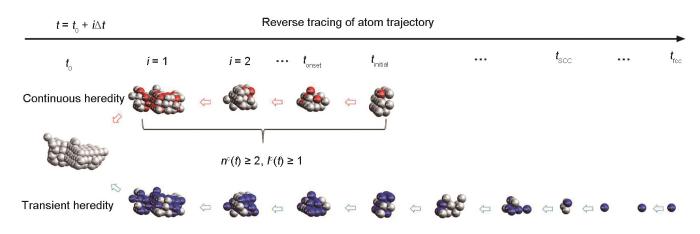
图1
fcc单晶团簇连续遗传和瞬态遗传示意图
Fig.1
Schematics of continuous and transient heredities of fcc single crystal cluster cores, in which red and blue balls represent continuously and transiently inheritable atoms, respectively (t is the isothermal crystallization time; t0 is a designated moment for the reverse tracing of atom trajectories; Δt is the time interval; i = 1, 2, 3, … is recorded step number; tfcc and tSCC are the initial moments of transient heredity of fcc atoms and fcc single crystal cores, respectively; tinitial represents the initial moment of continuous heredity; tonset denotes the onset moment of nucleation corresponding to a critical nucleus; nc(t) and lc(t) are the quantity of continuously inheritable fcc atoms and the number of intercross-sharing (IS) linkages among continuously heritable fcc atoms in fcc single crystal clusters, respectively)
2 模拟结果与分析
2.1 体系能量与结构分析
图2为Al液滴和Al液体在等温结晶过程中系统中每个原子的平均能量(E(t))及其对t的一阶导数(∂E / ∂t)随t的变化。可见,在ΔT ≈ 0.41Tm时,Al液滴和Al液体的液-固相变发生在30~100 ps之间,其中tcs、tcm和tce分别表示相变起始时间、峰值时间和结束时间。图3进一步示出了Al液滴和Al液体在等温结晶过程中tcs、tcm和tce时的双体分布函数(g(r),其中,r为与中心原子的距离)和各类原子的占比。可见,在tcs时,体系中晶体类原子很少,表明体系仍为未结晶的过冷液态;在tcm时,g(r)曲线第一峰和第二峰之间出现次峰,并检测到大量fcc原子以及少量hcp原子,表明体系已发生相变;到tce时,g(r)曲线呈典型的晶态结构特征,fcc原子占比达到50%以上,表明Al液滴和Al液体的等温结晶主要是fcc团簇的形成与演化过程。
图2

图2
Al液滴和Al液体在等温结晶过程中系统中每个原子的平均能量(E(t))及其对等温结晶时间(t)的一阶导数(∂E / ∂t)随t的变化
Fig.2
t dependences of average energy per atom (E(t)) in the Al droplet and Al bulk systems during the isothermal crystallization and its derivative (∂E / ∂t) with respect to t (tcs, tcm, and tce denote the beginning moment, the peak moment, and the ending moment of phase transformation, respectively)
图3

图3
等温结晶过程中Al液滴和Al液体的双体分布函数(g(r))和晶体原子占比
Fig.3
Pair distribution function (g(r)) curves (a, c) and percentages of fcc, hcp, bcc, and ico atoms (b, d) during the isothermal crystallization of Al droplet (a, b) and Al bulk (c, d) (r—distance from the central atom. fcc, hcp, bcc, and ico represent faced-centered cubic, hexagonal close-packed, body-centered cubic, and icosahedral, respectively)
2.2 fcc单晶团簇的生长与演变
图4a为Al液滴和Al液体在等温结晶过程中fcc单晶团簇数目(qSCC)与其核心原子数(nSCC)的平均值(即平均尺寸
图4

图4
在等温结晶过程中Al液滴和Al液体中fcc单晶团簇数目(qSCC)和平均尺寸
Fig.4
2.3 临界晶核的识别与形核特征分析
从上述对fcc单晶团簇随t演变的分析可知,大多数形核事件发生在qSCC达到最大值之前。为此,选择ts作为fcc单晶团簇及其前驱体逆向追踪的起始时间t0,并沿用本课题组先前定义的3条路径[13]来检测ts时刻体系中所有fcc单晶团簇的连续遗传性。依据图1所示识别临界晶核的“种子判据”,在Al液滴和Al液体中先后被识别的临界晶核总数分别为536和444。可见,Al液滴中的临界晶核比Al液体中多,并且与Al液体的均匀形核不同,Al液滴由于存在自由表面,其临界晶核的出现次序和数目分布呈现出区域特征。为此,以Al液滴中心为原点,将半径R ≈ 17 nm的液滴球体划分为芯部区域(记为core)与表层区域(记为shell)。图5为沿Al液滴半径方向的临界晶核数目(qc)分布,其中插图为Al液滴分区示意图。可见,在远离液滴芯部的表层区域,临界晶核的数目比液滴芯部多。
图5
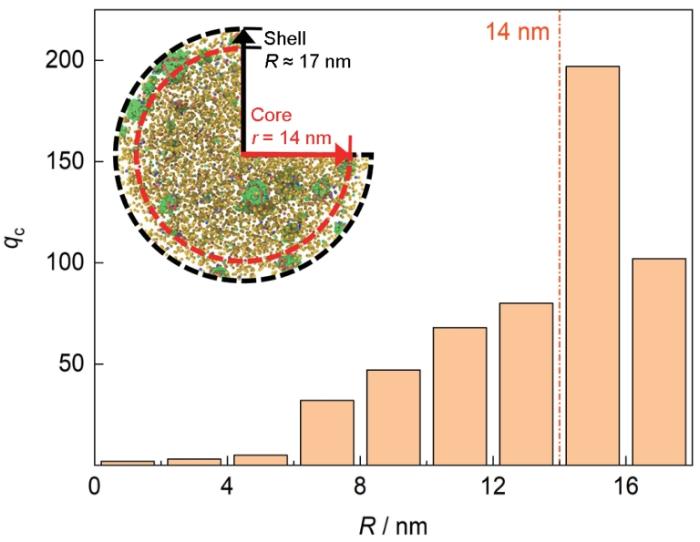
图5
沿Al液滴半径方向的临界晶核数目(qc)分布
Fig.5
Distribution of quantities of critical nuclei (qc) along the radius direction of Al droplet (Inset is a schematic of Al droplet partitioning. R—radius of Al droplet)
为了更清晰地揭示Al液滴的形核特征,需要了解临界晶核的形成时间、尺寸、几何构型以及界面形态。图6a示出了在等温结晶过程中Al液滴芯部和表层及Al液体被识别的临界晶核总数目(qca)随t的变化。可见,临界晶核首先出现在液滴表层,而芯部第一个临界晶核出现的时间则与Al液体中的起始形核时间接近;伴随着
图6
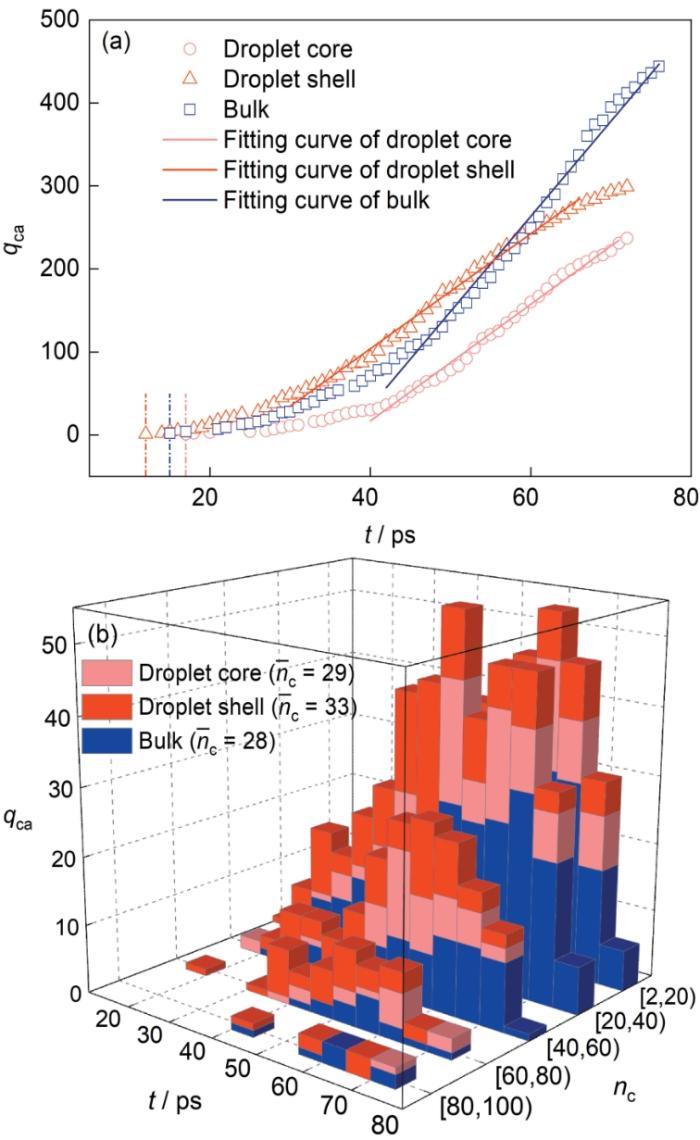
图6
Al液滴芯部和表层及Al液体中临界晶核总数(qca)随t的变化及不同临界尺寸(nc)和不同t下的qca分布
Fig.6
Total quantity of critical nuclei (qca) as a function of t (a) and qca with different critical sizes (nc) at different t (b) in the Al bulk and the core and shell of Al droplet (
图7
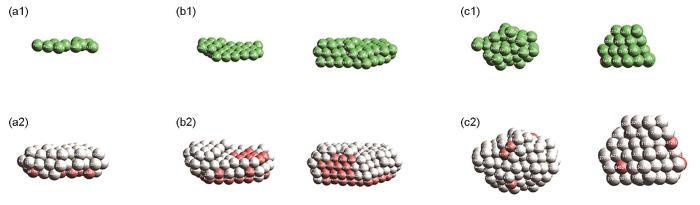
图7
不同形状临界晶核的内部结构和界面形态示意图
Fig.7
Snapshots of internal structures (a1-c1) of critical nuclei and their interfacial morphologies (a2-c2) (Green, red, and gray balls represent fcc, hcp, and other atoms, respectively. The digits on the ball are the identification codes of atoms)
(a1, a2) chainlike (b1, b2) lamellar (c1, c2) ellipsoidal/half-spherical
2.4 临界晶核的孕育
形成临界晶核需要经过一定的时间。由图1可见,在tonset以及tinitial之前,fcc单晶团簇虽不具有连续遗传性,但仍然存在瞬态遗传性。这些具有瞬态遗传性的fcc单晶团簇可视为晶胚[14],其形成临界晶核的过程可分为晶胚的孕育和晶胚的有效生长2个阶段。前者表示fcc原子的形成和演化过程,后者为fcc单晶团簇的形成和长大过程。其中,晶胚孕育时间为τe = tSCC - tfcc,晶胚有效生长时间为
表1
Al液滴芯部、表层和Al液体晶胚的平均孕育时间(
Table 1
| Region | |||
|---|---|---|---|
| Droplet core | 1.89 | 5.19 | 7.08 |
| Droplet shell | 2.31 | 5.06 | 7.37 |
| Bulk | 1.83 | 4.73 | 6.20 |
图8
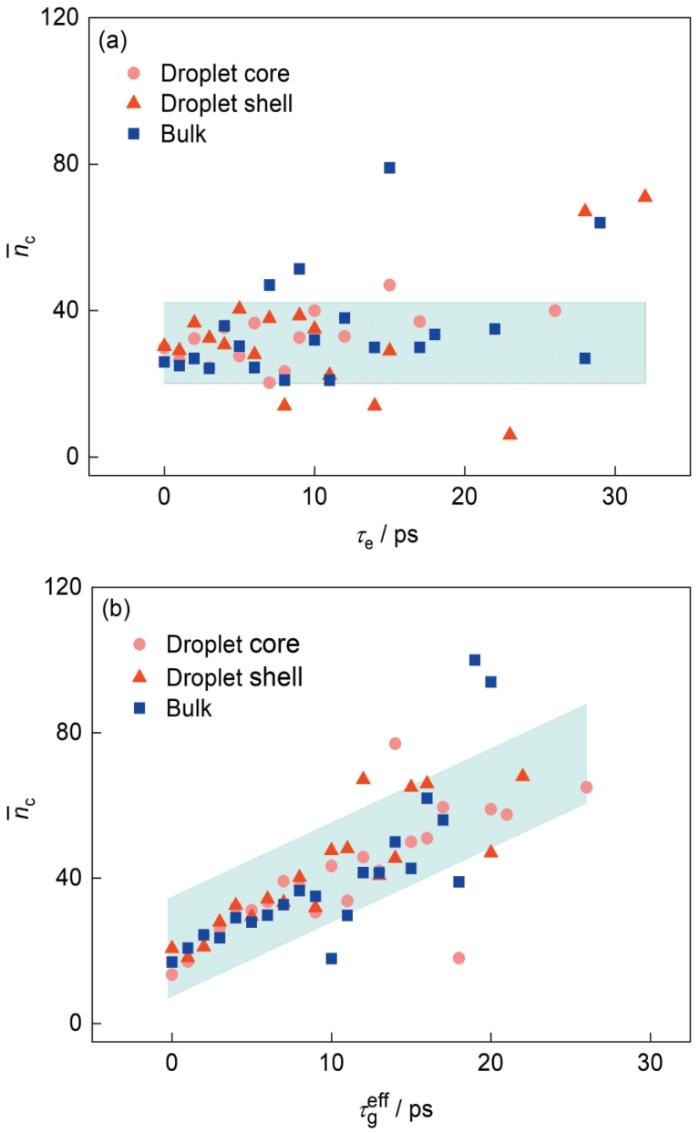
图8
Al液滴芯部和表层及Al液体晶胚孕育时间(τe)和晶胚有效生长时间(
Fig.8
Relationships between incubation time of embryos (τe) (a) and effective growth time (
对晶核孕育过程进一步分析发现,临界晶核的孕育存在4种模式:(I) 不仅存在晶胚孕育,还需要有效生长,即τc ≠ 0;(II) 没有晶胚孕育、只有有效生长,即τe = 0;(III) 晶胚有孕育,但无需有效生长,即
图9
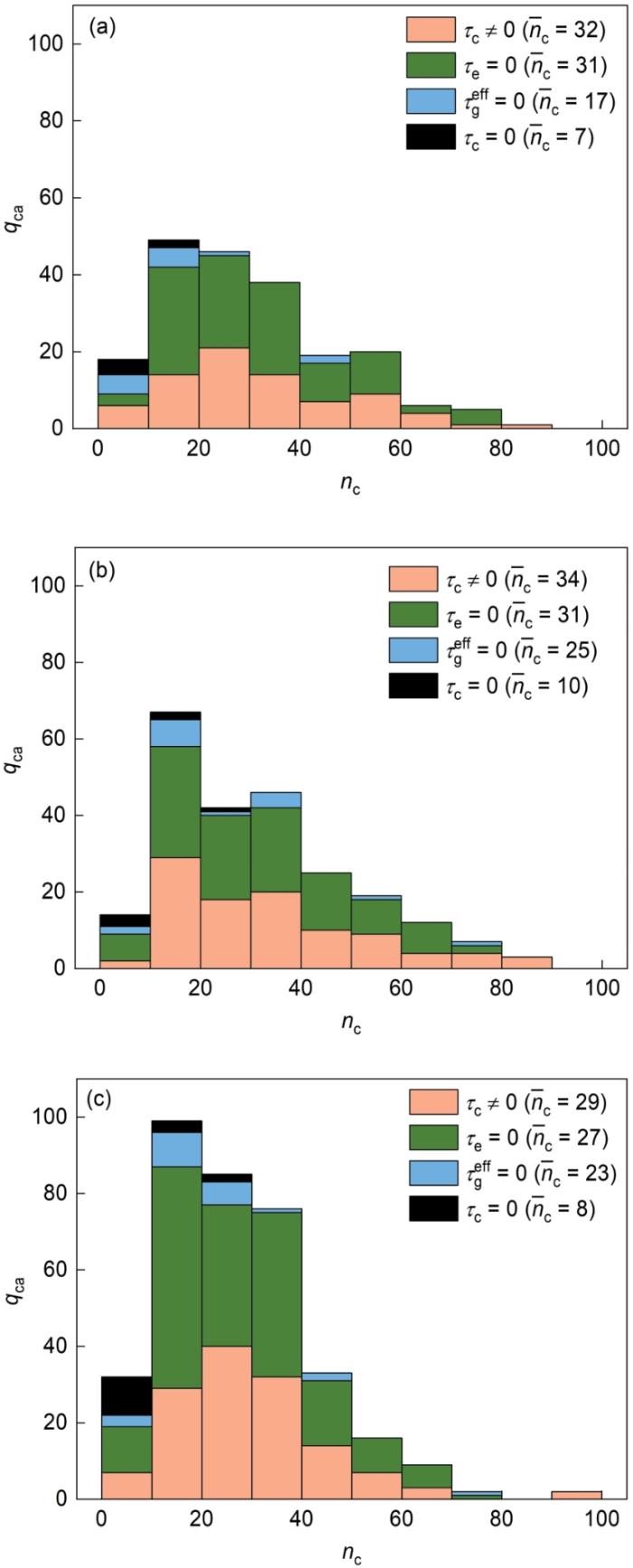
图9
Al液滴芯部和表层及Al液体中由不同模式形成的临界晶核的尺寸和数量
Fig.9
nc and qca of critical nuclei formed by different modes in Al droplet core (a), Al droplet shell (b), and Al bulk (c) (τc—nucleation incubation time)
3 结论
(1) Al液滴中临界晶核首先出现在液滴表层,芯部形成第一个临界晶核的时间与Al液体中的起始形核时间接近;Al液滴表层的稳态形核率最大,芯部次之,Al液体中最小。临界晶核尺寸(nc)在2~100个原子区间,Al液滴芯部临界晶核的平均尺寸
(2) 相较于Al液体,Al液滴的平均形核孕育时间(
(3) 临界晶核通过4种模式形成,即:(I) 不仅存在晶胚孕育,还需要有效生长;(II) 没有晶胚孕育、只有有效生长;(III) 晶胚有孕育,但无需有效生长;(IV) 既无晶胚孕育,也没有有效生长。其中,由模式I形成的临界晶核平均尺寸(
参考文献
Recent progresses in modeling of nucleation during solidification on the atomic scale
[J].
原子尺度下凝固形核计算模拟研究的进展
[J].
Direct observation of spatially isothermal equiaxed solidification of an Al-Cu alloy in microgravity on board the MASER 13 sounding rocket
[J].
Influence of gravity level on columnar-to-equiaxed transition during directional solidification of Al-20 wt.% Cu alloys
[J].
Structural evolution and micromechanical properties of ternary Al-Ag-Ge alloy solidified under microgravity condition
[J].
Theoretical prediction and experimental observation for microstructural evolution of undercooled nickel-titanium eutectic type alloys
[J].
Surface waves on floating liquids induced by ultrasound field
[J].
Understanding homogeneous nucleation in solidification of aluminum by molecular dynamics simulations
[J].
Measuring induction times and crystal nucleation rates
[J].
Molecular origins of homogeneous crystal nucleation
[J].
Overview: Experimental studies of crystal nucleation: Metals and colloids
[J].
The nucleation process and the roles of structure and density fluctuations in supercooled liquid Fe
[J].
Identification and tracking of different types of crystalline nucleiduring isothermal crystallization of amorphous Ag
[J].
非晶Ag晶化过程中不同类型晶核结构的识别与跟踪
[J].
Identification of critical nuclei in the rapid solidification via configuration heredity
[J].
An exact measurement of nucleation incubation times in isothermal crystallizations of liquid metal Al via configuration heredity
[J].
Heterogeneous nucleation in and out of pores
[J].
Kinetic Monte Carlo simulation of the classical nucleation process
[J].
Phase field crystal model for the effect of colored noise on homogenerous nucleation
[J].
噪声对均质形核过程影响的晶体相场法研究
[J].
Fast parallel algorithms for short-range molecular dynamics
[J].
Analysis of semi-empirical interatomic potentials appropriate for simulation of crystalline and liquid Al and Cu
[J].
Formation and description of nano-clusters formed during rapid solidification processes in liquid metals
[J].
A comparative study on local atomic configurations characterized by cluster-type-index method and Voronoi polyhedron method
[J].
A track study on icosahedral clusters inherited from liquid in the process of rapid solidification of Cu64Zr36 alloy
[J].
快凝过程中液态Cu64Zr36合金二十面体团簇遗传与演化跟踪
[J].
Formation mechanism of critical nucleus during nucleation process of liquid metal sodium
[J].
Crystallization in supercooled liquid Cu: Homogeneous nucleation and growth
[J].
Nucleation of stoichiometric compounds from liquid: Role of the kinetic factor
[J].
Kinetic reconstruction of the free-energy landscape
[J].


