|
|
|
| Microstructural Inheritance Behavior and Mechanical Property Control of TA18 Alloy From Ingot to Tube Blank |
LI Shuaiyu1, LIU Zedong1, YANG Jieren1( ), JIN Wei2, PENG Bo1, DU Xin1, ZHOU Siman1 ), JIN Wei2, PENG Bo1, DU Xin1, ZHOU Siman1 |
1 College of Materials Science and Engineering, Sichuan University, Chengdu 610065, China
2 Shi -changxu Innovation Center for Advanced Materials, Institute of Metal Research, Chinese Academy of Sciences, Shenyang 110016, China |
|
Cite this article:
LI Shuaiyu, LIU Zedong, YANG Jieren, JIN Wei, PENG Bo, DU Xin, ZHOU Siman. Microstructural Inheritance Behavior and Mechanical Property Control of TA18 Alloy From Ingot to Tube Blank. Acta Metall Sin, 2026, 62(9): 1487-1502.
|
|
|
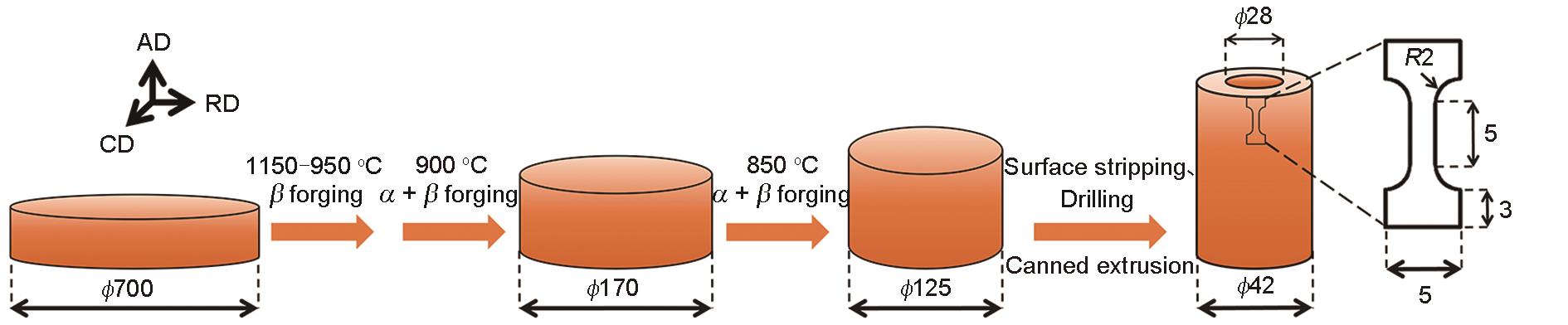
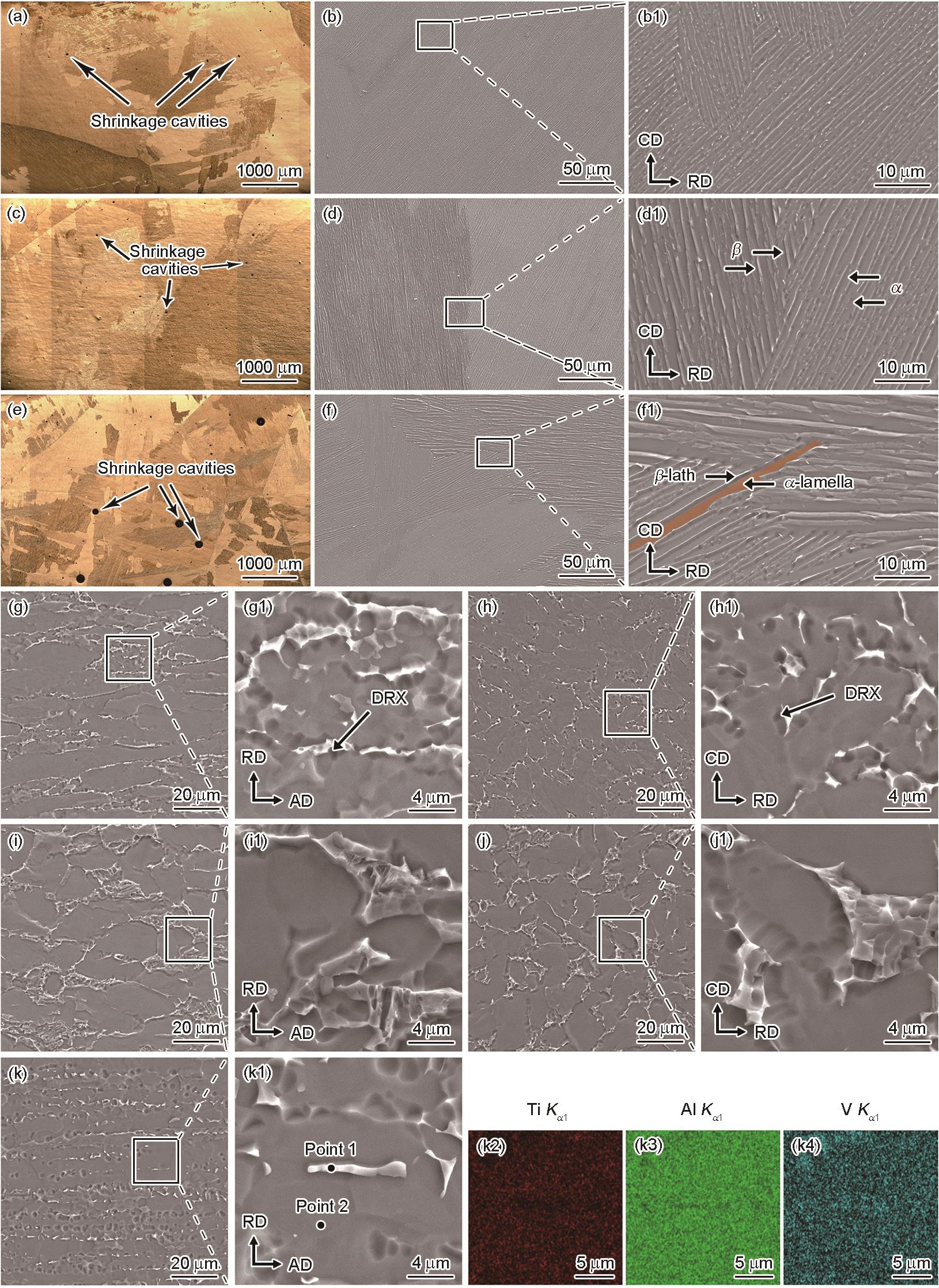
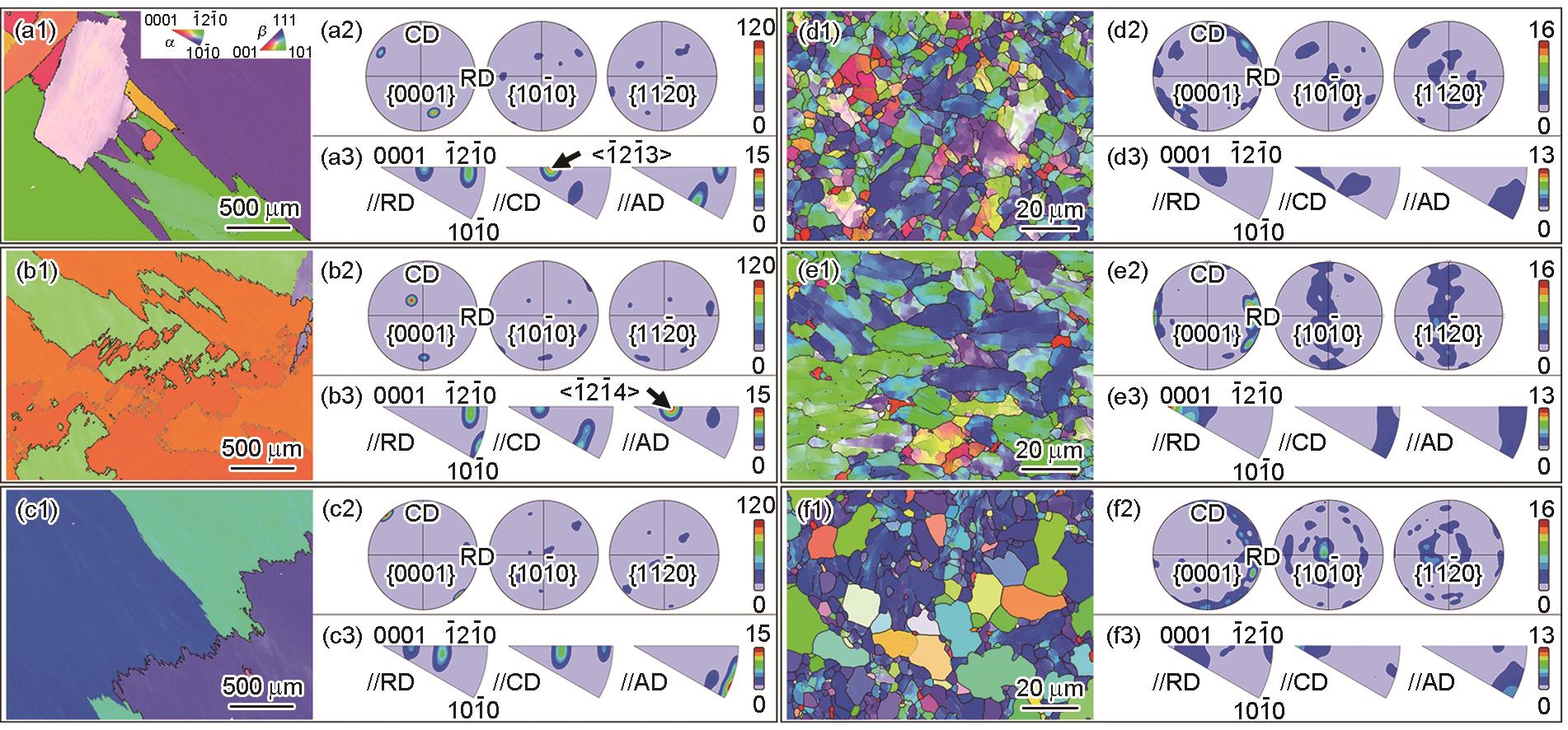
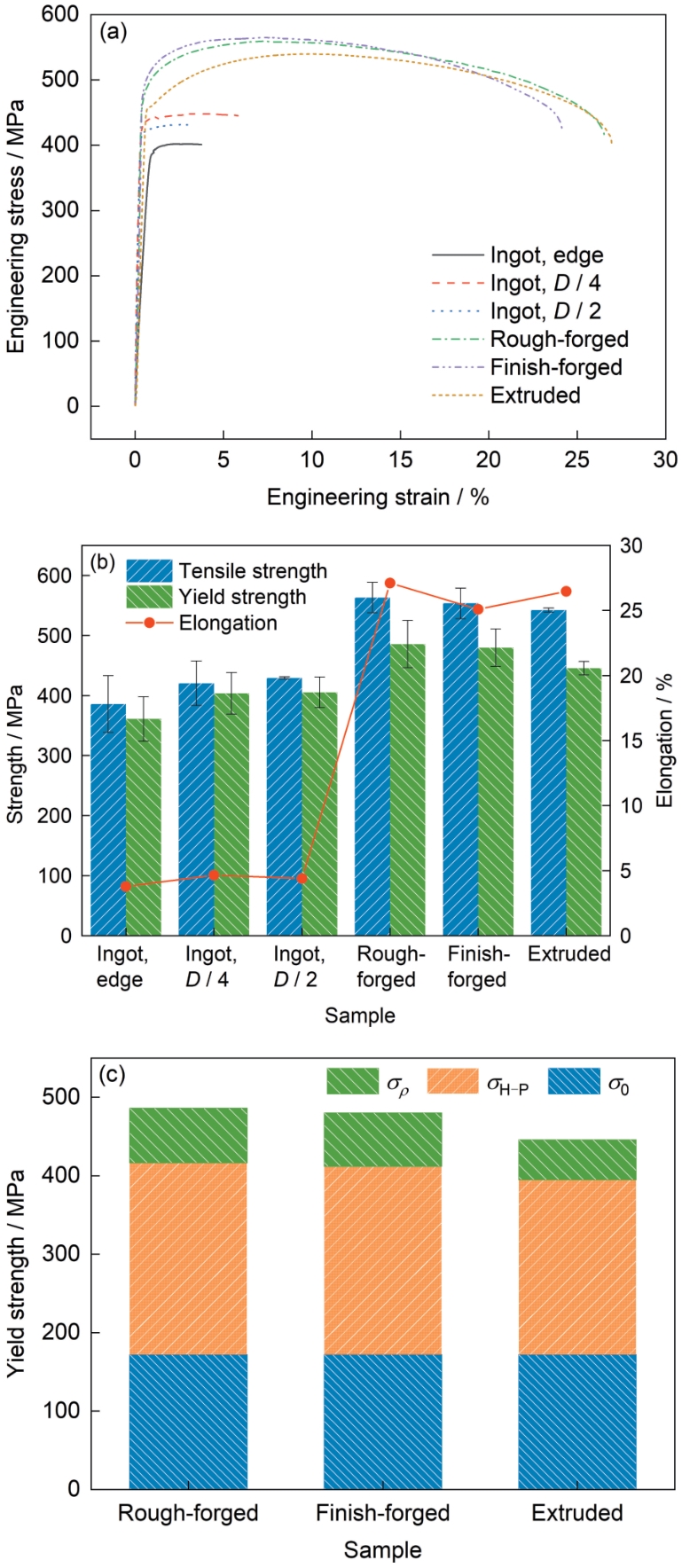
Abstract In metallic material processing, the microstructural and textural characteristics developed during each manufacturing stage establish the structural foundation for subsequent processing operations, creating substantial hereditary effects throughout the multistage manufacturing chain. This progressive, cross-process accumulation of microstructural and textural evolution makes precise tracing and effective control of microstructural inheritance pathways particularly complex during full-scale manufacturing from the initial ingot to the final TA18 tube blank. Microstructural inheritance forms the basis for structural design and property optimization in TA18 alloys. This investigation employed a 700-mm diameter TA18 alloy ingot as the starting material. The thermomechanical processing route comprised three stages: initial multipass forging in the β-phase field (1150-950 oC) followed by forging in the α + β phase field at 900 oC to produce a 170-mm diameter rough-forged bar; subsequent processing of the rough-forged bar in the two-phase region at 850 oC to obtain a 125-mm diameter finish-forged bar; finally, peeling, drilling, and canned hot extrusion of the finish-forged bar to fabricate tube blanks with inner and outer diameters of 28 and 42 mm, respectively. This study systematically investigates the hereditary evolution of microstructure and texture throughout the processing route from ingot to tube blank in the TA18 alloy and evaluates its impact on mechanical properties to guide the integrated control of multiscale microstructure and performance. The results demonstrate that microstructural hereditary characteristics can be categorized into three primary types. (1) Once established during rough forging, the micron-scale grain size and equiaxed α-phase morphology remain stably inherited in subsequent processing stages. Grain refinement serves as the fundamental basis for increasing axial tensile strength from 400 MPa to 550 MPa and improving elongation. (2) The inheritance of low angle grain boundary (LAGB) fraction exhibits dynamic evolution. The high fraction inherited during the rough- and finish-forging stages contributes to work hardening but negatively affects plasticity; in contrast, the low fraction inherited after extrusion, achieved via dynamic recrystallization, results in plasticity recovery. (3) The inheritance of crystallographic texture is governed by multiple competing mechanisms. The {0001}//axial direction (AD) basal texture and the <>//AD texture originating from the central region of the ingot are strongly inherited during subsequent processing, with the intensity of the <>//AD texture continuously increasing. The c-axis orientation of the α-phase undergoes controlled evolution during processing: it is randomly distributed after rough forging, transforms into a radial texture after finish forging, and finally develops into a circumferential texture after extrusion. The TA18 alloy controls the inheritance and evolution of crystallographic orientation through the competition and synergy of various mechanisms, including initial crystallographic orientation, deformation, and dynamic recrystallization. The integrated design of TA18 alloy tube blanks, possessing high strength and good plasticity can be achieved by reinforcing beneficial hereditary features (such as fine grains and favorable texture) and interrupting harmful features (such as high LAGB fraction and unfavorable texture).
|
|
Received: 12 November 2025
|
|
|
| Fund: National Key Research and Development Program of China(2023YFB3710700) |
Corresponding Authors:
YANG Jieren, professor, Tel: 15881010703, E-mail: yangjieren@scu.edu.cn
|
| [1] |
Najafizadeh M, Yazdi S, Bozorg M, et al. Classification and applications of titanium and its alloys: A review [J]. J. Alloys Compd. Commun., 2024, 3: 100019
|
| [2] |
Alabort E, Tang Y T, Barba D, et al. Alloys-by-design: A low-modulus titanium alloy for additively manufactured biomedical implants [J]. Acta Mater., 2022, 229: 117749
doi: 10.1016/j.actamat.2022.117749
|
| [3] |
Xu W C, Tong X Y, Wang Y Q, et al. Research progress on the influence of the deep-sea environment on the stress corrosion of titanium alloys [J]. Acta Metall. Sin., 2025, 61: 1469
doi: 10.11900/0412.1961.2024.00221
|
|
徐玮辰, 佟向瑜, 王优强 等. 深海环境对钛合金应力腐蚀影响的研究进展 [J]. 金属学报, 2025, 61: 1469
doi: 10.11900/0412.1961.2024.00221
|
| [4] |
Yang Z K, Wu J J, Wang M Y, et al. Tensile deformation behavior of high-strength TA18 titanium alloy tube under warm forming conditions and constitutive model based on dislocation density [J]. Mater. Today Commun., 2023, 37: 107336
|
| [5] |
Cheng Z H, Abd El-Aty A, Zhang R S X, et al. Finite element modeling and experimental investigation on manufacturing TA18 alloy pipes via hot free bending forming technology: Forming characteristics and process optimization [J]. J. Mater. Res. Technol., 2024, 29: 5225
doi: 10.1016/j.jmrt.2024.02.187
|
| [6] |
He S T, Zeng W D, Xu J W, et al. The texture evolution related to the interactions between α and β phases in dual-phase region annealing of a near α titanium alloy pipe after Pilger cold rolling [J]. J. Alloys Compd., 2022, 890: 161807
doi: 10.1016/j.jallcom.2021.161807
|
| [7] |
Lu S L, Zhang Z J, Liu R, et al. Optimal tensile properties of laser powder bed fusion hereditary basket-weave microstructure in additive manufactured Ti6Al4V [J]. Addit. Manuf., 2022, 59: 103092
|
| [8] |
Sun Z Y, Mo X F, Li Y F, et al. Effects of hot isostatic pressing parameters on microstructure and properties of TA15 titanium alloy [J]. Spec. Cast. Nonferrous Alloys, 2023, 43: 804
|
|
孙志雨, 莫晓飞, 李亚峰 等. 热等静压工艺参数对TA15钛合金组织及性能的影响 [J]. 特种铸造及有色合金, 2023, 43: 804
|
| [9] |
Wang C Y, Wang Y H, Li Y, et al. Effect of texture inheritance on microstructure of beta C titanium alloy [J]. Rare Met. Mater. Eng., 2023, 52: 3382
|
|
王春阳, 王玉会, 李 野 等. TB9钛合金棒材组织遗传效应与性能(英文) [J]. 稀有金属材料与工程, 2023, 52: 3382
|
| [10] |
Qin X Y, Liu H, Chen Y Y, et al. Optimization in strength-ductility of Mg-Gd-Y-Zn-Al alloy through microstructural heredity process regulation [J]. Mater. Sci. Eng., 2025, A944: 148930
|
| [11] |
Chen Q Y, Zhang W N, Tang S, et al. Microstructural heredity of Ni-containing cryogenic steel and its effect on the toughness at 77 K [J]. Mater. Sci. Eng., 2022, A832: 142441
|
| [12] |
Cheng X, Gao G H, Fu C, et al. Mechanistic understanding of banded microstructure and its effect on anisotropy of toughness in low carbon-low alloy steel [J]. Mater. Sci. Eng., 2025, A919: 147507
|
| [13] |
Azizi N, Mahmudi R. Microstructure, texture, and mechanical properties of the extruded and multi-directionally forged Mg-xGd alloys [J]. Mater. Sci. Eng., 2021, A817: 141385
|
| [14] |
Semiatin S L. An overview of the thermomechanical processing of α/β titanium alloys: Current status and future research opportunities [J]. Metall. Mater. Trans., 2020, 51A: 2593
|
| [15] |
Chen P, Li J S, Li C C, et al. Research on the hot-temperature rheological behavior and microstructural evolution of TA18 titanium alloy [J]. Mater. Today Commun., 2025, 43: 111810
|
| [16] |
Wang Z L, Wang L, Zhang S Y, et al. Analytical springback modelling for thermal-mechanical bending of TA18 tube under non-isothermal loading [J]. Appl. Math. Model., 2025, 143: 115964
doi: 10.1016/j.apm.2025.115964
|
| [17] |
Zhao Z B, Tan H B, Zhang B H, et al. Review: Microtextures in near α and α + β dual-phase titanium alloys [J]. Acta Metall. Sin., 2026, 62: 275
|
|
赵子博, 谭海兵, 张博华 等. 综述: 近α型和α + β两相钛合金的微织构 [J]. 金属学报, 2026, 62: 275
doi: 10.11900/0412.1961.2024.00449
|
| [18] |
Liang C Z, Wang J, Xu J F, et al. High-temperature tensile deformation behavior and damage model of TB6 alloy [J]. J. Inn. Mong. Univ. Technol. Nat. Sci. Ed., 2024, 43: 434
|
|
梁春祖, 王 静, 许江帆 等. TB6钛合金高温拉伸变形过程临界损伤模型 [J]. 内蒙古工业大学学报(自然科学版), 2024, 43: 434
|
| [19] |
Wang B, Li R, Liu J L. Grain refinement of ZALSi7Mg1 alloy by structure heredity [J]. Found. Technol., 2009, 30: 779
|
|
王 斌, 李 日, 刘军利. 利用组织遗传性细化ZAlSi7Mg1合金晶粒的研究 [J]. 铸造技术, 2009, 30: 779
|
| [20] |
Jing Z Q, Sun Y H, Song S C. Numerical simulation of macrosegregation heredity on TC4 titanium alloy ingot by vacuum arc remelting [J]. Metall. Res. Technol., 2023, 120: 116
doi: 10.1051/metal/2023012
|
| [21] |
Li D, Huang H L, Chen C, et al. Additive manufacturing of high strength near β titanium alloy Ti-55511 by engineering nanoscale secondary α laths via in-situ heat treatment [J]. Mater. Sci. Eng., 2021, A814: 141245
|
| [22] |
He S H, He B B, Zhu K Y, et al. On the correlation among dislocation density, lath thickness and yield stress of bainite [J]. Acta Mater., 2017, 135: 382
doi: 10.1016/j.actamat.2017.06.050
|
| [23] |
Zhang Y, Li D S, Li X Q, et al. Creep deformation and strength evolution mechanisms of a Ti-6Al-4V alloy during stress relaxation at elevated temperatures from elastic to plastic loading [J]. J. Mater. Sci. Technol., 2022, 126: 93
doi: 10.1016/j.jmst.2022.02.042
|
| [24] |
Sun Y G, Zhang C J, Feng H, et al. Dynamic recrystallization mechanism and improved mechanical properties of a near α high temperature titanium alloy processed by severe plastic deformation [J]. Mater. Charact., 2020, 163: 110281
doi: 10.1016/j.matchar.2020.110281
|
| [25] |
Fan X G, Yang H, Gao P F. Prediction of constitutive behavior and microstructure evolution in hot deformation of TA15 titanium alloy [J]. Mater. Des., 2013, 51: 34
doi: 10.1016/j.matdes.2013.03.103
|
| [26] |
Matsumoto H, Velay V. Mesoscale modeling of dynamic recrystallization behavior, grain size evolution, dislocation density, processing map characteristic, and room temperature strength of Ti-6Al-4V alloy forged in the (α + β) region [J]. J. Alloys Compd., 2017, 708: 404
doi: 10.1016/j.jallcom.2017.02.285
|
| [27] |
Yang G J, Park S J. Deformation of single crystals, polycrystalline materials, and thin films: A review [J]. Materials, 2019, 12: 2003
doi: 10.3390/ma12122003
|
| [28] |
Zhou Z C, Jiang B B, Qiu J K, et al. Phase interface-induced dwell fatigue cracks in titanium alloy with lamellar microstructure [J]. Sci. China Mater., 2023, 66: 4267
doi: 10.1007/s40843-023-2641-7
|
|
周志春, 江彬彬, 邱建科 等. 片层组织钛合金中相界面诱导保载疲劳裂纹形成(英文) [J]. 中国科学: 材料科学(英文版), 2023, 66: 4267
|
| [29] |
Burtscher M, Alfreider M, Schmuck K, et al. In situ fracture observations of distinct interface types within a fully lamellar intermetallic TiAl alloy [J]. J. Mater. Res., 2021, 36: 2465
doi: 10.1557/s43578-020-00088-z
|
| [30] |
Duan C Z, Zhang L C, Li H H, et al. Ductile fracture due to adiabatic shear during the serrated chip formation in high speed cutting: A microscopic investigation [J]. Key Eng. Mater., 2011, 467-469: 181
doi: 10.4028/www.scientific.net/KEM.467-469
|
| [31] |
Zhang M C, Xu Q S, Liu Y, et al. Effect of hot-pressing temperature on the microstructure and properties of the diffusion-bonded region of TC4 alloy [J]. Acta Metall. Sin., 2025, 61: 1183
doi: 10.11900/0412.1961.2023.00414
|
|
张洺川, 徐勤思, 刘 意 等. 热压温度对TC4合金扩散连接区组织与性能的影响 [J]. 金属学报, 2025, 61: 1183
doi: 10.11900/0412.1961.2023.00414
|
| [32] |
Wang K, Li H H, Zhou Y, et al. Dislocation slip and crack nucleation mechanism in dual-phase microstructure of titanium alloys: A review [J]. Acta Metall. Sin. (Engl. Lett.), 2023, 36: 353
doi: 10.1007/s40195-022-01505-4
|
| [33] |
Fan X G, Zeng X, Yang H, et al. Deformation banding in β working of two-phase TA15 titanium alloy [J]. Trans. Nonferrous Met. Soc. China, 2017, 27: 2390
doi: 10.1016/S1003-6326(17)60265-6
|
| [34] |
Chen G X. Microscopic deformation behavior of Ti-6Ai-4V titanium alloy based on the characteristic of two phase [D]. Qinhuangdao: Yanshan University, 2018
|
|
陈国兴. 基于双相特征的Ti-6Al-4V钛合金微观变形行为研究 [D]. 秦皇岛: 燕山大学, 2018
|
| [35] |
Chen Y T, Wang K, Ren Z. Interaction between phase transformation and static recrystallization during annealing of rolled TC18 titanium alloy [J]. J. Mater. Sci. Technol., 2024, 202: 1
doi: 10.1016/j.jmst.2024.03.011
|
| [36] |
Li Y L, Fang H Z, Chen R R, et al. A comparative analysis of a unique DRX process in achieving a homogeneous distribution of β grains in the single phase region of as-cast Ti644321 alloy [J]. Mater. Charact., 2024, 207: 113505
doi: 10.1016/j.matchar.2023.113505
|
| [37] |
Li H Z, Wu D P, Jiang H J, et al. Dynamic recrystallization mechanism and model of TC31 titanium alloy sheet during hot deformation [J]. J. Mater. Res., 2025, 40: 1877
doi: 10.1557/s43578-025-01620-9
|
| [38] |
Yang Q Y, Ma M, Tan Y B, et al. Microstructure and texture evolution of TB8 titanium alloys during hot compression [J]. Rare Met., 2021, 40: 2917
doi: 10.1007/s12598-020-01643-7
|
| [39] |
Rios P R, Siciliano Jr F, Sandim H R Z, et al. Nucleation and growth during recrystallization [J]. Mater. Res., 2005, 8: 225
doi: 10.1590/S1516-14392005000300002
|
| [40] |
Hadadzadeh A, Mokdad F, Wells M A, et al. A new grain orientation spread approach to analyze the dynamic recrystallization behavior of a cast-homogenized Mg-Zn-Zr alloy using electron backscattered diffraction [J]. Mater. Sci. Eng., 2018, A709: 285
|
| [41] |
Chen Y L, Jin L, Dong J, et al. Twinning effects on the hot deformation behavior of AZ31 Mg alloy [J]. Mater. Charact., 2016, 118: 363
doi: 10.1016/j.matchar.2016.06.014
|
| [42] |
Huang K, Logé R E. A review of dynamic recrystallization phenomena in metallic materials [J]. Mater. Des., 2016, 111: 548
doi: 10.1016/j.matdes.2016.09.012
|
| [43] |
Wang Y S, Li Z D, Wang H Y, et al. Flow behavior and dynamic recrystallization mechanism of a new near-alpha titanium alloy Ti-0.3Mo-0.8Ni-2Al-1.5Zr [J]. J. Mater. Res. Technol., 2024, 30: 3863
doi: 10.1016/j.jmrt.2024.04.076
|
| [44] |
Xie B C, Zhang B Y, Yu H, et al. Nucleation mechanism of discontinuous dynamic recrystallization with restrained grain boundary sliding [J]. Met. Mater. Int., 2021, 27: 5476
doi: 10.1007/s12540-020-00847-x
|
| [45] |
Qiang F M, Kou H C, Zhang Y D, et al. Crystallographic orientation related dynamic recrystallization behavior and its impact on texture development of high-temperature α phase in TiAl alloy [J]. J. Alloys Compd., 2025, 1010: 178066
doi: 10.1016/j.jallcom.2024.178066
|
| [46] |
Burgers W G. On the process of transition of the cubic-body-centered modification into the hexagonal-close-packed modification of zirconium [J]. Physica, 1934, 1: 561
doi: 10.1016/S0031-8914(34)80244-3
|
| [47] |
Li J S, Tang B, Fan J K, et al. Deformation mechanism and microstructure control of high strength metastable β titanium alloy [J]. Acta Metall. Sin., 2021, 57: 1438
|
|
李金山, 唐 斌, 樊江昆 等. 高强亚稳β钛合金变形机制及其组织调控方法 [J]. 金属学报, 2021, 57: 1438
doi: 10.11900/0412.1961.2021.00352
|
| [48] |
Guo B Q, Jonas J J. Dynamic transformation during the high temperature deformation of titanium alloys [J]. J. Alloys Compd., 2021, 884: 161179
doi: 10.1016/j.jallcom.2021.161179
|
| [49] |
Shi R, Dixit V, Viswanathan G B, et al. Experimental assessment of variant selection rules for grain boundary α in titanium alloys [J]. Acta Mater., 2016, 102: 197
doi: 10.1016/j.actamat.2015.09.021
|
| [50] |
Li H, Wei D, Zhang H Q, et al. Texture evolution and controlling of high-strength titanium alloy tube in cold pilgering for properties tailoring [J]. J. Mater. Process. Technol., 2020, 279: 116520
doi: 10.1016/j.jmatprotec.2019.116520
|
| [51] |
Chatterjee R, Narayana Murty S V S, Alankar A. Dynamic recrystallization in titanium alloys: A comprehensive review [J]. Mater. Perform. Charact., 2020, 9: 1
|
| [52] |
Hall E O. The deformation and ageing of mild steel: III Discussion of results [J]. Proc. Phys. Soc., 1951, 64B: 747
|
| [53] |
Petch N J. The cleavage strength of polycrystals [J]. J. Iron Steel Inst., 1953, 174: 25
|
| [54] |
Hémery S, Naït-Ali A, Smerdova O, et al. Deformation mechanisms in the α phase of the Ti-6Al-2Sn-4Zr-2Mo titanium alloy: In situ experiments and simulations [J]. Int. J. Plast., 2024, 175: 103947
doi: 10.1016/j.ijplas.2024.103947
|
| [55] |
Spurr W F, Quist W E. The effects of crystallographic texture on the mechanical and fracture properties of Ti-3Al-2.5V hydraulic tubing [J]. SAE Trans., 1973, 82: 730515
|
| No Suggested Reading articles found! |
|
|
Viewed |
|
|
|
Full text
|
|
|
|
|
Abstract
|
|
|
|
|
Cited |
|
|
|
|
| |
Shared |
|
|
|
|
| |
Discussed |
|
|
|
|