|
|
|
| Phase Constitution, Microstructure, and Properties of Ti-Doped SmFe12-Based Nanocrystalline Permanent Magnetic Alloys |
CHENG Feng, LU Hao( ), LIU Xuemei, SONG Xiaoyan() |
| State Key Laboratory of Materials Low-Carbon Recycling, Key Laboratory of Advanced Functional Materials, MOE, College of Materials Science and Engineering, Beijing University of Technology, Beijing 100124, China |
|
Cite this article:
CHENG Feng, LU Hao, LIU Xuemei, SONG Xiaoyan. Phase Constitution, Microstructure, and Properties of Ti-Doped SmFe12-Based Nanocrystalline Permanent Magnetic Alloys. Acta Metall Sin, 2026, 62(10): 1727-1736.
|
|
|
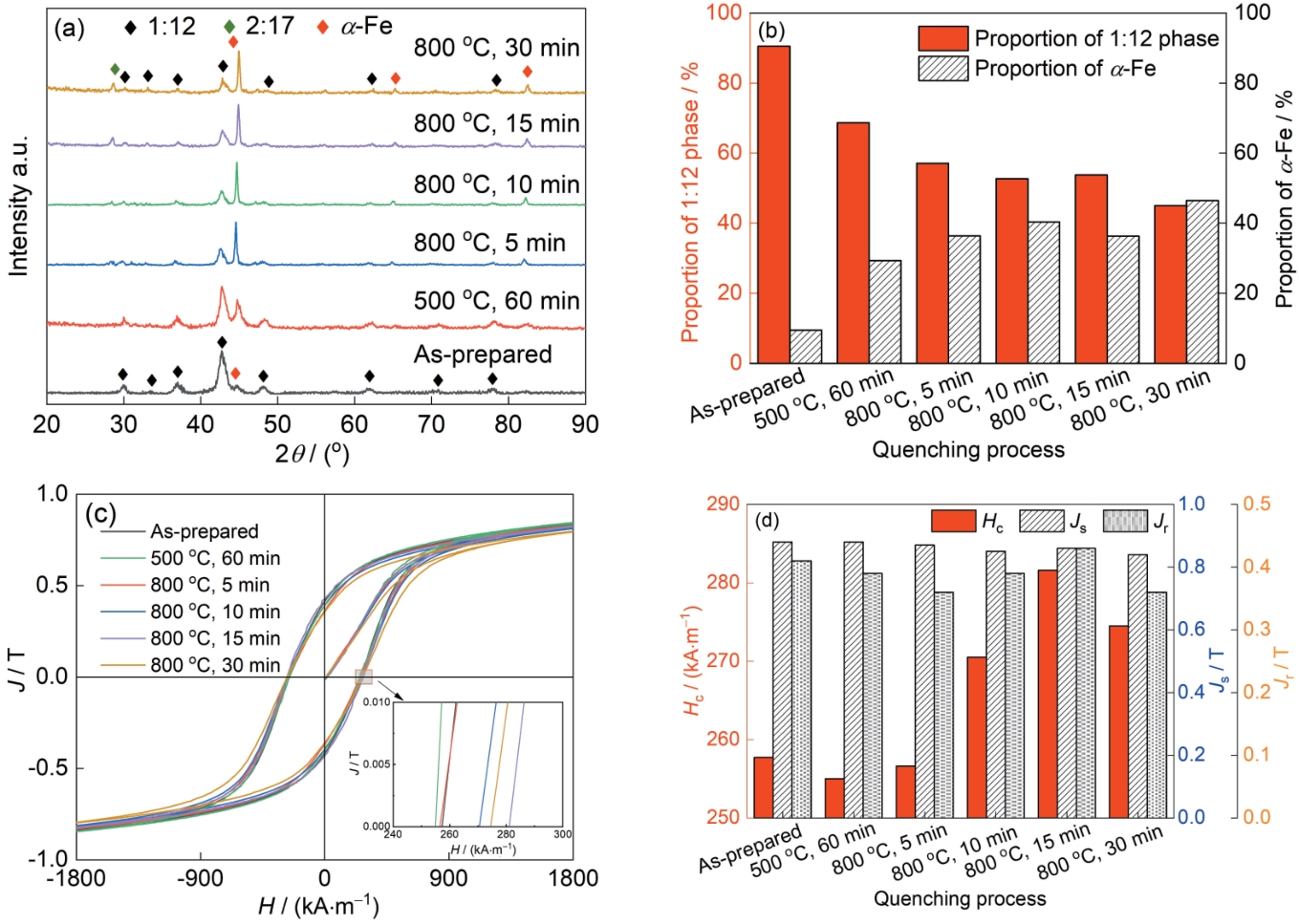
Abstract With the growing demand for rare-earth permanent magnetic materials and the overexploitation of rare-earth resources, ThMn12-type SmFe12-based alloys have attracted significant research interest. However, the SmFe12 phase exhibits poor structural stability and decomposes into the α-Fe phase at room temperature, drastically reducing the alloy's coercivity. The challenge of developing bulk SmFe12-based alloys with high coercivity has hindered their application as permanent magnetic materials. This study optimized Ti doping concentrations to achieve nearly single-phase SmFe12-based alloys. The SmFe12-based alloy ingot demonstrated high saturation magnetization but low coercivity. Amorphous SmFe11Ti1 alloy powder was prepared via high-energy ball milling, followed by rapid hot-pressing sintering, which induced crystallization and yielded nanocrystalline SmFe12-based sintered magnets with high phase purity. The combination of high-energy ball milling and rapid hot-pressing sintering significantly enhanced the coercivity of the sintered magnets compared to the original ingot. By optimizing the heat treatment process, the grain size and phase constitution of the alloy were effectively controlled. After heat treatment, the main phase remained SmFe12, with grain sizes approaching the single-domain dimension of SmFe12, leading to further coercivity enhancement. The approach proposed in this study—synergistically tailoring the phase constitution and microstructure of SmFe12-based alloys through alloying, nanocrystallization, and heat treatment—offers a new pathway for developing high-coercivity SmFe12-based magnets.
|
|
Received: 18 October 2024
|
|
|
| Fund: National Key Research and Development Program of China(2021YFB3501502);National Key Research and Development Program of China(2021YFB3501504) |
Corresponding Authors:
LU Hao, Tel: (010)67392829, E-mail: haolu@bjut.edu.cn;
SONG Xiaoyan, professor, Tel: (010)67392311, E-mail: xysong@bjut.edu.cn
|
| [1] |
Jones N. Materials science: The pull of stronger magnets[J]. Nature, 2011, 472: 22
doi: 10.1038/472022a
|
| [2] |
Xu W W, Song X Y, Zhang Z X. Thermodynamic study on metastable phase: From polycrystalline to nanocrystalline system[J]. Appl. Phys. Lett., 2010, 97: 181911
doi: 10.1063/1.3509407
|
| [3] |
Takahashi Y, Sepehri-Amin H, Ohkubo T. Recent advances in SmFe12-based permanent magnets[J]. Sci. Technol. Adv. Mater., 2021, 22: 449
doi: 10.1080/14686996.2021.1913038
|
| [4] |
Guo Z H, Li W. Room- and high-temperature magnetic properties of Sm(CobalFe x Cu0.088Zr0.025)7.5 (x = 0-0.30) sintered magnets[J]. Acta Metall. Sin., 2002, 38: 866
|
|
郭朝晖, 李 卫. Sm(CobalFe x Cu0.088Zr0.025)7.5 (x = 0~ 0.30)烧结永磁体的磁性及其高温特性[J]. 金属学报, 2002, 38: 866
|
| [5] |
Li J, Tang X, Sepehri-Amin H, et al. Angular dependence and thermal stability of coercivity of Nd-rich Ga-doped Nd-Fe-B sintered magnet[J]. Acta Mater., 2020, 187: 66
doi: 10.1016/j.actamat.2020.01.035
|
| [6] |
Pathak A K, Khan M, Gschneidner Jr K A, et al. Cerium: An unlikely replacement of dysprosium in high performance Nd-Fe-B permanent magnets[J]. Adv. Mater., 2015, 27: 2663
doi: 10.1002/adma.v27.16
|
| [7] |
Sato T, Ohsuna T, Yano M, et al. Permanent magnetic properties of NdFe12N x sputtered films epitaxially grown on V buffer layer[J]. J. Appl. Phys., 2017, 122: 053903
|
| [8] |
Liu Z W, He J Y. Several issues on the development of grain boundary diffusion process for Nd-Fe-B permanent magnets[J]. Acta Metall. Sin., 2021, 57: 1155
|
|
刘仲武, 何家毅. 钕铁硼永磁晶界扩散技术和理论发展的几个问题[J]. 金属学报, 2021, 57: 1155
doi: 10.11900/0412.1961.2020.00438
|
| [9] |
Hirayama Y, Takahashi Y K, Hirosawa S, et al. Intrinsic hard magnetic properties of Sm (Fe1 - x Co x )12 compound with the ThMn12 structure[J]. Scr. Mater., 2017, 138: 62
doi: 10.1016/j.scriptamat.2017.05.029
|
| [10] |
Li Y C, Yu N J, Pan M X, et al. Research progress on SmFe12-based permanent magnet alloys[J]. J. Magn. Mater. Devices, 2022, 53(6): 111
|
|
李迎畅, 俞能君, 泮敏翔 等. SmFe12基永磁合金研究进展[J]. 磁性材料及器件, 2022, 53(6): 111
|
| [11] |
Ohashi K, Tawara Y, Osugi R, et al. Identification of the intermetallic compound consisting of Sm, Ti, Fe[J]. J. Less-Common Met., 1998, 139: L1
doi: 10.1016/0022-5088(88)90020-3
|
| [12] |
Harashima Y, Fukazawa T, Kino H, et al. Effect of R-site substitution and the pressure on stability of RFe12: A first-principles study[J]. J. Appl. Phys., 2018, 124: 163902
doi: 10.1063/1.5050057
|
| [13] |
Harashima Y, Terakura K, Kino H, et al. First-principles study on stability and magnetism of NdFe11 M and NdFe11Mn for M = Ti, V, Cr, Mn, Fe, Co, Ni, Cu, Zn[J]. J. Appl. Phys., 2016, 120: 203904
doi: 10.1063/1.4968798
|
| [14] |
Yang Y C, Kong L S, Sun S H, et al. Intrinsic magnetic properties of SmTiFe10 [J]. J. Appl. Phys., 1988, 63: 3702
doi: 10.1063/1.340667
|
| [15] |
De Mooij D B, Buschow K H J. Some novel ternary ThMn12-type compounds[J]. J. Less-Common Met., 1988, 136: 207
doi: 10.1016/0022-5088(88)90424-9
|
| [16] |
Dirba I, Harashima Y, Sepehri-Amin H, et al. Thermal decomposition of ThMn12-type phase and its optimum stabilizing elements in SmFe12-based alloys[J]. J. Alloys Compd., 2020, 813: 152224
doi: 10.1016/j.jallcom.2019.152224
|
| [17] |
Tang X, Li J, Srinithi A K, et al. Role of V on the coercivity of SmFe12-based melt-spun ribbons revealed by machine learning and microstructure characterizations[J]. Scr. Mater., 2021, 200: 113925
doi: 10.1016/j.scriptamat.2021.113925
|
| [18] |
Hadjipanayis G C, Gabay A M, Schönhöbel A M, et al. ThMn12-type alloys for permanent magnets[J]. Engineering, 2020, 6: 141
doi: 10.1016/j.eng.2018.12.011
|
| [19] |
Saito T, Watanabe F, Nishio-Hamane D. Magnetic properties of SmFe12-based magnets produced by spark plasma sintering method[J]. J. Alloys Compd., 2019, 773: 1018
doi: 10.1016/j.jallcom.2018.09.297
|
| [20] |
Li Y C, Yu N J, Wu Q, et al. Novel method for preparation of high-performance SmFe12/α-Fe nanocomposite magnets by rapid thermal processing[J]. J. Alloys Compd., 2023, 954: 170056
doi: 10.1016/j.jallcom.2023.170056
|
| [21] |
Qian H D, Lim J T, Kim J W, et al. Phase transformation and magnetic properties of fully dense Sm(Fe0.8Co0.2)11Ti bulk magnets[J]. Scr. Mater., 2021, 193: 17
doi: 10.1016/j.scriptamat.2020.10.030
|
| [22] |
Zhang D L. Processing of advanced materials using high-energy mechanical milling[J]. Prog. Mater. Sci., 2004, 49: 537
doi: 10.1016/S0079-6425(03)00034-3
|
| [23] |
Luo Y, Yu D B, LI H W, et al. Structure and permanent magnetic properties of SmFe x (x = 3~8) melt spun ribbons during heat treatment[J]. J. Rare Earth, 2014, 32: 960
doi: 10.1016/S1002-0721(14)60169-1
|
| [24] |
Maât N, Lardé R, Nachbaur V, et al. Investigation by Mössbauer spectroscopy and atom probe tomography of the phase transformation of Nd-Fe-B alloys after high-energy ball milling[J]. J. Appl. Phys., 2018, 124: 223905
doi: 10.1063/1.5048619
|
| [25] |
Liu K, Wang S H, Feng Y L, et al. Phase transformation mechanism and magnetic properties of Sm-Fe alloys produced by melt-spinning and high-energy ball milling[J]. J. Magn. Magn. Mater., 2020, 513: 167229
doi: 10.1016/j.jmmm.2020.167229
|
| [26] |
Xiao Q F, Sun X K, Geng D Y, et al. Structure and magnetic properties of rapidly quenched Sm-Fe-Ti alloys[J]. J. Magn. Magn. Mater., 1995, 140-144: 1093
doi: 10.1016/0304-8853(94)01251-2
|
| [27] |
Sun H, Otani Y, Coey J M D, et al. Coercivity and microstructure of melt-spun Sm(Fe11Ti)[J]. J. Appl. Phys., 1990, 67: 4659
doi: 10.1063/1.344845
|
| [28] |
Tozman P, Sepehri-Amin H, Hono K. Prospects for the development of SmFe12-based permanent magnets with a ThMn12-type phase[J]. Scr. Mater., 2021, 194: 113686
doi: 10.1016/j.scriptamat.2020.113686
|
| [29] |
Jang T S, Stadelmaier H H. Phase equilibria and magnetic properties of iron-rich Fe-Nd-Ti and Fe-Sm-Ti alloys[J]. J. Appl. Phys., 1990, 67: 4957
doi: 10.1063/1.344746
|
| [30] |
Schrefl T, Fidler J, Kronmüller H. Remanence and coercivity in isotropic nanocrystalline permanent magnets[J]. Phys. Rev., 1994, 49B: 6100
|
| [31] |
Polin N, Gabay A M, Han C Y, et al. Understanding high coercivity in ThMn12-type Sm-Zr-Fe-Co-Ti permanent magnet powders through nanoscale analysis[J]. Scr. Mater., 2025, 259: 116537
doi: 10.1016/j.scriptamat.2025.116537
|
| [32] |
Coey J M D, Sun H. Improved magnetic properties by treatment of iron-based rare earth intermetallic compounds in anmonia[J]. J. Magn. Magn. Mater., 1990, 87: L251
doi: 10.1016/0304-8853(90)90756-G
|
| No Suggested Reading articles found! |
|
|
Viewed |
|
|
|
Full text
|
|
|
|
|
Abstract
|
|
|
|
|
Cited |
|
|
|
|
| |
Shared |
|
|
|
|
| |
Discussed |
|
|
|
|