



增材制造技术具有近净成形的特点,且生产过程不需要模具,可制备具有复杂结构的镍基高温合金零部件[3]。在成形过程中,增材制造技术具有快速冷却、快速加热的特点[4],能够降低元素在枝晶间和枝晶干的偏析,使组织更加均匀。但过快的冷却速率导致产生的应力来不及释放而残留在成形样品内部,是裂纹产生的重要因素[5]。铸造镍基高温合金中的γ′相含量对其高温性能有着重要影响,最佳的γ′相体积分数在65%左右[6],但高γ′相含量的镍基高温合金在增材制造过程中打印窗口较窄,易产生裂纹[7,8]。增材制造镍基高温合金中的热裂纹分为凝固裂纹和液化裂纹[9]。凝固裂纹发生在凝固末期,因液流补缩不足所致[10]。液化裂纹是因低熔点相在激光加热过程中熔化形成液膜所致,液膜的强度较低,在应力作用下被撕裂产生裂纹[11,12]。然而,通过工艺优化很难完全消除裂纹[13],通过后处理、热等静压工艺等则会增加制造成本[14]。
合金设计是保证镍基合金高温性能并降低裂纹敏感性的有效途径[15]。固溶强化通过增强合金的本征强度可以有效抑制裂纹的产生和扩展,并提高合金的强度[16]。有研究证明,固溶元素对裂纹有抑制作用[17],且固溶元素会改变γ/γ'相的错配度,进而控制γ'相的形貌,从而影响合金强度[18]。因此,调控固溶元素是开发既保证高温下材料的力学性能,又兼顾镍基高温合金可打印性的一种有效方法。然而,固溶元素中包含W、Mo和Re等难熔元素,在长期使用过程中,这些难熔元素的偏析会导致有害密排拓扑(TCP)相析出,降低了合金的高温性能[19]。本工作重点研究高温合金在高γ′相含量的前提下,通过调控固溶元素,兼顾合金可打印性和可使用性,以及控制有害相TCP相的析出,设计出强度和塑性均较为优异的增材制造专用镍基高温合金。本工作为固溶元素在增材制造镍基高温合金成分设计的应用奠定了基础。
1 实验方法
1.1 样品制备
表1 5因素3水平正交表 (mass fraction / %)
Table 1
| Level | Co | Cr | W | Mo | Re |
|---|---|---|---|---|---|
| 1 | 8.0 | 5.0 | 5.0 | 0.0 | 0.0 |
| 2 | 10.0 | 7.5 | 7.5 | 2.5 | 3.0 |
| 3 | 12.0 | 10.0 | 10.0 | 5.0 | 6.0 |
表2 镍基高温合金中固溶元素的名义成分 (mass fraction / %)
Table 2
| Alloy | Co | Cr | W | Mo | Re |
|---|---|---|---|---|---|
| ZGH-1 | 8.0 | 10.0 | 7.5 | 0.0 | 0.0 |
| ZGH-2 | 10.0 | 10.0 | 5.0 | 0.0 | 3.0 |
| ZGH-3 | 8.0 | 7.5 | 10.0 | 0.0 | 0.0 |
| ZGH-4 | 12.0 | 10.0 | 5.0 | 2.5 | 0.0 |
| ZGH-5 | 10.0 | 7.5 | 5.0 | 0.0 | 6.0 |
| ZGH-6 | 12.0 | 5.0 | 10.0 | 0.0 | 3.0 |
| ZGH-7 | 12.0 | 5.0 | 7.5 | 0.0 | 6.0 |
| ZGH-8 | 12.0 | 7.5 | 5.0 | 5.0 | 0.0 |
| ZGH-9 | 8.0 | 7.5 | 7.5 | 2.5 | 3.0 |
| ZGH-10 | 10.0 | 5.0 | 7.5 | 5.0 | 0.0 |
| ZGH-11 | 8.0 | 5.0 | 5.0 | 2.5 | 6.0 |
| ZGH-12 | 8.0 | 5.0 | 5.0 | 5.0 | 3.0 |
图1
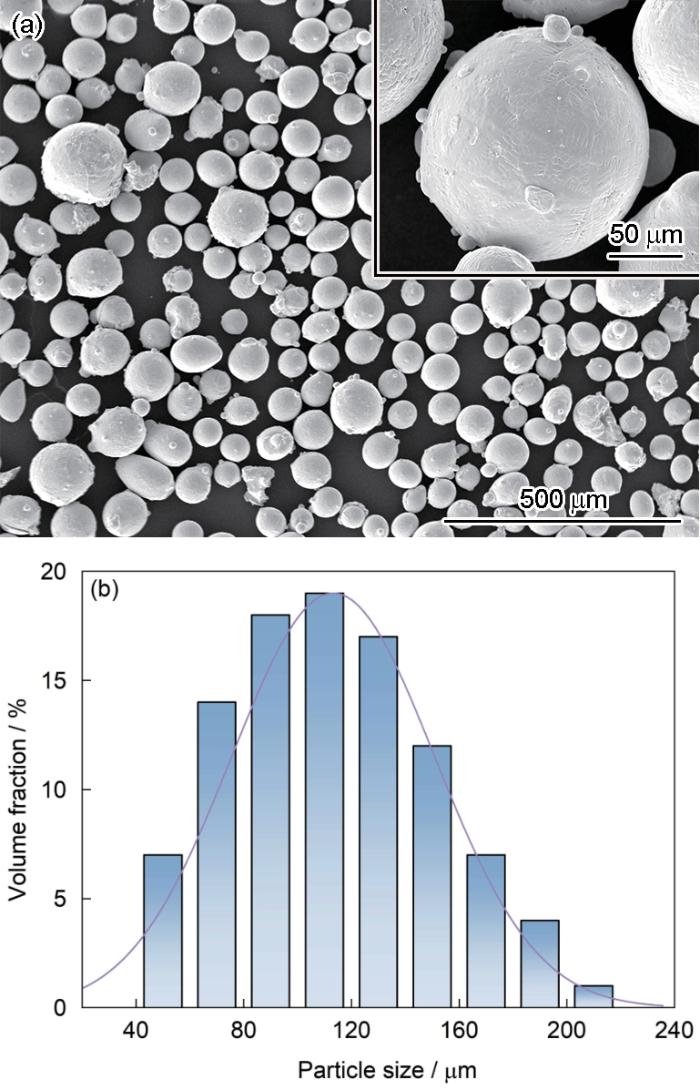
图1
合金粉末形貌和粒径分布
Fig.1
Morphology (a) and particle size distribution (b) of alloy powders (Inset in Fig.1a is the enlarged view of powders)
每种合金样品均采用4KW YLS-4000激光器通过激光能量沉积技术制备,制备工艺参数为:激光功率1200 W,扫描速率1200 mm/min,层厚0.167 mm,送粉量11 g/min,光斑直径2 mm;Ar气作为保护气。成形尺寸为16 mm × 16 mm × 20 mm的样品用于显微组织观察,成形尺寸为16 mm × 16 mm × 50 mm的样品用于拉伸性能测试。
1.2 组织表征
使用Thermo-Calc热力学软件计算合金中的γ'相含量,数据库为TCNI10。每个样品从外部到内部间隔2 mm取纵截面,抛光后用DMC4500金相显微镜(OM)观察裂纹,拼接之后用Image Pro Plus软件对裂纹的面积分数进行统计。对于机械磨抛后的样品,采用电解抛光的方式对表面进行去应力处理,电压25 V,时间15~30 s,电解抛光液为10 mL HClO4 + 90 mL C2H6O溶液,腐蚀温度为室温。采用D/MAX-2500PC型旋转阳极X射线衍射仪(XRD)测定γ/γ'相界面错配度。使用带有能谱仪(EDS)的MIRA扫描电镜(SEM)分辨不同成分样品中的裂纹类型,并观察1000 ℃下分别热暴露100和500 h样品中TCP相的析出情况,以及拉伸样品的断口形貌。抛光后的样品用170 mL H3PO4 + 10 mL H2SO4 + 15 g Cr2O3溶液进行电解腐蚀,电压5 V,时间10~20 s (或者用25 g CuCl2 + 100 mL HCl +100 mL C2H6O溶液进行化学腐蚀)。在待观察区切取500 μm厚的片状样品,用砂纸打磨至50 μm厚,并将其冲压成直径3 mm的圆形薄片,最后用电解双喷减薄仪对薄片进行减薄,采用的电压为20 V,温度-25 ℃左右,双喷液为10%HClO4 + 90%C2H6O (体积分数)。采用附带EDS的Talos F200X型透射电镜(TEM)的高分辨TEM (HRTEM)像和选区电子衍射(SAED)花样对热暴露样品中的析出相进行鉴定,并观察拉伸变形后的位错组态,工作电压200 kV。
1.3 拉伸实验
图2
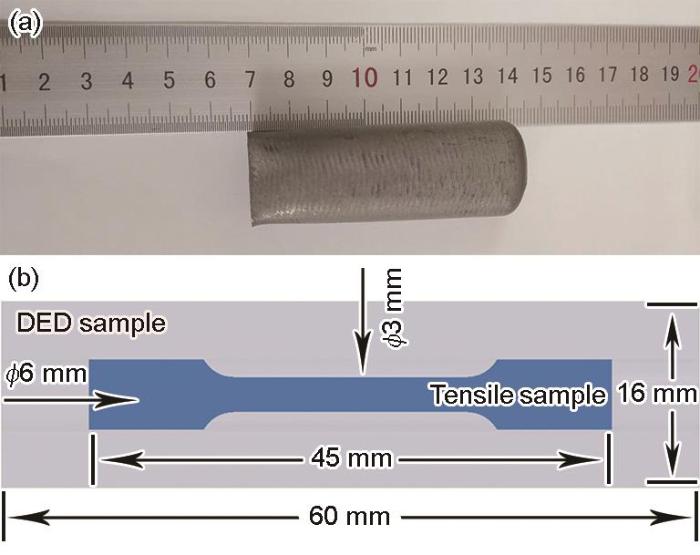
图2
激光能量沉积后用于拉伸测试样品实物图和拉伸试样的尺寸
Fig.2
As-deposited sample fabricated by directed energy deposition (DED) (a) and schematic of sample (b) for tensile testing
2 实验结果及分析
2.1 γ' 相含量
图3
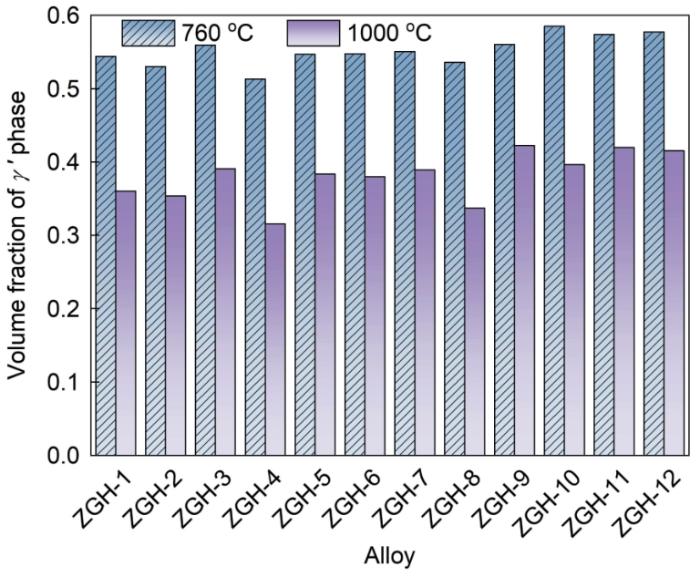
图3
Thermo-Calc计算的合金在760和1000 ℃下的γ'相含量
Fig.3
γ' phase content calculated by Thermo-Calc at 760 and 1000 oC
2.2 裂纹
表3 镍基高温合金中各元素固溶强化系数和合金元素的d轨道能级(Md)[16,20]
Table 3
| Element | ki MPa∙At. Fraction-1/2 | Md valueeV |
|---|---|---|
| Al | 225 | 1.900 |
| Ti | 775 | 2.271 |
| Ta | 1191 | 2.224 |
| Co | 39.4 | 0.777 |
| Cr | 337 | 1.142 |
| W | 977 | 1.655 |
| Mo | 1015 | 1.550 |
| Re | 1000 | 1.267 |
| C | 1061 | - |
图4
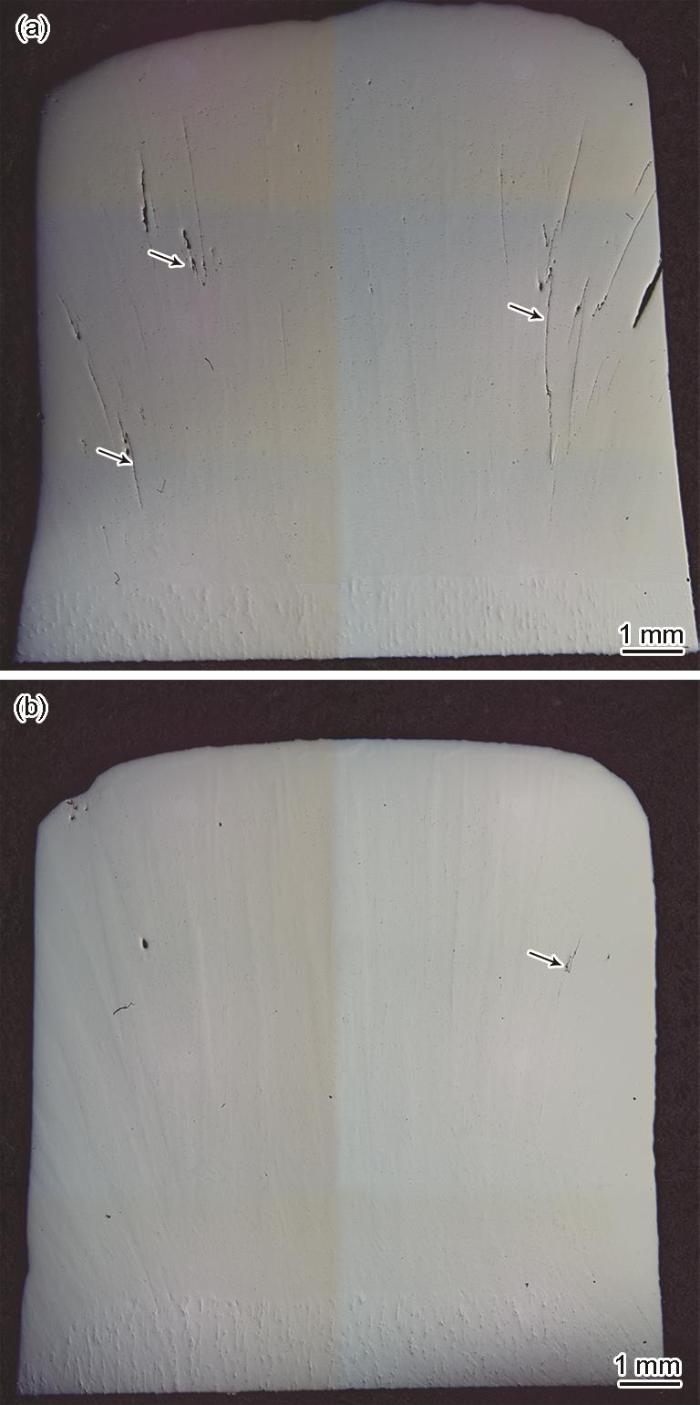
图4
ZGH-1和ZGH-10合金中纵截面的裂纹分布情况
Fig.4
Cracks (indicated by arrows) on the longitudinal sections of ZGH-1 (a) and ZGH-10 (b) alloys
图5

图5
合金固溶强度与裂纹面积分数的关系
Fig.5
Relationships between solid solution strength (
虽然有一些合金的
图6
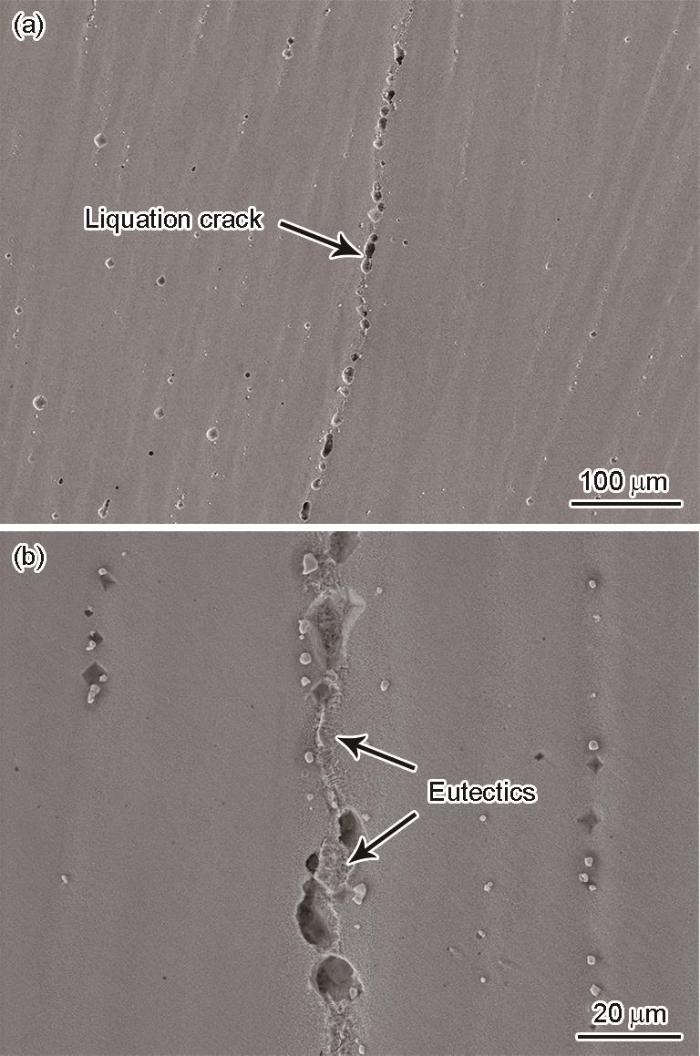
图6
ZGH-11合金中的液化裂纹
Fig.6
Cracks in ZGH-11 alloy showing liquation crack (a) and eutectics in liquation crack (b)
2.3 错配度
图7

图7
室温下ZGH-8和ZGH-10合金(002)峰XRD谱以及分峰后的拟合曲线
Fig.7
XRD spectra at room temperature of (002) peaks and fitting curves for ZGH-8 (a) and ZGH-10 (b) alloys
表4 ZGH-8和ZGH-10合金γ/γ'相的晶格常数和错配度
Table 4
| Alloy | δ / % | ||
|---|---|---|---|
| ZGH-8 | 0.35706 | 0.35751 | -0.13 |
| ZGH-10 | 0.35776 | 0.35870 | -0.26 |
图8
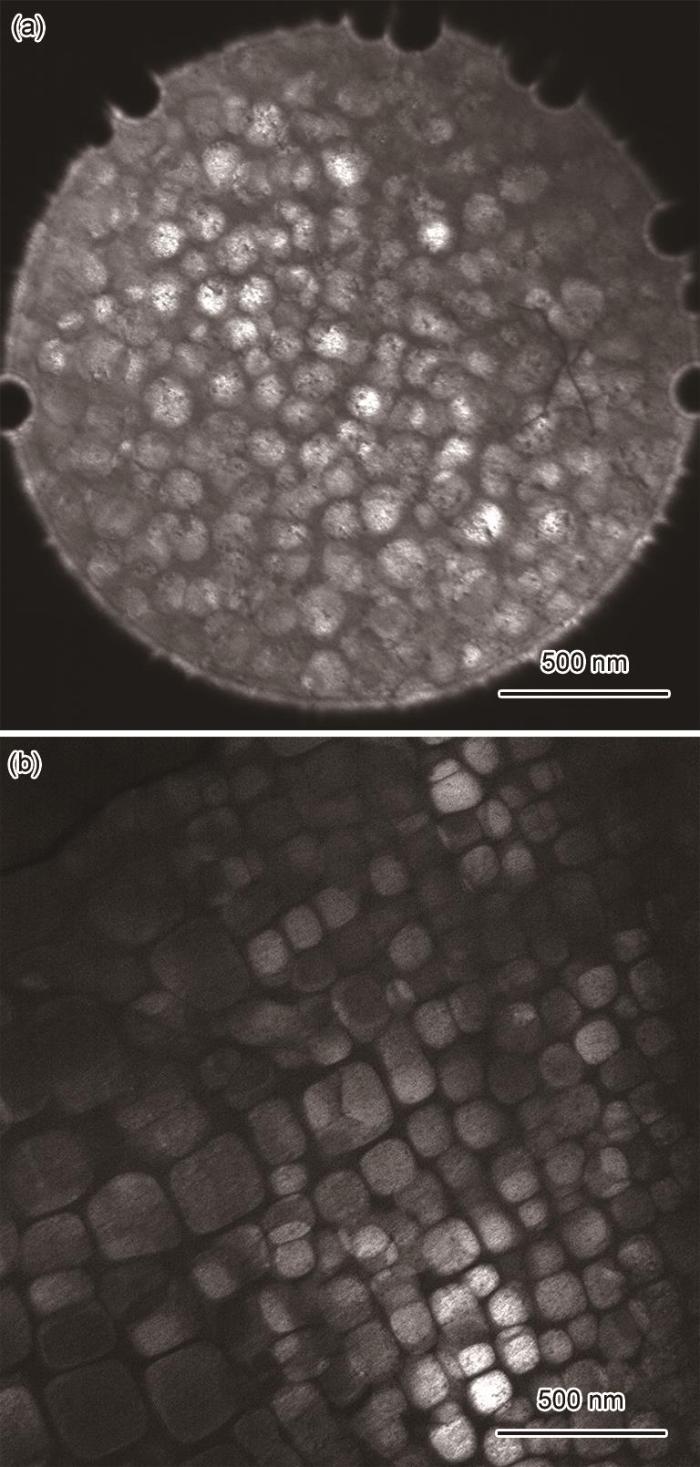
图8
ZGH-8和ZGH-10合金γ'相暗场TEM像
Fig.8
Dark-field TEM images of γ' phases of ZGH-8 (a) and ZGH-10 (b) alloys
2.4 TCP相析出情况
根据表3结果,通过
图9
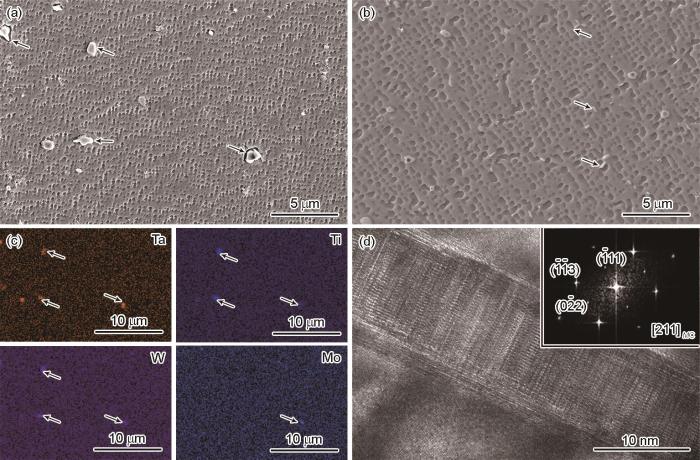
图9
ZGH-10合金在1000 ℃下热暴露100和500 h碳化物的类型及面扫描结果和电子衍射花样
Fig.9
SEM images (a, b), EDS mappings (c), and HRTEM image and SAED pattern (inset) (d) of carbides (indicated by arrows) precipitation after long-term thermal exposure at 1000 oC for 100 h (a, c) and 500 h (b, d)
图10
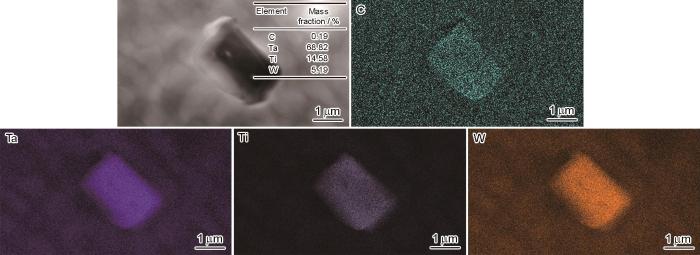
图10
ZGH-10合金在1000 ℃下热暴露500 h后析出的MC碳化物的SEM像及元素面扫描分布图
Fig.10
SEM image and EDS mappings of MC carbide after long-term thermal exposure at 1000 oC for 500 h
2.5 拉伸性能
图11
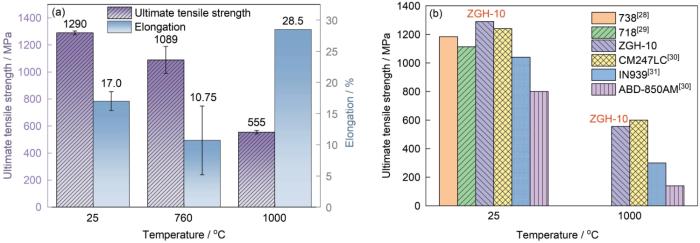
图12为ZGH-10合金在室温、760和1000 ℃下的拉伸断口形貌。从图12a可以看出,室温下断口处有大量的解理平台,以解理断裂为主,但也存在少量韧窝,韧窝的存在保证了该合金在室温下具有较好的塑性。图12b为ZGH-10合金在室温下的纵截面断口形貌。由于室温下晶界强度大于晶内强度,断裂发生在碳化物处。当温度升高至760 ℃ (图12c)时,断口表面更加光滑,也存在解理平台,脆性断裂特征明显,进一步表明760 ℃时合金塑性下降。由图12d的纵截面断口形貌可以看出,断裂面与外力应力轴呈45°倾斜,说明拉伸变形过程中滑移系沿(111)面开始滑动。1000 ℃下,如图12e所示,可观察到大量韧窝,为微孔聚集型韧性断裂。图12f显示合金的纵截面呈明显的颈缩断裂形貌,也证明在高温下该合金具有优异的塑性,高温下晶界强度低于晶内强度,裂纹发生在晶界处,为沿晶断裂。
图12
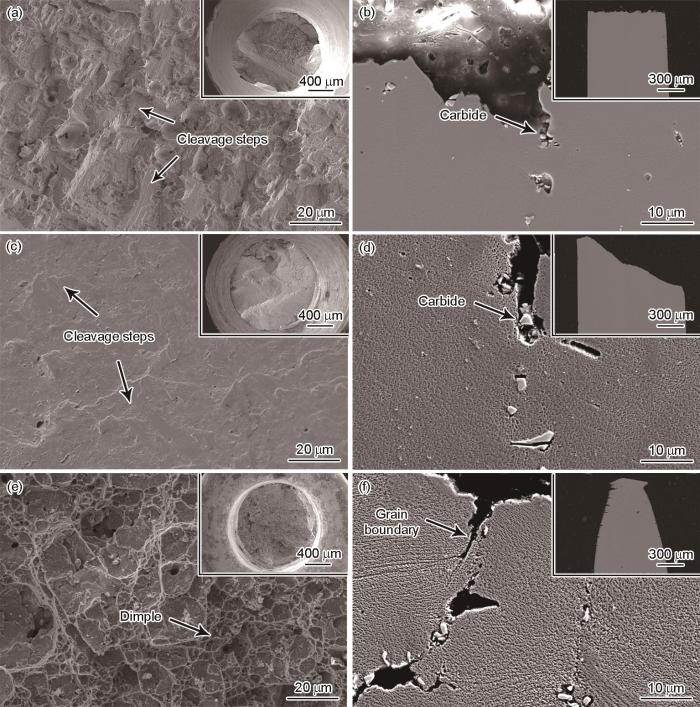
图12
ZGH-10合金在不同温度下拉伸断口形貌的SEM像
Fig.12
Cross-section (a, c, e) and longitudinal-section (b, d, f) fracture SEM images of ZGH-10 alloy at the temperatures of 25 oC (a, b), 760 oC (c, d), and 1000 oC (e, f) (Insets show the fracture macromorphologies)
ZGH-10合金在室温、760和1000 ℃下的拉伸变形机制不同。如图13a所示,在室温下,变形机制以位错对切割γ'相为主,存在少量的层错。由于γ'相中反相畴的存在,位错在γ'相中以位错对的形式运动,跟随位错和领先位错具有相同的Burgers矢量,可以消除领先位错切割γ'相产生的反相畴[32]。760 ℃拉伸后变形组织如图13b所示,可见大量的层错贯穿γ基体和γ'相,以及只存在γ'相中的层错,变形机制转变为不全位错切割γ'相形成层错。1000 ℃下的变形组织如图13c所示,有位错直接切入γ'相,在γ'相周围还观察到少量的位错环以及位错网,说明位错在基体中发生攀移或交滑移运动,位错网的形成会阻碍交滑移的运动,从而提高合金抵抗变形的能力。
图13
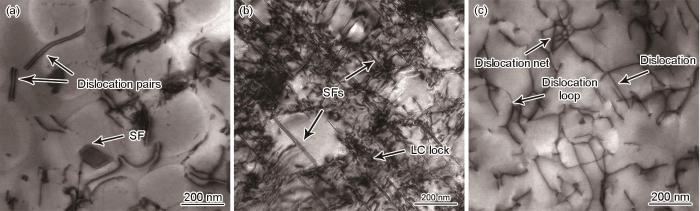
图13
ZGH-10合金拉伸变形后显微组织的TEM像
Fig.13
TEM images of deformation microstructures of ZGH-10 alloy after tensile test at 25 oC (a), 760 oC (b), and 1000 oC (c) (SF—stacking fault, LC lock—Lomer-Cottrell lock)
图14
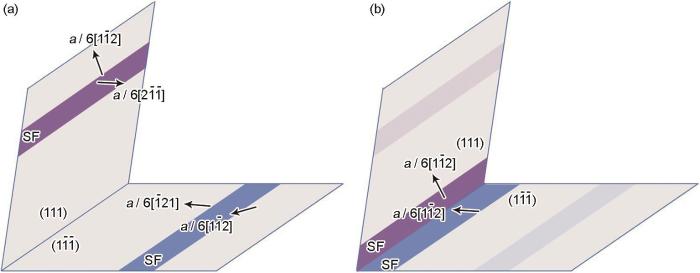
图14
Lomer-Cottrell (LC)锁形成示意图
Fig.14
SFs on different sets of {111} planes (a), and as the SFs glide, a LC lock is formed (b)
式中,
3 结论
(1) 优化后ZGH-10合金的固溶强度为236 MPa,裂纹面积分数为1.3 × 10⁻⁴%;错配度为-0.26%,γ'相形貌为方形;
(2) 与目前增材制造镍基高温合金相比,ZGH-10合金的拉伸性能优异。在25、760和1000 ℃下的抗拉强度分别为1290、1089和555 MPa,延伸率分别为17.0%、10.8%和28.5%。
(3) ZGH-10合金在不同温度下的拉伸变形机制不同。室温下,位错对和少量的层错切入γ'相;760 ℃下,有大量层错切入γ'相,层错之间相互反应,形成LC锁,增加了合金变形抗力;1000 ℃下,位错绕过和切入γ'相,也会形成位错网,其较大的错配度保证了合金的高温强度。
参考文献
Anisotropy of stress rupture property of Ni base single crystal superalloy DD432
[J].
镍基单晶高温合金DD432的持久性能各向异性
[J].
Recent progress in research and development of nickel-based single crystal superalloys
[J].
镍基单晶高温合金的研发进展
[J].
Research and development in materials and processes of superalloy fabricated by laser additive manufacturing
[J].
激光增材制造高温合金材料与工艺研究进展
[J].
Effect of heat treatment on the microstructural evolution and mechanical properties of GH4099 additive-manufactured by directed energy deposition
[J].
Additive manufacturing of Ni-based superalloys: Residual stress, mechanisms of crack formation and strategies for crack inhibition
[J].
Creep behaviour of Ni-base single-crystal superalloys with various γ′ volume fraction
[J].
Investigations on the microstructure and crack formation of IN738LC samples processed by selective laser melting using Gaussian and doughnut profiles
[J].
Additive manufacturing of CMSX-4 Ni-base superalloy by selective laser melting: Influence of processing parameters and heat treatment
[J].
Relationship between solidification and liquation cracks in the joining of GTD-111 nickel-based superalloy by Nd: YAG pulsed-laser welding
[J].
Formation mechanisms of hot cracks in laser additive repairing single crystal superalloys
[J].
激光增材修复单晶高温合金的热裂纹形成机制
[J].
Liquation cracking in fiber laser welded joints of Inconel 617
[J].
Hot cracking mechanism affecting a non-weldable Ni-based superalloy produced by selective electron beam melting
[J].
Influence of laser powder bed fusion process parameters on the microstructure and cracking susceptibility of nickel-based superalloy alloy 247LC
[J].
Microstructure of selective laser melted CM247LC nickel-based superalloy and its evolution through heat treatment
[J].
A new approach to design advanced superalloys for additive manufacturing
[J].
Reduction of micro-cracking in nickel superalloys processed by Selective Laser Melting: A fundamental alloy design approach
[J].
Effect of solid solution elements on cracking susceptibility of Ni-based superalloys during additive manufacturing
[J].
On the temperature dependent strengthening of nickel by transition metal solutes
[J].
Mutation in TCP phases and superior stress rupture life led by W/Mo ratio in Ni-based single crystal superalloys
[J].
Alloys-By-Design: Application to nickel-based single crystal superalloys
[J].
Cracking on a nickel-based superalloy fabricated by direct energy deposition
[J].
CALPHAD informed design of multicomponent CoNiCr-based superalloys exhibiting large lattice misfit and high yield stress
[J].
The effect of lattice misfit on the dislocation motion in superalloys during high-temperature low-stress creep
[J].
The microstructure and hardness of Ni-Co-Al-Ti-Cr quinary alloys
[J].
The precipitation of topologically close-packed phases in rhenium-containing superalloys
[J].
TCP phase predictions in Ni-based superalloys: Structure maps revisited
[J].
Microstructural stability and stress rupture properties of a third-generation Ni base single crystal supalloy
[J].
一种第三代单晶高温合金的组织稳定性与持久性能
[J].
Effect of carbon content on the microstructure, tensile properties and cracking susceptibility of IN738 superalloy processed by laser powder bed fusion
[J].
Influence of pulsed laser scanning patterns on microstructural evolution and mechanical properties of Inconel 718 in direct laser deposition
[J].
Alloys-by-design: Application to new superalloys for additive manufacturing
[J].
Microstructures and mechanical properties evolution of IN939 alloy during electron beam selective melting process
[J].
Shearing mechanisms of stacking fault and anti-phase-boundary forming dislocation pairs in the γ′ phase in Ni-based single crystal superalloy
[J].
Dynamic impact behavior and deformation mechanisms of Cr26Mn20Fe20Co20Ni14 high-entropy alloy
[J].
Transmission electron microscopy characterization of dislocation structure in a face-centered cubic high-entropy alloy Al0.1CoCrFeNi
[J].
New insights into the optimisation of the solution heat treatment process and properties of CMSX-4 superalloys
[J].
Dependence of creep strength on the interfacial dislocations in a fourth generation SC superalloy TMS-138
[J].


