



TC4合金属于典型的α + β型钛合金。研究表明,α相钛合金的力学性能主要受hcp结构α相的影响[3~7],而β型钛合金可以通过调控析出相演变优化材料性能[8,9]。TC4合金的力学性能与组织类型密切相关,等轴组织通常具有更高的强度和更长的疲劳寿命,而魏氏组织由于层片组织的晶界密度较大,能够降低裂纹扩展速率,但在界面处易形成裂纹,疲劳寿命性能受限[10]。此外,微织构区域(microtextured regions,MTRs)的存在进一步加剧了疲劳损伤风险。在TC4合金热机械加工过程中,具有相近取向的α晶粒会聚集形成尺寸远大于平均晶粒的MTRs[11~13]。这些区域在变形中表现为“伪单晶”单元[14],导致微织构区域界面处显著的应变不协调性和应力集中[15~17],进而缩短疲劳寿命并增大性能分散度[18~21]。
材料的力学性能不仅与材料的微观组织相关,更与其晶体结构相关[22]。TC4合金中α相为hcp结构,滑移主要沿着<
综上所述,TC4合金的滑移机制和组织特征较为复杂,有待进一步深入研究。本工作围绕TC4合金的循环变形损伤微观机制,开展了循环变形中微观组织演变、滑移机制实验与分析。通过对比不同循环周次下的微观组织、局部取向差(kernel average misorientation,KAM),揭示微织构区域主导下的局部塑性应变不均匀性以及锥面<c + a>滑移系主导的取向演化。研究结果将深化对循环载荷下TC4合金微观损伤演化机制的理解,并为优化材料设计、提高循环变形能力提供理论依据。
1 实验方法
1.1 实验材料
实验材料为准β退火态锻造处理的TC4合金,整体无明显各向异性。其化学成分(质量分数,%)为:Al 5.5~6.35,V 3.6~4.4,C ≤ 0.05,N ≤ 0.03,O ≤ 0.13,H ≤ 0.0125,Fe ≤ 0.25,Ti余量。试样参考HB 5287—1996《金属材料轴向加载疲劳试验方法》设计,试样几何尺寸和加载方向如图1所示,采用线切割进行加工。试样平行段中间深色区域为材料微观表征测试区域,使用400~2000号SiC砂纸依次打磨,并用粒度为0.05 μm的氧化物抛光悬浮液(OPS)进行镜面抛光。最后在VibroMet-2型振动抛光仪上振动抛光。所用腐蚀液为Kroll试剂(3%HF + 6%HNO3 + 91%H2O,体积分数)。
图1

图1
TC4合金循环变形试样几何示意图
Fig.1
Geometry of cyclic test specimen of TC4 alloy (unit: mm)
1.2 循环加载实验
循环加载实验在MTS Landmark电液伺服疲劳试验机上进行,实验过程采用应力控制,应力加载方向为X0方向,如图1所示,波形为正弦波,频率为10 Hz,应力比(R)为0.1,最大应力为700 MPa。单个试样循环加载周次分别达到0、100、500、5000 cyc时中断实验,进行材料微观组织和结构表征测试。
1.3 微观组织与结构表征
图1深色平行段区域为微观组织与结构表征区域,采用包含五轴样品台的Empyrean型X射线衍射仪(XRD)对经过处理的TC4合金试样平行段进行物相分析,仪器最大功率为2.2 kW,Cu靶,入射线波长为0.154 nm,θ-2θ联动扫描范围为30°~125°,测试电压40 kV,电流40 mA,扫描速率2°/min,步进0.02°。使用OLS5100激光共聚焦显微镜(LSCM)对该区域进行三维形貌扫描。采用配备有Symmetry S2电子背散射衍射(EBSD)系统的JSM-IT800高分辨场发射扫描电子显微镜(SEM)分析循环变形过程中微观组织的变化,测试电压20 kV,扫描步长3 μm,采集参数binning为4 × 4。后续处理在Channel 5软件中完成,用于提取晶粒度、取向信息及相关损伤评价指标。对不同周次疲劳加载的TC4合金试样,在平行段区域使用线切割切取尺寸为10 mm × 10 mm × 1 mm的试块。采用400~5000号砂纸依次打磨并用粒度为0.5 μm的研磨膏抛光,最后利用双束聚焦离子束对样品进行切割。采用Talos F200X冷场场发射透射电镜(TEM)对切割后的TC4合金试样进行电子衍射和位错形貌分析。
2 实验结果与分析
2.1 TC4合金初始微观组织和晶体结构
图2

图2
TC4合金初始显微组织及XRD谱
Fig.2
Initial microstructure (a) and XRD patterns (b) of TC4 alloy
2.2 TC4合金循环变形力学响应
式中,
图3

图3
TC4合金循环加载响应:应力-应变滞后环及塑性应变幅与循环加载周次曲线
Fig.3
Cyclic loading response of TC4 alloy
(a) stress-strain hysteresis loops (N—loading cycle) (b) plastic strain amplitude (
2.3 TC4合金循环变形微观组织演变
多晶材料循环加载过程中,不同取向晶粒的变形响应存在显著差异,其主导变形机制不仅取决于滑移系激活条件,还受晶界约束、相邻晶粒取向关系等多因素耦合影响。对于TC4合金,由于α相的滑移系数目有限,局部取向和微织构特征对微观塑性变形行为的影响尤为突出。图4为不同循环周次时TC4合金的LSCM表面形貌、EBSD晶粒取向分布反极图(inverse pole figure,IPF)以及KAM结果。从初始状态至100 cyc,部分晶粒发生明显塑性变形(图4a和b),并形成清晰的驻留滑移带(PSB)。随着循环周次增加,滑移带密度显著提高,且更多区域开始出现轻微塑性变形。图4e~h为不同加载周次时Z0方向的IPF,不同颜色代表晶粒不同取向,由于β相含量过低、尺寸过小,EBSD测试过程中不能有效解析,所以β相在EBSD测试过程中不予考虑,仅见部分α相粗大晶粒(区域Ⅰ)在Z0方向呈现较明显的<
图4
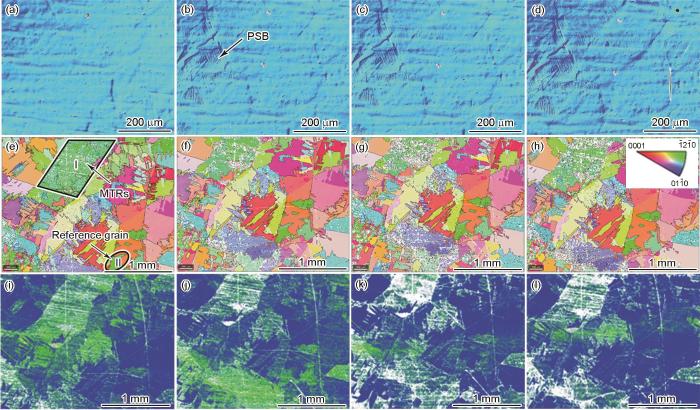
图4
不同循环周次TC4合金LSCM表面形貌、EBSD晶粒取向分布反极图及局部取向差(KAM)结果
Fig.4
Microstructural evolutions of TC4 alloy at 0th cyc (a, e, i), 100th cyc (b, f, j), 500th cyc (c, g, k), and 5000th cyc (d, h, l) (a-d) LSCM surface morphologies (PSB—persistent slip band) (e-h) inverse pole figure (IPF) maps, with the MTRs (Zone I) and a reference small grain (Zone II) of identical orientation (MTR—microtextured region) (i-l) kernel average misorientation (KAM) maps
为定量表征循环变形损伤的微观累积,统计了循环加载前后KAM分布直方图及其采用对数正态分布函数(f(KAM))的拟合结果。f(KAM)的表达式为:
式中,
mKAM可用于推断循环加载过程中微观尺度上的塑性应变水平,而vKAM能够量化微观结构内应变局部化的程度[31]。图5为TC4合金损伤参数mKAM和vKAM随循环周次的变化情况。初始状态下,两者均处于较低水平,随着循环周次的增加,两者迅速上升:mKAM从0.52升至0.74,vKAM由0.068激增至0.193。循环10 cyc以后,材料部分区域发生严重塑性变形,出现零解析区域,导致mKAM和vKAM突然降低。此后,两者趋于稳定,分别围绕0.50~0.54和0.085~0.092低幅振荡。结合图4i可见,初始状态下,高KAM区域较少,仅局部团簇或界面显示轻微的应变集中,因此其损伤参数均处于较低水平。图4j显示,外载初始作用下,部分区域因应力集中导致Kikuchi衍射花样质量下降,表明大量可动位错被激活且晶内局部形成显著取向梯度,塑性滑移呈现高度局域化,与图4b中明显的塑性变形及致密的驻留滑移带相对应。正是这种极端的局域化变形,导致部分区域(如驻留滑移带核心)的晶格畸变超过了EBSD的解析极限,形成了零解析区域。如图5所示,这些代表最严重损伤的区域在统计时被排除,是导致随后计算得到的mKAM和vKAM出现“急剧降低”这一统计现象的直接原因。而当mKAM和vKAM稳定时,KAM分布图(图4k和l)中高KAM区域面积减少、分布趋于离散,说明大多数晶粒内部的取向梯度已趋于稳态,仅余少量高KAM斑块残留于晶界或团簇边缘。损伤参数mKAM和vKAM的演变趋势与材料宏观力学响应高度一致。
图5

图5
TC4合金KAM分布的均值(mKAM)和方差(vKAM)随循环周次的变化情况
Fig.5
Average KAM (mKAM) and variance of KAM (vKAM) at different loading cycles for TC4 alloy
进一步提取不同循环周次、具有典型微织构特征区域Ⅰ与相同取向区域Ⅱ的带衬度(band contrast,BC)变化(图6)。BC值反映衍射信号质量,其下降直接关联于位错等晶体缺陷导致的晶格畸变。分析表明,微织构区域Ⅰ的BC值在前100 cyc从77.32快速降低到57.65,降低幅度为25%,此后周次趋于稳定;区域Ⅱ的BC值从0 cyc时的100.83变为5000 cyc时的85.12,下降约15%。后者BC值始终高于前者,定量证实了微织构区域在循环加载中经历了更剧烈的塑性变形,累积了更高的位错密度和晶格畸变。这一现象取决于微织构区域独特的微观结构。如图4e所示,区域Ⅰ由多个晶体学取向高度一致的α片层集束构成,形成了一个尺度远大于单个晶粒的“软性”单元。在循环载荷下,这种取向一致性使其表现出“类单晶”行为:集束内部晶粒间的变形约束较弱,允许滑移在多个平行片层间协调传递,从而使整个微织构区域能够协调更大的塑性应变。与之相对,区域Ⅱ中的细小晶粒受四周取向各异的其他晶粒制约,变形受到强烈约束,故塑性发展缓慢。这种“类单晶”行为使得晶粒团簇能够协调更大的塑性变形,但同时也加剧了其与周围硬取向区域在界面处的变形不协调性,导致显著的局域应力集中。因此,这种具有特定取向的晶粒团簇在循环载荷下更易成为损伤形核的核心位置[21]。Littewood和Wilkinson[32]在TC4合金塑性变形过程中,发现相同取向晶粒团簇承受更大的塑性应变,而相邻的硬取向晶粒则承担更高的弹性应变,进一步证实了在TC4合金中,微织构区域作为“软区”优先塑性协调变形的现象。
图6

图6
TC4合金不同循环周次不同区域的带衬度(BC)变化
Fig.6
Evolutions of band contrast (BC) in different regions of TC4 alloy at different loading cycles
2.4 TC4合金循环变形滑移机制
图7

图7
TC4合金循环变形过程中X0方向反极图及晶粒取向示意图
Fig.7
X0-direction IPFs at 0th cyc (a), 100th cyc (b), 500th cyc (c), and 5000th cyc (d); and grain orientation schematic (e) in TC4 alloy
织构的演化直接影响了材料内部各滑移系的Schmid因子分布。图8为不同循环周次下TC4合金α相各滑移系的Schmid因子演变。统计分析表明,在初始状态锥面
图8
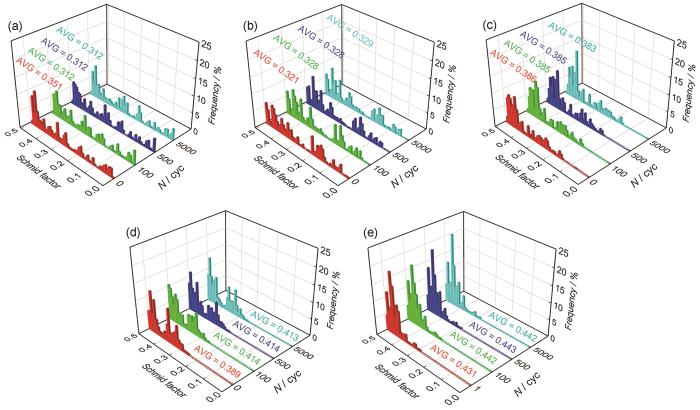
图8
不同循环周次下循环变形TC4合金滑移系的Schmid因子演变
Fig.8
Schmid factor evolutions of slip systems in cyclically deformed TC4 alloy (AVG—average of schmid factor)
(a) basal <a> slip (b) prismatic <a> slip (c) pyramidal <a> slip
(d) pyramidal 1st <c + a> slip (e) pyramidal 2nd <c + a> slip
这种由织构主导的滑移机制选择,是材料循环变形响应的核心。通常,在随机织构的α-Ti中,由于锥面<c + a>滑移具有较高的临界分切应力,其启动较为困难。然而,在本工作中的TC4合金初始织构状态下,即多数晶粒的c轴近似垂直于加载方向(图7e),为协调沿c轴方向的塑性应变,必须激活能提供c方向位移分量的滑移系。研究[24]表明,当hcp钛合金晶粒的c轴垂直于加载方向时,锥面<c + a>滑移系的启动变得至关重要。Su等[28]在循环变形TC4合金中,通过TEM双束衍射技术明确观察到,锥面<c + a>位错与基面<a>位错发生缠结,并且这些缠结结构会进一步演化为位错锁和小角度晶界。这一发现为理解织构材料中<c + a>滑移的活动及其对微观结构演化的影响提供了关键旁证。因此,在本工作中,如图9a~e所示,当大部分晶粒的c轴与加载方向接近垂直时:基面{0001}<a>由于滑移面平行于加载方向被显著抑制;柱面
图9
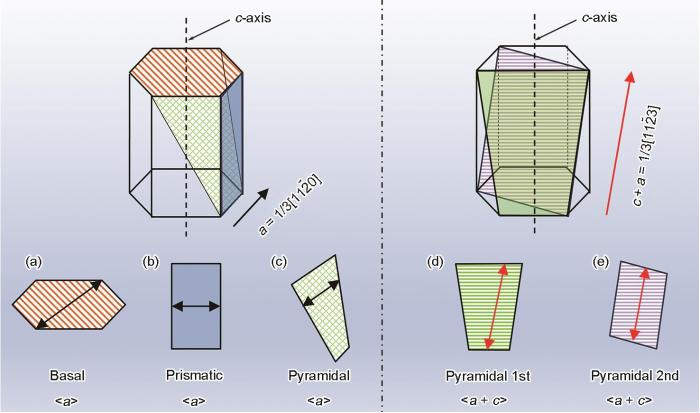
图9
TC4合金中α相滑移机制示意图
Fig.9
Schematics of slip mechanism in α phase of TC4 alloy
(a) basal <a> slip (b) prismatic <a> slip (c) pyramidal <a> slip
(d) pyramidal 1st <c + a> slip (e) pyramidal 2nd <c + a> slip
多晶材料的位错滑移不仅取决于滑移系的激活,更受其微观结构特征,特别是相界面的显著影响。图10为初始态和加载5000 cyc后TC4合金样品的TEM像。材料在初始态(图10a和b)时,在α相内部残存有少量的位错,这些位错呈现多条平行分布,在这些位错之间还交叉分布着较短的位错,并向α相内滑移。随着循环周次增加到5000 cyc,α相内部的微观形貌并未发生明显变化(图10c),但α/β界面对α相内部平行分布的位错滑移形成阻碍,这种高密度的相界面能够显著提高材料的循环寿命。由于循环过程中两相界面处产生切应力,α/β界面处的位错(图10d)数量明显增多,且位错沿界面呈平行分布,说明在循环变形过程中,界面成为新的位错源。
图10
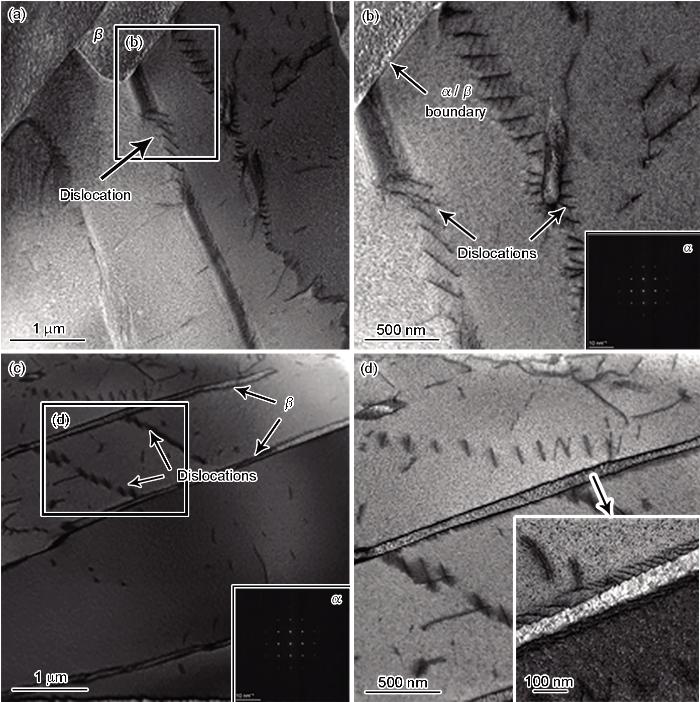
图10
初始态和加载5000 cyc后TC4合金样品的TEM像
Fig.10
Low (a, c) and high (b, d) magnified TEM images of TC4 alloy sample at initial state (a, b) and after 5000 cyc (c, d) (Insets in Figs.10b and c show the SAED patterns; inset in Fig.10d shows the dislocations)
综上所述,TC4钛合金在循环载荷下的微观变形和损伤演化由晶体取向相关的滑移行为与α/β界面处的位错活动共同调控。在织构演化背景下,锥面<c + a>滑移因具有持续较高的Schmid因子而被优先激活,不仅提供了额外的滑移系以协调c轴方向的应变,更主导了早期的塑性变形并推动晶粒取向朝<
3 结论
(1) TC4合金在循环加载过程中表现为初始快速硬化,应变幅急剧上升,随后进入准稳态阶段。相应地,其微观损伤演化表现为:初期损伤参数mKAM和vKAM快速升高,标志着微织构区域成为塑性应变高度集中区;随之变形加剧,导致晶格畸变过高而无法解析,引发损伤参数突降,此后进入缓慢波动阶段,最终在晶界团簇边缘残留高应变带。
(2) 在晶粒c轴近似与加载方向垂直的织构条件下,基面{0001}和柱面
(3) 在循环变形中,α/β界面是位错的核心源与累积区:两相界面处由于循环切应力作用下,界面处位错增殖、沿界面平行排列并发生堆积;同时,界面对滑移的阻碍促使位错在界面附近累积,诱发局部应力集中。因此,TC4合金在循环载荷下的宏观变形,是由晶体滑移与上述界面位错活动共同调控的协同机制所主导。
参考文献
Perspectives on titanium science and technology
[J].
Combined design and analysis of durability and damage tolerance for flight structure
[J].
飞机结构耐久性/损伤容限综合设计与分析
[J].
The effect of microstructure on the mechanical properties of TC4-DT titanium alloys
[J].
Research on damage behaviors of TC4-DT titanium alloys
[D].
TC4-DT钛合金损伤行为研究
[D].
Influence of alloying elements partitioning behaviors on the microstructure and mechanical properties in α + β titanium alloy
[J].
α + β两相钛合金元素再分配行为及其对显微组织和力学性能的影响
[J].
研究了两相区固溶温度及固溶后冷速对Ti-6Al-4V (TC4)合金元素再分配行为的影响,利用EPMA技术表征了初生α相(αp)以及β转变区域(βt)的元素浓度,考察了βt显微组织尺寸随固溶温度及元素浓度的变化。结果表明:随着固溶温度升高,βt区域元素浓度变化显著,表现为Al含量升高、V含量降低,而αp晶粒中元素浓度变化较小,导致两区域元素浓度差异减小;同一固溶温度下,以不同冷却方式(水冷、空冷及炉冷)冷却的显微组织及元素分布显示,冷却速率越低,αp比例越高,αp与βt之间元素浓度差异越明显。合金经固溶水冷、空冷后,βt分别为淬火马氏体、次生α相(αs)+残余β相,2种冷速下βt的显微组织尺寸均与高温β相内的元素浓度水平有关,即βt内部显微组织尺寸受固溶温度的显著影响。利用纳米压痕技术表征了不同固溶温度下微区域(αp、βt)的力学特征,结果表明,密排六方(hcp)晶格αp本身呈现的力学行为的各向异性对其纳米压痕性能起决定性作用,而βt的弹性模量及硬度主要受αs片层尺寸的影响。最后讨论了“固溶温度-微区元素浓度-微区显微组织-微区力学性能”之间的关系。
Microstructure and properties of as-cast Co-28Cr alloy with aging treatment
[J].
时效处理对铸态Co-28Cr合金组织和性能的影响
[J].
Research and application of damage tolerance titanium alloys for aeronautical use
[J].
航空用损伤容限型钛合金研究与应用
[J].
Study on cold deformation, phase transformation and corrosion behavior of a new metastable β-type Ti-B12 biomedical titanium alloy
[D].
新型亚稳定β型Ti-B12医用钛合金冷变形、相变与腐蚀行为研究
[D].
Engineering omega phase enables a wide temperature range Elinvar effect in metastable β-Ti alloys
[J].
Influence of microstructure on high-cycle fatigue of Ti-6Al-4V: Bimodal vs. lamellar structures
[J].
Texture heterogeneities induced by subtransus processing of near α titanium alloys
[J].
Microstructural influences on very-high-cycle fatigue-crack initiation in Ti-6246
[J].
β→αs variant selection in sharp hcp textured regions of a bimodal IMI834 billet
[J].
Effective structural unit size in titanium alloys
[J].This paper introduces the concept of effective structural size in titanium alloys and its importance with respect to material production routes and component lifing/design. Traditionally, process route optimization has relied on optical microscopy, which may be misleading when predicting mechanical properties. Similarly, continuum mechanics and current lifing methods are based on empirical data analysis. The advent of advanced material characterization techniques, e.g. EBSD combined with crystal plasticity modelling, has the potential to provide the next generation of mechanistically sound methods that more accurately predict material behaviour in complex loading regimes. These benefits are reviewed in the context of industrial application. Crystal plasticity modelling techniques are presented and a particular structural unit - termed a rogue grain - in a model single-phase titanium alloy is considered. Cold dwell under both strain and stress control is then assessed in the structural unit.
Dwell sensitive fatigue response of titanium alloys for power plant applications
[J].The phenomenon of “dwell sensitivity” in the α+β and near α titanium alloys and the intrinsic relationship with quasi-cleavage facet formation is discussed. In the present paper, particular emphasis is placed upon the role of “cold creep” and ambient temperature strain accumulation under cyclic loading. A process of stress redistribution between microstructurally distinct regions that demonstrate different strengths is proposed as the fundamental cause of facet development and subsequent dwell failures. A model to describe the redistribution process is validated through a matrix of fatigue testing designed to assess the effects of microstructural form, stress axiality, and periods of dwell loading at peak stress on cyclic strain accumulation.
Texture variations in titanium alloys for aeroengine applications
[J].Electron backscatter diffraction techniques have been used to assess the range of textures that exist in a number of common titanium alloys. Crystal orientation maps and pole figures have been obtained over representative areas to study preferred textures and regions of common crystallography (macrozones). Electron backscatter diffraction analysis has established different relationships between optical microstructures and crystallographic texture for different titanium alloys. For β processed alloys, there is a correspondence between optical colonies of α platelets and regions of crystallographic alignment. Various texture intensities, macrozones and effective structural unit sizes can be observed depending on the alloy and product form. These variations impact on the mechanical behaviour of titanium alloys.
Microscopic strain localisation in Ti-6Al-4V during uniaxial tensile loading
[J].
Understanding the role of local texture variation on slip activity in a two-phase titanium alloy
[J].
Slip and fatigue crack formation processes in an α/β titanium alloy in relation to crystallographic texture on different scales
[J].
Texture effects under tension and torsion loading conditions in titanium alloys
[J].
Local texture and fatigue crack initiation in a Ti-6Al-4V titanium alloy
[J].Fatigue crack initiation was studied in a bimodal TA6V titanium alloy. A ghost structure inherited from the forging process, the scale of which is roughly 100 times the apparent grain size, was found to govern the initiation process. In these macrograins, that we have labelled macrozones, most of the primary alpha grains (αp) are found to display the same crystallographic orientation. Fatigue cracks are initiated on the basal plane or, if basal slip is difficult, on the prismatic plane. Thus in macrozones, where basal or prismatic slip is easy, numerous neighbouring tiny cracks appear over the whole macrozone, which have the size of the primary αp grains. In these macrozones the contribution of crack coalescence to crack growth is consequently very significant. On the contrary, if basal and prismatic slips are both difficult in the macrozone, no crack can be found in the corresponding macrozone. The crack initiation process is thus highly heterogeneous at the scale of the macrozone. Furthermore, this microstructure is found to induce a large scatter in the fatigue life of notched samples.
The significance of crystal structure on grain refinement during severe plastic deformation
[J].
A study of active deformation systems in titanium alloys: Dependence on alloy composition and correlation with deformation texture
[J].
Analysis of the different slip systems activated by tension in a α/β titanium alloy in relation with local crystallographic orientation
[J].
Stress-state dependence of slip in titanium-6Al-4V and other H.C.P. metals
[J].
Crack initiation mechanism of a silicide-containing high-strength Ti-5Al-7.5V alloy under low-cycle fatigue loading
[J].
The role of pyramidal 〈c + a〉 dislocations in the grain refinement mechanism in Ti-6Al-4V alloy processed by severe plastic deformation
[J].
Effect of three-stage heat treatment on the composite waveform and variable amplitude fatigue properties of TC4 titanium alloy pulsed laser-arc hybrid welded joints
[J].
Fatigue damage evaluation of coarse-grained austenitic stainless steel based on EBSD and ultrasound methods
[D].
基于EBSD和超声的粗晶奥氏体不锈钢疲劳损伤评价
[D].
Mesoscale damage behavior and meso-macroscale correlation of low-cycle fatigue in Z2CND18.12N austenitic stainless steel
[J].
Creep strain and stress state-dependent creep asymmetry during early-stage room-temperature creep in a titanium alloy
[J].Room-temperature (RT) creep may happen below yield stress in titanium alloys, while the creep asymmetry remains pending under various stress states. The creep behavior and plastic damage were investigated during the early-stage RT-creep up to 60 h in a titanium alloy. The investigated TC4 ELI Ti-alloy is a high-purity (“Extra-Low-Interstitial”) version of Ti-6Al-4V with a near-α type microstructure after thermomechanical treatment. Three kinds of creep testing were conducted, including axial tension, compression, and torsion, respectively. The microstructure and especially, dislocation behaviors were analyzed in detail by using electron backscattered diffraction, transmission electron microscopy, and X-ray diffraction after an interrupted and terminated creep testing. The creep strain differs, which is 5 %, 1 %, and 0.5 % under tension, compression, and torsion, respectively. It undoubtedly indicates the presence of creep asymmetry. To clarify the creep mechanism, the slip system was then analyzed. It is shown that the prismatic slip is dominant during tensile creep, while the pyramidal slip appears most during compressive creep. The limited slip transmission and immobile dislocations result in lower creep strain. The reason behind the creep asymmetry is attributed to the stress state, producing the activation of various slip systems, along with the evolution of true stress. Finally, the mechanistic origins are also discussed as to the distinctive creep rate under various stress states.


