



铝基复合材料(aluminum matrix composites,AMCs)因其高比强度、高比刚度、良好的导热性能和可控的热膨胀系数,在航空航天、军事装备和电子封装等领域具有广阔的应用前景[1~5],是国民经济和国防建设中不可或缺的关键材料。通过引入高硬度、高模量的增强体(如SiC、B4C、Al2O3等),铝基复合材料的强度、刚度、耐磨性和高温性能得以显著提升,成功应用于刹车盘、发动机活塞、空间光学镜坯等关键部件[6~8]。然而,传统铝基复合材料通常采用微米级增强体,当其体积分数超过一定阈值时,虽然强度和硬度持续提高,但材料的延展性和断裂韧性急剧恶化,这主要归因于微米颗粒引起的应力集中以及界面脱黏等早期损伤[9,10],这种强度-塑性的“倒置关系”严重限制了其工程应用潜力[11]。
1 跨尺度协同增强铝基复合材料的发展背景
1.1 铝基复合材料的发展概况和应用背景
自20世纪60年代以来,铝基复合材料逐渐发展为金属基复合材料中研究最广泛、应用最成熟的体系之一,因其轻量化、高比刚度、高比强度、高耐磨性和环境稳定性等优势,成为航空航天、武器装备等国家重大工程领域不可或缺的关键材料[21,22]。利用铝合金低强度高延性的特点,将其与高强度低延性的增强体相结合,可使材料的强度-模量-延性同时达到预期标准[23]。目前应用较多的增强体包括SiC、Al2O3、BN等陶瓷颗粒/晶须/纤维[24~26],以及碳材料(如碳纤维、CNTs、石墨烯)等[5,27],常用的制备方法包括搅拌熔炼铸造法[28~31]、熔体浸渗法[32,33]、粉末冶金法[34,35]和选区激光熔化[36,37]等。
1.2 单一尺度增强体的局限性
按照颗粒尺寸的不同,铝基复合材料中的增强体可分为微米和纳米增强体。尽管微米和纳米增强体在提升铝基复合材料特定性能方面均展现出独特优势,但其固有的本征特性也导致了难以逾越的性能瓶颈,制约了材料综合性能的进一步突破。
微米增强体(如微米SiC、B4C)的强化机制主要依赖于载荷传递,其强化效率与体积分数正相关。然而,这种机制在提升强度的同时,也带来了显著的副作用。微米颗粒,特别是具有尖锐棱角的刻面状颗粒,在受力时将成为应力集中点,不仅促进位错快速塞积,更易诱发界面脱黏或成为微裂纹形核的核心,从而导致材料在塑性变形初期发生损伤,延伸率和断裂韧性急剧恶化。因此,通过进一步提高微米增强体含量来强化材料,往往以牺牲塑韧性为代价,陷入强度-塑性的倒置困境。
纳米增强体(如纳米颗粒、CNTs、石墨烯)则凭借其显著的尺寸效应,可通过Orowan强化、晶界钉扎等机制,在极低添加量下实现对基体的高效强化,且对塑性的损害相对较小。然而,其巨大的比表面积和高表面能导致其在制备过程中极易发生团聚。这种团聚体不仅丧失了纳米尺度的强化潜力,还会成为应力集中源和裂纹萌生点,导致材料性能下降。此外,庞大的界面面积加剧了纳米相与Al基体之间的界面反应风险,脆性反应产物的形成会恶化界面结合强度,导致强化效率下降以及韧性的进一步损失。
由此可见,无论是微米还是纳米尺度的单一增强策略,均难以独立实现高强度与高塑韧性的理想结合。这一根本矛盾促使研究者必须超越单一尺度的设计思路,探索通过多尺度增强体的协同复合构建新的材料体系。
1.3 跨尺度协同增强概念的提出
中南大学范景莲教授团队[38]提出了“微/纳复合”的设计思路,用于解决超高速飞行器用超高温难熔金属材料的瓶颈问题。2011年,《材料科学技术名词》将“混杂增强金属基复合材料”正式定义为“以两种或两种以上的增强体混合增强的以金属或合金为基体的复合材料”。上海交通大学张荻院士团队[17]进一步发展了微/纳混杂思想,以铜、铝基复合材料为研究对象,提出了“金属微/纳砖砌构型化复合”,将大径厚比的金属基体片层视为“砖”,纳米增强体(如CNTs、石墨烯)视为“灰浆”,在微观尺度上构建出类似砖墙的稳定互锁结构。这种构型能有效调控界面-位错相互作用和裂纹扩展路径,从而同步提升材料的强韧性,标志着该领域的研究从简单的机械混合走向了精细的构型设计。
2 跨尺度协同增强铝基复合材料的主要体系和制备方法
2.1 同质跨尺度
Zhang等[41]设计了一种自下而上的片状粉末组装工艺,利用微米片状γ-Al2O3粉末和表面原位包覆非晶Al2O3纳米层的片状Al粉,制备了具有仿生贝壳结构的Al2O3-rGO/Al (rGO为还原氧化石墨烯)层状复合材料。相比Al基体,复合材料的强度提高了22%,而塑性仅降低了7%,韧性显著提高了17%。多级Al2O3-rGO/Al界面处位错塞积能力增强是内禀的强韧化机制,而较大的颈缩后延伸率则归因于砖砌排列引发的多重外在增韧机制。
2.2 异质跨尺度
2.2.1 零维/三维颗粒+二维纳米片
2.2.2 零维/三维颗粒+一维纳米管
2.2.3 多元异质协同
为进一步优化综合力学性能,更为复杂的多元异质跨尺度增强体体系受到关注,如微米B4C +石墨烯纳米片+ CNTs,该体系旨在结合石墨烯的二维平面强化优势与CNTs的一维网络韧化优势。Wang等[42]采用球磨和热压法制备了添加不同含量CNTs和石墨烯的B4C/Al复合材料,这种“点-线-面”多维协同的复合材料展现出比单一增强体对照组更均衡的强韧性匹配。
2.3 内生跨尺度
2.3.1 Al-Ti-C体系
通常以K2TiF6、TiO2等作为Ti源,无定形碳、石墨、CNTs等作为C源,通过以下典型反应在Al熔体中原位生成纳米TiC颗粒:
Qiu等[48]利用高温自蔓延法基于Al-Ti-C体系原位合成了双峰混杂纳米/微米TiC/Al复合材料,通过颗粒诱导形核和晶界钉扎提高晶界强度并细化显微组织,显著提升了材料的室温强度和高温抗蠕变性能。
2.3.2 Al-Ti-B体系
通常以K2TiF6和KBF4为反应剂,在熔炼复合过程中原位生成TiB2纳米颗粒。TiB2与Al晶格的错配度低,可作为高效的异质形核基底,是铝基复合材料理想的增强相:
David等[49]利用Ti、H3BO3与熔融Al的原位反应,在Al基体中构筑TiB2与Al2O3混杂体系,显著提高了复合材料的显微硬度和抗拉强度。
2.3.3 其他体系
图1

2.4 关键制备技术及其原理
跨尺度协同增强铝基复合材料的性能优势能否实现,高度依赖于能否将多尺度增强体均匀、稳定地复合于Al基体中,并构建出理想的界面结构。为此,一系列针对性的制备技术被开发并优化。
2.4.1 粉末冶金法
粉末冶金法是制备高性能复合材料,尤其是纳米增强体复合材料的主要方法之一。其基本流程包括:将铝粉与增强体(微米/纳米颗粒、CNTs、石墨烯等)通过高能球磨进行机械混合和分散,随后将混合粉末冷压或真空除气,最后通过热压、热等静压或放电等离子烧结等工艺在高温高压下实现致密化。该方法的优势在于烧结温度低于Al的熔点,可有效抑制增强体与Al基体间有害界面反应的发生,尤其有利于纳米增强体(如CNTs、石墨烯)的分散保留和结构完整性。通过调控球磨参数(球料比、转速、时间)和烧结制度(温度、压力、时间),可实现增强体空间分布和基体晶粒尺寸的精细调控[51,52]。然而,该工艺流程较长、成本较高,且在制备大尺寸或复杂形状构件时存在挑战。
2.4.2 熔体搅拌法
2.4.3 熔体浸渗法
熔体浸渗法适用于制备具有高体积分数增强体的复合材料,主要包括压力浸渗和无压浸渗。该方法预先将增强体制备成具有连通孔道的多孔预制体,然后利用外部压力或毛细管力使Al熔体渗入预制体孔隙中,凝固后形成复合材料。压力浸渗通过施加高压(通常数十至数百兆帕)强制熔体快速充满预制体,能有效克服润湿性障碍,获得致密构件,常用于制备电子封装用高体积分数SiC/Al复合材料[56]。无压浸渗则依赖于熔体在特定气氛(如N2)下与预制体的自发反应改善润湿性,从而实现浸渗,工艺更简单但耗时较长[57]。此方法能精确控制增强体的体积分数和空间分布(包括构建三维网络结构),但预制体的制备和Al熔体对增强体的侵蚀是需要关注的重点。
2.4.4 原位合成法
原位合成法通过组分设计,使增强体在Al基体内部通过化学反应原位生成,而非从外部加入。如2.3节所述,Al-Ti-C、Al-Ti-B等是适用于原位合成法的典型体系。该方法的突出优势在于:(1) 原位生成的增强体表面纯净、无污染,与基体界面结合强度高、热力学稳定;(2) 增强体尺寸细小(通常为纳米或亚微米级)、分布均匀;(3) 工艺集成度高,可结合铸造或粉末冶金进行。然而,原位反应的热力学和动力学控制要求严格,反应物种类、比例、温度及冷却速率均会影响最终增强体的尺寸、形貌和数量,不恰当的控制可能导致残余反应物或粗大脆性相的产生[10]。
2.4.5 增材制造法
3 跨尺度协同强韧化机理
3.1 强化机制
在Al基体中,弥散分布的抗剪切增强体可阻碍位错滑移,通过与位错相互作用形成位错环,并对后续位错施加更大的弹性反作用,从而提高塑性变形抗力。可根据Orowan公式[60]计算Orowan机制贡献的屈服强度(ΔσOro):
式中,M为Taylor因子;G为剪切模量;b为Burgers矢量模;dp为纳米相的平均直径;υ为Poisson比;λ为纳米相的平均间距,λ
在材料承载过程中,特别是弹性变形阶段和塑性变形初期,轴向应力通过界面剪切应力从基体高效地传递给增强体,从而实现载荷传递强化。基于载荷传递机制贡献的屈服强度(ΔσLT)可以用剪切滞后模型估算[62]:
式中,V为增强相的体积分数,σm为Al基体的屈服强度,s为增强相的长宽比。
由于增强体促进异质形核和抑制晶粒长大的特性,必然导致复合材料的组织细化,该结果所贡献的强度可采用Hall-Petch方程[63]量化:
式中,
由于弹性模量失配和热膨胀系数失配,增强体/基体界面微区必然成为GNDs大量增殖的区域,该行为可导致林位错切割作用加剧,从而提供位错强化,其所贡献的强度可用Taylor公式[36]量化:
式中,
对于不同尺度、不同维度、不同形态的增强体,处于主导地位的强化机制也是不同的。例如,均匀分散的多刻面微米陶瓷颗粒的主要强化机制为借助GNDs冲孔区实现的跨界面载荷传递;而当陶瓷颗粒的粒径减小到足以在晶界移动过程中快速脱附并进入晶粒内部时,通过直接与滑动位错相互作用而产生的Orowan强化机制转而占据主导地位;此外,对于CNTs、石墨烯这类一维、二维纳米增强体,与Al基体的显著弹性模量失配和沿晶界连续分布的超大界面面积,将界面GNDs发射引起的位错强化和晶界迁移抑制导致的晶界强化推向前所未有的高度。可见,传统单一尺度增强体对上述强化机制的利用非常有限,而跨尺度多元增强体体系的精细化构筑和精准调控可实现多种强化机制的协同作用和高效叠加。
3.2 韧化机制
3.2.1 跨尺度增强体抑制裂纹萌生
裂纹萌生是损伤累积的起始阶段,也是决定材料韧性的关键环节。体系中的纳米增强体尺寸小、分布弥散,位错易在其周围绕过从而形成位错环,这种位错重组过程能够促进应力分布的均匀化,降低局部应力峰值,从而有效抑制裂纹的早期形核和扩展。
Liu等[64]使用有限元分析对单一微米和微/纳双尺度混杂增强的铝基复合材料的应变分布状态进行了研究,结果如图2[64]所示。对于分布在微米SiC颗粒(m-SiCp)/Al界面的高应变区域,当应变ε = 1%时,存在显著的应变集中和微裂纹成核现象。相反,由于纳米SiC颗粒(n-SiCp)的分散,m-SiCp/Al和n-SiCp/Al复合材料中的高应变区域是不连续的。并且随着应变增加到2%,m-SiCp/Al复合材料中的微裂纹沿着拉伸轴的45°方向不稳定地扩展,而m-SiCp/Al和n-SiCp/Al复合材料仍然表现出较轻微的局部剪切变形,即相比于单一微米尺度增强体,微/纳混杂增强体体系能够有效缓解颗粒尖锐棱角处的局部应力集中。
图2
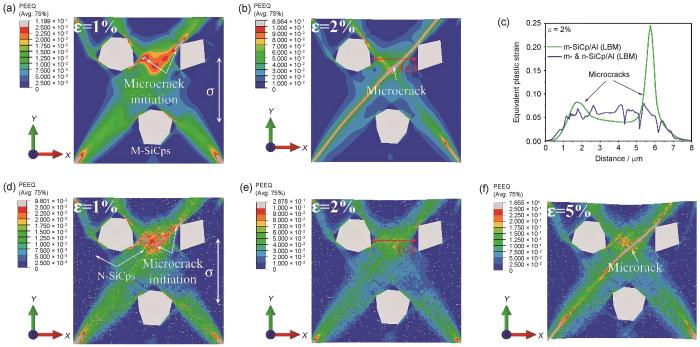
图2
拉伸变形过程中应变分布演变的有限元模型及等效塑性应变曲线[64]
Fig.2
Finite element model for the evolution of strain distributions of the regions near m-SiCp/Al (a, b) and m-SiCp/Al and n-SiCp/Al (d-f) composites during tensile deformation (PEEQ—equivalent plastic strain, ε—strain, σ—stress, m-SiCp—micron-sized SiCp, n-SiCp—nano-sized SiCp), and PEEQ curves along the red lines marked in Figs.2b and e (LBM—low speed ball milling) (c)[64]
3.2.2 多层次能量耗散抑制裂纹扩展
微/纳混杂增强体体系创造了多相分散的微观结构。在这种结构中,不同尺度的增强相相互配合,形成了多层次的能量耗散机制。当扩展中的裂纹遇到增强颗粒时,会改变方向,沿着能量更低的路径扩展。在微/纳混杂体系中,这种偏转效应得到极大增强,因为不同尺度的增强相创造了更为复杂的裂纹传播抵抗网络,即微米颗粒引起裂纹的大角度偏转,而纳米颗粒则导致裂纹产生小幅度的方向变化。这种多尺度偏转效应显著延长了裂纹扩展路径,增加了裂纹扩展导致的能量耗散。
图3

3.2.3 异质界面提供额外韧化
对于单一尺度的微米颗粒增强体,由于颗粒尺寸较大,界面面积有限,GNDs的增殖通常被约束在微米颗粒周围的界面微区内;然而,跨尺度增强体体系的构建意味着更大的界面面积和额外的GNDs发射,有利于界面主导的HDI应变硬化能力的提升。此外,研究[53]表明,跨尺度增强体体系有助于加载过程中材料的多级力学响应和分阶段应变硬化行为。例如,微米增强体作为“一级结构”,负责在介观尺度上产生强烈的应变梯度,激发大量GNDs并转化为塑性变形早期的背应力提升;而纳米增强体作为分散在微米增强体周围空间中的“二级结构”,可充当后者所产生的长程应力场中的位错源/阱的角色,使得位错结构更加复杂和稳定。此外,纳米粒子本身也可产生尺度更小的局域化HDI应力场,与微米颗粒的相互作用叠加,形成一个多层次、多尺度的背应力网络,即使在塑性变形的后期,也可通过强化林位错相互作用维持较高的应变硬化水平。因此,跨尺度增强体体系有利于铝基复合材料在不同变形阶段保持高的应变硬化水平,通过分级响应的方式实现材料的内禀韧化。
4 总结与展望
跨尺度协同增强策略通过构建多尺度多级增强体体系,为破解铝基复合材料中长期存在的强韧性倒置关系的瓶颈提供了行之有效的路径。该策略并非不同尺度增强效应的简单叠加,而是通过激发载荷传递强化、晶界强化、位错强化以及多级增强体界面应力调控等多重机制的协同交互作用,实现了材料在强度、硬度、延展性及韧性等方面的综合力学性能优化。粉末冶金、多步复合等制备技术的发展为跨尺度复合材料的可控制备奠定了基础。尽管实验室研究取得了显著成果,但若要实现跨尺度协同增强铝基复合材料的大规模工业应用,仍需在纳米相的空间可控分布、多级界面精准调控以及低成本规模化制备等方面取得突破。结合新材料设计、先进制造技术与多尺度模拟,跨尺度协同增强铝基复合材料有望在高端装备制造领域发挥更重要的作用。未来,跨尺度协同增强铝基复合材料的基础理论和应用研究可聚焦以下几个方面。
(1) 制备方法:核心在于实现跨尺度增强体的空间精准可控分布。未来的研究将趋向于发展原位自生、粉末冶金与增材制造相结合的新型复合工艺,并借助机器学习优化工艺参数,从源头上解决增强体团聚和界面反应失控的难题。
(2) 成型技术:目标是推动近净成形与结构功能一体化制造。通过将等温精密锻造、粉末注射成型等技术与架构设计(如仿生叠层)深度融合,直接制造出几何复杂、性能优异的终端构件,大幅减少后续加工并降低成本。
(3) 疲劳性能设计:需从抗疲劳设计转向耐疲劳和预测疲劳设计。重点阐明在多尺度应力集中下,微/纳增强体与裂纹萌生、扩展的交互作用机制,并通过界面梯度优化、引入压缩残余应力等手段提升疲劳寿命,同时建立精准的疲劳寿命预测模型。
(4) 应用拓展:应积极开拓跨尺度协同增强铝基复合材料在深空、超导等极端低温环境的应用。亟需研究材料在低温下的韧脆转变行为、热失配应力演化规律,以期利用低温下基体韧性的提升及其与增强体的协同效应,发掘跨尺度协同增强铝基复合材料独特的低温高韧、高强潜力。
参考文献
Effect of the CNTs into SiCp-Al interfacial micro-zones on ageing precipitation behavior, microstructure and mechanical properties of SiCp(CNT)/Al-Zn-Mg-Cu composites
[J].
Enhanced mechanical behavior and fabrication of silicon carbide particles covered by in-situ carbon nanotube reinforced 6061 aluminum matrix composites
[J].
Enhanced strength-ductility synergy of SiC particles reinforced aluminum matrix composite via dual configuration design of reinforcement and matrix
[J].
Overview of research and development for aluminum matrix composites driven by aerospace equipment demand
[J].
Tianwen-1 is China's first planetary probe. Its core, the rover Zhurong, undertook the task of tour and survey, and had extended the mission over the designed 90-Martian-day period limit on Mars. The rover was equipped with various silicon-carbide-particle-reinforced aluminum matrix composites for its bearing structure, motion system, and detectors to meet design requirements, such as lightweight, wear resistance, impact resistance, and dimensional stability. The use of these composites has set a new record for the proportion of aluminum matrix composites used in Chinese spacecraft. This paper discusses the research and development process of the four types of aluminum matrix composites used for the rover Zhurong: property simulation, material design, preparation, and processing. Additionally, the paper introduces new research and development paradigms based on material genetic engineering and the use of synchrotron radiation or neutron scattering facilities. The future development of aluminum matrix composites for high-tech equipment is also discussed.
航天装备牵引下的铝基复合材料研究进展与展望
[J].天问一号是我国第一个行星探测器,其核心祝融号火星车承担着星面巡视和探测重任,已圆满完成预定90个火星日的探测并进入拓展任务。火星车上使用了多种SiC颗粒增强铝基复合材料,分别满足承载结构、运动机构、探测器结构的轻量化、耐磨损、耐冲击、尺寸稳定等苛刻服役要求,用量刷新了我国航天器铝基复合材料占比记录。本文介绍了针对火星车需求的4种铝基复合材料的研发历程,尤其是性能仿真、材料成分设计与制备加工等。在此基础上,针对未来飞行器等先进装备更苛刻服役工况对材料性能的更高要求,对低成本、高效制备和快速响应的需求,介绍了基于材料基因工程思想与大科学装置的研发新模式,展望了铝基复合材料未来的发展方向。
Tensile and fracture behaviors of stitched twill carbon fabric structure reinforced aluminum matrix composites at elevated temperature
[J].Three-dimensional fabric-reinforced aluminum matrix composites with high specific strength and modulus, excellent high-temperature resistance, and impact resistance are ideal structural materials for fabricating heat-resistant components in aeronautics and aerospace engineering. However, few studies have explored the mechanical properties and fracture behaviors of these composites in high-temperature environments. This study aims to investigate the quasi-static tensile behaviors and failure mechanisms of a stitched twill carbon fabric-reinforced aluminum matrix composite at an elevated temperature of 400 oC. Based on the fabric structure and yarn microstructure, a mesoscle finite element model was established using representative unit cells at the microsale and mesoscale. The macroscopic mechanical response, damage evolution, and failure mechanism of the composite during the tensile test at an elevated temperature (400 oC) were analyzed through numerical simulations and experiments. Results show that the tested tensile modulus, strength, and fracture strain at 400 oC are 103.20 GPa, 621.60 MPa, and 0.819%, respectively. The calculated tensile stress-strain curve aligns with the experimental curves obtained from high-temperature tensile tests. The composites experience complex thermal stress at elevated temperatures, with the matrix pocket under compressive stress and the yarn structure under tensile stress. In the initial tensile stage, the matrix between interlaced weft/warp yarns is damaged, and local failure zones appear in the stitch and warp yarns; however, the composite exhibits a linear elastic response. As the tensile load increases, the degree of damage in the matrix pocket gradually increases, leading to the emergence of serious matrix damage zones and weft yarn cracking along the twill direction of the fabric. Consequently, the growth rate of tensile stress in the tensile curve declines with increasing tensile strain. In the final stage, the matrix failure zone and yarn fracture zone overlap. The axial fracture of warp yarn, in particular, leads to catastrophic fracture of the composite, resulting in a dramatic drop of the tensile stress. The stitch and weft yarns in the composites exhibit a flat fracture morphology, whereas the fractured warp yarn presents rugged fracture surfaces. A mass of fiber pull-out is observed on the microscopic fracture surface of a warp yarn, accompanied by matrix alloy tearing characteristics.
斜纹碳布缝合织物结构增强铝基复合材料的高温拉伸及断裂行为
[J].三维织物增强铝基复合材料具有高比强度、高比模量以及优良的耐高温和抗冲击性能,是制造航空航天耐热结构的理想材料,目前尚缺乏其高温环境下力学特性与失效机制的系统性研究。本工作研究了高温(400 ℃)环境下斜纹碳布缝合织物结构增强铝基复合材料的准静态拉伸力学行为与失效机理,并根据其织物结构和纱线微观组织特征建立了基于微观和细观尺度代表性单胞的细观力学有限元模型;采用数值模拟与实验结合的方法分析了复合材料在高温拉伸过程中的宏观力学响应、组元结构损伤演化与渐进失效行为。结果表明,复合材料的高温拉伸模量、强度与断裂应变的实验均值分别为103.20 GPa、621.60 MPa和0.819%,数值模拟得到拉伸应力-应变曲线与复合材料高温拉伸实验曲线总体上吻合较好。高温环境下复合材料内部存在复杂的热应力,基体合金和纱线分别处于压应力和拉应力状态。在拉伸初期阶段,复合材料中缝合纱失效、经/纬纱搭接处基体损伤和经纱局部失效,但表现出了线弹性力学响应。随着拉伸载荷增大,基体的损伤程度加重且沿织物斜纹方向出现严重的基体损伤区和纬纱开裂区,导致随应变增加拉伸应力的增长速率减缓。拉伸变形后期产生显著且互相重叠的基体和纱线失效带,经纱的轴向断裂使得复合材料失去承载能力并且拉伸应力急剧下降。高温拉伸断口中缝合纱和纬纱的断口较为平整,而经纱的断裂拔出长度不一,且呈现大量纤维断裂拔出并伴随基体合金撕裂的微观形貌特征。
Effect of Sc microalloying on fabrication, microstructure and mechanical properties of SiCp/Al-Cu-Mg-Sc composites via powder metallurgy
[J].
Fabrication, microstructure characterization and mechanical properties of B4C microparticles and SiC nanowires hybrid reinforced aluminum matrix composites
[J].
Towards the strength-ductility synergy of Al2O3/Al composite through the design of roughened interface
[J].
Achieving simultaneous enhancement of strength and ductility in Al matrix composites by employing the synergetic strengthening effect of micro- and nano-SiCps
[J].
Mechanical behavior and interfacial micro-zones of SiCp(CNT) hybrid reinforced aluminum matrix composites
[J].
Break through the strength-ductility trade-off dilemma in aluminum matrix composites via precipitation-assisted interface tailoring
[J].
Direct measurements of the mechanical strength of carbon nanotube-aluminum interfaces
[J].
Recent progress in the development and properties of aluminum matrix composites reinforced with graphene: A review
[J].
A novel strengthening effect of in-situ nano Al2O3w on CNTs reinforced aluminum matrix nanocomposites and the matched strengthening mechanisms
[J].
Enhanced distribution and mechanical properties of high content nanoparticles reinforced metal matrix composite prepared by flake dispersion
[J].
Carbon nanotube reinforced metal matrix composites—A review
[J].
Strong and ductile carbon nanotube/aluminum bulk nanolaminated composites with two-dimensional alignment of carbon nanotubes
[J].
In-situ carbon nanotube-covered silicon carbide particle reinforced aluminum matrix composites fabricated by powder metallurgy
[J].
Effects of carbon nanotube content on morphology of SiCp(CNT) hybrid reinforcement and tensile mechanical properties of SiCp(CNT)/Al composites
[J].\n \n \n \n
Tuning lamella spacings for simultaneous strength-ductility improvements in heterogeneous lamella SiCp/2024Al composites
[J].
Research progress and aerospace applications of aluminum matrix composite
[J].
铝基复合材料研究进展及其航空航天应用
[J].
Research progress in high-performance aluminum matrix composites
[J].Since the 1960s, aluminum matrix composites have been being investigated globally, and series of high-performance aluminum matrix composites, namely, damage tolerance, corrosion resistance, high-strength, heat resistance and low-thermal expansion aluminum matrix composites, have been developed. These composites have been used in the fields of aviation, aerospace, electronics and transportation. However, the present market for the application of high-performance aluminum matrix composites is still small, as compared to conventional metal materials and polymer matrix composites. In this paper, the advancements in reinforcements, aluminum matrix, processing methods, microstructure, properties and applications for high-performance aluminum matrix composites were reviewed. The problems existing in raw material, engineering, quality stability, property data, cost, application and materials development were discussed. Future directions from the aspects of applied basic research, materials development, engineering and applications were presented. The future directions for high-performance aluminum matrix composites include increasing the quality of raw materials, improving the stability of processing, lowering the cost, strengthening engineering, expanding applications, exploring the additive manufacturing plus die forging process, and developing new-generation nano reinforced and nano/micro hybrid reinforced aluminum matrix composites.
高性能铝基复合材料研究进展
[J].自1960年代以来, 全球持续开展了铝基复合材料研究, 研发了损伤容限型、耐蚀型、高强型、耐热型、低膨胀型等一系列高性能铝基复合材料。这些复合材料已应用于航空、航天、电子和交通领域。然而, 与传统金属材料和树脂基复合材料相比, 目前高性能铝基复合材料的应用市场仍然很小。本文综述了高性能铝基复合材料在增强体、铝基体、制备方法、组织、性能和应用等方面的进展, 讨论了在原材料、工程化、质量稳定性、性能数据、成本、应用和材料研制等方面存在的问题, 从应用基体研究、材料研制、工程化、应用等方面展望了未来发展方向。高性能铝基复合材料的未来发展方向包括提升原材料质量、改善工艺稳定性、降低成本、加强工程化、扩大应用、探索增材制造+模锻技术及研制新一代纳米增强和纳米/微米混杂增强铝基复合材料。
Research status on strengthening mechanism of particle-reinforced metal matrix composites
[J].
颗粒增强金属基复合材料的强化机理研究现状
[J].本文总结了较低颗粒体积分数(≤ 14%)的颗粒增强金属基复合材料中主要存在的Orowan强化应力、位错强化应力、颗粒承载强化应力和其他强化应力的理论研究现状,以及各项强化应力之间的耦合关系。得出以下结论:(1)降低颗粒尺寸、提高颗粒体积分数和提高颗粒分布均匀性能够同时提高Orowan强化应力和位错强化应力,提高颗粒体积分数还能够提高颗粒承载强化应力;(2)采用微观非均匀分布的颗粒包围金属基体的材料设计方法,通过提高颗粒承载强化应力和提供塑性形变区,能够进一步提高复合材料屈服强度和延展性;(3)晶界强化效应和晶格摩擦应力对复合材料屈服强度也有贡献,但较少通过增强这两项强化效应提高复合材料屈服强度,通常可忽略复合材料中的固溶强化效应;(4)各项强化应力的耦合关系存在线性叠加、乘积叠加和均方根叠加3种形式。线性叠加和乘积叠加适用于纳米颗粒增强金属基复合材料,其中乘积叠加关系应用效果更好;均方根叠加主要应用于微米级颗粒增强金属基复合材料。
Aging behaviors and mechanical properties of SiC/Al-Zn-Mg-Cu Composites
[J].
SiC颗粒增强Al-Zn-Mg-Cu复合材料的时效行为和力学性能
[J].利用粉末冶金法制备了含15%SiC (体积分数) 的SiC/Al-7.5Zn-2.8Mg-1.7Cu (质量分数,%)复合材料及其合金,对比了复合材料及其合金的硬度、电导率和力学性能随时效时间延长的变化规律,并提出了适用于SiC/Al-Zn-Mg-Cu复合材料的T6时效热处理工艺。利用TEM和HRTEM技术,对不同时效状态下的纳米析出相进行了定量分析。结果表明,SiC颗粒对复合材料的时效过程具有明显的促进作用,相同人工时效工艺处理后,复合材料中析出相尺寸更大、密度更低。复合材料提前14 h达到硬度最大值(238 HV),且比未增强合金的硬度最大值高29 HV。复合材料晶界处无析出带(PFZ)宽度与未增强合金相似,但粗大的第二相明显增多,这些晶界相和界面反应产物的形成均可消耗合金元素,降低晶内沉淀相的密度。HRTEM结果表明,SiC颗粒没有改变Al-Zn-Mg-Cu合金的时效析出序列,仍为过饱和固溶体(SSS)-GP区-η'-η相,其中过渡相η'是T6态复合材料的主要强化相。
Effect of in situ 2%TiB2 particles on microstructure and mechanical properties of 2024Al additive manufacturing alloy
[J].
原位自生2%TiB2颗粒对2024Al增材制造合金组织和力学性能的影响
[J].采用激光粉末床熔化(laser powder bed fusion,L-PBF)工艺制备含2% (质量分数)原位自生TiB<sub>2</sub>颗粒的2024Al-2%TiB<sub>2</sub>合金和难打印2024Al合金,研究了TiB<sub>2</sub>颗粒对经固溶(510℃处理1 h后水冷)和T6 (固溶处理后人工时效)热处理后增材制造2024Al合金组织和室温拉伸性能的影响。由于L-PBF冷却速率较快以及TiB<sub>2</sub>颗粒的添加,2024Al-2%TiB<sub>2</sub>合金微观组织以等轴晶为主,平均晶粒尺寸约为5.8 μm。T6热处理之后,2024Al合金的抗拉强度、屈服强度和伸长率分别为(261.3 ± 4.3) MPa、(252.6 ± 2.5) MPa和(0.3 ± 0.1)%;2024Al-2%TiB<sub>2</sub>合金抗拉强度、屈服强度和伸长率分别达到(458.2 ± 6.5) MPa、(398.4 ± 2.7) MPa和(3.4 ± 0.4)%;2种合金中析出大量均匀分布、尺寸细小的长条状析出相。T6态2024Al-2%TiB<sub>2</sub>增材制造合金的抗拉强度与2024Al增材制造合金相比提高75.5%,其强度与2024Al锻造合金强度相当。合金的主要强化机制是位错强化、晶界强化、析出相强化和TiB<sub>2</sub>颗粒带来的Orowan强化以及载荷传递强化,2种合金热处理后的拉伸断裂失效主要由缺陷控制。原位自生2024Al-2%TiB<sub>2</sub>增材制造合金成形性较好,经热处理后获得较高的综合室温拉伸性能。
Microstructure and thermal stability of heterostructured Al-AlN nanocomposite
[J].Efforts to develop high-strength and heat-resistant Al alloys have been ongoing to reduce the weight of automobiles and achieve transportation with low emissions. Traditional heat-resistant Al alloys are difficult to use at temperatures higher than 300oC because of the strength loss from precipitate coarsening behavior. This study examined the microstructure, mechanical properties, and thermal stability of a heterostructured Al nanocomposite reinforced by AlN nanoparticles using FESEM, TEM, EBSD, tensile test, and thermal exposure experiments. The heterogeneous lamellar structure of Al-AlN nanocomposite was composed of alternate distributed particle-rich and particle-free zones. Ultrafine Al grains formed in the particle-rich zone, whereas coarse Al grains formed in the particle-free zone. The mechanical tests of the Al-AlN nanocomposite showed no visible microhardness or loss of tensile strength after severe thermal exposure at 500oC for up to 100 h. The outstanding thermal stability and tensile strength combination were much better than the data in the literature. It is believed that the intergranular AlN nanoparticles pinned the Al grain boundaries and contributed to the superior thermal stability and strength. Furthermore, an abnormal increase in strength at the initial stage of the thermal exposure tests was revealed. A thermal exposure temperature resulted in a greater increase in strength and hardness, which was rationally interpreted in view of grain boundary relaxation strengthening.
Al-AlN异构纳米复合材料的组织构型与热稳定性
[J].采用FESEM、TEM、EBSD、拉伸实验和热暴露实验等方法研究了Al-AlN异构复合材料的微观组织、力学性能和热稳定性,分析了复合材料的热稳定性及其稳定机理。结果表明:Al-AlN复合材料的组织为由粒子富集区和粒子贫乏区交替分布形成的异质片层结构,粒子富集区的基体晶粒为超细晶结构,粒子贫乏区为粗晶结构;该复合材料在500℃长达100 h的热暴露条件下表现出优异的热稳定性,并且其热稳定性和抗拉强度的综合性能组合显著优于传统的耐热铝合金;分析认为其主要的热稳定机理是高温下晶界上的AlN纳米颗粒钉扎晶界,抑制了晶界迁移和晶粒长大,从而使该Al-AlN异构纳米复合材料在表现出优异的强度-塑性匹配的同时,还表现出良好的热稳定性。此外,在热暴露实验的初期,还发现了异常强化和硬化现象,且热暴露温度越高其强度和硬度提高的幅度越大,这主要与热处理过程中发生了晶界驰豫强化有关。
Preparation and properties of lightweight HfO2@CNT/polymer/CuAlMn composite with high strength and high damping
[J].
轻质高强高阻尼HfO2@CNT/聚合物/CuAlMn复合材料的制备及性能
[J].由于阻尼合金和聚合物分别在减振效果和力学性能方面存在不足,为了实现宽频域和温域内的功能结构一体化,本工作采用烧结蒸发法和真空渗入工艺成功制备了一种新型阻尼复合材料。该复合材料以多孔CuAlMn形状记忆合金为骨架,孔隙中填充了负载HfO<sub>2</sub>颗粒的碳纳米管与黏弹性聚合物组成的复合体。对样品进行了动态力学分析和室温单轴压缩实验,结果表明,当骨架孔隙率为80%、碳纳米管质量分数为1%时,该复合材料的压缩屈服强度和弹性模量分别为27 MPa和1040 MPa,密度仅为2.11 g/cm<sup>3</sup>,损耗因子在0.1~200 Hz和20~100℃范围内都在0.055以上,最大值可达0.102。相比于同等孔隙率的CuAlMn骨架,复合材料的弹性模量、压缩屈服强度和损耗因子分别提高了1、2和1.5倍。引入三相模型研究了复合材料的阻尼机理,计算结果表明,新型复合材料的主要阻尼机制是界面阻尼。
Influence of Al2TiO5 particles on AA6061 composites fabricated by bottom pouring stir casting technique
[J].
Microstructure and mechanical properties of graphene reinforced Al-matrix composites prepared by stirring casting
[J].
搅拌铸造法制备石墨烯增强铝基复合材料的组织和力学性能研究
[J].
Preparation of particle reinforced aluminum matrix composites by semi-solid stirring
[J].
半固态搅拌制备颗粒增强铝基复合材料
[J].采用半固态搅拌铸造法制备了SiC<sub>p</sub>含量为17%的SiC<sub>p</sub>/A357铝基复合材料,研究了搅拌温度、搅拌速度和搅拌时间对SiC<sub>p</sub>分布均匀性的影响并进行了优化。结果发现,与液态搅拌相比,在铝合金半固态温度区间搅拌有利于减少吸气和促进SiC<sub>p</sub>的均匀分布,但搅拌温度太低会使SiC<sub>p</sub>在搅拌过程中被较大的初生相推挤到边界处,导致SiC<sub>p</sub>分布不均匀;提高搅拌速度和延长搅拌时间可以提高SiC<sub>p</sub>分布均匀性,但搅拌时间过长,SiC<sub>p</sub>分布均匀性将变差。试验条件下优化后搅拌工艺参数:搅拌温度为610℃,搅拌速度为800 r/min,搅拌时间为25 min。制备的ϕ240 mm×330 mm、质量为41 kg的大规格铝基复合材料铸锭组织中SiC<sub>p</sub>分布均匀。
Effect of rolling and heat treatment on tensile behaviour of wrought Al-SiCp composites prepared by stir-casting
[J].
Recent progress in aluminum metal matrix composites: A review on processing, mechanical and wear properties
[J].
Microstructure and mechanical properties of graphene nanoplates reinforced pure Al matrix composites prepared by pressure infiltration method
[J].
Research on powder metallurgy processing for preparing Al matrix composites
[J].
粉末冶金法制备铝基复合材料的研究
[J].
Microstructure and mechanical behaviors of the ultrafine grained AA7075/B4C composites synthesized via one-step consolidation
[J].
Microstructure and mechanical properties of a novel Sc and Zr modified 7075 aluminum alloy prepared by selective laser melting
[J].
3D printing of high-strength aluminium alloys
[J].
Micro/Nano composited tungsten material and its high thermal loading behavior
[J].
The microstructural design of trimodal aluminum composites
[J].
Toughening of aluminum matrix nanocomposites via spatial arrays of boron carbide spherical nanoparticles
[J].
Bioinspired multiscale Al2O3-rGO/Al laminated composites with superior mechanical properties
[J].
Microstructures and mechanical properties of Al nanocomposites hybrid-reinforced with B4C, carbon nanotubes and graphene nanoplatelets
[J].
Fabrication and characterization of synergistic Al-SiC-GNPs hybrid composites
[J].
Microstructure and mechanical properties of bioinspired laminated Al matrix hybrid reinforced with B4C and graphene nanoplatelets
[J].
Effect of carbon nanotubes (CNTs) and silicon carbide (SiC) on mechanical properties of pure Al manufactured by powder metallurgy
[J].In the present research, the effects of the size and amount of CNT and SiC particles on the mechanical properties of Al matrix composite were investigated. SiC of particle size 10 mu m, CNT 10-40 nm, and Al powder of particle size less than 50 mu m and purity 99.99% were used. Composites of Al with 3, 6, 9 and 12 wt.% SiC and 0.25, 0.5, 0.75, and 1 wt.% CNT were manufactured by powder metallurgy technique by cold compaction and vacuum sintering. Relative density, hardness, compression and friction coefficient were studied. The results of scanning electron microscope (SEM) and optical microscope observations illustrated that the distribution of the reinforcing particles was uniform. Moreover, increasing the amount of SiC and CNT leads to decreasing the relative density and improving the hardness and compressive strength of Al-SiC and Al-CNT composites. (C) 2019 The Authors. Published by Elsevier B.V.
Mechanical and wear properties of SiCp/CNT/Al6061 hybrid metal matrix composites
[J].
Ameliorated mechanical and thermal properties of SiC reinforced Al matrix composites through hybridizing carbon nanotubes
[J].
Microstructures and compressive properties of Al matrix composites reinforced with bimodal hybrid in-situ nano-/micro-sized TiC particles
[J].Bimodal hybrid in-situ nano-/micro-size TiC/Al composites were prepared with combustion synthesis of Al-Ti-C system and hot press consolidation. Attempt was made to obtain in-situ bimodal-size TiC particle reinforced dense Al matrix composites by using different carbon sources in the reaction process of hot pressing forming. Microstructure showed that the obtained composites exhibited reasonable bimodal-sized TiC distribution in the matrix and low porosity. With the increasing of the carbon nano tube (CNT) content from 0 to 100 wt. %, the average size of the TiC particles decreases and the compressive strength of the composite increase; while the fracture strain increases first and then decreases. The compressive properties of the bimodal-sized TiC/Al composites, especially the bimodal-sized composite synthesized by Al-Ti-C with 50 wt. % CNTs as carbon source, were improved compared with the composites reinforced with single sized TiC. The strengthening mechanism of the in-situ bimodal-sized particle reinforced aluminum matrix composites was revealed.
Microstructure and mechanical characterization of in situ synthesized AA6061/(TiB2 + Al2O3) hybrid aluminum matrix composites
[J].
Prepare SiCp (in situ CNT) reinforced aluminum matrix composites and study on its properties
[D].
碳化硅颗粒原位自生碳纳米管增强铝基复合材料的制备与性能研究
[D].
Modelling of carbon nanotube dispersion and strengthening mechanisms in Al matrix composites prepared by high energy ball milling-powder metallurgy method
[J].
Unraveling the dispersion mechanism of carbon nanotubes in aluminum powder particles during high energy ball milling by FIB-TEM study
[J].
Research on hot deformation behaviors of discontinuously reinforced aluminum composites
[J].This paper describes the research progress in hot deformation behaviors of discontinuously reinforced aluminum (DRA) composite, including research method, deformation mechanism and hot workability. The reliability of constitutive equation and processing map for description of flowing behaviors and deformation mechanisms in the previous studies were discussed. Based on that, the strain rate and temperature sensitivities of flow stress were introduced to further identify the deformation mechanisms. Deformation characteristics and microstructures of the composites with different reinforcements were illustrated. Finally, the future researches of hot deformation of DRA composite are suggested.
非连续增强铝基复合材料的热变形行为研究进展
[J].本文综述了非连续增强铝基复合材料的热变形行为理论研究方法,并描述了典型铝基复合材料的热变形机制和可加工性特征。对本构方程、加工图理论方法对流变行为和变形机制研究的可靠性进行了讨论,同时介绍了引入应变速率敏感指数和温度敏感指数作为基体合金变形机制演化辅助判据的方法。根据铝合金常见变形机制,讨论了不同类型增强体的铝基复合材料热加工变形行为特征。最后,对该领域未来的研究方向进行了展望。
Progress on multi-dimensional carbon nanomaterials reinforced aluminum matrix composites: A review
[J].Metal matrix composites (MMCs), especially aluminum matrix composites (AMCs), are widely used in the applications of aerospace, automotive, mechatronics and other areas due to the advantages of high specific strength, high specific modulus, and excellent thermal and electrical conductivity. In recent years, carbon nanomaterials as the reinforcement of MMCs, have attracted great attention for their outstanding mechanical and functional properties. This review focuses on the progress on preparation methods and mechanical properties of different dimensional carbon nanomaterials (0-D carbon nano-onions, 1-D carbon nanotubes, 2-D graphene et al.) reinforced AMCs. The design ideas of aluminum matrix composites with high strength and toughness through the structural construction have been summarized ranging from single- to multi-dimensional hybrid reinforcements, and the future research trends of MMCs have been prospected.
多维度碳纳米相增强铝基复合材料研究进展
[J].以铝基复合材料为代表的金属基复合材料,具有高的比强度、比模量及优异的导热、导电性能,在航空航天、汽车制造、机械电子及其它民用领域具有广泛的应用前景。近年来,碳纳米相作为复合材料的增强体凭借其优异的力学性能和物理性能以及自身结构特点,引起人们极大关注而成为铝基复合材料研究领域的新热点。本文从不同维度结构的碳纳米相(零维碳纳米洋葱、一维碳纳米管、二维石墨烯等)为增强相的角度,概述了这些碳纳米相增强铝基复合材料的制备方法及其在力学性能方面的研究进展,阐述了从单一相增强到多元多维度混杂增强的铝基复合材料在力学性能方面的优势,旨在阐明通过碳纳米相的结构设计和空间构筑实现高强韧性铝基复合材料的设计思路,并展望了高强韧轻金属基复合材料未来的研究趋势。
Fabrication of carbon nanofiber reinforced aluminum alloy nanocomposites by a liquid process
[J].
Fabrication and mechanical characteristics of multi-laminated aluminum matrix composites reinforced by continuous basalt fibers
[J].
连续玄武岩纤维增强铝基层状复合材料的制备与力学特性
[J].
Surface modification of Al6061-SiC surface composite through impregnation of graphene, graphite & carbon nanotubes via FSP: A tribological study
[J].
3D printing of Al matrix composites through in situ impregnation of carbon nanotubes on Al powder
[J].
Recent progress on the additive manufacturing of aluminum alloys and aluminum matrix composites: Microstructure, properties, and applications
[J].
The role of equiaxed particles on the yield stress of composites
[J].
A model of ductile fracture based on the nucleation and growth of voids
[J].
Generalized shear-lag model for load transfer in SiC/Al metal-matrix composites
[J].
Hall-Petch relation and boundary strengthening
[J].
Grain structure tailoring strategy for heterogeneous lamella SiCp/2024Al composites with exceptional strength-ductility synergy
[J].
Heterogeneous materials: A new class of materials with unprecedented mechanical properties
[J].
Strain partitioning in dual-phase steels containing tempered martensite
[J].
Perspective on hetero-deformation induced (HDI) hardening and back stress
[J].


