



在汽车行业,开发兼具轻量化、高燃油效率和安全性的新环保型汽车一直是持续追求的目标[1,2]。汽车用先进高强钢(AHSS)已经发展到第三代,其基本目标在于:在降低生产成本的同时,实现优异的强塑性匹配[3~5]。AHSS的显微组织中通常含有一定数量的残余奥氏体,通过控制变形过程中发生的相变诱导塑性(TRIP)效应而获得优异的强度与塑性配合[6]。中锰钢(MMnS)作为极具发展潜质的第三代AHSS,其Mn含量一般为3%~12% (质量分数,下同)。与其他第三代AHSS相比,中锰钢因具有宽泛的相变调控空间和强塑性提升潜力,已成为新一代AHSS的研发热点[7~9]。然而在实际生产过程中,Mn含量过高通常会引发诸多工艺问题,例如:诱发Mn成分偏析和带状组织、降低微观组织均匀性、显著恶化钢板的焊接性能[10,11]等。同时,高Mn含量使得MMnS的制备工艺参数与现有产线工艺要求兼容较差。从制备工艺角度来看,低Mn含量的MMnS更具优势。但当中锰钢的Mn含量降低到3%以下时,其较低的Mn含量通常不足以使足够数量残余奥氏体稳定至室温,导致TRIP效应发挥受限,难以实现高强塑积指标[12~14]。
对于低Mn含量中锰钢,当Mn含量降低导致奥氏体稳定化作用减弱时,可以基于合金体系特征,寻求相变和组织调控与制备工艺之间的匹配,并提供更优化的解决方案。当Mn含量降低时,中锰钢的淬透性减弱,给基于过冷奥氏体分解相变路径的组织调控提供了可行性[15~18]。在工业化TRIP钢的制备过程中,通常会经历中温冷却阶段,通过此过程中发生的贝氏体相变,可获得薄片状贝氏体铁素体和残余奥氏体的微观组织,赋予TRIP钢优异的综合力学性能。此外,贝氏体相变可与热处理后的冷却路径充分结合,通过控制冷却工艺参数调控连续冷却过程中的无碳化物贝氏体相变,从而制备出具有优良强度和韧性的低合金贝氏体钢[19~24]。这一思路为基于连续冷却的相变路径在中锰钢中制备残余奥氏体提供了参考方案。近年来,利用Mn化学不均匀性调控组织和性能的工艺策略逐渐被用于中锰钢的制备过程中[25~27]。该策略通过在中锰钢中预先构建Mn成分的非均匀分布,利用局部合金成分富集来调控局部区域的相变行为及其组织状态,进而实现优化中锰钢组织和性能的目的[28~32]。Kim等[33]通过亚临界退火引入Mn的非均匀分布,促进了贫Mn奥氏体区域的贝氏体铁素体形核,加速了贝氏体相变动力学。Yan等[34]提出,在单个奥氏体晶粒内引入层片状的非均匀Mn分布,可有效提高残余奥氏体含量,进而使贝氏体钢的延展性提高。可见,通过预先在中锰钢中引入Mn配分,可以在后续相变中改变奥氏体的分解行为[35~38]。对于低Mn含量的中锰钢,这一思路可以用于弥补Mn含量不足而导致的残余奥氏体体积分数低的问题。
本工作以0.2C-3Mn-1.5Si (质量分数,%)中锰钢为研究对象,旨在探索基于中温连续冷却工艺制备高强塑性低Mn含量中锰钢的可行性。首先,分析中温连续冷却过程中,通过贝氏体相变在中锰钢中获取残余奥氏体的相变机理;进一步提出结合预先Mn配分处理提高低Mn含量中锰钢中残余奥氏体体积分数的思路,并阐述预先Mn配分对中锰钢残余奥氏体获取及力学性能的影响机制;最后,系统研究连续冷却起始温度和连续冷却速率对贝氏体相变和性能的影响。
1 实验方法
本工作选用0.2C-3Mn-1.5Si中锰钢,其化学成分(质量分数,%)为:C 0.19,Mn 2.85,Si 1.43,Fe余量。利用Thermo-Calc软件(TCFE8数据库)计算中锰钢的平衡相变温度,确定铁素体、奥氏体、渗碳体共存的最低温度(Ae1)和铁素体、奥氏体共存的最高温度(Ae3)分别为651和801 ℃。采用真空感应炉炼制50 kg中锰钢钢锭,将其在1200 ℃均匀化10 h后锻造成厚度为70 mm的锻坯。将锻坯重新加热至1200 ℃保温2 h,经7道次热轧为6 mm厚钢板,快速冷却至室温。对热轧钢板进行正火处理并快速冷却至室温,获得以马氏体为基体的中锰钢材料。利用L78 RITA/Q型热膨胀相变仪对试样进行模拟热处理,试样尺寸为直径3 mm、长10 mm。采用图1所示的热处理制度对试样进行热处理。首先以5 ℃/s加热速率将试样加热至780 ℃等温退火10 min,完成预先Mn配分处理(记为预配分样品,工艺记为PI);之后将试样快速冷却至共析转变温度之下、马氏体转变开始温度之上的中温温度,以此为起始温度缓慢冷却至室温,使中锰钢在连续冷却过程中发生贝氏体相变(记为中温连续冷却样品,工艺记为CB)。为了制定合理的中温连续冷却的工艺制度,根据合金成分对冷却过程中贝氏体相变起始温度(Bs)进行估算[39],如下式所示:
式中,xi 为合金元素i (i = C、Mn、Si、Mo)的含量(质量分数,%)。利用
图1
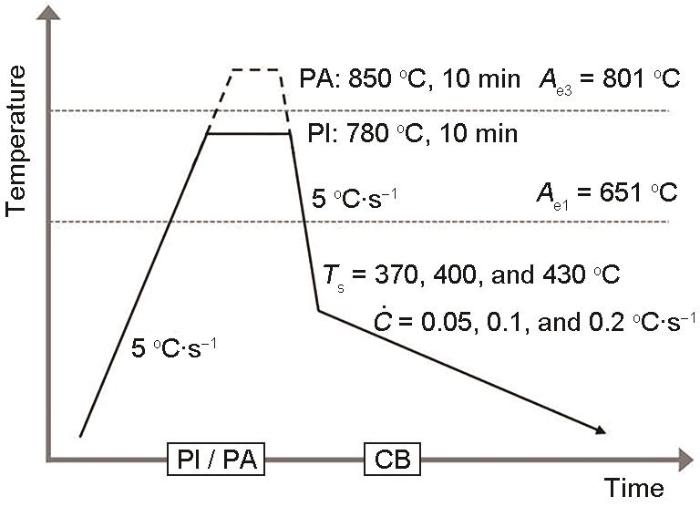
图1
中锰钢中温连续冷却过程的示意图
Fig.1
Schematic of the continuous cooling process from medium temperature in medium Mn steel (Ae3—the highest temperature at which ferrite and austenite phases can coexist in equilibrium, Ae1—the lowest temperature at which ferrite, cementite, and austenite phases can coexist in equilibrium,
表1 不同预退火和中温连续冷却条件处理的0.2C-3Mn-1.5Si中锰钢试样
Table 1
| Sample | Process | Pre-annealing process | CB | |
|---|---|---|---|---|
| Ts / oC | ||||
| PA-CB400-0.05 | PA | Annealing at 850 oC for 10 min | 400 | 0.05 |
| PI-CB370-0.05 | PI | Annealing at 780 oC for 10 min | 370 | 0.05 |
| PI-CB430-0.05 | 430 | 0.05 | ||
| PI-CB400-0.05 | 400 | 0.05 | ||
| PI-CB400-0.1 | 400 | 0.1 | ||
| PI-CB400-0.2 | 400 | 0.2 | ||
沿轧制方向切取表征试样,经机械研磨抛光后,利用2% (体积分数)硝酸酒精对试样进行腐蚀,采用SUPRA 35型场发射扫描电子显微镜(SEM)对试样的显微组织进行分析,加速电压为20 kV。利用Apero 2型SEM进行电子背散射衍射(EBSD)表征,同时利用附带的Ultim Max 100能谱(EDS)探头进行合金成分分析,加速电压为20 kV,扫描步长为20~30 nm。利用AztecCrystal软件进行EBSD数据处理。采用D8 Advance X射线衍射仪(XRD)采集热处理试样的特征谱线,选用(200) γ 、(200) α 、(220) γ 、(211) α 和(311) γ 衍射峰计算残余奥氏体的体积分数;测试靶材为Cu靶,扫描速率为1°/min,扫描范围(2θ)为40°~102°。制备EBSD和XRD试样时,先进行机械研磨抛光,再使用Buehler VibroMet 2型振动抛光仪去除试样表面的应力层,采用50 nm粒径SiO2悬浮液,抛光时间为2 h。单轴拉伸实验在DDL100试验机上进行,拉伸过程采用位移控制,夹头移动速率为2.1 mm/min。拉伸试样的标距为15 mm,平行段宽度为4 mm。拉伸实验结果取3个试样的平均值。
2 实验结果
2.1 中锰钢在中温连续冷却过程中发生的贝氏体相变
图2为0.2C-3Mn-1.5Si中锰钢经850 ℃等温退火10 min后,快速冷却至400 ℃,再以0.05 ℃/s速率连续冷却至室温时的热膨胀曲线和微观组织的SEM像、EBSD像及Mn元素分布图。由图2a可知,经850 ℃等温退火处理后,中锰钢已完全奥氏体化。随后从400 ℃缓慢冷却至室温的过程中,出现了明显的膨胀量转折,标志着贝氏体相变的开始。从图2b可见,贝氏体铁素体板条呈束状排列,板条边界处存在疑似析出物,呈细片状连续分布,如图2b中红色箭头所示。在贝氏体转变过程中,由于贝氏体铁素体向外排出C原子,使未转变奥氏体中的C含量逐渐增加,并导致贝氏体铁素体板条的界面处形成富C相[40,41]。EBSD分析表明,这些细小片状富C相为奥氏体(图2c)。本工作在中锰钢中添加了适量Si元素,目的是抑制贝氏体相变中渗碳体的析出,从而提高贝氏体铁素体板条界面处奥氏体相的稳定性[42,43],使中锰钢在连续冷却过程中发生无碳化物贝氏体相变。由于贝氏体相变发生的温度较低,Mn元素的扩散能力受限,因此Mn元素在相变过程中无法在贝氏体铁素体和未转变奥氏体两相之间发生有效配分,其分布保持与完全奥氏体化时相同的均匀分布状态(图2d)。
图2

图2
奥氏体化预退火0.2C-3Mn-1.5Si中锰钢在中温连续冷却处理时的热膨胀曲线和微观组织的SEM像、EBSD像和Mn元素分布图
Fig.2
Dilatation curve (a), SEM image (b), EBSD-band contrast (BC) map overlapped with the phase map of austenite (c), and Mn distribution map (d) of the 0.2C-3Mn-1.5Si MMnS austenitizing pre-annealed at 850 oC followed by continuous cooling from a medium temperature of 400 oC (ΔL—change in sample length, αB—bainitic ferrite, αM—martensite, γ—retained austenite. Inset in Fig.2a shows a magnified view of the dilatation infection due to bainite transformation during continuous cooling. The red arrows in Fig.2b point to the flak-like retained austenite that forms during the bainite transformation)
为了研究中锰钢在中温连续冷却过程中的贝氏体相变行为,将冷却至不同温度的试样直接淬火,以获得不同相变阶段的微观组织,结果如图3所示。可以看出,当试样由400 ℃缓冷到395 ℃时,贝氏体相变已在原始奥氏体晶界处发生,所形成的贝氏体铁素体呈板条状,并向晶内生长,如图3a1和a2所示。当试样继续冷却至390 ℃时,贝氏体铁素体板条进一步在原始奥氏体的晶粒内部形成。随着贝氏体相变的发生,贝氏体铁素体向外排出的C原子迅速扩散至未转变奥氏体中,提高其稳定性并得以保留至室温,如图3b1和b2所示。由于奥氏体的热稳定性受其尺寸影响,位于贝氏体铁素体板条界面处的小尺寸片状奥氏体容易残留至室温,而尚未转变的尺寸较大的块状奥氏体则在后续冷却过程中转变为马氏体[44]。当试样冷却至370 ℃时,贝氏体相变已经接近完成,获得由板条状贝氏体铁素体、细小片状残余奥氏体和少量马氏体岛组成的复相组织,如图3c1和c2所示。综上所述,利用在连续冷却过程中发生的无碳化物贝氏体相变可在中锰钢中获得残余奥氏体,但含量较低,利用XRD检测到其体积分数仅为9%。
图3

图3
奥氏体化预退火0.2C-3Mn-1.5Si中锰钢在中温连续冷却过程中冷却至395、390和370 ℃时微观组织的SEM像和EBSD像
Fig.3
SEM images (a1-c1) and EBSD-BC maps overlapped with the phase maps of austenite (a2-c2) of the austenitizing pre-annealed 0.2C-3Mn-1.5Si MMnS during the medium-temperature continuous cooling process when cooling to temperatures of 395 oC (a1, a2), 390 oC (b1, b2), and 370 oC (c1, c2)
2.2 预先Mn配分对中锰钢中温连续冷却过程中贝氏体相变的影响
上述结果表明,中锰钢在中温连续冷却过程中发生的无碳化物贝氏体相变为调控中锰钢中的残余奥氏体含量提供一种新思路。为了进一步提高利用贝氏体相变制备的残余奥氏体的体积分数,本工作采取了对中锰钢进行两相区预先配分处理之后,再进行中温连续冷却处理的工艺方案。从图4a的热膨胀曲线可以看出,试样在升温至780 ℃并保温10 min的过程中发生了奥氏体逆相变,生成了由奥氏体和铁素体组成的层片状双相组织(图4b1)。与此同时,随着奥氏体逆相变的进行,Mn元素由铁素体向逆变奥氏体配分,使形成的奥氏体富Mn,如图4c1和d1所示。但此时奥氏体中的Mn浓度仍不足以使其稳定至室温,冷却至室温后会转变为马氏体,无法获得残余奥氏体(图4c1)。将经两相区退火所形成的双相组织继续在400 ℃以0.05 ℃/s冷速进行连续冷却处理时,在奥氏体层片内部发生了贝氏体相变,从图4a中可观察到标志贝氏体相变发生的膨胀量转折。EBSD分析表示,奥氏体中形成了贝氏体铁素体和残余奥氏体,表明奥氏体层片内部同样发生无碳化物贝氏体相变。由于奥氏体层片的宽度较窄,通过贝氏体相变所形成的残余奥氏体尺寸较小,约为300 nm,且分布均匀,Mn元素在相变后仍然保持了与两相区退火后相同的带状分布状态(图4c2和d2)。
图4
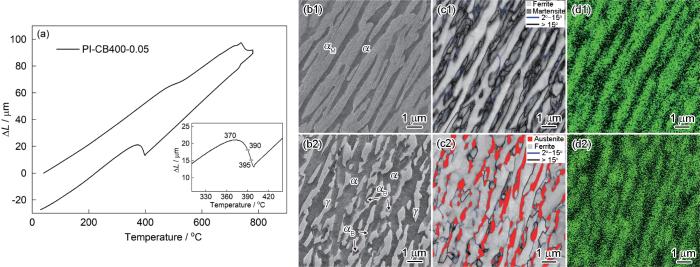
图4
临界区预退火0.2C-3Mn-1.5Si中锰钢在中温连续冷却处理时的热膨胀曲线,临界区预退火后和中温连续冷却处理后微观组织的SEM像、EBSD像和Mn元素分布
Fig.4
Dilatation curve of the intercritically pre-annealed 0.2C-3Mn-1.5Si MMnS during medium-temperature continuous cooling (a); SEM images (b1, b2), EBSD-BC maps overlapped with the phase maps of austenite (c1, c2) and Mn distribution maps (d1, d2) after intercritically pre-annealing (b1-d1) and after medium-temperature continuous cooling (b2-d2) (Inset in Fig.4a shows a magnified view of the dilatation infection due to bainite transformation during continuous cooling)
图5为两相区预退火后的0.2C-3Mn-1.5Si中锰钢在中温连续冷却过程中的组织演变情况。当试样由400 ℃缓冷至395 ℃时,贝氏体相变已在部分奥氏体层片内发生,如图5a1和a2所示。贝氏体铁素体自铁素体/奥氏体相界面处向奥氏体层片的内部生长。随着贝氏体相变的进行,C原子从贝氏体铁素体排出,并向奥氏体内部扩散,使未转变奥氏体内部的C含量提高。由于经两相区预配分处理所形成奥氏体层片本身富Mn (图4d1),且贝氏体铁素体的生成使未转变的奥氏体内部随之进一步富C,显著提高了奥氏体的稳定性,使之能残留至室温。当试样继续冷却至390 ℃时,相变驱动力随着温度的降低继续增大,发生贝氏体相变的奥氏体层片数量逐渐增加,所形成的残余奥氏体含量也同步增多,如图5b1和b2所示。当冷却至370 ℃时,贝氏体相变已经接近完全,原奥氏体层片因贝氏体相变的发生而被分割为贝氏体铁素体和细小片状残余奥氏体两相(图5c1和c2),残余奥氏体含量显著提升,体积分数达到20.9%。
图5

图5
临界区预退火0.2C-3Mn-1.5Si中锰钢在中温连续冷却过程中冷却至395、390和370 ℃时微观组织的SEM像和EBSD像
Fig.5
SEM images (a1-c1) and EBSD-BC maps overlapped with the phase maps of austenite (a2-c2) of the intercritically pre-annealed 0.2C-3Mn-1.5Si MMnS during the medium-temperature continuous cooling process when cooling to temperatures of 395 oC (a1, a2), 390 oC (b1, b2), and 370 oC (c1, c2)
图6对比了经完全奥氏体化预退火(PA)与两相区预配分退火(PI)处理的0.2C-3Mn-1.5Si中锰钢在中温连续冷却后的拉伸性能。可以看出,二者在拉伸变形中均表现出连续屈服的特征,抗拉强度均超过1000 MPa。对于经完全奥氏体化预退火处理的中锰钢,中温连续冷却后形成的贝氏体铁素体组织使中锰钢获得较高的屈服强度和抗拉强度,分别达到615和1025 MPa。虽然残余奥氏体有助于提升材料塑性,但此时组织中的残余奥氏体分布不均匀且数量有限。其中,位于原始奥氏体晶界处的较大尺寸块状残余奥氏体的稳定性低,持续诱发TRIP效应的能力有限,最终中锰钢的延伸率仅为16.6%,强塑积为17.0 GPa·%。对于经两相区预配分处理的中锰钢,由贝氏体相变所形成的残余奥氏体的体积分数显著提高,中锰钢在拉伸变形中持续诱发TRIP效应,使加工硬化率在变形过程中始终维持在较高水平,显著提升了材料的均匀变形能力,如图6b所示。此外,经两相区预配分处理的中锰钢中形成的残余奥氏体和贝氏体铁素体均明显细化,且残余奥氏体分布更加均匀。细小贝氏体板条构成的基体组织有助于塑性变形协调发生,使得中锰钢的强度和塑性进一步提升,获得抗拉强度1101 MPa和延伸率23.3%的优异强塑性匹配。但试样中同时保留了一定数量的临界铁素体,这种软相铁素体在变形过程中优先发生屈服[45],会显著降低中锰钢的屈强比,此时屈服强度为417 MPa。可见,通过两相区预配分处理后再进行中温连续冷却的简单工艺,可显著提升低Mn含量中锰钢中的残余奥氏体体积分数,利用连续冷却过程中发生的贝氏体相变可使中锰钢实现25.6 GPa·%的高强塑积。
图6

图6
不同温度预退火处理后中温连续冷却0.2C-3Mn-1.5Si中锰钢的工程应力-应变曲线和加工硬化曲线
Fig.6
Engineering stress-strain curves (a) and strain-hardening rate (SHR) curves alongside true stress-strain curves (b) of the 0.2C-3Mn-1.5Si MMnS pre-annealed at different temperatures followed by continuous cooling processing from the medium temperature of 400 oC
2.3 中温连续冷却过程中起始冷却温度对中锰钢贝氏体相变的影响
图7为不同Ts下预配分退火试样在连续冷却过程中的热膨胀曲线、XRD谱和残余奥氏体体积分数。将预配分退火后的试样分别快速冷却至370、400及430 ℃,随后再以0.05 ℃/s速率缓慢冷却至室温。从图7a的热膨胀曲线可以看出,三种工艺下均能观察到发生贝氏体相变的膨胀量转折,说明此三种Ts下中锰钢均能发生贝氏体相变。当Ts为370 ℃时,较低的相变温度为贝氏体相变提供了较大的相变驱动力,但同时C元素的扩散速率显著受限,导致奥氏体与贝氏体铁素体之间的C配分效率降低,削弱了未转变奥氏体的稳定性,此时在连续冷却处理后的试样中残余奥氏体体积分数为15.1%。当Ts为430 ℃时,贝氏体相变发生的温度较高,相变驱动力小,连续冷却过程中贝氏体相变未能充分发生。未转变的部分奥氏体在后续冷却过程中会进一步转变为马氏体,如图7a中的箭头所示,最终试样中残余奥氏体体积分数为8.4%。而从400 ℃开始进行连续冷却处理时,获得的残余奥氏体体积分数高达20.9%。由此可见,尽管无碳化物贝氏体相变可在Bs与马氏体相变起始温度(Ms)之间的温度区间内发生,但利用贝氏体相变在中锰钢中获得残余奥氏体,需综合考察贝氏体相变发生程度与C元素再分配之间的匹配,以实现调控残余奥氏体含量的目的。图8为预配分退火试样在不同Ts下连续冷却处理后的力学性能。可以看出,三种试样均呈现连续屈服的变形行为,具有1100 MPa级别的强度水平,延伸率均超过18%。试样强塑积超过21.0 GPa·%,均优于完全奥氏体化退火试样的强塑积(17.0 GPa·%)。
图7

图7
不同起始冷却温度下0.2C-3Mn-1.5Si中锰钢连续冷却时的热膨胀曲线、XRD谱和残余奥氏体体积分数
Fig.7
Dilatation curves (a), XRD patterns (b), and retained austenite (RA) volume fractions (c) of the intercritically pre-annealed 0.2C-3Mn-1.5Si MMnS continuously cooled from different Ts at a cooling rate of 0.05 oC/s (The black arrow in Fig.7a marks the dilatation inflection resulted from the martensite transformation)
图8
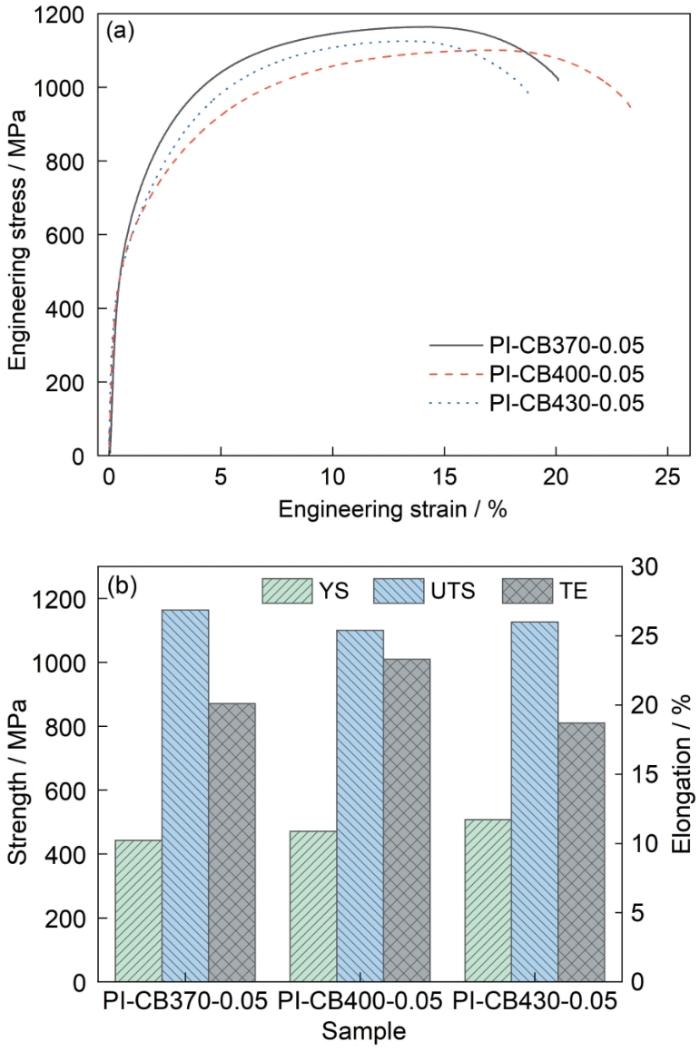
图8
以不同起始冷却温度连续冷却0.2C-3Mn-1.5Si中锰钢的工程应力-应变曲线和力学性能
Fig.8
Engineering stress-strain curves (a) and mechanical properties (b) of the intercritically pre-annealed 0.2C-3Mn-1.5Si MMnS continu-ously cooled from different Ts at a cooling rate of 0.05 oC/s (YS—yield strength, UTS—ultimate tensile strength, TE—total elongation)
2.4 中温连续冷却过程中冷却速率对中锰钢贝氏体相变的影响
为了探究冷却速率对贝氏体相变的影响,将经过Mn预配分退火后的试样冷却至400 ℃,再分别以0.05、0.1和0.2 ℃/s的冷速连续冷却至室温。试样在中温连续冷却过程中的热膨胀曲线如图9a所示。可以看出,试样在三种冷速下均发生了贝氏体相变,从热膨胀曲线中均能观察到发生贝氏体相变的膨胀量转折。从相变膨胀量上判断,冷却速率越慢,贝氏体相变发生的程度越大。在较高冷速(0.2 ℃/s)下,在贝氏体相变充分发生之前,试样即已冷却至低温段,未转变奥氏体会在后续冷却过程中发生马氏体相变,如图9a中箭头所示。从图9b的XRD谱可以看出,以0.2 ℃/s冷速连续冷却处理后的试样中,残余奥氏体体积分数为9.0%。而较低冷却速率(0.05 ℃/s)有助于贝氏体相变的充分发生。随着贝氏体铁素体的形成,充分的相变时间为C原子扩散提供了动力学条件,C元素可在未转变奥氏体中充分配分,通过C富集显著提升奥氏体稳定性。这种情况下,未转变的奥氏体在贝氏体相变结束后易于稳定到室温,最终在中锰钢中获得体积分数为20.9%的残余奥氏体。可见,冷速过高不利于贝氏体相变充分发生,试样中未转变的奥氏体在随后冷却过程中会继续转变为马氏体。相比之下,较慢冷速不仅可以使中锰钢中的贝氏体相变发生充分,而且可使未转变奥氏体中的C元素充分富集,有利于提高未转变奥氏体的热稳定性,进而提高最终组织中残余奥氏体的体积分数。
图9

图9
不同冷却速率下0.2C-3Mn-1.5Si中锰钢在中温连续冷却时的热膨胀曲线、XRD谱和残余奥氏体体积分数
Fig.9
Dilatation curves (a), XRD patterns (b) and RA volume fractions (c) of the intercritically pre-annealed 0.2C-3Mn-1.5Si MMnS continuously cooled from 400 oC at different cooling rates (The black arrow in Fig.9a marks the dilatation inflection resulted from the martensite transfor-mation)
3 分析与讨论
中锰钢优异的强塑性主要源自残余奥氏体在变形过程中发生的TRIP效应,在中锰钢中获得足够数量的残余奥氏体对于中锰钢设计具有非常重要的意义。为了获得足够含量的残余奥氏体,中锰钢的Mn含量通常不能太低;但较高Mn含量使中锰钢难以通过连续冷却过程中的过冷奥氏体分解获得残余奥氏体。因此,制备中锰钢的常规工艺是通过临界区长时间退火完成马氏体向奥氏体逆相变,利用奥氏体逆相变中的合金元素配分可将重新生成的亚稳奥氏体保留至室温,通过这种途径在中锰钢中获得残余奥氏体组织。但当中锰钢的Mn含量下降至3%时,通过临界区奥氏体逆相变所形成的奥氏体的热稳定性变差,难以将亚稳奥氏体保留至室温。在这种情况下,常规奥氏体逆相变退火工艺已不适用于低Mn含量中锰钢的制备,需要开发适用于低Mn含量中锰钢的奥氏体调控路径。
本工作针对低C低Mn含量中锰钢合金体系,探索基于连续冷却过程中过冷奥氏体分解途径在中锰钢中获取高体积分数残余奥氏体的可行性。对于此,可参考工业化汽车用低合金高强度Si-Mn系TRIP钢的工艺过程。TRIP钢的制备一般要求在中温区等温,通过过冷奥氏体中发生的贝氏体转变获得由铁素体、贝氏体和残余奥氏体构成的多相组织[46,47]。图2结果已证实,0.2C-3Mn-1.5Si中锰钢在中温连续冷却过程中可发生贝氏体相变。由于合金中添加了适量Si元素,有效抑制了贝氏体相变中碳化物的析出。这种情况下,相变以无碳化物贝氏体相变的模式发生,显然这种相变模式有利于在中锰钢中获取残余奥氏体。当过冷奥氏体快冷至中温温度后,贝氏体铁素体在原始奥氏体晶界处形成,并以层片状向晶内延伸,如图3所示。这种情况下,位于铁素体片层处的未转变奥氏体容易富C而残留至室温,但这部分残余奥氏体的体积分数较低。而对于尚未转变的大块奥氏体区,其内部富集的C不足以将其稳定至室温。尽管温度的缓慢降低为贝氏体铁素体的持续形成提供了驱动力,但C元素在未转变奥氏体中的分配效率也显著减弱,进而影响其内部贝氏体相变的继续发生。这部分奥氏体在随后的连续冷却过程中转变为块状马氏体。可见,仅利用单相奥氏体调控贝氏体相变时,获得的奥氏体体积分数较低,且连续冷却相变结束后仍存在块状马氏体,显微组织尺寸及分布不均匀。
为了进一步提高通过贝氏体相变获取残余奥氏体的体积分数,本工作采取了在临界区调控奥氏体的策略。第一步预配分处理选择在较高临界区温度对中锰钢进行常规奥氏体逆相变处理[48,49]。利用板条马氏体为初始组织进行临界区退火时,奥氏体逆相变沿马氏体板条界处发生,形成由层片状铁素体和奥氏体组成的双相组织,如图4所示。由于预配分处理在较高临界区温度进行,相变速率很快,奥氏体相变在较短时间内即可完成,因此预配分处理时间较短。通过预配分处理形成的组织有两个特点:① 在微观组织空间分布上,初始组织被分割成为铁素体和奥氏体两相区域,呈层片状交替分布;② 在合金成分分布上,形成了贫Mn铁素体区和富Mn奥氏体区。当将此双相组织用于后续连续冷却相变时,无碳化物贝氏体相变仅局限于奥氏体层片之内发生。值得指出的是,在临界区退火过程中形成的铁素体/奥氏体界面满足K-S关系。这种具有很高相干性的界面有利于无碳化物贝氏体的形成,极大地促进了无碳化物贝氏体的相变进程。这种情况下,奥氏体板条将转化为贝氏体铁素体和残余奥氏体两相。但因相变调控限制在奥氏体层片内部进行,即使有部分未转变奥氏体会转变为马氏体,各生成相的尺寸仍保持较小且分布均匀。同时,贝氏体相变被限制在奥氏体层片内发生时,C元素的扩散距离大大减小,进一步加快了C在未转变奥氏体中再分配的速率。在无碳化物贝氏体相变模式下,通过C元素配分稳定奥氏体的效果显著提升。其次,因预配分处理时C和Mn元素在铁素体和奥氏体中已经发生了配分,奥氏体层片内的C/Mn元素在贝氏体相变发生之前即发生富集。在随后的连续冷却相变过程中,奥氏体中的C含量随贝氏体铁素体的形成而二次富集。这种情况下,在预配分处理过程中的Mn富集与贝氏体相变过程中的C富集的共同作用下,未转变奥氏体的稳定性显著提升,从而大幅提高残余奥氏体的体积分数,如图10所示。可见,经Mn预配分处理后,无碳化物贝氏体相变局限于奥氏体层片内发生,组织得到细化且均匀性提升。正是由于这种预配分的作用,其冷却后所形成的残余奥氏体中的Mn含量更高。另外,由于无碳化物贝氏体相变被局限在临界奥氏体板条内部发生,未转变奥氏体的尺寸较小且均匀分布在组织内部,其机械稳定性优于奥氏体化预退火试样。这种残余奥氏体不会在变形初期快速转变完全,而会在更高的应变阶段继续转变,更有利于TRIP效应在较大应变范围内持续发生,进而提高中锰钢的塑性。将临界区Mn预配分退火与中温连续冷却工艺结合,通过调控相变和合金元素配分,可实现低C低Mn含量中锰钢的组织和性能优化。
图10

图10
中锰钢中温连续冷却过程中发生无碳化物贝氏体相变的示意图
Fig.10
Schematics of carbide-free bainite transformations during continuous cooling processing from a medium temperature in MMnS
本工作从相变的角度论证了基于中温连续冷却贝氏体相变提高低Mn含量中锰钢中残余奥氏体体积分数的可行性。参照薄板坯连铸连轧工艺制备Si-Mn系TRIP钢的经验,通过控制热轧TRIP钢板在冷却及卷取过程中的相变,可获得包含铁素体、贝氏体和残余奥氏体的多相微观组织。基于相同思路,将低Mn含量中锰钢冷却至起始冷却温度进行卷取,利用钢卷的自然缓慢冷却促使过冷奥氏体发生贝氏体相变,即可基于无碳化物贝氏体相变在低Mn含量中锰钢中制备残余奥氏体。通过与两相区退火结合,可进一步提升低Mn含量中锰钢中的残余奥氏体体积分数,使中锰钢获得优良的强塑性。而钢卷由中温区需经历20 h才能完成整个冷却过程[50],中温卷取钢卷的实际冷速适用于中温连续冷却过程中贝氏体相变所需的冷却速率要求,不经历额外热处理即可完成相变,可有效减少加工工序。综上可知,通过将中温连续冷却过程中的贝氏体相变调控与中温卷取冷却工艺结合,可以为基于过冷奥氏体分解相变路径制备低Mn含量中锰钢提供可行途径,也为利用现有工艺制备高强塑性低Mn含量中锰钢提供参考。
4 结论
(1) 利用两相区退火中发生的Mn配分,与后续中温连续冷却过程中发生的无碳化物贝氏体相变结合,可有效调控0.2C-3Mn-1.5Si中锰钢的微观组织和残余奥氏体。通过预配分退火生成的层片状富Mn奥氏体和贫Mn铁素体组成的两相组织,将连续冷却过程中发生的贝氏体相变限制在奥氏体片层内部,形成分布均匀的细晶多相组织。同时,通过将两相区退火中的Mn配分与贝氏体相变的C配分结合,使未转变奥氏体的稳定性显著提升,残余奥氏体的体积分数由9.0%提升至20.9 %。
(2) 将两相区预配分退火与中温缓慢连续冷却工艺结合,为基于过冷奥氏体分解工艺路线制备低Mn含量中锰钢提供了新思路。通过顺序调控临界区预退火中的奥氏体逆相变和中温连续冷却过程中的无碳化物贝氏体相变,可在中锰钢中获得由临界铁素体片层、贝氏体铁素体、薄膜状残余奥氏体和少量马氏体组成的细晶组织,实现抗拉强度1101 MPa和延伸率23.3%的综合性能,显著提升低Mn含量中锰钢的强塑性。
(3) 中锰钢在中温连续冷却过程中发生的贝氏体相变受连续冷却速率和起始冷却温度的显著影响。起始冷却温度是中温冷却贝氏体相变调控参数,影响贝氏体相变的温度区间及贝氏体相变的发生程度。降低冷却速率有利于贝氏体相变的充分发生及相变过程中的C配分行为,从而提高最终组织中的残余奥氏体含量。
参考文献
M³ microstructure control theory and technology of the third-generation automotive steels with high strength and high ductility
[J].
高强度高塑性第三代汽车钢的M3组织调控理论与技术
[J].
高强度、高塑性是汽车钢的重要发展方向,本文综述了高强度高塑性第三代汽车钢的“多相(multiphase)、亚稳(metastable)和多尺度(multiscale)” M<sup>3</sup>组织性能调控理论和技术,以及面临的新挑战。M<sup>3</sup>组织与性能调控理论为高强度高塑性钢提供了理论支持,亚稳奥氏体的相变诱发塑性(TRIP)效应能够提高加工硬化率并推迟颈缩的发生,从而提高了钢的强度与塑性,同时产生了剪切边裂纹敏感性提高,氢致延迟断裂性能下降,循环载荷下亚稳奥氏体的转变行为复杂等新的问题和挑战。当前,含亚稳奥氏体高强度高塑性钢的质量一致性和应用基础研究缺乏,而汽车钢作为量大面广的产品,需要从它的成分设计和组织调控-冲裁切割-成形制造-连接涂装-服役评价等全链条环节中开展组织演变和性能评估,充分考虑产品的技术适用性和成本,进而为组织调控理论和技术的完善提供依据。
Current trends in metallic materials for body panels and structural members used in the automotive industry
[J].The development of lightweight and durable materials for car body panels and load-bearing elements in the automotive industry results from the constant desire to reduce fuel consumption without reducing vehicle performance. The investigations mainly concern the use of these alloys in the automotive industry, which is characterised by mass production series. Increasing the share of lightweight metals in the entire structure is part of the effort to reduce fuel consumption and carbon dioxide emissions into the atmosphere. Taking into account environmental sustainability aspects, metal sheets are easier to recycle than composite materials. At the same time, the last decade has seen an increase in work related to the plastic forming of sheets made of non-ferrous metal alloys. This article provides an up-to-date systematic overview of the basic applications of metallic materials in the automotive industry. The article focuses on the four largest groups of metallic materials: steels, aluminium alloys, titanium alloys, and magnesium alloys. The work draws attention to the limitations in the development of individual material groups and potential development trends of materials used for car body panels and other structural components.
Advanced lightweight materials for automobiles: A review
[J].
TG-AHSS materials design based on thermodynamic and generalized stability
[J].Third-generation advanced high-strength steel (TG-AHSS) recently garnered significant attention in the field of materials science and the automotive industry. This study focuses on the composition design, heat treatment processing, and mechanisms underlying the strengthening and deformation of TG-AHSS. The principle of composition design for TG-AHSS is expounded based on thermodynamic stability. Furthermore, several representative heat treatment processes are interpreted by generalized stability (GS). The strengthening and deformation mechanisms of the TG-AHSS are summarized from the perspective of the thermo-kinetic connectivity arising from the GS and the thermo-kinetic correlation. Finally, considering concurrently thermodynamics and kinetics, the design strategy of the TG-AHSS was summarized and outlooked.
基于稳定性的第三代先进高强钢设计
[J].
Progress and perspective of ultra-high strength steels having high toughness
[J].Ultra-high strength steels have been widely used in the critical engineering structures in both military and civilian applications due to the combination of ultra-high strength and excellent toughness. In this paper, firstly, the typical ultra-high strength steel grades that have been employed were introduced, and their compositions, mechanical properties, application and histories of development were summarized with the emphasis on their microstructures and strengthening/toughening mechanism; secondly, the latest progress on the emerging ultra-high strength steel grades was reviewed, including their compositions, microstructures, strengthening mechanism and mechanical properties; thirdly, the newly emerging demands on replacing the currently employed ultra-high strength steels in China were defined, including steels for low-density but ultra-strong armors, the large ball grinding mill, cutters of tunnel boring machine and high pressure fracturing pump; finally, recent research results on ultra-high strength and high-toughness medium Mn steel were presented, which overcame the trade-off of strength and toughness to a greater extent; on this basis, some suggestions were put forward for the future development of these steel grades to meet the urgent national demands.
超高强高韧化钢的研究进展和展望
[J].超高强韧钢同时拥有超高强度和优良韧性,因而在国防和民用工程机械领域中广泛应用。本文首先综述了各类型传统超高强韧合金钢的典型钢种、成分、性能及应用和发展历程,并重点阐述了各典型钢种的组织和强韧化机理;然后介绍了近年所研发的具有代表性的新型超高强韧钢的成分、组织、强韧化机理及力学性能;接着梳理了我国近年来由于快速发展的经济需求和地理、资源等特点,出现了对现役超高强韧钢进行升级换代的迫切需求,包括新型轻质装甲防护钢、大型球磨机用钢、高山隧道挖掘的盾构机刃具用钢以及石油工程机械中的高压压裂泵用钢等;最后介绍了作者团队近期在超高强韧钢的一些最新研究成果,并据此提出超高强韧钢未来发展的思路。
Austenite tailoring for strength and ductility enhancement in medium Mn steel: A brief review
[J].
Processing, microstructure, mechanical properties, and hydrogen embrittlement of medium-Mn steels: A review
[J].As a representative of steels available in the market, medium-Mn steel shows vast application prospects in lightweight automobile fields. This review details the research progress of medium-Mn steels, focusing on the following aspects. The roles of common adding elements, rolling technologies, and various heat treatments on the microstructure and mechanical properties of medium-Mn steel are analyzed, thus providing references for designing tailored medium-Mn steel with excellent performance. Considering that hydrogen embrittlement is a challenge faced in the development of high-strength steel, the hydrogen embrittlement behavior of medium-Mn steel is also discussed, particularly emphasizing the influence of microstructure, hydrogen concentration, strain, etc. Furthermore, practical strategies to improve resistance to hydrogen embrittlement are summarized. Finally, this review provides prospects for the development and research prospects of medium-Mn steel.
Physical metallurgy of medium-Mn advanced high-strength steels
[J].Steels with medium manganese (Mn) content (3∼12 wt-%) have emerged as a new alloy class and received considerable attention during the last decade. The microstructure and mechanical response of such alloys show significant differences from those of established steel grades, especially pertaining to the microstructural variety that can be tuned and the associated micromechanisms activated during deformation. The interplay and tuning opportunities between composition and the many microstructural features allow to trigger almost all known strengthening and strain-hardening mechanisms, enabling excellent strength-ductility synergy, at relatively lean alloy content. Previous investigations have revealed a high degree of microstructure and deformation complexity in such steels, but the underlying mechanisms are not adequately discussed and acknowledged. This encourages us to critically review and discuss these materials, focusing on the progress in fundamental research, with the aim to obtain better understanding and enable further progress in this field. The review addresses the main phase transformation phenomena in these steels and their mechanical behaviour, covering the whole inelastic deformation regime including yielding, strain hardening, plastic instability and damage. Based on these insights, the relationships between processing, microstructure and mechanical properties are critically assessed and rationalized. Open questions and challenges with respect to both, fundamental studies and industrial production are also identified and discussed to guide future research efforts.
A critical review on medium-Mn steels: Mechanical properties governed by microstructural morphology
[J].
Improved microstructural homogeneity and mechanical property of medium manganese steel with Mn segregation banding by alternating lath matrix
[J].
Fracture mechanisms and microstructure in a medium Mn quenching and partitioning steel exhibiting macrosegregation
[J].
Optimum properties of quenching and partitioning steels achieved by balancing fraction and stability of retained austenite
[J].
Effect of precipitation-induced element partitioning during tempering on mechanical properties of hot-rolled 3Mn steel after intercritical annealing
[J].
Microstructures and mechanical properties of three medium-Mn steels processed via quenching and partitioning as well as austenite reversion heat treatments
[J].
A heterostructured bainitic steel produced by two-step austempering and low-temperature ausforming
[J].
Enabling strong and formable advanced high-strength steels through inherited homogeneous microstructure
[J].
Impacts of near-Ms austempering treatment on microstructure evolution and bainitic transformation kinetics of a medium Mn steel
[J].
Inhibition mechanism of heterogeneous grain structures on plastic instability behavior in 3Mn steel
[J].
Phase transformation under continuous cooling conditions in medium carbon microalloyed steels
[J].Several 35CrMo4 and 38MnV7 steels with different additions of Ti and V were manufactured by electroslag remelting. The influence of the alloying and microalloying elements on phase transformation at different cooling rates was studied and the continuous cooling transformation diagrams were plotted. In order to optimize the heat treatment and improve the mechanical properties, the range of cooling rates leading to a fully bainitic microstructure (without ferrite, pearlite and especially without martensite) was determined. Bainite and martensite transformation start temperatures (Bs, Ms) were also established and compared with the values predicted by empirical equations. The important role of precipitates (especially V carbonitride particles) on final microstructure and mechanical properties was assessed.
Investigation of austenite decomposition behavior and relationship to mechanical properties in continuously cooled medium-Mn steel
[J].
Development of continuously cooled low-carbon, low-alloy, high strength carbide-free bainitic rail steels
[J].
Carbide-free bainite in medium carbon steel
[J].
Design of cooling route for carbide-free bainitic rail steels and resultant microstructures and properties
[J].
Formation of bainite in a low-carbon steel at slow cooling rate-experimental observations and thermodynamic validation
[J].
Compositional heterogeneity in multiphase steels: Characterization and influence on local properties
[J].
Effects of mechanical and chemical heterogeneity on the strength-ductility synergy of a heterostructured medium Mn steel
[J].
Microstructure and tensile properties of chemically heterogeneous steel consisting of martensite and austenite
[J].
On the role of chemical heterogeneity in carbon diffusion during quenching and partitioning
[J].
The influence of ferrite content, ferrite-austenite morphology, and orientation relationship on bainite transformation in intercritically annealed bainitic steels
[J].
On the role of chemical heterogeneity in phase transformations and mechanical behavior of flash annealed quenching & partitioning steels
[J].
Improving ductility of a 3Mn medium-Mn steel by manipulating the austenite reversion path
[J].
Improving strength and ductility of Al-containing medium Mn steels by introducing pre-partitioning treatment in intercritical annealing
[J].
Acceleration of bainitic transformation in 0.28C-3.8Mn-1.5Si steel utilizing chemical heterogeneity
[J].
Enhancing ductility of the TRIP aided bainitic ferrite steel by Mn heterogeneity introduced via reversion: Towards the 3rd generation
[J].
Mechanistic role of Mn heterogeneity in austenite decomposition and stabilization in a commercial quenching and partitioning steel
[J].
Chemical heterogeneity enables austenite stabilization in a Si-/Al-free Fe-0.2C-2Mn steel
[J].
Leveraging chemical heterogeneity in steels heat treated to retain metastable austenite
[J].
Constructing multi-scale retained austenite makes bainitic steel better mechanical properties by introducing weak chemical heterogeneity
[J].
Prediction of bainite start temperature in alloy steels with different grain sizes
[J].
Partition of carbon and alloying elements during the growth of ferrous bainite
[J].
In situ observation of the lengthening rate of bainite sheaves during continuous cooling process in a Fe-C-Mn-Si superbainitic steel
[J].
Transformation behavior and properties of carbide-free bainite steels with different Si contents
[J].
Bainite transformation of low carbon Mn-Si TRIP-assisted multiphase steels: Influence of silicon content on cementite precipitation and austenite retention
[J].
Bainite transformation and resultant tensile properties of 0.6%C low alloyed steels with different prior austenite grain sizes
[J].
Transmission electron microscopy analysis of yielding in ultrafine-grained medium Mn transformation-induced plasticity steel
[J].
Structure-properties relationship in TRIP steels containing carbide-free bainite
[J].
A study of microstructure, transformation mechanisms and correlation between microstructure and mechanical properties of a low alloyed TRIP steel
[J].
Growth of austenite from as-quenched martensite during intercritical annealing in an Fe-0.1C-3Mn-1.5Si alloy
[J].
Microstructures and mechanical properties of the third generation automobile steels fabricated by ART-annealing
[J].


