



随着航空发动机的推重比不断提升,涡轮盘前进口温度不断提高,对涡轮盘用高温合金的承温能力也提出了更高的要求[1~3]。GH4151合金是一种高合金化难变形镍基高温合金,其沉淀强化元素Al + Ti + Nb含量超过10% (质量分数),γ'相体积分数约为55%,通过优化合金成分以及调控γ'相分布,其力学性能和高温组织稳定性得到显著提升[4~7],服役温度可达800 ℃,是新一代先进航空发动机涡轮盘用高温合金的重要材料[8,9]。涡轮盘工作条件非常苛刻,在发动机启停或快速模式切换过程中,温度和应力快速叠加,极易造成涡轮盘损伤[10]。因此,研究不同温度下GH4151合金的拉伸行为及其断裂机制,对GH4151合金工程化应用具有理论指导作用。
近年来,国内外学者对涡轮盘用变形高温合金的拉伸失效断裂行为做了相关研究。Duan等[11]研究表明,变形高温合金在室温拉伸时呈现混合断裂特征,750 ℃高温拉伸断口呈现沿晶断裂特征。Wan等[12]研究发现,合金的韧性断裂是由于应力作用下微孔洞合并所致,沿晶断裂是由晶界第二相引起的应力集中所致。Németh等[13]发现,随着温度升高,合金延伸率呈现出先下降后增加的趋势,这主要是环境辅助晶界氧化所致,同时晶界滑动缓解了晶界处的位错塞积,进而提高了高温阶段的延伸率。高温合金的塑性对实验温度具有较高的依赖性,晶界氧化[14]、晶界析出相[15]、滑移面脱黏[16]和晶界滑动[13]均会导致合金高温塑性下降,再结晶和晶界滑动[16]是引起高温塑性提升的主要原因。此外,Li等[5]研究表明,铸态GH4151高温合金裂纹的开裂机理为冷却过程中冷裂纹的形成。Jia等[17]对铸态GH4151合金的开坯裂纹进行了分析,发现析出相边缘及晶界附近细小孔洞是导致合金产生沿晶断裂的主要原因。李育升等[18]研究了热处理工艺对GH4151合金冲击性能的影响,认为晶界上连续或不连续分布的第二相导致合金发生脆性断裂。Pan等[19]认为,GH4151合金蠕变过程中沿晶断裂的产生与晶界MC碳化物和γ'相有关。Gai等[20]研究了固溶温度对GH4151合金拉伸性能的影响,发现随着固溶温度升高,晶粒尺寸增大,晶界强度降低,导致750 ℃拉伸断口由韧性断裂转变为混合断裂。作为航空发动机涡轮盘重要的备选材料之一,深入探究GH4151合金在不同温度阶段的断裂机理对其实际应用具有重要意义。然而,目前仍缺乏针对GH4151合金在不同温度下的拉伸行为及其断裂机制的系统性研究。
基于此,本工作研究了GH4151合金在23~950 ℃范围内的拉伸行为和显微组织演化,分析了不同温度下GH4151合金的拉伸断裂机制,以期更好地理解不同工作条件下涡轮盘材料的损伤和失效过程,从而为提高涡轮盘的可靠性和安全性提供理论依据。
1 实验方法
图1
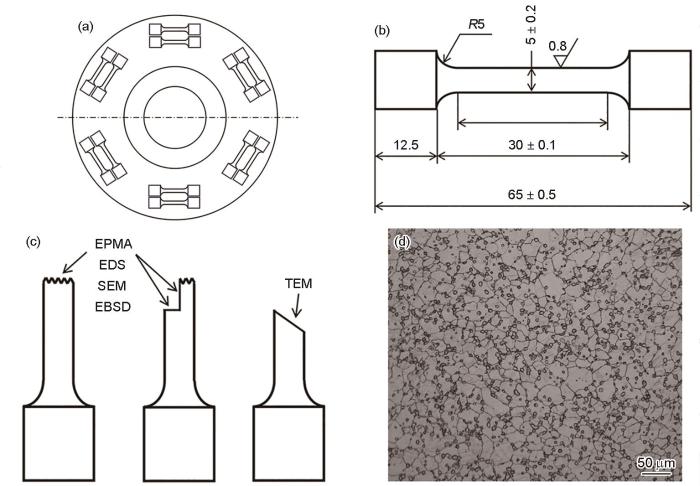
图1
GH4151合金拉伸样品取样位置、尺寸和表征位置示意图以及初始组织OM像
Fig.1
Schematics of sampling position (a), tensile sample size (unit: mm) (b), and material characterization positions (c) and OM image of the initial microstructure (d) of GH4151 alloy
依据GB/T 4338—2006标准,采用WE300B拉伸试验机在23、200、400、550、650、700、750、800和950 ℃条件下对GH4151合金进行拉伸实验,同时在真空条件下进行800 ℃拉伸实验作为对比实验,所有拉伸实验的应变速率均保持一致(屈服前0.003 min-1、屈服后0.03 min-1),每个条件下设置3个平行样品。利用电解抛光和电解腐蚀方法制备扫描电子显微镜(SEM)样品,电解抛光在20%H2SO4 + 80%CH3OH溶液(体积分数,下同)中进行,电压20 V,抛光时间20 s;电解腐蚀在30 mL H3PO4 + 3 g CrO3 + 2 mL H2SO4溶液中进行,电压5 V,腐蚀时间2 s。采用Tenupol-5型双喷电解设备制备透射电子显微镜(TEM)样品,双喷液为10%HClO4 + 90%C2H5OH溶液,温度-25 ℃,电流80 mA。为了防止引入O原子,采用机械抛光+超声波清洗的方法制备电子探针显微分析(EPMA)样品,实验前样品需在高温下(200 ℃)烘烤10 min。实验样品观测位置如图1c所示,采用GX71型光学显微镜(OM)分析断口表面裂纹萌生区和裂纹扩展区特征。采用配备能谱仪(EDS)和电子背散射衍射(EBSD)系统的JSM-7800 F场发射SEM分析γ'相和断口微观组织以及晶粒组织取向特征。采用JXA-8530F型EPMA定量分析合金元素的分布信息。采用G2 F20型TEM分析合金变形微观组织。采用JmatPro软件计算不同温度下GH4151合金的晶格错配度。采用Image J软件统计不同温度下GH4151合金中二次γ'相的球形度,每个温度分别在10个不同视场下统计200个二次γ'相的球形度。
2 实验结果
2.1 拉伸性能
图2为不同温度下GH4151合金的工程应力-应变曲线和拉伸性能。可以看出,当实验温度从23 ℃升高至650 ℃时,GH4151合金的屈服强度从1204 MPa下降至1113 MPa,抗拉强度从1628 MPa下降至1487 MPa。在700~800 ℃范围内,随着实验温度升高,屈服强度从1083 MPa下降至902 MPa,抗拉强度从1347 MPa下降至1080 MPa。当温度到达950 ℃时,屈服强度下降至332 MPa,抗拉强度下降至497 MPa。此外,当实验温度从23 ℃升高至800 ℃时,GH4151合金的断后伸长率从15%下降至7%,当温度继续升高至950 ℃时,合金断后伸长率提升至14%。
图2
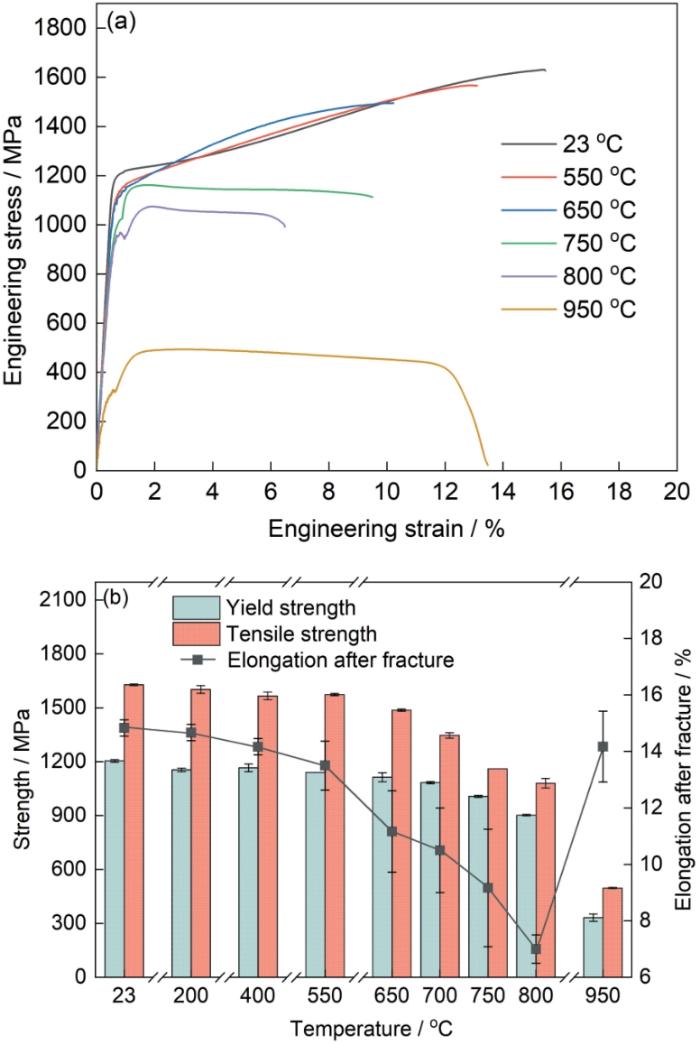
图2
不同温度拉伸后GH4151合金的工程应力-应变曲线和拉伸性能
Fig.2
Engineering stress-strain curves (a) and tensile properties (b) of GH4151 alloy after tensile testing at various temperatures
2.2 断口形貌
图3
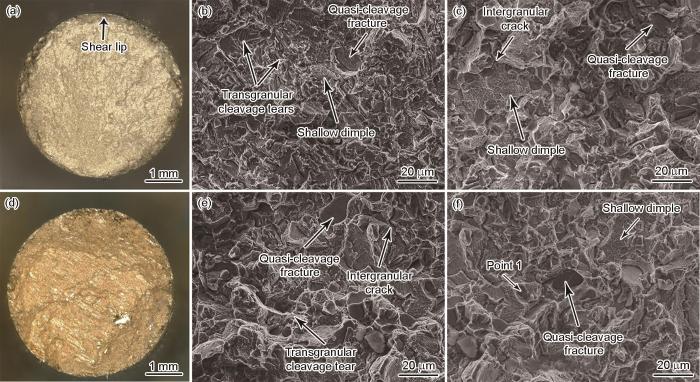
图3
23和550 ℃拉伸后GH4151合金断口横截面的OM和SEM像
Fig.3
Cross-sectional OM (a, d) and SEM (b, c, e, f) images of fracture morphologies of GH4151 alloy after tensile testing at 23 oC (a-c) and 550 oC (d-f)
图4为650~800 ℃拉伸后GH4151合金断口横截面的OM和SEM像。可以看出,650~800 ℃拉伸样品断口呈现出的断裂特性一致,即:存在明显的裂纹萌生区域和裂纹扩展区域(如图4a~d中黑色虚线标识区域)。差异在于,随着拉伸温度的升高,裂纹萌生区域面积逐渐增大,裂纹扩展区域相应减小。为进一步分析650~800 ℃拉伸样品的断裂方式,选取了具有代表性特征的800 ℃拉伸样品进行研究。图4e为800 ℃拉伸样品裂纹萌生区域的组织形貌。该区域表现出明显的沿晶断裂特征,说明650~800 ℃条件下样品裂纹萌生区域的断裂方式为沿晶断裂。g和区域表现出明显的沿晶为800 ℃拉伸样品裂纹扩展区域组织形貌。断口具有明显的解理面、穿晶撕裂棱和少量的沿晶裂纹,此区域的断裂模式为以穿晶断裂为主的混合断裂模式。因此,在650~800 ℃拉伸样品中,裂纹以沿晶断裂方式萌生,并以混合断裂模式扩展。值得注意的是,裂纹萌生区和裂纹扩展区具有明显的颜色差别,这可能与高应力氧化气氛下的环境损伤有关[13]。此外,550和800 ℃拉伸样品的混合断裂区域存在少量破碎或断裂的小平面(图3f中点1和图4f中点2位置)。采用EDS分析断裂小平面的化学成分,结果如表1所示。可以看出,这些小平面为富Nb、Ti的MC碳化物,这些MC碳化物可能与混合断裂中的沿晶断裂有关。
图4
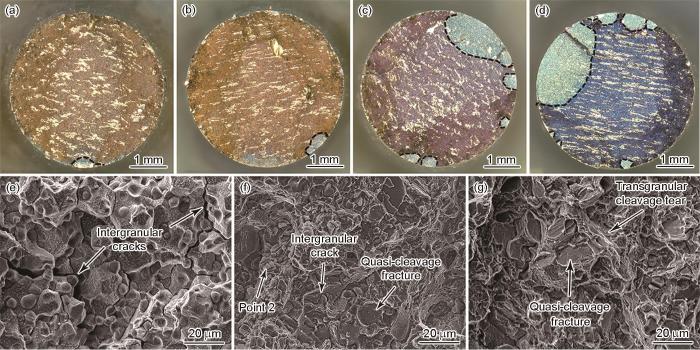
图4
650~800 ℃拉伸后GH4151合金断口横截面的OM和SEM像
Fig.4
Cross-sectional OM (a-d) and SEM (e-g) images of fracture morphologies of GH4151 alloy after tensile testing at 650 oC (a), 700 oC (b), 750 oC (c), and 800 oC (d-g) (The regions enclosed by the black dotted lines in Figs.4a-d represent the crack initiation areas, with the exterior demarcated as the crack propagation areas) (e) crack initiation zone (f, g) crack propagation zones
表1 图3f和4f中点1和2化学成分的EDS分析结果 (mass fraction / %)
Table 1
| Point | C | Al | Ti | Cr | Co | Ni | Nb | Mo | W |
|---|---|---|---|---|---|---|---|---|---|
| 1 | 8.79 | 0.45 | 11.71 | 4.67 | 5.78 | 19.19 | 41.14 | 4.26 | 4.01 |
| 2 | 8.05 | 1.08 | 9.13 | 6.35 | 9.86 | 20.27 | 36.83 | 3.58 | 4.85 |
图5
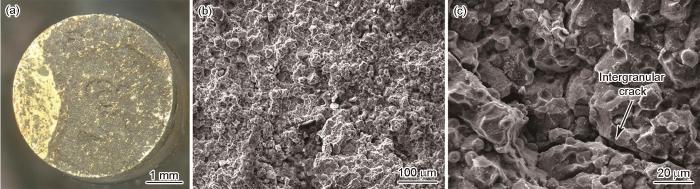
图5
950 ℃拉伸后GH4151合金断口横截面的OM和SEM像
Fig.5
Cross-sectional OM (a) and low (b) and high (c) magnified SEM images of fracture morphologies of GH4151 alloy after tensile testing at 950 oC
2.3 微观组织
式中,
图6
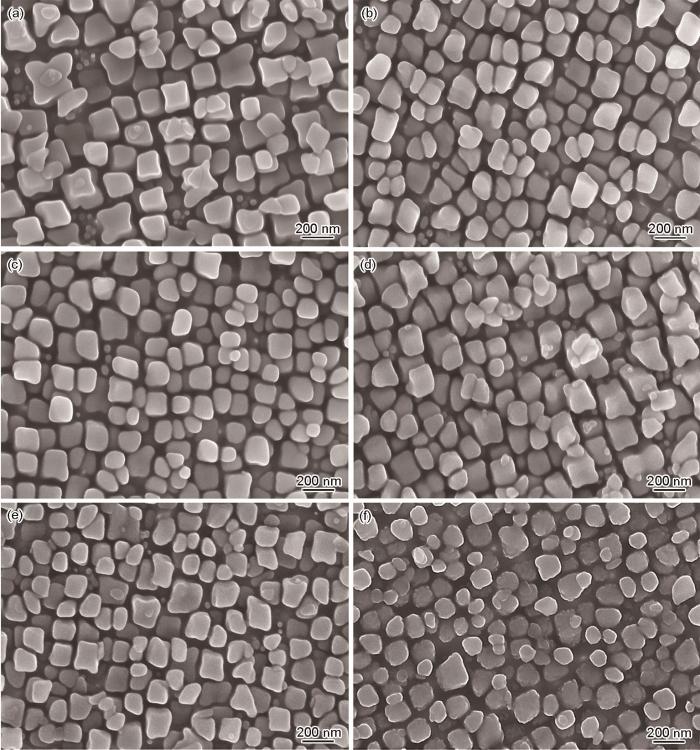
图6
不同温度拉伸后GH4151合金断口处二次γ'相的SEM像
Fig.6
SEM images of secondary γ' phases at fractures of GH4151 alloys after tensile testing at 23 oC (a), 550 oC (b), 650 oC (c), 750 oC (d), 800 oC (e), and 950 oC (f)
表2 不同温度拉伸后GH4151合金断口中二次γ'相球形度
Table 2
| Tensile temperatureoC | Median circularity | Average circularity |
|---|---|---|
| 23 | 0.793 | 0.782 |
| 550 | 0.787 | 0.785 |
| 650 | 0.806 | 0.796 |
| 750 | 0.789 | 0.786 |
| 800 | 0.811 | 0.808 |
| 950 | 0.852 | 0.849 |
图7
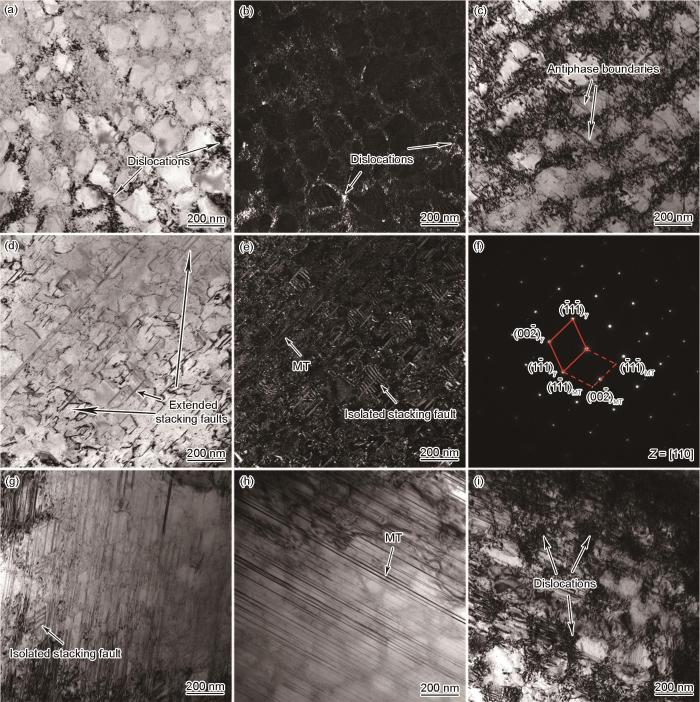
图7
不同温度拉伸后GH4151合金变形组织的TEM分析
Fig.7
Bright field (BF) (a, c, d, g-i) and dark field (DF) (b, e) TEM images, and SAED pattern (f) of GH4151 alloy after tensile fracture at various temperatures (MT—microtwinning) (a-c) 23 oC (d-f) 750 oC (g-i) 950 oC
3 分析与讨论
3.1 23~550 ℃拉伸过程中合金的断裂机制
在23~550 ℃温度范围内,GH4151合金的断裂模式为以穿晶断裂为主的混合断裂。由韧性撕裂棱和解理面主导的穿晶断裂可能与二次γ′相脱黏有关[12,25,26]。如图8所示,解理面和韧性撕裂棱前沿存在纳米级浅韧窝,这些浅韧窝尺寸与二次γ′相接近,因此浅韧窝可能是二次γ'相脱黏遗留的产物。图9为23~550 ℃拉伸过程中GH4151合金穿晶断裂示意图。γ/γ′相间存在着微小的间隙,间隙数量随着析出相数量增加而增加[27]。值得注意的是,GH4151合金具有较高的γ′相含量,体积分数约为55%。此阶段大部分位错被限制在γ通道,塑性变形主要发生在γ基体中,而二次γ′相基本不发生变形。随着应变的累积,位错在γ/γ′界面大量积聚,当γ基体应变累积到临界值时,γ基体与二次γ′相间塑性变形不协调,导致细小的间隙撕裂形成微孔洞,引起二次γ'相脱黏,进而导致穿晶断裂。
图8
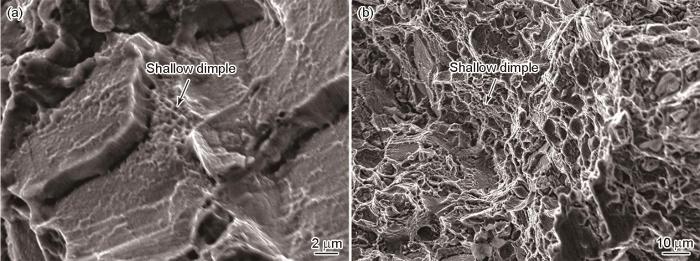
图8
550 ℃拉伸后GH4151合金断口表面的SEM像
Fig.8
Surface SEM images of GH4151 alloy fracture morphologies after tensile testing at 550 oC
(a) cleavage fracture (b) ductile tearing
图9
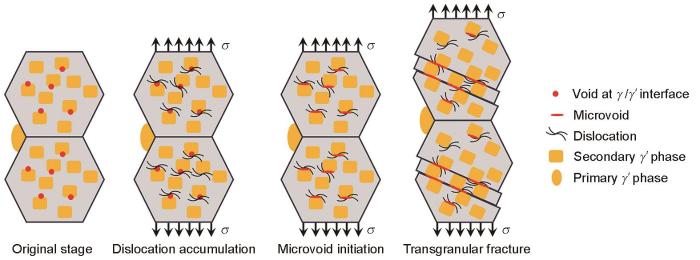
图9
23~550 ℃拉伸过程中GH4151合金断裂过程示意图
Fig.9
Schematics of fracture processes of GH4151 alloys during tensile testing at 23-550 oC (σ—tensile stress)
图10

图10
550 ℃拉伸后GH4151合金断口纵截面的SEM像、EDS面分布图和TEM像
(b) BF image (c) DF image
Fig.10
Longitudinal SEM image and EDS elemental mappings (a) and TEM images (b, c) of the fracture morphology of GH4151 alloy after tensile testing at 550 oC
3.2 650~800 ℃拉伸过程中合金的断裂机制
在650~800 ℃温度范围内,GH4151合金塑性下降。与23~550 ℃拉伸样品不同,650~800 ℃拉伸样品中裂纹以沿晶断裂方式萌生,以混合断裂方式扩展。图11为800 ℃拉伸后GH4151合金断口纵截面的EBSD分析,其中箭头所示为一次γ′相。局部取向差(KAM)图和几何必需位错(GND)密度图显示,位错主要在晶界处累积,尤其是一次γ'相附近的晶界。如2.3节所述,650~800 ℃拉伸过程中,变形同时发生在γ基体和γ′相内,与23~550 ℃拉伸相比,更多位错可通过剪切二次γ'相的方式运动至晶界。晶界处位错运动是协调相邻两晶粒变形的一种机制[29,30],而一次γ′相阻碍了位错运动,导致晶界局部应力集中,这些具有较高位错密度的晶界有可能是裂纹萌生的优先位置。
图11
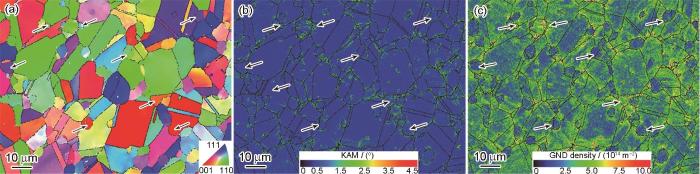
图11
800 ℃拉伸后GH4151合金断口的EBSD分析
Fig.11
Inverse pole figure (IPF) (a), kernel average misorientation (KAM) map (b), and geometrically necessary dislocation (GND) density map (c) of GH4151 alloy after tensile fracture at 800 oC (Black arrows represent primary γ′ phases, the same in Figs.12 and 15)
图12为800 ℃拉伸后GH4151合金裂纹尖端的SEM像和EPMA元素面分布图。可以看出,裂纹内部聚集大量O元素。因此,沿晶断裂不仅由局部应力集中所致,还可能涉及氧化损伤导致的晶界脆化。尽管本工作中拉伸速率较快,但合金中仍可观察到氧化损伤晶界现象。事实上,氧化损伤导致晶界开裂的过程极为迅速,这一点在Cao等[31] (拉伸速率为1 × 10⁻³ s-1)和Németh等[13] (拉伸速率为1 × 10⁻⁴ s-1)的工作中已得到证实,Molins等[32]更是认为材料脆化所需时间小于20 s。图13为真空条件和大气气氛下800 ℃拉伸时GH4151合金的应力-应变曲线和真空拉伸断口SEM像。与大气气氛拉伸样品相比,真空拉伸样品的断后伸长率大幅度提高,且断口呈现出与23~550 ℃拉伸断口相同的韧性断裂特征,即以穿晶断裂为主的混合断裂,且无明显脆性沿晶断裂区域,这充分证实了氧化损伤对650~800 ℃拉伸样品晶界的脆化作用。研究[13,31]表明,这种沿晶断裂的产生与应力辅助O原子扩散或动态脆化有关。晶界处大量缺陷聚集为O原子提供了通道[33,34],使高能晶界成为破坏性原子的快速扩散路径,加速了650~800 ℃下O原子向晶界弹性应力场或缺陷应力场的富集,导致裂纹尖端晶界局部内聚力损失,发生动态晶界脱黏,进而引起裂纹萌生和扩展。新扩展的裂纹尖端又会重新被O原子吸附,如此往复,形成沿晶断裂。因此,可推测GH4151合金的沿晶断裂是650~800 ℃下高应力与O原子共同作用的结果。
图12
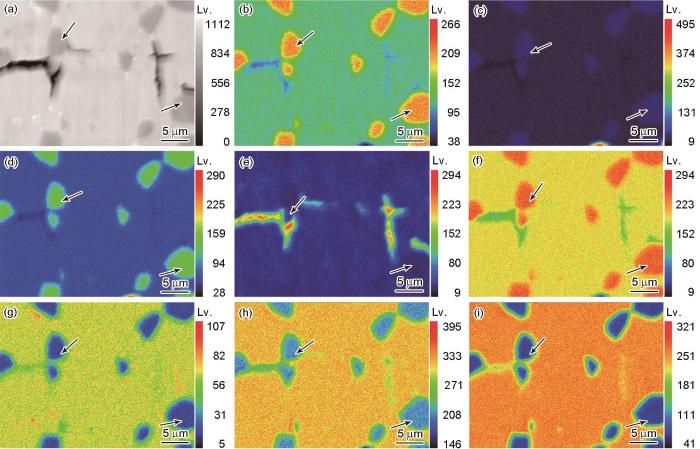
图12
800 ℃拉伸后GH4151合金裂纹尖端处SEM像和EPMA元素面分布图
Fig.12
SEM image (a) and EPMA elemental mappings (b-i) of crack tip in GH4151 alloy after tensile testing at 800 oC (Lv. represents degree of element concentration)
(b) Al (c) Nb (d) Ti (e) O (f) Ni (g) Mo (h) Co (i) Cr
图13
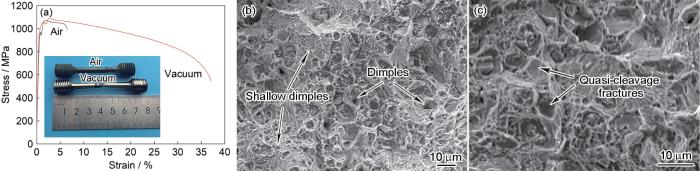
图13
在真空和大气气氛下800 ℃拉伸时GH4151合金的应力-应变曲线和真空拉伸断口SEM像
Fig.13
Tensile stress-strain curves of GH4151 alloy after tensile fracture at 800 oC in vacuum and atmospheric atmospheres (Inset in Fig.13a is photo of samples after tensile testing) (a) and SEM images of fracture of GH4151 alloy at 800 oC in vacuum (b, c)
图14
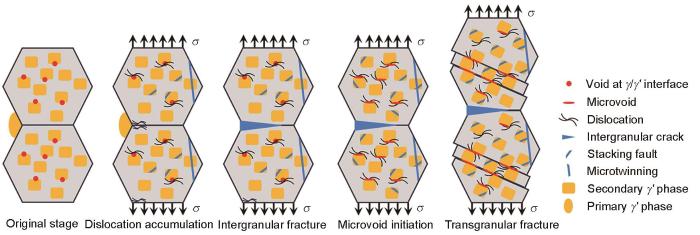
图14
650~800 ℃拉伸过程中GH4151合金断裂过程示意图
Fig.14
Schematics of fracture processes of GH4151 alloy during tensile testing at 650-800 oC
3.3 950 ℃拉伸时合金的断裂机制
950 ℃拉伸后样品的塑性增加,裂纹的萌生和扩展均为氧化损伤晶界控制的沿晶断裂。如图6f所示,二次γ'相形貌转变为近似球形,γ/γ'界面共格应变强化效果减弱,对位错的阻碍作用降低。整个拉伸过程未发生机械损伤转变,说明950 ℃拉伸样品中位错在γ/γ'界面累积程度不足,不能引起γ/γ′界面微孔洞合并。如2.3节所述,在950 ℃变形时位错更容易运动至晶界处。图15为950 ℃拉伸样品断口附近显微组织的EBSD分析。与800 ℃拉伸样品相比,950 ℃拉伸样品中晶界或一次γ′相处的位错密度显著提升,表明此阶段位错更易在晶界处累积。晶界结合力与温度成反比,随实验温度升高,O原子扩散速率增加,进一步弱化晶界,导致950 ℃拉伸样品更容易产生沿晶断裂。图16为950 ℃拉伸过程中GH4151合金断裂过程示意图。在位错累积阶段,位错在γ/γ′界面累积程度急剧减小,在晶界处累积程度迅速增加,在γ/γ′界面位错累积达到临界值之前材料便完成断裂。此外,裂纹扩展速率随裂纹尖端所受应力增加而增加[37,38],由于950 ℃拉伸后合金强度下降,外界施加应力降低,裂纹以较慢的速率扩展,导致断后伸长率增大。
图15
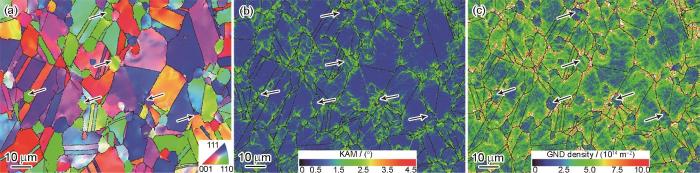
图15
950 ℃拉伸后GH4151合金断口的EBSD分析
Fig.15
IPF (a), KAM map (b), and GND density map (c) of GH4151 alloy after tensile fracture at 950 oC
图16
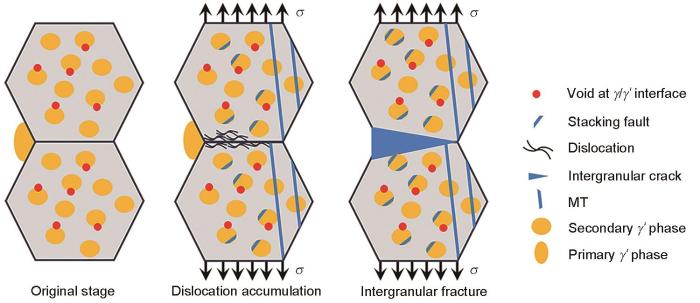
图16
950 ℃拉伸过程中GH4151合金断裂过程示意图
Fig.16
Schematics of the fracture processes of GH4151 alloy during tensile testing at 950 oC
4 结论
(1) 随着温度升高,GH4151合金的塑性呈现出先减小后增大的趋势,23~550 ℃拉伸样品的断裂方式为以穿晶断裂为主的混合断裂,变形主要发生在γ通道,位错在γ/γ'界面大量堆积,导致γ/γ'界面间隙撕裂形成微孔洞,从而引起穿晶断裂。混合断裂中的沿晶断裂是由于MC碳化物界面处应力集中产生的孔洞所导致。
(2) 拉伸温度为650~800 ℃时,裂纹以沿晶断裂方式萌生,随后以混合断裂方式扩展,变形同时发生在γ通道和γ′相,晶界位错塞积加速了高应力条件下O原子向晶界弹性应力场或缺陷处富集,导致晶界发生动态脆化,引起沿晶断裂,造成合金塑性下降。随着应变增加,裂纹扩展速率增大,减少了O原子导致晶界动态脆化所需时间,当γ/γ'界面位错累积达到临界值时,裂纹扩展转变为以穿晶断裂为主的混合断裂。
(3) 950 ℃拉伸时,裂纹以沿晶断裂方式萌生和扩展,γ'相形貌转变为近似球形,对位错的阻碍作用降低,不能引起γ/γ'界面微孔洞的合并,因此950 ℃拉伸样品未发生穿晶断裂。950 ℃拉伸后,合金强度下降,外界施加应力降低,裂纹以较慢的速率扩展,因此合金的塑性增加。
参考文献
Effect of Hf and Ta on the tensile properties of PM Ni-based superalloys
[J].
Recent development of nickel-based disc alloys and corresponding cast-wrought processing techniques
[J].
变形高温合金盘材及其制备技术研究进展
[J].
近年来一系列新型的高性能变形高温合金盘材在航空发动机和燃气轮机上获得了重要应用,这些盘材合金在追求高承温能力的同时更加注重服役性能、工艺性能与全寿命成本之间的平衡。国内在三联熔铸直径508 mm自耗锭、多重循环热机械处理制备直径300 mm以上细晶棒材、盘件热模锻成型与组织性能控制等关键制备技术取得突破的基础上,成功研制了GH4065、GH4720、GH4175与GH4975等一系列高性能盘材合金及全尺寸锻件,为先进军用涡扇发动机、大涵道比商用发动机提供了高可靠性、低成本的盘件选材方案。为充分发扬变形盘材在可靠性与成本方面的特有优势,需要在高性能盘材的合金设计与成分优化、自耗锭冶金缺陷的预防与识别、自由锻开坯的效率与成材率提升、双组织双性能盘件制备等方面进一步开展深入的研究工作。
Research progress of wrought superalloys in China
[J].Wrought superalloys are high temperature alloys produced by casting-forging-hot rolling-cold drawing, including disc, plate, bar, wire, tape, pipe etc. These products are widely used in aviation, aerospace, energy, petrochemical, nuclear power and other industrial fields. In this paper, domestic progress of wrought superalloys in recent ten years was reviewed, including advances in fabrication process, research in new alloys (GH4169G, GH4169D, GH4065 and GH4068 alloy et al.) and new techniques (deforming of FGH4096 alloy, nitriding of NGH5011 alloy and 3D printing of In718 alloy et al.).
国内变形高温合金研制进展
[J].变形高温合金是指通过铸造-变形工艺生产的高温合金,包括盘、板、棒、丝、带、管等产品,该类产品广泛用于航空、航天、能源、石化、核电等工业领域。本文介绍了国内变形高温合金近10年的最新进展,分别从变形高温合金的制备工艺流程,GH4169G、GH4169D、GH4065、GH4068等新合金的研制,以及FGH4096的变形化、NGH5011的氮化、In718合金的3D打印等新技术3个方面展开论述。
Investigation on sub-solvus recrystallization mechanisms in an advanced γ-γ′ nickel-based superalloy GH4151
[J].Sub-solvus dynamic recrystallization (DRX) mechanisms in an advanced γ-γ’ nickel-based superalloy GH4151 were investigated by isothermal compression experiments at 1040 °C with a strain rate of 0.1 s−1 and various true strain of 0.1, 0.3, 0.5, and 0.7, respectively. This has not been reported in literature before. The electron backscatter diffraction (EBSD) and transmission electron microscope (TEM) technology were used for the observation of microstructure evolution and the confirmation of DRX mechanisms. The results indicate that a new dynamic recrystallization mechanism occurs during hot deformation of the hot-extruded GH4151 alloy. The nucleation mechanism can be described as such a feature, that is a primary γ’ (Ni3(Al, Ti, Nb)) precipitate embedded in a recrystallized grain existed the same crystallographic orientation, which is defined as heteroepitaxial dynamic recrystallization (HDRX). Meanwhile, the conventional DRX mechanisms, such as the discontinuous dynamic recrystallization (DDRX) characterized by bulging grain boundary and continuous dynamic recrystallization (CDRX) operated through progressive sub-grain merging and rotation, also take place during the hot deformation of the hot-extruded GH4151 alloy. In addition, the step-shaped structures can be observed at grain boundaries, which ensure the low-energy surface state during the DRX process.
Cracking mechanism in as-cast GH4151 superalloy ingot with high γ′ phase content
[J].
Research on hot deformation behavior and microstructure-properties control of GH4151 alloy
[D].
GH4151合金高温变形行为及组织与性能控制研究
[D].
Evolution behavior of complex precipitation phases in highly alloyed GH4151 superalloy
[J].Designing high-performance aeroengine is important for development in the aviation industry. One of the key components is turbine disk material that can operate at 800oC. Among various methods for strengthening alloys, increasing the alloying degree is important, and GH4151 is one of the typical alloys with a high alloying degree. It comprises a large number of refractory metal elements and γ'-forming elements. OM, SEM, and JMatPro software were used to study the sensitivity of GH4151 microstructure evolution during heat treatment processes. The results show that a high alloying degree produces a complex microstructure with low-melting phases, such as Laves, γ/γ′ eutectic, and η phases. Due to the difference in incipient melting temperature of each precipitated phase, a three-stage heat treatment was developed to effectively eliminate the harmful phases in the alloy. The contents of segregation elements Nb and Ti in the as-cast GH4151 alloy have an obvious influence on the incipient melting temperature, whereas the effect of Mo content is relatively slight, and that of W content is not obvious. Decreasing Ti content while increasing Nb and Mo contents could reduce the incipient melting temperature of the η phase. Furthermore, increasing Ti and Mo contents while decreasing Nb content could reduce the incipient melting temperature of Laves phase. A large amount of γ'-forming elements contributes to the cooling rate sensitivity of γ′ phase evolution. 15oC/min is the critical value for the irregular growth of the γ' phase in the GH4151 alloy. When compared to alloys with low γ′-forming elements content, the γ′ phase in GH4151 alloy has a larger size when the cooling rate is > 15oC/min, and exhibits an irregular shape when the cooling rate is < 15oC/min. Thus, a high alloying degree contributes to the complex and sensitive microstructure evolution behavior of GH4151 alloy.
高合金化GH4151合金复杂析出相演变行为
[J].
Effect of carbon addition on microstructure and mechanical properties of a typical hard-to-deform Ni-base superalloy
[J].
The cracking behavior of the new Ni-based superalloy GH4151 in the triple melting process
[J].
A data-driven roadmap for creep-fatigue reliability assessment and its implementation in low-pressure turbine disk at elevated temperatures
[J].
Effect of γ' phase and microtwins on the microstructural evolution and mechanical properties of a novel Ni-Co base superalloy
[J].
Effect of solution treatment on microstructure and tensile properties of a U720LI Ni-based superalloy
[J].
Environmentally-assisted grain boundary attack as a mechanism of embrittlement in a nickel-based superalloy
[J].
Gas phase embrittlement and time dependent cracking of nickel based superalloys
[J].
Effects of initial δ phase on hot tensile deformation behaviors and fracture characteristics of a typical Ni-based superalloy
[J].
Failure of metals I: Brittle and ductile fracture
[J].
The mechanism of crack generation and propagation in the new casting alloy GH4151 during cogging
[J].
Effect of heat treatment process on impact properties of GH4151 alloy
[J].
热处理工艺对GH4151合金冲击性能的影响
[J].采用冲击实验研究了不同温度固溶处理及固溶和双级时效处理对GH4151合金冲击性能的影响,采用光学显微镜、扫描电镜和透射电镜等观察了合金经不同工艺处理后的显微组织、析出相和断口形貌。结果表明:对于仅固溶处理的合金,当固溶温度低于1140℃时,其冲击韧性值的变化不大,固溶温度高于1140℃时,冲击韧性值随固溶温度的升高而增加,断裂过程以裂纹的稳定扩展区为主,断口呈韧性断裂。对于固溶时效处理的合金,当固溶温度低于1160℃时,冲击韧性值的变化也比较稳定,固溶温度高于1160℃时,冲击韧性值随固溶温度的升高而降低,断裂过程不存在裂纹的稳定扩展区,断口呈典型的沿晶脆性断裂。这主要是因为当固溶温度低于1140℃时,合金的晶粒尺寸变化不大,而在1140℃以上时晶粒尺寸明显增大;双级时效后,当固溶温度高于1160℃时,晶界上连续或不连续分布的第二相显著降低了合金的冲击韧性。
On the stress rupture behavior and deformation mechanism of an advanced hot-extruded nickel-based superalloy
[J].
Effects of heat treatment on γ′ precipitates and tensile properties of a Ni-base superalloy
[J].
Quantitative characterization of HMX particle sphericity
[J].
HMX晶体颗粒球形度的定量表征
[J].
Microstructural and compositional design of Ni-based single crystalline superalloys—A review
[J].
Incipient melting phase and its dissolution kinetics for a new superalloy
[J].
Temperature dependence of tensile deformation mechanisms in a powder metallurgy Ni-Co-Cr based superalloy with Ta addition
[J].
Fracture behavior of superalloy IN738LC with various precipitate microstructures
[J].
Effect of γ′ particles morphology on dynamic strain aging behavior of Udimet 500 superalloy
[J].
Correlation of grain boundary precipitate characteristics with fracture and fracture toughness in an Mg-8Al-0.5 Zn alloy
[J].
Effects of tantalum on microstructure and mechanical properties of cast IN617 alloy
[J].
Characterization of localized deformation near grain boundaries of superalloy René-104 at elevated temperature
[J].
On the role of boron on improving ductility in a new polycrystalline superalloy
[J].
Intermediate temperature embrittlement in a precipitation-hardened high-entropy alloy: The role of heterogeneous strain distribution and environmentally assisted intergranular damage
[J].
Oxidation effects on the fatigue crack growth behaviour of alloy 718 at high temperature
[J].
Model of vacancy diffusion-assisted intergranular corrosion in low-alloy steel
[J].
Heterogenous columnar-grained high-entropy alloys produce exceptional resistance to intermediate-temperature intergranular embrittlement
[J].
Role of oxygen in enhanced fatigue cracking in a PM Ni-based superalloy: Stress assisted grain boundary oxidation or dynamic embrittlment?
[J].
Control of nanoscale precipitation and elimination of intermediate-temperature embrittlement in multicomponent high-entropy alloys
[J].Thermally stable high-entropy alloys (HEAs) consisting of a high density of coherent precipitates show a great potential for high-temperature applications. In this work, we systematically investigated the phase stability and coarsening kinetics of L1(2)-type coherent precipitates in a Ni-30Co-13Fe-15Cr-6Al-6Ti-0.1B (at.%) HEA isothermally aged at 800, 900 and 1000 degrees C. Aged microstructures in the grain interiors under this temperature range were essentially dominated by the uniform precipitation of multicomponent L1(2) (Ni, Co, Fe, Cr)(3)(Ti, Al)-type precipitates. The coarsening kinetics of these intragranular L1(2) precipitates were quantitatively determined, which were adequately characterized by the classical Lifshitz-Slyozov-Wagner model. The activation energy for coarsening was determined to be 378 kJ/mol, which is relatively higher than that of conventional Ni or Co-based superalloys, suggesting a slow elemental diffusion in the HEA matrix. More importantly, the heterogeneous precipitation and the associated metastable phase transformation mechanism along grain boundaries (GBs) were carefully analyzed. Localized chemical heterogeneity was identified within the discontinuous L1(2) phase at the GBs, which thermodynamically destabilizes the L1(2) structure and encourages the formation of brittle Heusler phase. Finally, we establish a unique duplex-aging strategy that can be efficiently utilized for GB stabilization, by which these detrimental intergranular heterostructures can be greatly eliminated, leading to an exceptional resistance to intermediate-temperature embrittlement, along with enhanced tensile strengths. These findings will not only shed light on the precipitation mechanisms in compositionally complex HEAs but also generate new opportunities to the interfacial design of HEAs for advanced high-temperature applications with superior properties. (C) 2020 Acta Materialia Inc. Published by Elsevier Ltd.
Influence of oxidation on fatigue crack initiation and propagation in turbine disc alloy N18
[J].


